
Scotland vs Brazil Match Result
Table of Contents Show
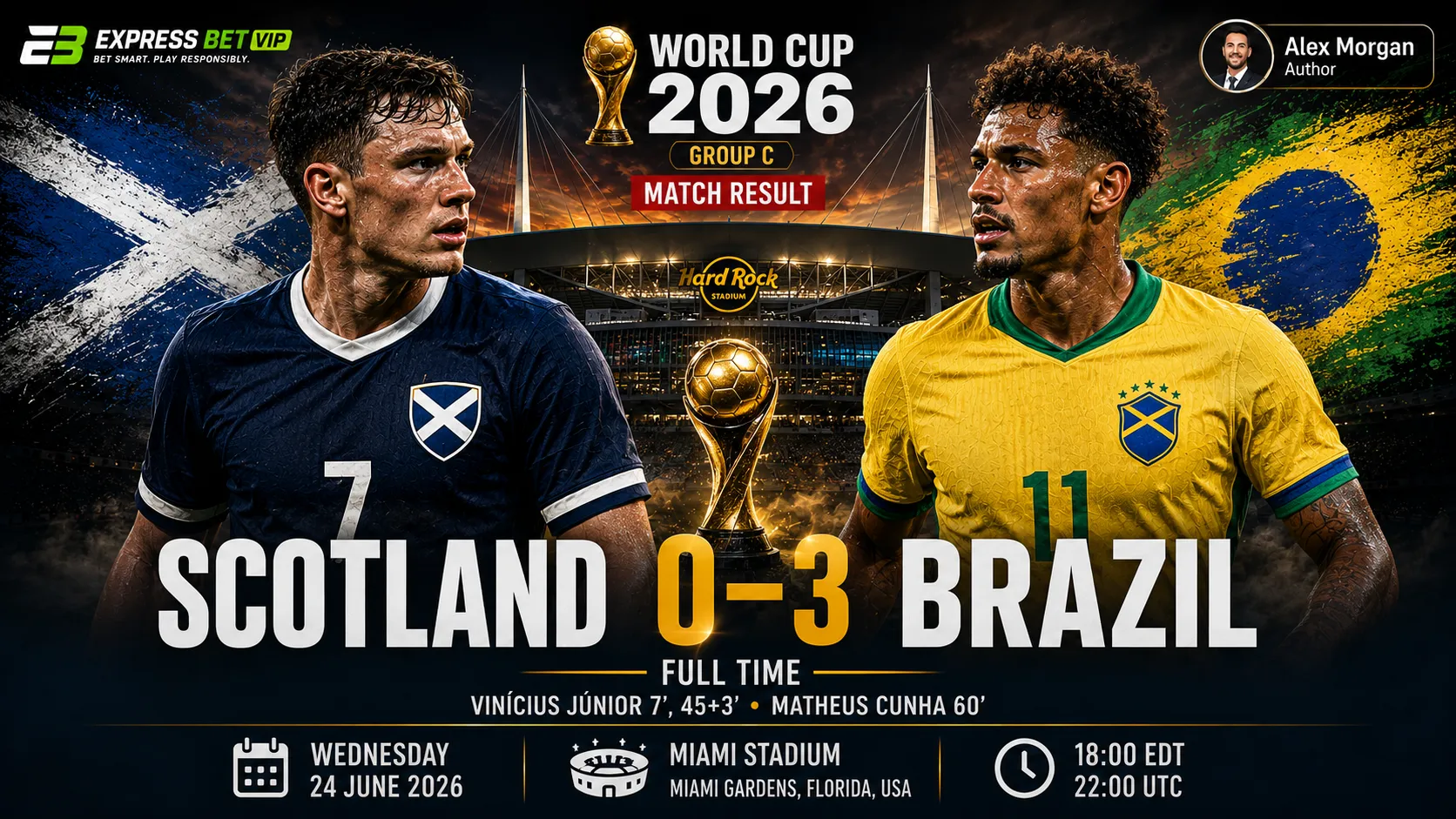
Brazil beat Scotland 3-0 in their final FIFA World Cup 2026 Group C match at Miami Stadium. Vinícius Júnior scored in the 7th and 45+3rd minutes before Matheus Cunha added the third in the 60th. Scotland’s first major error decided the direction of the game: Scott McKenna lost control under Rayan’s pressure, allowing Vinícius to round Angus Gunn and finish. Vinícius was the match’s decisive player, while Bruno Guimarães controlled midfield and created Brazil’s final two goals. Brazil’s 4-3-3 pressed Scotland’s build-up, attacked the space around the full-backs and produced far better chances. The South Florida heat required hydration pauses, but it did not explain Scotland’s defensive mistakes. Brazil topped Group C; Scotland were later eliminated from the third-place ranking. Brazil moneyline, over 2.5 goals and both teams to score No were winning outcomes, subject to the odds and market timing. (FIFA)
| Item | Detail | Data status |
|---|---|---|
| Match | Scotland vs Brazil | [CONFIRMED] |
| Competition | FIFA World Cup 2026 | [CONFIRMED] |
| Stage | Group stage | [CONFIRMED] |
| Group | Group C | [CONFIRMED] |
| Date | 24 June 2026 | [CONFIRMED] |
| Kickoff | 6:00 p.m. EDT / 22:00 UTC | [CONFIRMED] |
| Host country | United States | [CONFIRMED] |
| City | Miami Gardens, Florida | [CONFIRMED] |
| Stadium | Miami Stadium / Hard Rock Stadium | [CONFIRMED] |
| Attendance | 64,478 | [REPORTED] |
| Final score | Scotland 0-3 Brazil | [CONFIRMED] |
| Half-time score | Scotland 0-2 Brazil | [CONFIRMED] |
| Goal scorers | Vinícius Júnior 7’, 45+3’; Matheus Cunha 60’ | [CONFIRMED] |
| Referee | César Arturo Ramos Palazuelos | [CONFIRMED] |
| Lead VAR | Guillermo Pacheco Larios | [REPORTED] |
| Weather | Around 88°F near kickoff; humid, passing clouds | [REPORTED] |
| Pitch condition | Natural grass; no specific defect reported | [CONFIRMED / UNKNOWN] |
| Main tournament impact | Brazil won Group C; Scotland were eliminated | [CONFIRMED] |
FIFA confirms the score, scorers, kickoff, referee and venue. Sofascore reported the 64,478 attendance, while historical hourly weather data supplied the nearest public observation rather than an official stadium measurement. (FIFA)
| Layer | What it covers | Scotland vs Brazil example |
|---|---|---|
| [CONFIRMED] | Official result, scorer, time, competition and venue | Scotland 0-3 Brazil; Vinícius scored twice |
| [REPORTED] | Reputable information not contained in the main FIFA event record | Attendance 64,478; historical weather observation |
| [OBSERVED] | Match events described in live and post-match reporting | McKenna’s turnover, the hydration break and McTominay’s saved headers |
| [ANALYSIS] | Editorial interpretation based on the match evidence | Brazil’s pressing made Scotland’s build-up unsafe |
| [MARKET SIGNAL] | Published prices and settled markets | Brazil listed near -322; total-goals line 2.5 |
| [DISPUTED] | An incident or number on which sources differ | Vinícius’ disallowed goal; small shot and xG differences |
| [UNKNOWN] | Information unavailable from verified public data | Exact WBGT, PPDA, distance covered and all closing prices |
This separation prevents a common post-match error: turning an interpretation into a fact because the final score happens to support it. Brazil’s 3-0 win is official. The conclusion that their pressing caused Scotland’s collapse is analysis supported by the first goal, the territorial pattern and the shot profile.
Our data comparison also found provider variation. FOX recorded Scotland with 11 shots and Brazil with 21; Sofascore counted 14 and 21. FOX’s xG model produced 0.89-3.12, while Sofascore reported approximately 1.03-4.46. The providers agree on the direction of the game even when they classify individual attempts differently. (FOX Sports)
Brazil began as if qualification still required persuasion.
Carlo Ancelotti’s side pressed Scotland’s first pass, crowded the central midfield and attacked quickly once possession changed hands. Scotland needed a controlled opening because their route to the Round of 32 depended not only on earning points but also on protecting their goal difference. Seven minutes later, that plan had already been placed in storage.
Scott McKenna hesitated during Scotland’s build-up. Rayan closed him aggressively, the ball ricocheted into Vinícius Júnior’s path and the Brazilian forward rounded Angus Gunn before finishing into an exposed net. It was not an elaborate move. Brazil’s structure created the pressure; Scotland completed the paperwork. (The Guardian)
Brazil continued to dominate the early phase. Casemiro protected the centre, Bruno Guimarães moved beyond Scotland’s midfield line and Lucas Paquetá linked with Rayan and Vinícius. Scotland’s nominal 4-2-3-1 repeatedly collapsed into a narrow defensive shape, leaving the Brazilian wide players room to receive before driving inside.
Vinícius put the ball in the net again during that period, but the goal was disallowed after a VAR-assisted review identified a foul on Jack Hendry. Contemporary reporting described the decision as harsh, and Ancelotti reacted angrily. The score remained 1-0, although the tactical message had not changed: Scotland could not defend their box without first surviving Brazil’s pressure outside it. (The Guardian)
The mandatory hydration break gave Scotland their first useful pause. Steve Clarke’s team became more direct afterward. Lewis Ferguson saw more of the ball, Scott McTominay attacked second balls and the full-backs delivered earlier crosses rather than attempting to pass through Brazil’s midfield.
The improvement was real but limited. Scotland reached the final third more often without consistently creating clear central chances. Brazil’s centre-backs defended the first contact, while Alisson controlled the space behind them.
The second goal arrived immediately before half-time. Bruno Guimarães delivered from the right, Vinícius attacked the far-post area and Scotland failed to manage either the cross or the run. Vinícius headed in for 2-0 in the 45+3rd minute. Some live data feeds placed the goal at 45+2, but FIFA’s official record uses 45+3. (FIFA)
That goal changed the second half before it began. Scotland now needed an exceptional recovery while avoiding the additional goals that could destroy their third-place ranking. Tournament football occasionally asks a team to attack and protect goal difference simultaneously. It is not a generous administrative arrangement.
Kieran Tierney replaced Andy Robertson at half-time. Scotland pushed their left side higher and generated several better deliveries, but Brazil retained control of the central zones.
The third goal came in the 60th minute. Bruno Guimarães escaped pressure, carried toward the defensive line and released Matheus Cunha, who finished from inside the area. The move displayed the difference between the teams: Brazil created space with one accelerated central action; Scotland normally required several passes and a cross.
At 3-0, Brazil reduced the urgency without surrendering control. Fabinho and Gabriel Martinelli entered in the 66th minute. Neymar appeared in the 76th, making his return to international football after a long absence, before Alex Sandro and Endrick joined late. (The Guardian)
Scotland still produced respectable chances. McTominay forced saves from Alisson with headers, while Lawrence Shankland struck the roof of the net. Those moments prevented the second half from becoming a ceremonial exercise, but they did not alter the underlying result.
Brazil won because they created better chances, punished mistakes and maintained control after scoring. Scotland did not lose solely because of McKenna’s early error, but that moment forced them to play the rest of the match in the tactical state Brazil preferred.
Scotland attempted to build from their defensive line. McKenna received without a clean forward option and delayed his next action. Rayan pressed from Brazil’s right, forced the mistake and helped redirect the loose ball toward Vinícius.
FOX’s event record credited Rayan with the assist, although this was closer to a pressure-created turnover than a conventional final pass. Vinícius reacted immediately, carried around Gunn and finished into the empty section of the goal. (The Guardian)
Gunn’s decision to leave his line was reasonable once Vinícius had broken free. The goalkeeper attempted to narrow the angle but could not prevent the forward moving around him.
The defensive failure began before the one-against-one. Scotland’s spacing gave McKenna no secure outlet, while the centre-back’s hesitation allowed Brazil’s press to close. Brazil had identified the backwards and square pass as a trigger; Scotland supplied one at exactly the wrong moment.
The goal changed the emotional terms of the match. Scotland could no longer defend patiently and wait for Brazil to become frustrated. Brazil could circulate with the lead and attack the spaces created by Scotland’s attempts to move higher.
From a market perspective, Brazil’s already short live price contracted immediately, while first-goalscorer and Vinícius anytime-scorer positions were settled in the opening seven minutes.
Brazil worked the ball toward the right side, where Bruno Guimarães gained enough time to deliver into the penalty area. Vinícius moved behind the immediate defensive reference and attacked the far-post zone.
Nathan Patterson failed to control the run and the flight of the cross. Gunn remained in a difficult intermediate position: too deep to claim and unable to reach the header. Vinícius directed the ball beyond him for his second goal. (The Guardian)
The goal was not caused by one spectacular dribble. It came from Brazil stretching Scotland horizontally and then attacking the space created behind the full-back.
Bruno’s delivery represented a recurring problem. Scotland’s midfield had narrowed to protect the centre, but that allowed Brazil’s deeper players to look up before crossing. Once the ball travelled over the first defensive line, Scotland’s back four had to defend while moving toward their own goal.
The timing was damaging. Scotland had improved after the hydration break and appeared likely to reach half-time only one goal behind. Conceding in stoppage time removed much of the value from that recovery.
The second goal also moved the match beyond a common live under-2.5 position. One further goal was now enough to settle the standard over line.
Bruno Guimarães received centrally, escaped the first challenge and attacked the space between Scotland’s midfield and defence. Cunha moved in front of the back line, received the pass and completed the attack from inside the box. (The Guardian)
The goal exposed Scotland’s second-half risk. Their midfield had moved higher in search of a response, but the defensive line could not compress the space behind it without becoming vulnerable to Vinícius and Rayan.
Cunha’s movement gave Bruno a direct target. Rather than circulating toward another cross, Brazil entered the box through the central channel and finished before Scotland could reconstruct its block.
Gunn was again placed in a high-probability situation with limited reaction time. The goalkeeper’s positioning did not create the chance; Brazil’s ability to break the midfield line did.
At 3-0, the competitive result was effectively settled. Brazil began managing energy and substitutions, while Scotland’s remaining concern shifted toward avoiding further goal-difference damage.
| Minute | Moment | Why it mattered | Data status |
|---|---|---|---|
| 7’ | McKenna lost possession under Rayan’s pressure | Gave Vinícius the opener and destroyed Scotland’s cautious starting plan | [CONFIRMED / OBSERVED] |
| First half | Vinícius goal disallowed after VAR review | Temporarily kept Scotland within one goal | [CONFIRMED / DISPUTED] |
| Around 30’ | Mandatory hydration break | Allowed Scotland to reorganise and reduce Brazil’s momentum | [OBSERVED / ANALYSIS] |
| 45+3’ | Vinícius headed in Brazil’s second | Removed the value of Scotland’s improved spell before half-time | [CONFIRMED] |
| Half-time | Tierney replaced Robertson | Added more direct width and crossing from Scotland’s left | [CONFIRMED] |
| 60’ | Cunha scored after Bruno’s central progression | Settled the result and the over-2.5 market | [CONFIRMED] |
| 62’ | Danilo booked | Brazil’s right-back had to manage the remaining defensive duels | [CONFIRMED] |
| 66’ | Fabinho and Martinelli introduced | Brazil protected midfield control and refreshed the attack | [CONFIRMED] |
| 76’ | Neymar entered | Marked his return to international action | [CONFIRMED / REPORTED] |
| Second half | Alisson saved McTominay’s headers | Preserved Brazil’s clean sheet | [OBSERVED] |
| Late phase | Shankland hit the roof of the net | Scotland’s final meaningful opening failed to change the result | [OBSERVED] |
The two decisive moments came at opposite ends of the first half. Scotland presented Brazil with the opening goal, then conceded the second just as the match had begun to look more manageable. (The Guardian)
| Local factor | Verified or observed detail | Football meaning | Direct match evidence | Betting-result meaning | Status | Anti-template status |
|---|---|---|---|---|---|---|
| Stadium | Miami Stadium / Hard Rock Stadium | Open playing field beneath a large spectator canopy | Heat still reached players on the pitch | No enclosed-roof protection for tempo or fatigue | [CONFIRMED] | Stadium-specific |
| Attendance | 64,478 | Near-capacity crowd | Strong noise during Brazil’s attacks and goals | Increased event pressure but did not determine outcome | [REPORTED] | Fixture-specific |
| Fan distribution | Brazil supporters visibly outnumbered Scotland supporters inside | Brazil had the stronger acoustic presence | Guardian described the imbalance | Secondary psychological advantage | [OBSERVED] | Fixture-specific |
| Scottish presence | Around 8,000 joined Little Havana activities | Major travelling support existed outside the stadium | Local reporting documented the gathering | Demonstrates neutral venue was not culturally neutral | [REPORTED] | Fixture-specific |
| Temperature | Around 88°F near kickoff | High thermal load during repeated pressing | Hydration break used; tempo changed afterward | Relevant to live-tempo markets | [REPORTED] | Fixture-specific |
| Humidity | Around 63% near the closest hourly observation | Increased perceived heat and recovery demand | No confirmed cramp pattern | Heat should not be converted into an automatic under angle | [REPORTED] | Fixture-specific |
| Wind | Around 13 mph near kickoff | Could theoretically affect long crosses and kicks | No specific wind-distorted chance identified | No verified wind-based market effect | [REPORTED] | Fixture-specific |
| Surface | Natural Bermuda grass | Familiar, relatively fast football surface | No abnormal bounce or tearing reported | No reliable pitch-error angle | [CONFIRMED / UNKNOWN] | Stadium-specific |
| Hydration pause | First-half break around the half-hour | Interrupted Brazil’s pressure and aided Scotland’s reset | Scotland improved after the pause | Temporary influence on live momentum | [OBSERVED] | Fixture-specific |
The nearest historical hourly observation around kickoff recorded approximately 88°F with humidity above 60%. Climate Central’s pre-match model placed the fixture at a very high likelihood of performance-impairing heat, although that model was a risk estimate rather than an exact on-pitch measurement. (Time and Date)
The stadium’s canopy changes the spectator experience more than the playing environment. Most seats receive shade, but the field remains open. Brazil and Scotland therefore played in South Florida heat rather than the controlled conditions available at fully enclosed venues.
The first hydration break produced the clearest match-specific environmental effect. Brazil had dominated the opening period. The interruption gave Clarke time to speak to players, allowed Scotland to restore defensive distances and reduced the continuous pressure for several minutes. (The Guardian)
That did not make the heat the cause of the result. Brazil’s first goal came from pressing and a defensive mistake. The second came from poor far-post control. The third came from Bruno breaking the midfield line. None was a documented heat error.
The weather also did not create a goalkeeper problem. Gunn’s difficult evening resulted from the quality and location of Brazil’s chances. Alisson handled Scotland’s efforts securely. No verified report connected a save, missed catch or distribution error to humidity or wind.
The crowd offered Brazil the stronger match atmosphere. Scotland’s travelling support had been highly visible around Miami, but Brazil’s supporters were the clear majority inside the venue. That imbalance became more pronounced after the early goal, when the match began to resemble a Brazil home fixture staged in Florida. (The Guardian)
| Stadium factor | Detail |
|---|---|
| Stadium | Miami Stadium / Hard Rock Stadium |
| Approximate tournament capacity | Around 65,000 |
| Attendance | 64,478 |
| Pitch type | Natural Bermuda grass |
| Roof status | Large canopy over most seats; field not fully enclosed |
| Acoustic effect | Brazil supporters had the stronger audible presence |
| Surface condition | No match-specific defect reported |
| Airflow relevance | Open field exposed to outdoor heat and wind |
| Goalkeeper distribution | No verified weather-related effect |
| Set-piece effect | Scotland generated seven corners but did not convert |
| Communication effect | Crowd pressure possible; no specific breakdown confirmed |
| Data status | Mixed confirmed, reported and observed |
Hard Rock Stadium’s renovation added a canopy designed to shade the majority of spectators, but it did not create a climate-controlled football field. That distinction mattered during a humid evening fixture. Players still required mandated cooling opportunities, while many spectators watched from shaded seating. (media.miamidolphins.com)
The natural surface did not become part of the match story. No significant slipping, unstable seams, damaged grass or irregular bounce appeared in the verified reporting. Brazil’s passing remained precise, reflected in a provider-reported 93% completion rate.
The compact noise created by a near-capacity crowd intensified Brazil’s momentum after the opener. It would be excessive to blame Scotland’s defensive errors on communication failure, but the atmosphere offered little psychological relief once Brazil began controlling possession.
Scotland’s seven corners demonstrate that the venue did not prevent them reaching attacking territory. Their problem was converting those situations into clear shots against Marquinhos, Gabriel Magalhães and Alisson.
The available match evidence does not show a clear stadium-specific effect beyond outdoor heat exposure, a stable natural pitch and stronger Brazilian crowd support.
| Item | Detail |
|---|---|
| City | Miami Gardens, Florida |
| Host country | United States |
| Time zone | Eastern Daylight Time |
| June climate | Hot, humid and vulnerable to thunderstorms |
| Nearest temperature observation | Approximately 88°F |
| Humidity | Approximately 63% |
| Wind | Approximately 13 mph |
| Sky conditions | Passing clouds around kickoff; no match suspension |
| Altitude | Near sea level |
| Likely physical effect | Greater hydration demand and slower recovery between intense actions |
| Actual match evidence | Mandatory break; no confirmed heat injury or cramp pattern |
| Data status | Historical hourly observation, not stadium-sensor data |
South Florida’s climate created a real physical variable, but the teams did not respond identically. Brazil pressed sharply at the start and converted that pressure into an early goal. Scotland’s tempo improved after the hydration break rather than deteriorating immediately.
The second half did not show a clear heat-driven collapse. Brazil’s third goal arrived through a technical midfield action, not through a player cramping or failing to recover. Scotland continued attacking late and produced chances through McTominay and Shankland.
Substitution timing was consistent with both game state and environmental management. Brazil made two changes in the 66th minute and another in the 76th, then completed its final substitutions in the 82nd. Scotland waited until the 82nd minute for its next major double change after introducing Tierney at half-time. (FOX Sports)
The wind was not visibly decisive. Neither team suffered a clearly documented long-ball or cross error attributable to airflow. Bruno’s delivery for the second goal was accurate, while Scotland completed ten of 26 crosses in FOX’s dataset.
The safer conclusion is that Miami’s heat increased the physical cost of the match and made the hydration break tactically useful. It did not decide who passed, defended or finished better.
Scotland started in a 4-2-3-1 that frequently resembled a 4-5-1 without the ball. Ferguson and Kenny McLean worked behind an advanced group containing McGinn, McTominay and Ben Gannon-Doak, with Shankland as the central forward.
Brazil used a 4-3-3. Casemiro protected the centre-backs. Bruno Guimarães and Paquetá operated ahead of him, while Rayan, Cunha and Vinícius formed the front line. (The Guardian)
Brazil’s press targeted Scotland’s centre-backs whenever the receiving player faced his own goal or lacked a clear pass into midfield. Rayan and Cunha closed from outside to inside, steering possession toward a crowded central lane.
The first goal demonstrated the plan. McKenna delayed, Rayan arrived and Vinícius attacked the loose ball. Brazil were not pressing every pass at maximum speed. They waited for the vulnerable pass and then accelerated together.
Scotland’s midfield struggled to offer a stable exit. McLean often dropped toward the defenders, but that reduced the number of receivers ahead of Brazil’s first pressure line. Ferguson completed a large volume of safe passes but had limited opportunity to turn and progress centrally.
McTominay’s advanced role gave Scotland a target for crosses and second balls. It also left the deeper midfield with less physical support whenever Brazil recovered possession. Bruno could move into the space around Ferguson and McLean, especially when McGinn or Gannon-Doak had pushed higher.
Brazil’s left side created the greater individual danger. Vinícius repeatedly received against Patterson, while Douglas Santos supplied width behind him. Scotland’s right side had to manage the winger, overlapping support and Bruno’s movement toward the same half-space.
On the opposite flank, Rayan’s pressing mattered more than his crossing. He forced the mistake for the opener and remained aggressive against Robertson and McKenna. The young forward created four chances according to Opta-derived reporting, matching or exceeding most of Brazil’s established midfielders. (Opta Analyst)
The disallowed Vinícius goal briefly changed the emotional direction. Scotland remained one goal behind rather than two, and the hydration break soon provided a second opportunity to reset.
After the pause, Scotland stopped forcing as many short passes through Brazil’s pressure. Gunn and the centre-backs played more directly toward Shankland and McTominay. The full-backs delivered earlier, reducing the risk of losing the ball near their own box.
That adjustment generated territory but not enough quality. Gabriel and Marquinhos defended aerially, Casemiro collected second balls and Alisson controlled the crosses that reached his area.
The main individual duel remained Vinícius against Scotland’s right side. Patterson could not defend both the winger’s inside movement and Brazil’s supporting run. When he narrowed, Brazil crossed behind him. When he stayed wide, Vinícius moved toward goal.
The 45+3rd-minute header was therefore not an isolated lapse. It was the final product of a first-half matchup Brazil had repeatedly tested.
At half-time, Clarke needed Scotland to create more without leaving the centre-backs exposed. Ancelotti needed only to preserve the spacing and avoid allowing the heat or the score to reduce Brazil’s concentration.
Tierney replaced Robertson at half-time. The change gave Scotland a fresher, more direct player on the left and increased the number of early crosses toward Shankland and McTominay.
Scotland also moved McTominay closer to the penalty area. His aerial presence produced their clearest second-half opportunities. Alisson saved multiple efforts, demonstrating that Scotland’s attack had improved even though the score did not. (The Guardian)
Brazil’s response was to continue protecting the central corridor. Casemiro stayed behind Bruno and Paquetá, while Danilo and Douglas Santos avoided advancing simultaneously. That reduced the transition opportunities available to Gannon-Doak and McGinn.
The third goal emerged when Scotland attempted to press higher. Bruno escaped the first challenge, entered the space behind the midfield and released Cunha. Brazil had spent much of the match circulating around Scotland; this time they passed directly through them.
At 3-0, Ancelotti shifted toward controlled rotation. Fabinho replaced Casemiro, preserving the defensive-midfield role. Martinelli replaced Paquetá and gave Brazil another direct runner. Neymar later replaced Cunha, with Endrick and Alex Sandro completing the substitutions. (FOX Sports)
Neymar’s entry increased the crowd noise and supplied a significant personal moment, but Brazil did not reorganise the entire attack around him. He played within an already settled match rather than being asked to rescue it.
Scotland’s changes came later. Christie and Anthony Ralston entered in the 82nd minute, followed by Che Adams and Findlay Curtis in stoppage time. By then the problem was no longer tactical access alone. Scotland needed three goals against a side controlling possession and protecting a clean sheet.
Clarke’s team continued to compete. McTominay remained the main shooting threat, Tierney delivered several useful balls and Shankland found one late opening. This was more than cosmetic pressure, but it arrived after the score had become almost impossible to reverse.
Brazil’s late game management was disciplined. They did not chase unnecessary goals with both full-backs high. Fabinho stayed close to the centre-backs, and Alisson remained alert when Scotland did reach shooting positions.
The heat did not visibly destroy the final 20 minutes. The tempo slowed compared with the opening phase, but that was also the rational consequence of a 3-0 score. Brazil had no reason to convert the match into a repeated transition contest.
Brazil’s 4-3-3 offered a cleaner relationship between pressure, midfield control and attacking width.
Without the ball, Rayan, Cunha and Vinícius formed the first line. Their task was not simply to run at every defender. They blocked Scotland’s preferred pass into midfield and accelerated when a centre-back received facing the wrong direction.
Behind them, Bruno and Paquetá could step toward Scotland’s deeper midfielders because Casemiro protected the space in front of Marquinhos and Gabriel. That structure gave Brazil confidence to press without leaving one direct pass capable of exposing the entire team.
Scotland’s 4-2-3-1 had a different problem. Ferguson and McLean were often outnumbered or surrounded. McTominay’s advanced position created aerial threat but reduced the strength of the first build-up connection.
When Scotland tried to play short, Brazil pressed the centre-backs. When Scotland went long, Brazil’s centre-backs normally won or contested the first ball, and Casemiro gathered the second.
Brazil attacked closer to a 3-2-5 during sustained possession. One full-back could advance, Casemiro remained central and the opposite full-back provided defensive balance. Vinícius and Rayan stretched the last line, while Cunha moved between the centre-backs.
Bruno was the tactical hinge. He connected the deeper build-up with the front three, supplied the cross for the second goal and created the third through central progression. Opta-derived reporting credited him with two assists and three chances created. (Opta Analyst)
Scotland’s best route was the wide delivery toward McTominay. They attempted 26 crosses and won seven corners in FOX’s dataset. That approach produced shots and forced Alisson to work, but it became predictable.
Brazil’s centre-backs could defend while facing the ball. Scotland rarely created the type of cutback or central combination that forces defenders to turn toward their own goal.
The losing plan failed at both ends. Scotland could not build safely enough to control the match, and their attacking structure did not generate enough high-value chances to compensate for the defensive risk.
The local conditions increased the recovery cost but did not alter the tactical hierarchy. Brazil handled the ball more cleanly, pressed at better moments and managed its energy after establishing the lead.
| Zone | Edge | Match evidence | Key player | Local-condition effect | Result impact |
|---|---|---|---|---|---|
| Scotland left / Brazil right | Brazil | Rayan forced the turnover for the opener | Rayan | Heat increased pressing cost, but Brazil chose triggers well | Created first goal |
| Scotland right / Brazil left | Brazil | Vinícius scored twice and repeatedly attacked Patterson’s zone | Vinícius Júnior | Stable surface supported direct dribbling | Decisive |
| Central midfield | Brazil | Bruno created two goals; Casemiro controlled second balls | Bruno Guimarães | Hydration break briefly reduced Brazil’s momentum | Decisive |
| Penalty box | Brazil | Brazil produced substantially higher xG and more big chances | Vinícius / Cunha | No pitch defect affected finishing | Decisive |
| Set pieces | Scotland territorially | Scotland won seven corners but did not score | Scott McTominay | Wind effect not confirmed | Limited |
| Transitions | Brazil | Scotland’s higher second-half shape was punished for the third goal | Matheus Cunha | Heat did not prevent Brazil accelerating centrally | Major |
| Defensive third | Brazil | Alisson made several saves and centre-backs defended crosses | Gabriel Magalhães | Humidity caused no handling error | Preserved clean sheet |
| Goalkeeper build-up | Brazil | Alisson circulated securely; Scotland’s build-up produced first-goal error | Alisson | No verified wind disruption | Supported control |
| Bench impact | Brazil | Fabinho preserved midfield; Neymar and Martinelli maintained threat | Fabinho | Rotation reduced late physical load | Protected result |
These are editorial ratings based on tactical responsibility, verified match events and the provider data reviewed. They are not official FIFA scores.
| Player | Rating | Assessment |
|---|---|---|
| Angus Gunn | 5.5 | Exposed by the first goal and poorly protected for the next two. Made several saves that prevented a larger margin. |
| Nathan Patterson | 4.5 | Struggled with Vinícius’ movement and lost control of the far-post zone for the second goal. |
| Jack Hendry | 5.5 | Benefited from the foul decision that removed a Brazil goal. Competed physically but spent too long defending deep. |
| Scott McKenna | 4.0 | His hesitation under pressure created Brazil’s opener. Recovered partially but the mistake defined Scotland’s start. |
| Andy Robertson | 5.0 | Could not provide enough forward progression and was replaced at half-time. No injury was confirmed publicly. |
| Lewis Ferguson | 6.5 | Scotland’s cleanest possession player. Completed a high volume of passes and made a goal-line intervention. |
| Kenny McLean | 5.5 | Worked defensively but struggled to receive and turn under Brazil’s midfield pressure. |
| John McGinn | 5.5 | Offered physical resistance and ball protection without creating enough near the penalty area. |
| Scott McTominay | 6.5 | Scotland’s main scoring threat, producing four shots and forcing Alisson into several saves. |
| Ben Gannon-Doak | 5.0 | Had little space to accelerate and was required to defend deeper than Scotland wanted. |
| Lawrence Shankland | 5.5 | Created chances for teammates and threatened late, but received limited high-quality service. |
| Kieran Tierney | 6.5 | Improved Scotland’s left-sided delivery after entering. Supplied key passes and multiple crosses. |
| Ryan Christie | 5.0 | Added energy but was booked and entered too late to change the match. |
| Anthony Ralston | 5.5 | Provided fresh running during a settled final phase. |
| Che Adams | N/A | Introduced in stoppage time. |
| Findlay Curtis | N/A | Introduced in stoppage time. |
Ferguson recorded 112 touches and completed 87 of 92 passes in Sofascore’s dataset. McTominay registered four shots, three on target and two missed big chances, while Tierney supplied three key passes after entering. (Sofascore)
| Player | Rating | Assessment |
|---|---|---|
| Alisson | 8.0 | Made five saves in Sofascore’s dataset and preserved the clean sheet when Scotland improved. |
| Danilo | 6.5 | Defended his side reliably but collected a second-half caution. |
| Marquinhos | 7.5 | Completed 84 of 88 passes and controlled Scotland’s direct service. |
| Gabriel Magalhães | 8.0 | Dominant in the air, winning six aerial duels and protecting the central box. |
| Douglas Santos | 6.5 | Supported Vinícius while maintaining defensive balance. |
| Casemiro | 7.0 | Controlled second balls and protected Brazil’s centre during Scotland’s direct phases. |
| Bruno Guimarães | 9.0 | Supplied two assists, controlled the rhythm and broke Scotland’s midfield for the third goal. |
| Lucas Paquetá | 7.0 | Connected midfield to the front line and helped Brazil sustain attacks before being replaced. |
| Rayan | 7.5 | His pressure forced the opening goal and he created several chances. |
| Matheus Cunha | 7.5 | Occupied the centre-backs intelligently and scored Brazil’s third. |
| Vinícius Júnior | 9.5 | Two goals, constant one-against-one threat and five shots on target. Decided the game. |
| Fabinho | 6.0 | Preserved midfield control but was booked. |
| Gabriel Martinelli | 6.5 | Added direct running against a tired defence. |
| Neymar | 6.5 | Returned to international football and contributed calmly during a controlled final phase. |
| Alex Sandro | 6.0 | Helped close the match from the left side. |
| Endrick | 6.0 | Limited time after entering in the 82nd minute. |
Sofascore rated Vinícius above nine after eight shots, five on target and two goals. Bruno’s two assists represented his first two-assist match for Brazil according to Opta-derived reporting. (Sofascore)
| Category | Selection | Reason |
|---|---|---|
| Man of the Match | Vinícius Júnior | Two goals and constant pressure on Scotland’s right side |
| Best attacker | Vinícius Júnior | Converted Brazil’s first two decisive opportunities |
| Best midfielder | Bruno Guimarães | Two assists and control of the match’s central spaces |
| Best defender | Gabriel Magalhães | Dominated Scotland’s aerial service |
| Best goalkeeper | Alisson | Made the required saves and preserved the clean sheet |
| Best substitute | Kieran Tierney | Improved Scotland’s attacking delivery after half-time |
| Most underrated performance | Rayan | Forced the first goal and contributed creatively |
| Most disappointing performance | Scott McKenna | His early error placed Scotland immediately behind |
| Player | Team | Incident | Minute | Status | Next-match impact | Data status |
|---|---|---|---|---|---|---|
| Danilo | Brazil | Foul | 62’ | Yellow card | Accumulation effect not confirmed here | [CONFIRMED] |
| Fabinho | Brazil | Foul | 82’ | Yellow card | Accumulation effect not confirmed here | [CONFIRMED] |
| Ryan Christie | Scotland | Foul | 89’ | Yellow card | Scotland were eliminated | [CONFIRMED] |
| Andy Robertson | Scotland | Replaced at half-time | 46’ | Injury not confirmed | No confirmed medical consequence | [UNKNOWN] |
| Confirmed red cards | Both | None | — | No red cards | None | [CONFIRMED] |
| Confirmed match-ending injuries | Both | None publicly confirmed | — | None confirmed | None confirmed | [UNKNOWN] |
The match produced three yellow cards and no red cards. FOX recorded ten Scotland fouls and eleven by Brazil, indicating a competitive but not exceptionally card-heavy match. (FOX Sports)
Mexican referee César Ramos controlled the match, with Guillermo Pacheco Larios reported as the lead VAR and Abdullah Dhafer Al-Shehri assisting in the video team. (Sky Sports)
The major decision concerned Vinícius’ disallowed first-half goal. Brazil completed the attack and appeared to have doubled the lead, but the review identified a foul on Hendry during the sequence.
Contemporary reporting described the decision as harsh, and Ancelotti reacted visibly. That makes the incident [DISPUTED] in interpretation, not in outcome. The official decision remained no goal. (The Guardian)
The ruling briefly helped Scotland by preserving a one-goal margin. Brazil continued controlling the match and scored legally before half-time, so the review did not determine the winner.
No penalty decision, red-card review or major handball dispute altered the result. Ramos allowed a reasonable degree of physical contact and issued the three cautions during the second half.
The referee influenced the scoreline through the disallowed goal but did not become the explanation for the match. Brazil won through three confirmed goals and a much stronger attacking performance.
The table uses FOX’s published match dataset for consistency. Sofascore reported slightly different shot, shots-on-target and xG figures.
| Statistic | Scotland | Brazil |
|---|---|---|
| Possession | 46% | 54% |
| Total shots | 11 | 21 |
| Shots on target | 5 | 8 |
| Expected goals | 0.89 | 3.12 |
| Chances created | 6 | 16 |
| Pass accuracy | 89% | 93% |
| Crosses | 10 of 26 | 4 of 15 |
| Corners | 7 | 6 |
| Offsides | 0 | 1 |
| Fouls | 10 | 11 |
| Tackles | 3 | 13 |
| Interceptions | 3 | 7 |
| Blocks | 7 | 3 |
| Clearances | 21 | 23 |
| Goalkeeper saves | 5 | 4 |
| Yellow cards | 1 | 2 |
| Red cards | 0 | 0 |
FOX’s numbers show that the match was not defined by an enormous possession gap. Brazil’s advantage came from chance creation, pressure and shot quality. Twenty-one attempts and 3.12 xG produced three goals; Scotland’s 11 attempts generated less than one expected goal. (FOX Sports)
Sofascore counted Scotland with 14 shots, Brazil with nine shots on target and a larger 4.46-1.03 xG gap. Its model also recorded six Brazil big chances to Scotland’s two. The difference illustrates how providers classify blocked attempts and chance value, not a disagreement over which team was superior. (Sofascore)
Scotland’s 26 crosses and seven corners show that they reached wide attacking positions. The low xG indicates that many deliveries were defended before producing a clean central finish.
Brazil’s 13 tackles to Scotland’s three reflects their counterpressing and willingness to regain the ball quickly. It also helps explain why Scotland struggled to convert defensive recoveries into sustained attacks.
This section reviews settled outcomes after the event. It does not imply that the result was guaranteed beforehand.
| Market | Pre-match expectation | Actual result | Winning side | Key trigger | Local factor | Caution |
|---|---|---|---|---|---|---|
| Match winner | Brazil were strong favourites near -322 | Brazil won 3-0 | Brazil | Vinícius’ 7th-minute opener | Heat did not prevent Brazil pressing early | Short favourite prices provide limited margin |
| Draw | Scotland needed resistance and counterattacks | No draw | Draw lost | Early Scotland turnover | Hydration break helped only temporarily | A tactical plan can fail before market value develops |
| Brazil handicap | Brazil needed a multi-goal win on common lines | Won by three | Brazil on -1.5 and -2 lines, if offered | Second goal before half-time | No decisive local factor | Settlement depends on exact handicap |
| Total goals 2.5 | Three goals required for the over | Three goals | Over 2.5 | Cunha’s 60th-minute goal | Heat did not produce a low-tempo under | Exact total and price matter |
| Both teams to score | Scotland needed to beat Alisson | Scotland scored none | BTTS No | Alisson’s saves and Brazil’s box defending | No goalkeeper handling issue | Scotland still created chances |
| Correct score | Brazil 3-0 | Scotland 0-3 Brazil | 0-3 | Brazil stopped adding goals after minute 60 | Late tempo declined with game state | High-variance market |
| First goalscorer | Vinícius among Brazil’s main threats | Vinícius scored first | Vinícius | McKenna turnover | None | Player markets carry compressed star pricing |
| Anytime scorer | Vinícius and Cunha scored | Both landed where offered | Player dependent | Brazil’s superior box access | None | Cunha’s role mattered more than reputation |
| Corners | Brazil expected to dominate territory | Scotland won corners 7-6 | Scotland corner side, depending on line | Scotland relied heavily on crosses | Open field did not disrupt deliveries | Corners did not reflect scoring quality |
| Cards | Three cautions | Line dependent | Depends on operator line | Second-half tactical fouls | Heat produced no verified disciplinary surge | Referee and line are essential |
| Live betting | Brazil scored after seven minutes | Brazil controlled thereafter | Early Brazil positions strengthened | First goal | Cooling break briefly slowed momentum | Live prices can become poor immediately |
FOX displayed Brazil near -322 and a total-goals line of 2.5. Brazil won and the teams produced exactly three goals, settling those displayed positions on Brazil and over 2.5. (FOX Sports)
This result rewarded bettors who backed Brazil, Brazil to win to nil, BTTS No, over 2.5 and Vinícius scorer markets. Exact returns depended on the operator, timestamp and handicap.
The match punished one casual assumption: that South Florida heat would automatically produce a slow, low-scoring game. Brazil scored early, maintained technical control and reached three goals by the 60th minute.
It also showed why corner counts cannot be treated as a direct proxy for dominance. Scotland won the corner count 7-6 but lost the chance-quality and scoreline battles decisively.
Live bettors saw the match change after seven minutes. Brazil’s price shortened, Scotland had to abandon part of their low-risk plan and transitional space increased. That does not mean the correct response was automatically to chase a rapidly worsening price.
| Local factor | Market possibly affected | Actual match evidence | Possible interpretation | Risk of overreaction | Safer conclusion |
|---|---|---|---|---|---|
| 88°F conditions | Totals, second-half tempo, substitutions | Three goals scored by minute 60 | Heat did not force an early under | Assuming hot matches are automatically slow | Game state and quality mattered more |
| Humidity | Fatigue and live second-half markets | Tempo reduced after Brazil reached 3-0 | Recovery cost likely increased | Attributing every late slowdown to weather | Scoreline also explained the decline |
| Hydration break | Live momentum | Scotland improved after the first pause | Defending team gained a reset | Treating every cooling break as a reversal signal | Effect was temporary |
| Open field | Goalkeeper kicking and crosses | No verified wind-driven mistake | Conditions remained manageable | Inventing a wind angle | No match-specific evidence |
| Natural grass | Passing and player shots | Brazil completed passes at high accuracy | Stable surface reduced randomness | Claiming grass produced Brazil’s goals | Technical superiority was decisive |
| Brazilian crowd majority | Match winner and momentum | Noise increased after early goals | Favoured Brazil psychologically | Treating crowd as a guaranteed edge | Secondary factor |
| Scotland’s crossing volume | Corners and player headers | Scotland won seven corners; McTominay tested Alisson | Corner and McTominay shot lines may have benefited | Confusing volume with goal probability | Brazil still protected the clean sheet |
| Alisson’s performance | Saves and BTTS | Multiple second-half saves | Goalkeeper-save overs may have benefited | Assuming Brazil dominance means no saves | Scotland produced five on-target attempts |
Local conditions influenced pauses, recovery and atmosphere. They did not create a simple pre-match betting formula.
The most useful after-the-fact observation is that heat and a high total were not incompatible. Brazil’s first-half efficiency placed the game on an over trajectory before fatigue became central.
The hydration break mattered more for live rhythm than for the final market outcome. Scotland improved afterward, but Brazil still scored again before half-time.
Brazil finished Group C with seven points and a goal difference of +6. Morocco also collected seven points but finished second with a +3 goal difference. Scotland ended third with three points and a -3 goal difference, while Haiti finished fourth without a point. (AS USA)
| Position | Team | Points | Goal difference | Outcome |
|---|---|---|---|---|
| 1 | Brazil | 7 | +6 | Advanced as group winner |
| 2 | Morocco | 7 | +3 | Advanced as runner-up |
| 3 | Scotland | 3 | -3 | Eliminated after third-place ranking |
| 4 | Haiti | 0 | -6 | Eliminated |
The three-goal defeat damaged Scotland twice. It denied them points and weakened their comparison with third-placed teams from other groups. Once the ranking was completed, three points and a negative goal difference were insufficient for advancement. (ESPN)
Brazil’s margin mattered because it carried them above Morocco on goal difference. The group winner received the corresponding Round of 32 bracket position rather than the runner-up path.
For Scotland, the elimination was particularly severe because competitive qualification remained possible before kickoff. The early concession changed the match, while the second and third goals changed the mathematics outside it.
Brazil pressed selectively rather than wastefully.
Rayan and Cunha waited for Scotland’s build-up to become vulnerable, then closed quickly. The opening goal came from that exact trigger.
The midfield roles were clearly defined. Casemiro protected transitions, Paquetá connected possession and Bruno supplied progression. Scotland could not focus on one midfielder without freeing another.
Vinícius remained wide enough to stretch Patterson before attacking inside. His positioning created both isolation and far-post threat, which produced two different types of goal.
Brazil also defended Scotland’s direct response well. Gabriel and Marquinhos handled crosses, Casemiro controlled second balls and Alisson made the saves when McTominay reached the target.
Ancelotti’s substitutions protected the result without removing all attacking threat. Fabinho maintained the midfield platform, while Martinelli, Neymar and Endrick kept Scotland from committing every remaining player forward.
Scotland attempted to build through pressure without consistently creating a free midfielder.
McKenna’s error was individual, but the surrounding structure was weak. He received with Rayan approaching and few secure forward options.
The defensive right side could not control Vinícius. Patterson was forced to defend the winger, Douglas Santos’ support and Bruno’s movement. Scotland did not provide enough consistent help without narrowing the entire block.
The timing of the second concession was especially poor. Scotland had improved, but defensive concentration failed in stoppage time. A 1-0 half-time deficit would have preserved a plausible route back; 2-0 changed the risk calculation.
Scotland’s attack became heavily dependent on crosses. McTominay made those deliveries dangerous, yet Brazil were comfortable defending the box while facing the ball.
The later substitutions also arrived after the result had largely settled. Christie and Ralston entered in the 82nd minute, while Adams and Curtis appeared in stoppage time.
Ancelotti’s 4-3-3 balanced aggression and control.
Starting Rayan gave Brazil youthful pressing intensity on the right. That selection was rewarded directly through the first goal.
The midfield trio also suited the opponent. Casemiro handled Scotland’s direct play, while Bruno and Paquetá could attack the spaces around Ferguson and McLean.
Ancelotti did not overreact to the disallowed goal or Scotland’s improved spell. Brazil maintained the same structural advantages and found the second goal before half-time.
His substitutions were conservative in shape but ambitious in personnel. Fabinho replaced Casemiro like for like, while Martinelli, Neymar and Endrick preserved attacking depth.
Clarke’s initial structure aimed to protect the centre and use McTominay as an advanced aerial threat. That idea produced second-half chances but was undermined by the team’s build-up.
Scotland’s defenders were asked to play through a Brazilian first line that had clear pressing triggers. A more direct opening may have reduced the risk before the match settled.
Introducing Tierney at half-time improved the left side. Scotland’s crossing became more dangerous, and McTominay received better service.
The later changes came too late to place Brazil under sustained pressure. Clarke needed to balance the possibility of a comeback against the danger of further goal-difference damage. By the 60th minute, neither objective was realistic.
Vinícius finished the group phase with four goals and one assist across three matches according to Sofascore’s tournament data. His two goals against Scotland confirmed him as Brazil’s leading attacking figure during the opening round. (Sofascore)
Bruno Guimarães recorded two assists in a Brazil match for the first time, according to Opta-derived reporting. (Opta Analyst)
Neymar returned to international action after an absence dating back to late 2023. He entered in the 76th minute with Brazil already leading 3-0. (The Guardian)
No major Scotland player milestone was confirmed from verified public data at the time of writing.
This was the fifth World Cup meeting between Scotland and Brazil.
The previous tournament encounters produced a 0-0 draw in 1974, Brazil victories of 4-1 in 1982, 1-0 in 1990 and 2-1 in the opening match of the 1998 World Cup. Brazil entered the 2026 fixture unbeaten against Scotland at the tournament. (FIFA)
The 2026 match followed a different pattern from the narrow 1990 contest. Brazil scored early, forced Scotland to open the game and then used the resulting space.
It also repeated an old World Cup lesson: an underdog’s defensive plan is often strongest before the first goal. Once Scotland conceded, every attempt to attack increased the space available to Vinícius and Bruno.
This was not a tactical collapse caused by ambition alone. Scotland’s first problem came while attempting a relatively controlled build-up. The score forced the later risks; it did not create the initial mistake.
The main controversy was Vinícius’ disallowed first-half goal.
VAR identified a foul on Hendry during the attacking sequence, and Ramos removed the goal. Brazil disputed the interpretation, while contemporary reporting regarded the call as severe. The decision remained official and should not be rewritten as a confirmed refereeing error. (The Guardian)
No penalty dispute, red-card controversy, crowd disorder, pitch invasion or significant post-match confrontation was confirmed.
The Tartan Army’s presence around Miami generated substantial local attention, including the Little Havana gathering. Inside the ground, however, Brazil’s support was significantly larger.
This analysis combines the confirmed 3-0 score with:
The central finding is match-specific: Brazil did not win through possession volume alone. They won by turning Scotland’s vulnerable build-up into the opening goal, repeatedly isolating the right side and using Bruno Guimarães to connect wide superiority with central penetration.
| Detail | Included | Status | Specific to this fixture | Future update required |
|---|---|---|---|---|
| Stadium identity | Yes | Confirmed | Miami Stadium / Hard Rock Stadium | No |
| Capacity and attendance | Yes | Reported | 64,478 near a 65,000 configuration | Update if FIFA revises attendance |
| City detail | Yes | Confirmed | Miami Gardens and Little Havana supporter events | No |
| Weather | Yes | Reported | 88°F historical observation near kickoff | Replace if official stadium data appears |
| Humidity and wind | Yes | Reported | 63% and approximately 13 mph | Update with official match sensor data |
| Pitch | Yes | Confirmed / unknown | Natural Bermuda grass; no defect reported | Add technical report if published |
| Crowd | Yes | Observed / reported | Brazil majority inside; major Scottish presence outside | Add verified fan allocation if available |
| Acclimatisation | Limited | Unknown | No team-specific acclimatisation claim forced | Update only from federation sources |
| Betting risk | Yes | Analysis-based | Heat, hydration, corners and total assessed | Add full closing odds if licensed |
| Tactical-local connection | Yes | Analysis-based | Hydration break interrupted Brazil’s first spell | No |
| Anti-template status | Passed | Editorial review | Details tied to Miami and this match | No |
| Data point | Status | Main source type |
|---|---|---|
| Final score | Confirmed | FIFA |
| Goal scorers | Confirmed | FIFA |
| Goal times | Confirmed | FIFA |
| Assists | Reported | FOX / Opta-derived data |
| Stadium | Confirmed | FIFA / venue |
| City | Confirmed | FIFA |
| Attendance | Reported | Sofascore |
| Referee | Confirmed | FIFA |
| VAR | Reported | Officiating assignments |
| Lineups | Confirmed | FOX / live match record |
| Formations | Reported | FOX |
| Substitutions | Confirmed | Match event feeds |
| Cards | Confirmed | Match event feeds |
| Injuries | Unknown | No major confirmed injury |
| Match statistics | Reported | FOX |
| Alternative statistics | Reported | Sofascore |
| xG | Provider variation | FOX / Sofascore |
| Pre-match odds | Market signal | FOX |
| Complete closing odds | Unknown | Not available from verified public data |
| Stadium conditions | Confirmed / reported | Venue and local reporting |
| Weather | Reported | Historical hourly observations |
| Pitch condition | Unknown beyond surface type | No match-specific technical report |
| Crowd profile | Observed / reported | Guardian and Miami media |
| Tournament impact | Confirmed | FIFA standings and final third-place ranking |
| Update trigger | Required action |
|---|---|
| FIFA changes a scorer or goal time | Correct the timeline, tables and FAQ |
| Assist attribution changes | Update goal analysis and player ratings |
| Attendance is revised | Update local and stadium sections |
| Disciplinary ruling changes | Update cards and suspension consequences |
| Injury information is confirmed | Add verified medical and next-match impact |
| Provider statistics change | Identify the provider and revise comparisons |
| Official weather data appears | Replace the nearest hourly observation |
| Licensed closing odds become available | Add operator and timestamp context |
Last updated: 10 July 2026, 17:15 UTC
Brazil beat Scotland because they controlled the moments that decide tournament matches.
The possession difference was modest. The difference in execution was not.
Brazil pressed at the correct time, turned McKenna’s hesitation into the opening goal and isolated Scotland’s right side until Vinícius scored again. Bruno Guimarães then broke the central structure to create the third.
Scotland’s response contained useful elements. Tierney improved the left side, McTominay tested Alisson and the team continued competing after qualification had become improbable. The 3-0 score was not evidence of surrender.
It was, however, a fair result. Brazil produced more shots, more high-value chances and substantially more attacking control. Scotland’s seven corners and periods of second-half pressure did not compensate for the quality gap inside both penalty areas.
The most relevant local condition was the South Florida heat and the pause it required. The hydration break helped Scotland reset, but it did not erase Brazil’s structural advantages. There was no verified pitch defect, wind error or heat collapse capable of replacing football as the explanation.
For Brazil, the victory secured first place in Group C and confirmed Vinícius as their central attacking figure. For Scotland, the margin proved as damaging as the defeat. Three points and a minus-three goal difference were insufficient in the third-place ranking.
For bettors, the result rewarded the favourite, over 2.5 goals and Brazil’s clean sheet. It also demonstrated why match winner, corners and possession must be interpreted separately. Scotland won more corners. Brazil won the relevant parts of the match.
Football betting carries financial risk. Correct tactical analysis does not guarantee a winning bet. Odds change before and during matches as goals, substitutions, cards, VAR reviews and momentum alter the market.
Local conditions can be overvalued. Miami’s heat and humidity did not make Brazil’s 3-0 win inevitable. Pressing, defensive mistakes, chance quality and finishing mattered more.
Never chase losses. Do not bet money needed for food, housing, bills or other daily expenses. Use deposit, stake and time limits. Take regular breaks, check local gambling laws and use licensed operators only. Betting should remain entertainment, not income.
Brazil beat Scotland 3-0 in FIFA World Cup 2026 Group C.
Vinícius Júnior scored in the 7th and 45+3rd minutes. Matheus Cunha scored Brazil’s third goal in the 60th minute.
Vinícius Júnior was the best player after scoring twice and repeatedly exposing Scotland’s right side.
Brazil finished first in Group C with seven points. Scotland finished third with three points and did not qualify through the third-place ranking.
Brazil moneyline, over 2.5 goals, both teams to score No and Brazil win to nil were winning outcomes. Exact returns depended on the operator, odds and timing.