
Spain vs Belgium Match Result
Table of Contents Show
Spain beat Belgium 2-1 in their FIFA World Cup 2026 quarter-final at Los Angeles Stadium. Fabián Ruiz opened the scoring after 30 minutes, but Charles De Ketelaere headed Belgium level from Timothy Castagne’s cross in the 41st. The decisive moment came after Thibaut Courtois left the pitch injured: substitute goalkeeper Senne Lammens spilled Pau Cubarsí’s bouncing shot, allowing substitute Mikel Merino to score in the 88th minute.
Lamine Yamal was the match’s most persistent attacking threat, while Spain’s territorial pressure and 68% possession eventually wore down Belgium’s compact block. The noon kickoff and warm Inglewood conditions added a physical burden, although no single tactical outcome can be attributed entirely to the weather. Spain advanced; Belgium were eliminated. Betting outcomes depended on the selected market, price and timing.
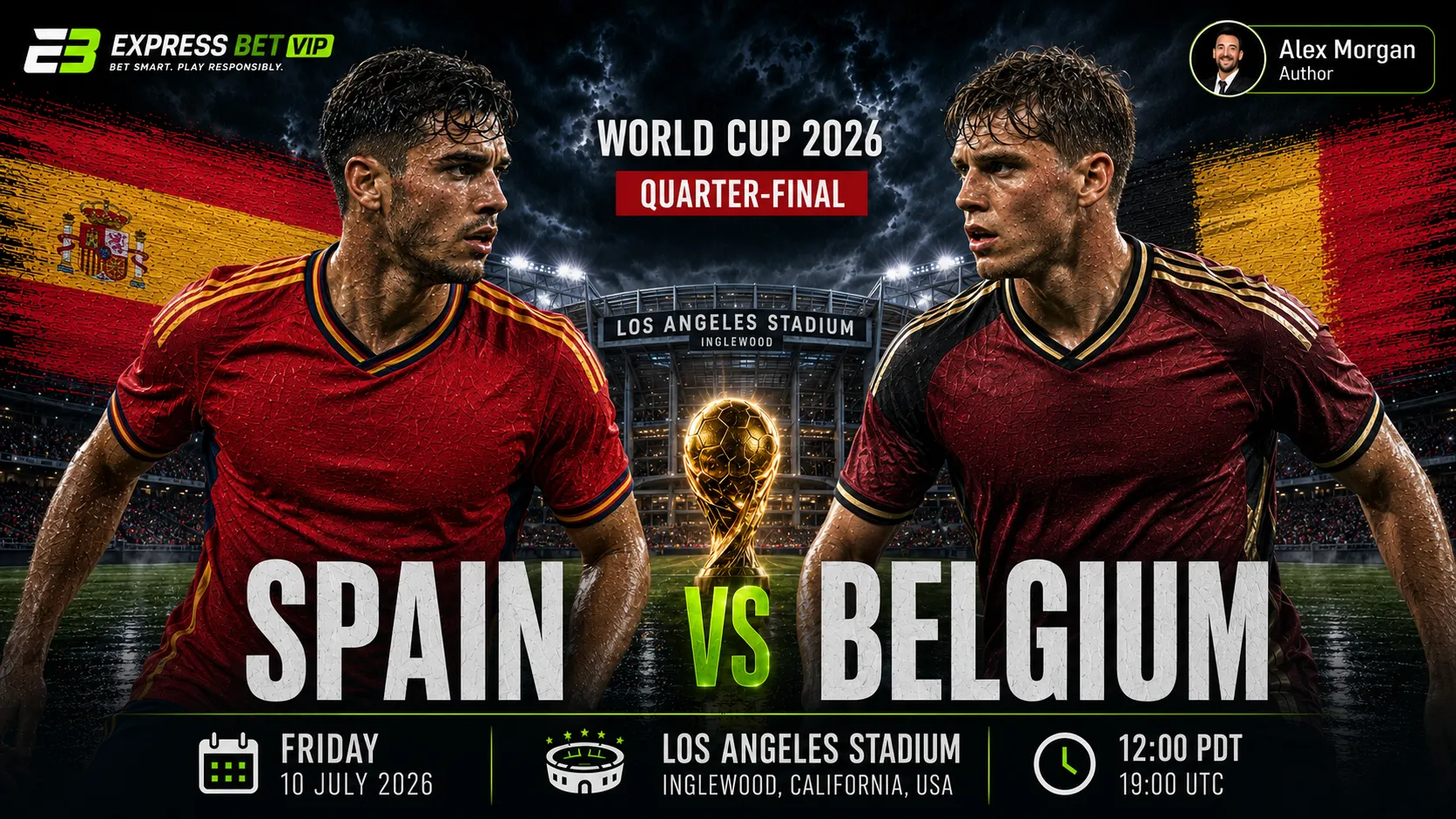
| Match fact | Verified detail |
|---|---|
| Match | Spain vs Belgium |
| Competition | FIFA World Cup 2026 |
| Stage | Quarter-final, Match 98 |
| Date | July 10, 2026 |
| Kickoff | 19:00 UTC; 12:00 PDT |
| Host country | United States |
| City | Inglewood, California |
| Stadium | Los Angeles Stadium, normally SoFi Stadium |
| Attendance | 70,492 |
| Final score | Spain 2-1 Belgium |
| Half-time score | 1-1 |
| Goal scorers | Fabián Ruiz 30’, Charles De Ketelaere 41’, Mikel Merino 88’ |
| Referee | Michael Oliver |
| VAR | Named VAR official not available from verified public data |
| Weather | 24°C listed; warm conditions reported inside the venue |
| Pitch | Temporary natural-grass surface |
| Tournament impact | Spain advanced to the semi-finals; Belgium were eliminated |
| Category | Content | Status |
|---|---|---|
| Match facts | Spain won 2-1; scorers and times verified | [CONFIRMED] |
| Reported detail | Courtois experienced muscular discomfort when kicking long | [REPORTED] |
| Observed detail | Lammens failed to hold Cubarsí’s bouncing shot before Merino scored | [OBSERVED] |
| Tactical interpretation | Spain’s sustained occupation of Belgium’s defensive third created cumulative pressure | [ANALYSIS] |
| Betting interpretation | Spain moneyline, over 2.5 goals and both teams to score landed | [MARKET SIGNAL] |
| Provider variation | Public xG totals differ slightly between data displays | [DISPUTED] |
| Unavailable data | Humidity, wind, named VAR official and verified closing prices | [UNKNOWN] |
This separation matters because an event is not the same thing as its interpretation. Spain having 68% possession is a recorded fact. Saying that possession progressively exhausted Belgium’s wide defenders is analysis based on the match pattern.
The distinction is especially important after a major tournament match. Goal attribution, assists and advanced statistics can be corrected. Tactical arguments are useful, but they should never be dressed up as entries from the official scoresheet.
Spain controlled most of the ball and most of the territory, yet Belgium kept the quarter-final alive until the final two minutes of regulation. That is often how these games behave. One team owns the map; the other waits beside the only bridge that matters.
Belgium’s preparations were damaged before kickoff. Captain Youri Tielemans was injured during the warm-up, forcing Hans Vanaken into the starting team. Amadou Onana was already unavailable with a serious knee injury. Belgium therefore entered the match without two important central-midfield options.
Spain started aggressively. Rodri and Fabián Ruiz established control behind Dani Olmo, while Lamine Yamal repeatedly received on the right with Marc Cucurella providing width from the opposite flank. Belgium defended in a compact 4-2-3-1 and tried to release Jérémy Doku into space whenever Spain lost the ball.
The opening goal arrived after half an hour. Courtois saved from Olmo, but Fabián reacted quickest and converted the loose ball with help from a deflection off Castagne.
Belgium’s response was efficient rather than expansive. Castagne advanced on the right and delivered a cross that De Ketelaere headed past Unai Simón. It was Belgium’s best constructed attack and the first goal Spain had conceded in the tournament.
Spain resumed their territorial control after the interval. Belgium occasionally escaped, notably through Maxim De Cuyper and later Romelu Lukaku, but the general direction of travel remained towards Courtois’ goal.
Then the match turned on an injury rather than a grand tactical revelation. Courtois, who had already made several important saves, could no longer continue. Lammens replaced him in the 71st minute.
Spain kept pressing. Merino entered in the 86th minute and scored two minutes later after Lammens spilled Cubarsí’s low effort. Belgium had little time to construct another response.
The scoreline was fair in relation to the chances and territory. Spain recorded 17 attempts to Belgium’s five and generated substantially more xG. Yet Belgium were not brushed aside. Their defensive discipline and Courtois’ goalkeeping took the game close to extra time.
Spain’s move developed through their established right-sided attacking structure. Lamine Yamal helped move Belgium’s block towards that flank before the ball reached Dani Olmo in a central shooting position.
Courtois dived to stop Olmo’s effort, but Belgium failed to clear the second ball. Fabián Ruiz arrived from midfield and shot through the traffic. The finish took a deflection off Timothy Castagne and passed between the defender’s legs.
No assist has been confirmed for the goal because the immediate preceding action was Courtois’ save.
The tactical value went beyond the score. Belgium could no longer remain entirely passive. Their midfield line had to step forward more often, which created small gaps around Rodri and Olmo.
Belgium’s equaliser came from one of their cleanest wide attacks. Castagne received room on the right and delivered an accurate cross towards the central channel.
De Ketelaere moved across Pau Cubarsí rather than waiting directly between the centre-backs. That diagonal movement gave him a running start and placed his body between the defender and the ball. His header beat Unai Simón.
Castagne received the assist. No decisive VAR intervention was reported.
The goal carried additional significance: it ended Spain’s run of approximately 649 minutes without conceding at the tournament. Belgium had spent much of the half defending, but one well-timed run restored parity. Tournament football is quite happy to ignore the possession graph.
Merino had replaced Dani Olmo only two minutes earlier. Spain recycled possession around Belgium’s box, and Cubarsí stepped forward to strike a low shot through the defensive line.
The ball bounced immediately before reaching Lammens. The substitute goalkeeper could not hold it, and Merino converted the rebound from close range.
No assist was officially confirmed. Cubarsí created the shot that produced the rebound, but that does not automatically constitute an assist under every data provider’s methodology.
The goal rewarded Spain’s sustained pressure and De la Fuente’s decision to introduce another midfielder capable of attacking the penalty area. It was also inseparable from Belgium’s enforced goalkeeper change.
Losing Tielemans shortly before kickoff disrupted Belgium’s midfield plan. Vanaken offered height, positional intelligence and passing quality, but Belgium lost Tielemans’ ability to receive under pressure and accelerate attacks from deeper areas.
This was not an excuse for the result. It was, however, a real structural disadvantage against a Spanish midfield built to monopolise the ball.
Courtois prevented Spain from converting early dominance into a comfortable lead. His save from Olmo immediately preceded Fabián’s goal, and he made further interventions as Spain attacked from the right.
Belgium’s block was organised, but it still required elite goalkeeping. Those are different things, even if post-match narratives often merge them.
Belgium scored with their first high-quality crossing sequence. Castagne’s timing and De Ketelaere’s movement exposed the space between Cubarsí’s starting position and Simón’s goal.
The equaliser forced Spain to solve the match again rather than merely manage it.
Courtois experienced discomfort when striking longer passes and eventually left in the 71st minute. Reuters reported that the goalkeeper was visibly emotional as he departed.
The substitution changed both performance quality and psychology. Belgium lost their best player on the day, while Spain knew that a cold substitute goalkeeper was entering under immediate pressure.
Merino came on in the 86th minute and scored in the 88th. His value was not based on elaborate creation. He entered the box, anticipated the rebound and finished.
De la Fuente did not reinvent football. He placed a physically strong, intelligent penalty-box runner near a goalkeeper who had only recently entered the match. Sometimes the direct idea is direct because it is good.
| Local factor | Verified or observed detail | Football meaning | Direct evidence | Betting meaning | Status | Anti-template status |
|---|---|---|---|---|---|---|
| City | Inglewood, California | Noon local kickoff increased heat exposure | Warm conditions reported | Potential second-half fatigue | [CONFIRMED] | Specific |
| Stadium | Los Angeles Stadium | Roof limited direct exposure but venue is indoor-outdoor | Fixed translucent canopy | Weather risk lower than open bowl, not eliminated | [CONFIRMED] | Specific |
| Attendance | 70,492 | Full stadium increased acoustic pressure | Sellout reported | Possible late momentum effect | [CONFIRMED] | Specific |
| Crowd | Majority support reported for Spain | Spain’s attacks received stronger reactions | Reuters match report | Do not price crowd noise as a guaranteed edge | [REPORTED] | Specific |
| Temperature | 24°C in match data | Warm but not extreme by the listed number | FotMob weather feed | Limited value without humidity data | [CONFIRMED] | Specific |
| Heat perception | Conditions described as sweltering | Physical load may have exceeded the temperature reading’s appearance | Reporting from venue | Relevant to late tempo and substitutions | [REPORTED] | Specific |
| Roof | Fixed; 60% transparent | Sunlight remains visible while climate is moderated | Official stadium guide | Reduces, but does not erase, weather uncertainty | [CONFIRMED] | Specific |
| Surface | Temporary natural grass | Different from the venue’s regular NFL surface | Match data and World Cup conversion | No proven systematic market effect | [CONFIRMED] | Specific |
| Decisive bounce | Cubarsí’s shot bounced before Lammens’ spill | Made handling more difficult | Match footage/report | Directly affected the next-goal market | [OBSERVED] | Specific |
| Wind/humidity | Not published in reliable match data | No evidence-based conversion possible | None | Should not be used to justify a bet | [UNKNOWN] | Specific missing-data statement |
The listed temperature was 24°C, but Reuters’ reporters inside the venue described oppressive or sweltering conditions. Those descriptions are not necessarily contradictory. A noon kickoff, radiant heat through a partly transparent canopy, limited airflow at pitch level and the physical intensity of a World Cup quarter-final can produce a heavier load than one temperature number suggests.
Spain nevertheless maintained their pressing and territorial pressure late into the match. That weakens any simple theory that the heat caused the game to slow decisively. De la Fuente also had the deeper possession share and could use fresh attackers and midfielders without abandoning his structure.
Belgium spent long periods defending laterally. That work is physically expensive because the team must shuffle across the pitch while remaining compact. Spain’s repeated switches towards Yamal and Cucurella forced Belgium’s wide players to cover distance without enjoying much possession-based recovery.
The natural-grass surface appeared playable. No verified report identified widespread slipping, abnormal wear or dangerously irregular bounce. The bounce before Lammens’ spill mattered, but the available evidence does not justify blaming the pitch for the goal.
| Stadium item | Match detail |
|---|---|
| Stadium | Los Angeles Stadium, normally SoFi Stadium |
| World Cup configuration capacity | 70,492 |
| Attendance | 70,492 |
| Pitch type | Temporary natural grass |
| Roof | Fixed ETFE canopy; 60% transparent |
| Venue design | Indoor-outdoor bowl |
| Acoustic effect | Full crowd, reportedly leaning towards Spain |
| Surface condition | No general problem confirmed |
| Wind relevance | Not available from verified public data |
| Goalkeeper distribution effect | Courtois’ physical discomfort affected long kicking |
| Set-piece effect | No decisive set-piece goal |
| Communication effect | Possible crowd-noise pressure; not directly measurable |
| Data status | Mixed [CONFIRMED], [REPORTED] and [UNKNOWN] |
The official SoFi Stadium guide describes a fixed roof with 60% transparent material and a climate-controlled environment. The venue also calls itself the NFL’s first indoor-outdoor stadium and lists a normal capacity of approximately 70,000, expandable for larger events.
That design matters. This was not an entirely exposed California bowl, but neither was it a sealed dome in which outside conditions became irrelevant. The midday light and reported warmth remained part of the event.
The full attendance also mattered in a more conventional way. Spain’s prolonged attacks generated increasingly loud reactions. We cannot quantify how many decibels were worth one expected goal—football analysis has not yet become that desperate—but a predominantly pro-Spain crowd increased the emotional pressure around Belgium’s box.
Courtois’ injury was the clearest stadium-level operational factor because it affected his distribution. He reportedly felt pain when attempting long kicks. That reduced Belgium’s ability to escape Spanish pressure and eventually removed their strongest performer.
| Factor | Detail |
|---|---|
| City | Inglewood |
| Host country | United States |
| Time zone | Pacific Daylight Time, UTC-7 |
| Local kickoff | 12:00 |
| Match-time temperature | 24°C |
| Humidity | Not available from verified public data |
| Wind | Not available from verified public data |
| Rain | No rain effect reported |
| Roof conditions | Fixed translucent canopy |
| Altitude | No meaningful altitude effect established |
| Likely physical effect | Increased thermal load during a noon kickoff |
| Actual evidence | Warm conditions reported; no confirmed heat illness |
| Data status | Partly confirmed, partly unknown |
Spain’s first-half tempo remained high despite the local kickoff time. Their counterpress immediately after possession losses was especially aggressive during the opening half-hour.
The second half became more fragmented as Belgium made multiple substitutions and Spain refreshed their attacking structure. It would be tempting to label every slower passage as “heat fatigue,” but the game state provides an equally strong explanation. Belgium were protecting a draw; Spain were trying to avoid opening transition lanes.
No confirmed cramp episode, heat-related injury or hydration intervention materially changed the match. Courtois’ problem was muscular, but verified reporting did not establish that the weather caused it.
The safest conclusion is narrow: the noon conditions added physical stress, especially for Belgium’s low block, but the evidence does not prove that the weather decided the result.
Both teams started in nominal 4-2-3-1 systems, although their shapes behaved very differently.
Spain built with Rodri dropping close to the centre-backs while Fabián moved higher. Pedro Porro and Cucurella provided width, allowing Yamal and Baena to enter the half-spaces. Olmo operated between Belgium’s midfield and defensive lines.
Without the ball, Belgium protected the centre first. De Ketelaere screened passes into Rodri, while De Bruyne and Trossard narrowed alongside Vanaken and Raskin. Doku remained slightly higher because Belgium needed at least one immediate transition threat.
Spain’s principal advantage developed on their right. Yamal repeatedly isolated De Cuyper or forced Trossard to recover, creating space for Porro’s supporting runs. Belgium usually prevented a clean final pass, but the amount of defensive attention required on that side stretched the block.
Fabián’s goal came from Spain’s willingness to send midfielders beyond the first shot. Olmo’s attempt did not end the attack because Fabián had continued his run.
Belgium did not respond by chasing the ball recklessly. They remained selective and looked for early switches into Doku or right-sided deliveries from Castagne. The equaliser showed why. Spain’s defensive line was set, but De Ketelaere’s diagonal run disrupted Cubarsí’s reference point.
At 1-1, Spain’s half-time problem was finishing rather than access. They were entering useful areas but had converted only one chance. Belgium’s problem was volume: their plan had produced a goal, yet it was unlikely to produce many more opportunities without better possession retention.
Spain resumed control, but Belgium’s defensive line became slightly more aggressive around the edge of the box. Raskin and Vanaken tried to deny Olmo the space to turn, accepting that passes might instead travel wide.
Belgium also showed more ambition on transition. De Cuyper reached a shooting position and hit the side netting. Later, Lukaku’s introduction supplied a fixed central target for direct passes and crosses.
Rudi Garcia made a triple change on the hour. Witsel replaced Trossard, Joaquin Seys replaced De Cuyper and Lukaku replaced Vanaken. The changes increased experience and physical presence, although they reduced some of Belgium’s midfield passing capacity.
De la Fuente had already introduced Pedri and Ferran Torres for Fabián and Baena. Pedri gave Spain another player capable of receiving behind Belgium’s first pressure line, while Torres attacked the spaces between full-back and centre-back more directly.
Courtois’ departure at 71 minutes altered the risk calculation. Spain began testing Lammens and sending more bodies towards rebounds. Belgium, understandably, protected the substitute goalkeeper by defending closer to him. The consequence was even less room to escape after recovering possession.
Nico Williams replaced Oyarzabal in the 79th minute, changing Spain’s left side from a combination-oriented lane into a more direct one-on-one threat. Merino then replaced Olmo.
Belgium’s late pressure after the second Spanish goal was brief and largely cosmetic. Spain controlled territory, accepted tactical fouls when required and avoided a final clear chance. Laporte and Witsel were booked in stoppage time as the match became increasingly tense.
Spain defended in a 4-4-2 press but attacked closer to a 3-2-5. One full-back advanced while the opposite side remained connected to the centre-backs, and Rodri protected the space behind the attacking line.
Yamal supplied the widest and most dangerous individual threat. Belgium could rarely leave De Cuyper alone against him, so an additional midfielder or winger had to move across. That created openings for Olmo and Fabián between the lines.
Belgium’s defensive plan was sensible. They reduced central access, maintained short distances and encouraged Spain to cross. Spain completed only two of 20 attempted crosses according to 365Scores. Belgium therefore succeeded in making many Spanish attacks inefficient.
The weakness was what happened after Belgium regained the ball. De Bruyne and Doku had too much space to cover before they could combine. De Ketelaere occasionally linked the attack, but Spain’s counterpress usually arrived before Belgium could establish possession.
Our team compared the raw shot count with the location data. Spain’s 17-5 advantage was not simply the product of harmless long-range shooting: they also led 41-11 in touches inside the opposition box and approximately 1.96-0.34 in xG on the main FotMob display.
Belgium’s transition defence survived largely because Courtois saved the first action or the back line blocked the shot. Once Courtois left, the same defensive workload became more dangerous.
The winning goal illustrated the larger tactical picture. Cubarsí was able to advance and shoot because Belgium had been pinned deep. Merino was already in the box because Spain could commit an extra midfielder without fearing an immediate counterattack. Lammens’ handling error was individual, but the situation producing it was structural.
| Zone | Edge | Match evidence | Key player | Local effect | Result impact |
|---|---|---|---|---|---|
| Spain left | Spain, slight | Cucurella and later Williams stretched Castagne | Cucurella | Fatigue increased recovery work | Secondary pressure route |
| Spain right | Spain | Yamal repeatedly forced double coverage | Lamine Yamal | Full crowd reacted strongly to isolations | Spain’s main creative lane |
| Central midfield | Spain | 68% possession and superior progression | Rodri | Belgium spent longer defending in warm conditions | Controlled match rhythm |
| Belgium right | Belgium in one key move | Castagne assisted De Ketelaere | Castagne | No clear weather link | Produced equaliser |
| Penalty box | Spain | 41-11 touches in opposition box | Merino | Decisive shot bounced before Lammens | Winning goal |
| Set pieces | Even | No decisive set-piece event | — | No verified wind effect | Limited |
| Transitions | Spain defensively | Belgium rarely sustained counters | Rodri | Heat may have reduced repeated runs | Restricted Belgium to five shots |
| Goalkeeper build-up | Spain | Courtois’ injury affected long kicking | Courtois | Physical condition relevant | Major turning point |
| Bench | Spain | Merino scored two minutes after entering | Merino | Fresh legs helped late occupation | Decisive |
These are editorial ratings based on match influence, tactical execution and decisive actions. I cross-checked the assessment against FotMob’s Opta-powered performance data rather than treating one algorithmic grade as a final verdict.
Substitutes
Substitutes
| Player | Team | Incident | Minute | Status | Next-match impact | Data status |
|---|---|---|---|---|---|---|
| Youri Tielemans | Belgium | Injured during warm-up | Pre-match | Did not start | Belgium eliminated | [REPORTED] |
| Thibaut Courtois | Belgium | Muscular discomfort | 71’ | Substituted | Further diagnosis required | [REPORTED] |
| Pau Cubarsí | Spain | Yellow card | 43’ | Booked | Suspension not confirmed | [CONFIRMED] |
| Kevin De Bruyne | Belgium | Yellow card | 85’ | Booked | Belgium eliminated | [CONFIRMED] |
| Aymeric Laporte | Spain | Yellow card | 90+3’ | Booked | Suspension not confirmed | [CONFIRMED] |
| Axel Witsel | Belgium | Yellow card | 90+5’ | Booked | Belgium eliminated | [CONFIRMED] |
No red card was shown. No verified post-match disciplinary change had been published at the time of the latest check.
Michael Oliver controlled a match that became more physical as Belgium’s defensive workload increased. Four yellow cards were shown, three of them from the 85th minute onwards.
No penalty, red-card decision or disallowed goal became a defining controversy. No major VAR intervention materially altered the score.
The referee therefore influenced the flow mainly through his foul threshold rather than a single decisive ruling. Belgium were permitted to compete physically, but the late cards showed that Oliver did not allow the closing minutes to become entirely lawless.
The named VAR official was not available from the verified public sources consulted.
| Statistic | Spain | Belgium |
|---|---|---|
| Possession | 68% | 32% |
| Shots | 17 | 5 |
| Shots on target | 8 | 2 |
| Shots off target | 4 | 1 |
| Blocked shots | 5 | 2 |
| xG | 1.96 | 0.34 |
| Big chances | 2 | 1 |
| Corners | 5 | 1 |
| Completed passes | 598 | 243 |
| Total passes | 664 | 312 |
| Opposition-box touches | 41 | 11 |
| Completed crosses | 2/20 | 2/11 |
| Offsides | 3 | 1 |
| Yellow cards | 2 | 2 |
| Red cards | 0 | 0 |
The numbers support the result without suggesting total domination. Spain created nearly six times Belgium’s xG, but the actual margin remained one goal because Courtois performed well and many Spanish attacks ended in blocked or low-value attempts.
The crossing numbers are especially informative. Spain attempted 20 and completed only two. Belgium attempted 11 and also completed two—one of which became De Ketelaere’s goal. Belgium were less frequent but more efficient in that specific route.
A separate FotMob article displayed approximately 2.08-0.37 xG. Small differences can occur because of live-feed revisions, rounding or different page updates. The 1.96-0.34 figures are used here as the primary Opta/FotMob match display.
DraftKings opening prices published by Sports Illustrated made Spain a clear favourite:
Those were opening prices, not verified closing odds. The Opta supercomputer projection reported by Al Jazeera gave Spain a 59.3% chance of winning in regulation, Belgium 18.3% and extra time 22.4%.
| Market | Pre-match expectation | Actual result | Winning side | Key trigger | Local factor | Caution |
|---|---|---|---|---|---|---|
| Match winner | Spain favoured | Spain won 2-1 | Spain | Merino 88’ | Late pressure in full venue | Opening price only |
| To advance | Spain heavily favoured | Spain advanced | Spain | Regulation win | None decisive | Short odds still carry risk |
| Over/under 2.5 | Over slightly favoured | Three goals | Over 2.5 | Late winner | Heat did not suppress total below line | Push rules vary only on whole-number lines |
| Both teams to score | Belgium expected to have fewer chances | Both scored | Yes | De Ketelaere header | No clear local cause | Price not verified |
| Correct score | 2-1 one possible outcome | Spain 2-1 | 2-1 | Lammens spill | Bounce relevant | High-variance market |
| First goalscorer | No verified market price | Fabián Ruiz | Ruiz | Rebound after Courtois save | None | Odds timing essential |
| Corners | Spain expected to dominate territory | Spain won 5-1 | Spain corner lines depending handicap | Sustained territorial control | Belgium’s deep block | Exact line required |
| Cards | Physical quarter-final expected | Four yellows | Depends on line | Three late bookings | Fatigue may have contributed | Line and operator rules differ |
This result rewarded bettors who backed Spain in regulation, but the win was not comfortable. Anyone holding Spain at a short price still required an 88th-minute goal after the favourite had spent nearly an hour level.
The over 2.5 market landed by one goal. That does not make the pre-match reasoning retrospectively certain. Had Lammens held Cubarsí’s shot, the same tactical performance might have produced a losing over ticket.
Live markets would have moved sharply after Fabián’s goal, De Ketelaere’s equaliser and Courtois’ substitution. Exact live prices are not available from verified public data and should not be reconstructed from memory.
| Local factor | Market possibly affected | Match evidence | Interpretation | Overreaction risk | Safer conclusion |
|---|---|---|---|---|---|
| Noon kickoff | Second-half totals | Warm conditions reported | Fatigue could reduce pressing duration | High | Use live tempo, not temperature alone |
| Fixed roof | Weather markets | Climate moderated | Reduced direct exposure | Medium | Indoor-outdoor is not the same as sealed |
| Full crowd | Match momentum | Support leaned towards Spain | Pressure increased around Belgium’s box | High | Crowd is context, not a pricing model |
| Natural grass | Goalkeeper handling | Late shot bounced before Lammens | Bounce contributed to rebound | High | One incident does not define the surface |
| Belgium’s defensive workload | Late Spain goal/player shots | 68% Spain possession | Repeated defending created cumulative stress | Medium | More useful than generic weather claims |
| Courtois injury | Live match winner | Belgium lost its best performer | Spain’s live probability increased | Low | Injury mattered, but price determines value |
| Unknown humidity/wind | Totals and crosses | No verified measurements | No sound conclusion available | Very high | Do not invent a weather edge |
The most relevant local betting lesson is that conditions must be connected to visible football. Warmth alone did not predict three goals. Belgium’s defensive workload, Courtois’ injury and Spain’s bench were more direct explanations.
Local factors can influence a live market, but they should not become an all-purpose story after the result is known.
Spain advanced to face France in the semi-final in Dallas. Belgium’s World Cup ended in the quarter-finals.
The result also carried a longer significance. Spain subsequently beat France 2-0 in the semi-final and defeated Argentina 1-0 after extra time in the final on July 19. The Belgium quarter-final therefore became the closest regulation-time obstacle in Spain’s championship run after the group stage.
Merino’s winner preserved Spain’s chance to claim their second men’s World Cup. It also confirmed the importance of De la Fuente’s bench: Spain’s decisive scorer against Belgium had played only two minutes before changing the bracket.
Belgium left with legitimate frustration. They had survived Spain’s strongest periods, equalised intelligently and remained level until losing Courtois. But knockout football does not issue certificates for being competitive in the 87th minute.
Spain controlled the central midfield without allowing that control to become entirely decorative.
Rodri provided the base, Fabián attacked beyond the ball and Olmo received in the space behind Belgium’s deeper midfield line. When Belgium closed the centre, Spain switched towards Yamal.
Their counterpress was equally important. Belgium had players capable of hurting them in open space, especially Doku and De Bruyne. Spain prevented those transitions from becoming sustained attacks by recovering the ball early.
De la Fuente also used his bench well. Pedri improved ball security, Williams supplied fresh width and Merino attacked the box. The decisive substitution was not simply lucky; Merino’s running profile matched the problem Spain faced.
Finally, Spain stayed patient after Belgium equalised. They did not turn the match into a sequence of desperate crosses, even though their crossing efficiency was poor. They continued circulating the ball until defenders such as Cubarsí could step into shooting range.
Belgium’s defensive organisation was respectable. Their problem was the absence of a reliable second phase after winning possession.
Too many recoveries ended with an isolated pass towards Doku or De Ketelaere. Spain could surround the receiver before De Bruyne arrived in support. As a result, Belgium’s back line rarely received meaningful rest.
The midfield absences mattered. Without Onana and then Tielemans, Belgium lacked both ball-winning range and progressive passing. Vanaken performed a difficult role responsibly, but the team could not consistently escape Rodri’s zone.
Belgium also became too deep after Courtois departed. The instinct was understandable: protect Lammens. Yet retreating invited Spain to bring centre-backs and midfield runners close to the penalty area. That is precisely how Cubarsí took the shot and Merino reached the rebound.
The failure was therefore not simply Lammens’ mistake. The goalkeeper made the decisive error, but Belgium had created a game state in which one imperfect handling action could end the tournament.
De la Fuente retained Spain’s 4-2-3-1 structure and trusted Yamal to solve wide pressure rather than overloading the attack with an additional striker.
His first changes—Pedri and Ferran Torres—freshened possession and depth. Williams then added left-sided acceleration. Merino’s late introduction was the decisive move.
Spain did not abandon midfield control when searching for the winner. That balance protected them from Doku and Lukaku while allowing more players to enter Belgium’s box.
Garcia’s initial defensive plan worked better than the possession figures suggest. Belgium protected central space, forced numerous unsuccessful crosses and created an equaliser through a prepared wide pattern.
His options were compromised by injuries. The warm-up loss of Tielemans forced an immediate change, while Courtois’ departure removed Belgium’s strongest performer.
The triple substitution after an hour gave Belgium physical presence but weakened their ability to retain the ball. After Courtois went off, the block became increasingly passive. Garcia’s plan took Belgium close to extra time, but it did not provide enough attacking relief to survive Spain’s final push.
[CONFIRMED] Merino became the first player reported to have scored the winning goal as a substitute in two different knockout matches at the same World Cup. He had also scored the late winner in Spain’s 1-0 round-of-16 victory over Portugal.
[CONFIRMED] De Ketelaere’s header was the first goal Spain conceded at the 2026 tournament and ended their shutout sequence at approximately 649 minutes.
[CONFIRMED] The victory sent Spain into their first men’s World Cup semi-final since 2010.
Spain subsequently won the tournament, but that later achievement should not be confused with what was known at the final whistle in Inglewood.
Spain’s 2010 champions became famous for controlling knockout matches by narrow margins. The 2026 side was more direct and carried greater one-on-one threat, but the Belgium quarter-final revived the same basic lesson: tournament control often looks less comfortable on the scoreboard than on the pitch map.
Belgium’s performance also fitted a familiar knockout pattern. A disciplined underdog survives long periods, finds one high-quality equaliser and begins to make extra time feel plausible. Then one rebound changes the national conversation.
This was not a repeat of an earlier World Cup match. Its particular combination—Spain’s wide threat, Courtois’ injury and Merino’s immediate impact—made it distinct.
No major refereeing controversy was confirmed.
The most discussed incident was Courtois’ injury and its effect on the winning goal. That is a sporting turning point, not evidence of wrongdoing or unfairness.
Lammens deserves context. He entered a World Cup quarter-final without a normal warm-up rhythm, faced sustained pressure and made one costly handling error. The mistake should be analysed clearly without turning the player into a convenient villain.
The raw score explains who advanced. It does not explain why the game stayed level for so long.
The additional value comes from connecting:
| Detail | Included | Status | Specific to fixture | Future update needed |
|---|---|---|---|---|
| Stadium | Yes | [CONFIRMED] | Yes | Only if FIFA corrects venue data |
| City | Yes | [CONFIRMED] | Yes | No |
| Weather | Yes | [CONFIRMED]/[REPORTED] | Yes | Humidity and wind if published |
| Pitch | Yes | [CONFIRMED]/[OBSERVED] | Yes | Maintenance report if released |
| Crowd | Yes | [REPORTED] | Yes | Official distribution unavailable |
| Travel/acclimatisation | Limited | [UNKNOWN] | Yes | Team travel details if confirmed |
| Betting risk | Yes | [ANALYSIS] | Yes | Closing odds if licensed data appears |
| Tactical-local link | Yes | [ANALYSIS] | Yes | No forced causal claim |
| Anti-template status | Passed | Mixed | Yes | Recheck after data corrections |
| Data point | Status | Primary source type |
|---|---|---|
| Final score | [CONFIRMED] | FIFA Match Centre |
| Goal scorers and times | [CONFIRMED] | FIFA/FotMob |
| Assists | [CONFIRMED] for Castagne; none confirmed for Spain’s goals | Match data |
| Stadium and city | [CONFIRMED] | FIFA/venue data |
| Attendance | [CONFIRMED] | Match data |
| Referee | [CONFIRMED] | Match data |
| Named VAR official | [UNKNOWN] | Not available |
| Lineups | [CONFIRMED] | Match data |
| Substitutions | [CONFIRMED] | Match data |
| Cards | [CONFIRMED] | Match data |
| Injuries | [REPORTED] | Reuters/match reporting |
| Possession and shots | [CONFIRMED] | Opta/FotMob/365Scores |
| xG | [DISPUTED] minor provider-display variation | Opta-powered services |
| Opening odds | [REPORTED] | DraftKings prices published by Sports Illustrated |
| Closing odds | [UNKNOWN] | Not available |
| Temperature | [CONFIRMED] | Match weather feed |
| Humidity and wind | [UNKNOWN] | Not available |
| Roof design | [CONFIRMED] | Official stadium guide |
| Pitch condition | [OBSERVED] | Match evidence |
| Crowd profile | [REPORTED] | Reuters |
| Tournament impact | [CONFIRMED] | FIFA competition results |
Spain won because they controlled more than possession. They controlled where Belgium had to defend, how often Belgium could counter and which goalkeeper faced the final wave of pressure.
Belgium’s plan was competitive. Castagne and De Ketelaere punished Spain’s only significant first-half defensive lapse, Courtois saved repeatedly and the compact block restricted Spain’s crossing efficiency. The 2-1 score was not an accident, but neither was Belgium’s resistance.
The decisive variables were Spain’s territorial persistence, deeper bench and reaction to Courtois’ departure. Merino’s winner looked like a rebound goal. Tactically, it was the final product of a match spent forcing Belgium closer and closer to their own line.
The warm Inglewood conditions added physical strain, but they should not be promoted into a universal explanation. Spain still pressed late, and no verified evidence shows that heat directly caused the decisive error.
For fans, this was another reminder that control does not remove jeopardy. For bettors, it showed why a correct favourite can remain an uncomfortable position until the 88th minute. Spain advanced, Belgium departed, and one substitute’s anticipation kept the eventual world champions alive.
Football betting carries financial risk. Even accurate match analysis cannot guarantee a winning wager, and odds change before and during matches.
Local conditions are often overvalued after a result. Never chase losses or bet money required for housing, food, bills or other daily needs. Set deposit and time limits, take regular breaks and check the gambling laws in your location.
Use licensed operators only. Betting should remain entertainment, not a source of income.
Spain beat Belgium 2-1 in the FIFA World Cup 2026 quarter-final.
Fabián Ruiz and Mikel Merino scored for Spain. Charles De Ketelaere scored for Belgium.
Lamine Yamal was our Man of the Match for his sustained attacking influence. Thibaut Courtois was Belgium’s best performer before leaving injured.
Spain advanced to face France in the semi-final. Belgium were eliminated. Spain later won the World Cup.
Spain’s 90-minute moneyline, Spain to advance, over 2.5 goals and both teams to score were winning outcomes. Returns depended on the operator, selected line and time at which the odds were taken.