
Spain vs Saudi Arabia World Cup 2026 Preview
Table of Contents Show
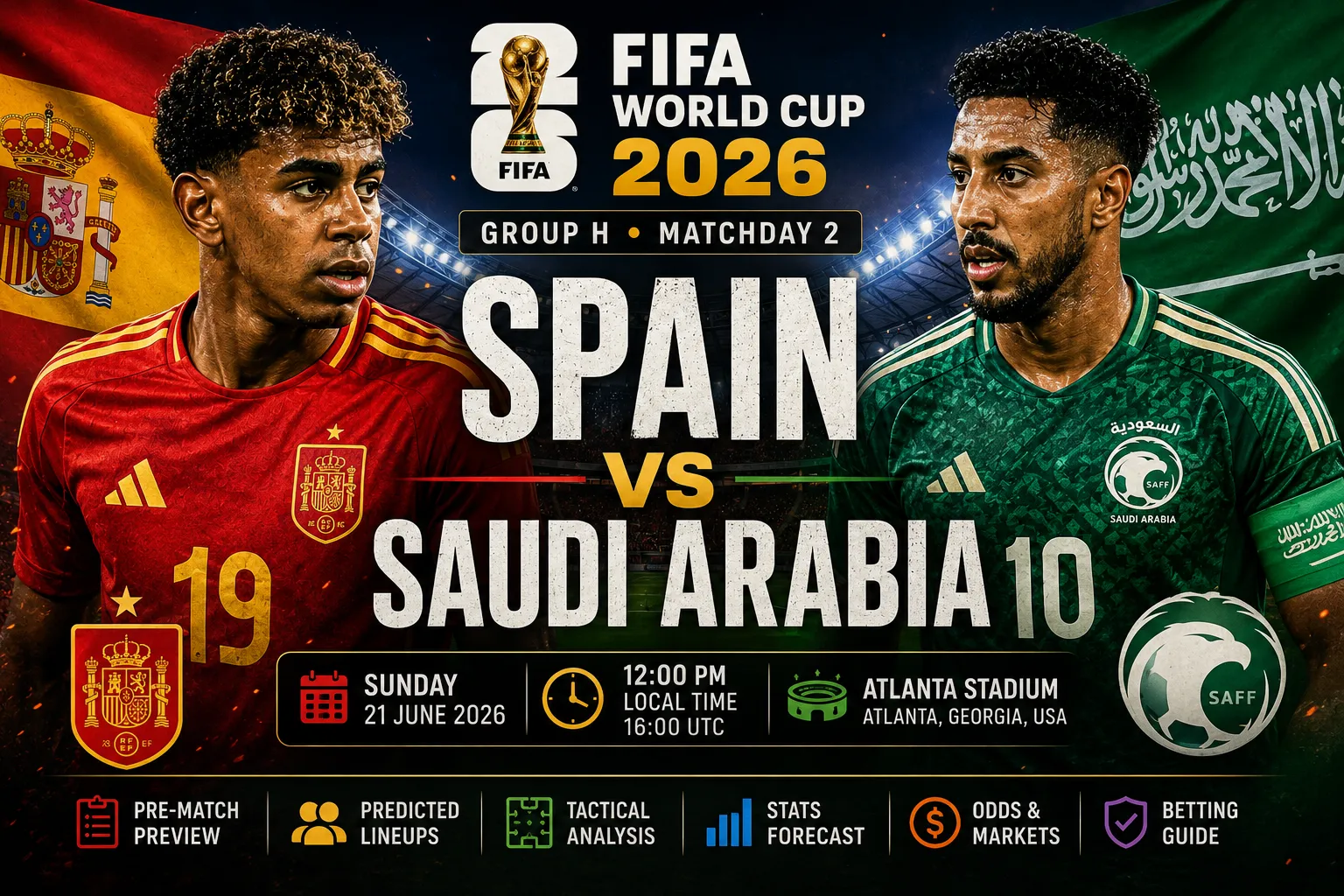
Spain face Saudi Arabia in a FIFA World Cup 2026 Group H match at Atlanta Stadium in Atlanta, Georgia, United States, on Sunday, 21 June 2026. Kick-off is scheduled for 12:00 p.m. local time and 16:00 UTC. This is a second-round group-stage match in a balanced Group H.
Spain enter after a 0-0 draw with Cabo Verde. Saudi Arabia enter after a 1-1 draw with Uruguay. Spain are coached by Luis de la Fuente and carry pressure after a possession-heavy opener that lacked finishing edge. Saudi Arabia are coached by Georgios Donis and gained confidence from their point against Uruguay. The confirmed team-sheet context before kick-off included Lamine Yamal returning to Spain’s starting XI. Spain’s expected core features Unai Simón, Pau Cubarsí, Aymeric Laporte, Marc Cucurella, Rodri, Pedri, Dani Olmo, Alex Baena, Yamal and Mikel Oyarzabal. Saudi Arabia’s expected core features Mohammed Alowais, Saud Abdulhamid, Hassan Altambakti, Abdulelah Alamri, Abdullah Alkhaibari, Musab Aljuwayr, Feras Albrikan and Salem Al-Dawsari.
The likely match type is Spain’s controlled possession and positional attack against Saudi Arabia’s compact defence, transition threat and set-piece route. The key matchup is Spain’s Yamal-Pedri-Rodri creative structure against Saudi Arabia’s midfield screen and wide recovery. Spain are heavy favourites in public markets, but betting involves risk and no outcome is guaranteed.
| Field | Data |
|---|---|
| Match | Spain vs Saudi Arabia |
| Competition | FIFA World Cup 2026 |
| Stage | First Stage / Group Stage |
| Group | Group H |
| Match Number | Match 38 |
| Date | Sunday, 21 June 2026 |
| Kick-off Time | 12:00 p.m. Atlanta time / 16:00 UTC |
| Stadium | Atlanta Stadium |
| Common Venue Context | Mercedes-Benz Stadium |
| City | Atlanta, Georgia |
| Host Country | United States |
| Expected Attendance | Not available from verified public data |
| Referee | Not available from verified official public data |
| VAR | Not available from verified official public data |
| Weather Forecast | Warm Atlanta matchday profile; historical matchday data showed around 25.8°C current and 30.6°C high; exact pitch-speed, indoor/outdoor roof status and match-hour humidity not available from verified public data |
| Pitch Context | NFL / multipurpose stadium adapted for World Cup football; exact pitch speed not available from verified public data |
| Main Article Focus | Spain’s attacking correction after Cabo Verde draw, Saudi Arabia’s defensive confidence after Uruguay draw, predicted lineups, Atlanta conditions, tactical matchups, projected stats, discipline, set pieces and responsible betting risk |
Spain vs Saudi Arabia is not only a favourite-versus-underdog fixture. It is a pressure test for Spain after failing to score against Cabo Verde. It is also a credibility test for Saudi Arabia after taking a point from Uruguay. Spain need a win to take control of Group H. Saudi Arabia need to prove that their first result was not only a one-match defensive effort.
Spain vs Saudi Arabia matters because both teams started Group H with one point, and the winner can move into a strong qualification position before the final group match.
| Category | Status | Spain vs Saudi Arabia Example | Article Use |
|---|---|---|---|
| Confirmed fact | Verified before publication | Spain vs Saudi Arabia, Group H, Atlanta Stadium | |
| Confirmed timing | Verified fixture context | Sunday, 21 June 2026, 12:00 p.m. local / 16:00 UTC | |
| Confirmed Spain result | Verified reporting | Spain drew 0-0 with Cabo Verde | |
| Confirmed Saudi Arabia result | Verified reporting | Saudi Arabia drew 1-1 with Uruguay | |
| Confirmed Spain coach | Verified public tournament data | Luis de la Fuente | |
| Confirmed Saudi Arabia coach | Verified public tournament data | Georgios Donis | |
| Announced lineup context | Verified matchday reporting | Yamal returned to Spain’s starting XI | |
| Confirmed Saudi lineup context | Verified matchday reporting | Alowais, Saud Abdulhamid, Altambakti, Aljuwayr, Albrikan and Salem Al-Dawsari were part of the starting structure | |
| Probable information | Tactical forecast | Spain likely control more possession; Saudi Arabia likely defend compactly | |
| Projected data | Model-based estimate | Possession, shots, xG, corners, cards and substitution windows | |
| Unknown data | Not verified in current source set | Referee, VAR, expected attendance, exact pitch speed and exact match-hour humidity | |
| Scenario-based analysis | Forecast only | Spain may use more verticality and wider one-vs-one play; Saudi Arabia may protect the draw longer if level |
This distinction matters because Spain’s market position can create false certainty. Spain are stronger on paper, but their opener against Cabo Verde showed that territorial dominance does not guarantee goals. Saudi Arabia are underdogs, but their draw against Uruguay showed that they can survive pressure and exploit opponent errors.
A confirmed fixture is different from a projected statistic. A source-reported team sheet is different from a lineup forecast. A betting price is not a match result. A weather profile is not final pitch condition. This dossier marks each category clearly.
Group H opened with two draws. Spain drew Cabo Verde 0-0. Saudi Arabia drew Uruguay 1-1. That left the group level on points before the second matchday.
| Team | Played | Won | Drawn | Lost | Goals For | Goals Against | Goal Difference | Points |
|---|---|---|---|---|---|---|---|---|
| Saudi Arabia | 1 | 0 | 1 | 0 | 1 | 1 | 0 | 1 |
| Uruguay | 1 | 0 | 1 | 0 | 1 | 1 | 0 | 1 |
| Spain | 1 | 0 | 1 | 0 | 0 | 0 | 0 | 1 |
| Cabo Verde | 1 | 0 | 1 | 0 | 0 | 0 | 0 | 1 |
This table should be updated if another Group H match is completed before publication. The pre-match logic remains clear: all four teams entered the second round with a route, and every result changed the qualification map.
Spain need to prove that the Cabo Verde draw was a correction point, not a deeper issue. De la Fuente’s side controlled the ball in the opener but did not create enough clean finishing moments. The key problem was not possession. The key problem was penetration and finishing rhythm.
Spain must now solve three connected questions.
First, Spain must create better shots. They cannot only circulate around a low block. They need runners, width, box entries and early vertical passes.
Second, Spain must manage Yamal’s role. His return to the starting XI changes the match because he can attack one-vs-one, stretch the defensive line and force Saudi Arabia to adjust their left side.
Third, Spain must protect transitions. Saudi Arabia will not dominate possession, but they can create moments through Salem Al-Dawsari, Feras Albrikan, Musab Aljuwayr, Saud Abdulhamid and set pieces.
Spain’s objectives:
Saudi Arabia’s draw against Uruguay gave Donis a platform. The team defended under pressure, gained belief and showed they can punish mistakes. The problem came after they led. Donis admitted he still needed time with the squad and that Saudi Arabia struggled to control possession under Uruguay’s second-half pressure.
Spain will test that issue even more. Saudi Arabia may have long stretches without the ball. They need compact distances, clean clearances and better possession relief after recoveries.
Saudi Arabia’s objectives:
Goal difference matters in this group because all teams opened level. Spain did not concede, but they also did not score. Saudi Arabia scored and conceded once. A narrow win, a heavy win, a draw and a narrow defeat all have different implications.
Spain may push for a second goal if they lead because Uruguay remain in the group. Saudi Arabia may protect a narrow deficit if the match becomes difficult because third-place comparisons can involve goal difference.
The expanded 48-team tournament gives the best eight third-placed teams a route to the Round of 32. Four points after two matches would be a strong platform. Two points would keep a team alive but not comfortable. One point after two matches would create heavy final-round pressure.
Spain do not want to enter the Uruguay match needing a win. Saudi Arabia do not want to enter the Cabo Verde match needing a large margin. This match can decide which team plays the final round with control and which team plays with anxiety.
Spain carry favourite pressure. Saudi Arabia carry opportunity pressure. Spain are expected to dominate. Saudi Arabia can use that expectation against them. If the game stays level, tension moves toward Spain. If Saudi Arabia score first, Spain must avoid panic. If Spain score first, Saudi Arabia must decide whether to open up or protect margin.
| Result | Spain Impact | Saudi Arabia Impact | Group H Meaning |
|---|---|---|---|
| Spain win | Spain move to four points and take a strong step toward qualification | Saudi Arabia stay on one point and face pressure before Cabo Verde | Spain restore control |
| Draw | Spain move to two points and still face Uruguay under pressure | Saudi Arabia move to two points and remain alive before Cabo Verde | Group stays tight |
| Saudi Arabia win | Spain stay on one point and face a crisis before Uruguay | Saudi Arabia move to four points and create a major qualification platform | Group H is transformed |
| Factor | Match Relevance |
|---|---|
| Host country | United States |
| Venue region | Southeast United States |
| City context | Atlanta, Georgia |
| Neutral match | Neither team is host nation |
| Crowd profile | Spain support, Saudi support and neutral U.S. spectators |
| Climate | Warm June matchday profile |
| Altitude | No meaningful altitude issue |
| Stadium context | Major NFL / multipurpose venue adapted for World Cup football |
| Travel context | Spain and Saudi Arabia both move from first-round group venues |
| Tournament pressure | Second group match with qualification control at stake |
Atlanta gives the match a major-event setting. The stadium environment can help Spain if early pressure creates momentum. It can also help Saudi Arabia if the underdog block frustrates the favourite and the crowd senses a possible upset.
| City Factor | Tactical Impact |
|---|---|
| 12:00 p.m. local kick-off | Midday timing increases heat and hydration relevance |
| Warm matchday profile | Pressing should be managed carefully |
| Indoor / roof event context | Match-specific roof status not available from verified public data |
| No altitude issue | Recovery is not altitude-limited |
| Large stadium environment | Communication and emotional control matter |
| Neutral site | Crowd momentum can shift with game state |
| Southeastern U.S. summer | Heat and humidity risk should be checked close to kick-off |
| Time-zone context | Both teams must adapt to U.S. tournament rhythm |
Spain may want long pressing waves, but heat can make wasteful pressing expensive. Saudi Arabia may defend deep, but deep defending also drains legs. The game may require earlier substitutions than a cooler evening match.
| Stadium Detail | Data |
|---|---|
| FIFA Stadium Name | Atlanta Stadium |
| Common Venue Context | Mercedes-Benz Stadium |
| City | Atlanta |
| State | Georgia |
| Host Country | United States |
| Kick-off | 12:00 p.m. local / 16:00 UTC |
| Expected Attendance | Not available from verified public data |
| Referee | Not available from verified official public data |
| VAR | Not available from verified official public data |
| Roof Status | Retractable-roof stadium context; match-specific roof status not available from verified public data |
| Pitch Speed | Not available from verified public data |
| Tactical Impact | Surface speed, roof status, heat and humidity can affect pressing and passing |
Atlanta Stadium can produce fast football if the surface plays cleanly. Spain will want quick passing. Saudi Arabia will want safe clearances and accurate long balls. The first 10 minutes should show ball speed, bounce and how each team handles the surface.
| Weather / Environment Factor | Tactical Meaning |
|---|---|
| Warm day | Pressing must be paced |
| Possible humidity | Recovery between sprints may slow |
| No altitude | Heat is more relevant than oxygen availability |
| Roof status unknown | Can change perceived heat and air movement |
| Wind less relevant if roof closed | Match-specific condition should be checked |
| Pitch speed unavailable | Early pass weight and first touches matter |
| Midday kick-off | Hydration and substitution timing matter |
| Crowd energy | Early tempo may exceed sustainable pace |
The most important environment factor is heat management. Spain want possession, counter-pressing and repeated attacks. Saudi Arabia want compact defending and fast counters. Both plans require physical discipline. The team that controls tempo better may gain a late edge.
| Team | Player / Role | Status | Tactical Impact |
|---|---|---|---|
| Spain | Luis de la Fuente | Head coach | Must fix final-third sharpness after Cabo Verde draw |
| Spain | Lamine Yamal | Returned to starting XI in source-reported team sheet | Adds one-vs-one threat, width and verticality |
| Spain | Unai Simón | Goalkeeper | Distribution and concentration against limited counters |
| Spain | Pedro Porro | Right-back | Width, crossing and recovery defending |
| Spain | Pau Cubarsí | Centre-back | Buildup, line control and defensive composure |
| Spain | Aymeric Laporte | Centre-back | Left-footed progression and aerial defending |
| Spain | Marc Cucurella | Left-back | High pressing, overlaps and defensive cover |
| Spain | Rodri | Midfielder | Main control player and rest-defence anchor |
| Spain | Pedri | Midfielder | Between-line passing and rhythm |
| Spain | Dani Olmo | Midfielder / attacker | Final-third movement and shot creation |
| Spain | Alex Baena | Attacker / midfielder | Wide or half-space support |
| Spain | Mikel Oyarzabal | Forward | Central striker movement and finishing pressure |
| Saudi Arabia | Georgios Donis | Head coach | Must balance defensive compactness and possession relief |
| Saudi Arabia | Mohammed Alowais | Goalkeeper | Shot-stopping and defensive command |
| Saudi Arabia | Saud Abdulhamid | Full-back | Main right-side outlet and recovery defender |
| Saudi Arabia | Hassan Altambakti | Centre-back | Box defence and aerial duels |
| Saudi Arabia | Abdulelah Alamri | Defender | Scored against Uruguay; set-piece and defensive role |
| Saudi Arabia | Abdullah Alkhaibari | Midfielder | Defensive screen and passing security |
| Saudi Arabia | Musab Aljuwayr | Midfielder | Progression, passing and transition support |
| Saudi Arabia | Feras Albrikan | Forward | Pressing, hold-up and box movement |
| Saudi Arabia | Salem Al-Dawsari | Forward / winger | Main attacking star and transition outlet |
| Player | Team | Status | Tactical Impact |
|---|---|---|---|
| Nico Williams | Spain | Reported pre-match concern / not central to confirmed starting XI context | If unavailable or limited, Spain lose direct left-wing acceleration |
| Lamine Yamal | Spain | Fitness managed before the match but source-reported starter | Adds danger but minutes may still be managed |
| Not available from verified public data | Saudi Arabia | No specific match-day doubtful player confirmed in current source set | Official team sheet and federation updates should be checked |
| Player | Team | Status | Tactical Impact |
|—|—|—|
| Not available from verified public data | Spain | No confirmed match-specific unavailable player used beyond source-reported lineup context | Do not invent absences |
| Not available from verified public data | Saudi Arabia | No confirmed match-specific unavailable player used in this preview | Do not invent absences |
| Player / Group | Team | Issue | Match Impact |
|---|---|---|---|
| Lamine Yamal | Spain | Recent fitness management context | Starting role adds danger, but minutes should be watched |
| Spain wide attackers | Spain | Selection and fitness management | De la Fuente may use bench width if Saudi Arabia sit deep |
| Rodri | Spain | Tactical workload, not injury | Must protect Spain’s rest defence |
| Salem Al-Dawsari | Saudi Arabia | High attacking workload, not injury | Main counterattacking outlet |
| Saudi Arabia full-backs | Saudi Arabia | Defensive workload against Spain’s width | Card and fatigue risk increase |
| Mohammed Alowais | Saudi Arabia | Expected shot-stopping workload | Must control rebounds and crosses |
| Team | Confirmed Suspension | Notes |
|—|—|
| Spain | Not available from verified public data | No confirmed active suspension used in this preview |
| Saudi Arabia | Not available from verified public data | No confirmed active suspension used in this preview |
Spain’s most important change is Yamal’s return to the starting structure. Against Cabo Verde, Spain lacked the final one-vs-one action that forces a block to break. Yamal can stretch Saudi Arabia, draw two defenders and open space for Pedri, Olmo and Oyarzabal.
Saudi Arabia’s team news is about continuity. Donis had limited time with the squad before the tournament, so he may prefer a stable structure. Alowais, Altambakti, Abdulhamid, Alkhaibari, Aljuwayr, Albrikan and Salem Al-Dawsari give Saudi Arabia a clear defensive and transition spine.
Where source-reported starting XI information is available, this section uses that information as the strongest pre-match lineup guide. If publishing before official team sheets are displayed in the stadium app or official match centre, treat the following as projected.
| Position / Line | Player | Likely Role |
|---|---|---|
| GK | Unai Simón | Distribution, concentration and sweeper support |
| RB | Pedro Porro | Width, crossing and right-side progression |
| CB | Pau Cubarsí | Buildup, composure and line control |
| CB | Aymeric Laporte | Left-footed progression and aerial control |
| LB | Marc Cucurella | Pressing, overlaps and defensive recovery |
| DM | Rodri | Control, counter-pressing and rest defence |
| CM | Pedri | Rhythm, half-space passing and chance creation |
| CM / AM | Dani Olmo | Between-line movement and shooting |
| RW | Lamine Yamal | One-vs-one threat, width and final-third acceleration |
| ST | Mikel Oyarzabal | Central movement, link play and finishing |
| LW / AM | Alex Baena | Wide support, half-space movement and delivery |
| Position / Line | Player | Likely Role |
|---|---|---|
| GK | Mohammed Alowais | Shot-stopping, cross handling and command |
| RB | Saud Abdulhamid | Recovery defending and right-side outlet |
| CB | Ali Lajami | Box defending and aerial duels |
| CB | Abdulelah Alamri | Central defence and set-piece threat |
| CB / LB | Hassan Altambakti | Defensive cover and first-contact defending |
| LB | Depending on final structure / back-four balance | Left-side protection against Yamal or Spain switches |
| DM | Abdullah Alkhaibari | Defensive screen and passing security |
| CM | Nasser Al-Dawsari | Work rate, second balls and midfield cover |
| CM | Musab Aljuwayr | Forward passing and transition support |
| FW | Feras Albrikan | Hold-up, pressing and central runs |
| LW / FW | Salem Al-Dawsari | Main transition threat and individual attacking outlet |
| Team | Base Formation | In Possession | Out of Possession | Confidence |
|---|---|---|---|---|
| Spain | 4-3-3 / 4-2-3-1 | 2-3-5 with full-backs supporting and Yamal high on the right | 4-4-2 press or 4-3-3 counter-press shape | Medium/high |
| Saudi Arabia | 4-1-4-1 / 5-4-1 / 4-5-1 | Direct 2-3-5 only in selected attacks; Abdulhamid and Salem key outlets | Compact 5-4-1 or 4-5-1 low-to-mid block | Medium |
| Scenario | Trigger | Expected Change |
|---|---|---|
| Spain need more width | Saudi Arabia defend narrow | Yamal stays high, Baena or another winger stretches opposite side |
| Spain need more central control | Saudi Arabia counter through Al-Dawsari | Rodri stays deeper; Pedri and Olmo stagger |
| Spain need more box presence | Oyarzabal gets isolated | Spain add a more direct striker or extra runner |
| Spain protect lead | Leading after 60’ | Midfield control increases; risk-taking full-back runs reduce |
| Saudi Arabia use back five | Donis prioritises containment | Extra defender protects central box and far post |
| Saudi Arabia add direct outlet | Spain dominate territory | Salem and Albrikan receive earlier forward balls |
| Saudi Arabia chase goal | Trailing after 70’ | Saleh Al-Shehri or another forward profile may become relevant |
| Saudi Arabia protect draw | Level after 70’ | Extra midfielder or defender enters; tempo slows |
| Phase | Expected Pattern |
|---|---|
| Build-up | Simón, Cubarsí, Laporte and Rodri control first phase |
| Attack | Yamal one-vs-one, Pedri and Olmo between lines, Oyarzabal box movement |
| Defense | Immediate counter-press and Rodri-led protection |
| Transitions | Quick regain, fast pass into Yamal or Baena, central support from Pedri |
| Set Pieces | Laporte, Cubarsí, Oyarzabal and Rodri attack deliveries |
| Weakness | Chance conversion, impatience against low block, space behind full-backs |
Spain should dominate the first phase. Unai Simón can connect with the centre-backs. Cubarsí can pass through pressure. Laporte can switch play. Rodri gives Spain control, security and rhythm. Pedri and Olmo should not both drop too deep. Spain need at least one advanced midfielder between Saudi Arabia’s midfield and defence.
The main problem from the Cabo Verde match was not ball control. Spain had enough of the ball. They lacked cutting edge. Against Saudi Arabia, Spain need sharper timing. They need faster switches, wider starting positions, more runs behind the back line and earlier cutbacks.
Useful Spain build-up routes:
Spain can press Saudi Arabia high, but they must manage heat and transition risk. Salem Al-Dawsari can punish space. Albrikan can hold the ball. Abdulhamid can run from right-back. Spain should press in waves instead of pressing blindly.
Useful Spain pressing triggers:
The counter-press after loss is crucial. Spain’s full-backs may advance. Rodri must stay connected to the centre-backs.
Spain’s right side becomes a major route because Yamal starts. He can receive wide, dribble inside, create shooting angles or force a second defender to help. That can open central lanes for Pedri and Olmo.
The left side also matters. Baena, Cucurella and Pedri can create overloads. Spain should not attack only through Yamal. If they become one-sided, Saudi Arabia can shift across and reduce space.
Rodri is the structural passer. Pedri is the rhythm passer. Yamal is the destabilising ball carrier. Olmo is the final-third connector. Spain’s best attacking sequences may come from Rodri’s control, Pedri’s timing and Yamal’s one-vs-one threat.
Spain may not get many classic counterattacks because Saudi Arabia may defend deep. Their best transition moments may come after winning the ball immediately after a Saudi clearance. These moments can find Saudi Arabia disorganised.
The ideal Spain transition:
Spain have technical delivery and aerial targets. Laporte, Cubarsí, Rodri and Oyarzabal can attack corners. Spain should also prepare for second balls around the edge of the box.
Saudi Arabia defended under pressure against Uruguay, so Spain need varied delivery. Repeated floated balls may not be enough. Low routines, blockers and far-post runs can matter.
Spain’s main defensive weakness is counter space. If both full-backs push high and Rodri is pulled forward, Saudi Arabia can break through Salem Al-Dawsari or Albrikan. The second weakness is impatience. If Spain force low-value shots, they can give Saudi Arabia easier recoveries and counters.
Unai Simón must help Spain play through the first line. He may not face many shots, but concentration matters. Saudi Arabia can create a high-value chance from a rare counter or set piece.
Porro and Cucurella can provide width, but they must stagger. If Porro advances with Yamal, the left side should hold more. If Cucurella overlaps, Rodri and a centre-back must cover the counter lane.
Oyarzabal must attack the box more directly than Spain’s opener suggested. He needs movement across centre-backs, near-post runs and link play. If he gets isolated, Spain may need another striker profile or more runners from midfield.
| Phase | Expected Pattern |
|---|---|
| Build-up | Low-risk play through Alowais, centre-backs and Alkhaibari; direct when pressed |
| Attack | Salem Al-Dawsari carries, Albrikan holds up, Aljuwayr connects transitions |
| Defense | Compact block, protect central zone and force Spain wide |
| Transitions | First forward pass to Salem, Albrikan or Abdulhamid support |
| Set Pieces | Alamri, Altambakti, Lajami and Albrikan attack deliveries |
| Weakness | Long defensive workload, possession relief, defending Yamal one-vs-one |
Saudi Arabia should not overplay under Spain’s press. Alowais can go long when required. The centre-backs should play short only when Alkhaibari or Aljuwayr has a clear angle. Spain will counter-press central mistakes quickly.
The first objective is not possession dominance. It is safe progression. Saudi Arabia need enough possession spells to slow Spain and give the defence rest.
Useful Saudi build-up routes:
Saudi Arabia may press selectively. A full high press against Spain can be dangerous because Simón, Rodri, Cubarsí, Laporte and Pedri can play through pressure. Donis may prefer a compact middle block and specific pressing traps.
Useful Saudi pressing triggers:
Saudi Arabia should avoid reckless fouls. Spain can punish free kicks and set pieces.
Saudi Arabia’s main attacking side is likely the side where Salem Al-Dawsari receives. He is the most important individual attacking outlet. Abdulhamid’s right-side runs can also give Saudi Arabia a release, especially if Spain’s left side pushes high.
Albrikan must support the transition by holding the ball and drawing fouls. If Saudi Arabia clear without support, Spain will restart another wave.
Alkhaibari is important for safety. Aljuwayr is important for progression. Salem Al-Dawsari is the key final-third player. Saudi Arabia’s most important pass is usually the first forward pass after a defensive recovery.
Transition is Saudi Arabia’s best route. Spain will likely have the ball. That creates space behind Spain’s full-backs and around Rodri if the counter-press fails.
The ideal Saudi transition:
Saudi Arabia showed set-piece and defensive resilience against Uruguay. Alamri scored in the opener. Altambakti, Lajami, Albrikan and other aerial players can create danger.
Set pieces also help Saudi Arabia slow the match. They can break Spain’s rhythm and shift pressure.
Saudi Arabia’s biggest defensive weakness is repeated pressure. Spain can move the block side to side. Yamal can force double teams. Pedri and Olmo can find pockets. If Saudi Arabia defend for too long without relief, gaps can appear.
The second weakness is defending the far post. Spain’s wide switches can create overloads if Saudi Arabia over-shift toward Yamal.
Alowais may face heavy pressure. His shot-stopping and rebound control matter. His distribution must be clear. Short passing under pressure can be risky. Direct balls need Albrikan or Salem support.
Saudi full-backs should defend first. Abdulhamid can still attack, but he must choose moments. If he goes forward too often, Spain can attack the space behind him.
Albrikan’s role is not only scoring. He must press, hold up long passes, draw fouls and support Salem. Saudi Arabia need him to keep the ball long enough for midfielders to join.
| Zone | Spain Edge | Saudi Arabia Edge | Likely Control | Why It Matters |
|---|---|---|---|---|
| Spain right / Saudi left | Yamal, Porro support, Pedri shifts | Saudi double-team and transition after Yamal loss | Spain | Main creative route |
| Spain left / Saudi right | Cucurella, Baena, Olmo rotations | Abdulhamid counter lane | Balanced | Saudi Arabia can counter into this space |
| Central midfield | Rodri, Pedri, Olmo | Alkhaibari, Aljuwayr and compact screen | Spain | Controls tempo and chance quality |
| Penalty box | Oyarzabal, Olmo, Rodri, Laporte | Alowais, Altambakti, Alamri, Lajami | Spain by volume | Spain must convert territory |
| Set pieces | Spain delivery and centre-backs | Saudi aerial resistance and Alamri threat | Balanced | Underdog can score from restarts |
| Transitions | Spain counter-press | Salem Al-Dawsari and Albrikan | Saudi danger | Main upset route |
| Defensive third | Spain likely defend fewer phases | Saudi Arabia defend longer spells | Saudi Arabia under pressure | Tests concentration and stamina |
Yamal changes Spain’s attacking profile. Saudi Arabia must prevent him from receiving in isolation.
Why it matters: If Yamal wins repeated one-vs-one duels, Spain can create higher-quality chances than they did against Cabo Verde.
What to watch: Whether Saudi Arabia double-team him early or let the full-back defend alone.
Risk trigger: If the Saudi left-side defender receives an early yellow card, Spain may overload that zone.
Rodri controls Spain’s rhythm and protects against counters. Aljuwayr and Alkhaibari must block his forward passes and release Saudi attacks.
Why it matters: If Rodri plays freely, Spain can lock Saudi Arabia deep. If Saudi Arabia can play around him, they can counter.
What to watch: Rodri’s position after Spain lose the ball.
Risk trigger: If Rodri is pulled ahead of the ball, Salem Al-Dawsari’s transition lane opens.
Pedri and Olmo must receive between the lines. Saudi Arabia must close those pockets.
Why it matters: Spain’s chance quality rises when these players face forward in central areas.
What to watch: Whether Saudi Arabia’s midfield steps up or holds a narrow screen.
Risk trigger: If Pedri receives on the half-turn, Spain can break the block quickly.
Salem is Saudi Arabia’s main attacking weapon. Spain must stop him before he runs at retreating defenders.
Why it matters: Saudi Arabia may create few attacks, so Salem’s actions carry high value.
What to watch: Whether he receives wide with space or with Rodri already closing.
Risk trigger: If Porro pushes high and Spain lose the ball, Salem’s threat rises.
Oyarzabal must improve Spain’s box presence. Saudi centre-backs must protect Alowais.
Why it matters: Spain can dominate the ball, but the striker must turn territory into goals.
What to watch: Oyarzabal’s near-post movement and his connection with Yamal crosses.
Risk trigger: If Saudi centre-backs win every first contact, Spain may become frustrated.
| Projected Stat | Spain | Saudi Arabia | Confidence | Reason |
|---|---|---|---|---|
| Possession | 64–74% | 26–36% | High | Spain should control the ball and territory |
| Shots | 15–26 | 4–9 | Medium/high | Spain likely create volume; Saudi Arabia likely lower-volume counters |
| Shots on Target | 5–10 | 1–3 | Medium | Alowais likely faces pressure; Saudi Arabia may create fewer clear shots |
| xG Range | 1.70–3.10 | 0.25–0.90 | Medium | Spain’s chance quality depends on Yamal, Pedri and central box entries |
| Big Chances | 2–5 | 0–1 | Low/medium | Spain should create more, but low block can reduce clarity |
| Corners | 6–11 | 1–4 | Medium/high | Spain territory should produce blocked crosses and clearances |
| Fouls | 7–12 | 11–19 | Medium | Saudi Arabia likely defend more technical actions |
| Yellow Cards | 1–2 | 1–4 | Low/medium | Referee unknown; Saudi defensive workload raises risk |
| Red-Card Risk | Low | Low/medium | Low | No red card is predicted |
| Offsides | 1–3 | 1–3 | Low | Spain attackers and Saudi counters can attack the line |
| Saves | 1–3 | 4–8 | Medium/high | Alowais likely busier |
| Crosses | 18–30 | 5–12 | Medium | Spain likely use width against compact block |
| Tackles | 10–18 | 18–32 | Medium | Saudi Arabia likely defend more one-vs-one actions |
| Interceptions | 7–13 | 12–22 | Medium | Saudi Arabia’s block can cut central passes |
| Clearances | 8–18 | 28–48 | Medium/high | Saudi Arabia may defend repeated Spain entries |
Spain should lead possession, shots and corners. The key is chance quality. If Spain create low crosses, cutbacks and central shots, the favourite model strengthens. If Spain create only blocked crosses and long-range shots, Saudi Arabia’s defensive model stays alive.
Saudi Arabia’s numbers may look smaller, but one clean counter or set piece can change the match. Spain must respect that.
| Match Window | Tactical State | Physical State | Card Risk | Goal Risk | Betting Market Trigger |
|---|---|---|---|---|---|
| 1’–15’ | Spain likely start with possession; Saudi Arabia likely defend compactly | Warm conditions require controlled pressing | Low/medium | Medium | First Yamal isolation, first Saudi counter |
| 16’–30’ | Spain may increase right-side pressure through Yamal | Saudi lateral movement load rises | Medium | Medium/high | Spain corner count, Alowais saves |
| 31’–45+’ | If level, Saudi confidence rises; Spain pressure increases | Heat affects pressing choices | Medium/high | Medium | Late first-half set pieces |
| 46’–60’ | De la Fuente may adjust width or striker support | Reset after halftime | Medium | Medium/high | Spain bench usage, Saudi possession relief |
| 61’–75’ | Space may open as Saudi defenders tire | Fatigue becomes clearer | High | Medium/high | Fresh Spain attacker or Saudi transition |
| 76’–90+’ | Game state dominates | Concentration and cramps watchlist rises | High | High | Spain winner chase, Saudi draw protection |
Spain should try to establish rhythm and test Saudi Arabia’s left side early. Saudi Arabia need one clean clearance and one useful counter to show Spain that the match will not be one-way.
Yamal may become more active. Saudi Arabia’s cover decisions become important. If they double-team him, Pedri and Olmo can find central space.
If Saudi Arabia reach halftime level, Spain’s frustration risk rises. Set pieces and second balls can become important before the break.
Spain may adjust faster than against Cabo Verde. De la Fuente can add width, directness or a different striker profile. Donis may add midfield legs if Spain’s pressure becomes constant.
Heat and fatigue can create late gaps. Saudi Arabia may struggle if they defend continuously. Spain must avoid forcing attacks without structure.
The final window depends on the score. Spain may chase a winner. Saudi Arabia may protect a draw. If Saudi Arabia trail narrowly, goal difference may affect risk-taking.
| Factor | Expected Impact | Spain Effect | Saudi Arabia Effect |
|---|---|---|---|
| Warm Atlanta matchday | Pressing must be paced | Spain should press in waves | Saudi Arabia must conserve energy |
| Possible humidity | Recovery between sprints can slow | Counter-pressing load increases | Defensive block fatigue rises |
| No altitude | Heat is larger factor than oxygen | Normal tactical recovery apart from heat | Same |
| Roof status unknown | Can affect air flow and perceived heat | Passing rhythm may change | Clearances and long balls may change |
| Pitch speed unknown | First 10 minutes are important | Spain must calibrate short passing | Saudi Arabia must judge clearances |
| Midday kick-off | Hydration becomes tactical | Substitutions may come earlier | Defensive legs matter after 60’ |
| Limited wind if roof managed | Crosses may become more stable | Yamal/Porro delivery can benefit | Alowais handling must stay sharp |
| Crowd and heat | Emotional tempo can exceed sustainable tempo | Spain must stay patient | Saudi Arabia must slow rhythm |
The most important weather factor is heat management. Spain need to move the ball quickly but not chase every press. Saudi Arabia need to defend compactly but also leave enough energy for counters.
| Player | Team | Role | Match Impact Score /10 | Reason |
|---|---|---|---|---|
| Lamine Yamal | Spain | Right winger | 9.2 | Main one-vs-one threat and key change from opener |
| Rodri | Spain | Defensive midfielder | 9.0 | Controls tempo and protects rest defence |
| Pedri | Spain | Midfielder | 8.8 | Between-line passing and rhythm |
| Dani Olmo | Spain | Attacking midfielder | 8.5 | Final-third movement and shot creation |
| Mikel Oyarzabal | Spain | Striker | 8.3 | Must convert territory into goals |
| Pau Cubarsí | Spain | Centre-back | 8.1 | Buildup and defensive composure |
| Marc Cucurella | Spain | Left-back | 8.0 | Pressing, overlap and recovery |
| Unai Simón | Spain | Goalkeeper | 7.7 | Concentration against rare counters |
| Salem Al-Dawsari | Saudi Arabia | Forward / winger | 8.8 | Main transition threat and individual outlet |
| Mohammed Alowais | Saudi Arabia | Goalkeeper | 8.6 | Likely heavy shot-stopping workload |
| Saud Abdulhamid | Saudi Arabia | Full-back | 8.3 | Recovery defending and counter support |
| Musab Aljuwayr | Saudi Arabia | Midfielder | 8.1 | Progression and transition passing |
| Abdullah Alkhaibari | Saudi Arabia | Midfielder | 8.0 | Defensive screen and central protection |
| Feras Albrikan | Saudi Arabia | Forward | 7.9 | Hold-up play and pressing outlet |
| Hassan Altambakti | Saudi Arabia | Defender | 7.9 | Box defence and aerial duels |
| Abdulelah Alamri | Saudi Arabia | Defender | 7.8 | Defensive work and set-piece threat |
Yamal is Spain’s most important attacker because he changes the match’s width and one-vs-one profile. Salem Al-Dawsari is Saudi Arabia’s most important attacker because he gives the underdog a route from deep defence into danger.
Rodri may be Spain’s most important defensive player even from midfield. He protects against counters. Alowais is Saudi Arabia’s most important defensive figure because Spain are projected to create more shots.
Rodri and Pedri define Spain’s control. Alkhaibari and Aljuwayr define Saudi Arabia’s survival and counter routes.
Spain can change the match with Nico Williams if fit and available, Ferran Torres, Gavi, Fabián Ruiz or another attacking and midfield option depending on the bench. Saudi Arabia can change the match with Saleh Al-Shehri, Aiman Yahya, Khalid Al-Ghannam, Mohamed Kanno or another forward/midfield profile depending on the official substitutes.
Saudi Arabia’s left-side defenders and midfield screen carry card risk against Yamal, Pedri and Olmo. Spain’s full-backs and Rodri carry risk if Salem or Albrikan break into space.
Yamal’s recent fitness management makes his minutes a watchlist. Nico Williams had pre-match fitness concern in reporting. No confirmed Saudi Arabia injury-management case was available from verified public data in this source set.
The referee and VAR were not available from verified official public data in this source set. This discipline section uses tactical logic only.
| Discipline Factor | Forecast |
|---|---|
| Referee Style | Not available from verified official public data |
| Tactical Foul Risk | Medium |
| Dissent Risk | Medium because Spain carry favourite pressure and Saudi Arabia may defend long spells |
| VAR Intervention Risk | Medium |
| Penalty Risk | Medium |
| Red-Card Risk | Low/medium |
| Team | Yellow-Card Range | Red-Card Risk | Main Risk Zone |
|---|---|---|---|
| Spain | 1–2 | Low | Recovery fouls after Saudi counters |
| Saudi Arabia | 1–4 | Low/medium | Full-back zones and midfield fouls against Yamal, Pedri and Olmo |
Saudi Arabia may face higher card exposure because they are projected to defend more one-vs-one actions. Spain’s card risk appears when the counter-press fails and Salem Al-Dawsari receives with space.
| Set-Piece Area | Spain | Saudi Arabia | Edge |
|---|---|---|---|
| Corners For | Laporte, Cubarsí, Rodri, Oyarzabal targets | Alowais, Altambakti, Alamri, Lajami defend | Spain by volume |
| Corners Against | Must defend Alamri, Altambakti, Albrikan | Must defend Spanish centre-backs and second balls | Balanced |
| Wide Free Kicks | Yamal, Olmo, Baena, Pedri delivery options | Salem, Aljuwayr or Saudi set-piece taker profile | Spain technical edge |
| Direct Free Kicks | Spain technical profiles | Salem Al-Dawsari profile | Balanced |
| Penalties | Taker hierarchy should be confirmed from official XI | Taker hierarchy should be confirmed from official XI | Unknown |
| Long Throws | Not available from verified public data | Not available from verified public data | Unknown |
| Aerial Duels | Strong through Laporte, Cubarsí and Oyarzabal | Strong through Alamri, Altambakti and Albrikan | Spain by volume, Saudi by resistance |
Set pieces matter because Saudi Arabia’s best scoring route may be a restart. Spain’s best set-piece route may come from volume. If Spain win repeated corners, Saudi Arabia must manage first contact and rebound zones.
| Area | Spain | Saudi Arabia |
|---|---|---|
| Goalkeeper Distribution | Simón supports buildup and restarts | Alowais likely mixes direct and short exits |
| Shot-Stopping Pressure | Low/medium | High |
| Cross Handling | Medium against Saudi set pieces | High against Spain wide pressure |
| High-Line Risk | Medium if full-backs advance together | Low if Saudi Arabia defend deep |
| Penalty-Box Defending | Must track Albrikan, Salem and set-piece runners | Must track Oyarzabal, Yamal cutbacks, Olmo and Pedri |
| Back-Post Weakness | Possible if over-shift toward Salem | Possible against Spain switches |
| Defensive Communication | Key after turnovers | Constant under Spain pressure |
Alowais may face more pressure. Simón may face fewer shots, but he must stay alert. One Saudi counter or set piece can be enough to change the match.
| Minute Window | Spain Possible Change | Saudi Arabia Possible Change | Trigger |
|---|---|---|---|
| 45’–60’ | Add faster winger, extra midfielder or different striker | Add defensive legs or second forward outlet | Scoreline and Spain chance quality |
| 60’–75’ | Add width, direct runner or midfield control | Add midfielder if protecting; striker if chasing | Fatigue, heat and game state |
| 75’–90’ | Chase winner with attacking overload or protect lead with control | Protect draw/lead or chase with direct balls | Group math and goal difference |
Spain should control the ball and protect rest defence. They should avoid dropping too deep too early. A second goal helps, but balance matters.
Saudi Arabia will likely defend deeper and use Salem as an outlet. Spain must avoid panic crossing and keep central combinations alive.
Pressure shifts toward Spain. Saudi Arabia may see a draw as valuable. Spain may chase the win. That can create transition space for Saudi Arabia.
| Market | Current Signal | Main Risk |
|—|—|
| Match Winner | Spain listed as heavy favourite | Low price, opener finishing issue, Saudi counter/set-piece route |
| Double Chance | Spain or draw likely very short | Limited value and favourite distortion |
| Over/Under Goals | Public market snapshot lists 2.5 goals | Saudi low block can suppress total; early Spain goal can open match |
| BTTS | Lower than Spain win expectation | Saudi Arabia may have low shot volume but set pieces remain live |
| Corners | Spain corner volume likely higher | Early goal can change pressure volume |
| Cards | Medium | Saudi Arabia defensive workload and Spain recovery fouls |
| Player Shots | Yamal, Oyarzabal, Olmo, Pedri, Salem, Albrikan watchlist | Official lineups and roles matter |
| Player Cards | Saudi left-side cover, Alkhaibari, Spain recovery defenders | Referee threshold unknown |
| Trigger | Possible Market Effect |
|---|---|
| Yamal starting confirmation | Strengthens Spain attacking expectation |
| Nico Williams status | Affects Spain wide depth |
| Spain striker choice | Changes shot and scorer markets |
| Saudi Arabia back-five signal | Can lower total and raise Spain corners |
| Salem Al-Dawsari role | Affects Saudi shots and BTTS market |
| Referee announcement | Can move cards and penalty markets |
| Roof / weather update | Can affect tempo and totals |
| Public money on Spain | Can shorten favourite price and reduce value |
| Trigger | Meaning | Risk |
|---|---|---|
| Yamal beats defender repeatedly | Spain chance quality rises | Saudi Arabia may double-team and open other zones |
| Spain only create blocked crosses | Saudi defensive model works | Corner count may rise without goals |
| Alowais makes early saves | Saudi confidence rises | Save volume can also signal danger |
| Salem completes early counter | Upset route is live | One counter can overstate balance |
| 0-0 after 60’ | Spain pressure and Saudi draw value rise | Spain bench can still change match |
| Saudi full-back booked | Spain wide attack value rises | Referee threshold may shift |
This preview explains match data and market behavior. It does not provide guaranteed betting advice. World Cup betting involves risk. Readers should check local gambling laws, use licensed operators, set limits and avoid chasing losses.
| Factor | How It Can Break the Forecast |
|---|---|
| Late Lineup Change | Spain width or Saudi formation can change match model |
| Early Goal | Forces one team away from base plan |
| Early Yellow Card | Changes Saudi ability to defend Yamal or Spain’s ability to stop counters |
| Injury | Can remove a key creator, defender or outlet |
| VAR Penalty | Creates a non-pattern goal and changes risk appetite |
| Weather Shift | Heat, humidity or roof conditions can change tempo |
| Red Card | Makes possession and xG projections much less useful |
| Goalkeeper Error | Can swing a favourite-underdog match |
| Tactical Surprise | Saudi Arabia may press higher or Spain may play more vertically |
| Market Overreaction | Spain possession can shorten prices without high-quality chances |
The forecast can fail if Saudi Arabia score first and force Spain into impatient attacks. It can also fail if Spain score early and open the match. Heat, finishing, referee decisions, set pieces and goalkeeper performance can all break the pre-match model.
| Scenario | Probability Band | Match Story |
|---|---|---|
| Spain Narrow Win | Medium/high | Spain control the ball, create enough pressure and convert one or two key chances |
| Draw | Low/medium | Saudi Arabia defend compactly, Alowais performs well and Spain lack precision |
| Saudi Arabia Upset | Low | Saudi Arabia score from transition or set piece and survive heavy pressure |
| High-Scoring Match | Medium | Early Spain goal forces Saudi Arabia to open up |
| Low-Scoring Match | Medium | Saudi Arabia’s low block suppresses chance quality |
The safest scenario frame is Spain-favoured but not Spain-certain. Spain have more technical quality, deeper control and stronger market support. Saudi Arabia have a defensive route, transition threat and set-piece route.
| Result | Spain Impact | Saudi Arabia Impact |
|---|---|---|
| Spain Win | Spain move to four points and gain strong control before Uruguay | Saudi Arabia stay on one point and need a final-round result |
| Draw | Spain move to two points and remain under pressure | Saudi Arabia move to two points and keep a realistic route |
| Saudi Arabia Win | Spain stay on one point and face major pressure before Uruguay | Saudi Arabia move to four points and take a major step toward qualification |
Four points would be valuable. Two points would keep both teams alive but uncomfortable. One point after two matches would be dangerous, especially for Spain with Uruguay next.
| Data Point | Status | Source Type |
|---|---|---|
| Match Date | Confirmed | FIFA / venue listing |
| Kick-off Time | Confirmed | FIFA / venue listing and time-zone conversion |
| Stadium | Confirmed | FIFA / Mercedes-Benz Stadium listing |
| City | Confirmed | Venue context |
| Group | Confirmed | FIFA / Reuters match context |
| Spain Opener Result | Confirmed | Reuters pre-match report |
| Saudi Arabia Opener Result | Confirmed | Reuters match and coach reporting |
| Spain Coach | Confirmed | Public tournament data |
| Saudi Arabia Coach | Confirmed | Reuters / FIFA squad context |
| Spain Starting XI Context | Confirmed by matchday reporting | Reuters lineup report |
| Saudi Arabia Starting XI Context | Confirmed by matchday reporting | Reuters lineup report |
| Referee | Pending | Not available from verified official public data |
| VAR | Pending | Not available from verified official public data |
| Weather | Forecast / historical matchday profile | Weather service |
| Lineups | Confirmed where source-reported; otherwise projected | Reuters lineup report and editorial projection |
| Injuries | Partly reported / partly unavailable | Reuters pre-match reporting; unknowns marked |
| Odds | Market-signal only | Public broadcaster / sportsbook market snapshot |
| Projected Stats | Model-based | Editorial projection using opener context and tactical matchup |
| Minute-Window Scenarios | Scenario-based | Editorial model, not factual prediction |
This dossier uses confirmed information where available and marks unknown data clearly. It does not invent expected attendance, referee assignment, VAR assignment, exact pitch speed, exact humidity, exact wind or unverified suspensions.
This preview is analytical and informational. The forecast is not a guarantee. Football includes randomness and low-probability events. Final lineups, injuries, referee decisions, VAR, weather and early goals can change the match.
Projected statistics, scoreline scenarios and betting market notes are probability-based estimates. Spain can dominate possession and still fail to win. Saudi Arabia can create fewer chances and still score from a counter, set piece or individual action. A goalkeeper error, red card, deflection, penalty, injury or weather shift can break the pre-match model.
Betting markets move before and during the match. Readers should verify official lineups, injuries, referee information, weather conditions, pitch condition and market prices before making decisions. Readers should check local gambling laws. Readers should use licensed operators only. Readers should set spending and time limits. Readers should not chase losses. Betting should be treated as entertainment, not income.
This article does not provide guaranteed betting advice, fixed-match information, insider tips, prediction tools, risk-free picks or certain outcomes.
Spain vs Saudi Arabia is scheduled for Sunday, 21 June 2026, with kick-off at 12:00 p.m. local time in Atlanta and 16:00 UTC.
Spain vs Saudi Arabia is being played at Atlanta Stadium in Atlanta, Georgia, United States. The common venue context outside FIFA naming is Mercedes-Benz Stadium.
Spain are expected to use Unai Simón, Pedro Porro, Pau Cubarsí, Aymeric Laporte, Marc Cucurella, Rodri, Pedri, Dani Olmo, Alex Baena, Lamine Yamal and Mikel Oyarzabal as the main starting structure. Saudi Arabia are expected to use Mohammed Alowais, Saud Abdulhamid, Ali Lajami, Abdulelah Alamri, Hassan Altambakti, Abdullah Alkhaibari, Nasser Al-Dawsari, Musab Aljuwayr, Feras Albrikan and Salem Al-Dawsari as core starters or core tactical references.
The main tactical matchup is Spain’s Yamal-Pedri-Rodri possession structure against Saudi Arabia’s compact defensive block, midfield screen and counterattacking outlet through Salem Al-Dawsari.
The prediction can be wrong because late lineup changes, early goals, injuries, VAR penalties, red cards, referee decisions, weather changes, set-piece goals and goalkeeper errors can change the match. This preview uses probability logic, not certainty.
[expert_review params=»JTdCJTIyY29sb3IlMjIlM0ElMjJncmVlbi0yJTIyJTJDJTIyZXhwZXJ0X2F2YXRhciUyMiUzQSUyMiUyMiUyQyUyMmV4cGVydF9uYW1lJTIyJTNBJTIyJTIyJTJDJTIyZXhwZXJ0X2xpbmslMjIlM0ElMjIlMjIlMkMlMjJleHBlcnRfaWQlMjIlM0ElMjIxJTIyJTJDJTIyZXhwZXJ0X3R5cGUlMjIlM0ElMjJleHBlcnRfaWQlMjIlMkMlMjJleHBlcnRfYXZhdGFyX2FsdCUyMiUzQSUyMiUyMiUyQyUyMmV4cGVydF9zaG93JTIyJTNBMSUyQyUyMmV4cGVydF9kZXNjcmlwdGlvbiUyMiUzQSUyMlNwb3J0cyUyMEJldHRpbmclMjBBbmFseXN0JTIwJTI2JTIwRWRpdG9yaWFsJTIwQ29udHJpYnV0b3IlMjIlMkMlMjJleHBlcnRfc2hvd19idXR0b24lMjIlM0ExJTJDJTIyZXhwZXJ0X3Nob3dfYnV0dG9uX3R5cGUlMjIlM0ElMjJwb3B1cCUyMiUyQyUyMmV4cGVydF9xdWVzdGlvbl9idXR0b25fdGV4dCUyMiUzQSUyMkFzayUyMFF1ZXN0aW9uJTIyJTJDJTIycXVlc3Rpb25fZXh0ZXJuYWxfbGluayUyMiUzQSUyMiUyMiUyQyUyMnBvcHVwX3VzZV9waG9uZSUyMiUzQTAlMkMlMjJleHBlcnRfdGl0bGUlMjIlM0ElMjJBdXRob3IlMjIlMkMlMjJleHBlcnRfc2hvd190aXRsZSUyMiUzQTElMkMlMjJleHBlcnRfdGV4dCUyMiUzQSUyMkFsZXglMjBNb3JnYW4lMjBpcyUyMGElMjBzcG9ydHMlMjBiZXR0aW5nJTIwYW5hbHlzdCUyMGFuZCUyMGVkaXRvcmlhbCUyMGNvbnRyaWJ1dG9yJTIwd2hvJTIwd3JpdGVzJTIwZGV0YWlsZWQlMjBib29rbWFrZXIlMjByZXZpZXdzJTJDJTIwYmV0dGluZyUyMGd1aWRlcyUyQyUyMHBsYXRmb3JtJTIwY29tcGFyaXNvbnMlMkMlMjBhbmQlMjByZXNwb25zaWJsZSUyMGdhbWJsaW5nJTIwZXhwbGFpbmVycy4lMjBIaXMlMjB3b3JrJTIwZm9jdXNlcyUyMG9uJTIwcHJhY3RpY2FsJTIwaW5mb3JtYXRpb24lMjBmb3IlMjB1c2VycyUyMHdobyUyMHdhbnQlMjB0byUyMHVuZGVyc3RhbmQlMjBob3clMjBiZXR0aW5nJTIwc2l0ZXMlMjBvcGVyYXRlJTIwYmVmb3JlJTIwdGhleSUyMHJlZ2lzdGVyJTJDJTIwZGVwb3NpdCUyQyUyMG9yJTIwY2xhaW0lMjBhJTIwYm9udXMuJTIyJTJDJTIycWElMjIlM0ElNUIlNUQlMkMlMjJxYV9zaG93X3RpdGxlJTIyJTNBMSUyQyUyMnFhX3RpdGxlJTIyJTNBJTIyJUQwJTkyJUQwJUJFJUQwJUJGJUQxJTgwJUQwJUJFJUQxJTgxJTIwJUQxJThEJUQwJUJBJUQxJTgxJUQwJUJGJUQwJUI1JUQxJTgwJUQxJTgyJUQxJTgzJTIyJTJDJTIyc2NvcmUlMjIlM0ElNUIlNUQlMkMlMjJzY29yZV9zdW1tYXJ5X3RleHQlMjIlM0ElMjIlMjIlMkMlMjJzY29yZV9zdW1tYXJ5X2F2ZXJhZ2UlMjIlM0EwJTJDJTIyc2NvcmVfbWF4JTIyJTNBJTIyNSUyMiUyQyUyMnNjb3JlX3N5bWJvbCUyMiUzQSUyMiUyMiUyQyUyMnNjb3JlX3RpdGxlJTIyJTNBJTIyJTIyJTJDJTIyc2NvcmVfc2hvd190aXRsZSUyMiUzQTAlMkMlMjJwbHVzZXMlMjIlM0ElNUIlNUQlMkMlMjJtaW51c2VzJTIyJTNBJTVCJTVEJTJDJTIycGx1c2VzX21pbnVzZXNfc2hvd190aXRsZSUyMiUzQTElMkMlMjJwbHVzZXNfbWludXNlc190aXRsZSUyMiUzQSUyMiVEMCU5RiVEMCVCQiVEMSU4RSVEMSU4MSVEMSU4QiUyMCVEMCVCOCUyMCVEMCVCQyVEMCVCOCVEMCVCRCVEMSU4MyVEMSU4MSVEMSU4QiUyMiUyQyUyMnBsdXNlc190aXRsZSUyMiUzQSUyMiUyMiUyQyUyMm1pbnVzZXNfdGl0bGUlMjIlM0ElMjIlMjIlN0Q=»]