
Sweden vs Tunisia Match Result
Table of Contents Show
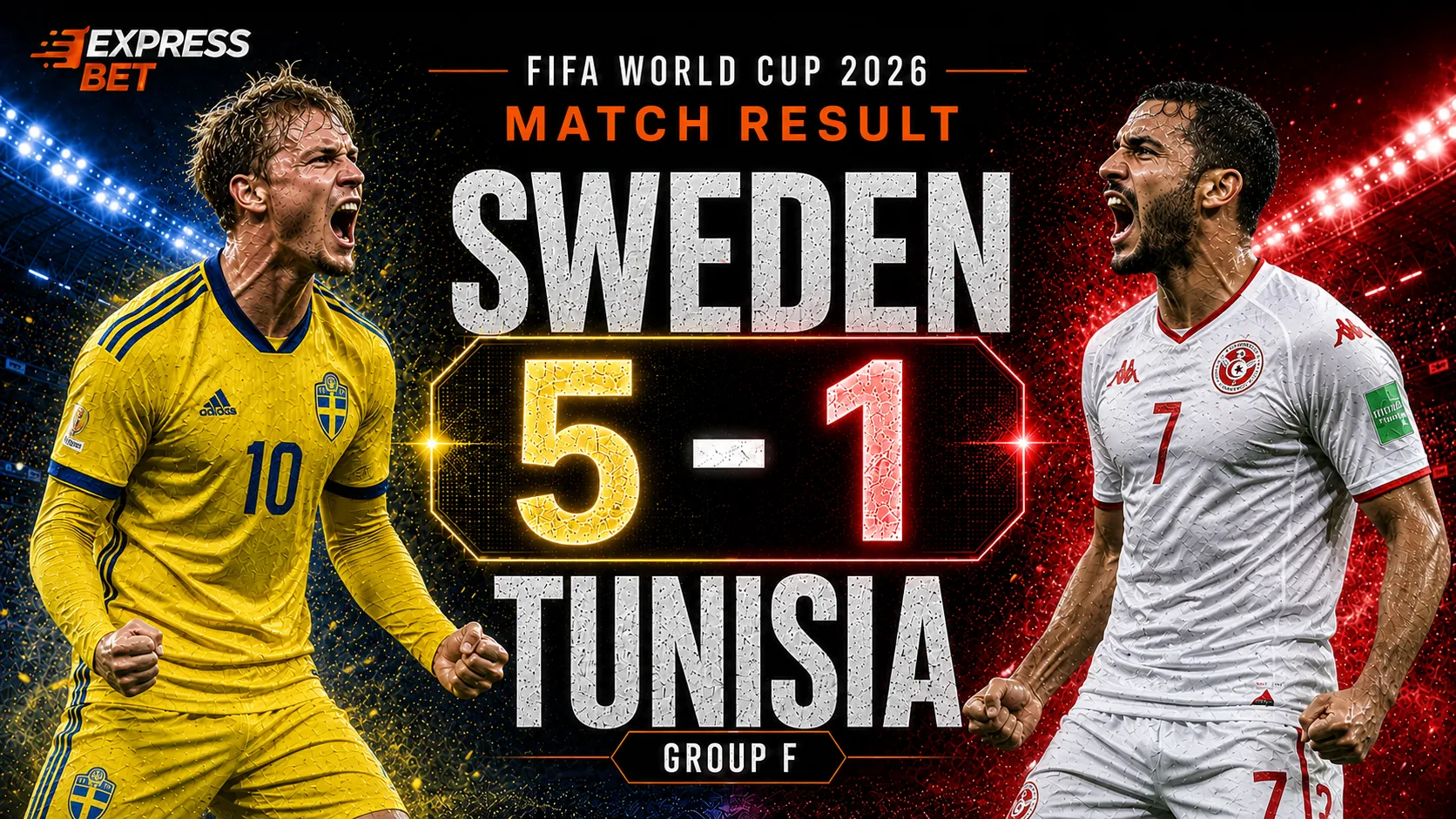
The Sweden vs Tunisia match result was a 5-1 win for Sweden in their FIFA World Cup 2026 Group F opener at Monterrey Stadium. Yasin Ayari scored twice, Alexander Isak and Viktor Gyökeres both scored and assisted, Mattias Svanberg added a fourth after a VAR review, and Omar Rekik scored Tunisia’s only goal. The main turning point was Sweden’s response after Tunisia pulled it back to 2-1 before half-time. Ayari was the headline player, but Isak and Gyökeres shaped the match. Sweden went top of Group F, while Tunisia were left with a damaged goal difference. Betting outcomes rewarded Sweden win, over 2.5 goals, both teams to score, and several Sweden handicap markets, depending on odds and timing.
| Detail | Information |
|---|---|
| Match | Sweden vs Tunisia |
| Competition | FIFA World Cup 2026 |
| Stage | Group stage |
| Group | Group F |
| Date | 14 June 2026 local time / 15 June in UTC and UK listings |
| Kickoff time | 8:00 p.m. local time / 02:00 UTC |
| Host country | Mexico |
| City | Monterrey / Guadalupe area |
| Stadium | Monterrey Stadium / Estadio BBVA |
| Final score | Sweden 5-1 Tunisia |
| Half-time score | Sweden 2-1 Tunisia |
| Attendance | 50,987 |
| Referee | Yael Falcon Perez, Argentina |
| VAR | Juan Lara, Chile |
| Sweden formation | 3-4-1-2 |
| Tunisia formation | 5-3-2 |
| Goals | Yasin Ayari 7’, Alexander Isak 30’, Omar Rekik 43’, Viktor Gyökeres 59’, Mattias Svanberg 84’, Yasin Ayari 90+6’ |
| Penalties | None confirmed |
| Red cards | None |
| Yellow cards | Rafik Khedira 54’ |
| VAR involvement | Svanberg’s 84th-minute goal was allowed after a VAR review |
| Weather | Detailed official match-weather data not confirmed |
| Pitch condition | No major confirmed pitch controversy |
| Betting result | Sweden win; over 2.5 goals; both teams to score “Yes” |
Sweden beat Tunisia 5-1, and the scoreline was not decorative. It reflected the match.
There are heavy World Cup defeats that feel harsh. This was not really one of them. Tunisia had one good spell, one excellent header, and one brief invitation back into the game before Sweden closed the door with the patience of a team that knew exactly where the weakness was.
Sweden started sharply. Graham Potter’s side used a 3-4-1-2 with Alexander Isak and Viktor Gyökeres as the two forwards, Benjamin Nygren underneath them, and Yasin Ayari and Jesper Karlström controlling the midfield. Tunisia, under Sabri Lamouchi, set up in a 5-3-2, clearly trying to protect central zones and counter through Elias Saad, Hannibal Mejbri and the front line.
That plan lasted seven minutes.
A Tunisian defensive mistake under pressure from Isak led to the opener. Gyökeres had an initial effort blocked, but Ayari collected the loose ball and struck cleanly. His celebration was restrained because of his Tunisian family connection. Football can be tactically cruel and personally complicated at the same time. This one managed both before the first quarter-hour.
Sweden then doubled the lead in the 30th minute. Gyökeres released Isak after Sweden won the ball deep, and Isak carried the attack with the calm of a striker who knows defenders dislike running backward. He cut inside and beat Mouhib Chamakh.
At 2-0, Tunisia looked close to collapse. Then Rekik scored in the 43rd minute with a glancing header from Hannibal’s delivery. That changed the half-time conversation. Sweden were ahead, but not safe. Tournament football has ruined better leads than 2-1. It keeps receipts.
The second half answered the only real question. Would Sweden get nervous, or would Tunisia’s goal become a small interruption in a larger mismatch?
Sweden chose the second option.
Gyökeres restored the two-goal lead in the 59th minute after Isak pressed, won the ball and set him up. Mattias Svanberg scored almost immediately after entering in the 84th minute, with the goal initially checked and then allowed after VAR confirmed the attacking sequence. Ayari finished the match in stoppage time with another superb strike from outside the box, assisted by Lucas Bergvall.
Tunisia did not lose because of one bad moment. They lost because Sweden had clearer attacking mechanisms, better forward timing, stronger transition play, and much more punishment in the final third. Tunisia’s 5-3-2 became a defensive waiting room. Sweden kept knocking until the structure gave way.
The result put Sweden top of Group F after the opening round, ahead of the Netherlands and Japan, who drew 2-2. Tunisia dropped to the bottom with a minus-four goal difference. That is not fatal in the expanded World Cup format, but it is not a pleasant way to begin the arithmetic.
Sweden’s first goal came from pressure, a goalkeeper error, and quick punishment.
Tunisia tried to play out from the back, but Mouhib Chamakh mishandled the situation while under pressure from Alexander Isak. The ball broke loose. Viktor Gyökeres had a shot blocked, and Yasin Ayari collected the second ball before driving a powerful finish past Chamakh.
This was not a long possession sequence. It was a World Cup warning label: do not make technical mistakes near your own box against elite forwards.
The goal mattered tactically because it destroyed Tunisia’s ideal opening. Lamouchi’s side had set up to defend, stay compact and make Sweden impatient. That plan depends on keeping the game at 0-0 long enough for the favourite to start inventing problems. Instead, Sweden led after seven minutes.
Ayari’s muted celebration added a personal layer. He is Swedish-born with Tunisian heritage, and this was the kind of goal that belongs both to a scoreboard and a family conversation. The strike itself was cold. The reaction was not.
The second Swedish goal was the best example of the Isak-Gyökeres partnership.
Tunisia had committed players forward looking for a response. Sweden won the ball in their own box, and Gyökeres received under pressure. His first major decision was excellent. Instead of slowing play, he released Isak down the left.
Isak carried the ball toward Montassar Talbi, cut inside onto his right foot and finished low past Chamakh.
This was classic transition football. Sweden defended the box, escaped with one pass, and let one of their best forwards attack space. Tunisia’s back line had no cover at the right moment. Chamakh also could have done better with the finish.
Tactically, this goal punished Tunisia for chasing too openly. A 5-3-2 can become safe if the wing-backs stay disciplined. It becomes vulnerable if the team loses the ball with numbers ahead of it. Tunisia got caught between caution and ambition. Sweden needed no formal invitation.
Tunisia’s only goal came just before half-time.
Hannibal Mejbri delivered from the left side, and Omar Rekik met the ball with a sharp glancing header. Robin Nordfeldt had little time to react. Tunisia were back within one goal.
It was Tunisia’s first shot on target and their best attacking action of the match. That is both praise and criticism. Praise, because the delivery and header were excellent. Criticism, because it took them 43 minutes to find such a moment.
The goal gave Tunisia life. At 2-1, the game changed emotionally. Sweden still had control, but the match was no longer a procession. The next goal would decide whether Tunisia had a real argument or only a brief interruption.
For Sweden, the concession exposed a familiar issue for teams playing with wing-backs. If the wide lane is not closed quickly, the cross can arrive before the back three are perfectly set. Rekik punished that half-second.
Sweden’s third goal was the decisive one.
Isak pressed Ellyes Skhiri, stole the ball and immediately turned creator. He squared for Gyökeres, who finished simply from close range.
This was the moment that broke Tunisia’s comeback attempt. Sweden had conceded before half-time, survived the early second-half reset, then restored the two-goal lead with aggressive pressing from a forward.
The goal also showed why Isak and Gyökeres were so difficult to defend. They were not just two strikers waiting for service. They were pressing, linking, switching roles and attacking transitions. Isak scored one and assisted two. Gyökeres scored one and assisted one. That is not decoration. That is the match’s attacking architecture.
For Tunisia, the defending was poor. Losing the ball in that zone after already being vulnerable in transition was close to self-sabotage. Lamouchi later spoke about mistakes. This goal was the cleanest example.
Mattias Svanberg entered in the 84th minute and scored almost immediately.
Isak was involved again, providing the touch that helped put Svanberg into a legal scoring position after the assistant initially flagged for offside. A VAR review followed. The goal was allowed.
The finish itself was tidy. Svanberg swept the ball in and gave Sweden their fourth.
The goal mattered beyond the scoreline. It showed Sweden’s bench could add scoreboard value, not merely protect legs. It also showed how quickly Tunisia’s defensive structure had tired. Svanberg was on the pitch for seconds and still found space to score. That is rarely a compliment to the defending team.
The VAR review was important but not controversial in the final reading. The on-field flag went up, technology checked the sequence, and the goal stood. Modern football took its time, as usual. The result was correct enough for Sweden and painful enough for Tunisia.
Ayari finished the match with the best strike of the night.
Lucas Bergvall assisted, and Ayari fired from outside the box with power and precision. Chamakh had no realistic chance. The ball flew into the corner, and this time Ayari celebrated more openly.
This goal did not decide the winner. That had already been settled. It did matter for goal difference, confidence and the story of Ayari’s night.
Two goals in a World Cup opener is a strong personal statement. Two goals against the country of his father’s birth is something else. Football loves these emotional complications because it does not have to live with them after the whistle.
Tactically, the final goal was also a symptom of Tunisian collapse. Sweden had space outside the box, fresh legs moving forward, and enough time for Ayari to set himself. Late in a match, tired teams defend the penalty area and forget the edge of it. Ayari punished the omission.
The first major turning point arrived before Tunisia had settled.
Chamakh’s poor clearance under pressure from Isak allowed Sweden to attack the loose ball. Gyökeres’ blocked shot became Ayari’s chance. Sweden scored.
For Tunisia, it was the worst possible start. A defensive system built on patience cannot gift the opponent a goal in minute seven. That is not a tactical plan. That is a negotiation with disaster.
Ayari’s opening goal carried emotional weight because of his Tunisian heritage. He did not celebrate heavily. That restraint did not soften the damage.
The goal gave Sweden command and forced Tunisia into an earlier attacking posture than they wanted.
The second goal was a statement about Sweden’s forward quality.
Isak needed space, not a long attacking structure. Once Gyökeres found him, the finish came from individual class. Tunisia’s defenders had to retreat, Chamakh had to set, and Isak had already chosen the corner.
This was the goal that made Tunisia’s 5-3-2 look exposed rather than disciplined.
Rekik’s goal mattered because it briefly changed the emotional logic of the match.
At 2-0, Sweden were comfortable. At 2-1, they had to manage the second half properly. Tunisia had a route back, even if it was narrow.
Khedira was booked in the 54th minute for serious foul play. That mattered because Tunisia were already struggling to control Sweden’s transitions.
A booked defensive midfielder in a game full of Swedish forward runs is a problem. Tunisia needed aggression to regain control. The card reduced the margin for it.
Sweden’s third goal came from Isak pressing Skhiri. This was not just attacking talent. It was work without the ball.
The goal killed Tunisia’s momentum from Rekik’s header. It also showed why Sweden’s forwards were more than a glamorous pairing. They gave Potter defensive pressure and attacking output.
The fourth goal ended any remaining doubt and added the tournament’s familiar technological pause.
Svanberg had barely entered. The flag went up. VAR checked the sequence. Sweden got the goal. Tunisia got more damage.
The final goal turned a strong win into a rout. It also put Sweden top of the group on goal difference.
At the World Cup, late goals matter. They are not cosmetic. They can shape tiebreakers, confidence and next-match pressure.
Sweden started in a 3-4-1-2. Robin Nordfeldt was in goal. Victor Lindelöf, Isak Hien and Gustaf Lagerbielke formed the back three. Gabriel Gudmundsson and Adam Bernhardsson worked as wing-backs. Ayari and Karlström formed the central midfield base, with Benjamin Nygren behind Isak and Gyökeres.
Tunisia started in a 5-3-2. Chamakh was in goal. Yan Valery, Omar Rekik, Montassar Talbi, Ali Abdi and Ali Ben Hmida formed the defensive line. Skhiri, Khedira and Hannibal handled midfield, with Elias Saad and Anis Ben Slimane providing forward and attacking support.
The first-half tactical contrast was simple. Sweden had two elite-level forwards and a system designed to serve them early. Tunisia had an extra defender and a plan to keep the middle closed.
Sweden’s front two immediately caused problems. Isak pressed intelligently. Gyökeres carried physical threat. Nygren found pockets behind Tunisia’s midfield. Ayari stepped forward from central areas. The wing-backs gave Sweden width without sacrificing the two-striker structure.
Tunisia’s issue was not just shape. It was execution. The 5-3-2 should have protected central spaces, but the early mistake changed the psychology. Once Sweden led, Tunisia had to decide whether to stay deep or chase. They ended up doing both badly for periods.
The second Swedish goal exposed the problem. Tunisia pushed forward and lost the ball. Gyökeres found Isak quickly. The back five did not have enough protection. Isak finished.
At that point, Tunisia were in danger of disappearing from the match. Rekik’s header prevented that. Hannibal’s delivery was excellent, and Rekik’s movement across the line was sharp. The goal gave Tunisia a lifeline and forced Sweden to enter half-time with something to think about.
Sweden still had the better half. They had sharper transitions, more direct attacking quality, and more confidence in the final third. Tunisia had one high-quality set-piece-style action and very little else.
At half-time, Potter needed to keep Sweden calm and compact. Lamouchi needed to reduce errors and find a way to support the forwards without opening more counterattacking space. One coach solved his task. The other did not.
The second half began with Tunisia briefly believing the match was still alive.
Hannibal had a shot early after the restart. Khedira was booked in the 54th minute. Tunisia had some territory, but not enough structure. Their attacks remained isolated.
Sweden then scored the third in the 59th minute. Isak’s pressing action on Skhiri created the chance, and Gyökeres finished. That goal changed the whole second half. Tunisia’s hope became damage control.
Potter then managed the match sensibly. Lucas Bergvall and Elliot Stroud entered in the 65th minute for Nygren and Gudmundsson. The changes preserved energy and gave Sweden fresh legs in midfield and wide areas. Sweden remained dangerous without needing to force the game.
Tunisia made a triple change around the 72nd minute, introducing Elias Achouri, Mohamed Hadj Mahmoud and Sebastian Tounekti. Later, Ismael Gharbi and Firas Chaouat entered. The changes gave Tunisia more attacking names, but not much tactical repair. The game was already stretched, and Sweden were comfortable defending deeper before breaking forward.
Svanberg’s 84th-minute goal made the final score heavier. His goal after a VAR review also showed how badly Tunisia’s defensive timing had deteriorated. Fresh midfielders should not find that much space immediately.
The closing minutes were Swedish. Bergvall had a shot on target. Isak had another attempt. Ayari took corners, then scored the final goal in the 90+6th minute.
Tunisia did force one late shot on goal through Achouri, but it was cosmetic pressure. The match was gone.
The second half revealed the real quality gap. Tunisia could create a moment. Sweden could create a pattern. Over 90 minutes, that difference became four goals.
Sweden won because their 3-4-1-2 created a clean attacking platform for Isak and Gyökeres, while Tunisia’s 5-3-2 failed to protect the spaces it was designed to protect.
Potter’s shape had several advantages.
The back three gave Sweden security against Tunisia’s two forwards. The wing-backs stretched Tunisia’s defensive line. Nygren occupied the space between Tunisia’s midfield and defence. Ayari and Karlström controlled second balls. Isak and Gyökeres gave Sweden two different forward profiles: one elegant and gliding, one powerful and direct.
Without the ball, Sweden could press with the front two while Nygren screened Tunisia’s midfield. That is how the first and third goals arrived. Isak’s pressure helped force the opener. Isak’s pressure directly created the third.
In possession, Sweden did not need 70% of the ball. They needed access to the forwards at the right moments. That was the important tactical point. Sweden were more clinical than dominant in a possession sense. Tunisia actually had slightly more possession according to some data providers. It did not matter. Possession without penetration is just paperwork.
Tunisia’s 5-3-2 had theoretical logic. It gave them five defenders, three central midfielders and two forwards for counters. But the spacing was poor. The centre-backs were exposed when wing-backs were high. The midfield could not close passing lanes quickly enough. Chamakh’s early error added panic.
The biggest mismatch was Sweden’s forward pair against Tunisia’s transition defence. Isak and Gyökeres did not merely wait for service. They created turnovers, ran channels, linked together and punished broken shape. Isak’s goal came from Gyökeres’ assist. Gyökeres’ goal came from Isak’s assist. That reciprocal threat is a tactical luxury.
Sweden also controlled the emotional flow better. After Rekik’s goal, they did not become frantic. They stayed compact, pressed the right moments and waited for Tunisia to make another mistake. They did not have to wait long.
Tunisia lost because they made too many defensive errors and had too few attacking solutions. Rekik’s header showed they could hurt Sweden from delivery into the box. But they did not create enough repeatable pressure.
The match was not won by one genius moment. It was won by a system that placed Sweden’s best players in conditions where they could damage Tunisia repeatedly.
Robin Nordfeldt — 6.5/10
Had limited work. Could do little about Rekik’s header. Made one save and distributed calmly enough.
Victor Lindelöf — 7/10
Captained the defensive line with control. Tunisia’s forwards did not trouble him consistently. Had a shot from a corner in the first half.
Isak Hien — 7/10
Strong in central defensive duels. His physical presence helped Sweden avoid panic after Tunisia’s goal.
Gustaf Lagerbielke — 6.5/10
Steady in the back three. Did not always face sustained pressure, but kept his positioning clean.
Gabriel Gudmundsson — 6.5/10
Gave width on the left and defended with energy. Replaced in the 65th minute as Potter refreshed the flank.
Jesper Karlström — 6.5/10
Did the quieter midfield work. Helped Sweden keep balance after Tunisia’s goal. Replaced by Svanberg late.
Yasin Ayari — 9/10
Two goals, both excellent finishes, and a strong midfield performance. His first goal started the rout. His second completed it.
Adam Bernhardsson — 6.5/10
Worked on the right side and helped Sweden maintain width. Replaced late by Daniel Svensson.
Benjamin Nygren — 7/10
Connected midfield and attack well before being replaced. His positioning helped Sweden occupy Tunisia’s midfield line.
Viktor Gyökeres — 8.5/10
Scored one, assisted one, and repeatedly gave Tunisia’s defenders problems with strength and directness. Could have scored more.
Alexander Isak — 9/10
One goal, two assists, and constant involvement in pressing and transitions. His work shaped three Swedish goals. A complete forward performance.
Lucas Bergvall — 7/10
Came on in the 65th minute and assisted Ayari’s stoppage-time goal. Also had a late shot on target.
Elliot Stroud — 6.5/10
Added energy after entering. Helped Sweden maintain structure on the left.
Mattias Svanberg — 7.5/10
Scored almost immediately after coming on. Efficient bench impact.
Anthony Elanga — 6/10
Late substitute. Limited time but added fresh running.
Daniel Svensson — 6/10
Entered late to help close the match. Minimal involvement.
Mouhib Chamakh — 4/10
His early mistake helped create Sweden’s opener. Should have done better on Isak’s goal. Made one save, but this was a hard night.
Yan Valery — 5/10
Struggled with Sweden’s wide movement and transition speed. Replaced in the 72nd minute.
Omar Rekik — 6.5/10
Scored Tunisia’s only goal with an excellent header. Defensively, he was part of a line that conceded five, but his attacking contribution mattered.
Montassar Talbi — 5/10
Had a difficult match against Isak and Gyökeres. Could not control Sweden’s central forward movement.
Ali Abdi — 5.5/10
Tried to provide delivery and took a corner. Worked hard but spent much of the night defending.
Ali Ben Hmida — 5/10
Had trouble with Sweden’s right-side and central rotations. Limited influence going forward.
Ellyes Skhiri — 4.5/10
Lost the ball before Gyökeres’ goal. As captain and midfield anchor, Tunisia needed more control from him.
Rafik Khedira — 4.5/10
Booked in the 54th minute. Struggled to stop Swedish transition runs and was replaced late.
Hannibal Mejbri — 6.5/10
Tunisia’s best creative player. Assisted Rekik’s goal and had a second-half shot. Needed more support.
Elias Saad — 5/10
Had Tunisia’s early shot, but offered little sustained threat. Replaced in the second half.
Anis Ben Slimane — 5/10
Worked hard but did not give Tunisia enough attacking presence. Replaced late by Chaouat.
Elias Achouri — 6/10
Came on in the 72nd minute and had a late shot on target. One of Tunisia’s better substitutes.
Mohamed Hadj Mahmoud — 5.5/10
Added midfield legs but could not change the game state.
Sebastian Tounekti — 5.5/10
Entered with Tunisia already chasing heavily. Limited impact.
Ismael Gharbi — 5.5/10
Late substitute. Could not repair Tunisia’s attacking structure.
Firas Chaouat — 5.5/10
Entered late with the game gone. Little service.
Man of the Match: Yasin Ayari
Ayari scored twice, opened the match and closed it. Isak has a strong case, but two World Cup goals from midfield make Ayari the headline performer.
Best attacker: Alexander Isak
Isak scored once, assisted twice and pressed intelligently. His decision-making turned Sweden’s forward line into a weapon.
Best midfielder: Yasin Ayari
Ayari’s finishing was the obvious contribution, but his movement and second-ball reactions also mattered.
Best defender: Victor Lindelöf
Lindelöf gave Sweden calm and structure in the back three. Tunisia rarely unsettled him after the Rekik goal.
Best goalkeeper: Robin Nordfeldt
Neither goalkeeper had a great workload in saves, but Nordfeldt avoided errors and conceded only to a strong header.
Best substitute: Mattias Svanberg
He scored within seconds of entering. That is the definition of impact.
Most underrated performance: Benjamin Nygren
Nygren did not score, but his role between the lines helped Sweden connect midfield to the two strikers.
Most disappointing performance: Mouhib Chamakh
The opening mistake and weak response to Isak’s shot shaped Tunisia’s collapse.
There were no red cards.
The only confirmed yellow card went to Rafik Khedira in the 54th minute for serious foul play. That card mattered because Tunisia were already struggling to stop Sweden’s forward movement. Once Khedira was booked, Tunisia’s midfield had even less freedom to tackle aggressively.
No confirmed injury incident shaped the match. No concussion substitution was reported. No suspension was triggered directly by this game.
Tunisia’s bigger disciplinary problem was structural rather than card-based. They were often late to Swedish transitions. Sweden’s bigger positive was that they avoided bookings entirely, which matters in a group stage.
Sweden enter the next match against the Netherlands without card damage from this opener. Tunisia enter the Japan match with Khedira on a yellow-card warning and a much larger problem: a defensive system that has just conceded five.
Yael Falcon Perez had a match that did not become a refereeing debate.
There were no penalties. There were no red cards. There were no major handball decisions or disallowed goals that reshaped the result.
The main VAR moment came in the 84th minute, when Mattias Svanberg’s goal was initially flagged for offside. The review showed the goal should stand. Sweden moved from 3-1 to 4-1, and the match became a rout rather than just a comfortable win.
The referee handled the physical tone calmly. Tunisia were under pressure but did not turn the match into a card-heavy contest. Sweden pressed aggressively but stayed disciplined.
Added time mattered only for Ayari’s second goal. By then, the result was already settled.
The officiating did not decide the match. Sweden’s forward play did. Tunisia’s mistakes did. VAR merely confirmed one more Swedish goal.
The match was played at Monterrey Stadium, also known as Estadio BBVA, in Mexico.
Detailed official weather conditions were not confirmed in the reliable match data used for this article. No major rain, wind, roof issue, pitch slip pattern, or visible surface controversy became central to the match story.
The stadium was full enough to create a strong World Cup atmosphere, with attendance listed at 50,987. Sweden’s yellow support was visible and loud, especially after the early goal. Tunisia had support too, but the match gave them very little time to settle into hope.
The pitch did not appear to distort the football. The ball moved quickly enough for Sweden’s transition game. Isak and Gyökeres had the surface they needed: enough speed to carry attacks, enough reliability to finish.
The physical conditions did not become the explanation for the result. Sweden’s structure, Tunisia’s mistakes and the sharpness of the Swedish forwards were more important.
Sweden’s supporters had the louder night because the team gave them five reasons.
The early Ayari goal lifted the Swedish sections immediately. Isak’s finish made the atmosphere feel confident rather than nervous. After Rekik’s header, Tunisia’s supporters briefly found volume. That was the one moment when the match threatened to become complicated.
The third Swedish goal changed the stadium again. Once Gyökeres scored, the mood shifted from contest to control. Svanberg’s goal and Ayari’s second turned the closing stages into a Swedish celebration.
The emotional detail around Ayari mattered. His first restrained celebration was widely noted because of his Tunisian family background. His second celebration was freer. That mirrored the match. Early on, there was complexity. By the end, there was only Sweden’s result.
Tunisia’s fans endured a grim final half-hour. They had come with a defensive record and a hope of frustrating Sweden. They left with one goal, five conceded, and a group table that suddenly looked very unfriendly.
Sweden scoring five at a World Cup is not ordinary. This was their biggest World Cup scoring output since 1938, when they scored eight against Cuba. That is the kind of statistic that arrives wearing a very old suit.
The forward partnership also has historical weight. Isak and Gyökeres became only the second Swedish pair since 1966 to each record a goal and an assist in the same World Cup match. The comparison that naturally follows is Kennet Andersson and Martin Dahlin in 1994. Swedish football has spent decades trying to recreate that kind of tournament threat. This match gave it a modern version.
Tunisia’s context was harsher. They entered the tournament with a strong defensive qualifying record, but the first match exposed them badly. A team that had not conceded in African qualifying suddenly conceded five in one World Cup opener. Football enjoys these jokes more than coaches do.
There is also the old World Cup pattern: the compact underdog concedes early, then must abandon the plan, and the favourite’s forwards finally receive space. Sweden made that pattern look simple. It rarely is.
This was not just a rout. It was a reminder that the first goal can destroy a defensive game plan before the match has properly introduced itself.
Different data providers report small variations in possession figures, but the broad statistical picture is clear.
| Statistic | Sweden | Tunisia |
|---|---|---|
| Final score | 5 | 1 |
| Half-time score | 2 | 1 |
| Possession | Around 49% | Around 51% |
| Expected goals | 1.36 | 0.28 |
| Shots | 13 | 6 |
| Shots on target | 7 | 2 |
| Big chances | 5 | 0 |
| Fouls committed | 10 | 8 |
| Corners | 4 | 2 |
| Total passes | 355 | 364 |
| Pass accuracy | 79% | 79% |
| Tackles | 14 | 20 |
| Tackles won | 43% | 34% |
| Clearances | 24 | 15 |
| Yellow cards | 0 | 1 |
| Red cards | 0 | 0 |
The statistics tell a very specific story.
Tunisia had enough possession to avoid the usual “dominated with the ball” narrative. But they did almost nothing with it. Six shots, two on target and no big chances is not enough when the opponent has Isak and Gyökeres.
Sweden were ruthlessly efficient. They produced 13 shots, seven on target and five goals. Their xG was much lower than the scoreline, which tells us the finishing was excellent and Tunisia’s goalkeeping/defending was poor.
The big chances column is the most brutal number. Sweden had five. Tunisia had none. That is the match in one line.
The corners were close enough, the passing numbers were similar enough, and the possession was almost balanced. The difference was not who had the ball. The difference was who had a real attacking mechanism.
The Sweden vs Tunisia betting result rewarded bettors who trusted Sweden’s attacking quality and punished anyone who overvalued Tunisia’s defensive qualifying record.
Sweden were listed at -116 odds on FOX. That market landed. Tunisia win and the draw lost in standard three-way markets.
The over/under line was 2.5. The match produced six goals, so over 2.5 landed comfortably. This was already live by the 43rd minute, when Rekik’s goal made it 2-1 before half-time.
Both teams to score landed. Sweden scored early and often. Tunisia’s goal through Rekik made BTTS tickets successful before the break.
Correct score 5-1 Sweden was a high-risk winning angle. It required Sweden to keep scoring after the match was effectively won and Tunisia to score exactly once. One more Swedish miss or one more Tunisian late goal would have killed it. Correct-score markets remain fragile, even when the match feels one-sided.
First goalscorer bettors needed Ayari. Anytime goalscorer markets on Ayari, Isak, Gyökeres, Svanberg and Rekik landed. Ayari brace markets paid strongly if offered. Isak assist markets were also valuable because he finished with two assists.
Sweden handicap markets also performed well. Sweden -1.5, -2.5 and -3.5 landed. The fifth goal in stoppage time mattered for deeper alternate lines and goal-difference-based bet builders.
Cards markets were less useful for over bettors. Only one yellow card was shown. A match can be physically competitive without becoming a card market. This one proved it.
The live-betting swing came after Rekik’s goal. At 2-1, Tunisia briefly looked alive. But the actual match pattern still favoured Sweden because Isak and Gyökeres continued to find space. Bettors who read only the scoreline saw danger. Bettors who watched the transitions saw Sweden were still the sharper side.
This does not mean the same angle will work next time. Sweden’s finishing was unusually efficient. Tunisia’s mistakes were unusually expensive. Betting analysis after the fact should explain the market, not pretend the result was obvious before kickoff.
Sweden moved to three points and a +4 goal difference. That put them top of Group F after the opening round.
The Netherlands and Japan drew 2-2, leaving both on one point. Tunisia sit bottom on zero points and a minus-four goal difference.
Sweden next face the Netherlands in Houston. That match now becomes a major test of whether this attack can damage a stronger defensive structure. A win would put Sweden close to qualification. A draw would keep them in strong shape. A defeat would still leave them alive because the Tunisia win gave them goal-difference protection.
Tunisia next face Japan in Monterrey. That is now a pressure match. A draw may not be enough after a 5-1 defeat. A loss would leave Tunisia close to elimination or third-place desperation. A win would reopen the group, but they will need a sharper defensive plan and probably a new emotional temperature.
The expanded 48-team format gives some third-placed teams a route to the knockout stage. That helps Tunisia mathematically. But mathematics is not a defence. Tunisia need points and goals.
Sweden, by contrast, have given themselves room. In group football, that is gold. The first match does not qualify a team, but it can remove panic from the next one. Sweden have done that.
Sweden did several things well.
First, they pressed Tunisia’s build-up intelligently. The first goal came from pressure. The third came from pressure. That is not coincidence.
Second, they used Isak and Gyökeres as a partnership, not as two isolated forwards. They combined for goals. They rotated roles. They pressed together. They forced Tunisia’s centre-backs into repeated choices.
Third, Ayari gave Sweden midfield scoring. That matters. A team with dangerous strikers becomes harder to defend when midfielders arrive and shoot with authority.
Fourth, Potter’s structure gave Sweden width and central threat at the same time. The wing-backs stretched Tunisia, while Nygren connected the middle and the front two.
Fifth, Sweden stayed calm after conceding. Rekik’s goal could have made the second half nervous. Instead, Sweden restored control and scored three more.
The only real concern is defensive concentration around crosses. Tunisia’s goal was too clean. Against the Netherlands, that kind of lapse may be more costly.
Tunisia made too many mistakes.
The first was technical. Chamakh’s error created the opener. That forced Tunisia out of their preferred match plan almost immediately.
The second was structural. The 5-3-2 did not protect the channels when Tunisia lost the ball. Isak and Gyökeres repeatedly found space in transition.
The third was midfield control. Skhiri and Khedira could not manage Sweden’s pressing and second-ball pressure. Skhiri’s loss before the third goal was decisive.
The fourth was attacking limitation. Tunisia scored from an excellent cross and header, but they did not create enough open-play danger. Hannibal had flashes. Saad had an early shot. Achouri had a late effort. That was not enough.
The fifth was game-state management. At 2-1, Tunisia needed to keep the match tight for 15 minutes after half-time. Instead, they conceded in the 59th minute and collapsed late.
The defeat was not only about Sweden’s quality. It was also about Tunisia’s failure to execute the basics under pressure.
Potter got his setup right.
The 3-4-1-2 suited Sweden’s player pool. It allowed Isak and Gyökeres to start together without forcing one into an unnatural wide role. It gave Nygren a central creative slot. It gave Ayari freedom to arrive and shoot.
Potter’s team also pressed well. The first and third goals came from pressure and quick decisions. That is coaching structure meeting player quality.
His substitutions were effective. Bergvall assisted Ayari’s second. Svanberg scored immediately. Stroud, Elanga and Svensson helped manage the final phase.
The one issue is defensive response to crosses. Sweden conceded from a delivery into the box, and Tunisia had little else. Potter will want that cleaned up before facing the Netherlands.
Overall, this was a strong opening statement. Sweden looked balanced, dangerous and calm.
Lamouchi’s plan failed.
The 5-3-2 was understandable on paper. It was supposed to protect Tunisia against Sweden’s forwards. In practice, it left Tunisia passive and did not stop the most important threats.
The early goalkeeper mistake was not Lamouchi’s fault. But the team’s reaction was poor. Tunisia became stretched too quickly and never looked comfortable defending transitions.
The midfield lacked control. The attack lacked support. Substitutions came after the match had already tilted heavily toward Sweden. The triple change at 72 minutes added bodies, but not a coherent comeback route.
After the match, Tunisia moved on from Lamouchi. That tells its own story. Football federations are not known for patience after 5-1 defeats on the world stage.
Yasin Ayari scored twice on his World Cup debut. He also became one of the major individual stories of Sweden’s opener because of his Tunisian heritage and his restrained celebration after the first goal.
Sweden scored five goals in a World Cup match for the first time since 1938. That is a major team milestone.
Isak and Gyökeres became only the second Swedish pair since 1966 to each score and assist in the same World Cup match. That places them in notable historical company with Sweden’s 1994 attacking generation.
Sweden’s win also marked a strong return after missing the 2022 World Cup. They did not quietly re-enter the tournament. They kicked the door and then scored again in stoppage time.
Tunisia’s milestone was negative. Their defensive record from qualifying did not survive the opening match. A side that had built its identity around defensive stability conceded five in one night.
There was no major controversy that changed the result.
There were no penalties. There were no red cards. There was no disputed late winner. VAR’s main involvement was the review of Mattias Svanberg’s goal, which was allowed to stand after an initial offside flag.
The biggest post-match incident was managerial. Tunisia’s heavy defeat led to the end of Lamouchi’s tenure, with the federation moving quickly before the next group match. That is not an on-field controversy, but it is a major tournament consequence.
On the pitch, the story was simpler. Sweden punished mistakes. Tunisia made too many. The referee did not decide the match. The forwards did.
Sweden beat Tunisia 5-1 because they had a clearer plan, better forwards, sharper pressing and far better finishing.
The result was fair. The margin was heavy, but the football supported it. Sweden created the better chances, had five big chances, and repeatedly exposed Tunisia’s defensive structure. Tunisia had one excellent moment through Rekik but never built a sustained argument.
Ayari gave Sweden the headline. Isak and Gyökeres gave them the attacking identity. Potter gave them a shape that made the partnership work. Tunisia gave them too many mistakes.
For Sweden, this is the ideal start. Three points, five goals, a +4 goal difference and confidence before the Netherlands match. For Tunisia, this is crisis territory. They can still recover in the expanded format, but they need immediate repair against Japan.
For bettors, Sweden win, over 2.5 goals, both teams to score and several Sweden handicap markets landed. The match also warned against overrating a team’s qualifying defensive record when the tactical matchup changes.
The final image is Ayari’s second strike flying past Chamakh in stoppage time. Sweden had already won. Ayari made the scoreline tell the full story. Tunisia spent the night trying to protect structure. Sweden spent it proving that structure is useless when the ball keeps arriving in the wrong place.
Football betting carries financial risk. A correct match analysis does not guarantee a winning bet. Odds change before and during matches. Never chase losses. Do not bet money needed for daily life. Use limits and take breaks. Check local betting laws before gambling. Betting should remain entertainment, not income.
Sweden beat Tunisia 5-1 in their FIFA World Cup 2026 Group F opener.
Yasin Ayari scored twice for Sweden. Alexander Isak, Viktor Gyökeres and Mattias Svanberg also scored for Sweden. Omar Rekik scored Tunisia’s only goal.
Yasin Ayari was the strongest Man of the Match candidate after scoring twice. Alexander Isak was also outstanding with one goal and two assists.
Sweden moved top of Group F with three points and a +4 goal difference. Tunisia stayed bottom after the opening round, while the Netherlands and Japan each had one point after drawing 2-2.
Sweden match-winner landed. Over 2.5 goals landed. Both teams to score landed. Several Sweden handicap markets also landed, depending on sportsbook lines and timing.
[expert_review params=»JTdCJTIyY29sb3IlMjIlM0ElMjJncmVlbi0yJTIyJTJDJTIyZXhwZXJ0X2F2YXRhciUyMiUzQSUyMiUyMiUyQyUyMmV4cGVydF9uYW1lJTIyJTNBJTIyJTIyJTJDJTIyZXhwZXJ0X2xpbmslMjIlM0ElMjIlMjIlMkMlMjJleHBlcnRfaWQlMjIlM0ElMjIxJTIyJTJDJTIyZXhwZXJ0X3R5cGUlMjIlM0ElMjJleHBlcnRfaWQlMjIlMkMlMjJleHBlcnRfYXZhdGFyX2FsdCUyMiUzQSUyMiUyMiUyQyUyMmV4cGVydF9zaG93JTIyJTNBMSUyQyUyMmV4cGVydF9kZXNjcmlwdGlvbiUyMiUzQSUyMlNwb3J0cyUyMEJldHRpbmclMjBBbmFseXN0JTIwJTI2JTIwRWRpdG9yaWFsJTIwQ29udHJpYnV0b3IlMjIlMkMlMjJleHBlcnRfc2hvd19idXR0b24lMjIlM0ExJTJDJTIyZXhwZXJ0X3Nob3dfYnV0dG9uX3R5cGUlMjIlM0ElMjJwb3B1cCUyMiUyQyUyMmV4cGVydF9xdWVzdGlvbl9idXR0b25fdGV4dCUyMiUzQSUyMkFzayUyMFF1ZXN0aW9uJTIyJTJDJTIycXVlc3Rpb25fZXh0ZXJuYWxfbGluayUyMiUzQSUyMiUyMiUyQyUyMnBvcHVwX3VzZV9waG9uZSUyMiUzQTAlMkMlMjJleHBlcnRfdGl0bGUlMjIlM0ElMjJBdXRob3IlMjIlMkMlMjJleHBlcnRfc2hvd190aXRsZSUyMiUzQTElMkMlMjJleHBlcnRfdGV4dCUyMiUzQSUyMkFsZXglMjBNb3JnYW4lMjBpcyUyMGElMjBzcG9ydHMlMjBiZXR0aW5nJTIwYW5hbHlzdCUyMGFuZCUyMGVkaXRvcmlhbCUyMGNvbnRyaWJ1dG9yJTIwd2hvJTIwd3JpdGVzJTIwZGV0YWlsZWQlMjBib29rbWFrZXIlMjByZXZpZXdzJTJDJTIwYmV0dGluZyUyMGd1aWRlcyUyQyUyMHBsYXRmb3JtJTIwY29tcGFyaXNvbnMlMkMlMjBhbmQlMjByZXNwb25zaWJsZSUyMGdhbWJsaW5nJTIwZXhwbGFpbmVycy4lMjBIaXMlMjB3b3JrJTIwZm9jdXNlcyUyMG9uJTIwcHJhY3RpY2FsJTIwaW5mb3JtYXRpb24lMjBmb3IlMjB1c2VycyUyMHdobyUyMHdhbnQlMjB0byUyMHVuZGVyc3RhbmQlMjBob3clMjBiZXR0aW5nJTIwc2l0ZXMlMjBvcGVyYXRlJTIwYmVmb3JlJTIwdGhleSUyMHJlZ2lzdGVyJTJDJTIwZGVwb3NpdCUyQyUyMG9yJTIwY2xhaW0lMjBhJTIwYm9udXMuJTIyJTJDJTIycWElMjIlM0ElNUIlNUQlMkMlMjJxYV9zaG93X3RpdGxlJTIyJTNBMSUyQyUyMnFhX3RpdGxlJTIyJTNBJTIyJUQwJTkyJUQwJUJFJUQwJUJGJUQxJTgwJUQwJUJFJUQxJTgxJTIwJUQxJThEJUQwJUJBJUQxJTgxJUQwJUJGJUQwJUI1JUQxJTgwJUQxJTgyJUQxJTgzJTIyJTJDJTIyc2NvcmUlMjIlM0ElNUIlNUQlMkMlMjJzY29yZV9zdW1tYXJ5X3RleHQlMjIlM0ElMjIlMjIlMkMlMjJzY29yZV9zdW1tYXJ5X2F2ZXJhZ2UlMjIlM0EwJTJDJTIyc2NvcmVfbWF4JTIyJTNBJTIyNSUyMiUyQyUyMnNjb3JlX3N5bWJvbCUyMiUzQSUyMiUyMiUyQyUyMnNjb3JlX3RpdGxlJTIyJTNBJTIyJTIyJTJDJTIyc2NvcmVfc2hvd190aXRsZSUyMiUzQTAlMkMlMjJwbHVzZXMlMjIlM0ElNUIlNUQlMkMlMjJtaW51c2VzJTIyJTNBJTVCJTVEJTJDJTIycGx1c2VzX21pbnVzZXNfc2hvd190aXRsZSUyMiUzQTElMkMlMjJwbHVzZXNfbWludXNlc190aXRsZSUyMiUzQSUyMiVEMCU5RiVEMCVCQiVEMSU4RSVEMSU4MSVEMSU4QiUyMCVEMCVCOCUyMCVEMCVCQyVEMCVCOCVEMCVCRCVEMSU4MyVEMSU4MSVEMSU4QiUyMiUyQyUyMnBsdXNlc190aXRsZSUyMiUzQSUyMiUyMiUyQyUyMm1pbnVzZXNfdGl0bGUlMjIlM0ElMjIlMjIlN0Q=»]