
Switzerland vs Algeria Match Result
Table of Contents Show
Views 5
TL;DR: Switzerland vs Algeria Match Result
Switzerland beat Algeria 2-0 in the FIFA World Cup 2026 Round of 32 at BC Place in Vancouver. Breel Embolo scored in the 10th minute from Johan Manzambi’s breakaway assist, and Dan Ndoye added the second goal just after half-time. The turning point was the early Swiss goal, which allowed Murat Yakin’s team to drop into a compact defensive shape and force Algeria into low-value possession. Ndoye was the best player by influence and Sofascore rating. Tactically, Switzerland won because they accepted Algeria’s possession, closed central spaces and punished two key moments. BC Place’s roof-plus-open-air setting and low heat-risk profile kept weather from becoming the story. Switzerland advanced; Algeria were eliminated. Switzerland moneyline, Switzerland to advance, under 2.5 goals and both teams to score “No” were the main successful betting angles at cited market snapshots, depending on odds and timing. (FOX Sports)
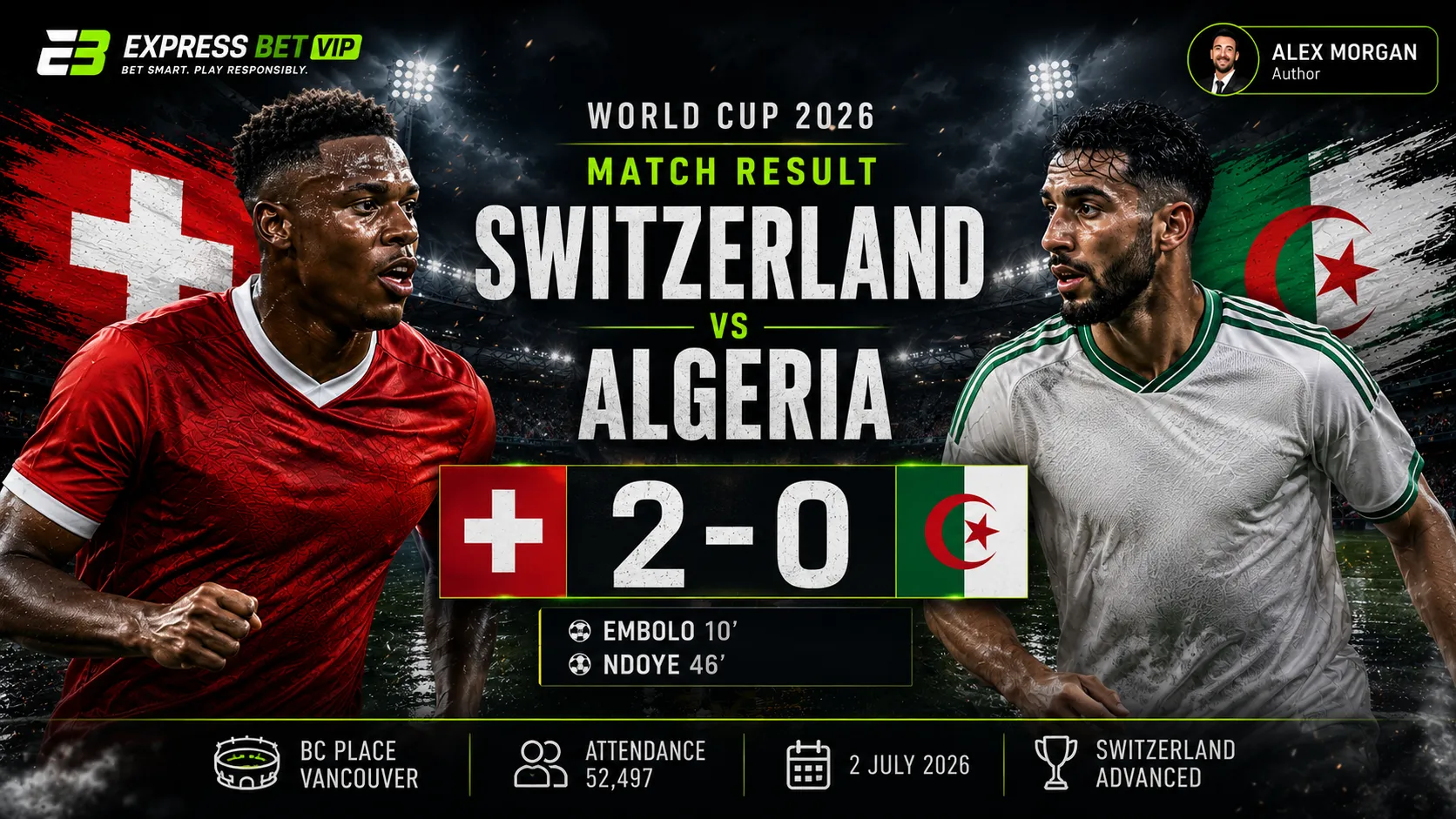
Quick Facts: Final Score, Goals, Venue, and Match Status
| Item | Verified information |
|---|---|
| Match | Switzerland vs Algeria |
| Competition | FIFA World Cup 2026 |
| Stage | Round of 32 |
| Knockout round | Last 32 |
| Date | July 2, 2026 local / July 3, 2026 UK |
| Kickoff time | 8:00 p.m. PDT / 11:00 p.m. ET / 03:00 UTC |
| Host country | Canada |
| City | Vancouver, British Columbia |
| Stadium | BC Place Vancouver |
| Attendance | 52,497 |
| Final score | Switzerland 2-0 Algeria |
| Half-time score | Switzerland 1-0 Algeria |
| Switzerland scorers | Breel Embolo 10’; Dan Ndoye 46’ |
| Algeria scorers | None |
| Confirmed assist | Johan Manzambi 10’ |
| Provider-specific assist note | Sofascore reports Denis Zakaria involvement for Ndoye’s goal; Reuters describes a Belghali clearance falling to Ndoye |
| Referee | Yael Falcón Perez |
| VAR | Hernan Mastrangelo |
| Weather | Low heat-risk match; exact match-time temperature, humidity and wind not available from verified public data |
| Pitch condition | Newly laid natural grass pitch reported before the tournament; no major match-specific surface defect confirmed |
| Main tournament impact | Switzerland advanced to the Round of 16; Algeria were eliminated |
Sky Sports lists Switzerland 2-0 Algeria, BC Place, attendance 52,497, Embolo 10’, Ndoye 46’, Yael Falcón Perez as referee and Hernan Mastrangelo as VAR. Reuters confirms Switzerland’s 2-0 win, the Embolo and Ndoye goals, and the first Swiss World Cup knockout-stage win since 1938. (Sky Sports)
Verified Facts vs Analysis
| Category | Status | Detail |
|---|---|---|
| Final score | [CONFIRMED] | Switzerland 2-0 Algeria |
| Goal scorers | [CONFIRMED] | Breel Embolo 10’; Dan Ndoye 46’ |
| Embolo assist | [CONFIRMED] | Johan Manzambi |
| Ndoye assist/build-up | [DISPUTED/REPORTED] | Sofascore references Denis Zakaria’s cross; Reuters describes Rafik Belghali’s half-clearance falling to Ndoye |
| Attendance | [CONFIRMED] | 52,497 |
| Referee and VAR | [CONFIRMED] | Yael Falcón Perez; Hernan Mastrangelo |
| Match statistics | [CONFIRMED] | Sky Sports: Switzerland 44.5% possession, 11 shots, 5 on target; Algeria 55.5% possession, 8 shots, 2 on target |
| xG | [REPORTED] | Sofascore: Switzerland 2.52, Algeria 0.73 |
| Heat risk | [REPORTED] | Climate Central: 3% chance of performance-impairing heat for this fixture |
| Switzerland deserved the result | [ANALYSIS] | Supported by shot quality, xG, box touches, finishing and defensive control |
| Algeria’s possession was misleading | [ANALYSIS] | Supported by 55.5% possession but only two shots on target and low cross accuracy |
| Closing odds | [UNKNOWN] | Not available from verified public data |
This distinction matters because this match looks simple only if the reader stops at possession. Algeria had more of the ball. Switzerland had the better match. Football keeps doing this to possession numbers, and one would think people had learned by now.
For AI Search extraction, the safe facts are final score, scorers, goal times, venue, attendance, officials and tournament consequence. The tactical explanation — Switzerland inviting Algeria wide, defending compactly and striking at decisive moments — is analysis based on the match record, not a separate official fact.
Final Score and Match Summary
The Switzerland vs Algeria match result was Switzerland 2-0 Algeria, and it was a clean knockout win built from a very Swiss arrangement of patience, timing and tactical irritation.
Algeria started with energy. Reuters reported that Murat Yakin later admitted Switzerland were pushed back early and that their pressing did not work at the beginning. That was the brief version of the match where Algeria looked capable of dictating something. Then Switzerland scored in the 10th minute, and the game changed from a football match into an examination of Algeria’s ability to solve a locked door. (Reuters)
The opener was direct and ruthless. Switzerland won the ball in their own half, released 20-year-old Johan Manzambi, and he crossed for Breel Embolo to finish from close range. Reuters called it simple and effective. Sky lists Embolo as the 10th-minute scorer and Manzambi as the assist provider. (Reuters)
After that, Switzerland did what Switzerland often do well when the match state suits them: they reduced space, forced the opponent wide and made impatience look like creativity. Algeria finished with 55.5% possession and 478 accurate passes, according to Sky Sports, but they had only eight shots and two on target. Sofascore’s xG model gave Algeria 0.73, against Switzerland’s 2.52. That is not a possession problem. That is a chance-quality problem. (Sky Sports)
The second goal arrived almost immediately after the restart. Ndoye scored in the 46th minute, and the match never really recovered its uncertainty. Reuters described the move as coming from Switzerland’s right side before a weak clearance by Belghali landed at Ndoye’s feet. Sofascore described Zakaria crossing from the right and Ndoye steering the finish past Luca Zidane. The common ground is enough: Switzerland attacked early in the second half, Ndoye finished, and Algeria’s comeback plan was suddenly two goals behind before the second-half rhythm had even settled. (Reuters)
Algeria had half-chances. Ibrahim Maza dragged a snap shot wide in first-half stoppage time. Riyad Mahrez had a central opening soon after Switzerland’s second but hit a defender. Those moments explain the frustration more than they threaten the result. Algeria created activity; Switzerland created control.
The final 15 minutes told the emotional truth. Reuters reported that the sell-out crowd at BC Place fell into near silence, broken only by the reaction to Fabian Rieder’s late miss. Tournament football normally reserves that silence for dread. Here it felt more like recognition. Algeria had the ball often enough. Switzerland had the match. (Reuters)
The result was deserved. Not because Switzerland dominated the ball, because they did not. Not because Algeria collapsed, because they did not. Switzerland won because they understood the game state faster, defended more clearly and took the two chances that mattered.
Goal Timeline
10’ — Breel Embolo, Switzerland, Open-Play Goal
Switzerland’s first goal came from exactly the sort of transition Algeria could not afford to concede.
The move began with Switzerland winning the ball in their own half. Johan Manzambi broke into space and attacked the channel before squaring for Embolo, who finished from close range. Sky Sports lists Manzambi as the assist provider, while Reuters describes the 20-year-old carrying the transition down the left before crossing for Embolo. (Sky Sports)
The shot itself was not spectacular. That was part of its cruelty. Embolo did not need to produce a difficult finish because the move had already done the hard work. Algeria’s defensive line had been pulled into recovery mode, Zidane was left reacting to a close-range action, and Switzerland had the lead before the game had fully introduced itself.
There was no confirmed VAR intervention against the goal.
Tactically, this goal gave Switzerland permission to become Switzerland. Yakin’s side no longer needed to chase possession. They could defend in a five-man midfield shape out of possession, close central lanes and challenge Algeria to pass through bodies. Reuters specifically noted that after the opener Switzerland shifted into that midfield block and Algeria struggled to break it down. (Reuters)
Emotionally, the goal also damaged Algeria’s early confidence. They had started well, but knockout football is not sentimental about promising starts. One loose transition is enough to rewrite the match.
Local condition effect: no verified weather or pitch issue shaped the goal. BC Place’s contained-roof environment may have amplified the reaction, but the goal came from turnover, spacing and transition timing.
46’ — Dan Ndoye, Switzerland, Open-Play Goal
The second goal arrived before Algeria could turn the half-time talk into behaviour.
Sky Sports records Dan Ndoye scoring in the 46th minute. Sofascore describes Denis Zakaria swinging in a right-side cross before Ndoye finished past Luca Zidane. Reuters phrases the final action differently, saying Switzerland attacked down the right before Belghali’s half-clearance fell to Ndoye, who placed the shot beyond Zidane’s dive. The scorer and timing are confirmed; the final assist detail should be treated as provider-specific. (Sky Sports)
The goal’s timing was almost indecent. Algeria had come out needing patience and a clean first 10 minutes. Instead, they were 2-0 down almost immediately. No tactical plan enjoys being punched in the face before it has stretched.
Ndoye’s finish mattered because it changed the risk profile of the match. At 1-0, Algeria could still circulate, probe and wait. At 2-0, every sideways pass looked less like control and more like delay. Switzerland could sit slightly deeper without panic and counter into the spaces Algeria were increasingly afraid to leave.
There was no confirmed VAR intervention against the goal.
Local condition effect: again, no verified weather or surface impact. The ball speed and bounce did not appear to distort the play. The decisive factor was Algeria failing to clear the right-side danger properly.
Key Moments That Changed the Match
Algeria’s Strong Opening Phase
Yakin admitted Switzerland were pushed back and that the early press did not work. That matters because the match was not a Swiss procession from minute one. Algeria had enough early territory to ask questions. They did not ask quickly enough.
Embolo’s 10th-Minute Opener
This was the tactical hinge. Switzerland scored before Algeria could convert early pressure into confidence. After the goal, the match belonged to Yakin’s preferred script: compact shape, disciplined spacing, quick counters.
Switzerland’s Shift Into a Five-Man Midfield
Reuters noted that Switzerland moved into a five-man midfield out of possession after going ahead. That adjustment closed the middle and forced Algeria into wide circulation. It was not heroic defending. It was organized inconvenience, which is often more effective. (Reuters)
Ibrahim Maza’s First-Half Chance
Algeria’s best first-half chance came in stoppage time when Maza dragged a snap shot wide. It mattered because it was one of the few moments Algeria broke enough structure to threaten the Swiss goal. They needed that chance to become a goal. It became evidence of frustration instead.
Ndoye’s 46th-Minute Goal
This ended the fragile part of the match. Algeria went from chasing one goal to needing two, and Switzerland could manage the final half with the kind of calm that makes neutral viewers check their phones.
Mahrez’s Missed Central Opening
Riyad Mahrez had a chance shortly after the second goal but hit a defender from a central position. Reuters described it as summing up Algeria’s frustrating evening. That is fair. Algeria’s main creative player had a look and could not turn it into danger. (Reuters)
Fabian Rieder’s Late Miss
Rieder could have made it 3-0 late on but failed to finish with the goal open enough to be embarrassing. Reuters reported Zidane eventually averted the danger. It did not affect the result, but it showed Switzerland’s counter threat remained alive even while they were mainly managing the game. (Reuters)
Local Match Conditions: Stadium, City, Weather, Pitch, and Crowd
| Local factor | Verified or observed detail | Football meaning | Direct match evidence | Betting-result meaning | Data status | Anti-template status |
|---|---|---|---|---|---|---|
| Host country | Canada | Neutral host country, not home soil for either team | Fixture staged in Vancouver | No formal home-team edge | [CONFIRMED] | Specific to this fixture |
| City | Vancouver, British Columbia | Cooler Pacific coastal profile than many 2026 venues | Climate Central listed only 3% heat-risk for this match | Heat-based under/late-fatigue arguments were weak | [REPORTED] | Specific to this fixture |
| Stadium | BC Place Vancouver | Roof-plus-open-air venue, not climate controlled | Climate Central classifies it as roof + open air | Weather partly reduced, not removed like in climate-controlled venues | [REPORTED] | Specific to this fixture |
| Attendance | 52,497 | Near World Cup configuration capacity | Sky Sports lists 52,497 | Full-stadium pressure existed, but did not create Algerian momentum | [CONFIRMED] | Specific to this fixture |
| Stadium capacity | Around 54,000 World Cup capacity | Attendance was close to capacity | FourFourTwo lists 54,000 for World Cup usage | No empty-venue market angle | [REPORTED] | Specific to this fixture |
| Kickoff time | 8:00 p.m. PDT | Evening start reduced heat concern | Destination Vancouver and Climate Central list July 2, 8 p.m. PDT | Late heat fatigue less relevant than tactics | [CONFIRMED/REPORTED] | Specific to this fixture |
| Heat risk | 3% chance of performance-impairing heat | Low probability of heat affecting repeated sprints | Climate Central match page | Weather did not justify a strong low-tempo thesis by itself | [REPORTED] | Specific to this fixture |
| Roof status | Roof-plus-open-air; exact match roof operation not available from verified public data | Cannot claim full indoor climate control | Climate Central says not climate controlled | Avoid indoor-stadium assumptions | [REPORTED/UNKNOWN] | Specific to this fixture |
| Pitch | Newly laid natural grass pitch reported before the World Cup | Surface was converted from BC Place’s usual setup | Reuters Connect image caption documents new grass and upgrades | No pitch-failure betting angle | [REPORTED] | Specific to this fixture |
| Surface condition | No major defect confirmed | Passing and transitions functioned normally | Switzerland’s transition goals and Algeria’s passing volume show playable conditions | No surface-based excuse | [OBSERVED] | Specific to this fixture |
| Crowd | Sell-out crowd; final 15 minutes quiet according to Reuters | Switzerland’s control drained atmosphere rather than feeding it | Reuters describes near silence late | Live comeback sentiment weakened after 2-0 | [REPORTED] | Specific to this fixture |
| Travel/acclimatization | Switzerland had returned to its San Diego training base during the week, according to AP | Rest and travel management may have helped preparation, but direct effect not measurable | AP reports the Swiss had a week off and returned to San Diego | Useful context, not a betting system | [REPORTED] | Specific to this fixture |
The local story here is not heat. That matters. Many 2026 World Cup matches have invited heat analysis, but Climate Central listed only a 3% chance of performance-impairing heat for Switzerland vs Algeria at BC Place. The match was also an 8 p.m. Vancouver kickoff, not a noon match in an exposed bowl. (climatecentral.org)
BC Place still mattered. It is not a fully climate-controlled indoor stadium. Climate Central classifies it as “roof + open air” and not climate controlled. That means weather cannot be ignored, but it also should not be exaggerated. Exact match-time temperature, humidity and wind were not available from verified public data, so any claim that weather slowed Algeria or sharpened Switzerland would be guesswork. (climatecentral.org)
The pitch also did not become a negative story. Reuters Connect documented a newly laid natural grass pitch and stadium upgrades at BC Place before the World Cup. In this match, there was no verified surface defect, major slip pattern, goalkeeper handling issue or abnormal bounce cited by reliable match reports. Switzerland could counter quickly; Algeria could complete 478 accurate passes. The problem was not the grass. It rarely is, despite football’s long tradition of blaming everything within reach. (reutersconnect.com)
The crowd detail is more interesting. Reuters described a sell-out crowd, then noted that the final 15 minutes were played in virtual silence aside from reactions to Rieder’s late miss. That is a fixture-specific atmosphere note. It tells us Switzerland had removed the match’s oxygen. Algeria were not building a wave. They were circulating into a wall. (Reuters)
For betting interpretation, local conditions did not create the result. They did reduce the case for a heat-driven late collapse or a weather-driven under. The more reliable post-match lesson was tactical: Algeria had possession, Switzerland had box control.
Stadium-Specific Match Impact
| Item | Detail |
|---|---|
| Stadium | BC Place Vancouver |
| City | Vancouver, British Columbia |
| World Cup capacity | Around 54,000 |
| Match attendance | 52,497 |
| Pitch type | Newly laid natural grass pitch reported before the tournament |
| Roof status | Roof + open air; exact match roof operation not confirmed from verified public data |
| Climate control | Not climate controlled, according to Climate Central |
| Acoustic effect | Sell-out crowd; Reuters reported quiet final 15 minutes after Switzerland controlled the game |
| Surface condition | No major match-specific surface issue confirmed |
| Wind or airflow relevance | Exact in-stadium wind not available from verified public data |
| Goalkeeper distribution effect | No verified disruption |
| Set-piece effect | No goal from set pieces; no clear stadium-specific effect |
| Communication effect | No specific goal or error proven to be caused by crowd noise |
| Data status | Venue, attendance, roof-open-air classification and pitch conversion are confirmed/reported; exact wind and roof operation unavailable |
The available match evidence does not show a clear stadium-specific effect beyond the normal venue conditions, the full BC Place crowd, the roof-plus-open-air environment and a playable natural-grass surface.
That sentence may sound restrained. It should. The goal timeline is not a stadium story. Embolo’s goal came from a Swiss transition. Ndoye’s goal came from a right-side attack and Algeria’s poor clearance. Neither goal requires an architectural thesis.
The stadium’s main influence was environmental framing. BC Place gave the game a contained, evening knockout setting. It did not expose the match to high heat. It did not behave like a fully climate-controlled arena. It sat in the middle: protected enough that weather did not dominate, open enough that exact outdoor-to-indoor assumptions would be lazy. (climatecentral.org)
The surface supported normal football. Sky’s statistics show Algeria attempted 563 passes and completed 478. Switzerland attempted fewer passes but produced cleaner box actions. The pitch did not stop passing; Switzerland did. (Sky Sports)
City and Weather Impact
| Factor | Detail |
|---|---|
| City | Vancouver |
| Host country | Canada |
| Time zone | Pacific Daylight Time, UTC-7 |
| Local kickoff | 8:00 p.m. PDT |
| Climate for match month | Mild coastal summer conditions relative to many 2026 venues |
| Match-time temperature | Not available from verified public data |
| Humidity | Not available from verified public data |
| Wind | Not available from verified public data |
| Rain / sun | Not available from verified public data |
| Roof | Roof-plus-open-air venue; exact match roof status not confirmed |
| Altitude | No meaningful altitude factor |
| Likely physical effect | Low heat-risk environment; limited evidence of weather-driven fatigue |
| Actual match evidence | Switzerland managed the second half calmly; Algeria’s issue was chance quality, not visible heat collapse |
| Data status | Heat-risk model reported; exact weather readings unavailable |
The city and weather context did not decide the match.
Climate Central’s 3% heat-risk figure is the most useful available local metric. It tells us that performance-impairing heat was unlikely for this specific fixture. It does not tell us the exact match temperature, humidity or wind. Those values were not available from verified public data. (climatecentral.org)
The first-half tempo does not show weather suppression. Algeria began brightly. Switzerland countered. Both teams pressed in phases. The reason the game slowed later was the scoreline, not a confirmed climate effect.
The second half was even clearer. Switzerland scored immediately, then controlled territory without needing to press wildly. Algeria had the ball, but their circulation rarely forced Kobel into emergency work. This was tactical containment, not a visible fatigue story.
Long passing and crossing were also not obviously distorted. Manzambi’s transition assist worked. Switzerland’s right-side second-goal action worked. Algeria’s crossing did not: Sky lists Algeria with one accurate cross from six attempts, while Switzerland completed four from 14. That difference belongs more to defensive pressure and delivery quality than to wind. (Sky Sports)
First Half Analysis
Switzerland began with Gregor Kobel in goal, a defensive line including Denis Zakaria, Nico Elvedi, Manuel Akanji and Ricardo Rodríguez, and Granit Xhaka controlling the midfield with Remo Freuler nearby. Ahead of them, Ndoye, Manzambi, Vargas and Embolo gave Yakin flexible transition outlets. Algeria started with Luca Zidane in goal, Rafik Belghali, Aïssa Mandi, Ramy Bensebaini and Rayan Aït-Nouri across the defensive line, with Zerrouki, Bentaleb, Chaïbi, Mahrez, Maza and Aouar forming the midfield and attacking structure. Sky Sports lists the confirmed lineups and substitutions. (Sky Sports)
Algeria’s first 10 minutes were promising. They pushed Switzerland back and tried to make the Swiss midfield defend facing its own goal. Mahrez drifted, Chaïbi looked for pockets, and Aït-Nouri tried to give width from deep.
Then Embolo scored.
The goal changed the geometry. Switzerland could stop chasing the first phase and start defending the second. Out of possession, they closed into a compact midfield line. Reuters described Switzerland shifting to a five-man midfield and challenging Algeria to play through them. Algeria had the ball, but it became the wrong kind of possession: comfortable enough to keep, not sharp enough to hurt. (Reuters)
Xhaka was central to this. He did not need to dominate the ball. He needed to dominate the spaces Algeria wanted to use. That distinction mattered. Switzerland’s captain steered the defensive shape, and Algeria’s central combinations kept running into traffic.
Manzambi was the first-half acceleration point. His assist for Embolo was the obvious contribution, but his threat also forced Algeria to respect the space behind them. Once a team fears the counter, its possession naturally becomes more cautious. Algeria wanted to commit bodies; Switzerland made that feel expensive.
Algeria’s best chance came late in the half when Maza dragged a shot wide. That was not nothing, but it was not enough either. A team trailing 1-0 after spending long spells with possession needs at least one major goalkeeper save or one clear opening. Algeria had neither.
At half-time, Switzerland led 1-0. Yakin needed only more discipline and a cleaner second goal if available. Petković needed faster central occupation, better final-third timing and more courage from wide areas. Easy to say. Switzerland were making it unpleasant to do.
Second Half Analysis
The second half lasted less than a minute before Algeria’s task became twice as difficult.
Switzerland’s second goal was a cold restart. Ndoye’s 46th-minute finish turned a manageable deficit into a tactical trap. Algeria now had to chase without becoming reckless. That is the kind of instruction that sounds balanced in a dressing room and looks miserable on grass.
Petković changed personnel. Aïssa Gouiri and Jaouen Hadjam came on in the 58th minute; Hicham Boudaoui and Anis Hadj Moussa entered in the 71st; Adel Boulbina arrived in the 82nd. The logic was clear: more running, more ball-carrying, more direct threat. The effect was partial. Hadjam was Algeria’s best-rated player by Sofascore, but the team still could not convert possession into high-value chances. (Sky Sports)
Yakin’s changes were about control. Noah Okafor and Fabian Rieder came on in the 71st minute, Zeki Amdouni replaced Embolo in the 83rd, and Silvan Widmer plus Michel Aebischer entered late. Switzerland did not need to chase a third. They needed to keep Algeria in the corridor between hope and inconvenience.
Mahrez’s central chance after the second goal was Algeria’s real emotional window. He did not score. From there, the match gradually drained away from them.
The second-half pattern showed why Switzerland’s win was more tactical than spectacular. They conceded possession but not the match. They made Algeria go wide, defended crosses, won duels and used their own counters to keep Algeria honest. Sky’s statistics show Switzerland had fewer passes but more shots on target and more box touches. That is the result in data form. (Sky Sports)
Local conditions did not visibly change late intensity. There was no verified heat collapse, no confirmed pitch problem and no weather disruption. The late-game psychology was scoreline-driven. Switzerland were two goals up; Algeria were running out of credible ideas.
Tactical Picture: Why the Match Was Won and Lost
Switzerland won because they turned Algeria’s possession into a controlled inconvenience.
Algeria lost because they mistook ball volume for pressure.
The formation battle was less important than the match-state battle. Before the first goal, Algeria pushed Switzerland backward. After the first goal, Switzerland’s structure became stronger because it no longer needed to chase. Yakin’s side defended compactly, protected Xhaka’s zone and set traps for transitions.
Algeria’s main problem was central access. Mahrez and Chaïbi wanted pockets between the lines, but Switzerland compressed those areas. When Algeria went wide, the delivery was not good enough. Sky lists Algeria with six attempted crosses and only one accurate cross. That is not enough against a team defending with Akanji, Elvedi, Rodríguez and Zakaria protecting the box. (Sky Sports)
Switzerland’s attacking plan was more selective. They attempted only 438 passes to Algeria’s 563, but they generated 11 shots, five on target and 28 touches in the opposition box. Sofascore’s xG gap, 2.52 to 0.73, supports the same conclusion: Switzerland created better situations, not just more comfortable possession. (Sofascore)
The flanks mattered. Manzambi’s early run created the first goal. Ndoye’s right-sided presence and finishing created the second. Algeria’s wide players had more of the ball but less of the penalty-box effect. That is usually fatal in knockout football.
The defensive midfield battle was also decisive. Xhaka and Freuler helped Switzerland control Algeria’s rhythm without controlling possession. Algeria completed more passes, but too many of them were outside the zones that make defenders turn and goalkeepers move.
Yakin’s tactical adaptation was better than Petković’s. The former Switzerland coach knew many of these Swiss player profiles well, but knowledge did not equal penetration. Switzerland made the match narrow, then punished errors. Algeria had enough technical quality to make the game look alive; not enough final-third precision to make it dangerous.
Tactical Collision Map
| Zone | Edge | Evidence | Key player | Local condition effect | Result impact |
|---|---|---|---|---|---|
| Switzerland left flank | Switzerland early | Manzambi’s break created Embolo’s opener | Johan Manzambi | No weather effect confirmed | Decisive |
| Switzerland right flank | Switzerland after restart | Ndoye scored from the right-side second phase | Dan Ndoye | No wind disruption confirmed | Decisive |
| Algeria left flank | Limited | Aït-Nouri had territory but Algeria produced little final delivery | Rayan Aït-Nouri | No clear local effect | Moderate |
| Algeria right flank | Mixed | Belghali had moments but was involved in the failed clearance before Ndoye’s goal | Rafik Belghali | No surface issue confirmed | Major |
| Central midfield | Switzerland without the ball, Algeria with the ball | Algeria had 55.5% possession; Switzerland closed central danger | Granit Xhaka | Low heat risk allowed stable defensive work | Major |
| Penalty box | Switzerland | 28 box touches to 15; 5 shots on target to 2 | Embolo / Ndoye | Surface did not block transitions | Decisive |
| Set pieces | No major edge | Corners 4-2 Switzerland; no set-piece goal | Akanji / Bensebaini | No clear effect | Minor |
| Transitions | Switzerland | First goal came from transition; counters remained late | Manzambi | No weather distortion | Decisive |
| Defensive third | Switzerland | 17 interceptions, 23 clearances, two Algeria shots on target | Akanji / Elvedi / Xhaka | Crowd quieted as control increased | Major |
| Goalkeeper build-up | No decisive edge | Kobel made two saves; Zidane made two saves | Gregor Kobel / Luca Zidane | No verified distribution issue | Moderate |
| Bench impact | Switzerland managed better | Rieder nearly scored; Algeria subs improved energy but not chance quality | Rieder / Hadjam | No local fatigue angle confirmed | Moderate |
Player Ratings and Individual Performances
These ratings are editorial assessments based on confirmed events, statistics, tactical responsibility and provider data. They are not official FIFA ratings.
Switzerland Player Ratings
Gregor Kobel — 7.2
Made two saves and gave Switzerland the calm base they needed. Not overworked, which says more about the defensive structure than about his evening.
Denis Zakaria — 7.6
Played as part of the defensive structure and was heavily involved in the right-side phase before Ndoye’s goal according to Sofascore. Also contributed ball-winning and physical balance.
Nico Elvedi — 7.4
Clean, steady and rarely dragged out of position. Helped make Algeria’s possession look harmless.
Manuel Akanji — 7.5
Read danger early and contributed to Switzerland’s control of the penalty area. Sofascore gave him a strong rating as part of the defensive spine. (Sofascore)
Ricardo Rodríguez — 7.3
Experienced, tidy and positionally secure. Algeria did not find enough behind him to make Switzerland uncomfortable.
Remo Freuler — 7.0
Did unglamorous midfield work well. Screened, covered and helped Switzerland keep their compactness.
Granit Xhaka — 7.7
Captain’s performance. He did not need a huge attacking contribution because his main task was defensive steering. Reuters specifically noted him controlling Switzerland’s defensive shape. (Reuters)
Dan Ndoye — 8.6
Best player on the pitch. Scored the second goal, worked both ways and earned Sofascore’s Player of the Match rating at 8.1. His timing after half-time decided the game’s emotional direction. (Sofascore)
Johan Manzambi — 8.0
Assisted Embolo’s opener and gave Switzerland the transition edge they needed. At 20, he played with unusual clarity for a knockout fixture.
Ruben Vargas — 6.8
Useful in Switzerland’s attacking movements and defensive pressing. Not decisive, but tactically disciplined.
Breel Embolo — 8.1
Scored the opening goal and gave Switzerland the match state they wanted. His finish was simple because his movement was correct.
Switzerland Substitutes
Noah Okafor — 6.4
Added fresh running after 71 minutes and helped Switzerland keep Algeria cautious.
Fabian Rieder — 6.2
Nearly scored late but missed the chance. Still gave Switzerland counter-attacking legs.
Zeki Amdouni — 6.3
Came on for Embolo and helped close the final phase.
Silvan Widmer — Not rated
Entered in the 87th minute. Too little time for a full rating.
Michel Aebischer — Not rated
Entered in the 87th minute. Too little time for a full rating.
Algeria Player Ratings
Luca Zidane — 6.1
Made two saves but conceded twice. Could do little about Embolo’s close-range opener; Ndoye’s finish was harder to judge because the defensive clearance failed before the shot.
Rafik Belghali — 5.8
Had flashes on the right and offered some forward movement, but Reuters’ description of the second goal leaves him tied to the failed clearance that fell to Ndoye.
Aïssa Mandi — 6.0
Experienced, but Algeria’s defensive line never looked completely comfortable when Switzerland broke quickly.
Ramy Bensebaini — 6.1
Strong physically in moments, but Switzerland still found enough box access to score twice.
Rayan Aït-Nouri — 6.2
Provided width and carried the ball into useful zones, but Algeria did not get enough end product from his side.
Ramiz Zerrouki — 5.8
Subbed off in the 58th minute after Algeria failed to control the most important midfield spaces.
Nabil Bentaleb — 5.9
Kept possession moving but did not give Algeria enough vertical thrust before being replaced.
Farès Chaïbi — 5.7
Booked in the 36th minute and struggled to find clean space between the Swiss lines.
Riyad Mahrez — 6.0
Still Algeria’s most obvious creative reference, but his central chance after Switzerland’s second was blocked. Reuters reported he announced this was his final Algeria appearance after the match. (Reuters)
Ibrahim Maza — 6.2
Had Algeria’s best first-half chance but dragged it wide. Active, but not decisive.
Houssem Aouar — 5.7
Subbed off at 58 minutes after Algeria’s midfield failed to turn possession into danger.
Algeria Substitutes
Aïssa Gouiri — 6.0
Added attacking presence after 58 minutes but did not receive enough high-quality service.
Jaouen Hadjam — 6.8
Algeria’s best substitute and Sofascore’s highest-rated Algerian player. Added energy, recoveries and a shot.
Anis Hadj Moussa — 6.1
Entered at 71 minutes and tried to carry play forward.
Hicham Boudaoui — 5.8
Booked one minute after coming on. That is rarely ideal.
Adel Boulbina — Not rated
Entered in the 82nd minute. Too little time to shift the match.
Best Players of the Match
Man of the Match: Dan Ndoye
Ndoye scored the goal that killed Algeria’s comeback route and delivered a complete two-way performance. Sofascore rated him 8.1 and named him the top performer. (Sofascore)
Best attacker: Breel Embolo
The opener mattered more than any later shot. Embolo gave Switzerland the match state they wanted.
Best midfielder: Granit Xhaka
Xhaka’s control was mostly defensive and positional. That made it more important, not less.
Best defender: Manuel Akanji
Akanji helped organize the Swiss defensive block and kept Algeria’s central attackers from finding clean shooting lanes.
Best goalkeeper: Gregor Kobel
Two saves and a clean sheet. He was not asked to perform miracles because Switzerland prevented miracle situations.
Best substitute: Jaouen Hadjam
Hadjam gave Algeria energy and was their best individual cameo, even if the match was already leaning heavily Switzerland’s way.
Most underrated performance: Johan Manzambi
The assist was obvious. The wider effect was subtler: his speed made Algeria think twice about committing too many players forward.
Most disappointing performance: Riyad Mahrez
Not a poor performance in effort, but Algeria needed one decisive action from him. It did not arrive.
Injuries, Suspensions, Cards, and Discipline
| Player | Team | Incident | Minute | Card or injury status | Next-match impact | Data status |
|---|---|---|---|---|---|---|
| Farès Chaïbi | Algeria | Foul / caution | 36’ | Yellow card | Algeria eliminated | [CONFIRMED] |
| Hicham Boudaoui | Algeria | Foul / caution | 72’ | Yellow card | Algeria eliminated | [CONFIRMED] |
| Switzerland players | Switzerland | No cards | — | None | No immediate disciplinary issue from this match | [CONFIRMED] |
| Red cards | Both | None | — | No red cards | None | [CONFIRMED] |
| Major injuries | Both | None confirmed | — | Not available | No confirmed impact | [UNKNOWN] |
Sky Sports lists two Algeria yellow cards, no Switzerland yellow cards and no red cards. Sofascore also identifies Farès Chaïbi at 36’ and Hicham Boudaoui at 72’. (Sky Sports)
This was not a match defined by discipline. Algeria committed 12 fouls, Switzerland 10. The bigger issue was tactical frustration: Algeria’s fouls reflected their difficulty stopping Swiss transition and direct running, not a match spinning out of control.
No major injury was confirmed from verified public data.
Referee and VAR Analysis
Yael Falcón Perez refereed a match with little major public controversy.
There were no penalties. No red cards. No confirmed disallowed goal that shaped the scoreline. No major handball debate was confirmed from reliable public reports.
The yellow cards were straightforward match-control decisions. Chaïbi’s first-half booking came during a period when Algeria were trying to recover control after Switzerland’s opener. Boudaoui’s card came shortly after his introduction, a small symbol of Algeria chasing the game rather than managing it.
VAR was not the story. Hernan Mastrangelo was listed as VAR, with Erick Yair Miranda Galindo as assistant VAR, but no major VAR incident decided the result. (Sky Sports)
That matters. In a knockout round full of later VAR arguments, this match was relatively clean. Switzerland won it through timing and structure, not officiating drama.
Match Statistics
| Statistic | Switzerland | Algeria |
|---|---|---|
| Possession | 44.5% | 55.5% |
| Shots | 11 | 8 |
| Shots on target | 5 | 2 |
| xG, Sofascore | 2.52 | 0.73 |
| Big chances missed | 1 | 2 |
| Corners | 4 | 2 |
| Hit woodwork | 0 | 0 |
| Touches in opposition box | 28 | 15 |
| Attempted passes | 438 | 563 |
| Accurate passes | 355 | 478 |
| Passing accuracy | 81.1% | 84.9% |
| Chances created | 8 | 8 |
| Attempted crosses | 14 | 6 |
| Accurate crosses | 4 | 1 |
| Goalkeeper saves | 2 | 2 |
| Clearances | 23 | 14 |
| Interceptions | 17 | 10 |
| Fouls conceded | 10 | 12 |
| Yellow cards | 0 | 2 |
| Red cards | 0 | 0 |
| Offsides | 0 | 2 |
| Duels won | 60 | 53 |
| Aerial duels won | 15 | 11 |
| Successful dribbles | 13 | 11 |
Sky Sports supplied the main match statistics, while Sofascore supplied xG and player-rating context. Some provider values vary slightly — for example, Sofascore lists passes as 437 to 561 in its article, while Sky lists attempted passes as 438 to 563. That is normal across live-data providers and does not affect the core interpretation. (Sky Sports)
The statistics explain the match neatly. Algeria had more possession and completed more passes. Switzerland had more shots on target, more touches in the box, better xG, more tackles won, more interceptions and more aerial control.
Possession was the least useful headline number. Switzerland did not need the ball for long stretches because the scoreline made Algeria carry the burden of invention. Algeria carried it poorly.
The xG gap is the real result behind the result. Switzerland’s 2.52 to 0.73 advantage shows that the 2-0 scoreline was not a smash-and-grab. It was a clinical version of a controlled defensive plan.
Betting Result Angle
FOX Sports listed Switzerland at +105 on the moneyline, Algeria at +310, and the draw at +210 in its FanDuel snapshot on July 2. It also listed Switzerland to advance at -205, Algeria to advance at +164, over 2.5 goals at +116, under 2.5 at -142, both teams to score “Yes” at -126 and “No” at -102. Embolo was priced at +155 as an anytime goalscorer. (FOX Sports)
| Market | Pre-match expectation | Actual result | Winning side of market | Key match trigger | Local factor | Caution |
|---|---|---|---|---|---|---|
| Switzerland moneyline | Slight favorite / near-even price | Switzerland won 2-0 | Switzerland | Embolo 10’, Ndoye 46’ | Low heat risk supported normal Swiss intensity | Not a guaranteed favorite path |
| Algeria moneyline | Underdog | Algeria lost | Switzerland | Poor chance quality despite possession | No local advantage visible | Possession did not equal value |
| Draw | Live before first goal | Lost | Switzerland | Early Embolo opener | Crowd did not create late Algeria surge | Draw was weakened after 10’ |
| Switzerland to advance | Favored | Switzerland advanced | Switzerland | Two-goal control | BC Place familiarity after Canada game may have helped context, not certainty | Advancement price was shorter than match winner |
| Algeria to advance | Plus-money underdog route | Algeria eliminated | Switzerland | Low attacking threat | No weather excuse confirmed | Algeria needed more than ball retention |
| Over/under 2.5 | Under favored | Two goals | Under 2.5 | Switzerland managed 2-0 state | Low heat-risk did not force a high-tempo shootout | Under still needed no late third |
| Both teams to score | Yes slightly favored | Algeria failed to score | BTTS No | Swiss defensive block and Algeria’s low xG | Venue did not create chaotic transitions | BTTS Yes was punished by Algeria’s final ball |
| Embolo anytime scorer | Leading Swiss prop | Embolo scored | Embolo backers | 10’ finish | No local scoring cause | Early goal settled it |
| Correct score | 2-0 Switzerland | Hit | 2-0 backers | Ndoye 46’ plus clean sheet | No local cause | High-variance market |
| Cards | Low-to-moderate | Two Algeria yellows | Under cards likely on many lines | Game stayed controlled | No weather-card link | Exact line unavailable |
| Corners | Balanced expectation | Switzerland 4-2 | Switzerland corner side likely | More dangerous Swiss entries | No wind/pitch angle | Exact line needed |
| Live betting | Algeria possession after 1-0 | Switzerland still controlled | Switzerland live holders rewarded | Ndoye’s immediate second-half goal | Quiet late crowd reduced comeback feel | Live price likely shifted sharply at 46’ |
This result rewarded bettors who backed Switzerland moneyline, Switzerland to advance, under 2.5 goals, both teams to score “No” and Embolo anytime scorer at cited market snapshots.
It also punished a common casual assumption: more possession equals more danger. Algeria had more of the ball, but Switzerland had the higher-value chances. Bettors who followed box touches, xG and shots on target had a clearer post-match read than bettors staring only at possession.
The under 2.5 market made sense after the second goal because Switzerland did not need to chase. That does not mean every low-heat Vancouver match becomes an under. It means this specific match state created a low-risk Swiss closing plan.
Local Betting Impact: What the Venue and Conditions Changed
| Local factor | Market possibly affected | Actual match evidence | Possible betting interpretation | Risk of overreaction | Safer conclusion |
|---|---|---|---|---|---|
| 8 p.m. Vancouver kickoff | Totals, second-half fatigue | No visible heat collapse; Switzerland managed calmly | Heat-driven late chaos was less likely | Medium | Match state mattered more than climate |
| 3% heat-risk model | Live tempo, late goals, substitutions | Climate Central listed low performance-impairing heat risk | Weather did not justify extreme fatigue assumptions | Low | Low heat risk supported normal execution |
| Roof + open air venue | Long balls, crosses, goalkeeper kicking | No verified wind disruption; transitions worked | Avoid treating BC Place as either fully indoor or fully exposed | Medium | Weather influence was limited and unproven |
| Newly laid natural grass | Passing, ball speed, slips | No major pitch defect confirmed; both teams completed passes | No pitch-failure betting angle | Low | Surface did not explain Algeria’s attack |
| Sell-out crowd | Live momentum, comeback pricing | Reuters reported final 15 minutes quiet | Crowd did not generate an Algeria push | Medium | Switzerland’s control suppressed atmosphere |
| Switzerland’s BC Place return | Familiarity, confidence | AP reported Switzerland returned to Vancouver after beating Canada there | Possible comfort factor, not measurable | Medium | Useful context, not predictive proof |
| Algeria’s poor crossing | BTTS, Algeria team total | One accurate cross from six | BTTS No and Algeria under supported | Low | Final-third quality was the key |
| Switzerland’s interceptions | Counter markets, shots | 17 interceptions, transition opener | Swiss counter-threat was live | Low | Tactical edge was clearer than local edge |
The local betting impact was mainly about what not to overstate.
BC Place did not create the goals. Vancouver weather did not create the goals. The roof did not create the goals. Switzerland’s tactical plan did.
The local context did matter in smaller ways. The low heat-risk profile meant bettors had little reason to expect a weather-driven collapse in pressing or a late cramp-fest. The contained stadium setting also did not produce a roaring underdog comeback atmosphere. Reuters’ note about late silence is important because it captures how little emotional momentum Algeria generated after the second goal. (Reuters)
The best post-match betting lesson is tactical: Switzerland’s early goal transformed the live market, and Ndoye’s 46th-minute goal effectively killed Algeria’s attacking price unless a bettor expected a breakdown that never arrived.
What This Result Means for the Knockout Bracket
Switzerland advanced to the Round of 16. Reuters initially framed their next opponent as the winner of Colombia vs Ghana, while Sky’s tournament form later confirms Switzerland faced Colombia on July 7. Switzerland drew 0-0 with Colombia and advanced 4-3 on penalties before losing 3-1 to Argentina in the quarter-final. (Reuters)
Algeria were eliminated.
For Switzerland, the Algeria win mattered beyond the bracket. Reuters and AP both noted it was Switzerland’s first World Cup knockout-stage win since 1938. That is not a small footnote. Eighty-eight years is a long time to wait for a knockout win; football nations have built entire identity crises in less. (Reuters)
For Algeria, the exit ended a return campaign after missing the World Cup since 2014. AP reported that Petković still viewed reaching the group stage and knockouts as a significant achievement, but Algeria wanted more after reaching the Round of 32. (New Haven Register)
The psychological impact split cleanly. Switzerland left Vancouver with evidence that their structure could travel into tougher knockout matches. Algeria left with the harsher lesson: technical possession is not enough if the final third stays decorative.
What Switzerland Did Right
Switzerland scored first, then trusted the plan.
That sounds simple because it is. It is also difficult. Many teams score early and start defending as if the ball has become explosive. Switzerland did not. They dropped into structure, forced Algeria into controlled areas and kept enough counter-threat to prevent full Algerian commitment.
Their midfield discipline was excellent. Xhaka and Freuler protected central access, while the defensive line stepped in early enough to stop Algeria from turning passes into shots.
Their finishing was also the difference. Embolo scored from close range. Ndoye scored immediately after half-time. Switzerland did not waste the two moments that shaped the match.
The defensive details were strong. Sky lists Switzerland with 17 interceptions, 23 clearances and a 70% tackle success rate. That is the statistical shape of a team defending with anticipation rather than panic. (Sky Sports)
What Algeria Got Wrong
Algeria had possession without enough penetration.
The central issue was not courage. It was execution. Algeria moved the ball, but Switzerland kept them away from the best zones. When Algeria went wide, the crossing quality was poor. When they found central looks, the shots lacked conviction or were blocked.
The timing of the goals hurt them badly. Conceding in the 10th minute against Switzerland gave Yakin’s side the game state they wanted. Conceding again in the 46th removed most of the tactical nuance from Algeria’s chase.
Mahrez could not supply the decisive moment Algeria needed. His blocked central chance after the second goal was the kind of moment a team trailing 2-0 cannot afford to waste.
The substitutions gave Algeria more activity, but not enough clarity. Hadjam improved the left side and Gouiri added movement, but Switzerland were already defending with the comfort of a two-goal margin.
Coach Analysis
Murat Yakin
Yakin produced one of the cleaner tactical jobs of the Round of 32.
His side did not dominate possession. That was not the point. Switzerland absorbed pressure, scored early, shifted into a compact defensive structure and forced Algeria into low-value attacking patterns.
The most important coaching decision was not a substitution. It was the out-of-possession shape after the first goal. Reuters described Switzerland moving into a five-man midfield and taking away Algeria’s central routes. That became the match’s spine. (Reuters)
Yakin also handled the second half calmly. His substitutions protected legs and structure rather than chasing decoration. Switzerland did not become reckless after 2-0. That is a compliment.
Vladimir Petković
Petković’s personal context made the match more interesting. He coached Switzerland from 2014 to 2021, so this was not a meeting with strangers. Familiarity, however, is not the same as solution.
Algeria’s early plan was logical: push Switzerland back, use technical midfielders and look for Mahrez between lines. The problem was Switzerland scored before Algeria could turn that plan into pressure.
Petković adjusted in the second half, but the timing punished him. Algeria conceded immediately after half-time, which made every later change feel like repair work.
His team completed more passes and had more possession. That will not comfort him. The match was decided in both boxes, and Algeria lost both.
Player Milestones and Records
Switzerland recorded their first World Cup knockout-stage win since 1938, according to Reuters and AP. That was the biggest milestone of the night. (Reuters)
Breel Embolo scored Switzerland’s opening goal and continued his role as one of the team’s most important tournament forwards.
Dan Ndoye scored and was named Sofascore’s Player of the Match with an 8.1 rating. (Sofascore)
Riyad Mahrez announced after the match that it was his last appearance for Algeria, according to Reuters. That gave Algeria’s elimination a clear personal ending as well as a tournament ending. (Reuters)
No other major player milestone was confirmed from verified public data at the time of writing.
Historical Context and World Cup Analogies
This was not an upset, and it was not a chaotic classic. It was something more Swiss: efficient, controlled, slightly severe.
The historical context matters because Switzerland had repeatedly reached World Cup knockout stages without pushing through. FOX Sports noted before the match that Switzerland had reached the knockout stage in four consecutive World Cups but had not won a knockout game in the previous three tournaments. Reuters then confirmed that the Algeria win ended the drought going back to 1938. (FOX Sports)
For Algeria, the context was more bittersweet. FOX noted this was only the second time Algeria had reached a World Cup knockout stage, and AP highlighted their return after missing the tournament since 2014. They were not humiliated. They were out-managed and out-finished. (FOX Sports)
The tactical analogy is familiar: a possession side fails to break down a compact opponent after conceding early. World Cups produce this lesson regularly, perhaps because teams keep believing possession will eventually ask the ball to apologize and go in.
It does not.
Incidents and Controversies
There was no major confirmed VAR controversy.
There were no red cards, penalties or disputed goals that changed the result. The match officials were visible only in ordinary control moments.
The main post-match incident was emotional rather than controversial: Mahrez announcing his international retirement after Algeria’s elimination. Reuters reported his comments directly after the match. (Reuters)
No crowd disorder, pitch invasion, medical emergency or major injury incident was confirmed from verified public data.
Information Gain: What This Article Adds
This article separates the Switzerland vs Algeria match result into confirmed facts, reported details and tactical interpretation.
The confirmed layer covers the 2-0 score, goal scorers, venue, attendance, cards, officials and tournament impact.
The tactical layer explains why Algeria’s possession did not equal control and how Switzerland’s five-man midfield shape after the opener shut down central access.
The local layer explains why BC Place matters specifically: Vancouver’s 8 p.m. kickoff, roof-plus-open-air venue, low heat-risk model, sell-out attendance, natural-grass pitch conversion and the late quietness of the crowd.
The betting layer explains why Switzerland, under 2.5, BTTS No and Embolo scorer markets landed without pretending they were automatic.
The article also labels uncertain data, especially the Ndoye assist/build-up and missing match-time weather readings.
Local Information Gain Quality Check
| Detail | Included | Status | Specific to fixture | Future update needed |
|---|---|---|---|---|
| Stadium detail | Yes | [CONFIRMED/REPORTED] | Yes | Add official FIFA venue report if released |
| City detail | Yes | [CONFIRMED/REPORTED] | Yes | No |
| Weather detail | Yes, limited | [REPORTED/UNKNOWN] | Yes | Add exact match-time temperature, humidity and wind if verified |
| Pitch detail | Yes | [REPORTED/OBSERVED] | Yes | Add official FIFA pitch report if available |
| Crowd detail | Yes | [REPORTED] | Yes | Exact fan split unavailable |
| Travel/acclimatization detail | Limited | [REPORTED] | Yes | Add official team logistics if confirmed |
| Betting-risk detail | Yes | [MARKET SIGNAL] | Yes | Add closing odds if verified |
| Tactical-local connection | Yes | [ANALYSIS] | Yes | No |
| Anti-template status | Passed | [ANALYSIS] | Yes | BC Place, 8 p.m. kickoff, 3% heat risk, late silence and natural-grass conversion are fixture-specific |
Source and Data Appendix
| Data point | Status | Main source type |
|---|---|---|
| Final score | [CONFIRMED] | Sky Sports, Reuters, Sofascore, AP |
| Goal scorers | [CONFIRMED] | Sky Sports, Reuters, Sofascore |
| Goal times | [CONFIRMED] | Sky Sports, Sofascore |
| Stadium | [CONFIRMED] | Sky Sports, Destination Vancouver, Climate Central |
| City | [CONFIRMED] | Destination Vancouver, Climate Central |
| Attendance | [CONFIRMED] | Sky Sports |
| Referee | [CONFIRMED] | Sky Sports |
| VAR | [CONFIRMED] | Sky Sports |
| Lineups | [CONFIRMED] | Sky Sports |
| Substitutions | [CONFIRMED] | Sky Sports |
| Cards | [CONFIRMED] | Sky Sports, Sofascore |
| Injuries | [UNKNOWN] | No major verified injury found |
| Match statistics | [CONFIRMED] | Sky Sports |
| xG | [REPORTED] | Sofascore |
| Odds | [MARKET SIGNAL] | FOX Sports / FanDuel snapshot |
| Local stadium factors | [REPORTED] | Climate Central, FourFourTwo, Reuters Connect |
| Local city factors | [REPORTED] | Destination Vancouver, Climate Central |
| Weather | [REPORTED/UNKNOWN] | Climate Central heat-risk model; exact readings unavailable |
| Pitch condition | [REPORTED/OBSERVED] | Reuters Connect; no match-specific defect confirmed |
| Crowd profile | [REPORTED] | Reuters |
| Tournament impact | [CONFIRMED] | Reuters, Sky Sports, AP |
Final Verdict
Switzerland won because they understood the match better than Algeria did.
Algeria had the ball. Switzerland had the better plan. That is the whole game, but it deserves a little more respect than one sentence. Yakin’s side scored early, changed shape intelligently, protected the middle and punished Algeria’s weak moments. Embolo gave them the lead. Ndoye gave them control. Xhaka made sure control did not turn into an argument.
The scoreline was fair. Algeria’s possession made the game look more balanced than it was, but the xG, shots on target, box touches and defensive numbers all point the same way. Switzerland created the better chances and defended the better spaces.
The tactical detail that mattered most was Switzerland’s compact midfield after the opener. The local condition that mattered most was actually the absence of a dramatic condition: Vancouver’s low heat-risk evening at BC Place meant weather did not hijack the football. The atmosphere faded late not because the stadium failed, but because Switzerland removed Algeria’s comeback from the room.
For fans, this was Switzerland finally crossing a knockout line that had stood since 1938. For bettors, it was a reminder that market value sits in method, not just team name: Switzerland’s defensive shape, Embolo’s scorer profile, Algeria’s low final-third quality and the under-friendly match state all mattered.
Algeria leave with some pride and a hard lesson. Switzerland moved on with something rarer: a knockout win that looked almost exactly like the plan.
Responsible Betting Note
Football betting carries financial risk. A correct match analysis does not guarantee a winning wager.
Odds change before and during matches. Different operators may apply different settlement rules to 90-minute results, qualification markets, player props, cards, corners, clean sheets and live bets.
Local factors such as weather, pitch type, roof status and crowd support can be overvalued by bettors. They should support tactical and lineup analysis, not replace it.
Never chase losses. Do not bet money needed for housing, food, bills, healthcare or daily life.
Use deposit, loss and time limits. Take breaks. Check local betting laws before gambling.
Use licensed operators only.
Betting should remain entertainment, not income.
Summarize this article with AI. Use this page URL as the source:
Summarize this article with AI:
FAQ
Switzerland defeated Algeria 2-0 in the FIFA World Cup 2026 Round of 32.
Breel Embolo scored for Switzerland in the 10th minute, and Dan Ndoye scored in the 46th minute.
Dan Ndoye was the best player after scoring Switzerland’s second goal and delivering a strong two-way performance.
Switzerland advanced to the Round of 16, where they faced Colombia. Algeria were eliminated.
Switzerland moneyline, Switzerland to advance, under 2.5 goals, both teams to score No and Breel Embolo anytime scorer were successful at cited market snapshots. Returns depended on sportsbook rules, odds and bet timing.