
Switzerland vs Colombia Match Result
Table of Contents Show
Views 5
TL;DR: Switzerland vs Colombia Match Result
Switzerland eliminated Colombia 4-3 on penalties after a 0-0 draw across 120 minutes at BC Place Vancouver. Davinson Sánchez struck the crossbar for Colombia, Manuel Akanji fired over for Switzerland, and Gregor Kobel saved Cucho Hernández’s attempt. Rubén Vargas then converted the decisive penalty. Kobel was the best player, having also denied Gustavo Puerta and Jáminton Campaz during open play. Colombia produced more shots and higher xG, but Switzerland defended their penalty area with greater control and managed the shootout more effectively. The closed roof removed wind and rain from the contest, although humidity was reported inside the stadium. Switzerland advanced to meet Argentina; Colombia were eliminated. The regulation draw and under 2.5 goals won, but returns depended on the available odds and settlement rules.
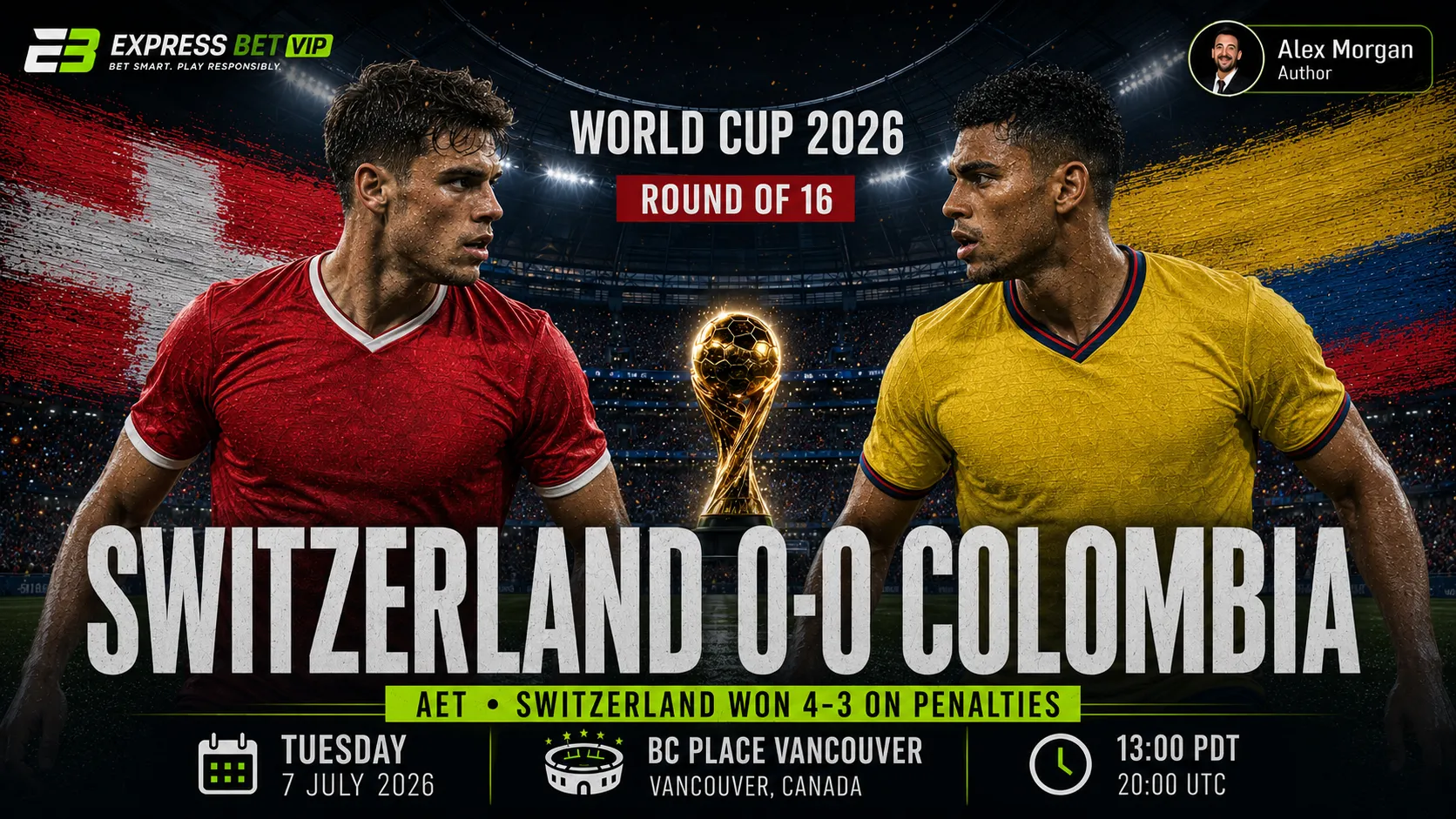
Quick Facts: Final Score, Venue, and Match Status
| Match detail | Confirmed information |
|---|---|
| Match | Switzerland vs Colombia |
| Competition | FIFA World Cup 2026 |
| Stage | Round of 16 |
| Date | July 7, 2026 |
| Kickoff | 20:00 UTC / 13:00 PDT |
| Host country | Canada |
| City | Vancouver, British Columbia |
| Stadium | BC Place Vancouver |
| Attendance | 52,497 |
| Regulation score | Switzerland 0-0 Colombia |
| Score after extra time | Switzerland 0-0 Colombia |
| Penalty shootout | Switzerland won 4-3 |
| Half-time score | 0-0 |
| Open-play goals | None |
| Winning penalty | Rubén Vargas |
| Referee | Iván Barton |
| VAR officials | Not available from verified public data |
| Formation | Both teams listed in 4-3-3 structures |
| Surface | Grass |
| Temperature | 24°C |
| Roof | Closed |
| Main impact | Switzerland advanced; Colombia were eliminated |
Verified Facts vs Analysis
| Category | Information |
|---|---|
| [CONFIRMED] | Result, shootout order, lineups, substitutions, cards, referee, attendance and principal statistics |
| [REPORTED] | Humidity inside BC Place and a heavily pro-Colombian crowd |
| [OBSERVED] | Switzerland’s compact defending, Colombia’s stronger extra time and Kobel’s saves |
| [ANALYSIS] | Why Switzerland restricted central access and why Colombia improved after Quintero and Campaz entered |
| [MARKET SIGNAL] | Colombia started as the regulation-time favourite; under 2.5 goals was strongly favoured |
| [DISPUTED] | No major match-changing decision remained formally disputed in the sources reviewed |
| [UNKNOWN] | Exact indoor humidity, complete VAR team, PPDA, running distance and archived live odds |
This separation is important because the result does not automatically prove that Switzerland were the better attacking team. Colombia recorded more shots, more xG and more touches inside the opposing penalty area. Switzerland were better at surviving the match and executing the shootout. Those are related achievements, but they are not identical.
Final Score and Match Summary
The Switzerland vs Colombia final score was 0-0 after extra time, with Switzerland winning the penalty shootout 4-3.
The result carried the familiar cruelty of knockout football. Colombia generated the better attacking numbers and created the clearest extra-time chances. Switzerland left with the quarter-final place.
Neither team controlled the opening half through sustained attacking pressure. Switzerland had slightly more possession, but much of it came in zones where Colombia were comfortable. Colombia threatened through Luis Díaz’s movement and Gustavo Puerta’s willingness to shoot from distance, yet they struggled to create clean central entries.
Puerta produced the best chance of the first half in the 21st minute. His curling effort forced Gregor Kobel into a strong diving save. Switzerland responded through Fabian Rieder and Dan Ndoye, although Camilo Vargas handled both efforts without the same level of difficulty.
The match became more cautious after the interval. Switzerland protected the spaces around Granit Xhaka and Remo Freuler, while Colombia’s central defenders remained comfortable against Breel Embolo. Both sides understood that a single transition could end the tournament. This is usually the point when brave pre-match speeches quietly give way to risk management.
The Opta numbers illustrate the lack of attacking quality during regulation. The teams combined for only 0.7 xG across the first 90 minutes—0.3 for Switzerland and 0.4 for Colombia. FotMob described it as the lowest combined regulation-time xG recorded in any match at the tournament up to that date.
Colombia improved in extra time. Jhon Lucumí headed against the crossbar, Kobel saved a swerving Campaz shot, and Campaz missed the best chance of the match in the 115th minute after Switzerland lost the ball near their own goal.
Switzerland produced only one extra-time attempt. Murat Yakin’s side were increasingly playing for the shootout, whether through deliberate choice or Colombia’s territorial pressure.
That gamble succeeded. Kobel saved Hernández’s penalty, Sánchez struck the bar and Vargas converted the decisive kick. Switzerland reached their first World Cup quarter-final since 1954.
Why the Match Finished 0-0
This was not a scoreless draw created by outstanding attacking play and miraculous goalkeeping at both ends. The primary explanation was structural caution.
Switzerland used a 4-3-3 formation that often became a compact 4-1-4-1 or 4-5-1 without the ball. Xhaka and Freuler protected the central passing lanes, while the wide players recovered to prevent Díaz and James Rodríguez from receiving with space to turn.
Colombia also started in a nominal 4-3-3. James moved away from the right side to find central pockets, leaving Daniel Muñoz responsible for much of the width. Díaz attacked from the left, but Switzerland frequently placed two defenders around him and forced Colombia toward less threatening areas.
Breel Embolo had a difficult assignment. He competed against Sánchez and Lucumí without receiving enough passes behind the defensive line. Switzerland recorded only four shots from inside the box and created no Opta-defined big chances.
Colombia created two big chances across the full match but missed both. Their xG advantage—1.09 to 0.39—developed largely during extra time, when Switzerland’s pressing weakened and the South Americans introduced more direct attacking players.
Kobel made three saves from three shots on target. Camilo Vargas stopped Switzerland’s two shots on target. Lucumí hit the crossbar and Campaz failed to convert the clearest late opportunity.
The 0-0 score therefore reflected Switzerland’s limited attacking ambition and Colombia’s poor finishing. Colombia deserved the better chance of winning before penalties. They did not do enough with that advantage.
Key Moments That Changed the Match
21’ — Kobel denies Gustavo Puerta
Puerta received the ball near the edge of the penalty area and curled a shot toward the far corner. Kobel moved quickly to his left and pushed it away.
The save was important because Colombia had begun finding space between Switzerland’s midfield and defensive lines. An early goal could have forced the Swiss to abandon their cautious structure.
51’ — Xhaka receives a yellow card
Xhaka was booked six minutes after half-time. The caution reduced his freedom to stop transitions with tactical fouls and became relevant later when Colombia pressed him aggressively near the Swiss penalty area.
60’ — Luis Suárez wastes a turnover
Suárez dispossessed Xhaka and gained a promising shooting opportunity. He rushed the finish and sent the effort away from goal.
The moment represented Colombia’s broader attacking problem. They could force errors but did not consistently turn them into controlled shots.
66’ — Colombia introduce Quintero and Campaz
Juan Fernando Quintero replaced James Rodríguez, while Jáminton Campaz replaced Jhon Arias.
Quintero gave Colombia a fresh creative passer and improved their set-piece delivery. Campaz offered more direct running and shooting. Both later converted their penalties, although Campaz also missed Colombia’s best open-play opportunity.
91’ — Ndoye shoots narrowly wide
Ndoye made an intelligent run and drove a low shot across Camilo Vargas. The ball travelled just outside the far post.
It was Switzerland’s best chance around the end of regulation and beginning of extra time. It was also close to their final meaningful attacking action.
Extra time — Lucumí hits the crossbar
Quintero delivered a corner and Lucumí rose without sufficient pressure. His header struck the crossbar.
This was Colombia’s clearest set-piece chance and one of two occasions when they hit the woodwork during the match and shootout combined.
115’ — Campaz misses the decisive open-play chance
Switzerland lost possession close to their own penalty area, leaving Campaz with a clear sight of goal. He fired over.
It was the match’s largest missed opportunity. Had Campaz scored, the penalty shootout—and the subsequent public fixation on individual misses—would never have existed.
Extra Time Analysis
Colombia became the stronger team during the additional 30 minutes.
According to the Opta match review, Colombia recorded eight extra-time shots after producing seven during regulation. Switzerland managed only one attempt in the same period.
The changes made by Néstor Lorenzo improved Colombia’s attack. Quintero could receive deeper and deliver set pieces, Campaz carried the ball directly at the defensive line, and Cucho Hernández provided fresher movement than Suárez.
Switzerland’s substitutions served a different purpose. Miro Muheim and Silvan Widmer added defensive energy, while Cédric Itten, Zeki Amdouni and Rubén Vargas gave Yakin potential penalty takers.
The Swiss defensive line dropped deeper as fatigue increased. Colombia gained second balls and reached crossing positions more regularly. Lucumí’s header hit the bar, Campaz forced another Kobel save and then missed from a central position.
Switzerland were taking an obvious risk. Their major-tournament shootout record was poor: they had won only one of their previous five shootouts at a World Cup or European Championship.
Yakin nevertheless trusted Kobel and the substitutes selected for the shootout. Tournament football occasionally rewards a team for spending half an hour waiting for the thing everyone claims to want to avoid.
Penalty Shootout: Kick-by-Kick
Juan Fernando Quintero — Colombia: scored
Quintero took Colombia’s first penalty and converted. His left-footed technique was controlled, giving Colombia a 1-0 lead.
Granit Xhaka — Switzerland: scored
Camilo Vargas reached Xhaka’s penalty and got a hand to the ball, but the shot still crossed the line. Switzerland levelled at 1-1.
Davinson Sánchez — Colombia: missed
Sánchez struck the crossbar. Kobel was beaten, but the height of the shot left no margin for error.
Zeki Amdouni — Switzerland: scored
Amdouni converted calmly to put Switzerland 2-1 ahead.
Jáminton Campaz — Colombia: scored
Campaz’s penalty squeezed beneath Kobel. It was not a perfect strike, but it crossed the line. Colombia levelled at 2-2.
Manuel Akanji — Switzerland: missed
Akanji sent his penalty over the crossbar. Colombia were back on level terms with the shootout in their control.
Cucho Hernández — Colombia: saved
Kobel read Hernández’s attempt and made the decisive save. The goalkeeper’s preparation, reach and timing turned the shootout back toward Switzerland.
Cédric Itten — Switzerland: scored
Itten converted to restore the Swiss advantage at 3-2.
Luis Díaz — Colombia: scored
Díaz handled the pressure and levelled at 3-3. His successful kick kept Colombia in the tournament temporarily.
Rubén Vargas — Switzerland: scored
Vargas placed the decisive penalty into the bottom-left corner. Camilo Vargas could not reach it. Switzerland won the shootout 4-3.
Penalties are not a lottery. The outcome depends on technique, goalkeeper research, placement and the ability to repeat a rehearsed action under unusual psychological pressure. Switzerland executed more successfully.
Local Match Conditions: Vancouver, BC Place, Roof, and Crowd
| Local factor | Verified or reported detail | Football meaning | Direct evidence | Betting meaning | Status | Specific to fixture? |
|---|---|---|---|---|---|---|
| City | Vancouver, British Columbia | Pacific time-zone venue | Official match data | Relevant to kickoff and travel | [CONFIRMED] | Yes |
| Stadium | BC Place Vancouver | Enclosed multi-purpose stadium | FIFA/FotMob | Reduced outdoor weather variance | [CONFIRMED] | Yes |
| Attendance | 52,497 | Full tournament capacity | FIFA/FotMob | Increased crowd pressure | [CONFIRMED] | Yes |
| Roof | Closed | No direct wind or rain effect | Match reporting | Weakened weather-based markets | [CONFIRMED] | Yes |
| Temperature | 24°C | Warm but below severe heat threshold | FotMob | Little support for a heat-driven under | [CONFIRMED] | Yes |
| Humidity | Exact figure unavailable; heavy indoor humidity reported | Could increase fatigue over 120 minutes | Guardian report | Relevant to extra-time markets, but difficult to quantify | [REPORTED] | Yes |
| Crowd split | Colombian fans vastly outnumbered Swiss fans | Colombia experienced de facto home support | Reuters | Possible psychological influence, not a predictive guarantee | [REPORTED] | Yes |
| Surface | Grass | Normal passing and tackle conditions | FotMob | No verified surface-based market effect | [CONFIRMED] | Yes |
| Pitch problems | No major deterioration confirmed | No basis for blaming the 0-0 on turf | Match evidence | Avoid retrospective pitch explanations | [OBSERVED] | Yes |
| Travel | Exact team schedules unavailable | Comparative acclimatisation cannot be measured | Public-data review | No responsible betting inference | [UNKNOWN] | Yes |
Vancouver was experiencing warm and sunny weather, but BC Place’s roof remained closed. That removed meaningful wind and rain effects from crosses, long passes and goalkeeper distribution.
Climate Central classified the fixture as having only a 3% probability of performance-impairing heat. Its analysis used 28°C as the threshold associated with reduced elite-player running performance. FotMob recorded 24°C for the match.
The Guardian nevertheless reported thick humidity inside BC Place and described the air-conditioning system as struggling with the enclosed conditions. No exact indoor humidity reading was published, so it would be irresponsible to convert that observation into a precise physical claim.
The match lasted 120 minutes, and fatigue became visible. Switzerland’s defensive line retreated while Colombia produced eight extra-time shots. However, that pattern does not prove that humidity decided the contest. Colombia became more active rather than less, while tactical substitutions and the scoreless game state also explain the shift.
The crowd offered Colombia a more obvious local advantage. Reuters described a sea of yellow shirts and reported that Colombian supporters vastly outnumbered Swiss fans. Swiss players were jeered in possession, while Colombian attacks received a home-style response.
Switzerland still handled the shootout better. Crowd dominance can affect emotion and communication, but it cannot place a penalty beneath the crossbar.
Stadium-Specific Match Impact
| Stadium detail | Information |
|---|---|
| Stadium | BC Place Vancouver |
| Tournament capacity | 52,497 |
| Attendance | 52,497 |
| Pitch type | Grass |
| Roof | Closed |
| Climate control | BC Place not classified as fully climate-controlled by Climate Central |
| Acoustic effect | Strong pro-Colombian noise reported |
| Surface condition | No major issue confirmed |
| Wind relevance | Minimal under closed roof |
| Goalkeeper distribution | No clear stadium-related problem |
| Set-piece effect | Colombia hit the bar following a corner |
| Communication | Potentially difficult for Switzerland during Colombian attacks |
| Data status | Venue facts confirmed; acoustic effect reported |
This was Vancouver’s final match of the tournament. FIFA reported that the city hosted seven World Cup fixtures, each with an attendance of 52,497.
The enclosed stadium concentrated the sound generated by Colombia’s supporters. That made the setting locally distinctive, but Switzerland’s defensive communication remained strong enough to preserve a clean sheet.
The available evidence does not show a clear surface problem. The low score resulted from tactical caution, limited shot quality in regulation and missed Colombian opportunities—not from abnormal ball movement.
City and Weather Impact
| Factor | Detail |
|---|---|
| City | Vancouver |
| Country | Canada |
| Time zone | Pacific Daylight Time, UTC-7 |
| Match kickoff | 13:00 local time |
| Outdoor conditions | Warm and sunny |
| Recorded match temperature | 24°C |
| Humidity | Exact number unavailable |
| Roof condition | Closed |
| Rain impact | None observed |
| Wind impact | Minimal |
| Altitude | No relevant high-altitude effect |
| Likely physical issue | Humidity and 120-minute duration |
| Match evidence | Switzerland retreated; Colombia increased extra-time pressure |
| Data status | Temperature confirmed; humidity reported but unmeasured |
The local environment did not clearly alter first-half tempo. Both teams were cautious from the beginning, long before extra-time fatigue became relevant.
Goalkeeper handling remained secure. Kobel and Camilo Vargas completed regulation and extra time without a handling error. Long passing also showed no consistent disruption.
If conditions influenced the match, the most plausible effect came during extra time. Switzerland’s midfield pressure weakened and Colombia gained territory. Even then, tactical substitutions and risk tolerance provide equally strong explanations.
First-Half Analysis
Switzerland’s 4-3-3 featured Xhaka, Freuler and Ardon Jashari in midfield. Fabian Rieder, Embolo and Ndoye formed the forward line. Johan Manzambi, who had recorded three goals and two assists during the tournament, missed the game after suffering a knee injury in training.
Manzambi’s absence reduced Switzerland’s speed and unpredictability between the lines. Rieder offered technique, but Switzerland lacked a second runner capable of attacking the space around Embolo.
Colombia used James Rodríguez nominally from the right, although he frequently moved centrally. Muñoz advanced outside him, while Díaz attacked from the opposite wing. Puerta and Arias supported Jefferson Lerma in midfield.
Switzerland concentrated on blocking James’s passing lanes and doubling Díaz. Zakaria, playing at right-back in the listed formation, had a difficult role: defend Díaz’s acceleration without opening the inside channel.
Colombia’s best early opportunity came when Puerta curled toward the far corner. Kobel saved. Switzerland responded through Rieder and Ndoye, but neither effort seriously threatened Camilo Vargas.
The half ended 0-0 because both teams protected their defensive balance before committing players forward. Switzerland’s possession rarely broke Colombia’s second line. Colombia’s wide talent generated promising positions without enough penalty-box occupation.
Second-Half Analysis
Yakin replaced Jashari with Djibril Sow at half-time. The change increased Switzerland’s defensive running and improved their ability to press Colombia’s midfield.
The match remained cautious. Xhaka and Zakaria received yellow cards, creating potential pressure points in Switzerland’s defensive structure. Colombia attempted to force Xhaka into mistakes, and Suárez succeeded in dispossessing him before wasting the resulting chance.
Lorenzo changed the creative structure in the 66th minute. Quintero replaced James, while Campaz replaced Arias. Quintero supplied a more natural left-footed distributor. Campaz attacked defenders directly and eventually became Colombia’s most dangerous extra-time player.
Switzerland introduced Muheim for Ricardo Rodríguez, followed by Itten and Widmer. The changes preserved defensive energy but did not improve open-play creation.
By the final ten minutes, both teams understood that one error could end the tournament. Colombia retained slightly more attacking intent. Switzerland accepted the increasing probability of extra time.
Tactical Picture: Why Switzerland Advanced
Switzerland did not advance because they dominated the match. They advanced because their defensive structure kept Colombia scoreless and Kobel decided the shootout.
Without the ball, Switzerland compressed the central area. Embolo screened passes into Lerma, while Xhaka and Freuler controlled the spaces used by James and Puerta. The wide players recovered to prevent Colombia creating regular two-against-one situations.
Colombia could advance through Muñoz and Mojica, but their crosses did not consistently find a central target. Suárez worked across the front line without fixing Switzerland’s centre-backs as effectively as Colombia required.
Switzerland’s own attack was limited. Embolo remained isolated, Rieder received too far from goal and the full-backs advanced cautiously. Their 0.39 xG and seven shots reflected that problem.
Colombia improved once Quintero and Campaz entered. Quintero’s passing and set-piece delivery created new angles. Campaz attacked the space around Switzerland’s tiring midfield. Colombia’s 1.09 xG was not overwhelming across 120 minutes, but it was clearly superior.
Yakin’s late substitutions also had the shootout in mind. Amdouni, Itten and Vargas all converted. This did not make the preceding attacking performance impressive. It made the squad management effective.
Kobel provided the final advantage. He stopped every shot on target during play and saved Hernández’s penalty. In a match built around avoiding the decisive mistake, the goalkeeper became Switzerland’s margin.
Tactical Collision Map
| Zone | Edge | Match evidence | Key player | Local effect | Result impact |
|---|---|---|---|---|---|
| Switzerland’s right | Balanced | Zakaria contained Díaz with support | Denis Zakaria | Pro-Colombia crowd increased pressure | Limited Díaz’s open-play influence |
| Switzerland’s left | Colombia | Muñoz and James combined outside Rodríguez | Daniel Muñoz | No weather effect | Territory without a goal |
| Central midfield | Switzerland early | Xhaka and Freuler controlled the first 90 minutes | Granit Xhaka | Humidity not clearly decisive | Restricted James |
| Extra-time midfield | Colombia | Eight extra-time shots | Juan Quintero | Fatigue possibly relevant | Created best late chances |
| Penalty area | Colombia | Nine box shots and two big chances | Jhon Lucumí | No pitch issue | Opportunities missed |
| Set pieces | Colombia | Lucumí hit the crossbar | Juan Quintero | Closed roof removed wind | Nearly decided extra time |
| Transitions | Colombia | Xhaka lost possession twice in dangerous areas | Jáminton Campaz | None verified | Campaz missed best chance |
| Goalkeeping | Switzerland | Three saves plus shootout stop | Gregor Kobel | No handling problem | Decisive |
| Bench | Switzerland | Three substitutes converted penalties | Rubén Vargas | No direct local influence | Won shootout |
Player Ratings and Individual Performances
The ratings below use a 1–10 scale. I reviewed the match events and compared the assessments with FotMob’s Opta-based ratings.
Switzerland Player Ratings
- Gregor Kobel — 8.8: Saved every on-target attempt and stopped Hernández in the shootout. The clear Man of the Match.
- Denis Zakaria — 7.0: Managed the difficult Díaz matchup with support. His booking reduced his aggression.
- Nico Elvedi — 7.6: Strong positioning and reliable work against Colombia’s central runners.
- Manuel Akanji — 7.0: Defended well across 120 minutes but fired his shootout penalty over.
- Ricardo Rodríguez — 6.4: Maintained his defensive position but contributed little in attack.
- Remo Freuler — 7.2: Closed central lanes and supported Xhaka during Colombia’s pressing phases.
- Granit Xhaka — 7.3: Directed possession and scored his penalty, although two losses near his own box created danger.
- Ardon Jashari — 5.9: Struggled to impose himself and was replaced at half-time.
- Fabian Rieder — 6.5: Tested Camilo Vargas and hit a free kick into the side-netting.
- Breel Embolo — 6.2: Worked against two physical centre-backs but received little useful service.
- Dan Ndoye — 7.4: Switzerland’s most threatening open-play attacker and nearly scored around the start of extra time.
- Djibril Sow — 6.8: Added running and helped stabilise midfield after half-time.
- Miro Muheim — 6.7: Brought defensive energy before receiving a yellow card in extra time.
- Silvan Widmer — 6.6: Helped protect the right side during the closing stages.
- Cédric Itten — 6.5: Limited open-play impact but converted an important penalty.
- Rubén Vargas — 7.2: Entered late and scored the winning penalty.
- Zeki Amdouni — 6.6: Added little during extra time but converted calmly in the shootout.
Colombia Player Ratings
- Camilo Vargas — 7.4: Kept a clean sheet across 120 minutes and touched Xhaka’s penalty without stopping it.
- Daniel Muñoz — 6.7: Supplied width and pushed Switzerland backward, although his final delivery lacked consistency.
- Davinson Sánchez — 7.1: Defended Embolo well but struck the crossbar in the shootout.
- Jhon Lucumí — 7.7: Strong defensively and came closest to scoring with an extra-time header against the bar.
- Johan Mojica — 7.3: Advanced well and supported Díaz without leaving excessive space behind.
- Jhon Arias — 7.0: Pressed effectively and helped Colombia control midfield before being replaced.
- Jefferson Lerma — 7.2: Protected the defensive line and competed well for second balls.
- Gustavo Puerta — 7.1: Forced Kobel into the first major save and offered a shooting threat.
- James Rodríguez — 6.7: Found occasional pockets but Switzerland restricted his influence.
- Luis Suárez — 6.0: Pressed Xhaka into an error but rushed the resulting chance.
- Luis Díaz — 7.0: Drew defensive attention and converted his penalty, but could not create a decisive open-play moment.
- Juan Fernando Quintero — 7.1: Improved Colombia’s creativity and converted the opening penalty.
- Jáminton Campaz — 6.8: Added direct threat and scored his penalty, but missed the best chance of the match.
- Richard Ríos — 6.7: Increased midfield energy during the closing stages.
- Cucho Hernández — 6.1: Offered fresh movement but had his penalty saved.
- Yerry Mina — not rated: Entered in the 118th minute for Lucumí.
Best Players of the Match
Man of the Match: Gregor Kobel. He saved all three on-target attempts during play and denied Hernández in the shootout.
Best attacker: Dan Ndoye. Switzerland’s winger produced his team’s most dangerous movement and went close early in extra time.
Best midfielder: Granit Xhaka. He controlled Switzerland’s possession and converted his penalty, despite two dangerous losses.
Best defender: Jhon Lucumí. He defended Embolo effectively and hit the crossbar in extra time.
Best goalkeeper: Gregor Kobel. Camilo Vargas performed well, but Kobel made the decisive shootout intervention.
Best substitute: Rubén Vargas. His open-play contribution was limited, yet he accepted and converted the most pressurised kick.
Most underrated performance: Nico Elvedi. His positioning helped Switzerland survive Colombia’s stronger extra-time phase.
Most disappointing performance: Luis Suárez. He worked hard but failed to convert Colombia’s most promising regulation-time turnover.
Cards, Injuries, and Discipline
| Player | Team | Incident | Minute | Consequence | Status |
|---|---|---|---|---|---|
| Granit Xhaka | Switzerland | Yellow card | 51’ | No confirmed suspension | [CONFIRMED] |
| Denis Zakaria | Switzerland | Yellow card | 59’ | No confirmed suspension | [CONFIRMED] |
| Luis Suárez | Colombia | Yellow card | 60’ | Colombia eliminated | [CONFIRMED] |
| Davinson Sánchez | Colombia | Yellow card | 94’ | Colombia eliminated | [CONFIRMED] |
| Miro Muheim | Switzerland | Yellow card | 105’ | No confirmed suspension | [CONFIRMED] |
| Johan Manzambi | Switzerland | Knee injury in training | Before match | Missed Round of 16 | [CONFIRMED] |
| Jhon Lucumí | Colombia | Replaced after apparent physical problem | 118’ | Diagnosis unavailable | [UNKNOWN] |
Manzambi’s absence mattered tactically. He had contributed three goals and two assists during the tournament and provided acceleration that Switzerland lacked against Colombia.
No red cards were shown. Confirmed suspension consequences for the quarter-final were not available from the public data reviewed.
Referee and VAR Analysis
Iván Barton allowed a physical match without losing basic control. Five yellow cards were recorded across 120 minutes, with no red cards.
There was no confirmed penalty during regulation or extra time. No major VAR reversal appeared in the official event sequence.
The referee’s decisions did not explain the result. Colombia’s elimination came from missed open-play chances and two failed shootout attempts. Switzerland’s progression came through defensive resilience and Kobel’s save.
Match Statistics
| Statistic | Switzerland | Colombia |
|---|---|---|
| Possession | 53% | 47% |
| Expected goals | 0.39 | 1.09 |
| Total shots | 7 | 15 |
| Shots on target | 2 | 3 |
| Big chances | 0 | 2 |
| Corners | 3 | 7 |
| Offsides | 5 | 4 |
| Total passes | 631 | 547 |
| Completed passes | 547 | 454 |
| Shots inside box | 4 | 9 |
| Shots outside box | 3 | 6 |
| Shots blocked | 1 | 4 |
| Woodwork | 0 | 2 |
| Opposition-box touches | 18 | 21 |
| Red cards | 0 | 0 |
The statistics favour Colombia. They attempted more than twice as many shots, created both big chances and recorded higher xG.
Switzerland’s possession advantage was not an attacking advantage. Much of their passing took place in safe areas. Colombia produced fewer passes but more shots and corners.
The 0.39 Swiss xG confirms the limitations of their forward play. Switzerland advanced without creating a major open-play chance. Their success belonged to the defensive and psychological parts of the match.
Betting Result Angle
FOX Sports published FanDuel odds on July 7 with Colombia at +125 to win in regulation, Switzerland at +260 and the draw at +200. Under 2.5 goals was priced at -168, while over 2.5 was +136.
| Market | Pre-match expectation | Actual outcome | Winning side | Main trigger | Caution |
|---|---|---|---|---|---|
| Regulation winner | Colombia favourite | 0-0 | Draw | Both attacks created little in 90 minutes | Favourite status did not guarantee control |
| Switzerland +0.5 | Competitive underdog | Switzerland avoided defeat | Switzerland +0.5 | Compact defensive structure | Settlement depends on 90-minute rules |
| Colombia -0.5 | Colombia expected to win | 0-0 | Lost | Poor finishing | Territorial pressure was insufficient |
| Under 2.5 | Strongly favoured | No goals | Under | Combined 0.7 regulation xG | Low odds still carried risk |
| Both teams to score | Exact price unavailable | No | BTTS No | Both goalkeepers kept clean sheets | Price and operator matter |
| Correct score | 0-0 | 0-0 | 0-0 backers | Cautious regulation | High-variance market |
| To qualify | Colombia favoured at -155 in SI’s preview | Switzerland advanced | Switzerland | Kobel’s save and Vargas’s kick | Separate from regulation market |
| Anytime scorer | Díaz, Suárez, Hernández and Embolo among listed options | No open-play scorer | None | 120 goalless minutes | Player props carried high variance |
The regulation draw at +200 won. The under 2.5 market also settled comfortably in score terms, although Lucumí’s crossbar and Campaz’s late miss show how close a low total can come to changing.
Colombia moneyline bets lost despite Colombia producing the stronger statistical performance. Switzerland-to-advance bets won, while Switzerland’s regulation moneyline did not.
Markets must be read according to their settlement rules. A team can advance after a draw without winning a three-way regulation market. That distinction is elementary, yet knockout football continues to charge tuition for the lesson.
Local Betting Impact
| Local factor | Possible market | Match evidence | Interpretation | Overreaction risk | Safer conclusion |
|---|---|---|---|---|---|
| Closed roof | Total goals | No wind or rain disruption | Weather variance reduced | High | Tactical caution drove the under |
| Reported humidity | Extra-time tempo | Switzerland retreated late | Fatigue may have contributed | Medium | Do not isolate humidity from tactics |
| Pro-Colombia crowd | Colombia live markets | Colombia created eight extra-time shots | Crowd supported momentum | High | Noise did not produce a goal |
| Grass surface | Passing markets | No major pitch issue | Neutral effect | High | Do not blame turf for 0-0 |
| 24°C temperature | Player running | Below Climate Central’s heat threshold | Limited heat impact | Medium | No strong heat-based betting angle |
| 120-minute duration | Substitutions and cards | Five cautions; both benches used | Fatigue increased uncertainty | Low | Relevant for live and extra-time markets |
The local conditions did not make the 0-0 predictable. The closed roof removed outdoor wind and rain, but it did not force either team to defend cautiously.
The reported humidity may have influenced late fatigue. Colombia nevertheless became more dangerous in extra time, so a simple “humidity causes lower tempo” explanation does not fit the evidence.
What the Result Means for the Knockout Bracket
Switzerland advanced to face defending champions Argentina in the quarter-finals at Kansas City Stadium on July 11.
The result ended a 72-year wait. Switzerland had not reached a World Cup quarter-final since hosting the 1954 tournament. They had been eliminated in the Round of 16 in 2006, 2014, 2018 and 2022.
Colombia were eliminated after attempting to reach the quarter-finals for only the second time. Their previous appearance in the last eight came in 2014.
Switzerland subsequently lost 3-1 to Argentina after extra time. That later result does not reduce the significance of the Vancouver victory: reaching the quarter-finals represented their best World Cup performance in seven decades.
What Switzerland Did Right
Switzerland protected the central zones and denied James and Díaz frequent access to dangerous receiving positions.
Elvedi and Akanji defended their penalty area well. Freuler and Xhaka controlled space in front of them. Kobel completed the structure with three open-play saves.
Yakin also prepared for penalties. Amdouni, Itten and Vargas entered late and converted. The substitution plan did not improve Switzerland’s attack, but it improved their shootout options.
Most importantly, Switzerland recovered emotionally after Akanji missed. Kobel saved the next Colombian attempt, Itten converted and Vargas finished the contest.
What Colombia Got Wrong
Colombia failed to convert superior extra-time pressure into a goal. Lucumí hit the crossbar and Campaz fired over from the clearest opportunity.
Their regulation attack was too dependent on individual actions from Díaz and James. Switzerland crowded both players and forced other Colombian attackers to make the decisive choice.
Suárez’s rushed finish after dispossessing Xhaka was a major example. Colombia had created the turnover they wanted but failed to control the final action.
The shootout added two technical failures. Sánchez struck the bar and Hernández allowed Kobel to make the decisive save.
Coach Analysis
Murat Yakin
Yakin’s starting plan prioritised defensive control. Switzerland conceded territory and chances in extra time, but the structure survived.
Losing Manzambi shortly before kickoff disrupted the intended attacking plan. Jashari struggled and was removed at half-time.
Yakin’s late substitutions were specifically valuable in the shootout. Vargas, Amdouni and Itten all converted. The approach carried risk, but the execution justified it.
Néstor Lorenzo
Lorenzo’s team produced the better attacking numbers and became increasingly dominant during extra time.
Introducing Quintero and Campaz improved Colombia. Quintero’s corner created Lucumí’s header, while Campaz forced a save and received the match’s best chance.
The criticism concerns finishing rather than tactical passivity. Lorenzo created conditions for Colombia to win. His players did not convert them.
Player Milestones and Records
- Switzerland reached their first World Cup quarter-final since 1954.
- It was Switzerland’s fourth World Cup quarter-final appearance.
- Switzerland ended a sequence of Round-of-16 eliminations in 2006, 2014, 2018 and 2022.
- Colombia failed to reach their second World Cup quarter-final after their 2014 appearance.
- FotMob reported that this was only the second World Cup knockout match since 2018 to finish 0-0 after extra time, following Morocco vs Spain in 2022.
- Gregor Kobel saved all three on-target attempts during play and one shootout penalty.
Historical Context
Switzerland and Colombia had previously met at the 1994 World Cup. Colombia won that group match 2-0, although both teams were eliminated before the knockout rounds.
The 2026 meeting carried a different significance. Switzerland had spent decades becoming a reliable World Cup qualifier without progressing beyond the first knockout round. Colombia had developed a more attacking tournament identity but still possessed only one previous quarter-final appearance.
The match did not resemble a great attacking contest. It resembled the sort of knockout fixture in which caution becomes increasingly rational until someone is asked to walk from the halfway line to the penalty spot.
Switzerland’s shootout victory also provided a response to their Euro 2024 elimination, when England defeated them on penalties in the quarter-finals.
Incidents and Controversies
No major referee or VAR controversy determined the match.
The more serious issue emerged after Colombia’s elimination. Reports stated that Jáminton Campaz received threats following his extra-time miss. Threatening a player over a football result is criminal behaviour, not sporting criticism. Campaz converted his shootout penalty and had also helped Colombia create their strongest attacking period.
The incident revived painful memories surrounding Colombian football, but comparisons should be handled with care and without sensationalism. Responsibility lies entirely with those making threats, not with a player who missed a chance.
Information Gain: What This Article Adds
This report distinguishes the 0-0 regulation result from Switzerland’s 4-3 shootout victory. It provides the complete penalty order, explains Colombia’s extra-time statistical advantage and evaluates Yakin’s substitution strategy.
It also connects BC Place’s closed roof, reported humidity and pro-Colombian crowd to the actual match evidence without pretending that local conditions determined the winner.
Local Information Gain Quality Check
| Detail | Included | Evidence status | Fixture-specific | Future update |
|---|---|---|---|---|
| Stadium | Yes | [CONFIRMED] | BC Place’s final tournament match | None expected |
| Attendance | Yes | [CONFIRMED] | Sellout of 52,497 | Update only if FIFA corrects |
| Roof | Yes | [CONFIRMED] | Closed during this match | None expected |
| Temperature | Yes | [CONFIRMED] | 24°C | Add official indoor reading if published |
| Humidity | Yes | [REPORTED] | Interior humidity reported | Exact percentage unavailable |
| Pitch | Yes | [OBSERVED] | No major problem confirmed | Add official pitch report if released |
| Crowd | Yes | [REPORTED] | Strong Colombian majority | Exact split unavailable |
| Travel | Yes | [UNKNOWN] | No schedule-based claim made | Update only with team data |
| Betting risk | Yes | [ANALYSIS] | Separates regulation and qualification | No update required |
| Tactical-local link | Yes | [ANALYSIS] | Humidity compared with extra-time pattern | Revise if physical data appears |
Source and Data Appendix
| Data point | Status | Main source |
|---|---|---|
| Final score | [CONFIRMED] | FIFA match centre |
| Shootout result | [CONFIRMED] | FIFA/FotMob |
| Penalty order | [CONFIRMED] | FotMob |
| Stadium and city | [CONFIRMED] | FIFA/FotMob |
| Attendance | [CONFIRMED] | FIFA/FotMob |
| Referee | [CONFIRMED] | FotMob |
| VAR officials | [UNKNOWN] | Not available |
| Lineups | [CONFIRMED] | FotMob/Opta |
| Substitutions | [CONFIRMED] | FotMob |
| Cards | [CONFIRMED] | FotMob |
| Manzambi injury | [CONFIRMED] | Reuters |
| Match statistics | [CONFIRMED] | Opta/FotMob/365Scores |
| xG | [CONFIRMED] | Opta |
| Pre-match odds | [REPORTED] | FanDuel via FOX Sports |
| Live odds | [UNKNOWN] | Complete archive unavailable |
| Temperature | [CONFIRMED] | FotMob |
| Indoor humidity | [REPORTED] | Guardian match report |
| Roof status | [CONFIRMED] | Match reporting |
| Crowd profile | [REPORTED] | Reuters |
| Tournament impact | [CONFIRMED] | FIFA |
Final Verdict
Switzerland advanced because their defensive plan survived Colombia’s pressure and Gregor Kobel produced the match’s decisive performance.
Colombia were the better attacking side. Their 15-7 shot advantage, 1.09-0.39 xG lead and two big chances support that conclusion. Their failure was finishing. Lucumí found the crossbar, Campaz fired over and Hernández lost his shootout duel with Kobel.
Switzerland’s attacking performance was limited. Seven shots and no big chances across 120 minutes will not support a claim of superiority. What they offered instead was defensive concentration, patience and better penalty execution.
The closed roof reduced wind and rain effects, while 24°C conditions did not amount to severe heat. Humidity was reported inside BC Place, but Colombia became more dangerous as the match progressed. The crowd strongly favoured Colombia, yet Switzerland handled the decisive pressure better.
For bettors, the match underlined the need to distinguish between regulation and qualification markets. The draw and under 2.5 goals won. Switzerland advanced without winning the 90-minute market. Colombia created more but failed to reward moneyline support.
Switzerland’s reward was a first World Cup quarter-final since 1954. Colombia’s punishment was elimination after doing almost everything except the tedious final requirement: putting the ball in the net.
Responsible Betting Note
Football betting carries financial risk. Correct tactical analysis cannot guarantee a winning wager. Odds change before and during matches, and knockout markets may be settled after 90 minutes, extra time or qualification depending on the operator’s rules.
Never chase losses or bet money needed for housing, food, bills or daily expenses. Use deposit, time and stake limits. Take regular breaks, check local gambling laws and use licensed operators only. Local weather and crowd conditions can be overvalued. Betting should remain entertainment, not a source of income.
Summarize this article with AI. Use this page URL as the source:
Summarize this article with AI:
FAQ
The match finished 0-0 after extra time. Switzerland won the penalty shootout 4-3.
No player scored during the 120 minutes. Quintero, Campaz and Díaz scored Colombia’s shootout penalties; Xhaka, Amdouni, Itten and Rubén Vargas converted for Switzerland.
Gregor Kobel was the best player. He made three saves during the match and stopped Cucho Hernández’s shootout penalty.
Switzerland advanced to face Argentina in the quarter-finals. Colombia were eliminated.
The regulation draw, under 2.5 goals, both teams to score “No” and Switzerland +0.5 won. Colombia moneyline and Colombia -0.5 lost. Returns depended on the odds and settlement rules.