
USA vs Belgium Match Result
Table of Contents Show
Views 5
TL;DR: USA vs Belgium Match Result
[CONFIRMED] Belgium defeated the USA 4-1 in the FIFA World Cup 2026 Round of 16. Charles De Ketelaere scored twice, in the ninth and 33rd minutes, before assisting Hans Vanaken’s 57th-minute goal. Malik Tillman briefly made it 1-1 with a deflected direct free kick in the 31st minute. Substitute Romelu Lukaku completed the scoring at 90+3.
De Ketelaere was the clear Man of the Match. Belgium’s advantage came from sharper counterpressing, better occupation of the penalty area and repeated attacks against an exposed American defensive line. A capacity crowd of 66,925 attended Seattle Stadium, where the match began in warm but manageable 27°C conditions.
Belgium advanced to face Spain; the USA were eliminated. Belgium moneyline, over 2.5 goals and both teams to score won, although settlements depended on the bookmaker’s odds and market timing.
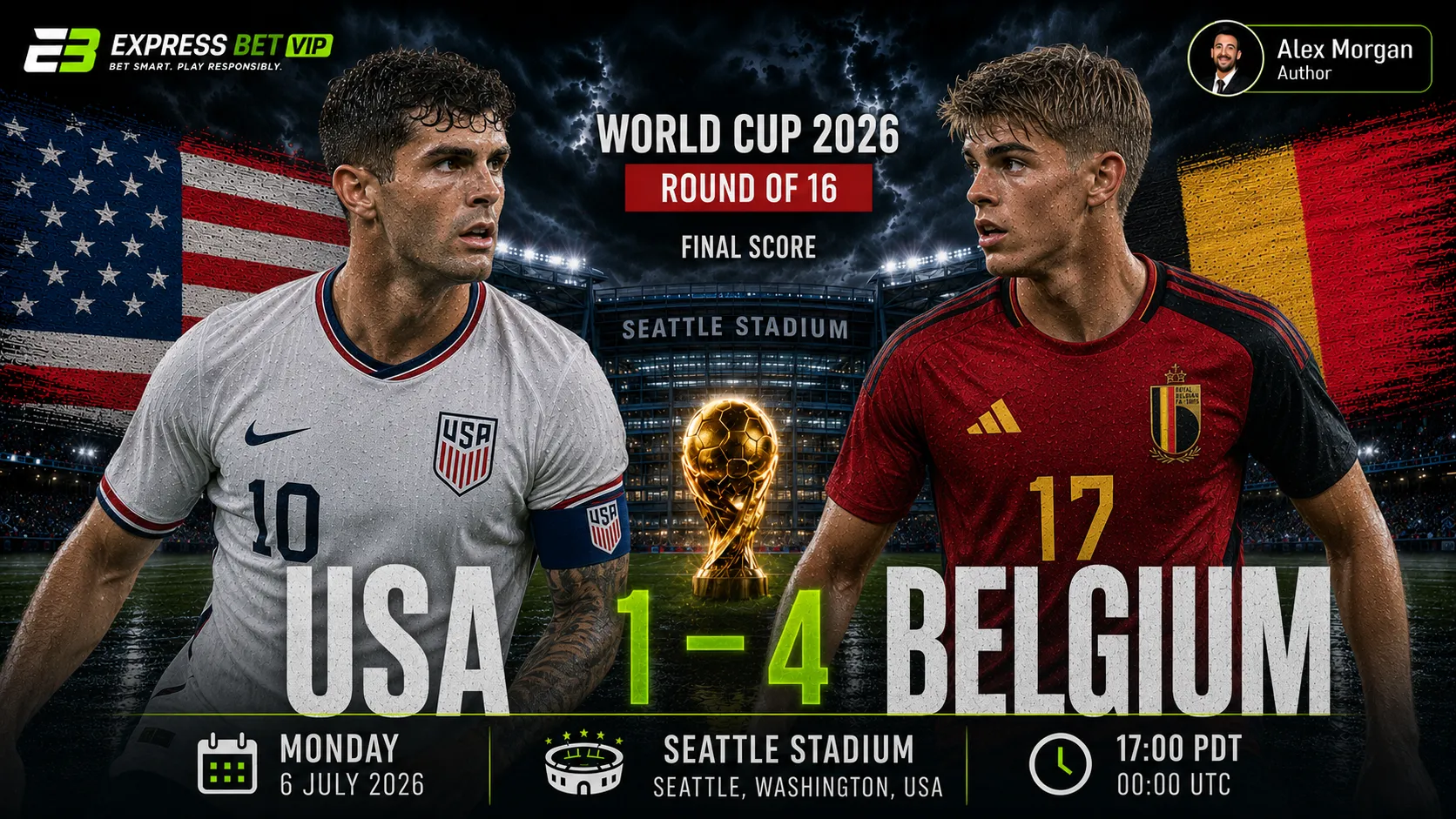
Quick Facts: Final Score, Goals, Venue, and Match Status
| Match detail | Verified information |
|---|---|
| Match | USA vs Belgium |
| Competition | FIFA World Cup 2026 |
| Stage | Round of 16 |
| Match type | Knockout |
| Date | July 6, 2026 locally; July 7 UTC |
| Kick-off | 17:00 PDT / 00:00 UTC |
| Host country | United States |
| City | Seattle, Washington |
| Stadium | Seattle Stadium |
| Attendance | 66,925 |
| Stadium capacity in match feed | 66,925 |
| Final score | USA 1-4 Belgium |
| Half-time score | USA 1-2 Belgium |
| USA scorer | Malik Tillman, 31 |
| Belgium scorers | Charles De Ketelaere 9, 33; Hans Vanaken 57; Romelu Lukaku 90+3 |
| Referee | Adham Mohammad Tumah Makhadmeh |
| VAR | Khamis Al Marri, reported by The Guardian |
| Weather | Warm, approximately 27°C |
| Humidity | 43%, reported in live match coverage |
| Wind | Light breeze; exact speed not confirmed |
| Surface | Natural grass |
| Roof | Open field; no retractable roof over the playing surface |
| Main tournament impact | Belgium advanced; USA eliminated |
The result and scorers match the official FIFA match report.
Verified Facts vs Analysis
| Label | Finding |
|---|---|
| [CONFIRMED] | Belgium won 4-1 and advanced to the quarter-finals. |
| [CONFIRMED] | De Ketelaere recorded two goals and one assist. |
| [CONFIRMED] | Tillman’s 31st-minute direct free kick was the USA’s only goal. |
| [CONFIRMED] | Belgium attempted 15 shots; the USA attempted seven in FotMob’s feed. |
| [CONFIRMED] | Belgium produced substantially more xG despite having less possession. |
| [REPORTED] | Kick-off humidity was 43%, with a light breeze. |
| [OBSERVED] | Belgium attacked the American penalty area more frequently and with better numbers. |
| [OBSERVED] | The USA’s possession was often accumulated outside Belgium’s defensive block. |
| [ANALYSIS] | Belgium’s narrow attacking rotations repeatedly pulled the USA centre-backs away from protection. |
| [ANALYSIS] | The American 4-1-2-3 left Tyler Adams with too much central defensive territory to manage alone. |
| [MARKET SIGNAL] | Pre-match pricing was close, with Belgium only a narrow moneyline favourite at some books. |
| [DISPUTED] | Providers differ slightly on USA shots, shots on target and xG. |
| [UNKNOWN] | The exact explanation for a first-half VAR event labelled “other decision cancelled” was not available from verified public data. |
| [UNKNOWN] | Detailed official pitch-testing data for this individual fixture were not publicly available. |
This distinction matters because a final score is a fact; an explanation of why it occurred is an interpretation. Search engines, AI summaries and readers all benefit when those categories are not placed in the same blender and served as certainty.
Final Score and Match Summary
USA 1-4 Belgium
Belgium began as if someone had informed them that knockout matches were allowed to start before the national anxiety had fully settled. Timothy Castagne forced Matt Freese into an early save, Youri Tielemans and Leandro Trossard found shooting positions, and the USA spent the opening minutes defending its own penalty area.
De Ketelaere made the pressure count in the ninth minute. Nicolas Raskin recovered a loose ball and drove a low cross into the six-yard area, where the Belgian forward finished from close range.
The USA equalised through Tillman’s free kick in the 31st minute. The shot took a deflection and beat Thibaut Courtois. Seattle responded, the score was 1-1, and the American recovery seemed to have acquired the necessary emotional soundtrack.
It lasted two minutes.
Trossard crossed from the left, De Ketelaere climbed above Tim Ream and Belgium led again. Tournament football has a cruel habit of allowing hope just enough time to remove its coat before showing it the exit.
Belgium controlled the decisive phases after half-time. Freese’s 57th-minute error allowed De Ketelaere to dispossess him outside a secure goalkeeping position. The Belgian then found Vanaken, whose long-range finish made it 3-1.
The USA created late opportunities through Sebastian Berhalter and Folarin Balogun, but the match had already moved into damage-limitation territory. At 90+3, Chris Richards lost possession and Vanaken supplied Lukaku, who finished clinically.
The four-goal total did not flatter Belgium’s attacking efficiency. The precise margin was severe because two American mistakes directly influenced the final two goals, but Belgium were clearly the better side. They produced more shots, higher xG and nearly twice as many touches in the opposition penalty area despite holding less possession.
Goal Timeline
9th minute — Charles De Ketelaere, Belgium, open-play goal
Score: USA 0-1 Belgium
Raskin reacted first to a loose ball and delivered a low cross through the six-yard area. De Ketelaere attacked the central space and finished from close range.
Freese had little time to adjust because the delivery travelled behind the recovering defenders. The larger defensive problem occurred before the shot: the USA failed to secure the second ball and then allowed Raskin an uncontested passing lane across goal.
[ANALYSIS] Belgium’s forward line compressed the American defence centrally while its supporting players attacked the spaces created around Tyler Adams. The goal rewarded the visitors’ aggressive start rather than arriving against the flow.
31st minute — Malik Tillman, USA, direct free kick
Score: USA 1-1 Belgium
Tillman struck a right-footed free kick after Balogun won the foul. The ball took a deflection and travelled beyond Courtois.
The goal is officially credited to Tillman. There was no assist because it came directly from a free kick.
[OBSERVED] The deflection disrupted Courtois’ reading of the trajectory. It was the USA’s first shot on target in most public statistical feeds and temporarily changed both the emotional and betting state of the match.
Belgium’s live moneyline price moved after the equaliser, but complete second-by-second archived odds were not available from verified public data.
33rd minute — Charles De Ketelaere, Belgium, header
Score: USA 1-2 Belgium
Trossard received room on the left and crossed toward the six-yard area. De Ketelaere rose above Ream and headed into the upper part of the goal.
The USA’s equaliser should have produced a short period of control. Instead, Belgium responded before the American defensive block had fully settled.
Ream was placed in a difficult physical duel, but the problem was collective. Trossard was permitted to cross without enough pressure, while Belgium’s attacking shape pinned the remaining defenders close to goal.
[ANALYSIS] This was the match’s emotional turning point. The home side had restored parity and the crowd had re-entered the contest. Belgium removed that momentum almost immediately.
57th minute — Hans Vanaken, Belgium, long-range open-play goal
Score: USA 1-3 Belgium
Freese moved into possession outside a secure goalkeeping position and was tackled by De Ketelaere. The Belgian recovered the ball and supplied Vanaken, who scored from distance into the exposed goal.
The mistake was individual, but the USA’s spacing also offered Freese few safe passing options. Once possession was lost, no American player could recover the open goal.
[ANALYSIS] At 2-1, the USA still had a plausible route back. At 3-1, Belgium could defend more conservatively, choose their counterattacking moments and introduce fresh forwards. The third goal changed the match from a contest into a rescue operation.
90+3 — Romelu Lukaku, Belgium, counterattacking goal
Score: USA 1-4 Belgium
Richards lost possession during the USA’s final attempt to play forward. Vanaken moved the ball into Lukaku’s path, and the substitute finished with control.
The goal added emphasis rather than changing the qualification outcome. It also rewarded Belgium’s bench depth: Lukaku had entered for De Ketelaere in the 67th minute.
No verified evidence indicates that VAR altered any goal decision.
Key Moments That Changed the Match
Belgium’s opening-minute warning
Freese was required to make an early save from Castagne, while Belgium generated several attacks before the USA had established possession.
This mattered because it revealed the tactical mismatch immediately. Belgium were finding the spaces around and behind the American midfield before the match had developed any settled rhythm.
Amadou Onana’s knee injury
Onana left in the 21st minute after suffering a knee problem. Vanaken replaced him.
A forced change usually weakens a plan. This one produced a goal and an assist. Vanaken scored Belgium’s third and assisted the fourth, earning an 8.4 FotMob rating.
A detailed official diagnosis was not confirmed from verified public data at the time of review.
Tillman’s free-kick equaliser
The equaliser offered the USA a route back without requiring them to solve Belgium consistently in open play.
Its importance was psychological and tactical. At 1-1, Belgium might have been forced to slow the game and protect against the home crowd’s energy. The visitors instead responded instantly.
Belgium retake the lead in two minutes
De Ketelaere’s second goal prevented the USA from turning the equaliser into sustained momentum. The inability to protect the next phase was among the clearest American failures.
Dest leaves at half-time
Giovanni Reyna replaced Sergiño Dest at the start of the second half. The FotMob event feed displayed an injury indicator for Dest.
The change increased the USA’s creative presence but reduced natural width and defensive recovery on the right. Belgium continued finding opportunities down the channels.
A confirmed medical diagnosis was not available from the sources reviewed.
Freese’s 57th-minute error
Freese had made early saves but was punished severely when De Ketelaere dispossessed him. Vanaken’s finish made the deficit two goals.
The error was the point after which Belgium could reduce risk. It also transformed multiple live markets: Belgium’s win price shortened sharply, while USA qualification became remote.
Pulisic’s withdrawal
Pulisic left in the 59th minute for Sebastian Berhalter after receiving treatment. Match reporting described the substitution as injury-related.
A confirmed diagnosis and next-match impact became irrelevant to this tournament because the USA were eliminated, but the injury remained relevant to his club availability. Detailed medical information was not available from verified public data.
Balogun’s late chance
Balogun forced Courtois into a save during the USA’s late pressure. It was one of the few moments when Belgium’s defensive line was attacked directly.
By then, however, the USA needed multiple goals. The chance demonstrated effort, not a genuine sustained comeback.
Local Match Conditions: Stadium, City, Weather, Pitch, and Crowd
| Local factor | Verified or observed detail | Football meaning | Direct evidence | Betting meaning | Status | Anti-template status |
|---|---|---|---|---|---|---|
| Host city | Seattle, Washington | Mild maritime climate, but this was a warm July evening | 27°C at kick-off | Reduced case for extreme-heat unders | [CONFIRMED] | Specific |
| Stadium | Seattle Stadium | Steep seating bowl and exposed central field | Capacity attendance recorded | Possible home-noise effect, not predictive | [CONFIRMED] | Specific |
| Attendance | 66,925 | Full stadium increased emotional pressure | Match feed lists 100% capacity | Increased live volatility after USA equaliser | [CONFIRMED] | Specific |
| Temperature | 27°C / approximately 80°F | Warm enough for hydration management, not extreme | FotMob and live coverage | Could affect late pressing, but evidence was limited | [CONFIRMED] | Specific |
| Humidity | 43% | Lower thermal strain than humid southern venues | Guardian live coverage | Weak basis for a weather-driven under | [REPORTED] | Specific |
| Wind | Light breeze | Limited effect on crosses and goalkeeper kicking | Live coverage | No strong market implication | [REPORTED] | Specific |
| Rain | No significant rain reported | No wet-ball handling or sliding-surface effect | Match reports recorded none | No rain-based goalkeeping angle | [REPORTED] | Specific |
| Surface | Natural grass | More familiar World Cup ball response than regular NFL turf | FotMob lists grass | No verified reason to discount technical play | [CONFIRMED] | Specific |
| Surface performance | No major match-specific complaint found | Passing and crossing were not visibly disrupted | Belgium completed several clean attacking moves | Avoid overreading the pitch | [OBSERVED] | Specific |
| Crowd | Predominantly supportive of the USA by visible and reported reaction | Noise peaked at 1-1 | Strong response to Tillman’s goal | Brief live-market momentum, not lasting tactical control | [OBSERVED] | Specific |
| Travel | Belgium had already played tournament matches in North America | No verified acclimatisation disadvantage identified | No clear fatigue evidence | No responsible market conclusion | [UNKNOWN] | Specific |
Seattle’s weather was warmer than the city’s normal July high, which is roughly 26°C, but it did not resemble the extreme heat conditions recorded at several open-air matches farther south. Live reporting listed 43% humidity and a light breeze.
That combination matters. At 27°C with moderate-to-low humidity, repeated pressing still carries a physical cost, but evaporative cooling is more effective than in high humidity. There was no strong evidence of heat-driven cramps or a general second-half collapse.
Belgium’s superiority appeared before fatigue could reasonably dominate the analysis. They created multiple chances in the opening minute and scored after nine. Weather did not cause the USA’s difficulty controlling second balls, defending crosses or protecting central space.
The natural-grass surface supported quick low passing. Raskin’s assist for the opening goal and Trossard’s cross for the second travelled cleanly. No verified report established unusual surface wear, dangerous slipping or an abnormal bounce.
The capacity crowd clearly altered the emotional temperature after Tillman’s equaliser. It did not, however, repair the defensive structure. Crowd noise is useful; marking De Ketelaere remains advisable.
Stadium-Specific Match Impact
| Stadium element | Match information |
|---|---|
| Stadium | Seattle Stadium, normally Lumen Field |
| Capacity used in match feed | 66,925 |
| Attendance | 66,925 |
| Pitch | Temporary natural grass |
| Roof status | Open field with fixed canopies over seating areas |
| Climate control | No closed-roof climate control |
| Acoustic effect | Full crowd and steep seating concentrated noise |
| Surface condition | No major verified match-specific defect |
| Wind relevance | Light breeze; no clear influence |
| Goalkeeper distribution | No wind issue; Freese’s error was decision-related |
| Set-piece effect | Tillman scored from a deflected direct free kick |
| Communication effect | Crowd pressure was strongest after the equaliser |
| Data status | Capacity, attendance and surface confirmed; detailed acoustic measurements unavailable |
Seattle Stadium is shaped differently from the enclosed venues in Dallas, Atlanta and Houston. The playing surface remained exposed to outdoor conditions, while the large fixed canopies covered much of the seating rather than the field.
That design creates a concentrated sound environment. With every listed seat occupied, American possession and forward pressure received a strong crowd response.
The best example came after Tillman’s equaliser. Noise increased, Belgium faced a potentially unstable period, and the USA had a chance to turn emotion into pressure. De Ketelaere’s header two minutes later prevented that transition.
The temporary grass did not produce a verified tactical problem. Belgium’s passing combinations, Raskin’s low cross and Trossard’s aerial delivery were all executed cleanly.
Freese’s error for the third goal should not be attributed to the pitch. The match evidence points to a risky possession decision and De Ketelaere’s pressure, not an abnormal bounce or slip.
City and Weather Impact
| Category | Match-specific information |
|---|---|
| City | Seattle |
| Host country | United States |
| Time zone | Pacific Daylight Time, UTC−7 |
| Local kick-off | 17:00 |
| Typical July climate | Mild, relatively dry maritime summer |
| Match temperature | Approximately 27°C |
| Humidity | 43%, reported |
| Wind | Light breeze; exact speed unavailable |
| Rain | No meaningful rain reported |
| Altitude | Near sea level |
| Likely physical effect | Normal warm-weather hydration demand |
| Actual fatigue evidence | No verified heat-related collapse |
| Goalkeeper-handling effect | No weather-related handling problem identified |
| Data status | Temperature confirmed; humidity reported; exact wind unavailable |
Seattle lies close to sea level, so altitude was irrelevant. The most useful local comparison is with other 2026 venues: the conditions were warmer than Seattle’s ordinary summer profile but substantially less oppressive than high-heat, high-humidity matches elsewhere.
The USA did not lose because their pressing disappeared after an hour. Belgium were already dominant during the opening phase.
There was also no clear weather influence on long passing or set pieces. Tillman’s free kick reached goal through a deflection, not a gust. Trossard’s cross for the second Belgian goal followed a stable flight.
Substitution timing was linked more clearly to injuries and match state than temperature. Onana left after 21 minutes with a knee problem; Dest and Pulisic were also replaced in injury-related circumstances.
The available match evidence does not show a clear weather-specific effect beyond normal warm-evening hydration and fatigue management.
First Half Analysis
The USA started in a 4-1-2-3 with Adams alone behind McKennie and Tillman. Dest operated nominally on the right of the front line but moved inside and dropped toward the ball. Pulisic started from the left, with Balogun central.
Belgium used a 4-2-3-1. Onana and Raskin protected the centre, Tielemans operated between the lines, Trossard and Lukébakio started wide, and De Ketelaere led the attack.
Belgium attack the single pivot
Belgium’s most important early advantage came around Adams. When McKennie and Tillman advanced, Adams was required to cover the width between both half-spaces.
Tielemans moved into one side of that zone while De Ketelaere dropped or ran beyond the centre-backs. Trossard and Lukébakio narrowed from the wings, forcing the American full-backs to make difficult marking decisions.
The USA’s front line did not consistently block passes into Raskin and Onana. Belgium could therefore progress centrally before switching toward an advanced full-back or winger.
American defensive line under pressure
Freeman, Richards, Ream and Robinson were repeatedly forced to defend while moving toward their own goal. That is rarely an ideal arrangement against a striker with De Ketelaere’s timing.
Belgium’s first goal came from a second-ball recovery and low cross. The second came from a left-wing delivery toward a centre-forward attacking Ream.
Different assists, same underlying problem: Belgium reached the delivery zone too easily and attacked the six-yard box with greater conviction.
USA possession without penetration
The USA finished with more overall possession, but the first half showed why that number can be misleading.
Belgium allowed the American centre-backs and deeper midfielders to possess the ball in less dangerous areas. When the USA attempted to progress, Belgium narrowed the central routes and forced play toward the touchline.
Pulisic received limited high-value possession. Balogun’s movement won the free kick for Tillman’s goal, but sustained open-play creation remained scarce.
Tillman’s set-piece intervention
The free kick gave the USA a goal without requiring them to solve Belgium’s defensive organisation. Tillman struck firmly and the deflection defeated Courtois.
The response after scoring was poor. Rather than controlling the next possession cycle, the USA allowed Trossard time to cross and De Ketelaere a favourable aerial duel.
Half-time problems
At 1-2, Pochettino needed to improve central protection and create cleaner service for Pulisic and Balogun. Garcia needed to compensate for Onana’s injury without losing midfield stability.
Vanaken’s introduction solved Belgium’s problem rather efficiently. By full time, he had a goal and an assist.
Second Half Analysis
Pochettino introduced Reyna for Dest at half-time. The intention was clear: add a player capable of receiving between the lines and connecting midfield to attack.
The USA began the second half with slightly better possession, but Belgium remained comfortable defending a narrow lead.
Belgium’s pressing trap around Freese
Belgium did not press every American build-up with maximum intensity. Instead, they waited for specific triggers:
- a backward pass toward Freese;
- a poor first touch by a defender;
- a receiver facing his own goal;
- a pass toward the touchline with limited support.
The third goal came when Freese was caught trying to manage possession too far from a protected position. De Ketelaere closed him down, won the ball and found Vanaken.
This was not simply a goalkeeper mistake isolated from tactics. Belgium had encouraged the USA to build short, then attacked the moment when Freese’s options narrowed.
USA chase without enough structure
After going 3-1 down, Pochettino replaced Pulisic with Berhalter and later Adams with Pepi. The changes added attacking numbers but weakened the USA’s control of defensive transitions.
Belgium could sit deeper, use Doku and Lukaku as outlets and attack the spaces left by American full-backs.
The USA’s late chances came from individual runs and direct attacks rather than repeatable possession patterns. Balogun tested Courtois, while Berhalter fired wide.
That pressure was not entirely cosmetic, but it never became a sustained comeback. Belgium’s defensive line faced moments, not waves.
Belgian game management
Garcia replaced De Ketelaere with Lukaku in the 67th minute and Lukébakio with Doku. Belgium exchanged one set of attacking threats for another without changing its basic structure.
Lukaku occupied Richards and Ream, while Doku provided a counterattacking outlet. The USA could not push both full-backs forward without leaving dangerous recovery distances.
The fourth goal arrived after Richards lost the ball and Vanaken released Lukaku. Belgium had protected the lead while keeping enough attacking presence to punish one final error.
Late-game conditions
The temperature was falling rather than rising as the evening progressed. No verified evidence linked Belgium’s late goal to heat exhaustion.
The decisive factor was game state. The USA were committing players forward because elimination was approaching. Belgium had fresh attackers waiting for the space.
Tactical Picture: Why the Match Was Won and Lost
Belgium’s 4-2-3-1 defeated the USA’s 4-1-2-3 by controlling the zones around the American single pivot and attacking the penalty area with more coherent numbers.
Belgium’s attacking structure
In possession, Belgium often resembled a 2-3-5:
- Castagne or De Cuyper advanced;
- Raskin held central security;
- Tielemans moved between midfield and defence;
- Trossard and Lukébakio occupied narrow attacking lanes;
- De Ketelaere alternated between dropping and attacking the six-yard box.
This structure placed five players across the American back line while still leaving support around the ball.
USA’s isolated defensive midfielder
Adams was responsible for screening Tielemans, covering runs from Raskin, helping the centre-backs and protecting transitions when the USA lost possession.
That is a generous workload for one player and a rather optimistic basis for an entire knockout plan.
McKennie and Tillman did not always recover quickly enough, while the wide forwards were inconsistent in tracking Belgium’s full-backs.
Space behind the full-backs
Robinson’s forward positioning left Trossard and Castagne opportunities to combine. On the opposite side, Freeman faced decisions between following a narrow winger and protecting the outside lane.
Belgium used these dilemmas to reach crossing positions. The second goal was the clearest example.
Centre-forward movement
De Ketelaere did not remain fixed between Richards and Ream. He moved toward loose balls, attacked the near-post space and selected his aerial duel.
His opening goal came through anticipation. His second came through physical timing. His assist came through pressure on the goalkeeper. It was a complete centre-forward performance rather than a simple brace.
Transition defence
Belgium’s Raskin was excellent at recovering loose possession and protecting attacks. The USA, by contrast, were frequently open after losing the ball.
Once Adams departed for Pepi, the home side became even more vulnerable centrally. That was a rational knockout risk at 1-3, but it created the conditions for Belgium’s fourth.
Set pieces
The USA’s only goal came from a direct free kick. It was their most successful attacking route because Belgium’s settled open-play defence conceded few clear opportunities.
Bench impact
Vanaken replaced an injured player after 21 minutes and contributed 1+1. Lukaku scored after entering. Doku offered transition speed.
Belgium’s bench improved the team without requiring a tactical reset. The USA’s changes produced activity but not control.
Tactical Collision Map
| Zone | Team with edge | Match evidence | Key player | Local effect | Result impact |
|---|---|---|---|---|---|
| USA left flank | Belgium | Trossard supplied the second-goal cross | Leandro Trossard | No clear weather effect | High |
| USA right flank | Belgium | Narrow rotations troubled Freeman and Dest | Tielemans | Light wind did not disrupt passing | Medium |
| Central midfield | Belgium | Raskin controlled loose balls; Adams isolated | Nicolas Raskin | Warm weather not decisive | High |
| USA penalty box | Belgium | 22 box touches to USA’s 12 | De Ketelaere | Grass supported clean deliveries | Very high |
| Belgium penalty box | Belgium defence | USA produced limited clear chances | Nathan Ngoy | No surface disruption | Medium |
| Set pieces | USA | Tillman scored from a direct free kick | Malik Tillman | Stable conditions | Medium |
| Transitions | Belgium | Fourth goal followed an American turnover | Hans Vanaken | Falling temperature irrelevant | High |
| Goalkeeper build-up | Belgium press | De Ketelaere dispossessed Freese | De Ketelaere | No verified pitch error | Very high |
| Bench impact | Belgium | Vanaken 1+1; Lukaku goal | Hans Vanaken | No clear local factor | Very high |
Player Ratings and Individual Performances
The following ratings are editorial assessments informed by match observation, the public event log and comparisons with FotMob’s player data.
USA Player Ratings
| Player | Rating | Assessment |
|---|---|---|
| Matt Freese | 4.8 | Made early saves but his 57th-minute error effectively ended the contest. |
| Alex Freeman | 6.1 | Competed physically but Belgium found space around his channel. |
| Chris Richards | 4.9 | Struggled with De Ketelaere and lost possession before the fourth goal. |
| Tim Ream | 4.8 | Beaten by De Ketelaere for the second goal and exposed by the structure around him. |
| Antonee Robinson | 6.1 | Supplied energy and progression, though Belgium attacked behind him. |
| Tyler Adams | 6.0 | Asked to cover too much central space as the lone holding midfielder. |
| Weston McKennie | 5.9 | Could not impose himself consistently and received a yellow card. |
| Malik Tillman | 7.5 | Scored the equaliser and remained the USA’s most influential attacker. |
| Sergiño Dest | 6.2 | Offered movement but left at half-time with an injury indicator. |
| Folarin Balogun | 6.0 | Won the free kick for the goal and later tested Courtois, but received limited service. |
| Christian Pulisic | 6.0 | Unable to shape the game before leaving after treatment. |
| Giovanni Reyna | 6.8 | Improved possession between the lines after entering at half-time. |
| Sebastian Berhalter | 6.4 | Added energy and had a late opportunity. |
| Ricardo Pepi | 6.3 | Increased the number of forwards but had little influence on the score. |
| Max Arfsten | Not rated | Entered in stoppage time. |
| Haji Wright | Not rated | Entered in stoppage time. |
Belgium Player Ratings
| Player | Rating | Assessment |
|---|---|---|
| Thibaut Courtois | 6.5 | Beaten by a deflected free kick but saved from Balogun late. |
| Timothy Castagne | 7.1 | Created an early chance and advanced effectively. |
| Nathan Ngoy | 7.2 | Defended assertively and supported progression. |
| Brandon Mechele | 6.8 | Generally secure, although his foul led to Tillman’s goal. |
| Maxim De Cuyper | 7.3 | Supplied width and helped Belgium establish early pressure. |
| Amadou Onana | 6.5 | Started well but left injured after 21 minutes. |
| Nicolas Raskin | 8.0 | Assisted the opener and controlled second balls throughout. |
| Dodi Lukébakio | 7.1 | His movement helped stretch the USA’s defensive line. |
| Youri Tielemans | 7.2 | Occupied the central spaces around Adams intelligently. |
| Leandro Trossard | 7.5 | Assisted the second goal and repeatedly threatened from the left. |
| Charles De Ketelaere | 9.4 | Two goals, one assist and decisive pressure for the third goal. |
| Hans Vanaken | 8.5 | Entered early, scored once and assisted Lukaku. |
| Jérémy Doku | 6.6 | Offered fresh transition speed after the 67th minute. |
| Romelu Lukaku | 7.1 | Occupied the centre-backs and scored in stoppage time. |
| Alexis Saelemaekers | Not rated | Entered too late for a meaningful rating. |
| Axel Witsel | Not rated | Introduced in the closing minutes. |
Best Players of the Match
- Man of the Match — Charles De Ketelaere: Two goals, one assist and the pressure that created Vanaken’s goal. FotMob rated him 9.4.
- Best attacker — Charles De Ketelaere: His movement dismantled the American centre-back pairing.
- Best midfielder — Nicolas Raskin: Recovered possession, assisted the opener and secured Belgium’s attacking structure.
- Best defender — Nathan Ngoy: Managed Belgium’s box and helped resist the USA’s late direct play.
- Best goalkeeper — Thibaut Courtois: Freese made more early saves, but Courtois avoided errors and denied Balogun late.
- Best substitute — Hans Vanaken: A forced 21st-minute change produced a goal and an assist.
- Most underrated performance — Leandro Trossard: His crossing, positioning and combination play repeatedly opened the American left side.
- Most disappointing performance — Matt Freese: His earlier saves deserve recognition, but the third-goal error changed the possibility of a comeback. This is an assessment of the match, not the player’s wider ability.
Injuries, Suspensions, Cards, and Discipline
| Player | Team | Incident | Minute | Status | Next-match impact | Data status |
|---|---|---|---|---|---|---|
| Amadou Onana | Belgium | Knee injury | 21 | Substituted | Quarter-final fitness required assessment | [REPORTED] |
| Chris Richards | USA | Received treatment | First half | Continued | None in this tournament | [OBSERVED] |
| Weston McKennie | USA | Yellow card | 35 | Booked | USA eliminated | [CONFIRMED] |
| Sergiño Dest | USA | Injury-related substitution indicator | 46 | Replaced | Diagnosis unavailable | [REPORTED] |
| Christian Pulisic | USA | Injury-related withdrawal | 59 | Replaced | Diagnosis unavailable | [REPORTED] |
| Malik Tillman | USA | Yellow card | 69 | Booked | USA eliminated | [CONFIRMED] |
No red cards were shown.
The USA’s disciplinary record did not decide the match. McKennie and Tillman were booked, but neither incident directly created a Belgian goal.
Onana’s injury could have damaged Belgium. Vanaken’s performance ensured it did the opposite.
Referee and VAR Analysis
Adham Makhadmeh of Jordan refereed the match. The Guardian reported Khamis Al Marri of Qatar as the VAR lead.
The major goals stood without a prolonged public controversy. Tillman’s direct free kick was credited despite the deflection, while De Ketelaere’s second was accepted as a legal header.
A first-half event feed included a VAR entry described as “other decision cancelled.” A complete official explanation was not available from verified public data, so it should not be reconstructed from guesswork.
Makhadmeh showed two yellow cards, both to American midfielders. Belgium committed nine fouls in the FOX Sports feed and received no card.
[ANALYSIS] The referee did not determine the match’s tactical pattern. Belgium’s superiority came from chance creation and American errors, not an exceptional penalty or red-card decision.
Match Statistics
| Statistic | USA | Belgium | Principal source |
|---|---|---|---|
| Possession | 56% | 44% | FotMob |
| Total shots | 7 | 15 | FotMob |
| Shots on target | 2 | 7 | FOX Sports |
| Expected goals | 0.63 | 2.01 | FotMob |
| Alternative xG | 0.67 | 2.15 | Opta Analyst |
| Touches in opposition box | 12 | 22 | FotMob |
| Corners | 3 | 5 | FOX Sports |
| Pass accuracy | 89% | 83% | FOX Sports |
| Fouls | 10 | 9 | FOX Sports |
| Yellow cards | 2 | 0 | Match event feed |
| Red cards | 0 | 0 | Match event feed |
| Offsides | 0 | 1 | FOX Sports |
| Tackles | 14 | 15 | FOX Sports |
| Interceptions | 5 | 9 | FOX Sports |
| Clearances | 35 | 23 | FOX Sports |
| Goalkeeper saves | 3 | 1 | FOX Sports |
Providers report small variations. FOX Sports lists the USA with six shots and 0.54 xG, while FotMob lists seven shots and 0.63. Opta Analyst gives the sides 0.67 and 2.15 xG.
The interpretation remains stable across every feed: the USA possessed the ball more often, while Belgium did far more with it.
The American 56% possession figure is therefore not evidence of control. Belgium led for most of the match and could allow lower-risk American circulation. Shot volume, box touches and xG offer a more reliable description of threat.
Betting Result Angle
FOX Sports published Belgium at +155, the USA at +175 and the draw at +240. Belgium were therefore a narrow favourite, although the market treated the contest as competitive.
The total was set at 2.5 goals:
- Over 2.5: -158
- Under 2.5: +128
Other published market snapshots priced both teams to score “Yes” as the favourite.
| Market | Pre-match expectation | Actual result | Winning side | Trigger | Local factor | Caution |
|---|---|---|---|---|---|---|
| Match winner | Close match; Belgium slight favourite | Belgium won | Belgium moneyline | De Ketelaere brace | Crowd could not reverse tactical gap | Prices vary |
| Draw | Competitive possibility | No draw | Lost | Belgium restored lead at 33 | USA momentum lasted two minutes | Timing matters |
| Over/under 2.5 | Over favoured | Five goals | Over 2.5 | Third goal at 57 | Warm weather did not suppress scoring | Not repeatable automatically |
| Both teams to score | Yes favoured | Both scored | Yes | Tillman free kick | Crowd response followed USA goal | Deflection involved |
| Correct score | 1-4 long price | 1-4 | Correct-score backers won | Lukaku at 90+3 | No clear local cause | High-variance market |
| USA +0.5 | USA supported in handicap market | Lost | Belgium -0.5 | Belgium’s early control | Home advantage insufficient | Home status is not certainty |
| De Ketelaere anytime scorer | Around +270 in one published snapshot | Scored twice | Won | Started as centre-forward | No weather link | Player prices differ |
| Lukaku anytime scorer | Market dependent; began on bench | Scored | Won where action rules counted substitutes | Entered at 67 | Fresh legs against open defence | Check operator rules |
| Belgium team over 1.5 | Plus-money in one published snapshot | Four Belgium goals | Over | Second goal at 33 | No strong local factor | Archived price not universal |
| Corners | Line unavailable from verified archive | Eight total | Depends on line | Belgium won five | No clear wind effect | Cannot settle without line |
| Cards | Exact line unavailable | Two cards | Depends on line | Both USA cards | Referee allowed flow | Market data incomplete |
At half-time, with Belgium leading 2-1, DraftKings reporting listed Belgium around -200, the draw +275 and the USA +650. Vanaken’s third goal then removed most of the remaining match-winner volatility.
The match rewarded Belgium moneyline and attacking markets, but it did not do so through a predictable script. Tillman’s deflected free kick briefly changed the match state, while Freese’s error materially increased the winning margin.
A correct tactical lean does not guarantee a correct wager. The price, market rules and moment of entry remain part of the result.
Local Betting Impact: What the Venue and Conditions Changed
| Local factor | Market possibly affected | Match evidence | Possible interpretation | Overreaction risk | Safer conclusion |
|---|---|---|---|---|---|
| 27°C temperature | Total goals, second-half tempo | Five goals; no heat collapse | Conditions did not suppress scoring | High | Weather was manageable |
| 43% humidity | Pressing and fatigue | Belgium pressed effectively for third goal | Lower humidity limited heat stress | Medium | Do not treat all 27°C matches alike |
| Light breeze | Crosses, corners, kicking | Trossard’s cross travelled cleanly | Minimal wind disruption | Low | No strong wind angle |
| Natural grass | Passing and ball speed | Belgium combined cleanly | Technical play remained reliable | Medium | No evidence of unusual surface |
| Capacity USA crowd | Home result, live momentum | Noise peaked at 1-1 | Brief emotional lift | High | Crowd energy is not tactical control |
| Open-air field | Weather exposure | Warm conditions remained relevant | More exposure than closed stadiums | Medium | Still milder than southern venues |
| Falling evening temperature | Second-half markets | Belgium remained sharp | No late heat penalty | Medium | Game state mattered more |
| Full stadium pressure | Cards, errors | Two USA cards and defensive mistakes | Psychological pressure possible | High | Causation is unproven |
The Seattle conditions did not provide a reliable pre-match reason to expect five goals. They simply failed to create an obstacle to attacking football.
The strongest local betting lesson concerns overreaction. A full home stadium and host-nation narrative made the USA emotionally attractive. Belgium’s chance quality, however, proved more important than crowd volume.
Similarly, warm weather did not automatically favour the under. Humidity was moderate, wind was light and the grass surface supported clean passing.
What This Result Means for the Knockout Bracket
Belgium advanced to the quarter-finals against Spain on July 10 at Los Angeles Stadium.
Spain subsequently won that quarter-final 2-1, with goals from Fabián Ruiz and Mikel Merino. De Ketelaere also scored against Spain, extending his strong tournament.
The USA were eliminated in the Round of 16. It was the sixth time in seven Round-of-16 appearances that the Americans had exited at that stage, including four consecutive eliminations in 2010, 2014, 2022 and 2026, according to Opta Analyst.
The defeat ended the hosts’ attempt to reach their first World Cup quarter-final since 2002.
Belgium received only three full rest days before facing Spain and had to travel from Seattle to the Los Angeles area. Onana’s fitness became an additional concern after his early knee injury.
What Belgium Did Right
Belgium started aggressively and attacked the match’s central weakness: the space around Adams.
Raskin’s ability to recover second balls gave Belgium repeat attacks. Trossard supplied quality from the left, Tielemans occupied difficult central positions and De Ketelaere combined movement with clinical finishing.
The defence accepted American possession without becoming stretched. Courtois faced few high-value shots, while Ngoy and Mechele protected the central box.
Garcia’s substitutions also worked. Vanaken replaced Onana and produced 1+1. Lukaku replaced De Ketelaere and scored. Doku supplied an outlet once the USA committed players forward.
Belgium adapted to the natural-grass surface and warm conditions without reducing its early pressing intensity.
What the USA Got Wrong
The USA’s single-pivot structure was too easy to overload. Adams could not screen every central movement while also covering transitions behind McKennie and Tillman.
The defensive line received insufficient protection. Belgium repeatedly reached crossing and shooting positions before American numbers could recover.
The response to the equaliser was particularly poor. At 1-1, the priority should have been to control the next few minutes. Belgium retook the lead in two.
Possession was also too safe. The USA completed passes but created only 12 box touches and approximately 0.6 xG. Belgium were comfortable allowing circulation that did not disturb their defensive structure.
Individual errors then enlarged the deficit. Freese’s loss of possession created the third goal; Richards’ turnover led to the fourth.
The scoreline was severe, but it was not mysterious.
Coach Analysis
Mauricio Pochettino
Pochettino selected an adventurous 4-1-2-3 and included Balogun after his disciplinary availability was restored. The system offered attacking talent but left Adams isolated.
Introducing Reyna at half-time was logical. The USA needed more creativity between the lines. Removing Dest, however, also reduced natural right-side balance.
After the third goal, Pochettino increased the number of forwards. That was necessary, but it exposed transitions and did not solve the underlying progression problem.
The USA needed either a second holding midfielder or more disciplined recovery from the advanced midfielders. They received neither consistently enough.
Editorial rating: 5/10.
Rudi Garcia
Garcia selected De Ketelaere ahead of Lukaku and left Kevin De Bruyne unused. The decision was fully justified.
Belgium’s structure attacked the American single pivot, while its pressing triggers around Freese produced the third goal.
Garcia also handled Onana’s early injury well. Vanaken entered without disrupting Belgium’s central control and became one of the match’s best players.
Once Belgium led by two, Garcia introduced Doku and Lukaku to attack the space created by American risk-taking.
Editorial rating: 8.5/10.
Player Milestones and Records
De Ketelaere became the first Belgian player on record to be directly involved in three goals in one World Cup match, with two goals and one assist.
Three of his first eight Belgium goals had come against the USA, making the Americans his most productive international opponent at that point.
According to Opta, Trossard became the third Belgian player since 1966 to record at least two goals and two assists in a single World Cup tournament, after Jan Ceulemans in 1986 and Eden Hazard in 2018.
The USA were eliminated in the Round of 16 for the fourth consecutive World Cup appearance in which they reached that stage.
No additional major player milestone was confirmed from verified public data at the time of writing.
Historical Context and World Cup Analogies
Belgium also eliminated the USA in the 2014 World Cup Round of 16, winning 2-1 after extra time. Courtois and Lukaku were involved in both tournaments.
The 2014 match was defined by Tim Howard’s saves and prolonged American resistance. The 2026 meeting was different. Belgium established superiority early and required no extra time.
The sides had also met in a March 2026 friendly, when Belgium recovered from falling behind to win 5-2. Across the two 2026 meetings, Belgium scored nine goals against the USA.
This was not a copy of the warm-up defeat, but it exposed the same broad concern: American possession and attacking ambition were not supported by reliable defensive control.
Control without protection is possession wearing formal clothes. It looks respectable until someone runs behind it.
Incidents and Controversies
Balogun’s availability attracted substantial pre-match attention after a red card from the USA’s previous knockout match was suspended or overturned through FIFA’s disciplinary process.
The exact internal reasoning and full legal documentation were not available in the public sources reviewed here. Political claims about outside influence were widely reported but should not be presented as established sporting fact without complete official evidence.
Balogun started and completed most of the match. His participation did not explain the USA’s defensive problems or Belgium’s four goals.
The match itself did not contain a decisive penalty controversy, red-card dispute or overturned goal.
Information Gain: What This Article Adds
This review separates the official score and events from tactical interpretation and disputed data.
It explains why Belgium’s lower possession share still represented greater control, maps the overload around Adams, evaluates the Freese error within Belgium’s pressing structure and compares statistical variations across FotMob, Opta and FOX Sports.
It also converts Seattle’s local conditions into football meaning. The 27°C temperature, moderate humidity, open field, natural grass and capacity crowd are assessed against actual match evidence rather than used as decorative geography.
Finally, the betting section records which markets won while avoiding the convenient fiction that every outcome was obvious after it happened.
Local Information Gain Quality Check
| Detail | Included | Evidence type | Fixture-specific? | Future update needed |
|---|---|---|---|---|
| Stadium capacity | Yes | Confirmed | Yes | Only if attendance corrected |
| Attendance | Yes | Confirmed | Yes | Check FIFA final record |
| Seattle climate | Yes | Confirmed/analysis | Yes | None |
| Match temperature | Yes | Confirmed | Yes | Update if official value changes |
| Humidity | Yes | Reported | Yes | Replace with official archive if published |
| Wind | Yes | Reported | Yes | Exact speed unavailable |
| Natural-grass surface | Yes | Confirmed | Yes | Add pitch report if released |
| Crowd response | Yes | Observed | Yes | No invented chants |
| Travel angle | Limited | Unknown/analysis | Yes | Add only with verified team logistics |
| Betting risk | Yes | Market signal | Yes | Update archived prices if corrected |
| Tactical-local link | Yes | Analysis | Yes | No change required |
| Anti-template status | Passed | Editorial check | Yes | Recheck after updates |
Source and Data Appendix
| Data point | Status | Main source |
|---|---|---|
| Final score | [CONFIRMED] | FIFA match report |
| Scorers and times | [CONFIRMED] | FIFA and FotMob |
| Assists | [CONFIRMED] | FotMob event feed |
| Stadium and city | [CONFIRMED] | FIFA/FotMob |
| Attendance | [CONFIRMED] | FotMob |
| Referee | [CONFIRMED] | FotMob |
| VAR lead | [REPORTED] | Guardian live report |
| Starting lineups | [CONFIRMED] | FotMob |
| Substitutions | [CONFIRMED] | FotMob |
| Cards | [CONFIRMED] | FotMob |
| Injuries | [REPORTED] | Match feed and reputable reports |
| Shots and possession | [DISPUTED] | FotMob and FOX vary slightly |
| xG | [DISPUTED] | FotMob, Opta Analyst and FOX use different models |
| Pre-match odds | [MARKET SIGNAL] | FOX Sports and ESPN |
| Live odds | [REPORTED] | DraftKings Network |
| Temperature | [CONFIRMED] | FotMob |
| Humidity and breeze | [REPORTED] | Guardian live report |
| Exact wind speed | [UNKNOWN] | Not available from verified public data |
| Pitch type | [CONFIRMED] | FotMob |
| Detailed pitch condition | [OBSERVED] | No major issue reported |
| Crowd profile | [OBSERVED] | Match coverage |
| Tournament impact | [CONFIRMED] | FIFA |
Principal sources:
- FIFA official match report
- FotMob match centre
- Opta Analyst statistical review
- FOX Sports match statistics
- FOX Sports pre-match odds
- Guardian live match report
- NBC Sports match report
Update Protocol
This article should be reviewed if:
- FIFA corrects a scorer, assist or goal time;
- final attendance is amended;
- FIFA publishes a fuller explanation of the VAR event;
- official diagnoses are released for Onana, Dest or Pulisic;
- disciplinary decisions change;
- a provider revises its shot or xG data;
- a more complete archived odds feed becomes available;
- official match-time wind or pitch information is published.
Last updated: July 18, 2026 (UTC).
Final Verdict
Belgium won because they attacked the match’s central weakness more efficiently than the USA could protect it.
Raskin controlled loose possession, Trossard supplied quality from the left, Vanaken turned an injury substitution into a goal and assist, and De Ketelaere delivered the tournament performance of his career.
The USA possessed the ball but rarely controlled the dangerous spaces. Adams was isolated, the centre-backs were exposed to crosses and transition runs, and the response to Tillman’s equaliser lasted only two minutes.
Freese’s mistake made the margin harsher. Richards’ late turnover made it four. Neither incident changes the broader conclusion that Belgium created more and defended the important zones better.
Seattle’s capacity crowd gave the USA emotional support, while warm, moderately dry conditions allowed both sides to maintain tempo. The venue did not decide the match. Belgium did.
For bettors, the favourite won and the attacking markets delivered, but the path included a deflected free kick, an injury substitution and a goalkeeper error. That is useful context for anyone tempted to confuse a winning ticket with a repeatable law of football.
Belgium advanced. The hosts went out. De Ketelaere left with two goals, one assist and the rather persuasive argument that Belgium had not needed Kevin De Bruyne or Lukaku to start in order to look dangerous.
Responsible Betting Note
Football betting carries financial risk. Even accurate tactical analysis cannot guarantee a winning wager, and odds can change significantly before and during a match.
Local conditions are only one part of match analysis and can easily be overvalued. Never chase losses or gamble with money needed for housing, food, bills or other daily expenses.
Set deposit and time limits, take regular breaks and check the betting laws in your jurisdiction. Use licensed operators only. Betting should remain entertainment, not a source of income.
Summarize this article with AI. Use this page URL as the source:
Summarize this article with AI:
FAQ
Belgium defeated the USA 4-1 in the FIFA World Cup 2026 Round of 16.
Charles De Ketelaere scored twice for Belgium, while Hans Vanaken and Romelu Lukaku added one each. Malik Tillman scored for the USA.
Charles De Ketelaere was the best player after contributing two goals and one assist.
Belgium advanced to the quarter-finals against Spain. The USA were eliminated.
Belgium moneyline, over 2.5 goals and both teams to score won. Market settlements depended on each operator’s odds, timing and rules.