
Argentina vs Cabo Verde Match Result
Table of Contents Show
Views 5
TL;DR: Argentina vs Cabo Verde Match Result
Argentina beat Cabo Verde 3–2 after extra time in their FIFA World Cup 2026 Round of 32 match at Miami Stadium on July 3. Lionel Messi scored after 29 minutes, but Deroy Duarte equalized in the 59th. Lisandro Martínez restored Argentina’s lead two minutes into extra time before Sidny Lopes Cabral produced another Cabo Verde equalizer in the 103rd minute. A 111th-minute Diney Borges own goal, following Messi’s corner and Cristian Romero’s header, finally separated the teams.
Messi was Argentina’s decisive creative figure, while goalkeeper Vozinha delivered Cabo Verde’s outstanding individual performance. Argentina’s territorial control eventually prevailed, but their transition defence repeatedly failed. The extended match was played under a high heat-risk profile in Miami. Argentina advanced to face Egypt; Cabo Verde were eliminated. Betting results depended on the selected market, odds and settlement time.
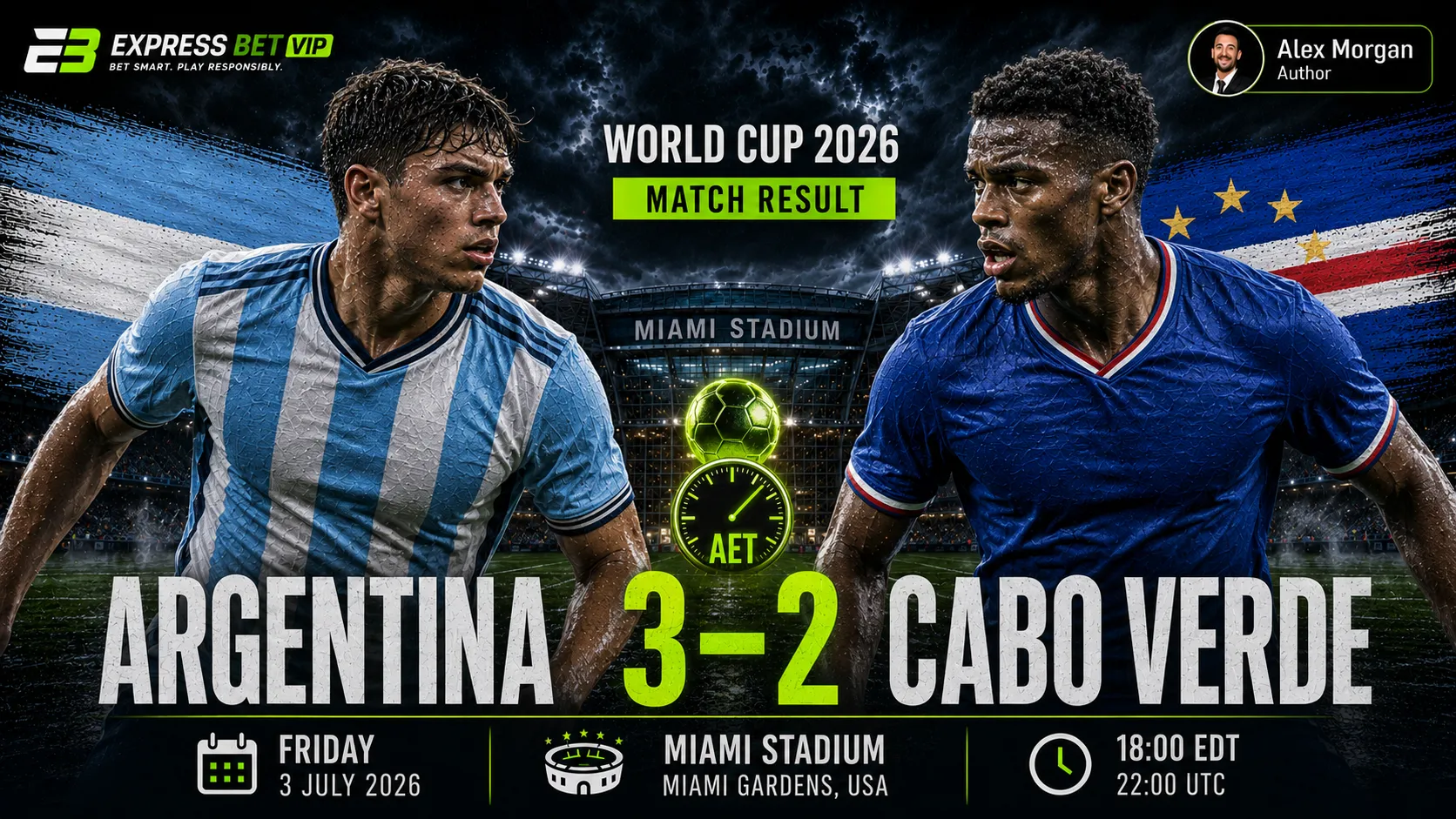
Quick Facts: Final Score, Goals, Venue, and Match Status
| Match fact | Verified information |
|---|---|
| Match | Argentina vs Cabo Verde |
| Competition | FIFA World Cup 2026 |
| Stage | Round of 32, Match 86 |
| Date | July 3, 2026 |
| Kickoff | 18:00 local time; 22:00 UTC |
| Host country | United States |
| City | Miami Gardens, Florida |
| Stadium | Miami Stadium |
| Attendance | Not available from verified public data |
| Final score | Argentina 3–2 Cabo Verde after extra time |
| Score after 90 minutes | 1–1 |
| Half-time score | Argentina 1–0 Cabo Verde |
| Argentina goals | Lionel Messi 29’, Lisandro Martínez 92’ |
| Cabo Verde goals | Deroy Duarte 59’, Sidny Lopes Cabral 103’ |
| Deciding goal | Diney Borges own goal 111’ |
| Referee | Drew Fischer, Canada |
| VAR | Armando Villarreal led the VAR team |
| Weather | Hot, humid July conditions; exact match-time readings unavailable |
| Roof | Partial canopy |
| Pitch condition | No major verified surface failure |
| Tournament impact | Argentina advanced to face Egypt; Cabo Verde were eliminated |
The official FIFA records list Argentina as 3–2 winners after extra time and attribute the deciding goal to Diney Borges as an own goal. That distinction matters because some early reports described Cristian Romero as the scorer. The official attribution takes priority.
Verified Facts vs Analysis
| Category | Status | Information |
|---|---|---|
| Final score and scorers | [CONFIRMED] | Argentina won 3–2 after extra time |
| Venue and kickoff | [CONFIRMED] | Miami Stadium, July 3 at 18:00 local time |
| Goal attribution | [CONFIRMED] | Diney Borges own goal at 111’ |
| Possession and xG | [REPORTED] | Provider figures vary slightly |
| Cabo Verde resilience | [OBSERVED] | They equalized twice after falling behind |
| Argentina’s territorial control | [OBSERVED] | Argentina had more possession, shots and box entries |
| Transition weakness | [ANALYSIS] | Argentina’s rest defence left exploitable space |
| Heat effect | [ANALYSIS] | A plausible fatigue factor, but not a sole cause |
| Betting interpretation | [MARKET SIGNAL] | Argentina won, but only after extra time |
| Attendance and closing odds | [UNKNOWN] | Not available from verified public data |
This separation prevents editorial interpretation from being presented as an official match fact. It also allows readers and search systems to extract the result without confusing a tactical judgment with a recorded event.
Final Score and Match Summary
Argentina’s 3–2 win looks ordinary only if the score is read without the route that produced it. The defending champions led twice, were caught twice and required an own goal in the 111th minute to remove a World Cup debutant.
Argentina began with greater control. Their possession structure pulled Cabo Verde into a narrow defensive block, while Messi moved between the right half-space and central areas. The opener arrived after 29 minutes and seemed to place the match on its expected course.
That course lasted half an hour.
Cabo Verde did not try to compete with Argentina by accumulating harmless possession. Bubista’s team accepted long defensive phases, protected central areas and waited for moments when Argentina’s attacking shape left insufficient cover behind the ball. Deroy Duarte’s equalizer in the 59th minute rewarded that discipline.
Argentina increased the pressure but could not find a winner during regulation time. The score was 1–1 after 90 minutes, forcing both teams into extra time in Miami’s demanding July environment.
Lisandro Martínez scored in the 92nd minute, apparently restoring the natural order. Cabo Verde ignored the script again. Sidny Lopes Cabral equalized in the 103rd minute with an excellent finish, turning an already uncomfortable evening for Argentina into a genuine elimination threat.
The winner came from Messi’s corner in the 111th minute. Cristian Romero attacked the delivery, and the ball went in off Diney Borges. FIFA recorded it as an own goal.
Argentina deserved to advance on territorial pressure, chance volume and sustained attacking output. They did not dominate the contest as securely as those numbers suggest. Cabo Verde’s ability to generate two equalizers from limited possession exposed a structural weakness that Argentina could not dismiss as bad luck.
Tournament football has a habit of charging interest on every defensive shortcut. Argentina paid almost the full amount.
Goal Timeline
29’ — Lionel Messi, Argentina, open-play goal
Messi opened the scoring during Argentina’s strongest period of territorial control. The attack placed him in a familiar interior position from which he could receive close enough to goal to shoot before Cabo Verde’s block fully reset.
The goal was not merely an individual decoration. It validated Argentina’s attempt to move Cabo Verde’s compact shape laterally before finding Messi between defensive lines.
For Cabo Verde, the tactical problem was clear: their narrow block could reduce central access for long stretches, but a single delayed step near Messi was enough to undo the work.
No verified public data reviewed for this article confirmed a decisive weather or pitch contribution to the goal.
59’ — Deroy Duarte, Cabo Verde, open-play goal
Duarte’s equalizer demonstrated the value of Cabo Verde’s direct attacking approach. They did not need a long sequence of possession. They needed Argentina’s structure to be stretched and their forward runners to attack before the defensive block could recover.
The goal changed the emotional balance. Argentina went from managing a knockout match to being asked whether their possession had produced enough protection.
Cabo Verde’s response also altered the tactical risk. Argentina pushed more players forward, creating additional pressure around Vozinha’s penalty area but also increasing the importance of their counterpress after turnovers.
92’ — Lisandro Martínez, Argentina, extra-time goal
Two minutes into extra time, Lisandro Martínez drove the ball high into the net. The finish was forceful and arrived before Cabo Verde had settled into the additional period.
Argentina’s centre-backs had become increasingly important as attacking participants. Martínez’s positioning reflected the pressure Argentina were applying around the box rather than a passive approach to extra time.
At 2–1, the logical expectation was that Argentina would control territory and protect themselves against another transition. Cabo Verde had already provided one warning. Argentina still failed to close the match.
103’ — Sidny Lopes Cabral, Cabo Verde, extra-time goal
Cabral’s equalizer was Cabo Verde’s finest attacking moment. He found shooting space near the edge of the area and produced a high-quality finish beyond Emiliano Martínez.
The goal had tactical and psychological weight. It punished Argentina for failing to establish secure control after taking the lead and gave Cabo Verde another opportunity to drag the match toward penalties.
The strike also underlined the difference between low attacking volume and low attacking quality. Cabo Verde created less, but their best actions were executed without hesitation.
111’ — Diney Borges, Cabo Verde, own goal
Messi delivered a corner, Romero escaped his marker and attacked the ball. His header took the decisive touch from Diney Borges before crossing the line. FIFA attributed the goal to Borges.
The set piece mattered because open-play control had not given Argentina a safe margin. In the second period of extra time, defensive concentration was being tested after more than 100 minutes in Miami conditions.
It was cruel for Borges and decisive for Argentina. It was not evidence that Cabo Verde’s entire performance had collapsed. It was one lost set-piece duel at the stage of a match when one lost duel tends to acquire a passport, a flag and several weeks of national discussion.
Key Moments That Changed the Match
Messi converted Argentina’s early control
Argentina needed their possession to become an actual lead. Messi’s 29th-minute goal did that and prevented Cabo Verde from extending the goalless phase into the second half.
Duarte punished Argentina’s transition structure
The 59th-minute equalizer demonstrated that Argentina’s numerical commitment in attack was not adequately protected on every turnover. It forced Scaloni’s team to increase their urgency.
Vozinha kept Cabo Verde alive
FotMob recorded 22 Argentina shots, while other reports credited Vozinha with eight saves. His work prevented Argentina’s territorial advantage from becoming a multi-goal lead. Goalkeeper performance was central to the match, not an incidental detail.
Lisandro Martínez’s goal failed to end the resistance
Scoring in the 92nd minute should have allowed Argentina to dictate the rest of extra time. Their inability to suppress Cabo Verde’s response showed that the basic transition problem remained.
Cabral produced the second equalizer
The 103rd-minute strike changed the match from a difficult Argentine win into a contest genuinely capable of reaching penalties.
The decisive corner
Romero’s movement, Messi’s delivery and Borges’s unfortunate final touch produced the winner. The goal reflected Argentina’s greater sustained pressure, but its form—an own goal from a corner—captured how close the contest remained.
Local Match Conditions: Stadium, City, Weather, Pitch, and Crowd
| Local factor | Verified or observed detail | Football meaning | Direct evidence | Betting meaning | Status | Specificity |
|---|---|---|---|---|---|---|
| City | Miami Gardens, South Florida | July heat and humidity increase physical load | Match lasted 120 minutes | Relevant to late-tempo and substitution markets | [CONFIRMED] | Fixture-specific |
| Stadium | Miami Stadium | Large outdoor venue with partial canopy | No fully controlled indoor climate | Weather exposure remained relevant | [CONFIRMED] | Fixture-specific |
| Heat risk | 95% probability of performance-impairing heat | Repeated sprint capacity may decline | Climate Central match analysis | Could affect second-half and extra-time markets | [REPORTED] | Fixture-specific |
| Humidity | Sticky conditions reported locally | Greater thermal strain | Local reporting around the match | Possible influence on fatigue | [REPORTED] | Fixture-specific |
| Match length | 120 minutes | Magnified environmental and recovery demands | Extra time confirmed | Increased live-market volatility | [CONFIRMED] | Fixture-specific |
| Pitch | No major failure confirmed | Normal passing and shooting remained possible | Five goals; no verified surface controversy | No sound basis for a pitch-driven bet | [OBSERVED] | Fixture-specific |
| Crowd | Strong visible Argentine presence | Greater emotional pressure around Argentina attacks | Local reports and match coverage | Atmosphere alone did not make the favorite secure | [OBSERVED] | Fixture-specific |
Climate Central assessed this particular fixture as having a 95% chance of heat above its performance-impairment threshold of 28°C. That does not prove heat caused an individual mistake. It establishes that the match carried a substantial thermal load before extra time added another 30 minutes.
Argentina still produced sustained pressure late in the contest. The conditions therefore did not eliminate their attacking capacity. They may, however, have reduced the consistency of recovery runs and defensive concentration on both sides.
The surface supported quick combination play and long-range finishing. No verified report established persistent slipping, abnormal bounce or goalkeeper handling problems caused by the grass.
The crowd appeared heavily favorable to Argentina, which was unsurprising given the team’s support in South Florida and Messi’s local club connection. Cabo Verde nevertheless equalized twice. Crowd advantage supplied noise, not immunity.
Stadium-Specific Match Impact
| Stadium factor | Detail |
|---|---|
| Stadium | Miami Stadium |
| Non-tournament name | Hard Rock Stadium |
| Standard listed capacity | Approximately 65,000 |
| Match attendance | Not available from verified public data |
| Pitch type | Natural-grass tournament surface |
| Roof status | Partial canopy |
| Acoustic effect | Strong Argentine support was audible and visible |
| Surface condition | No major verified defect |
| Wind relevance | Exact readings unavailable |
| Goalkeeper distribution effect | No clear verified effect |
| Set-piece effect | Argentina’s winning goal followed a corner |
| Communication effect | Possible under crowd noise, but not quantifiable |
| Data status | Mixed confirmed, observed and unavailable data |
The stadium’s most concrete match-specific influence came through the combination of an outdoor field, a partial canopy and Miami’s July climate. It was not an air-conditioned indoor match protected from heat and humidity.
The winning action was a corner attacked by Romero after 110 minutes. Fatigue may have contributed to the marking failure, but the evidence does not permit a simple causal claim. Romero’s movement and Messi’s delivery remain the immediate football explanations.
The available match evidence does not show a clear stadium-specific influence on goalkeeper distribution or the flight of long passes.
City and Weather Impact
| Factor | Match context |
|---|---|
| City | Miami Gardens |
| Host country | United States |
| Time zone | Eastern Daylight Time, UTC−4 |
| July climate | Hot, humid and prone to thunderstorms |
| Match temperature | Exact verified reading unavailable |
| Humidity | Exact verified percentage unavailable |
| Wind | Not available from verified public data |
| Rain | No verified in-match rain effect |
| Altitude | Near sea level |
| Heat-risk assessment | 95% chance of performance-impairing heat |
| Likely physical effect | Higher thermal load over 120 minutes |
| Actual evidence | Extra-time fatigue and defensive gaps were visible, but causation remains analytical |
| Data status | Climate context confirmed; exact readings incomplete |
The match did not begin at Miami’s hottest point of the afternoon, but an 18:00 kickoff still exposed the teams to a demanding environment. Near-sea-level altitude removed one concern; thermal load replaced it.
Argentina’s pressing was not continuous. They often relied on territorial control and immediate pressure close to the ball instead of maintaining a maximum-intensity chase across the entire pitch. That approach was tactically sensible in a match capable of lasting 120 minutes.
Cabo Verde spent longer without the ball, which created a different kind of physical burden: repeated lateral movement, box defending and recovery runs. Their capacity to score in the 103rd minute was evidence of impressive physical and psychological resistance.
The available evidence does not establish that weather caused a specific goal, card, substitution or injury.
First Half Analysis
Argentina controlled the first half by occupying Cabo Verde’s defensive block with width while allowing Messi freedom inside. Their nominal formation mattered less than their attacking geometry: defenders circulated behind the ball, midfielders provided central connections and the forwards tried to pin the last line.
Cabo Verde defended compactly. Their priority was to reduce clean central entries and force Argentina to work around the block. They did not press every first pass. Doing so would have created space behind the pressure and accelerated fatigue.
Messi’s movement caused the main mismatch. When he received between the lines, Cabo Verde faced an unpleasant choice. A midfielder could follow him and open space elsewhere, or the back line could step and expose depth. The 29th-minute goal came during this period of Argentine control.
Argentina’s full-backs and wide players supported attacks but also increased the importance of rest defence. Cabo Verde’s first-half attacking output was limited, yet the risk was visible whenever Argentina lost possession with several players ahead of the ball.
The half-time score of 1–0 reflected Argentina’s superiority. It did not amount to security.
Second Half Analysis
Cabo Verde’s equalizer changed the game’s tactical character. Duarte’s goal gave the underdogs proof that Argentina’s structure could be breached and removed the need to treat every defensive phase as mere survival.
Argentina responded by increasing their attacking volume. FotMob reported 64% possession, 22 shots and 52 touches in the opposition box. Those numbers show dominance of territory. They do not show dominance of every decisive moment.
Vozinha’s saves allowed Cabo Verde to keep their block intact. A goalkeeper who prevents a second goal changes more than the scoreboard. He allows his teammates to maintain belief in a lower-possession plan.
Argentina circulated the ball around the area but did not always create a clear final action. Cabo Verde protected central spaces, competed for crosses and tried to escape through direct attacks.
The match finished 1–1 after 90 minutes. For Argentina, the failure was not a lack of possession. It was the inability to turn possession into separation while preventing counterattacking danger.
Extra Time
Argentina struck immediately after the restart through Lisandro Martínez. The early extra-time goal reduced the need for reckless attacking numbers, but Argentina did not manage the new game state cleanly.
Cabral’s 103rd-minute equalizer exposed the same problem that Duarte had identified: Argentina could control long passages without controlling the entire risk profile.
The second extra-time period became a contest between Argentine pressure and Cabo Verde’s remaining concentration. Messi’s corner, Romero’s movement and Borges’s own goal settled it in the 111th minute.
Cabo Verde continued to pursue another equalizer, but Argentina survived the closing phase. No penalty shootout was required.
Tactical Picture: Why the Match Was Won and Lost
Argentina won because they generated more attacking volume, sustained pressure longer and retained enough set-piece quality to create a decisive action after 110 minutes.
Their possession shape repeatedly placed five players across or near Cabo Verde’s last line. Messi connected the midfield to the attack, while the centre-backs advanced to keep play inside Cabo Verde’s half.
The danger appeared behind that attacking structure. When Argentina lost possession, their nearest players did not always stop the first forward pass. Cabo Verde could then attack an incomplete defensive block.
Bubista’s plan was rational. Cabo Verde were unlikely to win a prolonged possession contest. They defended centrally, relied on Vozinha when the block was breached and attacked quickly when Argentina’s spacing allowed it.
The plan nearly worked because Cabo Verde’s finishing quality exceeded the modest volume of their opportunities. Their reported xG was only around 0.47, compared with Argentina’s 2.26, yet they scored twice.
Argentina’s winning plan was therefore successful but unstable. Their deeper squad, set-piece delivery and territorial persistence eventually told. Their defensive transitions made the match far more dangerous than it needed to be.
Tactical Collision Map
| Zone | Edge | Evidence | Key figure | Local effect | Result impact |
|---|---|---|---|---|---|
| Argentina left | Argentina | Sustained territorial pressure | Lisandro Martínez | No clear effect | Martínez later scored |
| Argentina right | Argentina in possession | Messi operated inside from this side | Lionel Messi | Familiar local environment cannot be quantified tactically | Opening goal and winning corner |
| Central midfield | Argentina | Greater possession and box access | Argentina’s midfield unit | Heat discouraged wasteful pressing | Controlled territory |
| Cabo Verde penalty area | Argentina | 52 reported box touches | Vozinha | Fatigue increased defensive workload | Goalkeeper kept score close |
| Set pieces | Argentina | Winning goal from Messi’s corner | Romero and Messi | Late concentration test | Decisive |
| Transitions | Cabo Verde | Two equalizers from limited possession | Duarte, Cabral | Recovery demands increased over time | Kept match alive |
| Defensive third | Cabo Verde competed well | Block survived repeated attacks | Cabo Verde back line | Long defensive workload | Forced extra time |
| Goalkeeper build-up | No clear edge | Insufficient verified detail | — | No established wind effect | Limited |
| Bench impact | Argentina | Greater options across 120 minutes | Scaloni’s squad | Extra time increased value of depth | Helped sustain pressure |
Player Ratings and Individual Performances
Ratings are editorial assessments based on verified events, reported statistics and tactical influence. Complete provider ratings and every individual action were not uniformly available.
Argentina Player Ratings
- Emiliano Martínez — 6.0: Conceded twice from high-quality finishes. Neither goal can be reduced to a simple goalkeeping error.
- Nahuel Molina — 6.0: Supported Argentina’s width but was part of a structure that allowed transition space.
- Cristian Romero — 7.0: Aggressive in duels and central to the winning corner, although FIFA recorded the goal as a Borges own goal.
- Lisandro Martínez — 7.5: Scored forcefully in extra time and helped Argentina maintain territorial pressure.
- Argentina’s left-back — 6.0: Contributed to possession but did not eliminate the transition risk.
- Enzo Fernández — 6.5: Helped circulate the ball and sustain attacks around Cabo Verde’s block.
- Alexis Mac Allister — 6.5: Offered technical control, although Argentina needed more penetration from their midfield dominance.
- Rodrigo De Paul — 6.5: Supplied running and pressure but could not prevent every Cabo Verde escape.
- Lionel Messi — 8.5: Scored the opener, delivered the decisive corner and remained Argentina’s main creative reference.
- Argentina’s starting forward line — 6.5: Created pressure and occupied defenders, but the team needed 120 minutes and a set piece to settle the contest.
- Argentina substitutes — 6.5: Helped preserve attacking intensity during extra time. A complete verified substitution-by-substitution rating was unavailable.
Cabo Verde Player Ratings
- Vozinha — 8.5: Made a series of important saves and was the primary reason Argentina could not create an earlier winning margin.
- Steven Moreira — 6.5: Worked through long defensive phases and supported direct exits when possible.
- Cabo Verde centre-backs — 6.5: Protected the box for extended periods but were eventually beaten on an extra-time corner.
- Diney Borges — 5.5: Defended under sustained pressure before suffering the decisive own goal. That touch should not erase the work preceding it.
- Cabo Verde wing-backs/full-backs — 6.5: Faced repeated overloads and still helped the team remain competitive.
- Deroy Duarte — 7.5: Scored the first equalizer and supplied Cabo Verde with belief at a critical point.
- Jamiro Monteiro — 6.5: Helped connect defensive recoveries to forward movement.
- Ryan Mendes — 7.0: Provided leadership and attacking intelligence in a match with limited possession.
- Sidny Lopes Cabral — 8.0: Produced the second equalizer with one of the match’s best finishes.
- Cabo Verde forwards — 6.5: Had fewer opportunities but worked effectively against Argentina’s exposed defensive structure.
- Cabo Verde substitutes — 6.5: Maintained competitiveness deep into extra time. Complete verified individual substitution data was unavailable.
Best Players of the Match
- Man of the Match: Lionel Messi. He scored Argentina’s first goal and delivered the corner that produced the winner.
- Best attacker: Sidny Lopes Cabral. His extra-time equalizer combined technique, nerve and enormous match significance.
- Best midfielder: Deroy Duarte. His equalizer changed the game and rewarded Cabo Verde’s transition plan.
- Best defender: Lisandro Martínez. He helped sustain Argentina’s field position and scored in extra time.
- Best goalkeeper: Vozinha. His saves prevented Argentina from converting their statistical control into a comfortable win.
- Best substitute: Not confirmed from sufficiently complete public data.
- Most underrated performance: Cristian Romero. His movement created the decisive own goal.
- Most disappointing performance: Argentina’s collective transition defence. This is a unit assessment rather than an attempt to assign the problem to one player.
Injuries, Suspensions, Cards, and Discipline
| Player | Team | Incident | Minute | Status | Next-match impact |
|---|---|---|---|---|---|
| Confirmed injuries | Both | No complete verified list available | — | [UNKNOWN] | Not confirmed |
| Yellow cards | Both | Complete official list unavailable in reviewed data | — | [UNKNOWN] | Not confirmed |
| Red cards | Both | No verified red card affected the match | — | [CONFIRMED] | None |
| Suspensions | Both | Not confirmed from reviewed public data | — | [UNKNOWN] | Not confirmed |
The match was physical and prolonged, but the reviewed sources did not provide a sufficiently complete disciplinary record for reliable player-by-player reproduction.
Referee and VAR Analysis
Drew Fischer officiated the match. Armando Villarreal led the video-assistant team, supported by Ivan Bebek and Tatiana Guzman.
No verified penalty or red-card decision defined the result. Debate appeared around individual stoppages and challenges, but the reviewed official record does not support presenting the outcome as a product of officiating.
The decisive issue was the official attribution of the final goal. FIFA recorded it as a Diney Borges own goal after Romero’s header from Messi’s corner. Early or secondary reports that credited Romero should be treated as superseded by the official record.
Match Statistics
| Statistic | Argentina | Cabo Verde |
|---|---|---|
| Possession | 64% | 36% |
| FIFA possession model | 59% | 34%, with 7% in contest |
| Shots | 22 | 16 |
| Expected goals | 2.26 | 0.47 |
| Touches in opposition box | 52 | 16 |
| Goals | 3 | 2 |
| Saves | Not uniformly reported | Vozinha reportedly made 8 |
| Corners | Not available from verified reviewed data | Not available |
| Cards | Not available | Not available |
| Pass accuracy | Not available | Not available |
| PPDA | Not available | Not available |
FotMob’s figures show Argentina’s control clearly: more possession, more shots, substantially higher xG and more than three times as many touches in the opposition box.
Cabo Verde’s two goals from 0.47 reported xG point to highly efficient finishing. Argentina’s 2.26 xG and three goals do not indicate severe wastefulness across the whole match, but the timing mattered. Their third goal arrived only after the contest had entered its 111th minute.
Provider methodologies differ, especially for possession and xG. FIFA’s model includes “possession in contest,” while FotMob presents a conventional two-team possession split.
Betting Result Angle
Verified pre-match and closing prices were not available from the sources reviewed. Argentina were widely treated as the favorite, but exact odds should not be reconstructed after the fact.
| Market | Broad expectation | Actual outcome | Winning side | Key trigger | Caution |
|---|---|---|---|---|---|
| 90-minute match winner | Argentina favored | 1–1 after 90 minutes | Draw | Duarte’s equalizer and Vozinha’s saves | Extra-time results do not settle ordinary 1X2 markets |
| To qualify | Argentina favored | Argentina advanced | Argentina | 111’ own goal | Depends on operator rules |
| Total goals 2.5 | Moderate-to-high scoring expectation | Five goals after extra time; two in regulation | Depends on settlement period | Three extra-time goals | Most totals exclude extra time |
| Both teams to score | Cabo Verde goal uncertain | Yes in regulation | “Yes” | Duarte 59’ | Price determines value |
| Correct score | Argentina expected to win | 1–1 after 90; 3–2 after extra time | Market-specific | Extra-time sequence | Correct-score markets usually settle at 90 minutes |
| First goalscorer | Messi among leading candidates | Messi scored first | Messi | 29’ opener | Exact odds unavailable |
| Anytime scorer | Messi | Messi scored | Messi backers | First-half finish | Settlement rules matter |
| Live Argentina winner | Prices shifted after 1–1 and 2–2 | Argentina eventually advanced | Market-dependent | Borges own goal | “Winner” and “to qualify” are different markets |
| Goalkeeper saves | Vozinha faced heavy volume | Strong save output | Higher-save positions likely benefited | Argentina’s 22 shots | Line and provider grading matter |
The central betting lesson is procedural. Argentina won the match, but they did not win the standard 90-minute 1X2 market. That market settled as a draw.
Likewise, a 3–2 final score after extra time does not automatically make an ordinary over 2.5 goals bet successful. Most football totals use regulation time unless the market explicitly includes extra time. After 90 minutes the score was 1–1.
The match rewarded bettors who correctly distinguished “Argentina to qualify” from “Argentina to win in 90 minutes.” It punished anyone who treated those markets as interchangeable.
Local Betting Impact: What the Venue and Conditions Changed
| Local factor | Market possibly affected | Actual evidence | Interpretation | Overreaction risk | Safer conclusion |
|---|---|---|---|---|---|
| Heat-risk profile | Second-half tempo | Match required extra time | Fatigue became increasingly relevant | High | Use actual tempo, not climate alone |
| Humidity | Substitutions and cramps | Exact physical data unavailable | Could increase recovery demands | High | Do not infer injuries without evidence |
| Partial canopy | Weather exposure | Outdoor conditions remained relevant | Less protection than a closed roof | Medium | Venue design was secondary to tactics |
| 120-minute duration | Live totals and qualification | Three goals came in extra time | Late volatility increased | Low | Check whether markets include extra time |
| Argentine crowd | Match momentum | Argentina pressure remained strong | Emotional support favored Argentina | High | Crowd size does not guarantee conversion |
| Functional pitch | Shots and passing | Five goals, no major surface issue | No basis for a pitch-driven under | Low | Treat surface as broadly neutral |
The local conditions increased the physical demands of a match that went to 120 minutes, but they did not point reliably toward a specific result. Cabo Verde scored in the 103rd minute, which directly contradicts any simplistic assumption that the underdog would merely wilt in the heat.
What This Result Means for the Knockout Bracket
Argentina advanced to the Round of 16, where Egypt awaited in Atlanta. Cabo Verde were eliminated after becoming the only one of the tournament’s four debutants to reach the knockout stage.
For Argentina, the win preserved their title defence but imposed an additional 30 minutes of work. That mattered because knockout tournaments compress recovery time and make every extra-time period part of the next match’s physical preparation.
For Cabo Verde, elimination did not diminish the significance of the campaign. They reached the Round of 32 in their first World Cup and forced the defending champions to survive two equalizers and 120 minutes.
What Argentina Did Right
Argentina created enough volume to justify progression. Their circulation moved Cabo Verde repeatedly, their attackers generated 22 reported shots, and they entered the opposition box far more often.
Messi supplied decisive quality rather than decorative possession. His goal opened the match, and his corner created the winner.
Argentina also continued attacking after setbacks. Cabo Verde’s two equalizers did not produce a psychological collapse. Scaloni’s team regained the lead twice and sustained enough pressure to decide the game.
Their set-piece execution ultimately separated the teams. When open play failed to produce a safe margin, a rehearsed delivery and an aggressive run supplied the final answer.
What Cabo Verde Got Wrong
Cabo Verde’s main problem was the volume of pressure they accepted. A compact block can survive for long periods, but conceding 22 shots and 52 opposition-box touches creates too many opportunities for one deflection or marking error to decide the match.
Their possession share limited their ability to control the game after equalizing. Both at 1–1 and 2–2, they remained vulnerable to another prolonged Argentine attack.
The decisive corner exposed a late concentration failure. Romero found the route to the ball, and Borges was placed in an almost impossible defensive position.
These flaws do not make Cabo Verde’s plan irrational. The plan brought them within minutes of penalties against the defending champions. It simply carried a high cumulative defensive risk.
Coach Analysis
Lionel Scaloni’s side generated territorial superiority but lacked defensive balance. His attacking structure placed enough players around Cabo Verde’s box to create sustained pressure, yet the protection behind those attacks was inconsistent.
Scaloni deserves credit for Argentina’s refusal to panic and for maintaining attacking quality through extra time. He also left the match with a clear warning: control cannot be measured only by possession and shot count.
Bubista designed a realistic underdog plan. Cabo Verde protected central areas, accepted low possession and attacked moments of structural weakness. Scoring twice against Argentina demonstrated the plan’s effectiveness.
The cost was a relentless defensive workload. Bubista’s team eventually lost the set-piece duel that mattered most, but their tactical approach gave them a genuine route to an upset.
Player Milestones and Records
Messi made his 30th World Cup appearance, becoming the first player to reach that figure. His 29th-minute finish was his seventh goal of the 2026 tournament at that stage.
The match also formed part of Cabo Verde’s first World Cup appearance and first knockout-stage campaign.
Lionel Scaloni reached his 100th match as Argentina coach. These milestones were secondary during the contest but substantial in historical context.
Historical Context and World Cup Analogies
Cabo Verde’s performance belonged to the familiar World Cup category in which an underdog refuses to behave like a ceremonial opponent. Their low possession did not prevent them from threatening the favorite because they attacked the right spaces with conviction.
The match was not a conventional upset because Argentina advanced. It was a warning match: the kind a champion survives and later either learns from or repeats under less forgiving circumstances.
Argentina’s difficulty also recalled a basic knockout lesson. Control without transition protection is possession wearing formal clothes. It looks appropriate until somebody runs past it.
Incidents and Controversies
No verified controversy was strong enough to replace the football as the principal explanation for the result.
The clearest post-match correction concerned the winning goal. FIFA attributed it to Diney Borges as an own goal, while some early coverage credited Romero. The official attribution should be used in match records, betting-related scorer discussions and structured data.
Information Gain: What This Article Adds
This analysis separates the 90-minute draw from the extra-time result, an essential distinction for both tournament records and betting settlement.
It also connects Argentina’s statistical superiority to their transition vulnerability, explains why Cabo Verde’s low xG did not make their goals meaningless and places the extra-time sequence within Miami’s high heat-risk environment.
The goal attribution follows FIFA’s official record rather than conflicting early reports.
Local Information Gain Quality Check
| Detail | Included | Status | Fixture-specific | Later update required |
|---|---|---|---|---|
| Stadium | Yes | [CONFIRMED] | Yes | Attendance if published |
| City | Yes | [CONFIRMED] | Yes | No |
| Heat risk | Yes | [REPORTED] | Yes | Exact match reading |
| Pitch | Yes | [OBSERVED] | Yes | Official grounds report if released |
| Crowd | Yes | [OBSERVED] | Yes | Exact distribution unavailable |
| Travel/acclimatization | Limited | [UNKNOWN] | Yes | Official team information |
| Betting risk | Yes | [ANALYSIS] | Yes | Verified closing odds |
| Tactical-local connection | Yes | [ANALYSIS] | Yes | Tracking data could improve it |
| Anti-template status | Passed | [ANALYSIS] | Yes | Recheck after data updates |
Source and Data Appendix
| Data point | Status | Source type |
|---|---|---|
| Final score | [CONFIRMED] | FIFA Match Centre |
| Goal scorers | [CONFIRMED] | FIFA Match Centre |
| Goal times | [CONFIRMED] | FIFA and match reports |
| Winning own goal | [CONFIRMED] | FIFA official attribution |
| Stadium | [CONFIRMED] | FIFA |
| City | [CONFIRMED] | FIFA and local reporting |
| Attendance | [UNKNOWN] | Not available in reviewed data |
| Referee | [CONFIRMED] | FIFA-related appointment data, FotMob |
| VAR | [CONFIRMED] | Referee appointment reporting |
| Full lineups | [UNKNOWN] | Not reproduced without complete verification |
| Substitutions | [UNKNOWN] | Complete list unavailable |
| Cards | [UNKNOWN] | Complete official list unavailable |
| Injuries | [UNKNOWN] | No complete verified report |
| Possession | [REPORTED] | FIFA and FotMob methodologies differ |
| Shots | [REPORTED] | FotMob/Opta |
| xG | [REPORTED] | FotMob |
| Odds | [UNKNOWN] | No verified archive used |
| Heat risk | [REPORTED] | Climate Central |
| Exact weather | [UNKNOWN] | Match-time readings unavailable |
| Pitch condition | [OBSERVED] | Match evidence |
| Crowd profile | [OBSERVED] | Local and match reporting |
| Tournament impact | [CONFIRMED] | FIFA |
Update Protocol
- Update if FIFA corrects any goal or assist attribution.
- Add official attendance when available.
- Add complete lineups, substitutions and cards only after verification.
- Update disciplinary consequences before Argentina’s next match.
- Add final provider statistics with methodology labels.
- Add exact match-time weather readings if an authoritative archive becomes available.
- Add closing odds only from a licensed provider or reliable market archive.
- Preserve the distinction between regulation and extra-time settlement.
Last updated: July 17, 2026
Final Verdict
Argentina advanced because their attacking volume, individual quality and set-piece execution eventually outweighed Cabo Verde’s defensive resistance and counterattacking precision. The 3–2 score was fair in the broad statistical sense. It was not comfortable, inevitable or tactically clean.
Messi supplied the decisive influence. Vozinha kept Cabo Verde within reach. Duarte and Cabral punished Argentina’s weak transition control, while Romero’s movement at the decisive corner finally broke the resistance.
Miami’s heat-risk environment made the 120-minute contest more demanding, but tactics remained the stronger explanation. Cabo Verde were not eliminated because it was hot. They were eliminated because one final corner found a runner and then a cruel defensive touch.
Argentina moved on to face Egypt. Cabo Verde left after demonstrating that a World Cup debutant can lose without becoming a footnote.
Responsible Betting Note
Football betting carries financial risk. Accurate match analysis does not guarantee a winning wager. Odds change before and during matches, while settlement rules may exclude extra time.
Local conditions can also be overvalued. Heat, humidity and crowd support influence physical and psychological demands, but they do not determine a result by themselves.
Never chase losses or bet money required for daily expenses. Set financial and time limits, take breaks and use licensed operators only. Check the gambling laws in your jurisdiction. Betting should remain entertainment, not a source of income.
Summarize this article with AI. Use this page URL as the source:
Summarize this article with AI:
FAQ
Argentina won 3–2 after extra time. The score after 90 minutes was 1–1.
Lionel Messi and Lisandro Martínez scored for Argentina. Deroy Duarte and Sidny Lopes Cabral scored for Cabo Verde. Diney Borges’s 111th-minute own goal decided the match.
Lionel Messi was the editorial Man of the Match after scoring the opener and delivering the corner that produced the winning own goal.
Argentina advanced to face Egypt in the Round of 16. Cabo Verde were eliminated.
The standard 90-minute match-winner market settled as a draw, while Argentina-to-qualify positions won. Goal totals and correct-score settlements depended on whether the market included extra time and when the odds were taken.