
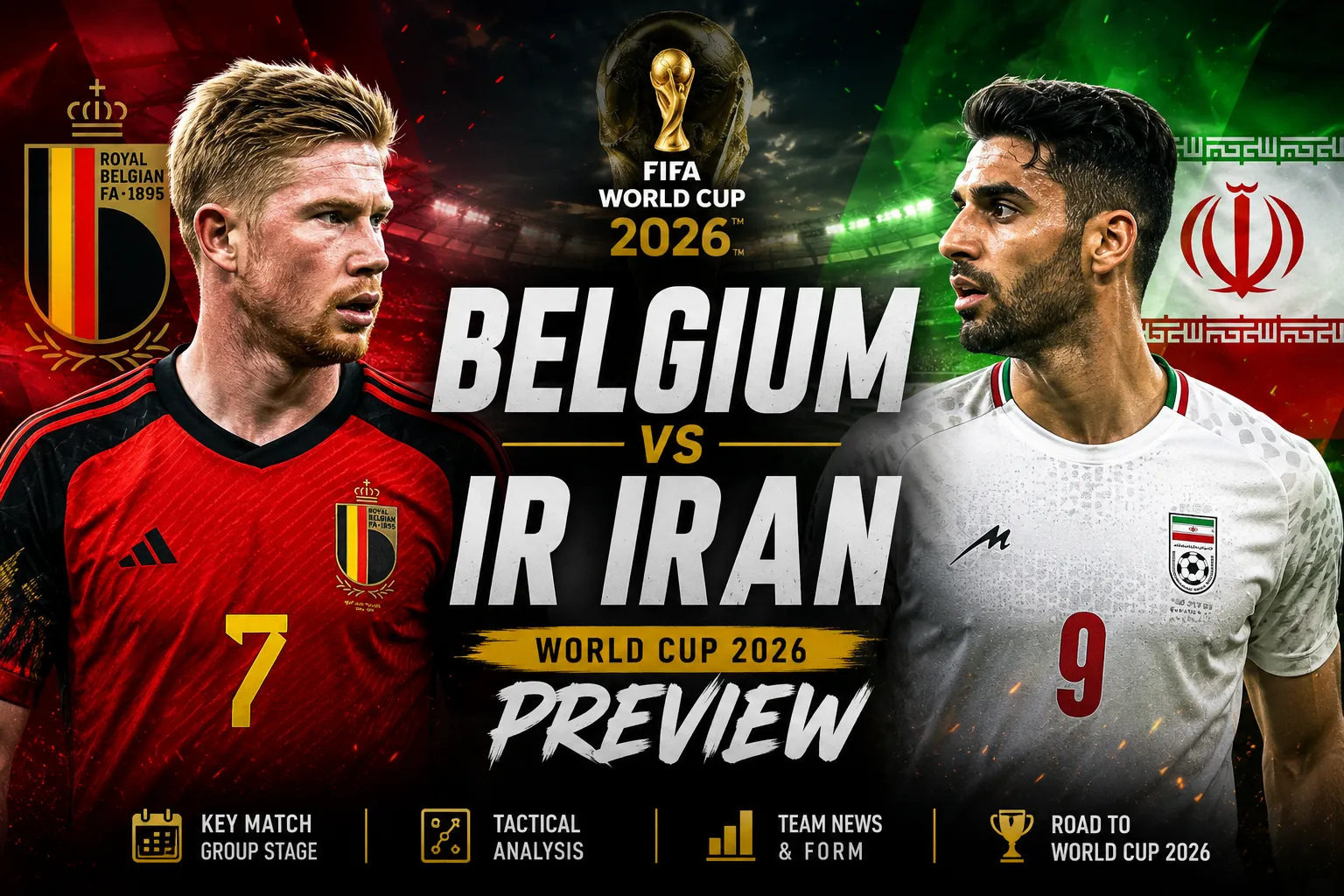
Belgium vs IR Iran World Cup 2026 Preview
Table of Contents Show
Belgium face IR Iran in a FIFA World Cup 2026 Group G match at Los Angeles Stadium in Inglewood, Los Angeles, California, United States, on Sunday, 21 June 2026. Kick-off is scheduled for 12:00 p.m. Pacific Time and 19:00 UTC. This is Match 39 and the second group-stage match for both teams.
Belgium enter after a 1-1 draw with Egypt. Iran enter after a 2-2 draw with New Zealand. Group G is balanced before this match because Belgium, Iran, Egypt and New Zealand each opened with one point. Belgium are coached by Rudi Garcia and carry a squad led by Thibaut Courtois, Kevin De Bruyne, Youri Tielemans, Amadou Onana, Romelu Lukaku, Leandro Trossard, Jeremy Doku and Charles De Ketelaere. Iran are coached by Amir Ghalenoei and carry a squad led by Alireza Beiranvand, Mehdi Taremi, Alireza Jahanbakhsh, Ramin Rezaeian, Saeid Ezatolahi, Saman Ghoddos and Mohammad Mohebi.
The likely tactical shape is Belgium controlling more possession through De Bruyne, Tielemans and wide attackers, while Iran defend compactly and counter through Taremi, Mohebi, Jahanbakhsh and Rezaeian. The key matchup is Belgium’s creative midfield and wide overloads against Iran’s defensive block and transition route. Belgium are market favourites, but this article gives analysis only. It does not provide guaranteed betting advice.
| Field | Data |
|---|---|
| Match | Belgium vs IR Iran |
| Competition | FIFA World Cup 2026 |
| Stage | First Stage / Group Stage |
| Group | Group G |
| Match Number | Match 39 |
| Date | Sunday, 21 June 2026 |
| Kick-off Time | 12:00 p.m. Pacific Time / 19:00 UTC |
| Stadium | Los Angeles Stadium |
| Common Venue Context | SoFi Stadium, Inglewood |
| City | Inglewood / Los Angeles metropolitan area |
| Host Country | United States |
| Expected Attendance | Not available from verified public data |
| Referee | Not available from verified official public data |
| VAR | Not available from verified official public data |
| Weather Forecast | Mild Southern California matchday profile, around 19.4°C / 67°F in the wider event window; exact match-hour wind, humidity and pitch speed not available from verified public data |
| Pitch Context | Tournament football surface at an NFL venue adapted for World Cup football; exact pitch speed not available from verified public data |
| Main Article Focus | Group G pressure, Belgium’s attacking correction, Iran’s transition threat, predicted lineups, Los Angeles context, projected stats, card risk, set pieces and responsible betting market analysis |
Belgium vs Iran is not a routine favourite-versus-underdog match. Belgium have the deeper squad and stronger market profile. Iran have a strong tournament identity, experienced forwards and a proven ability to turn limited possession into dangerous moments. Both teams drew their opening games. That makes the second match a leverage point, not a warm-up.
Belgium vs IR Iran matters because both teams entered the match on one point, and the winner can take control of a wide-open Group G before the final round.
| Category | Status | Belgium vs IR Iran Example | Article Use |
|---|---|---|---|
| Confirmed fact | Verified before publication | Belgium vs IR Iran, Group G, Match 39, Los Angeles Stadium | |
| Confirmed timing | Verified fixture context | Sunday, 21 June 2026, 12:00 p.m. PT / 19:00 UTC | |
| Confirmed Belgium opener | Verified reporting | Belgium drew 1-1 with Egypt | |
| Confirmed Iran opener | Verified reporting | Iran drew 2-2 with New Zealand | |
| Confirmed group context | Verified reporting | All four Group G teams opened with one point | |
| Confirmed Belgium coach | Verified squad source | Rudi Garcia | |
| Confirmed Iran coach | Verified squad source | Amir / Ardeshir Ghalenoei | |
| Confirmed Belgium squad context | Verified squad source | Courtois, De Bruyne, Tielemans, Onana, Lukaku, Trossard, Doku, De Ketelaere | |
| Confirmed Iran squad context | Verified squad source | Beiranvand, Taremi, Jahanbakhsh, Rezaeian, Ezatolahi, Ghoddos, Mohebi | |
| Probable information | Tactical forecast | Belgium likely control more possession and territory | |
| Projected data | Model-based estimate | Possession, shots, xG, corners, cards and substitutions | |
| Unknown data | Not verified in current source set | Referee, VAR, expected attendance, exact humidity, exact wind, final pitch speed | |
| Scenario-based analysis | Forecast only | Lukaku may start or remain a managed-minute option; Iran may use a compact block or deeper back five |
This distinction matters because the match can be misread by market price alone. Belgium are favourites, but the favourite label is not a result. Iran conceded chances against New Zealand, but that does not mean they will defend the same way against Belgium. Belgium needed impact from the bench against Egypt, but that does not mean Lukaku must start or that he will be able to play a full match.
A projected lineup is not an official team sheet. A projected xG range is not a final statistic. A betting price is not a guarantee. A weather profile is not final pitch condition. This dossier separates confirmed facts from forecasts so the reader can see what is known, what is likely and what remains uncertain.
Group G opened with two draws. Belgium drew Egypt. Iran drew New Zealand. That means no team entered the second round with a clear advantage. The group is open, but the pressure is real.
| Team | Played | Won | Drawn | Lost | Goals For | Goals Against | Goal Difference | Points |
|---|---|---|---|---|---|---|---|---|
| Belgium | 1 | 0 | 1 | 0 | 1 | 1 | 0 | 1 |
| Egypt | 1 | 0 | 1 | 0 | 1 | 1 | 0 | 1 |
| Iran | 1 | 0 | 1 | 0 | 2 | 2 | 0 | 1 |
| New Zealand | 1 | 0 | 1 | 0 | 2 | 2 | 0 | 1 |
The top two teams in each group qualify directly for the Round of 32. The best eight third-placed teams also qualify. Four points after two matches create a strong route. Two points keep a team alive but not safe. One point after two matches creates heavy final-round pressure.
Belgium’s final group match is against New Zealand. Iran’s final group match is against Egypt. That makes this game a strategic pivot. A win gives either side a qualification platform. A draw keeps both alive but leaves both exposed. A loss puts the final match under serious pressure.
Belgium need attacking clarity. The draw against Egypt kept them alive, but it also raised questions. Garcia has elite names, but his team must produce better rhythm, better box entries and better finishing sequences.
The central issue is balance. Belgium want De Bruyne on the ball. They want width from Doku, Trossard, Lukebakio or Saelemaekers. They want Lukaku or De Ketelaere to occupy centre-backs. They also need Tielemans, Onana or Witsel to protect against counters. If Belgium commit too many players forward, Iran can attack quickly through Taremi and the wide outlets.
Belgium’s objectives:
Iran showed both strength and vulnerability against New Zealand. They scored twice and created real attacking moments. They also conceded two goals and allowed chances. Against Belgium, they likely need more defensive control and fewer open spaces.
Ghalenoei’s team have experience. Beiranvand gives goalkeeping leadership. Taremi gives elite penalty-box intelligence. Jahanbakhsh gives leadership and wide quality. Rezaeian gives set-piece and right-side value. Mohebi gives direct running. Ghoddos gives technical connection. Ezatolahi gives midfield strength.
Iran’s objectives:
Goal difference matters because Group G started level. Belgium and Iran both entered with a neutral goal difference. A narrow win is useful. A heavy win is powerful. A heavy defeat can make third-place comparison difficult.
Belgium may chase a second goal if they lead because group ranking matters. Iran may defend margin if they trail, because goal difference can keep them alive. That creates a tactical tension in the final 20 minutes.
The expanded World Cup format makes third place relevant. A team with four points after two matches is likely in a strong position. A team with two points still has a route. A team with one point must likely win the final match.
Belgium want to avoid needing a final-day rescue. Iran want to avoid making the Egypt match a must-win under extra travel and pressure. That makes this match important even if it does not decide everything.
Belgium carry expectation pressure. Iran carry resilience pressure. Belgium are expected to attack. Iran are expected to defend and counter. If Iran keep the match level for long enough, pressure shifts toward Belgium. If Belgium score early, Iran must decide whether to open up. If Iran score first, Belgium may have to attack a disciplined block with growing anxiety.
| Result | Belgium Impact | Iran Impact | Group G Meaning |
|---|---|---|---|
| Belgium win | Belgium move to four points and gain control before New Zealand | Iran stay on one point and face pressure before Egypt | Belgium restore favourite status |
| Draw | Belgium move to two points and remain under final-round pressure | Iran move to two points and stay alive before Egypt | Group remains open |
| Iran win | Belgium stay on one point and face a difficult final-round situation | Iran move to four points and take a major step toward qualification | Iran create a major Group G shift |
| Factor | Match Relevance |
|---|---|
| Host country | United States |
| Venue region | Southern California |
| City context | Inglewood / Los Angeles metropolitan area |
| Neutral match | Neither team is host nation |
| Crowd profile | Belgian support, Iranian support, large local neutral audience |
| Climate | Mild coastal Southern California matchday profile |
| Altitude | No meaningful altitude issue |
| Stadium context | NFL venue adapted for World Cup football |
| Travel context | Belgium travel from Seattle opener; Iran have had complex travel and base logistics |
| Tournament pressure | Second group match with qualification control at stake |
Los Angeles gives the match a major-event setting. The stadium can amplify Iran’s support if their fans travel in numbers and neutral spectators respond to the underdog. Belgium’s task is to keep the match technical and controlled. Iran’s task is to make the game emotional, compact and transition-heavy.
| City Factor | Tactical Impact |
|---|---|
| 12:00 p.m. local kick-off | Daytime rhythm affects warm-up and hydration |
| Mild weather profile | Pressing is physically more viable than in hot venues |
| No altitude issue | Sprint recovery is normal |
| Large stadium environment | Communication and emotional control matter |
| Neutral but lively crowd | Momentum may swing with defensive blocks and counterattacks |
| Travel context | Iran’s preparation and movement have been complicated |
| Surface adaptation | Early touches should reveal pitch speed |
| Broadcast and crowd pressure | Favourite pressure rises if Belgium fail to score early |
The weather is less severe than Miami, Houston or Atlanta. Belgium can press more aggressively if the team structure supports it. Iran can also counter with repeated sprints. The main physical issue is not heat. It is recovery, travel and match rhythm.
| Stadium Detail | Data |
|---|---|
| FIFA Stadium Name | Los Angeles Stadium |
| Common Venue Context | SoFi Stadium |
| City | Inglewood / Los Angeles area |
| State | California |
| Host Country | United States |
| Kick-off | 12:00 p.m. PT / 19:00 UTC |
| Expected Attendance | Not available from verified public data |
| Referee | Not available from verified official public data |
| VAR | Not available from verified official public data |
| Roof Status | Stadium has a roof/canopy design; match-specific environmental setup not available from verified public data |
| Pitch Speed | Not available from verified public data |
| Tactical Impact | The venue supports fast circulation if the surface plays cleanly; both teams must calibrate early |
Los Angeles Stadium is a high-profile venue. Its scale can influence communication, especially during set pieces and pressing triggers. Belgium’s defenders must talk clearly when Iran play direct. Iran’s midfielders must stay connected when Belgium switch play.
| Weather / Environment Factor | Tactical Meaning |
|---|---|
| Around 19.4°C / 67°F event-window profile | Pressing is viable |
| Mild conditions | Fewer heat-related constraints than some other host cities |
| Exact humidity unavailable | Avoid precise cramp claims |
| Exact wind unavailable | Long diagonals and crosses need live reading |
| No altitude | Normal oxygen recovery |
| Stadium roof/canopy context | Wind and sun may be moderated, but match-specific setup is unknown |
| Pitch speed unknown | First 10 minutes should guide pass weight |
| Travel load | Iran’s off-field logistics can affect freshness more than weather |
The most important physical factor is not temperature. It is preparation and recovery. Belgium can build a controlled rhythm if they avoid frustration. Iran must manage defensive workload and make every counterattack efficient.
| Team | Player / Role | Status | Tactical Impact |
|---|---|---|---|
| Belgium | Rudi Garcia | Head coach | Must sharpen attack and manage experienced players |
| Belgium | Thibaut Courtois | Goalkeeper | Shot-stopping, command and distribution |
| Belgium | Kevin De Bruyne | Midfielder | Main chance creator and tempo director |
| Belgium | Youri Tielemans | Midfielder | Passing, set pieces and second-ball control |
| Belgium | Amadou Onana | Midfielder | Physical balance and defensive screen |
| Belgium | Axel Witsel | Midfielder / defensive cover | Experience and late-game control option |
| Belgium | Romelu Lukaku | Forward | Managed fitness context; central striker and box target |
| Belgium | Leandro Trossard | Forward / winger | Movement, finishing and left-side combinations |
| Belgium | Jeremy Doku | Winger | One-vs-one threat and width if available |
| Belgium | Charles De Ketelaere | Attacker / forward | Link play, height and flexible role |
| Belgium | Maxim De Cuyper | Defender / full-back | Width and crossing threat |
| Iran | Amir / Ardeshir Ghalenoei | Head coach | Compact defensive plan and transition structure |
| Iran | Alireza Beiranvand | Goalkeeper | Command, shot-stopping and long distribution |
| Iran | Mehdi Taremi | Forward / captain-level figure | Main striker, penalty-box intelligence and outlet |
| Iran | Alireza Jahanbakhsh | Winger / leader | Experience, wide threat and leadership |
| Iran | Ramin Rezaeian | Full-back / wide outlet | Set-piece quality and right-side progression |
| Iran | Saeid Ezatolahi | Midfielder | Defensive screen and aerial duels |
| Iran | Saman Ghoddos | Midfielder | Technical connection and forward passing |
| Iran | Mohammad Mohebi | Forward / wide player | Direct running and transition threat |
| Player | Team | Status | Tactical Impact |
|---|---|---|---|
| Romelu Lukaku | Belgium | Fitness and minutes management watchlist | Starting role or substitute timing changes Belgium’s penalty-box threat |
| Jeremy Doku | Belgium | Matchday availability should be checked from official team sheet | If available, Belgium gain elite one-vs-one width |
| Zeno Debast | Belgium | Injury concern in broader squad context | Defensive depth and rotation should be verified |
| Not available from verified public data | Iran | No specific match-day doubtful player confirmed in this source set | Official team sheet should be checked |
| Player | Team | Status | Tactical Impact |
|---|---|---|---|
| Sardar Azmoun | Iran | Not selected in Iran’s 26-man World Cup squad | Removes an experienced forward option; Taremi carries greater attacking weight |
| Not available from verified public data | Belgium | No confirmed match-specific unavailable player used in this preview | Do not invent absences |
| Not available from verified public data | Iran | No additional confirmed match-specific unavailable player used in this preview | Do not invent absences |
| Player / Group | Team | Issue | Match Impact |
|---|---|---|---|
| Romelu Lukaku | Belgium | Fitness and managed minutes | Influences striker selection and late-game plan |
| Belgium wide attackers | Belgium | Availability and selection uncertainty | Changes one-vs-one threat and crossing volume |
| Belgium centre-backs | Belgium | Transition exposure risk, not injury | Need protection against Taremi and Mohebi |
| Iran defensive line | Iran | High workload forecast | Must handle De Bruyne service and wide attacks |
| Alireza Beiranvand | Iran | Expected workload, not injury | Likely faces pressure if Belgium dominate |
| Mehdi Taremi | Iran | Tactical workload, not injury | Must hold up play and attack limited chances |
| Team | Confirmed Suspension | Notes |
|—|—|
| Belgium | Not available from verified public data | No confirmed active suspension used in this preview |
| Iran | Not available from verified public data | No confirmed active suspension used in this preview |
Belgium’s most important selection question is how Garcia balances Lukaku’s penalty-box value with his managed fitness. A fully fit Lukaku changes the geometry of the attack because he pins centre-backs and creates space for De Bruyne, Trossard and wide runners. A limited Lukaku changes the plan. De Ketelaere, Trossard or another forward profile may give more movement but less classic box presence.
Iran’s biggest squad issue is Azmoun’s absence. Taremi becomes the main reference point. That makes the quality of support around him critical. If Jahanbakhsh, Mohebi, Ghoddos or Rezaeian cannot get close to Taremi after long passes, Iran will struggle to keep the ball.
Official starting lineups were not available from verified public data at the time of writing. The following XIs are projections based on squad context, opening-match reports and tactical logic.
| Position / Line | Player | Likely Role |
|---|---|---|
| GK | Thibaut Courtois | Goalkeeper, command and distribution |
| RB | Timothy Castagne / Thomas Meunier | Right-side defence and support runs |
| CB | Zeno Debast / Koni De Winter | Buildup and recovery defending |
| CB | Arthur Theate / Brandon Mechele | Left-sided defending and aerial duels |
| LB | Maxim De Cuyper | Width, crossing and left-side progression |
| DM | Amadou Onana | Physical screen and second-ball control |
| CM | Youri Tielemans | Passing rhythm and set-piece delivery |
| AM | Kevin De Bruyne | Main creator and final-third passer |
| RW | Jeremy Doku / Dodi Lukebakio | One-vs-one threat and width |
| ST | Charles De Ketelaere / Romelu Lukaku | De Ketelaere for movement; Lukaku for box power |
| LW | Leandro Trossard | Inside movement, finishing and combination play |
| Position / Line | Player | Likely Role |
|---|---|---|
| GK | Alireza Beiranvand | Goalkeeper, command and long distribution |
| RB | Ramin Rezaeian / Aria Yousefi | Right-side defence, set pieces and forward support |
| CB | Shojae Khalilzadeh | Defensive leadership and aerial duels |
| CB | Ali Nemati / Hossein Kanaani-type profile if selected | Box defending and first contact |
| LB | Milad Mohammadi | Left-side defence and recovery |
| DM | Saeid Ezatolahi | Midfield screen and aerial protection |
| CM | Saman Ghoddos | Technical connection and transition passing |
| CM | Ahmad Noorollahi / Ali Gholizadeh-type profile if selected | Duels, cover and support runs |
| RW | Alireza Jahanbakhsh | Leadership, wide threat and delivery |
| ST | Mehdi Taremi | Main outlet, penalty-box threat and hold-up play |
| LW | Mohammad Mohebi / Mehdi Ghayedi | Direct running and counterattacking support |
| Team | Base Formation | In Possession | Out of Possession | Confidence |
|---|---|---|---|---|
| Belgium | 4-2-3-1 / 4-3-3 | 2-3-5 with De Bruyne between lines and full-backs high | 4-4-2 press or 4-2-3-1 counter-press shape | Medium |
| Iran | 4-2-3-1 / 4-4-2 / 5-4-1 | Direct 2-3-5 only in selected counters; Rezaeian and wide forwards support | Compact 5-4-1 or 4-5-1 block | Medium/high |
| Scenario | Trigger | Expected Change |
|---|---|---|
| Lukaku starts | Garcia wants immediate penalty-box reference | Belgium cross earlier and pin Iran centre-backs |
| Lukaku stays on bench | Minutes management continues | De Ketelaere or Trossard may start centrally |
| Doku starts | Belgium want direct one-vs-one width | Iran’s left defensive cover faces high pressure |
| Doku does not start | Belgium choose control or fitness caution | Lukebakio, Trossard or Saelemaekers carry more width |
| Belgium add Witsel | Garcia wants late control | Midfield becomes more conservative |
| Iran use back five | Ghalenoei prioritises containment | Extra defender protects Beiranvand and central box |
| Iran use two forwards | Iran want better support for Taremi | Mohebi or Moghanlou plays closer to him |
| Iran chase late goal | Trailing after 70’ | Jahanbakhsh, Ghayedi, Moghanlou or another forward profile becomes more important |
| Phase | Expected Pattern |
|---|---|
| Build-up | Courtois and centre-backs feed Tielemans, Onana and De Bruyne |
| Attack | De Bruyne service, wide isolation, Trossard movement, striker box presence |
| Defense | Counter-press after loss, Onana screening, centre-backs protecting Taremi route |
| Transitions | Quick release to Doku, Trossard, Lukebakio or De Bruyne after regain |
| Set Pieces | De Bruyne/Tielemans delivery to Lukaku, Onana, De Ketelaere and centre-backs |
| Weakness | Finishing rhythm, striker fitness, space behind full-backs and defensive recovery |
Belgium should control the first phase. Courtois can pass short or go long. The centre-backs should find Tielemans or Onana early. De Bruyne should receive higher, not too close to the centre-backs. If he drops too deep, Belgium may lose final-third creativity.
The key is tempo. Iran will likely defend compactly. Belgium cannot move the ball slowly from side to side without penetration. They need quick switches, early diagonal balls, and combinations around the box.
Useful Belgium build-up routes:
Belgium can press Iran high, but they must not overcommit. Iran can go direct to Taremi or wide to Mohebi and Jahanbakhsh. Belgium’s press should trap Iran near the sideline and force low-quality clearances.
Useful Belgium pressing triggers:
The counter-press after losing the ball may decide the match. If Belgium stop Iran’s first forward pass, they can keep pressure high. If Iran play through the first wave, Belgium can become exposed.
Belgium’s main attacking side depends on Doku. If Doku starts, Belgium can target his flank repeatedly. If he does not start, Trossard and De Cuyper may become the main left-side creators, while Lukebakio or Saelemaekers can attack the right.
Belgium should not rely only on crosses. Iran’s centre-backs and Beiranvand can handle predictable balls. Better routes include cutbacks, De Bruyne through passes, Trossard combinations and second balls around the penalty arc.
De Bruyne is the main passer. Tielemans is the rhythm passer. Courtois can also be a major distribution weapon. Belgium’s best sequences will likely involve De Bruyne receiving between Iran’s midfield and defence.
Belgium can transition quickly if Iran commit players forward. Those moments may be limited. More often, Belgium will attack after winning the ball back from an Iran clearance. That second-phase pressure can produce high-value shots.
Belgium have strong set-piece tools. De Bruyne and Tielemans can deliver. Lukaku, Onana, De Ketelaere, Theate, Mechele, Debast and De Winter can attack aerial balls. Iran must defend both the first ball and the second ball.
Belgium’s main defensive weakness is space after full-back advances. If both full-backs go high and Onana steps forward, Taremi can receive into a large transition lane. Belgium must stagger their rest defence.
Courtois can help Belgium bypass Iran’s first pressure. He must also stay alert because Iran may create few chances but high-value chances. A goalkeeper can be quiet for 70 minutes and still decide the match.
Belgium’s full-backs can support attacks, but they must coordinate. One can advance. The opposite side should hold. Onana should remain close enough to stop counters.
The striker choice changes Belgium’s attack. Lukaku gives power, presence and gravity. De Ketelaere gives movement, link play and pressing flexibility. Trossard as a false nine would increase rotation but reduce classic penalty-box power.
| Phase | Expected Pattern |
|---|---|
| Build-up | Low-risk exits, Beiranvand long distribution, Ezatolahi/Ghoddos support |
| Attack | Direct counters through Taremi, Mohebi, Jahanbakhsh and Rezaeian |
| Defense | Compact block, central protection and forced wide attacks |
| Transitions | First forward pass into Taremi or wide runner |
| Set Pieces | Rezaeian delivery, Taremi movement, centre-back aerial targets |
| Weakness | Defensive spacing after New Zealand draw, pressure under wide overloads, possession relief |
Iran should not overplay in central areas. Belgium can press with De Bruyne, Trossard, Onana and wide players. Beiranvand can go long when needed. Ezatolahi and Ghoddos must offer simple passing options when Iran need to rest with the ball.
The most important build-up task is clean first contact. If Taremi receives long balls without support, Iran will lose possession quickly. If Mohebi, Jahanbakhsh or Ghoddos get close, Iran can create real attacks.
Iran should press selectively. A constant high press against Belgium may leave too much space. Ghalenoei may prefer a mid-block or low block with specific pressing triggers.
Useful Iran pressing triggers:
Iran must avoid fouls around the box. Belgium have elite delivery and aerial targets.
Iran’s right side can be important because Rezaeian provides experience, delivery and forward support. Jahanbakhsh can operate as a wide leader. Mohebi can attack space on the opposite side. Taremi is the central reference.
The best Iran attacks will likely be short and direct:
Ghoddos is an important connector. Ezatolahi provides structure. Rezaeian can deliver from wide and set pieces. Taremi can also act as a passer when he drops and lays the ball off.
Transition is Iran’s best route. Belgium will likely control territory. That creates space behind Belgian full-backs. Taremi’s intelligence makes those spaces dangerous even if Iran have limited possession.
The ideal Iran transition:
Iran can use set pieces as a route to pressure. Rezaeian can deliver. Taremi can attack space. Centre-backs can provide aerial targets. Set pieces also slow Belgium’s rhythm and help Iran gain territory.
Iran’s main weakness is defensive spacing if Belgium move the ball quickly. Against Belgium’s wide quality, full-backs can become isolated. The second weakness is defending second balls after Beiranvand saves or punches.
Beiranvand is central. He can use long distribution to bypass pressure. He must also manage crosses and rebounds. If Belgium shoot often, rebound control becomes crucial.
Iran’s full-backs should defend first. Rezaeian can support attacks, but he must choose moments carefully. If he advances too early, Belgium can attack the space behind him.
Taremi must do several jobs. He must hold the ball, draw fouls, attack the box and connect transitions. Iran need him to turn limited possession into meaningful attacks.
| Zone | Belgium Edge | Iran Edge | Likely Control | Why It Matters |
|---|---|---|---|---|
| Belgium left / Iran right | Trossard, De Cuyper, Doku if used | Rezaeian experience and counter route | Belgium in possession, Iran in transition | Wide pressure and counter risk |
| Belgium right / Iran left | Doku/Lukebakio/Saelemaekers width | Mohammadi recovery and Mohebi counter | Belgium | One-vs-one duels can break block |
| Central midfield | De Bruyne, Tielemans, Onana | Ezatolahi, Ghoddos, compact screen | Belgium by possession | Controls rhythm and chance quality |
| Penalty box | Lukaku/De Ketelaere, Trossard, Onana | Beiranvand, Khalilzadeh, Taremi defensive set pieces | Belgium by volume | Belgium must convert territory |
| Set pieces | De Bruyne/Tielemans delivery | Rezaeian delivery, Taremi movement | Balanced | Dead balls can decide tight match |
| Transitions | Belgium counter-press | Taremi, Mohebi, Jahanbakhsh | Iran danger | Iran’s best route |
| Defensive third | Belgium likely defend fewer phases | Iran defend long spells | Iran under pressure | Tests concentration and fatigue |
De Bruyne wants to receive between the lines. Ezatolahi must block central passes and prevent clean turns.
Why it matters: If De Bruyne faces forward, Belgium can create high-quality chances.
What to watch: Whether Iran track him with a midfielder or protect zones.
Risk trigger: If Ezatolahi gets booked early, Iran’s central defence becomes less aggressive.
Belgium’s central striker must pin Iran’s centre-backs. Khalilzadeh must control first contact.
Why it matters: Belgium need a penalty-box reference against a compact block.
What to watch: Whether Belgium’s striker receives with support or becomes isolated.
Risk trigger: If Iran centre-backs lose aerial duels early, Belgium can build pressure.
Belgium’s wide players can create one-vs-one pressure.
Why it matters: Iran’s block can survive central passing if Belgium cannot beat wide defenders.
What to watch: Whether Iran double-team the winger or allow isolation.
Risk trigger: If the full-back receives an early yellow card, Belgium may target that side repeatedly.
Taremi is Iran’s main outlet and scoring reference.
Why it matters: Belgium can dominate possession and still suffer if Taremi receives cleanly after turnovers.
What to watch: Whether Onana and the centre-backs stay connected after Belgium attacks.
Risk trigger: If Taremi draws fouls or holds up play, Iran can escape pressure and create set pieces.
Beiranvand may face pressure if Belgium dominate territory.
Why it matters: Iran need their goalkeeper to keep the game close.
What to watch: Save technique, rebound control and cross handling.
Risk trigger: If rebounds fall centrally, Belgium’s second-wave runners can punish Iran.
| Projected Stat | Belgium | IR Iran | Confidence | Reason |
|---|---|---|---|---|
| Possession | 58–68% | 32–42% | Medium/high | Belgium should control more ball and territory |
| Shots | 13–23 | 5–11 | Medium | Belgium have more creative volume; Iran have counter routes |
| Shots on Target | 4–8 | 2–4 | Medium | Beiranvand likely busier; Iran can still create efficient chances |
| xG Range | 1.40–2.60 | 0.45–1.15 | Medium | Belgium chance quality depends on central access and striker role |
| Big Chances | 1–4 | 0–2 | Low/medium | First goal and transition quality can shift the model |
| Corners | 5–10 | 2–5 | Medium | Belgium territory likely creates more corners |
| Fouls | 9–14 | 11–18 | Medium | Iran defensive workload and Belgium recovery fouls both relevant |
| Yellow Cards | 1–3 | 1–4 | Low/medium | Referee unknown; transitions and wide duels raise risk |
| Red-Card Risk | Low | Low/medium | Low | No red card is predicted |
| Offsides | 1–3 | 1–4 | Low | Belgium striker and Taremi can attack lines |
| Saves | 2–4 | 4–7 | Medium | Iran goalkeeper likely faces more volume |
| Crosses | 16–30 | 7–15 | Medium | Belgium likely use width against compact block |
| Tackles | 12–20 | 18–30 | Medium | Iran likely defend more one-vs-one actions |
| Interceptions | 8–14 | 12–22 | Medium | Iran’s compact block can cut central passes |
| Clearances | 10–20 | 24–42 | Medium/high | Iran may defend repeated Belgian entries |
Belgium should lead possession, shots and corners. That does not make the result certain. Belgium’s most important statistic is not possession. It is shot quality. If Belgium create central chances from De Bruyne passes, cutbacks and striker movement, the favourite model strengthens. If Belgium only create blocked crosses and long shots, Iran’s defensive model stays alive.
Iran’s route is lower-volume but dangerous. Taremi, Jahanbakhsh, Mohebi and Rezaeian can make a small number of attacks count.
| Match Window | Tactical State | Physical State | Card Risk | Goal Risk | Betting Market Trigger |
|---|---|---|---|---|---|
| 1’–15’ | Belgium likely control ball; Iran likely defend compactly | Mild conditions support early pressing | Low/medium | Medium | First De Bruyne touch, first Iran counter |
| 16’–30’ | Belgium may increase wide pressure | Iran defensive workload rises | Medium | Medium | Belgium corner count, Beiranvand saves |
| 31’–45+’ | If level, Iran belief grows; Belgium urgency rises | Physical load remains manageable | Medium/high | Medium | Late first-half set pieces |
| 46’–60’ | Garcia may adjust striker or wing profile | Fresh intensity after halftime | Medium | Medium/high | Lukaku usage, Doku/Trossard role |
| 61’–75’ | Space can open if Belgium push | Transition fatigue appears | High | Medium/high | Iran counter success, Belgium bench impact |
| 76’–90+’ | Game state dominates | Concentration matters more than heat | High | High | Draw protection, winner chase, live total shift |
Belgium should try to take control without rushing. Iran need compact distances and one early counter or set piece to show Belgium that transition risk is real.
Belgium may begin to overload wide areas. Iran must avoid fouls near the box. Beiranvand’s command can calm the team if Belgium create early shots.
If the match remains level, pressure starts to build on Belgium. Iran can slow the match through restarts and set pieces.
This window may show Belgium’s striker plan. Lukaku’s role, whether starting or entering, can change the box dynamic. Iran may also add a runner if Belgium push too high.
Belgium may increase risk if still searching for a goal. Iran’s transition route can improve if the Belgian full-backs tire or push too high.
The final window depends on the score. A draw may be useful for Iran. Belgium may see a draw as missed control. Card risk, set-piece risk and emotional decisions rise.
| Factor | Expected Impact | Belgium Effect | Iran Effect |
|---|---|---|---|
| Mild temperature | Allows sustained pressing phases | Belgium can press higher if structure is right | Iran can counter with repeated sprints |
| Limited heat stress | Less need to reduce tempo early | More room for aggressive counter-pressing | Defensive block still needs energy |
| Exact humidity unavailable | Avoid precise cramp claims | Hydration remains standard | Travel recovery may matter more |
| Wind not fully verified | Crosses and diagonals need live calibration | De Bruyne switches and wide service need adjustment | Beiranvand long kicks need adjustment |
| No altitude | Normal oxygen recovery | Helps pressing waves | Helps transition sprints |
| Stadium canopy context | May moderate sun and wind | Passing rhythm can stay stable | Goalkeeper handling still needs live reading |
| Pitch speed unknown | First touches matter | Fast circulation requires calibration | Clearances and counters must adjust |
| Travel and preparation | Can affect freshness | Belgium likely more settled | Iran’s logistics can affect recovery |
The most important match-context factor is preparation load rather than weather. Los Angeles conditions are manageable. Iran’s travel and recovery context may be more important than temperature. Belgium must use the favourable physical setting to press intelligently, not emotionally.
| Player | Team | Role | Match Impact Score /10 | Reason |
|---|---|---|---|---|
| Kevin De Bruyne | Belgium | Creator / midfielder | 9.2 | Main final-third passer and tempo changer |
| Thibaut Courtois | Belgium | Goalkeeper | 8.7 | Concentration against limited but dangerous chances |
| Romelu Lukaku | Belgium | Striker | 8.6 if fit | Box presence and gravity against deep block |
| Leandro Trossard | Belgium | Forward / winger | 8.4 | Movement, finishing and combination play |
| Youri Tielemans | Belgium | Midfielder | 8.2 | Passing rhythm and set-piece delivery |
| Amadou Onana | Belgium | Midfielder | 8.1 | Counter-pressing and physical balance |
| Jeremy Doku | Belgium | Winger | 8.0 if available | One-vs-one pressure and width |
| Charles De Ketelaere | Belgium | Attacker | 7.9 | Link play and alternative striker profile |
| Alireza Beiranvand | Iran | Goalkeeper | 8.9 | Likely high workload and distribution value |
| Mehdi Taremi | Iran | Forward | 8.8 | Main outlet, scorer and foul-drawing threat |
| Ramin Rezaeian | Iran | Full-back / wide outlet | 8.3 | Set-piece quality and right-side progression |
| Alireza Jahanbakhsh | Iran | Winger / leader | 8.2 | Experience, delivery and transition link |
| Saeid Ezatolahi | Iran | Midfielder | 8.1 | Defensive screen and aerial presence |
| Saman Ghoddos | Iran | Midfielder | 8.0 | Technical link between defence and attack |
| Mohammad Mohebi | Iran | Forward / winger | 7.9 | Direct running and transition support |
| Shojae Khalilzadeh | Iran | Centre-back | 7.9 | Box defence and physical duels |
De Bruyne is Belgium’s most important attacking player because he can turn possession into chances. Taremi is Iran’s most important attacker because he can turn limited possession into shots, fouls and set pieces.
Courtois matters because Belgium may face fewer shots but higher-pressure isolated moments. Beiranvand matters because Iran may defend long spells and need saves, crosses and long distribution.
Onana and Tielemans must support De Bruyne and protect against counters. Ezatolahi and Ghoddos must keep Iran compact and connect the first pass out.
Lukaku can change the match if he starts on the bench. Doku can change the match if he is used as a fresh winger. For Iran, Ghayedi, Moghanlou, Mohebi or Jahanbakhsh-type attacking profiles can change the counter plan depending on the official XI.
Iran full-backs and midfield screen carry card risk against Belgium’s wide players and De Bruyne. Belgium centre-backs and Onana carry card risk if Taremi and Mohebi break into space.
Lukaku remains Belgium’s major minutes-management watchlist. No confirmed Iran match-day injury-management case was available from verified public data in this source set.
The referee and VAR were not available from verified official public data in this source set. This discipline section uses tactical logic only.
| Discipline Factor | Forecast |
|---|---|
| Referee Style | Not available from verified official public data |
| Tactical Foul Risk | Medium |
| Dissent Risk | Medium because of group stakes |
| VAR Intervention Risk | Medium |
| Penalty Risk | Medium |
| Red-Card Risk | Low/medium |
| Team | Yellow-Card Range | Red-Card Risk | Main Risk Zone |
|---|---|---|---|
| Belgium | 1–3 | Low | Recovery fouls after Iran counters |
| Iran | 1–4 | Low/medium | Full-back zones and midfield fouls against De Bruyne, Doku and Trossard |
Iran may face more defensive actions. Belgium may commit tactical fouls if Iran beat the counter-press. The unknown referee profile reduces confidence in card projections.
| Set-Piece Area | Belgium | Iran | Edge |
|---|---|---|---|
| Corners For | Lukaku, Onana, De Ketelaere, centre-backs attack delivery | Beiranvand, Khalilzadeh, Ezatolahi and defenders clear | Belgium by volume |
| Corners Against | Courtois and centre-backs defend Taremi and aerial targets | Rezaeian delivery and Taremi movement | Balanced |
| Wide Free Kicks | De Bruyne, Tielemans, Trossard delivery options | Rezaeian and Jahanbakhsh delivery options | Belgium technical edge |
| Direct Free Kicks | De Bruyne/Tielemans profiles | Rezaeian/Jahanbakhsh profiles | Belgium slight edge |
| Penalties | Taker hierarchy should be confirmed from official XI | Taremi profile if on pitch; official hierarchy should be checked | Unknown |
| Long Throws | Not available from verified public data | Not available from verified public data | Unknown |
| Aerial Duels | Strong through Lukaku, Onana, De Ketelaere and defenders | Strong through Taremi, Ezatolahi, Khalilzadeh | Belgium by volume, Iran by resistance |
Set pieces are important because Iran may defend deep. Belgium can create corners and free kicks through pressure. Iran can create their best chances from restarts if open-play possession is limited.
| Area | Belgium | Iran |
|---|---|---|
| Goalkeeper Distribution | Courtois can build short or bypass pressure | Beiranvand can go direct toward Taremi |
| Shot-Stopping Pressure | Low/medium | Medium/high |
| Cross Handling | Medium against Iran set pieces | High against Belgium wide pressure |
| High-Line Risk | Medium if Belgium overcommit | Low if Iran defend deep |
| Penalty-Box Defending | Must track Taremi, Mohebi, Jahanbakhsh and set-piece runners | Must track Lukaku/De Ketelaere, Trossard, Onana and De Bruyne runners |
| Back-Post Weakness | Possible if Belgium over-shift toward Taremi | Possible against Belgium switches |
| Defensive Communication | Key after turnovers | Constant under Belgian pressure |
Beiranvand may face more volume. Courtois may face fewer actions, but those actions can be decisive. The goalkeeper who controls crosses and rebounds better can change the match’s risk profile.
| Minute Window | Belgium Possible Change | Iran Possible Change | Trigger |
|---|---|---|---|
| 45’–60’ | Add Lukaku, Doku, Lukebakio or Trossard depending on starters | Add wide runner or extra midfielder | Scoreline and chance quality |
| 60’–75’ | Add direct striker or fresh winger | Add defensive legs if drawing; striker if trailing | Fatigue and tactical state |
| 75’–90’ | Chase winner with attacking overload or protect lead with Witsel/Onana structure | Protect draw/lead or chase through Taremi support | Group math and game state |
Belgium should control the ball and avoid transition mistakes. They should not drop too deep too early because Iran can attack set pieces and long balls.
Iran will likely defend deeper and use Taremi as an outlet. Belgium must avoid panic crossing and keep De Bruyne central.
A draw may be more useful for Iran than Belgium. Belgium may chase the win. That can open counter space for Iran.
| Market | Current Signal | Main Risk |
|—|—|
| Match Winner | Belgium listed as favourite | Iran transition route, Belgium finishing issues and Lukaku minutes management |
| Double Chance | Belgium or draw likely short | Limited value if price becomes too compressed |
| Over/Under Goals | Public market snapshot lists 2.5 goals | Iran’s compact block can suppress total; early goal can open match |
| BTTS | Plausible | Iran scored twice in opener but Belgium may control shot volume |
| Corners | Belgium corner volume likely higher | Early Belgium goal can reduce pressure volume |
| Cards | Medium | Iran defensive workload and Belgium recovery fouls |
| Player Shots | De Bruyne, Trossard, Lukaku/De Ketelaere, Taremi, Mohebi, Jahanbakhsh watchlist | Official lineups and roles matter |
| Player Cards | Iran full-backs, Ezatolahi, Belgium recovery defenders | Referee threshold unknown |
| Trigger | Possible Market Effect |
|---|---|
| Lukaku starting status | Changes Belgium scorer and shot markets |
| Doku availability | Changes Belgium width and dribble market |
| Belgium striker choice | De Ketelaere vs Lukaku changes attacking model |
| Iran back-five signal | Can lower totals and raise Belgium corners |
| Taremi starting status | Supports Iran shot and BTTS markets |
| Referee announcement | Can move cards and penalty markets |
| Weather / pitch update | Can affect tempo and passing speed |
| Public money on Belgium | Can shorten favourite price and reduce value |
| Trigger | Meaning | Risk |
|---|---|---|
| De Bruyne receives freely | Belgium chance creation improves | Iran may still protect box |
| Belgium only create blocked crosses | Iran low-block model works | Corner count can rise without goals |
| Beiranvand makes early saves | Iran confidence rises | Save volume can also signal danger |
| Taremi holds up counters | Iran upset route becomes live | One counter can overstate balance |
| 0-0 after 60’ | Belgium pressure rises; Iran draw value rises | Belgium bench can still change match |
| Iran full-back booked | Belgium wide attack value rises | Referee threshold may shift |
This preview explains match data and market behavior. It does not provide guaranteed betting advice. World Cup betting involves risk. Readers should check local gambling laws, use licensed operators, set limits and avoid chasing losses.
| Factor | How It Can Break the Forecast |
|---|---|
| Late Lineup Change | Lukaku, Doku or Iran back-line decisions can change the model |
| Early Goal | Forces one team away from base plan |
| Early Yellow Card | Changes full-back or midfield aggression |
| Injury | Can remove a creator, striker or defensive screen |
| VAR Penalty | Creates a non-pattern goal |
| Weather Shift | Pitch speed or wind can change passing and crossing |
| Red Card | Makes possession and xG projections much less useful |
| Goalkeeper Error | Can swing a favourite-underdog match |
| Tactical Surprise | Iran may press higher or Belgium may use a false-nine model |
| Market Overreaction | Belgium possession can shorten prices without clear chances |
The forecast can fail if Iran score first and force Belgium into impatient attacks. It can also fail if Belgium score early and Iran must open up. Referee decisions, goalkeeper saves, finishing, set pieces and transition defending can all break the pre-match model.
| Scenario | Probability Band | Match Story |
|---|---|---|
| Belgium Narrow Win | Medium/high | Belgium control possession, create enough chances and convert one key moment |
| Draw | Medium | Iran defend compactly, Beiranvand performs well and Belgium lack cutting edge |
| Iran Upset | Low/medium | Iran score from transition or set piece and survive pressure |
| High-Scoring Match | Medium | Early goal opens the match and creates transition space |
| Low-Scoring Match | Medium/high | Iran’s block suppresses chance quality and Belgium struggle to finish |
The safest scenario frame is Belgium-favoured but not Belgium-certain. Belgium have stronger individual quality and more creative tools. Iran have a disciplined block, an elite outlet in Taremi and enough set-piece quality to make the match uncomfortable.
| Result | Belgium Impact | Iran Impact |
|---|---|---|
| Belgium Win | Belgium move to four points and gain control before New Zealand | Iran stay on one point and need a strong final match against Egypt |
| Draw | Belgium move to two points and stay alive but under pressure | Iran move to two points and keep a realistic route |
| Iran Win | Belgium stay on one point and face major pressure before New Zealand | Iran move to four points and take a major step toward qualification |
Four points would be valuable. Two points would keep either team alive but uncomfortable. One point after two matches would be dangerous. The third-place route matters, but no team should rely on it.
| Data Point | Status | Source Type |
|---|---|---|
| Match Date | Confirmed | FIFA match centre / ticketing listing |
| Kick-off Time | Confirmed | FIFA UTC listing and local ticketing listing |
| Stadium | Confirmed | FIFA match centre / venue listing |
| City | Confirmed | FIFA / venue context |
| Group | Confirmed | FIFA / Reuters Group G context |
| Belgium Opener Result | Confirmed | Reuters / match reporting |
| Iran Opener Result | Confirmed | Reuters / match reporting |
| Belgium Coach | Confirmed | Reuters / FIFA squad context |
| Iran Coach | Confirmed | Reuters / FIFA squad context |
| Belgium Squad | Confirmed | Reuters / FIFA squad source |
| Iran Squad | Confirmed | Reuters / FIFA squad source |
| Lukaku Fitness Context | Reported / watchlist | Reuters pre-tournament and opener reporting |
| Azmoun Absence | Confirmed not selected | Reuters squad reporting |
| Referee | Pending | Not available from verified official public data |
| VAR | Pending | Not available from verified official public data |
| Weather | Forecast / historical matchday profile | Weather service |
| Lineups | Projected | Editorial forecast until official team sheet |
| Injuries | Partly reported / partly unavailable | Public reporting and unknowns marked |
| Odds | Market-signal only | Public sportsbook / broadcaster market snapshot |
| Projected Stats | Model-based | Editorial projection using opener context and tactical matchup |
| Minute-Window Scenarios | Scenario-based | Editorial model, not factual prediction |
This dossier uses confirmed information where available and marks unknown data clearly. It does not invent official starting XIs, expected attendance, referee assignment, VAR assignment, exact pitch speed, exact humidity, exact wind or unverified suspensions.
This preview is analytical and informational. The forecast is not a guarantee. Football includes randomness and low-probability events. Final lineups, injuries, referee decisions, VAR, weather and early goals can change the match.
Projected statistics, scoreline scenarios and betting market notes are probability-based estimates. Belgium can dominate possession and still fail to win. Iran can create fewer chances and still score from a counter, set piece or individual action. A goalkeeper error, red card, deflection, penalty, injury or weather shift can break the pre-match model.
Betting markets move before and during the match. Readers should verify official lineups, injuries, referee information, weather conditions, pitch condition and market prices before making decisions. Readers should check local gambling laws. Readers should use licensed operators only. Readers should set spending and time limits. Readers should not chase losses. Betting should be treated as entertainment, not income.
This article does not provide guaranteed betting advice, fixed-match information, insider tips, prediction tools, risk-free picks or certain outcomes.
Belgium vs IR Iran is scheduled for Sunday, 21 June 2026. Kick-off is 12:00 p.m. Pacific Time in Los Angeles and 19:00 UTC.
Belgium vs IR Iran is being played at Los Angeles Stadium in Inglewood, California, United States. The common venue context outside FIFA naming is SoFi Stadium.
Official starting lineups should be checked close to kick-off. Belgium are projected to use Thibaut Courtois, Timothy Castagne or Thomas Meunier, Arthur Theate, Zeno Debast or Koni De Winter, Maxim De Cuyper, Amadou Onana, Youri Tielemans, Kevin De Bruyne, Leandro Trossard and a striker option such as Romelu Lukaku or Charles De Ketelaere. Iran are projected to use Alireza Beiranvand, Ramin Rezaeian, Shojae Khalilzadeh, Milad Mohammadi, Saeid Ezatolahi, Saman Ghoddos, Alireza Jahanbakhsh, Mohammad Mohebi and Mehdi Taremi as key figures.
The main tactical matchup is Belgium’s De Bruyne-led chance creation and wide overloads against Iran’s compact defensive block, Beiranvand’s goalkeeping and Taremi-led transition route.
The prediction can be wrong because late lineup changes, Lukaku’s fitness management, early goals, injuries, VAR penalties, red cards, referee decisions, set-piece goals, goalkeeper errors and unexpected tactical choices can change the match. This preview uses probability logic, not certainty.
[expert_review params=»JTdCJTIyY29sb3IlMjIlM0ElMjJncmVlbi0yJTIyJTJDJTIyZXhwZXJ0X2F2YXRhciUyMiUzQSUyMiUyMiUyQyUyMmV4cGVydF9uYW1lJTIyJTNBJTIyJTIyJTJDJTIyZXhwZXJ0X2xpbmslMjIlM0ElMjIlMjIlMkMlMjJleHBlcnRfaWQlMjIlM0ElMjIxJTIyJTJDJTIyZXhwZXJ0X3R5cGUlMjIlM0ElMjJleHBlcnRfaWQlMjIlMkMlMjJleHBlcnRfYXZhdGFyX2FsdCUyMiUzQSUyMiUyMiUyQyUyMmV4cGVydF9zaG93JTIyJTNBMSUyQyUyMmV4cGVydF9kZXNjcmlwdGlvbiUyMiUzQSUyMlNwb3J0cyUyMEJldHRpbmclMjBBbmFseXN0JTIwJTI2JTIwRWRpdG9yaWFsJTIwQ29udHJpYnV0b3IlMjIlMkMlMjJleHBlcnRfc2hvd19idXR0b24lMjIlM0ExJTJDJTIyZXhwZXJ0X3Nob3dfYnV0dG9uX3R5cGUlMjIlM0ElMjJwb3B1cCUyMiUyQyUyMmV4cGVydF9xdWVzdGlvbl9idXR0b25fdGV4dCUyMiUzQSUyMkFzayUyMFF1ZXN0aW9uJTIyJTJDJTIycXVlc3Rpb25fZXh0ZXJuYWxfbGluayUyMiUzQSUyMiUyMiUyQyUyMnBvcHVwX3VzZV9waG9uZSUyMiUzQTAlMkMlMjJleHBlcnRfdGl0bGUlMjIlM0ElMjJBdXRob3IlMjIlMkMlMjJleHBlcnRfc2hvd190aXRsZSUyMiUzQTElMkMlMjJleHBlcnRfdGV4dCUyMiUzQSUyMkFsZXglMjBNb3JnYW4lMjBpcyUyMGElMjBzcG9ydHMlMjBiZXR0aW5nJTIwYW5hbHlzdCUyMGFuZCUyMGVkaXRvcmlhbCUyMGNvbnRyaWJ1dG9yJTIwd2hvJTIwd3JpdGVzJTIwZGV0YWlsZWQlMjBib29rbWFrZXIlMjByZXZpZXdzJTJDJTIwYmV0dGluZyUyMGd1aWRlcyUyQyUyMHBsYXRmb3JtJTIwY29tcGFyaXNvbnMlMkMlMjBhbmQlMjByZXNwb25zaWJsZSUyMGdhbWJsaW5nJTIwZXhwbGFpbmVycy4lMjBIaXMlMjB3b3JrJTIwZm9jdXNlcyUyMG9uJTIwcHJhY3RpY2FsJTIwaW5mb3JtYXRpb24lMjBmb3IlMjB1c2VycyUyMHdobyUyMHdhbnQlMjB0byUyMHVuZGVyc3RhbmQlMjBob3clMjBiZXR0aW5nJTIwc2l0ZXMlMjBvcGVyYXRlJTIwYmVmb3JlJTIwdGhleSUyMHJlZ2lzdGVyJTJDJTIwZGVwb3NpdCUyQyUyMG9yJTIwY2xhaW0lMjBhJTIwYm9udXMuJTIyJTJDJTIycWElMjIlM0ElNUIlNUQlMkMlMjJxYV9zaG93X3RpdGxlJTIyJTNBMSUyQyUyMnFhX3RpdGxlJTIyJTNBJTIyJUQwJTkyJUQwJUJFJUQwJUJGJUQxJTgwJUQwJUJFJUQxJTgxJTIwJUQxJThEJUQwJUJBJUQxJTgxJUQwJUJGJUQwJUI1JUQxJTgwJUQxJTgyJUQxJTgzJTIyJTJDJTIyc2NvcmUlMjIlM0ElNUIlNUQlMkMlMjJzY29yZV9zdW1tYXJ5X3RleHQlMjIlM0ElMjIlMjIlMkMlMjJzY29yZV9zdW1tYXJ5X2F2ZXJhZ2UlMjIlM0EwJTJDJTIyc2NvcmVfbWF4JTIyJTNBJTIyNSUyMiUyQyUyMnNjb3JlX3N5bWJvbCUyMiUzQSUyMiUyMiUyQyUyMnNjb3JlX3RpdGxlJTIyJTNBJTIyJTIyJTJDJTIyc2NvcmVfc2hvd190aXRsZSUyMiUzQTAlMkMlMjJwbHVzZXMlMjIlM0ElNUIlNUQlMkMlMjJtaW51c2VzJTIyJTNBJTVCJTVEJTJDJTIycGx1c2VzX21pbnVzZXNfc2hvd190aXRsZSUyMiUzQTElMkMlMjJwbHVzZXNfbWludXNlc190aXRsZSUyMiUzQSUyMiVEMCU5RiVEMCVCQiVEMSU4RSVEMSU4MSVEMSU4QiUyMCVEMCVCOCUyMCVEMCVCQyVEMCVCOCVEMCVCRCVEMSU4MyVEMSU4MSVEMSU4QiUyMiUyQyUyMnBsdXNlc190aXRsZSUyMiUzQSUyMiUyMiUyQyUyMm1pbnVzZXNfdGl0bGUlMjIlM0ElMjIlMjIlN0Q=»]