
Belgium vs Senegal Match Result
Table of Contents Show
Views 4
TL;DR: Belgium vs Senegal Match Result
Belgium beat Senegal 3-2 after extra time in the FIFA World Cup 2026 Round of 32 at Seattle Stadium. Senegal led 2-0 through Habib Diarra and Ismaïla Sarr, but Belgium survived through Romelu Lukaku’s 86th-minute goal, Youri Tielemans’ 89th-minute header and Tielemans’ 120+5’ penalty after VAR review. Tielemans was the best player because he scored twice, won the decisive penalty and carried Belgium through a match they had spent too long misreading. Tactically, Belgium won through late crossing volume, aerial superiority and penalty-box ruthlessness. Seattle’s mild weather did not drive the result; the loud, open-air venue and extra-time tension did. Belgium advanced to face the USA. Belgium to advance, over 2.5 goals, both teams to score and Lukaku anytime scorer landed at cited market snapshots, but returns depended on odds and timing.
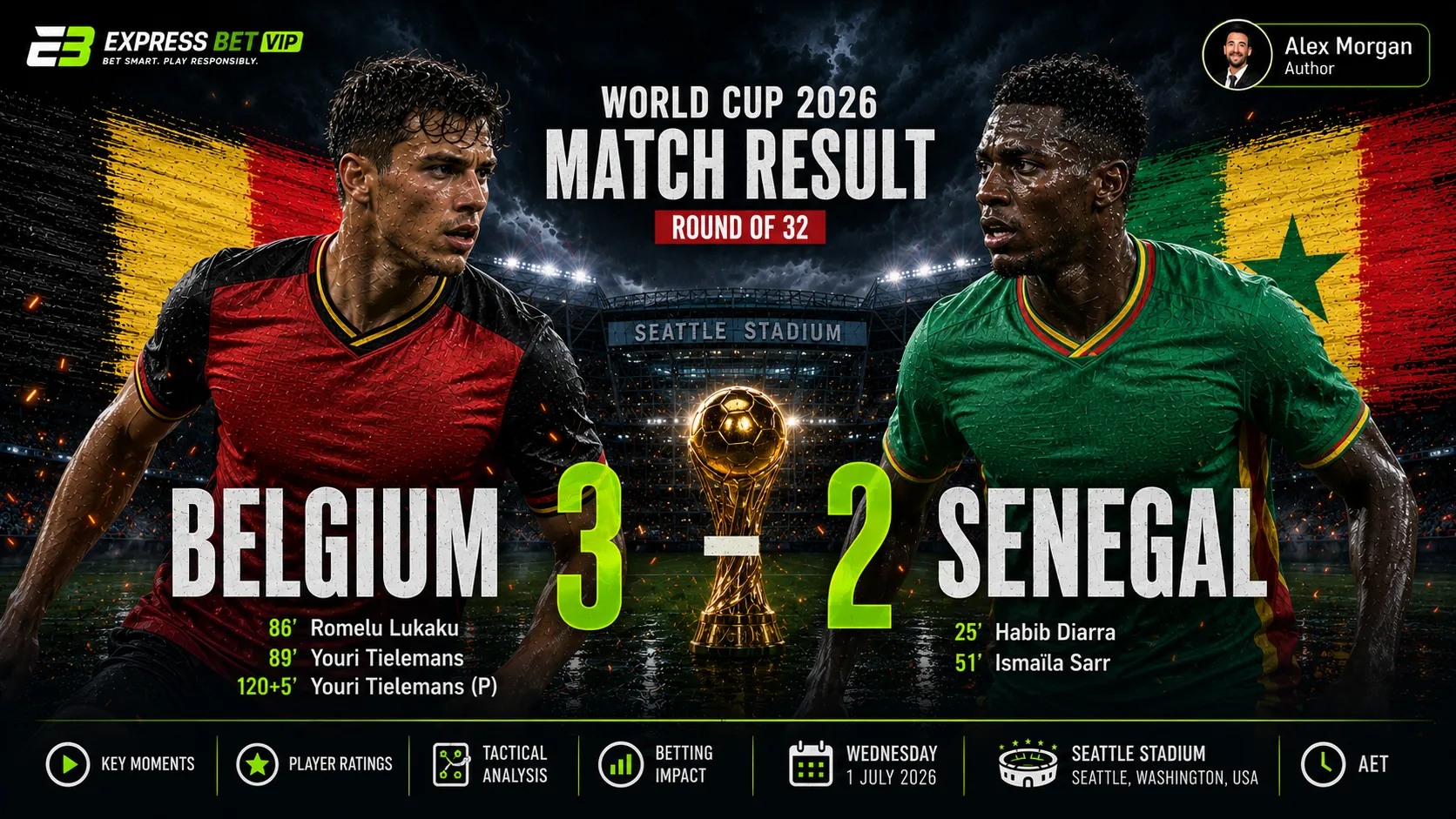
Quick Facts: Final Score, Goals, Venue, and Match Status
| Item | Verified information |
|---|---|
| Match | Belgium vs Senegal |
| Competition | FIFA World Cup 2026 |
| Stage | Round of 32 |
| Match number | Match 82 |
| Date | July 1, 2026 |
| Kickoff time | 1:00 p.m. PT / 4:00 p.m. ET / 20:00 UTC / 9:00 p.m. UK |
| Host country | United States |
| City | Seattle, Washington |
| Stadium | Seattle Stadium / Lumen Field |
| Attendance | 66,925 |
| Final score | Belgium 3-2 Senegal after extra time |
| Score after 90 minutes | Belgium 2-2 Senegal |
| Half-time score | Belgium 0-1 Senegal |
| Belgium scorers | Romelu Lukaku 86’; Youri Tielemans 89’, 120+5’ pen |
| Senegal scorers | Habib Diarra 25’; Ismaïla Sarr 51’ |
| Referee | Héctor Said Martínez |
| VAR | Guillermo Pacheco Larios |
| Weather | Around 68°F / 20°C expected, mostly cloudy, slight rain chance |
| Pitch condition | Native natural grass World Cup surface; no major defect confirmed |
| Main tournament impact | Belgium advanced to face USA; Senegal were eliminated |
Sky Sports lists Belgium 3-2 Senegal after extra time, Lumen Field, attendance 66,925, Lukaku 86’, Tielemans 89’ and 120+5’ penalty, Diarra 25’ and Sarr 51’. Sofascore confirms the same final score and extra-time result, while listing Diarra’s goal at 24’, which is a minor provider timing difference. (Sky Sports)
Verified Facts vs Analysis
| Category | Status | Detail |
|---|---|---|
| Final score | [CONFIRMED] | Belgium 3-2 Senegal after extra time |
| Score after 90 minutes | [CONFIRMED] | Belgium 2-2 Senegal |
| Goal scorers | [CONFIRMED] | Diarra, Sarr, Lukaku, Tielemans twice |
| Goal timing | [REPORTED] | Sky lists Diarra 25’; Sofascore lists 24’ |
| Attendance | [CONFIRMED] | 66,925 |
| Referee and VAR | [CONFIRMED] | Héctor Said Martínez; Guillermo Pacheco Larios |
| Penalty award | [CONFIRMED] | Tielemans won and scored a 120+5’ penalty after VAR review |
| Penalty controversy | [REPORTED] | Sky, Al Jazeera and Reuters all describe heavy debate around the decision |
| xG | [REPORTED] | Sofascore: Senegal 3.54, Belgium 1.80 |
| Match statistics | [CONFIRMED] | Sky Sports: 19 shots each, 5 shots on target each |
| Belgium tactical edge | [ANALYSIS] | Late crossing, aerial duels and box efficiency changed the match |
| Senegal deserved more | [ANALYSIS] | Supported by xG, woodwork, chances and 2-0 lead |
| Humidity and wind | [UNKNOWN] | Not available from verified public data |
| Closing odds | [UNKNOWN] | Not available from verified public data |
This distinction matters because the Belgium vs Senegal match result is a clean scoreline with an untidy explanation. Belgium won. That is confirmed. Senegal created enough chances to win. That is analysis supported by data. The penalty was awarded. That is confirmed. Whether it should have been awarded is a dispute, not a fact.
For AI Search extraction, the safe facts are final score, scorers, goal times, venue, attendance and tournament consequence. The rest needs labels. Otherwise the article becomes another overconfident match report pretending that every opinion arrived wearing a badge.
Final Score and Match Summary
Belgium beat Senegal 3-2 after extra time, which is the sort of sentence that looks calm only because it has escaped the match.
For 85 minutes, Belgium looked less like a team managing a knockout tie and more like a side slowly discovering that Senegal had brought speed, confidence and a working plan. Senegal scored first, scored again after half-time, hit the woodwork twice and finished with a higher xG figure. Sofascore’s post-match analysis had Senegal at 3.54 xG and Belgium at 1.80, which tells you the scoreboard was not the whole argument. (Sofascore)
Senegal’s opener came after sustained threat. Local reporting from Seattle described Sarr heading against the post before Diarra followed up to score. Sky lists Diarra’s goal in the 25th minute, while Sofascore has it at 24’. Either way, Belgium were behind and had not earned many complaints. (soundersfc)
The second Senegal goal arrived in the 51st minute. Sarr, already a problem for Belgium’s back line, finished a move that Sky and Sofascore credit to Moussa Niakhaté’s assist. Seattle Sounders’ local recap described the wider build-up as a diagonal delivery into Sarr’s run. That difference matters less than the conclusion: Belgium’s defensive line had again failed to control Senegal’s timing into space. (Sky Sports)
Belgium’s comeback came late enough to feel rude. Lukaku, introduced at half-time, scored in the 86th minute from Thomas Meunier’s delivery. Three minutes later, Leandro Trossard crossed and Tielemans headed in. The match that had looked like Senegal’s statement became extra time, because tournament football remains structurally opposed to emotional stability. (Sky Sports)
Extra time nearly went to penalties. Then VAR intervened in the 120th minute, and Martínez awarded Belgium a penalty after a challenge by Lamine Camara on Tielemans. Tielemans scored at 120+5. Sky reported strong criticism from Gary Neville and Roy Keane, both calling the decision harsh, while Al Jazeera described widespread controversy around the award. Reuters confirmed that the penalty sealed Belgium’s 3-2 win. (Sky Sports)
Was Belgium’s win deserved? On finishing and late execution, yes. On the full chance profile, Senegal can object and would not be wasting the court’s time. Belgium were more clinical in the air and from the penalty spot. Senegal were better for long periods but not better at closing the match. That is often the entire World Cup, compressed into one afternoon in Seattle.
Goal Timeline
25’ — Habib Diarra, Senegal, Rebound Goal
Senegal’s first goal came from the pressure they had already been building.
The move developed through wide service and penalty-box aggression. Seattle Sounders’ local recap described Sadio Mané curling a cross toward Sarr, whose headed effort beat Courtois but hit the post. Diarra reacted first and swept home the rebound. Sky lists the goal at 25’, while Sofascore records it at 24’. The discrepancy is minor but worth flagging because match data providers often round or log moments slightly differently. (soundersfc)
The tactical meaning was clear. Senegal were not waiting for Belgium to make the match polite. They attacked the far-post zone, forced Courtois to deal with awkward second balls and made Belgium defend facing their own goal.
The goalkeeper could do little once the rebound landed in the danger area. Belgium’s defensive issue was not only the initial cross. It was second-ball reaction.
There was no confirmed VAR intervention that changed the goal.
51’ — Ismaïla Sarr, Senegal, Open-Play Goal
Senegal’s second goal was the one that should have made the tie safe. Naturally, it did not.
Sarr ran into space behind Belgium’s defensive line and finished past Courtois. Sky and Sofascore list Moussa Niakhaté as the assist provider, while local Seattle reporting described the broader move as a clipped diagonal that isolated Sarr’s speed against Belgium’s retreating defenders. (Sky Sports)
The goal punished Belgium’s spacing. Their midfield and back line were not connected enough to stop the pass, and their recovery line could not match Sarr’s timing.
At 2-0, Senegal had control, threat and the match’s better attacking evidence. What they did not have was the ability to end the match before Belgium’s bench altered the physical profile.
No confirmed VAR issue changed this goal.
86’ — Romelu Lukaku, Belgium, Open-Play Goal
Belgium’s comeback began with the most obvious tournament tool available: put Lukaku in the box and deliver the ball properly.
Thomas Meunier, introduced in the 78th minute, got behind Senegal’s defensive line and pulled the ball into the six-yard area. Lukaku lifted a first-time finish over Mory Diaw to make it 2-1. Sky lists Meunier as the assist provider. (Sky Sports)
The goal changed the match in two ways. First, it gave Belgium oxygen. Second, it made Senegal defend the final minutes with the knowledge that every cross now had a serious target.
This was not tactical complexity. It was match-state brutality. Senegal had defended many cleverer things. They failed to defend the one simple thing Belgium needed.
89’ — Youri Tielemans, Belgium, Header
Three minutes later, Belgium were level.
Leandro Trossard clipped the ball into the box, and Tielemans headed beyond Diaw. Sky and Sofascore list Trossard as the assist provider. The finish made it 2-2 and sent the tie into extra time. (Sky Sports)
This goal exposed Senegal’s late-game vulnerability. Their block had been stretched by Lukaku’s presence, and Belgium’s crossing became more accurate and more aggressive. Tielemans attacked the space with the timing of a midfielder who understood that nobody was going to remember his passing map if Belgium went out.
The emotional impact was severe. Senegal had been minutes from the Round of 16. Now they were entering another 30 minutes against a Belgium side that had suddenly remembered the penalty area existed.
120+5’ — Youri Tielemans, Belgium, Penalty
The winning goal came after the match appeared to be crawling toward penalties.
Tielemans went down after contact with Lamine Camara inside the box. The referee initially allowed play to continue, then went to the monitor after VAR review and awarded Belgium a penalty. Tielemans took it himself and scored. Sofascore logs the VAR decision at 120’ and the penalty at 120+5’. (Sofascore)
The decision became the match’s central controversy. Sky Sports’ report carried Gary Neville’s view that the award did not fit the bar set in the tournament and Roy Keane’s view that the decision was “very, very harsh.” Al Jazeera also described heavy backlash and debate around the VAR intervention. (Sky Sports)
The tactical meaning was almost irrelevant by then. Extra-time structure had become fatigue, nerves and set-piece survival. The emotional meaning was everything: Belgium were through, Senegal were out, and the final touch of the match came with a controversy that will not be filed quietly.
Key Moments That Changed the Match
Sarr Hits the Post Before the Opener
Before Diarra scored, Sarr’s header hit the post. That was not just a near miss. It was a warning that Belgium’s far-post defending was already unstable.
Diarra Scores First
The first goal turned Senegal’s early pressure into scoreboard control. It also forced Belgium to carry possession with more urgency. They did not do that well enough before half-time.
Lukaku Comes On at Half-Time
Garcia introduced Lukaku for Charles De Ketelaere at the interval. It did not instantly solve Belgium, but it changed Senegal’s centre-back responsibilities. Belgium now had a true box reference, and that mattered when the match became a crossing exercise. (Sky Sports)
Sarr Makes It 2-0
Sarr’s goal should have pushed the tie toward Senegal. It also created the fatal temptation: defend deeper, protect the lead, and let Belgium bring bigger bodies into your box. Many teams have read that script. Few like the ending.
Garcia’s Second Wave of Changes
Belgium brought on Nicolas Raskin and Dodi Lukebakio in the 56th minute, Diego Moreira in the 63rd, and Meunier in the 78th. The Meunier change was decisive because he assisted Lukaku’s goal. (Sky Sports)
Lukaku Scores in the 86th Minute
The goal made Senegal nervous and made Belgium direct. That is an unpleasant combination for a team trying to close out a knockout match.
Tielemans Equalizes in the 89th Minute
This was the emotional hinge. Senegal went from protecting a win to surviving extra time in three minutes.
Ibrahim Mbaye Misses in Extra Time
Seattle Sounders’ recap notes that Bara Ndiaye found Ibrahim Mbaye around the penalty spot in the 109th minute, but the first-time shot drifted wide. That was Senegal’s clearest late chance to reclaim the match. (soundersfc)
The 120th-Minute VAR Review
The VAR review and penalty award decided the match. It was also the moment that changed post-match analysis from “Belgium comeback” to “Belgium comeback, but let us discuss the penalty for several years.”
Local Match Conditions: Stadium, City, Weather, Pitch, and Crowd
| Local factor | Verified or observed detail | Football meaning | Direct match evidence | Betting-result meaning | Data status | Anti-template status |
|---|---|---|---|---|---|---|
| Host country | United States | Neutral World Cup host venue | Match played in Seattle, USA | No home-team market edge | [CONFIRMED] | Specific to this fixture |
| City | Seattle, Washington | Cool Pacific Northwest summer context | Visit Seattle listed the fixture as Seattle’s Round-of-32 opener | Weather did not create a heat angle | [CONFIRMED] | Specific to this fixture |
| Stadium | Seattle Stadium / Lumen Field | Open-air, loud NFL/MLS venue | Sky and FIFA list the fixture at Seattle Stadium / Lumen Field | Noise and late pressure mattered more than climate | [CONFIRMED] | Specific to this fixture |
| Capacity | 72,000 listed by SeattleFWC26 | Attendance sat below listed full venue capacity but near World Cup configuration | SeattleFWC26 capacity vs 66,925 attendance | No empty-venue angle | [REPORTED] | Specific to this fixture |
| Attendance | 66,925 | Large knockout crowd | Sky and Sofascore list 66,925 | Live-game psychology intensified late | [CONFIRMED] | Specific to this fixture |
| Roof status | Not a fully enclosed climate-controlled venue | Weather exposure exists, but no storm or heat issue confirmed | Mild weather reports; no weather delay | No weather-driven betting angle | [REPORTED/OBSERVED] | Specific to this fixture |
| Weather | Around 68°F / 20°C, mostly cloudy, slight rain chance | Comfortable for pressing and extra time | Bolavip pre-match weather report | Totals were not suppressed by heat or rain | [REPORTED] | Specific to this fixture |
| Humidity | Not available from verified public data | Cannot quantify fatigue or cramp risk | No public verified humidity found | No humidity-based betting conclusion | [UNKNOWN] | Specific to this fixture |
| Wind | Not available from verified public data | Cannot link crossing to wind | Crosses worked for Belgium late | No wind-based conclusion | [UNKNOWN] | Specific to this fixture |
| Pitch | Native natural grass installed for World Cup requirements | Football surface suited passing and crossing | SeattleFWC26 lists native grass improvements | No pitch-failure angle | [REPORTED] | Specific to this fixture |
| Crowd noise | Stadium known for extreme noise and seismic fan reactions | Late Belgian goals and Senegal opener carried heavy atmosphere | SeattleFWC26 notes noise history; local recap described eruptions | Live volatility increased emotionally | [REPORTED/OBSERVED] | Specific to this fixture |
Seattle did not turn this match into a weather story. That is useful information because the 2026 tournament has produced plenty of heat narratives elsewhere. In Seattle, pre-match reporting expected around 68°F / 20°C, mostly cloudy conditions and only a slight rain chance. For football, that means repeated pressing, extra time and late crossing were not obviously distorted by climate. (bolavip.com)
The stadium mattered more than the weather. SeattleFWC26 describes Seattle Stadium as one of the loudest stadiums in the world and notes that fan reactions have registered seismic activity in past events. That reputation did not score Belgium’s goals, but it did make the last 40 minutes feel like a match being played inside a pressure cooker with decent ventilation. (seattlefwc26.org)
The surface also mattered by not becoming a story. SeattleFWC26’s venue page says World Cup improvements included laying natural grass natively, not over turf. The match evidence supports a stable football surface: both teams attempted 19 shots, completed high passing volumes, crossed often and carried attacks into the box without a publicly confirmed pitch defect. (seattlefwc26.org)
The local betting angle is narrow. Mild weather did not explain five goals. The open-air, loud venue did not explain the penalty. The more useful betting interpretation is that Seattle’s conditions allowed the match to keep its speed into extra time, and Belgium’s late aerial pressure became more valuable once Senegal’s block dropped.
Stadium-Specific Match Impact
| Item | Detail |
|---|---|
| Stadium | Seattle Stadium / Lumen Field |
| City | Seattle, Washington |
| Listed capacity | 72,000 via SeattleFWC26 |
| Match attendance | 66,925 |
| Pitch type | Native natural grass installed for World Cup requirements |
| Roof status | Open-air / not fully climate-controlled |
| Acoustic effect | Venue known for extreme crowd noise and seismic fan reactions |
| Surface condition | No major defect confirmed |
| Wind relevance | Exact wind not available from verified public data |
| Goalkeeper distribution effect | No verified disruption |
| Set-piece effect | Penalty decided the match; crosses created Belgium’s late comeback |
| Communication effect | No specific goal proven to be caused by noise |
| Data status | Venue, attendance, capacity and grass-improvement context confirmed/reported; wind/humidity unavailable |
The available match evidence does not show a clear stadium-specific effect beyond loud venue conditions, a stable native grass surface and an open-air Seattle environment.
That is not a boring conclusion. It is the correct one. The stadium did not bend Tielemans’ penalty into the net. It did not make Senegal hit the woodwork. It did not make Belgium win 28 aerial duels. The football did that.
But Seattle Stadium did shape the emotional environment. Local reporting described the stadium erupting after Senegal’s opener and descending into pandemonium after Belgium’s equalizer. In a quieter venue, the same football still happens. It just arrives with less tremor in the air. (soundersfc)
The pitch supported the match’s technical pattern. Belgium attempted 26 crosses. Senegal attempted 22. Belgium completed 602 passes; Senegal completed 536. Those are not numbers from a broken surface.
City and Weather Impact
| Factor | Detail |
|---|---|
| City | Seattle |
| Host country | United States |
| Time zone | Pacific Time, UTC-7 |
| Local kickoff | 1:00 p.m. PT |
| Climate for match month | Mild Pacific Northwest summer conditions |
| Match-time temperature | Around 68°F / 20°C reported before match |
| Humidity | Not available from verified public data |
| Wind | Not available from verified public data |
| Rain / sun | Mostly cloudy, slight rain chance reported |
| Altitude | No meaningful altitude factor |
| Likely physical effect | Conditions allowed full-intensity match and extra time without major heat-management narrative |
| Actual match evidence | Match reached 120+ minutes; no verified heat, cramp or weather-delay issue |
| Data status | Temperature and cloud/rain forecast reported; humidity and wind unavailable |
Seattle’s local conditions were football-friendly. The match kicked off in the early afternoon, but not in punishing heat. That matters because Belgium’s comeback required late sprinting, repeated crossing and extra-time concentration. There is no verified evidence that heat, humidity or wind dragged either side out of the match. (bolavip.com)
Rain did not become a handling story. Courtois and Diaw each made three saves, according to Sky’s statistics, but neither goalkeeper’s night is defined by a weather mistake. (Sky Sports)
Long balls and diagonal deliveries worked. Senegal’s second goal came from a vertical attacking pattern into Sarr. Belgium’s late goals came through wide delivery. If wind affected ball flight, the verified public data does not show it.
The city context therefore sits in the background. Seattle gave the match a cool, loud, open-air stage. The match itself was decided by finishing, substitutions, aerial duels and VAR.
First Half Analysis
Belgium started with Courtois behind a back line of Castagne, Mechele, Theate and De Cuyper. Tielemans, Vanaken, Trossard, De Bruyne and Doku supported De Ketelaere. The shape looked close to a 4-2-3-1 with De Ketelaere as the attacking reference, but it lacked penalty-box gravity. (Sky Sports)
Senegal started with Diaw in goal, Diatta, Ciss, Niakhaté and Jakobs across the defensive line, Gueye captaining midfield with Pape Gueye and Diarra, and Ndiaye, Sarr and Mané as the attacking line. In practice, it became a direct 4-3-3 that used wide channels and transition running. (Sky Sports)
The first half belonged to Senegal’s sharper moments. Belgium had possession spells, but they were too polite in the final third. De Bruyne was substituted in the 56th minute later, but his lack of clean influence had already been visible before the break. Doku carried threat, yet Senegal’s defensive covering kept him from turning dribbles into enough central shots.
Senegal’s plan was more dangerous because it had better access to space. Mané and Sarr attacked wide areas, Diarra arrived aggressively, and Belgium’s centre-backs had to defend facing their own goal too often.
The goal reflected the half. Senegal attacked the far post, hit the woodwork and reacted faster to the rebound. Belgium had technical players. Senegal had the sharper edge.
At half-time, Garcia’s problem was clear: Belgium needed a real penalty-box target and more vertical delivery. Pape Thiaw’s problem was different: Senegal had to convert pressure into a second goal before Belgium’s bench changed the physical profile.
Second Half Analysis
Garcia made the obvious change at half-time: Lukaku replaced De Ketelaere. It was not subtle. It was necessary.
Senegal still struck first after the restart. Sarr’s 51st-minute goal gave them the 2-0 lead and forced Belgium into more direct attacking. At that stage, Senegal looked closer to 3-0 than Belgium looked to 2-1.
Belgium then changed shape through substitutions. Raskin and Lukebakio came on in the 56th minute. Moreira replaced Vanaken in the 63rd. Meunier replaced De Cuyper in the 78th. These changes increased width, crossing and penalty-box presence. (Sky Sports)
Senegal responded by adding Lamine Camara, Pape Sarr, Ibrahim Mbaye, Nicolas Jackson, El Hadji Malick Diouf and Nampalys Mendy across the second half and extra time. The intent was legs, coverage and fresh outlets. The issue was that Senegal lost too much territory after 2-0. (Sky Sports)
Belgium’s late goals came from the pattern that had been building. Meunier assisted Lukaku. Trossard assisted Tielemans. The match moved from Senegal’s transition game to Belgium’s crossing game.
Extra time was less tactical and more nervous. Senegal still had chances. Belgium still had aerial power. The decisive moment came not from open-play structure but from the VAR penalty review.
Extra Time and Penalty Decision
Extra time began with both teams carrying different regrets. Belgium regretted the first 85 minutes. Senegal regretted not ending the match when the xG was on their side and the scoreboard was 2-0.
The main open-play extra-time moment came in the 109th minute, when Bara Ndiaye found Ibrahim Mbaye near the penalty spot. Mbaye’s first-time shot drifted past the far post. That chance will not appear in the headline, but it may be the one Senegal replay privately. (soundersfc)
The penalty decision arrived at the edge of a shootout. Martínez reviewed the challenge between Camara and Tielemans and awarded Belgium a penalty. The review was long enough to become part of the controversy. Sky’s broadcast analysis quoted Neville and Keane calling the decision harsh. Al Jazeera noted that the decision triggered widespread anger because it came with the match tied and penalties looming. (Sky Sports)
Tielemans scored. Belgium advanced. Senegal did not walk off, did not collapse into chaos, and did not get another chance to repair the match.
This was not a penalty shootout. It was worse for Senegal: a match decided just before one.
Tactical Picture: Why the Match Was Won and Lost
Belgium won because they eventually turned the match into a delivery-and-duel contest.
Senegal lost because they created enough to win but did not close the tie before Belgium’s aerial advantage became decisive.
The formation battle changed after half-time. Belgium began with more technical fluidity and less penalty-box occupation. Senegal’s 4-3-3 could handle that because the Belgian front line lacked a fixed reference. Once Lukaku entered, Senegal’s centre-backs had to defend the six-yard box more honestly.
Belgium’s late crossing was the tactical hinge. Sky recorded Belgium with 26 attempted crosses and seven accurate crosses. Senegal attempted 22 and completed five. The numbers were close, but Belgium’s crosses arrived later, against a more tired defence and toward Lukaku and Tielemans. (Sky Sports)
Aerial duels were decisive. Belgium won 28 aerial duels to Senegal’s 15. That 65.1 percent aerial success rate mattered because both late Belgian goals came from the kind of box pressure that rewards height, timing and second-ball reactions. (Sky Sports)
Senegal’s best football came earlier. Sarr’s runs, Mané’s delivery and Diarra’s penalty-box timing hurt Belgium. They also generated the better expected-goals total. Sofascore gave Senegal 3.54 xG to Belgium’s 1.80, with Senegal hitting the woodwork twice and missing four big chances. (Sofascore)
That is the hard lesson. Tactical superiority for 70 minutes is not a receipt you can redeem after the final whistle. Belgium were poor for too long, but their late plan was brutally simple and effective: put bodies in the box, cross with quality, win aerial duels, keep attacking until something breaks.
Something broke. Senegal.
Tactical Collision Map
| Zone | Edge | Evidence | Key player | Local condition effect | Result impact |
|---|---|---|---|---|---|
| Belgium left flank | Belgium late | Trossard assisted Tielemans’ 89’ equalizer | Leandro Trossard | Mild weather allowed late delivery quality | Decisive |
| Belgium right flank | Belgium late | Meunier assisted Lukaku after coming on | Thomas Meunier | No verified wind disruption | Decisive |
| Senegal left flank | Senegal early | Sarr repeatedly attacked Belgium’s defensive line | Ismaïla Sarr | Open-air pitch allowed transition speed | Major |
| Senegal right flank | Mixed | Mané delivered threat but Belgium adjusted late | Sadio Mané | No local effect confirmed | Moderate |
| Central midfield | Senegal early, Belgium late | Tielemans finished with two goals; Senegal controlled transition phases | Youri Tielemans / Idrissa Gueye | Noise increased late pressure | Major |
| Penalty box | Belgium late | Belgium scored all three decisive chances; Senegal missed four big chances | Lukaku / Tielemans | Stable surface supported crossing | Decisive |
| Set pieces / penalty | Belgium | VAR penalty at 120+5 decided match | Tielemans | Crowd pressure amplified controversy | Decisive |
| Transitions | Senegal | Sarr and Diarra created the 2-0 lead and xG edge | Sarr | No weather suppression | Major |
| Defensive third | Senegal for 85 minutes, Belgium after comeback | Senegal made 31 clearances but failed late | Mory Diaw / Niakhaté | No pitch issue confirmed | Major |
| Goalkeeper build-up | No clear edge | Courtois and Diaw each made three saves | Courtois / Diaw | No handling issue confirmed | Moderate |
| Bench impact | Belgium | Lukaku, Meunier and Raskin changed the rhythm | Lukaku / Meunier | Conditions allowed high late intensity | Decisive |
Player Ratings and Individual Performances
These ratings are editorial assessments based on match events, statistics, tactical responsibility and provider data. They are not official FIFA ratings.
Belgium Player Ratings
Thibaut Courtois — 6.6
Made three saves and had little chance with the rebound opener or Sarr’s finish. His distribution was not the story; Belgium’s defensive spacing in front of him was.
Timothy Castagne — 6.1
Had to handle Senegal’s left-sided movement and transition bursts. Better late once Belgium pushed the match into Senegal’s half.
Brandon Mechele — 5.9
Booked in the 64th minute and struggled with Senegal’s speed into the box. Improved in extra time but had a rough first hour.
Arthur Theate — 6.8
Belgium’s most stable defender in possession. Sofascore noted his high passing contribution, and he helped Belgium keep enough structure once the comeback began. (Sofascore)
Maxim De Cuyper — 5.8
Worked hard but gave Belgium limited attacking quality before being replaced by Meunier, whose assist made the contrast obvious.
Youri Tielemans — 9.1
Two goals, including the equalizer and winner. Won the penalty. Carried leadership and execution when Belgium had almost run out of calendar. Sofascore gave him the match’s top rating at 8.5. (Sofascore)
Hans Vanaken — 5.7
Did not give Belgium enough midfield control or penalty-box timing before being replaced in the 63rd minute.
Leandro Trossard — 7.6
Assisted Tielemans’ equalizer and gave Belgium better final-third delivery than most starters. Replaced by Onana in extra time after a productive shift.
Kevin De Bruyne — 5.8
A quiet game by his standards. Substituted in the 56th minute after Belgium failed to build enough dangerous central attacks.
Jérémy Doku — 6.2
Threatened with carries but did not convert them into enough end product. Replaced early in the second half.
Charles De Ketelaere — 5.4
Started as the forward reference but did not occupy Senegal’s centre-backs strongly enough. Lukaku’s half-time introduction told the tactical story.
Belgium Substitutes
Romelu Lukaku — 8.0
Changed Belgium’s penalty-box profile and scored the 86th-minute goal. One of those substitute performances that makes everyone ask why the solution waited until half-time.
Dodi Lukebakio — 6.7
Added directness and almost scored from distance in the second half. Helped stretch Senegal before the late comeback.
Nicolas Raskin — 6.6
Gave Belgium extra midfield energy after De Bruyne came off. Less glamorous, but useful in the match’s more chaotic phase.
Diego Moreira — 6.4
Added legs and width after replacing Vanaken. Part of the pressure wave.
Thomas Meunier — 7.4
Assisted Lukaku almost immediately after coming on. His delivery changed the match.
Amadou Onana — 6.2
Entered in extra time for Trossard and helped Belgium survive the final physical exchanges.
Senegal Player Ratings
Mory Diaw — 6.4
Made three saves but conceded three times. Could not stop the penalty. Sofascore noted an error leading to a goal in its player notes, which makes his night harder to defend fully. (Sofascore)
Krépin Diatta — 6.5
Solid in the first hour and useful in the wide defensive structure. Had more problems once Belgium increased crossing volume.
Pathé Ciss — 6.3
Competed physically but was increasingly pinned by Lukaku and Tielemans’ late box runs.
Moussa Niakhaté — 7.1
Credited with the assist for Sarr’s goal and defended well for long periods. Could not hold Belgium off late.
Ismail Jakobs — 6.6
Energetic on the left and involved in Senegal’s early attacking rhythm. Replaced at 93’ as fatigue and extra-time management arrived.
Habib Diarra — 7.5
Scored the opener and gave Senegal vertical midfield running. Replaced in the 73rd minute, and Senegal lost some of that forward energy.
Idrissa Gana Gueye — 7.0
Organized midfield well and helped Senegal control the match’s best phases. Replaced in extra time.
Pape Gueye — 6.5
Disciplined for the first hour but replaced by Lamine Camara, whose later foul became the central controversy.
Iliman Ndiaye — 6.3
Worked between lines but did not produce the decisive final action. Substituted in the 73rd minute.
Ismaïla Sarr — 8.3
Senegal’s best attacker. Scored, hit the woodwork and repeatedly exposed Belgium’s defensive recovery. Sofascore rated him 8.2. (Sofascore)
Sadio Mané — 7.0
Delivered threat, especially on the first goal sequence. Faded as Senegal dropped deeper and Belgium’s crosses took over.
Senegal Substitutes
Lamine Camara — 5.6
Entered at 66’, booked shortly after, and was involved in the decisive penalty incident. His wider contribution became secondary to that final moment.
Pape Matar Sarr — 6.1
Added running after Diarra came off but could not restore Senegal’s first-half control.
Ibrahim Mbaye — 5.8
Had the extra-time chance to make it 3-2 but missed the target. A brutal detail in a knockout match.
Nicolas Jackson — 6.0
Entered for Mané and gave Senegal fresh forward running, but service became limited.
El Hadji Malick Diouf — 6.0
Replaced Jakobs and helped defensively in extra time.
Nampalys Mendy — 6.0
Added midfield legs but could not slow Belgium’s late directness enough.
Best Players of the Match
Man of the Match: Youri Tielemans
Two goals, one penalty won, and the decisive final action. Belgium were not better than Senegal for most of the match, but Tielemans was better than the moment.
Best attacker: Ismaïla Sarr
Sarr scored, hit the woodwork and gave Belgium their most uncomfortable defensive problems. He was Senegal’s most dangerous player.
Best midfielder: Youri Tielemans
Diarra was excellent for Senegal, but Tielemans decided the match twice.
Best defender: Arthur Theate
Belgium’s back line had problems, but Theate was the most composed defender in possession and helped steady the late phase.
Best goalkeeper: Thibaut Courtois
Neither goalkeeper dominated, but Courtois avoided a decisive mistake and made the saves he could reasonably make.
Best substitute: Romelu Lukaku
Lukaku’s goal gave Belgium the comeback route. Meunier deserves mention because his assist was vital.
Most underrated performance: Thomas Meunier
The assist for Lukaku changed the tactical shape of the match. Belgium’s right side became far more threatening after his introduction.
Most disappointing performance: Charles De Ketelaere
He did not give Belgium enough penalty-box presence. Lukaku’s impact made that painfully clear.
Injuries, Suspensions, Cards, and Discipline
| Player | Team | Incident | Minute | Card or injury status | Next-match impact | Data status |
|---|---|---|---|---|---|---|
| Brandon Mechele | Belgium | Foul | 64’ | Yellow card | No confirmed suspension impact | [CONFIRMED] |
| Lamine Camara | Senegal | Foul | 67’ | Yellow card | Senegal eliminated | [CONFIRMED] |
| Lamine Camara | Senegal | Challenge on Tielemans | 120’ | Penalty awarded after VAR review | Senegal eliminated | [CONFIRMED/DISPUTED] |
| Rudi Garcia | Belgium | Argument | Not confirmed by all sources | Coach yellow listed by Sofascore | No confirmed next-match impact | [REPORTED] |
| Major injury | Both | None confirmed | — | Not available | No confirmed impact | [UNKNOWN] |
Sky Sports lists one Belgium yellow card and one Senegal yellow card, with no red cards. Sofascore also lists a bench yellow to Rudi Garcia for argument, but that is not consistently emphasized across match reports. (Sky Sports)
The disciplinary story is the penalty, not the card count. Belgium committed 22 fouls to Senegal’s 12, according to Sky. That tells a quiet story about Belgium breaking up Senegal transitions before the game got away completely. (Sky Sports)
Referee and VAR Analysis
Héctor Said Martínez controlled a match that will be remembered mainly for one decision.
The decisive penalty came after a long VAR review. Tielemans and Camara made contact inside the box, and Martínez awarded the spot-kick after checking the monitor. Sky’s report highlighted criticism from Gary Neville and Roy Keane, while Al Jazeera described the decision as widely controversial and noted arguments that Tielemans had placed his foot into Camara’s path. (Sky Sports)
The correct framing is not “corruption” or “robbery.” The correct framing is [DISPUTED]. The penalty was awarded. Belgium scored. The decision was heavily questioned by pundits and fans. Those three things can all be true.
There were no red cards. There was no penalty shootout. There were no confirmed injuries that changed the match.
The referee influenced the match because the late penalty decision determined the winner. That is not the same as saying the referee decided the match wrongly. It means any serious match result article must analyze the decision rather than pretend it was a normal stoppage-time detail.
Match Statistics
| Statistic | Belgium | Senegal |
|---|---|---|
| Possession | 52.3% | 47.7% |
| Shots | 19 | 19 |
| Shots on target | 5 | 5 |
| xG, Sofascore | 1.80 | 3.54 |
| Big chances missed | 0 | 4 |
| Corners | 4 | 2 |
| Hit woodwork | 1 | 2 |
| Touches in opposition box | 37 | 30 |
| Attempted passes | 701 | 639 |
| Accurate passes | 602 | 536 |
| Passing accuracy | 85.9% | 83.9% |
| Chances created | 15 | 13 |
| Attempted crosses | 26 | 22 |
| Accurate crosses | 7 | 5 |
| Goalkeeper saves | 3 | 3 |
| Clearances | 28 | 31 |
| Headed clearances | 15 | 19 |
| Interceptions | 8 | 11 |
| Fouls conceded | 22 | 12 |
| Yellow cards | 1 | 1 |
| Red cards | 0 | 0 |
| Offsides | 2 | 2 |
| Duels won | 62 | 55 |
| Ground duels won | 34 | 40 |
| Aerial duels won | 28 | 15 |
| Successful dribbles | 11 | 9 |
Sky Sports supplied the main match statistics, while Sofascore supplied xG and player-rating context. Provider statistics may vary slightly across feeds, especially for xG, assists and exact event timing. (Sky Sports)
The numbers show why this match was uncomfortable to summarize. Belgium had more possession, more accurate passes, more crosses completed and a huge aerial edge. Senegal had the better xG, more big chances missed and two efforts off the woodwork.
Belgium won the match by winning the late-match version of it. Senegal won large portions of the earlier one. Only one of those versions is allowed into the next round.
Betting Result Angle
FOX Sports listed Belgium at +115 on the 90-minute moneyline, Senegal at +270 and the draw at +210. Belgium were -178 to advance, Senegal +146, over 2.5 goals was -106, under 2.5 was -114, both teams to score Yes was -140, and Lukaku was +135 to score anytime. DraftKings Network also framed Belgium as shorter to advance than to win in regulation, with Belgium -175 to advance and +115 on the 90-minute moneyline. (FOX Sports)
| Market | Pre-match expectation | Actual result | Winning side of market | Key match trigger | Local factor | Caution |
|---|---|---|---|---|---|---|
| Belgium 90-minute moneyline | Belgium slight favorite | 2-2 after 90 | Lost | Tielemans equalized too late for regulation win | None clear | Advancement and regulation were different markets |
| Senegal 90-minute moneyline | Underdog | 2-2 after 90 | Lost | Belgium scored twice late | None clear | Senegal led 2-0 but did not close |
| Draw after 90 | Live outsider | 2-2 | Draw | Tielemans 89’ | Loud venue amplified late chaos | Draw was not decoration |
| Belgium to advance | Belgium favorite | Belgium advanced | Belgium | 120+5’ penalty | No weather edge | Very uncomfortable path |
| Senegal to advance | Underdog but respected | Senegal eliminated | Belgium | VAR penalty | No local cause | Senegal were live deep into extra time |
| Over 2.5 goals | Near-even market | Five goals | Over 2.5 | Late Belgium comeback | Mild conditions allowed full tempo | Over needed late goals |
| Under 2.5 goals | Slightly favored in some snapshots | Lost | Over | Match opened after 51’ | No weather suppression | Knockout caution failed |
| Both teams to score | Yes favored | Both scored | BTTS Yes | Diarra, Sarr, Lukaku, Tielemans | No local cause | Landed before extra time |
| Lukaku anytime scorer | Shortest Belgium scorer prop | Scored | Lukaku backers | 86’ goal | No local cause | He started on bench |
| Correct score 3-2 Belgium | Longshot | Hit after extra time depending on market rules | Belgium 3-2 backers if extra-time market | 120+5’ penalty | None clear | 90-minute correct score differed |
| Cards | Moderate | One yellow each | Under cards likely | Foul count high, card count low | No weather-card link | Exact line unavailable |
| Corners | Belgium pressure late | Belgium 4-2 | Belgium corner side likely | Late territorial push | No wind claim | Exact line needed |
This result rewarded Belgium-to-advance bettors, over 2.5 backers, both-teams-to-score Yes bettors and Lukaku anytime scorer backers. It punished anyone who treated Belgium’s advancement price as a smooth match script.
The sharpest pre-match distinction was between “Belgium to advance” and “Belgium to win in 90 minutes.” DraftKings highlighted that the market was pricing Belgium as the likely survivor but not as a comfortable regulation winner. That read proved almost painfully accurate. (DraftKings Network)
The match also rewarded live bettors who trusted Belgium’s late crossing wave, but that is easier to write after the fact than to execute with a two-goal deficit on the screen. Good betting analysis should admit that.
Local Betting Impact: What the Venue and Conditions Changed
| Local factor | Market possibly affected | Actual match evidence | Possible betting interpretation | Risk of overreaction | Safer conclusion |
|---|---|---|---|---|---|
| Mild Seattle weather | Totals, second-half tempo, extra-time markets | Match sustained high tempo into 120+ minutes | Weather did not suppress goals or pressing | Low | Tactics mattered more than climate |
| Open-air stadium | Long balls, crosses, goalkeeper handling | Belgium and Senegal both crossed heavily | No wind disruption confirmed | Medium | Do not invent wind impact |
| Loud Seattle crowd | Live momentum | Stadium erupted at key goals | Emotional volatility increased after 86’ | Medium | Crowd amplified pressure, not outcome certainty |
| Native grass surface | Passing, crossing, footing | High passing volume and 48 total crosses | Surface allowed normal technical play | Low | No pitch-failure angle |
| Extra-time fatigue | Player props, late goals, penalty market | Penalty came at 120+5 | Late decision volatility rose | Medium | Fatigue plus VAR, not a betting system |
| Belgium aerial edge | Goals, assists, shots | Belgium won 28 aerial duels | Belgium crossing and header markets gained logic live | Low | Price and timing mattered |
| Senegal transition threat | Underdog, BTTS, Sarr shots | Senegal scored twice and hit woodwork | Senegal props were live | Low | They did not close the match |
| Penalty controversy | Cards, penalty awarded, live winner | VAR penalty decided match | Penalty market landed only if backed | High | Not predictable pre-match |
The local betting impact was mostly about what did not happen. Seattle weather did not slow the game. The pitch did not turn the match into a handling lottery. There was no heat collapse.
The venue did matter emotionally. A loud, open-air crowd and a stadium known for extreme noise created a setting where Belgium’s late goals felt heavier and Senegal’s defensive phase felt longer. But no bettor should turn “Seattle is loud” into a repeatable betting rule.
The football edge was clearer: Belgium’s aerial dominance and late crossing volume became the live-market story. Senegal’s transition threat made BTTS and underdog positions credible. VAR supplied the final swing.
What This Result Means for the Knockout Bracket
Belgium advanced to face the United States in the Round of 16 at Seattle Stadium on July 6. Local Seattle reporting confirmed that Belgium would watch USA vs Bosnia and Herzegovina to determine their next opponent. The bracket later produced USA as Belgium’s opponent. (soundersfc)
Belgium later beat the USA 4-1 in the Round of 16 before losing 2-1 to Spain in the quarter-finals, according to Sky Sports’ tournament form listing and Reuters’ Spain-Belgium quarter-final report. (Sky Sports)
Senegal were eliminated after a match they had led 2-0. Their exit became part of a broader post-tournament fallout: Reuters later reported that Senegal dismissed coach Pape Thiaw after the World Cup, referencing the surrendered 2-0 lead against Belgium as part of the disappointment. (Reuters)
For Belgium, this result created momentum but also warned future opponents exactly where to attack: transition channels, pace behind defenders and defensive reactions after losing the ball.
For Senegal, the tournament ended with the worst kind of evidence. They were good enough to hurt Belgium. They were not steady enough to eliminate them.
What Belgium Did Right
Belgium eventually solved the match state.
They did not start well. They did not defend Senegal’s speed well. They did not create enough before half-time. But Garcia’s bench corrected the main flaw: Belgium needed a true penalty-box reference.
Lukaku changed the physical conversation. Meunier gave the delivery. Trossard gave the equalizing cross. Tielemans gave the finish and the nerve.
Belgium also stayed alive emotionally after going 2-0 down. That sounds soft, but it matters. Tournament football often beats teams before the final whistle. Belgium looked close to that point, then found a route.
Their aerial dominance was the clearest football strength. Winning 28 aerial duels to Senegal’s 15 gave their late pressure a repeatable mechanism.
What Senegal Got Wrong
Senegal did not lose because they were passive. They lost because they did not finish Belgium when Belgium were available to be finished.
The xG says enough. Senegal created the better chances and missed four big ones. They hit the woodwork twice. They led 2-0. That is a lot of evidence to take into an elimination.
The tactical error was late territory. After Sarr’s goal, Senegal gradually defended deeper. Some of that was natural game state. Some of it was fatigue. Some of it was Belgium’s bench. But the effect was clear: crosses kept arriving.
Senegal also failed to manage the final five minutes of normal time. Conceding in the 86th minute is bad. Conceding again in the 89th is how a strong performance becomes a national headache.
The final penalty was disputed, but Senegal had several earlier chances to make that decision irrelevant.
Coach Analysis
Rudi Garcia
Garcia got the starting attacking balance wrong, then fixed it aggressively.
Starting De Ketelaere rather than Lukaku gave Belgium more mobility but less box authority. Against Senegal’s athletic centre-backs, that did not work. Lukaku’s introduction changed the match.
Garcia also used his bench well. Meunier’s assist was decisive. Raskin helped stabilize midfield. Moreira added energy. Onana helped in extra time.
Reuters quoted Garcia saying Belgium were second-best for large parts but that the comeback could spark improvement. That is a fair reading. It was also a polite way of saying Belgium escaped a mess partly of their own making. (Reuters)
Pape Thiaw
Thiaw’s plan worked for most of the match.
Senegal used pace, transitions, wide delivery and aggressive box arrival. Sarr and Diarra exposed Belgium. The midfield competed. The attack generated a huge xG edge.
The criticism is game management. Senegal could not keep enough pressure after 2-0, and the substitutions did not stop Belgium’s crossing rhythm. Once Lukaku and Meunier were involved, Senegal’s defensive line had to deal with a very different problem.
Thiaw can argue that the penalty was harsh. He can also look at four missed big chances and know this match should not have been left to a 120th-minute decision.
Player Milestones and Records
Tielemans scored the latest goal in World Cup history, with Sky reporting the penalty at 124 minutes and 44 seconds. That is a verified milestone and not a decorative stat. (Sky Sports)
Lukaku added another World Cup knockout goal for Belgium after starting on the bench. FOX and DraftKings had both treated him as Belgium’s leading goalscorer-market figure before the match, and his late finish justified that market attention. (FOX Sports)
Senegal reached consecutive World Cup knockout stages for the first time, according to FOX’s pre-match context, but their run ended in the Round of 32 after the 3-2 extra-time defeat. (FOX Sports)
No other major player milestone was confirmed from verified public data at the time of writing.
Historical Context and World Cup Analogies
This was not a clean historical replica of any famous World Cup comeback. It did, however, share the old knockout lesson: a lead is not a result until the referee stops finding minutes.
Senegal’s pain also carried continental context. In January, Senegal had walked off during the Africa Cup of Nations final after a penalty controversy and were later stripped of the title, a point Sky referenced in its report. This time, despite another late penalty controversy, there was no walk-off. There was only disbelief, protest and elimination. (Sky Sports)
Belgium’s comeback also sits in the broader story of their late golden-generation era: still talented, still flawed, still able to make a match look lost before finding the one route that keeps them alive.
The tactical analogy is simple: Senegal controlled the match’s best chances; Belgium controlled the match’s final mechanisms. World Cups do not reward the first category unless it becomes goals.
Incidents and Controversies
The main controversy was the 120th-minute penalty award.
Héctor Said Martínez reviewed the challenge between Camara and Tielemans and awarded the penalty. Sky’s coverage included criticism from Gary Neville and Roy Keane, while Al Jazeera reported that the decision caused widespread controversy and social-media anger. (Sky Sports)
The safe label is [DISPUTED]. The penalty was awarded after VAR review. Belgium scored. The decision was heavily questioned. That is the responsible way to write it.
No red cards were shown. No major confirmed injury changed the match. A fan-pitch incident was reported by some outlets, but it was not central to the football result and is not used here as a confirmed match-changing factor.
Information Gain: What This Article Adds
This article separates Belgium vs Senegal match result facts from interpretation.
The confirmed layer gives the score, goals, venue, attendance, officials and tournament impact.
The tactical layer explains why Senegal created the better chances but Belgium won through late aerial pressure, crossing and box finishing.
The local layer explains why Seattle mattered: a loud open-air stadium, native grass, mild weather, 66,925 attendance and no verified heat or pitch disruption.
The betting layer separates Belgium to advance from Belgium in 90 minutes, a crucial distinction because Belgium only won after extra time.
The controversy layer treats the penalty as disputed without turning analysis into accusation.
Local Information Gain Quality Check
| Detail | Included | Status | Specific to fixture | Future update needed |
|---|---|---|---|---|
| Stadium detail | Yes | [CONFIRMED/REPORTED] | Yes | Add official FIFA pitch report if released |
| City detail | Yes | [CONFIRMED] | Yes | No |
| Weather detail | Yes | [REPORTED] | Yes | Add official match-time weather if published |
| Pitch detail | Yes | [REPORTED/OBSERVED] | Yes | Add surface-speed or wear data if available |
| Crowd detail | Yes | [CONFIRMED/REPORTED] | Yes | Exact fan split unavailable |
| Travel/acclimatization detail | Limited | [UNKNOWN] | Yes | Team logistics not confirmed |
| Betting-risk detail | Yes | [MARKET SIGNAL] | Yes | Add closing/live odds if verified |
| Tactical-local connection | Yes | [ANALYSIS] | Yes | No |
| Anti-template status | Passed | [ANALYSIS] | Yes | Seattle-specific stadium, weather and noise context included |
Source and Data Appendix
| Data point | Status | Main source type |
|---|---|---|
| Final score | [CONFIRMED] | FIFA, Sky Sports, Sofascore, Reuters |
| Goal scorers | [CONFIRMED] | Sky Sports, Sofascore, Reuters |
| Goal times | [CONFIRMED/REPORTED] | Sky Sports, Sofascore; minor Diarra timing variation |
| Stadium | [CONFIRMED] | FIFA, Sky Sports, Sofascore, local host sources |
| City | [CONFIRMED] | FIFA / host city / match listings |
| Attendance | [CONFIRMED] | Sky Sports, Sofascore, local report |
| Referee | [CONFIRMED] | Sky Sports, match reports |
| VAR | [CONFIRMED] | Sky Sports |
| Lineups | [CONFIRMED] | Sky Sports |
| Substitutions | [CONFIRMED] | Sky Sports, Sofascore |
| Cards | [CONFIRMED] | Sky Sports, Sofascore |
| Injuries | [UNKNOWN] | No major verified match injury found |
| Match statistics | [CONFIRMED] | Sky Sports |
| xG | [REPORTED] | Sofascore |
| Odds | [MARKET SIGNAL] | FOX Sports, DraftKings Network |
| Local stadium factors | [REPORTED] | SeattleFWC26, Lumen Field / local host sources |
| Local city factors | [REPORTED] | Visit Seattle, pre-match weather reporting |
| Weather | [REPORTED] | Bolavip weather report |
| Pitch condition | [REPORTED/OBSERVED] | SeattleFWC26, match evidence |
| Crowd profile | [REPORTED/OBSERVED] | SeattleFWC26, Seattle Sounders local recap |
| Tournament impact | [CONFIRMED] | Reuters, Sky Sports, local host reporting |
Final Verdict
Belgium won because they found the simplest possible answer to a very complicated afternoon: cross the ball, attack the box, trust Tielemans and Lukaku, and let Senegal’s missed chances become heavier with every minute.
Senegal were better for long stretches. Their xG was stronger. Their transitions were sharper. Sarr looked like the match’s most dangerous open-play attacker. Diarra gave them the early reward. At 2-0, they had Belgium exactly where they wanted them.
Then Belgium changed the match. Lukaku entered. Meunier arrived. Trossard delivered. Tielemans finished. The match moved from Senegal’s speed to Belgium’s aerial strength, and Senegal never fully adjusted.
The scoreline was both fair and unfair, which is an annoying but accurate tournament truth. Belgium were more ruthless. Senegal created enough to win. The penalty was disputed. The result is final.
The local condition that mattered most was not weather. Seattle’s mild afternoon allowed the football to run into extra time without heat becoming the story. The real local factor was the stage itself: a loud, open-air Seattle Stadium with enough noise to make every late clearance feel like a public exam.
For bettors, the best lesson is structural. Belgium to advance and Belgium in 90 minutes were not the same bet. Over 2.5 and BTTS made sense only after the match opened up. Lukaku anytime was rescued late. Nothing here was easy, safe or obvious.
Belgium moved on. Senegal left with the better chance map and the worse ending. Football has never promised justice. It only promises that someone will explain the penalty for the next decade.
Responsible Betting Note
Football betting carries financial risk. A correct match analysis does not guarantee a winning wager.
Odds change before and during matches. Different operators may apply different settlement rules to 90-minute results, qualification markets, extra-time results, player props, cards, corners, penalties and live bets.
Local factors such as weather, pitch type, roof status and crowd noise can be overvalued by bettors. They should support tactical and lineup analysis, not replace it.
Never chase losses. Do not bet money needed for housing, food, bills, healthcare or daily life.
Use deposit, loss and time limits. Take breaks. Check local betting laws before gambling.
Use licensed operators only.
Betting should remain entertainment, not income.
Summarize this article with AI. Use this page URL as the source:
Summarize this article with AI:
FAQ
Belgium defeated Senegal 3-2 after extra time in the FIFA World Cup 2026 Round of 32.
Habib Diarra and Ismaïla Sarr scored for Senegal. Romelu Lukaku scored for Belgium, and Youri Tielemans scored twice, including the 120+5’ penalty winner.
Youri Tielemans was the best player after scoring Belgium’s equalizer and the extra-time penalty winner.
Belgium advanced to face the United States in the Round of 16. Senegal were eliminated.
Belgium to advance, over 2.5 goals, both teams to score Yes and Lukaku anytime scorer were successful at cited market snapshots. Belgium 90-minute moneyline did not land because the match was 2-2 after regulation. Returns depended on sportsbook rules, odds and bet timing.