
Brazil vs Haiti Match Result
Table of Contents Show
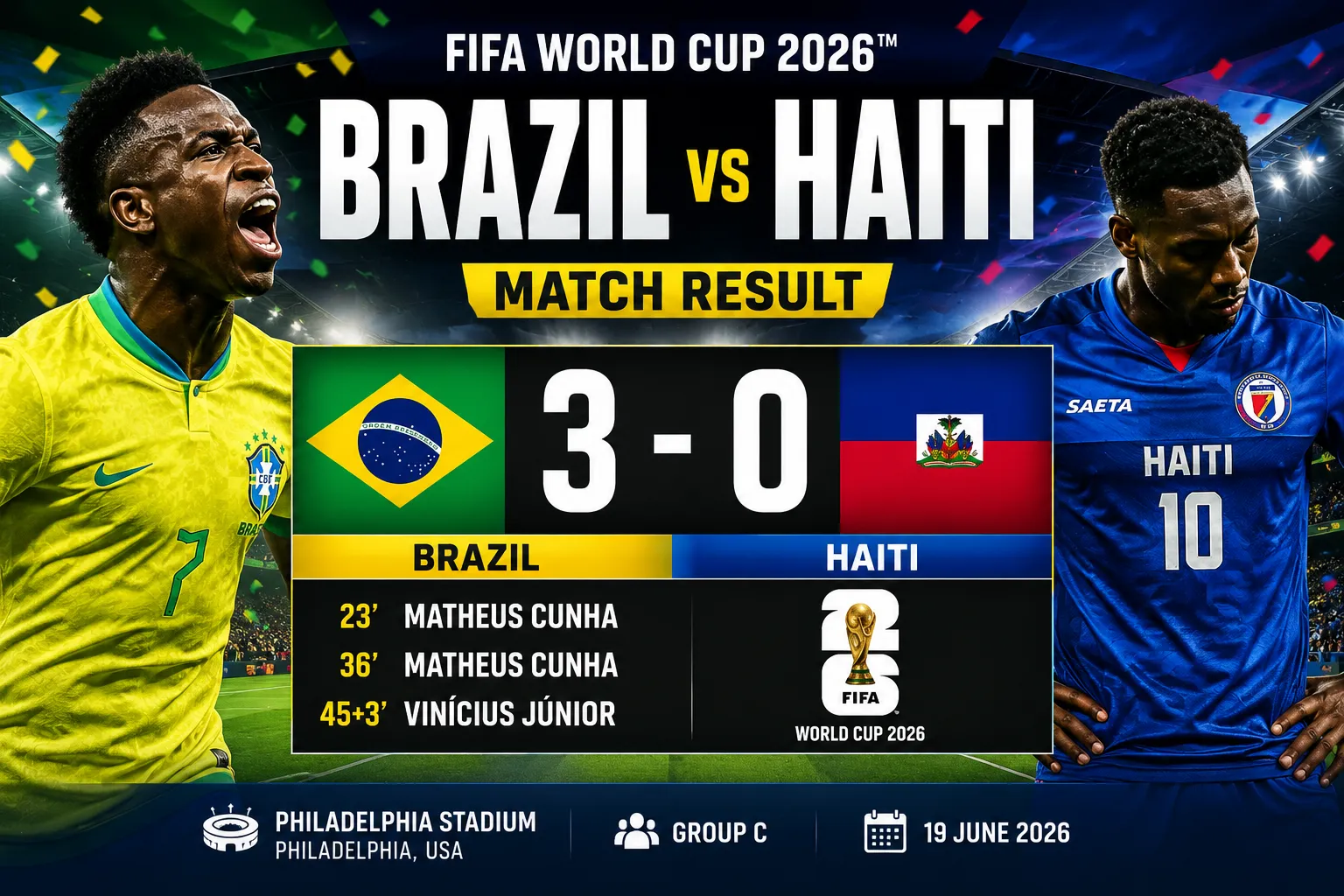
Brazil beat Haiti 3-0 in their FIFA World Cup 2026 Group C match at Philadelphia Stadium. Matheus Cunha scored twice in the first half, first after Johnny Placide spilled a Vinícius Júnior shot in the 23rd minute, then from a Vinícius pass in the 36th. Vinícius added the third in first-half stoppage time. The main turning point was Brazil’s first goal, because Haiti’s low block had survived more than 20 minutes before the rebound opened the game. Vinícius was the best player: one goal, two direct goal actions before the break, constant threat. Locally, Philadelphia brought a large Brazilian crowd, an open-air stadium and a relevant heat-risk layer. For bettors, Brazil win, Brazil handicap, under 3.5 and both-teams-to-score “No” landed, but odds timing still mattered.
| Item | Detail | Data status |
|---|---|---|
| Match | Brazil vs Haiti | [CONFIRMED] |
| Competition | FIFA World Cup 2026 | [CONFIRMED] |
| Stage | Group stage | [CONFIRMED] |
| Group | Group C | [CONFIRMED] |
| Date | June 19, 2026 local time / June 20 UTC | [CONFIRMED] |
| Kickoff time | 8:30 p.m. ET / 00:30 UTC | [REPORTED] |
| Host country | United States | [CONFIRMED] |
| City | Philadelphia | [CONFIRMED] |
| Stadium | Philadelphia Stadium / Lincoln Financial Field | [CONFIRMED] |
| Attendance | 68,324 reported | [REPORTED] |
| Final score | Brazil 3-0 Haiti | [CONFIRMED] |
| Half-time score | Brazil 3-0 Haiti | [CONFIRMED] |
| Goal scorers | Matheus Cunha 23’, 36’; Vinícius Júnior 45+3’ | [CONFIRMED] |
| Referee | not confirmed from verified public data | [UNKNOWN] |
| VAR | not confirmed from verified public data | [UNKNOWN] |
| Weather | complete match-time weather not available from verified public data | [UNKNOWN] |
| Heat risk | 43% chance of performance-impairing heat listed by Climate Central | [REPORTED] |
| Pitch condition | new grass installed for World Cup; match-specific surface behavior not confirmed | [REPORTED/UNKNOWN] |
| Main tournament impact | Brazil moved to four points and Haiti were eliminated from knockout contention | [CONFIRMED] |
FIFA’s match report lists the final score as Brazil 3-0 Haiti and confirms the scorers: Cunha in the 23rd and 36th minutes, then Vinícius Júnior in first-half stoppage time.
| Category | Content used in this article | Why it matters |
|---|---|---|
| [CONFIRMED] match facts | Brazil 3-0 Haiti; Group C; Philadelphia Stadium; Cunha and Vinícius goals | Safe for AI extraction, schema and direct-answer search |
| [REPORTED] details | Attendance 68,324; Raphinha injury; Alisson save from Ricardo Ade; xG values | Useful, but attributed rather than treated as official FIFA data |
| [OBSERVED] match shape | Brazil decided the game in the first half, then managed the second half | Explains tempo without inventing lineups |
| [ANALYSIS] tactical reading | Brazil’s left-sided threat and Vinícius-driven acceleration broke Haiti’s defensive block | Editorial interpretation based on goal pattern and match reports |
| [MARKET SIGNAL] betting reading | Brazil win, handicap, under 3.5 and BTTS No were result-side winners | Post-match market interpretation, not betting advice |
| [UNKNOWN] unavailable data | Referee, VAR official, full cards, complete lineups, closing odds, exact weather | Prevents fake precision |
This distinction matters because match-result articles often fail by trying to sound complete when the data is not complete. A final score is a fact. A tactical interpretation is an argument. A fake referee name is just vandalism in a suit.
Brazil’s 3-0 win over Haiti was settled before half-time. That is the blunt version. The more useful version is that Haiti kept the game alive for 22 minutes, Brazil found the first rupture through Vinícius Júnior and Matheus Cunha, and then the match stopped being a live upset scenario.
Brazil entered under pressure after a 1-1 draw with Morocco. Carlo Ancelotti had talked before the match about reducing mistakes, finding better control and improving in the forward positions. Against Haiti, he got enough of that in the first half to calm the scoreboard, if not every tactical debate around Brazil.
The opener came after Vinícius forced Johnny Placide into a save that could not be held. Cunha reacted first and scored. It was not art. It was penalty-box hygiene. Haiti’s defensive plan had done the hard part by delaying Brazil, then failed the basic part by losing the rebound.
The second goal was cleaner. Vinícius slid the ball through and Cunha finished powerfully. The third came in first-half stoppage time, when Vinícius ended the half himself. Brazil went into the break 3-0 up, and the second half became game management with a few unresolved questions attached.
Brazil deserved the result. Haiti were spirited but limited. ESPN reported Brazil at 1.50 xG and Haiti at 0.25 xG, which fits the match: Brazil were clinical, Haiti produced little sustained scoring threat, and the gap in final-third quality was large enough without needing exaggeration.
This was not Brazil at their most fluid. It was Brazil at their most useful. That can be enough in June. In July, useful needs to become sharper.
Brazil’s first goal came in the 23rd minute. Vinícius Júnior cut into shooting position and forced Johnny Placide into a save. The Haiti goalkeeper could not hold the ball, and Matheus Cunha arrived centrally to finish from close range. FIFA described the sequence as Vinícius creating the first goal by firing a shot that Placide could not hold, with Cunha tapping in from close range.
Assist: not officially confirmed from verified public data.
Goal type: rebound goal after a saved shot.
Defensive error: failure to secure the first save and failure to win the second ball.
Goalkeeper positioning: Placide made the initial stop but pushed the ball into a dangerous central area.
VAR check: not confirmed from verified public data.
Tactical meaning: Haiti’s block had delayed Brazil, but it could not control second balls in the six-yard area. Against a side with Brazil’s forward speed, delaying is not the same as surviving.
Betting meaning: the first goal moved live markets strongly toward Brazil match winner, Brazil handicap and Haiti low-scoring positions.
Cunha scored again in the 36th minute. Reuters reported that Vinícius created both of Cunha’s strikes, while Al Jazeera/AP described Vinícius sliding a pass through the defence for Cunha to power the finish high into the net.
Assist: Vinícius Júnior, reported.
Goal type: open-play goal.
Shot type: powerful finish from inside the attacking zone.
Defensive issue: Haiti’s line failed to stop the pass and could not close Cunha quickly enough.
VAR check: not confirmed from verified public data.
Tactical meaning: the second goal killed Haiti’s low-block patience. Once Haiti had to chase, Brazil had more transition space. That is not a good exchange when Vinícius is already driving the match.
Vinícius scored Brazil’s third before half-time. FIFA lists the goal at 45+3’, and multiple reports identify him as the scorer who closed the match as a contest before the interval.
Assist: not confirmed from verified public data.
Goal type: open-play goal.
Tactical meaning: Brazil punished Haiti before half-time, removing most of the emotional oxygen from the second half.
Emotional impact: this goal changed the match from “Brazil control but Haiti survive” into “Brazil manage the margin.”
Betting meaning: over 2.5 landed before the break, while under 3.5 remained alive because Brazil slowed the match after half-time.
| Minute | Moment | Why it mattered | Data status |
|---|---|---|---|
| 4’ | Carlens Arcus yellow card reported by live coverage | Haiti had an early disciplinary warning while defending deep | [REPORTED] |
| 12’ | Raphinha goal disallowed for offside | Temporarily delayed Brazil but showed right-side danger | [REPORTED] |
| 23’ | Cunha opener | Broke Haiti’s low block and changed the betting state | [CONFIRMED] |
| 36’ | Cunha second goal | Turned Brazil’s control into scoreboard security | [CONFIRMED] |
| 40’ | Raphinha injury substitution | Created a Brazil fitness concern despite the comfortable score | [REPORTED] |
| 45+3’ | Vinícius goal | Ended the competitive phase before half-time | [CONFIRMED] |
| Second half | Brazil slowed the match | Good for control, less convincing for goal-difference aggression | [ANALYSIS] |
| Second half | Ricardo Ade header saved by Alisson | Haiti’s closest route to a consolation goal | [REPORTED] |
The Raphinha injury was the one negative item in Brazil’s first half. Al Jazeera/AP reported that he left in the first half with an injury, while Reuters described it as an apparent leg injury.
| Local factor | Verified or observed detail | Football meaning | Direct match evidence | Betting-result meaning | Data status | Anti-template status |
|---|---|---|---|---|---|---|
| Host country | United States | Neutral host country, but strong Brazil fan presence | Brazil fans made up the bulk of 68,324 spectators | Brazil crowd support could affect momentum perception | [REPORTED] | Specific |
| City | Philadelphia | Urban East Coast setting, not an indoor/domed venue | Match played at Philadelphia Stadium | Weather and crowd travel mattered more than indoor comfort | [CONFIRMED] | Specific |
| Stadium | Philadelphia Stadium / Lincoln Financial Field | Open-air NFL stadium adapted for World Cup | Venue confirms open-air stadium with over 70,000 seats | Heat and humidity cannot be dismissed | [CONFIRMED] | Specific |
| Attendance | 68,324 reported | Large crowd, heavy Brazil support | Al Jazeera/AP reported crowd size and Brazil fan bulk | Strong home-like crowd effect for Brazil | [REPORTED] | Specific |
| Haitian support | Haitian fans sang “Grenadye Alaso” | Haiti had visible diaspora support despite imbalance | Al Jazeera/AP reported chants | Crowd was not one-color only | [REPORTED] | Specific |
| Weather risk | 43% chance of performance-impairing heat | Heat could affect pressing duration and hydration | Climate Central match page | Could matter for second-half tempo markets | [REPORTED] | Specific |
| Pitch | New grass installed for World Cup | Natural surface adaptation from NFL venue | Billy Penn reported grass installation | No proven pitch-speed betting edge | [REPORTED] | Specific |
| Roof | Open-air stadium | No roof protection like domed venues | Stadium source describes open-air venue | Weather exposure relevant | [CONFIRMED] | Specific |
| Crowd distribution | Brazil fans made up bulk; Haitian fans visible | Brazil had emotional venue edge | WHYY and Al Jazeera/AP | Supports Brazil live momentum, not automatic prediction | [REPORTED] | Specific |
Philadelphia was not just a backdrop. Brazil turned the city into a travelling home crowd for one night. WHYY reported Brazil fans around the Art Museum steps before the game and said Brazil fans filled most of the stadium, while Haiti’s diaspora also converged on Philadelphia.
That matters, but it should be handled carefully. Crowd energy does not explain Placide spilling Vinícius’ shot. It may explain the emotional pressure around every Brazil attack, especially after the first goal. The stadium became louder, the match became looser, and Brazil’s speed began to feel heavier.
The weather layer is real but not decisive. Climate Central listed a 43% chance of performance-impairing heat for Brazil vs Haiti at Philadelphia Stadium. That is worth noting because Philadelphia Stadium is open-air. But Brazil’s goals arrived in the first half through technical actions and rebound control, not through a late heat collapse.
The pitch layer should also stay narrow. Lincoln Financial Field had new grass installed for the tournament, replacing the usual NFL surface context with a World Cup setup. But there is no verified evidence that bounce, grip, surface wear or ball speed caused the goals.
| Stadium factor | Detail |
|---|---|
| Stadium | Philadelphia Stadium / Lincoln Financial Field |
| Capacity | over 70,000 seats per stadium source; around 69,000 World Cup capacity reported by FourFourTwo |
| Attendance | 68,324 reported |
| Pitch type | grass installed for World Cup |
| Roof status | open-air stadium |
| Acoustic effect | large Brazil-supporting crowd reported; Haitian chants also reported |
| Surface condition | match-specific surface condition not confirmed from verified public data |
| Wind or airflow relevance | not available from verified public data |
| Goalkeeper distribution effect | no verified stadium-specific effect |
| Set-piece effect | no set-piece goal; no verified set-piece stadium effect |
| Communication effect | no verified evidence that crowd noise caused defensive errors |
| Data status | venue and crowd strong; wind, pitch behavior and technical acoustics unknown |
The available match evidence shows a strong crowd effect but not a clear stadium-mechanics effect. Philadelphia Stadium influenced the match as a noisy, open-air stage with heavy Brazilian support. It did not visibly decide the match through pitch behavior, wind, roof design or set-piece conditions.
That distinction matters. Brazil’s goals came from Vinícius’ pressure, Cunha’s positioning and Haiti’s inability to secure key defensive moments. The stadium amplified the event. It did not score the goals.
| City/weather factor | Detail |
|---|---|
| City | Philadelphia |
| Host country | United States |
| Time zone | Eastern Time |
| Climate for match month | warm early-summer East Coast conditions |
| Match-time temperature | exact match-time temperature not available from verified public data |
| Humidity | not available from verified public data |
| Wind | not available from verified public data |
| Rain or sun | not available from verified public data |
| Altitude | no meaningful altitude angle |
| Heat risk | 43% chance of performance-impairing heat listed by Climate Central |
| Likely physical effect | possible pressure on pressing duration and second-half intensity |
| Actual match evidence | Brazil scored all three goals before half-time, then managed the second half |
| Data status | heat-risk reported; exact weather unknown |
The weather did not write the scoreline. Brazil had already won the competitive argument by half-time. If heat mattered, its clearest football meaning was in the second half, where Brazil had little reason to keep pressing hard at 3-0.
That matters for betting interpretation. A 3-0 half-time lead plus possible heat-risk context can suppress second-half intensity. But the article should not pretend that this was proven by biometric data or official weather logs. It is a reasonable tactical reading, not a confirmed physiological report.
Brazil started with pressure but not immediate clarity. Haiti’s early defensive plan was predictable and sensible: stay compact, delay Brazil’s wide players, protect central lanes and hope the match becomes awkward.
For a while, it worked. Raphinha had an early effort disallowed for offside, and Brazil needed more than 20 minutes to find the breakthrough. That delay matters because it shows Haiti were not simply spectators in yellow-and-blue traffic.
The key tactical imbalance was Vinícius against Haiti’s defensive spacing. He did not need constant clean dribbles to change the match. He needed one shot that forced Placide to handle under pressure. Cunha’s opener came from that sequence.
The second goal showed Brazil’s best attacking idea: early acceleration into space before Haiti’s defensive line could reset. Vinícius found Cunha, and Cunha finished like a player determined not to return quietly to the bench. Reuters reported that Cunha had started in place of Igor Thiago and rewarded Ancelotti’s decision with his first two World Cup goals.
The third goal was Brazil’s most important psychologically. At 2-0, Haiti could still frame the second half as damage control with a miracle attached. At 3-0, the miracle needed paperwork.
Brazil’s second half was efficient, not exciting. That is not a crime. It is also not a parade.
At 3-0, Brazil reduced risk. They did not need to chase every transition or overload the box with six bodies. The match became a management exercise: protect legs, avoid cards, test bench pieces and keep the clean sheet.
Haiti showed more life after the break, but they did not force a sustained crisis. Ricardo Ade came closest with a header that forced Alisson into a save, according to Reuters. That was Haiti’s best chance of changing the emotional tone of the night. It did not change the result.
Brazil’s restraint may have been sensible. It may also have left some analysts cold. Group-stage goal difference matters, and Brazil had the chance to score more. Still, after Raphinha’s injury, the risk calculation shifted. Tournament coaches are paid to know when to keep the knife out and when to put it back in the drawer.
Brazil won because they had superior individual quality in the exact areas where Haiti’s block was most vulnerable: wide isolation, second-ball reaction and quick penalty-box finishing.
Haiti’s plan was not foolish. Against Brazil, a lower block is not cowardice. It is basic survival. The problem is that survival football demands clean first contacts and disciplined clearances. Haiti failed on the first goal, then lost the second through a passing lane that Vinícius found before the block could recover.
Brazil’s attacking shape did not need to be perfect because Vinícius kept bending the match toward himself. He created the first goal, assisted the second and scored the third. FotMob reported that Vinícius became only the third Brazilian in the 21st century to be involved in three goals across his first two matches at a World Cup, after Elano and Rivaldo.
Cunha also changed the reference point of Brazil’s front line. He attacked rebounds, ran behind and finished with conviction. That mattered after Brazil’s flat opener against Morocco. If a striker is going to start instead of another forward, scoring twice is usually considered a useful rebuttal.
Haiti lost because they could not carry possession into danger often enough. Their second-half effort was honest, but honest without shot quality is just running with a national anthem attached.
| Zone | Edge | Evidence from the match | Key player | Local condition effect | Result impact |
|---|---|---|---|---|---|
| Brazil left channel | Brazil | Vinícius created the first two goals and scored the third | Vinícius Júnior | Crowd intensified Brazil attacks | Decisive |
| Brazil right channel | Brazil early, then disrupted | Raphinha had early danger but left injured | Raphinha | No verified local effect | Injury concern |
| Central midfield | Brazil | Brazil managed tempo after 3-0 | Bruno Guimarães / Brazil midfield | Heat-risk context may support slower second half | Control |
| Haiti defensive box | Brazil | Placide rebound, Cunha positioning, third goal before half-time | Cunha, Vinícius | Crowd pressure possible but not causal proof | Main result zone |
| Set pieces | No clear edge | No set-piece goal confirmed | not applicable | No verified wind/set-piece effect | Limited |
| Transitions | Brazil | Second goal came through quick Vinícius-Cunha action | Vinícius, Cunha | Open-air heat not direct cause | Brazil’s best attacking pattern |
| Haiti attack | Brazil defensive edge | Haiti produced only 0.25 xG per ESPN | Alisson, Brazil defence | No clear local condition effect | Clean sheet |
| Goalkeeper actions | Brazil | Placide spill led to goal; Alisson saved Ade header | Placide / Alisson | No verified communication effect | Significant |
| Bench impact | Brazil cautious | Brazil rotated after injuries and lead | Endrick / Martinelli reported in later tournament context | Second-half management | Preserved result |
Ratings are editorial ratings based on confirmed events, reported match data and available public information. Full official lineups and all substitutions were not available from verified public data in the source set used for this article.
| Player / unit | Rating | Explanation |
|---|---|---|
| Alisson | 7.0 | Kept the clean sheet and saved Ricardo Ade’s header, according to Reuters. Limited workload, but handled the key moment. |
| Brazil centre-backs | 7.0 | Not overloaded, but maintained enough control to prevent Haiti from turning effort into pressure. |
| Brazil full-backs | 7.0 | Supported control and wide circulation. No verified defensive breakdown. |
| Bruno Guimarães | 6.5 | Early foul on him led to Haiti’s reported first yellow. Helped Brazil manage midfield rhythm. |
| Brazil midfield unit | 6.5 | Functional rather than dazzling. Controlled the second half without forcing tempo. |
| Raphinha | 6.0 | Had early involvement and a disallowed goal but left injured before half-time. Rating limited by early exit. |
| Vinícius Júnior | 9.5 | Best player. Created the first goal, assisted the second and scored the third. Brazil’s attacking reference point. |
| Matheus Cunha | 9.0 | Two goals in his first World Cup start. Excellent box timing and finishing. |
| Endrick / attacking substitutes | 6.0 | Endrick appeared later in the tournament context and had minutes in this match, but detailed verified contribution is limited. |
| Brazil bench | 6.5 | Helped see out the match after the score was settled; no major verified match-changing second-half moment. |
| Player / unit | Rating | Explanation |
|---|---|---|
| Johnny Placide | 4.5 | Initial save before the first goal was not held, leading to Cunha’s opener. Also faced high-quality Brazil pressure. |
| Carlens Arcus | 5.0 | Early yellow reported. Defending Brazil’s wide threat became a long night. |
| Haiti centre-backs | 5.0 | Competed physically but could not control rebounds or Vinícius-Cunha movement. |
| Ricardo Ade | 6.0 | Produced Haiti’s closest chance with a strong header saved by Alisson. |
| Haiti midfield unit | 5.5 | Worked hard but struggled to create controlled attacks after falling behind. |
| Haiti wide players | 5.0 | Limited attacking outlet. Defensive work was heavy. |
| Haiti forwards | 5.0 | Low service, low threat. ESPN’s 0.25 xG figure shows the attacking ceiling. |
| Haiti substitutes | 5.5 | Brought energy in the second half, but not enough to change the game. |
| Category | Choice | Reason |
|---|---|---|
| Man of the Match | Vinícius Júnior | One goal, involvement in both Cunha goals, constant match-breaking threat |
| Best attacker | Matheus Cunha | Two goals and strong penalty-box timing |
| Best midfielder | Brazil midfield unit | Controlled enough territory to keep Haiti from building pressure |
| Best defender | Ricardo Ade | Haiti’s strongest individual moment came from his header |
| Best goalkeeper | Alisson | Clean sheet and important save from Ade |
| Best substitute | not confirmed from verified public data | No substitute had enough verified match impact |
| Most underrated performance | Cunha’s box movement | His rebound instinct changed the match |
| Most disappointing performance | Haiti’s rebound defending | The first goal came from a preventable second-ball failure |
| Player | Team | Incident | Minute | Status | Next-match impact | Data status |
|---|---|---|---|---|---|---|
| Raphinha | Brazil | Apparent leg injury / first-half substitution | Around 40’ | Left match | Fitness concern for Scotland match | [REPORTED] |
| Carlens Arcus | Haiti | Yellow card reported in live coverage | 4’ | Booked | Accumulation impact not confirmed | [REPORTED] |
| Casimir | Haiti | Treatment reported before half-time | 43’ | Injury treatment | Not confirmed | [REPORTED] |
| Neymar | Brazil | Calf injury; ruled out before match | Pre-match | Did not play | Possible return later in tournament not confirmed here | [REPORTED] |
Neymar was ruled out of Brazil’s second straight match with a lingering calf injury, according to Al Jazeera/AP. That detail matters because it shaped Brazil’s attacking selection and increased the attention on Cunha, Vinícius and Raphinha.
The referee and VAR officials were not confirmed from verified public data in the source set used for this article.
There was an early disallowed Raphinha goal for offside, reported by Al Jazeera/AP and live coverage. That decision temporarily delayed Brazil but did not materially change the final outcome.
No verified penalty controversy, red-card controversy or major VAR dispute was found in the reviewed public sources. The match flow was determined by Brazil’s first-half finishing and Haiti’s limited attacking production, not by officiating.
| Statistic | Brazil | Haiti | Data status |
|---|---|---|---|
| Final score | 3 | 0 | [CONFIRMED] |
| Expected goals | 1.50 | 0.25 | [REPORTED, ESPN] |
| Goals | Cunha 23’, 36’; Vinícius 45+3’ | none | [CONFIRMED] |
| Half-time score | 3 | 0 | [CONFIRMED] |
| Clean sheet | Yes | No | [CONFIRMED] |
| Key goalkeeper save | Alisson vs Ade header | Placide initial save before rebound goal | [REPORTED] |
| Disallowed goal | Raphinha offside | none confirmed | [REPORTED] |
| Red cards | none confirmed | none confirmed | [UNKNOWN] |
| Full possession / shots / corners | not confirmed from official public data in source set | not confirmed from official public data in source set | [UNKNOWN] |
The xG gives the match a useful frame. Brazil scored three from 1.50 xG, which suggests clinical first-half finishing. Haiti’s 0.25 xG shows that their spirit did not become enough threat.
A 3-0 scoreline can sometimes hide chaos. This one mostly hid restraint. Brazil did enough early, then reduced risk.
This section is post-match betting analysis. It is not betting advice.
| Market | Pre-match expectation | Actual result | Winning side of market | Key match trigger | Local factor | Caution note |
|---|---|---|---|---|---|---|
| Match winner | Brazil heavy favorite | Brazil won 3-0 | Brazil | First goal at 23’ | Strong Brazil crowd | Price likely short; value depended on odds |
| Draw | Low-probability but alive until 23’ | Lost | Draw lost | Cunha rebound | None decisive | Draw died once Brazil scored |
| Brazil handicap | Brazil expected to win clearly | Brazil won by 3 | Brazil handicap lines up to -2.5 depending on price | First-half treble | Crowd and talent gap | Handicap depends on line |
| Over/under 2.5 | Needed three goals | Over 2.5 landed | Over 2.5 | Vinícius 45+3’ | Not weather-driven | Landed before half-time |
| Over/under 3.5 | Needed fourth goal | Under 3.5 landed | Under 3.5 | Brazil slowed second half | Heat-risk and game state may have reduced tempo | Do not overstate weather |
| BTTS | Haiti needed one goal | No | BTTS No | Haiti 0.25 xG | No direct local effect | Alisson save protected clean sheet |
| Correct score | 3-0 | Brazil 3-0 | 3-0 tickets | Brazil first-half efficiency | None direct | High-variance market |
| First goalscorer | Cunha | Cunha | Cunha tickets | Rebound finish | None direct | Rebound goals are volatile |
| Player goals | Cunha brace, Vinícius goal | Cunha/Vinícius scorers | Cunha and Vinícius backers | Selection and left-side threat | Crowd support | Player props depend on starts |
| Live betting | Brazil shortened after opener | Brazil controlled | Brazil live backers | 23’ goal | Crowd amplified Brazil pressure | Live prices move fast |
Brazil win was the expected result, but expected results are not automatically profitable results. Heavy favorites often come with compressed prices. The better post-match lesson sits in the totals and handicap markets: Brazil scored early enough to cover several lines, then slowed enough for under 3.5 to survive.
That is the kind of match casual bettors often misread. A first-half 3-0 does not guarantee a second-half avalanche. Sometimes it guarantees a coach looking at his injured winger and deciding the fourth goal can manage without him.
| Local factor | Market possibly affected | Actual match evidence | Possible betting interpretation | Risk of overreaction | Safer conclusion |
|---|---|---|---|---|---|
| Brazil-heavy crowd | Match winner, live momentum | Brazil fans made up bulk of crowd | Supported Brazil emotional pressure | Treating crowd as prediction engine | Crowd helped context, not proof |
| Haitian diaspora support | BTTS, emotional resistance | Haitian chants reported | Haiti did not fold emotionally | Overrating atmosphere | Support did not create xG |
| Open-air stadium | Totals, second-half tempo | Climate Central heat-risk data | Possible lower second-half intensity | Claiming weather caused the result | Game state mattered more |
| Heat-risk layer | Pressing, substitutions, second-half markets | 43% chance of performance-impairing heat | Brazil had reason to conserve at 3-0 | Overfitting weather | Treat as supporting factor only |
| New grass surface | passing, ball speed | grass installed before tournament | no verified pitch issue | inventing surface effect | no betting conclusion |
| Raphinha injury | player props, Brazil next match | first-half injury reported | next-match market relevance | immediate overreaction | wait for medical confirmation |
Local factors mattered most after the score reached 3-0. The crowd gave Brazil emotional lift. The open-air conditions and heat-risk context made second-half conservation understandable. But the goals themselves came from football actions: Vinícius pressure, Cunha timing, and Haiti’s defensive limitations.
Brazil moved to four points in Group C and went above Morocco on goal difference after the win. FIFA’s match report states that Brazil edged ahead of Morocco on goal difference at the top of Group C after the victory.
Haiti were eliminated from knockout contention. Al Jazeera/AP and Reuters both reported that Haiti became the first team guaranteed not to reach the knockout round.
Brazil’s next group match was against Scotland in Miami Gardens on June 24, while Haiti were scheduled to close against Morocco in Atlanta.
For Brazil, the win restored order after the draw with Morocco. It did not answer every question about Ancelotti’s structure, but it gave Brazil the scoreboard and group-table correction they needed.
For Haiti, the result confirmed elimination, but not embarrassment. The gap in quality was clear. The effort was also clear. Those two statements can coexist without needing sentimentality.
Brazil did four things well.
First, they attacked the rebound zone. Cunha’s first goal was not luck. It was striker positioning and reaction speed.
Second, they used Vinícius as the match breaker. He was not just a winger staying wide. He was the source of acceleration, shot pressure and final-third timing.
Third, they scored before Haiti could turn survival into belief. Low blocks become more powerful the longer they stay level. Brazil cut that line at 23 minutes.
Fourth, they controlled the second half without giving Haiti a serious route back. It was not especially entertaining. It was professionally useful.
Haiti’s largest problem was defensive second-ball control. The first goal came because Placide’s save was not secured and Cunha was freer than a striker should be in that zone.
The second problem was the space around Vinícius. Haiti could delay him, but they could not shut down his influence. He created both Cunha goals and scored the third.
The third problem was attacking weight. Haiti did not turn possession, emotion or crowd energy into enough high-quality chances. ESPN’s 0.25 xG figure is blunt. It says Haiti did not make Brazil defend enough dangerous moments.
None of this requires lazy criticism. Haiti faced a five-time world champion with one of the tournament’s best attacking players. The difference was not attitude. It was execution.
Ancelotti needed a response after the Morocco draw. He got it through Cunha’s selection and Vinícius’ centrality.
Reuters reported that Cunha started in place of Igor Thiago and rewarded Ancelotti with two goals. That selection was the cleanest coaching win of the match.
Ancelotti’s second-half management was conservative. At 3-0, with Raphinha injured, that made sense. The remaining concern is whether Brazil’s control can become creative control against stronger opponents.
Migné’s Haiti had a realistic first-stage plan: stay compact, keep the game scoreless as long as possible, and look for moments. The plan survived 22 minutes. Then Brazil’s individual quality cracked it.
Before the match, Migné framed the fixture as a chance to make Haitian people proud, while acknowledging the emotional size of the occasion.
His team did not get a result, but they did not vanish completely. That matters for evaluation. The limitation was not fight. It was the gap in final-third quality.
Matheus Cunha scored his first two World Cup goals, according to Reuters and Al Jazeera/AP.
FotMob reported that Cunha became the fifth player to score a brace for Brazil in a World Cup match during the 21st century, joining Ronaldo, Neymar, Luis Fabiano and Richarlison.
Vinícius Júnior was involved in three goals across Brazil’s first two matches of the 2026 World Cup, becoming only the third Brazilian to do so in the 21st century after Elano and Rivaldo, according to FotMob.
ESPN also reported that Brazil overtook Germany as the all-time top scorers in FIFA World Cup history, with their 241st goal coming against Haiti.
Brazil and Haiti had met before, including Brazil’s 7-1 win at the 2016 Copa América Centenario. Al Jazeera’s preview noted that Brazil had won all three previous meetings and that this was their first World Cup meeting.
This 2026 match was not a repeat of 2016. The scoreline was smaller, the context bigger for Haiti, and the tactical story more controlled. Brazil did not destroy Haiti for 90 minutes. Brazil punished them for 23 first-half minutes and then managed the rest.
The useful World Cup lesson is old: underdogs can survive pressure for a while, but they must defend the second ball like it is a government document. Haiti did not.
The main match incident was Raphinha’s first-half injury. Al Jazeera/AP reported that he was substituted in the first half, and Reuters described an apparent leg injury.
There was also an early Raphinha goal disallowed for offside. No verified public source reviewed for this article framed it as a major controversy.
No verified penalty dispute, red-card dispute, crowd disorder, pitch invasion or VAR controversy was found in the source set used for this article.
This article does not only repeat the score. It separates the confirmed Brazil vs Haiti match result from tactical interpretation and missing data.
It adds:
The key local gain is specific to this fixture: Philadelphia Stadium, Brazilian crowd dominance, Haitian chants, open-air heat-risk context, new grass installation and the match’s first-half/second-half split.
| Check item | Included? | Status | Specific to this fixture? | Needs update later |
|---|---|---|---|---|
| Stadium detail | Yes | confirmed/reported | Yes | Add FIFA official attendance if available |
| City detail | Yes | confirmed/reported | Yes | Add verified travel notes if released |
| Weather detail | Yes | reported/unknown | Yes | Add exact temperature, humidity and wind if verified |
| Pitch detail | Yes | reported/unknown | Yes | Add match-specific pitch report if released |
| Crowd detail | Yes | reported | Yes | Add official crowd distribution if available |
| Travel/acclimatization detail | Limited | unknown | Yes | Update only from official team comments |
| Betting-risk detail | Yes | analysis | Yes | Add licensed closing odds if available |
| Tactical-local connection | Yes | analysis with limits | Yes | No forced weather claim |
| Anti-template status | Passed | mixed | Yes | No generic venue paragraph used |
| Data point | Status | Source type |
|---|---|---|
| Final score | [CONFIRMED] | FIFA match report |
| Goal scorers | [CONFIRMED] | FIFA match report |
| Goal times | [CONFIRMED] | FIFA match report |
| Stadium | [CONFIRMED] | FIFA / venue sources |
| City | [CONFIRMED] | FIFA / venue sources |
| Attendance | [REPORTED] | Al Jazeera/AP |
| Referee | [UNKNOWN] | not available from verified public data |
| VAR | [UNKNOWN] | not available from verified public data |
| Lineups | [PARTIAL] | Reuters / Al Jazeera reporting |
| Substitutions | [PARTIAL] | Raphinha injury substitution reported |
| Cards | [PARTIAL/UNKNOWN] | live coverage only, not fully verified |
| Injuries | [REPORTED] | Raphinha injury reported |
| Match statistics | [REPORTED] | ESPN xG |
| xG | [REPORTED] | ESPN |
| Odds | [UNKNOWN] | no licensed closing odds used |
| Local stadium factors | [CONFIRMED/REPORTED] | stadium source, FourFourTwo, Billy Penn |
| Local city factors | [REPORTED] | WHYY |
| Weather | [REPORTED/UNKNOWN] | Climate Central heat-risk data; exact weather unknown |
| Pitch condition | [REPORTED/UNKNOWN] | Billy Penn grass installation; match behavior unknown |
| Crowd profile | [REPORTED] | Al Jazeera/AP, WHYY |
| Tournament impact | [CONFIRMED] | FIFA, Reuters, Al Jazeera/AP |
Recommended schema types:
For SportsEvent, include when available:
Structured data must match the visible page content. Do not add schema facts that are not visible in the article.
Update this article if:
Last updated: July 3, 2026, 22:15 Asia/Kolkata.
Brazil 3-0 Haiti was a professional correction, not a full artistic rebirth. Brazil needed a win after the draw with Morocco. They got it by trusting Vinícius, starting Cunha and finishing the match before Haiti could turn belief into pressure.
The scoreline was fair. Brazil had the better players, the better box presence and the cleaner finishing. Haiti gave effort and carried visible support in Philadelphia, but effort without chance quality usually becomes a respectable defeat.
The most important tactical detail was Brazil’s control of the left-side attacking channel through Vinícius. The most important local detail was the Brazil-heavy crowd in an open-air Philadelphia Stadium, with heat risk present but not decisive. The most important betting lesson was that a heavy favorite can still produce layered market outcomes: Brazil win and handicap landed, over 2.5 landed, but Brazil’s second-half slowdown protected under 3.5.
For Brazil, this was enough. For Haiti, this was the end of the knockout chase. For everyone else watching Group C, it was a reminder that Brazil do not need to be perfect to make a game disappear before half-time.
Football betting carries financial risk. A correct match analysis does not guarantee a winning bet. Odds change before and during matches, and one early goal can completely alter live markets.
Local conditions can also be overvalued by bettors. Crowd support, heat risk and venue profile matter, but they do not make any result automatic. Never chase losses. Do not bet money needed for daily life. Use limits, take breaks and check local betting laws before gambling. Use licensed operators only. Betting should remain entertainment, not income.
Brazil beat Haiti 3-0 in their FIFA World Cup 2026 Group C match.
Matheus Cunha scored twice, in the 23rd and 36th minutes. Vinícius Júnior scored Brazil’s third goal in first-half stoppage time.
Vinícius Júnior was the best player. He created the first two Brazil goals and scored the third.
Brazil moved to four points and went top of Group C on goal difference. Haiti were eliminated from knockout contention.
Brazil match winner, Brazil handicap, over 2.5 goals and both-teams-to-score “No” were the main result-side winners. Exact outcomes depended on the odds, line and timing.