
Cabo Verde vs Saudi Arabia Match Result
Table of Contents Show
Views 6
TL;DR: Cabo Verde vs Saudi Arabia Match Result
Cabo Verde and Saudi Arabia drew 0-0 at Houston Stadium. The result, combined with Spain’s 1-0 victory over Uruguay, sent the World Cup debutants through as Group H runners-up. Cabo Verde created the better chances, attempted 15 shots and generated considerably more xG, but Mohammed Al Owais saved from Willy Semedo, Jamiro Monteiro and substitute Laros Duarte. Vozinha stopped Saudi Arabia’s three efforts on target, including Abdullah Al-Hamdan’s late attempt. Deroy Duarte was the official post-match standout, while Kevin Pina controlled the space ahead of Cabo Verde’s defence. The tactical difference was chance creation: Cabo Verde progressed through the flanks and second balls; Saudi Arabia struggled to retain possession or support their forwards. The provider-listed 30°C conditions and drinks breaks did not produce a visible technical collapse. The draw, under 2.5 goals and both teams to score — No won, subject to the operator and timing of the wager. (Reuters)
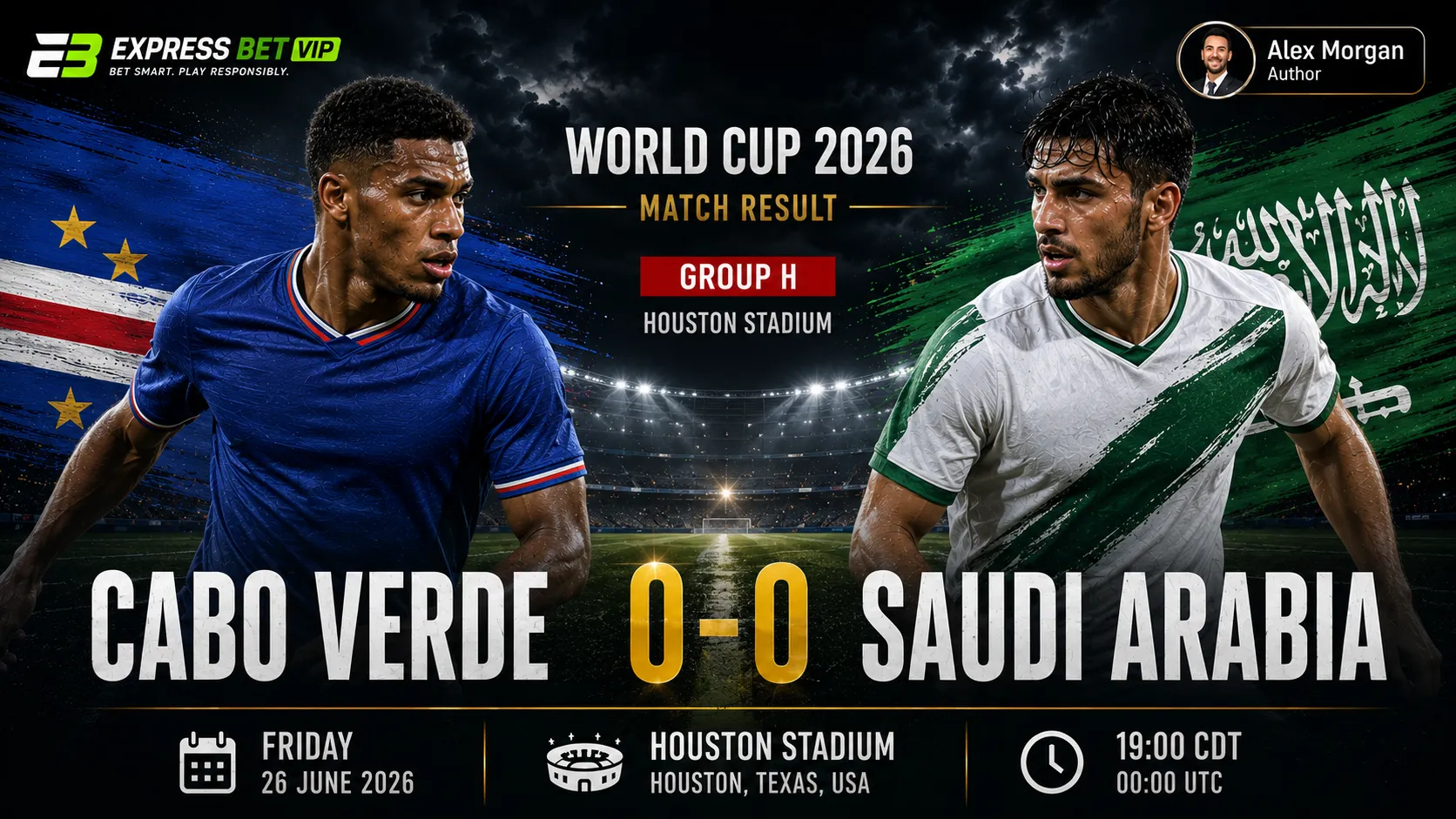
Quick Facts: Final Score, Venue, and Match Status
| Item | Verified detail |
|---|---|
| Match | Cabo Verde vs Saudi Arabia |
| Competition | FIFA World Cup 2026 |
| Stage | Group stage, Matchday 3 |
| Group | Group H |
| Local date | June 26, 2026 |
| FIFA UTC date | June 27, 2026 |
| Kickoff | 19:00 CDT / 00:00 UTC |
| Host country | United States |
| City | Houston, Texas |
| Stadium | Houston Stadium |
| Regular stadium name | NRG Stadium |
| Attendance | 68,278 |
| Final score | Cabo Verde 0-0 Saudi Arabia |
| Half-time score | 0-0 |
| Goalscorers | None |
| Referee | François Letexier |
| VAR | Not available from verified public data |
| Temperature | 30°C according to FotMob |
| Surface | Natural grass World Cup surface |
| Roof | Retractable; expected to remain closed during the tournament |
| Cards | Saud Abdulhamid 4’, Wagner Pina 8’, Nasser Al-Dawsari 67’, Firas Al-Buraikan 90+3’ |
| Main tournament impact | Cabo Verde qualified in second place; Saudi Arabia were eliminated |
Sky Sports confirmed the score, attendance, lineups, cards and event sequence. FIFA lists Houston Stadium as a retractable-roof venue, while FotMob recorded the match surface and temperature. (Sky Sports)
Verified Facts vs Analysis
| Category | Information |
|---|---|
| [CONFIRMED] | The match finished 0-0. |
| [CONFIRMED] | Cabo Verde had 15 shots; Saudi Arabia had seven. |
| [CONFIRMED] | Cabo Verde finished second in Group H with three points. |
| [CONFIRMED] | Saudi Arabia finished fourth with two points. |
| [REPORTED] | Cabo Verde supporters used drums and celebrated after Spain’s win was confirmed. |
| [OBSERVED] | Cabo Verde created more dangerous open-play attacks after half-time. |
| [ANALYSIS] | Saudi Arabia’s 4-4-2 lacked enough midfield support around its two forwards. |
| [MARKET SIGNAL] | Both teams were priced close to +160–+175, with the draw around +220–+230. |
| [DISPUTED] | Provider xG totals varied slightly. |
| [UNKNOWN] | Internal temperature, humidity, wind, complete VAR crew and tracking data. |
This distinction protects the article from turning interpretation into event data. Fifteen shots and a 0-0 score are recorded facts. The conclusion that Saudi Arabia’s forwards were isolated is an analytical reading of the formations, passing patterns and chance volume.
It also matters for AI Search. A system extracting the Cabo Verde vs Saudi Arabia match result should identify the final score and qualification outcome without presenting an editorial tactical explanation as an official FIFA statement. (Sky Sports)
Final Score and Match Summary
The arithmetic was uncomplicated before kickoff, which is usually when tournament football decides to become emotionally complicated.
Cabo Verde knew a victory would guarantee progression. A draw could also be enough if Spain defeated Uruguay in the simultaneous Group H match. Saudi Arabia required a win and outside assistance.
Both teams began cautiously. The first shot did not arrive until Salem Al-Dawsari’s blocked attempt after 17 minutes and 12 seconds—the latest first attempt in any match at the tournament to that point. Neither side wanted to concede the transition that would change every qualification calculation. (FotMob)
Saudi Arabia’s early structure suggested aggression on paper. Georgios Donis selected Firas Al-Buraikan and Mohamed Kanno together in a 4-4-2. In practice, Kanno frequently dropped toward midfield, leaving Al-Buraikan alone between Roberto Lopes and Diney Borges.
Cabo Verde gradually gained control through Kevin Pina and Deroy Duarte. Ryan Mendes and Willy Semedo stayed wide enough to stretch the Saudi back four, while Jamiro Monteiro moved between the lines.
Semedo produced the first serious Cabo Verde threat. He attacked from the left, cut toward the penalty area and forced Al Owais to protect his near post. He later dragged another attempt narrowly wide.
Saudi Arabia’s best first-half effort arrived in stoppage time. Abdulelah Al-Amri returned the ball into the area, and Kanno directed a looping header toward Vozinha. The 40-year-old goalkeeper held it without difficulty. (Sky Sports)
The match changed after the interval.
Cabo Verde increased the speed of its first pass after recovering possession. Wagner Pina advanced from right-back, João Paulo supported from the opposite side, and Saudi Arabia’s midfield began retreating toward its defence.
Monteiro tested Al Owais immediately after half-time. Kevin Pina then drove narrowly wide from approximately 30 yards. Ryan Mendes had another attempt blocked after Wagner Pina entered the final third.
Saudi Arabia remained dangerous only in isolated moments. Mohammed Abu Al-Shamat, introduced in the 65th minute, forced Vozinha into his strongest save with a shot from a tight right-sided angle. The goalkeeper pushed it away from the upper corner. (Sky Sports)
Bubista then introduced Laros Duarte and Garry Rodrigues. Duarte’s effect was immediate. He created three chances despite entering in the 71st minute and received the clearest opportunity of the match after Nuno da Costa released him behind the defensive line.
Al Owais stayed upright, reduced the angle and saved Duarte’s attempt from the centre of the penalty area. It was the action that preserved Saudi Arabia’s clean sheet and denied Cabo Verde the victory their attacking superiority arguably merited. (FotMob)
Saudi Arabia pushed more players forward during the closing phase, but its attacks remained disjointed. Al-Buraikan received too far from goal, Al-Hamdan lacked support and the midfield struggled to recover second balls.
Al-Hamdan’s stoppage-time attempt provided one final anxiety. Al-Buraikan supplied him inside the box, but the finish went directly toward Vozinha.
The final whistle did not confirm Cabo Verde’s qualification. Spain and Uruguay were still playing.
Players and staff remained on the Houston pitch, gathered around mobile phones and watched Spain protect its 1-0 lead. When the other match ended, the tension released at once. The players embraced, supporters banged drums and a goalless draw acquired the emotional weight normally reserved for a late winner. (Reuters)
Cabo Verde deserved at least a point. They led shots 15-7, created 12 chances to Saudi Arabia’s five and produced the better opportunities. The score reflected poor finishing and two competent goalkeepers rather than Saudi control.
Saudi Arabia’s elimination was equally understandable. They scored one goal across three matches and produced only seven attempts in a game they had to win. Urgency appeared in the tournament table more clearly than on the pitch. (Reuters)
Why the Match Finished 0–0
The match finished goalless because Cabo Verde lacked finishing precision and Saudi Arabia lacked attacking volume.
Cabo Verde generated the superior provider xG and created the game’s only clear one-on-one. Yet just two of their 15 shots tested Al Owais. Eight went off target and five were blocked.
The Blue Sharks reached useful areas without controlling the final action. Semedo’s early work came from tight angles. Kevin Pina’s best attempt came from distance. Monteiro shot directly at the goalkeeper. Duarte’s one-on-one was saved.
Saudi Arabia’s failure was more structural. Donis selected two forwards but could not connect them to the midfield. Salem Al-Dawsari and Sultan Mandash often received close to the touchline, while Abdullah Al-Khaibari and Nasser Al-Dawsari remained too deep to support attacks around the penalty area.
The Saudis recorded three shots on target, but none carried high finishing quality. Kanno’s header, Abu Al-Shamat’s angled shot and Al-Hamdan’s late effort all allowed Vozinha to make controlled saves.
Cabo Verde’s defensive spacing also mattered. Kevin Pina screened passes into Kanno, while Lopes and Borges remained compact around Al-Buraikan. When the Saudi full-backs advanced, Mendes and Semedo recovered to form a five-player midfield line.
The provider xG difference—approximately 1.4–1.5 for Cabo Verde against 0.4 for Saudi Arabia—supports the visual assessment. The debutants created enough to win. Saudi Arabia did not. (FotMob)
Key Moments That Changed the Match
Saud Abdulhamid’s Early Yellow Card
Abdulhamid was booked in the fourth minute after fouling João Paulo.
The card did not remove his attacking contribution—FotMob rated him as Saudi Arabia’s best player—but it limited the aggression available when defending Semedo and João Paulo on Cabo Verde’s left. (Sky Sports)
Wagner Pina Is Booked Four Minutes Later
Wagner Pina received Cabo Verde’s only yellow card in the eighth minute after fouling Salem Al-Dawsari.
The caution created an early risk on the side Saudi Arabia were most likely to attack. Pina responded well, continuing to overlap without giving the referee another serious disciplinary decision.
Semedo Forces Al Owais into Action
Semedo’s near-post effort established Cabo Verde’s most productive first-half route: recovering the ball, moving quickly toward the left and attacking before Saudi Arabia’s 4-4-2 could become compact.
The winger later missed narrowly from outside the area, but his movement forced Saudi Arabia to defend deeper. (FotMob)
Hassan Al-Tambakti Leaves Injured
Al-Tambakti required treatment around the 30th minute and was replaced by Ali Lajami in the 33rd.
Saudi Arabia maintained its defensive structure, but the enforced change removed one of its established centre-backs during a match that offered little margin for communication errors. A verified diagnosis was not publicly available. (Sky Sports)
Kevin Pina Misses Narrowly
Five minutes after the restart, Pina moved into space outside the penalty area and drove a left-footed attempt just beyond the upper-left corner.
The chance showed Cabo Verde’s improved second-half positioning. Their defensive midfielder was now receiving close enough to goal to shoot rather than merely recycling possession.
Vozinha Denies Abu Al-Shamat
Abu Al-Shamat entered in the 65th minute and almost scored with one of his first actions.
He attacked from a tight angle on Saudi Arabia’s right and forced Vozinha to push the shot away from the upper-left section of the goal. It was Saudi Arabia’s sharpest attack of the second half. (Sky Sports)
Al Owais Saves from Laros Duarte
Duarte’s 74th-minute one-on-one was the game’s defining missed chance.
Nuno da Costa played the substitute through the centre. Duarte had enough space to finish, but Al Owais delayed his movement and saved centrally.
A goal would have removed Cabo Verde’s dependence on Spain’s result. Instead, the qualification calculation remained open until the other match ended. (Sky Sports)
Al-Hamdan’s Stoppage-Time Attempt
Saudi Arabia produced its final chance in the 92nd minute. Al-Buraikan found Al-Hamdan near the centre of the box, but the substitute’s tame shot was collected by Vozinha.
The action summarized Saudi Arabia’s tournament: a necessary goal remained possible, but the execution never carried the required conviction.
Local Match Conditions: Stadium, City, Weather, Pitch, and Crowd
| Local factor | Verified or observed detail | Football meaning | Direct match evidence | Betting-result meaning | Data status | Anti-template status |
|---|---|---|---|---|---|---|
| Venue | Houston Stadium, normally NRG Stadium | Retractable-roof, climate-managed NFL venue | Match played without weather interruption | Reduced direct rain and wind uncertainty | [CONFIRMED] | Fixture-specific |
| Attendance | 68,278 | Near-full tournament configuration | Strong noise during qualification wait | Crowd size did not produce a winner | [CONFIRMED] | Fixture-specific |
| FIFA capacity | 68,777 | Tournament configuration differed from regular venue listings | Attendance was close to FIFA capacity | Useful attendance context only | [CONFIRMED] | Fixture-specific |
| Temperature | FotMob listed 30°C | External/provider reading; internal temperature unknown | Drinks breaks at 24’ and 69’ | Possible live-tempo interruptions | [REPORTED] | Fixture-specific |
| Roof | Expected to remain closed for World Cup matches | Limited direct heat, rain and wind exposure | No weather delay or wind incident | Reduced weather-market volatility | [REPORTED] | Fixture-specific |
| Pitch | Temporary natural grass | Different from the venue’s usual NFL configuration | No decisive slip or abnormal bounce | No clear surface-derived betting edge | [CONFIRMED/OBSERVED] | Fixture-specific |
| Drinks breaks | Around 24’ and 69’ | Allowed tactical and hydration resets | Both teams reorganised after pauses | Brief live-market tempo interruption | [CONFIRMED] | Fixture-specific |
| Crowd profile | Houston Stadium contained extensive Cabo Verde colours | Stronger visible support for the debutants | Drums and post-match celebrations reported | Psychological support, not a predictive system | [REPORTED] | Fixture-specific |
| Simultaneous match | Qualification depended on Spain vs Uruguay | Created delayed post-match tension | Players watched the result on phones | Live qualification markets remained unsettled | [CONFIRMED] | Fixture-specific |
| Travel | Both teams moved through southern U.S. host cities | Limited cross-time-zone disruption | No verified travel-related fatigue pattern | Weak standalone market value | [CONFIRMED/ANALYSIS] | Fixture-specific |
Houston Stadium has a retractable roof and was built as a climate-managed indoor-outdoor venue. Reports before the tournament indicated that the roof would remain closed for World Cup matches, although a separate match-specific roof log was not found. (NRG Park —)
FotMob listed 30°C, but that figure should not be presented as the internal pitch temperature. Exact humidity and air-conditioning settings were not available. The roof reduced direct solar load and airflow, while the two drinks breaks created scheduled pauses for hydration and tactical instruction.
The conditions did not visibly destroy the pressing or passing quality of either side. Cabo Verde increased its attacking tempo after half-time and produced several late transitions. Saudi Arabia’s lack of urgency was tactical and technical rather than clear evidence of heat exhaustion.
The natural-grass surface behaved consistently. Cabo Verde completed 84.5% of their passes; Saudi Arabia completed 80.9%. No major slip, damaged area, irregular bounce or handling error was recorded. (Sky Sports)
The crowd supplied the fixture’s most distinctive local element. Reuters reported extensive Cabo Verde colours inside the venue, continuous drumming and an emotional delayed celebration once Spain’s result was confirmed.
Noise did not create a specific defensive mistake, but it altered the psychology of the closing sequence. Every Cabo Verde clearance was understood not merely as a defensive action but as another few seconds closer to an unprecedented qualification. (Reuters)
Stadium-Specific Match Impact
| Stadium factor | Match detail |
|---|---|
| Stadium | Houston Stadium |
| Regular name | NRG Stadium |
| FIFA tournament capacity | 68,777 |
| Recorded attendance | 68,278 |
| Pitch type | Temporary natural grass |
| Regular venue configuration | Multi-purpose NFL stadium |
| Roof status | Retractable; expected closed for World Cup matches |
| Climate control | Available |
| Acoustic effect | Drums and Cabo Verde support clearly reported |
| Surface condition | Stable; no decisive defect reported |
| Wind relevance | Reduced if roof was closed; exact airflow unavailable |
| Goalkeeper distribution | No confirmed venue-related disruption |
| Set-piece effect | Six combined corners; no set-piece goal |
| Communication effect | No error conclusively linked to crowd noise |
| Data status | Venue, attendance and pitch confirmed; exact internal climate unknown |
FIFA’s published capacity of 68,777 differs from FotMob’s broader venue listing of 71,054. This is best understood as a tournament-configuration difference rather than an attendance conflict. The official recorded crowd was 68,278. (FIFA)
The venue reduced environmental randomness. Crosses, long passes and goalkeeper distribution were not visibly altered by wind or rain.
Set pieces played a limited role. Cabo Verde won four corners and Saudi Arabia two, but neither team consistently converted delivery into high-quality headers.
The strongest stadium influence was acoustic and emotional. Cabo Verde’s supporters continued backing the team through a match without goals and remained after the final whistle for confirmation from the simultaneous fixture.
The available match evidence does not show a clear stadium-specific effect beyond the controlled venue conditions, reliable grass and highly visible Cabo Verde support.
City and Weather Impact
| Factor | Detail |
|---|---|
| City | Houston |
| State | Texas |
| Host country | United States |
| Time zone | Central Daylight Time, UTC-5 |
| Kickoff | 19:00 local time |
| June climate | Typically hot and humid |
| Listed temperature | 30°C |
| Internal stadium temperature | Not available from verified public data |
| Humidity | Not available from verified public data |
| Wind | Not available from verified public data |
| Rain | No match interruption reported |
| Roof | Retractable and expected closed |
| Altitude | No meaningful altitude issue |
| Likely physical effect | Hydration demand and management of repeated sprints |
| Actual match evidence | Two drinks breaks; no confirmed heat illness or cramp-related withdrawal |
| Data status | Provider temperature available; detailed atmospheric data unavailable |
Houston’s June climate made temperature management relevant before kickoff, but the stadium design reduced exposure compared with an open bowl.
The first half was slow, yet weather alone does not explain it. Both teams had qualification risk, the first shot arrived after 17 minutes and neither midfield committed numbers forward early.
The second half became faster rather than slower. Cabo Verde pressed higher, full-backs advanced more often and Saudi Arabia eventually opened space while searching for a winner.
Al-Tambakti’s first-half injury was the only substitution directly attributed to a physical problem. The nature of the injury was not confirmed, and there is no reliable evidence connecting it to heat or the surface.
Goalkeeper handling remained secure. Vozinha made three saves; Al Owais made two. Neither spilled a routine ball because of sweat, moisture or irregular bounce.
First Half Analysis
Cabo Verde started in a 4-1-4-1:
Vozinha; Wagner Pina, Roberto Lopes, Diney Borges, João Paulo; Kevin Pina; Ryan Mendes, Deroy Duarte, Jamiro Monteiro, Willy Semedo; Dailon Livramento.
Saudi Arabia used a 4-4-2:
Mohammed Al Owais; Saud Abdulhamid, Abdulelah Al-Amri, Hassan Al-Tambakti, Nawaf Al-Boushail; Sultan Mandash, Abdullah Al-Khaibari, Nasser Al-Dawsari, Salem Al-Dawsari; Firas Al-Buraikan, Mohamed Kanno. (Sky Sports)
Cabo Verde’s shape became a compact 4-5-1 without possession. Kevin Pina protected the centre-backs, while Mendes and Semedo dropped level with Duarte and Monteiro.
Saudi Arabia found little space between the lines. Kanno attempted to drop away from the centre-backs, but Kevin Pina followed his zone rather than the player. Al-Buraikan was then left against two defenders.
With the ball, Cabo Verde attacked closer to a 3-2-5. Wagner Pina advanced from right-back, João Paulo selected his moments more carefully and Kevin Pina remained available behind the attack.
Mendes and Semedo held the width. Duarte and Monteiro occupied the half-spaces, while Livramento attempted to stretch the two Saudi centre-backs.
The main Cabo Verde pressing trigger was a pass toward either Saudi full-back. Semedo or Mendes closed from outside, the nearest midfielder blocked the return pass and Livramento screened the central defender.
Saudi Arabia’s press was less coordinated. Al-Buraikan and Kanno approached the centre-backs, but the midfield line often remained too deep to challenge Kevin Pina.
The early yellow cards affected both flanks. Abdulhamid had to defend carefully against Semedo. Wagner Pina could not make reckless recovery tackles against Salem Al-Dawsari.
The first drinks break arrived during Cabo Verde’s improving spell. Saudi Arabia used the pause to tighten the distance between its midfield and defence, but Semedo continued finding shooting positions.
Al-Tambakti’s injury forced Lajami into an unfamiliar match rhythm. Saudi Arabia survived the adjustment without conceding, although its defensive line became more conservative.
The half-time score was fair. Cabo Verde had shown greater attacking intention, but neither side had created a clear chance.
Bubista needed more runners around Livramento and faster circulation after regains. Donis needed his midfield closer to the forwards and more aggressive movement from the full-backs.
Second Half Analysis
Cabo Verde implemented the more effective half-time adjustment.
Wagner Pina and João Paulo moved several metres higher. Monteiro began receiving closer to the penalty area, while Kevin Pina stepped forward whenever Saudi Arabia cleared without control.
The opening minutes produced attempts from Monteiro, Kevin Pina and Mendes. Saudi Arabia were now defending inside their own half rather than meeting Cabo Verde around midfield.
Donis introduced Musab Al-Juwayr for Al-Khaibari at half-time. The change gave Saudi Arabia a more creative midfielder, but it reduced the protection available in front of the centre-backs.
Saudi Arabia’s best transition came through Al-Juwayr, who released Abu Al-Shamat for the shot saved by Vozinha.
Bubista’s double change in the 61st minute replaced Livramento and Semedo with Nuno da Costa and Hélio Varela. Da Costa offered stronger link play, while Varela carried the ball directly at the defensive line.
The next Cabo Verde changes were more influential. Laros Duarte and Rodrigues entered in the 71st minute. Duarte immediately found space around Saudi Arabia’s midfield and supplied three chances before full time.
Saudi Arabia’s defensive block began losing its compactness because a draw was insufficient. Abdulhamid and Al-Boushail advanced, leaving wider recovery channels behind them.
Cabo Verde exploited those channels but failed to finish. Duarte’s one-on-one was saved. Da Costa missed after Rodrigues’s headed pass. Wagner Pina had a late attempt blocked.
Donis introduced Al-Hamdan and Abu Al-Shamat in the 65th minute. The substitutions added movement but did not create sustained penalty-box occupation.
The second drinks break briefly interrupted Cabo Verde’s pressure. It did not reverse the tactical trend.
During the final ten minutes, Saudi Arabia pushed forward without controlling rest defence. Cabo Verde looked more likely to score through transitions than Saudi Arabia did through established possession.
The leading team did not exist, but the risk profiles were different. Cabo Verde could accept the draw. Saudi Arabia could not.
That difference should have produced Saudi urgency. Instead, it produced rushed attacks and additional space for Cabo Verde.
Tactical Picture: Why Neither Team Won
Cabo Verde’s 4-1-4-1 worked because Kevin Pina controlled the centre.
Saudi Arabia’s two-striker selection was designed to occupy the centre-backs, but Kanno repeatedly had to leave the front line to find possession. Al-Buraikan became isolated.
Cabo Verde attacked with five lanes:
- Semedo or Varela on the left;
- Monteiro or Laros Duarte in the left half-space;
- Livramento or Da Costa centrally;
- Deroy Duarte in the right half-space;
- Mendes, Rodrigues or Wagner Pina on the right.
The spacing forced Saudi Arabia’s wide midfielders to defend close to their own full-backs. That reduced the support available for counters.
Saudi Arabia’s main threat should have come through Abdulhamid and Salem Al-Dawsari. Abdulhamid advanced effectively and earned FotMob’s highest player rating, but the final pass rarely found a well-supported attacker.
Cabo Verde’s pressing triggers included:
- a backward pass toward Al Owais;
- a slow pass into either full-back;
- Kanno receiving with his back to goal;
- an incomplete clearance;
- a loose second ball outside the Saudi box.
Saudi Arabia struggled to escape those sequences because Al-Khaibari and Nasser Al-Dawsari received under pressure and lacked a nearby third midfielder.
Cabo Verde’s weakness was finishing. Their structure created 12 chances and 15 shots, but only two were on target.
Saudi Arabia’s weakness appeared earlier in the process. They created only five chances and seven shots in a match requiring victory.
Bubista’s substitutions improved Cabo Verde. Donis’s changes created individual moments but did not repair the team’s possession structure.
The draw therefore came from two different failures: Cabo Verde reached dangerous areas and did not score; Saudi Arabia rarely reached them at all.
Tactical Collision Map
| Zone | Edge | Match evidence | Key player | Local-condition effect | Result impact |
|---|---|---|---|---|---|
| Cabo Verde left flank | Cabo Verde | Semedo produced early shots against booked Abdulhamid | Willy Semedo | Stable surface supported direct dribbling | Main first-half threat |
| Cabo Verde right flank | Mixed | Wagner Pina advanced; Salem Al-Dawsari threatened in transitions | Wagner Pina | No clear effect | Yellow-card risk managed |
| Central midfield | Cabo Verde | More recoveries, chances and cleaner progression | Kevin Pina | Drinks breaks allowed resets | Controlled match structure |
| Penalty box | Cabo Verde territorially | Better xG and one clear one-on-one | Laros Duarte | No surface issue | Missed winning chance |
| Set pieces | Slight Cabo Verde | Four corners to two | Jamiro Monteiro | Closed-roof conditions aided delivery consistency | No goal |
| Transitions | Cabo Verde | Saudi push created late counter space | Laros Duarte | Controlled conditions supported late running | Nearly produced winner |
| Defensive third | Cabo Verde | Saudi Arabia limited to seven shots | Roberto Lopes | No handling disruption | Clean sheet |
| Goalkeeper build-up | Even | Both keepers distributed without major errors | Vozinha / Al Owais | Reliable pitch and limited wind | Supported controlled possession |
| Bench impact | Cabo Verde | Laros Duarte created three chances | Laros Duarte | Fresh legs after drinks break | Strongest late influence |
Player Ratings and Individual Performances
These are editorial ratings based on tactical execution, verified match events and available statistics. They are not official FIFA ratings.
Cabo Verde Player Ratings
Vozinha — 7.5
Made three saves and handled every direct attempt securely. Abu Al-Shamat’s angled shot was the most difficult. His calmness mattered during stoppage time.
Wagner Pina — 7.0
Received an early yellow card but managed the risk well. Advanced effectively after half-time and helped create Mendes’s blocked attempt.
Roberto “Pico” Lopes — 7.3
Controlled Al-Buraikan, defended crosses and maintained the line when Saudi Arabia pushed forward late.
Diney Borges — 7.2
Strong aerially and disciplined around the penalty area. Saudi Arabia created little through his central zone.
João Paulo — 7.6
Produced one of Cabo Verde’s strongest two-way performances. Defended his side cleanly, supported attacks and won key duels.
Kevin Pina — 7.8
The tactical centre of Cabo Verde’s performance. Screened the defence, recovered second balls and came close with a long-range effort.
Ryan Mendes — 6.9
Provided width and leadership. His best second-half attempt was blocked before he left in the 71st minute.
Deroy Duarte — 8.0
The official post-match standout. Helped Cabo Verde progress through midfield and found Semedo with an important first-half pass.
Jamiro Monteiro — 6.6
Linked possession but lacked precision near goal. His early second-half attempt was too close to Al Owais.
Willy Semedo — 7.2
Cabo Verde’s most dangerous first-half attacker. Forced a save, missed narrowly and repeatedly attacked inside from the left.
Dailon Livramento — 5.9
Worked across the front line but received limited clean service. Could not convert his movement into a shot on target.
Nuno da Costa — 6.9
Improved Cabo Verde’s link play and supplied the pass for Duarte’s one-on-one. Missed a late attempt from the right.
Hélio Varela — 6.5
Added direct running and helped sustain pressure, although his final action remained inconsistent.
Laros Duarte — 7.8
Created three chances after entering and became Cabo Verde’s most influential substitute. The missed one-on-one prevented a higher rating.
Garry Rodrigues — 6.6
Added pace and supplied the headed pass before Da Costa’s late attempt.
Steven Moreira — Not rated
Entered in stoppage time.
Saudi Arabia Player Ratings
Mohammed Al Owais — 8.0
Saudi Arabia’s decisive defender. Made two saves, including the one-on-one stop from Laros Duarte, and handled Cabo Verde’s crosses securely.
Saud Abdulhamid — 7.8
Booked after four minutes but remained Saudi Arabia’s strongest outfield player. Advanced well and created Salem Al-Dawsari’s blocked first-half attempt.
Abdulelah Al-Amri — 7.3
Defended the central area effectively and supplied the ball for Kanno’s first-half header.
Hassan Al-Tambakti — 6.6
Started securely but left injured after 33 minutes.
Nawaf Al-Boushail — 6.7
Worked defensively but contributed little progression before being replaced.
Sultan Mandash — 6.4
Tracked runners and offered occasional width. Saudi Arabia needed more attacking influence from his position.
Abdullah Al-Khaibari — 6.2
Protected the defence in the first half but struggled to progress the ball. Replaced at half-time.
Nasser Al-Dawsari — 6.8
Covered substantial ground and attempted from distance late. His yellow card reduced his defensive margin.
Salem Al-Dawsari — 6.5
Produced Saudi Arabia’s first attempt but found limited space against Cabo Verde’s compact midfield. Replaced after 65 minutes.
Firas Al-Buraikan — 6.3
Assisted Al-Hamdan’s late chance but spent much of the match isolated. Booked during stoppage time.
Mohamed Kanno — 6.8
Dropped into midfield to improve possession and produced Saudi Arabia’s first shot on target. His movement left the front line short of numbers.
Ali Lajami — 6.7
Entered unexpectedly and defended competently against changing Cabo Verde forwards.
Musab Al-Juwayr — 6.7
Added creativity and released Abu Al-Shamat for Saudi Arabia’s best second-half chance.
Mohammed Abu Al-Shamat — 6.6
Forced Vozinha’s strongest save shortly after entering.
Abdullah Al-Hamdan — 5.9
Received Saudi Arabia’s final clear opening but directed his shot at the goalkeeper.
Moteb Al-Harbi — Not rated
Entered for the final minutes.
Best Players of the Match
Man of the Match: Deroy Duarte
Reuters identified Duarte as the match award recipient. He helped Cabo Verde pass through Saudi Arabia’s midfield and maintained composure under qualification pressure. (Reuters)
Best attacker: Willy Semedo
Semedo created the most consistent first-half threat and forced Saudi Arabia to defend deeper.
Best midfielder: Kevin Pina
He controlled the centre, protected the defence and supported Cabo Verde’s second-half pressure.
Best defender: João Paulo
His defending and forward support gave Cabo Verde balance on the left.
Best goalkeeper: Mohammed Al Owais
His one-on-one save against Laros Duarte directly preserved the draw.
Best substitute: Laros Duarte
Three chances created in approximately 20 minutes made him the most productive player from either bench. (FotMob)
Most underrated performance: Roberto Lopes
He controlled Al-Buraikan’s central movements and maintained the defensive line during Saudi Arabia’s late push.
Most disappointing performance: Firas Al-Buraikan
The striker contributed to Al-Hamdan’s late chance but never became the sustained penalty-box threat Saudi Arabia required.
Injuries, Suspensions, Cards, and Discipline
| Player | Team | Incident | Minute | Status | Next-match impact | Data status |
|---|---|---|---|---|---|---|
| Saud Abdulhamid | Saudi Arabia | Foul on João Paulo | 4’ | Yellow card | Tournament ended | [CONFIRMED] |
| Wagner Pina | Cabo Verde | Foul on Salem Al-Dawsari | 8’ | Yellow card | No suspension reported | [CONFIRMED] |
| Hassan Al-Tambakti | Saudi Arabia | Injury | 30’–33’ | Replaced by Ali Lajami | Diagnosis unavailable | [CONFIRMED/UNKNOWN] |
| Nasser Al-Dawsari | Saudi Arabia | Bad foul | 67’ | Yellow card | Tournament ended | [CONFIRMED] |
| Firas Al-Buraikan | Saudi Arabia | Bad foul | 90+3’ | Yellow card | Tournament ended | [CONFIRMED] |
| Sidny Lopes Cabral | Cabo Verde | Pre-match suspension | Before match | Unavailable | Suspension served | [CONFIRMED] |
| Red cards | Both teams | None | — | None | None | [CONFIRMED] |
The match produced 26 fouls—ten by Cabo Verde and 16 by Saudi Arabia—and four yellow cards. The early cautions did not lead to a dismissal or major confrontation. (Sky Sports)
Al-Tambakti’s injury was the only verified physical issue that forced a substitution. No public authoritative source reviewed for this article supplied a diagnosis.
Referee and VAR Analysis
French referee François Letexier controlled the match with four yellow cards and no red cards.
The first two cautions arrived within eight minutes. Letexier established a relatively strict threshold for late or stopping fouls, then allowed normal physical duels without repeatedly interrupting play.
Sky’s event record listed two VAR sequences as “other decision cancelled,” one in each half. Neither resulted in a goal, penalty, red card or other match-changing ruling. The underlying review details were not available from verified public data, so they should not be reconstructed. (Sky Sports)
No penalty decision created controversy. No goal required review because the match remained goalless.
Letexier added six minutes in the first half, influenced by Al-Tambakti’s treatment and the drinks break. Five minutes were announced after the second half, with play continuing beyond 90+5.
The referee did not materially determine the result. Finishing, midfield structure and goalkeeper decisions mattered more.
Match Statistics
| Statistic | Cabo Verde | Saudi Arabia |
|---|---|---|
| Possession | 51% | 49% |
| Shots | 15 | 7 |
| Shots on target | 2 | 3 |
| Shots off target | 8 | 1 |
| Blocked shots | 5 | 3 |
| Provider xG | 1.39–1.52 | 0.39–0.40 |
| Big chances missed | 1 | 1 |
| Corners | 4 | 2 |
| Touches in opposition box | 19 | 20 |
| Accurate passes | 381 | 359 |
| Pass accuracy | 84.5% | 80.9% |
| Chances created | 12 | 5 |
| Accurate crosses | 2 | 3 |
| Goalkeeper saves | 3 | 2 |
| Successful tackles | 12 | 15 |
| Recoveries | 52 | 43 |
| Interceptions | 13 | 11 |
| Clearances | 29 | 25 |
| Duels won | 58 | 56 |
| Aerial duels won | 18 | 11 |
| Successful dribbles | 10 | 6 |
| Fouls | 10 | 16 |
| Yellow cards | 1 | 3 |
| Red cards | 0 | 0 |
| Offsides | 2 | 0 |
| PPDA | Not available | Not available |
| Distance covered | Not available | Not available |
Sky supplied the detailed match totals, while FotMob supplied the xG estimates. (Sky Sports)
Possession was almost even, but the teams did not use it equally.
Cabo Verde completed more passes, created more than twice as many chances and attempted more than twice as many shots.
Saudi Arabia’s 20 box touches appear competitive, but those entries rarely became clean attempts. Only seven shots followed, and their xG remained around 0.4.
Cabo Verde’s statistics describe better attacking structure and inadequate finishing. Saudi Arabia’s describe possession without enough penetration.
The aerial comparison also mattered. Cabo Verde won 18 aerial duels to Saudi Arabia’s 11, helping the Blue Sharks recover long clearances and sustain pressure.
Betting Result Angle
Pre-match market snapshots treated this as a close fixture. FOX listed Saudi Arabia around +165, Cabo Verde around +170 and the draw at +230. Other FanDuel-linked snapshots placed Cabo Verde near +160–+165, Saudi Arabia near +175 and the draw around +220–+230.
The common total was 2.5 goals. The under was priced around -130 to -145, depending on the source and timing. (FanDuel)
| Market | Pre-match expectation | Actual result | Winning side | Key trigger | Local factor | Caution |
|---|---|---|---|---|---|---|
| Match winner | Near-even prices | 0-0 | Draw | Both teams failed to finish | Controlled roof conditions did not create goals | Prices varied |
| Cabo Verde +0.5 | Cabo Verde needed to avoid defeat | Won | Cabo Verde +0.5 | Al Owais denied Duarte | Crowd support helped psychology, not settlement alone | Handicap price varied |
| Saudi Arabia -0.5 | Saudi Arabia needed to win | Failed | Cabo Verde +0.5 | Only seven Saudi shots | Heat cannot explain tactical shortcomings | Win requirement increased late risk |
| Over/under 2.5 | Under favoured | Zero goals | Under 2.5 | Low shot quality and strong goalkeeping | Roof reduced weather volatility | One match does not create a system |
| Under 1.5 | Market-dependent | Zero goals | Under 1.5 | No finishing breakthrough | Drinks breaks interrupted rhythm | Exact price unavailable |
| Both teams to score | No likely favoured | Neither scored | BTTS No | Both keepers kept clean sheets | No surface-handling errors | Exact price unavailable |
| Correct score | 0-0 | 0-0 | Correct-score backers | Duarte and Al-Hamdan missed late chances | Stable conditions | High-variance market |
| First goalscorer | Livramento and Al-Buraikan among options | No scorer | Operator-dependent | No legal goal | No local cause | Settlement rules differ |
| Corners | Close match expected | Cabo Verde won 4-2 | Cabo Verde corner side, line-dependent | More sustained attacking possession | Roof supported stable delivery | Exact handicap unknown |
| Goalkeeper saves | Both keepers expected to work | Vozinha 3, Al Owais 2 | Prop-dependent | Low but accurate Saudi shot volume | No handling disruption | Provider definitions vary |
| Cards | Competitive qualification match | Four yellows | Line-dependent | Two cards inside eight minutes | No clear local influence | Exact total unavailable |
| Live draw | Score remained level | Draw held | Draw backers | Al Owais’s 74’ save | Simultaneous match altered incentives | Prices changed continuously |
The result rewarded draw bettors, under positions, Cabo Verde double chance and both teams to score — No.
The under 2.5 market had a clear pre-match logic. Cabo Verde had held Spain 0-0, while Saudi Arabia had scored once in two group matches. That logic remained probabilistic, not certain.
Cabo Verde generated enough xG to defeat the under market alone. Al Owais’s save and several inaccurate finishes preserved it.
Live betting became more complicated because the simultaneous Spain–Uruguay score changed Cabo Verde’s incentives. Once Spain led, a draw became increasingly valuable to Bubista’s side.
Saudi Arabia still needed a win, but its late attacking commitment created better Cabo Verde counterattacks rather than a sustained Saudi siege.
The final score looked calm. The market path was not. A single Duarte finish in the 74th minute would have changed the moneyline, correct score and several live totals.
Local Betting Impact: What the Venue and Conditions Changed
| Local factor | Market possibly affected | Actual match evidence | Possible interpretation | Risk of overreaction | Safer conclusion |
|---|---|---|---|---|---|
| Retractable roof | Goals, crosses, goalkeeper markets | No wind or rain disruption | Reduced weather uncertainty | Assuming a closed roof guarantees technical quality | Tactics remained decisive |
| Provider-listed 30°C | Tempo and substitutions | Two drinks breaks, but faster second half | Hydration management remained relevant | Claiming heat caused the 0-0 | Internal temperature was unknown |
| Temporary grass | Passing and goalkeeper props | No abnormal bounce or handling error | Stable surface reduced random mistakes | Assuming every temporary pitch is unreliable | No fixture-specific defect appeared |
| Drinks breaks | Live totals and momentum | Pauses at 24’ and 69’ | Allowed structural resets | Expecting an under because of pauses alone | One contextual variable |
| Cabo Verde crowd | Live psychology | Drums, colours and delayed celebrations | Supported emotional resilience | Treating neutral support as home advantage | No direct causal link to score |
| Simultaneous group match | Draw and live qualification markets | Cabo Verde could accept 0-0 once Spain led | Reduced late need for reckless attack | Assuming the team stopped trying | Cabo Verde still created late chances |
| Saudi win requirement | Late totals and counterattacks | Full-backs advanced; Cabo Verde found space | Increased transition volatility | Assuming urgency creates goals | Saudi execution remained weak |
| Climate-managed venue | Fatigue and second-half markets | No verified physical collapse | Reduced external heat exposure | Ignoring all hydration demands | Exact internal data unavailable |
The venue reduced environmental uncertainty more than it created a betting edge.
The roof and climate-management capability limited direct rain and wind effects. The surface allowed both teams to pass with reasonable accuracy.
The drinks breaks interrupted momentum, but Cabo Verde returned from the second pause as the more dangerous team.
The most meaningful in-play factor was the simultaneous result. Spain’s lead gradually made 0-0 acceptable for Cabo Verde while Saudi Arabia had to open its shape.
That should not be simplified into “Cabo Verde played for the draw.” They created the game’s clearest late chance and finished with considerably more xG.
What This Result Means for Group H and the Knockout Bracket
| Position | Team | Played | Wins | Draws | Losses | Goals | Goal difference | Points | Outcome |
|---|---|---|---|---|---|---|---|---|---|
| 1 | Spain | 3 | 2 | 1 | 0 | 5-0 | +5 | 7 | Qualified |
| 2 | Cabo Verde | 3 | 0 | 3 | 0 | 2-2 | 0 | 3 | Qualified |
| 3 | Uruguay | 3 | 0 | 2 | 1 | 3-4 | -1 | 2 | Eliminated |
| 4 | Saudi Arabia | 3 | 0 | 2 | 1 | 1-5 | -4 | 2 | Eliminated |
Cabo Verde qualified as Group H runners-up because Spain defeated Uruguay 1-0. The Blue Sharks completed their debut group stage unbeaten after draws against Spain, Uruguay and Saudi Arabia. (Sky Sports)
They advanced to face defending champions Argentina at Miami Stadium on July 3.
Cabo Verde later lost 3-2 but remained competitive against the holders, completing one of the tournament’s strongest debut campaigns. (Sky Sports)
Saudi Arabia finished fourth. Two draws produced the same points total as Uruguay, but their -4 goal difference placed them below the South American side.
Their attack scored once in three games. The elimination was therefore not caused solely by this 0-0 draw. The 4-0 loss to Spain had already placed the team under severe goal-difference pressure.
What Cabo Verde Did Right
Cabo Verde maintained defensive organisation without becoming permanently passive.
Kevin Pina protected the centre, allowing Duarte and Monteiro to move forward when possession changed.
Lopes and Borges defended the penalty area calmly and prevented Al-Buraikan from receiving on the turn.
The wide players recovered diligently. Mendes and Semedo reduced the space available to Saudi Arabia’s full-backs, then moved quickly into attacking positions.
Cabo Verde also improved during the match. The second-half full-back positions were higher, and the substitutions introduced more direct chance creation.
Bubista did not remove every attacker when a draw became useful. Da Costa, Varela, Laros Duarte and Rodrigues all entered.
The team’s only major failure was finishing. Its tactical plan generated enough opportunities to win.
What Saudi Arabia Got Wrong
Saudi Arabia failed to connect midfield and attack.
The nominal 4-4-2 often became a 4-4-1-1 because Kanno had to drop toward the ball. Al-Buraikan was isolated against two centre-backs.
The wide midfielders received too deep. Salem Al-Dawsari remained capable of beating a player, but Cabo Verde usually placed a second defender behind the first challenge.
Saudi Arabia’s central midfield did not progress possession quickly enough. Al-Khaibari protected the defence but offered limited vertical passing. Al-Juwayr improved creativity after half-time without solving the structural distance to the forwards.
The team also reacted poorly to the game state. A win was necessary, but sustained attacking pressure never developed.
The substitutions created two useful shots but no extended siege.
Donis later identified the same problem: Saudi Arabia could not control the tempo, retain possession or create enough in the attacking third. (Reuters)
Coach Analysis
Bubista
Bubista retained the 4-1-4-1 that had made Cabo Verde difficult to break down against Spain and Uruguay.
The decision provided continuity under extreme pressure. Kevin Pina anchored the system, while the two central midfielders could support attacks without exposing the centre-backs.
Bubista’s substitutions were assertive. Da Costa added link play. Varela added dribbling. Laros Duarte added creativity. Rodrigues added transition speed.
The coach balanced two competing objectives: pursue a victory and avoid the defeat that would end the campaign.
His team created the better late chances without losing its defensive structure.
Georgios Donis
Donis selected two recognised attacking players but did not create a functional attacking partnership.
The 4-4-2 lacked midfield superiority against Cabo Verde’s five-player central and wide line.
Replacing Al-Khaibari with Al-Juwayr was logical. The Saudis needed more forward passing.
The double substitution in the 65th minute also produced an immediate opportunity through Abu Al-Shamat.
The problem was timing and collective structure. Saudi Arabia needed greater risk earlier, particularly from its full-backs and central midfield.
By the time the team fully opened its shape, Cabo Verde had fresher attackers ready to counter.
Player Milestones and Records
Cabo Verde became the smallest nation by population to reach the World Cup knockout stage. (Reuters)
They became the first World Cup debutants to advance from the group stage since Slovakia in 2010 and the first African debutants to do so since Ghana in 2006. (FotMob)
Cabo Verde also became the first debutant to complete an unbeaten World Cup group stage since Senegal in 2002.
Vozinha became the third goalkeeper aged over 40 to keep multiple World Cup clean sheets, following Peter Shilton and Dino Zoff. (FotMob)
Saudi Arabia failed to advance from the group stage for a sixth consecutive World Cup appearance.
Historical Context and World Cup Analogies
This was the first World Cup meeting between Cabo Verde and Saudi Arabia.
The match did not resemble Cabo Verde’s defensive survival against Spain. Against Saudi Arabia, the Blue Sharks had more possession, more shots and the better attacking structure.
That distinction matters. Cabo Verde did not advance solely by placing ten players behind the ball. They adapted their approach to three different opponents.
The 0-0 also followed a familiar World Cup pattern: a team needing a draw remains organised, while a team requiring victory discovers that urgency and creativity are not the same thing.
Saudi Arabia possessed the greater historical tournament experience. Cabo Verde possessed the clearer plan.
Incidents and Controversies
No major penalty, red-card or offside controversy determined the result.
Sky recorded two VAR sequences as cancelled “other decisions,” but neither produced a visible change to the score or disciplinary record. The exact subject of those reviews was not available from verified public data.
The main uncertainty occurred after the final whistle. Cabo Verde’s qualification depended on Spain maintaining its lead against Uruguay.
Players watched the simultaneous match on a mobile phone while remaining on the pitch. The celebration began only when the final result became official. (Reuters)
No crowd disorder, pitch invasion or post-match confrontation was confirmed.
Information Gain: What This Article Adds
This report:
- preserves the verified 0-0 result and qualification outcome;
- explains why Cabo Verde’s superior xG did not produce a goal;
- identifies Kevin Pina’s defensive-midfield role as the tactical foundation;
- separates Saudi Arabia’s attacking-volume problem from Cabo Verde’s finishing problem;
- records the full chance, passing, duel and defensive statistics;
- evaluates every starter and used substitute;
- connects Houston’s retractable roof, listed temperature, drinks breaks and temporary grass to the match evidence;
- documents the delayed qualification celebration caused by the simultaneous Spain–Uruguay fixture;
- explains the draw, totals, BTTS and handicap betting results responsibly.
Local Information Gain Quality Check
| Detail | Included | Status | Specific to fixture | Later update required |
|---|---|---|---|---|
| Stadium identity | Yes | Confirmed | Yes | No |
| Tournament capacity | Yes | Confirmed | Yes | Only if FIFA corrects it |
| Attendance | Yes | Confirmed | Yes | Only if corrected |
| Roof design | Yes | Confirmed | Yes | No |
| Match roof status | Expected closed | Reported | Yes | Replace if match log appears |
| Temperature | Yes | Provider-reported | Yes | Replace if stadium reading appears |
| Internal temperature | Explicitly unavailable | Unknown | Yes | Add if verified |
| Humidity | Explicitly unavailable | Unknown | Yes | Add if verified |
| Wind | Explicitly unavailable | Unknown | Yes | Add if verified |
| Drinks breaks | Yes | Confirmed | Yes | No |
| Temporary grass | Yes | Confirmed | Yes | No |
| Surface behaviour | Yes | Observed | Yes | Update if pitch report appears |
| Crowd profile | Yes | Reuters-reported | Yes | No |
| Simultaneous-match reaction | Yes | Confirmed/reported | Yes | No |
| Travel context | Limited | Confirmed/analysis | Yes | Add exact itineraries if published |
| Betting-risk detail | Yes | Market-based/analysis | Yes | Add consensus closing odds |
| Tactical-local connection | Yes | Analysis-based | Yes | Reassess if tracking data appears |
| Anti-template status | Passed | Reviewed | Yes | Recheck after editorial changes |
Source and Data Appendix
| Data point | Status | Main source type |
|---|---|---|
| Final score | Confirmed | FIFA, Reuters, Sky |
| Half-time score | Confirmed | Sky event record |
| Goalscorers | Confirmed — none | FIFA, Sky |
| Stadium | Confirmed | FIFA, venue source |
| City | Confirmed | FIFA, Reuters |
| Attendance | Confirmed | Sky, FotMob |
| Referee | Confirmed | FIFA, FotMob |
| VAR crew | Unknown | Not available |
| Starting lineups | Confirmed | Sky, FotMob |
| Formations | Provider notation | FotMob |
| Substitutions | Confirmed | Sky, FotMob |
| Cards | Confirmed | Sky |
| Al-Tambakti injury | Confirmed; diagnosis unknown | Sky |
| Sidny Cabral suspension | Confirmed | FotMob |
| Match statistics | Confirmed | Sky |
| xG | Provider-dependent | FotMob/Opta |
| Pre-match odds | Market snapshots | FOX, FanDuel, CBS |
| Closing odds | Unknown | Not available |
| Temperature | Reported | FotMob |
| Humidity and wind | Unknown | Not available |
| Pitch type | Confirmed | FIFA/FotMob |
| Roof | Design confirmed; match status reported | FIFA, venue reporting |
| Surface behaviour | Observed | Event record |
| Crowd profile | Reported | Reuters |
| Group outcome | Confirmed | FIFA, Reuters, Sky |
| Knockout opponent | Confirmed | FIFA, Reuters |
| Later knockout result | Confirmed | Sky |
Update Protocol
Review this article if:
- FIFA corrects a match event;
- the official attendance changes;
- the complete VAR appointment becomes public;
- Al-Tambakti’s injury is formally clarified;
- Sky or Opta revises the statistics;
- FotMob updates its xG model;
- verified internal stadium climate data becomes available;
- an official roof-status record is published;
- archived consensus closing odds become available.
Last updated: July 15, 2026
Final Verdict
Cabo Verde advanced because they understood the match better than Saudi Arabia.
Bubista’s side knew when to defend, when to increase pressure and when not to expose the centre for a victory that was becoming less necessary elsewhere.
Saudi Arabia knew they needed to win. Their football rarely expressed that knowledge.
Kevin Pina controlled the centre. Duarte and Monteiro moved the ball forward. Semedo supplied the first-half threat. Laros Duarte supplied the late creativity.
The missing element was finishing. Cabo Verde should have converted at least one of their stronger opportunities, particularly the 74th-minute one-on-one.
Saudi Arabia’s failure occurred before the shot. Their forwards remained disconnected, the midfield progressed too slowly and the wide players received without enough support.
The 0-0 scoreline therefore understated Cabo Verde’s attacking superiority while accurately representing the finishing level of both sides.
Houston’s conditions did not decide the match. The roof reduced direct weather exposure, the temporary grass behaved normally and the listed 30°C temperature produced drinks breaks rather than a visible physical collapse.
The most important local element was the crowd. Cabo Verde’s supporters remained after the final whistle while the players watched events in another country decide their position in the bracket.
For Cabo Verde, three draws became enough to make World Cup history. Tournament formats occasionally produce strange mathematics. The Blue Sharks supplied the footballing justification.
For Saudi Arabia, elimination followed a campaign of one goal in three matches. The lack of attacking production was too persistent to blame on one save, one draw or one difficult evening in Houston.
For bettors, the draw and under markets won. Cabo Verde’s 15 shots and substantial xG advantage show why those outcomes were never guaranteed.
Responsible Betting Note
Football betting carries financial risk. Correct tactical or statistical analysis does not guarantee a winning wager.
Odds change before and during matches. Prices and settlement rules differ between licensed operators.
Local conditions such as temperature, roof status, pitch type and crowd support can be overvalued. They do not create a dependable betting system.
Never chase losses or bet money required for housing, food, healthcare, debt payments or other daily expenses.
Use financial and time limits. Take breaks and stop when gambling no longer remains entertainment.
Check local betting laws and use licensed operators only. Betting should remain entertainment, not income.
Summarize this article with AI. Use this page URL as the source:
Summarize this article with AI:
FAQ
Cabo Verde and Saudi Arabia drew 0-0 at Houston Stadium.
No player scored. The match finished goalless.
Deroy Duarte received the official post-match award, while Mohammed Al Owais made the decisive save against Laros Duarte.
Cabo Verde finished second with three points and advanced to face Argentina. Saudi Arabia finished fourth with two points and were eliminated.
The draw, under 2.5 goals, both teams to score — No and Cabo Verde +0.5 won at the referenced market prices. Returns depended on the sportsbook and wager timing.