
Canada vs Bosnia and Herzegovina Match Result: Final Score, Goals, Key Moments, and Tactical Analysis
Table of Contents Show
Views 160
Canada vs Bosnia and Herzegovina Match Result
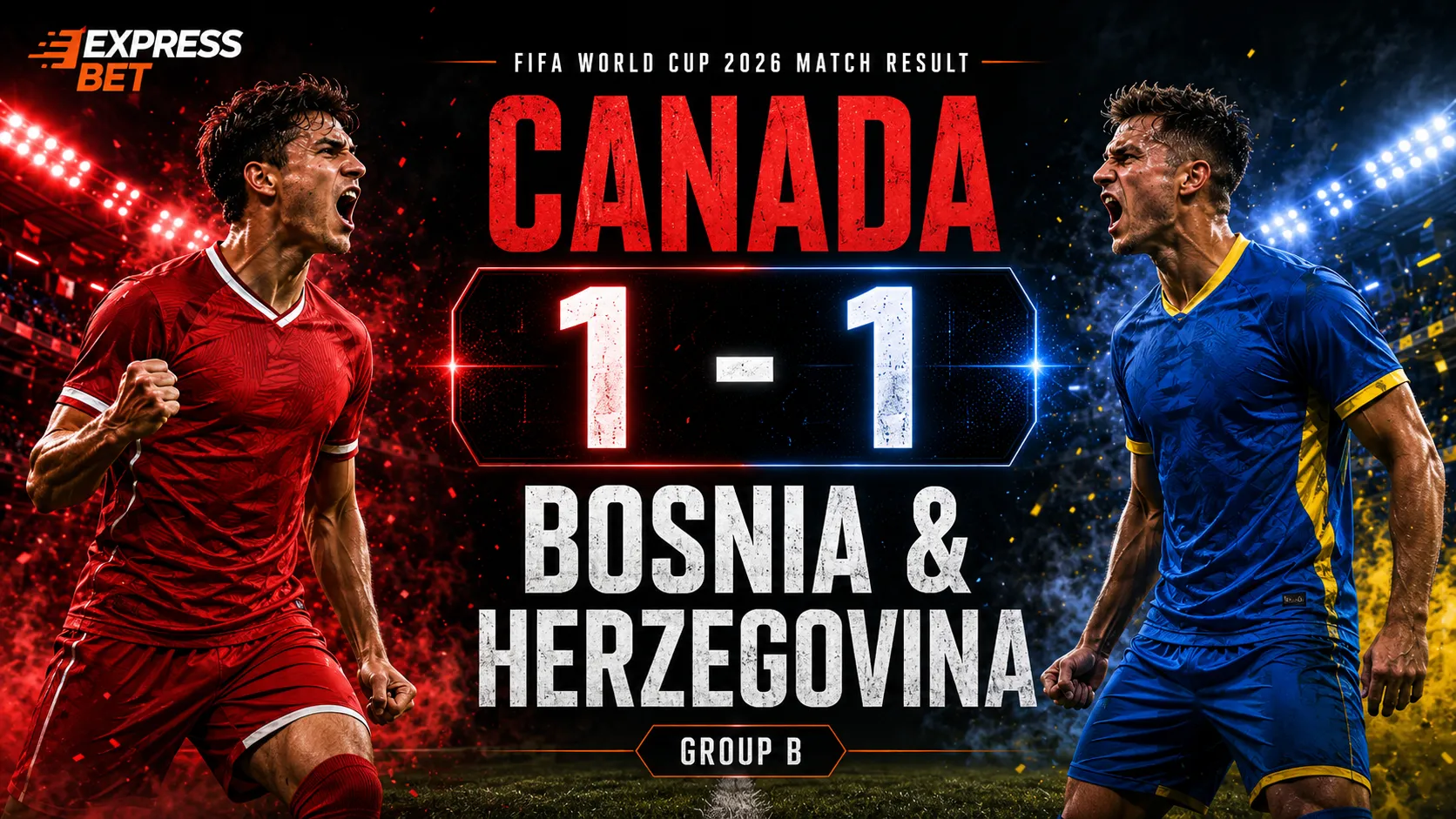
Canada drew 1-1 with Bosnia and Herzegovina in their FIFA World Cup 2026 Group B opener at Toronto Stadium. Jovo Lukic gave Bosnia and Herzegovina the lead in the 21st minute after Sead Kolasinac assisted from a set-piece situation. Canada pushed for most of the match but lacked a clean final touch until Cyle Larin came off the bench and equalised in the 78th minute from Promise David’s assist. The main turning point was Jesse Marsch’s attacking triple substitution after the hour. Ismael Kone was officially named Player of the Match, while Larin became the decisive finisher. The draw gave Canada their first men’s World Cup point. Bettors on the draw and under 2.5 goals were rewarded, depending on market timing and odds.
Match Information
| Detail | Information |
|---|---|
| Match | Canada vs Bosnia and Herzegovina |
| Competition | FIFA World Cup 2026 |
| Stage | Group B, Matchday 1 |
| Date | 12 June 2026 |
| Kickoff time | 15:00 EDT |
| Host country | Canada |
| City | Toronto, Ontario |
| Stadium | Toronto Stadium / BMO Field |
| Final score | Canada 1-1 Bosnia and Herzegovina |
| Half-time score | Canada 0-1 Bosnia and Herzegovina |
| Attendance | 43,002 |
| Referee | Facundo Tello, Argentina |
| VAR | Hernan Mastrangelo, Argentina |
| Canada formation | 4-4-2 |
| Bosnia and Herzegovina formation | 4-4-2 |
| Goals | Jovo Lukic 21’; Cyle Larin 78’ |
| Assists | Sead Kolasinac; Promise David |
| Penalties | None |
| Red cards | None |
| Yellow cards | Canada 2, Bosnia and Herzegovina 3 |
| Weather | Detailed match-time weather not confirmed |
| Pitch condition | No major confirmed pitch controversy |
| Betting result | Draw; under 2.5 goals; both teams to score |
Final Score and Match Summary
The Canada vs Bosnia and Herzegovina match result was 1-1, which is both a fair scoreline and a slightly cruel one for Canada. That is usually how tournament football files its paperwork. Canada had the ball, Canada had the corners, Canada had the noise, Canada had the historical occasion. Bosnia and Herzegovina had the first goal and enough defensive stubbornness to make the afternoon difficult.
This was the first men’s World Cup match played by Canada on home soil. It also became Canada’s first point at a men’s World Cup. That matters. It matters historically, emotionally, and commercially. It also matters because Canadian football has spent years talking about progress. Progress is useful, but the World Cup has a habit of asking for receipts.
Canada started aggressively. Jesse Marsch’s team pressed high, attacked wide, and tried to drag Bosnia’s back line into foot races. The plan made sense. Bosnia’s central defenders had strength and experience, but Canada wanted to test their mobility. The problem was familiar: movement without ruthless finishing becomes theatre with shin pads.
Bosnia and Herzegovina did not need much possession to create danger. Sergej Barbarez’s team were direct, compact, and clearly comfortable defending without glamour. In the 21st minute, they struck from a set-piece pattern. Sead Kolasinac assisted, Jovo Lukic finished, and Toronto Stadium suddenly had that strange tournament silence where a home crowd processes betrayal.
Canada reacted with energy but not enough calm. Jonathan David had earlier forced a save. Tani Oluwaseyi ran hard. Tajon Buchanan attacked on the right. Liam Millar tried to stretch the opposite side. Stephen Eustaquio delivered set pieces. Ismael Kone carried the ball through midfield. Yet the final shot, pass, or touch kept arriving slightly late, slightly heavy, or slightly hopeful.
Bosnia defended with the patience of a side that had no interest in Canada’s national storyline. Nikola Vasilj handled his box. Nikola Katic and Tarik Muharemovic absorbed crosses. Kolasinac produced the match’s defensive highlight with a goal-line clearance in the second half. Bosnia also threatened through Ermedin Demirovic, who forced Maxime Crepeau into work after the break.
The match changed after the hour. Marsch removed Jonathan David, Liam Millar, and Tajon Buchanan. Ali Ahmed, Promise David, and Jacob Shaffelburg entered. It was a bold set of changes. It also looked necessary. Canada needed speed, directness, and a cleaner penalty-box connection.
Then came Cyle Larin. He replaced Oluwaseyi in the 76th minute and scored two minutes later. Promise David provided the assist, Larin turned the chance into a goal, and Canada finally had the equaliser that their pressure had been demanding for nearly an hour.
The closing minutes were loud, tense, and not especially elegant. Canada pushed for a winner. Bosnia held their shape and survived. Katic was booked late. Larin had another shot deep into stoppage time. The match ended level.
Canada did not get the win they wanted. Bosnia did not get the win they briefly held. The table gave both one point. Tournament football, the great accountant, approved the compromise.
Goal Timeline
21’ — Jovo Lukic, Bosnia and Herzegovina, set-piece goal
Bosnia and Herzegovina’s goal came from a corner sequence, the most obvious warning sign in this match. Canada had started with urgency, but Bosnia had already shown that their best route into the game would come from restarts, aerial pressure, and second-ball control.
Ivan Basic took the corner. Sead Kolasinac was credited with the assist. Jovo Lukic finished the move in the 21st minute.
The goal was simple in structure and damaging in effect. Bosnia did not need a long passing move. They did not need to own possession. They needed one delivery, one duel, and one clean reaction inside the area. Canada lost the key moment, and Lukic punished them.
Tactically, the goal confirmed Bosnia’s route into the match. They were not going to outpass Canada through midfield. They were going to defend compactly, slow the rhythm, win fouls, attack set pieces, and make the home team prove they could defend concentration rather than just space.
Emotionally, it changed the room. Toronto Stadium had been waiting for Canada to take the first historic step. Bosnia interrupted the ceremony. Football is rude like that.
78’ — Cyle Larin, Canada, open-play goal
Canada’s equaliser came from the bench and from a move that finally gave the attack what it had been missing: a composed final action.
Cyle Larin had entered in the 76th minute for Tani Oluwaseyi. Less than three minutes later, he scored. Promise David, another substitute, provided the assist. Larin received the ball in the area, adjusted quickly, and finished past Nikola Vasilj.
It was not only a goal. It was a correction. Canada had spent much of the match attacking with energy but without a penalty-box reference who could turn pressure into something cold and decisive. Larin gave them that.
The assist mattered too. Promise David pulled away intelligently, linked the move, and delivered the pass that created the shooting lane. Canada’s substitutions did not merely freshen the team. They produced the goal.
Tactically, the equaliser showed why Marsch changed the front line. Canada needed different movements, not just more of the same. Larin gave them a striker’s economy. Promise David gave them a different connection point. The result was Canada’s first men’s World Cup point.
Key Moments That Changed the Match
Jonathan David’s early chance
Canada’s first major warning came in the 17th minute. Jonathan David found space inside the area after good work from Canada’s wide channels. His effort was on target but too comfortable for Vasilj.
It was a chance that mattered because it defined the first half. Canada could find promising positions. They could arrive in numbers. They could turn Bosnia around. But finishing was not clean enough.
This is the classic trap for attacking teams. A good chance missed early can be dismissed as “settling into the game.” By full-time, it becomes evidence.
Lukic scores from a set piece
The 21st-minute Bosnia goal changed the tactical landscape. Bosnia no longer needed to chase anything. They could defend deeper, slow the match, foul intelligently, and make Canada’s possession feel heavier.
For Canada, conceding first was a test of emotional control. A home opener can carry a team. It can also rush a team into bad decisions. Canada did not collapse, but they did spend long stretches attacking with more speed than precision.
Canada’s corner spell before half-time
Canada generated repeated corners in the first half. Eustaquio delivered them. Bosnia defended them. The sequence gave Canada territory but not a goal.
This mattered because set pieces were supposed to be one of the ways Canada could convert pressure into a high-quality chance. Instead, Bosnia were the team that found the decisive first-half set-piece moment.
Kolasinac’s goal-line clearance
In the 53rd minute, Richie Laryea came close to equalising. His effort beat Vasilj but not Sead Kolasinac, who produced a superb goal-line clearance.
This was one of the match’s defining defensive moments. It was worth almost as much as a goal for Bosnia. Canada had finally broken through the defensive wall, only to find Kolasinac acting as emergency architecture.
Moments like that can change a match’s emotional direction. Canada might have thought the day was cursed. Bosnia might have believed the drawbridge would hold forever. Both were wrong, but only after another 25 minutes of argument.
Marsch’s triple substitution in the 61st minute
Canada changed the match after the hour. Ali Ahmed replaced Tajon Buchanan. Promise David replaced Jonathan David. Jacob Shaffelburg replaced Liam Millar.
The move was aggressive. It was also a clear admission that Canada needed a different attacking texture. The starters had worked hard, but Bosnia had settled into the rhythm of defending them.
Ahmed added directness. Shaffelburg added width and vertical running. Promise David added a new link around the box. The equaliser eventually came through Promise David’s assist.
Cyle Larin enters and scores
Larin came on in the 76th minute. He scored in the 78th.
Some substitutions require detailed analysis. This one can be explained with a striker’s sentence: he entered, he found space, he scored.
That does not make the moment simple. It makes it decisive. Canada had lacked composure in the box. Larin supplied it.
Late stoppage-time pressure
Canada kept pushing after the equaliser. Osorio came on in stoppage time. Larin had another shot at 90+6. Bosnia defended heavily, and Katic received a late yellow card.
The winner never came. Canada had to accept the point. In a group opener, that is not disaster. But with home advantage and superior possession, it also was not the full prize.
First Half Analysis
Canada started in a 4-4-2 shape. Maxime Crepeau was in goal. Alistair Johnston, Luc de Fougerolles, Derek Cornelius, and Richie Laryea formed the back line. Stephen Eustaquio and Ismael Kone handled central midfield, with Tajon Buchanan and Liam Millar working wide. Jonathan David and Tani Oluwaseyi started up front.
Bosnia and Herzegovina also lined up in a 4-4-2. Nikola Vasilj started in goal. Amar Dedic, Nikola Katic, Tarik Muharemovic, and Sead Kolasinac formed the defensive line. Benjamin Tahirovic, Ivan Basic, Amar Memic, and Esmir Bajraktarevic worked across midfield, with Ermedin Demirovic and Jovo Lukic as the forwards.
The mirror formations created direct individual battles. When both teams use a 4-4-2, the match becomes less about structural mystery and more about who wins the duels, who rotates smarter, and who manages the wide channels.
Canada tried to win through tempo. Their full-backs pushed high. Buchanan and Millar stayed wide. Kone carried forward through midfield. Eustaquio looked to switch play and deliver set pieces. Jonathan David dropped and spun, while Oluwaseyi ran behind.
Bosnia’s plan was more compact. They allowed Canada territory in exchange for defensive density. Their two central banks protected the middle. When they regained possession, they looked early toward Demirovic and Lukic or into wide areas for set-piece territory.
Canada’s problem was not access. They had access. They got around the box. They had corners. They had wide crossing positions. Their problem was penalty-box clarity. Too many attacks ended in blocked shots, rushed decisions, or deliveries that Bosnia’s centre-backs could attack comfortably.
Kone was Canada’s best stabiliser. He carried the ball through pressure, used his body well, and helped Canada keep attacks alive. He did not play like a midfielder overwhelmed by the occasion. That matters in a World Cup home opener, where adrenaline often makes the ball feel like it has corners.
Bosnia’s first-half goal came against the broader run of territory but not against the tactical logic of the match. Their set-piece threat was real. Canada gave them the situation, and Bosnia converted it.
The yellow cards also shaped the half. Johnston was booked early. Demirovic and Lukic were booked late in the first half. The match was physical but not wild. Bosnia were prepared to break rhythm. Canada had to avoid confusing speed with control.
At half-time, Canada trailed 1-0 despite having the stronger territorial game. Bosnia led because they had defended with patience and converted the kind of moment they had clearly targeted.
Second Half Analysis
The second half began with immediate danger for Bosnia. Demirovic forced Crepeau into a save shortly after the restart. It was a reminder that Bosnia were not just waiting to be rescued by the final whistle.
Canada then resumed pressure. The most important early second-half moment came in the 53rd minute, when Laryea’s effort was cleared by Kolasinac. It was a brilliant defensive action and a psychological blow to Canada.
Luc de Fougerolles was booked in the same period. Canada had to chase without losing balance. That is difficult. Chasing teams often start defending with fewer players than they think.
Marsch acted after the hour. His triple change shifted Canada’s attacking pattern. Buchanan, Millar, and Jonathan David went off. Ahmed, Shaffelburg, and Promise David came on.
The changes gave Canada more running and less predictability. Ahmed attacked from the right. Shaffelburg offered a left-sided burst. Promise David gave Bosnia a different kind of forward to track. He was less about reputation and more about immediate disruption.
Bosnia also changed. Gigovic and Bazdar entered in the 62nd minute. Sunjic and Alajbegovic followed in the 74th. Burnic replaced Kolasinac in the 83rd after the captain had given an enormous defensive performance.
The game became more open between minutes 60 and 80. Canada had the ball, but Bosnia still had counterattacking moments. Bajraktarevic had a shot on goal in the 68th minute. Bosnia were not pinned so deeply that they had no way out. They were stretched, but not broken.
Then Larin came on. His equaliser came almost instantly. Canada finally had the calm striker’s action they had missed earlier.
After 1-1, the match became an argument over risk. Canada wanted the winner but could not afford to gift Bosnia a transition. Bosnia wanted to survive with a point but still had moments to move forward. The closing minutes were tense rather than controlled.
Canada’s late pressure did not bring a second goal. Bosnia’s defensive line survived. The final whistle confirmed a draw that both teams could justify and neither could fully celebrate.
Tactical Picture: Why the Match Finished Level
This match finished level because Canada won territory, while Bosnia won enough defensive moments to survive.
Canada’s 4-4-2 attacked like a wide, aggressive system. Laryea and Johnston advanced. Buchanan and Millar tried to stretch Bosnia horizontally. Eustaquio and Kone controlled central circulation. Jonathan David and Oluwaseyi tried to pin and threaten the back line.
The issue was the final zone. Canada’s ball progression was better than their box occupation. When crosses arrived, Bosnia had enough size and positioning to deal with them. When Canada tried to combine centrally, the Bosnian block narrowed quickly.
Bosnia defended in a compact 4-4-2 with disciplined distances between midfield and defence. They did not always press high. They preferred to let Canada come forward, then contest the final pass or cross. That can look passive. It was not passive when executed well. It was calculated discomfort.
Bosnia’s attacking plan was based on efficiency. Their set pieces were not accidents. Lukic’s goal, Muharemovic’s later header, and their general aerial pressure all came from a clear understanding that Canada could be tested in dead-ball moments.
Canada’s best tactical change was the use of substitutes. Marsch did not simply replace tired legs. He changed the attack. Promise David gave a better linking action around the penalty area. Larin gave a true penalty-box finisher. Shaffelburg and Ahmed gave vertical width.
Bosnia’s adjustment was more conservative. Their substitutions were designed to preserve energy and maintain compactness. That made sense while leading. After the equaliser, however, they had fewer tools to chase a winner.
The draw was therefore logical. Canada were superior in possession and chance volume. Bosnia were superior in set-piece execution and defensive emergency work. One side had the ball. The other had the first goal and the best clearance. The scoreboard split the difference.
Player Ratings and Individual Performances
These ratings are editorial ratings based on match influence, tactical role, official events, and available match data.
Canada Player Ratings
Maxime Crepeau — 6.5/10
Could not do much about Lukic’s goal. Made an important save from Demirovic early in the second half. Calm enough in distribution.
Alistair Johnston — 6/10
Booked early, which limited his aggression. Still pushed forward and kept working down the right side. Took a shot before half-time.
Luc de Fougerolles — 6/10
Showed composure at times but was booked in the second half. Had to manage Bosnia’s direct play and physical forwards.
Derek Cornelius — 6.5/10
Defended much of the game cleanly. Attacked a late first-half set piece. Canada needed slightly more dominance on the goal concession.
Richie Laryea — 7/10
One of Canada’s most dangerous runners. Nearly scored in the 53rd minute before Kolasinac cleared off the line. Caused problems with his directness.
Tajon Buchanan — 5.5/10
Worked hard and stretched the pitch, but his final product was inconsistent. Replaced in the 61st minute.
Stephen Eustaquio — 6.5/10
Delivered Canada’s set pieces and helped control possession. Did not create enough decisive danger from repeated corners. Substituted in stoppage time.
Ismael Kone — 8/10
Canada’s best all-round performer and officially Player of the Match. Carried the ball, broke lines, and gave Canada midfield authority. His passing into the final third helped sustain pressure.
Liam Millar — 5.5/10
Provided width but could not consistently beat Bosnia’s defensive structure. Replaced as part of the triple change.
Tani Oluwaseyi — 6.5/10
Lively and direct. Made runs that pushed Bosnia back and had attempts at goal. Replaced by Larin, who gave Canada the finishing touch.
Jonathan David — 5.5/10
Had an early chance and another shot on target, but Canada needed more precision from him. His substitution after 61 minutes said plenty.
Ali Ahmed — 6.5/10
Added sharpness on the right after coming on. Helped increase tempo during Canada’s strongest second-half spell.
Promise David — 7.5/10
Changed the attack and assisted Larin’s equaliser. His movement gave Canada a new connection point around the box.
Jacob Shaffelburg — 6.5/10
Gave width and direct running. Helped stretch Bosnia late.
Cyle Larin — 8/10
Entered in the 76th minute and scored in the 78th. That is impact. Canada needed composure, and he supplied it.
Jonathan Osorio — 6/10
Came on in stoppage time to help Canada finish the match with control and one last push.
Bosnia and Herzegovina Player Ratings
Nikola Vasilj — 7/10
Handled a heavy volume of pressure and made important saves. Could not stop Larin’s finish.
Amar Dedic — 6.5/10
Worked hard defensively and helped Bosnia handle Canada’s left-side attacks. Did not always advance, but his defensive discipline mattered.
Nikola Katic — 7/10
Strong in the air and important late. Booked in stoppage time, but his defensive work helped Bosnia survive.
Tarik Muharemovic — 7/10
Made a huge block late and defended the box with discipline. One of Bosnia’s key survival pieces.
Sead Kolasinac — 8/10
Assisted Lukic’s goal and produced the goal-line clearance of the match. Captained the side before leaving injured or physically spent late on.
Benjamin Tahirovic — 6.5/10
Provided midfield work and helped Bosnia compete physically. Had a shot and contributed to the team’s defensive screen.
Ivan Basic — 6.5/10
Delivered set pieces and was involved in the goal sequence. Replaced in the 62nd minute.
Amar Memic — 6/10
Worked hard in midfield and wide areas. Replaced after 74 minutes as Bosnia refreshed the block.
Esmir Bajraktarevic — 6.5/10
Had a shot on goal in the second half and offered an outlet. Replaced after a physically demanding shift.
Ermedin Demirovic — 6/10
Had Bosnia’s best second-half chance but could not convert. Booked late in the first half. Worked hard without always being clean.
Jovo Lukic — 7.5/10
Scored Bosnia’s goal and had two shots on target. Also booked before half-time and substituted after 62 minutes.
Armin Gigovic — 6/10
Entered to add energy in midfield. Helped Bosnia hold shape during Canada’s pressure spell.
Samed Bazdar — 6/10
Replaced Lukic and gave Bosnia fresh forward movement. Limited service.
Ivan Sunjic — 6/10
Added defensive legs late.
Kerim Alajbegovic — 6/10
Took a late corner and helped Bosnia manage the final phase.
Dzenis Burnic — 6/10
Replaced Kolasinac late and helped Bosnia close the match.
Best Players of the Match
Man of the Match: Ismael Kone
Kone was officially named Player of the Match and deserved serious credit. He led Canada’s midfield, carried possession into advanced zones, and kept the home side from becoming frantic.
Best attacker: Cyle Larin
Larin scored the equaliser less than three minutes after entering. There are more complex ways to influence a match. Few are clearer.
Best midfielder: Ismael Kone
He gave Canada control, ball progression, and physical resistance. His performance held the Canadian structure together.
Best defender: Sead Kolasinac
Assist at one end, goal-line clearance at the other. That is a full day’s defensive union work.
Best goalkeeper: Nikola Vasilj
Vasilj faced repeated pressure and helped Bosnia protect their lead for most of the match.
Best substitute: Cyle Larin
The category is not close. He changed Canada’s scoreboard and its mood.
Most underrated performance: Tarik Muharemovic
He dealt with pressure, defended the box, and made a critical late block.
Most disappointing performance: Jonathan David
Not a disaster, but Canada needed more from one of their major attacking names. The 61st-minute substitution was a blunt tactical verdict.
Injuries, Suspensions, Cards, and Discipline
There were no red cards. There were no penalties. There were five yellow cards.
Canada’s bookings went to Alistair Johnston in the 11th minute and Luc de Fougerolles in the 53rd minute. Bosnia’s bookings went to Ermedin Demirovic late in the first half, Jovo Lukic in first-half stoppage time, and Nikola Katic in stoppage time.
Kolasinac left the match late, with Dzenis Burnic replacing him. His physical condition will matter for Bosnia’s next match, because he was one of their most important players in Toronto. He assisted the goal, defended the box, and produced the clearance that preserved the lead before Canada eventually equalised.
Alphonso Davies was on Canada’s bench but did not play. He was still working through return-to-play issues after a hamstring problem, so his availability remains one of Canada’s major tournament questions.
No player was sent off, and no suspension was triggered directly by this match. But yellow-card accumulation will matter later in the group. Johnston and de Fougerolles now need to manage their aggression carefully.
Referee and VAR Analysis
Facundo Tello managed a physical match that never completely lost control. The game had five yellow cards, no red cards, and no penalty.
The most debated moment came in the second half when Tani Oluwaseyi collided with Nikola Vasilj in the Bosnia penalty area. Canada wanted a penalty. The referee did not give one. Available live reporting indicated the decision was allowed to stand, with Vasilj judged to have challenged fairly.
That decision mattered because Canada were chasing the match and the crowd was already operating at full tournament volume. A home crowd always sees contact through a magnifying glass. Referees rarely get that privilege.
The yellow cards were mostly tied to tactical or physical fouls. Johnston’s early booking put Canada’s right side under some caution. Demirovic and Lukic entered the book before half-time. De Fougerolles was booked after the break. Katic received a late yellow for stopping Larin.
VAR did not dominate the match. That is worth noting. In many modern tournaments, VAR can become the third team. Here, the match was decided by a set piece, a goal-line clearance, substitutions, and one composed Canadian finish.
Weather, Stadium, Pitch, and Match Conditions
The match was played at Toronto Stadium, the tournament name for BMO Field, in Toronto, Ontario. The announced attendance was 43,002.
Detailed match-time weather was not confirmed in the available official match data used for this article. No major rain, wind, surface failure, or weather-related incident became central to the match report.
The stadium itself mattered. This was Canada’s first men’s World Cup match on home soil. That made the event bigger than a normal group game. The players were not just managing Bosnia. They were managing a national occasion with football boots on.
Toronto Stadium gave Canada emotional force. It also created pressure. Every misplaced final pass felt heavier because the crowd expected the breakthrough. That kind of atmosphere can lift a team, but it can also rush the final action.
The pitch did not appear to create a major controversy. The match was decided by tactical and technical factors rather than surface problems. Canada moved the ball well enough to dominate possession. Bosnia defended well enough to keep most of that possession outside the most dangerous finishing zones.
Fans and Stadium Atmosphere
The crowd was one of Canada’s best assets.
The opening ceremony, the home setting, and the national significance gave the match a charged atmosphere. Canada’s players clearly fed off it, especially after Larin’s equaliser. Alistair Johnston later credited the crowd for helping pull Canada back into the match.
But the same crowd also made the first hour tense. Canada trailed despite heavy pressure. Every corner carried expectation. Every missed chance added another layer of impatience. It is a strange thing, home advantage. It gives oxygen and demands interest.
Bosnia handled the atmosphere well. They did not look overwhelmed. They scored first, defended stubbornly, and forced Canada to chase. That is not easy in a host nation’s opener.
The loudest moment came with Larin’s goal. It was not just a 1-1 equaliser. It was Canada’s first men’s World Cup point arriving in real time. That gave the goal a historical weight beyond the technical finish.
Historical Context and World Cup Analogies
Canada entered this match still chasing their first men’s World Cup point. Their previous World Cup campaigns had brought effort, visibility, and some good football, but no result in the table. Against Bosnia and Herzegovina, that changed.
The obvious historical echo is Canada’s 2022 performance against Belgium. Canada played with energy and created chances but lost 1-0. That match became a lesson in the difference between playing well and earning something. Against Bosnia, Canada again had spells of pressure and wastefulness, but this time Larin turned the story.
Bosnia and Herzegovina brought their own World Cup history. Their previous appearance came in 2014, when Edin Dzeko was part of a squad that showed flashes of quality but exited in the group stage. In 2026, Dzeko was again part of the group, though not a starter here. His presence still mattered as leadership and tournament memory.
The match itself followed an old World Cup pattern: the host nation attacks, the disciplined visitor scores from a set piece, the crowd gets nervous, and the substitute writes the headline. Football has been recycling this script for decades because audiences keep suffering through it willingly.
This was not a classic. It was not a masterpiece. But it was a proper World Cup match: emotional, imperfect, tactical, and slightly cruel to anyone who expected the story to follow the brochure.
Match Statistics
| Statistic | Canada | Bosnia and Herzegovina |
|---|---|---|
| Final score | 1 | 1 |
| Half-time score | 0 | 1 |
| Ball possession | 61% | 39% |
| Attempts at goal | 13 | 8 |
| Shots on target | 4 | 3 |
| Blocked attempts | 2 | 0 |
| Fouls against | 10 | 20 |
| Corners | 9 | 4 |
| Direct free kicks | 20 | 10 |
| Indirect free kicks | 0 | 1 |
| Penalties | 0/0 | 0/0 |
| Offsides | 1 | 0 |
| Own goals | 0 | 0 |
| Yellow cards | 2 | 3 |
| Red cards | 0 | 0 |
The statistics show Canada’s territorial advantage. They had more possession, more shots, more corners, and more free kicks.
The problem is that possession and pressure do not automatically become clean chances. Canada had 13 attempts, but only four were on target. Bosnia had eight attempts and three on target. That is not a huge difference in shooting efficiency.
Canada’s nine corners are particularly revealing. They had repeated set-piece opportunities but did not score from them. Bosnia scored from one of their own set-piece situations. That is the match in miniature: Canada had volume; Bosnia had execution.
The foul count also tells a story. Bosnia committed 20 fouls against Canada’s 10. That helped break rhythm and gave Canada territory, but it also showed Bosnia’s willingness to manage the match physically. It was not always pretty. It was effective enough.
Betting Result Angle
The Canada vs Bosnia and Herzegovina betting result was useful for post-match analysis because the most obvious pre-match angle did not fully land.
Canada were priced as the favourite in many pre-match markets. They had home advantage, stronger recent momentum, and the emotional force of a historic home World Cup fixture. But the match winner market did not reward Canada backers. The result was a draw.
The draw market landed. Anyone who backed a tight opening game was rewarded. That was not a wild position before kickoff. Group openers often carry tension, and Bosnia had enough defensive structure to make Canada work.
The over/under line was commonly set around 2.5. The match finished with two goals, so under 2.5 landed. This made sense after the first half, where Canada had pressure but not finishing, and Bosnia were content to protect a lead.
Both teams to score landed. Bosnia scored first. Canada equalised late. That market reflected the actual match better than the winner market: one team had set-piece threat, the other had sustained attacking pressure.
Correct score 1-1 landed, but correct-score betting remains high variance. One better Jonathan David finish, one Demirovic goal, one late Larin shot, and the market breaks.
Live betting was more interesting. After Bosnia’s 21st-minute goal, Canada’s price would have drifted, while Bosnia and the draw became more attractive. After Marsch’s substitutions, Canada’s attacking pressure improved. The equaliser was not guaranteed, but the tactical signal was visible: fresh pace, new striker movements, and Bosnia dropping deeper.
The main betting lesson is simple. A favourite can dominate the ball and still fail to win. Home crowd, possession, and corners are not enough if finishing is poor and set-piece defending is loose.
No betting angle is safe. Odds change quickly. Live markets react to goals, cards, substitutions, and momentum. A correct football read does not guarantee a winning bet.
What This Result Means for Group B
Canada and Bosnia and Herzegovina both started Group B with one point.
That is not a disaster for either side. It is also not a comfortable result. In the 48-team World Cup format, the top two teams in each group advance, and the best third-placed teams also have a route through. An opening draw keeps both teams alive but leaves work to do.
Canada’s next match is against Qatar in Vancouver. That now becomes the key test. A win would put Canada in a strong position before the final group match against Switzerland. Another draw would leave them doing arithmetic. A defeat would turn the final match into a problem.
Bosnia and Herzegovina next face Switzerland in Los Angeles. That is a difficult assignment, but they can take confidence from their defensive performance in Toronto. They also need to improve their ball retention. Defending for long spells is possible once. Doing it repeatedly across a group stage is a tiring business.
The wider Group B context is balanced. All four teams were level on one point, one goal scored, and one goal conceded after the opening round. That makes goal difference, discipline, and head-to-head results especially important.
Canada will feel they missed a chance to win. Bosnia will feel they were close to stealing three points. The table does not care about either feeling. It gives both one.
What Canada Did Right
Canada did several things well.
First, they controlled territory. Their 61% possession was not sterile. They pushed Bosnia back, earned corners, and created repeated pressure.
Second, they used wide areas effectively. Laryea was dangerous. Johnston pushed forward. Buchanan and Millar stretched the first phase before the substitutes gave Canada even more directness.
Third, Kone controlled midfield. His ball-carrying and passing helped Canada sustain attacks and prevent Bosnia from settling into long spells of possession.
Fourth, the substitutions worked. Marsch’s changes could have looked desperate. Instead, they gave Canada the equaliser. Promise David assisted. Larin scored. That is the bench doing its job.
Fifth, Canada did not emotionally collapse after going behind. The occasion was huge. The goal against them could have frozen the match. Instead, they kept pushing and found the point.
The main weakness was finishing. Canada cannot rely on late rescue goals every match. They need cleaner first-half decisions and better conversion from corners.
What Bosnia and Herzegovina Got Wrong
Bosnia did a lot right defensively, but the match still exposed problems.
First, they conceded too much territory. A 1-0 lead is useful, but defending that deeply for that long is an invitation to stress. Canada eventually found the goal.
Second, they committed too many fouls. Twenty fouls gave Canada rhythm resets, free kicks, and pressure opportunities. Bosnia survived, but the method was risky.
Third, they did not convert the chance to make it 2-0. Demirovic had a major opportunity early in the second half. A second goal would have changed the match completely.
Fourth, after Lukic went off, Bosnia lost some attacking threat. Bazdar gave energy, but Canada were able to keep the ball higher up the pitch.
Fifth, they did not fully manage the substitute phase. Canada’s bench changed the game. Bosnia’s bench helped preserve the draw but did not restore control.
Still, Bosnia’s result was valuable. Taking a point from a host nation in its home World Cup opener is useful. But the way they lost the lead will bother Barbarez.
Coach Analysis
Jesse Marsch
Jesse Marsch’s starting plan was clear: press, run, stretch Bosnia, and make the match physically uncomfortable.
The plan mostly worked until the final third. Canada won territory and created pressure. But Jonathan David and Oluwaseyi did not produce the goal, and the wide attacks became repetitive before the hour.
Marsch’s best work came with the substitutions. The 61st-minute triple change was aggressive and justified. Ahmed, Promise David, and Shaffelburg shifted the attack’s speed and angles. Larin then came on and scored almost immediately.
The criticism is set-piece defending and finishing structure. Canada conceded from a restart and failed to convert several dead-ball opportunities of their own. That needs work before Qatar.
Sergej Barbarez
Sergej Barbarez set Bosnia up to frustrate Canada, and for long periods that plan worked.
His team were compact, physical, and dangerous from set pieces. Lukic’s goal was not an accident. Bosnia had a clear route to hurt Canada.
Barbarez’s problem was the second-half pressure wave. Bosnia could not keep enough of the ball after the hour. They were forced to defend too close to their own goal, and Canada’s substitutes eventually broke the line.
Replacing Kolasinac late was forced by physical condition, but it removed one of Bosnia’s best defenders. The late phase became survival.
Barbarez will take the point. He will also know that Switzerland will punish passive defending if Bosnia repeat too much of the second half.
Player Milestones and Records
Cyle Larin’s goal was historic because it secured Canada’s first point at a men’s World Cup. It was also a reminder of his value as Canada’s most natural penalty-box finisher.
Ismael Kone being named Player of the Match gave Canada another positive. His performance showed that Canada can compete in midfield at World Cup level, not just through pace and emotion.
Jovo Lukic’s goal was a major personal and national moment for Bosnia and Herzegovina. It gave Bosnia the lead in their first World Cup match since returning to the tournament.
The match itself was historic because it was Canada’s first men’s World Cup game on home soil. The result did not deliver a first win, but it did deliver a first point.
No confirmed youngest scorer, oldest scorer, national scoring record, or appearance record was verified in the available official match data used for this article.
Incidents and Controversies
The main debated incident was the second-half collision between Oluwaseyi and Vasilj. Canada appealed for a penalty. The referee waved play on. The decision stood.
There was no red card, no confirmed disallowed goal, and no penalty. VAR did not become the centre of the match.
Kolasinac’s goal-line clearance was not controversial, but it became the most replayed defensive moment. It looked like Canada had scored. Instead, Bosnia’s captain stretched a leg and turned a goal into a headline.
The late yellow card for Katic was straightforward. He stopped Larin in stoppage time and went into the book.
The biggest “controversy” for Canada may be selection. Larin did not start, then scored almost immediately after entering. That will fuel debate before the Qatar match. Strikers tend to make selection arguments with goals. It is their least polite habit.
Final Verdict
Canada deserved a point. Bosnia and Herzegovina earned one.
That is the cleanest reading of the match. Canada had more of the ball, more shots, more corners, and more pressure. Bosnia had the first goal, the best defensive intervention, and enough structure to survive.
The 1-1 scoreline was fair because Canada were not clinical enough to win and Bosnia were not ambitious enough after scoring to claim full control. Both teams had a case. Neither team had the complete performance.
For Canada, this was history with a warning label. Their first men’s World Cup point is a real achievement. But the match also showed a familiar issue: chance volume without finishing can turn home advantage into frustration.
For Bosnia, the draw was valuable but incomplete. They silenced the home crowd, scored from their strength, defended bravely, and still let the result slip late. That will sting.
For bettors, this was a reminder that the favourite is not always the value. Canada had the better football for long stretches, but the draw and under 2.5 goals were the markets that landed.
Group B remains open. Canada go to Vancouver needing to turn pressure into a win. Bosnia go to Los Angeles needing to prove this was not just one hard-earned defensive point. The World Cup has started. The mathematics have already begun.
Responsible Betting Note
Football betting carries financial risk. A correct tactical analysis does not guarantee a winning bet. Odds change before and during matches, and one goal can completely alter a market. Never chase losses. Do not bet money needed for daily life. Use limits and take breaks. Check local betting laws before gambling. Betting should remain entertainment, not income.
FAQ
Canada drew 1-1 with Bosnia and Herzegovina in their FIFA World Cup 2026 Group B opener.
Jovo Lukic scored for Bosnia and Herzegovina in the 21st minute. Cyle Larin equalised for Canada in the 78th minute.
Ismael Kone was officially named Player of the Match. Cyle Larin was Canada’s most decisive substitute after scoring the equaliser.
Both teams earned one point. Canada next face Qatar, while Bosnia and Herzegovina face Switzerland. The group remains wide open.
The draw market landed. Under 2.5 goals landed because the match finished with two goals. Both teams to score also landed.
[expert_review params=»JTdCJTIyY29sb3IlMjIlM0ElMjJncmVlbi0yJTIyJTJDJTIyZXhwZXJ0X2F2YXRhciUyMiUzQSUyMiUyMiUyQyUyMmV4cGVydF9uYW1lJTIyJTNBJTIyJTIyJTJDJTIyZXhwZXJ0X2xpbmslMjIlM0ElMjIlMjIlMkMlMjJleHBlcnRfaWQlMjIlM0ElMjIxJTIyJTJDJTIyZXhwZXJ0X3R5cGUlMjIlM0ElMjJleHBlcnRfaWQlMjIlMkMlMjJleHBlcnRfYXZhdGFyX2FsdCUyMiUzQSUyMiUyMiUyQyUyMmV4cGVydF9zaG93JTIyJTNBMSUyQyUyMmV4cGVydF9kZXNjcmlwdGlvbiUyMiUzQSUyMlNwb3J0cyUyMEJldHRpbmclMjBBbmFseXN0JTIwJTI2JTIwRWRpdG9yaWFsJTIwQ29udHJpYnV0b3IlMjIlMkMlMjJleHBlcnRfc2hvd19idXR0b24lMjIlM0ExJTJDJTIyZXhwZXJ0X3Nob3dfYnV0dG9uX3R5cGUlMjIlM0ElMjJwb3B1cCUyMiUyQyUyMmV4cGVydF9xdWVzdGlvbl9idXR0b25fdGV4dCUyMiUzQSUyMkFzayUyMFF1ZXN0aW9uJTIyJTJDJTIycXVlc3Rpb25fZXh0ZXJuYWxfbGluayUyMiUzQSUyMiUyMiUyQyUyMnBvcHVwX3VzZV9waG9uZSUyMiUzQTAlMkMlMjJleHBlcnRfdGl0bGUlMjIlM0ElMjJBdXRob3IlMjIlMkMlMjJleHBlcnRfc2hvd190aXRsZSUyMiUzQTElMkMlMjJleHBlcnRfdGV4dCUyMiUzQSUyMkFsZXglMjBNb3JnYW4lMjBpcyUyMGElMjBzcG9ydHMlMjBiZXR0aW5nJTIwYW5hbHlzdCUyMGFuZCUyMGVkaXRvcmlhbCUyMGNvbnRyaWJ1dG9yJTIwd2hvJTIwd3JpdGVzJTIwZGV0YWlsZWQlMjBib29rbWFrZXIlMjByZXZpZXdzJTJDJTIwYmV0dGluZyUyMGd1aWRlcyUyQyUyMHBsYXRmb3JtJTIwY29tcGFyaXNvbnMlMkMlMjBhbmQlMjByZXNwb25zaWJsZSUyMGdhbWJsaW5nJTIwZXhwbGFpbmVycy4lMjBIaXMlMjB3b3JrJTIwZm9jdXNlcyUyMG9uJTIwcHJhY3RpY2FsJTIwaW5mb3JtYXRpb24lMjBmb3IlMjB1c2VycyUyMHdobyUyMHdhbnQlMjB0byUyMHVuZGVyc3RhbmQlMjBob3clMjBiZXR0aW5nJTIwc2l0ZXMlMjBvcGVyYXRlJTIwYmVmb3JlJTIwdGhleSUyMHJlZ2lzdGVyJTJDJTIwZGVwb3NpdCUyQyUyMG9yJTIwY2xhaW0lMjBhJTIwYm9udXMuJTIyJTJDJTIycWElMjIlM0ElNUIlNUQlMkMlMjJxYV9zaG93X3RpdGxlJTIyJTNBMSUyQyUyMnFhX3RpdGxlJTIyJTNBJTIyJUQwJTkyJUQwJUJFJUQwJUJGJUQxJTgwJUQwJUJFJUQxJTgxJTIwJUQxJThEJUQwJUJBJUQxJTgxJUQwJUJGJUQwJUI1JUQxJTgwJUQxJTgyJUQxJTgzJTIyJTJDJTIyc2NvcmUlMjIlM0ElNUIlNUQlMkMlMjJzY29yZV9zdW1tYXJ5X3RleHQlMjIlM0ElMjIlMjIlMkMlMjJzY29yZV9zdW1tYXJ5X2F2ZXJhZ2UlMjIlM0EwJTJDJTIyc2NvcmVfbWF4JTIyJTNBJTIyNSUyMiUyQyUyMnNjb3JlX3N5bWJvbCUyMiUzQSUyMiUyMiUyQyUyMnNjb3JlX3RpdGxlJTIyJTNBJTIyJTIyJTJDJTIyc2NvcmVfc2hvd190aXRsZSUyMiUzQTAlMkMlMjJwbHVzZXMlMjIlM0ElNUIlNUQlMkMlMjJtaW51c2VzJTIyJTNBJTVCJTVEJTJDJTIycGx1c2VzX21pbnVzZXNfc2hvd190aXRsZSUyMiUzQTElMkMlMjJwbHVzZXNfbWludXNlc190aXRsZSUyMiUzQSUyMiVEMCU5RiVEMCVCQiVEMSU4RSVEMSU4MSVEMSU4QiUyMCVEMCVCOCUyMCVEMCVCQyVEMCVCOCVEMCVCRCVEMSU4MyVEMSU4MSVEMSU4QiUyMiUyQyUyMnBsdXNlc190aXRsZSUyMiUzQSUyMiUyMiUyQyUyMm1pbnVzZXNfdGl0bGUlMjIlM0ElMjIlMjIlN0Q=»]