
Canada vs Morocco Match Result
Table of Contents Show
Views 5
TL;DR: Canada vs Morocco Match Result
Morocco beat Canada 3–0 in the FIFA World Cup 2026 Round of 16 at Houston Stadium. Canada produced the more aggressive first half, but the match was goalless at the interval. Azzedine Ounahi changed it with a rehearsed free-kick finish in the 50th minute and added a second after a Moroccan counterattack in the 82nd. Substitute Soufiane Rahimi scored at 90+8, with Brahim Díaz completing a two-assist performance.
Ounahi was the best player. Morocco’s half-time adjustment, set-piece execution and transition efficiency decided the contest. The reported outdoor heat was largely neutralised by Houston’s climate-controlled stadium. Morocco advanced to face France in the quarter-finals; Canada were eliminated. Morocco won the match-winner, over-2.5-goals and both-teams-to-score “No” outcomes, although every betting result depends on the selected odds and market timing.
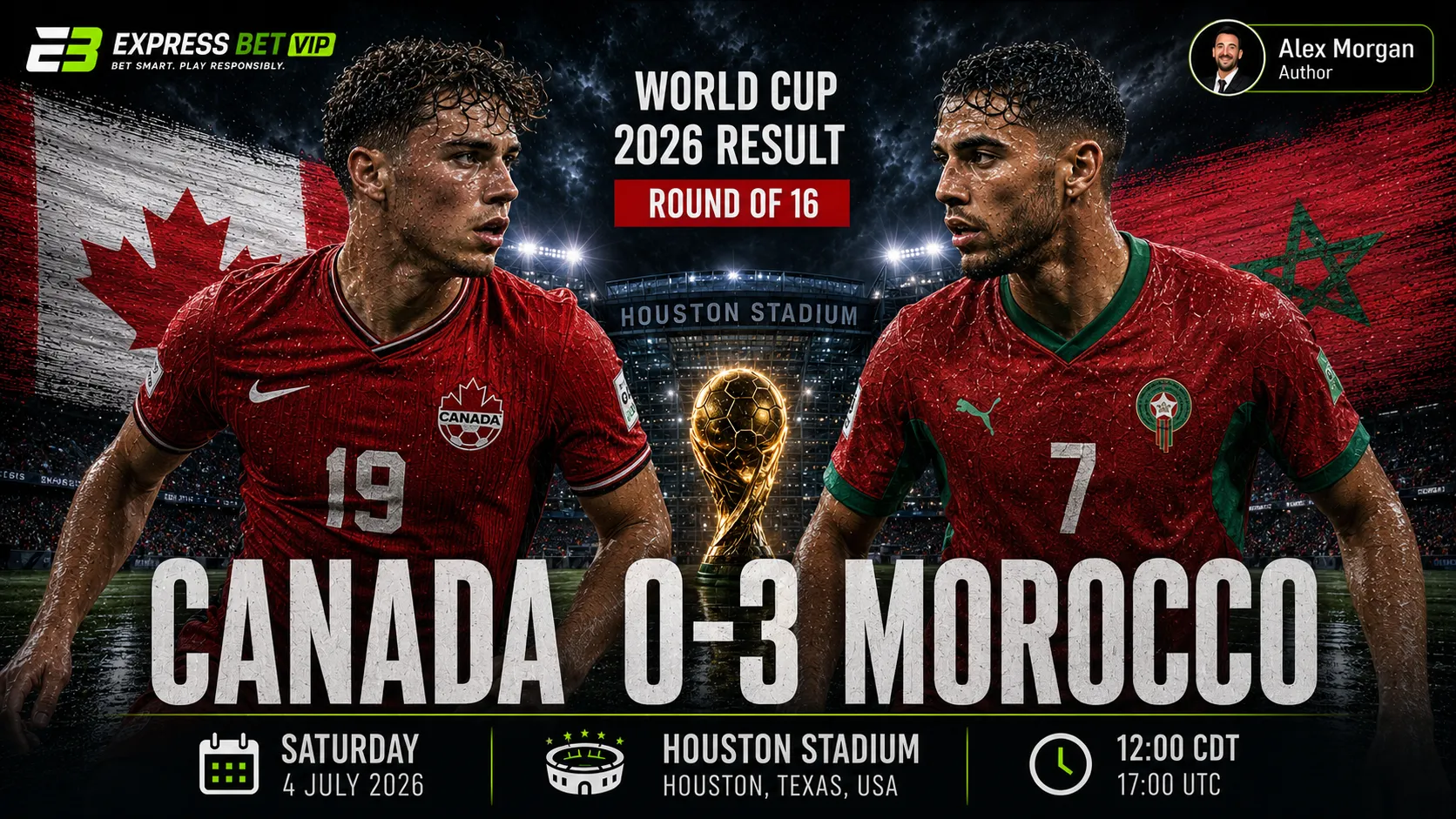
Quick Facts: Final Score, Goals, Venue, and Match Status
| Match detail | Verified information |
|---|---|
| Match | Canada vs Morocco |
| Competition | FIFA World Cup 2026 |
| Stage | Round of 16 |
| Date | July 4, 2026 |
| Kickoff | 12:00 local time; 17:00 UTC |
| Host country | United States |
| City | Houston, Texas |
| Stadium | Houston Stadium, commonly known as NRG Stadium |
| Attendance | 68,777 |
| Final score | Canada 0–3 Morocco |
| Half-time score | 0–0 |
| Goals | Ounahi 50’, 82’; Rahimi 90+8’ |
| Assists | Hakimi for the opener; Díaz for the second and third goals |
| Referee | Michael Oliver |
| VAR | Complete official VAR assignment not confirmed from the public data reviewed |
| Weather | Approximately 35°C outside; match staged indoors in a climate-controlled stadium |
| Surface | Grass |
| Pitch condition | No decisive surface problem was documented in the sources reviewed |
| Main impact | Morocco advanced; Canada were eliminated |
The FIFA Match Centre confirms the score and all three goal times. ESPN reports the attendance and Michael Oliver’s appointment.
Verified Facts vs Analysis
| Category | Finding | Status |
|---|---|---|
| Final score and scorers | Canada 0–3 Morocco; Ounahi twice, Rahimi once | [CONFIRMED] |
| Half-time score | 0–0 | [CONFIRMED] |
| Attendance | 68,777 | [REPORTED] by reliable match-data providers |
| Stadium format | Retractable-roof, climate-controlled venue | [CONFIRMED] |
| Match environment | Played indoors, limiting direct outdoor heat exposure | [REPORTED] |
| First-half pattern | Canada pressed well and created the stronger early threat | [OBSERVED] and supported by multiple reports |
| Decisive tactical change | Ounahi operated higher and Morocco attacked transitions more directly after half-time | [ANALYSIS], supported by Ouahbi’s explanation |
| xG | Provider totals differed slightly | [DISPUTED] |
| Eight yellow cards | Reported by local Houston coverage | [REPORTED] |
| Complete card list | Not available from verified public data reviewed | [UNKNOWN] |
| Closing odds | Not available from a sufficiently reliable archived source | [UNKNOWN] |
| Betting interpretation | Morocco win, over 2.5 and BTTS No were winning outcomes | [MARKET SIGNAL] based on final settlement |
This distinction matters because an event and its interpretation are not the same thing. Ounahi scoring in the 50th minute is a fact. Morocco deliberately allowing Canada harmless possession is an analytical conclusion that must be supported by the match pattern. Keeping those categories separate improves reader trust and reduces the risk of search systems extracting opinion as official data.
Final Score and Match Summary
The bare Canada vs Morocco final score suggests a comfortable Moroccan afternoon. The football was less tidy.
Canada began with courage, aggression and enough pressure to make Morocco uncomfortable. Jesse Marsch’s side pushed their wide midfielders forward, challenged Morocco’s first pass and prevented the Atlas Lions from settling into their preferred possession rhythm. Reuters reported that Morocco did not register their first attempt until the 28th minute.
That opening phase mattered. It showed that Canada were not overwhelmed by the occasion, even without a fully fit Alphonso Davies in the starting side. Tani Oluwaseyi gave Morocco’s centre-backs an awkward physical assignment, while Ali Ahmed and Tajon Buchanan attacked from the flanks.
The problem was familiar: Canada’s good work stopped short of a goal. Their pressure generated territory and several threatening situations, but not the clinical finish required in a knockout match.
Morocco survived the first half at 0–0. In tournament football, survival can be a tactical achievement rather than an aesthetic one. Half-time then gave Mohamed Ouahbi’s staff an opportunity to correct the distances around Ounahi and Brahim Díaz.
Five minutes after the restart, Morocco scored from a prepared free-kick routine. Achraf Hakimi rolled the ball toward Ounahi at the edge of the area, and the midfielder finished low. Canada’s energetic first half had purchased no scoreboard protection; Morocco’s first decisive move after the interval purchased the lead.
Canada then had to expand their attacking shape. That created the kind of transition spaces Morocco had been missing. Díaz found Ounahi during a quick break in the 82nd minute, and the second goal effectively ended the contest. Rahimi’s finish at 90+8 made the margin emphatic.
Was the victory deserved? Yes. Morocco defended the difficult periods, improved tactically and finished with elite efficiency.
Did 3–0 perfectly describe the balance of chances? Probably not. FotMob’s post-match analysis gave Canada a narrow expected-goals advantage, 0.86 to 0.78, while ESPN’s model recorded slightly different figures. Three goals from a sub-1.0 xG total is not sustained domination; it is ruthless execution.
The scoreboard was accurate. Its tone was a little severe.
Goal Timeline
50’ — Azzedine Ounahi, Morocco, rehearsed set-piece goal
Morocco’s opener came from a cleverly designed free kick on the right. Hakimi shaped as though he might deliver into the penalty area but instead played a short, controlled pass toward Ounahi near the edge of the box.
The routine altered Canada’s defensive reference points. Players expecting an aerial delivery began moving toward the goal area, leaving Ounahi with the fraction of space required to strike low.
His finish beat Maxime Crépeau and turned a balanced knockout match into a chase.
There was no publicly documented VAR reversal or prolonged intervention. The tactical meaning was more important: Morocco had found a way to avoid Canada’s open-play pressure by using a dead-ball situation. Set pieces are football’s legal method of briefly stopping the opposition from pressing.
82’ — Azzedine Ounahi, Morocco, counterattacking goal
Canada’s search for an equaliser widened the spaces behind their midfield. Morocco recovered possession and accelerated before the Canadian defensive structure could reset.
Díaz carried the creative responsibility and released Ounahi, who had again moved into a more advanced scoring position. The midfielder finished the transition for his second goal.
The sequence reflected Ouahbi’s tactical adjustment. Ounahi was no longer operating mainly as a connective midfielder. He was arriving where a second striker might normally appear.
This was the decisive goal emotionally and tactically. Canada still had time after 1–0. At 2–0, they needed a recovery bordering on the unreasonable.
90+8’ — Soufiane Rahimi, Morocco, transition goal
Rahimi, introduced after Ismael Saibari’s injury, scored Morocco’s third deep into added time. Díaz again supplied the final pass, giving him two assists.
Canada were committed forward and unable to rebuild their defensive rest structure. Rahimi attacked the available space and finished beyond Crépeau.
The goal rewarded Morocco’s bench and completed a clinical second half. It also moved the match over 2.5 total goals at the latest possible stage, a reminder that betting markets remain alive until the referee actually ends the match.
Key Moments That Changed the Match
Canada’s first-half pressure
Canada’s pressing prevented Morocco from circulating the ball comfortably. Morocco’s lack of an attempt until the 28th minute was evidence that the approach worked.
The missing element was a goal. Knockout matches are not awarded on the artistic merit of the press.
Oluwaseyi’s threat without a finish
Oluwaseyi caused problems through running power and direct movement. Canada created situations around him, but Bounou and Morocco’s defensive line survived.
Had Canada converted one of those early openings, Morocco would have been forced to build against a set defence rather than attack transition space.
Saibari’s injury
Saibari left the match with a reported thigh problem. Rahimi replaced him and later scored. The substitution therefore changed both Morocco’s attacking reference and the identity of the final goalscorer.
The injury’s longer-term significance was more serious: Morocco faced a quarter-final only five days later.
Morocco’s half-time correction
Ouahbi said his staff used half-time analysis to make adjustments and move Ounahi into positions from which he could break Canada’s lines. The result was immediate.
Morocco became more compact around the ball and more direct once possession was recovered. Ounahi’s positioning was the central change.
The 50th-minute free-kick routine
This was the match’s main turning point. Canada had been the more proactive team but conceded from a prepared action five minutes after half-time.
The lead allowed Morocco to protect central space and wait for Canada to take greater risks.
Ounahi’s second goal
The 82nd-minute counterattack converted tactical control into scoreboard security. Canada’s comeback probability collapsed, while Morocco could manage the remaining minutes without chasing possession.
Rahimi’s stoppage-time goal
The third was not needed for qualification, but it affected the correct-score and goal-total markets. It also made Morocco’s performance look more dominant statistically than much of the match had been.
Local Match Conditions: Stadium, City, Weather, Pitch, and Crowd
| Local factor | Verified or observed detail | Football meaning | Direct evidence | Betting meaning | Status | Fixture-specific? |
|---|---|---|---|---|---|---|
| City | Houston, Texas | Severe July heat was a pre-match concern | Outdoor temperature reported near 35°C | Could influence public expectations about tempo | [REPORTED] | Yes |
| Stadium | Houston Stadium/NRG Stadium | Climate control reduced exposure to outdoor heat | Match reported as played indoors | Weakened simplistic “heat means under” assumptions | [REPORTED] | Yes |
| Attendance | 68,777 | Large crowd increased knockout-match pressure | Attendance recorded by ESPN/FotMob | No reliable direct market effect | [REPORTED] | Yes |
| Capacity | Approximately 71,000 in tournament configuration | Venue was close to full | Attendance represented roughly 97% capacity | Possible emotional effect, not a standalone betting edge | [ANALYSIS] | Yes |
| Surface | Grass | Supported normal passing and set-piece execution | No major surface complaints documented | No evidence for a pitch-based market adjustment | [CONFIRMED] | Partly |
| Crowd profile | Visible Canadian and Moroccan support; organised Canadian march and special Moroccan supporter flights reported | Both teams had substantial backing | Local Houston reporting | Reduced the idea of a simple Canadian home-crowd advantage | [REPORTED] | Yes |
| Cards | Eight yellows reported | Physical knockout pressure and referee management became relevant | Houston Chronicle report | Higher-card positions were rewarded | [REPORTED] | Yes |
| Houston finale | Final tournament match staged in Houston | Increased local ceremonial significance | Local reporting | No direct predictive value | [REPORTED] | Yes |
Houston’s outdoor conditions invited an obvious pre-match theory: heat would drain repeated pressing and produce a slower game. The stadium complicated that theory. AccuWeather later described Morocco’s match as being played indoors in a climate-controlled environment, giving the teams relief from Houston’s heat and humidity.
That distinction matters. An outdoor reading of approximately 35°C does not mean the players competed in 35°C air. The exact internal temperature and the detailed roof-operation record were not available from verified public data, but the indoor setting materially reduced direct sun, wind and heat exposure.
Canada maintained an aggressive press during the opening half. That is practical evidence against claiming that Houston’s outdoor climate immediately suppressed their intensity. Their decline after Morocco scored is better explained by game state and expanding tactical risk than by temperature alone.
No repeated slips, abnormal bounce or goalkeeper-handling problem was prominent in the reports reviewed. The available evidence therefore does not justify presenting the grass surface as a decisive factor.
The crowd was locally distinctive. Canadian supporters organised a march and tailgate, while Moroccan fans arrived in significant numbers, including through 12 reported special flights. Morocco did not face the one-sided away environment sometimes implied by Canada’s co-host status.
Stadium-Specific Match Impact
| Stadium factor | Canada vs Morocco detail |
|---|---|
| Stadium | Houston Stadium, commonly known as NRG Stadium |
| Capacity | Approximately 71,054 in tournament configuration |
| Attendance | 68,777 |
| Pitch type | Grass |
| Roof status | Match reported as played indoors; precise operational log not reviewed |
| Acoustic effect | Strong support for both teams was visible; measurable communication impact not confirmed |
| Surface condition | No decisive defect reported |
| Wind relevance | Greatly reduced by the enclosed venue |
| Goalkeeper distribution | No verified stadium-specific effect |
| Set-piece effect | Ounahi’s opener came from a rehearsed routine, not from wind or an irregular surface |
| Communication effect | Possible in a near-capacity crowd, but not established by verified evidence |
| Data status | Capacity, attendance and surface reported; internal climate data unavailable |
The stadium’s clearest influence was subtractive: it prevented Houston’s severe outdoor conditions from becoming the central physical story.
That allowed Canada to press hard during the first half and enabled both teams to play a tactically recognisable match. Long passes were not visibly being redirected by wind, and set-piece delivery was not compromised by rain.
The acoustic environment may have made communication more difficult, particularly during defensive set pieces. However, it would be speculative to blame Canada’s organisation for the first goal on crowd noise. Morocco’s deception and Ounahi’s execution provide a cleaner explanation.
Beyond climate protection and the pressure of a 68,777 crowd, the available match evidence does not show a clear stadium-specific effect beyond normal venue conditions.
City and Weather Impact
| Category | Detail |
|---|---|
| City | Houston |
| Host country | United States |
| Time zone | Central Daylight Time, UTC−5 |
| July climate | Typically hot and humid |
| Outdoor temperature | Approximately 35°C reported |
| Humidity | Not available from verified match-specific public data |
| Wind | Not available from verified match-specific public data |
| Rain/sun | Direct playing impact limited by the enclosed stadium |
| Altitude | Low altitude; no meaningful altitude effect |
| Likely physical effect | Reduced because of climate control |
| Actual match evidence | Canada sustained an intense first-half press; no documented heat stoppage or widespread cramping |
| Data status | Outdoor temperature reported; indoor measurements unavailable |
The match evidence does not support a strong weather-based explanation for the result. Canada’s pressing intensity was highest before half-time, when their physical plan worked well. Morocco improved after the interval because of positioning and decision-making, not because Houston suddenly changed climate.
Saibari’s thigh injury may have had a muscular cause, but no verified medical information linked it to temperature, humidity or the surface. It should not be labelled a heat injury.
There was also no clear wind effect on long passing or goalkeeper distribution. The free-kick opener was a short routine, which largely removed environmental variables from the delivery.
For betting analysis, the lesson is useful: the city forecast and the actual playing environment were not identical. Treating Houston’s outdoor heat as automatic evidence for a low total would have ignored the stadium.
First Half Analysis
Canada started in a 4-4-2, with Jonathan David and Oluwaseyi forming the first pressing line. Behind them, Buchanan and Ahmed could advance toward Morocco’s full-backs, while Eustáquio and Niko Sigur worked to close central passing lanes.
Morocco used a nominal 4-2-3-1. El Aynaoui and Bouaddi formed the double pivot, with Díaz, Ounahi and El Khannouss behind Saibari. Hakimi and Mazraoui supplied potential width from full-back.
Canada’s objective was to prevent the Moroccan double pivot from receiving cleanly on the half-turn. David and Oluwaseyi curved their runs to guide possession toward the touchline. Once the pass travelled wide, Canada increased pressure.
That structure disrupted Morocco’s normal rhythm. The Atlas Lions were often forced backward or into longer distribution before their attackers had established good positions. Morocco’s first attempt did not arrive until the 28th minute.
Canada’s full-backs also stepped forward with conviction. Johnston supported Buchanan on the right, while Laryea’s movement on the opposite side helped Ahmed attack narrower spaces. The cost was transition exposure, but Morocco did not exploit it consistently before half-time.
The central duel belonged largely to Canada. Eustáquio directed pressure and circulated possession, while Sigur protected against counters. Canada were not simply running; they were pressing with a plan.
Their limitation appeared around the penalty area. Morocco’s centre-backs defended the box, Bounou remained composed and Canada struggled to turn promising entries into clear, high-value finishes.
The physical tone became increasingly severe. Six of the match’s reported eight yellow cards came during the first half according to contemporary reports. That interrupted rhythm and forced several players to manage their tackling more carefully.
At half-time the score was 0–0. Marsch needed greater composure in the final action. Ouahbi needed to improve Morocco’s first pass, compress the midfield distances and place Ounahi closer to goal.
Ouahbi’s correction proved more decisive.
Second Half Analysis
Morocco emerged with a narrower, more connected attacking structure. Ounahi played higher, finding pockets beyond Canada’s midfield rather than remaining involved only in early circulation.
The opening goal arrived too soon for Canada to evaluate the change gradually. Morocco’s set-piece routine attacked a moment of defensive expectation: Canada prepared for a cross, Hakimi played short and Ounahi struck.
Once behind, Canada could no longer maintain the same balance between pressure and protection. Their full-backs advanced, the midfield had to support attacks earlier, and the space behind the first counterpress increased.
Morocco did not need to dominate possession. Their task became selecting when to accelerate. Díaz was important because he could carry or release the ball before Canada reconstructed their block.
Canada continued to compete and did not simply disappear. Yet much of their second-half pressure became less dangerous as Morocco defended the centre. Possession near the box is not the same as penetration inside it, however similar the television camera angle may look.
The 82nd-minute goal was the tactical bill arriving. Canada lost their structure while attacking, Díaz advanced the transition and Ounahi appeared in a scorer’s position.
Rahimi’s introduction gave Morocco fresher running through the centre. His stoppage-time goal was produced against a Canadian side committed forward and emotionally drained.
Morocco therefore did more than protect 1–0. They continued attacking the spaces created by the scoreline and converted two of those opportunities.
Tactical Picture: Why the Match Was Won and Lost
The starting formations were 4-4-2 against 4-2-3-1, but the key contest involved position rather than notation.
Canada’s 4-4-2 press initially placed Morocco’s double pivot under pressure. David and Oluwaseyi screened central access, and the wide midfielders jumped toward the full-backs. Morocco struggled to connect the first and second phases of possession.
Canada’s defensive line supported that aggression by holding relatively high. Bombito’s recovery pace was important because Hakimi, Díaz and Saibari posed a threat if Morocco escaped.
The system worked until the penalty area. Canada created more pressure than clean finishing opportunities. Their attacks needed either a sharper final pass or more efficient occupation of the six-yard area.
Morocco’s solution was to move Ounahi higher and simplify the route forward. Instead of asking him to help control every possession, Ouahbi used his timing between Canada’s midfield and defence.
The free-kick opener bypassed the pressing contest entirely. After that, game state performed part of Morocco’s tactical work. Canada had to open; Morocco could counter.
Díaz’s role became clearer as space increased. He was not required to control the whole match. He was required to make the correct pass when Canada’s defensive distances stretched. He did that twice.
Morocco’s transition defence also deserves credit. Hakimi and Mazraoui could not both attack recklessly, and the double pivot protected the centre. When Canada reached wide zones, Moroccan defenders generally prevented an uncontested final action.
The main difference was efficiency. Canada’s plan created a competitive game. Morocco’s adjustment created goals.
Tactical Collision Map
| Zone | Edge | Evidence | Key player | Local effect | Result impact |
|---|---|---|---|---|---|
| Canada’s left/Morocco’s right | Balanced | Ahmed and Laryea advanced; Hakimi still created the first goal | Hakimi | No clear effect | Assist for 1–0 |
| Canada’s right/Morocco’s left | Canada early | Buchanan and Johnston supported the press | Buchanan | Indoor conditions supported pressing | Early territorial pressure |
| Central midfield | Canada first half; Morocco second | Canada disrupted the pivot before Ounahi moved higher | Ounahi | No verified local effect | Decisive after half-time |
| Penalty box | Morocco | Better finishing and stronger defensive control | Bounou/Ounahi | Surface normal | Three-goal difference |
| Set pieces | Morocco | Prepared routine produced opener | Hakimi | No wind interference | Main turning point |
| Transitions | Morocco | Second and third goals followed exposed game states | Díaz | Climate not decisive | Secured result |
| Defensive third | Morocco | Canada’s pressure was not converted | Diop, Halhal | Crowd pressure managed | Clean sheet |
| Goalkeeper build-up | Canada press early | Morocco struggled to exit cleanly | Crépeau/Bounou | Enclosed venue reduced wind | No first-half goal |
| Bench impact | Morocco | Rahimi replaced injured Saibari and scored | Rahimi | No confirmed local effect | 3–0 |
Player Ratings and Individual Performances
Ratings are editorial assessments based on tactical influence, execution and decision-making rather than official FIFA grades.
Canada Player Ratings
- Maxime Crépeau — 5.5: Faced four reported shots on target and conceded three. The finishes gave him limited margin, although the final score will inevitably sit beside his name.
- Alistair Johnston — 6.0: Supported the press and advanced well in the first half. Space appeared behind him once Canada chased the game.
- Moïse Bombito — 6.5: His recovery speed helped Canada hold an aggressive line. The late transitions eventually became too open for any centre-back to manage alone.
- Luc De Fougerolles — 6.0: Competitive in direct duels and generally steady before Morocco accelerated after half-time.
- Richie Laryea — 6.5: Added width and energy. He was part of Canada’s strong opening but had increasing defensive ground to cover.
- Tajon Buchanan — 6.5: Pressed with intent and carried the ball directly. Final production did not match his involvement.
- Niko Sigur — 6.0: Protected central areas in the opening half but found the spaces larger after Canada conceded.
- Stephen Eustáquio — 6.5: Canada’s organiser. Helped control the early midfield battle but could not generate the decisive final pass.
- Ali Ahmed — 6.5: Positive movement and ball carrying troubled Morocco’s right side. His work deserved more attacking reward.
- Jonathan David — 5.5: Contributed to the pressing structure but had too little influence as a finisher.
- Tani Oluwaseyi — 6.5: Canada’s most persistent physical threat. Created discomfort but did not convert his opportunities.
- Substitutes — not individually rated: The complete verified substitution log and playing-time breakdown were not available from the public sources reviewed. No substitute changed Canada’s attacking outcome.
Morocco Player Ratings
- Yassine Bounou — 7.5: Made the necessary saves and gave Morocco stability during Canada’s strongest phase.
- Achraf Hakimi — 7.5: Supplied the intelligent short pass for Ounahi’s opener and managed an active Canadian left side.
- Issa Diop — 7.0: Strong inside the box and disciplined during Canada’s early pressure.
- Redouane Halhal — 7.0: Helped protect central areas and preserve the clean sheet.
- Noussair Mazraoui — 7.0: Balanced defensive responsibility with support in possession.
- Neil El Aynaoui — 7.0: Endured a difficult first half before contributing to Morocco’s improved control.
- Ayyoub Bouaddi — 7.0: Worked through Canada’s pressure and protected transitions more effectively after the break.
- Brahim Díaz — 8.5: Two assists, intelligent transitional decisions and valuable defensive work. He did not need a goal to shape the result.
- Azzedine Ounahi — 9.0: Two finishes from two different tactical situations. His advanced second-half role decided the match.
- Bilal El Khannouss — 6.5: Had limited influence during Morocco’s difficult start but supported the improved second-half structure.
- Ismael Saibari — 6.0: Worked through a challenging opening before leaving with a thigh injury.
- Soufiane Rahimi — 7.5: Entered unexpectedly, stretched Canada’s defence and scored the third goal.
- Other substitutes — not individually rated: Verified playing-time detail was insufficient for fair ratings.
Best Players of the Match
- Man of the Match: Azzedine Ounahi. Two goals transformed a match Morocco had not controlled in the first half.
- Best attacker: Brahim Díaz. His two assists were products of awareness rather than hopeful passing.
- Best midfielder: Ounahi. The position change after half-time unlocked his scoring influence.
- Best defender: Issa Diop. Helped Morocco survive Canada’s best spell and protected the penalty area.
- Best goalkeeper: Yassine Bounou. His first-half security preserved the platform for Morocco’s recovery.
- Best substitute: Soufiane Rahimi. Replaced the injured Saibari and scored in stoppage time.
- Most underrated performance: Moïse Bombito. Canada’s aggressive defensive height depended on his pace.
- Most disappointing performance: Jonathan David. His pressing was useful, but Canada needed more penalty-box influence from their leading forward.
Injuries, Suspensions, Cards, and Discipline
| Player/issue | Team | Incident | Minute | Status | Next-match impact |
|---|---|---|---|---|---|
| Ismael Saibari | Morocco | Thigh injury | First half | [REPORTED] | Availability for France required assessment |
| Alphonso Davies | Canada | Fitness concerns; did not start | Pre-match | [REPORTED] | Canada eliminated |
| Yellow cards | Both teams | Eight in total reported | Various | [REPORTED] | Individual suspension effects not confirmed |
| Red cards | Neither team | None reported | — | [CONFIRMED] | None |
The match became unusually card-heavy. Local reporting counted eight yellow cards, the highest total in any World Cup match staged in Houston during the tournament. Six were reportedly shown in the first half.
The complete, officially verified list of booked players and exact card minutes was not available from the public match data reviewed. It would therefore be irresponsible to manufacture a disciplinary table from incomplete secondary snippets.
Saibari’s injury was the more significant personnel concern. Reuters reported a thigh problem, with the severity still requiring assessment after the match.
Referee and VAR Analysis
Michael Oliver controlled a physically demanding match without issuing a red card. The high yellow-card total indicates that he used cautions frequently, particularly before half-time.
There was no match-defining penalty decision, red-card review or disallowed goal documented in the principal reports. None of Morocco’s three goals required a publicly reported VAR reversal.
Added time extended to at least eight minutes, during which Rahimi scored. The available reports do not establish that the amount of added time was controversial.
The complete VAR team was not confirmed from the verified public data reviewed. On the available evidence, officiating influenced the match’s rhythm through frequent cautions but did not decide the winner.
Match Statistics
| Statistic | Canada | Morocco | Data note |
|---|---|---|---|
| Goals | 0 | 3 | FIFA |
| Shots | 10 | Not consistently available | FotMob report confirmed Canada’s total |
| Shots on target | 3 | 4 | FotMob post-match analysis |
| xG | 0.86 | 0.78 | FotMob model |
| ESPN xG | 0.78 | 0.85 | Provider variation |
| FIFA possession | 37% | 50% | Additional 13% classified “in contest” |
| Yellow cards | Combined total: 8 | Combined total: 8 | Local report |
| Red cards | 0 | 0 | Match reports |
These numbers explain why 3–0 should not be translated into “Morocco dominated every phase.” Canada produced a similar or slightly greater quantity of chances according to one xG model.
Morocco’s advantage was conversion. Three goals from four shots on target is exceptional efficiency. Canada’s three efforts on target produced none.
The xG disagreement is small but instructive. Different providers use different event definitions and shot-quality models. FotMob recorded a narrow Canadian advantage; ESPN gave Morocco a narrow advantage. Both models agree on the main point: the underlying chance difference was nowhere near three goals.
FIFA’s possession model also includes an “in contest” category, so its 37%-50%-13% split should not be compared directly with conventional two-team possession percentages.
Betting Result Angle
Exact pre-match and closing prices were not available from a reliable archived odds source used for this article. Morocco’s tournament record and 2022 semi-final pedigree made them a respected side, but Canada’s co-host status and strong 2026 run complicated the market.
| Market | Pre-match expectation | Actual result | Winning side | Trigger | Caution |
|---|---|---|---|---|---|
| Match winner | Competitive game, with Morocco widely respected | Morocco won | Morocco | Ounahi’s 50th-minute goal | Exact return depended on price |
| Draw | Plausible after 0–0 first half | Lost | — | Morocco’s second-half efficiency | Half-time balance did not guarantee full-time draw |
| Double chance | Morocco-or-draw positions had protection | Won | X2 | Morocco avoided early damage | Market price unavailable |
| Over/under 2.5 | First half supported the under | Three goals | Over 2.5 | Rahimi at 90+8 | Settled only in stoppage time |
| Both teams to score | Canada had attacking potential | Canada failed to score | BTTS No | Bounou and Moroccan box defence | Canada still generated chances |
| Correct score | 0–3 | 0–3 | Morocco 3–0 | Late Rahimi goal | High-variance market |
| First goalscorer | Ounahi | Ounahi | Ounahi backers | Set-piece routine | Role change was difficult to price |
| Anytime scorer | Ounahi and Rahimi scored | Both won if offered and selected | Scorers | Ounahi advanced; Rahimi off bench | Availability and odds varied |
| Cards | Physical match | Eight yellows reported | Higher-card selections | Six first-half cautions reported | Line and settlement rules differ |
| Goalkeeper saves | Bounou faced three shots on target | Canada scored none | Depends on operator line | Canadian first-half pressure | Save totals vary by provider |
| Live betting | Under and draw prices shortened at 0–0 | Morocco won 3–0 | Morocco/overs after opener | 50th-minute goal | Live odds move rapidly |
The match punished two casual assumptions.
First, Canada’s superior first half did not make a Canadian result inevitable. Pressure without finishing remains an invoice waiting to be disputed.
Second, a goalless first half did not guarantee an under. Once Morocco scored, Canada’s necessary risk changed the geometry of the match. The second and third goals came from the spaces created by that chase.
The 90+8 goal was especially important. It moved the total from two goals to three, settling over-2.5 positions and changing many correct-score outcomes.
None of this means the same angle will work in another match. Post-match clarity is generous because it never has to place a bet before kickoff.
Local Betting Impact: What the Venue and Conditions Changed
| Local factor | Market possibly affected | Match evidence | Interpretation | Overreaction risk | Safer conclusion |
|---|---|---|---|---|---|
| Houston outdoor heat | Totals, second-half goals | Match played in climate-controlled stadium | Outdoor heat was less relevant than forecast alone suggested | High | Confirm roof and indoor conditions first |
| Enclosed venue | Passing, shots, goalkeeper markets | No clear wind or rain disruption | Supported stable technical conditions | Medium | Do not assume indoor venue means high scoring |
| Near-capacity attendance | Cards, home advantage | Strong support for both teams | Canada did not have exclusive crowd control | High | Crowd composition matters more than raw attendance |
| Eight yellow cards | Cards markets | Physical first half | Higher lines may have benefited after early cautions | Medium | Referee and game state remain essential |
| Normal grass surface | Passing and goal totals | No decisive surface issue documented | No reason for a pitch-based adjustment | Low | Avoid inventing a surface edge |
| Goalless first half | Live unders | Three second-half goals | Game state changed after the opener | High | Reassess structure after every goal |
The venue mainly removed a potential variable. It did not create Morocco’s goals.
There is no reliable evidence that climate control directly increased the total, reduced injuries or changed the card count. Its clearest effect was allowing the match to proceed without Houston’s outdoor heat becoming the dominant physical constraint.
Bettors should be particularly careful with city-level weather data. A forecast for Houston is not automatically a forecast for the air above an indoor pitch.
What This Result Means for the Knockout Bracket
Morocco advanced to the quarter-finals and Canada were eliminated.
France defeated Paraguay 1–0 in the corresponding bracket match, creating a France–Morocco quarter-final at Boston Stadium on July 9. That fixture reprised the 2022 World Cup semi-final, which France won 2–0.
Morocco had five days between the Canada match and the quarter-final. The main recovery concern involved Saibari’s thigh injury. The number of yellow cards also required disciplinary checking, although confirmed suspension information was not available from the data reviewed.
Canada’s tournament ended after a landmark home campaign. They recorded their first World Cup victory, progressed beyond the group stage for the first time and won a knockout match before facing Morocco.
For Morocco, reaching a second consecutive quarter-final confirmed that Qatar 2022 was not an isolated surge. They became the first African national team to reach the World Cup last eight on more than one occasion.
What Morocco Did Right
Morocco survived their worst phase without conceding. That sounds basic, but knockout football has built entire national legends from the ability to remain level while playing badly.
Bounou and the centre-backs protected the box. The midfield did not panic when Canada disrupted the early build-up. Morocco accepted that control could be recovered later.
Ouahbi’s half-time adjustment then placed Ounahi higher. That increased Morocco’s threat between the lines and reduced the amount of ground he had to cover before reaching shooting positions.
The set-piece routine was excellent. Hakimi’s short pass exploited Canada’s expectation of a cross, and Ounahi finished without unnecessary decoration.
Morocco also managed the score intelligently. They did not retreat into a passive block immediately after going ahead. Instead, they waited for Canada’s structure to open and attacked quickly through Díaz.
Finally, the bench contributed. Rahimi entered because of an injury and still adapted quickly enough to score.
What Canada Got Wrong
Canada’s main failure was conversion rather than courage.
Their first-half press worked. The midfield competed. The wide players advanced. Yet too few attacks ended with a finish capable of beating Bounou.
After conceding, Canada’s rest defence became increasingly vulnerable. Their full-backs pushed forward, midfield coverage stretched and Morocco could attack centre-backs running toward their own goal.
Canada also failed to control the edge of the penalty area during Morocco’s free-kick routine. The defence anticipated an aerial delivery and reacted too slowly to Ounahi’s position.
The absence of a fully fit Davies reduced Canada’s ability to transform possession through individual acceleration. That does not mean one player would necessarily have reversed the result, but it removed their most explosive transition option.
Marsch’s side continued playing positively, yet the chase became too open. By the final minutes, their attacking pressure was producing more risk behind the ball than danger in front of it.
Coach Analysis
Jesse Marsch
Marsch’s 4-4-2 selection gave Canada a strong first-half platform. The press had clear triggers, the midfield stayed connected and Morocco struggled to build.
Starting Oluwaseyi alongside David was defensible because it added running power and direct pressure. The approach made Canada competitive rather than cautious.
The weakness appeared in game-state management. Once Canada trailed, their attacking expansion was not matched by sufficient transition protection. Marsch needed a route to increase penalty-box threat without removing the midfield’s defensive security.
He later argued that Canada had been the better team for substantial periods. The chance data provides some support, but knockout football judges the full process, including both penalty areas.
Mohamed Ouahbi
Ouahbi’s starting structure initially struggled. Morocco’s pivot could not escape Canada’s pressure, and Saibari was isolated.
His half-time response was the more important coaching performance. Ounahi moved higher, Morocco simplified their transition game and the team became more decisive around the box.
The prepared free kick also reflected effective set-piece work. Once ahead, Morocco balanced defensive compactness with continued counterattacking ambition.
The concern was the first half. France would offer less forgiveness if Morocco required 45 minutes to solve the press.
Player Milestones and Records
Ounahi became the first African player since 2002 to score twice in a World Cup knockout match, according to Reuters.
Díaz’s two assists took him to four in the tournament. Contemporary reporting described that as a new single-tournament assist record for an African player.
Morocco reached the World Cup quarter-finals for the second time, becoming the first African national team to reach that stage more than once.
Canada’s elimination did not erase their own milestones. The co-hosts had already achieved their first World Cup win, first progression from a group and first knockout victory during the tournament.
Historical Context and World Cup Analogies
Canada and Morocco also met at the 2022 World Cup. Morocco won 2–1 in the group stage, a result that helped send the Atlas Lions into the knockouts while Canada departed without a point.
The 2026 meeting was different. Canada were more mature, playing at home and capable of imposing themselves for long periods. Morocco were no longer an emerging surprise; they carried the expectation attached to a recent semi-finalist.
Yet the basic lesson remained familiar. Morocco handled the penalty areas better.
This was not a copy of their 2022 meeting, but it repeated an old tournament rule: control without finishing is just a well-dressed argument.
Incidents and Controversies
No decisive VAR controversy, penalty dispute, red-card incident or disallowed goal dominated the match.
The principal disciplinary issue was the number of yellow cards. Eight were reported, with six arriving before half-time. The physical tone affected rhythm, but there was no evidence that refereeing determined the outcome.
Davies’ fitness and non-start generated discussion because of his importance to Canada. The available reporting described the decision as fitness-related; there is no basis for treating it as a disciplinary or political issue.
Saibari’s injury was the main medical incident and required further assessment before Morocco’s quarter-final.
Information Gain: What This Article Adds
This review combines the confirmed Canada vs Morocco match result with several layers that a basic score page does not provide:
- A minute-by-minute explanation of all three goals
- Separation of official facts, reported information and tactical analysis
- Explanation of Morocco’s half-time positional change
- A zone-by-zone tactical collision map
- Individual player ratings based on role and performance
- Comparison of conflicting xG figures
- Houston-specific roof, heat, attendance and supporter context
- Post-match interpretation of common betting markets
- Precise consequences for the World Cup bracket
- A responsible betting framework that does not treat hindsight as prediction
Local Information Gain Quality Check
| Detail | Included? | Status | Specific to fixture? | Possible future update |
|---|---|---|---|---|
| Stadium | Yes | Confirmed/reported | Yes | Official roof-operation record |
| City | Yes | Confirmed | Yes | None required |
| Weather | Yes | Reported | Yes | Indoor temperature and humidity |
| Pitch | Yes | Confirmed/observed | Yes | Official grounds report |
| Crowd | Yes | Reported | Yes | Official supporter-allocation data |
| Travel | Partial | Reported supporter flights | Yes | Team travel details unavailable |
| Betting risk | Yes | Analysis | Yes | Archived closing odds |
| Tactical-local link | Yes | Analysis | Yes | Tracking data could refine conclusions |
| Anti-template status | Passed | Editorial review | Yes | Recheck if official local data changes |
Source and Data Appendix
| Data point | Status | Principal source |
|---|---|---|
| Final score | [CONFIRMED] | FIFA Match Centre |
| Goalscorers and times | [CONFIRMED] | FIFA Match Centre |
| Assists | [CONFIRMED]/[REPORTED] | FIFA report and FIFA Díaz feature |
| Stadium and city | [CONFIRMED] | FIFA/FotMob |
| Attendance | [REPORTED] | ESPN and FotMob |
| Referee | [REPORTED] by multiple reliable sources | ESPN |
| VAR team | [UNKNOWN] | Not available in reviewed public data |
| Starting lineups | [REPORTED] | FotMob/Opta |
| Complete substitutions | [UNKNOWN] | Incomplete verified public record reviewed |
| Cards | [REPORTED] | Local Houston coverage |
| Injuries | [REPORTED] | Reuters |
| Shots and shots on target | [REPORTED] | FotMob |
| xG | [DISPUTED] | FotMob and ESPN provider models |
| Pre-match/closing odds | [UNKNOWN] | Reliable archive not obtained |
| Outdoor temperature | [REPORTED] | FotMob/local weather reporting |
| Indoor venue conditions | [REPORTED] | AccuWeather |
| Surface condition | [OBSERVED] | Match reports |
| Crowd profile | [REPORTED] | Houston Chronicle/local coverage |
| Tournament impact | [CONFIRMED] | FIFA competition pages |
Primary references include the FIFA result page, FIFA match report, FIFA’s Brahim Díaz reaction, FotMob match data, ESPN match centre, Reuters’ tactical report and The Guardian’s match coverage.
Update Protocol
This report should be updated if:
- FIFA corrects a goal or assist attribution;
- official attendance changes;
- the complete substitution or card log becomes available;
- Saibari’s injury diagnosis is formally confirmed;
- disciplinary decisions alter a suspension;
- a statistics provider revises its xG data;
- reliable archived closing odds become available;
- official indoor temperature, humidity or roof-operation data is released.
Last updated: July 17, 2026, 12:00 UTC.
Final Verdict
Morocco won because they solved the match more efficiently than Canada.
Canada’s press controlled much of the first half, and the underlying chance data indicates a far closer contest than 3–0. But Canada failed in the two places knockout football values most brutally: finishing attacks and protecting themselves after falling behind.
Morocco survived, adjusted and struck. Moving Ounahi higher gave them a scorer between Canada’s midfield and defence. The free-kick routine opened the match, Díaz’s transition passing stretched it, and Rahimi’s late finish made the scoreboard severe.
Houston’s outdoor heat was not the decisive factor. The indoor, climate-controlled stadium largely neutralised it. The near-capacity crowd added pressure but did not produce an exclusive Canadian home advantage.
Canada leave with evidence of genuine progress and an equally genuine finishing problem. Morocco move on with another demonstration of tournament maturity. They were not superior for every minute. They were superior in the minutes that entered the scorebook.
For fans and bettors, that is the useful lesson. Match control matters, but goals settle the market, the bracket and every argument that follows.
Responsible Betting Note
Football betting carries financial risk. Even accurate tactical analysis cannot guarantee a winning bet, and odds change before and during matches.
Local conditions can also be overvalued. Houston was extremely hot outside, but this match was played in a climate-controlled stadium—an important distinction that still did not make the result predictable.
Never chase losses or bet money required for housing, food, bills or other daily needs. Set deposit and time limits, take regular breaks and check the gambling laws in your location. Use licensed operators only. Betting should remain entertainment, not a source of income.
Summarize this article with AI. Use this page URL as the source:
Summarize this article with AI:
FAQ
Morocco defeated Canada 3–0 in the FIFA World Cup 2026 Round of 16.
Azzedine Ounahi scored in the 50th and 82nd minutes. Soufiane Rahimi scored at 90+8.
Ounahi was the best player after scoring twice and thriving in a more advanced second-half role.
Morocco advanced to the quarter-finals to face France. Canada were eliminated.
Morocco won the match-winner market. Over 2.5 goals and both teams to score “No” also settled as winners. Exact returns depended on the operator, odds and time of placement.