
Colombia vs Ghana World Cup 2026 Preview
Table of Contents Show
Views 60
Summary
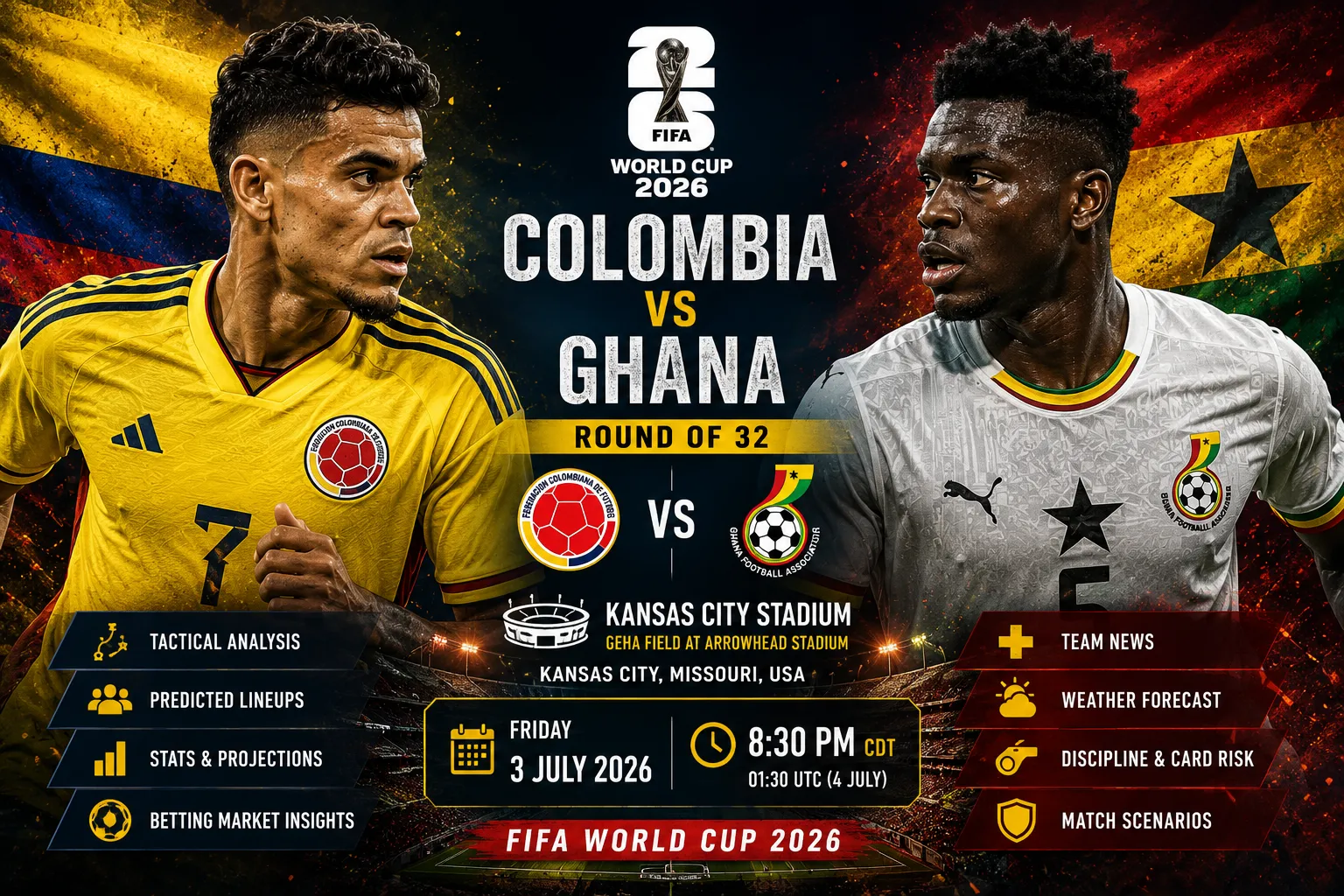
Colombia face Ghana in a FIFA World Cup 2026 Round of 32 match on Friday, 3 July 2026, at Kansas City Stadium, also known outside FIFA tournament naming as GEHA Field at Arrowhead Stadium, in Kansas City, Missouri, United States. FIFA’s match page lists Colombia vs Ghana as a Round of 32 fixture, Match 87, with a 01:30 UTC kick-off on 4 July; that converts to 8:30 PM CDT on Friday, 3 July in Kansas City.
Colombia reached this knockout game as Group K winners after going unbeaten and finishing above Portugal. Ghana reached the Round of 32 as one of the best third-placed teams from Group L, behind England and Croatia. Reuters frames the fixture around a clear coaching subplot: Ghana coach Carlos Queiroz faces Colombia, the national team he managed from 2019 to 2020.
Confirmed final lineups are not available before official team sheets. Public preview reporting says Colombia have a fully fit squad, while Ghana have no fresh injury concerns; Antoine Semenyo had a slight ankle issue earlier, but Kansas City Star reported that Carlos Queiroz expected him to be ready.
Colombia are likely to use a proactive 4-3-3 built around James Rodríguez, Luis Díaz, Luis Suárez, Jefferson Lerma and Richard Ríos. Ghana are likely to defend in a 4-1-4-1, using Thomas Partey as the central screen and Jordan Ayew as the counterattacking reference. The projected match type is Colombia territory and attacking rhythm against Ghana physical resistance, transitional threat and set-piece pressure. Betting markets make Colombia clear favorites, but World Cup knockout betting carries risk and no forecast should be treated as a guaranteed result.
Match Snapshot
| Field | Information | Status |
|---|---|---|
| Match | Colombia vs Ghana | Confirmed |
| Competition | FIFA World Cup 2026 | Confirmed |
| Stage | Round of 32 | Confirmed |
| Group | Not applicable to match stage; Colombia came from Group K, Ghana came from Group L | Confirmed |
| Date | Friday, 3 July 2026 local time / Saturday, 4 July UTC | Confirmed |
| Kick-off time | 8:30 PM CDT / 9:30 PM EDT / 01:30 UTC on 4 July | Confirmed by FIFA match listing and public schedules |
| Stadium | Kansas City Stadium | Confirmed |
| Common venue name | GEHA Field at Arrowhead Stadium | Public venue identity |
| City | Kansas City, Missouri | Confirmed |
| Host country | United States | Confirmed |
| Expected attendance | Not available from verified public match data | |
| World Cup venue capacity | 69,045 reported as FIFA World Cup capacity for Kansas City Stadium | Public venue report |
| Referee | Not available from verified public data | |
| VAR | Not available from verified public data | |
| Weather forecast | Around 89°F / 32°C at 8 PM and 88°F / 31°C at 9 PM; extreme heat warning active until 9 PM CDT | Forecast |
| Pitch context | FIFA World Cup grass installation; exact match-day pitch condition not available from verified public data | Partial / unknown |
| Main article focus | Tactical control, Ghana counter risk, heat management, cards, set pieces and responsible betting context | Analytical |
Kansas City Stadium is one of the U.S. venues for World Cup 2026 and Visit KC lists Colombia vs Ghana as the July 3 Round of 32 match at Kansas City Stadium, also known as GEHA Field at Arrowhead Stadium. The local weather forecast is unusually important because Kansas City is under an extreme heat warning until 9 PM CDT, with temperatures near match time still around 88–89°F.
Result Stakes in One Sentence
Colombia must convert group-stage authority into knockout control, while Ghana must turn physical discipline, counterattacks and Carlos Queiroz’s Colombia knowledge into an upset path.
Confirmed Facts vs Forecasts
| Category | Data Point | Current Status | How It Should Be Used |
|---|---|---|---|
| Confirmed fact | Colombia vs Ghana is a World Cup 2026 Round of 32 match | Confirmed | Core match fact |
| Confirmed fact | Match is at Kansas City Stadium | Confirmed | Venue fact |
| Confirmed fact | Kick-off is 01:30 UTC on 4 July / 8:30 PM CDT on 3 July | Confirmed | Timing fact |
| Confirmed fact | Colombia won Group K | Confirmed by Reuters and Kansas City Star | Tournament context |
| Confirmed fact | Ghana finished third in Group L and advanced | Confirmed by Reuters and Kansas City Star | Tournament context |
| Confirmed fact | Carlos Queiroz previously coached Colombia | Confirmed by Reuters | Coaching context |
| Announced information | Referee | Not available from verified public data | Do not invent |
| Announced information | VAR | Not available from verified public data | Do not invent |
| Probable information | Colombia predicted XI | Racing Post projection | Forecast only |
| Probable information | Ghana predicted XI | Racing Post projection | Forecast only |
| Projected data | Possession, shots, xG, cards, corners | Model-based forecast ranges | Not a confirmed outcome |
| Unknown data | Official lineups | Pending official team sheets | Check before kick-off |
| Unknown data | Final pitch speed and match-day surface state | Not available from verified public data | Watch early touches |
| Scenario-based analysis | First-goal effects, live betting triggers, substitutions | Conditional forecast | Use as probability logic |
This distinction matters because knockout previews often exaggerate certainty. Colombia’s group-stage strength is real, but it does not guarantee a Round of 32 win. Ghana’s third-place route is real, but it does not mean Ghana are passive. A responsible dossier must separate confirmed match information from tactical forecasts, market signals and conditional scenarios.
Why This Match Matters
Colombia enter this match with one of the stronger group-stage profiles in the tournament. Reuters reported that Colombia went unbeaten through Group K, finished above Portugal and built their campaign on defensive solidity and attacking football. The same report states that Colombia “cruised” through a difficult group and reached the knockout phase with a proactive identity under Néstor Lorenzo.
Ghana enter from a different position. They had to wait to know whether four points from Group L would be enough to advance behind England and Croatia. Reuters identifies Ghana as one of the best third-placed teams and adds the major subplot: Carlos Queiroz faces the Colombia team he managed from 2019 to 2020.
Kansas City Star adds useful qualifying context. Colombia won Group K with a 2-0-1 record. Ghana finished third in Group L with a 1-1-1 record. Colombia also scored 28 goals in South American qualifying, second only to Argentina, while Ghana went 8-1-1 in World Cup qualifying and conceded only six goals.
Group-Stage Reference Table
| Team | Group | Finish | Group Record | Qualification Route | Match Meaning |
|---|---|---|---|---|---|
| Colombia | K | 1st | 2-0-1 | Group winner above Portugal | Favorite profile, stronger control expectation |
| Ghana | L | 3rd | 1-1-1 | Best third-place qualifier behind England and Croatia | Underdog profile, counterattacking route |
Result Scenario Table
| Result | Colombia Impact | Ghana Impact | Next-Round Impact |
|---|---|---|---|
| Colombia win | Colombia advance and validate group-stage strength | Ghana eliminated | Colombia face winner of Switzerland vs Algeria |
| Draw after 90 minutes | Extra time follows if level under knockout rules | Extra time follows if level under knockout rules | Fitness, heat, bench depth and penalties become central |
| Ghana win | Colombia suffer a major knockout setback | Ghana claim a high-value upset and extend their run | Ghana face winner of Switzerland vs Algeria |
This match matters because it tests Colombia’s maturity. They are no longer just a lively South American side with attacking quality. They are a group winner with expectation. Ghana’s task is different. Ghana need to make the match uncomfortable, physical and slower than Colombia want.
Country, City, Stadium and Weather Intelligence
The match takes place in Kansas City, Missouri, at Kansas City Stadium. Visit KC lists the venue as Kansas City Stadium, also known as GEHA Field at Arrowhead Stadium, and confirms that the city is hosting all six matches at that venue. KCTV reported that FIFA set Kansas City Stadium’s World Cup capacity at 69,045, lower than its usual capacity for Kansas City Chiefs games because World Cup configuration changes the venue setup.
The weather is a major tactical variable. Kansas City is forecast to be around 89°F / 32°C at 8 PM and 88°F / 31°C at 9 PM, with an extreme heat warning active until 9 PM CDT. The alert warns of dangerously hot conditions with heat index values up to 100–110°F in parts of the region.
Host-Country Factors
| Factor | Information | Tactical Meaning |
|---|---|---|
| Host country | United States | Neutral tournament venue, but strong travelling fan presence possible |
| Host city | Kansas City, Missouri | Heat and evening conditions matter |
| Time zone | Central Daylight Time | 8:30 PM local kick-off reduces direct sun but not heat load |
| Tournament phase | Round of 32 | Coaches reduce unnecessary early risk |
| Venue identity | Kansas City Stadium / GEHA Field at Arrowhead Stadium | Large NFL venue adapted for World Cup football |
| Crowd profile | Strong Colombia travelling support expected by local reporting, exact allocation unavailable | Colombia may feel strong crowd energy |
Kansas City Star reported that Colombia fans “travel well” and that local spectators should expect “a lot of yellow” in Kansas City. This is not a confirmed ticket-allocation fact, but it is a reasonable crowd-context signal from local reporting.
City Factors
| City Factor | Confirmed / Forecast Information | Tactical Meaning |
|---|---|---|
| City | Kansas City | Large U.S. host-market event setting |
| Local kick-off | 8:30 PM CDT | Heat remains present but direct sun is reduced |
| Temperature | 88–89°F near kick-off | Pressing must be managed |
| Heat warning | Extreme heat warning active until 9 PM CDT | Hydration, substitutions and tempo control matter |
| Altitude | Low altitude | Altitude is not a major fatigue model |
| Travel load | Exact team travel routes not available from verified public data | Do not overstate travel fatigue |
Stadium Details
| Stadium Detail | Information | Status |
|---|---|---|
| FIFA tournament name | Kansas City Stadium | Confirmed |
| Common venue name | GEHA Field at Arrowhead Stadium | Confirmed by Visit KC |
| City / state | Kansas City, Missouri | Confirmed |
| World Cup capacity | 69,045 | Public report citing FIFA capacity announcement |
| Venue type | Open-air NFL stadium adapted for football | Public venue context |
| Roof | No indoor roof listed in World Cup venue information | Open-air context |
| Pitch condition | Exact match-day condition not available from verified public data | Unknown |
| Grass context | FIFA World Cup pitches use special installed sod systems across host venues | General tournament context |
Business Insider reported that World Cup 2026 stadiums require roughly 84,000 to 87,000 square feet of sod and that FIFA worked with turfgrass researchers to create more consistent playing surfaces across different climates and stadium designs. This supports a general pitch-context note, but the exact Kansas City match-day surface speed remains unavailable from verified public data.
Weather Factors Into Tactical Meaning
| Weather Factor | Forecast / Status | Tactical Meaning |
|---|---|---|
| Heat | Around 88–89°F near match time | Reduces repeated sprint pressing and increases hydration load |
| Heat index risk | Extreme heat warning mentions possible 100–110°F heat index in affected areas | Physical-risk forecast increases |
| Rain | No rain signal in retrieved hourly forecast near kick-off | Wet-ball risk appears low |
| Wind | Not available from verified public data in retrieved forecast | Do not overstate crossing drift |
| Humidity | Implied by heat warning but exact match-hour humidity not available from verified public data | Avoid precise humidity claims |
| Pitch | Exact surface condition not available | Watch early ball speed and player footing |
| Crowd heat | Large open-air venue | Late-game fatigue and cramps become more plausible |
The weather model favors the team that manages tempo better. Colombia can reduce heat load by holding possession and moving the ball rather than chasing. Ghana can reduce heat load by defending compactly, slowing restarts and picking counterattacks carefully. Both teams face a physical-risk increase after 60 minutes.
Team News and Availability Ledger
Final team sheets are not available before official publication. Public preview data says Colombia have a fully fit squad. Racing Post reports that Néstor Lorenzo has a fully fit squad and that Daniel Muñoz, Johan Mojica and Luis Suárez should return after being benched against Portugal.
For Ghana, Racing Post reports that Carlos Queiroz has no fresh injury concerns and that Benjamin Asare should keep his place in goal, while Caleb Yirenkyi could return to midfield ahead of Kwasi Sibo. Kansas City Star separately reported that Antoine Semenyo had a slight ankle issue against Croatia but that Carlos Queiroz said he should be ready for the knockout stage.
Colombia Team News Table
| Player / Unit | Status | Verification Level | Tactical Meaning |
|---|---|---|---|
| Daniel Muñoz | Expected to return to XI | Racing Post projection | Adds right-back energy, overlaps and recovery speed |
| Johan Mojica | Expected to return to XI | Racing Post projection | Adds left-side width and crossing |
| Luis Suárez | Expected to start | Racing Post projection | Central finishing and penalty-box presence |
| Luis Díaz | Expected to start | Racing Post projection | Main left-sided threat and transition runner |
| James Rodríguez | Expected to start | Racing Post projection | Key passer, set-piece taker and chance creator |
| Davinson Sánchez | Expected to start | Racing Post projection | Aerial defense and physical duels |
| Squad injuries | Fully fit squad reported | Public preview source | Still check official team sheet |
| Suspensions | Not available from verified public data | Unknown | Do not invent |
Ghana Team News Table
| Player / Unit | Status | Verification Level | Tactical Meaning |
|---|---|---|---|
| Benjamin Asare | Expected to start in goal | Racing Post projection | Shot-stopping and penalty-area command |
| Caleb Yirenkyi | Could return to midfield | Racing Post projection | Adds energy and forward thrust |
| Kwasi Sibo | Possible alternative midfield option | Racing Post projection | More conservative central cover |
| Antoine Semenyo | Slight ankle issue earlier; expected to be ready per Queiroz in local report | Partial public reporting | Main wide/forward transition outlet if fit |
| Thomas Partey | Expected central screen | Racing Post projection | Protects defensive line and starts counters |
| Jordan Ayew | Expected striker | Racing Post projection | Experience, hold-up play, fouls won |
| Fresh injuries | No fresh injury concerns reported | Public preview source | Still check official team sheet |
| Suspensions | Not available from verified public data | Unknown | Do not invent |
| Team | Confirmed Available | Doubtful / Watchlist | Confirmed Unavailable | Tactical Effect |
|---|---|---|---|---|
| Colombia | Fully fit squad reported by public preview | Not available from verified public data | Not available from verified public data | Selection is tactical rather than forced |
| Ghana | No fresh injury concerns reported | Antoine Semenyo ankle watchlist from earlier report | Not available from verified public data | If Semenyo lacks full sprint capacity, Ghana lose transition edge |
Colombia’s team-news question is not availability. It is selection. Lorenzo must decide how much attacking width and box presence he wants from the start. Ghana’s main question is whether Semenyo can carry full-speed transition load in heat.
Predicted Lineups and Formations
These are forecasts, not confirmed team sheets. Racing Post lists Colombia in a 4-3-3 and Ghana in a 4-1-4-1.
Colombia Predicted XI
| Position | Player | Projected Role |
|---|---|---|
| GK | Camilo Vargas | Shot-stopping, rest-defense organization, long restart option |
| RB | Daniel Muñoz | Overlaps, right-side pressure, recovery runs |
| CB | Davinson Sánchez | Aerial duels, physical defending, set-piece target |
| CB | Jhon Lucumí | Left-sided build-up, recovery cover |
| LB | Johan Mojica | Width, crosses, left-side support for Díaz |
| CM | Jhon Arias | Half-space movement, pressing and third-man runs |
| CM | Jefferson Lerma | Ball-winning, central cover, aerial presence |
| CM | Gustavo Puerta | Passing support, midfield balance |
| RW | James Rodríguez | Creative right-sided passer, set-piece delivery, inward rotations |
| CF | Luis Suárez | Central finishing, pressing trigger, box movement |
| LW | Luis Díaz | Main dribbler, transition threat, one-v-one attacker |
Ghana Predicted XI
| Position | Player | Projected Role |
|---|---|---|
| GK | Benjamin Asare | Shot-stopping, command, defensive resets |
| RB | Terry Yegbe Senaya | Wide defending, containment of Díaz/Mojica rotations |
| CB | Terry Adjetey | Box defense, aerial duels |
| CB | Nicholas Opoku | Physical defending, clearances, set-piece cover |
| LB | Gideon Mensah | Recovery runs, wide defensive support |
| DM | Thomas Partey | Central screen, passing outlet, transition control |
| RM | Antoine Semenyo | Counter outlet, carrying, pressing |
| CM | Caleb Yirenkyi | Forward running, midfield energy, duels |
| CM | Ibrahim Sulemana / Owusu role | Central coverage, second balls |
| LM | Kamaldeen Sulemana | Wide speed, counter threat |
| CF | Jordan Ayew | Hold-up play, fouls won, leadership |
Racing Post’s listed Ghana XI is Asare; Senaya, Adjetey, Opoku, Mensah; Partey; Semenyo, Yirenkyi, Owusu, Sulemana; Ayew. This preview uses that as the public projection and treats it as unconfirmed until official lineups are released.
Formation Forecast Table
| Team | Base Shape | In-Possession Shape | Out-of-Possession Shape | Confidence |
|---|---|---|---|---|
| Colombia | 4-3-3 | 2-3-5 / 3-2-5 with full-back support | 4-1-4-1 or 4-3-3 press | Medium/high |
| Colombia alternative | 4-2-3-1 | James central, Díaz left, Suárez ahead | 4-4-2 press | Medium |
| Ghana | 4-1-4-1 | 4-3-3 in counters | 4-5-1 deep or mid-block | Medium/high |
| Ghana alternative | 5-4-1 | Direct outlet to Ayew/Semenyo | Deep five-man last line | Medium/low |
Alternative Lineup Scenario Table
| Scenario | Team | Possible Change | Tactical Reason |
|---|---|---|---|
| Colombia want more midfield security | Colombia | Richard Ríos starts or enters early | More ball-carrying and control under physical pressure |
| Colombia want direct box threat | Colombia | Jhon Córdoba option instead of Suárez | More power against Ghana centre-backs |
| Colombia need late creativity | Colombia | Juan Fernando Quintero from bench | Final pass against deep block |
| Ghana protect central lane | Ghana | Kwasi Sibo starts instead of Yirenkyi | More defensive screening |
| Ghana need more pace | Ghana | Semenyo and Sulemana both held high | Faster counters into channels |
| Ghana protect Semenyo | Ghana | Semenyo starts but minutes managed | Ankle-load and heat management |
Tactical Identity: Colombia
Colombia’s identity under Néstor Lorenzo is no longer only emotional and transition-based. Reuters describes Colombia as a side that has combined defensive solidity with attacking football during this tournament. Richard Ríos also told reporters that Colombia intended to keep imposing their proactive game, but this dossier treats that as context, not as a guaranteed match script.
Colombia can build through centre-backs, use Lerma as a protective platform and then search for James Rodríguez between the right half-space and central lane. Díaz gives the left side its sharpest vertical threat. Muñoz and Mojica can widen the pitch. Suárez offers penalty-box timing and finishing.
The main danger for Colombia is impatience. Ghana will likely accept long spells without the ball. If Colombia force crosses too early or rely only on Díaz isolations, Ghana can defend the box and wait for counters. Colombia must combine width with central occupation.
Colombia Tactical Table
| Phase | Colombia Pattern | Ghana Problem It Creates | Colombia Risk |
|---|---|---|---|
| Build-up | Centre-backs plus Lerma platform, full-backs available wide | Ghana must decide whether to press or protect shape | Slow circulation lets Ghana reset |
| Attack | Díaz left isolations, James right half-space passing, Suárez box movement | Ghana full-backs and centre-backs face different threats | Attack can become predictable if James is crowded |
| Defense | Aggressive rest defense and physical centre-backs | Ghana counters face immediate contact | Space behind full-backs if counter-press fails |
| Transitions | Quick forward pass to Díaz or James after regain | Ghana can be exposed before block resets | Heat can reduce repeated counter-pressing |
| Set pieces | James delivery, Sánchez/Lerma/Suárez targets | Ghana must defend aerial duels and second balls | Poor delivery can release Ghana counters |
| Weakness | Emotional momentum can turn into rushed decisions | Ghana can slow rhythm and draw fouls | Late-game frustration if level |
Colombia’s full-back behavior is a key variable. If both Muñoz and Mojica push high at the same time, Colombia can overload Ghana wide. They also risk counters through Semenyo and Sulemana. A more balanced pattern may see one full-back attack while the other holds.
Tactical Identity: Ghana
Ghana’s identity in this match should be practical. They are unlikely to out-possess Colombia. They must compress the pitch, defend the central lane, keep Partey close to the centre-backs and use wide speed after regains. Kansas City Star described Ghana as defensive-minded and looking to hit teams with counterattacks, with Caleb Yirenkyi as a rising force.
Carlos Queiroz’s presence matters. Reuters identifies this as a reunion with Colombia, the team he coached from 2019 to 2020. That does not mean Ghana automatically know Colombia’s current tactical plan. It does mean Ghana’s staff should understand the emotional and technical profile of several Colombian players and the pressure surrounding Colombia’s expectations.
Ghana’s build-up should not be overcomplicated. The first pass after a regain must find Ayew, Semenyo, Sulemana or a central runner. If Ghana clear the ball without support, Colombia will restart attacks. If Ghana hold the first pass and draw fouls, they can control rhythm.
Ghana Tactical Table
| Phase | Ghana Pattern | Colombia Problem It Creates | Ghana Risk |
|---|---|---|---|
| Build-up | Direct outlet to Ayew or wide runners; Partey as pressure release | Colombia cannot commit both full-backs without risk | Turnovers invite repeated pressure |
| Attack | Semenyo and Sulemana carry into channels | Colombia full-backs must recover quickly | Low shot volume if counters fail |
| Defense | 4-1-4-1 block, Partey screening James zone | Colombia may struggle to enter central lane | Wide overloads can stretch block |
| Transitions | Fast release after midfield regain | Colombia rest defense tested | Heat can limit sprint frequency |
| Set pieces | Partey, Ayew, centre-backs attack deliveries | Colombia must defend contact and second balls | Poor delivery wastes rare territory |
| Weakness | Limited sustained possession | Colombia can build pressure and corners | Defensive fatigue after 60 minutes |
Ghana’s striker role is not only about shots. Jordan Ayew must hold contact, win fouls and let the team breathe. If he cannot secure the first ball, Ghana will defend in repeated waves.
Tactical Collision Map
| Zone | Colombia Edge | Ghana Edge | Likely Zone Winner | Why It Matters |
|---|---|---|---|---|
| Colombia left / Ghana right | Luis Díaz and Mojica overload | Ghana can double-team with wide midfielder and full-back | Colombia edge | Díaz is the most direct dribbling threat |
| Colombia right / Ghana left | James passing, Muñoz runs | Gideon Mensah recovery and Ghana counter space | Colombia slight edge | James can control tempo from this side |
| Central midfield | Lerma, Arias, Puerta/Ríos balance | Partey, Yirenkyi physicality | Balanced / Colombia slight edge | Second balls decide rhythm |
| Penalty box | Suárez movement, Sánchez aerial threat | Opoku, Adjetey, Asare box defense | Balanced | Ghana can survive if first contact is clean |
| Set pieces | James delivery | Ghana aerial resistance | Colombia slight edge | Restarts can break a tight game |
| Transitions | Colombia counter-press | Semenyo/Sulemana speed | Ghana if first pass is clean | Main upset route |
| Defensive third | Colombia more stable overall | Ghana compact block | Colombia territory, Ghana resistance | Determines whether control becomes goals |
Key Duel Cards
| Duel | Why It Matters | What To Watch | Risk Trigger |
|---|---|---|---|
| Luis Díaz vs Ghana right side | Díaz can create separation in one-v-one actions | Double-team timing and recovery fouls | Early booking for Ghana right-back or wide cover |
| James Rodríguez vs Thomas Partey | James controls the final pass; Partey protects the middle | Whether James receives facing forward | Partey dragged too far from central screen |
| Luis Suárez vs Opoku / Adjetey | Colombia need penalty-box finishing | Near-post runs, cut-back timing, aerial duels | Ghana centre-backs lose contact |
| Semenyo vs Mojica / Lucumí channel | Ghana need transition threat | Semenyo’s first touch and sprint capacity | Semenyo ankle load or heat fatigue |
| Lerma vs Yirenkyi | Midfield physical contest shapes second balls | Late tackles, aerial contact, loose balls | Card risk rises after repeated duels |
Projected Match Statistics
These numbers are projected ranges, not confirmed match data. They use team identity, group-stage context, public market shape and matchup logic.
| Metric | Colombia Projected Range | Ghana Projected Range | Confidence | Reason |
|---|---|---|---|---|
| Possession | 55%–65% | 35%–45% | Medium/high | Colombia should control more territory |
| Shots | 12–19 | 6–11 | Medium | Ghana should counter, but Colombia volume likely higher |
| Shots on target | 4–7 | 2–4 | Medium | Ghana can limit clear chances if compact |
| xG | 1.4–2.3 | 0.6–1.2 | Medium | Colombia edge, Ghana transition threat |
| Big chances | 2–4 | 1–2 | Medium | Ghana can create one major counter chance |
| Corners | 5–9 | 2–5 | Medium/high | Colombia pressure likely creates blocked wide attacks |
| Fouls | 10–15 | 12–18 | Medium | Physical midfield and heat increase contact |
| Yellow cards | 1–3 | 2–4 | Medium | Ghana may defend more emergency moments |
| Red-card risk | Low/medium | Low/medium | Low | Referee not confirmed |
| Offsides | 1–3 | 1–4 | Medium | Ghana counters and Colombia runs behind |
| Saves | 2–4 | 3–6 | Medium | Ghana goalkeeper likely busier |
| Crosses | 16–27 | 8–16 | Medium | Colombia wide pressure, Ghana counter deliveries |
| Tackles | 14–20 | 18–28 | Medium | Ghana defensive workload higher |
| Interceptions | 8–14 | 11–19 | Medium | Ghana block aims to cut central passes |
| Clearances | 13–21 | 22–36 | High | Ghana likely defend box repeatedly |
Colombia’s expected edge is structural rather than absolute. They should produce more territory and more shots. Ghana’s route is lower volume but higher volatility. One counterattack, one set piece or one goalkeeper moment can alter the match.
90-Minute Probability Map
This table uses match windows. It does not claim exact future events.
| Match Window | Tactical State | Physical State | Card Risk | Goal Risk | Betting Market Trigger |
|---|---|---|---|---|---|
| 1’–15’ | Colombia likely test Ghana’s block; Ghana likely stay compact | Heat still high but players fresh | Low/medium | Medium | Early Colombia corners may move corner markets |
| 16’–30’ | James and Díaz involvement should increase | Wide recovery work grows | Medium | Medium | If Ghana counters twice, BTTS markets may react |
| 31’–45+’ | Colombia may increase crossing and set-piece pressure | First heat-management signs appear | Medium | Medium/high | Late first-half pressure can shorten Colombia next-goal prices |
| 46’–60’ | Coaches adjust midfield pressure and full-back heights | Heat recovery after halftime matters | Medium | Medium | Substitution markets become sensitive |
| 61’–75’ | Ghana fatigue risk rises; Colombia bench creativity matters | Cramps and hydration issues more plausible | Medium/high | High if Colombia pressure continues | Live handicap and cards markets can overreact |
| 76’–90+’ | Match state dominates: Colombia manage/chase, Ghana defend/counter | Highest concentration risk | High | High | Draw, extra-time, late-card and corner markets become volatile |
The most important early signal is not possession. It is the quality of Colombia’s entries. If Colombia reach the box with cut-backs and central combinations, Ghana’s block is bending. If Colombia only cross from deep, Ghana may accept that pattern.
Weather-to-Match Model
| Weather Factor | Match Reading | Pressing Effect | Passing Effect | Goalkeeper Effect | Fouls / Injury Effect |
|---|---|---|---|---|---|
| Heat | 88–89°F near kick-off | Reduces repeated pressing | Slows tempo if teams conserve energy | Restart management becomes important | Cramp and fatigue risk increase |
| Heat warning | Extreme heat warning active until 9 PM CDT | Coaches may reduce sprint pressing | Short passing may be safer than constant transitions | Hydration breaks or stoppage rhythm may matter if applied | Heat illness watchlist |
| Humidity | Exact match-hour humidity not available from verified public data | Cannot model precisely | Ball speed not directly assumed | Handling not overmodelled | Avoid precise humidity claims |
| Wind | Not available from verified public data | Unknown | Long diagonals not overmodelled | Unknown | Unknown |
| Rain | No clear rain risk in retrieved hourly forecast | Little direct effect | Normal passing model | Normal handling model | Low slip-risk forecast |
| Roof status | Open-air stadium | Weather remains exposed | Wind/heat remain relevant | Sun not direct at late kick-off | Heat remains central |
| Pitch condition | Not available from verified public data | Unknown | Watch first touches and bounce | Watch goalmouth traction | Match-day variable |
The dominant weather variable is heat. This match begins after sunset conditions improve, but heat remains heavy enough to affect sprint frequency, counter-pressing and recovery. Colombia should avoid emotional pressing. Ghana should avoid long defensive runs without pressure relief.
Player Impact Index
| Player | Team | Role | Match Impact Score / 10 | Reason |
|---|---|---|---|---|
| Luis Díaz | Colombia | Left winger / direct attacker | 9.0 | Main one-v-one threat and transition weapon |
| James Rodríguez | Colombia | Creator / set-piece taker | 8.8 | Controls final pass and dead-ball quality |
| Jefferson Lerma | Colombia | Defensive midfielder | 8.4 | Protects counters and wins second balls |
| Luis Suárez | Colombia | Striker | 8.1 | Must turn territory into box chances |
| Daniel Muñoz | Colombia | Right-back | 7.9 | Adds width and recovery power |
| Davinson Sánchez | Colombia | Centre-back | 7.8 | Key against Ayew and set pieces |
| Camilo Vargas | Colombia | Goalkeeper | 7.5 | May face fewer but sharp transition chances |
| Thomas Partey | Ghana | Defensive midfielder | 8.8 | Central screen against James and Colombia interiors |
| Jordan Ayew | Ghana | Striker / outlet | 8.2 | Must hold first ball and win fouls |
| Antoine Semenyo | Ghana | Wide counter threat | 8.0 | Key if fully fit after ankle concern |
| Kamaldeen Sulemana | Ghana | Wide runner | 7.9 | Can attack space behind full-backs |
| Caleb Yirenkyi | Ghana | Midfield runner | 7.7 | Adds energy and direct ball-carrying |
| Benjamin Asare | Ghana | Goalkeeper | 8.0 | Likely faces more pressure and crosses |
Díaz is Colombia’s highest-upside attacking player because he can beat a marker without needing a full-team combination. Partey is Ghana’s most important structural player because he must protect the central lane and manage James’ receiving zones.
Referee, Cards and Discipline Preview
The referee and VAR crew are not available from verified public data at the time of this preview. No referee-specific card profile should be treated as confirmed.
Discipline Table
| Discipline Factor | Colombia Risk | Ghana Risk | Match Meaning |
|---|---|---|---|
| Referee style | Not available from verified public data | Not available from verified public data | Avoid referee-specific claims |
| Tactical foul risk | Medium | Medium/high | Ghana may stop Díaz, James and Muñoz actions |
| Dissent risk | Medium | Medium | Heat and knockout pressure can increase frustration |
| VAR intervention risk | Unknown | Unknown | VAR crew not confirmed |
| Penalty risk | Medium | Medium | Wide dribbles and set pieces create contact |
| Red-card risk | Low/medium | Low/medium | Rises with early bookings and transition fouls |
Cards Forecast Table
| Team | Yellow-Card Range | Red-Card Risk | Main Risk Zone |
|---|---|---|---|
| Colombia | 1–3 | Low | Midfield fouls stopping Ghana counters |
| Ghana | 2–4 | Low/medium | Wide defensive duels against Díaz and Muñoz |
| Match Total | 3–6 | Low/medium | Second half if Ghana defend deep and Colombia chase |
Cards are more likely to come from recovery situations than from open aggression. Ghana full-backs and midfielders face repeated one-v-one and half-space defending. Colombia defenders face sudden sprint duels if Ghana escape.
Set-Piece Intelligence
| Set-Piece Area | Colombia Outlook | Ghana Outlook | Edge |
|---|---|---|---|
| Corners for | Likely higher volume through territorial pressure | Lower volume unless counters force blocks | Colombia volume edge |
| Corners against | Colombia must defend fewer but dangerous restarts | Ghana likely defend repeated corner sequences | Ghana aerial workload higher |
| Wide free kicks | James delivery is a major threat | Partey/Ayew/Semenyo can attack second balls | Colombia delivery edge |
| Central free kicks | Colombia have James shooting/passing options | Ghana may win rare free kicks in transition | Colombia edge |
| Penalties | Díaz and Muñoz dribbles increase box-contact risk | Ghana counters can force recovery tackles | Balanced risk |
| Long throws | Not available from verified public data | Not available from verified public data | Unknown |
| Aerial duels | Sánchez, Lerma, Suárez | Opoku, Adjetey, Ayew, Partey | Balanced physically |
Colombia have the cleaner set-piece delivery profile. Ghana have enough aerial strength to defend and threaten, but they need territory first. If Ghana cannot keep the ball long enough to earn restarts, their aerial edge becomes mostly defensive.
Goalkeeper and Defensive Risk Map
| Area | Colombia | Ghana | Risk Reading |
|---|---|---|---|
| Goalkeeper distribution | Vargas can reset pressure and choose safer passes | Asare likely faces more pressure | Colombia calmer restart profile |
| Shot-stopping pressure | Lower volume but high consequence | Higher volume likely | Ghana goalkeeper workload higher |
| Cross handling | Colombia defend fewer crosses | Ghana defend repeated wide deliveries | Ghana workload higher |
| High-line risk | Colombia vulnerable if full-backs overcommit | Ghana likely lower defensive line | Colombia transition watchlist |
| Penalty-box defending | Colombia must stay alert on rare counters | Ghana must handle Díaz cut-backs and Suárez movement | Ghana high-pressure zone |
| Back-post weakness | Colombia must track Sulemana/Semenyo far-side runs | Ghana must track Díaz and Muñoz far-post actions | Both teams have watchlist |
Asare may face more saves, crosses and corners. Vargas may face fewer direct actions, but those actions could be high-value. This is common in favorite-underdog matches: one goalkeeper handles volume, the other handles isolated danger.
Bench and Substitution Forecast
Substitutions will depend on score, heat, cards and sprint load. The windows below are forecasts.
| Window | Colombia Possible Substitution Type | Ghana Possible Substitution Type | Trigger |
|---|---|---|---|
| 45’–60’ | Add midfield control, adjust full-back risk, introduce Quintero-type creativity | Add fresh midfield legs, protect booked defender | Heat, bookings, low chance quality |
| 60’–75’ | Add Jhon Córdoba or another direct striker | Add pace through Nuamah / Fatawu-type profile | Need for goal or counter threat |
| 75’–90’ | Defensive midfielder if leading, second striker if drawing/losing | Extra forward or deeper defender depending on score | Match state and fatigue |
Coach Reaction Matrix
| Match State | Colombia Likely Reaction | Ghana Likely Reaction |
|---|---|---|
| Colombia leading | Control possession, reduce counter risk, manage heat | Push wide players higher and attack set pieces |
| Match level | Increase width, add creativity, target Díaz side | Keep block compact, counter selectively |
| Ghana leading | Colombia overload attack and raise full-backs | Ghana defend deeper and slow rhythm |
| Ghana trailing | Colombia attack open spaces | Ghana add speed and accept defensive gaps |
Colombia’s bench gives them more attacking variety. Ghana’s bench gives them sprint replacement and physical renewal. In heat, fresh legs matter more than reputation after 70 minutes.
Betting Market Intelligence and Risk Review
Racing Post lists Colombia as 2-9 to qualify and Ghana at 10-3 to qualify. In the 90-minute match betting market, Racing Post lists Colombia at 1-2, Ghana at 13-2 and the draw at 3-1, with odds correct at publication time. These numbers are market signals, not guarantees.
Market Snapshot Table
| Market | Public Market Signal | Interpretation | Main Risk |
|---|---|---|---|
| Match winner | Colombia clear favorite | Market trusts group form and attacking quality | Knockout variance and heat |
| Double chance | Colombia/draw likely short | Conservative favorite-side angle | Low value, limited upside |
| Over/under goals | Not available from verified public data in cited source | Use tactical model only | Ghana deep block can slow goals |
| BTTS | Not available from verified public data in cited source | Ghana can score via counters but volume may be low | One rare counter can change market |
| Corners | Not available from verified public data in cited source | Colombia pressure implies corner edge | Early goal can reduce corner pace |
| Cards | Not available from verified public data in cited source | Ghana defensive workload implies card risk | Referee unknown |
| Player shots | Not available from verified public data | Díaz, James, Suárez most relevant | Final lineup and role uncertainty |
| Player cards | Not available from verified public data | Ghana full-backs, Partey, Lerma watchlist | Referee profile missing |
What Could Move Odds Before Kick-Off
| Trigger | Likely Market Effect |
|---|---|
| Colombia full-strength XI confirmed | Colombia price may shorten |
| Semenyo confirmed fully fit | Ghana counterattacking markets may improve |
| Ghana select more defensive midfield | Under and Colombia corners may gain attention |
| Heat warning worsens or match delay risk appears | Totals and late-goal markets may shift |
| Referee with high-card profile confirmed | Cards markets may adjust upward |
| Díaz or James unexpectedly benched | Colombia attacking markets may soften |
| Public Colombian money arrives | Favorite price can shorten without improving true value |
Live Betting Trigger Table
| Trigger | Meaning | Risk |
|---|---|---|
| Colombia create repeated cut-backs early | Ghana’s block is bending | Market may overreact before goal arrives |
| Ghana survive first 30 minutes with low xG conceded | Defensive plan is working | Colombia can still improve after substitutions |
| Díaz beats his marker repeatedly | Ghana right side is exposed | Ghana may add a double team |
| Ghana win two clean counters early | Colombia rest defense is vulnerable | Small sample can mislead live bettors |
| Early yellow to Ghana full-back | Colombia can target that flank | Second-yellow risk changes player behavior |
| 0-0 after 70 minutes | Extra-time pressure rises | Emotional bets become dangerous |
| Colombia score first | Ghana must open shape | Colombia handicap may shorten too far |
| Ghana score first | Upset script becomes live | Colombia pressure and corners likely rise |
This preview explains match data and market behavior. It does not provide guaranteed betting advice. World Cup betting involves risk. Readers should check local gambling laws, use licensed operators, set limits and avoid chasing losses.
NCPG’s helpline page states that support is available for people struggling with gambling problems and that the National Problem Gambling Helpline connects people to local resources.
Forecast Failure Factors
Forecasts fail because football contains low-frequency events that carry high leverage. A penalty, early red card, goalkeeper error, injury, weather shift or tactical surprise can override pre-match models.
| Failure Factor | How It Breaks the Forecast | Match-Specific Impact |
|---|---|---|
| Late lineup change | Expected formation becomes wrong | Díaz, James, Partey or Semenyo availability/role matters |
| Early goal | Forces one team out of base plan | Ghana leading would change Colombia’s rhythm |
| Early yellow card | Changes duel behavior | Ghana full-back booking can unlock Díaz side |
| Injury | Removes planned tactical role | Heat increases physical-risk watchlist |
| VAR penalty | Creates goal without open-play dominance | Underdog can lead from one box incident |
| Weather shift | Changes tempo and fatigue | Extreme heat is already a match factor |
| Red card | Breaks 11v11 projection | Favorite or underdog model can collapse |
| Goalkeeper error | Creates unmodeled goal | Asare/Vargas decisions matter under pressure |
| Tactical surprise | Opponent prepared for wrong shape | Ghana back five or Colombia double pivot changes game |
| Market overreaction | Odds move beyond real probability | Colombia public support can shorten favorite price |
The biggest failure factor is heat plus first goal. Heat can reduce pressing and increase late mistakes. The first goal changes whether the game stays tactical or becomes emotionally stretched.
Scoreline Scenarios
These are scenario bands, not final-score guarantees.
| Scenario | Probability Band | Match Story |
|---|---|---|
| Colombia narrow win | Medium/high | Colombia control territory, Ghana defend well, one or two quality actions decide it |
| Draw after 90 minutes | Medium | Ghana slow rhythm, Asare performs well, Colombia lack finishing clarity |
| Ghana upset | Low/medium | Ghana score from transition or set piece and survive pressure |
| High-scoring match | Low/medium | Early goal opens the pitch and heat creates late defensive gaps |
| Low-scoring match | Medium/high | Ghana compactness and heat reduce tempo |
Scenario Details
| Scoreline Type | Colombia Requirements | Ghana Requirements | Main Risk |
|---|---|---|---|
| Colombia 1-goal win | Patience, Díaz/James quality, clean rest defense | Defend long spells but eventually concede | Colombia finishing variance |
| Colombia 2+ goal win | Early breakthrough and Ghana forced open | Ghana lose compactness | Depends on first goal |
| Draw | Colombia lack central penetration | Ghana defend box and use goalkeeper well | Extra time changes model |
| Ghana 1-goal win | Efficient counter or set piece | Colombia frustration rises | Low margin for error |
| 3+ total goals | Early match-state disruption | Ghana cannot sit deep | Heat can create late errors |
The most stable pre-match story is Colombia control plus Ghana resistance. The most dangerous betting assumption is that Colombia’s favorite status automatically creates a wide-margin result.
Group Scenario Matrix
This match is not a group-stage fixture. Points, goal difference and third-place routes no longer apply.
| Result | Colombia Consequence | Ghana Consequence | Points / Goal Difference | Next-Match Consequence |
|---|---|---|---|---|
| Colombia win | Advance | Eliminated | No group-table impact | Colombia face Switzerland or Algeria |
| Ghana win | Eliminated | Advance | No group-table impact | Ghana face Switzerland or Algeria |
| Draw after 90 | Extra time if level | Extra time if level | No group-table impact | Bench depth and fatigue matter |
| Draw after extra time | Penalty shootout if still level | Penalty shootout if still level | No group-table impact | Goalkeepers and penalty takers decide route |
The group stage matters only as evidence. Colombia showed a stronger group profile. Ghana showed enough resilience to qualify. The knockout match removes all safety.
What Each Team Must Do to Win
Colombia Win Conditions
- Colombia must use Díaz early without forcing every attack through him.
- Colombia must let James receive between Ghana’s midfield and defense.
- Colombia must keep Lerma close enough to stop Ghana counters.
- Colombia must avoid pushing both full-backs high at the same time without cover.
- Colombia must attack Ghana’s box with Suárez movement, not only wide crosses.
- Colombia must use set pieces as a pressure tool.
- Colombia must manage heat with possession, not emotional pressing.
- Colombia must avoid cheap fouls that give Ghana set-piece territory.
- Colombia must stay patient if the first goal does not arrive early.
- Colombia must use bench creativity before fatigue narrows the attack.
Ghana Win Conditions
- Ghana must keep Partey in the central screen and block James’ passing lane.
- Ghana must double-team Díaz without leaving Suárez free.
- Ghana must protect full-backs from early yellow cards.
- Ghana must make Ayew useful as a pressure-release target.
- Ghana must use Semenyo and Sulemana in short, high-speed counter windows.
- Ghana must slow the tempo in the Kansas City heat.
- Ghana must attack set pieces with conviction.
- Ghana must keep clearances purposeful.
- Ghana must stay psychologically calm if Colombia dominate possession.
- Ghana must treat one or two chances as enough to create an upset path.
Source and Data Appendix
| Data Point | Status | Source Type | Article Use |
|---|---|---|---|
| Match date | Confirmed | FIFA match page / public schedule | Match snapshot |
| Kick-off time | Confirmed | FIFA match page / Sportsnet schedule | Match snapshot |
| Stadium | Confirmed | FIFA / Visit KC | Stadium section |
| City | Confirmed | FIFA / Visit KC | City context |
| Stage | Confirmed | FIFA match page | Tournament context |
| Colombia group finish | Confirmed | Reuters / Kansas City Star | Tournament context |
| Ghana qualification route | Confirmed | Reuters / Kansas City Star | Tournament context |
| Coaches | Confirmed by Reuters context | Reuters | Tactical context |
| Referee | Not available from verified public data | Not found | Marked unknown |
| VAR | Not available from verified public data | Not found | Marked unknown |
| Weather | Forecast | Weather tool | Weather model |
| Venue capacity | Public report citing FIFA capacity announcement | KCTV5 | Stadium context |
| Team news | Public preview reporting | Racing Post / Kansas City Star | Availability ledger |
| Predicted lineups | Forecast | Racing Post | Lineup section |
| Odds | Market signal | Racing Post | Betting context |
| Projected stats | Model-based | Tactical analysis | Projection table |
| Minute-window scenarios | Model-based | Tactical analysis | Probability map |
| Pitch details | General tournament pitch report, exact match condition unknown | Business Insider | Weather/stadium context |
Disclaimer: Forecast Accuracy and Betting Risk
This preview is analytical and informational. It is not a guarantee. Football includes randomness and low-probability events. Final lineups, injuries, referee decisions, VAR, weather, pitch conditions and early goals can change the match.
Colombia may control territory and still struggle to score. Ghana may defend well and still concede from one elite action. A goalkeeper error, red card, penalty, heat-related fatigue issue or tactical surprise can break any model. Betting markets move before kick-off and during the match.
Readers should verify official lineups and conditions before making decisions. Readers should check local gambling laws. Readers should use licensed operators only. Readers should set spending and time limits. Readers should not chase losses. Betting should be treated as entertainment, not income.
Summarize this article with AI. Use this page URL as the source:
Summarize this article with AI:
FAQ
Colombia vs Ghana is scheduled for Friday, 3 July 2026 in Kansas City local time. Kick-off is 8:30 PM CDT, which is 01:30 UTC on Saturday, 4 July 2026.
Colombia vs Ghana is being played at Kansas City Stadium in Kansas City, Missouri, United States. The venue is commonly known outside FIFA tournament naming as GEHA Field at Arrowhead Stadium.
The projected Colombia XI is Camilo Vargas; Daniel Muñoz, Davinson Sánchez, Jhon Lucumí, Johan Mojica; Jhon Arias, Jefferson Lerma, Gustavo Puerta; James Rodríguez, Luis Suárez, Luis Díaz. The projected Ghana XI is Benjamin Asare; Senaya, Adjetey, Opoku, Mensah; Thomas Partey; Antoine Semenyo, Caleb Yirenkyi, Owusu, Kamaldeen Sulemana; Jordan Ayew. These are forecasts, not confirmed lineups.
The main tactical matchup is Colombia’s left-side and right-half-space creation against Ghana’s compact 4-1-4-1 block. Luis Díaz can stretch Ghana wide, while James Rodríguez can attack the central passing lane. Ghana need Thomas Partey to protect that lane and keep counters alive.
The prediction can be wrong because final lineups, heat, injuries, referee decisions, VAR, early cards, penalties, goalkeeper errors and tactical surprises can change the match. Betting markets are signals, not guarantees.