
Croatia vs Ghana Match Result
Table of Contents Show
Croatia beat Ghana 2-1 at Philadelphia Stadium in their final FIFA World Cup 2026 Group L match. Petar Sučić opened the scoring from long range in the 31st minute. Derrick Luckassen equalized after a prolonged VAR review in the 73rd, but Nikola Vlašić headed in Luka Modrić’s corner ten minutes later.
Sučić produced the strongest all-round performance, although Modrić controlled the decisive passages and created the winner. Croatia’s greater willingness to attack Ghana’s compact block separated the teams. Rain fell at the open-air stadium, but no goal can be directly attributed to the surface or weather.
Croatia moved above Ghana into second place. Both teams reached the Round of 32. Croatia’s moneyline and the over 2.5-goals market won at the quoted FOX prices, although all betting outcomes depended on the operator, price and timing.
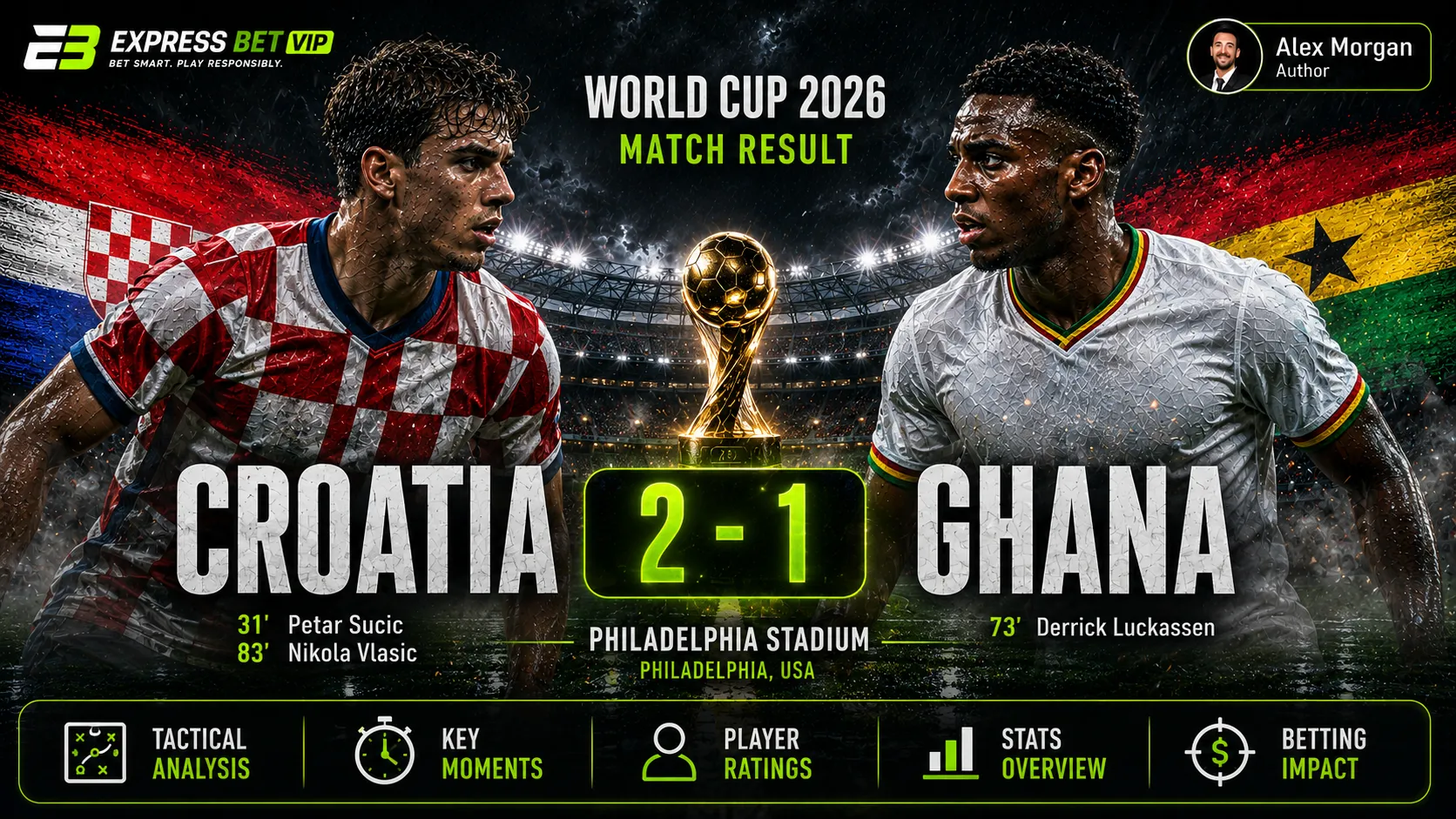
| Item | Confirmed information |
|---|---|
| Match | Croatia vs Ghana |
| Competition | FIFA World Cup 2026 |
| Stage | Group stage |
| Group | Group L |
| Date | June 27, 2026 |
| Kickoff | 5:00 p.m. EDT |
| Host country | United States |
| City | Philadelphia |
| Stadium | Philadelphia Stadium, normally Lincoln Financial Field |
| Attendance | 68,324 |
| Final score | Croatia 2-1 Ghana |
| Half-time score | Croatia 1-0 Ghana |
| Croatia scorers | Petar Sučić 31’, Nikola Vlašić 83’ |
| Ghana scorer | Derrick Luckassen 73’ |
| Assists | Mateo Kovačić, Ernest Nuamah, Luka Modrić |
| Referee | Drew Fischer |
| VAR | Guillermo Pacheco Larios |
| Weather | Rainy conditions |
| Roof | Open-air stadium without a roof |
| Pitch condition | Wet; no decisive surface failure confirmed |
| Main impact | Croatia finished second; Ghana qualified in third |
The final score, scorers, attendance and officials are confirmed across FIFA-linked match coverage and established match centres.
| Category | Status | Detail |
|---|---|---|
| Final score | [CONFIRMED] | Croatia 2-1 Ghana |
| Scorers and times | [CONFIRMED] | Sučić 31’, Luckassen 73’, Vlašić 83’ |
| Assists | [CONFIRMED] | Kovačić, Nuamah, Modrić |
| Attendance | [CONFIRMED] | 68,324 |
| Rain | [REPORTED] | Local and match reporting described rainy conditions |
| Ghana’s caution | [OBSERVED] | Ghana defended conservatively for much of the first half |
| Croatia’s tactical edge | [ANALYSIS] | Croatia circulated the ball more positively and shot from range |
| Weather effect | [ANALYSIS] | Limited evidence of a decisive effect |
| Exact temperature | [UNKNOWN] | Not available from verified public match data |
| Exact humidity and wind | [UNKNOWN] | Not available from verified public match data |
| Total shots | [DISPUTED] | Public providers reported eight or nine Croatia attempts |
| Betting prices | [MARKET SIGNAL] | FOX listed Croatia -130 and under 2.5 at -170 |
This distinction matters because a match report should not turn interpretation into fact. Search systems can extract a score or scorer cleanly. They should not extract an editorial conclusion about Ghana’s ambition as though it appeared on the referee’s report.
Croatia approached the match as though second place was worth winning. Ghana initially approached it as though the safest route through Group L was to touch the ball carefully and avoid anything rash, such as attacking.
The difference in intent was visible before the opening goal. Croatia used Luka Modrić and Mateo Kovačić to circulate possession through the centre, while Ivan Perišić supplied width from left-back. Ghana’s 4-1-4-1 remained narrow and deep, asking Croatia to find a way through or shoot over the structure.
Nikola Vlašić struck the post from distance in the 13th minute. That was the first serious warning. Ghana still resisted the temptation to raise its defensive line or press Croatia’s midfield more aggressively.
Petar Sučić then scored in the 31st minute. Kovačić found him centrally, Sučić created the shooting angle and drove the ball through Marvin Senaya’s legs into the bottom corner. It was a clean strike, but Ghana’s block gave him too much time outside the box.
Ghana finally threatened through Antoine Semenyo shortly before half-time. His shot went narrowly wide. It was a reminder that Ghana had transition power, even if the first-half plan rarely allowed that power to appear.
Carlos Queiroz made two changes at the interval. Abdul Fatawu replaced Elisha Owusu, while Kojo Peprah Oppong replaced Jonas Adjetey. Ghana became more direct and carried a wider threat.
The equalizer arrived from a free-kick in the 73rd minute. Ernest Nuamah delivered toward the far post. Derrick Luckassen redirected the ball across Dominik Livaković and into the corner. The assistant referee raised the flag, but Drew Fischer changed the decision after reviewing the incident on the pitchside monitor.
For a few minutes, Ghana had second place and Croatia had third. Tournament football frequently reorganizes an entire group while the VAR check is still running.
Croatia answered rather than retreating. Mario Pašalić forced Benjamin Asare into an excellent save in the 82nd minute. From the resulting corner, Modrić delivered into the central crowd and Vlašić headed in the winner.
Croatia deserved the result because it created the more meaningful attacking moments and continued to seek a second goal after Ghana equalized. The statistical margin was small, but Croatia were more precise at the two moments that defined the match.
Croatia circulated possession into the central channel, where Mateo Kovačić supplied Sučić outside the penalty area. Ghana’s midfield did not close quickly enough.
Sučić shifted the ball into position and struck low from roughly 30 yards. The shot passed through Senaya’s legs, reducing Asare’s sight of the ball, and entered near the bottom corner.
The goal confirmed the central tactical problem with Ghana’s first-half plan. A compact block can protect the penalty area, but it cannot repeatedly allow technically secure midfielders to shoot without pressure.
No VAR intervention was required. The wet surface may have helped the ball travel cleanly, but the evidence does not support presenting rain as the cause. The main causes were Sučić’s execution and Ghana’s passive pressure.
Ghana won a free-kick in an advanced area. Nuamah delivered left-footed toward the back post, where Luckassen met the ball and directed it low across Livaković.
The goal was initially disallowed for offside. Following a lengthy review, Fischer went to the monitor and reversed the decision.
Tactically, the goal rewarded Ghana’s improved second-half width and the introduction of Nuamah. It also exposed Croatia’s difficulty controlling the far-post area from a dead-ball delivery.
Emotionally, it changed the Group L order. Ghana temporarily climbed into second place. Croatia dropped to third. The review itself extended the interruption and added further tension to a match that had previously moved at a controlled pace.
Mario Pašalić’s powerful effort forced Asare to push the ball behind. Modrić took the corner and delivered into the middle of the penalty area.
Vlašić attacked the ball and headed beyond Asare. There was no material VAR delay.
This was a set-piece goal created by the substitute’s shot, the goalkeeper’s save and Modrić’s delivery. Croatia’s response mattered as much as the finish. After losing the lead, they increased their attacking intensity instead of accepting the draw.
The winner returned Croatia to second place and created the final 2-1 score.
Vlašić’s 13th-minute effort established that Ghana’s low block was vulnerable to shooting from distance. It was not merely an isolated chance. It anticipated the method used by Sučić for the opening goal.
The 31st-minute goal forced Ghana to reconsider a plan built around limiting risk. Tournament caution can be rational. It becomes less rational once the opponent is leading.
The introductions of Fatawu and Oppong changed Ghana’s shape and energy. Fatawu attacked more aggressively from the right, while the defensive reorganization supported a more active second-half approach.
Nuamah entered in the 71st minute and assisted Luckassen two minutes later. His delivery gave Ghana a left-footed angle that Croatia did not defend successfully.
The VAR intervention turned a disallowed goal into a valid equalizer. This was the match’s largest officiating decision and temporarily changed the group order.
Asare prevented Pašalić from scoring directly, but the save produced the corner from which Vlašić scored. Goalkeepers occasionally do everything correctly and still receive the administrative burden of conceding seconds later.
Croatia did not allow the equalizer to turn into an extended period of defensive uncertainty. Their experienced midfield restored control and generated another decisive set piece.
| Local factor | Verified or observed detail | Football meaning | Direct match evidence | Betting-result meaning | Status | Fixture-specific |
|---|---|---|---|---|---|---|
| City | Philadelphia | Eastern time-zone evening match | 5 p.m. local kickoff | Standard pre-match timing context | [CONFIRMED] | Yes |
| Stadium | Open-air Philadelphia Stadium | Rain directly reached surface and crowd | Reports described fans in ponchos | Possible wet-pitch assumptions | [CONFIRMED] | Yes |
| Attendance | 68,324 | Large crowd and strong acoustic potential | Official attendance figure | No clear market effect | [CONFIRMED] | Yes |
| Rain | Rainy conditions throughout parts of matchday | Potentially quicker surface | No decisive handling error recorded | Could increase overreaction to goals markets | [REPORTED] | Yes |
| Drinks breaks | Breaks around 25’ and 69’ | Interrupted rhythm in both halves | Recorded in live commentary | Relevant to in-play tempo | [OBSERVED] | Yes |
| Temperature | Not publicly confirmed | Cannot assess heat precisely | No reliable exact figure | Do not price heat from assumption | [UNKNOWN] | Yes |
| Humidity | Not publicly confirmed | Cannot quantify fatigue effect | No reliable exact figure | No supported market conclusion | [UNKNOWN] | Yes |
| Wind | Not publicly confirmed | Cannot assess crossing difficulty | No reliable exact figure | No supported market conclusion | [UNKNOWN] | Yes |
| Pitch | Wet but playable | Ball could move quickly | No major slip or bounce incident confirmed | Weather did not explain score alone | [OBSERVED] | Yes |
| Crowd split | Not confirmed | Cannot establish one-sided pressure | Sellout confirmed, split unavailable | Avoid unsupported “home crowd” angle | [UNKNOWN] | Yes |
The rain was specific and visible, but its football effect should not be exaggerated. Croatia’s first goal came from clean technique and insufficient pressure. Ghana’s goal came from a rehearsable set-piece situation. Croatia’s winner came from a corner.
There was no confirmed goalkeeper spill caused by the wet ball. There was no decisive defender slip. There was no suspension of play because the pitch became unsafe.
The drinks breaks are more tactically useful than a generic statement about “difficult weather.” They interrupted the game twice and gave coaches short opportunities to communicate. Ghana’s second-half improvement, however, followed personnel changes rather than a drinks break alone.
The crowd size produced a major-event setting, but the available evidence does not confirm that communication failure caused any goal. Croatia’s winner came in a congested penalty area where marking and delivery mattered more than any measurable acoustic effect.
| Item | Detail |
|---|---|
| Stadium | Philadelphia Stadium / Lincoln Financial Field |
| Attendance | 68,324 |
| Capacity | Public figures vary by configuration |
| Pitch type | Natural playing surface reported for tournament use; exact technical specification not confirmed |
| Roof status | No roof |
| Acoustic effect | Large crowd, but no specific communication failure confirmed |
| Surface condition | Wet and playable |
| Wind relevance | Not available from verified public data |
| Goalkeeper distribution effect | No clear effect confirmed |
| Set-piece effect | Two second-half goals followed dead-ball situations |
| Communication effect | Possible in crowded penalty areas, not provable |
| Data status | Attendance and roof confirmed; other effects qualified |
The open roof made the rain relevant in a way it would not have been at a closed indoor venue. Even so, the match did not become a sequence of weather-induced errors.
The stadium’s clearest football connection was set-piece concentration. Luckassen scored from a free-kick delivered to the back post. Vlašić scored from a corner delivered centrally. Both sequences demanded marking decisions in crowded areas.
The available match evidence does not show a clear stadium-specific effect beyond the normal open-air conditions and wet surface.
| Factor | Detail |
|---|---|
| City | Philadelphia |
| Host country | United States |
| Time zone | Eastern Daylight Time, UTC-4 |
| Typical June climate | Warm and humid with regular rainfall possible |
| Match-time temperature | Not available from verified public data |
| Humidity | Not available from verified public data |
| Wind | Not available from verified public data |
| Rain | Confirmed by match and local reporting |
| Altitude | No meaningful high-altitude factor |
| Likely physical effect | Wet equipment and interrupted rhythm |
| Actual evidence | Drinks breaks; no clear weather-caused goal |
| Data status | Rain confirmed; exact measurements unavailable |
Neither team showed an obvious late physical collapse. Croatia still produced a high-intensity attacking sequence in the 82nd and 83rd minutes. Ghana also continued pushing during added time.
Pressing intensity was influenced more clearly by tactics than weather. Ghana chose not to press aggressively in the first half. After its substitutions, the team became more active.
The rain did not prevent long-range shooting. Sučić scored from distance, while Vlašić and Pašalić also threatened from outside the area.
No verified evidence connects the conditions to Semenyo’s late discomfort. He required attention around the 87th minute, but no confirmed diagnosis established weather, fatigue or surface conditions as the cause.
Croatia started in a 4-2-3-1. Modrić and Kovačić managed the first phase, with Petar Sučić, Vlašić and Martin Baturina operating behind Ante Budimir. Perišić advanced from left-back to create width.
Ghana used a 4-1-4-1. Thomas Partey protected the defence, while Semenyo and Kamaldeen Sulemana offered the theoretical transition threat from wider positions. Jordan Ayew led the line.
The difficulty was that Ghana’s attacking potential existed mainly on paper during the opening half-hour. The midfield line dropped close to Partey. Croatia were allowed to possess the ball across the centre without sustained pressure.
Croatia did not break the block with intricate penalty-area combinations. Instead, they stretched it horizontally and used shots from distance. Vlašić’s effort against the post was the first warning. Sučić’s goal was the punishment.
Perišić’s positioning forced Ghana’s right side to monitor the overlap. That gave Croatia more space in the inside-left and central channels. Kovačić used one such central pocket to find Sučić for the goal.
Ghana’s main individual threat was Semenyo. In the 40th minute, he carried the ball into the box and shot narrowly wide. It was Ghana’s best first-half moment and evidence that a more proactive plan might have tested Croatia earlier.
At half-time, Croatia needed to maintain concentration against counters and set pieces. Ghana needed more width, quicker forward passing and greater support around its striker.
Queiroz acted. Dalić initially kept his structure intact.
Ghana’s double substitution changed the match. Fatawu increased the direct threat on the right. Oppong entered the defensive line, allowing Ghana to reorganize behind a higher and more assertive midfield.
Fatawu reached the byline in the 51st minute and delivered toward Semenyo. The chance did not produce a goal, but it demonstrated the new approach. Ghana were now attacking around Croatia’s full-backs rather than waiting behind the ball.
Croatia’s control weakened. Their possession became less progressive, and Vlašić lost the ball during one potentially dangerous Ghana transition.
Dalić replaced Budimir with Igor Matanović in the 66th minute. The change refreshed the striker position but did not immediately restore Croatian dominance.
Perišić was booked in the 68th minute for a forceful challenge on Fatawu. That duel had become one of Ghana’s best routes forward.
Queiroz then introduced Nuamah and Brandon Thomas-Asante for Sulemana and Ayew. Nuamah’s immediate set-piece quality produced the equalizer.
The four-minute review created a psychological pause. Ghana had moved into second place and could have protected the draw. Croatia could also have accepted qualification from third. Instead, Dalić introduced Mario Pašalić for Kovačić.
That substitution proved significant. Pašalić’s 82nd-minute shot forced the save that produced Croatia’s winning corner.
After Vlašić scored, Croatia shifted into result protection. Joško Gvardiol and Marco Pašalić entered in the 88th minute. Ghana pushed late, but Fatawu’s added-time attempt went high and wide.
Croatia managed the final minutes with possession, defensive substitutions and tactical fouls avoided at the most dangerous moments. Ghana’s pressure was real but did not produce a second shot on target.
Croatia’s 4-2-3-1 became closer to a 3-2-5 or 2-3-5 during longer possessions. Perišić pushed high, the attacking midfielders occupied narrow zones and Modrić adjusted his position according to the pressure.
Ghana’s 4-1-4-1 protected the centre of the penalty area but conceded space outside it. The block was compact vertically, yet its first line applied too little pressure to Croatia’s deeper midfielders.
This created a tactical contradiction. Ghana wanted to prevent central penetration, but its passivity allowed Croatia’s technically strong players to set their feet and shoot.
Sučić’s goal was the clearest example. A defensive block is not successful merely because the opponent remains outside the penalty area. Thirty-yard shots become dangerous when the shooter has time, a clear lane and defenders screening their own goalkeeper.
Croatia also used Perišić to stretch Ghana. His high positioning forced the right side of Ghana’s midfield to defend wider, creating gaps between the winger, central midfielder and full-back.
Ghana improved after half-time by increasing width and attacking the channels. Fatawu threatened Perišić’s side, while Nuamah added delivery quality. The equalizer came from that improved use of wide service.
Croatia won because Dalić’s team retained several methods of scoring. They threatened from distance, generated a set piece from a substitute’s shot and then converted the corner.
Ghana’s plan failed because it gave away the initiative for too long. Once Ghana began attacking, the contest became much more balanced. Its problem was not a lack of athletic ability or individual quality. It was the delayed permission to use them.
| Zone | Edge | Evidence | Key player | Local-condition effect | Result impact |
|---|---|---|---|---|---|
| Croatia left flank | Croatia first half | Perišić advanced and stretched Ghana | Ivan Perišić | Wet surface did not stop overlapping | Created central space |
| Croatia right flank | Balanced | Limited decisive output | Josip Stanišić | No clear effect | Minor |
| Central midfield | Croatia | Modrić and Kovačić controlled early rhythm | Luka Modrić | Breaks interrupted but did not remove control | Major |
| Ghana right flank | Ghana second half | Fatawu attacked more directly | Abdul Fatawu | No clear weather effect | Improved Ghana |
| Outside penalty area | Croatia | Post, opening goal and Pašalić shot | Petar Sučić | Wet ball may travel quickly, but causation unconfirmed | Major |
| Set pieces | Even in production | One goal each | Nuamah, Modrić | Rain did not prevent accurate delivery | Decisive |
| Transitions | Ghana potential | Semenyo and Sulemana had space | Antoine Semenyo | No clear effect | Underused |
| Defensive third | Croatia | Limited Ghana to one shot on target | Croatian back line | No decisive slip | Major |
| Goalkeeper build-up | Croatia | Livaković faced little pressure | Dominik Livaković | No verified distribution problem | Moderate |
| Bench impact | Croatia | Pašalić shot created winning corner | Mario Pašalić | Late intensity remained possible | Decisive |
The ratings below are editorial assessments based on match influence, tactical role, decision-making and the verified event record. They are not official FIFA ratings.
Dominik Livaković — 6.0
Faced only one shot on target and conceded from it. Luckassen’s finish was difficult to stop because it was redirected across goal from close range.
Josip Stanišić — 6.4
Generally secure, although Ghana found more width after half-time. Conceded a corner during Ghana’s stronger spell but avoided a decisive individual error.
Josip Šutalo — 6.6
Kept the central defensive line organized and limited Ghana’s striker involvement. The back-post free-kick remained the major collective failure.
Marin Pongračić — 6.5
Defended several direct sequences and competed physically. Replaced late as Croatia protected the lead.
Ivan Perišić — 6.8
Important for first-half width and territorial control. His influence declined after Fatawu entered, and his 68th-minute yellow card reflected the increasing pressure on his flank.
Luka Modrić — 8.3
Controlled possession, created the winning goal and still contributed defensively in the closing minutes. His corner decided the match. He also became the oldest player recorded with a World Cup assist.
Mateo Kovačić — 7.2
Helped Croatia escape pressure and assisted Sučić’s opener. His influence became less pronounced as Ghana increased its second-half intensity.
Nikola Vlašić — 7.8
Hit the post early and scored the winning header. His second-half involvement was inconsistent, but decisive actions matter more than decorative possession.
Petar Sučić — 8.6
Man of the Match. Scored with authority, supported midfield circulation and continued contributing without the ball. His goal changed Ghana’s strategic position.
Martin Baturina — 6.5
Occupied useful attacking spaces without producing a decisive final action. Helped Croatia maintain its positional structure.
Ante Budimir — 6.1
Worked against Ghana’s centre-backs but received limited service inside the box. Replaced in the 66th minute.
Igor Matanović — 6.3
Provided fresh physical presence and helped Croatia protect possession late.
Mario Pašalić — 7.0
His powerful shot forced Asare’s save and created the corner for the winner. A short but directly influential appearance.
Joško Gvardiol — 6.2
Entered to reinforce the defence during the final minutes.
Marco Pašalić — 6.1
Added energy during result protection but had little time to shape the match.
Benjamin Asare — 7.0
Made two saves, including the excellent stop from Mario Pašalić. Had limited visibility for Sučić’s goal and little chance against Vlašić’s header.
Marvin Senaya — 6.0
Screened Asare during the opening goal and struggled when Croatia created shooting lanes. Offered some forward involvement late.
Jonas Adjetey — 5.8
Part of a defence that remained compact but too passive. Replaced at half-time during Queiroz’s tactical reset.
Derrick Luckassen — 7.5
Ghana’s best defensive performer and scorer. Defended aggressively, then showed composure to redirect Nuamah’s free-kick across goal.
Gideon Mensah — 6.5
Worked through a difficult first half against Croatia’s wide rotations. Assisted Fatawu’s late attempt.
Thomas Partey — 6.4
Protected the defensive line but could not prevent Croatia from finding shooting space in front of him. More influential when Ghana pushed higher.
Antoine Semenyo — 6.5
Produced Ghana’s best first-half attempt and remained the main transition threat. Received treatment late after an apparent leg or knee problem.
Elisha Owusu — 5.7
Ghana lacked progression and attacking connection during his first-half appearance. Replaced at the interval.
Kwasi Sibo — 6.0
Worked within Ghana’s narrow midfield but offered limited attacking influence. Replaced after the second Croatian goal.
Kamaldeen Sulemana — 6.1
Had isolated transition moments but rarely received the ball in positions where he could attack Croatia’s back line.
Jordan Ayew — 5.7
Captained the team but remained disconnected from Ghana’s deep midfield and defensive block.
Abdul Fatawu — 6.8
Changed Ghana’s right side by attacking Perišić directly. His introduction increased the pace and width of Ghana’s possession.
Kojo Peprah Oppong — 6.0
Supported the second-half defensive reorganization but received a late yellow card.
Brandon Thomas-Asante — 6.1
Added movement through the centre without producing a shot on target.
Ernest Nuamah — 7.1
Assisted Luckassen two minutes after entering. His delivery created Ghana’s only goal.
Caleb Yirenkyi — 6.0
Entered for the closing minutes and helped Ghana maintain pressure.
Man of the Match: Petar Sučić
His goal broke the tactical stalemate, and his midfield work gave Croatia greater balance.
Best attacker: Nikola Vlašić
He struck the post and scored the winner. His influence came in sharp, decisive bursts.
Best midfielder: Luka Modrić
He controlled Croatia’s possession and supplied the winning corner.
Best defender: Derrick Luckassen
He defended the box with commitment and scored Ghana’s equalizer.
Best goalkeeper: Benjamin Asare
He made the match’s best save, even though the resulting corner produced the winner.
Best substitute: Ernest Nuamah
His first major contribution was the assist for Ghana’s goal.
Most underrated performance: Mateo Kovačić
His ability to receive, turn and move the ball into Sučić’s path was central to Croatia’s opener.
Most disappointing performance: Jordan Ayew
The tactical plan isolated him, but he also struggled to offer an outlet or connect Ghana’s midfield to its attack.
| Player | Team | Incident | Minute | Status | Next-match impact |
|---|---|---|---|---|---|
| Ivan Perišić | Croatia | Foul on Fatawu | 68’ | Yellow card | No suspension confirmed |
| Antoine Semenyo | Ghana | Leg or knee discomfort | 87’ | Treatment required | Diagnosis not confirmed |
| Kojo Peprah Oppong | Ghana | Tactical foul | 90+4’ | Yellow card | No suspension confirmed |
No red cards were issued. No verified post-match information confirmed that Semenyo’s discomfort caused him to miss Ghana’s next match.
The referee allowed a reasonably physical contest without losing control. Ghana committed more fouls, but the disciplinary count remained one yellow card per team.
Drew Fischer’s most important decision concerned Luckassen’s equalizer.
The assistant referee initially indicated offside. VAR Guillermo Pacheco Larios reviewed the sequence, after which Fischer used the pitchside monitor and awarded the goal.
The intervention took several minutes, but the final decision was accepted into the official match record. No public evidence established a clear error in the reversal.
Fischer issued yellow cards to Perišić and Oppong. He did not award a penalty or show a red card.
The referee influenced the match through the correct procedural use of VAR rather than through an excessive number of whistles. The review changed the score, the live group standings and the tactical requirements for both teams.
| Statistic | Croatia | Ghana |
|---|---|---|
| Possession | 53% | 47% |
| Total shots | 8 | 6 |
| Shots on target | 4 | 1 |
| Reported xG | 0.42 | 0.74 |
| Corners | 3 | 2 |
| Fouls | 9 | 13 |
| Yellow cards | 1 | 1 |
| Red cards | 0 | 0 |
| Passes | 523 | 455 |
| Saves | 0 | 2 |
| Tackles | 14 | 13 |
| Interceptions | 4 | 10 |
| Big chances | 0 | 2 |
Some public feeds recorded nine rather than eight Croatia shots. Minor variations can occur because providers classify blocked attempts and sequences differently.
The most important statistic was the 4-1 advantage in shots on target. Croatia tested Asare more frequently and scored twice despite a relatively modest chance volume.
The reported xG figures favored Ghana, largely because Luckassen’s close-range finish carried more expected value than Croatia’s long-range opener. The score therefore demonstrates a familiar limitation of single-match xG: it describes chance quality, not shooting execution or tournament nerve.
Croatia won through two lower-frequency actions—a long-range strike and a headed set piece. Ghana created higher-value moments but generated too few of them.
FOX listed Croatia at -130, Ghana at +490 and the draw at +220. The under 2.5-goals market was priced at -170, while over 2.5 was +138. These were market snapshots, not universal closing prices.
| Market | Pre-match expectation | Actual result | Winning side | Key trigger | Local factor | Caution |
|---|---|---|---|---|---|---|
| Match winner | Croatia favored | Croatia won 2-1 | Croatia | Vlašić 83’ | No clear effect | Prices varied |
| Draw | Plausible qualification result | Draw lost late | Croatia win | Winning corner | None proven | A draw remained live until 83’ |
| Over/under 2.5 | Under favored | Three goals | Over 2.5 | Two goals after 73’ | Rain not decisive | Low-event games can still turn late |
| Both teams to score | Ghana had limited early attack | Yes | BTTS Yes | Luckassen equalizer | Set-piece delivery | Operator prices unavailable |
| Correct score | Croatia narrow win plausible | 2-1 | Croatia 2-1 | Late header | None proven | High-variance market |
| First scorer | Player market varied | Petar Sučić | Sučić | Long-range shot | Wet pitch not proven | Lineup and price mattered |
| Corners | Line unavailable | Five total | Depends on line | Winner came from corner | Rain not clearly causal | Exact market unavailable |
| Cards | Line unavailable | Two yellows | Depends on line | Perišić and Oppong | No clear weather effect | Do not infer settlement |
| Live winner | Price moved after 1-1 | Croatia scored again | Croatia | Pašalić shot and corner | None proven | Live prices unavailable |
The result rewarded Croatia moneyline bettors, but the match was not comfortable. Ghana’s equalizer in the 73rd minute changed the live state sharply.
The over 2.5-goals market won despite the under being favored before kickoff. This is a useful warning against treating a cautious group-stage scenario as a guarantee of a low total. One VAR-awarded set-piece goal changed the match, and the response produced another goal ten minutes later.
The first half supported the under narrative. The final 20 minutes destroyed it. Tournament football has little respect for a betting thesis once the group table starts changing in real time.
| Local factor | Market possibly affected | Match evidence | Possible interpretation | Overreaction risk | Safer conclusion |
|---|---|---|---|---|---|
| Rain | Total goals | Three goals, no major handling error | Wet conditions did not suppress scoring | High | Do not price rain alone |
| Wet pitch | Shots from distance | Sučić scored from range | Ball may travel quickly | Medium | Defensive pressure mattered more |
| Open roof | Weather markets | Rain reached field | Conditions remained relevant | Low | Confirm actual match weather |
| Drinks breaks | Live tempo | Breaks around 25’ and 69’ | Temporary rhythm interruption | Medium | Watch restart patterns |
| Large attendance | Cards or late pressure | Two cards, late winner | High-pressure environment | High | Crowd effect not quantifiable |
| Set-piece sequence | Goals and corners | Two second-half set-piece goals | Dead balls became decisive | Medium | Match-specific, not automatic |
| Unconfirmed wind | Crosses and corners | No verified wind data | No supported conclusion | Very high | Exclude from analysis |
The local conditions did not provide a reliable standalone betting edge. Rain was visible, but the match did not feature the goalkeeper errors or repeated defensive slips sometimes associated with a wet surface.
The strongest in-play information came from tactical changes. Ghana’s half-time substitutions increased its attacking threat. Nuamah’s entrance improved set-piece delivery. Mario Pašalić’s entrance improved Croatia’s late shooting threat.
Those changes were more useful than the simple observation that it was raining.
The win lifted Croatia to six points and second place. England finished first with seven points after defeating Panama. Ghana remained on four points and qualified as one of the eight best third-placed teams. Panama finished fourth with no points.
| Position | Team | Points | Goal difference |
|---|---|---|---|
| 1 | England | 7 | +4 |
| 2 | Croatia | 6 | 0 |
| 3 | Ghana | 4 | 0 |
| 4 | Panama | 0 | -4 |
Croatia advanced to face Portugal in the Round of 32. Ghana advanced to face Colombia.
At the time of the latest verification, both teams had subsequently been eliminated. Portugal defeated Croatia 2-1, while Colombia defeated Ghana 1-0. The Group L result therefore secured progression but did not become the beginning of a deep knockout run.
The Croatia victory also affected the ranking of third-placed teams and confirmed Scotland’s elimination.
Croatia accepted responsibility for controlling the match.
Their midfield passed with greater purpose during the first half. Modrić and Kovačić moved Ghana’s block, while Sučić positioned himself in the space outside Partey.
Croatia also recognized that Ghana’s compact structure could be attacked from distance. Vlašić struck the post, Sučić scored and Kovačić had another attempt blocked.
Perišić provided width from left-back. His position stretched Ghana horizontally and prevented the defensive block from remaining completely narrow.
Dalić’s most important substitution was Mario Pašalić for Kovačić. Pašalić immediately supplied a more aggressive shooting threat and created the corner for the winner.
Croatia also responded well psychologically after conceding. They did not confuse qualification with safety. They attacked again and regained the lead.
Ghana surrendered too much of the first half.
The 4-1-4-1 shape was compact, but the first line rarely pressured Croatia’s midfield. Sučić and Vlašić were allowed to receive and shoot outside the area.
Semenyo and Sulemana offered counterattacking speed, yet Ghana’s deep circulation seldom found them early enough. Ayew became isolated.
The conservative approach may have reflected the group situation, but the score elsewhere was changing. Relying on a draw while allowing Croatia to control territory created unnecessary dependence on other results.
Queiroz improved the team after half-time. The question is why Ghana waited until it was losing to use Fatawu and later Nuamah more aggressively.
After equalizing, Ghana also failed to stabilize the next ten minutes. Croatia’s substitute produced a dangerous shot, Ghana conceded a corner and Vlašić won the decisive header.
The defeat was not caused by a lack of effort. It was caused by delayed ambition and poor control of the moments immediately outside and inside the penalty area.
Dalić selected an experienced midfield but supported it with the energy of Petar Sučić and Baturina.
Using Perišić at left-back made Croatia more adventurous. It also created a defensive risk once Fatawu entered, but the initial territorial gain justified the decision.
The substitution of Matanović for Budimir maintained a physical striker presence. The introduction of Mario Pašalić was the decisive move because it created a new shooting threat.
Dalić also protected the result correctly after the winner by introducing Gvardiol and Marco Pašalić.
Queiroz’s starting plan prioritized control and qualification security. It limited Croatia’s penalty-area entries but allowed too much unpressured possession.
His half-time response was effective. Ghana attacked with greater width and intensity after Fatawu entered.
Nuamah was another productive substitution. His free-kick created the equalizer almost immediately.
The weakness was timing. Ghana’s best attacking structure appeared only after the team had fallen behind. The coach improved the match but first helped create the problem he needed to solve.
Luka Modrić became the oldest player to record an assist at a men’s World Cup when he created Vlašić’s winner.
Ghana reached the knockout stage for the first time since the 2010 World Cup.
The match was the first competitive meeting between Croatia and Ghana.
No additional major player record was confirmed from sufficiently reliable public data at the time of verification.
Croatia’s victory followed a pattern familiar from its recent tournament history: control the emotional temperature, survive the opponent’s strongest spell and remain dangerous late.
This was not a knockout match, extra-time contest or penalty shootout. It did, however, demonstrate the same preference for experience and late-game precision.
Ghana’s performance carried a different World Cup lesson. Control without forward intent can preserve a position temporarily, but group tables are unstable. One goal elsewhere or one VAR decision can turn caution into exposure.
The match also showed why the expanded 48-team format changes final group games. Both teams could advance, but the finishing order still determined different opponents and bracket paths.
Possession without penalty-box threat is often described as control. In tournament football, it can also be anxiety wearing formal clothes. Croatia avoided that trap by shooting and attacking the set pieces that followed.
The only major disputed incident was Ghana’s equalizer.
Luckassen’s finish was initially ruled offside. VAR recommended a review, and Fischer awarded the goal after visiting the monitor.
The process lasted approximately four minutes. It affected the match rhythm and temporarily changed the group order.
No major crowd disorder, political incident, medical emergency or post-match confrontation was confirmed.
Semenyo’s late injury concern was visible, but the severity was not confirmed during the immediate match reporting.
The score alone suggests a narrow Croatia win. The deeper evidence shows several more useful points:
| Detail | Included | Status | Fixture-specific | Future update needed |
|---|---|---|---|---|
| Stadium | Yes | Confirmed | Yes | Capacity configuration |
| City | Yes | Confirmed | Yes | No |
| Rain | Yes | Reported | Yes | Exact observation data |
| Temperature | No exact value | Unknown | Yes | Add only from reliable archive |
| Humidity | No exact value | Unknown | Yes | Add only from reliable archive |
| Wind | No exact value | Unknown | Yes | Add only from reliable archive |
| Pitch | Yes | Observed | Yes | Technical surface report |
| Crowd | Attendance only | Confirmed | Yes | Fan distribution unavailable |
| Acclimatization | Limited | Unknown | Yes | No unsupported claims |
| Betting risk | Yes | Analysis | Yes | Closing market archive |
| Tactical-local link | Yes | Qualified analysis | Yes | No |
| Anti-template status | Passed | Verified | Yes | Recheck after updates |
| Data point | Status | Primary source type |
|---|---|---|
| Final score | Confirmed | FIFA and established match centres |
| Goal scorers | Confirmed | FIFA, Sky Sports |
| Goal times | Confirmed | Sky Sports |
| Assists | Confirmed | Sky Sports and match reporting |
| Stadium | Confirmed | FIFA match centre |
| City | Confirmed | FIFA match centre |
| Attendance | Confirmed | Sky Sports and local reporting |
| Referee | Confirmed | Sky Sports |
| VAR | Confirmed | Sky Sports |
| Lineups | Confirmed | Sky Sports |
| Substitutions | Confirmed | Sky Sports and event feed |
| Cards | Confirmed | Sky Sports |
| Semenyo injury | Reported | Live match reporting |
| Possession | Reported | Public statistical feed |
| Shots | Disputed slightly | Multiple data providers |
| xG | Reported | Guardian live match data |
| Pre-match odds | Market signal | FOX Sports |
| Rain | Reported and observed | Local and match reporting |
| Exact temperature | Unknown | No reliable match-time record located |
| Exact humidity | Unknown | No reliable match-time record located |
| Exact wind | Unknown | No reliable match-time record located |
| Pitch influence | Analysis-based | Match-event review |
| Crowd profile | Unknown | Attendance confirmed; split unavailable |
| Tournament impact | Confirmed | FIFA standings |
Croatia won because they were willing to act before the match forced them to.
Their midfield controlled the first half, their shooters tested Ghana’s passive block, and Petar Sučić converted the space Ghana repeatedly conceded. When Ghana improved after half-time and equalized through Luckassen, Croatia found another method: substitute shot, goalkeeper save, corner, Modrić delivery, Vlašić header.
The 2-1 score was fair. Ghana’s reported xG was higher, but it produced only one shot on target. Croatia tested Asare four times and hit the post as well.
Ghana’s second-half performance showed that the team had enough pace and quality to trouble Croatia. The frustration is that this version of Ghana appeared only after the cautious first-half plan had failed.
The rain gave the match a specific Philadelphia texture, but it was not the central explanation. The goals came from space management, set-piece execution and better late-game decision-making.
For bettors, the match was another warning about assuming that a qualification scenario guarantees a low total or a passive draw. The under looked comfortable for long periods and lost within ten late minutes.
For Croatia, the victory secured second place but not a long tournament run. For Ghana, defeat still brought qualification but a difficult knockout assignment. Both advanced. Neither escaped the consequences of how they finished the group.
Football betting carries financial risk. Accurate match analysis does not guarantee a winning bet.
Odds change before and during matches. Prices also differ between operators. Weather, stadium conditions and historical trends can be overvalued when they are not supported by direct evidence.
Never chase losses or bet money required for housing, food, bills, healthcare or other daily needs. Set deposit and time limits. Take breaks when betting stops being entertainment.
Check the gambling laws in your jurisdiction and use licensed operators only. Betting should not be treated as income.
Croatia defeated Ghana 2-1 in their FIFA World Cup 2026 Group L match.
Petar Sučić and Nikola Vlašić scored for Croatia. Derrick Luckassen scored for Ghana.
Petar Sučić was the strongest overall performer. He scored the opening goal and contributed in midfield.
Croatia finished second in Group L with six points. Ghana finished third with four points. Both teams advanced to the Round of 32.
Croatia’s match-winner market, over 2.5 goals and both teams to score were successful. Settlement and returns depended on the bookmaker, selected odds and bet timing.