
Ecuador vs Curaçao Match Result
Table of Contents Show
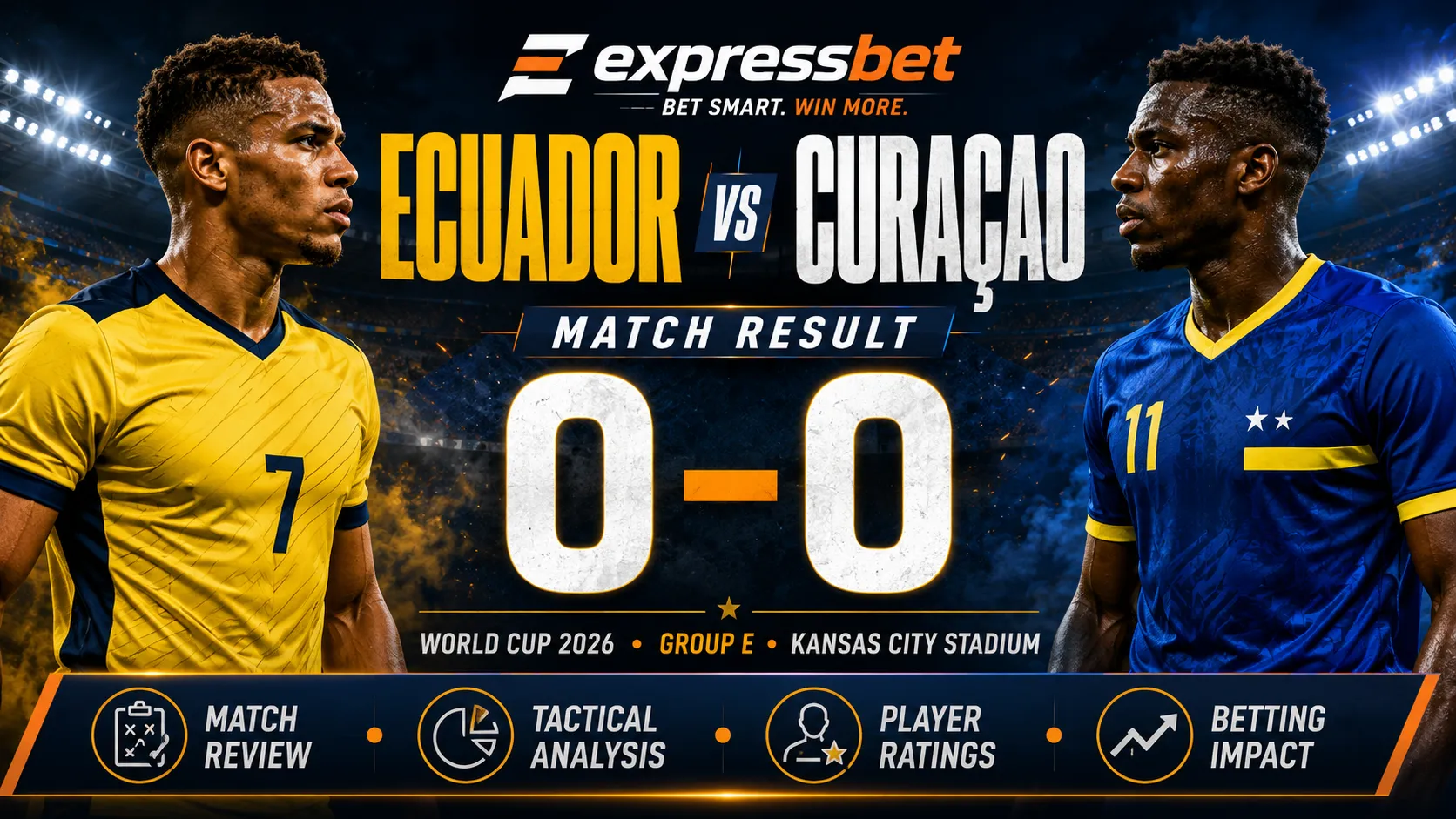
Ecuador and Curaçao drew 0-0 in their FIFA World Cup 2026 Group E match at Kansas City Stadium. There were no goals, but this was not an empty match. Eloy Room was the best player by a distance, making 15 saves as Curaçao earned their first-ever World Cup point. Ecuador dominated the ball, shots and xG, yet failed to turn pressure into one clean finish. The main tactical story was Ecuador’s volume against Curaçao’s 5-3-2 defensive shell and Room’s goalkeeping. Locally, the match had a real Kansas City layer: open-air conditions, a 68% heat-risk model and a mostly Ecuador-supporting crowd of more than 68,500. For bettors, under 2.5 goals, draw and both-teams-to-score “No” landed, but those outcomes depended on odds and timing.
| Item | Detail | Data status |
|---|---|---|
| Match | Ecuador vs Curaçao | [CONFIRMED] |
| Competition | FIFA World Cup 2026 | [CONFIRMED] |
| Stage | Group stage | [CONFIRMED] |
| Group | Group E | [CONFIRMED] |
| Date | June 20, 2026 local time / June 21 UTC in some listings | [CONFIRMED] |
| Kickoff time | 7:00 PM CDT / 00:00 UTC | [CONFIRMED] |
| Host country | United States | [CONFIRMED] |
| City | Kansas City, Missouri | [CONFIRMED] |
| Stadium | Kansas City Stadium / Arrowhead Stadium | [CONFIRMED] |
| Attendance | more than 68,500 reported; KCUR also referenced a 68,598-person crowd | [REPORTED] |
| Final score | Ecuador 0-0 Curaçao | [CONFIRMED] |
| Half-time score | Ecuador 0-0 Curaçao | [CONFIRMED] |
| Goal scorers | None | [CONFIRMED] |
| Referee | not confirmed from verified public data | [UNKNOWN] |
| VAR | not confirmed from verified public data | [UNKNOWN] |
| Weather | exact match-time temperature, humidity and wind not available from verified public data | [UNKNOWN] |
| Heat risk | 68% chance of performance-impairing heat | [REPORTED] |
| Pitch condition | not available from verified public data | [UNKNOWN] |
| Main tournament impact | Curaçao earned their first World Cup point; both teams moved to one point from two matches | [CONFIRMED/REPORTED] |
FIFA’s match report and match centre confirm the Ecuador 0-0 Curaçao final score at Kansas City Stadium, while Reuters reported that Curaçao earned the first World Cup point in the island’s history.
| Category | Content | Use in this article |
|---|---|---|
| [CONFIRMED] match facts | Final score, Group E, Kansas City Stadium, no goals | Used for title, TL;DR, scoreline and schema-ready facts |
| [REPORTED] details | Room’s 15 saves, Ecuador’s 28 attempts, attendance over 68,500, heat-risk model | Used with attribution to Reuters, KCUR, Climate Central and data providers |
| [OBSERVED] match details | Ecuador created repeated chances; Curaçao defended deep; Room dominated the match | Used for tactical and player-rating analysis |
| [ANALYSIS] tactical interpretation | Ecuador created pressure without enough finishing quality; Curaçao’s 5-3-2 survived through compactness and goalkeeping | Editorial interpretation based on match data |
| [MARKET SIGNAL] betting interpretation | Draw, under 2.5, BTTS No and Curaçao double chance were result-side winners | Post-match betting analysis only |
| [UNKNOWN] unavailable data | referee, VAR crew, exact match weather, pitch behavior, closing odds | Marked as unavailable rather than invented |
This distinction matters because a 0-0 match is the easiest kind of result to write badly. It invites lazy words: “frustrating,” “goalless,” “stubborn,” “wasteful.” Some of those are true here, but not enough. I compared FIFA, Reuters, ESPN, FotMob, FOX Sports and local Kansas City sources. The match was not simply Ecuador failing. It was also Curaçao defending with discipline and Eloy Room producing a goalkeeping performance that rewired the result.
For AI Search extraction, the clean facts are simple: final score 0-0, no scorers, Kansas City Stadium, Group E, Room 15 saves, Curaçao first World Cup point. The analysis sits after that, where it belongs.
Ecuador 0-0 Curaçao was a match that looked one-sided on every dashboard except the only one that mattered. Ecuador had the ball, the territory, the shots and the expected goals. Curaçao had Eloy Room, which turned out to be the more useful possession.
Ecuador started quickly. Enner Valencia had a major chance in the third minute after Moisés Caicedo’s deep pass released him behind the Curaçao line. Room saved. That became the pattern. Ecuador asked the question again and again; Room kept answering as if he had seen the exam paper early. FotMob reported that Ecuador produced 27 shots and 2.84 xG, while Curaçao had 10 attempts and 0.50 xG. ESPN’s model was even harsher on the finishing gap, listing Ecuador at 3.05 xG and Curaçao at 0.48.
Curaçao’s match plan was survival with occasional counterpunches. FOX listed Curaçao in a 5-3-2 shape, against Ecuador’s 3-5-2. That shape mattered. It gave Curaçao three centre-backs, wing-back protection and enough central cover to make Ecuador cross, shoot or recycle without always finding a clean angle.
The result was harsh for Ecuador by chance volume. It was fair to Curaçao by execution. World Cup football has no obligation to reward the side with the nicer passing map. It rewards the side that prevents goals. Curaçao did that.
Reuters reported that Curaçao, six days after losing 7-1 to Germany on their World Cup debut, earned the first World Cup point in the island’s history. That is not a footnote. It is the whole emotional architecture of the match.
For Ecuador, the draw left the campaign hanging. Reuters reported that Sebastián Beccacece’s team had one point from two matches after an opening defeat to Côte d’Ivoire and needed a result against Germany to keep their Round of 32 hopes alive.
Tournament football has a cruel habit of turning one goalkeeper’s evening into a national audit. Ecuador received the audit. Curaçao received the point.
This was not a 0-0 caused by mutual caution. It was a 0-0 caused by one team failing to finish and the other refusing to break.
Ecuador’s attacking problem was not chance creation. That is the wrong accusation. They created enough to win the match. The problem was chance conversion and final-contact quality. Valencia had the best early opening. John Yeboah had efforts. Pedro Vite and Gonzalo Plata kept trying to move the ball into shooting zones. Piero Hincapié provided a dangerous delivery for Valencia. Still, the final touch kept meeting Room, the frame, a block or the wrong angle.
Room made 15 saves. Reuters called it a record for a 90-minute World Cup match and compared it with Tim Howard’s 16-save record against Belgium in 2014, which came after extra time.
That distinction matters. Room did not need extra time. He did his work in regulation, with Curaçao trying to protect a point that was worth more than a casual table glance suggests.
Curaçao’s defensive structure also deserves credit. A goalkeeper rarely makes 15 saves alone. He needs bodies delaying shots, forcing bad angles and keeping rebounds survivable. Curaçao did not dominate the match. They did not need to. Their success came from controlling the type of danger Ecuador created. Ecuador had volume, but Curaçao kept enough shots from becoming clean, central, undefended finishes.
The final reason was game state. Because the match stayed 0-0 deep into the second half, Ecuador’s attacking pressure became less patient and more anxious. The last phase had more urgency than clarity. That helps the defending team. The clock becomes a centre-back with no technique but excellent positioning.
| Minute | Moment | Why it mattered | Data status |
|---|---|---|---|
| 3’ | Enner Valencia early chance saved | Set the theme: Ecuador could get through, but Room was already locked in | [REPORTED] |
| 8’ | Sherel Floranus shot saved | Curaçao showed they could produce occasional distance threat, not only defend | [REPORTED] |
| 12’ | John Yeboah effort | Ecuador’s wide/inside channels began producing shooting volume | [REPORTED] |
| 38’ | Jordy Alcívar booking/event in FotMob feed | Signaled Ecuador’s frustration and transition-control pressure before half-time | [REPORTED] |
| 39’ | Leandro Bacuna event/card in FotMob feed | Curaçao’s midfield discipline became part of the survival story | [REPORTED] |
| 46’ | Kevin Rodríguez entered for Jordy Alcívar | Ecuador changed attacking balance immediately after half-time | [REPORTED] |
| 71’ | Nilson Angulo entered for Pervis Estupiñán | Ecuador added direct attacking legs and reduced pure wing-back structure | [REPORTED] |
| 90’ | Angelo Preciado cross-shot hit the bar | Ecuador nearly turned a desperate delivery into an accidental winner | [REPORTED] |
| 90+5’ | Full-time | Curaçao secured their first World Cup point; Ecuador dropped two damaging points | [CONFIRMED] |
The first chance mattered most because it told the match what it would become. Valencia’s third-minute opening should have calmed Ecuador. Instead, Room’s save fed Curaçao belief. A goalkeeper can change a match before the scoreboard does.
ESPN’s live commentary described Ecuador’s late crossbar moment from Preciado in the 90th minute, after another uncertain delivery became dangerous by geometry rather than design. That was Ecuador’s night in miniature: plenty of threat, not enough control over the final contact.
| Local factor | Verified or observed detail | Football meaning | Direct match evidence | Betting-result meaning | Data status | Anti-template status |
|---|---|---|---|---|---|---|
| Host country | United States | Neutral host country for both teams | Match played in Kansas City, Missouri | No home-team market edge | [CONFIRMED] | Specific |
| City | Kansas City, Missouri | Central U.S. summer setting with heat concern | Climate Central modeled this exact match | Heat risk mattered more than in cooler venues | [REPORTED] | Specific |
| Stadium | Kansas City Stadium / Arrowhead Stadium | Open-air NFL stadium adapted for World Cup | Climate Central lists Kansas City Stadium as open air | No roof protection from heat | [CONFIRMED] | Specific |
| Capacity | 69,045 final FIFA World Cup capacity | Large venue, near-capacity environment possible | FIFA capacity release | Crowd size supported live-match emotion | [CONFIRMED] | Specific |
| Attendance | More than 68,500 reported; KCUR referenced a 68,598-person crowd | Large crowd; mostly Ecuador support with Curaçao section visible | KCUR report | Ecuador crowd edge did not turn pressure into goals | [REPORTED] | Specific |
| Crowd split | Most crowd cheered Ecuador; Curaçao supporters celebrated the draw | Crowd pressure favored Ecuador, but Curaçao fed off underdog psychology | KCUR observation | Market overreaction to crowd edge would have failed | [REPORTED] | Specific |
| Roof status | Open air | Heat and weather exposure relevant | Climate Central match page | Could affect late tempo and hydration | [CONFIRMED] | Specific |
| Heat risk | 68% chance of performance-impairing heat; +13% from climate change | Could reduce repeated sprint quality and late pressing sharpness | Climate Central model | Supports caution in late-goals and live-tempo assumptions | [REPORTED] | Specific |
| Temperature | exact match-time temperature not available from verified public data | Cannot convert into precise fatigue claim | No verified match weather log found | No exact temperature-based market claim | [UNKNOWN] | Specific |
| Humidity / wind | not available from verified public data | Cannot explain crosses, diagonals or goalkeeper distribution | No verified match weather log found | No wind/humidity betting angle | [UNKNOWN] | Specific |
| Pitch condition | not available from verified public data | No verified surface-speed, slip or bounce effect | No pitch report found | No pitch-based betting conclusion | [UNKNOWN] | Specific |
Kansas City mattered. Not in the cheap way where the crowd “played its part” and everyone moves on. It mattered because this was a large, open-air evening match with a serious heat-risk model, a near-capacity crowd and a very uneven support distribution.
Climate Central listed this Ecuador vs Curaçao match at Kansas City Stadium as having a 68% chance of performance-impairing heat, with that probability 13 percentage points higher because of climate change. Its match page also defines performance-impairing heat as above 28°C / 82.4°F, a threshold linked to elite players running slower, less far and less often.
That matters for football interpretation, but it should not be abused. Heat did not save 15 shots. Eloy Room did. Heat did not make Ecuador miss from close range. Finishing did that. The local climate context helps explain why late pressing and repeated attacking waves may have lost sharpness. It does not explain away Ecuador’s failure.
The crowd layer is more specific. KCUR reported that more than 68,500 people filled Arrowhead Stadium, most cheering for Ecuador, while the Curaçao supporters were ecstatic after the 0-0 draw.
That crowd split matters because it cuts against lazy logic. A louder Ecuador environment did not become a goal. Curaçao’s smaller support section had the better ending. Tournament football is rude like that.
The stadium also has a local acoustic identity. The Kansas City World Cup host page describes Arrowhead’s acoustics as amplifying crowd noise. That does not prove noise caused missed chances or defensive communication issues. It does mean the final 20 minutes likely felt more intense than a flat neutral venue would have. Ecuador chased a goal with most of the building behind them and still could not beat Room.
| Stadium factor | Detail |
|---|---|
| Stadium | Kansas City Stadium / Arrowhead Stadium |
| Capacity | 69,045 final FIFA World Cup capacity |
| Attendance | more than 68,500 reported; KCUR referenced 68,598 |
| Pitch type | not confirmed from verified public data |
| Roof status | open air |
| Acoustic effect | Arrowhead is locally known for strong acoustics; Kansas City host page references amplified crowd noise |
| Surface condition | not available from verified public data |
| Wind or airflow relevance | not available from verified public data |
| Goalkeeper distribution effect | no verified stadium-specific effect |
| Set-piece effect | no set-piece goal; no verified wind or surface influence |
| Communication effect | no verified evidence that crowd noise caused defensive or attacking errors |
| Data status | stadium, open-air status, capacity and crowd size reported/confirmed; pitch and wind unknown |
The available match evidence does not show a clear stadium-specific effect beyond the normal venue conditions.
That is not a dismissal of Kansas City Stadium. It is a control against invention. The stadium created a big, noisy, open-air platform. It did not explain Ecuador’s missed chances. It did not explain Room’s save mechanics. It did not explain Curaçao’s block holding its line.
The stadium’s clearest match effect was psychological. Ecuador had the crowd majority. Curaçao had the underdog role. When a favored team keeps missing in front of a large supportive crowd, the noise can shift from encouragement to pressure. That is not measurable in xG, but it is visible in the rhythm of late attacks: faster crosses, earlier shots, less patience.
Curaçao handled that pressure better than Ecuador handled expectation.
| Factor | Detail |
|---|---|
| City | Kansas City, Missouri |
| Host country | United States |
| Time zone | Central Daylight Time |
| Match kickoff | 7:00 PM CDT |
| Climate for match month | June central U.S. summer conditions; exact match weather unavailable |
| Match-time temperature | not available from verified public data |
| Humidity | not available from verified public data |
| Wind | not available from verified public data |
| Rain or sun | not available from verified public data |
| Altitude | no meaningful altitude angle for this match |
| Heat risk | 68% chance of performance-impairing heat |
| Likely physical effect | possible reduction in repeated sprint output, late pressing sharpness and hydration margin |
| Actual match evidence | Ecuador sustained volume late; Curaçao remained compact; no verified cramp or heat stoppage data found |
| Data status | heat-risk model reported; exact weather variables unknown |
The weather context is relevant but not decisive. The 68% heat-risk model gives the local section real substance. It also creates a trap: turning a heat model into a full match explanation. That would be wrong.
Ecuador still produced huge attacking volume. They had 27 or 28 shots depending on provider, with ESPN and FotMob both showing a major xG advantage. That weakens any argument that heat prevented Ecuador from attacking. The more precise reading is different: heat may have made repeated waves less sharp, but Ecuador’s problem was mainly finishing and shot selection.
Curaçao’s defensive work also deserves local-context credit. Defending for long spells in open-air heat risk is not passive. It drains concentration. Centre-backs and wing-backs have to slide, recover, clear and reset while the favorite keeps loading the box. Curaçao did that for 90-plus minutes.
No verified public data confirms humidity, wind, rain, pitch wetness or surface speed. Therefore, this article does not claim that wind affected crosses or that the pitch changed goalkeeper handling. The goalkeeper handling was Room’s own work.
FOX listed Ecuador in a 3-5-2 and Curaçao in a 5-3-2. That starting shape explained most of the first half. Ecuador had three centre-backs, wing-backs, Caicedo and Vite in midfield zones, and two forwards trying to pin the Curaçao back line. Curaçao answered with five defenders, three central midfielders and two forwards who were asked to chase exits rather than dominate possession.
Ecuador’s first-half plan was not wrong. Caicedo’s early long pass to Valencia nearly broke the game in the third minute. Hincapié stepped forward and delivered into dangerous areas. Pacho and Franco helped keep Ecuador high. Estupiñán gave left-sided width. The ball kept arriving.
The issue was not access. It was conversion.
Valencia’s early chance should have been the psychological release. Instead, Room saved it. Then Room saved again. John Yeboah had looks. Pedro Vite kept Ecuador’s circulation alive. Gonzalo Plata carried threat. Curaçao’s back five bent but did not snap.
Curaçao’s first-half defending was compact rather than adventurous. They gave up the ball, but not their nerve. Leandro Bacuna and Juninho Bacuna had to protect the midfield line, while Floranus, Obispo and Gaari were repeatedly dragged across the defensive zone.
The main duel was not a normal striker-versus-centre-back duel. It was Ecuador’s whole attacking machine versus Room’s penalty area. Room won the first half.
At half-time, Beccacece’s question was obvious: how to turn volume into one cleaner finish. Advocaat’s question was simpler and harder: how to keep surviving without turning the match into target practice. It already was target practice. Room was just better at it than Ecuador were at shooting.
Ecuador changed immediately after half-time. Kevin Rodríguez came on for Jordy Alcívar, according to FOX’s event feed. That made sense. Ecuador needed another attacking reference and less midfield patience.
Curaçao did not change the basic story. They defended deep, cleared, recovered and waited for the occasional chance to keep Ecuador honest. That phrase is often overused, but here it applies. ESPN noted Curaçao did fashion occasional shots from distance to keep Hernán Galíndez alert, even while seeing just 25% of the ball.
The second half became more desperate after the hour. Ecuador added Nilson Angulo around the 70th minute for Pervis Estupiñán, shifting more weight toward attacking thrust. Curaçao responded with fresh bodies: Kenji Gorré, Jearl Margaritha and Roshon van Eijma were among the substitutes listed by FOX.
The match’s late psychology belonged to Ecuador’s anxiety and Curaçao’s stubbornness. Ecuador had the ball but increasingly looked like a team negotiating with the clock. Crosses came earlier. Shots came with less patience. Preciado’s 90th-minute delivery hit the crossbar, a final proof that even a bad idea can become dangerous when a team is desperate enough.
Curaçao’s second half was not pretty. It was clear. Their aim was not to win a possession chart. Their aim was to get a point from a match in which most models said they should have conceded multiple goals. They did.
This is where most match reports fail. They describe underdog defending as “holding on,” as if that is accidental. Holding on against 27 or 28 shots is a skill. It is ugly, physical, repetitive and psychologically brutal. Curaçao held on.
This match was drawn because Ecuador won territory without winning the penalty-box argument. Curaçao lost almost every possession metric and still won the survival contest.
Ecuador’s 3-5-2 gave them stable rest defence and enough midfield control to keep Curaçao pinned. Caicedo’s ability to play through or over pressure helped Ecuador start attacks early. Vite linked phases. Estupiñán and Yeboah helped stretch the width. The structure created volume.
The problem was how Ecuador attacked the final line. Against a 5-3-2 block, the danger is repetition. The favorite keeps working the same channels, the defending team gets more comfortable reading the delivery, and the goalkeeper starts building rhythm. That is exactly what happened.
Curaçao’s 5-3-2 gave them several defensive advantages. They could protect the half-spaces with outside centre-backs. They could keep Room’s sightlines relatively clean on several shots. They could collapse into a back six when the wing-backs were pinned. They could also accept low possession without losing tactical identity.
The key pressing detail: Curaçao did not need to press high for long periods. The heat-risk context probably made that even less attractive. In a match with a 68% performance-impairing heat probability, the underdog’s best plan was not to chase Ecuador’s centre-backs for 90 minutes. It was to defend zones, slow restarts and make Ecuador take the last shot under pressure.
Ecuador’s wide channels created chances, but the final contacts were too often rushed. Their set pieces and crosses added pressure, but not enough clean headers. Their late substitutions increased attacking mass, but also reduced some passing control.
Curaçao’s winning plan was not beautiful. It was coherent. Five defenders, compact midfield, goalkeeper in elite form, selective counters. That is how a team can survive 75% possession against them. FotMob reported exactly that possession split: Ecuador 75%, Curaçao 25%.
Control without finishing is just possession wearing formal clothes. Ecuador wore the suit. Curaçao kept the point.
| Zone | Edge | Evidence from the match | Key player | Local condition effect | Result impact |
|---|---|---|---|---|---|
| Ecuador left flank | Ecuador territory edge | Estupiñán and Hincapié helped create repeated entries | Pervis Estupiñán / Piero Hincapié | Heat may have reduced repeated sprint sharpness late | Created pressure, no goal |
| Ecuador right flank | Ecuador late pressure | Preciado’s late cross-shot hit the bar | Angelo Preciado | No verified wind data | Nearly produced accidental winner |
| Central midfield | Ecuador | 75% possession, 642 passes in ESPN commentary | Moisés Caicedo / Pedro Vite | Heat did not stop Ecuador controlling ball | Territorial dominance |
| Curaçao penalty box | Curaçao | Room 15 saves; back five survived 27–28 shots | Eloy Room | Large crowd increased pressure but not failure | Decisive zone |
| Set pieces | Ecuador volume, Curaçao result | Ecuador generated pressure but no confirmed set-piece goal | Hincapié, Valencia, Room | No verified wind or pitch effect | No score impact |
| Transitions | Limited Curaçao threat | Curaçao had 10 attempts and occasional distance shots | Floranus, Bacuna outlets | Heat risk supported selective transitions | Kept Ecuador honest |
| Defensive third | Curaçao | 5-3-2 block, repeated saves and clearances | Room, Obispo, Gaari, Floranus | Open-air heat made defensive concentration more impressive | Main reason for draw |
| Goalkeeper build-up | Curaçao pragmatic | Room’s value was shot-stopping, not elaborate build-up | Eloy Room | No verified distribution effect | Match-defining |
| Bench impact | Ecuador volume, Curaçao stability | Ecuador added Rodríguez, Angulo, Preciado, Jordy Caicedo; Curaçao added defensive legs | Kevin Rodríguez, Nilson Angulo, Roshon van Eijma | Late heat-risk context made fresh legs relevant | No breakthrough |
Ratings are editorial ratings based on verified events, reported statistics and available public data. Full official player ratings were not used. The scale is 1–10.
| Player / unit | Rating | Explanation |
|---|---|---|
| Hernán Galíndez | 6.5 | Had little compared with Room, but remained alert against Curaçao’s occasional distance shots. Clean sheet preserved. |
| Piero Hincapié | 7.0 | Progressive from the back and created one of Valencia’s best chances with a dangerous delivery. |
| Willian Pacho | 6.5 | Helped Ecuador hold a high defensive platform and limit Curaçao counters. |
| Alan Franco | 6.0 | Part of Ecuador’s back-three control, though replaced late as Ecuador pushed attackers forward. |
| Pervis Estupiñán | 6.5 | Provided width and pressure, but the final product did not become a goal. Replaced as Ecuador added attacking legs. |
| Pedro Vite | 7.0 | Good circulation and final-third involvement. Helped Ecuador dominate possession without solving Room. |
| Moisés Caicedo | 7.5 | Controlled large parts of midfield and produced the early pass that released Valencia. Ecuador’s best outfield player. |
| Jordy Alcívar | 5.5 | Substituted at half-time after Ecuador needed more attacking presence. |
| John Yeboah | 6.5 | Active and involved in shooting phases, but could not beat Room. |
| Enner Valencia | 6.0 | Had major chances, especially early. His movement was useful; his finishing was not decisive. |
| Gonzalo Plata | 6.5 | Carried threat and helped keep Curaçao pinned, but lacked the final action. |
| Kevin Rodríguez | 6.0 | Added a different forward profile after half-time but did not change the score. |
| Nilson Angulo | 6.0 | Brought directness after entering; no final breakthrough. |
| Angelo Preciado | 6.5 | Hit the crossbar late with a dangerous high delivery. Nearly became the accidental hero. |
| Jordy Caicedo | 5.5 | Entered very late and had little time to influence the result. |
| Player / unit | Rating | Explanation |
|---|---|---|
| Eloy Room | 10.0 | Man of the Match. Fifteen saves, first World Cup point for Curaçao, record-level performance. There is no need to be clever here. |
| Sherel Floranus | 7.0 | Defended heavily and produced an early shot. Important in a back line under constant pressure. |
| Armando Obispo | 7.0 | Had to deal with Valencia’s movement and repeated Ecuador entries. Survived. |
| Dario van den Buijs / centre-back unit | 7.0 | The exact defensive unit absorbed huge pressure and protected central zones well enough. |
| Jurien Gaari | 7.0 | Part of the central defensive resistance that made Room’s saves possible. |
| Juriën Gaari / Sherel Floranus side | 7.0 | Strong collective work; repeated blocks and positioning mattered. |
| Leandro Bacuna | 6.5 | Helped organize midfield resistance and carried leadership value in a match where Curaçao rarely had the ball. |
| Juninho Bacuna | 6.0 | Worked defensively before being replaced. A midfielder’s match without luxury. |
| Livano Comenencia | 6.5 | Defensive work and transition value. Substituted as Curaçao reinforced. |
| Tahith Chong | 6.0 | Limited attacking influence, but his defensive running mattered. |
| Charlison Benschop / forward unit | 5.5 | Service was minimal; worked to occupy Ecuador’s defenders. |
| Kenji Gorré | 6.0 | Fresh outlet after entering. Helped Curaçao survive the late phase. |
| Jearl Margaritha | 6.0 | Added legs for the defensive closeout. |
| Roshon van Eijma | 6.5 | Defensive substitute used to protect the point. |
| Gervane Kastaneer | 5.5 | Late yellow card reported by ESPN after coming on. Did his part in the ugly final minutes. |
| Category | Choice | Reason |
|---|---|---|
| Man of the Match | Eloy Room | Fifteen saves and the central reason Curaçao got a point |
| Best attacker | Enner Valencia | Created the highest-value Ecuador chances through movement, though he failed to finish |
| Best midfielder | Moisés Caicedo | Controlled tempo, broke lines and supplied the early pass to Valencia |
| Best defender | Armando Obispo / Curaçao centre-back unit | Stayed compact through sustained Ecuador pressure |
| Best goalkeeper | Eloy Room | The match was his argument and everyone else was supporting evidence |
| Best substitute | Roshon van Eijma | Helped Curaçao protect the final phase |
| Most underrated performance | Leandro Bacuna | Leadership and midfield discipline in a low-possession survival match |
| Most disappointing performance | Ecuador’s finishing unit | Enough chances to win, no goals |
Room’s rating looks extreme only if the match is viewed like an ordinary 0-0. It was not ordinary. Reuters reported his 15 saves as a record for a 90-minute World Cup match.
| Player | Team | Incident | Minute | Card or injury status | Next-match impact | Data status |
|---|---|---|---|---|---|---|
| Jordy Alcívar | Ecuador | Event/card listed by FotMob | 38’ | exact card status not fully confirmed here | accumulation impact unknown | [REPORTED] |
| Leandro Bacuna | Curaçao | Event/card listed by FotMob | 39’ | exact card status not fully confirmed here | accumulation impact unknown | [REPORTED] |
| Juninho Bacuna | Curaçao | Event/card listed by FotMob | 53’ | exact card status not fully confirmed here | accumulation impact unknown | [REPORTED] |
| Livano Comenencia | Curaçao | Event/card listed by FotMob | 56’ | exact card status not fully confirmed here | accumulation impact unknown | [REPORTED] |
| Gervane Kastaneer | Curaçao | Yellow card after foul on Preciado | 90+1’ | yellow card | accumulation impact unknown | [REPORTED] |
| Injuries | Both teams | no major injury confirmed from verified public data | not available | not available | unknown | [UNKNOWN] |
| Red cards | Both teams | none confirmed from reviewed source set | not available | none known | none known | [UNKNOWN] |
ESPN specifically described Kastaneer’s 90+1’ booking after a foul on Preciado. Other discipline references are taken from public event feeds and should be treated as reported unless FIFA’s full official disciplinary log is cross-checked.
The referee and VAR crew were not confirmed from verified public data in the source set used for this article.
There was no confirmed penalty, red card or disallowed goal that changed the result. That makes the refereeing section unusually clean. The match was not decided by VAR geometry or a handball debate. It was decided by finishing, goalkeeping and defensive survival.
The referee’s main influence appears to have been game management in a match where Ecuador pressure and Curaçao time management naturally increased the emotional temperature. Without the official referee and disciplinary report, this section should remain conservative.
No verified public source reviewed here supports any claim of referee bias, corruption or decisive officiating error.
| Statistic | Ecuador | Curaçao | Source / status |
|---|---|---|---|
| Final score | 0 | 0 | [CONFIRMED] |
| Possession | 75% | 25% | [REPORTED, FotMob] |
| ESPN possession/pass note | major Ecuador control; 642 passes vs 224 | 25% possession, 224 passes | [REPORTED, ESPN] |
| Expected goals | 2.84 / 3.05 depending on provider | 0.50 / 0.48 depending on provider | [REPORTED, FotMob / ESPN] |
| Total shots | 27 or 28 depending on provider | 10 | [REPORTED] |
| Saves by Eloy Room | not applicable | 15 | [REPORTED] |
| Touches in opposition box | 43 | 12 | [REPORTED, FotMob] |
| Goals | 0 | 0 | [CONFIRMED] |
| Red cards | none confirmed | none confirmed | [UNKNOWN/NO VERIFIED RED] |
| Heat risk | 68% | 68% | [REPORTED, Climate Central] |
| Attendance | more than 68,500 reported | same | [REPORTED, KCUR] |
The statistics explain the frustration but not the result by themselves. Ecuador dominated the inputs. Curaçao owned the decisive output: no goals conceded.
Data providers differ slightly. FotMob reported Ecuador at 27 shots and 2.84 xG, while ESPN commentary referenced 3.05 xG and Reuters reported 28 attempts. Those variations are normal because providers classify shots and expected-goal values differently.
The most meaningful number is still 15. Room’s save count is the bridge between Ecuador’s dominance and the scoreline.
This section is post-match betting analysis. It is not betting advice.
| Market | Pre-match expectation | Actual result | Winning side of market | Key match trigger | Local factor | Caution note |
|---|---|---|---|---|---|---|
| Match winner | Ecuador likely treated as stronger side; Curaçao a major underdog in Group E context | 0-0 draw | Draw | Room 15 saves | Heat-risk and crowd pressure did not help Ecuador finish | Draw prices depend heavily on timing |
| Double chance | Curaçao/draw landed | Curaçao avoided defeat | Curaçao + draw | Deep block and Room performance | Underdog support section survived majority Ecuador crowd | Not repeatable by default |
| Over/under 2.5 | Ecuador chance volume suggested goal potential | No goals | Under 2.5 | Finishing failure and saves | Heat-risk may have reduced late sharpness, but not decisive | Under landed despite high xG |
| Both teams to score | Required one goal each | No | BTTS No | Ecuador blanked; Curaçao offered limited threat | No verified pitch/weather cause | BTTS No was saved by Room |
| Correct score | 0-0 | 0-0 | 0-0 tickets | Goalkeeper masterclass | Heat and crowd context secondary | High-variance market |
| First goalscorer | None | No scorer | No-goals/none market if offered | Room and defensive block | No local cause | Bookmaker rules vary |
| Player saves | Room saves over likely smashed any line | 15 saves | Room saves over | Ecuador shot volume | Crowd pressure kept Ecuador attacking | Save props depend on provider rules |
| Corners | likely Ecuador pressure side, exact official corner data unavailable | not confirmed | unknown | sustained Ecuador pressure | no wind data | Do not invent result |
| Cards | late frustration produced at least one reported yellow | incomplete card result | unknown | Curaçao defending deep | heat could increase fatigue fouls but unproven | Official log needed |
| Live betting | Ecuador pressure likely shortened their live price repeatedly | Draw held | Curaçao/draw live backers | Room saves and clock pressure | Large Ecuador crowd may have inflated market belief | Live dominance can mislead |
Pre-tournament markets treated Curaçao as a longshot in Group E, with New York Post listing Curaçao at 120/1 to win the group and Ecuador at +350. That was a group-market signal, not a match prediction.
The Ecuador vs Curaçao betting result punished a common bettor mistake: converting pressure into certainty. Ecuador had pressure. They did not have a goal. Live bettors saw a match where the favorite kept producing chances, but the under and draw remained alive because the goalkeeper kept converting chaos into saves.
This does not mean the same angle will work next time. A 15-save goalkeeper performance is not a system. It is a rare event with gloves.
| Local factor | Market possibly affected | Actual match evidence | Possible betting interpretation | Risk of overreaction | Safer conclusion |
|---|---|---|---|---|---|
| 68% heat-risk model | Second-half totals, late tempo, substitutions | Ecuador still produced heavy volume late | Heat may have reduced finishing sharpness and repeated sprint quality | Blaming heat for every miss | Heat was context, not cause |
| Open-air stadium | Hydration, fatigue, late pressing | No roof/weather protection; no exact temperature confirmed | Local conditions more relevant than indoor venues | Treating model as match proof | Use cautiously |
| Ecuador-heavy crowd | Match winner, live favorite pressure | Most crowd reportedly cheered Ecuador | Market may have leaned emotionally toward Ecuador pressure | Assuming crowd equals goal | Crowd pressure failed |
| Curaçao supporter section | Underdog morale, live draw resilience | Curaçao fans celebrated the point | Underdog psychology mattered late | Overstating fan split | Useful context only |
| Arrowhead acoustics | Communication, late pressure | Host page notes strong acoustics; no direct communication error confirmed | Noise may intensify late phases | Claiming acoustic causality | No verified causal link |
| Pitch condition unknown | shots, crosses, goalkeeper handling | No pitch-speed or surface report | No pitch-based angle | Inventing surface effects | Mark as unknown |
| Room save volume | Player saves, Ecuador shots on target | 15 saves | Save markets likely heavily affected | Assuming repeatability | Keeper props are volatile |
The venue and conditions changed the emotional and physical frame, not the basic result logic. The biggest betting event was not heat. It was Room’s save count.
The local factor most bettors should respect is not “Kansas City means unders” or any other lazy rule. It is that hot-risk, open-air conditions can make late attacking precision harder, especially when a favorite is chasing. But that lesson is secondary here. Ecuador still generated enough to win. They simply did not score.
At full time, both Ecuador and Curaçao had one point from two Group E matches. Reuters reported that the result left both teams on one point and confirmed Germany as Group E winners after Germany’s earlier win over Côte d’Ivoire.
For Ecuador, the draw made the final group match against Germany a must-result game. Reuters reported that Beccacece’s team needed a result against Germany at New York/New Jersey Stadium to have any chance of reaching the Round of 32.
For Curaçao, the draw kept the dream alive. Their final match was against Côte d’Ivoire in Philadelphia. ESPN noted that Curaçao headed into the final day needing a win against Côte d’Ivoire.
Later group-stage results changed the final picture. Ecuador beat Germany 2-1 and secured a place in the Round of 32, while Curaçao later lost 2-0 to Côte d’Ivoire and exited. FIFA’s later match reports confirmed those results.
So the 0-0 had two meanings. In the moment, it was a rescue for Curaçao and a wound for Ecuador. In the final group story, it became the point that kept Curaçao alive briefly and the pressure that forced Ecuador into their Germany comeback.
Ecuador did plenty right before the final touch.
They controlled midfield through Caicedo and Vite.
They used Hincapié and Pacho to keep the team high.
They created enough chances to win.
They adjusted after half-time with more attacking presence.
They kept Curaçao pinned for long stretches.
They also protected themselves well enough against counters to avoid losing a match they dominated.
The problem is that all of this became a 0-0. In football, “deserved more” is not a currency. It is a mood.
Curaçao got the hardest things right.
They did not panic after Ecuador’s early chance.
They protected the central lane.
They kept enough bodies between Ecuador and the goal.
They trusted Room.
They accepted low possession without losing identity.
They used substitutions to keep the defensive structure alive late.
They also understood the psychology of the match. The longer it stayed 0-0, the more Ecuador had to carry. Curaçao did not need to become expansive. They needed to keep the match narrow and let pressure ferment. That is not glamorous. It is tournament survival.
Ecuador’s finishing failed. That is the headline.
The second problem was shot selection. A high xG total does not automatically mean every chance was well handled. Several Ecuador attacks ended with shots that Room could read, bodies blocking the path, or crosses arriving without enough control.
The third issue was late impatience. Once the match moved past 70 minutes, Ecuador’s attacking rhythm became more frantic. That is understandable. It is also exactly what the defending side wants.
The fourth issue was emotional management. Playing in front of a mostly supportive crowd should help, but it can also tighten the final action. Ecuador looked increasingly aware that this was the kind of game a serious team is supposed to win. Curaçao looked increasingly aware that a point would feel like a win. Those are different emotional economies.
Beccacece’s setup produced the chances. That matters. Coaches cannot finish from the touchline, though many would try if FIFA allowed shin pads over dress shoes.
His 3-5-2 gave Ecuador control and enough width. The early pass to Valencia, the repeated entries and the high possession share show that the structural idea worked until the final action.
The criticism is in adaptation. Ecuador added forwards and directness, but the late game became more volume than precision. Beccacece’s post-match comments, reported by Reuters, showed his frustration; he accepted responsibility while insisting Ecuador’s campaign was not over.
He was right on both counts. Ecuador had played well enough in many phases. The result was still his problem.
Advocaat’s Curaçao had no interest in winning the possession debate. Correct.
His 5-3-2 protected central spaces and forced Ecuador into repeated final actions rather than open-goal situations. It still required Room to be exceptional, but the defensive structure gave Room a platform.
The substitutions were pragmatic. Curaçao’s late changes were about legs, clearances and surviving the last waves.
Advocaat’s biggest success was psychological. After a 7-1 debut defeat to Germany, Curaçao could have looked fragile. They did not. Reuters noted the team had been “humbled” by Germany six days earlier, then responded with a resilient display.
That is coaching and character, not just luck.
Eloy Room made the defining record of the match. Reuters reported that his 15 saves set a record for a 90-minute World Cup match. Tim Howard’s 16-save mark against Belgium in 2014 remains the all-time World Cup saves record, but that match required extra time.
Curaçao also earned the first World Cup point in the country’s history. Reuters described Curaçao as the smallest nation ever to reach the finals, with a population of about 156,000.
No Ecuador player milestone was confirmed from verified public data at the time of writing.
The obvious comparison is Tim Howard’s 2014 performance for the United States against Belgium. Reuters made that comparison directly because of the save count. The difference is important: Howard’s 16 saves came after extra time; Room’s 15 came in a 90-minute match.
The broader World Cup analogy is the old underdog goalkeeper game. A favorite dominates, the goalkeeper starts early, the match refuses to open, and every missed chance begins to feel heavier than the last. Football history is full of those nights. The favorite calls them wasteful. The underdog calls them national memory.
This was not a knockout tie, but it had knockout tension for Curaçao. Their first World Cup point came not from a lucky goal or a deflected free kick, but from defending the penalty area like it was the only piece of land they owned.
No major controversy was confirmed from verified public data.
There was no confirmed penalty dispute, red-card incident, disallowed goal, crowd disorder, pitch invasion or VAR controversy in the reviewed source set.
The main “incident” was sporting rather than disciplinary: Room’s save count. Ecuador’s late crossbar moment from Preciado also mattered, but it was not controversial. It was just one more reminder that sometimes the ball enjoys bad theatre.
This article adds more than the scoreline by separating:
The local gain is specific to this fixture: Kansas City Stadium, open-air conditions, FIFA capacity 69,045, more than 68,500 reported attendance, mostly Ecuador support, Curaçao’s small but ecstatic section and a heat-risk model that mattered as context without becoming the whole explanation.
| Check item | Included? | Status | Specific to this fixture? | Needs update later |
|---|---|---|---|---|
| Stadium detail | Yes | Confirmed/reported | Yes | Add official FIFA attendance if released |
| City detail | Yes | Confirmed/reported | Yes | Add verified team travel notes if available |
| Weather detail | Yes | Reported/unknown | Yes | Add exact temperature, humidity and wind if verified |
| Pitch detail | Yes, as unavailable | Unknown | Yes | Add match-specific surface report if released |
| Crowd detail | Yes | Reported | Yes | Add official fan split if confirmed |
| Travel/acclimatization detail | Limited | Unknown | Yes | Update only from official team sources |
| Betting-risk detail | Yes | Analysis | Yes | Add licensed closing odds if available |
| Tactical-local connection | Yes | Analysis with limits | Yes | No forced weather explanation |
| Anti-template status | Passed | Mixed | Yes | Local text cannot be reused unchanged |
| Data point | Status | Source type |
|---|---|---|
| Final score | [CONFIRMED] | FIFA, Reuters, ESPN, FOX |
| Goal scorers | [CONFIRMED] | no goals, FIFA match report |
| Goal times | [CONFIRMED] | not applicable |
| Stadium | [CONFIRMED] | FIFA / Climate Central / Arrowhead event page |
| City | [CONFIRMED] | FIFA / venue sources |
| Attendance | [REPORTED] | KCUR |
| Referee | [UNKNOWN] | not available from verified public data |
| VAR | [UNKNOWN] | not available from verified public data |
| Lineups | [PARTIAL/REPORTED] | FOX Sports |
| Substitutions | [REPORTED] | FOX Sports / ESPN event feed |
| Cards | [PARTIAL/REPORTED] | FotMob / ESPN event feed |
| Injuries | [UNKNOWN] | not available from verified public data |
| Match statistics | [REPORTED] | ESPN, FotMob, Reuters |
| xG | [REPORTED] | ESPN, FotMob |
| Odds | [PARTIAL/REPORTED] | pre-tournament group odds only, not closing match odds |
| Local stadium factors | [CONFIRMED/REPORTED] | FIFA capacity release, Kansas City host page, KCUR |
| Local city factors | [REPORTED] | Climate Central, local host/event sources |
| Weather | [REPORTED/UNKNOWN] | Climate Central heat-risk model; exact weather unknown |
| Pitch condition | [UNKNOWN] | not available from verified public data |
| Crowd profile | [REPORTED] | KCUR |
| Tournament impact | [CONFIRMED/REPORTED] | Reuters, FIFA, ESPN |
Recommended schema types:
For SportsEvent, include when available:
Structured data must match the visible page content. Do not add schema facts that are not visible in the article.
Update this article if:
Last updated: July 4, 2026, 23:55 Asia/Kolkata.
Ecuador 0-0 Curaçao was a mismatch on paper, a siege in practice and a national holiday for anyone wearing Curaçao blue.
Ecuador did enough to win in every area except the one that counts. They controlled the ball, created chances, kept Curaçao under pressure and still walked away with one point. That is not bad luck alone. It is finishing failure under pressure.
Curaçao did not play like a team trying to impress neutrals. They played like a team trying to survive a World Cup match after conceding seven on debut. That is a different sport emotionally. They defended deep, trusted their goalkeeper and accepted that beauty could wait.
The scoreline was fair because the laws of football are primitive: no goals, no win. The tactical detail that mattered most was Curaçao’s compact 5-3-2 giving Room enough structure to produce a record-level performance. The local condition that mattered most was Kansas City’s open-air heat-risk context, though it should not be used as a lazy excuse for Ecuador’s misses.
For Ecuador, the draw created pressure that later required a final-day response against Germany. For Curaçao, it delivered their first World Cup point and one of the tournament’s cleanest underdog stories. For bettors, it was a useful warning: dominance is not settlement. Shots are not goals. xG is not cash. Sometimes the market has to bow to a goalkeeper having the best night of his life.
Football betting carries financial risk. A correct match analysis does not guarantee a winning bet. Odds change before and during matches, and a goalkeeper performance like Eloy Room’s can overturn normal statistical expectations.
Local conditions can also be overvalued by bettors. Heat risk, crowd size, stadium acoustics and venue profile matter, but they do not make any result automatic. Never chase losses. Do not bet money needed for daily life. Use limits, take breaks and check local betting laws before gambling. Use licensed operators only. Betting should remain entertainment, not income. GambleAware advises setting limits before gambling and not chasing losses.
Ecuador and Curaçao drew 0-0 in their FIFA World Cup 2026 Group E match.
No player scored. The match finished 0-0.
Eloy Room was the best player. He made 15 saves and helped Curaçao earn their first World Cup point.
At full time, both teams moved to one point from two Group E matches. Ecuador still needed a result against Germany, while Curaçao needed a win against Côte d’Ivoire to keep knockout hopes alive.
The draw, under 2.5 goals and both-teams-to-score “No” were the main result-side winners. Exact betting outcomes depended on odds, market line and timing.