
England vs Croatia Match Result
Table of Contents Show
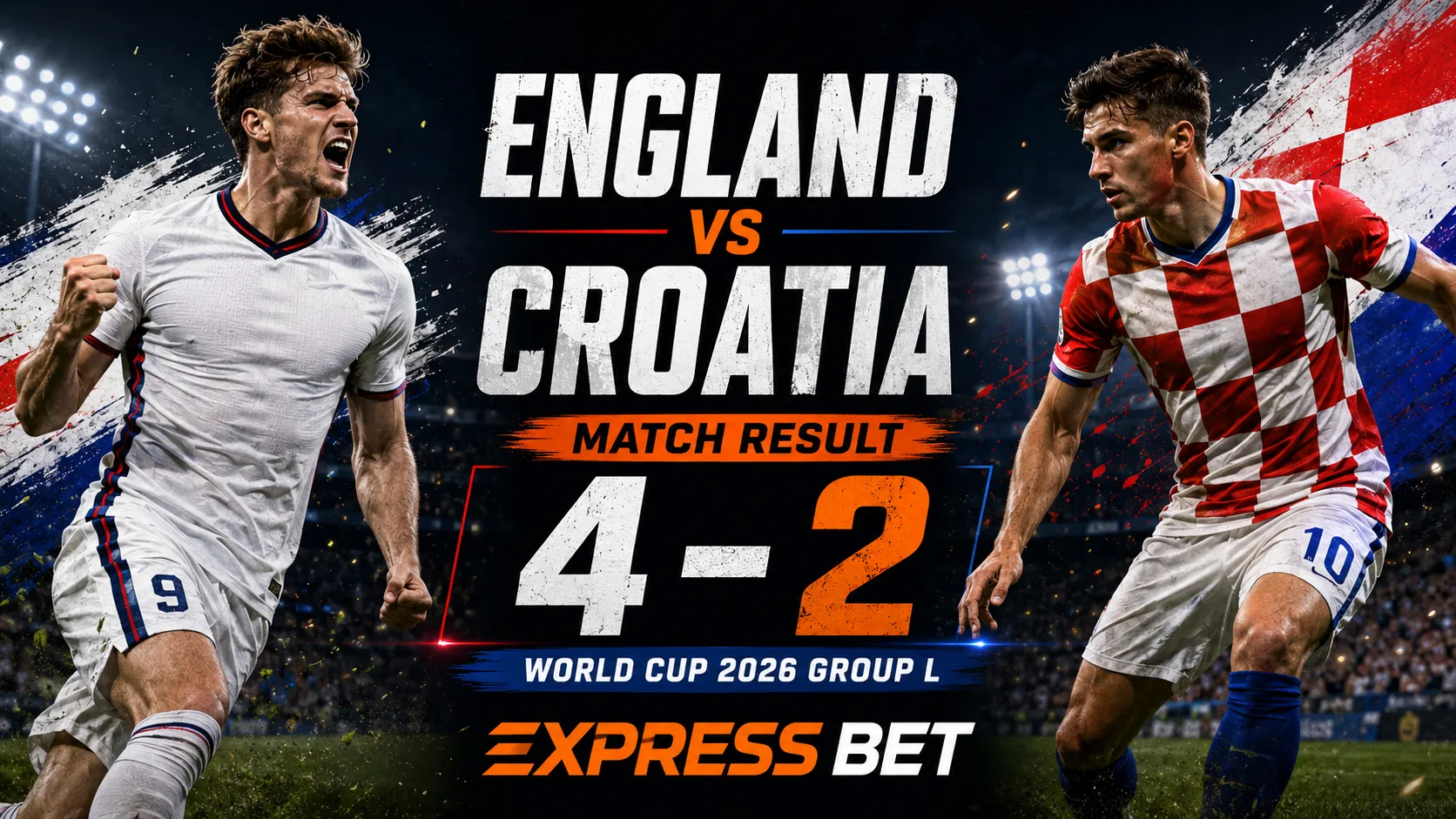
The England vs Croatia match result was a 4-2 win for England in their FIFA World Cup 2026 Group L opener at Dallas Stadium. Harry Kane scored twice in the first half, including a retaken penalty and a header from a Declan Rice corner. Croatia twice equalised through Martin Baturina and Petar Musa, but England controlled the second half through Jude Bellingham’s 47th-minute goal and Marcus Rashford’s 85th-minute finish from Bukayo Saka’s assist. Kane was the best player, Bellingham changed the tempo, and England’s bench closed the match. Betting outcomes rewarded England moneyline, over 2.5 goals, both teams to score, and Kane scorer markets, depending on odds and market timing.
| Detail | Information |
|---|---|
| Match | England vs Croatia |
| Competition | FIFA World Cup 2026 |
| Stage | Group stage |
| Group | Group L |
| Date | 17 June 2026 |
| Kickoff time | 3:00 p.m. local time / 20:00 UTC |
| Host country | United States |
| City | Arlington / Dallas, Texas |
| Stadium | Dallas Stadium / AT&T Stadium |
| Final score | England 4-2 Croatia |
| Half-time score | England 2-2 Croatia |
| Attendance | 70,389 reported |
| Referee | Clément Turpin, France |
| VAR | Full VAR crew not confirmed in the sources used |
| England formation | 4-2-3-1 |
| Croatia formation | 3-4-3 |
| Weather | Hot Arlington day; historical average around 28.6°C |
| Stadium conditions | Climate-controlled stadium environment reported |
| Pitch condition | No major confirmed pitch controversy |
| Surface type | Not confirmed in the sources used |
| Roof status | Stadium roof / climate control reduced direct weather impact |
| Penalties | Harry Kane scored a retaken penalty |
| Red cards | None |
| Yellow cards | None in FOX match statistics |
| VAR involvement | Kane penalty retaken after goalkeeper movement / encroachment review |
| Betting result | England win; over 2.5 goals; both teams to score “Yes” |
England beat Croatia 4-2, and the scoreline tells the truth only if it is allowed to include the first-half mess.
This was not a smooth opening statement from England. It was a powerful one, eventually. There is a difference. Thomas Tuchel’s side scored four, created heavily, and finished the match looking like the better team by a wide margin. They also spent much of the first half defending like a side that had been handed a tactical map but folded it badly.
Croatia twice came back before half-time. That alone says enough about England’s early control. Harry Kane gave England the lead from a retaken penalty in the 12th minute. Martin Baturina equalised in the 36th. Kane restored the lead in the 42nd with a header from a Declan Rice corner. Petar Musa then made it 2-2 in first-half stoppage time, turning the interval into a small English inquiry.
Tournament football enjoys that kind of thing. It gives a favourite an early penalty, lets them feel mature for a few minutes, then starts asking questions about defensive spacing.
Croatia were brave and technically sharp in the first half. Luka Modrić started as captain on his 199th cap and still had enough authority to help Croatia find rhythm in possession. Ivan Perišić gave them width and later assisted Musa’s equaliser. Baturina attacked the space between England’s midfield and back line well. Musa gave Croatia a direct penalty-box reference.
England, meanwhile, had more attacking quality than defensive calm. Noni Madueke won the early penalty and justified his start ahead of Bukayo Saka. Kane looked like the most complete footballer on the pitch, not only as a scorer but as a connector. Jude Bellingham had flashes before half-time but did not yet own the game. Declan Rice delivered the corner for Kane’s second but later left with lower-back discomfort, which gives England a practical concern before Ghana.
The second half was different.
England came out with more conviction, more verticality and much better distances. Bellingham scored in the 47th minute, driving into space and finishing low across goal. That was the match’s decisive shift. Croatia had answered England twice in the first half. They did not answer this one.
After that, England became sharper in transition and more secure around second balls. Croatia made changes. Mateo Kovačić entered early in the second half. Igor Matanović and Marco Pašalić followed. Andrej Kramarić and Nikola Vlašić arrived late. The idea was logical: more legs, more forward options, more technical help. It did not restore control.
Tuchel’s bench had the stronger effect. Saka, Marcus Rashford and Morgan Rogers entered around the 72nd minute. Rashford gave direct running. Saka gave the late assist. Djed Spence added fresh legs. Marc Guéhi came on late for John Stones to close the match.
Rashford’s 85th-minute goal made it 4-2 and killed Croatia’s last serious hope. Saka’s pass found him, and Rashford finished calmly. It was a substitute goal in the most useful sense: not decorative, not ceremonial, but decisive.
England finished with 20 shots, 12 on target, 2.88 xG and eight corners. Croatia had 11 shots, five on target, and 0.92 xG. That statistical profile supports the final result. But the first half still matters because England conceded twice from a position of advantage. The win was deserved. The warning was also deserved.
England’s opener came from a penalty sequence that immediately gave the match a legal department.
Noni Madueke attacked Croatia’s defensive left side and drew the foul. Luka Modrić was involved in the penalty concession, which made the scene even more loaded. A 40-year-old Croatian captain giving England a penalty in a World Cup opener is the kind of detail football writers do not need to invent because football is already strange enough.
Kane’s first attempt was saved by Dominik Livaković. The relief lasted briefly. Referee Clément Turpin ordered a retake after the goalkeeper was ruled to have moved early, with encroachment also part of the discussion in live reports.
Kane did not waste the second chance. He struck the retaken penalty firmly into the right side of the goal as Livaković moved the wrong way.
Tactically, the goal rewarded England’s early wide aggression. Madueke had started because Tuchel wanted direct one-v-one threat. Within 12 minutes, that decision had produced the opening goal.
Emotionally, the goal should have settled England. It did not. That was the first clue that this match was not going to follow the favourite’s preferred script.
Croatia’s first equaliser came from England’s bad habit of giving good midfielders time near the edge of the box.
Baturina received in a dangerous central pocket after England’s midfield pressure broke down. He set himself and struck toward goal. Jordan Pickford got a hand to the shot but could not keep it out.
The finish was sharp. The defending was not.
England’s problem was the space between the midfield and defence. Rice and Elliot Anderson had moments of control on the ball, but England were not always compact when possession turned over. Baturina found the lane, attacked it, and punished the gap.
Pickford may feel he could have done more. It was not a clean goalkeeper error, but it was saveable enough to irritate him. Those are the worst goals for goalkeepers: not obvious howlers, not unstoppable strikes, just something in the uncomfortable middle.
Tactically, the goal confirmed Croatia’s route. They were not going to dominate England with pure width alone. They needed interior receiving positions around Baturina and Modrić, then quick shots before England’s centre-backs could step.
Emotionally, it put Croatia fully into the match. England had led. Croatia had answered. The old 2018 ghost did not need an invitation. It had already found a seat.
Kane’s second goal was a classic set-piece punishment.
Declan Rice delivered the corner. Kane found space inside the box and headed past Livaković. Croatia’s marking was too passive, and Kane’s movement was too clean.
The goal mattered in two ways. First, it restored England’s lead. Second, it took Kane to 10 career World Cup goals, level with Gary Lineker’s England record.
For Croatia, it was a poor goal to concede. Zlatko Dalić later pointed to set-piece defending as a major issue, and this was the obvious example. England are not a side opponents can afford to give clean corner routines to. They have height, delivery and Kane’s timing.
Tactically, England’s set pieces remain a serious weapon. Even when open play becomes untidy, they can manufacture pressure from dead balls. Rice’s delivery gave Kane enough to attack. Kane did the rest.
The lead again should have given England control. Again, it did not.
Croatia’s second equaliser came at the worst possible time for England.
Ivan Perišić provided the assist, delivering from the left after Croatia worked the ball into a dangerous wide position. Petar Musa found the space inside the box and finished. England’s defensive line was not set cleanly, and the marking around Musa was too loose.
The timing was brutal. England were almost at half-time with a 2-1 lead. Instead, they walked into the dressing room at 2-2 with their defensive organisation under examination.
Musa’s finish was efficient. He did not need a heavy touch or a second invitation. Perišić’s delivery was exactly the kind of service Croatia wanted: early, shaped, and into a corridor where England’s defenders had to turn.
Tactically, it showed Croatia’s wide threat and England’s vulnerability when the first press failed. Perišić may no longer run like the younger version of himself, but his delivery remains sharp. England allowed him the angle. Musa punished the space.
Emotionally, it was a major blow. Nothing ruins a coach’s half-time talk like conceding in stoppage time. It turns tactical correction into psychological repair.
England’s third goal came immediately after the restart and changed the match.
Bellingham drove forward with power, attacked the right-side channel and guided a low finish across goal. The ball kissed the post on its way in.
This was not a scruffy rebound or a set-piece scramble. It was a statement from the player England needed most after half-time. Bellingham had been active before the break, but this was different. He carried the ball with authority and finished like a player who understood the emotional timing.
The build-up had a cleaner rhythm than much of England’s first-half play. The distances were better. The support around the ball was better. Croatia’s midfield did not close Bellingham quickly enough, and once he was running at the defensive line, the danger was already alive.
Tactically, the goal rewarded England’s half-time correction. They stopped playing with hesitation. They moved earlier and attacked space before Croatia settled.
Emotionally, this was the goal Croatia did not recover from. They had twice answered Kane. They did not answer Bellingham.
England’s fourth came from the bench.
Bukayo Saka, introduced in the second half, found Marcus Rashford with a precise pass. Rashford received, stayed calm and slotted past Livaković.
The goal was clean and useful. It did not just make the scoreline prettier. It ended the match as a real contest.
Rashford’s movement mattered. Croatia were pushing for another equaliser, and their defensive distances were stretched. Rashford attacked the space with fresh legs and better timing than Croatia’s tired defenders could manage.
Saka’s assist also mattered. He had not started, with Madueke preferred on the right, but his introduction gave England another high-level wide creator. That is a luxury. Many teams bring on energy. England brought on Saka.
Tactically, the goal showed England’s bench depth. Croatia’s substitutes did not change the match enough. England’s did.
Emotionally, the fourth goal finally let England exhale. They had spent 70 minutes proving they could score and 45 minutes proving they could wobble. Rashford made sure only the first part mattered in the table.
Madueke’s selection was one of the pre-match talking points. He answered quickly.
His direct running gave Croatia a problem from the opening phase. He won the penalty and gave England an early advantage. That justified Tuchel’s choice to start him ahead of Saka, at least for the first hour.
The tactical meaning was clear. Tuchel wanted a winger who would attack the box, not only circulate possession. Madueke did exactly that.
The retake was the first major VAR-linked moment.
Livaković saved the first penalty. Croatia celebrated briefly. Turpin ordered the retake. Kane scored the second.
This mattered because it gave England a goal from a moment that had initially looked lost. It also unsettled Croatia, who felt they had survived. Football loves removing survival retroactively.
Baturina’s equaliser was more than a goal. It was a warning label.
England’s midfield and defence were too far apart. Croatia played into the gap and punished it. Stronger opponents will notice this. Croatia certainly did.
Set pieces remain England’s pressure valve.
The second Kane goal gave England a route when open play became anxious. Rice’s delivery and Kane’s movement made the difference.
It also gave Kane a record-equalling milestone, which added personal weight to the match.
This was the most damaging Croatian moment psychologically.
England were close to the interval with the lead. Musa’s equaliser changed the entire conversation. Tuchel had to correct not only shape, but emotion.
England’s second-half response was the tactical turning point.
Tuchel later said England had played too much in a low block and had overthought decisions in the first half. The second half looked like the correction: more confidence, cleaner pressing, faster forward play.
Bellingham’s goal came two minutes after the restart. That is not coincidence.
The timing was decisive.
Croatia had just repaired the match at 2-2. Bellingham took it away again before they could settle. Tournament football often turns on those first five minutes after the break. This one did.
Rice’s substitution was precautionary, but still relevant.
England need him for structure, set pieces and defensive balance. Tuchel said he did not want to take risks. That is sensible. It is also the kind of sentence that makes supporters read medical updates with unusual attention.
This was bench quality in its cleanest form.
Saka assisted. Rashford scored. England closed the match not by retreating into anxiety, but by using fresh attackers to punish space.
Kane’s match was not only about scoring.
His late defensive intervention in his own penalty area showed the all-round performance. It also summed up why he was England’s most important player. He scored twice, dropped deep, connected play and still helped protect the result.
The first half was a six-goal match trying to introduce itself early.
England started in a 4-2-3-1. Pickford was in goal. Reece James and Nico O’Reilly operated as the full-backs, with John Stones and Ezri Konsa central. Rice and Anderson formed the double pivot. Madueke and Gordon started wide. Bellingham played in the central attacking midfield role behind Kane.
Croatia used a 3-4-3. Livaković started in goal. Gvardiol, Šutalo and Vušković formed the defensive line. Stanišić and Perišić worked as wing-backs. Modrić, Sučić, Pašalić and Baturina shaped the central and half-space structure around Musa.
England’s early plan was aggressive enough on the right. Madueke attacked the box and won the penalty. Kane converted at the second attempt. For a few minutes, England looked in control.
The problem was what happened after the lead.
England dropped too much. Tuchel later criticised that low-block instinct. The team looked unsure whether to press or protect. Croatia exploited that uncertainty. Modrić and Sučić found enough passes to release Baturina and Perišić into better areas.
England’s double pivot had mixed results. Rice gave set-piece quality and physical coverage. Anderson had some good forward passes but also found himself in a difficult defensive rhythm when Croatia moved around him. Bellingham’s starting position gave England a runner between lines, but the team’s first-half spacing did not always connect him to Kane cleanly.
Croatia were not dominant in shot volume, but they were dangerous in the right zones. Baturina’s goal came from central space. Musa’s came from wide service. Those are two different defensive problems for England.
Kane’s second goal from Rice’s corner showed England’s set-piece edge. Croatia’s set-piece defending was poor. Kane had too much freedom. Livaković had little chance.
But England’s lead lasted only a few minutes. Perišić’s assist for Musa showed Croatia’s experience and patience. They did not panic after conceding twice. They kept working the channels, and they found the second equaliser in stoppage time.
The first-half statistics later showed England had created more, but that did not fully capture the emotional shape. England were sharper near goal. Croatia were calmer in possession. England had Kane. Croatia had enough old tournament intelligence to keep asking awkward questions.
At half-time, England had to fix the spaces around midfield and stop playing like the lead was something fragile to hide in a drawer. Croatia had to keep England stretched while defending set pieces better. Only one side solved its problem.
England won the match after half-time.
That is the cleanest version.
Bellingham scored in the 47th minute, and the second half changed immediately. The goal gave England the lead for the third time, but this time they used it properly.
The pressing was cleaner. The defensive line was less timid. Kane dropped into better positions, and Bellingham attacked beyond him. Madueke still carried threat before being replaced. Gordon’s work on the left remained energetic, though not decisive. Rice’s situation became the concern when he was removed as a precaution.
Croatia tried to react with Kovačić after 58 minutes. That gave them more ball security, but England’s control had already improved. Croatia needed not only possession, but penetration. They did not produce enough.
Dalić then added Matanović and Marco Pašalić around the 66th minute. Later Kramarić and Vlašić entered. The substitutions made sense in isolation, but Croatia did not regain the first-half edge. England’s midfield distances were better, and Croatia’s attacks became more forced.
Tuchel used his bench around the 72nd minute. Rashford, Saka and Rogers came on. That changed the final phase. England now had speed against a Croatia side that had to chase.
The match became stretched after 75 minutes. That suited England more than Croatia. Kane’s ability to drop and link gave England a release. Saka’s ball-carrying and passing gave them precision. Rashford’s running gave them depth.
Rashford’s goal in the 85th minute sealed it. Croatia still pushed late. Kramarić had a shot. Perišić delivered a late corner. Gvardiol forced Pickford into action. But the comeback never felt as alive as it had before half-time.
England managed stoppage time better than they managed the first half. That sounds like a small thing. It is not. Tournament football is full of teams who score enough and still do not manage the last part. England did manage it.
The second half revealed the match’s central truth: England had more attacking gears. Croatia had enough craft to punish early disorder, but not enough pace or control to survive once England corrected the structure.
England won because they created more high-value chances, dominated set-piece pressure and adjusted their spacing after half-time.
Croatia lost because they defended set pieces poorly, allowed Bellingham to break lines after the interval, and could not sustain their first-half attacking rhythm.
The formation battle was clear on paper: England’s 4-2-3-1 against Croatia’s 3-4-3.
England’s 4-2-3-1 gave them natural attacking width and a central creator behind Kane. In possession, it often looked closer to a 3-2-5 or 2-3-5 depending on Reece James’ position. O’Reilly pushed at moments from the left. Rice and Anderson tried to hold the middle. Bellingham moved between the lines. Kane dropped, spun, or attacked the box depending on the phase.
Croatia’s 3-4-3 gave them back-three security and wing-back outlets. Perišić and Stanišić were important because they had to defend England’s wide players and still provide attacking width. Modrić and Sučić helped circulate. Baturina attacked pockets. Musa occupied England’s centre-backs.
In the first half, Croatia found value between England’s midfield and defence. England’s first press was not always backed by the second line. When Croatia escaped the initial pressure, Baturina could receive facing goal. That led to the first equaliser.
England’s right side also carried both promise and risk. Madueke won the penalty, but Croatia could attack the space behind England’s full-backs when possession broke. This is the normal trade with aggressive wide play. The trick is making sure the benefits outweigh the fires. In the first half, the trade was unstable.
Set pieces were England’s clearest advantage. Rice’s corner for Kane’s second goal exposed Croatia’s marking. England finished with eight corners to Croatia’s two. That reflects territory and pressure. It also reflects Croatia’s need to clear wide actions under stress.
After half-time, England changed the central distances. They stopped leaving Kane isolated and Bellingham disconnected. The third goal came from Bellingham attacking space with support around him. Croatia’s back line had to retreat, and the midfield could not catch him.
Tuchel’s substitutes then stretched Croatia. Saka provided decision-making. Rashford provided running. Rogers added legs and ball-carrying. Spence gave late athleticism. Guéhi added defensive security.
Dalić’s changes did not have the same effect. Kovačić improved possession but did not solve England’s vertical threat. Matanović and Kramarić gave forward options, but Croatia lacked clean service late. Vlašić entered a match that had already tilted.
The tactical lesson is sharp. Croatia were good enough to expose England’s first-half nerves. England were good enough to fix them and still score four. That is the difference between a side with issues and a side with weapons.
Jordan Pickford — 6/10
Could have done better on Baturina’s goal, getting a hand to the shot but not stopping it. Made a late save from Gvardiol and stayed alert during Croatia’s final push. Mixed, but not disastrous.
Reece James — 6.5/10
Provided structure on the right and handled several defensive transitions. Did not dominate going forward, but helped England settle after half-time.
Ezri Konsa — 6/10
Had difficult first-half moments when Croatia attacked central channels. Improved in the second half as England’s midfield protection became cleaner.
John Stones — 5.5/10
Looked rusty at times. Croatia found spaces around him and England’s back line in the first half. Replaced late by Guéhi.
Nico O’Reilly — 6/10
Worked hard at left-back in a demanding World Cup opener. Croatia targeted wide spaces, but he survived enough and contributed to England’s possession shape.
Declan Rice — 7/10
Assisted Kane’s second goal from a corner and gave England set-piece quality. Substituted as a precaution due to lower-back discomfort. Important, though not fully dominant before leaving.
Elliot Anderson — 7/10
Helped England’s second-half rhythm and was involved in the attacking connection for Bellingham’s goal. Also committed late fouls as the match opened. Promising and brave.
Noni Madueke — 7.5/10
Won the early penalty and gave Croatia problems with direct running. His selection was justified. Replaced after doing the job Tuchel wanted.
Jude Bellingham — 8.5/10
Scored the decisive third goal and changed the emotional temperature after half-time. His first-half influence was uneven, but his second-half authority was decisive.
Anthony Gordon — 6/10
Pressed and ran hard on the left. Did not produce a decisive final action, but helped stretch Croatia before Rashford came on.
Harry Kane — 9/10
Two goals, record-equalling World Cup tally, strong link play, and late defensive work. England’s best player. He looked like a centre-forward, No. 10 and emergency centre-back at different points, which is excessive but useful.
Marcus Rashford — 7.5/10
Came on and scored the fourth. His fresh running was ideal against Croatia’s stretched back line.
Bukayo Saka — 7/10
Did not start, but assisted Rashford and gave England sharper decision-making late. Strong substitute impact.
Morgan Rogers — 6.5/10
Added energy and ball-carrying after coming on. Helped England keep the match moving forward.
Djed Spence — 6.5/10
Injected late athleticism and had a shot on goal. Useful final-phase cameo.
Marc Guéhi — 6/10
Came on late for Stones to help close the match. Limited time, but England looked more stable by then.
Dominik Livaković — 7/10
Conceded four but made seven saves by FOX statistics. Saved Kane’s first penalty before the retake. Could not prevent the scoreline from growing. One of Croatia’s better players despite the goals.
Joško Gvardiol — 6/10
Had a difficult match against England’s movement but still produced a late shot on goal. Not poor, but not in control.
Josip Šutalo — 5.5/10
Struggled with Kane’s movement and England’s set-piece threat. Croatia’s box defending was not good enough.
Luka Vušković — 5.5/10
A hard night against Kane and Bellingham’s runs. Replaced in the second half after England’s pressure increased.
Josip Stanišić — 6/10
Worked hard as a wing-back and helped Croatia’s early balance. Was stretched late as England’s substitutes added pace.
Ivan Perišić — 7/10
Assisted Musa’s equaliser and remained one of Croatia’s best delivery options. Still intelligent, still dangerous, even when the legs are not what they were.
Luka Modrić — 6.5/10
Captained Croatia on his 199th appearance. Conceded the penalty but still gave Croatia passing quality before being replaced. A mixed night with moments of class.
Petar Sučić — 6/10
Covered ground and helped Croatia’s first-half possession. Had a late shot but could not control the match after England’s third.
Mario Pašalić — 5.5/10
Worked in midfield areas but did not affect the game enough before being replaced.
Martin Baturina — 7/10
Scored Croatia’s first equaliser and attacked England’s midfield gaps well. One of Croatia’s best players before being substituted.
Petar Musa — 7/10
Scored the second equaliser and gave Croatia a central penalty-box threat. Replaced in the second half as Croatia looked for fresh legs.
Mateo Kovačić — 6/10
Added possession security after coming on. Forced a shot on goal late, but Croatia needed more than ball circulation.
Igor Matanović — 5.5/10
Provided a physical forward option but could not recreate Musa’s impact.
Marco Pašalić — 5.5/10
Entered to add attacking energy. Limited effect.
Andrej Kramarić — 6/10
Had a late shot and gave Croatia some technical threat, but the game was already moving away.
Nikola Vlašić — 5.5/10
Came on late. Committed a stoppage-time foul and had limited influence.
Man of the Match: Harry Kane
Kane scored twice, equalled Gary Lineker’s England World Cup scoring record and contributed defensively late. He was the clearest difference between control and damage.
Best attacker: Harry Kane
Bellingham and Rashford scored important goals, but Kane shaped the match from the start. His penalty, header and link play gave England structure.
Best midfielder: Jude Bellingham
Bellingham’s goal two minutes after half-time was the match’s decisive psychological moment. He also increased the tempo after a shaky first half.
Best defender: Reece James
England’s defenders had difficult moments, but James gave the side enough balance and defensive recovery. This was not a match for glamorous defensive ratings.
Best goalkeeper: Dominik Livaković
He conceded four, but he made several saves and kept Croatia from a heavier defeat. The penalty retake went against him, but his overall shot-stopping kept the game alive longer.
Best substitute: Marcus Rashford
Rashford came on and scored the goal that settled the result. Saka also deserves credit for the assist.
Most underrated performance: Elliot Anderson
Anderson was not perfect, but his work between midfield and attack helped England grow into the second half. He looked ready for the level.
Most disappointing performance: Croatia’s set-piece defending
This is a collective verdict. Kane’s header was too easy for this level. Against England, that is not a minor flaw. It is a structural invitation.
There were no red cards.
FOX’s match statistics listed no yellow cards for either team. That is slightly surprising given the tempo and the number of duels, but the match never became a disciplinary scrap.
The main injury concern was Declan Rice. Tuchel said Rice was removed as a precaution after feeling discomfort around the lower back / upper hamstring area. That matters because Rice is not a decorative midfielder for England. He gives them set-piece delivery, defensive cover and structure in front of the back line.
John Stones was also substituted late, though no confirmed injury issue shaped that change in the sources used. It looked more like match management and defensive security.
For Croatia, no confirmed suspension or major in-match injury was reported from the sources used.
Discipline therefore does not damage either side before the next fixtures. England face Ghana with a clean card sheet. Croatia face Panama without card trouble, though their tactical margin is already thinner than they wanted.
Clément Turpin had one major decision to manage, and it arrived early.
Kane’s first penalty was saved by Livaković, but the kick was ordered to be retaken. The decision came after review of goalkeeper movement and encroachment. Kane scored the second attempt.
The call was technically decisive because it gave England the lead. It was also exactly the kind of modern football decision that creates complaint without necessarily creating injustice. Croatia had stopped the first penalty. The law did not allow them to keep the stop.
Beyond that, Turpin kept control without becoming the main character. There were no red cards. No penalty was awarded to Croatia. No goal was disallowed after a major open-play review. Added time in the first half mattered because Musa scored in the 45+5th minute.
The referee also enforced the hydration break around the 22nd minute, which drew boos from both fanbases. That was not Turpin’s personal invention. It was part of tournament policy. Still, the whistle made him the nearest available symbol of irritation.
The officiating did not decide the match. England’s attacking quality did. But the penalty retake shaped the opening phase and gave the game its first argument.
The match was played at Dallas Stadium in Arlington, Texas.
Outside conditions were hot. Historical weather data for Arlington on match day showed an average around 28.6°C, with the daily range rising above 33°C. Inside the stadium, climate control reduced the direct physical impact of the heat.
That matters. Dallas in June can make pressing look like a bad financial decision. The indoor / climate-controlled setting helped the tempo stay high enough for a six-goal match.
The pitch did not become a major story. There was no confirmed surface failure, no repeated slipping pattern, and no visible pitch controversy that shaped the result.
Hydration breaks did become a talking point. Fans booed the first break when Turpin stopped play. The reaction was part football culture, part suspicion about broadcast-driven interruptions, and part simple impatience. Supporters rarely enjoy being told a game needs a pause when they have just watched the ball start moving properly.
The conditions probably helped England late. Their bench speed mattered in the final quarter, and the controlled stadium environment allowed the tempo to stay high enough for Rashford and Saka to exploit space.
The atmosphere was strong and divided.
England supporters were loud from the start, especially after the early penalty sequence. Croatia’s fans responded sharply after Baturina’s equaliser and again after Musa’s goal before half-time. The match had the feel of a proper World Cup fixture rather than a neutral corporate event, which is not always guaranteed in vast stadiums.
The Croatian presence mattered. Their team fed off the first-half comeback. Every equaliser changed the sound of the stadium. England’s supporters, meanwhile, had to live through that familiar emotional exercise: believing, doubting, believing again, and pretending the first doubt did not happen.
Bellingham’s goal shifted the atmosphere. The English sections became louder after the 47th minute because the goal felt different from the first two. Kane’s goals had given leads. Bellingham’s goal gave control.
Rashford’s fourth produced the release. By then, Croatia had pushed and failed to find a third. England’s bench had taken over. The stadium knew the match was done.
There were also wider reports around crowd management and security discussion at the stadium, but the football itself was not interrupted by a confirmed crowd incident in the sources used.
England vs Croatia never arrives without baggage.
The 2018 World Cup semi-final sits in the background. England led that night through Kieran Trippier, then Croatia equalised through Ivan Perišić and won in extra time through Mario Mandžukić. It was the kind of defeat England fans stored in the national hard drive with a password nobody asked for.
This 2026 match was not a clean revenge story. Group-stage wins do not erase semi-final exits. But it did reverse one important pattern. In 2018, England started well and faded. Here, England started chaotically, then improved after half-time.
There is also a Euro 2004 echo. England beat Croatia 4-2 then as well, with Wayne Rooney central to the story. This time it was Kane and Bellingham. Different generation, same scoreline, similar reminder: England-Croatia matches rarely enjoy restraint.
Kane’s record matters historically. His brace moved him level with Gary Lineker on 10 England World Cup goals. Lineker’s record had long stood as a reference point for English tournament scoring. Kane reaching it in a match where he also defended his own box says plenty about how his role has evolved.
For Croatia, the result adds pressure to a proud recent World Cup record. They were finalists in 2018 and third in 2022. This generation has survived plenty, but the group now gives them little margin for nostalgia.
| Statistic | England | Croatia |
|---|---|---|
| Final score | 4 | 2 |
| Half-time score | 2 | 2 |
| Possession | 54% | 46% |
| Total shots | 20 | 11 |
| Shots on goal | 12 | 5 |
| Expected goals | 2.88 | 0.92 |
| Chances created | 14 | 7 |
| Passing accuracy | 88% | 87% |
| Crosses completed | 6 from 17 | 4 from 16 |
| Corners | 8 | 2 |
| Offsides | 0 | 1 |
| Fouls | 10 | 11 |
| Tackles | 6 | 7 |
| Interceptions | 10 | 7 |
| Blocks | 1 | 8 |
| Clearances | 26 | 20 |
| Keeper saves | 3 | 7 |
| Yellow cards | 0 | 0 |
| Red cards | 0 | 0 |
The statistics support England’s win.
England created far more. Twenty shots, 12 on target and 2.88 xG is a serious attacking output against Croatia. This was not a lucky 4-2 built from four shots and a prayer.
Croatia’s 0.92 xG explains the other side of the match. They scored twice from lower volume, which reflects good finishing and England’s defensive errors. It also explains why they could not sustain the comeback. They were efficient in the first half but did not keep creating enough after the break.
The corner count is important. England had eight. Croatia had two. That tells us where much of the territorial pressure lived. Kane’s second goal came from that set-piece advantage.
The saves column is also revealing. Livaković made seven saves. Pickford made three. Croatia’s goalkeeper had to keep working. England’s did not have a quiet match, but he was not under the same repeated siege.
The most useful statistical summary is simple: Croatia exposed England’s defensive flaws, but England’s attacking machine produced too much volume and too much quality.
The England vs Croatia betting result rewarded bettors who backed England, goals and Kane-specific markets.
England were listed at -153 on the team-to-win market. That landed, but not calmly. Anyone holding England moneyline had to watch Croatia equalise twice before half-time. The ticket won. The pulse probably did not enjoy the process.
The over/under line was 2.5. The match produced six goals, so over 2.5 landed comfortably. This market was essentially settled before half-time after Musa made it 2-2.
Both teams to score landed. Croatia’s Baturina equaliser was enough to secure that market after Kane’s penalty, and Musa added another before the break.
Correct score 4-2 England landed for anyone holding that high-risk ticket. It required England to score twice after a 2-2 half-time score and Croatia not to find another late response. Correct-score markets remain an excellent way to feel clever only after the event.
First goalscorer bettors needed Kane. Anytime goalscorer markets on Kane landed. Kane brace markets also landed. Kane to score by penalty landed where offered. Bellingham anytime scorer and Rashford anytime scorer markets also landed.
Croatia scorer markets rewarded Baturina and Musa backers. Perišić assist markets landed where available. Saka assist markets landed after Rashford’s goal, though deeper assist markets vary by sportsbook.
Cards markets were poor for over bettors. No yellow cards were listed in FOX statistics. A high-tempo World Cup match with six goals and no cards is not the most intuitive market profile, but that is why card betting has a habit of humiliating certainty.
Corners markets favoured England. Eight England corners to Croatia’s two meant England corner-over and England corner-handicap angles were stronger than Croatia corner volume.
The live-betting swings were severe. England shortened after Kane’s penalty. Croatia’s equaliser reopened the draw. Kane’s second restored England control. Musa’s stoppage-time equaliser changed the half-time market completely. Bellingham’s goal early in the second half moved England back toward control. Rashford’s goal killed most remaining Croatia and draw positions.
This does not mean England moneyline is automatically good value next time. Ghana will offer a different problem. It means that England’s attacking depth can rescue volatility, but their first-half defensive shape remains a risk for bettors who confuse talent with safety.
England moved to three points in Group L.
Ghana also moved to three points after beating Panama 1-0 in Toronto. That leaves England and Ghana top of the group after the opening round, with Croatia and Panama on zero.
England next face Ghana in Boston on June 23. That match now has major top-of-group implications. A win would put England close to qualification for the Round of 32 and likely in strong position to win the group. A draw would still be useful. A defeat would reopen the group immediately.
Croatia next face Panama in Toronto. That match is already high pressure. Croatia can still recover, but Dalić is right: there is little room for error now. Panama lost late to Ghana, so they also need points. That fixture may become a survival match rather than a routine second game.
Goal difference matters. England are +2. Ghana are +1. Panama are -1. Croatia are -2. England’s fourth goal from Rashford therefore mattered beyond celebration. It gave them an early edge over Ghana in goal difference.
The expanded 48-team format means some third-placed teams can advance. That gives Croatia a safety net. But serious teams do not build tournament plans around being one of the best third-place sides. Croatia now need a clean response.
England have room. Croatia have pressure. Ghana have belief. Panama have urgency. Group L is already doing its job.
England created high-value chances.
That is the main positive. The defensive issues were obvious, but the attacking output was real: 20 shots, 12 on target, four goals and 2.88 xG. England did not steal this match. They attacked it into submission.
Kane was superb. His penalty and header were the headline, but his link play and defensive commitment mattered too. He gave England a reference point in every phase.
Bellingham responded after a mixed first half. His goal was the turning point, and his second-half authority gave England the psychological lift they needed.
Madueke justified his start. Winning the penalty changed the early match. He gave Croatia a direct problem.
The set pieces were strong. Rice’s corner for Kane’s header showed England’s dead-ball threat. Eight corners also showed sustained pressure.
The bench worked. Saka assisted. Rashford scored. Rogers added energy. Spence gave athleticism. Guéhi helped close it.
The biggest positive may be the response after half-time. England did not sink into frustration after conceding in the 45+5th minute. They came out and scored almost immediately. That is proper tournament behaviour.
Croatia defended the box poorly.
That is the first issue. The penalty came from Madueke’s direct run. Kane’s header came from loose marking. Bellingham’s goal came from midfield and defensive line failing to close quickly enough. Rashford’s goal came when the shape was stretched.
The second issue was set-piece defending. England had too much joy from corners. Dalić’s frustration after the match was justified.
The third issue was second-half reaction. Croatia answered England twice in the first half but had no response after Bellingham made it 3-2. That was the key difference between resilience and control.
The fourth issue was fatigue and spacing. Once England added Saka and Rashford, Croatia’s back line was pulled across wider spaces. The late goal was not random. It came from a match state Croatia failed to manage.
The fifth issue was overreliance on first-half efficiency. Croatia scored twice from five shots on target overall, but they did not generate enough sustained danger after the break.
Croatia were not poor. They were punished. There is a difference. But at World Cups, the table rarely cares about nuance.
Tuchel’s first-half plan had problems. His half-time response was excellent.
Starting Madueke worked. The winger won the penalty and gave England direct threat. Starting Gordon over Rashford was less obviously decisive, but Gordon’s work rate helped before the substitutes changed the game.
The issue was the team’s behaviour after taking the lead. Tuchel said England spent too much time in a low block and overthought decisions. That was visible. The team looked stuck between pressing and protecting.
The half-time correction was strong. England played faster, pressed better and found Bellingham earlier. The third goal came almost immediately.
Tuchel also managed the bench well. Saka and Rashford combined for the fourth. Rogers and Spence added late energy. Guéhi came on to help close. Rice was protected after discomfort, which was sensible.
The main work before Ghana is defensive balance. England cannot allow the midfield and defence to split so easily. Ghana’s pace and direct running will test that.
Tuchel got the result and the response. He also got a video session full of red flags.
Dalić’s first-half plan caused England problems.
Croatia found spaces around England’s midfield, used Perišić well, and got Baturina and Musa into decisive zones. Coming back twice against England in a World Cup opener is not a small achievement.
But the defensive plan did not hold. Croatia could not contain England’s set pieces, did not handle Madueke early, and failed to respond after Bellingham’s goal.
The substitutions were logical but not transformative. Kovačić gave more control. Matanović and Pašalić added forward options. Kramarić and Vlašić offered experience. None changed the direction of the second half.
Dalić now has a simpler problem and less time. Croatia must beat Panama or at least avoid defeat while improving goal difference. They also need cleaner set-piece defending immediately.
The performance had positives. The result had damage.
Harry Kane moved level with Gary Lineker on 10 World Cup goals for England.
That is the main individual milestone from the match. Kane’s goals came in different ways: a retaken penalty and a header from a corner. That fits his career neatly. He is not only a finisher from one zone. He is a full penalty-box operating system.
Kane also continued to strengthen his status as England’s all-time attacking reference in major tournaments.
Luka Modrić captained Croatia on his 199th international appearance and at his fifth World Cup. That is a remarkable career marker, even on a night when the result hurt.
Jude Bellingham scored another World Cup goal and again showed why England’s midfield is now built around his ability to change tempo and break lines.
Marcus Rashford scored as a substitute, adding a useful tournament moment after entering in the second half.
No confirmed youngest scorer, oldest scorer, red-card record or goalkeeper record was verified from the sources used.
The main controversy was the retaken Kane penalty.
Livaković saved the first attempt, but the penalty was retaken after goalkeeper movement and encroachment were identified. Kane scored the second. Croatia could reasonably feel punished by the technicality, but the decision was within the modern penalty framework.
Hydration breaks were another talking point. Fans booed when Turpin stopped play for the first-half break. The policy has been controversial throughout the tournament because many supporters see it as killing rhythm.
There were also reports around match security and questions about ticketless fans, but FIFA downplayed suggestions of unauthorised entry. That issue did not affect the football itself.
On the pitch, there were no red cards, no major injury stoppage that changed the result, and no confirmed post-match confrontation.
The match’s real controversy is more football-based: England can score four against Croatia and still leave analysts discussing defensive frailty. That is not scandal. It is just inconvenient evidence.
England beat Croatia 4-2 because their attacking quality, set-piece strength and second-half correction outweighed their first-half defensive disorder.
The result was fair. England created more, shot more, hit the target more, generated higher xG and finished with greater authority. Croatia’s first-half fight made the match dangerous, but England’s second-half control made the outcome logical.
Kane was the difference in the first half. Bellingham was the difference after the break. Saka and Rashford closed the match from the bench. That is the advantage of elite depth: a team can start with Madueke, then bring on Saka; start with Gordon, then bring on Rashford. Most opponents do not have that problem. England do.
Croatia showed enough to worry Panama and Ghana. Baturina was sharp. Musa finished well. Perišić still has delivery. Modrić still has control in moments. But their defending was too loose, especially on set pieces.
For England, this is a strong opening result with serious warnings attached. Against better knockout opponents, the first-half gaps could be fatal. Against Group L opposition, the attack may be enough to cover them. For now.
For bettors, England moneyline, over 2.5 goals, both teams to score, Kane first goalscorer, Kane anytime scorer, Kane brace, Bellingham scorer and Rashford scorer markets all landed where available. But the route was volatile. Anyone calling it easy after the match is performing the usual post-result theatre.
The final image is Rashford finishing from Saka’s pass, England’s bench settling a match that had tried to embarrass them before half-time. Croatia made England uncomfortable. England made Croatia pay. In World Cup football, that is usually enough.
Football betting carries financial risk. A correct match analysis does not guarantee a winning bet. Odds change before and during matches. Never chase losses. Do not bet money needed for daily life. Use limits and take breaks. Check local betting laws before gambling. Betting should remain entertainment, not income.
England beat Croatia 4-2 in their FIFA World Cup 2026 Group L opener at Dallas Stadium.
Harry Kane scored twice for England. Jude Bellingham and Marcus Rashford also scored. Martin Baturina and Petar Musa scored for Croatia.
Harry Kane was the best player after scoring twice, equalling Gary Lineker’s England World Cup goals record, linking play and making a late defensive contribution.
England moved to three points, level with Ghana after the opening round. Croatia stayed on zero points and now face Panama in a high-pressure recovery match.
England moneyline landed. Over 2.5 goals landed. Both teams to score landed. Kane first goalscorer, anytime scorer and brace markets also landed where offered.
[expert_review params=»JTdCJTIyY29sb3IlMjIlM0ElMjJncmVlbi0yJTIyJTJDJTIyZXhwZXJ0X2F2YXRhciUyMiUzQSUyMiUyMiUyQyUyMmV4cGVydF9uYW1lJTIyJTNBJTIyJTIyJTJDJTIyZXhwZXJ0X2xpbmslMjIlM0ElMjIlMjIlMkMlMjJleHBlcnRfaWQlMjIlM0ElMjIxJTIyJTJDJTIyZXhwZXJ0X3R5cGUlMjIlM0ElMjJleHBlcnRfaWQlMjIlMkMlMjJleHBlcnRfYXZhdGFyX2FsdCUyMiUzQSUyMiUyMiUyQyUyMmV4cGVydF9zaG93JTIyJTNBMSUyQyUyMmV4cGVydF9kZXNjcmlwdGlvbiUyMiUzQSUyMlNwb3J0cyUyMEJldHRpbmclMjBBbmFseXN0JTIwJTI2JTIwRWRpdG9yaWFsJTIwQ29udHJpYnV0b3IlMjIlMkMlMjJleHBlcnRfc2hvd19idXR0b24lMjIlM0ExJTJDJTIyZXhwZXJ0X3Nob3dfYnV0dG9uX3R5cGUlMjIlM0ElMjJwb3B1cCUyMiUyQyUyMmV4cGVydF9xdWVzdGlvbl9idXR0b25fdGV4dCUyMiUzQSUyMkFzayUyMFF1ZXN0aW9uJTIyJTJDJTIycXVlc3Rpb25fZXh0ZXJuYWxfbGluayUyMiUzQSUyMiUyMiUyQyUyMnBvcHVwX3VzZV9waG9uZSUyMiUzQTAlMkMlMjJleHBlcnRfdGl0bGUlMjIlM0ElMjJBdXRob3IlMjIlMkMlMjJleHBlcnRfc2hvd190aXRsZSUyMiUzQTElMkMlMjJleHBlcnRfdGV4dCUyMiUzQSUyMkFsZXglMjBNb3JnYW4lMjBpcyUyMGElMjBzcG9ydHMlMjBiZXR0aW5nJTIwYW5hbHlzdCUyMGFuZCUyMGVkaXRvcmlhbCUyMGNvbnRyaWJ1dG9yJTIwd2hvJTIwd3JpdGVzJTIwZGV0YWlsZWQlMjBib29rbWFrZXIlMjByZXZpZXdzJTJDJTIwYmV0dGluZyUyMGd1aWRlcyUyQyUyMHBsYXRmb3JtJTIwY29tcGFyaXNvbnMlMkMlMjBhbmQlMjByZXNwb25zaWJsZSUyMGdhbWJsaW5nJTIwZXhwbGFpbmVycy4lMjBIaXMlMjB3b3JrJTIwZm9jdXNlcyUyMG9uJTIwcHJhY3RpY2FsJTIwaW5mb3JtYXRpb24lMjBmb3IlMjB1c2VycyUyMHdobyUyMHdhbnQlMjB0byUyMHVuZGVyc3RhbmQlMjBob3clMjBiZXR0aW5nJTIwc2l0ZXMlMjBvcGVyYXRlJTIwYmVmb3JlJTIwdGhleSUyMHJlZ2lzdGVyJTJDJTIwZGVwb3NpdCUyQyUyMG9yJTIwY2xhaW0lMjBhJTIwYm9udXMuJTIyJTJDJTIycWElMjIlM0ElNUIlNUQlMkMlMjJxYV9zaG93X3RpdGxlJTIyJTNBMSUyQyUyMnFhX3RpdGxlJTIyJTNBJTIyJUQwJTkyJUQwJUJFJUQwJUJGJUQxJTgwJUQwJUJFJUQxJTgxJTIwJUQxJThEJUQwJUJBJUQxJTgxJUQwJUJGJUQwJUI1JUQxJTgwJUQxJTgyJUQxJTgzJTIyJTJDJTIyc2NvcmUlMjIlM0ElNUIlNUQlMkMlMjJzY29yZV9zdW1tYXJ5X3RleHQlMjIlM0ElMjIlMjIlMkMlMjJzY29yZV9zdW1tYXJ5X2F2ZXJhZ2UlMjIlM0EwJTJDJTIyc2NvcmVfbWF4JTIyJTNBJTIyNSUyMiUyQyUyMnNjb3JlX3N5bWJvbCUyMiUzQSUyMiUyMiUyQyUyMnNjb3JlX3RpdGxlJTIyJTNBJTIyJTIyJTJDJTIyc2NvcmVfc2hvd190aXRsZSUyMiUzQTAlMkMlMjJwbHVzZXMlMjIlM0ElNUIlNUQlMkMlMjJtaW51c2VzJTIyJTNBJTVCJTVEJTJDJTIycGx1c2VzX21pbnVzZXNfc2hvd190aXRsZSUyMiUzQTElMkMlMjJwbHVzZXNfbWludXNlc190aXRsZSUyMiUzQSUyMiVEMCU5RiVEMCVCQiVEMSU4RSVEMSU4MSVEMSU4QiUyMCVEMCVCOCUyMCVEMCVCQyVEMCVCOCVEMCVCRCVEMSU4MyVEMSU4MSVEMSU4QiUyMiUyQyUyMnBsdXNlc190aXRsZSUyMiUzQSUyMiUyMiUyQyUyMm1pbnVzZXNfdGl0bGUlMjIlM0ElMjIlMjIlN0Q=»]