
England vs Ghana Match Result
TL;DR: England vs Ghana Match Result
England vs Ghana finished 0-0 in FIFA World Cup 2026 Group L at Boston Stadium. There were no goals, although England created the clearer late chances: Nico O’Reilly headed against the crossbar, Harry Kane missed the rebound, Bukayo Saka forced Benjamin Asare into a strong save and Marc Guéhi had a stoppage-time header cleared near the line. Ghana’s compact defensive block was the central tactical factor. They conceded 78.8% possession and 19 shots but protected the most dangerous central spaces, made 37 clearances and restricted England to 1.28 xG. Benjamin Asare was this article’s player of the match. Earlier rain and two hydration breaks interrupted the rhythm, but no verified evidence shows that weather or the natural-grass surface decided the result. Both teams moved to four points. The draw, under 2.5 goals and Ghana +1.5 landed, although returns depended on the odds and market timing. (Opta Analyst)
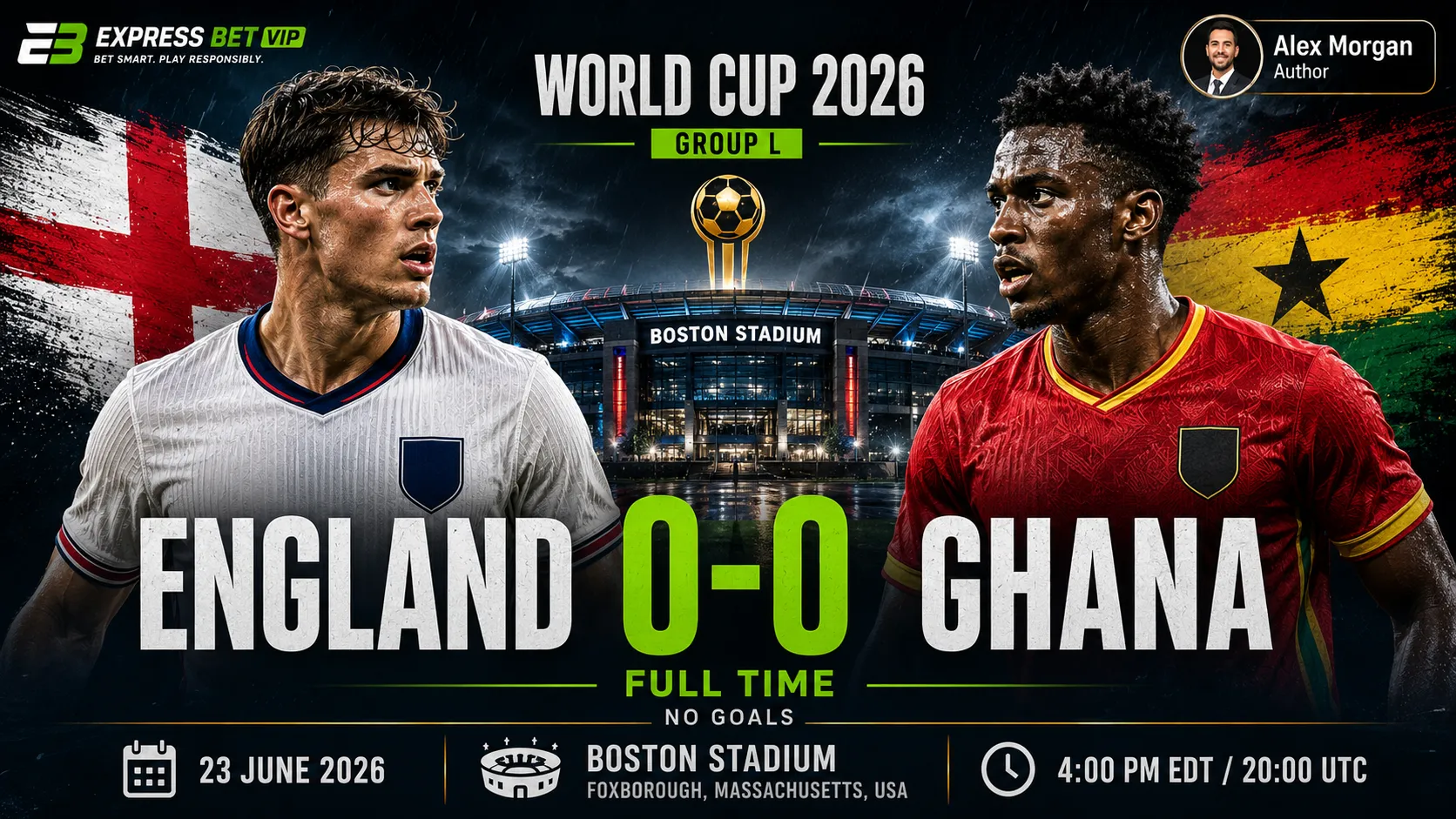
Quick Facts: Final Score, Goals, Venue, and Match Status
| Item | Detail | Data status |
|---|---|---|
| Match | England vs Ghana | [CONFIRMED] |
| Competition | FIFA World Cup 2026 | [CONFIRMED] |
| Stage | Group stage | [CONFIRMED] |
| Group | Group L | [CONFIRMED] |
| Date | 23 June 2026 | [CONFIRMED] |
| Kickoff time | 4:00 p.m. EDT / 20:00 UTC / 9:00 p.m. BST | [CONFIRMED] |
| Host country | United States | [CONFIRMED] |
| City | Foxborough, Massachusetts / Boston host region | [CONFIRMED] |
| Stadium | Boston Stadium / Gillette Stadium | [CONFIRMED] |
| Attendance | 63,983 | [REPORTED] |
| Final score | England 0-0 Ghana | [CONFIRMED] |
| Half-time score | England 0-0 Ghana | [CONFIRMED] |
| Goal scorers | None | [CONFIRMED] |
| Referee | Saíd Martínez | [CONFIRMED] |
| Lead VAR | Armando Villarreal | [REPORTED] |
| Weather | Morning rain; scattered rain remained possible later | [REPORTED] |
| Pitch condition | Temporary natural-grass World Cup surface; no specific match defect reported | [CONFIRMED / UNKNOWN] |
| Main tournament impact | England and Ghana moved to four points; England remained ahead on goal difference | [CONFIRMED] |
FIFA lists the match at Boston Stadium with a 20:00 UTC kickoff and Saíd Martínez as referee. ESPN and Sofascore report an attendance of 63,983, while the FA match centre confirms the 0-0 result, lineups, substitutions and two cautions. (FIFA)
Verified Facts vs Analysis
| Layer | What it covers | England vs Ghana example |
|---|---|---|
| [CONFIRMED] | Official score, teams, venue, kickoff, lineups, cards and substitutions | England 0-0 Ghana; Rice and Iñaki Williams booked |
| [REPORTED] | Reliable data-provider or media information | Attendance 63,983; xG 1.28-0.29 |
| [OBSERVED] | Events described in official or contemporaneous match coverage | O’Reilly hit the bar; Kane missed the rebound; Guéhi header cleared |
| [ANALYSIS] | Tactical interpretation based on those events | Ghana denied central access and accepted low possession |
| [MARKET SIGNAL] | Betting prices or settled market outcomes | Draw +550; under 2.5 +138 in one published FOX market |
| [DISPUTED] | Incidents viewed differently by teams or observers | Konsa’s challenge on Adu and Ghana’s penalty complaint |
| [UNKNOWN] | Information unavailable from verified public data | Exact match-time wind, humidity, PPDA and complete odds movement |
The separation matters because 78.8% possession is a fact, but “total domination” is an interpretation. England controlled territory. Ghana controlled enough of the penalty area to keep the score at zero. Those are related claims, but they are not identical. Opta recorded 19 England shots and 1.28 xG, which points to significant pressure without a volume of truly elite chances. (Opta Analyst)
Our editorial comparison used FIFA and the FA for the event record, Opta and Sofascore for statistical context, and live reporting for the timing and character of major incidents. Provider totals can vary slightly—one public FOX feed displayed a lower shot count than Opta—so the Opta/Sofascore figures are used consistently throughout the analysis. (FOX Sports)
Why the Match Finished 0-0
England had the ball. Ghana had the structure. The scoreboard sided with the structure.
Thomas Tuchel’s side spent most of the afternoon in Ghana’s half, completed hundreds more passes and finished with 19 attempts. Yet neither team managed a shot on target before half-time. England’s 104 completed passes ending in the final third were the most recorded by a team that failed to register a first-half shot on target in a World Cup match since Opta’s records began in 1966. Possession became circulation, circulation became crossing, and crossing frequently became another Ghana clearance. (Opta Analyst)
Ghana defended in a narrow structure that various providers described as a 4-1-4-1 or 5-4-1 depending on the phase. The distinction is less important than the function. Carlos Queiroz kept the space between midfield and defence small, asked his wide players to recover deeply and accepted that England’s centre-backs would accumulate harmless passes. Ghana rarely pressed Guéhi and Konsa high. They waited for the ball to enter the crowded zones where a tackle, block or clearance had greater value. (sofascore.com)
England’s crossing numbers explain part of the frustration. They completed only seven of 29 crosses. Ghana made 37 clearances, 21 tackles and eight interceptions. Gideon Mensah recorded nine clearances, while Jerome Opoku and Jonas Adjetey repeatedly dealt with deliveries toward Kane. England were technically dominant and spatially predictable—a combination that looks impressive on a possession graphic and less impressive when the goalkeeper can still see the ball. (sofascore.com)
The result could still have changed late. Saka forced Asare into a low save. O’Reilly attacked a Reece James cross and struck the underside or upper section of the crossbar. The rebound fell to Kane six yards out, but his hurried half-volley cleared the goal. In stoppage time, Guéhi’s header was cleared from near the line. England had chances sufficient to win; Ghana defended them sufficiently to avoid losing. (https://www.englandfootball.com)
Ghana also carried a limited counterattacking threat. Prince Kwabena Adu produced their clearest opening after entering from the bench, breaking beyond England’s defensive line before the move ended amid contact with Pickford and recovery defending. Sofascore valued Ghana’s total attacking output at 0.29 xG, with Adu responsible for most of it. (sofascore.com)
A 0-0 draw did not accurately describe the territory, but it accurately described the finishing. Tournament football occasionally converts 79% possession into a lecture about patience. England received the full seminar.
Key Moments That Changed the Match
| Minute | Moment | Why it mattered | Data status |
|---|---|---|---|
| 13’ | Rice free kick cleared the bar | England’s first direct attempt failed to test Asare | [OBSERVED] |
| First half | James and Jordan Ayew collided head-to-head | Interrupted the rhythm and required treatment | [OBSERVED] |
| First half | First hydration break | Helped Ghana reset after England’s early territorial pressure | [OBSERVED / ANALYSIS] |
| 30’ | Bellingham shot blocked; Rice header over | England reached promising areas without creating a shot on target | [OBSERVED] |
| 41’ | Rice booked | England’s holding midfielder had to manage transitions carefully afterward | [CONFIRMED] |
| 55’-60’ | Gordon and Kane finally tested Asare | England began converting possession into shots on target | [OBSERVED] |
| 60’ | Iñaki Williams booked | Ghana’s forward press became more cautious | [CONFIRMED] |
| 65’ | Saka and O’Reilly introduced | England added width, freshness and a stronger attacking full-back | [CONFIRMED] |
| 79’ | Adu’s break created Ghana’s best opening | Demonstrated the risk in England’s high territorial position | [OBSERVED] |
| 86’ | O’Reilly hit the bar; Kane missed rebound | England’s clearest chance of winning | [OBSERVED] |
| 90+3’ | Guéhi header cleared near the line | Ghana’s final defensive intervention protected the point | [OBSERVED] |
The substitutions at 65 minutes were the most important tactical intervention. Saka gave England greater one-against-one quality on the right, while O’Reilly attacked the far post more aggressively than Spence had. Both were directly involved in England’s strongest final phase. (https://www.englandfootball.com)
The second hydration break also mattered to the rhythm. England had begun increasing the speed of their attacks when another pause allowed Ghana to reorganise. It would be excessive to claim the break caused the draw, but it undoubtedly suited the team defending a compact shape more than the team trying to build continuous pressure. (https://www.englandfootball.com)
Local Match Conditions: Stadium, City, Weather, Pitch, and Crowd
| Local factor | Verified or observed detail | Football meaning | Direct match evidence | Betting-result meaning | Status | Anti-template status |
|---|---|---|---|---|---|---|
| Stadium | Boston Stadium / Gillette Stadium in Foxborough | Large open-air NFL venue converted for World Cup football | Match played before 63,983 | Open venue left weather relevant | [CONFIRMED] | Fixture-specific |
| Capacity | Approximately 65,000 for the tournament | Attendance represented a near-capacity crowd | 63,983 reported | Strong event atmosphere, but fan split unverified | [REPORTED] | Fixture-specific |
| Surface | New natural-grass installation | Replaced the venue’s normal artificial surface | No abnormal bounce or major surface complaint reported | No reliable pitch-derived betting angle | [CONFIRMED / UNKNOWN] | Stadium-specific |
| Grass composition | Mainly Kentucky bluegrass with perennial ryegrass | Designed for stability and drainage | No major standing-water issue reported | Rain did not obviously create high handling volatility | [REPORTED] | Stadium-specific |
| Weather | Rain earlier in the day; evening showers remained possible | Cooler, wetter conditions than many daytime World Cup fixtures | Fans arrived in rain; no weather suspension occurred | Reduced value of heat-based assumptions | [REPORTED] | Fixture-specific |
| Hydration breaks | Two interruptions noted by the FA report | Broke England’s attacking rhythm and allowed Ghana to reset | Both occurred during periods of pressure | Relevant to live tempo, not a standalone prediction | [OBSERVED] | Fixture-specific |
| Roof status | Open-air | Rain and wind could reach the playing area | No verified severe wind or rain effect during play | No dome-style weather protection | [CONFIRMED] | Stadium-specific |
| Crowd | Near-capacity attendance; exact national split unavailable | Noise rose during late England pressure | Crowd reaction noted after late misses | Psychological pressure increased, but not measurable | [REPORTED / OBSERVED] | Fixture-specific |
Gillette Stadium usually operates with an artificial surface, but its World Cup conversion involved removing the turf and underlying gravel, rebuilding the base and installing natural grass. Local reporting described a mix of roughly 85% Kentucky bluegrass and 15% perennial ryegrass, maintained at approximately 0.9 inches. (Boston.com)
That matters because generic claims about Gillette’s artificial turf would be wrong for this match. England and Ghana played on the tournament’s specially installed grass surface. No verified source reported serious tearing, dangerous seams, repeated slipping or irregular bounce during the game. The pitch therefore belongs in the local context, not in the explanation for England’s finishing. (Boston.com)
The weather story was similarly specific. Heavy or scattered rain affected parts of Massachusetts during the day, and local forecasts warned that further showers could reach Foxborough during the evening. NBC Boston reported fans arriving despite the rain, while CBS Boston noted rain-cooled air and below-average temperatures. The match proceeded without a lightning suspension or prolonged weather delay. (NBC Boston)
The available evidence does not establish a direct weather-to-score relationship. There was no goalkeeper spill caused by a wet ball, no wind-altered cross identified in reporting and no pitch slip that produced a major chance. England’s poor conversion had clearer football causes: Ghana’s compactness, inaccurate crossing, blocked shots and missed late opportunities.
The interruptions did matter more subtly. A team defending deeply benefits from opportunities to breathe, communicate and restore distances. England’s attack had to restart after the head collision and hydration breaks. Ghana were repeatedly granted the one resource a low block normally lacks: time without defending.
Stadium-Specific Match Impact
| Stadium factor | Detail |
|---|---|
| Stadium | Boston Stadium / Gillette Stadium |
| Location | Foxborough, Massachusetts |
| Approximate World Cup capacity | 65,000 |
| Attendance | 63,983 |
| Pitch type | Temporary natural grass |
| Roof status | Open-air |
| Acoustic effect | Strong late reaction to England’s chances; communication impact not confirmed |
| Surface condition | No match-specific defect reported |
| Wind relevance | Not available from verified public data |
| Goalkeeper distribution effect | No verified effect |
| Set-piece effect | England generated repeated corners and free kicks but no goal |
| Communication effect | Not directly measurable from verified sources |
| Data status | Mixed confirmed, reported and unknown |
The available match evidence does not show a clear stadium-specific effect beyond the normal venue conditions.
Boston Stadium did, however, shape the event in identifiable ways. The nearly full open bowl amplified the tension around England’s late pressure, while the natural-grass conversion removed the usual artificial-turf variable associated with Gillette Stadium. The venue lies around 30 miles from central Boston, making this a Foxborough match under a Boston host-city label rather than a game inside the city itself. (AP News)
Set pieces became increasingly important as England ran out of ways through open play. Rice delivered multiple free kicks, England won an 8-2 corner advantage according to Sofascore, and Guéhi nearly scored from a late aerial situation. Those events were tactical products of territorial pressure rather than visible effects of the stadium’s architecture or airflow. (sofascore.com)
City and Weather Impact
| Item | Detail |
|---|---|
| City / host region | Foxborough / Greater Boston |
| Host country | United States |
| Time zone | Eastern Daylight Time |
| June climate | Generally warm and humid, with variable showers and thunderstorms |
| Match-time temperature | Not available from verified public data |
| Humidity | Not available from verified public data |
| Wind | Not available from verified public data |
| Rain / sun | Morning rain and possible evening showers |
| Altitude | Low altitude |
| Likely physical effect | Cooler conditions than many daytime tournament fixtures; wet-ball risk theoretically possible |
| Actual match evidence | Two hydration breaks, but no confirmed heat collapse or weather-driven error |
| Data status | Partial |
Foxborough’s matchday weather differed sharply from the hot afternoon conditions affecting several other 2026 venues. Rain and cloud cover cooled the area, and no evidence supports a heat-driven reduction in England’s press or Ghana’s late defensive concentration. (CBS News)
England maintained territorial pressure into stoppage time, while Ghana continued making recovery runs and clearances. That late physical resilience argues against a major climatic explanation. The match slowed because Ghana disrupted attacks, England recycled possession and official pauses broke the flow—not because either side visibly ran out of energy in extreme heat.
Long passing was more relevant for Ghana than England. Sofascore recorded 56 Ghana long balls compared with 26 from England. This was a tactical response to pressure: clear the first line, seek Ayew or Williams and move the team upfield. No verified report attributes inaccurate long passes to wind or rain. (sofascore.com)
Goalkeeper handling remained secure. Asare made several saves and dealt with crowded deliveries; Pickford was rarely required to stop a shot. The wet matchday did not turn into a goalkeeper-error market, despite the theoretical risk.
First Half Analysis
England started in a 4-2-3-1. Pickford played behind James, Konsa, Guéhi and Spence. Rice and Elliot Anderson formed the double pivot, with Madueke, Bellingham and Gordon behind Kane. Ghana’s listed XI could resemble a 4-1-4-1 in possession phases but collapsed into a five-man defensive line at times, particularly when England advanced both full-backs. (https://www.englandfootball.com)
Tuchel’s build-up used Guéhi and Konsa as the first circulation line. Ghana did not waste energy chasing them. Jordan Ayew and Iñaki Williams screened central passes while the midfield narrowed around Bellingham. England could move the ball horizontally almost without resistance, but the relevant forward lanes were crowded.
Rice often dropped toward the centre-backs, while Anderson moved higher to connect with Bellingham. This gave England numerical control but occasionally placed too many players behind Ghana’s midfield. The ball reached the final third; the runners did not always arrive with it.
Madueke presented England’s best early one-against-one route. He stayed wide on the right, received against Mensah and attempted to create separation before crossing. Ghana generally forced him toward the outside and defended the resulting deliveries with numbers.
On the opposite side, Gordon and Spence did not create the same consistent imbalance. Gordon moved inside, but Ghana’s midfield line closed the half-space. Spence offered width without repeatedly breaking the final defensive line.
Kane often dropped away from the centre-backs to combine. That movement helped England retain possession but removed their strongest finisher from the area when crosses arrived. Ghana were content to let him receive with his back to goal 25 metres out rather than face him near the penalty spot.
The first half’s main statistic was not possession. It was zero shots on target for both sides. England completed 104 passes ending in the final third but did not force Asare into a save. Ghana’s defensive plan was functioning exactly as intended. (Opta Analyst)
Rice’s yellow card in the 41st minute introduced a transition-management risk. With England’s full-backs advanced, Rice had to protect counterattacks without committing another sanctionable foul. Ghana did not exploit that vulnerability consistently, but it remained part of the second-half equation. (https://www.englandfootball.com)
At half-time, Tuchel needed faster ball movement, more aggressive far-post occupation and greater one-against-one quality. Queiroz needed precisely the opposite: maintain patience, avoid unnecessary pressing and preserve the distances that had made England’s possession sterile.
Second Half Analysis
England increased the tempo after half-time without immediately changing personnel. Gordon produced the first straightforward save for Asare, and Madueke’s deflected effort created another uncomfortable moment. The improvement came from quicker circulation around Ghana’s block rather than through it. (https://www.englandfootball.com)
Ghana’s counters remained rare but became more dangerous because England committed greater numbers. Marvin Senaya briefly reached space behind Spence before the England full-back recovered. Later, Adu attacked the gap between centre-back and goalkeeper and created Ghana’s best opportunity.
Tuchel made the decisive attacking changes in the 65th minute. Saka replaced Gordon, while O’Reilly replaced Spence. Madueke moved left, Saka took the right and O’Reilly gave England a more aggressive left-sided presence. (https://www.englandfootball.com)
The change improved England’s width. Saka could threaten both the outside and inside lane, forcing Mensah and Opoku into narrower decisions. O’Reilly attacked the box rather than merely supporting possession. The eventual crossbar chance came from exactly that alteration: James delivered from the right, O’Reilly arrived as an additional aerial target and Ghana’s centre-backs could not fully control the far-post space.
Rogers and Eze replaced Bellingham and Anderson in the 74th minute. Eze’s 0.4268 expected assists in a short appearance reflected his willingness to play more ambitious final passes. England now had five attack-minded players moving around Ghana’s box, but this also increased exposure to direct counters. (sofascore.com)
Ghana introduced Abdul Fatawu and Adu for Iñaki Williams and Jordan Ayew. The substitutes carried fresher legs into the transition phases. Adu’s break in the 79th minute was the clearest evidence that England could have lost a match they territorially dominated.
The incident involving Adu, Pickford and Konsa became the main officiating controversy. Ghana argued that Konsa’s airborne challenge deserved a penalty or VAR review. Martínez awarded England a free kick, and lead VAR Armando Villarreal did not advise an on-field review. Ghana coach Carlos Queiroz later criticised the decision, while subsequent reporting described it as a continuing grievance in the Ghana camp. The incident remains disputed rather than established as an officiating error. (ESPN)
England’s strongest sequence came in the 86th minute. O’Reilly’s header struck the frame of the goal. Kane reacted to the rebound but lifted his effort over. The chance combined a good delivery, intelligent movement and poor final execution. It was the match in miniature.
Guéhi’s stoppage-time header offered the final threat. Kojo Peprah Oppong, introduced late, produced a goal-line clearance and another block during his brief appearance. Ghana’s substitutes therefore contributed at both ends: Adu nearly won the match, while Oppong helped preserve the draw. (sofascore.com)
Tactical Picture: Why the Match Was Drawn
England’s possession shape resembled a 3-2-5 during sustained attacks. Rice dropped between or alongside the centre-backs, James advanced on the right and Spence pushed from the left. Bellingham occupied a central attacking pocket, with Gordon and Madueke providing width or diagonal movement.
The shape created territorial control but not enough positional disorganisation. Ghana kept their defensive line narrow and allowed England’s outside centre-backs to carry the ball into low-risk spaces. The Black Stars pressed when a pass entered the touchline zone or when an England attacker received facing backward.
England needed to switch play faster before Ghana’s block could slide. Instead, several possessions involved one extra stabilising pass. At international tournament level, one extra pass is often all a compact defence requires to restore order.
Ghana’s deepest midfielder, Partey, protected the zone in front of the centre-backs. Sibo and Yirenkyi supported him laterally, while Semenyo and the opposite winger dropped into the midfield line. Kane could leave the box to receive, but Bellingham then had to enter a zone occupied by multiple Ghana defenders.
England attempted 29 crosses and completed seven. That ratio indicates not only delivery quality but also the context of the crosses. Many came against a set defensive line with no transition disorder. Ghana were rarely turning toward their own goal. They could face the ball, attack the first contact and rely on Asare behind them. (sofascore.com)
Ghana’s transition plan was extremely direct. They attempted 56 long balls and had little interest in building through England’s counterpress. Ayew and Williams competed for clearances, while Semenyo tried to carry through open channels. The plan created only two shots, but it also prevented Ghana from losing possession in their own central build-up repeatedly. (sofascore.com)
Tuchel’s substitutions improved the attack because Saka, O’Reilly and Eze changed the nature of the occupation. Saka attacked defenders, O’Reilly entered the box and Eze played earlier forward passes. England’s problem was that the improved structure arrived after Ghana had spent more than an hour rehearsing the same defensive movements.
Queiroz’s plan succeeded because it matched the group situation. Ghana had won their opener and did not need to turn a stable draw into a reckless contest. They accepted statistical inferiority in exchange for scoreboard stability.
The draw therefore came from three connected factors: Ghana’s compactness, England’s slow first-half progression and failure to convert the late chances created after tactical changes. Weather and pitch conditions were secondary.
Tactical Collision Map
| Zone | Edge | Match evidence | Key player | Local-condition effect | Result impact |
|---|---|---|---|---|---|
| England left / Ghana right | Ghana initially | Gordon and Spence struggled to create clean penetration | Marvin Senaya | No confirmed surface effect | Limited England’s balance |
| England right / Ghana left | England | Madueke and later Saka produced England’s best wide attacks | Saka / Madueke | Wet day did not prevent direct running | Created late chances |
| Central midfield | England territorially | Rice and Anderson controlled possession | Declan Rice | Hydration pauses interrupted momentum | Sustained pressure |
| Central defensive zone | Ghana | Partey screened, Opoku and Adjetey cleared repeatedly | Thomas Partey | No weather effect confirmed | Protected clean sheet |
| Penalty box | Ghana | 37 clearances and multiple blocks | Jerome Opoku | Natural grass showed no visible defect | Main reason for draw |
| Set pieces | England | Eight corners and several Rice deliveries | Declan Rice | Wind not available | Guéhi nearly scored late |
| Transitions | Ghana | Adu produced the clearest counterattack | Prince Adu | Cooler conditions supported late running | Nearly changed result |
| Goalkeeper area | Ghana | Asare saved from Saka, Kane and other efforts | Benjamin Asare | Wet-ball problems did not materialise | Preserved point |
| Bench impact | Mixed | England hit bar; Ghana nearly scored and cleared off line | O’Reilly / Adu / Oppong | Pauses supported fresh tactical resets | Decisive late phase |
Player Ratings and Individual Performances
These ratings are editorial. They use the official event record, Opta and Sofascore data, and observed tactical roles rather than simply copying one provider’s score.
England Player Ratings
| Player | Rating | Assessment |
|---|---|---|
| Jordan Pickford | 6.0 | Almost no conventional shot-stopping work. His advance during Adu’s break created a controversial moment. |
| Reece James | 7.0 | Supplied England’s best late cross and created two key chances. Increasingly influential after Saka entered. |
| Ezri Konsa | 6.5 | Controlled Ghana’s direct play for long periods. Involved in the disputed Adu incident. |
| Marc Guéhi | 8.0 | Completed more than 120 passes, dominated duels and nearly scored in stoppage time. England’s best starter. |
| Djed Spence | 6.0 | Secure in possession but offered limited penalty-box penetration before being replaced. |
| Declan Rice | 7.5 | Six key passes and sustained territorial control. Booking reduced his freedom against counters. |
| Elliot Anderson | 5.5 | Retained possession but moved it too slowly and rarely broke Ghana’s midfield line. |
| Noni Madueke | 6.5 | England’s most direct starting attacker. Created pressure but lacked consistency on the final delivery. |
| Jude Bellingham | 6.0 | Found little space between Ghana’s midfield and defence. Influence declined before substitution. |
| Anthony Gordon | 5.5 | Produced a tame shot on target but struggled to create separation on the left. |
| Harry Kane | 5.5 | Linked play and tested Asare once, but missed England’s clearest chance from the rebound. |
| Bukayo Saka | 7.5 | Changed the tempo, forced a strong save and gave England a genuine one-against-one threat. |
| Nico O’Reilly | 7.0 | Hit the crossbar and attacked the far post aggressively. Strong substitute appearance. |
| Eberechi Eze | 7.0 | Played earlier and more ambitious forward passes; produced strong chance-creation data in limited minutes. |
| Morgan Rogers | 6.0 | Added running but struggled to find decisive central space. |
| Marcus Rashford | 6.0 | Entered late and had limited time to alter the match. |
Guéhi completed 125 of 128 passes in Sofascore’s dataset, won 12 duels and earned the strongest England rating from that provider. Rice recorded six key passes, while Saka and Eze improved England’s chance creation after entering. (sofascore.com)
Ghana Player Ratings
| Player | Rating | Assessment |
|---|---|---|
| Benjamin Asare | 8.5 | Commanded the area, made the necessary saves and stayed composed during England’s late pressure. |
| Caleb Yirenkyi | 7.0 | Helped protect the inside channel and maintained Ghana’s midfield distances. |
| Marvin Senaya | 7.5 | Won repeated tackles, defended the flank and briefly threatened in transition. |
| Jonas Adjetey | 8.0 | Seven clearances and strong penalty-box positioning. Rarely lost first contact. |
| Jerome Opoku | 8.0 | Five clearances, good anticipation and calm distribution when Ghana escaped pressure. |
| Gideon Mensah | 8.0 | Nine clearances, five tackles and two interceptions. Handled Madueke and Saka with limited support. |
| Antoine Semenyo | 6.5 | Defended deeper than usual and offered occasional carrying threat. |
| Kwasi Sibo | 7.0 | Covered central ground and helped close passing lanes into Bellingham. |
| Thomas Partey | 8.0 | Won all four recorded tackles, made five clearances and screened the defence intelligently. |
| Jordan Ayew | 6.5 | Led the first defensive press and competed for difficult direct passes. |
| Iñaki Williams | 5.5 | Worked without the ball but offered little attacking output; booked before substitution. |
| Abdul Fatawu | 6.0 | Added speed but had few stable possessions. |
| Prince Kwabena Adu | 7.0 | Created Ghana’s biggest chance and forced England into emergency defending. |
| Kojo Peprah Oppong | 7.5 | Made a crucial goal-line clearance and block after entering late. |
| Abdul Baba Rahman | N/A | Introduced too late for a meaningful rating. |
Ghana’s defensive totals support the individual scores: 37 clearances, 21 tackles and eight interceptions. Mensah, Opoku, Adjetey and Partey carried the heaviest workload, while Asare made three or four saves depending on the provider’s treatment of blocked efforts. (sofascore.com)
Best Players of the Match
| Category | Selection | Reason |
|---|---|---|
| Man of the Match | Benjamin Asare | Managed England’s late pressure, made key saves and gave Ghana calm behind the block |
| Best attacker | Bukayo Saka | England’s most dangerous one-against-one player after entering |
| Best midfielder | Thomas Partey | Protected Ghana’s centre and won his defensive actions cleanly |
| Best defender | Jerome Opoku | Strong positioning, repeated clearances and composure under pressure |
| Best goalkeeper | Benjamin Asare | Preserved the clean sheet during England’s strongest phase |
| Best substitute | Nico O’Reilly | Hit the crossbar and transformed England’s far-post threat |
| Most underrated performance | Gideon Mensah | Exceptional volume of tackles, interceptions and clearances |
| Most disappointing performance | Harry Kane | Missed the decisive rebound and struggled to receive in scoring zones |
Bellingham was reportedly selected for the public player-of-the-match award, but the match data and defensive workload make Asare, Opoku, Mensah and Guéhi stronger analytical candidates. This article selects Asare rather than treating the public award as an objective performance ranking. (Facebook)
Injuries, Suspensions, Cards, and Discipline
| Player | Team | Incident | Minute | Status | Next-match impact | Data status |
|---|---|---|---|---|---|---|
| Declan Rice | England | Foul | 41’ | Yellow card | Accumulation risk continued | [CONFIRMED] |
| Iñaki Williams | Ghana | Foul | 60’ | Yellow card | Accumulation risk continued | [CONFIRMED] |
| Reece James | England | Head collision with Jordan Ayew | First half | Continued playing | No immediate absence confirmed | [OBSERVED] |
| Jordan Ayew | Ghana | Head collision with Reece James | First half | Continued playing | No immediate absence confirmed | [OBSERVED] |
| Confirmed red cards | Both | None | — | None | None | [CONFIRMED] |
| Confirmed match-ending injury | Both | None | — | None | None | [CONFIRMED] |
Sofascore recorded Ghana committing 24 fouls to England’s 13, with one yellow card for each team. The high Ghana foul count reflected the defensive workload and willingness to disrupt combinations before England reached the penalty area. (sofascore.com)
The James-Ayew collision required treatment and contributed to first-half stoppage time. Both players continued, and no subsequent concussion diagnosis was confirmed in the verified match sources. (https://www.englandfootball.com)
Referee and VAR Analysis
Saíd Martínez of Honduras refereed the match, assisted by Walter López and Christian Ramírez. Ma Ning served as fourth official. Armando Villarreal was reported as lead VAR. (FIFA)
The referee generally allowed Ghana to defend physically while sanctioning repeated or more obvious infringements. Only Rice and Iñaki Williams were booked despite 37 combined fouls in Sofascore’s dataset. That produced a stop-start match without turning it into a card-heavy contest. (sofascore.com)
The major disputed incident came during Adu’s second-half break. Pickford moved outside or toward the edge of his area, while Konsa challenged the forward as he attempted to reach the loose ball. Martínez awarded England a foul, and VAR did not recommend a review.
Queiroz later suggested Ghana had been denied a penalty, while Ghana players called for greater pressure on referees in future matches. Reuters reported that Martínez remained unmoved by Konsa’s airborne challenge. The absence of an on-field review does not by itself prove the original decision was correct; it indicates that VAR did not judge the available evidence to meet its intervention threshold. (ESPN)
The incident should be labelled [DISPUTED], not rewritten as a confirmed penalty. No other handball, red-card or offside decision materially altered the match.
Six minutes were added at the end of each half according to Sofascore. The second-half allowance reflected substitutions, treatment, hydration and repeated stoppages. (sofascore.com)
Match Statistics
| Statistic | England | Ghana | Data status |
|---|---|---|---|
| Final score | 0 | 0 | [CONFIRMED] |
| Possession | 78.8% | 21.2% | [REPORTED: Opta] |
| Shots | 19 | 2 | [REPORTED: Opta/Sofascore] |
| Shots on target | 4 | 1 | [REPORTED] |
| Shots inside box | 14 | Not available | [REPORTED / UNKNOWN] |
| Expected goals | 1.28 | 0.29 | [REPORTED] |
| Big chances | 2 | 1 | [REPORTED] |
| Big chances missed | 2 | 1 | [REPORTED] |
| Corners | 8 | 2 | [REPORTED] |
| Crosses completed | 7 of 29 | Not available | [REPORTED / UNKNOWN] |
| Accurate passes | 579 | 128 | [REPORTED] |
| Final-third entries | 87 | Not available | [REPORTED / UNKNOWN] |
| Clearances | Not available | 37 | [REPORTED] |
| Tackles | Not available | 21 | [REPORTED] |
| Interceptions | Not available | 8 | [REPORTED] |
| Fouls | 13 | 24 | [REPORTED] |
| Yellow cards | 1 | 1 | [CONFIRMED] |
| Red cards | 0 | 0 | [CONFIRMED] |
| Woodwork | 1 | 0 | [CONFIRMED] |
| PPDA | Not available | Not available | [UNKNOWN] |
| Distance covered | Not available | Not available | [UNKNOWN] |
England’s 78.8% possession was their highest recorded figure in a World Cup match since 1966 and the highest recorded by any World Cup team that failed to score over the same period. Their 19 shots were their most without a goal at the tournament since attempting 25 against Nigeria in 2002. (Opta Analyst)
Those records sound more impressive than the attack looked. The 1.28 xG total from 19 shots equates to roughly 0.067 xG per attempt. England produced quantity but often from crowded, low-value situations. The two major chances—O’Reilly’s header and Kane’s rebound—accounted for much of the genuine scoring threat.
Ghana’s numbers were almost the reverse. Two shots and 21% possession indicate minimal attacking control. Yet their 37 clearances and 21 tackles show that the defensive workload was completed with unusual concentration. This was not balanced football. It was balanced scoring.
Betting Result Angle
The section below reviews settled outcomes after the match. It does not imply that the draw or total was certain beforehand.
| Market | Pre-match expectation | Actual result | Winning side | Key trigger | Local factor | Caution |
|---|---|---|---|---|---|---|
| Match winner | England were heavy favourites | 0-0 draw | Draw | Ghana’s compact block and England’s missed chances | Pauses helped defensive resets | Favourite status is not value by itself |
| England spread | England -1.5 priced as favourite side | England failed to score | Ghana +1.5 | Ghana protected the box | Weather not decisive | Handicap lines amplify finishing risk |
| Total goals 2.5 | Over was favoured in published markets | No goals | Under 2.5 | Low shot quality and strong defending | Cooler conditions secondary | One match does not create a universal under angle |
| Both teams to score | England expected to carry scoring load | Neither scored | BTTS No | Ghana produced only two attempts | No direct local factor | Market depended heavily on England |
| Correct score | 0-0 was a long-price outcome | 0-0 | Correct score 0-0 | Woodwork, saves and clearances | No verified pitch effect | Very high-variance market |
| Anytime scorer | Kane was shortest-priced scorer | Kane did not score | No listed scorer landed | Kane’s late miss | None | Player fame can compress odds |
| Corners | England expected to dominate territory | England won corners 8-2 | England corner lines, depending on line | Sustained wide pressure | Open stadium did not disrupt delivery | Exact handicap required |
| Cards | Ghana faced long defensive workload | Two total cards | Under on higher card lines | Martínez used a relatively high threshold | Rain not a clear factor | Referee style and line matter |
| Live betting | England price shortened during pressure | Draw remained | Ghana/draw positions survived | Late defensive actions | Hydration breaks interrupted momentum | Live prices react before outcomes settle |
Published FOX prices listed England around -500, Ghana around +1400 and the draw around +550. England -1.5 was priced near -160, while over 2.5 goals was favoured at approximately -170 and under 2.5 at +138. FanDuel prices reported by CBS and Sports Illustrated varied slightly, demonstrating why betting results must always be tied to a particular operator and timestamp. (CBS Sports)
The draw rewarded bettors who opposed an extremely short England moneyline. Ghana +1.5 also landed comfortably, as did under 2.5 and BTTS No. Kane anytime-scorer positions lost despite his late rebound chance.
The useful lesson is not that heavy favourites should automatically be opposed. England created enough chances to win many repetitions of this match. The lesson is narrower: when a favourite faces a disciplined low block, moneyline price and underlying win probability are not the same thing as value.
The market also appears to have leaned heavily on England’s 4-2 opening win over Croatia. Ghana presented a different tactical problem. Croatia played a more open match; Ghana defended the central corridor and reduced the game to crosses, blocks and second contacts. Previous scorelines do not transfer cleanly between tactical contexts.
Local Betting Impact: What the Venue and Conditions Changed
| Local factor | Market possibly affected | Actual match evidence | Possible interpretation | Overreaction risk | Safer conclusion |
|---|---|---|---|---|---|
| Earlier rain | Totals, goalkeeper saves, slips | No confirmed handling error or slip-created chance | Wet conditions did not create volatility | Assuming rain always increases goals | Surface effect was limited or unverified |
| Natural-grass conversion | Passing, tackles, injuries | No defect or unusual bounce reported | Pitch performed normally | Treating former artificial-turf identity as relevant | Use match-specific surface, not stadium reputation |
| Hydration breaks | Live tempo, second-half markets | Both pauses interrupted England pressure | Ghana benefited from reset time | Calling breaks the cause of 0-0 | Tactical compactness mattered more |
| Open-air venue | Crosses and long passing | No verified strong-wind disruption | Delivery quality was mainly technical | Inventing a wind angle | Wind data unavailable |
| Near-capacity crowd | Late pressure and psychology | Strong reaction to O’Reilly/Kane misses | England faced growing urgency | Turning crowd noise into a measurable edge | Psychological effect only |
| Cooler rain-influenced day | Pressing and fatigue | Ghana maintained concentration late | Heat did not drive defensive collapse | Assuming cool weather guarantees high tempo | Game state dictated rhythm |
| Foxborough location | Travel/acclimatisation | No verified team complaint | No clear market impact | Using travel without evidence | Mark as unknown |
Local conditions did not clearly determine the betting result. The most visible effect came from interruptions rather than the pitch or weather itself.
A bettor expecting rain to create goalkeeper mistakes received the opposite: Asare handled the ball securely. A bettor expecting Ghana to tire under sustained pressure also saw the compact block survive into stoppage time.
The match therefore warns against converting generic weather theory into a betting position without match-specific evidence. Rain can increase ball speed and handling risk. In this game, it did not produce a goal.
What This Result Means for Group L
England and Ghana both finished the second round of group matches with four points. England stayed ahead because their opening 4-2 win over Croatia gave them a stronger goal difference than Ghana’s 1-0 victory over Panama. (https://www.englandfootball.com)
Neither team had secured first place. England’s final group match was against Panama on 27 June at New York/New Jersey Stadium. Ghana were scheduled to face Croatia on the same date in Philadelphia. (FIFA)
For England, victory against Panama would place them in a strong position to win Group L, subject to Ghana’s result and the relevant tiebreakers. The draw against Ghana therefore postponed qualification certainty rather than causing immediate danger.
For Ghana, the point was highly valuable. Having already beaten Panama, a win or draw against Croatia would secure a top-two finish. Even a loss could leave them competitive in the ranking of third-placed teams under the expanded 48-team format. (FOX Sports)
The draw also preserved Ghana’s unbeaten start. England remained unbeaten as well, but their route looked less convincing than after the six-goal opener against Croatia.
What England Did Right
England controlled transition defence for most of the match. Ghana produced only two shots, the fewest England had allowed in a recorded World Cup match since 1966. Guéhi and Konsa recovered quickly whenever Ghana attempted to play beyond the first pressure line. (Opta Analyst)
The centre-backs were also secure in possession. Guéhi completed a record number of passes for an England player in a World Cup match, while Konsa’s passing accuracy was similarly high. They kept Ghana pinned rather than allowing clearances to become sustained counterattacks. (Opta Analyst)
Tuchel’s substitutions improved the attack. Saka added one-against-one threat, O’Reilly attacked the box and Eze accelerated central combinations. England’s best chances followed those changes.
The team also continued attacking until the end. Guéhi’s stoppage-time header showed that England did not accept the draw passively, even if the response came later than required.
What England Got Wrong
England moved the ball too slowly in the first half. Ghana were permitted to slide across the pitch without being forced into emergency rotations.
The attacking line also lacked simultaneous depth. Kane dropped, Bellingham searched for central pockets and Gordon moved inside, but Ghana rarely had to defend multiple runners behind the line at the same moment.
Crossing became a default rather than a targeted solution. Twenty-nine attempts produced seven completions and no goal. Deliveries arrived against a settled defence whose strongest work came in aerial and second-ball situations.
England also failed to finish the chances that finally appeared. Kane’s rebound miss was the clearest example. Tactical analysis explains why chances were scarce; it cannot excuse missing from six yards.
What Ghana Did Right
Ghana protected the centre. England were allowed to possess the ball in front of the block and near the touchlines, but direct passes into Kane and Bellingham were repeatedly crowded.
The back line defended the first ball and the second action. Opoku, Adjetey and Mensah did not merely head crosses away; they reacted quickly to rebounds and loose balls.
Partey’s positioning was central to the plan. He stayed close enough to the centre-backs to prevent Bellingham turning, while still stepping forward to challenge Anderson and Rice.
Asare gave the defensive line confidence. He held routine shots, saved Saka’s more dangerous effort and managed aerial pressure without creating panic.
Queiroz also used the bench intelligently. Adu threatened on the counter, and Oppong made one of the match’s defining defensive interventions in stoppage time.
What Ghana Could Improve
Ghana’s attacking output was too low to represent a repeatable route to qualification. Two shots and 21% possession can earn a point, but they leave almost no margin if one clearance or save fails.
Ayew and Iñaki Williams received poor service, yet Ghana also lacked a midfielder consistently capable of carrying the ball beyond England’s counterpress.
The long-ball plan produced relief but little sustained territory. Ghana attempted 56 long passes, often surrendering possession immediately after clearing the initial danger. (sofascore.com)
Adu’s late break showed that England could be attacked behind the full-backs. Ghana might have explored that channel earlier or more often without abandoning their defensive priorities.
Coach Analysis
Thomas Tuchel
Tuchel retained the 4-2-3-1 used in the opening phase of the tournament and changed two defenders from the Croatia match, bringing Guéhi and Spence into the starting XI. The defensive changes worked. England conceded almost nothing. (https://www.englandfootball.com)
The attacking setup was less successful. Anderson and Rice gave control but insufficient progression against a team uninterested in pressing them. England needed a player who could receive on the half-turn or carry through the first Ghana midfield line.
Tuchel’s substitutions were correct but arguably late. Saka and O’Reilly entered at 65 minutes and immediately improved the attack. Eze followed at 74 minutes. A more aggressive intervention at half-time might have given England longer to exploit those patterns.
Moving Madueke to the left after Saka entered was sensible. It created two genuine dribbling threats and prevented Ghana from leaning entirely toward one flank.
The main coaching question was not whether England had enough attackers. It was whether the structure allowed them to attack at the same time rather than in sequence.
Carlos Queiroz
Queiroz chose the correct level of risk for Ghana’s group position. His side had three points and did not need to trade attacks with an England team that had scored four in its opener.
The compact block was well drilled. Ghana’s midfield and defence moved as a unit, kept the penalty area crowded and accepted low possession without losing emotional control.
Queiroz also identified when England’s rest defence was becoming vulnerable. Introducing Adu gave Ghana a more explosive outlet and nearly produced a decisive chance.
The weakness was that Ghana’s plan left almost no route back if England scored first. That goal never came, so the limitation remained theoretical. Tournament coaches are judged by the match that occurred, not the more entertaining match observers wanted.
Player Milestones and Records
England’s 78.8% possession was their highest in a World Cup match in Opta’s records since 1966. It was also the highest recorded possession share by any team that failed to score in a World Cup match over that period. (Opta Analyst)
England reached 23 World Cup draws, including 13 scoreless draws, both competition records according to Opta. (Opta Analyst)
Guéhi completed more passes than any England player had previously recorded in a World Cup match since 1966. (Opta Analyst)
The match was the first competitive meeting between England and Ghana. Their only previous senior meeting had ended 1-1 in a 2011 friendly at Wembley. (https://www.englandfootball.com)
No scoring milestone was achieved because neither team scored.
Historical Context and World Cup Analogies
The match joined a familiar World Cup category: a heavyweight dominates the ball, the underdog defends the area, and every passing statistic gradually becomes less relevant than one clearance.
England have experienced versions of this before. Their tournament history includes scoreless draws against Algeria in 2010, Scotland at Euro 2020 and the United States at the 2022 World Cup. The tactical details differ, but the emotional pattern is consistent: possession creates expectation faster than it creates goals.
Ghana’s performance had echoes of disciplined African tournament defences that refuse to make ranking differences visible on the pitch. This was not a copy of Ghana’s 2010 quarter-final side, but it showed the same willingness to defend collectively without treating a major opponent’s reputation as tactical information.
The 2011 friendly between the teams also ended level. Andy Carroll scored for England before Asamoah Gyan equalised in stoppage time. Fifteen years later, the teams again shared the result, this time without troubling the scorekeeper. (https://www.englandfootball.com)
Incidents and Controversies
The principal controversy concerned Ghana’s late counterattack and the collision involving Adu, Pickford and Konsa.
Ghana believed the challenge warranted a penalty. Martínez instead awarded England a free kick, and VAR did not intervene. Queiroz later criticised the process, while Semenyo suggested Ghana needed to apply more pressure to officials during matches. (ESPN)
The incident did not produce a formal reversal, retrospective sanction or official admission of error in the verified sources checked for this article. It should therefore remain labelled disputed.
A separate pre-match moment involving Spence and Partey was discussed in live coverage after Spence appeared not to accept a handshake. No official disciplinary action or match-related consequence followed. It did not affect the football and does not justify broader speculation. (The Guardian)
No crowd disorder, pitch invasion, red card or medical emergency was confirmed.
Information Gain: What This Article Adds
This analysis combines:
- the verified 0-0 final score and tournament consequences;
- an explanation of why 78.8% possession produced no goal;
- the O’Reilly, Kane, Saka, Adu and Guéhi turning points;
- tactical analysis of Ghana’s compact block;
- complete editorial player ratings;
- Boston Stadium’s natural-grass conversion;
- Foxborough’s rain-influenced matchday conditions;
- post-match betting-market settlement;
- balanced treatment of the disputed penalty incident;
- clear separation between facts, provider data and interpretation.
The central finding is specific: England did not fail because possession was useless. They failed because their possession moved Ghana without disorganising Ghana. The distinction is the entire match.
Local Information Gain Quality Check
| Detail | Included | Status | Specific to fixture | Future update |
|---|---|---|---|---|
| Stadium identity | Yes | Confirmed | Boston Stadium / Gillette Stadium | None |
| Location | Yes | Confirmed | Foxborough rather than central Boston | None |
| Attendance | Yes | Reported | 63,983 | Update if FIFA revises |
| Surface conversion | Yes | Reported/confirmed | New natural-grass installation | Add FIFA technical report if published |
| Weather | Yes | Reported | Morning rain and evening shower risk | Add exact hourly observations if available |
| Pitch effect | Yes | Unknown/analysis | No defect reported in this match | Update if team comments emerge |
| Crowd detail | Partial | Reported | Near-capacity; national split unknown | Add verified split only |
| Travel/acclimatisation | Limited | Unknown | Not forced into the article | Add only from federation sources |
| Local betting effect | Yes | Analysis | Breaks, rain and surface assessed specifically | No |
| Tactical-local connection | Yes | Analysis | Pauses helped Ghana reset | No |
| Anti-template status | Passed | Editorial check | Specific to this fixture | No |
Source and Data Appendix
| Data point | Status | Main source type |
|---|---|---|
| Final score | Confirmed | FIFA / FA |
| Half-time score | Confirmed | FIFA / FA |
| Goal scorers | Confirmed: none | FIFA |
| Venue | Confirmed | FIFA / stadium |
| City | Confirmed | FIFA / local host reporting |
| Attendance | Reported | ESPN / Sofascore |
| Referee | Confirmed | FIFA |
| VAR | Reported | ESPN / officiating reports |
| Lineups | Confirmed | FA |
| Substitutions | Confirmed | FA |
| Cards | Confirmed | FA / Sofascore |
| Injuries | No significant injury confirmed | Match reports |
| Possession | Reported | Opta |
| Shots | Reported | Opta / Sofascore |
| xG | Reported | Opta / Sofascore |
| Odds | Market signal | FOX / FanDuel reports |
| Weather | Reported | NBC Boston / CBS Boston |
| Surface | Reported/confirmed | Local stadium reporting |
| Pitch condition | Unknown | No defect report found |
| Crowd distribution | Unknown | No verified breakdown |
| Tournament impact | Confirmed | FIFA / FA |
Update Protocol
Update this article if:
- FIFA revises the official statistics;
- attendance is corrected;
- the referee or VAR report clarifies the Adu incident;
- disciplinary decisions change;
- a confirmed injury emerges from the match;
- Opta or another licensed provider revises xG;
- closing-odds history becomes available;
- an official match-time weather observation is published;
- FIFA issues a technical report on the Boston Stadium surface.
Last updated: 10 July 2026
Final Verdict
England controlled nearly everything except the number that mattered.
Their possession was overwhelming, their centre-backs circulated the ball without pressure and Ghana spent most of the match near their own penalty area. Yet England’s control lacked enough acceleration, variation and coordinated movement to break the defensive structure before the final quarter-hour.
The draw was fortunate for Ghana in the narrow sense that England hit the bar and missed the rebound. It was earned in the broader sense that Ghana defended 90 minutes of pressure with concentration, positioning and physical commitment.
The scoreline slightly flattered Ghana’s attacking performance. Two shots and 0.29 xG offered almost no sustained threat. It did not flatter their defence. The clearances, blocks, saves and compact spacing were exactly what the match required.
The most important tactical detail was Ghana’s refusal to press England’s harmless possession. Queiroz understood that Guéhi completing 126 passes was less dangerous than Bellingham receiving six clean passes between the lines. Ghana protected the second situation and tolerated the first.
The local conditions did not decide the game. Foxborough’s rain-influenced afternoon, new natural-grass surface and two hydration breaks affected rhythm but produced no verified error or physical collapse. Ghana’s defensive resets mattered more than the weather itself.
For England, the result was a warning rather than a crisis. They remained top of Group L and still controlled their qualification path. But future opponents now had a clear reference: deny the centre, allow circulation and make England prove they can create before the substitutes arrive.
For Ghana, the point strengthened their path to the Round of 32. It also demonstrated that tactical discipline can close an enormous talent and possession gap—provided every defender remains alert and the goalkeeper does his work.
For bettors, the lesson is less romantic. Heavy favourites can control the data and still fail to cover the simplest market. Possession is informative. Price is decisive. Neither guarantees a goal.
Responsible Betting Note
Football betting carries financial risk. Correct match analysis does not guarantee a winning bet. Odds change before and during matches as goals, cards, substitutions, injuries, VAR decisions and tactical momentum alter the market.
Local conditions can be overvalued. Earlier rain and the Boston Stadium grass surface did not make the 0-0 result inevitable. Ghana’s defensive structure and England’s missed chances were more important.
Never chase losses. Do not bet money required for food, housing, bills or other daily expenses. Use deposit, stake and time limits. Take regular breaks. Check local gambling laws and use licensed operators only. Betting should remain entertainment, not income.
Summarize this article with AI. Use this page URL as the source:
FAQ
England and Ghana drew 0-0 in FIFA World Cup 2026 Group L.
No player scored. The match finished goalless.
Benjamin Asare was this article’s player of the match after keeping a clean sheet and handling England’s late pressure.
England and Ghana both moved to four points. England remained ahead on goal difference before the final Group L matches.
The draw, under 2.5 goals, BTTS No and Ghana +1.5 were winning outcomes. Exact returns depended on the operator, selected line and timing of the bet.