
France vs Morocco Match Result
Table of Contents Show
Views 3
TL;DR: France vs Morocco Match Result
[CONFIRMED] France beat Morocco 2-0 in their FIFA World Cup 2026 quarter-final at Boston Stadium. Kylian Mbappé scored in the 60th minute and assisted Ousmane Dembélé six minutes later. Yassine Bounou had kept Morocco level by saving Mbappé’s 28th-minute penalty, but that resistance eventually became an exercise in postponement rather than escape.
Mbappé was the decisive player; Dembélé was arguably the most complete performer. France created five big chances to Morocco’s none and allowed only one shot on target. The open-air afternoon temperature was reported between 29°C and 32°C, prompting cooling breaks, although the evidence points to France’s superior structure—not the weather—as the decisive factor.
France advanced to face Spain in the semi-finals; Morocco were eliminated. France, under 2.5 goals and both teams to score—No were winning market outcomes, subject to each bettor’s odds and settlement rules.
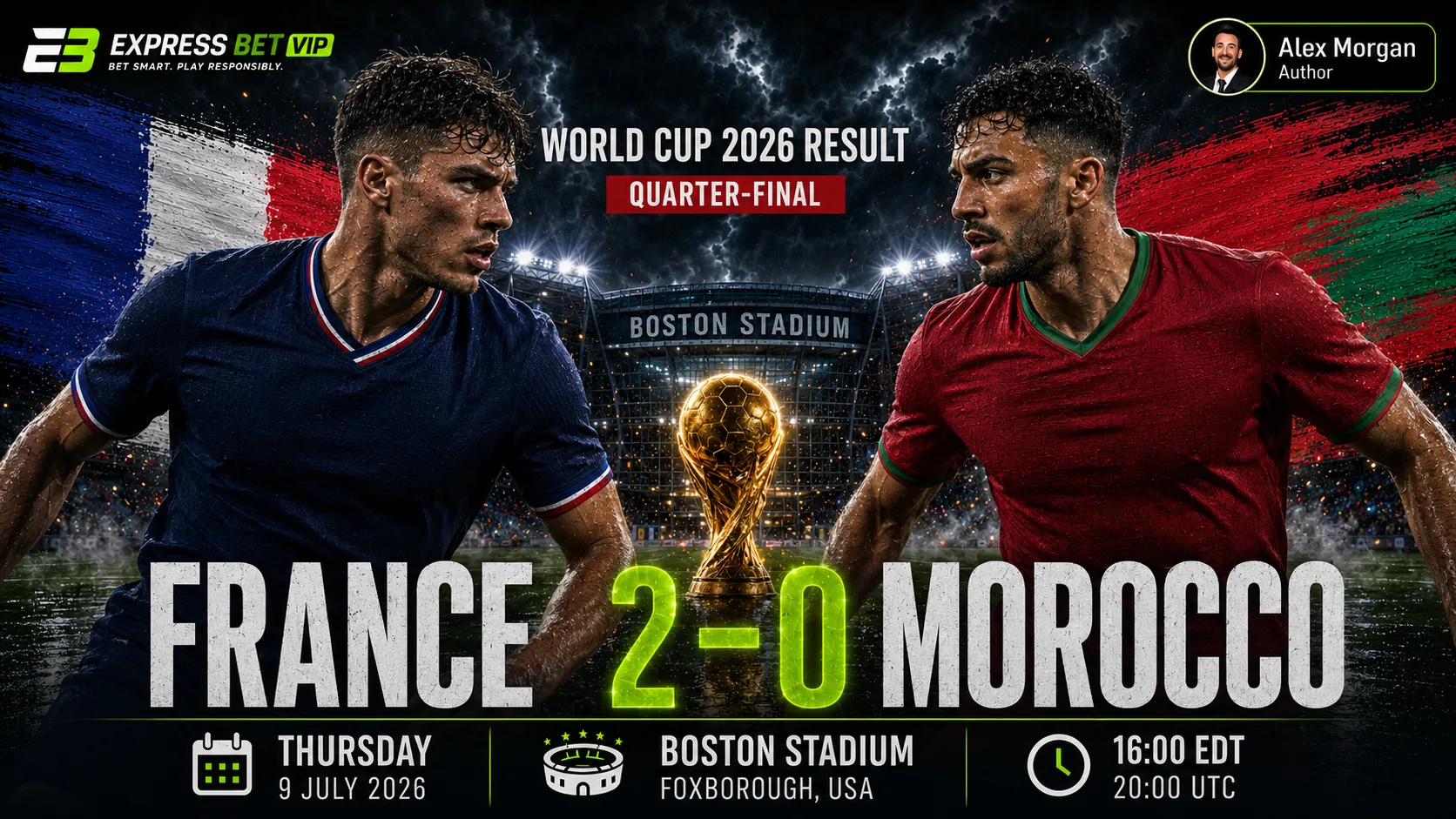
Quick Facts: Final Score, Goals, Venue, and Match Status
| Fact | Confirmed information |
|---|---|
| Match | France vs Morocco |
| Competition | FIFA World Cup 2026 |
| Stage | Quarter-final, Match 97 |
| Date | July 9, 2026 |
| Kickoff | 4:00 p.m. EDT / 20:00 UTC |
| Host country | United States |
| City | Foxborough, Massachusetts |
| Stadium | Boston Stadium, normally Gillette Stadium |
| Attendance | 63,811 |
| Final score | France 2-0 Morocco |
| Half-time score | 0-0 |
| Goals | Mbappé 60’, Dembélé 66’ |
| Assists | Désiré Doué; Kylian Mbappé |
| Missed penalty | Mbappé 28’, saved by Bounou |
| Referee | Facundo Tello, Argentina |
| VAR | Individual VAR appointment not confirmed from verified public data |
| Weather | Hot, open-air conditions; 29°C on FotMob, 32°C in an on-site report |
| Pitch | Temporary natural grass |
| Main impact | France advanced; Morocco were eliminated |
The official match centre identifies the fixture as a 2-0 French quarter-final victory at Boston Stadium. Reuters’ Opta-supported match graphic confirms the scorers and goal times. FotMob’s match page confirms the attendance, referee, starting formations, substitutions and surface.
Verified Facts vs Analysis
| Category | Finding |
|---|---|
| [CONFIRMED] | France won 2-0; Mbappé and Dembélé scored; Bounou saved a penalty |
| [REPORTED] | Mbappé received treatment for a sore ankle after Issa Diop’s challenge |
| [OBSERVED] | France repeatedly reached shooting positions; Morocco rarely threatened Maignan |
| [ANALYSIS] | France’s wide rotations and central counterpressure prevented Moroccan transitions |
| [MARKET SIGNAL] | France closed as the odds-on favourite at major US sportsbooks |
| [DISPUTED] | xG: FotMob/365Scores recorded 3.69-0.14; Sofascore recorded approximately 3.10-0.13 |
| [UNKNOWN] | Named VAR official, exact humidity, wind and official pitch-speed measurements |
This distinction matters because the final score is a fact; the reason behind it is an interpretation. Search engines can extract both, but readers deserve to know which is which. Expected-goals models provide a useful example: they agree that France created vastly better chances, but not on the exact total.
I compared the event logs from FIFA, Reuters, FotMob and two statistical platforms on July 20. Where providers differed, I retained the range rather than pretending football data is produced by one immaculate spreadsheet descending from the clouds.
Final Score and Match Summary
France began with clear attacking authority. Mbappé tested Bounou from distance inside five minutes, and Dayot Upamecano forced another save from the resulting corner. Morocco temporarily calmed the rhythm through safe possession across their back line, but possession without progression soon became merely a way of choosing where to lose the ball.
Didier Deschamps’ side attacked through a flexible 4-2-3-1. Dembélé started from the right, Désiré Doué from the left and Michael Olise operated behind Mbappé. Their positions were only starting coordinates. Olise moved toward both half-spaces, Dembélé carried inside, and Doué’s direct running repeatedly challenged Morocco’s improvised defensive structure.
Morocco also began in a nominal 4-2-3-1, with Brahim Díaz and Bilal El Khannouss rotating around the central attacking role. Yet they lacked Ismaël Saibari, whose hamstring injury had ruled him out. His absence removed an important combination of vertical running and physical presence.
Bounou’s penalty save in the 28th minute offered Morocco a route back into the contest. It did not produce a change in approach. France continued to create the better chances and Lucas Digne hit the crossbar from range before halftime.
The score remained 0-0, but the balance was less even than the scoreboard suggested. France had accumulated substantial chance value; Morocco had barely entered the French penalty area. Tournament football occasionally rewards such resistance. On this occasion, it simply charged interest.
Mbappé finally opened the scoring in the 60th minute with a curling finish from the left side of the box. Dembélé made it 2-0 six minutes later, carrying through an unprotected centre before driving a low shot beyond Bounou.
From there, France reduced their risk. Morocco held more of the ball but still produced only one meaningful effort on target, an Azzedine Ounahi shot that Mike Maignan turned away. The 2-0 scoreline was fair and, given the volume and quality of French chances, relatively kind to Morocco.
Goal Timeline
60’ — Kylian Mbappé, France, open-play goal
[CONFIRMED] Désiré Doué supplied the assist. Mbappé received the ball near the left corner of Morocco’s penalty area, shifted it onto his right foot and curled his finish around Issa Diop toward the far side.
The shot carried only 0.05 xG in the 365Scores model, illustrating why xG measures opportunity rather than finishing talent. Mbappé’s execution transformed a difficult angle into a high-quality shot on target.
Morocco appealed for handball earlier in the move. The goal was checked and allowed to stand. Mohamed Ouahbi later questioned the incident, but no official reversal followed. The appropriate label is [DISPUTED] for the complaint and [CONFIRMED] for the awarded goal.
Tactically, the breakthrough came from France creating isolation on the left rather than forcing another crowded central combination. Mbappé needed one defender’s hesitation and half a yard. At this level, that is practically an invitation.
66’ — Ousmane Dembélé, France, open-play goal
[CONFIRMED] Mbappé was credited with the assist.
Dembélé advanced through central midfield with Morocco’s first line behind the ball and its remaining defenders slow to engage. Mbappé’s movement pulled attention away from the carrier. Dembélé reached the edge of the penalty arc and drove low toward the bottom-right corner.
Bounou got a hand to the shot but could not keep it out. Unlike Mbappé’s opener, the second goal contained an obvious structural failure: Morocco neither stopped the transition at source nor closed Dembélé before he reached shooting range.
The six-minute interval between the goals ended the competitive uncertainty. Morocco made changes after going 1-0 down, but conceded again before its revised shape could settle.
Key Moments That Changed the Match
Bounou’s early saves
Mbappé’s fifth-minute drive and Upamecano’s header established the pattern. France could reach shooting positions without committing reckless numbers forward. Morocco’s goalkeeper was already working before his attackers had registered a shot.
28’ — Mbappé’s penalty saved
Noussair Mazraoui brought Mbappé down inside the area. Facundo Tello awarded the penalty, and the decision survived a lengthy review. Bounou held his position, read the low attempt and made the save.
It was Mbappé’s first penalty miss for France since Euro 2020, according to Reuters. More importantly for this match, it denied France the early lead that their pressure warranted. It also increased the probability of under-goal and halftime-draw markets.
Digne hits the crossbar
Digne’s powerful long-range effort struck the frame of the goal in first-half stoppage time. Morocco therefore reached halftime level through Bounou, French wastefulness and the width of a crossbar—not through control of the contest.
60’–66’ — France’s decisive burst
Mbappé’s goal forced Morocco to abandon some of their caution. Dembélé exploited the resulting central space almost immediately. This was the match’s tactical hinge: Morocco’s passive shape could delay France, but it offered no convincing response once a goal was required.
63’ — Diop’s challenge on Mbappé
Diop was booked for chopping down Mbappé as the forward attempted to turn away. Mbappé later left with discomfort and applied ice to his right ankle. Reuters reported that he was substituted after the knock, although he was able to celebrate after full time.
Ounahi’s late shot
Morocco did not register a shot on target until the 84th minute, when Ounahi forced Maignan to save. By then, France were defending a two-goal advantage in a more conservative block. It was danger, but not sustained pressure.
Local Match Conditions: Stadium, City, Weather, Pitch, and Crowd
| Local factor | Verified or observed detail | Football meaning | Match evidence | Betting meaning | Status | Specificity |
|---|---|---|---|---|---|---|
| Venue | Boston Stadium, Foxborough | Open-air exposure | Cooling breaks used | Possible effect on late tempo | [CONFIRMED] | Fixture-specific |
| Capacity | 64,146 in match configuration | Near-full environment | 63,811 attendance, about 99% | Noise cannot be quantified as a market edge | [CONFIRMED] | Fixture-specific |
| Surface | Temporary natural grass | Different from usual FieldTurf | No major surface failure reported | No sound basis for a pitch-derived wager | [CONFIRMED] | Fixture-specific |
| Temperature | 29°C feed; 32°C live report | Increased hydration demand | Cooling breaks around the midpoint of each half | Relevant to second-half tempo, not a prediction by itself | [DISPUTED] | Fixture-specific |
| Roof | Open-air stadium | No climate control | Teams remained exposed to afternoon heat | May influence live total expectations | [CONFIRMED] | Fixture-specific |
| Crowd profile | Exact fan split unavailable | Communication effect cannot be measured | Whistling was audible early | Insufficient for a cards or winner conclusion | [OBSERVED] | Fixture-specific |
| Pitch problems | None clearly documented | Normal passing and tackling | No decisive slip or abnormal bounce | Avoid retrofitting a pitch narrative | [UNKNOWN] | Fixture-specific |
| Travel | France and Morocco were already tournament-based in North America | Limited value without camp data | No verified acclimatisation complaint | Weak betting signal | [UNKNOWN] | Fixture-specific |
The venue’s official site lists a normal capacity of 64,628 and a distance of 29 miles from downtown Boston. The World Cup match configuration was listed at 64,146, with 63,811 present. This was not a loosely populated neutral venue. It was effectively full.
The afternoon heat was more relevant. FotMob recorded 29°C; the Guardian’s live reporter cited 32°C at the stadium. The discrepancy may reflect different observation times or providers. Both readings indicate a hot match, and cooling breaks were taken.
Heat can shorten sustained pressing spells, but it does not explain why Morocco failed to produce a first-half attempt of consequence. France also played in the same temperature and generated repeated final-third entries. The stronger conclusion is that Deschamps’ side managed its physical output better because it controlled where the game was played.
The temporary grass deserves attention because Gillette Stadium normally uses artificial turf. FIFA’s competition requirements prompted the installation of natural grass, supported by the stadium’s existing drainage and ventilation infrastructure. FotMob recorded the surface as grass, while local reporting detailed the conversion.
No important goal, save or card can be attributed to a slip, divot or strange bounce. Therefore, the surface is useful local context, but not a causal explanation. A pitch is allowed to exist without becoming the villain.
Stadium-Specific Match Impact
| Stadium item | Match detail |
|---|---|
| Tournament name | Boston Stadium |
| Regular name | Gillette Stadium |
| Official regular capacity | 64,628 |
| Match configuration | 64,146 |
| Attendance | 63,811 |
| Surface | Temporary natural grass |
| Roof | Open air |
| Acoustic effect | Early whistles audible; measurable communication effect unavailable |
| Wind relevance | Not available from verified public data |
| Goalkeeper distribution | No confirmed wind-related problem |
| Set pieces | France created an early header; Morocco’s deliveries produced little |
| Data status | Venue facts confirmed; acoustic and airflow effects partly unknown |
The stadium influenced the match primarily through exposure to afternoon heat and its near-capacity crowd. It did not produce an identifiable technical distortion. Bounou’s save from the penalty spot came from anticipation and execution, not the surface. Mbappé and Dembélé’s goals were cleanly struck.
France’s centre-backs circulated possession calmly despite the crowd noise. Morocco’s communication problems were more visible in transition than during settled defending, particularly when Dembélé advanced unchallenged for the second goal. Whether noise contributed cannot be established.
The available match evidence does not show a clear stadium-specific effect beyond the hot, open-air venue conditions and temporary natural-grass field.
City and Weather Impact
| Item | Detail |
|---|---|
| City | Foxborough, Massachusetts |
| Host country | United States |
| Time zone | Eastern Daylight Time, UTC−4 |
| Kickoff | 4:00 p.m. local |
| Match temperature | 29°C to 32°C, depending on provider |
| Humidity | Not available from verified public data |
| Wind | Not available from verified public data |
| Rain | No rain effect reported |
| Altitude | Not tactically significant |
| Likely physical effect | Higher hydration load; shorter pressing cycles |
| Actual evidence | Cooling breaks; no verified heat injury |
| Data status | Temperature range confirmed by reputable match reports; other details incomplete |
The 4:00 p.m. kickoff exposed the players to the warmest portion of the afternoon rather than New England’s cooler evening conditions. That increased the value of possession as a recovery tool. Morocco recorded 52% of the ball in some provider datasets, but much of it came in low-risk areas.
France did not press every Moroccan pass. Their front line instead selected triggers: a backward pass, a receiver facing his own goal or a loose touch in midfield. This reduced unnecessary running and helped preserve compactness.
Morocco’s lack of freshness was acknowledged by Ouahbi after the game, although he connected it to the overall performance rather than blaming the weather alone. There were no verified heat-related cramps, goalkeeper handling errors or emergency substitutions.
The local conditions probably encouraged game management after 2-0. They did not create France’s tactical superiority.
First Half Analysis
France’s 4-2-3-1 became a 3-2-5 in longer possessions. Digne pushed forward from left-back while Koundé adopted more conservative positions on the opposite side. Rabiot and Kouadio Koné provided the central platform, with Olise moving between Morocco’s midfield and defence.
Morocco defended in a narrow 4-4-1-1 or 4-5-1, depending on Díaz’s position. Hakimi had to choose between following Doué and protecting the channel beside Diop. On the opposite side, Anass Salah-Eddine faced Dembélé’s inward movement and Koundé’s supporting angles.
France’s occupation of both half-spaces prevented Morocco’s midfield pair from shifting comfortably. If Bouaddi stepped toward Olise, space opened for Rabiot or Doué. If he remained central, France could turn and face the defensive line.
The Atlas Lions occasionally enjoyed possession but lacked a reference point capable of holding up direct passes. Brahim Díaz could drift into useful pockets, yet France’s centre-backs did not need to follow him recklessly. Koné screened the space in front, allowing Saliba and Upamecano to protect depth.
France’s penalty was the clearest demonstration of the mismatch. Mbappé attacked the channel around Mazraoui, whose unfamiliar centre-back assignment left him defending a fast, technically elite forward while moving toward his own goal.
Bounou’s save changed the score, not the territorial picture. France continued to generate attempts. According to Sofascore’s model, Les Bleus produced approximately 1.87 first-half xG, although other providers use different definitions.
Morocco reached halftime without conceding, but their coaching problem remained unpleasantly simple: continuing with the same low-output plan invited another half of pressure; opening up invited Mbappé, Doué and Dembélé into larger spaces.
Second Half Analysis
Morocco initially remained cautious. That was understandable at 0-0, but it also meant France could resume their pressure without facing meaningful transition risk.
The opening goal arrived through the left half-space. Doué found Mbappé in an isolation, and the captain supplied the finishing quality the first half had lacked.
Ouahbi responded by introducing Sofyan Amrabat and Soufiane Rahimi for Bouaddi and El Khannouss. The idea was sensible: add midfield experience and a more direct forward. The timing was unfortunate. Before Morocco could reorganise, France struck again.
Dembélé’s goal exposed the space created by the attempted transition from defensive containment to attacking ambition. Morocco’s midfield pressure was neither aggressive enough to win the ball nor compact enough to protect the centre.
After 2-0, France’s behaviour changed. The full-backs became more selective. Rabiot stayed closer to the centre-backs, and the block narrowed. Morocco were allowed to circulate possession outside the most dangerous zones.
Deschamps replaced Koné with Warren Zaïre-Emery in the 71st minute, then withdrew Mbappé and Doué for Jean-Philippe Mateta and Bradley Barcola. The changes preserved running power without requiring France to chase a third goal.
Barcola still threatened the tiring Moroccan defence, while Mateta offered an outlet for longer passes. Morocco’s later substitutions—Zakaria El Ouahdi, Gessime Yassine and Amine Sbaï—created isolated moments rather than a collective surge.
Ounahi’s late shot was Morocco’s only attempt on target. France’s pressure had decreased, but their defensive control remained. Morocco finished with more possession yet almost no penalty-box authority. That was pressure in the cosmetic sense: visible, present and largely harmless.
Tactical Picture: Why the Match Was Won and Lost
France won because their attacking structure stretched Morocco in two directions.
Horizontally, Doué and Dembélé occupied the wide defenders while Olise appeared between the lines. Vertically, Mbappé threatened the space behind Morocco’s back four, preventing it from stepping too aggressively into midfield.
France’s 3-2 base also protected transitions. When Digne advanced, Koundé stayed deeper with Saliba and Upamecano. Koné and Rabiot guarded central turnovers. Morocco therefore found few opportunities to release Hakimi, Díaz or Talbi into open grass.
Morocco’s nominal 52% possession was misleading. France produced 63 final-third entries in Sofascore’s count, won 54% of the duels and completed a much higher percentage of their long passes and crosses. Possession told us who touched the ball; the rest told us who controlled the match.
The aerial differential was especially revealing. Sofascore credited France with winning 12 of 13 aerial duels. Morocco could not bypass midfield effectively because direct passes were repeatedly returned.
Without Saibari, Morocco lacked a runner who could connect midfield possession with the penalty area. Díaz and El Khannouss moved toward the ball, but too few players moved beyond it. France’s defensive line could hold its position rather than being forced to turn.
Ouahbi’s low block kept the match scoreless for an hour, yet it depended on Bounou outperforming the chances France created. Once Mbappé scored, the design had no attacking second act.
Tactical Collision Map
| Zone | Edge | Evidence | Key player | Local-condition effect | Result impact |
|---|---|---|---|---|---|
| France left | France | Doué’s direct carries and Mbappé’s isolation | Doué | Heat encouraged selective bursts | Assist for 1-0 |
| France right | France | Dembélé moved inside beyond Salah-Eddine | Dembélé | No clear effect | Goal for 2-0 |
| Central midfield | France | Better duel and second-ball control | Rabiot | Controlled possession aided recovery | Restricted transitions |
| Morocco right | France defensively | Hakimi rarely reached dangerous crossing zones | Digne | No verified wind issue | Reduced Morocco’s width |
| Penalty area | France | Five big chances to none | Mbappé | Surface played normally | Decisive superiority |
| Set pieces | Slight France edge | Early Upamecano header; limited Moroccan threat | Upamecano | No clear local effect | Bounou forced into work |
| Transitions | France | Morocco failed to stop Dembélé’s carry | Dembélé | Heat may have reduced recovery speed, but evidence is insufficient | Second goal |
| Goalkeeper build-up | France | Maignan rarely forced long under pressure | Maignan | No wind problem reported | Maintained control |
| Bench | France | Barcola and Mateta sustained threat | Barcola | Fresh legs useful in heat | Closed game safely |
Player Ratings and Individual Performances
The ratings below use match evidence and were cross-checked against FotMob, Sofascore and LiveScore. They are editorial assessments, not official FIFA awards.
France Player Ratings
- Mike Maignan — 6.5: One meaningful save, from Ounahi. His quiet evening reflected France’s protection rather than inactivity through error.
- Jules Koundé — 7.0: Conservative positioning balanced Dembélé’s freedom. Completed his passes reliably before leaving late.
- William Saliba — 7.2: Read Morocco’s limited transitions early and circulated possession without forcing the issue.
- Dayot Upamecano — 7.3: Strong in the air, progressive with the ball and dangerous from an early corner.
- Lucas Digne — 7.1: Provided width, defended Hakimi’s lane and struck the crossbar before halftime.
- Kouadio Koné — 6.8: Screened the defence and helped France recover second balls. Left after taking a knock.
- Adrien Rabiot — 7.2: Controlled midfield distances and gave the attacking line a stable platform.
- Ousmane Dembélé — 8.6: Carried the ball aggressively, destabilised Morocco’s left side and scored the second goal. Our Man of the Match.
- Michael Olise — 7.7: Excellent between the lines. His positioning forced Morocco’s midfield to defend in two directions.
- Désiré Doué — 7.8: Justified his selection over Barcola. Direct running, two forced saves and the assist for Mbappé.
- Kylian Mbappé — 8.5: A poor penalty, followed by a superb goal and an assist. Elite forwards are inconvenient like that.
- Warren Zaïre-Emery — 6.5: Added energy and positional security after replacing Koné.
- Jean-Philippe Mateta — 6.7: Offered a physical outlet and forced Bounou into another late intervention.
- Bradley Barcola — 7.0: Attacked tired legs and produced dangerous width from the bench.
- Malo Gusto — 6.3: Limited time, but helped secure France’s right side.
Morocco Player Ratings
- Yassine Bounou — 8.1: Saved Mbappé’s penalty and made six saves. Morocco would have been eliminated by a wider margin without him.
- Achraf Hakimi — 6.7: Worked hard and created one headed opportunity from a set piece but could not establish his usual attacking influence.
- Issa Diop — 5.9: Struggled when Mbappé turned toward goal and received Morocco’s only yellow card.
- Noussair Mazraoui — 5.8: Conceded the penalty and looked uncomfortable in an unfamiliar central-defensive role.
- Anass Salah-Eddine — 6.2: Reasonably composed in possession, though his flank was repeatedly placed under pressure.
- Ayyoub Bouaddi — 6.1: Produced a few neat touches but could not control France’s half-space rotations.
- Neil El Aynaoui — 6.2: Worked diligently and headed one set-piece chance wide.
- Brahim Díaz — 6.2: Showed technical quality in isolated moments but received little useful service.
- Azzedine Ounahi — 6.7: Morocco’s most progressive midfielder and the only starter to force Maignan into a serious save.
- Chemsdine Talbi — 6.0: Pressed and recovered, but lacked the final action required to trouble France.
- Bilal El Khannouss — 5.9: Could not connect Morocco’s midfield with its attacking line.
- Sofyan Amrabat — 6.2: Entered after 1-0 but was unable to stabilise the centre before Dembélé scored.
- Soufiane Rahimi — 6.0: Offered a more direct presence without receiving enough service.
- Zakaria El Ouahdi — 6.1: Added some forward movement from the left.
- Gessime Yassine — 6.4: Morocco’s liveliest substitute and attempted an ambitious late shot.
- Amine Sbaï — 5.9: Too little time to change the result.
Best Players of the Match
| Category | Selection | Reason |
|---|---|---|
| Man of the Match | Ousmane Dembélé | Goal, progressive carrying and constant positional threat |
| Best attacker | Kylian Mbappé | One goal, one assist and repeated chance creation |
| Best midfielder | Adrien Rabiot | Controlled distances and transition security |
| Best defender | Dayot Upamecano | Dominant aerially and composed in distribution |
| Best goalkeeper | Yassine Bounou | Six saves, including a penalty |
| Best substitute | Bradley Barcola | Immediate pace and width against tired defenders |
| Underrated performance | Désiré Doué | Selection vindicated by direct running and an assist |
| Most disappointing | Bilal El Khannouss | Unable to connect Morocco’s attack before being replaced |
Injuries, Suspensions, Cards, and Discipline
| Player | Team | Incident | Minute | Status | Next-match impact | Data status |
|---|---|---|---|---|---|---|
| Issa Diop | Morocco | Foul on Mbappé | 63’ | Yellow card | Irrelevant after elimination | [CONFIRMED] |
| Kylian Mbappé | France | Right-ankle knock | 63’/77’ | Substituted, later iced ankle | Monitored before semi-final | [REPORTED] |
| Kouadio Koné | France | Knock | Before 71’ | Replaced | No confirmed serious injury | [REPORTED] |
| Ismaël Saibari | Morocco | Pre-existing hamstring injury | Pre-match | Unavailable | Weakened Morocco’s attacking options | [CONFIRMED] |
Tello issued only one yellow card. France conceded no bookings, so the match created no confirmed suspension problem for their semi-final.
Mbappé’s ankle caused brief concern, but Reuters noted that he later removed the ice and joined the celebrations without obvious discomfort. A post-match concern is not the same thing as a diagnosed injury.
Referee and VAR Analysis
Facundo Tello correctly awarded France’s first-half penalty after Mazraoui’s challenge on Mbappé. Bounou saved it, preventing the decision from becoming the match’s central controversy.
The build-up to Mbappé’s goal produced a Moroccan handball appeal. The check did not result in an intervention, and the goal stood. Ouahbi questioned the episode afterward while also accepting that France were the better side.
Diop’s 63rd-minute foul brought the game’s only card. It was a forceful challenge and left Mbappé requiring treatment, but Tello judged it as reckless rather than serious foul play.
There were no red cards, overturned goals or confirmed errors that changed which team deserved to advance. The referee influenced individual moments; France’s superiority influenced the match.
Match Statistics
| Statistic | France | Morocco |
|---|---|---|
| Possession | 48% | 52% |
| Total shots | 21–22 | 5 |
| Shots on target | 8 | 1 |
| xG, FotMob/365Scores | 3.69 | 0.14 |
| xG, Sofascore | 3.10 | 0.13 |
| Big chances | 5 | 0 |
| Touches in opposition box | 26–28 | 8 |
| Shots inside box | 12 | 1 |
| Completed crosses | 5/12 | 2/13 |
| Completed long balls | 14/30 | 12/39 |
| Aerial duels won | 12/13 | 1/13 |
| Saves | 1 | 6 |
| Yellow cards | 0 | 1 |
| Red cards | 0 | 0 |
Our research desk compared provider data published on July 9 and 10. Small shot and penalty-related xG differences arise because Opta, Sofascore and other models classify actions differently.
The overall interpretation does not depend on choosing one model. France created roughly three or more expected goals; Morocco created approximately 0.1. France produced eight shots on target and five big chances; Morocco managed one and zero.
Morocco’s 52% possession did not translate into attacking control. Their possession was slower, deeper and less penetrative. France’s lower share contained far more threat.
Betting Result Angle
FOX listed France at -175 on the three-way moneyline shortly before kickoff, with Morocco at +500 and the draw at +290. Under 2.5 goals was -115, over 2.5 was -105, while both teams to score—No was -120. Prices varied by operator and time. Sports Illustrated reported similar opening prices from DraftKings.
| Market | Pre-match expectation | Actual outcome | Winning side | Match trigger | Local factor | Caution |
|---|---|---|---|---|---|---|
| Match winner | France favoured | France won | France | Second-half quality | Heat not decisive | Favourite status does not remove variance |
| To qualify | France strongly favoured | France advanced | France | 2-0 regulation win | None established | Prices offered limited return |
| Total 2.5 | Slight lean under | Two goals | Under | Saved penalty; Morocco’s weak attack | Heat may have reduced late tempo | One more French finish changes settlement |
| Both teams to score | No slightly favoured | Morocco failed to score | No | France allowed one shot on target | No strong local effect | Clean sheets remain volatile |
| Correct score | 2-0 | 2-0 | France 2-0 | Two goals in six minutes | None established | High-variance market |
| Anytime scorer | Mbappé -125 | Mbappé scored | Mbappé backers | 60th-minute curler | No local cause | His missed penalty shows prop volatility |
| Anytime scorer | Dembélé +170 | Dembélé scored | Dembélé backers | Central transition | Heat may have affected recovery, unproven | Price depended on bookmaker |
| Cards | Line unavailable | One yellow | Market-dependent | Diop challenge | No verified effect | Settlement cannot be stated without the line |
| Corners | Line unavailable | Full reliable total not established here | Unknown | — | — | Do not infer settlement |
The result rewarded bettors who backed France in regulation, France to advance, under 2.5 goals, both teams to score—No, Mbappé anytime and Dembélé anytime.
It punished the casual assumption that France’s attacking form automatically meant over 2.5 goals. Les Bleus created enough chances to clear that line, but a saved penalty and Bounou’s six saves kept the total at two.
Live prices would have shifted sharply after Mbappé missed from the spot and again when he scored. Exact movements are not available from verified public data, so they should not be reconstructed after the fact.
Local Betting Impact: What the Venue and Conditions Changed
| Local factor | Market possibly affected | Actual evidence | Interpretation | Overreaction risk | Safer conclusion |
|---|---|---|---|---|---|
| Afternoon heat | Second-half totals | Cooling breaks; tempo managed after 2-0 | May reduce sustained late pressing | High | Use live tempo, not temperature alone |
| Open-air venue | Player performance | No roof or climate control | Increased hydration load | Medium | Consider workload, but avoid deterministic claims |
| Temporary grass | Totals, cards | No decisive slip or handling issue | Little visible impact | High | Do not build a betting theory from surface novelty |
| Near-full crowd | Cards, home-style momentum | Audible pressure but neutral venue | Psychological effect possible | High | Fan split was unverified |
| Bounou’s workload | Saves market | Six saves plus penalty stop | French shot volume supported saves | Medium | Goalkeeper props depend on starting status and line |
| Morocco’s low block | France shots, live unders | France accumulated repeated attempts | Shot volume stronger than goal conversion | Medium | Shots and goals are different markets |
| Cooling breaks | Live betting | Natural tactical reset points | Coaches could reorganise | Medium | Observe changes after the break before acting |
The local conditions mattered more to match management than to the final result. The heat helped explain cooling breaks and France’s controlled finish. It did not explain the enormous difference in chance quality.
What This Result Meant for the Knockout Bracket
[CONFIRMED] France advanced to their third consecutive World Cup semi-final and Morocco were eliminated in the quarter-finals.
France were initially due to meet the winner of Spain versus Belgium. Spain won that quarter-final 2-1, setting up a France–Spain semi-final in Arlington, Texas.
With the tournament now complete, we can add the subsequent verified outcome: Spain beat France 2-0 in the semi-final. France then lost 6-4 to England in the third-place match, while Spain defeated Argentina 1-0 after extra time in the final.
For Morocco, the defeat ended another deep run after their 2022 semi-final appearance. They remained the first African team to reach World Cup quarter-finals in consecutive editions, but France again blocked the route to the final stages.
What France Did Right
France made Morocco defend the entire width of the pitch while maintaining central protection.
Doué’s inclusion gave the left side directness. Olise’s roaming disrupted Morocco’s midfield references. Dembélé’s ability to move from the right wing into central shooting positions created the second goal.
Deschamps also balanced ambition with transition security. Koundé rarely advanced at the same moment as Digne, and the midfield pair protected the space behind the attackers.
After scoring twice, France stopped turning control into unnecessary risk. They allowed harmless possession, refreshed midfield and attack, and protected Maignan’s penalty area.
What Morocco Got Wrong
Morocco defended too passively without constructing an effective counterattacking route.
Their possession lacked vertical threat. Díaz frequently received with his back to goal, El Khannouss struggled to connect phases, and Talbi spent more time tracking than attacking.
The central defensive arrangement also created problems. Mazraoui’s speed and technical quality are useful, but defending Mbappé as an improvised centre-back required specialist positioning under extreme pressure. His penalty concession was one consequence.
Most damagingly, Morocco did not react with enough structural clarity after conceding. They introduced attacking players, but their distances opened before their possession became more dangerous. Dembélé walked into that uncertainty and made it 2-0.
Coach Analysis
Didier Deschamps
Deschamps’ decision to start Doué instead of Barcola worked. Doué supplied the first assist and gave France a more varied left-sided game.
The 4-2-3-1 preserved Mbappé’s central role while allowing Dembélé and Olise to interchange. France attacked with numbers without becoming structurally reckless.
His substitutions were timely. Zaïre-Emery protected midfield after Koné’s knock, and Barcola plus Mateta maintained an outlet when Mbappé left.
Mohamed Ouahbi
Ouahbi faced genuine personnel problems, particularly Saibari’s absence. His cautious selection kept Morocco level for an hour, which deserves recognition.
However, the system produced almost no threat. A knockout plan cannot rely indefinitely on the goalkeeper saving a penalty, stopping six other shots and hoping the crossbar joins the back four.
The double substitution after 1-0 attempted to address the lack of progression, but Morocco conceded again before establishing the new structure. Ouahbi later acknowledged that France had been stronger and that his team lacked ideas and freshness.
Player Milestones and Records
Mbappé made his 20th World Cup appearance and, at 27, became the youngest player to reach that mark, according to Reuters. He also scored his 20th World Cup goal.
At the time, the goal moved him level with Lionel Messi on eight goals in the 2026 tournament, with Mbappé leading on assists. He later finished the competition with ten goals and won the Golden Boot.
France reached a third consecutive World Cup semi-final. Morocco were denied a second consecutive semi-final appearance.
Historical Context and World Cup Analogies
The result repeated the scoreline from the 2022 World Cup semi-final, when France also beat Morocco 2-0. The similarity extends only so far.
Morocco’s 2022 performance carried more attacking threat and emotional momentum. In Foxborough, France controlled the penalty areas more decisively and allowed Morocco almost nothing.
This was not a match in which the underdog produced a near-perfect defensive performance and was undone by one unfortunate bounce. France created between 3.10 and 3.69 xG, depending on the provider. Control without threat may be possession wearing formal clothes; Morocco spent too much of this quarter-final properly dressed and going nowhere.
Incidents and Controversies
The principal disputed incident was Morocco’s handball appeal in the build-up to Mbappé’s goal. The goal stood following the check. Ouahbi questioned the decision but accepted France’s overall superiority.
The penalty awarded against Mazraoui was reviewed and upheld. Bounou’s save removed some of the emotional heat from the debate.
Diop’s challenge on Mbappé also drew criticism because it caused the ankle problem that led to the captain’s substitution. Tello issued a yellow rather than a red card. No authoritative post-match ruling upgraded the offence.
Information Gain: What This Analysis Adds
This report combines the confirmed result and event timeline with provider-aware statistical analysis. It explains why Morocco’s greater possession did not equal control, how France protected transitions, and why the second goal followed the change in game state.
It also separates the open-air heat and temporary grass from unsupported claims about causation. Finally, it explains which betting markets settled successfully without suggesting that the result was inevitable or repeatable.
Local Information Gain Quality Check
| Detail | Included | Status | Fixture-specific? | Possible update |
|---|---|---|---|---|
| Stadium configuration | Yes | [CONFIRMED] | Yes | Correct only if FIFA revises attendance |
| Foxborough location | Yes | [CONFIRMED] | Yes | None expected |
| Temperature | Yes | [DISPUTED] | Yes | Add official match-time observation if released |
| Temporary grass | Yes | [CONFIRMED] | Yes | Add technical pitch report if published |
| Crowd | Yes | [CONFIRMED]/[OBSERVED] | Yes | Fan split remains unavailable |
| Travel/acclimatisation | Limited | [UNKNOWN] | Yes | Update only from team evidence |
| Local betting risk | Yes | [ANALYSIS] | Yes | Do not generalise to another Foxborough game |
| Tactical-local connection | Yes | [ANALYSIS] | Yes | Heat effect deliberately qualified |
| Anti-template status | Passed | Mixed | Yes | No generic substitute used for missing data |
Source and Data Appendix
| Data point | Status | Source type |
|---|---|---|
| Final score | [CONFIRMED] | FIFA, Reuters |
| Scorers and times | [CONFIRMED] | FIFA, Reuters/Opta |
| Assists | [CONFIRMED] | FotMob |
| Stadium and city | [CONFIRMED] | FIFA, venue source |
| Attendance | [CONFIRMED] | FotMob, Sofascore, 365Scores |
| Referee | [CONFIRMED] | FIFA/FotMob |
| VAR official | [UNKNOWN] | Not available from verified public data |
| Lineups | [CONFIRMED] | FotMob, Reuters |
| Substitutions | [CONFIRMED] | FotMob |
| Cards | [CONFIRMED] | FotMob, Sofascore |
| Injuries | [REPORTED] | Reuters, post-match reports |
| Shots and possession | [CONFIRMED] | Opta-powered providers |
| xG | [DISPUTED] | Provider models differ |
| Pre-match odds | [MARKET SIGNAL] | FanDuel, DraftKings reports |
| Weather | [DISPUTED] | Match feed and live report differ |
| Pitch surface | [CONFIRMED] | Venue reporting, FotMob |
| Crowd distribution | [UNKNOWN] | Not available from verified public data |
| Tournament impact | [CONFIRMED] | FIFA bracket and later results |
Final Verdict
France won because they were better in the areas that decide knockout matches: both penalty boxes, second balls and the moments immediately after possession changed hands.
Morocco’s defensive organisation and Bounou’s goalkeeping kept the score level until the 60th minute. They did not make the contest equal. Once Mbappé converted a difficult chance, Morocco had to reveal an attacking plan that never fully appeared.
Dembélé’s second goal exposed the problem. France could move from control to penetration in seconds. Morocco moved from possession to danger only once all evening.
The heat influenced pacing and hydration, while the temporary natural grass provided a distinctive local setting. Neither condition distorted the result. France created five big chances and Morocco created none.
For supporters, the match confirmed France’s extraordinary tournament consistency, even though Spain later stopped them. For bettors, it was another warning that correct team analysis does not guarantee the correct goals line: France dominated enough to score four, but the final total remained under 2.5.
The scoreline was fair. If anything, it was merciful.
Responsible Betting Note
Football betting carries financial risk. Even accurate match analysis cannot guarantee a winning wager, and odds change before and during games.
Local conditions are frequently overvalued. Heat, wind or a different surface may matter without determining the score.
Never chase losses or bet money required for housing, food, bills or other daily needs. Set deposit and time limits, take breaks and use licensed operators only. Check the gambling laws and minimum-age rules in your jurisdiction.
Betting should remain entertainment, not a source of income.
Summarize this article with AI. Use this page URL as the source:
Summarize this article with AI:
FAQ
France beat Morocco 2-0 in the FIFA World Cup 2026 quarter-final.
Kylian Mbappé scored in the 60th minute and Ousmane Dembélé scored in the 66th minute.
Ousmane Dembélé was our Man of the Match, while FotMob selected Mbappé. Both were decisive; Dembélé delivered the stronger all-round performance.
France advanced to face Spain in the semi-finals. Morocco were eliminated. Spain later beat France 2-0.
France’s moneyline, France to qualify, under 2.5 goals and both teams to score—No were winning outcomes. Actual returns depended on the bookmaker, selected odds and bet timing.