
IR Iran vs New Zealand Match Result
Table of Contents Show
Views 155
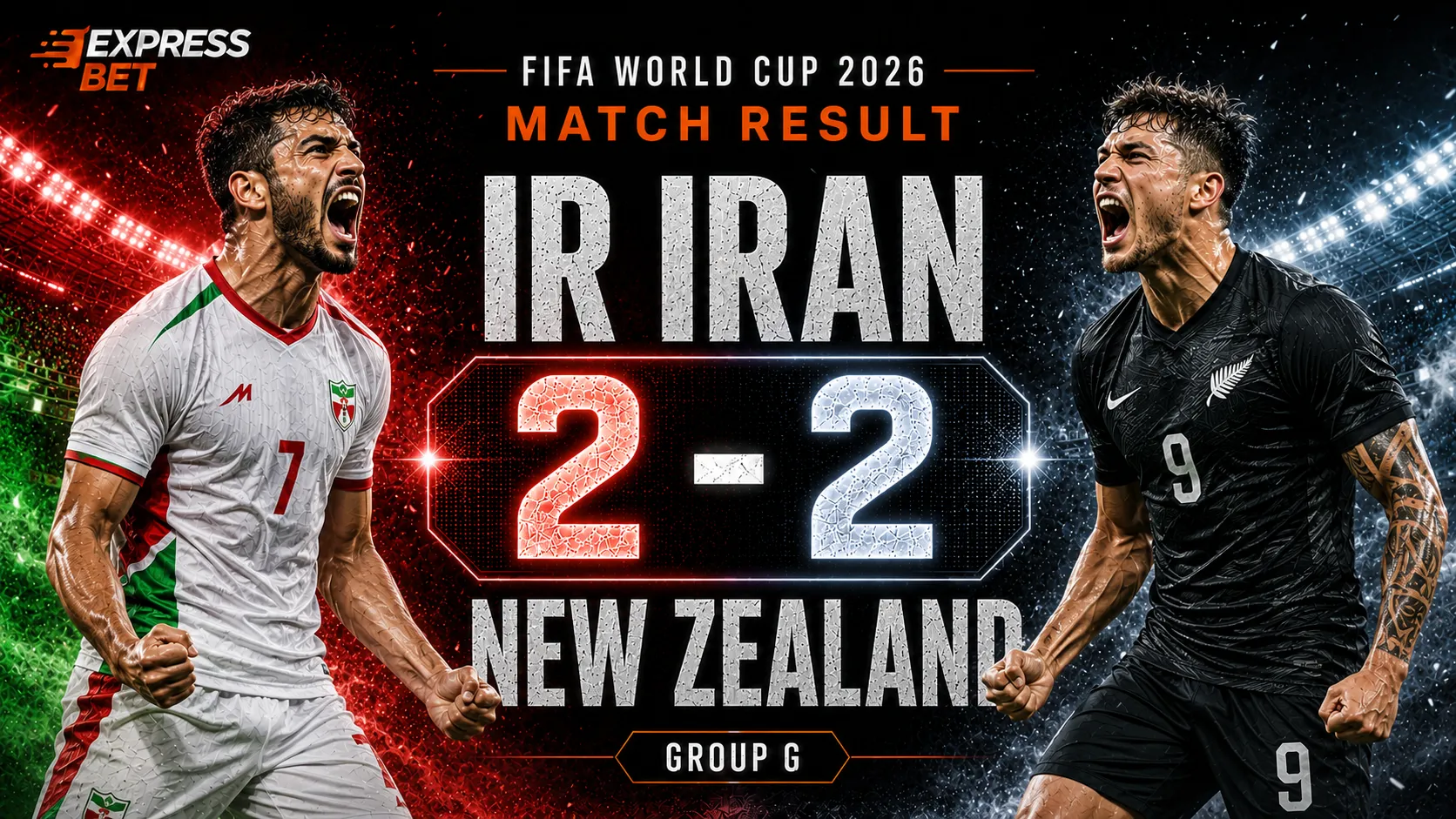
The IR Iran vs New Zealand match result was a 2-2 draw in their FIFA World Cup 2026 Group G opener at Los Angeles Stadium. Elijah Just scored twice for New Zealand, both assisted by Chris Wood. Iran equalised twice through Ramin Rezaeian and Mohammad Mohebbi, with Rezaeian also assisting the second goal. The main turning point was Iran’s response after New Zealand’s second lead, when Rezaeian’s right-side delivery restored Iran’s rhythm and found Mohebbi. Elijah Just was the standout attacker, while Rezaeian was Iran’s most decisive player. The result left Group G level after Belgium and Egypt also drew. Betting outcomes rewarded the draw, over 1.5 goals, both teams to score, and player-goal markets, depending on odds and timing.
Match Information
| Detail | Information |
|---|---|
| Match | IR Iran vs New Zealand |
| Competition | FIFA World Cup 2026 |
| Stage | Group stage |
| Group | Group G |
| Date | 15 June 2026 local time / 16 June UTC |
| Kickoff time | 6:00 p.m. local time / 01:00 UTC |
| Host country | United States |
| City | Los Angeles / Inglewood area |
| Stadium | Los Angeles Stadium |
| Final score | IR Iran 2-2 New Zealand |
| Half-time score | IR Iran 1-1 New Zealand |
| Attendance | 70,108 |
| Referee | Cesar Ramos, Mexico |
| VAR | Erick Miranda, Mexico |
| Assistant referees | Alberto Morin and Marco Bisguerra |
| Fourth official | Yusuke Araki |
| Iran formation | 4-4-2 |
| New Zealand formation | 4-2-3-1 |
| Weather | Historical Inglewood data shows around 19°C on match day; detailed official match-weather data not confirmed |
| Pitch condition | No major confirmed pitch controversy |
| Surface type | Natural grass for World Cup configuration reported by venue guides; official match report did not list surface detail |
| Roof status | Los Angeles Stadium has a fixed translucent canopy; roof conditions were not a decisive match factor |
| Penalties | None |
| Red cards | None |
| Yellow cards | Ehsan Hajisafi 89’ |
| VAR involvement | VAR assigned; no decisive goal or penalty reversal confirmed |
| Betting result | Draw; over 1.5 goals; both teams to score “Yes” |
Final Score and Match Summary
IR Iran and New Zealand drew 2-2, which was both a fair result and a deeply annoying one for both managers.
New Zealand will see the match as a missed chance. They led twice. They had eight shots on target from 14 attempts. Elijah Just scored twice. Chris Wood assisted twice and still found time to behave like a striker who had personally read the scouting report. For a nation still chasing its first World Cup win, this was close enough to hurt.
Iran will see the match as a rescue operation that should not have been necessary. They started with intent, fell behind after seven minutes, hit the post through Mehdi Taremi, had pressure, had a disallowed goal before half-time, then had to climb back again after Just’s second goal. Tournament football is not always about authority. Sometimes it is about refusing to leave when the scoreboard suggests you should.
The match began with Iran on the front foot. Amir Ghalenoei’s side played in a 4-4-2, with Mehdi Taremi and Shahriyar Moghanloo up front, Ramin Rezaeian and Milad Mohammadi providing full-back width, and Saeid Ezatolahi and Saman Ghoddos trying to connect midfield to attack. New Zealand set up in a 4-2-3-1, with Chris Wood as the central striker, Elijah Just and Callum McCowatt around Sarpreet Singh, and Joe Bell and Marko Stamenic holding midfield.
Iran made the first noise. Arya Yousefi forced Max Crocombe into an early save in the sixth minute. Then New Zealand scored with their first serious strike. Wood cushioned the ball into Just’s path, and Just finished cleanly past Alireza Beiranvand. This is the part of football that keeps analysts humble: a team can control the first five minutes and still be behind after seven.
Iran answered through Rezaeian in the 32nd minute. The right-back reacted after Moghanloo’s shot was blocked and finished with the outside of his boot. It was scrappy enough to be real and sharp enough to count. At that point, the stadium sound shifted again. In Los Angeles, with a large and divided Iranian diaspora in attendance, every Iranian action carried more noise than a normal neutral-site group match.
New Zealand had a strong end to the first half. Wood and McCowatt both had shots on target before the interval. Iran also threatened, including an offside header from Ali Nemati right before half-time. The 1-1 score at the break felt accurate. Both teams had scored. Both teams had evidence. Neither had control.
The second half repeated the pattern with almost comic precision. Iran began aggressively. New Zealand then scored again. In the 54th minute, Wood again assisted Just, who ran into space and lifted his finish beyond the Iranian defence. The All Whites led 2-1 and had the match where they wanted it.
For ten minutes.
Iran equalised in the 64th minute. Rezaeian, already the scorer, delivered from the right. Mohammad Mohebbi attacked the ball and finished. The match returned to level terms and stayed there, despite late Iranian pressure and a stoppage-time Wood shot on target.
This was not a match of one dominant side and one stubborn underdog. It was open, flawed, emotional and tactically imperfect. Iran created more total attempts. New Zealand created more on-target threat. Iran had the better late pressure. New Zealand had the better finishing moments. The draw was not clean. It was fair enough.
Goal Timeline
7’ — Elijah Just, New Zealand, open-play goal
New Zealand’s opener came early and against the first flow of the match.
Iran had started quickly, pushing crosses into the New Zealand box and forcing an early save from Crocombe through Arya Yousefi. Then New Zealand broke. Chris Wood, operating as the central reference point, controlled the attack with the kind of composure that matters more than speed. He cushioned the ball into Elijah Just’s path, and Just finished past Beiranvand.
The goal was direct and efficient. New Zealand did not need a long passing sequence. They needed one good forward connection and one runner arriving at the right time.
Iran’s defensive line was caught between stepping up and retreating. Just attacked the gap, Wood made the right touch, and Beiranvand was left exposed. It was not a goal from sustained pressure. It was a goal from timing.
Tactically, it immediately validated Darren Bazeley’s setup. New Zealand were not going to out-possess Iran in every phase. They were going to hit quickly through Wood, Just, Singh and McCowatt. The first goal showed exactly why Iran’s full-backs had to be careful when advancing.
Emotionally, the goal did two things. It gave New Zealand belief. It also made Iran play the rest of the half with extra urgency, which in a World Cup opener can be useful or dangerous. Often both.
32’ — Ramin Rezaeian, IR Iran, open-play goal
Iran’s equaliser came through persistence, a blocked shot, and a full-back who understood the value of arriving late.
The move developed after Iran pushed New Zealand back. Shahriyar Moghanloo had the first shot, which was blocked by Max Crocombe and the defensive crowd around him. The loose ball broke toward the right side of the box, where Ramin Rezaeian arrived and used the outside of his boot to finish.
It was not a perfect passing move. It was more important than that. It was a response.
Iran had been threatening before the goal. Taremi had struck the post in the 23rd minute after a strong carry through central space. Ghoddos had shots. Moghanloo was beginning to occupy the New Zealand centre-backs. The pressure had been building, and Rezaeian converted it into something the scoreboard understood.
The goal also exposed New Zealand’s difficulty clearing second balls. Their first block was good. The second action was not. Rezaeian had time to attack the rebound because New Zealand’s defensive line did not reset quickly enough.
Tactically, the equaliser came from Iran’s right side, which became a major theme. Rezaeian’s influence was not limited to defensive work. He became Iran’s key attacking full-back, later assisting the second equaliser.
For Iran, the goal restored order. For New Zealand, it was a warning that a 1-0 lead against Iran tends to come with paperwork.
54’ — Elijah Just, New Zealand, open-play goal
New Zealand’s second goal was almost a sequel to the first, only cleaner in space.
Just started the move with a diagonal run through midfield. Wood again became the connector. He received and released the ball into Just’s path with an intelligent pass. Just lifted the finish beyond the goalkeeper and restored New Zealand’s lead.
The goal showed the best of New Zealand’s attacking plan. Wood was not only a target man. He was a playmaker with his back to goal and a forward who understood the timing of runners around him. Just was not only a winger waiting wide. He moved inside and attacked central gaps.
Iran’s midfield did not close the lane quickly enough. The centre-backs were forced to react while running toward their own goal. That is exactly the situation New Zealand wanted.
The finish was composed. Just had already scored once, but his second goal required another kind of calm: the confidence to repeat the same punishment after Iran had spent half-time trying to prevent it.
Emotionally, the goal was enormous for New Zealand. They were 36 minutes from what would have been their first World Cup win. That is the kind of number nobody should say too loudly until the final whistle, because football has ears.
64’ — Mohammad Mohebbi, IR Iran, open-play goal
Iran’s second equaliser came from the same man who had scored the first: Rezaeian, this time as creator.
The move came from the right side. Rezaeian delivered into the penalty area, and Mohammad Mohebbi attacked the ball decisively. The finish brought Iran level at 2-2.
This was Iran’s best team response of the match. They had gone behind for the second time and did not collapse into rushed shooting. They found the wide lane, trusted the delivery, and attacked the box with enough bodies.
New Zealand’s defending was passive in the decisive action. They had been strong in several central duels, but the cross from Rezaeian found the dangerous corridor. Mohebbi’s movement punished that hesitation.
Tactically, the goal confirmed Iran’s most productive route. Rezaeian’s right-side role gave Iran width, crossing quality and late-box timing. New Zealand had dealt with several Iranian attacks from central areas, but the wide service became harder to defend.
Emotionally, the equaliser shifted the final phase. New Zealand were no longer protecting a famous lead. Iran were no longer chasing. Both teams then had to decide whether one point was enough or whether the match still had a third act. The third act never scored.
Key Moments That Changed the Match
Yousefi’s early shot on target
Arya Yousefi forced Max Crocombe into an early save in the sixth minute. It was Iran’s first clear sign of attacking intent.
The chance mattered because it showed Iran were not starting slowly. They pressed high, used the right flank, and tried to unsettle New Zealand before the match became structured. New Zealand survived that early phase and scored one minute later, which made the moment even more important in hindsight.
Just scores from New Zealand’s first real strike
The first goal changed the match because it rewarded New Zealand immediately for their direct plan.
Iran had been active. New Zealand were clinical. That contrast shaped the whole night. Iran had more attempts. New Zealand were sharper on target.
Taremi hits the post
In the 23rd minute, Mehdi Taremi struck the post after a direct central attack. Beiranvand’s opposite number was beaten, and Iran were inches from equalising before Rezaeian eventually did the job.
The miss mattered because it could have turned Iran’s early pressure into a calmer match. Instead, Iran had to keep chasing. Taremi’s performance had moments of class, but this was the one chance he will remember.
Rezaeian equalises
Rezaeian’s 32nd-minute goal restored Iran’s balance. Without it, New Zealand could have spent the rest of the half in a compact defensive posture.
The goal also turned Rezaeian into the match’s most important Iranian player. He had entered the article as a full-back. He left it as a goal-and-assist tournament reference point.
Nemati’s disallowed header before half-time
Iran thought they had scored right before the interval when Ali Nemati headed in from a set-piece situation. The flag went up for offside, and the goal did not count.
The moment mattered psychologically. Iran had almost completed the comeback before half-time. New Zealand escaped to the dressing room level rather than behind. That changed both team talks.
Just scores again after half-time
New Zealand’s second goal came after Iran had started the second half with pressure. That made it especially damaging.
It repeated the match’s core pattern: Iran territory, New Zealand forward efficiency. Just’s second goal put New Zealand close to a historic win and forced Iran into another chase.
Ghayedi and Alipour change Iran’s attack
Iran introduced Mehdi Ghayedi at half-time and Ali Alipour in the 53rd minute. Those changes increased mobility and gave Iran more attacking angles.
Iran’s second equaliser did not come directly from a substitute, but the attacking rhythm after the changes was better. New Zealand had to defend more runs and more bodies around the box.
Rezaeian assists Mohebbi
This was the decisive Iranian response. Rezaeian’s delivery and Mohebbi’s finish produced 2-2.
It prevented New Zealand from turning their second lead into a famous win. It also gave Iran a point they needed badly in a group with Belgium and Egypt still ahead.
Hajisafi’s yellow card
Ehsan Hajisafi was booked in the 89th minute. It was the match’s only yellow card.
The booking mattered less for this match than for the group. Iran already face difficult fixtures, and any accumulation risk for experienced players must be managed.
Wood’s stoppage-time shot
Chris Wood had a shot on target in the 90+3rd minute. It was New Zealand’s final reminder that they had not come only to survive.
Wood did not score, but his two assists and late threat made him one of the match’s defining players. New Zealand nearly found the third. Iran survived.
First Half Analysis
Iran started in a 4-4-2. Beiranvand was in goal. Mohammadi, Nemati, Khalilzadeh and Rezaeian formed the back four. Yousefi, Ezatolahi, Ghoddos and Mohebbi worked across midfield. Taremi and Moghanloo started as the front pair.
New Zealand used a 4-2-3-1. Crocombe was in goal. Payne, Surman, Boxall and Cacace formed the defensive line. Bell and Stamenic sat in midfield. Just, Singh and McCowatt supported Wood.
The early tactical pattern was not complicated. Iran wanted to play forward quickly, use Rezaeian and Mohammadi for width, and get Taremi into pockets around Moghanloo. New Zealand wanted to stay compact, then release Wood as the first attacking reference.
Iran looked sharper in the opening minutes. They crossed early, pressed after losses, and forced New Zealand into a few hurried clearances. Yousefi’s shot on target showed the plan. Iran were trying to attack before New Zealand settled.
Then came the New Zealand goal. It changed the emotional structure but not the tactical one. Iran still had more pressure. New Zealand still had the clearer transition threat.
Wood’s role was central. He did not run constantly behind the line. He did something more useful: he made the ball stick, then released runners. Just benefited most. McCowatt and Singh also found moments around Iran’s midfield.
Iran’s midfield had mixed control. Ezatolahi gave physical presence and later had shots. Ghoddos tried to shoot and connect. Mohebbi worked between wide and central lanes. But Iran’s best moments came when Taremi received facing goal or when Rezaeian arrived high.
Taremi’s post shot was the clearest sign that Iran could hurt New Zealand centrally. He carried the attack himself, struck well, and hit the upright. A little more inside, and the match becomes 1-1 earlier.
Iran did equalise through Rezaeian in the 32nd minute. The goal rewarded their pressure and New Zealand’s imperfect clearance. After that, the half opened up.
New Zealand had good late-half chances. Cacace forced a shot on target. Singh tested Beiranvand. Wood had a shot on goal in the 44th minute. McCowatt followed with another in stoppage time. Those chances matter because they show New Zealand were not merely defending after equalising. They kept attacking.
Iran’s disallowed Nemati header near half-time was another major swing. The offside flag prevented Iran from taking the lead. New Zealand had survived a difficult half and still had enough attacking evidence to believe.
At half-time, both coaches had obvious tasks. Ghalenoei needed more movement around Taremi and more precision in wide delivery. Bazeley needed to close the second-ball problem and keep Wood connected to Just.
Both teams partially solved their tasks. Neither solved the match.
Second Half Analysis
Iran made the first change at half-time, introducing Mehdi Ghayedi for Arya Yousefi. The idea was clear. Iran needed a sharper forward profile and more movement between New Zealand’s right-back and centre-back.
Iran started the half with energy. Ghayedi had an early shot. Rezaeian took a corner. Moghanloo had another attempt. The pressure looked real.
Then New Zealand scored again.
Wood and Just combined in the 54th minute, and the match tilted back toward the All Whites. It was a classic counterpunch. Iran had the territorial push. New Zealand had the goal.
Ghalenoei reacted quickly. Ali Alipour replaced Moghanloo in the 53rd-minute sequence, giving Iran another forward type. Later, Ehsan Hajisafi came on for Ghoddos in the 65th minute and took the captaincy from Taremi. Amirhossein Hosseinzadeh replaced Taremi in the 80th minute.
The changes reflected the game state. Iran needed fresh energy, extra width, and more players attacking the box. They were not dominating cleanly, but they were forcing New Zealand into deeper defending.
Mohebbi’s equaliser in the 64th minute came from that pressure and Rezaeian’s quality. Once the score became 2-2, the match became more nervous. Both teams had reasons to chase and reasons to fear losing.
Bazeley adjusted too. Ben Old and Ryan Thomas came on in the 68th minute for Cacace and McCowatt. Callan Elliot replaced Tim Payne in the 77th minute. Jesse Randall and Tyler Bindon entered in stoppage time for Singh and Stamenic.
New Zealand’s changes were partly about fresh legs and partly about protecting structure. They had already created enough to win but were now absorbing Iran’s momentum.
The final 20 minutes belonged more to Iran territorially. Taremi had a shot before being replaced. Hajisafi shot. Mohebbi threatened again. Ezatolahi had two late attempts, one on target. Nemati had a shot after a late corner. Iran were pushing.
But New Zealand still had one more danger moment. Wood’s stoppage-time shot on target was a reminder that Iran’s full push left space. Beiranvand had to remain alert until the end.
The second half revealed the match’s truth: Iran had more urgency and volume; New Zealand had better attacking efficiency. The draw was born from that imbalance.
Tactical Picture: Why the Match Finished Level
The match finished level because Iran produced pressure without enough defensive control, while New Zealand produced cutting transitions without enough match management.
Iran’s 4-4-2 gave them two central forwards and wide support. Taremi could drop off, Moghanloo could occupy centre-backs, and Rezaeian could advance from right-back. Without the ball, Iran pressed in a front-two shape, trying to force New Zealand toward the touchline.
The problem was transition defence. Every time Rezaeian or Mohammadi pushed high, Iran’s centre-backs had to manage space behind the full-backs. New Zealand targeted that risk through Wood’s hold-up play and Just’s runs.
Wood was the tactical key for New Zealand. He did not score. He still shaped the match. His two assists came from intelligent link play. Iran’s centre-backs could not ignore his physical presence, but midfielders also had to track the runners around him. That created confusion.
Just attacked the space better than anyone else on the pitch. He timed runs diagonally and centrally, which made him harder to track than a winger staying wide. His first goal came from arriving into the right area. His second came from reading Wood’s pass and attacking the lane before Iran closed it.
Iran’s best attacking route was the right side. Rezaeian scored from a second ball and assisted from delivery. Mohebbi also drifted into dangerous areas from that side. When Iran crossed early and attacked rebounds, they looked dangerous. When they slowed into central passing, New Zealand had time to compact.
New Zealand’s 4-2-3-1 defended as a 4-4-1-1 or 4-5-1 at times. Bell and Stamenic tried to protect the centre. Singh worked between midfield and attack. McCowatt gave support on one side, Just on the other. The problem was second balls around the penalty area. Iran’s first equaliser came from exactly that.
Bazeley’s side also had issues after taking leads. They scored early, conceded. They scored again, conceded again. This was not a collapse, but it was a failure to slow Iran’s rhythm after key moments.
Iran’s substitutions improved attacking variety. Ghayedi gave movement. Alipour gave a different forward reference. Hajisafi added experience and another left-sided option. But Iran did not fully dominate the final third because New Zealand’s centre-backs handled many aerial and central actions.
The draw was tactical and emotional. New Zealand’s plan worked twice. Iran’s response worked twice. Neither side defended well enough after scoring. That is how 2-2 happens.
Player Ratings and Individual Performances
IR Iran Player Ratings
Alireza Beiranvand — 6/10
Conceded twice from eight New Zealand shots on target. Not directly at fault for either Just goal, but did not produce the decisive save Iran needed. Handled late pressure reasonably.
Milad Mohammadi — 6/10
Worked on the left side and supported attacks when possible. Had to manage McCowatt and Singh rotations. Solid but not especially influential in the final third.
Ali Nemati — 6/10
Had a disallowed header before half-time and a late shot. Defensively, he struggled at times with Just’s diagonal movement.
Shoja Khalilzadeh — 6/10
Physical and experienced, but New Zealand’s movement around Wood created problems. Won several duels but could not fully control the central spaces.
Ramin Rezaeian — 8.5/10
Iran’s best player. Scored the first equaliser, assisted Mohebbi’s second, and gave Iran their most productive attacking lane. One goal and one assist from right-back is a serious World Cup contribution.
Arya Yousefi — 6/10
Forced an early save but was replaced at half-time. His early attacking work was useful, though Iran wanted more danger after falling behind.
Saeid Ezatolahi — 6.5/10
Had two late attempts, including one on target. Provided midfield strength but could not always stop New Zealand’s forward transitions.
Saman Ghoddos — 6/10
Had two first-half shots and tried to link midfield to attack. Replaced by Hajisafi as Iran searched for more left-side control.
Mohammad Mohebbi — 7.5/10
Scored Iran’s second equaliser and remained active throughout. His movement into the box was decisive when Rezaeian delivered.
Mehdi Taremi — 6.5/10
Hit the post in the first half and carried threat between lines. Did not score and was replaced in the 80th minute. His miss remains one of the match’s big what-ifs.
Shahriyar Moghanloo — 6/10
His blocked shot led to Rezaeian’s equaliser. Worked physically but lacked finishing precision. Replaced by Alipour.
Mehdi Ghayedi — 6.5/10
Added movement after half-time and had a shot early in the second half. Helped Iran’s attack become less predictable.
Ali Alipour — 6/10
Entered in the 53rd minute and gave Iran fresh forward legs. Worked hard but did not produce a decisive shot.
Ehsan Hajisafi — 5.5/10
Brought experience and took the captaincy, but his late yellow card slightly damages the rating. Had one shot.
Amirhossein Hosseinzadeh — 6/10
Late attacking substitute. Limited time to change the match.
New Zealand Player Ratings
Max Crocombe — 6.5/10
Conceded twice but made important saves, including early and late work. Could not fully control rebounds before Rezaeian’s goal.
Tim Payne — 6/10
Defended under repeated pressure and was replaced late by Callan Elliot. Solid enough but stretched by Iran’s wide attacks.
Finn Surman — 6.5/10
Had to handle Taremi and Moghanloo’s movement. Not perfect, but competed well in a busy defensive match.
Michael Boxall — 6.5/10
Experienced, physical, and important in central clearances. Iran’s two goals came from second-phase and wide-service moments rather than simple centre-back collapse.
Liberato Cacace — 6.5/10
Had a shot on target and carried some left-side threat. Replaced in the 68th minute as New Zealand refreshed the flank.
Joe Bell — 6.5/10
Worked in midfield and helped New Zealand move the ball under pressure. His positioning mattered when Iran tried to attack centrally.
Marko Stamenic — 6/10
Had an early attempt and worked hard defensively. Replaced in stoppage time. Some difficulty containing Iran’s late midfield pressure.
Elijah Just — 9/10
Two goals, excellent movement, and the best attacking performance of the match. His finishing gave New Zealand a real chance at a historic win.
Sarpreet Singh — 7/10
Three attempts, two on target, and useful creative movement. Replaced late after a strong technical performance.
Callum McCowatt — 6.5/10
Had two attempts, one on target, and worked in support of Wood. Replaced by Ryan Thomas.
Chris Wood — 8.5/10
Two assists, two shots on target, and excellent link play. Did everything except score. His partnership with Just defined New Zealand’s attack.
Ben Old — 6/10
Entered in the 68th minute and added fresh running. Limited attacking impact.
Ryan Thomas — 6/10
Helped New Zealand manage midfield pressure after coming on. Did not change the attacking pattern much.
Callan Elliot — 6/10
Late defensive substitute. Helped New Zealand survive the final phase.
Jesse Randall — 6/10
Stoppage-time substitute. Too little time to judge meaningfully.
Tyler Bindon — 6/10
Late substitute for Stamenic. Entered to protect structure.
Best Players of the Match
Man of the Match: Elijah Just
Two goals in a World Cup match make the argument simple. Just was New Zealand’s most dangerous runner and the player Iran never truly solved.
Best attacker: Chris Wood
Just scored the goals, but Wood created both. His hold-up play, timing and final pass gave New Zealand their attacking identity.
Best midfielder: Sarpreet Singh
Singh connected New Zealand’s midfield to attack and produced two shots on target. He gave the All Whites more than just counterattacking effort.
Best defender: Ramin Rezaeian
This is partly cheating because his attacking contribution was enormous. Still, from a defensive slot, he scored and assisted. That wins categories.
Best goalkeeper: Max Crocombe
Beiranvand faced more on-target shots, but Crocombe’s early save from Yousefi and handling under Iran’s pressure mattered. Neither goalkeeper had a flawless night.
Best substitute: Mehdi Ghayedi
Ghayedi gave Iran more movement after half-time and helped change the rhythm of the attack.
Most underrated performance: Joe Bell
Bell’s work in front of the New Zealand defence helped prevent Iran from turning pressure into repeated central chances.
Most disappointing performance: Mehdi Taremi’s finishing
Taremi played with intelligence and threat, but the post shot was a major missed opportunity. Iran needed their captain to turn one big moment into a goal.
Injuries, Suspensions, Cards, and Discipline
There were no red cards and no confirmed injury incident that shaped the match.
The only yellow card went to Ehsan Hajisafi in the 89th minute for serious foul play. That matters more for the group than for this match. Iran face Belgium next, and yellow-card accumulation can become an irritant quickly.
No player triggered a confirmed suspension from this match. No concussion substitution was reported. No penalty-box injury delay changed the result.
The discipline pattern was otherwise clean. Iran committed 10 fouls against and New Zealand eight according to FIFA’s official report. The match had intensity, but it was not dirty. That is worth noting because the atmosphere around the stadium carried political tension. On the pitch, the football stayed mostly within normal competitive lines.
New Zealand’s zero-card match is useful before Egypt. Iran’s only booking is manageable, but Hajisafi must be careful if used heavily in the next fixture.
Referee and VAR Analysis
Cesar Ramos had a match with goals, transitions and emotional noise, but not many major refereeing controversies.
There were no penalties. No red cards. No decisive VAR overturn changed the result. VAR Erick Miranda was assigned, with Fedayi San as assistant VAR and Bastian Dankert as support VAR, but the match did not become a technology drama. That alone is sometimes enough.
The key officiating moment was Nemati’s disallowed header before half-time. The offside flag denied Iran what would have been a 2-1 lead. The decision stood. There was no confirmed reversal.
Ramos allowed the match to flow. Both teams had periods of physical pressure, but the foul count remained modest. The only booking arrived late.
Added time mattered. FIFA’s report listed six minutes added in the first half and five in the second. Iran’s disallowed header came before half-time, while Wood’s late shot on target came in stoppage time. The match had time for one final twist. It did not take it.
The referee did not decide the result. Defensive spacing, forward timing and finishing did.
Weather, Stadium, Pitch, and Match Conditions
The match was played at Los Angeles Stadium in the United States, with 70,108 in attendance.
Historical weather data for Inglewood on match day showed mild conditions around 19°C, with the daily range roughly from 17°C to 22°C. The official match report did not confirm detailed in-stadium weather readings such as humidity, wind or roof ventilation.
Los Angeles Stadium has a fixed translucent canopy and open-air elements rather than a conventional closed dome. Weather did not become a visible match story. There was no confirmed pitch controversy, no rain-related delay, and no major surface issue reported in the official match data.
The pitch played quickly enough for both sides to counter. That mattered. New Zealand’s goals came from forward connections and runners attacking open lanes. Iran’s best moments also came when they moved early into the box, not when possession slowed into static crossing.
The setting mattered more emotionally than meteorologically. Los Angeles has a large Iranian diaspora, and the match carried visible tension around protests, flags and political division. That atmosphere did not stop the game from becoming an open football contest. If anything, it gave every Iranian attack a sharper sound.
Fans and Stadium Atmosphere
This was not a normal neutral-site group match.
The Los Angeles crowd was large, loud and politically charged. Iranian supporters were visible in huge numbers, but the atmosphere was divided. Some backed Team Melli loudly. Others used the match as a stage for protest and dissent. The result was a stadium that never quite sounded simple.
New Zealand had a smaller support base in the stadium, but their goals produced the kind of noise that travels well. Just’s opener created shock. His second goal created belief. For a team still chasing its first World Cup win, those moments mattered deeply.
Iran’s goals produced heavier emotional releases. Rezaeian’s equaliser lifted the stadium. Mohebbi’s second equaliser felt like relief as much as celebration.
The late phase was tense rather than euphoric. Iran pushed. New Zealand countered. The crowd knew one more goal would change the group completely. It never came.
The atmosphere affected the match because it added pressure to Iran’s every action. They were not playing in a quiet neutral bubble. They were playing inside a national argument with football boots.
Historical Context and World Cup Analogies
New Zealand have lived through World Cup draws before.
In 2010, they famously finished the group stage unbeaten with three draws and still did not advance. That memory hangs over every All Whites World Cup point. A draw can be noble. It can also be insufficient. Football has no duty to reward dignity.
This match nearly changed that history. New Zealand twice led and came close to their first World Cup win. Elijah Just became the first New Zealand player to score twice in a World Cup match, while Chris Wood became the first New Zealand player to provide multiple assists in a World Cup match. That is not trivia. It is national football progress.
Iran also created a record note through Rezaeian, who became the first Iranian player to score and assist in a World Cup match. His performance now belongs in Iran’s tournament archive, even if the result left them frustrated.
The match also followed an old World Cup pattern: the team with the more established tournament identity controls more total pressure, while the underdog produces the cleaner attacking moments. This was not a smash-and-grab. New Zealand had eight shots on target. They were dangerous enough to win.
Iran’s broader World Cup story remains the same. They have reached the tournament repeatedly but have never escaped the group stage. New Zealand are still chasing the same breakthrough from fewer appearances. The expanded 48-team format makes that dream more realistic for both. This draw keeps both alive and leaves both slightly annoyed.
Match Statistics
| Statistic | IR Iran | New Zealand |
|---|---|---|
| Final score | 2 | 2 |
| Half-time score | 1 | 1 |
| Ball possession | 48% | 52% |
| Attempts at goal | 17 | 14 |
| Shots on target | 4 | 8 |
| Blocked attempts | 5 | 1 |
| Fouls against | 10 | 8 |
| Corners | 4 | 1 |
| Direct free kicks | 8 | 9 |
| Indirect free kicks | 0 | 2 |
| Penalties | 0/0 | 0/0 |
| Offsides | 2 | 0 |
| Own goals | 0 | 0 |
| Yellow cards | 1 | 0 |
| Red cards | 0 | 0 |
The statistics explain why the draw feels fair.
Iran had more attempts and more corners. New Zealand had more possession and twice as many shots on target. Iran’s pressure was broader. New Zealand’s chance quality on target was more consistent.
The 17-14 shot split shows an open match. The 4-8 shots-on-target split shows why New Zealand will regret not winning. When a team produces eight shots on target in a World Cup opener and leads twice, one point can feel thin.
The corner count favoured Iran 4-1, which reflects their pressure around the box. But New Zealand defended enough set-piece phases and created more from open transition.
There were no penalties and no red cards. This was not a match bent by a single officiating event. It was decided by forward play, rebound reactions, and two teams who never fully protected a lead.
Betting Result Angle
The IR Iran vs New Zealand betting result was useful for bettors who respected both teams’ attacking paths and avoided assuming that reputation alone would settle the match.
The standard three-way match-winner market rewarded the draw. Iran win lost. New Zealand win lost. In some two-way “team to win” markets, a draw may have been graded as a push, depending on sportsbook rules.
The over/under line listed by FOX was 1.5. The match produced four goals, so over 1.5 landed comfortably. Over 2.5 also landed where available. This was not a slow underdog match. It was open from the seventh minute.
Both teams to score landed before the 32nd minute. Just scored for New Zealand, Rezaeian answered for Iran. From that point, BTTS tickets were already settled.
Correct score 2-2 landed for bettors who took the high-risk draw angle. It required New Zealand to lead twice, Iran to answer twice, and neither side to finish late. That is exactly why correct-score betting is volatile. It can look clever afterward and absurd before kickoff.
First goalscorer bettors needed Elijah Just. Anytime goalscorer markets on Just, Rezaeian and Mohebbi landed. Just brace markets paid strongly if offered. Chris Wood assist markets were excellent where available, because he assisted both New Zealand goals. Rezaeian goal contribution markets also landed if the book offered them.
Cards markets were quiet. Only one yellow card was shown. Anyone expecting political tension to translate into a card-heavy match would have been wrong. The emotional noise around the match did not become disciplinary chaos on the field.
Corners markets likely rewarded Iran corner volume more than New Zealand corner volume. Iran had four corners to New Zealand’s one. But this was not a corner-heavy match overall.
The live-betting swings were sharp. New Zealand’s early goal would have moved the draw and Iran comeback prices. Rezaeian’s equaliser restored balance. Just’s second goal again pushed New Zealand close to win territory. Mohebbi’s equaliser reset the market. The late phase then became classic World Cup draw tension.
This does not mean the same angle will work next time. Iran’s finishing, New Zealand’s transition efficiency, and match state all shaped the outcome. Betting analysis after the fact should explain what happened, not pretend the result was obvious.
What This Result Means for Group G
Group G is level after the opening round.
Iran drew 2-2 with New Zealand. Belgium drew 1-1 with Egypt. That leaves all four teams on one point.
Iran next face Belgium in Los Angeles. That match now carries heavy pressure. A win would change Iran’s tournament. A draw would keep them alive. A defeat would make the final group match against Egypt extremely uncomfortable.
New Zealand next face Egypt in Vancouver. That is now a major opportunity. If New Zealand can build on the attacking quality shown here, they have a real chance to push toward the Round of 32. But they also need to manage leads better. A team cannot keep producing good performances and calling them moral victories forever.
Goal difference is level enough that every future goal matters. Iran and New Zealand both scored twice, which helps if tiebreakers later include goals scored. But the missed chance for three points may matter more.
The expanded World Cup format gives some third-placed teams a route forward. That helps both teams. But neither can assume one point will be enough. This draw keeps the group open. It does not solve it.
What IR Iran Did Right
Iran responded well twice.
That is the biggest positive. They went behind early and did not panic. They went behind again after half-time and still found a way back. This matters in tournament football, where one bad emotional spell can ruin an entire campaign.
Rezaeian was excellent. His attacking timing, finishing and crossing gave Iran their most productive route. Mohebbi also made the decisive penalty-box run for the second equaliser.
Iran created volume. Seventeen attempts, four corners and repeated late pressure show that they did not retreat after setbacks. They kept attacking.
The substitutions added energy. Ghayedi, Alipour and Hajisafi all helped Iran push higher, even if the final winning goal never came.
Iran’s issue was not effort. It was defensive control. They allowed too many clean New Zealand shots on target and did not solve the Wood-Just connection quickly enough.
What New Zealand Got Wrong
New Zealand’s biggest failure was not performance. It was game management after taking the lead.
They scored early and conceded. They scored again and conceded again. That is the entire frustration.
Their defensive second-ball control was poor on the first Iran goal. Crocombe and the defence made the first stop, but Rezaeian arrived faster than anyone in black. On the second, they allowed Rezaeian too much room to deliver and Mohebbi enough space to finish.
New Zealand also struggled to slow the match after going 2-1 up. A team chasing its first World Cup win needs spells of possession, fouls in safe areas, throw-ins, and boring little bits of game control. New Zealand still looked dangerous, but they did not make Iran suffer enough without the ball.
This should not obscure the positives. Just and Wood were excellent. Singh was sharp. The midfield competed. New Zealand looked like a serious tournament side.
But serious tournament sides protect leads. That is the next lesson.
Coach Analysis
Amir Ghalenoei
Ghalenoei’s starting structure gave Iran attacking numbers but left transition risk.
The 4-4-2 made sense because Iran wanted Taremi and Moghanloo in the box and around New Zealand’s centre-backs. It also created right-side attacking value through Rezaeian. But it did not fully protect the spaces around Wood.
The half-time introduction of Ghayedi was logical. Iran needed more movement. Alipour’s introduction also made sense after the second half opened. Hajisafi brought experience and width. Hosseinzadeh gave late fresh legs.
Ghalenoei deserves credit for Iran’s response. His team did not mentally collapse after either New Zealand goal.
The concern is defensive preparation. Belgium will punish transition gaps even more ruthlessly. Iran cannot give that opponent eight shots on target and expect the same result.
Darren Bazeley
Bazeley’s attacking plan worked.
New Zealand were compact, direct and dangerous. Wood’s role was excellent. Just’s movement was perfect for the match. Singh and McCowatt gave enough support to prevent New Zealand from becoming a one-route team.
The issue is the management phase. Bazeley made changes after the hour, bringing on Old and Thomas, then Elliot and late defensive bodies. That was sensible, but the team had already conceded the second equaliser by the time the game-control substitutions could fully matter.
Bazeley will take pride in the performance. He should. New Zealand looked like they belonged. But he will also know this was a huge missed chance. Performances are useful. Points are stricter.
Player Milestones and Records
Elijah Just became the first New Zealand player to score more than once in a men’s World Cup match.
Chris Wood became the first New Zealand player to provide multiple assists in a men’s World Cup match.
Ramin Rezaeian became the first Iranian player to both score and assist in a World Cup match.
Iran and New Zealand met for the first time at a FIFA World Cup. That added a fresh entry to both nations’ tournament records.
New Zealand are still searching for their first World Cup win. This was one of their closest chances. Iran remain in pursuit of their first progression beyond the group stage.
No confirmed youngest scorer, oldest scorer, red-card record, penalty record or goalkeeper clean-sheet milestone was verified from the match data used here.
Incidents and Controversies
The main incident context around the match was off the pitch.
The fixture took place in a politically charged atmosphere, with protests outside the stadium and visible division among Iranian supporters inside. Some fans booed Iran’s anthem, while others supported the team loudly. Political symbols and protest flags were part of the wider match environment.
On the pitch, there was no major VAR controversy. No penalty was awarded. No red card was shown. No goal was overturned after a long review.
The main football controversy was Nemati’s disallowed header before half-time. The assistant raised the flag for offside, and the goal did not stand. Iran may regret that moment, but the match report records it as no goal.
There was also post-match discussion around goal celebrations and political interpretation, especially after Mohebbi’s equaliser. Such gestures should be handled carefully and factually. They did not change the football result.
Final Verdict
IR Iran vs New Zealand finished 2-2 because both teams had a plan good enough to score and a defensive structure loose enough to concede.
New Zealand were sharper in attack. Elijah Just and Chris Wood produced the match’s best partnership. Just scored twice. Wood assisted twice. That should have been enough for a historic win. It was not.
Iran were more persistent. Rezaeian delivered a complete attacking full-back performance, scoring once and assisting once. Mohebbi made the second equaliser count. Taremi had moments but missed the biggest one when he hit the post.
The scoreline was fair. Iran had more volume. New Zealand had better on-target efficiency. Both led or chased in different ways. Neither controlled the match long enough to win.
For Iran, the point is useful but not comfortable before Belgium. For New Zealand, the point is encouraging but painful before Egypt. Both teams remain alive. Both teams also left two points somewhere in Los Angeles, probably between the penalty areas.
For bettors, the match rewarded draw backers, over bettors, both-teams-to-score tickets, Just scorer markets, Wood assist angles, and Rezaeian goal-contribution markets. It punished anyone who assumed either team would manage the game cleanly.
The final image is simple: New Zealand close to history, Iran refusing to let them have it. That is a World Cup group opener with proper teeth.
Responsible Betting Note
Football betting carries financial risk. A correct match analysis does not guarantee a winning bet. Odds change before and during matches. Never chase losses. Do not bet money needed for daily life. Use limits and take breaks. Check local betting laws before gambling. Betting should remain entertainment, not income.
FAQ
IR Iran drew 2-2 with New Zealand in their FIFA World Cup 2026 Group G opener.
Elijah Just scored both goals for New Zealand. Ramin Rezaeian and Mohammad Mohebbi scored for Iran.
Elijah Just was the standout player after scoring twice. Chris Wood and Ramin Rezaeian were also excellent, with two assists for Wood and a goal plus assist for Rezaeian.
All four teams in Group G moved to one point after IR Iran drew with New Zealand and Belgium drew 1-1 with Egypt. Iran next face Belgium, while New Zealand face Egypt.
The draw landed in standard three-way markets. Over 1.5 goals landed. Both teams to score landed. First goalscorer and anytime goalscorer markets rewarded Elijah Just backers.
[expert_review params=»JTdCJTIyY29sb3IlMjIlM0ElMjJncmVlbi0yJTIyJTJDJTIyZXhwZXJ0X2F2YXRhciUyMiUzQSUyMiUyMiUyQyUyMmV4cGVydF9uYW1lJTIyJTNBJTIyJTIyJTJDJTIyZXhwZXJ0X2xpbmslMjIlM0ElMjIlMjIlMkMlMjJleHBlcnRfaWQlMjIlM0ElMjIxJTIyJTJDJTIyZXhwZXJ0X3R5cGUlMjIlM0ElMjJleHBlcnRfaWQlMjIlMkMlMjJleHBlcnRfYXZhdGFyX2FsdCUyMiUzQSUyMiUyMiUyQyUyMmV4cGVydF9zaG93JTIyJTNBMSUyQyUyMmV4cGVydF9kZXNjcmlwdGlvbiUyMiUzQSUyMlNwb3J0cyUyMEJldHRpbmclMjBBbmFseXN0JTIwJTI2JTIwRWRpdG9yaWFsJTIwQ29udHJpYnV0b3IlMjIlMkMlMjJleHBlcnRfc2hvd19idXR0b24lMjIlM0ExJTJDJTIyZXhwZXJ0X3Nob3dfYnV0dG9uX3R5cGUlMjIlM0ElMjJwb3B1cCUyMiUyQyUyMmV4cGVydF9xdWVzdGlvbl9idXR0b25fdGV4dCUyMiUzQSUyMkFzayUyMFF1ZXN0aW9uJTIyJTJDJTIycXVlc3Rpb25fZXh0ZXJuYWxfbGluayUyMiUzQSUyMiUyMiUyQyUyMnBvcHVwX3VzZV9waG9uZSUyMiUzQTAlMkMlMjJleHBlcnRfdGl0bGUlMjIlM0ElMjJBdXRob3IlMjIlMkMlMjJleHBlcnRfc2hvd190aXRsZSUyMiUzQTElMkMlMjJleHBlcnRfdGV4dCUyMiUzQSUyMkFsZXglMjBNb3JnYW4lMjBpcyUyMGElMjBzcG9ydHMlMjBiZXR0aW5nJTIwYW5hbHlzdCUyMGFuZCUyMGVkaXRvcmlhbCUyMGNvbnRyaWJ1dG9yJTIwd2hvJTIwd3JpdGVzJTIwZGV0YWlsZWQlMjBib29rbWFrZXIlMjByZXZpZXdzJTJDJTIwYmV0dGluZyUyMGd1aWRlcyUyQyUyMHBsYXRmb3JtJTIwY29tcGFyaXNvbnMlMkMlMjBhbmQlMjByZXNwb25zaWJsZSUyMGdhbWJsaW5nJTIwZXhwbGFpbmVycy4lMjBIaXMlMjB3b3JrJTIwZm9jdXNlcyUyMG9uJTIwcHJhY3RpY2FsJTIwaW5mb3JtYXRpb24lMjBmb3IlMjB1c2VycyUyMHdobyUyMHdhbnQlMjB0byUyMHVuZGVyc3RhbmQlMjBob3clMjBiZXR0aW5nJTIwc2l0ZXMlMjBvcGVyYXRlJTIwYmVmb3JlJTIwdGhleSUyMHJlZ2lzdGVyJTJDJTIwZGVwb3NpdCUyQyUyMG9yJTIwY2xhaW0lMjBhJTIwYm9udXMuJTIyJTJDJTIycWElMjIlM0ElNUIlNUQlMkMlMjJxYV9zaG93X3RpdGxlJTIyJTNBMSUyQyUyMnFhX3RpdGxlJTIyJTNBJTIyJUQwJTkyJUQwJUJFJUQwJUJGJUQxJTgwJUQwJUJFJUQxJTgxJTIwJUQxJThEJUQwJUJBJUQxJTgxJUQwJUJGJUQwJUI1JUQxJTgwJUQxJTgyJUQxJTgzJTIyJTJDJTIyc2NvcmUlMjIlM0ElNUIlNUQlMkMlMjJzY29yZV9zdW1tYXJ5X3RleHQlMjIlM0ElMjIlMjIlMkMlMjJzY29yZV9zdW1tYXJ5X2F2ZXJhZ2UlMjIlM0EwJTJDJTIyc2NvcmVfbWF4JTIyJTNBJTIyNSUyMiUyQyUyMnNjb3JlX3N5bWJvbCUyMiUzQSUyMiUyMiUyQyUyMnNjb3JlX3RpdGxlJTIyJTNBJTIyJTIyJTJDJTIyc2NvcmVfc2hvd190aXRsZSUyMiUzQTAlMkMlMjJwbHVzZXMlMjIlM0ElNUIlNUQlMkMlMjJtaW51c2VzJTIyJTNBJTVCJTVEJTJDJTIycGx1c2VzX21pbnVzZXNfc2hvd190aXRsZSUyMiUzQTElMkMlMjJwbHVzZXNfbWludXNlc190aXRsZSUyMiUzQSUyMiVEMCU5RiVEMCVCQiVEMSU4RSVEMSU4MSVEMSU4QiUyMCVEMCVCOCUyMCVEMCVCQyVEMCVCOCVEMCVCRCVEMSU4MyVEMSU4MSVEMSU4QiUyMiUyQyUyMnBsdXNlc190aXRsZSUyMiUzQSUyMiUyMiUyQyUyMm1pbnVzZXNfdGl0bGUlMjIlM0ElMjIlMjIlN0Q=»]