
Iraq vs Norway Match Result
Table of Contents Show
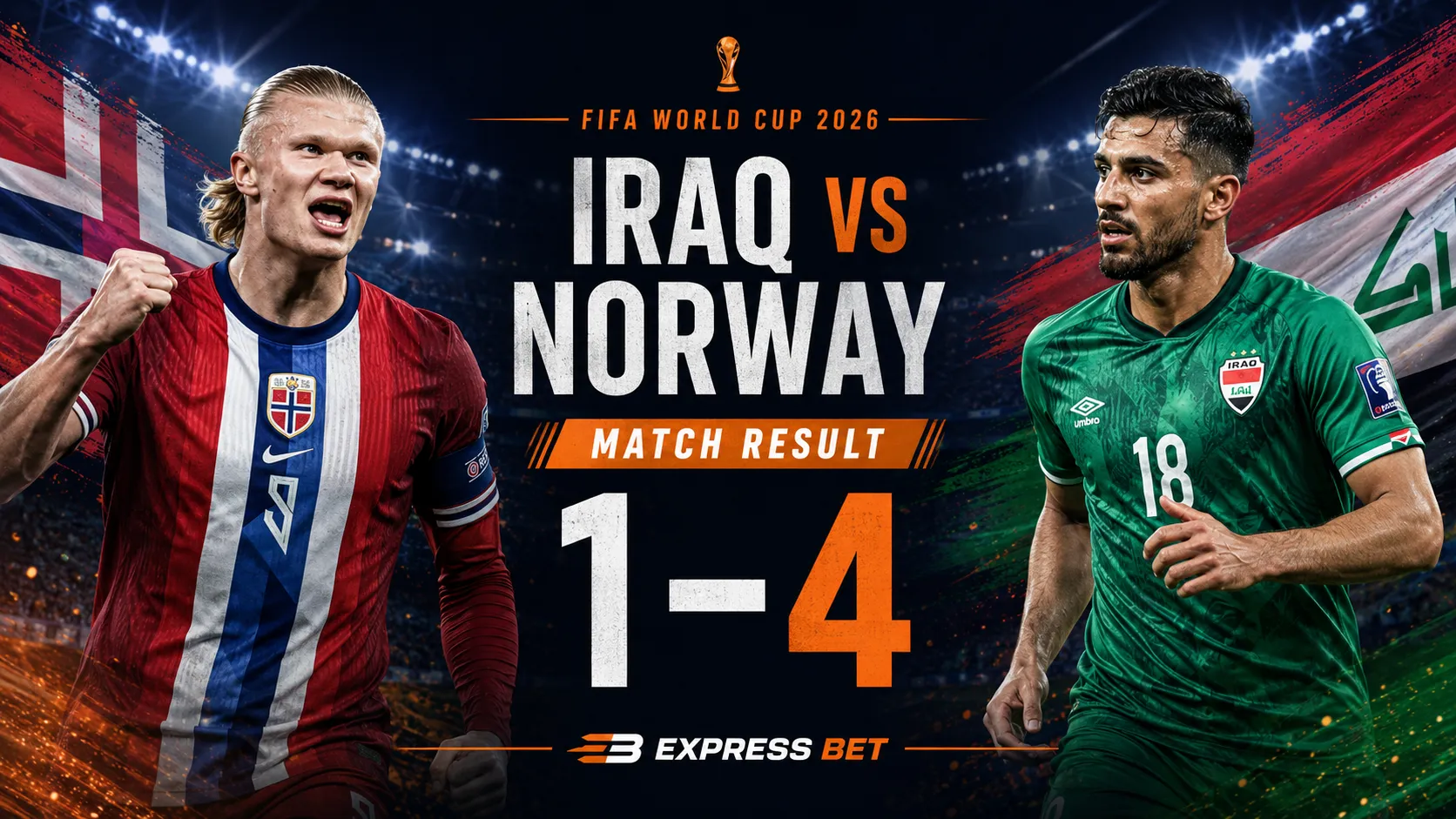
The Iraq vs Norway match result was a 4-1 win for Norway in their FIFA World Cup 2026 Group I opener at Boston Stadium. Erling Haaland scored twice on his World Cup debut, Aymen Hussein briefly levelled with a superb header, Leo Østigård added Norway’s third from a corner, and Hussein’s late own goal made the score heavier than Iraq’s performance deserved. The main turning point was Haaland’s second goal after a defensive mistake just before half-time. Haaland was the decisive player, but Iraq caused Norway real problems. Betting outcomes rewarded Norway moneyline, over 2.5 goals, both teams to score, and selected Haaland scorer markets, depending on odds and market timing.
| Detail | Information |
|---|---|
| Match | Iraq vs Norway |
| Competition | FIFA World Cup 2026 |
| Stage | Group stage |
| Group | Group I |
| Date | 16 June 2026 |
| Kickoff time | 6:00 p.m. local time / 22:00 UTC |
| Host country | United States |
| City | Boston / Foxborough, Massachusetts |
| Stadium | Boston Stadium |
| Final score | Iraq 1-4 Norway |
| Half-time score | Iraq 1-2 Norway |
| Attendance | 63,106 |
| Referee | Pierre Atcho, Gabon |
| VAR | Guillermo Pacheco, Mexico |
| Assistant referees | Boris Ditsoga and Amos Abeigne |
| Fourth official | Amin Mohamed |
| Iraq formation | 4-4-2 |
| Norway formation | FIFA tactical sheet: 4-1-2-3; some live graphics showed 4-3-3 |
| Weather | Mild conditions reported; detailed official match-weather data not confirmed |
| Pitch condition | No major confirmed pitch controversy |
| Surface type | Not confirmed in the match report |
| Roof status | Open-air stadium; no roof factor |
| Penalties | None |
| Red cards | None |
| Yellow cards | Zaid Tahseen, Iraq, 86’ |
| VAR involvement | VAR assigned; no decisive goal or penalty reversal confirmed |
| Betting result | Norway win; over 2.5 goals; both teams to score “Yes” |
Norway beat Iraq 4-1, but the number is slightly rude to the match.
The scoreboard says Norway controlled the evening. The football said something more complicated. Iraq played their first World Cup finals match in 40 years and did not look like a team arriving only to wave politely. They pressed, attacked, forced Norway into awkward defensive recoveries, and produced one of the best emotional moments of the match when Aymen Hussein rose above the Norwegian defence to make it 1-1.
Then Erling Haaland did what Erling Haaland does. He reduced Iraq’s best spell into a footnote.
Norway’s return to the World Cup after 28 years was always going to carry a strange pressure. They had the celebrity forward. They had Martin Ødegaard. They had tournament-dark-horse noise around them before they had actually won a match. This is football’s preferred way of making a team uncomfortable.
Ståle Solbakken set Norway in a shape that worked like a 4-1-2-3 in the official tactical listing, though many viewers would have read it as a 4-3-3. Ørjan Nyland started in goal. Julian Ryerson, Kristoffer Ajer, Torbjørn Heggem and David Møller Wolfe formed the back four. Sander Berge screened midfield, with Martin Ødegaard and Fredrik Aursnes ahead of him. Antonio Nusa and Alexander Sørloth played either side of Haaland.
Iraq, under Graham Arnold, used a 4-4-2. Jalal Hassan captained the side in goal. Merchas Doski, Akam Hashim, Zaid Tahseen and Hussein Ali formed the defensive line. Ali Jassim, Amir Al-Ammari, Zaid Ismael and Ibrahim Bayesh worked across midfield. Ali Al-Hamadi and Aymen Hussein led the attack.
The opening was not a Norwegian procession. Iraq started bravely. Aymen Hussein had an early attempt. Al-Hamadi fired over under pressure. Norway slowly found their rhythm, but Haaland was quiet for nearly half an hour. Quiet, in this case, meant waiting. With Haaland, silence is rarely peace. It is usually loading time.
The first goal arrived in the 29th minute. Møller Wolfe drove a low cross across the face of goal, and Haaland got across his markers to tap in at the far post. It was his first World Cup goal and Norway’s first tournament goal of this era. Nobody needed a tactical thesis for it. Good width, good delivery, terrifying striker, goal.
Iraq’s response was excellent. Ali Jassim isolated Ryerson, found Al-Ammari’s run, and Al-Ammari delivered the cross. Aymen Hussein did the rest, rising above three defenders and heading past Nyland. The Iraqi end had its moment. It was only Iraq’s second World Cup goal and their first in four decades. For ten minutes, the match was level and deservedly so.
Then came the decisive mistake. Zaid Tahseen played a weak back pass toward Jalal Hassan. Hassan hesitated. Haaland chased. The ball bounced off him and into the net. It was not elegant. It was devastating. Tournament football has a cruel habit of turning one loose pass into a national conversation. This was another entry.
The second half had less tempo. Iraq kept trying to play. Norway were not entirely comfortable, but they had the lead and the bigger bodies. Østigård’s 76th-minute header from Ødegaard’s corner finally killed the contest. Deep in stoppage time, Haaland’s aerial presence helped force Hussein’s own goal at the far post.
Norway moved top of Group I on goal difference after France also beat Senegal 3-1. Iraq left with no points, but not with no evidence. They showed enough to make France prepare properly. Norway showed enough to win. They also showed enough defensive vulnerability to make Senegal and France smile quietly.
Norway’s opener was simple, sharp and very difficult to defend once the ball reached the corridor.
David Møller Wolfe advanced on the left and sent a low cross through the Iraq penalty area. Haaland attacked the far-post lane, moved across the defensive line and stabbed the ball in from close range.
The finish was not spectacular. It was better than spectacular. It was inevitable once the delivery arrived. Haaland’s value is not only his size or left foot. It is the timing of his first two steps. He turns crosses into tap-ins because he moves before defenders accept that danger has become immediate.
Iraq’s back line did not collapse. It was beaten by a classic striker’s run. Zaid Tahseen and Akam Hashim were drawn toward the ball, while Haaland attacked the blind-side space.
Tactically, the goal validated Norway’s wide route. Iraq had competed well centrally, but Møller Wolfe’s overlap gave Norway a clean delivery angle. Against a forward like Haaland, one clean cross is often too many.
Emotionally, the goal lifted Norway’s tension. Their first World Cup match since 1998 now had the thing everyone expected: a Haaland goal. Football likes making obvious things wait just long enough to create doubt.
Iraq’s equaliser was the best football moment of their night.
Ali Jassim received wide, faced Ryerson and held the defender long enough to create uncertainty. He then found Amir Al-Ammari’s supporting run. Al-Ammari delivered a quality cross into the box, and Aymen Hussein attacked it like a striker who had been waiting 40 years on behalf of an entire country.
The header was excellent. Hussein rose above the Norwegian defenders and powered the ball past Ørjan Nyland.
This was not a fluke. Iraq had been growing into the match after Norway’s opener. Their wide players were finding better angles. Al-Hamadi’s movement was stretching Norway’s right side. Al-Ammari’s delivery gave Hussein the service he needed.
Defensively, Norway were too passive. Heggem, Ajer and the midfield screen did not attack the cross or the runner with enough authority. Haaland may define Norway’s attack, but this moment exposed their defensive structure.
Emotionally, the goal mattered deeply. Iraq had their first World Cup goal since 1986. The equaliser also changed the mood in Boston Stadium. Norway’s expected win suddenly had an argument inside it.
That argument lasted four minutes.
Norway’s second goal was not tactical poetry. It was pressure, hesitation and punishment.
Zaid Tahseen played a weak pass back toward Jalal Hassan. The goalkeeper hesitated before trying to clear. Haaland chased the action, closed the space, and the ball bounced off him into the net.
It was the sort of goal every coach hates because it is both preventable and difficult to forgive. Iraq had just equalised. They had momentum. They had Norway wobbling. Then they handed Haaland a gift and asked the least forgiving striker in football to be polite. He declined.
The goal changed the match more than any other moment. At 1-1 at half-time, Iraq enter the dressing room with belief and Norway enter with questions. At 2-1 Norway, the emotional balance changes. Iraq had to chase again. Norway had the scoreboard protection their performance had not fully earned.
Tactically, the goal showed the danger of playing backward under pressure without a clean angle. Haaland does not always press for 90 minutes like a frantic forward. But when he sees a weak pass, he attacks it. A striker does not need 50 touches if two of them go in.
Emotionally, it was brutal for Iraq. Their best spell became contaminated by one mistake.
Norway’s third goal came from a corner and from the aerial advantage that had been visible all evening.
Martin Ødegaard delivered the corner. Leo Østigård, introduced only minutes earlier, attacked the ball with fresh legs and clean timing. He rose through a crowded area and headed into the net.
This was the goal that ended the competitive phase. Iraq had pushed in the second half and had half-chances, including Hussein’s header after a Bayesh cross and Hussein Ali’s effort onto the roof of the net. But they had not found the equaliser.
Østigård’s goal punished that failure.
Defensively, Iraq did not mark the run aggressively enough. Set-piece defending is rarely glamorous, which is why teams remember it only after conceding. Østigård was able to attack the delivery without enough contact, pressure or disruption.
Tactically, Norway’s bench mattered. Solbakken introduced Østigård, Oscar Bobb, Andreas Schjelderup and Kristian Thorstvedt in the 73rd minute. Three minutes later, Østigård scored. That is efficient substitution work.
Emotionally, Iraq’s belief drained. The difference between 1-2 and 1-3 is not one goal. It is a different sport.
Norway’s fourth arrived deep in stoppage time and made the scoreline look more comfortable than the match had been.
Norway worked a late free-kick sequence, moved the ball back into the area, and Haaland attacked the far-post space. Under pressure, Aymen Hussein turned the ball over his own line.
Some live graphics initially suggested a Norwegian player might receive credit. The settled record listed it as a Hussein own goal.
The goal was cruel to Hussein. He had scored Iraq’s equaliser and led the line with strength. But football has never been especially careful with symmetry. It gave him the emotional peak and the final wound in the same match.
Tactically, the goal again came from Norway’s aerial presence. Haaland’s header and body pressure created confusion. Iraq’s defenders were exhausted. The ball landed in a dangerous zone. The own goal followed.
For betting markets, it mattered a lot. It pushed Norway’s margin to three, helped deeper handicap lines, and made the score look like a clean favourite win. Anyone who watched the full match knows it was not that simple.
In the 13th minute, Ali Al-Hamadi fired over under pressure from Torbjørn Heggem. It did not become a goal, but it showed Iraq were not here to defend passively.
Al-Hamadi’s runs gave Norway’s centre-backs work from the beginning. Iraq needed that. Aymen Hussein is the obvious focal point, but Al-Hamadi’s movement helped create the space around him.
Around the 20th minute, Haaland met a Norway corner and headed well over.
This was a useful early image. Iraq had kept him quiet in open play, but set pieces immediately showed the physical imbalance. Norway did not score from that corner, but the warning was there. Østigård later turned that warning into the third goal.
The 29th-minute goal changed the match state. Iraq now had to step higher. That could have broken them early. It did not. Their response was one of the best parts of the game.
The 39th-minute header brought Iraq level and gave the match its emotional centre. It also exposed Norway’s defensive weakness against wide delivery and aerial timing.
For a few minutes, Iraq looked capable of doing more than merely compete.
This was the decisive moment.
Tahseen’s weak back pass and Hassan’s hesitation gave Haaland his second. It turned Iraq’s momentum into Norway’s half-time lead. Some mistakes hurt. This one changed the result.
Iraq came close several times before the interval. Al-Hamadi had a one-on-one chance after a through ball but waited too long, allowing the shot to be deflected for a corner. Akam Hashim then struck fiercely from distance after the corner sequence.
These chances mattered because Iraq could have gone into half-time level again. They did not. That is how tournament football slowly charges interest.
In the 53rd minute, Hussein met a Bayesh cross but could not guide his header on target. The chance was not as clean as his goal, but it was another warning to Norway.
At 1-2, that kind of chance matters. Iraq needed one more precise contact. They did not get it.
The third goal ended Iraq’s best remaining hope. It also showed Norway’s depth and set-piece threat.
Solbakken needed control. He got it from a substitute centre-back heading in from a corner. Managers enjoy complicated plans. Sometimes the answer is just a fresh defender jumping higher than tired markers.
Tahseen was booked in the 86th minute for a tactical foul on Haaland. It was Iraq’s only card.
It also reflected the match’s late reality. Norway were seeing the game out, and Iraq’s defensive actions were becoming more reactive.
The first half was far better than a casual glance at the final score would suggest.
Iraq started in a 4-4-2, with Al-Hamadi and Hussein giving them two forward references. The midfield four tried to stay narrow when Norway built through Ødegaard and Berge, then release Ali Jassim and Ibrahim Bayesh into wide zones when possession turned.
Norway’s 4-1-2-3 gave them structure around Haaland. Berge sat as the deepest midfielder. Ødegaard and Aursnes worked ahead of him. Nusa stayed wide on the left, Sørloth started from the right but moved inside, and Haaland occupied the centre-backs.
In the opening 20 minutes, Iraq did more than survive. They competed for second balls and found early shots through Hussein and Al-Hamadi. Norway had possession phases, but they were not fully fluent. Ødegaard was involved, but Iraq’s central block denied him easy forward passing lanes.
Norway’s main early route was wide delivery. Ryerson and Møller Wolfe were important because Iraq’s compact midfield made central progression slow. The first goal came exactly from that route. Møller Wolfe got forward, crossed low, and Haaland finished.
Iraq’s response was tactically intelligent. They did not simply throw players forward. They targeted Norway’s right side. Ali Jassim’s one-v-one ability against Ryerson became important, and Al-Ammari’s support run created the equalising cross.
The Hussein header was the best example of Iraq’s plan working. Wide isolation, supporting runner, early cross, striker attacking the zone. Simple, clear, effective.
Then Norway’s press and Haaland’s anticipation punished Iraq’s build-up. The back-pass mistake came at the worst possible time. It changed the dressing-room mood.
Iraq’s final surge before half-time was impressive. Al-Hamadi went close. Hashim had a long-range strike. Norway’s defensive line looked uncomfortable when Iraq ran beyond midfield. This is the important warning for Solbakken: France and Senegal will have more ruthless runners than Iraq.
At half-time, Norway led 2-1. The scoreline belonged to Haaland. The balance of play belonged to a much more complicated match.
Graham Arnold had to reduce mistakes and keep Iraq brave. Solbakken had to fix defensive spacing and stop the match becoming a transition argument. Only one coach had the scoreboard, which tends to make tactical problems feel smaller than they are.
The second half never quite matched the first-half electricity.
Iraq still tried to play. That deserves credit. They did not collapse into resignation after Haaland’s second goal. They pushed through Bayesh, Al-Ammari and Ali Jassim, and they continued looking for Hussein in the box.
Norway were more conservative after the break. They did not press with the same aggression. They managed the game in spells, kept the ball longer and relied on Iraq having to open up.
The first big Iraq moment came in the 53rd minute, when Hussein met a good cross but could not direct the header on target. It was the chance that could have made the final half-hour uncomfortable for Norway. Instead, Norway survived and allowed the match to slow.
Graham Arnold made changes in the 59th minute, introducing Marko Farji and Zidane Iqbal for Al-Hamadi and Zaid Ismael. That gave Iraq fresh legs and more midfield mobility. The team kept asking questions, though not always with clean final passes.
Norway’s mass change in the 73rd minute changed the final result. Østigård, Bobb, Schjelderup and Thorstvedt all came on. Three minutes later, Østigård headed in from Ødegaard’s corner.
That was the match-killer.
After 3-1, Iraq’s energy dropped. Mohanad Ali came on in the 78th minute. Norway replaced Ødegaard with Patrick Berg in the 81st, with Haaland taking the captain’s armband. The final phase became less about the result and more about margin.
Haaland had a chance for a hat-trick in the 83rd minute but shot straight at Jalal Hassan. Tahseen was booked three minutes later for stopping Haaland. Iraq tried to keep going, but the match had moved beyond them.
The own goal in stoppage time was harsh. It came after another Norway aerial action and made the score 4-1. The result now looked like a dominant favourite performance, but the second half was more about efficiency and game management than total control.
The key second-half lesson is clear. Norway can punish teams without playing brilliant football. That is useful. They can also be exposed by well-timed runs and wide delivery. That is dangerous.
Norway won because their high-value actions were cleaner. Iraq lost because their good periods were damaged by mistakes and poor box management.
The formation battle started with Iraq’s 4-4-2 against Norway’s 4-1-2-3. Iraq wanted two forwards to occupy Norway’s centre-backs and stop Berge from building without pressure. Norway wanted width from Møller Wolfe and Ryerson, central creativity from Ødegaard, and penalty-box gravity from Haaland.
The first 30 minutes showed the central tension. Iraq’s compact midfield prevented Norway from playing easily through the middle. Norway therefore used the flanks. The opening goal came from the left side because Møller Wolfe had enough time and space to deliver.
Haaland’s role was not high-volume. It never needs to be. He had limited touches, but his movement turned Norway’s best deliveries and Iraq’s worst mistake into goals. This is the tactical problem of defending Haaland: you can mark him for 28 minutes, then lose him for one second and still be behind.
Iraq’s best route was their left-to-right attacking pattern. Ali Jassim created from wide, Al-Ammari supported, and Hussein attacked crosses. That was not accidental. Iraq knew Norway’s defensive line could be stretched by wide movement and delayed midfield runners.
The problem was sustainability. Iraq did not have enough clean final-third control. Their chances came in bursts. Norway’s came in more decisive forms: a tap-in, a pressing gift, a corner, and a late aerial scramble.
Transition defence was Norway’s concern. When Iraq played early through midfield, Norway’s back line could be exposed. Jackson, Mané and Mbappé will not need many invitations if Norway repeat those gaps later in the group.
Set pieces were the second major difference. Norway had a clear height and power advantage. Østigård’s goal was simple but important. Iraq complained about contact in the area, but they still failed to attack the first ball with enough authority.
Iraq’s defensive mistake before half-time was the tactical hinge. Their structure had been working. Their wide attacks were causing problems. The score was level. Then the back pass changed everything.
Solbakken’s bench strengthened Norway’s aerial and transition threat. Arnold’s bench gave Iraq energy but not enough end product. That is the difference between a squad built around elite European attacking pieces and a team still trying to turn brave play into tournament points.
Norway won because they were more ruthless. Iraq lost because World Cup football rarely forgives generosity near your own goalkeeper.
Jalal Hassan — 4.5/10
Captain’s night with one major mistake attached. His hesitation before Haaland’s second goal changed the match. Made a brave close-range save from Haaland later, but the error remains central.
Merchas Doski — 6/10
Worked hard on the left side and had to manage Sørloth’s movement and Ryerson’s overlaps. Limited attacking influence, but disciplined for long spells.
Akam Hashim — 6/10
Had a fierce shot before half-time and competed physically. Could not fully control Haaland or Norway’s aerial threat.
Zaid Tahseen — 4.5/10
The weak back pass before Haaland’s second goal was the match’s biggest defensive mistake. Booked late for a foul on Haaland. A difficult night.
Hussein Ali — 5.5/10
Had a second-half attacking moment when he lifted an effort onto the roof of the net. Defensively stretched by Nusa and Møller Wolfe.
Ali Jassim — 7/10
Iraq’s most creative wide player. His work before the equaliser helped open the route for Al-Ammari’s cross. Replaced in the 73rd minute.
Amir Al-Ammari — 7/10
Delivered the assist for Hussein’s goal and gave Iraq useful midfield control. One of Iraq’s best players.
Zaid Ismael — 5.5/10
Worked in midfield but struggled to slow Norway’s central rhythm after the first goal. Replaced by Zidane Iqbal.
Ibrahim Bayesh — 6/10
Created a good second-half crossing chance for Hussein and carried some transition threat. Replaced late.
Ali Al-Hamadi — 6/10
Ran well and had early and late first-half chances. His delayed finish in stoppage time was costly. Replaced in the 59th minute.
Aymen Hussein — 7/10
Scored Iraq’s goal with a superb header and led the line strongly. The late own goal was cruel, but his attacking contribution was still major.
Marko Farji — 5.5/10
Added energy after coming on but did not change Iraq’s attacking efficiency.
Zidane Iqbal — 6/10
Gave Iraq more midfield mobility after entering. Showed composure but could not turn possession into a goal.
Mustafa Saadoon — 5.5/10
Entered for Hussein Ali and helped late defensive work. Had a head clash in stoppage time.
Ahmed Qasem — 5.5/10
Came on for Ali Jassim. Limited impact as Norway took control.
Mohanad Ali — 5.5/10
Late forward substitute. Had little service after Norway’s third goal.
Ørjan Nyland — 6/10
Beaten by Hussein’s powerful header. Had some nervous defensive moments in front of him but handled enough late pressure.
Julian Ryerson — 6/10
Busy night. Involved in corners and wide play, but struggled at times with Ali Jassim’s one-v-one work before Iraq’s equaliser.
Kristoffer Ajer — 6.5/10
Strong physically and important in aerial duels. Iraq’s forward movement caused occasional issues.
Torbjørn Heggem — 6/10
Did enough defensively but was part of a back line that looked vulnerable in transition and on Hussein’s goal.
David Møller Wolfe — 7.5/10
Assisted Haaland’s opener and gave Norway width from the left. Replaced in the second half after cramp concerns.
Sander Berge — 6.5/10
Anchored midfield and helped Norway slow the match after half-time. Not dominant, but useful.
Martin Ødegaard — 7/10
Quiet in open play by his standards, but assisted Østigård from a corner and managed important possession phases. Replaced in the 81st minute.
Fredrik Aursnes — 6.5/10
Hard-working midfield display. Helped Norway keep balance until the 73rd-minute change.
Antonio Nusa — 6/10
Threatened in wide areas and drew fouls, but did not produce the decisive final action. Replaced after 73 minutes.
Erling Haaland — 9/10
Two goals, constant penalty-box danger, and a role in the late own goal. Had limited touches but maximum consequence. Standard Haaland accounting.
Alexander Sørloth — 6/10
Worked on the right and inside channels. Had a shot blocked after Haaland chose to pass. Replaced by Oscar Bobb.
Oscar Bobb — 6/10
Came on with fresh legs and helped Norway carry late transitions.
Leo Østigård — 8/10
Scored three minutes after entering. Strong aerial impact and exactly the kind of substitute performance coaches like to pretend they predicted fully.
Andreas Schjelderup — 6.5/10
Added late running and was involved in stoppage-time action.
Kristian Thorstvedt — 6.5/10
Had a late chance and was involved around Norway’s fourth-goal sequence, though the goal was ultimately credited as an own goal.
Patrick Berg — 6/10
Replaced Ødegaard late and helped close the match.
Man of the Match: Erling Haaland
Two goals on a World Cup debut. He did not dominate every minute. He did not need to. He decided the match’s most important moments.
Best attacker: Erling Haaland
Aymen Hussein deserves respect, but Haaland’s two goals and late aerial pressure shaped the result.
Best midfielder: Amir Al-Ammari
His assist for Hussein’s goal was excellent, and he gave Iraq real quality in possession. Ødegaard had the set-piece assist, but Al-Ammari was more central to his team’s best spell.
Best defender: Leo Østigård
He came on, scored the third, and made Norway safer aerially. Short performance, large effect.
Best goalkeeper: Ørjan Nyland
Neither goalkeeper had a spotless night. Nyland avoided the major mistake. Hassan did not.
Best substitute: Leo Østigård
The category is not complicated. He entered in the 73rd minute and scored in the 76th.
Most underrated performance: David Møller Wolfe
His assist for Haaland’s opener was the action that unlocked the match. His width was essential.
Most disappointing performance: Zaid Tahseen
The back-pass error changed the match. He had decent defensive moments, but one mistake at the World Cup can become the headline.
There were no red cards.
The only confirmed yellow card went to Zaid Tahseen in the 86th minute for a serious foul on Haaland. It came too late to shape the result, but it matters for group-stage accumulation.
No confirmed injury forced a major tactical reshuffle. David Møller Wolfe appeared to struggle with cramp before being replaced, but no serious injury was confirmed in the sources used. Mustafa Saadoon and Andreas Schjelderup were involved in a late head-contact moment, but play continued and no concussion substitution was confirmed.
Discipline was otherwise clean. This was not a bad-tempered match. It was open, physical and competitive, but not chaotic.
For Iraq, Tahseen’s booking adds a small administrative problem before facing France. For Norway, no card damage is useful before Senegal.
The larger concern is not discipline. It is defensive concentration. Iraq were punished for one major error. Norway were repeatedly opened by Iraq’s midfield and wide players. Neither coach will file that under “acceptable.”
Pierre Atcho controlled the match without becoming the story. That is often the highest compliment available to a referee.
There were no penalties. No red cards. No decisive VAR reversal. VAR Guillermo Pacheco was assigned, but the match did not become a technology debate.
The one notable disciplinary decision was Tahseen’s late yellow card for stopping Haaland. It was straightforward enough. Norway had attacking momentum, Tahseen fouled, and the card followed.
Iraq had complaints around Østigård’s goal, mainly about contact inside the penalty area before the header. The goal stood. There was no confirmed VAR intervention that changed the call.
Added time was significant in both halves. Iraq used first-half stoppage time to create several chances. Norway used second-half stoppage time to add the fourth.
The referee allowed physical duels and aerial contests to continue. That suited Norway’s strengths late, especially at set pieces. It also allowed Iraq to compete aggressively without the match becoming stop-start.
No credible reading says the referee decided this result. Haaland, Iraq’s mistake, and Norway’s set-piece height did.
The match was played at Boston Stadium in Foxborough, Massachusetts.
Detailed official match-weather data was not confirmed in the match report used for this article. Public reporting described conditions as mild rather than extreme, and the match still included tournament hydration breaks as part of FIFA’s wider 2026 heat-management policy.
The stadium is open-air. No roof factor shaped the match. There was no major confirmed pitch controversy. No repeated slipping pattern, surface failure, or unusual ball movement defined the game.
The pitch allowed quick transitions. That mattered. Iraq’s best attacks came from early passes into wide or central channels. Norway’s first goal came from a low cross on a fast wide action. Their second came from pressing a back pass, not from slow possession.
Hydration pauses may have influenced rhythm. They gave coaches moments to reset and interrupt momentum. This has become a wider discussion in the tournament. In this game, Iraq’s best emotional spell came late in the first half, not directly out of a break. Norway’s set-piece control arrived later through substitutions.
The physical environment did not decide the match. Execution did.
The atmosphere carried the weight of two long absences.
Norway had not been at a World Cup since 1998. Iraq had not been at one since 1986. That alone gave the match a different sound. This was not just another group fixture. It was two football nations reopening old files.
Iraq’s supporters were loud during the equaliser. Hussein’s header produced the best emotional moment of the night. It was the kind of goal that briefly makes the entire stadium forget market prices, tactical boards and FIFA rankings.
Norwegian fans had their own release. Haaland’s first World Cup goal was the moment they had been waiting for since qualification. His second created relief. Østigård’s third brought control. The fourth gave the scoreboard its final shape.
The match did not feel neutral in the emotional sense. Both fanbases had real stakes. Norway were celebrating a new era. Iraq were celebrating a return.
There were also reports of huge celebrations back in Norway after Haaland’s goals, including measurable crowd vibrations in Bergen. That sounds excessive until one remembers Norway had waited 28 years for this stage and then got Haaland scoring twice. Football supporters have done stranger things with less provocation.
This match was built on absence.
Norway had last played at a World Cup in 1998. Iraq had last appeared in 1986. Combined, that is 68 years away from the tournament. The game therefore carried a peculiar kind of freshness. Not debutants, but returns. Football countries with old World Cup memories and new pressure.
Haaland’s World Cup debut will be the historical headline. Great forwards are judged differently at this tournament. Club goals are one currency. World Cup goals are another. Haaland converted quickly. Two goals in his first match is a clean answer to a question that had followed him for years: what would he look like on this stage?
Iraq’s goal has its own place. Aymen Hussein gave Iraq their first World Cup goal in 40 years and only their second ever. That matters, even in defeat. Tournament history is not only written by winners. Sometimes it is written by a striker heading in an equaliser before reality returns.
The scoreline also recalls an old World Cup pattern: underdog plays well, favourite has the star, one mistake changes the tone, late goals make the margin look cruel. This has happened before. It will happen again. The World Cup enjoys repeating its lessons because teams keep pretending they are new.
The comparison to Norway’s 1998 side will grow if this team advances. That team beat Brazil in the group stage. This team has Haaland, Ødegaard and a more modern attacking profile. But the defensive problems shown against Iraq suggest caution. France and Senegal will not need many invitations.
Full official team-stat data such as possession, total shots, shots on target, passing accuracy and xG was not confirmed in the official sources used for this article. Some live and data providers published partial or changing figures, so the table below separates confirmed match events from unavailable advanced data.
| Statistic / Event | Iraq | Norway |
|---|---|---|
| Final score | 1 | 4 |
| Half-time score | 1 | 2 |
| Goals | Aymen Hussein 39’ | Erling Haaland 29’, 43’; Leo Østigård 76’; Aymen Hussein own goal 90+6’ |
| Confirmed assists | Amir Al-Ammari | David Møller Wolfe, Martin Ødegaard |
| Own goals | Aymen Hussein 90+6’ | 0 |
| Penalties | 0 | 0 |
| Red cards | 0 | 0 |
| Yellow cards | Zaid Tahseen 86’ | 0 |
| Formations | 4-4-2 | 4-1-2-3 / 4-3-3 display |
| Attendance | 63,106 | 63,106 |
| Betting total | Over 2.5 landed | Over 2.5 landed |
| Both teams to score | Yes | Yes |
| Player | Team | Public key data |
|---|---|---|
| Erling Haaland | Norway | 2 goals, 4 shots on goal, 4 passes in FOX key-player data |
| Aymen Hussein | Iraq | 1 goal, 11 passes in FOX key-player data |
| Leo Østigård | Norway | 1 goal, 16 passes in FOX key-player data |
| Amir Al-Ammari | Iraq | 1 assist, 32 passes in FOX key-player data |
The statistics that are confirmed support the match story. Norway did not need overwhelming possession numbers to win. They needed decisive moments. Haaland scored twice. Østigård scored from a corner. Iraq made one fatal defensive mistake.
Iraq’s performance looked better than the scoreline. Their chance creation in first-half stoppage time and their second-half pressure showed real threat. But tournament football does not grade intent generously. It grades goals.
The most important numbers are 29, 39, 43 and 76. Norway scored first. Iraq answered. Norway scored again before half-time. Østigård killed the match. The rest is interpretation.
The Iraq vs Norway betting result rewarded bettors who backed Norway and goals, but the path was not as smooth as the final score suggests.
Norway were heavy favourites. FOX listed Norway winning at -467 in the team-to-win market. That landed. The price was short, though, which means the basic Norway moneyline offered limited value compared with the risk of Iraq’s strong spells.
The over/under line was 2.5. The match produced five goals, so over 2.5 landed comfortably by full time. It looked live before half-time once the score reached 1-2. Østigård’s goal and the stoppage-time own goal pushed it well clear.
Both teams to score landed because Hussein equalised in the 39th minute. That market was one of the better reflections of the match. Norway had superior finishing power, but Iraq had enough attacking structure to score.
Correct score 4-1 Norway landed for anyone holding that high-risk ticket. It required the late own goal, which is exactly why correct-score betting is a cruel little theatre. At 1-3 in the 90th minute, the market was still wrong. One final aerial sequence made it right.
First goalscorer bettors needed Haaland. Anytime goalscorer markets on Haaland landed. Haaland brace markets landed. Haaland hat-trick markets failed after he missed or passed up the late chance and the fourth was settled as a Hussein own goal.
Østigård anytime scorer markets paid if available and if bettors found the courage to back a substitute defender before kick-off. Most did not. That is why those prices exist.
Cards markets were quiet. Only one yellow card was shown. Anyone expecting Iraq’s physical defending to create a card-heavy match did not get that profile.
Corners mattered in specific moments, especially Ødegaard’s delivery for Østigård’s goal, but without a full verified corner count in the sources used here, this article should not present a settled corner-market total.
The live-betting swings were sharp. Norway shortened after Haaland’s first goal. Iraq’s equaliser would have improved the draw and Iraq handicap prices. Haaland’s second before half-time restored Norway control. Østigård’s header broke the match. The own goal changed deeper handicap and correct-score positions.
The lesson is not that heavy favourites are automatic. Iraq’s first-half response made that clear. The better lesson is that elite finishing and set-piece dominance can turn an uneven performance into a comfortable betting result.
This does not mean the same angle will work next time. Senegal and France will stress Norway differently. Iraq may also find a more favourable attacking matchup against another opponent.
Norway moved to three points and top of Group I on goal difference.
France also won their opener, beating Senegal 3-1. That leaves Norway and France on three points, with Iraq and Senegal on zero.
Norway next face Senegal at New York/New Jersey Stadium. That match is now a major test. A win would put Norway close to the Round of 32. A draw would keep them in a strong position. A defeat would make the final group match against France very serious.
Iraq next face France in Philadelphia. That is a difficult assignment after losing the opener. Iraq do not need romance there. They need structure, defensive discipline and fewer gifts near their own penalty area.
Goal difference matters. Norway are +3. France are +2. Senegal are -2. Iraq are -3. The late own goal therefore matters beyond decoration. It gave Norway an extra goal-difference cushion.
In the expanded 48-team format, some third-placed teams can advance. That means Iraq are not dead after one defeat. But a -3 goal difference is not a friendly travel companion. They likely need points from France or Senegal to stay alive.
Norway have margin. Iraq have urgency. That is the group after one round.
Norway did several important things well.
First, they fed Haaland in the zones that matter. Møller Wolfe’s cross for the opener was exactly the type of service Norway need. Low, early, across defenders, into the far-post lane.
Second, they pressed at the correct moment before Haaland’s second goal. The goal came from Iraq’s mistake, but Norway still had to attack the mistake. Haaland did.
Third, Norway used set pieces properly. Ødegaard’s corner to Østigård was simple and decisive. A team with Norway’s height should be dangerous from dead balls. They were.
Fourth, Solbakken’s substitutions worked. Østigård scored almost immediately. Fresh legs helped Norway close the match.
Fifth, Norway found a way to win without playing brilliantly. That matters in tournament football. The World Cup rarely gives teams seven perfect matches. Winning on an average day is a useful habit.
The concern is defensive control. Iraq created enough to worry them. Senegal and France will punish similar spaces more harshly.
Iraq’s main issue was not courage. It was execution.
The back-pass mistake before half-time was the obvious failure. It came at the worst possible moment and handed Norway the lead back after Iraq had earned their equaliser.
The second issue was finishing. Al-Hamadi had a major chance in first-half stoppage time but waited too long. Hussein had a second-half header he could not direct on target. Those moments do not have to become goals every time, but Iraq needed one of them.
The third issue was set-piece defending. Østigård had too much freedom on Norway’s third goal. Against bigger teams, Iraq cannot allow clean headers from six to eight yards.
The fourth issue was late structure. Once Norway made it 3-1, Iraq’s shape dropped and the own goal followed from another aerial action.
Still, Iraq did plenty right. They competed, attacked and exposed Norway’s defence. The problem is that World Cup matches are not judged by moral balance. They are judged by whether you survive your own mistakes.
Arnold’s plan was credible.
Iraq’s 4-4-2 gave them forward presence and a clear route into wide attacks. Hussein and Al-Hamadi worked as a useful pair. Ali Jassim and Al-Ammari combined well before the equaliser. Iraq were brave enough to press and direct enough to trouble Norway.
The coach cannot legislate for the exact back-pass mistake that led to Haaland’s second. But he will still have to address the build-up risk. Iraq cannot invite France into similar chances.
The substitutions were logical. Farji and Iqbal gave energy after 59 minutes. Saadoon and Qasem refreshed wide and defensive areas. Mohanad Ali came late as another forward option.
The issue was that Iraq’s changes did not produce the equaliser. Norway’s did produce the third.
Arnold can take positives. Iraq looked like a real team. But he also knows the group does not reward good impressions unless they become points.
Solbakken got the result and several warnings.
The starting structure gave Haaland service eventually, but the midfield did not fully control the match. Ødegaard was quieter than expected in open play. Berge gave balance but Iraq still found ways through the centre and wide channels.
The decision to use Møller Wolfe high on the left worked for the opening goal. That route should remain important, especially when Haaland is attacking far-post space.
The substitutions were excellent. Østigård’s goal justified the timing. Bobb, Schjelderup and Thorstvedt added running and helped Norway stretch the final phase.
The concern is defensive vulnerability. Norway’s back line struggled with Iraq’s movement and delivery. France and Senegal will test those same zones with more elite attackers.
Solbakken will enjoy the three points. He will not enjoy the video review.
Erling Haaland scored his first World Cup goal in the 29th minute and added his second in the 43rd. That is the major Norwegian milestone.
Norway played their first World Cup match since 1998 and won it. That gives this result immediate national weight.
Iraq played their first World Cup finals match since 1986. Aymen Hussein’s header was Iraq’s first World Cup goal in 40 years and only their second ever.
Leo Østigård scored a World Cup goal as a substitute, just minutes after entering. That gives Norway another useful squad story beyond Haaland.
Reports also noted a generational angle in Norway’s squad, with several players having fathers connected to earlier World Cup eras. Those details add colour, but the central milestone remains simpler: Norway returned, Haaland scored, and the team won.
There was no major VAR controversy.
There were no penalties. No red cards. No disallowed goal decided the match. No confirmed crowd incident shaped the result.
The main disputed football moment was Østigård’s header, with Iraq appearing unhappy about contact in the penalty area. The goal stood.
The late fourth goal also carried brief confusion because it was initially celebrated as a Norwegian goal for Kristian Thorstvedt in some live contexts, but the settled scoring credited it as an Aymen Hussein own goal.
There was also a late head-contact moment involving Mustafa Saadoon and Andreas Schjelderup. No serious injury was confirmed from the sources used.
The biggest incident was not controversial. It was the defensive mistake before Haaland’s second goal. That was football, not officiating. Usually, that is worse.
Norway beat Iraq 4-1 because they had Haaland, set-piece power and better punishment inside decisive moments.
Iraq were better than the scoreline. That matters for analysis, even if it does nothing for the table. They attacked bravely, equalised with a superb Hussein header, and created enough chances to make Norway uncomfortable. But they made one huge defensive mistake and failed to defend the key set piece.
Norway were not flawless. Their defensive structure looked shaky. Ødegaard was not dominant in open play. The match was closer than the final score suggests for long periods. But Norway had the ruthless parts right: Haaland in the box, a substitute defender on a corner, and enough late aerial pressure to force an own goal.
The result is fair because Norway took the chances. It is harsh because Iraq played too well to be dismissed as a 4-1 victim. Both can be true. Football is very comfortable with that kind of unfair fairness.
For Norway, this is an ideal opening result with useful warnings before Senegal. For Iraq, this is a painful loss with enough positive evidence to keep the tournament alive, at least mathematically.
For bettors, Norway moneyline, over 2.5 goals, both teams to score, Haaland first scorer and Haaland anytime markets landed. Deeper Norway handicap and 4-1 correct-score tickets needed the late own goal. That is a reminder that a winning bet can still depend on one exhausted defender and one cruel bounce.
The final image is Haaland smiling after a match in which he did not need to dominate the ball. Iraq had the effort. Norway had the killer. The World Cup usually knows which one it prefers.
Football betting carries financial risk. A correct match analysis does not guarantee a winning bet. Odds change before and during matches. Never chase losses. Do not bet money needed for daily life. Use limits and take breaks. Check local betting laws before gambling. Betting should remain entertainment, not income.
Norway beat Iraq 4-1 in their FIFA World Cup 2026 Group I opener at Boston Stadium.
Erling Haaland scored twice for Norway. Aymen Hussein scored Iraq’s goal. Leo Østigård added Norway’s third, and Aymen Hussein’s own goal made it 4-1 in stoppage time.
Erling Haaland was the best player after scoring twice on his World Cup debut and influencing the late own-goal sequence.
Norway moved to three points and top of Group I on goal difference. Iraq stayed on zero points and next face France.
Norway moneyline landed. Over 2.5 goals landed. Both teams to score landed. Haaland first goalscorer, anytime scorer and brace markets also landed where offered.
[expert_review params=»JTdCJTIyY29sb3IlMjIlM0ElMjJncmVlbi0yJTIyJTJDJTIyZXhwZXJ0X2F2YXRhciUyMiUzQSUyMiUyMiUyQyUyMmV4cGVydF9uYW1lJTIyJTNBJTIyJTIyJTJDJTIyZXhwZXJ0X2xpbmslMjIlM0ElMjIlMjIlMkMlMjJleHBlcnRfaWQlMjIlM0ElMjIxJTIyJTJDJTIyZXhwZXJ0X3R5cGUlMjIlM0ElMjJleHBlcnRfaWQlMjIlMkMlMjJleHBlcnRfYXZhdGFyX2FsdCUyMiUzQSUyMiUyMiUyQyUyMmV4cGVydF9zaG93JTIyJTNBMSUyQyUyMmV4cGVydF9kZXNjcmlwdGlvbiUyMiUzQSUyMlNwb3J0cyUyMEJldHRpbmclMjBBbmFseXN0JTIwJTI2JTIwRWRpdG9yaWFsJTIwQ29udHJpYnV0b3IlMjIlMkMlMjJleHBlcnRfc2hvd19idXR0b24lMjIlM0ExJTJDJTIyZXhwZXJ0X3Nob3dfYnV0dG9uX3R5cGUlMjIlM0ElMjJwb3B1cCUyMiUyQyUyMmV4cGVydF9xdWVzdGlvbl9idXR0b25fdGV4dCUyMiUzQSUyMkFzayUyMFF1ZXN0aW9uJTIyJTJDJTIycXVlc3Rpb25fZXh0ZXJuYWxfbGluayUyMiUzQSUyMiUyMiUyQyUyMnBvcHVwX3VzZV9waG9uZSUyMiUzQTAlMkMlMjJleHBlcnRfdGl0bGUlMjIlM0ElMjJBdXRob3IlMjIlMkMlMjJleHBlcnRfc2hvd190aXRsZSUyMiUzQTElMkMlMjJleHBlcnRfdGV4dCUyMiUzQSUyMkFsZXglMjBNb3JnYW4lMjBpcyUyMGElMjBzcG9ydHMlMjBiZXR0aW5nJTIwYW5hbHlzdCUyMGFuZCUyMGVkaXRvcmlhbCUyMGNvbnRyaWJ1dG9yJTIwd2hvJTIwd3JpdGVzJTIwZGV0YWlsZWQlMjBib29rbWFrZXIlMjByZXZpZXdzJTJDJTIwYmV0dGluZyUyMGd1aWRlcyUyQyUyMHBsYXRmb3JtJTIwY29tcGFyaXNvbnMlMkMlMjBhbmQlMjByZXNwb25zaWJsZSUyMGdhbWJsaW5nJTIwZXhwbGFpbmVycy4lMjBIaXMlMjB3b3JrJTIwZm9jdXNlcyUyMG9uJTIwcHJhY3RpY2FsJTIwaW5mb3JtYXRpb24lMjBmb3IlMjB1c2VycyUyMHdobyUyMHdhbnQlMjB0byUyMHVuZGVyc3RhbmQlMjBob3clMjBiZXR0aW5nJTIwc2l0ZXMlMjBvcGVyYXRlJTIwYmVmb3JlJTIwdGhleSUyMHJlZ2lzdGVyJTJDJTIwZGVwb3NpdCUyQyUyMG9yJTIwY2xhaW0lMjBhJTIwYm9udXMuJTIyJTJDJTIycWElMjIlM0ElNUIlNUQlMkMlMjJxYV9zaG93X3RpdGxlJTIyJTNBMSUyQyUyMnFhX3RpdGxlJTIyJTNBJTIyJUQwJTkyJUQwJUJFJUQwJUJGJUQxJTgwJUQwJUJFJUQxJTgxJTIwJUQxJThEJUQwJUJBJUQxJTgxJUQwJUJGJUQwJUI1JUQxJTgwJUQxJTgyJUQxJTgzJTIyJTJDJTIyc2NvcmUlMjIlM0ElNUIlNUQlMkMlMjJzY29yZV9zdW1tYXJ5X3RleHQlMjIlM0ElMjIlMjIlMkMlMjJzY29yZV9zdW1tYXJ5X2F2ZXJhZ2UlMjIlM0EwJTJDJTIyc2NvcmVfbWF4JTIyJTNBJTIyNSUyMiUyQyUyMnNjb3JlX3N5bWJvbCUyMiUzQSUyMiUyMiUyQyUyMnNjb3JlX3RpdGxlJTIyJTNBJTIyJTIyJTJDJTIyc2NvcmVfc2hvd190aXRsZSUyMiUzQTAlMkMlMjJwbHVzZXMlMjIlM0ElNUIlNUQlMkMlMjJtaW51c2VzJTIyJTNBJTVCJTVEJTJDJTIycGx1c2VzX21pbnVzZXNfc2hvd190aXRsZSUyMiUzQTElMkMlMjJwbHVzZXNfbWludXNlc190aXRsZSUyMiUzQSUyMiVEMCU5RiVEMCVCQiVEMSU4RSVEMSU4MSVEMSU4QiUyMCVEMCVCOCUyMCVEMCVCQyVEMCVCOCVEMCVCRCVEMSU4MyVEMSU4MSVEMSU4QiUyMiUyQyUyMnBsdXNlc190aXRsZSUyMiUzQSUyMiUyMiUyQyUyMm1pbnVzZXNfdGl0bGUlMjIlM0ElMjIlMjIlN0Q=»]