
Jordan vs Argentina Match Result
Table of Contents Show
Views 4
TL;DR: Jordan vs Argentina Match Result
Argentina defeated Jordan 3-1 at Dallas Stadium to complete the FIFA World Cup 2026 group stage with three wins from three matches. Giovani Lo Celso scored a direct free kick, Lautaro Martínez converted a penalty and Lionel Messi added another free-kick goal after coming off the bench. Mousa Al-Taamari scored Jordan’s reply.
Lo Celso was Argentina’s most influential starter, while Messi provided the defining individual moment. Argentina’s possession structure, technical control and ability to create set-piece opportunities decided the match. Jordan improved sharply after introducing Al-Taamari and Mahmoud Al-Mardi at half-time.
The reported closed roof and climate-controlled venue reduced the direct influence of the Texas heat. Argentina won the moneyline, over 2.5 goals and both-teams-to-score markets. Returns depended on the selected bookmaker, price and timing. (Sky Sports)
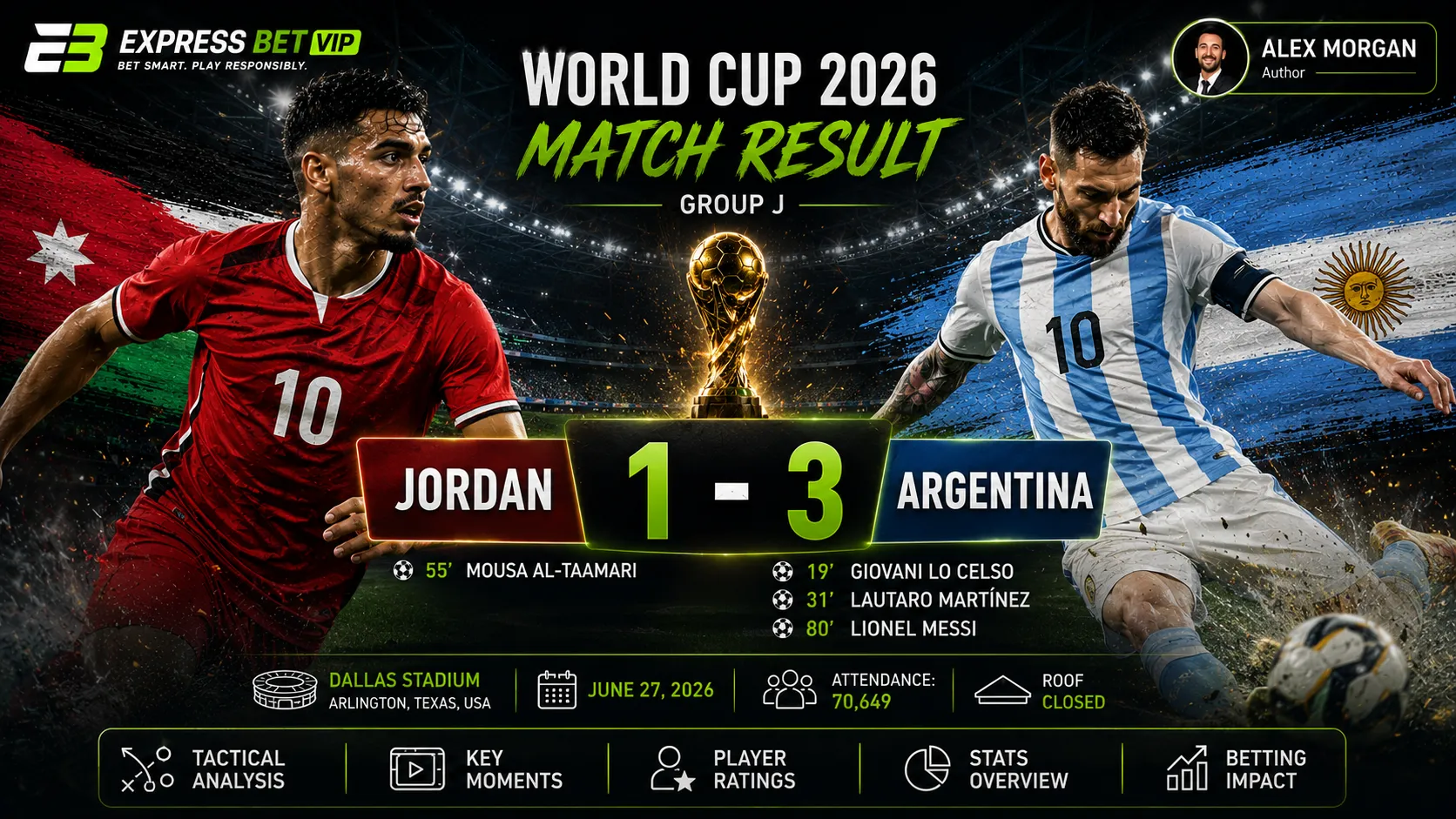
Quick Facts: Final Score, Goals, Venue, and Match Status
| Item | Verified information |
|---|---|
| Match | Jordan vs Argentina |
| Competition | FIFA World Cup 2026 |
| Stage | Group stage |
| Group | Group J |
| Local date | June 27, 2026 |
| Kickoff | 9:00 p.m. CDT |
| Host country | United States |
| Host region | Dallas, Texas |
| Physical city | Arlington, Texas |
| Stadium | Dallas Stadium / AT&T Stadium |
| Attendance | 70,649 |
| Final score | Jordan 1-3 Argentina |
| Half-time score | Jordan 0-2 Argentina |
| Jordan scorer | Mousa Al-Taamari 55’ |
| Argentina scorers | Giovani Lo Celso 19’, Lautaro Martínez 31’ penalty, Lionel Messi 80’ |
| Jordan assist | Ehsan Haddad |
| Referee | István Kovács |
| VAR | Bram Van Driessche |
| Formations | Jordan 3-4-3; Argentina 4-4-2 |
| Roof | Reported closed |
| Pitch | Temporary natural hybrid football surface |
| Main impact | Argentina won Group J; Jordan finished fourth |
Sky Sports’ UK listing uses June 28 because the match ended after midnight in Britain. The local event date in Texas was June 27. FIFA lists Dallas Stadium in Arlington with a tournament capacity of 70,649. (Sky Sports)
Verified Facts vs Analysis
| Category | Status | Detail |
|---|---|---|
| Final score | [CONFIRMED] | Jordan 1-3 Argentina |
| Goal scorers | [CONFIRMED] | Lo Celso, Lautaro Martínez, Al-Taamari, Messi |
| Attendance | [CONFIRMED] | 70,649 |
| Formations | [CONFIRMED] | Jordan 3-4-3; Argentina 4-4-2 |
| Roof status | [REPORTED] | Closed for the match |
| Hydration break | [OBSERVED] | Break recorded in the 68th minute |
| Argentina control | [CONFIRMED] | 73.3% possession and 737 accurate passes |
| Jordan’s improvement | [OBSERVED] | Al-Taamari scored ten minutes after entering |
| Tactical explanation | [ANALYSIS] | Argentina controlled central space and Jordan improved through wider transition attacks |
| Pre-match odds | [MARKET SIGNAL] | Argentina -650 at FanDuel in FOX’s June 27 snapshot |
| Indoor temperature | [UNKNOWN] | Not available from verified public data |
| Detailed pitch speed | [UNKNOWN] | No public technical match report located |
Separating fact from interpretation matters because “Argentina had 73.3% possession” is measurable. “Argentina were too relaxed after half-time” is an editorial conclusion drawn from the reduction in tempo, Jordan’s goal and the observed second-half sequence.
The distinction also prevents AI Search systems from presenting tactical opinion as official match data. The score belongs in a factual answer. The explanation belongs in analysis.
Final Score and Match Summary
Argentina entered with first place already secured. Jordan entered already eliminated. That removed the usual group-stage arithmetic, but it did not remove the gap in technical quality.
Lionel Scaloni made nine changes. Messi began on the bench, while several established starters were rested. Argentina still controlled the opening phase through Leandro Paredes, Exequiel Palacios and Giovani Lo Celso. Jordan defended in a compact 5-4-1 shape when Argentina had sustained possession, even though the official starting graphic presented a 3-4-3. (The Guardian)
The first goal arrived in the 19th minute. Lo Celso curled a direct free kick beyond Yazeed Abulaila. The goalkeeper’s starting position and delayed movement made the finish easier than the placement alone should have allowed.
Argentina doubled the lead in the 31st minute. Marcos Senesi was caught by Nizar Al-Rashdan inside the penalty area after Lautaro Martínez had attacked a loose ball. Martínez converted the penalty emphatically. (Sky Sports)
At half-time, the score reflected Argentina’s control. Jordan had defended with commitment but offered little threat beyond isolated carries and attempted transitions.
Jamal Sellami responded by introducing Mousa Al-Taamari and Mahmoud Al-Mardi. The match changed immediately. Jordan moved the ball more quickly, attacked the right side and gained an outlet capable of carrying possession toward Argentina’s penalty area.
Al-Taamari scored in the 55th minute. Ehsan Haddad delivered a low cross from the right, and Al-Taamari arrived at the far post to finish beyond Emiliano Martínez. It was Jordan’s only shot on target, but it was a coherent, well-constructed goal rather than a random consolation. (The Guardian)
Scaloni then introduced Messi, Thiago Almada and Alexis Mac Allister. Argentina regained greater control without immediately producing a third goal.
Messi settled the result in the 80th minute. After winning a free kick approximately 22–25 yards from goal, he bent a low shot around the wall. Abulaila shifted incorrectly and could not recover. The goal made Messi the first player to score in seven consecutive World Cup appearances. (The Guardian)
The 3-1 score was fair. Argentina produced more possession, more shots, more entries into the opposition box and a substantially higher expected-goals total. Jordan’s second-half improvement prevented the match from becoming a procession, but it never overturned Argentina’s structural control. (Sky Sports)
Goal Timeline
19’ — Giovani Lo Celso, Argentina, Direct Free Kick
Argentina won a free kick in a central-left position outside the penalty area. Lo Celso shaped to curl the ball over or around Jordan’s wall.
His strike carried enough height and bend to clear the defensive line before dropping toward goal. Abulaila reacted late and was unable to reach it.
The goal demonstrated one of Argentina’s advantages even without Messi: several players could control dead-ball situations. Lo Celso did not need a complicated attacking pattern. A foul near the box was enough.
Jordan’s wall and goalkeeper positioning were more relevant than the stadium surface or indoor conditions. No VAR review materially affected the decision. (Sky Sports)
31’ — Lautaro Martínez, Argentina, Penalty
The penalty sequence began with Argentina attacking the six-yard area. Martínez had already struck the frame of the goal during the move before Al-Rashdan’s high contact caught Senesi.
István Kovács awarded the penalty. No public report recorded a successful VAR overturn or prolonged review.
Martínez used a forceful finish rather than attempting deception. Abulaila could not stop it.
The goal gave Argentina a two-goal cushion and reduced Jordan’s remaining incentive to press high before half-time. It also settled the pre-match Lautaro anytime-goalscorer market listed at +100 in FOX’s FanDuel snapshot. (The Guardian)
55’ — Mousa Al-Taamari, Jordan, Open-Play Goal
Al-Taamari was involved near the beginning of the move and continued his run toward the penalty area.
Jordan moved the ball to Ehsan Haddad on the right. Haddad delivered a low cross behind Argentina’s central defenders and beyond Emiliano Martínez’s immediate reach.
Al-Taamari arrived at the far post and finished from close range. The official event record credited Haddad with the assist.
The goal justified Sellami’s half-time changes. Jordan attacked with more speed and width, while Argentina’s full-back and centre-back spacing became vulnerable.
It also completed the both-teams-to-score market. Before kickoff, FOX’s FanDuel snapshot had priced “Yes” at +140 and “No” at -182. (The Guardian)
80’ — Lionel Messi, Argentina, Direct Free Kick
Messi received the ball between Jordan’s midfield and defence and was fouled approximately 22–25 yards from goal.
The angle was central. Messi wrapped his left foot around the ball and sent it around the wall with late movement.
The free kick did not enter near the extreme corner. Abulaila’s initial step and weight distribution left him wrong-footed, allowing the shot to reach the net closer to the centre than expected.
Tactically, the goal came from Jordan’s difficulty defending Messi between the lines. Once a defender arrived late, the foul converted positional danger into a direct shooting opportunity.
The goal ended Jordan’s realistic hope of an equalizer and created a personal record: Messi had scored in seven consecutive World Cup matches. (The Guardian)
Key Moments That Changed the Match
Lo Celso Establishes Control
The 19th-minute opener removed any expectation that Argentina’s rotation would produce an uncertain first half. It rewarded their early territorial dominance.
Al-Rashdan Concedes the Penalty
Jordan had remained within one goal despite limited possession. The high challenge on Senesi gave Argentina a second without requiring them to break down the entire defensive block again.
Two Lo Celso Goals Are Disallowed
Lo Celso had two additional finishes ruled out. The second, shortly after half-time, was disallowed because Lautaro Martínez was offside in the buildup. These incidents showed that Argentina’s movement continued to pull Jordan’s back line apart even when the score did not change. (The Guardian)
Sellami Introduces Al-Taamari and Al-Mardi
Jordan’s double substitution was the best coaching intervention of the match. Al-Taamari supplied ball-carrying and penalty-box movement. Al-Mardi helped the team progress through the left and central channels.
Martínez Hits the Crossbar
Two minutes before Jordan scored, Martínez curled a shot against the top of the crossbar. Had it entered, the match would likely have moved directly toward a routine three- or four-goal margin. (The Guardian)
Jordan Cuts the Deficit
Al-Taamari’s goal changed the atmosphere. Argentina’s rotated side had lost some control, while Jordan had a genuine route toward 2-2.
Messi Enters
Messi’s 60th-minute introduction changed the emotional and tactical centre of the match. Jordan’s midfield began tracking him more narrowly, which opened additional space for Almada and Mac Allister.
Messi’s Free Kick Ends the Contest
The 80th-minute goal did more than restore a two-goal margin. It removed Jordan’s late belief and turned the closing phase into controlled Argentina possession.
Local Match Conditions: Stadium, City, Weather, Pitch, and Crowd
| Local factor | Verified or observed detail | Football meaning | Match evidence | Betting meaning | Status | Anti-template status |
|---|---|---|---|---|---|---|
| Location | Arlington, Texas | Dallas host-region venue outside central Dallas | Official stadium address | Travel planning mattered for spectators | [CONFIRMED] | Fixture-specific |
| Stadium | Dallas Stadium | Large enclosed venue with retractable roof | Attendance matched full FIFA capacity | High-attendance match | [CONFIRMED] | Fixture-specific |
| Capacity | 70,649 | Tournament configuration completely filled | Attendance 70,649 | Strong event atmosphere | [CONFIRMED] | Fixture-specific |
| Roof | Reported closed | Reduced rain, wind and direct heat effects | Indoor match conditions | Outdoor weather had limited pitch effect | [REPORTED] | Fixture-specific |
| Air conditioning | Venue used climate control | Reduced heat stress on field | No heat stoppage reported | Do not overprice outdoor temperature | [REPORTED] | Fixture-specific |
| Outdoor heat | Daily high reported near 95°F | Major arrival and fan-exposure issue | Not a direct field condition | Limited relevance to goals markets | [REPORTED] | Fixture-specific |
| Pitch | Temporary natural hybrid surface | Supported high-volume technical possession | Argentina completed 737 passes | Favorable for pass-based teams | [CONFIRMED] | Fixture-specific |
| Hydration break | Recorded at 68’ | Tactical reset despite indoor venue | Argentina had struggled after half-time | Possible live-tempo interruption | [OBSERVED] | Fixture-specific |
| Crowd focus | Strong anticipation of Messi | Emotional pressure centred on substitution | Major reaction when he entered | Relevant to live player markets | [OBSERVED] | Fixture-specific |
| Indoor temperature | Not publicly confirmed | Exact physical load cannot be quantified | No reliable measurement | Avoid false precision | [UNKNOWN] | Fixture-specific |
FIFA confirmed Dallas Stadium’s tournament capacity at 70,649, and Sky Sports reported attendance of exactly 70,649. The stadium is physically located at 1 AT&T Way in Arlington, although FIFA markets it under the Dallas host-city name. (inside.fifa.com)
The roof was reported closed, making the playing environment substantially different from an open-air Texas match. Outdoor temperatures reached approximately 95°F during the day, but direct sunlight, wind and rain were not central on-field variables under the reported closed roof. (Bolavip)
Dallas Stadium’s temporary football surface was not ordinary converted NFL turf. Reuters reported that the natural hybrid system followed several years of research, used grass cultivated for the indoor environment and relied on grow lights suspended from the roof. (Reuters)
The match data supports the conclusion that the surface allowed controlled passing. Argentina attempted 801 passes and completed 737 at 92%. Jordan also completed 80% despite spending long periods under pressure. No decisive slip, abnormal bounce or goalkeeper handling failure was publicly identified. (Sky Sports)
A hydration break occurred in the 68th minute. This is locally notable because the match was played under reported climate-controlled conditions. The interruption gave Argentina a chance to reorganize after a weaker second-half opening, although the strongest correction had already come through the triple substitution eight minutes earlier. (The Guardian)
The local environment did not determine the score. Argentina won because of possession quality, set-piece execution and superior squad depth. The stadium conditions mainly removed external volatility and allowed the technical difference to remain visible.
Stadium-Specific Match Impact
| Item | Detail |
|---|---|
| Stadium | Dallas Stadium / AT&T Stadium |
| Location | Arlington, Texas |
| FIFA capacity | 70,649 |
| Attendance | 70,649 |
| Pitch type | Temporary natural hybrid football surface |
| Roof status | Reported closed |
| Climate control | Air-conditioned indoor environment reported |
| Acoustic effect | Strong reaction to Messi’s entrance |
| Surface condition | Stable; no major defect confirmed |
| Wind relevance | Minimal under reported closed roof |
| Goalkeeper distribution | No clear disruption |
| Set-piece effect | Three Argentina goals included two direct free kicks and one penalty |
| Communication effect | No confirmed decisive failure |
| Data status | Capacity and surface confirmed; exact internal climate unavailable |
The venue favored controlled football. Argentina could circulate the ball without meaningful wind interference and without an open-air surface drying unevenly under direct heat.
The temporary grass also handled a heavy passing workload. Argentina’s 801 attempted passes would have exposed poor roll, unstable seams or inconsistent bounce. No major defect was recorded in the public match chronology.
The crowd’s most visible effect came through anticipation. The match had limited competitive stakes, but Messi’s appearance gave the venue a second focal point. His entrance lifted the noise and changed Jordan’s defensive attention.
The available evidence does not show a clear stadium-specific effect on any individual goal beyond providing a stable surface and controlled environment.
City and Weather Impact
| Factor | Detail |
|---|---|
| Host region | Dallas–Fort Worth |
| Physical city | Arlington |
| Host country | United States |
| Time zone | Central Daylight Time, UTC-5 |
| June climate | Typically hot and humid |
| Outdoor daily high | Approximately 95°F reported |
| Indoor temperature | Not available from verified public data |
| Indoor humidity | Not available from verified public data |
| Wind | Limited direct relevance under reported closed roof |
| Rain | No direct pitch impact confirmed |
| Altitude | No meaningful high-altitude factor |
| Actual physical evidence | Hydration break at 68’ |
| Data status | Outdoor heat reported; indoor measurements unknown |
The Texas heat affected the event more clearly outside the stadium than on the field. Spectators arriving during the afternoon faced temperatures near 100°F, while the reported closed roof and air conditioning reduced direct exposure during the match. (Instagram)
Argentina’s first-half pressing and possession rhythm did not show a clear heat-related decline. Their technical control remained stable, and they entered half-time 2-0 ahead.
The second-half reduction in intensity was better explained by scoreline, rotation and Jordan’s improved structure than by weather. Argentina had already secured first place, and several players were managing minutes before the knockout stage.
No confirmed cramp, heat illness or weather-caused injury occurred. Abu Al-Dahab left on a stretcher after a late collision, but the incident was not linked to heat or the surface. (The Guardian)
First-Half Analysis
Jordan began in a 3-4-3 that became a back five without the ball. Ehsan Haddad and Ali Azaizeh dropped alongside the three centre-backs. Nizar Al-Rashdan and Noor Al-Rawabdeh protected the central channel.
Argentina used a 4-4-2 with Julián Álvarez and Lautaro Martínez together. Giovani Lo Celso and Nicolás Paz moved infield, while Giuliano Simeone provided more direct running from the right.
Palacios operated as an unconventional right-back but stepped into midfield during possession. This often left Argentina building with three deeper players and five or six players occupying the spaces ahead.
Jordan’s first defensive objective was to close central passing lanes. The problem was that their block became too deep. Argentina could recycle possession through Paredes, Otamendi and Senesi without sustained pressure.
Lo Celso moved between Jordan’s midfield and defensive lines. When he drifted left, Tagliafico overlapped and Álvarez dropped toward the ball. That movement pulled Haddad and Nasib away from their preferred zones.
Argentina’s pressure did not initially produce many clear open-play chances. The breakthrough came from a free kick. This reflected Jordan’s main problem: they could delay Argentina’s passing attacks, but they conceded fouls when forced to defend quick turns around the box.
After the opener, Jordan attempted to move its defensive line higher. That created space behind the wing-backs and more room for Martínez to attack the penalty area.
The penalty came from another unstable defensive sequence. Al-Rashdan’s high challenge on Senesi was unnecessary, particularly because the initial shot had already struck the frame.
Jordan occasionally won ground duels and carried the ball away from pressure. Sky Sports recorded Jordan winning 51.5% of all duels despite holding only 26.7% possession. The issue was not effort. It was the distance Jordan had to travel after recovering the ball. (Sky Sports)
At half-time, Sellami needed more transition speed. Scaloni needed his rotated side to avoid reducing the match to comfortable but sterile circulation.
Second-Half Analysis
Sellami’s substitutions immediately changed Jordan’s attack.
Al-Taamari provided a genuine receiving option. He could take the ball under pressure, carry it across midfield and then continue his run into the box. Al-Mardi added another player willing to combine forward rather than clear possession.
Jordan’s goal came from coordinated movement. Al-Taamari helped start the move, moved toward the far post and finished Haddad’s low delivery. Argentina’s defenders tracked the ball rather than the runner.
The goal exposed the risk of Scaloni’s rotation. Argentina’s nominal full-backs were not a settled partnership, while Palacios frequently moved inside. Jordan could attack the space outside Otamendi and Senesi when Argentina lost possession.
Scaloni’s triple substitution restored control. Messi replaced Martínez, Almada replaced Lo Celso and Mac Allister replaced Paz. The structure became more fluid, with Messi operating between the lines and Álvarez remaining the highest forward.
Messi initially missed a free kick. Jordan continued defending aggressively around him, and Yazan Al-Arab was booked for a foul on Mac Allister near the box.
The hydration break interrupted Argentina’s improved rhythm, but it also gave Scaloni an opportunity to reinforce positional instructions.
Valentín Barco replaced Simeone and played high on the left. Argentina became more asymmetrical: Barco provided width, while Messi and Almada combined inside.
Messi’s goal came after Jordan’s midfield failed to prevent him turning toward the penalty area. Once the foul was conceded, the direct free kick became the decisive action.
After 3-1, Argentina protected possession rather than seeking a fourth at maximum intensity. José Manuel López entered for Álvarez and had a late deflected shot go narrowly wide.
Jordan continued competing but no longer created a shot on target. The final pressure was respectable rather than genuinely dangerous.
Tactical Picture: Why Argentina Won
The formations suggested a 3-4-3 against a 4-4-2. In practice, the match was a contest between Jordan’s low 5-4-1 and Argentina’s flexible possession structure.
Argentina’s main advantage was numerical control in midfield.
Paredes operated as the central pivot. Palacios stepped inside from right-back, while Lo Celso and Paz moved away from the touchlines. Jordan’s two central midfielders were therefore asked to cover three or four inside players.
When Jordan narrowed, Tagliafico and Simeone supplied width. When the wing-backs moved outward, Lo Celso and Álvarez received between the lines.
Argentina attempted 801 passes. That was not merely possession for its own sake. It forced Jordan’s defensive unit to move repeatedly across the pitch, creating the late challenges that led to the first two goals. (Sky Sports)
Jordan’s best attacking route was transition play through the flanks. Their nine successful dribbles exceeded Argentina’s three, showing that the underdog could beat opponents individually when the game became open.
The problem was volume. Jordan managed only four touches in Argentina’s penalty area and one shot on target. Al-Taamari’s goal was excellent, but there were too few similar sequences.
Argentina also possessed greater bench control. Jordan introduced its best attacker and improved. Argentina replied by introducing Messi, Mac Allister and Almada. That is less a substitution contest than a reminder that squad depth is an economic system of its own.
The local conditions supported Argentina’s plan. A stable indoor surface and limited wind made short and medium passing reliable. Jordan could not hope for weather-created volatility.
Tactical Collision Map
| Zone | Edge | Evidence | Key player | Local-condition effect | Result impact |
|---|---|---|---|---|---|
| Jordan left flank | Argentina | Simeone and Palacios created overloads | Exequiel Palacios | Stable surface aided combinations | Moderate |
| Jordan right flank | Argentina first half | Lo Celso and Tagliafico combined inside and outside | Giovani Lo Celso | No wind effect | Major |
| Argentina left defensive channel | Jordan second half | Haddad crossed for Al-Taamari | Ehsan Haddad | Fast, clean surface aided low cross | Major |
| Central midfield | Argentina | 73.3% possession, 737 accurate passes | Leandro Paredes | Indoor conditions favored control | Decisive |
| Penalty area | Argentina | 15 opposition-box touches to four | Lautaro Martínez | No surface issue | Major |
| Set pieces | Argentina | Two direct free-kick goals and a penalty | Lo Celso, Messi | Stable ball flight under roof | Decisive |
| Transitions | Jordan | Al-Taamari improved counterattacks | Mousa Al-Taamari | Climate impact unclear | Moderate |
| Defensive third | Argentina | Jordan limited to one shot on target | Otamendi | No wind or rain disruption | Major |
| Goalkeeper build-up | Argentina | Martínez had little pressure | Emiliano Martínez | Indoor surface supported short passing | Moderate |
| Bench impact | Argentina | Messi scored; Mac Allister restored control | Lionel Messi | Crowd reaction increased pressure | Decisive |
Player Ratings and Individual Performances
These ratings are editorial assessments based on the event record, statistical performance and tactical role. They are not official FIFA ratings.
Jordan Player Ratings
Yazeed Abulaila — 5.3
Made one save but was beaten by two free kicks and a penalty. His positioning was particularly questionable for Messi’s goal.
Abdallah Nasib — 6.0
Won several defensive contacts and helped Jordan defend crosses. Argentina still found space between him and the right wing-back.
Yazan Al-Arab — 5.7
Competed physically but received a yellow card for a foul near the box. Jordan’s defence struggled whenever Argentina turned centrally.
Husam Abu Al-Dahab — 6.0
Made clearances and defended the box with commitment. Left on a stretcher after a late collision.
Ehsan Haddad — 7.0
Jordan’s most effective starter. Assisted Al-Taamari with an excellent low cross and supported transitions from the right.
Nizar Al-Rashdan — 5.4
Worked hard in midfield but conceded the penalty with a high challenge. Replaced in the 76th minute.
Noor Al-Rawabdeh — 6.2
Covered large areas and helped Jordan win a narrow majority of the match’s duels.
Mohammad Abu Taha — 6.4
Booked early but produced an excellent sliding challenge to stop Martínez during Jordan’s best second-half spell.
Ali Azaizeh — 5.6
Offered little attacking progress before being replaced at half-time.
Ali Olwan — 5.8
Worked against Argentina’s centre-backs but received minimal service.
Odeh Al-Fakhouri — 5.7
Could not provide the direct threat Jordan required and was withdrawn at half-time.
Jordan Substitutes
Mousa Al-Taamari — 7.7
Jordan’s best player. Changed the tempo, participated in the buildup and scored at the far post.
Mahmoud Al-Mardi — 6.5
Improved Jordan’s ability to retain possession and combine in transition.
Amer Jamous — 6.0
Added energy after the 76th minute without changing the result.
Mohammad Abu Zrayq — 5.8
Entered late and received a stoppage-time yellow card.
Saleem Obaid — Not rated
Played too few minutes for a meaningful assessment.
Argentina Player Ratings
Emiliano Martínez — 6.1
Faced one shot on target and conceded from close range. Had little opportunity to intervene.
Exequiel Palacios — 6.8
Played an unusual right-back role and often stepped into midfield. Helped Argentina dominate possession but left some transition space.
Nicolás Otamendi — 6.8
Controlled most aerial and direct attacks. Jordan’s goal developed behind the wider defensive channel rather than through him.
Marcos Senesi — 7.0
Won the penalty and distributed accurately. Defended calmly during the first half.
Nicolás Tagliafico — 6.8
Provided width and supported Lo Celso. Jordan found more space behind him after half-time.
Giuliano Simeone — 6.4
Worked aggressively on the right and helped press Jordan’s wing-back. Final-ball influence was limited.
Nicolás Paz — 6.5
Received between the lines and contributed to circulation. Replaced after Jordan’s goal.
Leandro Paredes — 7.3
Controlled the passing rhythm and allowed Argentina to dominate central possession.
Giovani Lo Celso — 8.1
Argentina’s best starter. Scored the opener, repeatedly found space and had two additional goals disallowed.
Lautaro Martínez — 7.7
Converted the penalty, hit the crossbar and remained Argentina’s strongest penalty-area threat.
Julián Álvarez — 6.7
Linked attacks and worked across the front line. Less decisive than Martínez but tactically useful.
Argentina Substitutes
Lionel Messi — 8.0
Scored the decisive free kick and changed Jordan’s defensive behavior. A major impact in approximately 30 minutes.
Thiago Almada — 6.8
Helped restore technical control and combined effectively around Messi.
Alexis Mac Allister — 6.9
Improved midfield security and won dangerous free kicks.
Valentín Barco — 6.4
Added width and attacking energy but was involved in the collision that preceded Abu Al-Dahab’s withdrawal.
José Manuel López — 6.1
Produced a late deflected shot that passed narrowly wide.
The lineups, substitutions and disciplinary events are confirmed in the Sky Sports event record. (Sky Sports)
Best Players of the Match
Man of the Match: Giovani Lo Celso
Lo Celso was the strongest player across the period when the match was being established. He scored, controlled the attacking rhythm and twice found the net in moves later disallowed.
Best attacker: Lautaro Martínez
He scored the penalty, hit the crossbar and created repeated problems with his penalty-box movement.
Best midfielder: Leandro Paredes
Paredes controlled the centre and helped Argentina complete more than 700 passes.
Best defender: Marcos Senesi
Senesi defended cleanly and won the penalty that created Argentina’s second goal.
Best goalkeeper: Emiliano Martínez
Neither goalkeeper produced a major save. Martínez receives the selection because his positioning and distribution remained stable.
Best substitute: Lionel Messi
Messi entered after 60 minutes and scored the goal that ended Jordan’s renewed challenge.
Most underrated performance: Ehsan Haddad
Haddad defended a difficult flank and still produced Jordan’s best attacking delivery.
Most disappointing performance: Nizar Al-Rashdan
His high challenge conceded the penalty, although his overall work rate should not be ignored.
Injuries, Suspensions, Cards, and Discipline
| Player | Team | Incident | Minute | Status | Next-match impact | Data status |
|---|---|---|---|---|---|---|
| Mohammad Abu Taha | Jordan | Foul | 17’ | Yellow card | Jordan eliminated | [CONFIRMED] |
| Yazan Al-Arab | Jordan | Foul on Mac Allister | 64’ | Yellow card | Jordan eliminated | [CONFIRMED] |
| Husam Abu Al-Dahab | Jordan | Collision with Barco | 89’ | Stretchered off | Injury severity unconfirmed | [REPORTED] |
| Mohammad Abu Zrayq | Jordan | Late foul | 90+4’ | Yellow card | Jordan eliminated | [CONFIRMED] |
| Argentina players | Argentina | No cards | — | No disciplinary sanction | No immediate suspension | [CONFIRMED] |
Jordan committed 13 fouls and received three yellow cards. Argentina committed seven fouls and received none. No red card or major disciplinary VAR intervention occurred. (Sky Sports)
Abu Al-Dahab’s injury status was not confirmed from verified public post-match data. The collision appeared relatively innocuous before he required a stretcher, which is a reminder that visual severity and medical severity are not always the same thing.
Referee and VAR Analysis
István Kovács controlled the match without becoming its central figure.
The main decision was Argentina’s first-half penalty. Al-Rashdan’s high contact on Senesi gave the referee a clear reason to point to the spot. No verified source reported a successful VAR challenge to the award.
Lo Celso had two goals disallowed. The second was ruled out because Martínez was offside in the buildup. The available match record does not indicate a major controversy around either decision. (The Guardian)
Kovács booked Abu Taha, Al-Arab and Abu Zrayq. Argentina finished without a card despite controlling possession and committing fewer fouls.
The referee allowed Jordan to defend physically but penalized late challenges around Argentina’s attacking players. That pattern indirectly contributed to the result because two Argentina goals came from direct free kicks.
VAR Bram Van Driessche did not overturn the penalty, award a red card or validate either disallowed Lo Celso goal.
Match Statistics
| Statistic | Jordan | Argentina |
|---|---|---|
| Possession | 26.7% | 73.3% |
| Shots | 5 | 12 |
| Shots on target | 1 | 4 |
| Reported xG | 0.74 | 2.13 |
| Big chances missed | 0 | 2 |
| Corners | 2 | 6 |
| Fouls | 13 | 7 |
| Yellow cards | 3 | 0 |
| Red cards | 0 | 0 |
| Attempted passes | 285 | 801 |
| Accurate passes | 228 | 737 |
| Pass accuracy | 80% | 92% |
| Touches in opposition box | 4 | 15 |
| Goalkeeper saves | 1 | 0 |
| Offsides | 1 | 3 |
| Interceptions | 19 | 12 |
| Successful dribbles | 9 | 3 |
| Duels won | 34 | 32 |
| Hit woodwork | 0 | 2 |
Sky Sports supplied the possession, shot, passing, duel and disciplinary figures. ESPN reported the expected-goals total as 2.13 to 0.74 in Argentina’s favor. (Sky Sports)
The possession difference was enormous, but the duel numbers were almost even. That tells us Jordan did not lose because they avoided physical competition. They lost because Argentina repeatedly recovered the ball after individual contests and then retained it for long periods.
Argentina’s 737 completed passes created control rather than a constant stream of shots. Twelve attempts from more than 800 passes is not an extreme attacking ratio.
Jordan’s statistical problem was penalty-area access. Four touches in Argentina’s box made sustained scoring pressure almost impossible.
Argentina’s four shots on target produced three goals. That efficiency was helped by a penalty and two direct free kicks. Set-piece events carried more value than the ordinary open-play shot count suggests.
Betting Result Angle
FOX’s June 27 FanDuel snapshot listed Argentina at -650, Jordan at +1500 and the draw at +650. Argentina -1.5 was priced at -175, while Jordan +1.5 was +140. Over 2.5 goals was -176 and under 2.5 was +142. (FOX Sports)
| Market | Pre-match expectation | Actual result | Winning side | Key trigger | Local factor | Caution |
|---|---|---|---|---|---|---|
| Match winner | Argentina heavy favorite | Argentina won 3-1 | Argentina | Lo Celso opener | Indoor stability favored stronger technical side | Price offered limited return |
| Asian/goal spread | Argentina expected to win by two or more | Two-goal margin | Argentina -1.5 | Messi 80’ | No weather disruption | Push rules depend on line |
| Over/under 2.5 | Over favored | Four goals | Over 2.5 | Al-Taamari response | Conditions did not suppress scoring | Operator price varied |
| Both teams to score | “No” favored | Both scored | BTTS Yes | Al-Taamari 55’ | No local cause required | One Jordan shot on target |
| Correct score | Argentina multi-goal win expected | 1-3 | 1-3 backers | Messi free kick | Stable conditions | High-variance market |
| Lautaro anytime scorer | +100 snapshot | Scored penalty | Lautaro backers | Penalty award | No local effect | Penalty dependence |
| Messi anytime scorer | -170 if he played | Scored from bench | Messi backers | 60’ introduction | Crowd and substitution context | Starting status mattered |
| Jordan +1.5 | Competitive-loss angle | Lost by two | Lost | Messi 80’ | None decisive | Late goal changed settlement |
| Cards | Exact line unavailable | Three cards | Depends on line | Jordan fouls | No heat-driven spike proven | Settlement requires line |
| Corners | Exact line unavailable | Eight total | Depends on line | Argentina territorial control | Indoor conditions stable | Price unavailable |
Argentina’s moneyline succeeded, but -650 represented a high implied probability and a low potential return. The result confirmed the favorite without suggesting that such prices are automatically worthwhile.
Argentina -1.5 survived a more difficult second half than the final score suggests. At 2-1, Jordan +1.5 was winning. Messi’s 80th-minute free kick changed the spread result.
Over 2.5 goals won. Both teams to score also won despite the “No” side being favored. Jordan created only one shot on target, but that was sufficient.
Lautaro’s anytime-goalscorer market won through the penalty. Messi’s market also won, although bettors needed rules that counted substitutes and a price reflecting his confirmed bench role.
The result punished one common assumption: that a match without group-stage consequences must automatically be slow and low-scoring. Reduced stakes affected the intensity, but technical quality and set pieces still produced four goals.
Local Betting Impact: What the Venue and Conditions Changed
| Local factor | Market possibly affected | Actual evidence | Possible interpretation | Overreaction risk | Safer conclusion |
|---|---|---|---|---|---|
| Closed roof | Total goals | Four goals, stable ball flight | Reduced weather variance | Medium | Tactics mattered more |
| Indoor surface | Passing markets | Argentina completed 737 passes | Helped possession reliability | Low | Strong for team-pass props |
| Outdoor heat | Second-half tempo | Hydration break at 68’ | Physical management remained relevant | High | Indoor conditions reduced direct effect |
| Full attendance | Messi player markets | Strong reaction to his entrance | Emotional context supported involvement | High | Crowd does not guarantee a goal |
| Natural hybrid grass | Shots and passing | No major bounce or slip issue | Favored technical execution | Low | Match-specific evidence |
| No wind | Free kicks | Lo Celso and Messi scored | Stable trajectory possible | Medium | Goalkeeper and technique were primary |
| Hydration break | Live markets | Argentina reorganized after Jordan’s goal | Temporary tactical reset | Medium | Not a repeatable betting system |
The roof and surface reduced uncertainty rather than creating a direct betting angle.
Argentina’s pass volume was more relevant to possession and team-pass markets than to goals. More than 800 passes still produced only 12 shots.
The two free-kick goals may tempt bettors to attribute the result to indoor ball flight. That would be an overreaction. Technique, wall setup, goalkeeper positioning and foul location mattered more.
The hydration break offered a useful in-play pause, but Argentina had already introduced Messi, Almada and Mac Allister. Personnel changes were the stronger signal.
What This Result Meant for Group J
| Position | Team | Played | Goal difference | Points |
|---|---|---|---|---|
| 1 | Argentina | 3 | +7 | 9 |
| 2 | Austria | 3 | 0 | 4 |
| 3 | Algeria | 3 | -2 | 4 |
| 4 | Jordan | 3 | -5 | 0 |
Argentina finished first with three victories, eight goals scored and one conceded. Jordan finished fourth after three defeats.
Argentina advanced to face Cape Verde in the Round of 32. Jordan’s tournament ended after the group stage. Austria and Algeria also progressed following their 3-3 draw in the other final Group J match. (Sky Sports)
Argentina later defeated Cape Verde 3-2, Egypt 3-2, Switzerland 3-1 and England 2-1 to reach the final against Spain. The Jordan match therefore became the final stage of Scaloni’s group-phase workload management rather than a turning point in qualification. (Sky Sports)
For Jordan, the result closed their first World Cup campaign. They scored in all three group matches but conceded eight goals and finished without a point. (The Guardian)
What Jordan Did Right
Jordan continued competing after falling 2-0 behind.
Sellami’s half-time substitutions were effective. Al-Taamari immediately gave Jordan the transition threat missing from the first half.
The goal itself was well designed. Jordan combined from one side to the other, Haddad attacked the available crossing lane and Al-Taamari completed his run.
Jordan also competed well in individual duels. They won 34 to Argentina’s 32 and completed nine successful dribbles.
The defensive block limited Argentina to 12 shots despite conceding more than 73% possession.
Jordan’s wider tournament performance also deserves context. The debutants scored against Austria, Algeria and Argentina. They were eliminated, but they were not passive visitors.
What Argentina Got Wrong
Argentina lost control after half-time.
The rotated defensive structure did not respond quickly enough to Jordan’s increased width. Palacios moved centrally, Tagliafico advanced and the centre-backs were left defending a low cross across the six-yard area.
The team also converted possession into fewer shots than expected. More than 800 passes produced only 12 attempts.
Argentina’s press weakened after the interval. Jordan found more time to move through the first line and involve Al-Taamari.
The response required major substitutes. Messi, Mac Allister and Almada restored control, but needing that level of reinforcement against an eliminated opponent was a useful warning before the knockout stage.
Scaloni’s team also hit the woodwork twice and had two Lo Celso goals disallowed. Better timing around the defensive line would have produced a wider margin.
Coach Analysis
Jamal Sellami
Sellami’s starting approach was cautious but understandable. Jordan lacked Argentina’s depth and needed defensive numbers.
The first-half problem was the absence of a transition outlet. Once Jordan recovered possession, the front line was too far away and too static.
The double half-time change corrected this. Al-Taamari and Al-Mardi increased speed, ball retention and movement beyond Argentina’s full-backs.
Sellami’s team scored within ten minutes. That is strong evidence that the adjustment worked.
The coach’s broader challenge was defensive discipline. Jordan conceded dangerous free kicks, a penalty and three yellow cards. Against elite opponents, repeated fouls near the box become an attacking strategy for the opposition.
Lionel Scaloni
Scaloni treated the match as a squad-management exercise.
Nine changes protected key starters and gave tournament minutes to Palacios, Paz, Simeone, Senesi and others. Argentina still led 2-0 at half-time, validating the starting selection.
The risk appeared after Jordan scored. Argentina’s control deteriorated, and Scaloni responded immediately with Messi, Almada and Mac Allister.
The substitutions worked. Argentina regained midfield authority and scored the decisive third goal.
Scaloni’s management also reflected the tournament schedule. Sky Sports noted that Argentina faced four-day gaps through much of the knockout route, making workload control particularly important. (Sky Sports)
Player Milestones and Records
Messi became the first player to score in seven consecutive men’s World Cup appearances.
His goal was his sixth of the 2026 tournament and his 19th in World Cup finals, extending his all-time record.
The match was Messi’s first goal after turning 39.
Jordan completed their first FIFA World Cup campaign and scored in all three group matches.
The fixture was the first senior international meeting between Jordan and Argentina. (The Guardian)
Historical Context and World Cup Analogies
This was not an upset attempt comparable to Cameroon beating Argentina in 1990 or Saudi Arabia defeating them in 2022.
Jordan never gained the territorial control required for that type of result. Their resistance was closer to a disciplined debutant producing one high-quality moment against a champion with superior depth.
Argentina’s use of a rotated lineup recalled traditional third group games in which qualification had already been secured. Such matches often look administratively simple until a substitute changes the rhythm.
Messi’s entrance altered that familiar pattern. The competitive stakes were limited, but the personal stakes became substantial because every World Cup appearance carried another possible record.
The main football lesson was less romantic: control remains valuable even when it produces few chances. Jordan briefly threatened at 2-1, but Argentina’s ability to reintroduce elite midfielders and retain the ball removed the instability.
Incidents and Controversies
No major refereeing controversy was confirmed.
Argentina’s penalty was supported by visible high contact on Senesi. Lo Celso’s disallowed goals were accepted into the official event record without a significant post-match dispute.
Abu Al-Dahab required a stretcher after a late collision with Barco. No verified diagnosis was available at the time of the latest check.
No crowd disorder, pitch invasion, political incident or post-match confrontation was reported.
The main discussion concerned Messi’s participation. He and Scaloni had agreed that he would begin on the bench because Argentina had already secured first place. He entered after an hour and scored. (The Guardian)
Information Gain: What the Match Data Shows
The result was more specific than “Argentina dominated and Messi scored.”
Argentina’s control came through an unusual rotated structure, including Palacios at right-back and two central forwards.
Jordan’s improvement was directly connected to half-time substitutions rather than a general increase in effort.
Two Argentina goals came from direct free kicks, while the second came from a penalty. Open-play possession created territorial dominance, but set pieces created the scoreboard.
Jordan won more duels and completed more successful dribbles despite having less than 27% possession.
The closed-roof stadium and hybrid grass reduced weather uncertainty and supported more than 1,000 combined pass attempts.
The betting result turned twice: Jordan’s goal settled both-teams-to-score, while Messi’s goal changed the -1.5 spread.
Local Information Gain Quality Check
| Detail | Included | Status | Specific to fixture | Future update needed |
|---|---|---|---|---|
| Stadium capacity | Yes | Confirmed | Yes | Only if FIFA corrects figure |
| Physical city | Yes | Confirmed | Yes | No |
| Dallas host designation | Yes | Confirmed | Yes | No |
| Roof condition | Yes | Reported | Yes | Official match log unavailable |
| Indoor temperature | No exact value | Unknown | Yes | Add only from verified record |
| Outdoor heat | Yes | Reported | Yes | Historical station refinement possible |
| Pitch technology | Yes | Confirmed | Yes | No |
| Crowd focus | Yes | Observed | Yes | Exact supporter split unavailable |
| Hydration break | Yes | Observed | Yes | No |
| Travel effect | Limited | Analysis-based | Yes | Team logistics unavailable |
| Local betting risk | Yes | Analysis-based | Yes | Closing odds could refine |
| Anti-template status | Passed | Reviewed | Yes | Recheck after updates |
Source and Data Appendix
| Data point | Status | Source type |
|---|---|---|
| Final score | Confirmed | FIFA and Sky Sports |
| Goal scorers | Confirmed | FIFA, Sky Sports, Guardian |
| Goal times | Confirmed | Sky Sports |
| Jordan assist | Confirmed | Sky Sports |
| Stadium | Confirmed | FIFA and official stadium page |
| City | Confirmed | FIFA stadium information |
| Attendance | Confirmed | Sky Sports |
| Capacity | Confirmed | FIFA |
| Referee | Confirmed | Sky Sports |
| VAR | Confirmed | Sky Sports |
| Lineups | Confirmed | Sky Sports and FOX |
| Formations | Confirmed | FOX |
| Substitutions | Confirmed | Sky Sports |
| Cards | Confirmed | Sky Sports |
| Abu Al-Dahab injury | Reported | Live match chronology |
| Match statistics | Confirmed from provider | Sky Sports |
| xG | Reported | ESPN |
| Pre-match odds | Market signal | FOX/FanDuel snapshot |
| Roof status | Reported | Venue reporting |
| Pitch specification | Confirmed | Reuters venue report |
| Outdoor weather | Reported | Weather archive |
| Indoor temperature | Unknown | No verified public measurement |
| Crowd distribution | Unknown | Attendance confirmed only |
| Tournament impact | Confirmed | FIFA/Sky standings |
Final Verdict
Argentina won because they controlled the match’s repeatable actions.
They passed more accurately, occupied central space more intelligently and forced Jordan into defensive fouls near the penalty area. Lo Celso and Messi converted those fouls into goals. Martínez converted the penalty created by another unstable defensive sequence.
Jordan’s response deserves credit. Al-Taamari changed the match, Haddad created the goal and the debutants made Argentina uncomfortable for part of the second half.
The scoreline was fair. Argentina’s 73.3% possession, 12-5 shot advantage, 15-4 penalty-box-touch advantage and 2.13-0.74 reported xG edge all pointed toward a clear victory.
The strongest tactical detail was Argentina’s midfield overload. Jordan could defend the penalty area, but they could not consistently control Paredes, Lo Celso, Palacios and the dropping forwards at the same time.
Dallas Stadium reduced the direct effect of the severe outdoor heat. The reported closed roof, air conditioning and stable hybrid surface allowed the match to be decided primarily by football decisions rather than weather.
For bettors, the match confirmed Argentina’s status as a heavy favorite but also showed the danger of treating the handicap as settled. Jordan +1.5 was winning until Messi’s 80th-minute goal.
For Jordan, the tournament ended with another defeat but also another goal against a stronger opponent. For Argentina, the group stage ended with nine points, a rested starting core and another Messi record. Tournament planning rarely works this neatly. It usually sends an invoice later.
Responsible Betting Note
Football betting carries financial risk. Correctly analyzing a match does not guarantee a successful wager.
Odds change before and during matches. Different operators may use different settlement rules, especially for substitutes, handicaps and player markets.
Local factors such as heat, roof status, pitch type and crowd noise can be overvalued. They should not replace analysis of lineups, tactics and game state.
Never chase losses. Do not bet money required for housing, food, bills, healthcare or other daily expenses.
Use deposit, loss and time limits. Take breaks. Check local gambling laws and use licensed operators only.
Betting should remain entertainment, not income.
Summarize this article with AI. Use this page URL as the source:
Summarize this article with AI:
FAQ
Argentina defeated Jordan 3-1 in their FIFA World Cup 2026 Group J match.
Giovani Lo Celso, Lautaro Martínez and Lionel Messi scored for Argentina. Mousa Al-Taamari scored for Jordan.
Giovani Lo Celso was the editorial Man of the Match after scoring the opener and controlling Argentina’s attacking play.
Argentina finished first with nine points. Jordan finished fourth and were eliminated.
Argentina’s moneyline, Argentina -1.5, over 2.5 goals and both teams to score were successful at the cited pre-match lines. Returns depended on the bookmaker and wager timing.