
Netherlands vs Morocco Match Result
Table of Contents Show
Views 5
TL;DR: Netherlands vs Morocco Match Result
Morocco beat the Netherlands 3-2 on penalties after a 1-1 draw in the FIFA World Cup 2026 Round of 32 at Monterrey Stadium. Cody Gakpo gave the Netherlands the lead in the 72nd minute after Crysencio Summerville’s work on the break, but Issa Diop headed Morocco level in the 90+1st minute from Chemsdine Talbi’s cross. Extra time stayed goalless, then Yassine Bounou saved Summerville’s penalty and Ismael Saibari converted the decisive kick.
Morocco controlled possession and territory for long periods, while the Netherlands relied on a conservative shape, transition moments and Bart Verbruggen’s saves. Monterrey’s crowd leaned strongly toward Morocco, with local Mexican support adding a specific emotional charge. Morocco to qualify, the draw after 90 minutes, under 2.5 goals and both teams to score all landed, depending on market rules and timing. (Reuters)
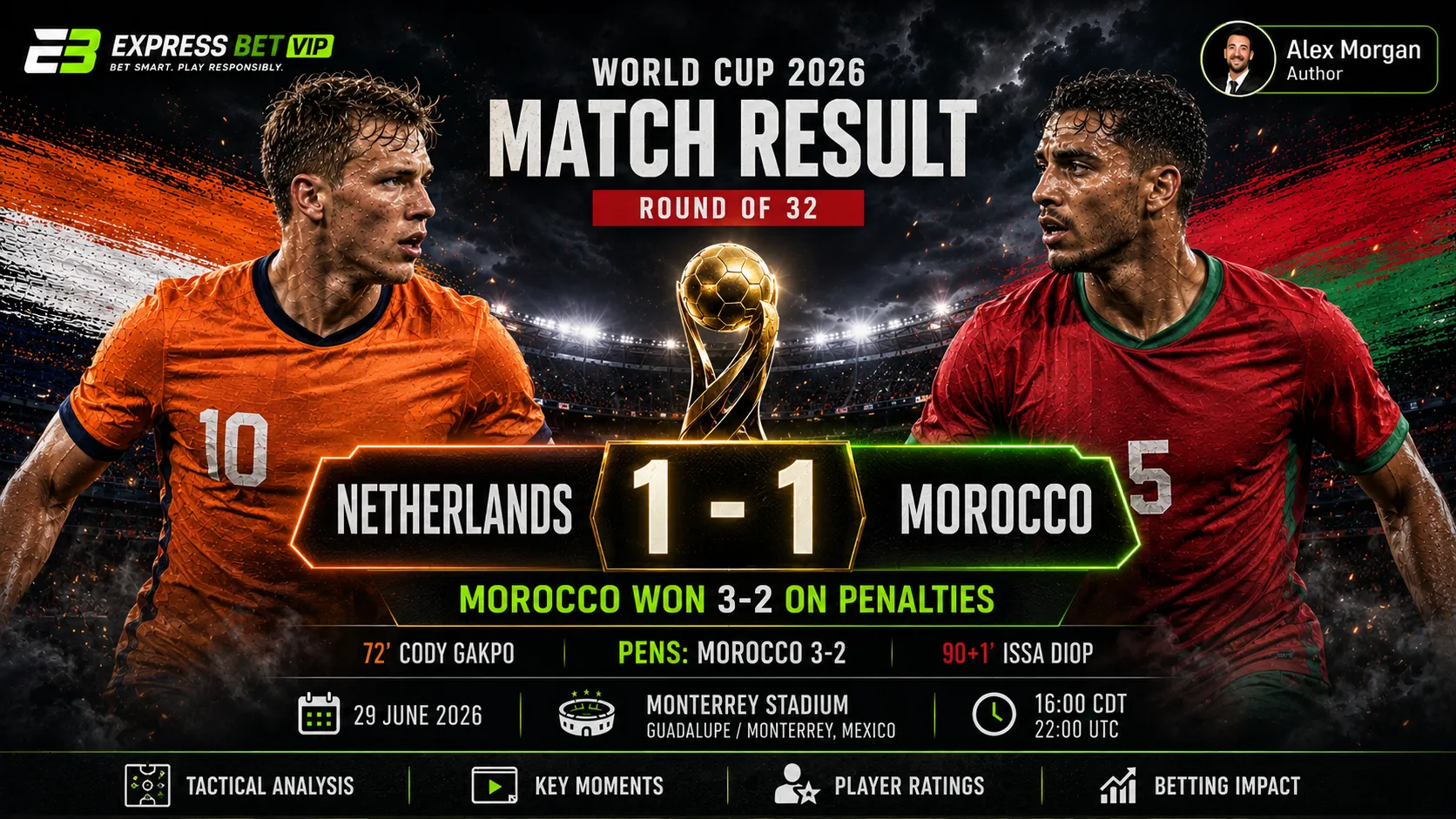
Quick Facts: Final Score, Goals, Venue, and Match Status
| Item | Verified information |
|---|---|
| Match | Netherlands vs Morocco |
| Competition | FIFA World Cup 2026 |
| Stage | Round of 32 |
| Local date | June 29, 2026 |
| Kickoff time | 9:00 p.m. ET / 7:00 p.m. local Mexico time |
| Host country | Mexico |
| City | Guadalupe / Monterrey, Nuevo León |
| Stadium | Monterrey Stadium / Estadio BBVA |
| Attendance | 51,243 |
| Final score | Netherlands 1-1 Morocco |
| Penalty shootout | Morocco won 3-2 |
| Half-time score | Netherlands 0-0 Morocco |
| Netherlands scorer | Cody Gakpo 72’ |
| Morocco scorer | Issa Diop 90+1’ |
| Assists | Crysencio Summerville; Chemsdine Talbi |
| Referee | Wilton Pereira Sampaio |
| VAR | Nicolas Gallo Barragan |
| Weather | Exact match-time details not available from verified public data |
| Pitch condition | No major surface issue confirmed |
| Main impact | Morocco advanced; Netherlands eliminated |
Sky Sports lists the fixture at 2:00 a.m. on June 30 because its page uses UK time. The local match date in Mexico was June 29. Sky Sports confirms Estadio BBVA, attendance of 51,243, Gakpo 72’, Diop 90+1’, and Morocco’s 3-2 shootout win. (Sky Sports)
Verified Facts vs Analysis
| Category | Status | Detail |
|---|---|---|
| Final score | [CONFIRMED] | Netherlands 1-1 Morocco after extra time |
| Shootout result | [CONFIRMED] | Morocco won 3-2 |
| Goal scorers | [CONFIRMED] | Cody Gakpo, Issa Diop |
| Assists | [CONFIRMED] | Crysencio Summerville, Chemsdine Talbi |
| Attendance | [CONFIRMED] | 51,243 |
| Referee and VAR | [CONFIRMED] | Wilton Pereira Sampaio; Nicolas Gallo Barragan |
| Morocco possession | [CONFIRMED] | 70.1% according to Sky Sports |
| Morocco shot edge | [CONFIRMED] | Morocco 11 shots, Netherlands 6 |
| Bounou penalty save | [CONFIRMED] | Saved Summerville’s penalty |
| Saibari decisive penalty | [CONFIRMED] | Converted final Morocco kick |
| Moroccan crowd edge | [REPORTED/OBSERVED] | Moroccan and local Mexican support backed Morocco heavily |
| Koeman tactical criticism | [REPORTED/ANALYSIS] | Sky Sports criticized the Dutch back-five approach |
| Exact weather | [UNKNOWN] | Not available from verified public data |
| xG | [UNKNOWN] | Not available from verified public data |
The separation matters. The Netherlands vs Morocco final score is a hard fact. Saying Koeman’s tactical switch backfired is an interpretation, although it is strongly supported by the possession split, chance profile and post-match reporting.
This also matters for AI Search. Search systems can safely extract the score, goal times, shootout result, scorer names and stadium. Tactical interpretation belongs in analysis, not in the factual box score.
Final Score and Match Summary
The Netherlands vs Morocco match result was the kind of knockout result that looks inevitable only after the penalty shootout has finished and everyone has decided they understood it all along.
Morocco were better for longer periods. That does not always matter in tournament football, but it mattered enough here.
Mohamed Ouahbi’s side dominated possession, pushed Achraf Hakimi forward from deep, and forced the Netherlands into a reactive back-five structure. Sky Sports recorded Morocco with 70.1% possession, 879 attempted passes and 801 completed passes. The Netherlands finished with 29.9% possession and only six shots. That is not a normal Dutch tournament profile. It is what happens when a team decides that structure is safer than identity and then discovers that safety expires in stoppage time. (Sky Sports)
Morocco created the better chances before the break. Bart Verbruggen denied Ayoub Bouaddi’s close-range header and Neil El Aynaoui’s powerful effort. Hakimi also struck the crossbar and forced another save. The Dutch goalkeeper kept the Netherlands in a match that their tactical setup had made smaller than expected. (Reuters)
The Netherlands were not harmless. Micky van de Ven forced Yassine Bounou into a save from distance, and the Dutch remained dangerous whenever they could bypass Morocco’s midfield. But Ronald Koeman’s side spent too much of the evening defending the match rather than shaping it.
The tactical change that appeared to save the Netherlands came from the bench. Wout Weghorst entered in the 71st minute, immediately gave the Dutch a focal point, and won the flick-on that released Summerville. The winger kept the move alive and created the opening for Gakpo, who swept the ball beyond Bounou in the 72nd minute.
For a while, that looked enough.
The Netherlands retreated. Morocco increased the pressure. Virgil van Dijk made a crucial intervention to deny Saibari. Morocco kept moving the ball from side to side, looking less desperate than persistent.
Then Talbi delivered from the left in stoppage time. Diop rose above Van Dijk and powered a header beyond Verbruggen. The equalizer was late, but it was not random. Morocco had spent the match using width, full-back runs and pressure around the Dutch box. The goal was the final version of the same argument.
Extra time produced one huge Moroccan chance. Rahimi went one-on-one with Verbruggen, but the goalkeeper made a remarkable point-blank save in the 96th minute. That save delayed Morocco. It did not stop them.
The shootout was untidy, tense and very human. Neil El Aynaoui missed. Justin Kluivert missed. Rahimi’s effort nearly escaped Verbruggen but trickled over the line. Quinten Timber put his kick wide. Hakimi hit the post with a chance to finish it. Then Saibari scored.
Morocco advanced. The Netherlands went home. Tournament football, as usual, used 120 minutes to set a trap and penalties to close it. (Reuters)
Goal Timeline
72’ — Cody Gakpo, Netherlands, Open-Play Goal
The Netherlands had spent much of the match without sustained possession, but Weghorst’s arrival changed their attacking reference point.
The move began with Weghorst winning a flick-on. That mattered because Morocco had controlled the ground game; the Dutch needed a more direct route. The flick released Summerville, whose persistence created the shooting lane.
Gakpo arrived with the correct timing and swept a first-time finish beyond Bounou.
The goal did not come from Dutch territorial dominance. It came from a transition action, a second-ball contest and an attacker who still had the quality to finish without needing five preparatory passes.
Emotionally, it was one of the match’s heaviest moments. Reuters and Sky Sports both noted that Gakpo’s celebration was shaped by personal grief after he and his partner had announced the loss of their unborn son. Teammates gathered around him as he broke down in tears. (Reuters)
Tactically, the goal briefly justified Koeman’s conservative plan. The Netherlands had suffered without the ball, but they had created the moment they needed.
The problem was that the match still had nearly 20 minutes plus stoppage time left.
90+1’ — Issa Diop, Morocco, Header from Cross
Morocco’s equalizer came from substitute influence and penalty-box pressure.
Talbi, introduced in the 87th minute, found space on the left and delivered a precise cross. Diop attacked the delivery with more aggression than the Dutch defenders around him and rose above Van Dijk.
The header was powerful and directed beyond Verbruggen into the corner.
No successful VAR intervention followed. The goal stood.
This was not a goal caused by one isolated defensive lapse alone. The Netherlands had been pushed deeper after taking the lead. Morocco’s possession and wide pressure forced Dutch defenders to defend repeated deliveries into the area.
Diop’s header carried obvious emotional impact. It rescued Morocco at the edge of elimination and turned a Dutch survival job into another 30 minutes of stress. Reuters described the equalizer as the moment that forced extra time after the Netherlands had looked increasingly comfortable. (Reuters)
It also changed the betting result. The draw after 90 minutes, both teams to score and under 2.5 goals all became live settlement outcomes.
Key Moments That Changed the Match
Verbruggen Denies Bouaddi and El Aynaoui
Morocco’s first-half superiority was not cosmetic. Verbruggen had to save Bouaddi’s close-range header and El Aynaoui’s powerful effort before the Netherlands had found a stable attacking rhythm.
Those saves prevented Morocco from turning control into an early lead. They also preserved the Dutch option of winning through one transition moment.
Hakimi Hits the Crossbar
Hakimi’s forward runs were one of the match’s clearest tactical patterns. Reuters noted that he hit the crossbar and forced another save from Verbruggen. The Dutch struggled to contain his runs from deep.
That was a warning. Morocco’s right side was not just providing width; it was creating elite-level penalty-box stress. (Reuters)
Weghorst Gives the Dutch a Focal Point
Koeman’s introduction of Weghorst solved one problem. The Netherlands finally had a player who could contest long balls, occupy centre-backs and create knockdowns.
The opening goal came almost immediately from that change. It was the best argument for Koeman’s pragmatism.
It was not a complete argument.
Gakpo Scores and the Netherlands Retreat
After Gakpo’s goal, the Dutch did not use the lead to control the match. They protected it.
That choice is understandable in a knockout game. It is also dangerous when the opposition has already spent the evening proving it can reach your penalty area.
Van Dijk Denies Saibari
Before Morocco’s equalizer, Van Dijk produced a crucial intervention to deny Saibari. It looked like the captain’s classic rescue action: one read, one block, danger gone.
But the sequence also showed how much space Morocco were finding around the box. The Dutch were solving emergencies rather than preventing them.
Talbi’s Late Cross
Talbi entered late and still supplied the decisive open-play contribution. His cross for Diop was one of the cleanest deliveries of the night.
Late substitutes are often described as fresh legs. In this match, Morocco’s bench supplied fresh decisions.
Rahimi’s Extra-Time Chance
Sky Sports called Verbruggen’s 96th-minute save from Rahimi one of the tournament’s best. Morocco had the chance to finish the match before penalties, but the Dutch goalkeeper somehow blocked the one-on-one. (Sky Sports)
The save extended the drama but did not reverse the balance.
Bounou Saves Summerville
The shootout turned when Bounou saved Summerville’s penalty. Summerville had assisted the Dutch goal, but the penalty spot has no memory and very little mercy.
Saibari Converts the Decisive Penalty
Hakimi hit the post when he could have sealed it. That created one final pressure point. Saibari handled it and sent Morocco into the Round of 16.
Penalties are not a lottery. They are technique under emotional noise. Morocco managed the noise better. (Reuters)
Local Match Conditions: Stadium, City, Weather, Pitch, and Crowd
| Local factor | Verified or observed detail | Football meaning | Direct match evidence | Betting-result meaning | Data status | Anti-template status |
|---|---|---|---|---|---|---|
| Host country | Mexico | Neutral site with strong local World Cup memory | Mexican fans backed Morocco, including “No era penal” chants | Increased Morocco crowd energy | [REPORTED] | Fixture-specific |
| City | Guadalupe / Monterrey | Venue in Greater Monterrey, not central Mexico City or Guadalajara | FIFA identifies Monterrey Stadium as the host venue | Travel and local support context | [CONFIRMED] | Fixture-specific |
| Stadium | Monterrey Stadium / Estadio BBVA | Football-specific venue with steep, compact bowl | Attendance reached 51,243 | Near-capacity pressure environment | [CONFIRMED] | Fixture-specific |
| Capacity | 51,243 tournament capacity | Full venue | FIFA said crowd was a sellout | Strong atmosphere but not automatically predictive | [CONFIRMED] | Fixture-specific |
| Roof | Open-air | Weather exposure possible | No roof protection reported | Weather risk existed but exact values unavailable | [CONFIRMED/REPORTED] | Fixture-specific |
| Temperature | Not available from verified match data | Cannot quantify heat effect | No verified match-time reading | Avoid false weather betting claims | [UNKNOWN] | Fixture-specific |
| Humidity | Not available from verified match data | Fatigue impact cannot be quantified | No verified value | No humidity-based market conclusion | [UNKNOWN] | Fixture-specific |
| Wind | Not available from verified match data | Cannot link crosses or long balls to wind | No verified wind report | No wind-based betting claim | [UNKNOWN] | Fixture-specific |
| Pitch | Grass / hybrid surface reported by stadium data; no issue confirmed | Passing and dribbling remained clean | Morocco completed 801 passes | Surface did not prevent high possession | [CONFIRMED/OBSERVED] | Fixture-specific |
| Crowd distribution | Morocco and local Mexican support strongly visible/reported | Morocco received emotional lift late | Reuters reported thousands of Moroccan supporters and local fans celebrating with them | Useful for live momentum, not a standalone betting system | [REPORTED/OBSERVED] | Fixture-specific |
| Local history | “No era penal” chants revived 2014 Netherlands–Mexico memory | Created anti-Dutch local emotional layer | Reuters reported the chant during the match | Increased atmosphere specificity | [REPORTED] | Fixture-specific |
Monterrey mattered in this match because the crowd did not behave like a neutral audience waiting politely for football. Reuters reported Moroccan supporters erupting after the shootout and local Mexican fans backing Morocco through the evening, including chants of “No era penal,” a direct reference to the controversial penalty that helped the Netherlands eliminate Mexico in 2014. That is not generic atmosphere. That is local memory turning into match noise. (Reuters)
The stadium itself was also specific. FIFA wrote that Monterrey Stadium staged its fourth and final match of the tournament on June 29 and that this fixture was played before a sellout crowd of 51,243. Monterrey’s four-match average attendance reached 99.9% of tournament capacity. (Inside FIFA)
The available evidence does not support a strong weather explanation. The match was played in an open-air venue in a city where summer heat can be relevant, but exact match-time temperature, humidity and wind were not available from verified public data. No confirmed cramp pattern, weather delay, hydration controversy or wind-distorted goal was reported.
The pitch supported Morocco’s technical plan. Completing 801 of 879 passes at 91.1% accuracy is difficult on a poor surface. That does not mean the surface favored Morocco by itself. It means the surface did not prevent Morocco from imposing a possession-heavy match.
The crowd’s effect was more psychological than technical. The Netherlands heard the match turning against them after Diop’s equalizer. Morocco heard something closer to a second home venue. Footballers rarely admit how much that matters. Penalty takers usually know.
Stadium-Specific Match Impact
| Item | Detail |
|---|---|
| Stadium | Monterrey Stadium / Estadio BBVA |
| Location | Guadalupe, Nuevo León, Mexico |
| Tournament capacity | 51,243 |
| Attendance | 51,243 |
| Pitch type | Grass / hybrid surface listed for Estadio BBVA; no surface issue confirmed |
| Roof status | Open-air |
| Acoustic effect | Moroccan and local Mexican support strongly backed Morocco |
| Surface condition | Stable; no major defect confirmed |
| Wind relevance | Not available from verified public data |
| Goalkeeper distribution effect | No confirmed disruption |
| Set-piece effect | Diop scored from a late cross; no weather effect confirmed |
| Communication effect | No specific defensive error proven to be caused by noise |
| Data status | Stadium, capacity and attendance confirmed; weather details unavailable |
The available match evidence does not show a clear stadium-specific effect beyond the normal venue conditions, except in one important area: emotional pressure.
Monterrey Stadium gave Morocco a louder and more sympathetic environment than a neutral fixture normally supplies. Reuters’ report of Moroccan and Mexican support matters because this was a penalty shootout. Pressure is not a statistic, but it is part of the event.
The open-air stadium did not create a known wind issue. It did not produce a confirmed surface problem. It did not create a goalkeeper handling error.
Its main contribution was that it made Morocco’s late pressure feel heavier and the Netherlands’ lead feel less secure. That is not enough to explain the result alone. It is enough to explain why the final 30 minutes felt like the match had changed ownership.
City and Weather Impact
| Factor | Detail |
|---|---|
| City | Guadalupe / Monterrey |
| Host country | Mexico |
| Time zone | Central Time, UTC-6 |
| Local kickoff | 7:00 p.m. |
| Climate context | Monterrey is a hot northern Mexican host city in summer |
| Match-time temperature | Not available from verified public data |
| Humidity | Not available from verified public data |
| Wind | Not available from verified public data |
| Rain | No meaningful rain effect confirmed |
| Roof | Open-air venue |
| Altitude | Moderate elevation; no verified match-specific effect |
| Likely physical effect | Possible heat-management factor, but not quantifiable from verified data |
| Actual match evidence | Extra time remained intense; no confirmed heat-related injury pattern |
| Data status | Exact weather unavailable |
The city and weather layer should be handled carefully. Monterrey in late June can produce heat-management questions, but this match does not have a verified public match-time weather record in the sources used.
The match evidence points more strongly toward tactical and psychological causes than environmental ones. Morocco kept enough energy to equalize in stoppage time and continue attacking in extra time. The Netherlands had enough energy to produce the Gakpo goal and then survive Rahimi’s extra-time chance through Verbruggen.
There was no confirmed weather delay. No confirmed heat-related substitution. No confirmed cramp sequence that changed the match.
Long passing and crossing remained functional. Summerville’s attacking action, Talbi’s cross and Diop’s header were all technically clean. If wind affected the ball, it was not evident in the confirmed reporting.
The safest conclusion is narrow: Monterrey’s open-air conditions formed part of the match environment, but verified evidence does not show that weather decided the result.
First Half Analysis
Koeman’s Netherlands started with a defensive structure that looked closer to a back five than the more assertive Dutch profile from the group stage.
Sky Sports’ lineup shows Bart Verbruggen behind Jan Paul van Hecke, Virgil van Dijk and Nathan Aké, with Denzel Dumfries and Micky van de Ven operating as wide defenders. Frenkie de Jong and Ryan Gravenberch formed the central midfield base, while Summerville and Gakpo supported Brian Brobbey. (Sky Sports)
The shape gave the Netherlands numbers across the defensive line. It also surrendered the ball.
Morocco used a possession structure built around Hakimi, Diop, Chadi Riad, Noussair Mazraoui, Ayoub Bouaddi, El Aynaoui, Brahim Díaz, Azzedine Ounahi, Bilal El Khannouss and Saibari. Bounou provided stability behind them. The team’s shape often looked like a 4-3-3 in buildup, but Hakimi’s forward runs made it more aggressive on the right.
Morocco’s early control came from midfield patience. Bouaddi and El Aynaoui helped move the ball away from Dutch pressure. Ounahi and Díaz received between lines. Hakimi repeatedly advanced from deeper areas, forcing Van de Ven and Aké to decide whether to step out or hold position.
The Dutch press was limited. Brobbey could close one centre-back, but Morocco had enough passing angles to bypass the first line. When the ball moved wide, the Netherlands often dropped rather than pressed.
This created a strange first half. The Netherlands were compact, but not comfortable. Morocco controlled the rhythm, but did not score. Verbruggen became the reason.
Morocco’s best chances came from penalty-box presence rather than speculative possession. Bouaddi’s header and El Aynaoui’s shot required major saves. Hakimi hit the woodwork and kept stretching the Dutch right-to-left defensive movement.
The Netherlands’ best attacking route was distance and transition. Van de Ven forced Bounou into action from range, but the Dutch did not build sustained pressure.
At half-time, Koeman needed a route out. His team had survived, but a survival strategy has a habit of charging interest.
Ouahbi needed more edge in the final action. Morocco had control, wide runners and box entries. They lacked the finishing moment.
Second Half Analysis
The second half began with the same broad pattern: Morocco with the ball, the Netherlands waiting for the moment.
Diop received Morocco’s only yellow card in the 47th minute. It mattered because he had to defend the rest of the game carefully. It became a footnote only because he later scored the equalizer.
Koeman’s major adjustment came in the 71st minute. Weghorst replaced Brobbey, and Teun Koopmeiners replaced Aké. The Netherlands became more direct and more capable of contesting first and second balls.
The move worked almost immediately.
Weghorst’s flick-on released Summerville, and Summerville’s work created the Gakpo goal. That sequence revealed what the Netherlands had lacked earlier: vertical force.
After going ahead, the Dutch had a choice. They could use the goal to step higher and threaten Morocco’s rest defence, or they could protect the 1-0.
They chose protection.
Morocco changed personnel and kept the ball. Ayman Salah-Eddine replaced Chadi Riad at 75’. Selim El Mourabet and Gessime Yassine entered in the 79th minute. Rahimi entered at 86’. Talbi entered at 87’. Those changes gave Morocco new movement, but more importantly, they gave Morocco fresh crossing and attacking legs while the Netherlands were defending deeper.
The equalizer came from exactly that. Talbi crossed. Diop headed. The Netherlands’ defensive lead dissolved.
The late Dutch substitutions — Hato and Timber at 86’, De Roon at 110’, Kluivert at 113’ — looked more like survival management than a fresh attacking plan.
Morocco’s second-half performance was more coherent. They did not panic after Gakpo’s goal. They stretched the pitch and trusted the pressure.
The Netherlands had the lead. Morocco had the match.
Extra Time and Penalty Shootout
Extra time began with Morocco carrying the momentum.
The decisive open-play chance arrived in the 96th minute. Rahimi went through one-on-one and looked certain to score. Verbruggen produced a point-blank save that Sky Sports called one of the tournament’s best. (Sky Sports)
That save changed the emotional direction again. The Netherlands, who had been nearly eliminated by Diop, suddenly had another life.
But extra time did not restore Dutch control. Morocco still looked more fluent. The Netherlands still looked like a team waiting for one isolated moment.
The shootout had five misses and one strange near-save.
Reuters confirmed the key sequence: El Aynaoui missed for Morocco; Kluivert missed for the Netherlands; Rahimi’s penalty went under Verbruggen and crossed the line; Timber missed wide; Hakimi hit the post when he could have sealed it; and Saibari scored the decisive penalty. Bounou also saved Summerville’s attempt. (Reuters)
| Confirmed shootout event | Team | Result | Match meaning |
|---|---|---|---|
| Neil El Aynaoui | Morocco | Missed | Early Morocco setback |
| Justin Kluivert | Netherlands | Missed | Netherlands failed to exploit Morocco’s miss |
| Soufiane Rahimi | Morocco | Scored despite Verbruggen contact | Morocco gained momentum through a near-save |
| Quinten Timber | Netherlands | Missed wide | Netherlands fell behind psychologically |
| Achraf Hakimi | Morocco | Hit post | Morocco missed chance to seal immediately |
| Crysencio Summerville | Netherlands | Saved by Bounou | Bounou gave Morocco the decisive edge |
| Ismael Saibari | Morocco | Scored | Morocco advanced |
The full official kick-by-kick sequence was not available from the accessible FIFA page used in this article, so the table lists the confirmed events from Reuters and Sky Sports rather than inventing missing kicks.
The penalty shootout did not make Morocco’s win accidental. Morocco had already controlled the match for long periods, created more shots, more shots on target, more corners and more completed passes. The shootout decided the tie, but it did not erase the previous 120 minutes.
Tactical Picture: Why the Match Was Won and Lost
Morocco won because they made the match larger. The Netherlands lost because they tried to make it smaller.
That is the tactical summary.
Koeman’s decision to use a more defensive shape made sense on one level. Morocco had strong wide runners, technical midfielders and a full-back in Hakimi who can turn a normal right flank into a launch platform. The Netherlands protected the back line with numbers.
But the cost was severe.
The Netherlands gave Morocco 70.1% possession and allowed 879 passes. They defended the box well for long stretches, but they did not control the middle of the game. They waited for Morocco to make mistakes.
Morocco’s structure was better balanced. Diop and Riad provided the base. Hakimi and Mazraoui gave width. Bouaddi and El Aynaoui controlled circulation. Ounahi and Díaz helped move between the Dutch midfield and defensive line. Saibari attacked the spaces around the forward line.
The key mismatch was on Morocco’s right. Hakimi’s runs forced the Netherlands to adjust constantly. When Van de Ven stayed narrow, Hakimi had space. When Van de Ven stepped, Morocco could play inside.
The Dutch goal came from a different tactical route: aerial contest, direct ball, Summerville running at unsettled defenders, Gakpo finishing. It was effective, but it was not repeatable often enough.
Morocco’s equalizer came from width and late-box occupation. Talbi’s delivery punished the Netherlands for dropping too deep. Diop beat Van Dijk in the air — a rare and decisive event.
The penalty-box numbers tell the story. Morocco had 20 touches in the opposition box to the Netherlands’ 17, but Morocco created 10 chances to the Netherlands’ four and missed four big chances. The Dutch had the more efficient scoring moment. Morocco had the more consistent attacking process. (Sky Sports)
The bench impact also favored Morocco. Weghorst changed the Dutch attack, but Talbi changed the result. Rahimi nearly won it in extra time. Saibari won it from the spot.
Koeman found a route to 1-0. Ouahbi found a route through the whole match.
Tactical Collision Map
| Zone | Edge | Evidence | Key player | Local condition effect | Result impact |
|---|---|---|---|---|---|
| Netherlands left flank | Morocco | Hakimi repeatedly advanced and hit the bar | Achraf Hakimi | No wind effect confirmed | Major |
| Netherlands right flank | Balanced | Summerville created the Dutch goal but Morocco controlled volume | Crysencio Summerville | Stable surface aided direct running | Major |
| Central midfield | Morocco | 70.1% possession, 801 accurate passes | Ayoub Bouaddi | No clear weather effect | Decisive |
| Penalty box | Morocco overall | More shots, more shots on target, four big chances missed | Issa Diop | Crowd pressure rose late | Decisive |
| Set pieces / crosses | Morocco | Talbi assisted Diop’s equalizer | Chemsdine Talbi | Open-air venue caused no confirmed crossing issue | Decisive |
| Transitions | Netherlands | Gakpo goal came from Weghorst/Summerville transition | Cody Gakpo | No local effect confirmed | Major |
| Defensive third | Netherlands under pressure | Verbruggen made five saves | Bart Verbruggen | No surface handling problem | Major |
| Goalkeeper build-up | Morocco | Bounou had limited save workload and clean distribution base | Yassine Bounou | Stable pitch helped circulation | Moderate |
| Bench impact | Morocco | Talbi assisted, Rahimi nearly scored, Saibari won shootout | Ismael Saibari | Crowd support amplified late momentum | Decisive |
Player Ratings and Individual Performances
These ratings are editorial assessments based on the event record, statistics and tactical roles. They are not official FIFA ratings.
Netherlands Player Ratings
Bart Verbruggen — 8.5
Made five saves and kept the Netherlands alive before penalties. His stop from Rahimi in extra time was outstanding. Could not prevent Diop’s header and was unlucky when Rahimi’s penalty slipped under him and crossed the line.
Jan Paul van Hecke — 6.4
Defended with physical commitment and dealt with several wide deliveries. Morocco’s pressure still forced him into long periods of reactive defending.
Virgil van Dijk — 6.2
Made one crucial intervention to deny Saibari, but Diop beat him for the equalizer. For a centre-back of his standard, that moment weighs heavily.
Nathan Aké — 6.0
Helped protect the left side in the first half. Removed when Koeman needed a more direct route into the match.
Denzel Dumfries — 6.2
Worked hard defensively but had limited attacking influence. Morocco’s possession pinned him deeper than usual.
Ryan Gravenberch — 6.1
Had to cover large spaces without the ball. Could not give the Netherlands sustained control in midfield.
Frenkie de Jong — 6.4
Tried to connect the Dutch buildup but was often outnumbered. Substituted in extra time after a demanding match.
Micky van de Ven — 6.6
Forced Bounou into a save and offered athletic cover. His forward influence was limited by the conservative shape.
Crysencio Summerville — 7.0
Created the Gakpo goal with persistence and speed. His penalty was saved by Bounou, which unfortunately becomes part of the final evaluation.
Cody Gakpo — 7.4
Scored the Netherlands’ goal with a clean first-time finish and carried emotional weight. Removed late before the shootout.
Brian Brobbey — 5.8
Worked physically but did not give the Dutch enough relief. The attack improved when Weghorst replaced him.
Netherlands Substitutes
Wout Weghorst — 7.1
Immediate impact. Won the flick-on that helped create Gakpo’s goal and gave the Netherlands a direct outlet.
Teun Koopmeiners — 6.2
Added structure after coming on but did not change Morocco’s midfield dominance.
Jorrel Hato — 6.0
Entered during a defensive phase and helped protect the left side, but Morocco’s late pressure continued.
Quinten Timber — 5.5
Missed wide in the shootout and struggled to settle the Dutch midfield late.
Marten de Roon — 6.0
Entered in extra time to add defensive legs. Limited time to influence the game.
Justin Kluivert — 5.3
Entered late and missed in the shootout. Harsh, but penalties are harsh by design.
Morocco Player Ratings
Yassine Bounou — 8.2
Had only one save in open play, according to Sky Sports, but his shootout value was decisive. Saved Summerville’s penalty and projected calm throughout.
Achraf Hakimi — 7.7
Hit the crossbar, forced a save and repeatedly gave Morocco superiority on the right. Missed a penalty that could have sealed it, but Morocco survived.
Issa Diop — 8.3
Booked early in the second half, then scored the 90+1’ equalizer with a commanding header. His penalty-box aggression changed the match.
Chadi Riad — 6.8
Helped Morocco build from deep and defend direct balls. Replaced in the 75th minute.
Noussair Mazraoui — 7.0
Offered balance on the left and contributed to Morocco’s controlled buildup.
Ayoub Bouaddi — 7.4
Had a strong chance saved and helped Morocco dominate central circulation. Replaced in the 79th minute.
Neil El Aynaoui — 7.0
Forced a strong save in open play but missed in the shootout. His midfield work before that was important.
Brahim Díaz — 7.1
Connected midfield and attack well. Morocco’s possession became dangerous when he received between lines.
Azzedine Ounahi — 7.0
Moved intelligently through central spaces and helped Morocco keep pressure on the Dutch block.
Bilal El Khannouss — 6.7
Supported Morocco’s possession and pressing before being replaced late.
Ismael Saibari — 8.0
Scored the decisive penalty and remained a persistent attacking threat. His composure at the end separated Morocco from the Netherlands.
Morocco Substitutes
Ayman Salah-Eddine — 6.5
Entered for Riad and helped Morocco sustain width and possession.
Selim El Mourabet — 6.4
Added fresh legs in midfield during the late push.
Gessime Yassine — 6.3
Helped Morocco keep the ball moving after the 79th minute.
Soufiane Rahimi — 6.9
Nearly won the match in extra time and scored a penalty that almost failed to cross the line. Tournament football is rarely tidy.
Chemsdine Talbi — 7.8
Best substitute. Entered in the 87th minute and assisted Diop’s equalizer with a precise cross.
Best Players of the Match
Man of the Match: Yassine Bounou
Verbruggen made more open-play saves, but Bounou decided the shootout. Saving Summerville’s penalty and holding his nerve through a chaotic sequence gave Morocco the result.
Best attacker: Cody Gakpo
One chance, one goal, and a moment of genuine emotional weight. The Netherlands did not create much, but he converted the moment they gave him.
Best midfielder: Ayoub Bouaddi
Morocco’s control required midfield security. Bouaddi provided it and nearly scored before being substituted.
Best defender: Issa Diop
He defended through a yellow card and scored the equalizer. Beating Van Dijk in that moment was the match’s defining defensive-attacking action.
Best goalkeeper: Bart Verbruggen
Open-play goalkeeper performance belongs to Verbruggen. Five saves, including the Rahimi stop, kept the Netherlands alive.
Best substitute: Chemsdine Talbi
No debate. He supplied the cross that forced extra time.
Most underrated performance: Crysencio Summerville
He assisted Gakpo and was the Dutch player most capable of breaking Morocco’s pressure. His penalty miss should not erase his open-play value.
Most disappointing performance: Ronald Koeman’s midfield setup
This is not a player, but the Dutch midfield structure was the disappointment. Morocco’s 801 completed passes made the Netherlands look less like a group winner and more like a team trying to survive its own plan.
Injuries, Suspensions, Cards, and Discipline
| Player | Team | Incident | Minute | Card or injury status | Next-match impact | Data status |
|---|---|---|---|---|---|---|
| Issa Diop | Morocco | Foul | 47’ | Yellow card | Morocco advanced; no suspension confirmed | [CONFIRMED] |
| Netherlands players | Netherlands | No cards | — | No yellow or red card | Team eliminated | [CONFIRMED] |
| Morocco players | Morocco | No red card | — | One yellow total | No red-card suspension | [CONFIRMED] |
| Injury details | Both | No major confirmed match-ending injury | — | Not available from verified public data | Unknown | [UNKNOWN] |
Sky Sports recorded one yellow card for Morocco and none for the Netherlands. No red cards were shown. (Sky Sports)
The match was physical, especially late, but the card profile remained low. Morocco committed 15 fouls and the Netherlands 18. That is not a disciplinary meltdown. It is a tense knockout match doing tense knockout match things.
No verified public data confirmed a major injury from the match that altered Morocco’s next-round availability.
Referee and VAR Analysis
Wilton Pereira Sampaio controlled the match without becoming the main story.
The confirmed officiating team listed by Sky Sports included Sampaio as referee, Cristian Garay as fourth official, Nicolas Gallo Barragan as VAR and Leodan Gonzalez as assistant VAR. (Sky Sports)
There was no confirmed penalty awarded in open play. No red card. No disallowed goal that changed the score.
The main officiating detail was restraint. Sampaio allowed physical contact through long phases and produced only one yellow card. That helped the match retain flow, although both teams committed enough fouls to make the contest bruising.
VAR did not visibly reshape the result. The goals stood. The penalties were decided by the takers and goalkeepers, not by review protocol.
Added time mattered because Diop scored in the 90+1st minute, but there was no credible timekeeping controversy in the sources reviewed.
Match Statistics
| Statistic | Netherlands | Morocco |
|---|---|---|
| Possession | 29.9% | 70.1% |
| Shots | 6 | 11 |
| Shots on target | 2 | 5 |
| Big chances missed | 0 | 4 |
| Corners | 5 | 8 |
| Attempted passes | 371 | 879 |
| Accurate passes | 292 | 801 |
| Pass accuracy | 78.7% | 91.1% |
| Chances created | 4 | 10 |
| Touches in opposition box | 17 | 20 |
| Attempted crosses | 10 | 18 |
| Accurate crosses | 3 | 4 |
| Hit woodwork | 0 | 1 |
| Goalkeeper saves | 5 | 1 |
| Clearances | 22 | 34 |
| Interceptions | 11 | 11 |
| Successful tackles | 10 | 14 |
| Ground duels won | 35 | 41 |
| Aerial duels won | 18 | 12 |
| Successful dribbles | 2 | 8 |
| Fouls conceded | 18 | 15 |
| Yellow cards | 0 | 1 |
| Red cards | 0 | 0 |
| Offsides | 3 | 0 |
Sky Sports supplied the statistical dataset. xG was not available from verified public data in the sources used for this article. (Sky Sports)
The statistics are not subtle.
Morocco controlled the ball and created more. The Netherlands defended the air better, winning 18 aerial duels to Morocco’s 12, and that helped them survive crosses and long spells of pressure.
But Morocco’s ground superiority mattered more. The Atlas Lions completed eight successful dribbles to the Netherlands’ two and created 10 chances to the Dutch four.
The Netherlands had the cleaner conversion moment through Gakpo. Morocco had the stronger overall process.
Penalty shootouts do not always reward the better open-play side. This one broadly did.
Betting Result Angle
FOX listed the Netherlands at +110, Morocco at +290 and the draw at +210 in the 90-minute moneyline market on June 29. The over/under was 2.5 goals, with over +122 and under -150. FOX also listed both teams to score at Yes -118 and No -108. DraftKings had the Netherlands favored at +115, Morocco at +260 and the draw at +230 in its opening 90-minute market. (FOX Sports)
| Market | Pre-match expectation | Actual result | Winning side of market | Key trigger | Local factor | Caution |
|---|---|---|---|---|---|---|
| 90-minute moneyline | Netherlands slight favorite | 1-1 after 90 minutes | Draw | Diop 90+1’ | Moroccan/local crowd pressure | Odds varied by book |
| To qualify | Netherlands favored | Morocco advanced | Morocco | 3-2 shootout | Crowd supported Morocco | Qualification market differs from 90-minute |
| Over/under 2.5 | Under favored | Two goals | Under 2.5 | Morocco equalized but no third goal | Weather not proven decisive | Under was not low-event |
| Both teams to score | Yes slight favorite | Both scored | BTTS Yes | Gakpo and Diop goals | No clear local cause | Price depended on operator |
| Correct score | 1-1 regulation | 1-1 | 1-1 backers | Late header | High variance | Not predictable with confidence |
| Netherlands -0.5 | Netherlands slight favorite | Failed | Morocco +0.5 / draw | Diop equalizer | Local backing intensified late | Spread rules vary |
| Cody Gakpo anytime scorer | Listed around +250 by FOX | Scored | Gakpo backers | 72’ transition finish | No local factor | Player props depend on minutes |
| Ismael Saibari anytime scorer | Listed by FOX at +295 | Did not score in open play | No open-play scorer settlement | Shootout goal does not count in most player-goal markets | Rules matter | Check settlement terms |
| Goalkeeper saves | Verbruggen faced pressure | Verbruggen made five saves | Verbruggen overs on some lines | Morocco shot volume | Crowd not relevant | Exact line unavailable |
| Corners | Morocco territorial edge | Morocco won 8-5 | Morocco corner side on many lines | Possession and wide pressure | No wind issue confirmed | Exact line required |
| Cards | Physical knockout match | One yellow | Under on many card lines | Referee allowed flow | Venue not relevant | Market line unavailable |
| Live betting | Netherlands led after 72’ | Morocco forced ET and won pens | Late Morocco / draw / qualify | Talbi-Diop equalizer | Crowd momentum clear but not predictive | Live odds unavailable |
The result rewarded bettors who backed the regulation draw, Morocco to qualify, under 2.5 goals, both teams to score, Morocco corners and Verbruggen save volume. It punished anyone who treated Dutch group-stage scoring as a simple carryover into the knockout stage.
The under did not win because the match lacked attacking events. Morocco missed four big chances, hit the woodwork and forced five saves. That is a very different under from a sterile 0-0.
The most important betting lesson is market definition. Saibari scored the decisive penalty, but shootout goals usually do not count for anytime goalscorer settlement. “Morocco to qualify” and “Morocco moneyline in 90 minutes” were not the same bet.
Local Betting Impact: What the Venue and Conditions Changed
| Local factor | Market possibly affected | Actual match evidence | Possible betting interpretation | Risk of overreaction | Safer conclusion |
|---|---|---|---|---|---|
| Moroccan/local crowd support | To qualify, live momentum | Morocco pushed late and won shootout | Emotional support helped pressure phase | High | Crowd is context, not a system |
| Open-air stadium | Totals, crosses, set pieces | No confirmed weather disruption | No strong weather adjustment justified | Medium | Avoid weather claims without data |
| Monterrey heat risk | Second-half tempo, substitutions | Exact match temperature unavailable | Possible fatigue concern but unverified | High | Do not price unverified heat |
| Stable pitch | Passing, possession props | Morocco completed 801 passes | Supported technical possession | Low | Tactical quality mattered more |
| Morocco possession dominance | Corners, shots, saves | Morocco won shots 11-6 and corners 8-5 | Verbruggen save/corners markets had logic | Low | Needs line and timing |
| Dutch low block | Under, Morocco shots | Netherlands defended deep after scoring | Under and Morocco pressure both compatible | Medium | Low block can still concede late |
| Penalty shootout | To qualify markets | Morocco won 3-2 on pens | Bounou’s profile mattered | High | Shootouts remain high variance |
| “No era penal” local memory | Crowd psychology | Reuters reported chants | Added emotional edge against Dutch | High | Not a repeatable betting angle |
The local factor that mattered most for bettors was not weather. It was atmosphere and game state.
Morocco had the crowd energy, the possession edge and the late pressure. Those factors made a Morocco live angle plausible after the Netherlands retreated, but they did not make the equalizer guaranteed.
The pitch did not create a clear betting edge. It simply allowed the technically cleaner team to keep the ball.
The weather should not be overused. Exact match-time figures were not available from verified public data. Bettors often overprice heat narratives. This match was decided more by tactics, substitutions and penalties than by any confirmed climate effect.
What This Result Means for the Knockout Bracket
Morocco advanced to the Round of 16 and faced Canada in Houston on July 4. They won that match 3-0, according to Sky Sports’ tournament form record, before losing 2-0 to France in the quarter-finals on July 9. (Sky Sports)
The Netherlands were eliminated in the Round of 32.
For Morocco, this win reinforced the legitimacy of their 2022 semi-final run. FOX had noted before the match that Morocco had reached consecutive World Cup knockout stages for the first time and had already gone unbeaten in Group C, drawing Brazil and beating Scotland and Haiti. (FOX Sports)
For the Netherlands, the result was severe. They had won Group F unbeaten and scored 10 goals in the group stage, matching their highest World Cup group-stage scoring total, according to FOX. Then they produced only six shots in 120 minutes against Morocco. (FOX Sports)
The bracket consequence was simple. Morocco moved on. The Netherlands’ latest attempt to end their World Cup wait ended before the last 16.
What Morocco Did Right
Morocco trusted their midfield.
They did not abandon the ball after failing to score early. Bouaddi, El Aynaoui, Ounahi and Díaz kept circulating possession until the Dutch defensive line had to move laterally again and again.
Hakimi gave Morocco a persistent right-sided threat. His runs from deep created the best first-half visual evidence of Moroccan superiority.
Morocco also used the bench well. Talbi’s cross decided regulation. Rahimi nearly won extra time. Saibari handled the final shootout moment.
The defensive response after Gakpo’s goal was also important. Morocco did not become frantic. They continued playing through the same principles: width, patience, cross timing and pressure around the box.
Finally, they handled penalties better. Not perfectly. Better. In shootouts, that is enough.
What the Netherlands Got Wrong
The Netherlands gave up too much control.
A conservative structure can work if it produces enough counters and protects the box cleanly. For 71 minutes, the Dutch mostly protected the box. After Gakpo scored, they stopped producing enough threat in transition.
The midfield was too passive. De Jong and Gravenberch spent too much time defending passing lanes rather than dictating play.
The back five also created an identity problem. The Netherlands looked like a team trying not to lose rather than a group winner trying to impose itself.
Koeman’s Weghorst substitution worked, which makes the broader plan more frustrating. When the Netherlands played direct with purpose, Morocco looked vulnerable. But that route appeared too late and too rarely.
The shootout misses from Kluivert, Timber and Summerville completed the damage, but the real problem began long before the penalty spot.
Coach Analysis
Ronald Koeman
Koeman’s starting plan was understandable and damaging at the same time.
He wanted defensive protection against Morocco’s wide runners, especially Hakimi. That part made sense. Morocco had enough pace and technical ability to punish a stretched back four.
But the Netherlands lost their own rhythm. Sky Sports’ post-match analysis called out the switch to a back five and argued that the Dutch surrendered possession while Morocco dominated the game. (Sky Sports)
Koeman’s best decision was Weghorst. The striker changed the game immediately and helped create the Gakpo goal.
His worst phase came after the goal. The Netherlands retreated too deeply and did not maintain enough counterattacking threat. Once Morocco began crossing late, Dutch survival depended on individual defending.
That is not game management. It is waiting for the clock to behave.
Mohamed Ouahbi
Ouahbi’s Morocco were brave without being reckless.
They controlled the ball, trusted Hakimi’s forward runs and kept the midfield technically secure. The decision to continue pushing after falling behind showed clarity.
His substitutions were decisive. Talbi arrived late and assisted the equalizer. Rahimi created the biggest extra-time chance. Saibari finished the shootout.
Morocco also looked psychologically prepared for the penalty sequence. Bounou’s presence helped, but the team’s emotional control after Hakimi’s miss was just as important.
Ouahbi did not win because Morocco were perfect. They missed big chances, hit the woodwork and nearly wasted the shootout.
He won because his team’s plan kept generating ways back into the match.
Player Milestones and Records
FIFA described this fixture as Monterrey Stadium’s final match of the 2026 World Cup and noted that the city’s four matches averaged 99.9% of tournament capacity. (Inside FIFA)
Morocco advanced to face Canada and continued a second consecutive knockout-stage run after their 2022 semi-final campaign. FOX noted before the match that this was the first time Morocco had reached consecutive World Cup knockout stages. (FOX Sports)
Gakpo scored a deeply emotional World Cup knockout goal after personal tragedy. Reuters and Sky Sports both reported the context around his celebration. (Reuters)
No additional major player record was confirmed from verified public data at the time of writing.
Historical Context and World Cup Analogies
The local historical echo was impossible to ignore.
Reuters reported that Mexican supporters revived “No era penal” chants, referring to the Netherlands’ controversial penalty against Mexico in the 2014 World Cup. That made this not just Netherlands vs Morocco in Monterrey. It made it a match in which the Dutch were carrying an old Mexican memory they did not ask to bring. (Reuters)
The football analogy is also clear. This was another World Cup reminder that control and scoreline can spend most of a match disagreeing.
Morocco controlled the match. The Netherlands scored first. Morocco equalized late. Penalties decided it.
It shared some emotional DNA with Morocco’s 2022 knockout work: disciplined structure, goalkeeper authority, resilience under pressure and a refusal to treat European possession as destiny.
For the Netherlands, it belongs to a longer national file of near-misses, penalty pain and tournament exits that leave more tactical questions than answers.
Incidents and Controversies
There was no major VAR controversy.
The main incident was emotional rather than disciplinary: Gakpo’s celebration after scoring. Reuters reported that he had recently suffered the loss of his unborn son with his partner, and teammates surrounded him after the goal. That context should be handled with restraint. It was part of the match’s human weight, not a dramatic accessory. (Reuters)
The local crowd’s “No era penal” chant was also notable. It did not create a controversy inside the match, but it made the atmosphere unusually specific.
No red card, disallowed goal, crowd disorder or pitch invasion was confirmed from verified public data.
Information Gain: What This Article Adds
This article separates the Netherlands vs Morocco match result into facts, analysis and uncertainty.
The confirmed facts are clear: 1-1 after extra time, Morocco 3-2 on penalties, Gakpo and Diop as scorers, Saibari as the decisive penalty taker.
The tactical layer explains why Morocco’s 70.1% possession and 801 completed passes mattered, and why the Netherlands’ back-five plan created a short-term lead but long-term pressure.
The local layer explains why Monterrey was not a neutral background: a sellout crowd, Moroccan support, local Mexican backing, “No era penal” chants and the venue’s final tournament match all shaped the emotional context.
The betting layer explains the difference between 90-minute markets and qualification markets. That distinction mattered more than any casual “Morocco upset” headline.
Local Information Gain Quality Check
| Detail | Included | Status | Specific to fixture | Future update needed |
|---|---|---|---|---|
| Stadium identity | Yes | Confirmed | Yes | Only if naming changes |
| City detail | Yes | Confirmed | Yes | No |
| Attendance | Yes | Confirmed | Yes | Only if corrected |
| Capacity | Yes | Confirmed | Yes | No |
| Weather detail | Limited | Unknown | Yes | Add exact official match-time data if released |
| Pitch detail | Yes | Confirmed/observed | Yes | Add technical pitch report if released |
| Crowd profile | Yes | Reported/observed | Yes | Exact ticket split unavailable |
| Travel/acclimatization | Limited | Unknown | Yes | Team logistics unavailable |
| Betting-risk detail | Yes | Analysis-based | Yes | Closing/live odds could refine |
| Tactical-local connection | Yes | Analysis-based | Yes | No |
| Anti-template status | Passed | Reviewed | Yes | Recheck after official corrections |
Source and Data Appendix
| Data point | Status | Main source type |
|---|---|---|
| Final score | Confirmed | FIFA, Reuters, Sky Sports |
| Shootout result | Confirmed | FIFA, Reuters, Sky Sports |
| Goal scorers | Confirmed | Sky Sports, Reuters |
| Goal times | Confirmed | Sky Sports |
| Assists | Confirmed | Sky Sports |
| Stadium | Confirmed | FIFA, Sky Sports |
| City | Confirmed | FIFA, Reuters |
| Attendance | Confirmed | FIFA, Sky Sports |
| Referee | Confirmed | Sky Sports |
| VAR | Confirmed | Sky Sports |
| Lineups | Confirmed | Sky Sports |
| Substitutions | Confirmed | Sky Sports |
| Cards | Confirmed | Sky Sports |
| Injuries | Unknown | No major confirmed injury in reviewed data |
| Match statistics | Confirmed by provider | Sky Sports |
| xG | Unknown | Not available from verified public data |
| Odds | Market signal | FOX Sports, DraftKings Network |
| Local stadium factors | Confirmed/reported | FIFA, Reuters |
| Local city factors | Confirmed/reported | FIFA |
| Weather | Unknown | Exact match-time data unavailable |
| Pitch condition | Observed | No major issue confirmed |
| Crowd profile | Reported/observed | Reuters, FIFA |
| Tournament impact | Confirmed | Reuters, Sky Sports |
Final Verdict
Morocco deserved to advance because they played more of the match on their own terms.
The Netherlands found one excellent moment through Weghorst, Summerville and Gakpo. It nearly worked. It would have become a pragmatic knockout win if the defensive line had survived stoppage time.
It did not.
Morocco’s pressure was too persistent, their bench too useful and their penalty nerve just better enough. Diop’s header was the reward for a team that kept crossing, kept running and kept forcing the Dutch to defend actions rather than ideas.
Koeman’s Netherlands did not lose because they lacked talent. They lost because their plan reduced too many gifted players to defensive roles and then asked penalties to repair the imbalance.
The local setting sharpened the result. Monterrey’s sellout crowd, Moroccan backing and Mexican anti-Dutch memory made the final stages feel less neutral than the fixture label suggested.
For bettors, the match was a clean reminder that 90-minute result, qualification, totals and player-goal markets are separate languages. The draw won in regulation. Morocco won the tie. The under won without the game being dull. Saibari scored the decisive penalty, but that is not the same as an anytime-goalscorer payout.
For Morocco, this was another knockout proof. For the Netherlands, it was another World Cup exit that will spend years being described as tactical, emotional, unlucky and self-inflicted. All four can be true.
Responsible Betting Note
Football betting carries financial risk. Correct match analysis does not guarantee a winning wager.
Odds change before and during matches. Different operators may apply different settlement rules to 90-minute results, extra time, penalties, qualification markets, player props, cards and corners.
Local factors such as crowd support, weather, pitch type and stadium layout can be overvalued by bettors. They should support tactical and lineup analysis, not replace it.
Never chase losses. Do not bet money needed for housing, food, bills, healthcare or daily life.
Use deposit, loss and time limits. Take breaks. Check local betting laws before gambling.
Use licensed operators only.
Betting should remain entertainment, not income.
Summarize this article with AI. Use this page URL as the source:
Summarize this article with AI:
FAQ
The match finished Netherlands 1-1 Morocco after extra time. Morocco won 3-2 on penalties.
Cody Gakpo scored for the Netherlands in the 72nd minute. Issa Diop scored for Morocco in the 90+1st minute.
Yassine Bounou was the Man of the Match because he saved Crysencio Summerville’s penalty and helped Morocco win the shootout.
Morocco advanced to the Round of 16 to face Canada. The Netherlands were eliminated from the FIFA World Cup 2026.
The regulation draw, under 2.5 goals, both teams to score and Morocco to qualify were successful. Exact returns depended on sportsbook rules, odds and timing.