
Netherlands vs Sweden World Cup 2026 Preview
Table of Contents Show
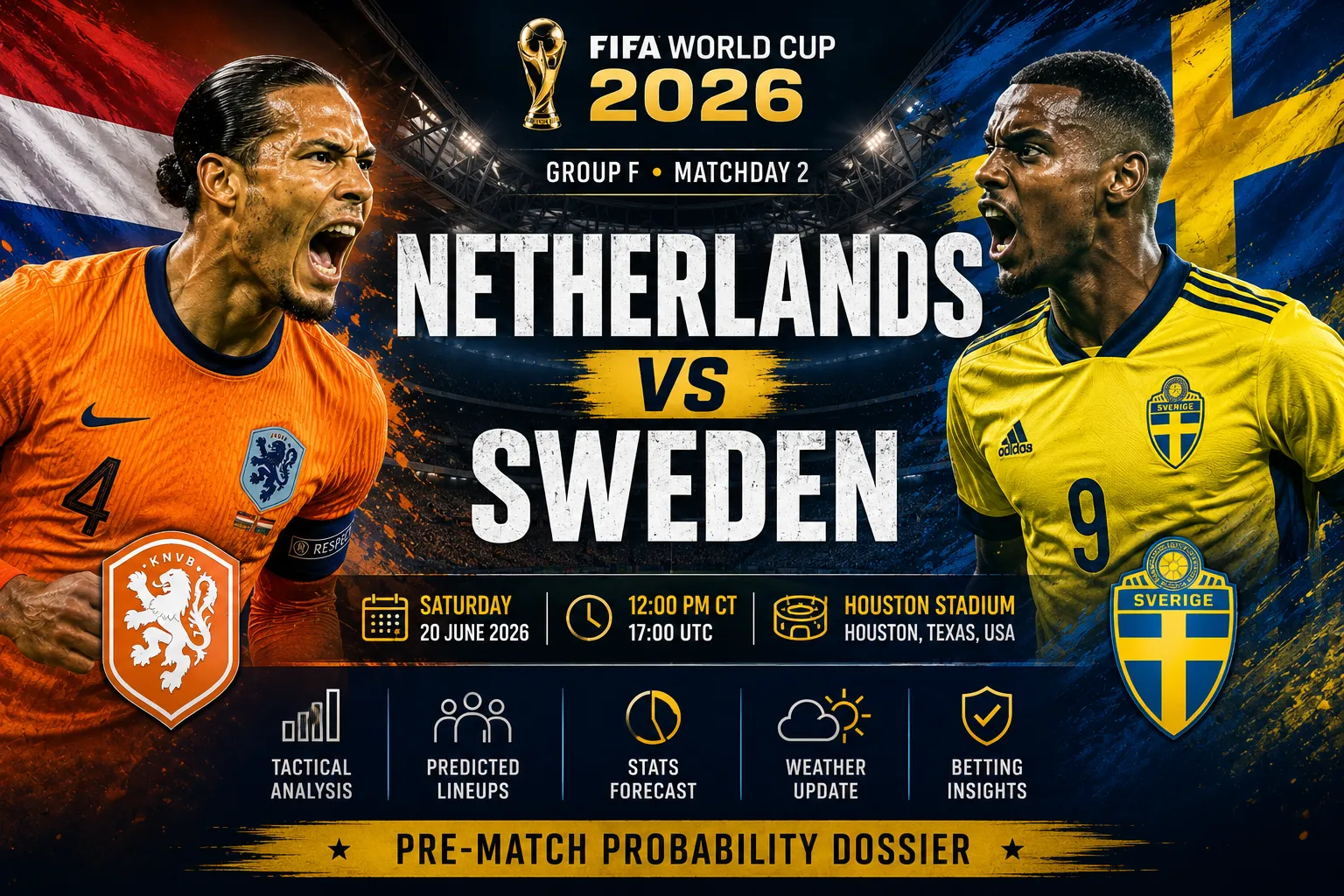
Netherlands face Sweden in a FIFA World Cup 2026 Group F match at Houston Stadium in Houston, Texas, United States, on Saturday, 20 June 2026. Kick-off is scheduled for 12:00 p.m. local time in Houston and 17:00 UTC. This is Match 35 and the second group-stage match for both teams.
Sweden enter with three points after a 5-1 win over Tunisia. The Netherlands enter with one point after a 2-2 draw against Japan. Sweden’s confirmed team context includes a strong attacking start under Graham Potter, with Alexander Isak, Viktor Gyökeres and Yasin Ayari central to the opening victory. The Netherlands’ confirmed team-news concern is Quinten Timber, who is ruled out with concussion. Jurrien Timber is already absent from the tournament, while Memphis Depay’s thigh condition remains a selection watchlist. Ronald Koeman must also respond after the Dutch twice failed to protect a lead against Japan.
The likely tactical shape is Netherlands controlling more possession through Frenkie de Jong, Ryan Gravenberch and wide progression, while Sweden defend pragmatically in Potter’s compact system and attack through Isak, Gyökeres and Anthony Elanga-type pace. The key matchup is Van Dijk and the Dutch back line against Sweden’s two-striker power. Betting markets favour the Netherlands, but this preview explains probabilities only and does not provide guaranteed betting advice.
| Field | Data |
|---|---|
| Match | Netherlands vs Sweden |
| Competition | FIFA World Cup 2026 |
| Stage | First Stage / Group Stage |
| Group | Group F |
| Match Number | Match 35 |
| Date | Saturday, 20 June 2026 |
| Kick-off Time | 12:00 p.m. Houston time / 17:00 UTC |
| Stadium | Houston Stadium |
| Common Venue Context | NRG Stadium, Houston |
| City | Houston, Texas |
| Host Country | United States |
| Expected Attendance | Not available from verified public data |
| Referee | Not available from verified official public data |
| VAR | Not available from verified official public data |
| Weather Forecast | Around 87°F / 30°C near local kick-off; partly cloudy; possible thunderstorm risk later in the day; exact humidity and pitch-speed data not available from verified public data |
| Pitch Context | Tournament football surface at an NFL venue adapted for World Cup use; exact pitch speed not available from verified public data |
| Main Article Focus | Group F control, Netherlands response after Japan draw, Sweden’s attacking surge, predicted lineups, heat context, tactical matchups, projected stats, cards and responsible betting risk |
Netherlands vs Sweden is a high-pressure Group F match because the two teams enter from different emotional positions. Sweden have momentum after a strong opening win. The Netherlands have pressure after twice losing a lead against Japan. Sweden can move close to knockout control with another win. The Netherlands need a response before their final group match against Tunisia.
Netherlands vs Sweden matters because Sweden can move to six points and take control of Group F, while the Netherlands need a win to repair the damage from their late draw against Japan.
| Category | Status | Netherlands vs Sweden Example | Article Use |
|---|---|---|---|
| Confirmed fact | Verified before publication | Netherlands vs Sweden, Group F, Houston Stadium | |
| Confirmed timing | Verified fixture context | Saturday, 20 June 2026, 12:00 p.m. Houston time / 17:00 UTC | |
| Confirmed Netherlands result | Verified reporting | Netherlands drew 2-2 with Japan | |
| Confirmed Sweden result | Verified reporting | Sweden beat Tunisia 5-1 | |
| Confirmed Netherlands team news | Verified reporting | Quinten Timber is ruled out with concussion | |
| Confirmed Netherlands tournament absence | Verified reporting | Jurrien Timber is already unavailable for the tournament | |
| Confirmed Sweden team context | Verified reporting | Sweden scored five against Tunisia, with Ayari, Isak and Gyökeres among the scorers | |
| Probable information | Tactical forecast | Netherlands likely control more possession; Sweden likely defend compactly and counter | |
| Projected data | Model-based estimate | Possession, shots, xG, corners, fouls and cards | |
| Unknown data | Not verified in current public source set | Expected attendance, official referee, official VAR, exact humidity, exact wind and final pitch speed | |
| Scenario-based analysis | Forecast only | Memphis Depay may start, come from the bench or remain limited depending on fitness |
This distinction matters because the match has a strong market favourite but no certain outcome. The Netherlands have more possession tools. Sweden have the more convincing first result. Sweden’s 5-1 win does not guarantee another high-scoring match. The Dutch draw with Japan does not mean the Netherlands are structurally broken.
A predicted lineup is not an official lineup. A projected xG range is not a final statistic. A weather forecast can change. A betting price is not a result. This dossier separates confirmed data from editorial projections to protect forecast accuracy and reader trust.
Group F changed quickly after the first matchday. Sweden took the strongest result. Japan and the Netherlands shared points. Tunisia lost heavily and changed the mood around their campaign. The second matchday can decide whether Sweden become group leaders or whether the Netherlands restore balance.
| Team | Played | Won | Drawn | Lost | Goals For | Goals Against | Goal Difference | Points |
|---|---|---|---|---|---|---|---|---|
| Sweden | 1 | 1 | 0 | 0 | 5 | 1 | +4 | 3 |
| Netherlands | 1 | 0 | 1 | 0 | 2 | 2 | 0 | 1 |
| Japan | 1 | 0 | 1 | 0 | 2 | 2 | 0 | 1 |
| Tunisia | 1 | 0 | 0 | 1 | 1 | 5 | -4 | 0 |
The top two teams in each group qualify directly for the Round of 32. The best eight third-placed teams also qualify. Six points after two matches would put Sweden in a very strong position. Four points would keep the Netherlands stable. One or two points would leave the Netherlands under pressure before Tunisia.
The Netherlands need a controlled response. The Japan match was not a disaster, but it created tactical questions. Koeman’s side led twice. Van Dijk scored. Summerville scored. Japan still came back twice, including a late equaliser. That pattern raises questions about game management, defensive substitutions, midfield control and late concentration.
The Netherlands also carry injury and fitness questions. Quinten Timber is out. Jurrien Timber is already absent. Memphis Depay’s thigh situation affects attacking planning. Koeman must decide whether Depay can start, whether he is better as a substitute, or whether Cody Gakpo, Donyell Malen, Crysencio Summerville, Brian Brobbey, Wout Weghorst or another forward profile should carry the attack.
Netherlands objectives:
Sweden enter with the strongest Group F position. Potter’s team have three points, five goals and major attacking confidence. Ayari scored twice. Isak scored. Gyökeres scored. Svanberg scored after entering from the bench. The forwards looked powerful enough to punish even strong opponents.
The Netherlands are a much harder test than Tunisia. Sweden will not expect to control the ball for long stretches. Potter’s pragmatic setup may become important. Sweden can defend in a compact shape, use their front two as outlets, and attack Dutch full-back space after turnovers.
Sweden objectives:
Goal difference matters already. Sweden are +4. Netherlands are 0. Japan are 0. Tunisia are -4. Sweden can afford a draw, but a win would give them group control. The Netherlands can still recover from the Japan draw, but another draw would put pressure on the final match.
If Sweden lead late, goal difference may not require them to chase another goal. If the Netherlands lead late, Koeman must decide whether to control the ball or drop deeper. The Japan match makes that decision sensitive.
The third-place route matters less for Sweden right now and more for the Netherlands. Sweden can build toward top-two qualification. The Netherlands must avoid entering the final match with only two points. Four points after two matches would be useful. One point after two matches would be dangerous.
A draw would not eliminate either side. It would help Sweden more than the Netherlands. A Dutch win would reset the group. A Swedish win would make them one of the strongest early group-stage stories.
The Netherlands carry correction pressure. Sweden carry confirmation pressure. The Dutch must show that the Japan draw was a warning, not a structural problem. Sweden must show that the Tunisia win was not only an opener against an opponent that made errors.
If the Netherlands score first, the key question is whether they manage the lead better than against Japan. If Sweden score first, the Dutch must chase against a compact team with elite counter attackers. If the match remains level after 60 minutes, the pressure may shift toward the Netherlands.
| Result | Netherlands Impact | Sweden Impact | Group F Meaning |
|---|---|---|---|
| Netherlands win | Netherlands move to four points and repair the Japan draw | Sweden stay on three points and remain well placed but lose top control | Group F reopens |
| Draw | Netherlands move to two points and still need a strong final match | Sweden move to four points and remain in strong position | Sweden benefit more |
| Sweden win | Netherlands stay on one point and face serious pressure before Tunisia | Sweden move to six points and likely control Group F | Sweden become clear group leader |
| Factor | Match Relevance |
|---|---|
| Host country | United States |
| Venue region | Texas / Gulf Coast |
| City context | Houston, large international football market |
| Neutral match | Neither team is host nation |
| Crowd profile | Dutch orange support, Swedish yellow support, local neutrals |
| Climate | Hot midday conditions |
| Altitude | No meaningful altitude issue |
| Stadium context | Houston Stadium / NRG Stadium event context |
| Travel context | Netherlands arrive from Texas opener in Arlington; Sweden arrive from Monterrey |
| Tournament pressure | Second group match with top-place implications |
Houston creates a hot and loud setting. Dutch supporters are expected to create a visible orange presence. Swedish supporters also have a strong travelling base. The crowd will matter, but heat and game-state management may matter more.
| City Factor | Tactical Impact |
|---|---|
| 12:00 p.m. local kick-off | Midday heat affects pressing and hydration |
| Around 87°F / 30°C near kick-off | Full-match high pressing becomes harder |
| Partly cloudy forecast | Some heat load remains |
| Possible thunderstorm risk later | Weather should be monitored, but match starts earlier |
| No altitude issue | Oxygen recovery is normal |
| High humidity risk by climate context | Exact humidity not available from verified public data |
| Large stadium environment | Crowd noise affects defensive communication |
| Strong fan marches expected | Emotional atmosphere can increase tempo early |
The match may start quickly because both fan bases should bring energy. The teams must then manage heat. Sweden may benefit from a compact block because they can reduce running distances. The Netherlands may need patient possession, but slow possession without penetration can help Sweden recover.
| Stadium Detail | Data |
|---|---|
| FIFA Stadium Name | Houston Stadium |
| Common Venue Context | NRG Stadium |
| City | Houston |
| State | Texas |
| Host Country | United States |
| Kick-off | 12:00 p.m. local / 17:00 UTC |
| Expected Attendance | Not available from verified public data |
| Referee | Not available from verified official public data |
| VAR | Not available from verified official public data |
| Roof Status | Stadium has retractable-roof context; match-specific roof status not available from verified public data |
| Pitch Speed | Not available from verified public data |
| Tactical Impact | Heat, surface speed, roof status and humidity can affect pressing, passing and fatigue |
Houston Stadium’s roof status matters. If closed or partially managed, heat and ball speed may change. If open, midday conditions become more important. Official roof status was not available from verified public data in the current source set.
| Weather / Environment Factor | Tactical Meaning |
|---|---|
| Around 87°F / 30°C | High pressing should be used in waves |
| Partly cloudy | Does not remove heat stress |
| Possible later storms | Weather should be monitored close to kick-off |
| Exact humidity unavailable | Avoid precise cramp claims |
| Wind not fully verified | Long diagonals and crosses need live calibration |
| No altitude | Sprint recovery not altitude-limited |
| Roof status unknown | Could change perceived heat and ball speed |
| Noon kick-off | Hydration and substitutions become more important |
The most important environment factor is heat. The Netherlands may want to dominate the ball. Sweden may want to defend compactly and attack fast. Both plans require energy, but Sweden’s lower-possession model may be less exposed to sustained pressing fatigue.
| Team | Player / Role | Status | Tactical Impact |
|---|---|---|---|
| Netherlands | Ronald Koeman | Head coach | Must respond after Japan draw and late-game management criticism |
| Netherlands | Quinten Timber | Ruled out with concussion | Removes midfield/defensive versatility from bench and rotation |
| Netherlands | Jurrien Timber | Already unavailable for tournament | Reduces defensive depth and right-sided flexibility |
| Netherlands | Memphis Depay | Thigh fitness watchlist | Could start, remain bench option or stay limited |
| Netherlands | Virgil van Dijk | Captain / centre-back | Must defend Isak and Gyökeres; scored vs Japan |
| Netherlands | Frenkie de Jong | Midfielder | Main tempo controller and pressure escape |
| Netherlands | Crysencio Summerville | Forward / winger | Scored against Japan and can stretch Sweden |
| Netherlands | Cody Gakpo | Forward / winger | Key attacking player and left-side threat |
| Netherlands | Denzel Dumfries | Wing-back / full-back | Right-side width, aerial threat and box runs |
| Sweden | Graham Potter | Head coach | Pragmatic five-defender system and attacking partnership focus |
| Sweden | Alexander Isak | Forward | Scored against Tunisia and provides depth and finishing |
| Sweden | Viktor Gyökeres | Forward | Scored against Tunisia and gives power, hold-up and pressing |
| Sweden | Yasin Ayari | Midfielder | Scored twice against Tunisia and adds confidence |
| Sweden | Mattias Svanberg | Midfielder | Scored as substitute against Tunisia |
| Sweden | Kristoffer Nordfeldt | Goalkeeper from opener | Started against Tunisia |
| Sweden | Dejan Kulusevski | Not in World Cup squad due to injury recovery | Removes major creative forward option |
| Sweden | Victor Lindelöf | Defender | Defensive leadership and back-line organisation |
| Player | Team | Status | Tactical Impact |
|---|---|---|---|
| Memphis Depay | Netherlands | Fitness watchlist due to thigh trouble | Impacts striker/creator selection and bench plan |
| Not available from verified public data | Sweden | No additional confirmed match-day doubtful player in current source set | Official team sheet should be checked |
| Player | Team | Status | Tactical Impact |
|---|---|---|---|
| Quinten Timber | Netherlands | Ruled out with concussion | Reduces midfield and defensive rotation |
| Jurrien Timber | Netherlands | Tournament absence | Reduces defensive depth |
| Dejan Kulusevski | Sweden | Not selected after long-term knee injury recovery | Removes a major creative attacking option |
| Not available from verified public data | Both | Other confirmed unavailable players not verified in current source set | Do not invent additional absences |
| Player / Group | Team | Issue | Match Impact |
|---|---|---|---|
| Memphis Depay | Netherlands | Thigh fitness | Starting role and minutes need official confirmation |
| Quinten Timber | Netherlands | Concussion | Confirmed out for Sweden match |
| Netherlands defensive line | Netherlands | Late-game control concern after Japan draw | Tactical, not medical, watchlist |
| Sweden front two | Sweden | High workload in heat | Isak and Gyökeres must balance pressing with recovery |
| Sweden midfield | Sweden | Defensive shifting in Houston heat | Ayari, Karlström, Svanberg and support players must manage intensity |
| Sweden centre-backs | Sweden | Expected aerial and crossing workload | Lindelöf, Hien and supporting defenders need concentration |
| Team | Confirmed Suspension | Notes |
|---|---|---|
| Netherlands | Not available from verified public data | No confirmed active suspension used in this preview |
| Sweden | Not available from verified public data | No confirmed active suspension used in this preview |
The Netherlands have two linked issues. First, Quinten Timber cannot be used. Second, Memphis Depay may not be ready for a full starting workload. Koeman must build attacking clarity without assuming Depay can solve chance creation. The Japan match showed that Netherlands can score, but also that they can lose control.
Sweden’s major absence is Kulusevski. Potter has already built around a different identity: two powerful forwards, a compact defensive structure and simpler tactical messages. The Tunisia match showed that this plan can be direct and productive.
Official starting lineups were not available from verified public data at the time of writing. These XIs are projections based on opening-match context, squad reporting and tactical logic.
| Position / Line | Player | Likely Role |
|---|---|---|
| GK | Bart Verbruggen | Goalkeeper, distribution and shot-stopping |
| RCB / RB | Jan Paul van Hecke / Lutsharel Geertruida | Right-side defending against Swedish forwards and runners |
| CB | Virgil van Dijk | Captain, aerial control and Isak/Gyökeres duel leader |
| LCB | Micky van de Ven / Nathan Aké | Recovery pace and left-side buildup |
| RWB / RB | Denzel Dumfries | Width, box runs and aerial pressure |
| CM | Frenkie de Jong | Tempo, progression and press resistance |
| CM | Ryan Gravenberch / Tijjani Reijnders | Ball carrying, second balls and forward support |
| AM / CM | Teun Koopmeiners / Xavi Simons | Set-piece delivery, link play and attacking balance |
| RW | Crysencio Summerville / Donyell Malen | Direct width and shot threat |
| ST | Memphis Depay / Brian Brobbey / Wout Weghorst | Depay if fit; Brobbey for power; Weghorst for aerial late-game plan |
| LW | Cody Gakpo | Main left-side attacker and inside scoring threat |
| Position / Line | Player | Likely Role |
|---|---|---|
| GK | Kristoffer Nordfeldt | Goalkeeper, command and distribution |
| RCB / RB | Gustaf Lagerbielke / Alexander Bernhardsson role depending on shape | Defensive cover and wide protection |
| CB | Isak Hien | Central defender, duels and box protection |
| CB | Victor Lindelöf | Defensive leader and buildup reference |
| LCB / LB | Gabriel Gudmundsson | Left-side defence and forward support |
| CM | Jesper Karlström | Midfield screen and second-ball work |
| CM | Yasin Ayari | Ball carrying, shooting and opener confidence |
| CM / AM | Lucas Bergvall / Mattias Svanberg / Benjamin Nygren | Creative support and transition passing |
| RW / RWB | Anthony Elanga / Alexander Bernhardsson | Speed, wing outlet and counter option |
| ST | Alexander Isak | Forward, depth runs and finishing |
| ST | Viktor Gyökeres | Forward, power, hold-up and pressing |
| Team | Base Formation | In Possession | Out of Possession | Confidence |
|---|---|---|---|---|
| Netherlands | 4-3-3 / 3-4-2-1 / 4-2-3-1 | 2-3-5 with Dumfries high, Gakpo inside and De Jong controlling | 4-4-2 press or 5-3-2 if protecting lead | Medium |
| Sweden | 5-3-2 / 5-4-1 / 4-4-2 | Direct 3-2-5 in selected attacks; front two as outlets | Compact 5-3-2 or 5-4-1 block | Medium/high |
| Scenario | Trigger | Expected Change |
|---|---|---|
| Depay starts | Medical staff clear him for match rhythm | Netherlands gain link play and set-piece creativity |
| Depay stays on bench | Thigh issue remains minutes-management concern | Brobbey, Malen, Summerville, Gakpo or Weghorst roles become bigger |
| Netherlands use back three | Koeman wants extra protection against Isak and Gyökeres | Van Dijk, Van Hecke and Van de Ven/Aké form central line |
| Netherlands add Weghorst late | Sweden defend deep and lead or draw late | More crosses and aerial pressure |
| Sweden keep Potter’s opener structure | Potter rewards 5-1 win | Isak and Gyökeres start as front two |
| Sweden add midfield control | Netherlands dominate possession early | Svanberg or Bergvall helps ball retention |
| Sweden protect lead | Leading after 70 minutes | Extra defender or midfielder enters |
| Sweden chase goal | Trailing after 60 minutes | More width, Elanga speed or second-wave midfielder |
| Phase | Expected Pattern |
|---|---|
| Build-up | Verbruggen, Van Dijk and De Jong control first phase; full-backs or wing-backs provide width |
| Attack | Gakpo inside movements, Dumfries wide pressure, De Jong progression, Summerville/Malen speed |
| Defense | High counter-press in waves, Van Dijk aerial control and central compactness |
| Transitions | Quick release to Gakpo, Summerville, Malen or Depay/Brobbey after regain |
| Set Pieces | Van Dijk, Dumfries, De Vrij/Van Hecke, Weghorst/Brobbey targets |
| Weakness | Late-game passivity, transition defence against two strikers, Depay fitness uncertainty |
The Netherlands should build through De Jong and Van Dijk. De Jong can escape pressure, turn away from Swedish midfielders and connect the first phase to the attack. Van Dijk can switch play and break lines. Sweden will not want to chase every Dutch pass, so the Netherlands must move the ball quickly enough to disrupt the block.
The Dutch issue against Sweden is not only possession. It is what possession creates. Sweden can defend deep and wait for counters. If the Netherlands circulate without penetration, Potter’s team can rest in structure.
Useful Dutch build-up routes:
The Netherlands can press Sweden, but they must not leave Isak and Gyökeres one pass away from goal. Sweden’s forward pairing can punish loose rest defence. Koeman may choose pressing waves instead of constant pressure.
Useful Dutch pressing triggers:
The Dutch counter-press after losing the ball may decide the match. If Sweden’s first pass finds Isak or Gyökeres, the Netherlands become exposed.
The Netherlands can attack through both flanks. Gakpo’s side is likely the main creative route because he can move inside and shoot. Dumfries gives a major right-side outlet because Sweden’s back line must track his far-post runs.
If Sweden defend in a back five, the Netherlands must attack the half-spaces. Simple crosses into Sweden’s central defenders may be low-value unless Weghorst or Brobbey is used. Cutbacks, third-man runs and quick switches are more valuable.
Frenkie de Jong is the most important passer. Van Dijk is the most important long passer. Gakpo is the most important final-third carrier. If Depay starts, he becomes the most important link player. If Depay is limited, the Netherlands need Gakpo, Simons, Reijnders or Summerville to take more creative load.
The Netherlands can transition quickly if Sweden attack with numbers. Those moments may be limited because Sweden may not overcommit. The Dutch transition threat is stronger through wide speed and central runners than through direct long balls.
The ideal Netherlands transition:
The Netherlands have strong set-piece tools. Van Dijk, Dumfries, Van Hecke, De Vrij, Brobbey and Weghorst provide aerial targets. Delivery can come from Depay, Koopmeiners, Gakpo or other set-piece takers depending on the XI.
Sweden also defend aerially well. Set pieces will be physical. The first contact may not decide everything. Second balls around the penalty area can be decisive.
The biggest Dutch weakness is the space around transitions. Sweden have two forwards who can hold, run, combine and finish. If Van Dijk is forced to defend both the ball and a runner, the Netherlands have already lost structure.
The second weakness is late-game passivity. The Japan draw raised this question. If the Netherlands lead Sweden, they must keep the ball better or press exits more intelligently.
Verbruggen must manage both short buildup and long distribution. Sweden may press selectively. If Verbruggen plays short, the spacing around De Jong matters. If he goes long, Sweden’s centre-backs may win first contact.
Dumfries can create major pressure, but his high position opens counter space. The left side must also balance attacking and defensive cover. If both full-backs or wing-backs go high at once, Isak and Gyökeres become dangerous outlets.
The striker role depends on Depay. If he starts, he can drop, connect and shoot. If Brobbey starts, the Netherlands gain power. If Weghorst starts or enters late, the team may cross more. Koeman must avoid making the attack predictable.
| Phase | Expected Pattern |
|---|---|
| Build-up | Pragmatic, direct when pressed, with Lindelöf and midfield support |
| Attack | Isak and Gyökeres as central outlets, Ayari runs, Elanga speed, Bergvall/Svanberg support |
| Defense | Compact five-defender or four-defender system, central protection and selective pressing |
| Transitions | First forward pass into Isak, Gyökeres or wide runner |
| Set Pieces | Lindelöf, Hien, Gyökeres, Isak and midfield runners attack deliveries |
| Weakness | Long defensive spells, full-back isolation and possible overconfidence after Tunisia win |
Sweden do not need to build like the Netherlands. Potter’s Sweden should be pragmatic. Nordfeldt can play short when lanes are open. Lindelöf can step forward. Karlström can provide a simple midfield connection. But Sweden’s most valuable pass may be the first forward ball into Isak or Gyökeres.
The front two can make direct play useful. Isak can run channels. Gyökeres can hold off defenders and release others. This makes Sweden dangerous even with lower possession.
Sweden can press selectively. Potter will likely avoid constant high pressing in Houston heat. A compact mid-block can force the Netherlands into wide areas and preserve energy.
Useful Sweden pressing triggers:
Sweden must avoid fouls around the box. Dutch set pieces are dangerous.
Sweden’s attack can be central because of Isak and Gyökeres. It can also become wide through Elanga, Bernhardsson or Gudmundsson-type movement. Against the Netherlands, the most valuable attacking space may be behind Dumfries or behind the Dutch left-back/wing-back when they advance.
Sweden’s best attacks will not require 15 passes. They need one clean regain, one accurate forward ball, and immediate support.
Lindelöf can be a key first passer from defence. Karlström can provide simple circulation. Ayari can carry confidence from the Tunisia match. Bergvall or Svanberg can add more creative support if selected. But Sweden’s key “passer” may be the player who makes the first transition pass under pressure.
Transition is Sweden’s most dangerous route. Isak and Gyökeres can turn a low-possession match into a high-danger match. If the Netherlands lose the ball with both wide players high, Sweden can attack in two or three passes.
The ideal Sweden transition:
Sweden have strong set-piece potential. Lindelöf, Hien, Gyökeres, Isak and midfield runners can attack aerial balls. The Netherlands also defend well, so delivery quality matters.
Set pieces can help Sweden slow the game and generate chances without long possession phases.
Sweden’s weakness is defending repeated rotations. If the Netherlands move the ball quickly, the Swedish block can become stretched. The second weakness is full-back or wing-back isolation against Gakpo, Summerville or Dumfries.
Sweden must also manage heat. If they defend deep for long periods, fatigue can open gaps late.
Nordfeldt started the opener. His distribution must relieve pressure. Long balls should target Gyökeres or Isak. Short passes should be used only when the first passing lane is safe.
Swedish wide defenders must defend first. They can counterattack when the ball is secure, but they cannot leave Gakpo, Summerville or Dumfries untracked.
Isak and Gyökeres are central to Sweden’s identity. Isak gives depth and finishing. Gyökeres gives power, hold-up and direct running. Their connection was not perfect against Tunisia, but the output was strong. Against the Netherlands, they must be efficient with fewer chances.
| Zone | Netherlands Edge | Sweden Edge | Likely Control | Why It Matters |
|---|---|---|---|---|
| Netherlands left / Sweden right | Gakpo, left-sided rotations, De Jong support | Sweden counter lane if Dutch full-back advances | Netherlands in possession, Sweden in transition | Major creative route |
| Netherlands right / Sweden left | Dumfries far-post runs and width | Gudmundsson/Swedish left block and counters | Balanced | Determines crossing and far-post pressure |
| Central midfield | De Jong, Gravenberch, Reijnders / Koopmeiners | Karlström, Ayari, Svanberg, Bergvall physical work | Netherlands in possession | Controls rhythm and second balls |
| Penalty box | Van Dijk, Dumfries, Brobbey/Weghorst | Lindelöf, Hien, Isak, Gyökeres | Balanced | Aerial duels can decide tight phases |
| Set pieces | Dutch delivery and Van Dijk | Swedish height and front two | Balanced | High-value route for both teams |
| Transitions | Dutch counter-press | Sweden front two | Sweden danger | Sweden’s best upset route |
| Defensive third | Netherlands likely defend fewer spells | Sweden likely defend more compactly | Sweden under pressure | Tests Potter’s structure and heat management |
Van Dijk must manage Isak’s movement, depth runs and finishing threat.
Why it matters: Sweden can create danger without long possession if Isak receives behind or beside the centre-backs.
What to watch: Whether Van Dijk can defend forward passes while keeping the rest of the Dutch line connected.
Risk trigger: If Isak drags Van Dijk wide, Gyökeres can attack central space.
Gyökeres gives Sweden power and directness. The Dutch right centre-back zone may be tested physically.
Why it matters: If Gyökeres wins hold-up duels, Sweden can move upfield and reduce Dutch pressure.
What to watch: First contact after Swedish clearances and direct balls.
Risk trigger: If the Dutch centre-backs lose second balls, Sweden’s attack becomes much more dangerous.
De Jong controls the Dutch tempo. Sweden must deny him easy forward passes.
Why it matters: If De Jong turns freely, the Netherlands can move Sweden’s block and create overloads.
What to watch: Whether Sweden press De Jong or block his passing lanes.
Risk trigger: If Sweden’s midfield drops too deep, De Jong can dictate the match.
Gakpo can attack inside and shoot. Sweden must control him without opening the left-back or centre-back lane.
Why it matters: The Netherlands need a reliable final-third source if Depay is limited.
What to watch: Gakpo’s first touch inside the box or half-space.
Risk trigger: If Sweden’s right defender gets booked, Gakpo becomes a larger threat.
Ayari scored twice against Tunisia and gives Sweden midfield confidence.
Why it matters: Sweden need midfield support behind Isak and Gyökeres.
What to watch: Whether Ayari arrives around loose balls after direct passes.
Risk trigger: If the Netherlands leave the edge of the box unprotected, Ayari can shoot or recycle attacks.
| Projected Stat | Netherlands | Sweden | Confidence | Reason |
|---|---|---|---|---|
| Possession | 55–64% | 36–45% | Medium/high | Netherlands should control more ball through De Jong and centre-backs |
| Shots | 12–20 | 8–14 | Medium | Dutch volume likely higher; Sweden transition quality strong |
| Shots on Target | 4–8 | 3–6 | Medium | Sweden front two can create efficient chances |
| xG Range | 1.25–2.25 | 0.90–1.70 | Low/medium | First goal and transition success can shift model |
| Big Chances | 1–3 | 1–3 | Low/medium | Sweden may create fewer but high-value chances |
| Corners | 5–9 | 2–6 | Medium | Dutch territory likely produces more corners |
| Fouls | 9–14 | 10–16 | Medium | Sweden defensive workload and Dutch transition fouls both relevant |
| Yellow Cards | 1–3 | 1–4 | Low/medium | Referee unknown; heat and transitions raise risk |
| Red-Card Risk | Low | Low | Low | No red card predicted |
| Offsides | 1–3 | 1–4 | Low | Isak, Gyökeres, Gakpo and Malen/Summerville can attack lines |
| Saves | 2–5 | 4–7 | Medium | Sweden goalkeeper likely faces more shot volume |
| Crosses | 16–28 | 9–17 | Medium | Netherlands likely use wide pressure |
| Tackles | 12–20 | 18–30 | Medium | Sweden likely defend more one-vs-one actions |
| Interceptions | 8–14 | 11–20 | Medium | Swedish block can cut central passes |
| Clearances | 12–22 | 24–40 | Medium/high | Sweden may defend sustained Dutch pressure |
The Netherlands should lead possession and shot volume. Sweden may still produce the more frightening transition moments. The key Dutch metric is not only possession. It is central chance quality. The key Swedish metric is not shot volume. It is how often they can release Isak and Gyökeres against an unsettled back line.
| Match Window | Tactical State | Physical State | Card Risk | Goal Risk | Betting Market Trigger |
|---|---|---|---|---|---|
| 1’–15’ | Netherlands likely start with possession; Sweden likely protect central block | Heat starts to matter early | Low/medium | Medium | First De Jong rhythm, first Isak/Gyökeres outlet |
| 16’–30’ | Dutch wide pressure may increase; Sweden counter plan becomes clearer | Defensive shifting rises for Sweden | Medium | Medium | Dutch corner count, Swedish transition quality |
| 31’–45+’ | If level, Sweden confidence grows; Dutch urgency rises | Heat affects pressing choices | Medium/high | Medium | Late first-half set pieces |
| 46’–60’ | Koeman may adjust Depay/striker role; Potter may adjust block height | Reset after halftime | Medium | Medium/high | Depay usage, Elanga/Svanberg-type changes |
| 61’–75’ | Space can open as legs fade | Houston heat becomes more relevant | High | Medium/high | Fresh Dutch winger or Swedish counter runner |
| 76’–90+’ | Game state dominates | Concentration and substitutions matter | High | High | Netherlands lead management, Sweden draw/win calculation |
The Netherlands should try to set the rhythm. Sweden should show early that they can counter. One strong Swedish outlet can force the Dutch to respect space behind their full-backs.
Dutch possession may become more territorial. Sweden must avoid conceding repeated corners and free kicks. The front two must stay connected enough to relieve pressure.
If Sweden reach halftime level, their confidence will grow. If the Netherlands lead, the main question becomes whether Koeman keeps attacking balance or protects early.
This window may show Depay’s role. If he starts, his physical response matters. If he is on the bench, Koeman may use him as a second-half connector. Potter may add midfield legs if Sweden defend too much.
Heat, substitutions and tired defending can change the match. Fresh attackers matter. Sweden may add pace. The Netherlands may add aerial presence or technical control.
The Japan draw makes the Dutch late-game model a major watchlist. Sweden can wait for one counter or set piece. The Netherlands must control the match with the ball, not only with defensive numbers.
| Factor | Expected Impact | Netherlands Effect | Sweden Effect |
|---|---|---|---|
| Heat around 87°F / 30°C | Reduces full-match pressing efficiency | Pressing should come in waves | Compact defending can conserve energy |
| Partly cloudy | Does not remove heat load | Ball circulation still viable | Defensive shifting still demanding |
| Humidity unavailable | Avoid exact cramp claims | Hydration and substitution timing matter | Front two must manage sprint load |
| Wind not fully verified | Crosses and diagonals need live calibration | Van Dijk and De Jong switches need adjustment | Direct balls to Isak/Gyökeres need accuracy |
| Thunderstorm risk later | Weather can change if delayed or conditions shift | Passing and handling can change | Clearances and long balls can change |
| No altitude | Normal oxygen recovery | Heat is bigger factor than altitude | Same |
| Roof status unknown | Could affect heat and ball speed | Must adapt after warm-up | Must adapt after warm-up |
| Noon kick-off | Energy management matters | Avoid wasteful pressing | Use compact phases |
The most important weather factor is heat. The Netherlands may need to press less often and pass more intelligently. Sweden may need to conserve energy in a compact block, then sprint with purpose.
| Player | Team | Role | Match Impact Score /10 | Reason |
|---|---|---|---|---|
| Frenkie de Jong | Netherlands | Midfielder | 9.0 | Main tempo controller and pressure escape |
| Virgil van Dijk | Netherlands | Centre-back / captain | 8.9 | Direct duel with Sweden’s elite forwards |
| Cody Gakpo | Netherlands | Forward / winger | 8.7 | Main left-side attacking threat |
| Denzel Dumfries | Netherlands | Wing-back / full-back | 8.4 | Width, aerial runs and far-post pressure |
| Crysencio Summerville | Netherlands | Winger | 8.2 | Scored vs Japan and adds speed |
| Memphis Depay | Netherlands | Forward | 8.1 if fit | Fitness-dependent creator and scorer |
| Ryan Gravenberch | Netherlands | Midfielder | 8.0 | Ball carrying and midfield support |
| Bart Verbruggen | Netherlands | Goalkeeper | 7.8 | Concentration against efficient Sweden attacks |
| Alexander Isak | Sweden | Forward | 9.0 | Depth, finishing and transition threat |
| Viktor Gyökeres | Sweden | Forward | 8.9 | Power, hold-up play and scoring form |
| Yasin Ayari | Sweden | Midfielder | 8.6 | Two-goal opener and second-ball threat |
| Victor Lindelöf | Sweden | Defender | 8.3 | Defensive leadership and box organisation |
| Kristoffer Nordfeldt | Sweden | Goalkeeper | 8.1 | Likely shot-stopping workload |
| Jesper Karlström | Sweden | Midfielder | 8.0 | Defensive screen and passing simplicity |
| Mattias Svanberg | Sweden | Midfielder | 7.9 | Bench or starting midfield impact |
| Anthony Elanga | Sweden | Wide attacker | 7.9 | Pace and late-game counter threat |
Gakpo is the Netherlands’ most important attacker if Depay is limited. Depay becomes central if fit. Isak and Gyökeres are Sweden’s most important attacking pair because they can turn limited possession into real threat.
Van Dijk is the most important defender in the match. Sweden’s front two will test his positioning, recovery and aerial command. Lindelöf is Sweden’s key defensive organiser against Dutch movement.
De Jong is the central midfield reference. Ayari is Sweden’s confidence player after the Tunisia match. Karlström may be Sweden’s most important defensive midfielder if he starts.
The Netherlands can change the match through Depay, Weghorst, Malen, Brobbey, Simons or Koopmeiners depending on the starting XI. Sweden can change the match through Svanberg, Bergvall, Elanga, Nygren or another wide/central runner.
Dutch centre-backs and full-backs carry card risk against Isak and Gyökeres. Swedish midfielders and wide defenders carry card risk against De Jong, Gakpo, Summerville and Dumfries.
Depay is the key injury-management watchlist. Quinten Timber is unavailable. Jurrien Timber is unavailable for the tournament.
The referee and VAR were not available from verified official public data in this source set. This discipline section uses tactical logic only.
| Discipline Factor | Forecast |
|---|---|
| Referee Style | Not available from verified official public data |
| Tactical Foul Risk | Medium/high |
| Dissent Risk | Medium because of group stakes and heat |
| VAR Intervention Risk | Medium |
| Penalty Risk | Medium |
| Red-Card Risk | Low |
| Team | Yellow-Card Range | Red-Card Risk | Main Risk Zone |
|---|---|---|---|
| Netherlands | 1–3 | Low | Recovery fouls against Isak and Gyökeres |
| Sweden | 1–4 | Low | Midfield and wide fouls against De Jong, Gakpo and Dumfries |
Heat can raise late tackle risk. Sweden may defend more one-vs-one actions. The Netherlands may commit emergency fouls if Sweden break the first press.
| Set-Piece Area | Netherlands | Sweden | Edge |
|---|---|---|---|
| Corners For | Van Dijk, Dumfries, Brobbey/Weghorst, Van Hecke targets | Lindelöf, Hien, Nordfeldt command | Netherlands by volume |
| Corners Against | Must defend Lindelöf, Hien, Gyökeres, Isak | Must defend Van Dijk and Dutch runners | Balanced |
| Wide Free Kicks | Depay, Koopmeiners, Gakpo, De Jong-type delivery | Svanberg, Bergvall, Ayari-type delivery | Balanced |
| Direct Free Kicks | Depay / Gakpo / Koopmeiners if selected | Sweden taker hierarchy should be confirmed from XI | Netherlands slight edge if Depay fit |
| Penalties | Taker hierarchy should be confirmed from official XI | Taker hierarchy should be confirmed from official XI | Unknown |
| Long Throws | Not available from verified public data | Not available from verified public data | Unknown |
| Aerial Duels | Strong through Van Dijk and Dumfries | Strong through Lindelöf, Hien, Gyökeres and Isak | Balanced |
Set pieces can decide this match because both teams have aerial strength. The Netherlands may win more corners through territorial pressure. Sweden may create fewer set pieces but attack them with real size.
| Area | Netherlands | Sweden |
|---|---|---|
| Goalkeeper Distribution | Verbruggen supports buildup and restarts | Nordfeldt likely mixes direct and short exits |
| Shot-Stopping Pressure | Medium | Medium/high |
| Cross Handling | Medium against Swedish height | High against Dutch wide volume |
| High-Line Risk | High if full-backs push together | Lower if Sweden defend deep |
| Penalty-Box Defending | Must track Isak, Gyökeres and late midfield runners | Must track Gakpo, Dumfries, Van Dijk and central striker |
| Back-Post Weakness | Possible if over-shift toward Isak/Gyökeres | Possible against Dumfries far-post runs |
| Defensive Communication | Critical after Japan late collapse | Critical under Dutch pressure |
Nordfeldt may face more shot volume. Verbruggen may face fewer shots but more dangerous isolated chances. Goalkeeper concentration can decide a match where one team controls the ball and the other attacks efficiently.
| Minute Window | Netherlands Possible Change | Sweden Possible Change | Trigger |
|---|---|---|---|
| 45’–60’ | Use Depay, Simons, Malen or Brobbey; adjust midfield control | Add Svanberg/Bergvall or wide runner | Scoreline and Dutch chance quality |
| 60’–75’ | Add Weghorst, fresh winger or extra midfielder | Add Elanga speed or deeper midfielder | Heat, fatigue and transition risk |
| 75’–90’ | Protect lead with midfield control or chase with aerial plan | Protect draw/lead or chase with front-two support | Group math and game state |
The Netherlands must not repeat the Japan late-game problem. They should keep possession, protect transitions and avoid dropping too deep too early.
Sweden can defend deeper and play into Isak and Gyökeres. The Netherlands should avoid panic crossing and keep central combinations alive.
Sweden may accept a draw more than the Netherlands. The Netherlands may push for the win. That can create late transition space for Sweden.
| Market | Current Signal | Main Risk |
|—|—|
| Match Winner | Netherlands listed as favourite | Sweden’s strong opener, front-two threat and heat conditions |
| Double Chance | Netherlands or draw likely shorter | Low price may not reflect Swedish counter quality |
| Over/Under Goals | Public snapshot lists 2.5 goals | Early goal can open match; heat and compact shape can suppress tempo |
| BTTS | Plausible | Sweden are efficient; Netherlands defensive issues appeared vs Japan |
| Corners | Netherlands corner volume likely higher | Sweden can reduce volume if they score first |
| Cards | Medium | Heat, transitions and forward duels create tactical-foul risk |
| Player Shots | Gakpo, Depay if fit, Summerville, Isak, Gyökeres, Ayari watchlist | Official lineups and roles matter |
| Player Cards | Dutch recovery defenders, Swedish midfield screen | Referee threshold unknown |
| Trigger | Possible Market Effect |
|---|---|
| Depay starting status | Moves Netherlands attack and player props |
| Netherlands formation | Back three may lower Sweden transition expectation but reduce Dutch width |
| Sweden starting front two | Isak and Gyökeres confirmation supports BTTS and Sweden shot markets |
| Sweden midfield choice | Extra midfielder can lower total and improve Sweden control |
| Referee announcement | Can move cards and penalty markets |
| Roof / weather update | Can affect heat, tempo and totals |
| Public money on Netherlands | Can shorten favourite price |
| Official team sheets | Can shift shots, scorer and card markets |
| Trigger | Meaning | Risk |
|---|---|---|
| De Jong receives freely | Netherlands control model is working | Possession still needs chance quality |
| Gakpo isolates defender | Dutch chance quality can rise | Sweden may adjust with extra cover |
| Isak or Gyökeres win first balls | Sweden transition route is live | One outlet can overstate balance |
| Netherlands drop deep after lead | Japan-repeat risk increases | Sweden still need execution |
| 0-0 after 60’ | Sweden confidence and draw value rise | Dutch bench can still change match |
| Heat slows pressing | Match may become more tactical | Late errors can still appear |
This preview explains match data and market behavior. It does not provide guaranteed betting advice. World Cup betting involves risk. Readers should check local gambling laws, use licensed operators, set limits and avoid chasing losses.
| Factor | How It Can Break the Forecast |
|---|---|
| Late Lineup Change | Depay status or Sweden midfield shape can alter the model |
| Early Goal | Forces one team away from base plan |
| Early Yellow Card | Changes centre-back and full-back aggression |
| Injury | Can remove a creator, defender or striker |
| VAR Penalty | Creates a non-pattern goal and changes risk appetite |
| Weather Shift | Heat, storms or roof status can change tempo |
| Red Card | Makes possession and xG projections much less useful |
| Goalkeeper Error | Can swing a tight match |
| Tactical Surprise | Sweden may press higher or Netherlands may use back three |
| Market Overreaction | Dutch possession can shorten prices without central chance quality |
The forecast can fail if Sweden score first and defend compactly. It can also fail if the Netherlands score early and force Sweden to chase. Heat, Depay’s fitness, Sweden’s front two and late-game management can all change the match.
| Scenario | Probability Band | Match Story |
|---|---|---|
| Netherlands Narrow Win | Medium | Dutch possession produces enough chances and late management improves |
| Draw | Medium | Sweden defend compactly, use transitions and keep group control |
| Sweden Upset | Low/medium | Isak and Gyökeres punish Dutch transition space |
| High-Scoring Match | Medium | Early goal opens both teams and transition spaces grow |
| Low-Scoring Match | Medium | Heat and compact Swedish shape suppress tempo |
The safest scenario frame is Netherlands-favoured but not Netherlands-certain. Sweden have the stronger first result. The Netherlands have more possession tools and elite defensive leadership. The match depends on whether Dutch control can reduce Swedish transition danger.
| Result | Netherlands Impact | Sweden Impact |
|---|---|---|
| Netherlands Win | Netherlands reach four points and return to a strong qualification route | Sweden stay on three points and remain alive but lose top control |
| Draw | Netherlands reach two points and face Tunisia with pressure | Sweden reach four points and stay in strong position |
| Sweden Win | Netherlands stay on one point and enter final match under major pressure | Sweden reach six points and likely control Group F |
Six points would put Sweden close to qualification control. Four points would be useful for either team. Two points for the Netherlands would be uncomfortable. One point after two matches would be dangerous.
| Data Point | Status | Source Type |
|---|---|---|
| Match Date | Confirmed | FIFA match centre / venue listing |
| Kick-off Time | Confirmed | FIFA UTC listing and local ticketing / venue listing |
| Stadium | Confirmed | FIFA match centre / local venue listings |
| City | Confirmed | FIFA / venue context |
| Group | Confirmed | FIFA / Reuters context |
| Netherlands Opener Result | Confirmed | Reuters match report |
| Sweden Opener Result | Confirmed | Reuters match report |
| Netherlands Coach | Confirmed | Reuters / public team context |
| Sweden Coach | Confirmed | Reuters / public team context |
| Quinten Timber Status | Confirmed out | Reuters injury report |
| Jurrien Timber Status | Confirmed tournament absence | Reuters team-news context |
| Memphis Depay Status | Fitness watchlist | Reuters pre-match reporting |
| Sweden Scorers vs Tunisia | Confirmed | Reuters match report |
| Referee | Pending | Not available from verified official public data |
| VAR | Pending | Not available from verified official public data |
| Weather | Forecast | Weather service |
| Lineups | Projected | Editorial forecast until official team sheets |
| Odds | Market-signal only | Public broadcaster / sportsbook snapshot |
| Projected Stats | Model-based | Editorial projection using opener context and tactical matchup |
| Minute-Window Scenarios | Scenario-based | Editorial model, not factual prediction |
This dossier uses confirmed information where available and marks unknown data clearly. It does not invent official starting XIs, expected attendance, referee assignment, VAR assignment, exact pitch speed, exact humidity, exact wind or unverified suspensions.
This preview is analytical and informational. The forecast is not a guarantee. Football includes randomness and low-probability events. Final lineups, injuries, referee decisions, VAR, weather and early goals can change the match.
Projected statistics, scoreline scenarios and betting market notes are probability-based estimates. The Netherlands can dominate possession and still fail to win. Sweden can create fewer chances and still score through Isak, Gyökeres, a counterattack, a set piece or an individual action. A goalkeeper error, red card, deflection, penalty, injury or weather shift can break the pre-match model.
Betting markets move before and during the match. Readers should verify official lineups, injuries, referee information, weather conditions, pitch condition and market prices before making decisions. Readers should check local gambling laws. Readers should use licensed operators only. Readers should set spending and time limits. Readers should not chase losses. Betting should be treated as entertainment, not income.
This article does not provide guaranteed betting advice, fixed-match information, insider tips, prediction tools, risk-free picks or certain outcomes.
Netherlands vs Sweden is scheduled for Saturday, 20 June 2026. Kick-off is 12:00 p.m. local time in Houston and 17:00 UTC.
Netherlands vs Sweden is being played at Houston Stadium in Houston, Texas, United States. The common venue context outside FIFA naming is NRG Stadium.
Official starting lineups were not available from verified public data at the time of writing. Netherlands are projected to use Bart Verbruggen, Virgil van Dijk, Jan Paul van Hecke or another right-sided defender, Frenkie de Jong, Ryan Gravenberch, Cody Gakpo, Denzel Dumfries, Crysencio Summerville and a striker option depending on Memphis Depay’s fitness. Sweden are projected to use Kristoffer Nordfeldt, Victor Lindelöf, Isak Hien, Gabriel Gudmundsson, Jesper Karlström, Yasin Ayari, Alexander Isak and Viktor Gyökeres as key figures.
The main tactical matchup is Netherlands’ possession structure through Frenkie de Jong, Cody Gakpo and Denzel Dumfries against Sweden’s compact defensive shape and the transition power of Alexander Isak and Viktor Gyökeres.
The prediction can be wrong because late lineup changes, Memphis Depay’s fitness, early goals, injuries, VAR penalties, red cards, referee decisions, weather changes, set-piece goals and goalkeeper errors can change the match. This preview uses probability logic, not certainty.
[expert_review params=»JTdCJTIyY29sb3IlMjIlM0ElMjJncmVlbi0yJTIyJTJDJTIyZXhwZXJ0X2F2YXRhciUyMiUzQSUyMiUyMiUyQyUyMmV4cGVydF9uYW1lJTIyJTNBJTIyJTIyJTJDJTIyZXhwZXJ0X2xpbmslMjIlM0ElMjIlMjIlMkMlMjJleHBlcnRfaWQlMjIlM0ElMjIxJTIyJTJDJTIyZXhwZXJ0X3R5cGUlMjIlM0ElMjJleHBlcnRfaWQlMjIlMkMlMjJleHBlcnRfYXZhdGFyX2FsdCUyMiUzQSUyMiUyMiUyQyUyMmV4cGVydF9zaG93JTIyJTNBMSUyQyUyMmV4cGVydF9kZXNjcmlwdGlvbiUyMiUzQSUyMlNwb3J0cyUyMEJldHRpbmclMjBBbmFseXN0JTIwJTI2JTIwRWRpdG9yaWFsJTIwQ29udHJpYnV0b3IlMjIlMkMlMjJleHBlcnRfc2hvd19idXR0b24lMjIlM0ExJTJDJTIyZXhwZXJ0X3Nob3dfYnV0dG9uX3R5cGUlMjIlM0ElMjJwb3B1cCUyMiUyQyUyMmV4cGVydF9xdWVzdGlvbl9idXR0b25fdGV4dCUyMiUzQSUyMkFzayUyMFF1ZXN0aW9uJTIyJTJDJTIycXVlc3Rpb25fZXh0ZXJuYWxfbGluayUyMiUzQSUyMiUyMiUyQyUyMnBvcHVwX3VzZV9waG9uZSUyMiUzQTAlMkMlMjJleHBlcnRfdGl0bGUlMjIlM0ElMjJBdXRob3IlMjIlMkMlMjJleHBlcnRfc2hvd190aXRsZSUyMiUzQTElMkMlMjJleHBlcnRfdGV4dCUyMiUzQSUyMkFsZXglMjBNb3JnYW4lMjBpcyUyMGElMjBzcG9ydHMlMjBiZXR0aW5nJTIwYW5hbHlzdCUyMGFuZCUyMGVkaXRvcmlhbCUyMGNvbnRyaWJ1dG9yJTIwd2hvJTIwd3JpdGVzJTIwZGV0YWlsZWQlMjBib29rbWFrZXIlMjByZXZpZXdzJTJDJTIwYmV0dGluZyUyMGd1aWRlcyUyQyUyMHBsYXRmb3JtJTIwY29tcGFyaXNvbnMlMkMlMjBhbmQlMjByZXNwb25zaWJsZSUyMGdhbWJsaW5nJTIwZXhwbGFpbmVycy4lMjBIaXMlMjB3b3JrJTIwZm9jdXNlcyUyMG9uJTIwcHJhY3RpY2FsJTIwaW5mb3JtYXRpb24lMjBmb3IlMjB1c2VycyUyMHdobyUyMHdhbnQlMjB0byUyMHVuZGVyc3RhbmQlMjBob3clMjBiZXR0aW5nJTIwc2l0ZXMlMjBvcGVyYXRlJTIwYmVmb3JlJTIwdGhleSUyMHJlZ2lzdGVyJTJDJTIwZGVwb3NpdCUyQyUyMG9yJTIwY2xhaW0lMjBhJTIwYm9udXMuJTIyJTJDJTIycWElMjIlM0ElNUIlNUQlMkMlMjJxYV9zaG93X3RpdGxlJTIyJTNBMSUyQyUyMnFhX3RpdGxlJTIyJTNBJTIyJUQwJTkyJUQwJUJFJUQwJUJGJUQxJTgwJUQwJUJFJUQxJTgxJTIwJUQxJThEJUQwJUJBJUQxJTgxJUQwJUJGJUQwJUI1JUQxJTgwJUQxJTgyJUQxJTgzJTIyJTJDJTIyc2NvcmUlMjIlM0ElNUIlNUQlMkMlMjJzY29yZV9zdW1tYXJ5X3RleHQlMjIlM0ElMjIlMjIlMkMlMjJzY29yZV9zdW1tYXJ5X2F2ZXJhZ2UlMjIlM0EwJTJDJTIyc2NvcmVfbWF4JTIyJTNBJTIyNSUyMiUyQyUyMnNjb3JlX3N5bWJvbCUyMiUzQSUyMiUyMiUyQyUyMnNjb3JlX3RpdGxlJTIyJTNBJTIyJTIyJTJDJTIyc2NvcmVfc2hvd190aXRsZSUyMiUzQTAlMkMlMjJwbHVzZXMlMjIlM0ElNUIlNUQlMkMlMjJtaW51c2VzJTIyJTNBJTVCJTVEJTJDJTIycGx1c2VzX21pbnVzZXNfc2hvd190aXRsZSUyMiUzQTElMkMlMjJwbHVzZXNfbWludXNlc190aXRsZSUyMiUzQSUyMiVEMCU5RiVEMCVCQiVEMSU4RSVEMSU4MSVEMSU4QiUyMCVEMCVCOCUyMCVEMCVCQyVEMCVCOCVEMCVCRCVEMSU4MyVEMSU4MSVEMSU4QiUyMiUyQyUyMnBsdXNlc190aXRsZSUyMiUzQSUyMiUyMiUyQyUyMm1pbnVzZXNfdGl0bGUlMjIlM0ElMjIlMjIlN0Q=»]