
New Zealand vs Egypt Match Result
Table of Contents Show
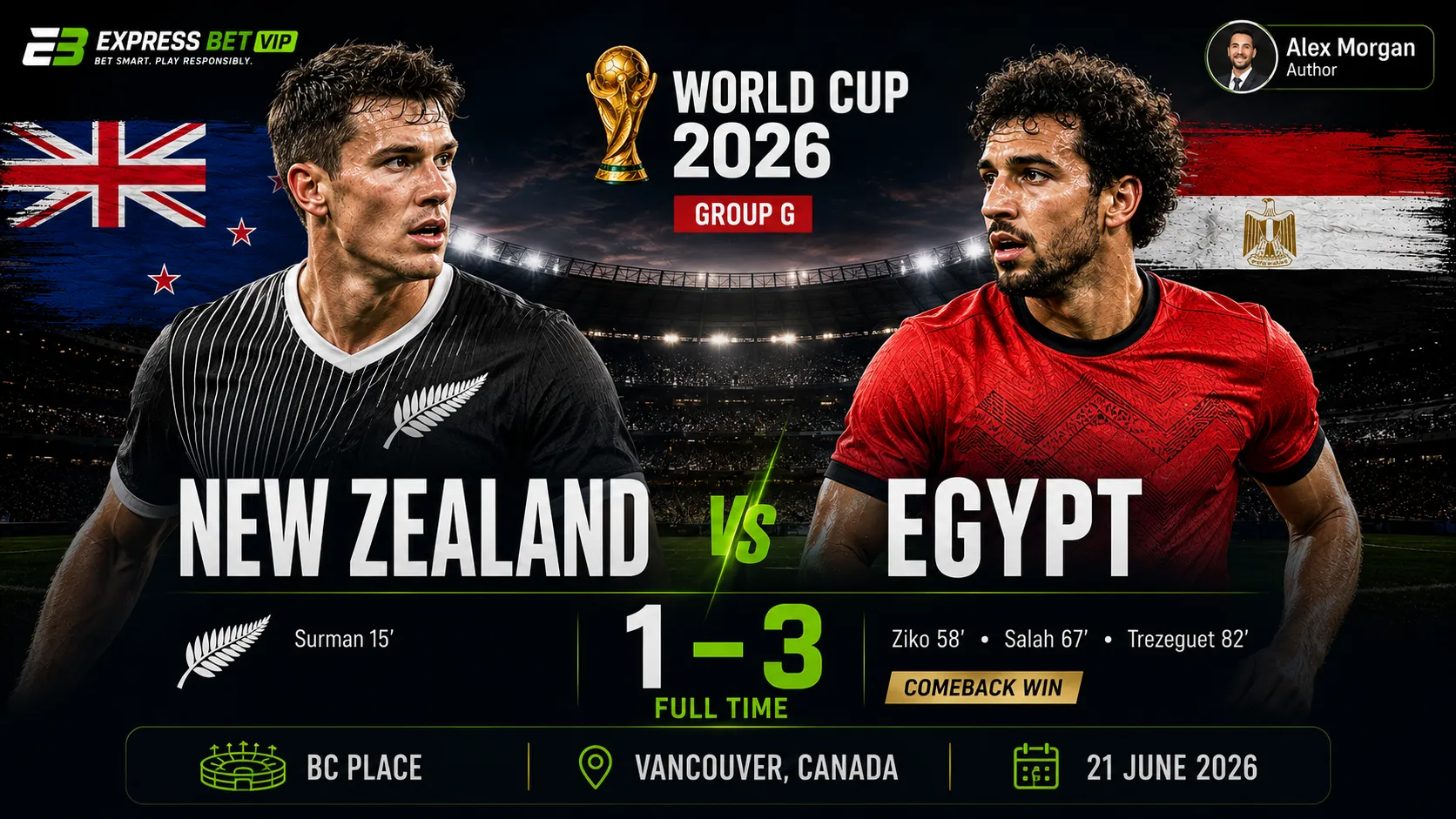
New Zealand vs Egypt finished 1-3 in FIFA World Cup 2026 Group G at BC Place in Vancouver. New Zealand led at half-time after Finn Surman headed in from a Tim Payne corner in the 15th minute. Egypt then changed the match after the break: Mostafa Ziko equalised, Mohamed Salah scored the decisive second goal, and Mahmoud Trezeguet sealed it from Salah’s corner. The main turning point was Egypt’s second-half move to sharper right-sided combinations and Salah’s more central influence. Salah was the best player, with a goal and two assists. Local conditions did not explain the result; BC Place’s closed-roof, controlled environment made the football clearer. For betting markets, Egypt win, over 2.5 goals and BTTS Yes landed, but value depended on odds and timing.
| Item | Detail | Data status |
|---|---|---|
| Match | New Zealand vs Egypt | [CONFIRMED] |
| Competition | FIFA World Cup 2026 | [CONFIRMED] |
| Stage | Group stage | [CONFIRMED] |
| Group | Group G | [CONFIRMED] |
| Date | 21 June 2026 local / 22 June 2026 UTC | [CONFIRMED] |
| Kickoff time | 18:00 PDT / 01:00 UTC | [CONFIRMED] |
| Host country | Canada | [CONFIRMED] |
| City | Vancouver | [CONFIRMED] |
| Stadium | BC Place | [CONFIRMED] |
| Attendance | not available from verified public data | [UNKNOWN] |
| Final score | New Zealand 1-3 Egypt | [CONFIRMED] |
| Half-time score | New Zealand 1-0 Egypt | [CONFIRMED] |
| Goal scorers | Finn Surman 15’; Mostafa Ziko 58’; Mohamed Salah 67’; Mahmoud Trezeguet 82’ | [CONFIRMED] |
| Referee | not available from verified public data | [UNKNOWN] |
| VAR | no major confirmed VAR-changing incident found | [UNKNOWN] |
| Weather | Vancouver June conditions; roof setting reduced direct weather impact | [REPORTED / ANALYSIS] |
| Pitch condition | Temporary natural-grass World Cup surface; match-specific wear not available from verified public data | [REPORTED / UNKNOWN] |
| Main tournament impact | Egypt moved to four points from two matches and took control of Group G | [CONFIRMED] |
Sofascore lists New Zealand 1-3 Egypt at BC Place, Vancouver, with the match starting at 01:00 UTC on 22 June 2026 and records the goal sequence as Surman 15’, Ziko 58’, Salah 67’ and Trezeguet 82’. (Sofascore) Reuters confirms the same core match narrative: Egypt came from behind in Vancouver and moved top of Group G on four points. (Reuters)
| Layer | What it covers | New Zealand vs Egypt example |
|---|---|---|
| [CONFIRMED] match facts | Score, venue, goals, cards, substitutions where available | New Zealand 1-3 Egypt; Surman, Ziko, Salah, Trezeguet scored |
| [REPORTED] details | Credible reporting not fully official in the available public data | Egypt’s first-ever World Cup win; Group G points situation |
| [OBSERVED] match details | Descriptions from live reports and match footage/reporting | Egypt’s second-half pressure, Salah moving inside, Ziko header |
| [ANALYSIS] tactical interpretation | Editorial explanation based on evidence | Egypt improved when Salah moved infield and Hany advanced wider |
| [MARKET SIGNAL] betting interpretation | After-the-fact market reading | Egypt win, over 2.5, BTTS Yes, Egypt second-half markets |
| [UNKNOWN] unavailable data | Details not confirmed publicly | Official attendance, referee, official xG, closing odds |
This distinction is not decoration. It is the difference between a match result page and a rumour cupboard. I compared the available match feeds, Reuters reporting, Guardian live notes and stadium sources. The score and scorers are firm. Official xG, referee, VAR crew and attendance were not available from verified public data at the time of writing.
New Zealand lost 3-1 to Egypt after leading 1-0 at half-time. That sentence does most of the work, but it does not quite capture the shape of the collapse.
The first half belonged to New Zealand’s direct plan. Darren Bazeley’s side used Chris Wood as a reference point, attacked second balls, and made Egypt defend corners and aerial pressure. Surman’s 15th-minute header came from exactly that script. Tim Payne delivered the corner, Surman lost Ahmed Fatouh and powered the header in. It was not elaborate. It did not need to be. World Cup group games often reward the team that remembers set pieces are not optional admin.
Egypt were sluggish before half-time, but the second half was a different match. Salah moved into more dangerous central lanes. Emam Ashour became a connector between midfield and attack. Mohamed Hany pushed higher on the right. Ziko stopped being an isolated name on a team sheet and became a problem. The Guardian’s live report described Egypt’s second-half pattern as quicker, crisper and more varied, with Salah moving inside and Hany acting almost like an auxiliary right winger. (The Guardian)
The comeback was deserved. Ziko equalised with a close-range header from Hany’s cross. Salah then played a one-two with Ziko and finished calmly across Max Crocombe. Trezeguet finished the job with a header from Salah’s corner. Reuters described it as a brilliant second-half display and noted that Egypt moved top of Group G with four points from two matches. (Reuters)
New Zealand did not merely concede three goals. They lost the second-half structure. That is more damaging. Goals can happen. A team being unable to exit its defensive third is a deeper issue.
New Zealand’s opener came from a corner delivered by Tim Payne. Surman attacked the delivery, lost his marker Ahmed Fatouh and directed a powerful header into the net. Reuters and The Guardian both frame the goal as the product of New Zealand’s direct first-half plan: long balls when needed, possession when available, and set-piece force when Egypt gave them the chance. (Reuters)
Tactically, it confirmed New Zealand’s route into the match. They were not going to out-combine Egypt through central midfield for 90 minutes. They were going to make the game physical, use Wood’s presence, attack corners and force Egypt’s back line to defend repeated aerial stress.
The emotional impact was large. Egypt entered the interval behind, and New Zealand had the match where they wanted it: low-scoring, structured, slightly awkward. Tournament football likes awkwardness. It keeps favourites awake.
Egypt’s equaliser came after the game had already tilted. Hany crossed from the right, Ziko arrived unmarked and headed past Crocombe from close range. Sofascore lists the goal at 58’, assisted by Mohamed Hany; The Guardian’s live blog labels the event at 59’, which appears to be live-blog timing rather than the official match-event minute. (Sofascore)
The build-up mattered more than the finish. Egypt had started the second half with more width, quicker circulation and better support around Salah. Hany’s role became important because he gave Egypt a reliable right-sided crossing outlet. New Zealand’s block, which had looked compact in the first half, began to lose distances.
Crocombe could possibly have done better, as The Guardian noted, but the bigger defensive problem was Ziko being able to attack the header without enough pressure. Once Egypt got the equaliser, New Zealand’s game management became the central test. They failed it.
Salah’s goal was the match’s decisive action. He found space between the lines, exchanged a one-two with Ziko and side-footed the ball calmly past Crocombe. Reuters described Salah breaking forward down the right, combining with Ziko and slotting into the far corner. The Guardian’s live report described it as a trademark calm finish after Egypt had taken control of the second half. (Reuters)
This goal was not just individual class. It was positional correction. Salah had been quieter when he stayed wider and Egypt’s movement was slower. Once he moved into inside-right and central pockets, New Zealand had to choose between stepping out and leaving space behind or staying deep and letting him face forward. Neither choice looked pleasant.
The goal also flipped the betting result. Egypt live backers were now in control. New Zealand +0.5 and draw-position bettors were suddenly staring at the usual World Cup cruelty: one good half does not pay unless the second half signs the receipt.
Trezeguet sealed the match in the 82nd minute. Salah’s deflected shot won the corner. Salah then took it, and Trezeguet headed in at the near post. The Guardian described him as unmarked, stooping to angle the header past Crocombe. Reuters also notes Salah’s assist from the resulting corner after nearly scoring himself. (The Guardian)
The defending was poor. New Zealand were chasing the game, but that does not excuse losing a near-post runner from a corner. Set pieces had given them the lead. Set pieces helped bury them. Football has a tidy sense of irony when it wants one.
The goal ended the contest. New Zealand still pushed late, but Egypt had the cushion and the emotional possession of the match.
| Minute | Moment | Why it mattered | Data status |
|---|---|---|---|
| 15’ | Surman scores from Payne corner | New Zealand’s direct and set-piece plan worked early | [CONFIRMED] |
| 47’ | Salah forces early second-half save | Immediate sign Egypt had changed tempo after half-time | [OBSERVED] |
| 53’ | Shobeir tips McCowatt header over | New Zealand nearly made it 2-0 before Egypt’s comeback | [OBSERVED] |
| 58’ | Ziko equalises | Egypt turned pressure into scoreboard control | [CONFIRMED] |
| 67’ | Salah scores | The match moved from Egyptian recovery to Egyptian command | [CONFIRMED] |
| 73’ | Hydration break / New Zealand reorganisation | Bazeley had to reset a team sinking under pressure | [OBSERVED] |
| 82’ | Trezeguet scores from Salah corner | Egypt killed the match | [CONFIRMED] |
| 90+5’ | Abdelmaguid head injury delay | Late medical concern; later substitution reported | [REPORTED] |
The overlooked moment is the McCowatt chance at 53’. Shobeir tipped the header over. At 2-0, New Zealand could have made Egypt chase through a narrower door. Instead, Egypt survived and equalised five minutes later. Tournament football is often decided by the five minutes before the obvious turning point.
| Local factor | Verified or observed detail | Football meaning | Direct match evidence | Betting-result meaning | Data status | Anti-template status |
|---|---|---|---|---|---|---|
| Stadium | BC Place, Vancouver | Closed/retractable-roof venue reduced direct wind/rain effect | Match played at BC Place | Weather props should not be overstated | [CONFIRMED] | Specific |
| Capacity | BC Place official site says capacity over 55,000 | Big indoor bowl can amplify late noise | Reuters reported Egyptian fans whistling and roaring late | Crowd angle relevant late, not predictive | [CONFIRMED / REPORTED] | Specific |
| Roof | Cable-supported retractable roof; World Cup roof reportedly closed | More controlled environment than open-air venues | No verified wind or rain disruption | Lower weather volatility | [CONFIRMED / REPORTED] | Specific |
| Pitch | Temporary natural-grass surface for World Cup over normal stadium setup | Natural grass changes ball roll and footing from artificial-turf norm | Match-specific surface issue not available | Do not invent pitch-driven betting edge | [REPORTED / UNKNOWN] | Specific |
| City | Vancouver, Canada | Mild June climate compared with hotter U.S./Mexico venues | No confirmed heat distress pattern | Heat-driven late unders/cards angle weak | [CONFIRMED / ANALYSIS] | Specific |
| Weather | June Vancouver average highs rise toward 69°F / 21°C | Moderate conditions for pressing and recovery | Hydration break occurred, but no verified heat crisis | Avoid overrating weather | [REPORTED / ANALYSIS] | Specific |
| Crowd | Egyptian support audible late | Late-game psychological reinforcement for Egypt | Reuters reported whistles in stoppage time and roar at full-time | Live-market pressure after 1-3 likely stabilized Egypt side | [REPORTED] | Specific |
BC Place is not a generic stadium line. It is downtown Vancouver, indoors by football standards when the roof is closed, and acoustically different from an open summer venue. The official BC Place site lists capacity over 55,000 and says the venue will host seven World Cup matches between June 13 and July 7. (bcplace.com) ETS describes BC Place as a 55,000-seat stadium transformed from an air-supported dome into a cable-supported retractable-roof venue. (ETS)
The pitch layer also matters, but only carefully. BC Place’s usual football identity is tied to artificial turf, while World Cup play required a natural-grass solution. Available match evidence does not confirm slips, abnormal bounce, surface tearing or goalkeeper handling problems. So the proper conclusion is narrow: the surface was part of the local context, not a proven cause of the result.
Vancouver weather also should not be forced into the story. WeatherSpark’s June climate data for Vancouver shows daily highs increasing from about 65°F to 69°F, with lows from 52°F to 56°F. That is not a heat-stress profile like Miami or Monterrey. (weatherspark.com)
The atmosphere became relevant late. Reuters reported Egyptian fans whistling loudly for the referee to end the game in stoppage time, followed by a major roar at full-time as Egypt made history. (Reuters) That is specific to this fixture. It is not reusable filler about “passionate fans.”
| Stadium | Capacity | Attendance | Pitch type | Roof status | Acoustic effect | Surface condition | Wind relevance | Goalkeeper distribution effect | Set-piece effect | Communication effect | Data status |
|---|---|---|---|---|---|---|---|---|---|---|---|
| BC Place | Over 55,000 | not available from verified public data | Temporary natural grass for World Cup | Retractable roof; closed-roof context reported for World Cup matches | Egyptian late noise reported | Match-specific wear not available | Reduced compared with open stadium | No verified distribution issue from wind | Three goals came from headers/corners/crosses, but not proven surface-related | No verified communication breakdown | Mixed |
The available match evidence does not show a clear stadium-specific effect beyond the normal venue conditions.
That does not mean the stadium was irrelevant. BC Place shaped the match environment: controlled roof, indoor acoustics, natural-grass World Cup conversion, and a large crowd bowl. But the actual football explanation still sits on tactical ground. New Zealand scored from a corner. Egypt answered by improving spacing, crossing quality and central occupation around Salah.
| City | Host country | Time zone | Climate for match month | Match-time temperature | Humidity | Wind | Rain/sun | Altitude | Likely physical effect | Actual match evidence | Data status |
|---|---|---|---|---|---|---|---|---|---|---|---|
| Vancouver | Canada | Pacific Time | Mild June coastal climate | Exact match-time figure not available from verified public data | not available from verified public data | not available from verified public data | Roof reduced direct weather relevance | Low altitude | Limited heat/altitude stress compared with hotter venues | Hydration break noted, but no verified weather-caused tactical collapse | [REPORTED / UNKNOWN] |
Vancouver did not turn this into a survival game. The city’s June profile is moderate. The match kicked off in the evening local time. The roof context reduced wind and rain as direct football factors. There is no verified evidence that heat, humidity or altitude caused New Zealand to fade.
The fatigue was football fatigue. New Zealand spent the second half failing to clear pressure. Egypt moved the ball quicker, found better lanes, and forced repeated defensive actions. That drains legs even in perfect weather.
Both teams started in 4-2-3-1 structures according to the Guardian’s lineup notes. New Zealand’s XI: Max Crocombe; Tim Payne, Michael Boxall, Finn Surman, Liberato Cacace; Joe Bell, Marko Stamenic; Eli Just, Sarpreet Singh, Callum McCowatt; Chris Wood. Egypt’s XI: Mostafa Shobeir; Mohamed Hany, Hamdi Fathy, Yasser Ibrahim, Ahmed Fatouh; Mohanad Lasheen, Marwan Attia; Mohamed Salah, Emam Ashour, Mostafa Ziko; Omar Marmoush. (The Guardian)
New Zealand’s plan was coherent. They did not try to win an aesthetic contest. They used Wood as a target, pushed runners around him, and asked Egypt to defend corners, aerial contact and second balls. Surman’s goal was the reward.
Egypt’s first half had too much horizontal passing and not enough penalty-box timing. Salah was not absent, but he was easier to track when he stayed wider and New Zealand’s midfield line could see him. Ashour was present without yet controlling the central rhythm.
The midfield battle was not about possession purity. It was about whether New Zealand could keep Egypt away from the high-value lanes. For 45 minutes, they did enough. At half-time, Bazeley had a lead and a clear task: protect the central zone, avoid cheap turnovers, do not let Salah receive facing goal. Football then did what football does. It asked whether the plan could survive contact with a better second-half opponent.
Egypt’s second half was the match. They came out faster, cleaner and more aggressive with their right-side combinations. Salah’s early second-half shot forced Crocombe into a save. Hany linked with Ziko. Ashour started to receive between lines. Marmoush’s left-sided movement stretched the defensive unit. New Zealand were no longer defending isolated attacks. They were defending waves. (The Guardian)
The Guardian’s live report made the tactical shift plain: Salah moved into a more central area; Hany linked well down the right; Egypt’s play became quicker and more varied. (The Guardian)
Ziko’s equaliser was not a random header. It was the visible result of Egypt moving New Zealand’s block sideways, then delivering before the defence was set. Salah’s goal then punished the space between New Zealand’s midfield and centre-backs. Trezeguet’s goal punished set-piece marking.
New Zealand’s response was poor. The Guardian described them as unable to clear their lines and repeatedly giving up turnover possession after Egypt took control. (The Guardian) That is not just pressure. That is pressure with no exit plan.
The late substitutions did not repair the match. By the time New Zealand chased, Egypt had the scoreboard and the emotional rhythm.
Egypt won because they turned a static 4-2-3-1 into a more fluid attacking shape after half-time. Salah drifted inside. Hany advanced on the right. Ashour connected the midfield to the front line. Ziko attacked the box rather than remaining peripheral. Trezeguet gave fresh penalty-box movement from the bench.
New Zealand lost because their first-half plan had no second-half stabiliser. The long ball to Wood and the corner threat worked early. But once Egypt controlled second balls and pinned New Zealand deeper, Bazeley’s side lacked the midfield composure to slow the match.
The shape problem was visible around minute 60. New Zealand’s two deeper midfielders were forced to protect too much space. Egypt’s attacking midfielders received between lines. When the full-backs stepped, gaps opened. When they stayed, Egypt crossed. That is the old defensive tax: pay wide or pay central.
Egypt’s set-piece work also mattered. New Zealand scored from a corner, but Egypt scored the third from one. Trezeguet’s near-post header was not lucky. It was the product of a substitute attacking a specific zone while New Zealand’s marking slept.
| Zone | Edge | Evidence from the match | Key player | Local condition effect | Result impact |
|---|---|---|---|---|---|
| New Zealand left / Egypt right | Egypt after half-time | Hany crossed for Ziko and linked with Salah/Ziko | Mohamed Hany | No verified surface effect | Egypt equaliser came from this side |
| New Zealand right / Egypt left | Mixed | Marmoush stretched play but Egypt’s decisive work leaned right/central | Omar Marmoush | none confirmed | Helped create width |
| Central midfield | Egypt second half | Ashour grew into the match and linked attacks | Emam Ashour | no weather evidence | Changed match rhythm |
| Penalty box | Egypt | Three second-half goals, two headers | Ziko, Salah, Trezeguet | no verified pitch issue | Decided result |
| Set pieces | Both, then Egypt | Surman scored from corner; Trezeguet scored from corner | Surman / Salah / Trezeguet | controlled roof reduced wind excuse | Massive result impact |
| Transitions | Egypt | New Zealand lost ability to exit after half-time | Salah, Ashour | no local factor confirmed | Put NZ under repeated stress |
| Defensive third | Egypt improved | Shobeir saved McCowatt header; Egypt defended late balls | Mostafa Shobeir | none confirmed | Protected lead |
| Goalkeeper build-up | New Zealand issue late | Crocombe’s long clearance out on full noted before equaliser | Max Crocombe | no wind evidence | Sign of pressure |
| Bench impact | Egypt | Trezeguet scored after entering | Mahmoud Trezeguet | none confirmed | Closed match |
These ratings are editorial, based on verified event data and match reports. They are not official FIFA ratings.
| Player / unit | Rating | Explanation |
|---|---|---|
| Max Crocombe | 5.5 | Made some interventions, but beaten three times and could have done better on Ziko’s header. Also showed pressure in distribution. |
| Tim Payne | 6.5 | Assisted Surman from the corner. Substituted late as New Zealand chased. |
| Michael Boxall | 5.5 | Battled physically but New Zealand’s second-half defensive line lost control. |
| Finn Surman | 7.0 | Scored the opener and gave New Zealand their best route into the match. Defensive organisation suffered later. |
| Liberato Cacace | 5.5 | Worked hard but New Zealand’s left side came under pressure when Egypt accelerated. |
| Joe Bell | 5.5 | Had moments of recovery defending, including a key intervention, but could not regain midfield control. |
| Marko Stamenic | 6.0 | Tried to carry and shoot late; forced involvement in stoppage-time pressure. |
| Eli Just | 6.0 | Important in New Zealand’s first-half running and early second-half chance creation. |
| Sarpreet Singh | 5.0 | Booked early and struggled to influence the second half. |
| Callum McCowatt | 6.0 | Had a dangerous header saved by Shobeir. Booked and later substituted. |
| Chris Wood | 5.5 | Useful target in the first half, but New Zealand could not keep feeding him once Egypt took control. |
| Substitutes | 5.5 | Could not materially reverse Egypt’s second-half command. |
| Player / unit | Rating | Explanation |
|---|---|---|
| Mostafa Shobeir | 7.0 | Key save from McCowatt at 1-0 kept Egypt alive before the comeback. |
| Mohamed Hany | 8.0 | Assisted Ziko and became a major right-sided outlet after half-time. |
| Yasser Ibrahim | 6.5 | Important late defending against New Zealand’s aerial attempts. |
| Hamdi Fathy | 5.5 | Substituted in the first half; full reason not confirmed from verified public data. |
| Ahmed Fatouh | 5.5 | Lost Surman for the opener, but Egypt recovered structurally. |
| Mohanad Lasheen | 6.0 | Booked early; helped Egypt survive the first-half direct game. |
| Marwan Attia | 6.5 | Supported Egypt’s second-half control and helped move the ball quicker. |
| Mohamed Salah | 9.0 | Goal, two assists, second-half positional intelligence. Best player. |
| Emam Ashour | 8.0 | Grew into the game and gave Egypt the missing link between midfield and attack. |
| Mostafa Ziko | 8.5 | Equalised and assisted Salah. Directly involved in the two goals that flipped the match. |
| Omar Marmoush | 6.5 | Stretched New Zealand and created lanes, even without scoring. |
| Mahmoud Trezeguet | 7.5 | Came off the bench and scored the third with a near-post header. |
| Egypt substitutes | 7.0 | Trezeguet’s impact made the bench a decisive factor. |
| Category | Pick | Reason |
|---|---|---|
| Man of the Match | Mohamed Salah | Goal, two assists, and the positional shift that changed Egypt’s attack. |
| Best attacker | Mostafa Ziko | Scored the equaliser and assisted Salah’s winner. |
| Best midfielder | Emam Ashour | Improved Egypt’s second-half rhythm between the lines. |
| Best defender | Finn Surman | Scored and defended strongly in the first half, despite the final result. |
| Best goalkeeper | Mostafa Shobeir | His save from McCowatt stopped New Zealand going 2-0 up. |
| Best substitute | Mahmoud Trezeguet | Scored the clinching third goal. |
| Most underrated performance | Mohamed Hany | His second-half width and cross changed the match. |
| Most disappointing performance | New Zealand midfield unit | Could not slow Egypt’s second-half pressure. |
| Player | Team | Incident | Minute | Card or injury status | Next-match impact | Data status |
|---|---|---|---|---|---|---|
| Mohanad Lasheen | Egypt | Foul | 17’ | Yellow card | Suspension impact not confirmed from verified public data | [CONFIRMED] |
| Sarpreet Singh | New Zealand | Foul | 20’ | Yellow card | Suspension impact not confirmed from verified public data | [CONFIRMED] |
| Callum McCowatt | New Zealand | Foul | 34’ | Yellow card | Suspension impact not confirmed from verified public data | [CONFIRMED] |
| Hossam Abdelmaguid | Egypt | Head injury concern | 90+5’ | Treated; replaced late | Further medical status not available from verified public data | [REPORTED] |
Sofascore records the three yellow cards: Lasheen, Singh and McCowatt. Reuters reported that Hossam Abdelmaguid had to be replaced late with a suspected concussion and visible swelling near the eye. (Sofascore)
No red card was confirmed. No suspension triggered by accumulation was confirmed from verified public data.
The referee name and full VAR crew were not available from verified public data checked for this article.
There was no confirmed match-changing VAR incident comparable to a penalty reversal, red-card upgrade or disallowed goal in the available public reports. The disciplinary pattern was moderate: three yellow cards and no red cards.
The match did not appear to hinge on officiating. New Zealand lost because they could not handle Egypt’s second-half pressure. Egypt won because they adjusted better, moved Salah into stronger areas and finished the chances that mattered.
| Statistic | New Zealand | Egypt | Data status |
|---|---|---|---|
| Final score | 1 | 3 | [CONFIRMED] |
| Half-time score | 1 | 0 | [CONFIRMED] |
| Goals | Surman 15’ | Ziko 58’, Salah 67’, Trezeguet 82’ | [CONFIRMED] |
| Yellow cards | Singh, McCowatt | Lasheen | [CONFIRMED] |
| Red cards | 0 | 0 | [CONFIRMED] |
| xG | not available from verified public data | not available from verified public data | [UNKNOWN] |
| Possession | not available from verified public data | not available from verified public data | [UNKNOWN] |
| Shots | not available from verified public data | not available from verified public data | [UNKNOWN] |
| Shots on target | not available from verified public data | not available from verified public data | [UNKNOWN] |
| Corners | Egypt’s third came from a corner; full count unavailable | Egypt’s third came from a corner; full count unavailable | [PARTIAL] |
The statistics that matter most here are event statistics: four goals, three second-half Egyptian goals, two Salah assists, one Salah goal, and one New Zealand lead lost.
Full official match statistics, including xG, possession, shots, corners and pass accuracy, were not available from verified public data checked at publication time. If later added by FIFA, Opta, Stats Perform, FotMob or FBref, this section should be updated rather than guessed.
This is post-match betting analysis, not advice.
| Market | Pre-match expectation | Actual result | Winning side of market | Key match trigger | Local factor | Caution note |
|---|---|---|---|---|---|---|
| Match winner | Egypt likely carried star-player and ranking appeal, but both sought first win | Egypt won 3-1 | Egypt | Second-half tactical shift | Venue not decisive | Odds timing matters |
| Draw | Live draw looked plausible at half-time | No draw | Draw lost | Ziko equaliser became platform, not endpoint | none clear | Half-time draw does not equal full-time draw |
| Over/under 2.5 | Needed three goals | Four goals | Over 2.5 | Egypt scored three after half-time | Roof/weather not causal | Do not assume repeatability |
| Both teams to score | Needed both sides | Yes | BTTS Yes | Surman opener, Egypt comeback | none clear | BTTS landed before game opened completely |
| Correct score | 1-3 | 1-3 | Correct-score 1-3 | Trezeguet late third | none clear | High-variance market |
| Anytime scorer | Salah, Ziko, Surman, Trezeguet | All scored | Depends on selection | Salah central role after half-time | none clear | Player markets depend on minutes and role |
| Cards | Three yellows | Moderate cards | Over/under depended on line | First-half fouls | no crowd/weather proof | Do not overread discipline |
| Live betting | Egypt trailed at HT | Egypt comeback | Egypt live / over live | 47’-67’ pressure surge | closed roof made weather less relevant | Live markets move faster than analysis |
This result rewarded bettors who backed Egypt or waited for Egypt’s second-half pressure to become visible. It also rewarded over 2.5 goals and both teams to score. But the match was not “obvious.” At half-time, New Zealand had the lead and a functioning plan. The second half changed the price of everything.
The biggest betting lesson: do not price a lead without reading the territory. New Zealand led 1-0, but after half-time they could not clear pressure. Egypt’s live profile improved before the equaliser. That is the signal, not the shirt badge.
| Local factor | Market possibly affected | Actual match evidence | Possible betting interpretation | Risk of overreaction | Safer conclusion |
|---|---|---|---|---|---|
| Closed-roof BC Place | Totals, corners, passing rhythm | No rain/wind disruption confirmed | Cleaner technical conditions may support passing | Overstating roof as goal cause | Egypt’s tactics mattered more |
| Natural-grass conversion | Passing, slips, ball speed | No match-specific pitch issue confirmed | Avoid pitch excuses | Inventing surface angle | Mark as unknown |
| Mild Vancouver climate | Second-half tempo | No heat collapse verified | Weather not a strong under/over driver | Treating all North American venues alike | Local weather impact limited |
| Egyptian crowd late | Live match-winner, game state | Reuters reported loud whistles and full-time roar | Helped emotional close-out | Turning crowd into prediction | Relevant after Egypt led |
| Hydration break | Tempo, second-half markets | Guardian noted a hydration break around 73’ | Brief reset for NZ | Calling it heat-driven without data | Tactical reset, not proven weather story |
The local betting conclusion is conservative. Venue and weather did not create the 1-3. Egypt’s improved structure did. Bettors should not turn Vancouver into a universal betting angle.
Egypt moved top of Group G with four points from two matches after drawing 1-1 with Belgium and beating New Zealand 3-1. New Zealand stayed bottom with one point after drawing 2-2 with Iran and losing here. Reuters and The Guardian both reported Egypt’s move to four points and the Group G implications. (Reuters)
The next round of pressure was clear. Egypt had Iran next in Seattle. New Zealand had Belgium in Vancouver. Belgium and Iran were both on two points after their 0-0 draw, meaning Group G remained open rather than solved. (The Guardian)
For Egypt, the win did more than add three points. It changed the emotional status of the tournament. A team that had never won a World Cup match suddenly controlled its group. That is not a minor psychological detail.
For New Zealand, the loss was brutal because they had led again. The Guardian noted that New Zealand had thrown away a lead for the third time in the tournament. (The Guardian) That pattern is not just bad luck. It is a late-game management issue.
New Zealand’s first-half plan was strong. They played directly when needed. They used Wood’s presence. They attacked set pieces. Surman’s goal was not an accident; it was the natural product of their best route to goal.
They also created a major chance early in the second half. McCowatt’s header could have made it 2-0, and Shobeir had to intervene. At that point, New Zealand were still in position to win the match.
But doing something right for 53 minutes is not the same as controlling a World Cup game. New Zealand needed a second layer: controlled possession after regains, better spacing around Wood, and smarter management once Egypt changed tempo.
Egypt’s half-time response was excellent. Hossam Hassan did not just ask for more effort. Egypt changed the functional shape of the attack.
Salah moved into more influential lanes. Ashour became a better connector. Hany pushed higher. Ziko attacked the box. Trezeguet came on and scored. Those are not motivational-poster details. They are football details.
Egypt also showed maturity after taking the lead. They did not stop at 2-1. Their 77th-minute substitutions suggested they were still looking for control and threat. Trezeguet’s third rewarded that aggression.
New Zealand’s biggest failure was second-half exit play. Once Egypt pushed them back, they could not turn defensive actions into possession. Clearances became invitations. Long balls became turnovers. Midfield spacing collapsed.
The second problem was box defending. Ziko was too free for the equaliser. Trezeguet was too free for the third. Two headed goals against a side that had built its own lead from a corner is a bitter symmetry.
The third problem was emotional management. After Salah’s goal, New Zealand chased without clarity. They were not passive. They were worse: active without control.
Darren Bazeley got the first half right. His team had a clear plan and executed it. The problem came after Egypt adjusted. New Zealand needed either an extra midfielder link, a calmer outlet, or earlier changes to stop the pressure wave. The substitutions came, but not before Egypt had reversed the match.
Hossam Hassan won the coaching duel after half-time. Egypt’s second-half improvement was too coordinated to dismiss as emotion. The team’s spacing changed. Salah’s role changed. Hany became more aggressive. Ashour influenced possession higher up the pitch.
Hassan’s reported half-time message focused on determination and drawing confidence from support. That message mattered, but it worked because the football structure improved too. Passion without structure is just running in circles. Egypt avoided that.
Egypt’s 3-1 win was reported as their first-ever FIFA World Cup victory. Reuters described it as Egypt’s first World Cup win, achieved at the ninth attempt. (Reuters)
Salah’s performance also becomes part of Egypt’s tournament history: one goal, two assists, and the decisive role in the nation’s first World Cup win.
No other major player milestone was confirmed from verified public data at the time of writing.
This match fits a familiar World Cup pattern: the underdog scores first, the more technical side looks irritated, then the second half reveals whether the lead had structure or just momentum.
New Zealand’s first half was not fake. It had logic. But Egypt’s second half had higher quality in the decisive zones. This was not a simple “big player saves team” match either. Salah was essential, but Ziko, Hany, Ashour and Trezeguet gave Egypt the framework that allowed Salah to matter.
The better analogy is not a miracle comeback. It is a tactical correction. Egypt solved the game. New Zealand could not solve the solution.
No major VAR controversy, penalty dispute, red-card incident, pitch invasion or crowd disorder was confirmed from verified public data.
There was a late medical concern involving Hossam Abdelmaguid. Reuters reported a suspected concussion and visible swelling before he was replaced. (Reuters)
There was also an odd equipment-related delay involving Ben Old’s shorts, noted by The Guardian live blog. It did not decide the match. It did remind everyone that even at a World Cup, football can still produce administrative comedy at the worst possible time. (The Guardian)
This article adds:
The useful point is not that Egypt “wanted it more.” That is pub analysis. The useful point is that Egypt changed the right side of their attack, moved Salah into better spaces and made New Zealand defend repeated high-pressure sequences.
| Detail type | Included | Status | Specific to this fixture | Needs later update |
|---|---|---|---|---|
| Stadium detail | Yes | Confirmed | Yes: BC Place, Vancouver, closed-roof/retractable-roof context | Official attendance |
| City detail | Yes | Confirmed | Yes: Vancouver evening kickoff | Exact match-time weather |
| Weather detail | Yes | Reported / analysis | Yes: Vancouver June climate, not generic heat language | Official hourly weather |
| Pitch detail | Yes | Reported / unknown | Yes: BC Place World Cup natural grass conversion | Match-specific surface report |
| Crowd detail | Yes | Reported | Yes: Egyptian stoppage-time whistles and full-time roar | Attendance / fan split |
| Travel/acclimatization detail | Limited | Unknown | Not forced | Team travel confirmation |
| Betting-risk detail | Yes | Analysis-based | Yes: 1-3 comeback, over/BTTS/Egypt win | Verified odds |
| Tactical-local connection | Yes | Analysis-based | Yes: local conditions did not explain the result | More official data |
| Anti-template status | Passed | Mixed | Fixture-specific | Update missing data only |
| Data point | Status | Source type used |
|---|---|---|
| Final score | Confirmed | Sofascore, Reuters, Guardian |
| Goal scorers | Confirmed | Sofascore, FIFA search result, Guardian, Reuters |
| Goal times | Confirmed with minor provider variation on Ziko minute | Sofascore, Guardian |
| Stadium | Confirmed | Sofascore, BC Place |
| City | Confirmed | Sofascore, Reuters |
| Attendance | Unknown | Not available from verified public data |
| Referee | Unknown | Not available from verified public data |
| VAR | Unknown / no major confirmed incident | Public match reports checked |
| Lineups | Reported | Guardian live report |
| Substitutions | Partial confirmed | Sofascore, Guardian |
| Cards | Confirmed | Sofascore |
| Injuries | Reported | Reuters |
| Match statistics | Partial | Sofascore event data, public reports |
| xG | Unknown | Not available from verified public data |
| Odds | Unknown | Not available from verified public data |
| Local stadium factors | Confirmed / reported | BC Place official site, ETS, local venue reports |
| Local city factors | Confirmed / reported | BC Place / Vancouver sources |
| Weather | Reported climate context | WeatherSpark |
| Pitch condition | Partial | Public venue/tournament reports; match-specific condition unknown |
| Crowd profile | Partial | Reuters |
| Tournament impact | Confirmed | Reuters, Guardian |
Recommended schema types:
For SportsEvent, include when available:
Structured data must match the visible page content. Do not add schema facts that are not visible in the article.
Update this article if:
Last updated: 10 July 2026
Egypt beat New Zealand 3-1 because they solved the match after half-time. New Zealand had the better first-half plan: direct play, set-piece pressure, Surman’s header. Egypt had the better full-match answer: Salah inside, Hany higher, Ashour between lines, Ziko attacking the box, Trezeguet finishing the job.
The scoreline was fair. New Zealand earned their lead. Egypt earned the comeback more.
The local conditions at BC Place did not decide the result. The closed-roof Vancouver setting reduced weather noise rather than creating it. No verified data shows wind, rain, heat or pitch wear changing the match. The decisive local element was atmosphere late, when Egyptian support helped carry the final minutes after the football had already swung Egypt’s way.
For bettors, the lesson is plain: a half-time lead is not a match state unless the team can still exit pressure. New Zealand could not. Egypt could. Salah made the difference, but the comeback was not only Salah. It was structure plus quality. That combination tends to survive longer than vibes.
Football betting carries financial risk. A correct match analysis does not guarantee a winning bet. Odds change before and during matches, especially after goals, injuries, substitutions and tactical momentum swings.
Local conditions can be overvalued by bettors. In this match, BC Place and Vancouver formed the setting, but Egypt’s tactical correction decided the result. Never chase losses. Do not bet money needed for daily life. Use limits, take breaks, check local betting laws and use licensed operators only. Betting should remain entertainment, not income.
New Zealand vs Egypt finished 1-3 in FIFA World Cup 2026 Group G.
Finn Surman scored for New Zealand. Mostafa Ziko, Mohamed Salah and Mahmoud Trezeguet scored for Egypt.
Mohamed Salah was the best player. He scored Egypt’s second goal and assisted the goals for Mostafa Ziko and Mahmoud Trezeguet.
Egypt moved to four points from two matches and took control of Group G. New Zealand stayed bottom with one point.
Egypt win, over 2.5 goals and both teams to score Yes were the settled outcomes. Betting results depended on pre-match odds, live timing and Egypt’s second-half comeback.