
Norway vs France Match Result
Table of Contents Show
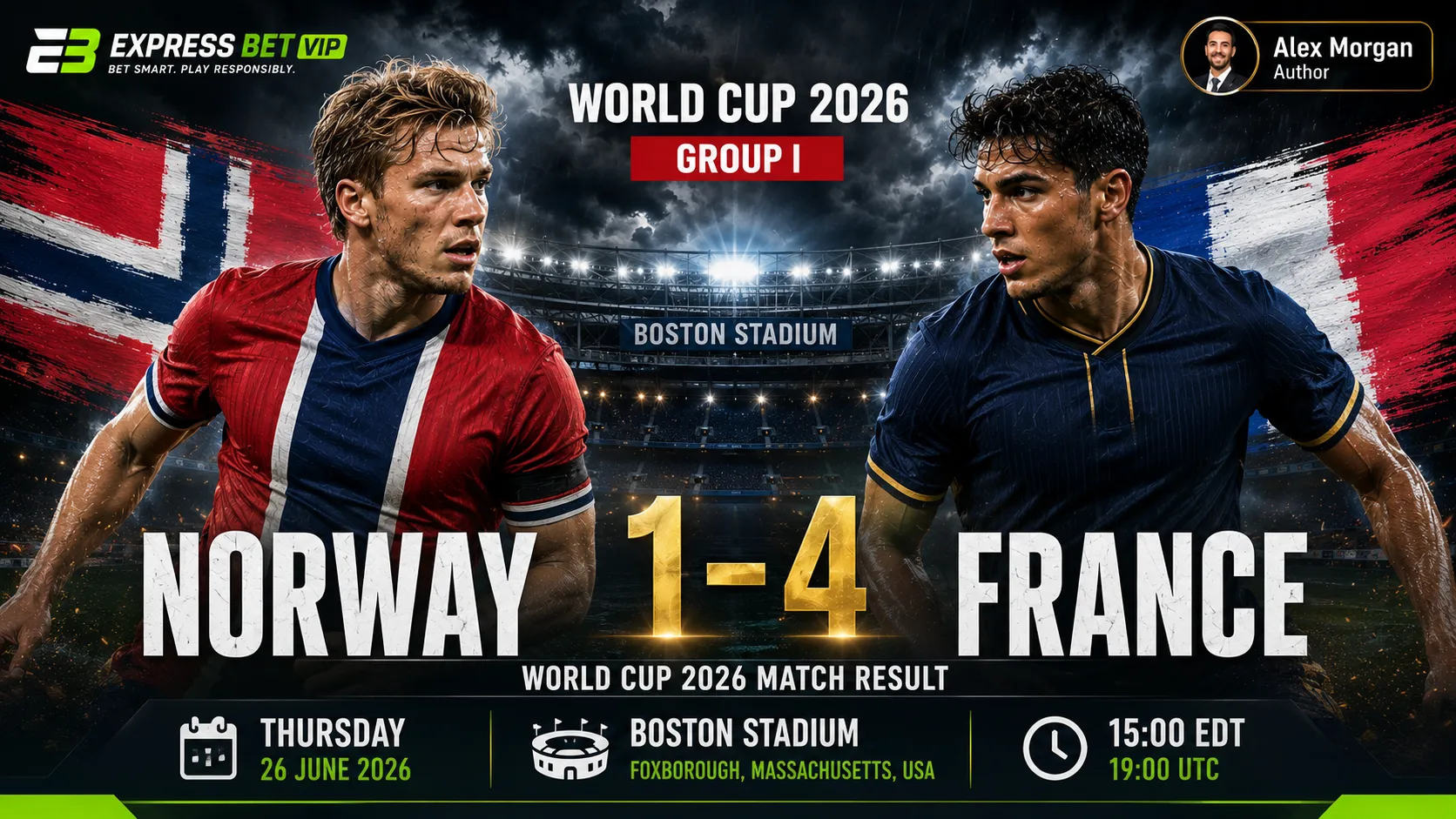
France defeated Norway 4-1 at Boston Stadium and completed the Group I stage with three wins. Ousmane Dembélé scored a first-half hat-trick in the seventh, 20th and 32nd minutes. Thelo Aasgaard briefly reduced Norway’s deficit, and Désiré Doué added a stoppage-time header. Mike Maignan’s save from Jørgen Strand Larsen’s 50th-minute penalty prevented Norway from turning the second half into a contest. Dembélé was the clear Man of the Match, while Kylian Mbappé supplied two assists. France won because its wide attackers punished repeated Norwegian turnovers before the rotated defensive unit could recover. The temporary natural-grass surface and 24°C conditions produced no confirmed distortion. France’s moneyline and the over 2.5-goal market won, but returns depended on the sportsbook, odds and entry time. France won Group I; Norway advanced in second place. (Reuters)
| Item | Verified detail |
|---|---|
| Match | Norway vs France |
| Competition | FIFA World Cup 2026 |
| Stage | Group stage, Matchday 3 |
| Group | Group I |
| Date | June 26, 2026 |
| Kickoff | 15:00 EDT / 19:00 UTC |
| Host country | United States |
| City | Foxborough, Massachusetts |
| Stadium | Boston Stadium |
| Regular stadium name | Gillette Stadium |
| Attendance | 64,146 |
| Final score | Norway 1-4 France |
| Half-time score | Norway 1-3 France |
| Norway scorer | Thelo Aasgaard 21’ |
| France scorers | Ousmane Dembélé 7’, 20’, 32’; Désiré Doué 90+4’ |
| Assists | Mbappé twice, Schjelderup, Tchouaméni, Barcola |
| Missed penalty | Jørgen Strand Larsen 50’ |
| Referee | Michael Oliver |
| VAR | Not available from verified public data |
| Temperature | 24°C in FotMob’s match record |
| Surface | Temporary natural grass |
| Roof | Open-air stadium |
| Main tournament impact | France won Group I; Norway finished second |
(FIFA)
| Category | Information |
|---|---|
| [CONFIRMED] | France won 4-1 after leading 3-1 at half-time. |
| [CONFIRMED] | Dembélé scored three goals inside 32 minutes. |
| [CONFIRMED] | Aasgaard scored Norway’s goal; Doué scored France’s fourth. |
| [CONFIRMED] | Maignan saved Strand Larsen’s penalty. |
| [CONFIRMED] | Norway changed ten starters and left Haaland and Ødegaard unused. |
| [REPORTED] | Previous humidity-related cramping influenced Norway’s rotation. |
| [OBSERVED] | France repeatedly attacked the spaces around Norway’s full-backs after turnovers. |
| [ANALYSIS] | Norway’s unfamiliar defensive relationships were more damaging than its basic 4-3-3 formation. |
| [MARKET SIGNAL] | France were priced between approximately -160 and -175 in published snapshots. |
| [UNKNOWN] | Exact humidity, wind, complete VAR crew, PPDA and distance covered. |
This separation matters because the final score, scorers and cards belong in an event record. Claims about transition defence, recovery distances or rotation-related coordination are analytical conclusions. AI-generated summaries often flatten those categories, which is how a sensible tactical interpretation gradually mutates into a fictional official statistic. (Reuters)
Provider differences also require context. FotMob’s Opta model gave Norway 1.70 xG and France 1.50, despite France winning by three goals. Norway’s missed penalty materially increased its xG, while France converted several lower-probability attempts with exceptional precision. Expected goals describe chance quality, not the obligation of the scoreboard to behave politely. (FotMob)
Both teams had qualified before kickoff, but first place still mattered. France wanted the more favourable travel arrangement attached to winning Group I. Norway wanted first place too, although Ståle Solbakken treated the Round of 32 as the greater priority and changed ten players from the side that had beaten Senegal. Haaland, Ødegaard, Sander Berge and several other first-choice players remained on the bench. (Reuters)
France did not interpret Norway’s rotation as an invitation to spend ten minutes studying the arrangement. Mbappé hit the crossbar after roughly 20 seconds. The warning was not subtle. Six minutes later, he switched play toward Dembélé, who manipulated the defender, created the shooting angle and drove France ahead. (Reuters)
Norway’s problem was not merely that Dembélé was quick. The back four lacked shared timing. Fredrik Aursnes was operating at right-back, Henrik Falchener and Leo Østigård formed the central pairing, and Fredrik Bjørkan started on the left. Whenever France changed the direction of attack, Norway’s midfield pressure and defensive line moved at different speeds.
Dembélé’s second goal arrived in the 20th minute, again after Mbappé found him. This time the winger created a yard and sent a dipping left-footed shot toward the same general corner. Norway’s defenders knew the preferred route by then. Knowing and preventing remain separate professions. (Reuters)
Norway responded immediately. Andreas Schjelderup found Thelo Aasgaard near the edge of the area, and the midfielder produced an intelligent finish to make it 2-1. The goal demonstrated why Solbakken later defended his reserve selection: Norway could still create against France, even while struggling to survive France’s attacks. (FotMob)
The response lasted 11 minutes. Aurélien Tchouaméni released Dembélé, who completed his hat-trick with another low finish into the bottom corner. By the 32nd minute, France had scored three times from a sequence of attacks that exposed the same central issue: Norway lost possession in areas where its replacement defenders had no settled protection. (FotMob)
France led 3-1 at half-time, but the score did not fully reflect Norway’s attacking contribution. Solbakken said his side had created several strong chances. Sky’s data later showed Norway finishing with ten shots, four on target and three missed big chances. The rotated side was not passive. It was simply punished with much greater efficiency. (Reuters)
Norway’s best opportunity arrived five minutes after the restart. Theo Hernández tripped Oscar Bobb inside the penalty area, and Michael Oliver awarded the penalty. Strand Larsen used a stuttering approach but sent a soft effort within Maignan’s reach. The goalkeeper saved comfortably. (Sky Sports)
A successful penalty would have made the score 3-2 with 40 minutes remaining. France had shown some defensive vulnerability, and Norway’s substitutes had added energy. Instead, the save removed the possibility of a genuine comeback and allowed France to control the remaining game without forcing every attack.
Oscar Bobb later went through and forced another save from Maignan. The Norwegian winger produced one of the match’s strongest losing performances, but France’s goalkeeper ensured the scoreboard continued to exaggerate the difference in chance conversion. (Reuters)
France made controlled substitutions after the hour. Bradley Barcola replaced Dembélé, Rayan Cherki replaced Michael Olise, and Ibrahima Konaté entered for Dayot Upamecano. Mbappé and Jules Koundé were withdrawn late. The changes reduced the first-half intensity without surrendering territorial control. (FotMob)
The fourth goal came in the 94th minute. Barcola delivered from the flank, and Doué headed past Egil Selvik. It added gloss, but the match had been decided much earlier. Tournament football frequently waits until the final kick before correcting the scoreline toward the dominant narrative. It occasionally does so with unnecessary enthusiasm. (Reuters)
France deserved the victory. Its passing was cleaner, its transition attacks were faster and its finishing was vastly superior. The 4-1 margin was harsher than the underlying chance models suggested, but Norway could not concede three first-half goals and then submit an xG appeal to the tournament table.
Mbappé received on the opposite side and played a long diagonal toward Dembélé. The winger controlled, shifted inside and outside the defender and opened an angled shooting lane. He drove the ball beyond Selvik. (Reuters)
Assist: Kylian Mbappé
Goal type: Wide isolation followed by an angled finish
Shot type: Powerful open-play strike
VAR: No decisive intervention reported
Defensive issue: Norway failed to provide effective cover behind the isolated full-back
Goalkeeper position: Selvik protected the central goal but could not close the angle quickly enough
Tactical meaning: France established that switches toward Dembélé would be the primary route
Emotional impact: Norway’s rotated defence lost its planned settling period
The goal began with the quality of Mbappé’s switch but depended on the structural isolation of Dembélé. Norway’s winger and nearest midfielder did not recover in time, leaving the defender to manage an elite dribbler without support.
Mbappé again supplied Dembélé, this time closer to the edge of the penalty area. The forward created a small pocket and struck a dipping left-footed shot toward the bottom corner. (Reuters)
Assist: Kylian Mbappé
Goal type: Open-play shot after positional isolation
Shot type: Dipping left-footed strike
VAR: No decisive intervention reported
Defensive issue: Norway allowed Dembélé to receive facing goal and shift onto his left foot
Match impact: France moved two goals ahead before Norway had created sustained possession
The second goal demonstrated Dembélé’s two-footed threat. The first move did not provide a permanent answer for the next one. Defenders could not simply close one direction and consider the problem solved.
Schjelderup found Aasgaard near the edge of the box. Aasgaard shaped his body and guided the ball beyond Maignan with a controlled finish. (FotMob)
Assist: Andreas Schjelderup
Goal type: Open-play combination
Shot type: Placed finish from the edge of the area
VAR: No decisive intervention reported
Defensive issue: France allowed Aasgaard to receive between the midfield screen and central defenders
Tactical meaning: Norway showed that France’s attacking commitment could leave space behind Tchouaméni and Koné
Emotional impact: The deficit fell to one only 79 seconds after Dembélé’s second goal
This was Norway’s best constructed open-play move. Schjelderup attracted pressure, and Aasgaard arrived in the space behind France’s double pivot.
Tchouaméni played forward toward Dembélé, who again found room around the edge of Norway’s defensive block. He curled a low shot into the bottom corner and completed the hat-trick. (FotMob)
Assist: Aurélien Tchouaméni
Goal type: Central progression into a wide-forward shooting position
Shot type: Low curling finish
VAR: No decisive intervention reported
Defensive issue: Norway’s midfield line failed to close the passing lane before the back four retreated
Match impact: France restored the two-goal lead and removed the momentum created by Aasgaard
Dembélé scored three times in 25 minutes. Reuters identified it as the second-earliest completed World Cup hat-trick, behind Erich Probst’s treble for Austria in 1954. (Reuters)
Barcola advanced along the flank and delivered toward Doué, who attacked the aerial ball and headed beyond Selvik. (FotMob)
Assist: Bradley Barcola
Goal type: Open-play cross and header
VAR: No decisive intervention reported
Defensive issue: Norway’s tired defensive line failed to control the far-side runner
Match impact: France completed the 4-1 scoreline with virtually the final action
The substitute assist underlined France’s depth. Removing Dembélé and Mbappé did not leave the attack without high-level one-on-one quality.
France’s first attack ended against the woodwork. The chance showed immediately that Norway’s defensive spacing was unstable and that France intended to attack rather than manage the point required to finish first. (Reuters)
Berg was booked in the 10th minute. The caution reduced his freedom to stop French transitions with tactical fouls and placed additional pressure on Norway’s centre-backs whenever Mbappé or Doué moved inside. (FotMob)
Norway’s goal arrived 79 seconds after Dembélé made it 2-0. It prevented France from converting the opening 20 minutes into a passive exhibition and exposed space behind the French midfield. (Sky Sports)
The third French goal arrived before Norway could build on Aasgaard’s response. It was psychologically decisive because it turned a possible comeback phase into another defensive recovery exercise.
The 50th-minute penalty was Norway’s clearest route back into the match. Maignan read the stuttering run-up, remained balanced and saved the weak attempt. At 3-2, the remaining 40 minutes would have carried genuine tension. At 3-1, France could manage the match. (Sky Sports)
Bobb later reached a one-on-one situation, but Maignan saved again. The goalkeeper’s second-half work prevented Norway’s 1.70 provider xG from becoming a misleadingly close scoreline. (Reuters)
Barcola’s assist for Doué showed that France could reduce the workloads of Dembélé and Mbappé without losing threat from the bench. That depth became relevant throughout France’s subsequent knockout run. (FotMob)
| Local factor | Verified or observed detail | Football meaning | Direct match evidence | Betting-result meaning | Data status | Anti-template status |
|---|---|---|---|---|---|---|
| Stadium | Boston Stadium in Foxborough | Open-air NFL venue converted for football | Full 64,146 attendance | High-attendance setting, but no automatic home edge | [CONFIRMED] | Fixture-specific |
| Location | Foxborough, outside central Boston | Additional regional transport planning | Local reports noted road closures and extended matchday operations | No clear result effect | [CONFIRMED] | Fixture-specific |
| Surface | Temporary natural grass replacing artificial turf | More conventional football surface | No decisive slip or abnormal bounce reported | No verified pitch-based edge | [CONFIRMED/OBSERVED] | Fixture-specific |
| Temperature | 24°C in FotMob’s match record | Moderate summer workload | High tempo from kickoff; no heat collapse | Did not suppress goals | [REPORTED] | Fixture-specific |
| Humidity | Exact match reading unavailable | Cannot quantify fatigue directly | Norway’s rotation related to prior-match humidity, not verified Boston humidity | Rotation affected lineup markets | [UNKNOWN/REPORTED CONTEXT] | Fixture-specific |
| Roof | Open-air | Full environmental exposure | No weather delay reported | Outdoor forecasts remained relevant | [CONFIRMED] | Fixture-specific |
| Attendance | 64,146 sellout | Strong acoustic background | No verified fan split | Crowd size alone did not predict result | [CONFIRMED] | Fixture-specific |
| Norway rotation | Ten starters changed | Reduced defensive familiarity | Three first-half goals conceded | Major lineup and live-market factor | [CONFIRMED] | Fixture-specific |
| Travel strategy | France wanted first place partly for lighter travel | Increased incentive despite prior qualification | France selected a strong team and attacked immediately | Motivation affected pre-match assumptions | [REPORTED] | Fixture-specific |
(Sky Sports)
The venue’s natural grass was installed specifically for the World Cup after years of artificial-turf use. The conversion involved replacing the normal surface with a carefully maintained grass system. No reviewed match report identified a damaged area, unexpected bounce or decisive slip. The pitch therefore belongs in the match context, not in the explanation for Norway’s defensive failures. (Boston.com)
FotMob listed 24°C. Exact humidity and wind readings were not available from the verified match data. The first half remained extremely fast, which argues against a simple weather-driven reduction in tempo. France scored three times before the 33rd minute, and Norway still generated useful second-half attacks. (FotMob)
The more important environmental story came from Norway’s previous match. Solbakken said several first-choice players had experienced cramping in New Jersey’s humidity. That contributed to his decision to rest ten starters before the Round of 32 in Dallas. Local conditions from one venue therefore shaped the lineup at another—an unusually clear example of the World Cup’s continental scale affecting selection. (Reuters)
France approached the travel problem differently. Finishing first reduced the burden of the next stage’s North American routing, so Guy Stéphan fielded a strong side and pursued the group win. The result was not caused by geography, but geography influenced why one team rotated heavily and the other did not. (Reuters)
The sellout crowd did not produce a verified one-sided home atmosphere. Norwegian supporters were visibly present, and Solbakken acknowledged that fans wanted to see Haaland and Ødegaard. The rotation created disappointment, but no verified evidence shows crowd pressure causing a defensive mistake or refereeing decision. (Reuters)
| Stadium factor | Match detail |
|---|---|
| Stadium | Boston Stadium |
| Regular name | Gillette Stadium |
| Location | Foxborough, Massachusetts |
| FIFA capacity | 64,146 |
| Attendance | 64,146 |
| Pitch type | Temporary natural grass |
| Regular surface | Artificial turf outside the World Cup |
| Roof status | Open-air |
| Acoustic effect | Sellout crowd; supporter split not verified |
| Surface condition | No decisive defect reported |
| Wind relevance | Not available from verified public data |
| Goalkeeper distribution | No clear venue-related problem |
| Set-piece effect | Norway won a penalty; no set-piece goal |
| Communication effect | No specific error conclusively linked to crowd noise |
| Data status | Capacity, attendance and surface confirmed; airflow data unavailable |
(FotMob)
Boston Stadium influenced this fixture mainly through its temporary surface and full attendance. The grass behaved consistently enough for France to circulate at 86.5% pass accuracy and for both teams to combine for 28 shots. (Sky Sports)
The available match evidence does not show a clear stadium-specific effect beyond the normal open-air conditions. Dembélé’s goals resulted from space, technique and slow Norwegian coverage. Strand Larsen’s missed penalty resulted from execution and Maignan’s positioning. Neither requires an architectural theory.
| Factor | Detail |
|---|---|
| Host area | Foxborough, Greater Boston |
| State | Massachusetts |
| Host country | United States |
| Time zone | Eastern Daylight Time, UTC-4 |
| Kickoff | 15:00 local time |
| June climate | Warm early-summer conditions with variable humidity |
| Listed temperature | 24°C |
| Exact humidity | Not available from verified public data |
| Wind | Not available from verified public data |
| Rain | No match interruption reported |
| Roof | Open-air |
| Altitude | No meaningful altitude issue |
| Likely physical effect | Normal hydration and repeated-sprint load |
| Actual match evidence | Fast first half, no confirmed heat illness or weather-related substitution |
| Data status | Temperature reported; detailed atmospheric readings unavailable |
(FotMob)
Weather did not define the first half. France’s pressing and attacking transitions were at their sharpest during the opening 32 minutes. Norway’s errors came from possession loss, poor distances and unfamiliar defensive partnerships rather than visible exhaustion.
The second half slowed because France led by two goals and began managing workloads. Norway still produced the penalty and Bobb’s one-on-one chance. That sequence does not support a claim that local heat removed attacking intensity.
No confirmed cramp, weather-related injury or goalkeeper-handling problem occurred. Maignan dealt with the penalty and Norway’s other efforts cleanly. Selvik conceded four, but none was attributed to rain, wind or an irregular bounce.
Norway started in a 4-3-3:
Egil Selvik; Fredrik Aursnes, Henrik Falchener, Leo Østigård, Fredrik Bjørkan; Kristian Thorstvedt, Patrick Berg, Thelo Aasgaard; Oscar Bobb, Jørgen Strand Larsen, Andreas Schjelderup.
France used a 4-2-3-1:
Mike Maignan; Jules Koundé, Dayot Upamecano, Maxence Lacroix, Theo Hernández; Aurélien Tchouaméni, Kouadio Koné; Ousmane Dembélé, Michael Olise, Désiré Doué; Kylian Mbappé. (FotMob)
Norway’s 4-3-3 became a narrow 4-5-1 without the ball. Bobb and Schjelderup dropped alongside the midfield, while Strand Larsen remained near France’s centre-backs. The intention was to protect central passes into Olise and force France toward the wings.
That plan failed because France wanted the wings. Mbappé frequently moved left or dropped short, while Dembélé remained wider on the right. When Norway narrowed around Olise, France switched toward Dembélé. When the full-back stepped out, Dembélé attacked him directly.
France’s build-up often resembled a 3-2-5. Hernández moved higher on the left, Koundé stayed more conservative and Tchouaméni dropped near the centre-backs. Mbappé, Doué, Olise and Dembélé occupied different lines around Norway’s back four.
Norway’s main weakness appeared after losing possession. Berg and Thorstvedt moved forward to support attacks, but the ball was often surrendered before the full-backs had recovered. France then needed only one or two passes to isolate a defender.
Dembélé’s three goals came from similar visual zones but different mechanisms. The first followed a major switch. The second followed Mbappé’s shorter combination. The third came from Tchouaméni’s central progression. Norway could not solve the winger by blocking one supply route.
Norway still created danger because France’s full-backs advanced. Schjelderup and Bobb attacked the spaces behind them, while Aasgaard moved beyond Koné and Tchouaméni. Aasgaard’s goal came from this secondary central run.
The central duel favoured Tchouaméni. He controlled France’s first pass after recovery and supplied the third-goal assist. Berg’s early booking made it harder for Norway’s captain to interrupt those transitions aggressively.
At half-time, Solbakken needed greater protection around both full-backs and more physical control in midfield. He introduced Marcus Holmgren Pedersen for Bjørkan and Morten Thorsby for Thorstvedt.
France needed only to avoid turning a 3-1 lead into an unnecessarily open match. The first half had exposed some defensive space, but France’s attacking superiority had already established control.
Norway began the second half with greater directness. Pedersen provided fresh running from full-back, while Thorsby added physical support around Berg and Aasgaard.
The penalty came from Norway attacking the space behind Hernández. Bobb entered the box, Hernández arrived late and Michael Oliver pointed to the spot. This was a genuine tactical response: Norway targeted the area left by France’s aggressive left-back.
Strand Larsen’s miss changed the second half. A 3-2 score would have forced France to restore its first-half intensity. At 3-1, France could maintain possession, lower the tempo and wait for Norway to commit players.
Norway continued creating moments. Bobb’s one-on-one in the 72nd minute required another strong Maignan save. Sky recorded four Norwegian shots on target and three missed big chances, evidence that the second half was not purely decorative pressure. (Sky Sports)
France adjusted after 65 minutes. Cherki replaced Olise, and Barcola replaced Dembélé. The shape remained a 4-2-3-1, but the attack became less rigid. Cherki drifted toward the ball, while Barcola attacked the space behind Aursnes.
Konaté replaced Upamecano after 76 minutes. France’s defensive line became more cautious, and Tchouaméni stayed closer to the centre-backs after receiving his yellow card.
Norway introduced Sondre Klingen Langås, Antonio Nusa and Jens Petter Hauge. The changes preserved attacking pace but did not solve the lack of control after possession losses.
The final phase became a depth comparison. Norway had already rested most of its first team. France introduced Barcola, Cherki, Konaté, Malo Gusto and Jean-Philippe Mateta. The fourth goal came from two players who had not started.
France protected the result without withdrawing completely. Norway created real chances but could not convert them. The late Doué header made the score look more comfortable than the second-half chance pattern, though not more comfortable than the first-half tactical mismatch.
France won because its attacking structure consistently created one-against-one situations for Dembélé.
Without the ball, France defended in a 4-4-2. Olise moved near Mbappé, while Dembélé and Doué dropped into the midfield line. The press was selective rather than constant.
France accelerated when Norway played:
Those triggers produced the transitions Solbakken later described. Once France recovered possession, Mbappé and Dembélé immediately attacked opposite channels. (Reuters)
Norway’s attack used Bobb and Schjelderup as the main carriers. Strand Larsen occupied the centre-backs, allowing Aasgaard to move into shooting positions from midfield. This structure produced a goal, a penalty and several other opportunities.
The problem was transition defence. Norway’s full-backs advanced, its midfielders supported the front three, and the replacement central defenders were left to protect large areas against Mbappé, Dembélé and Doué.
France’s 4-2-3-1 attacked closer to a 3-2-5:
That spacing made Norway choose between protecting central areas and assisting the full-back against Dembélé. Both choices left another route open.
France did not dominate every statistic. FotMob’s xG model favoured Norway 1.70 to 1.50, largely because of the penalty and other missed chances. France dominated execution. Four goals from 18 shots reflected elite finishing rather than complete territorial suppression. (FotMob)
Norway’s plan did not entirely fail. Its attack generated enough to score more than once. Its defensive personnel and recovery structure failed against a France team that could punish a half-second delay.
| Zone | Edge | Match evidence | Key player | Local-condition effect | Result impact |
|---|---|---|---|---|---|
| Norway left flank | France | Dembélé scored three times from right-sided attacking positions | Ousmane Dembélé | Stable grass supported sharp changes of direction | Match-defining |
| Norway right flank | France slightly | Doué and Hernández created width and late aerial threat | Désiré Doué | No verified weather effect | Fourth goal |
| Central midfield | France | Tchouaméni supplied progression and an assist | Aurélien Tchouaméni | No direct local effect | France controlled transitions |
| Penalty box | France in finishing | France converted four; Norway missed a penalty and three big chances | Mike Maignan | No handling issue on temporary grass | Decisive |
| Set pieces | Norway opportunity | Bobb won a penalty | Oscar Bobb | No weather effect confirmed | Missed comeback route |
| Transitions | France | Repeated Norwegian turnovers became fast attacks | Mbappé / Dembélé | Moderate conditions supported high-speed play | Three first-half goals |
| Defensive third | France | Maignan saved the penalty and three other shots | Mike Maignan | Reliable surface | Preserved lead |
| Goalkeeper build-up | France | Higher pass accuracy and cleaner first progression | Tchouaméni / Maignan | Grass behaved normally | Territorial control |
| Bench impact | France | Barcola assisted Doué | Bradley Barcola | Fresh legs late | Fourth goal |
The ratings below are editorial assessments. FotMob’s provider ratings were used as one comparison point, but the explanations reflect tactical role and match evidence rather than automatically copying its model. (FotMob)
Egil Selvik — 5.8
Made five saves but conceded four. Dembélé’s precision gave him limited margin, although the goalkeeper could not consistently narrow the shooting angles.
Fredrik Aursnes — 6.0
Played out of his usual midfield role at right-back. Offered composure in possession but received insufficient protection against Doué and Hernández.
Henrik Falchener — 5.3
Struggled with France’s movement between the central and wide channels. Replaced after 66 minutes.
Leo Østigård — 5.0
The experienced member of an unfamiliar defensive unit, but the back line repeatedly retreated without stopping the shot.
Fredrik Bjørkan — 5.7
France targeted the space around his side. Replaced at half-time as Norway reorganised.
Kristian Thorstvedt — 6.2
Supported Norway’s attacks but left difficult recovery distances behind him. Withdrawn at the interval.
Patrick Berg — 6.0
The early yellow card restricted his ability to stop transitions. Continued trying to organise a midfield that was repeatedly bypassed.
Thelo Aasgaard — 7.5
Scored Norway’s goal and made intelligent forward runs. The clearest positive performance from the rotated midfield.
Oscar Bobb — 7.4
Won the penalty and later forced Maignan into a strong save. Norway’s most persistent attacking threat.
Jørgen Strand Larsen — 5.6
Worked against France’s centre-backs but missed the penalty that could have changed the second half.
Andreas Schjelderup — 7.2
Assisted Aasgaard and progressed the ball intelligently from the left. His attacking quality justified Solbakken’s confidence in the reserve lineup.
Marcus Holmgren Pedersen — 6.2
Improved Norway’s right-sided energy after half-time.
Morten Thorsby — 6.0
Added physical presence without changing France’s midfield control.
Sondre Klingen Langås — 6.0
Entered after the main damage had been done and defended conservatively.
Antonio Nusa — 6.0
Had limited time to influence the final phase.
Jens Petter Hauge — 6.0
Provided fresh width but entered too late to alter the result.
Mike Maignan — 8.0
Saved Strand Larsen’s penalty and denied Bobb. France’s attacking display receives the attention, but Maignan prevented the second half from becoming complicated.
Jules Koundé — 7.5
Maintained defensive balance while Hernández advanced on the opposite side. Reliable in possession and recovery.
Dayot Upamecano — 7.3
Defended Strand Larsen aggressively and progressed the ball cleanly before his substitution.
Maxence Lacroix — 6.5
France conceded space around him on several Norwegian attacks, but he recovered well enough to protect the central box.
Theo Hernández — 6.2
Contributed width but conceded the penalty with a late challenge on Bobb.
Aurélien Tchouaméni — 8.5
Controlled transitions, assisted Dembélé’s third goal and completed France’s positional structure. The late yellow card was the only significant negative.
Kouadio Koné — 7.2
Covered large spaces behind the attackers and supported the counterpress.
Ousmane Dembélé — 9.7
Three goals inside 32 minutes. He finished with both feet, manipulated defenders repeatedly and decided the match before halftime.
Michael Olise — 6.8
Occupied useful central spaces and helped France circulate, although he was less directly influential than the other attackers.
Désiré Doué — 8.5
Scored the fourth goal and moved intelligently between left-wing and central positions.
Kylian Mbappé — 8.8
Hit the crossbar inside 20 seconds and assisted Dembélé’s first two goals. He did not score but shaped France’s entire attacking geometry.
Rayan Cherki — 6.3
Helped maintain possession after entering.
Bradley Barcola — 7.5
Supplied the stoppage-time assist and continued attacking Norway’s tired right side.
Ibrahima Konaté — 6.5
Added defensive control during the final phase.
Malo Gusto — Not rated
Entered in the 86th minute.
Jean-Philippe Mateta — Not rated
Entered in the 86th minute and had limited involvement.
Man of the Match: Ousmane Dembélé
Three goals in 25 minutes settled the result. FotMob also rated him highest at 9.6. (FotMob)
Best attacker: Ousmane Dembélé
He converted three different supply patterns from similar attacking areas.
Best midfielder: Aurélien Tchouaméni
His positioning allowed France to attack with five players while retaining transition protection.
Best defender: Jules Koundé
Koundé provided the defensive balance required while France’s other full-back attacked.
Best goalkeeper: Mike Maignan
The penalty save and intervention against Bobb prevented Norway from changing the game state.
Best substitute: Bradley Barcola
His late assist demonstrated France’s attacking depth.
Most underrated performance: Andreas Schjelderup
The assist and progressive movement gave Norway a credible left-sided threat.
Most disappointing performance: Jørgen Strand Larsen
The penalty miss was the decisive lost opportunity, although his service and matchup against France’s centre-backs were difficult.
| Player | Team | Incident | Minute | Status | Next-match impact | Data status |
|---|---|---|---|---|---|---|
| Patrick Berg | Norway | Foul | 10’ | Yellow card | No suspension confirmed | [CONFIRMED] |
| Aurélien Tchouaméni | France | Foul | 74’ | Yellow card | No suspension confirmed | [CONFIRMED] |
| Oscar Bobb | Norway | Fouled by Hernández in box | 49’/50’ | Penalty awarded | Continued playing | [CONFIRMED] |
| Match injuries | Both | No major new injury confirmed | — | — | No confirmed impact | [UNKNOWN] |
| Red cards | Both | None | — | None | None | [CONFIRMED] |
(FotMob)
The match produced 20 total fouls—nine by Norway and 11 by France—but only two yellow cards. Michael Oliver allowed a reasonable physical threshold without losing control. (Sky Sports)
No verified injury materially affected either team’s next match. Norway’s rotation was based primarily on recovery and previous cramping rather than an injury sustained against France. (Reuters)
Michael Oliver correctly awarded Norway’s penalty after Hernández tripped Bobb inside the area. No reviewed source identified a serious dispute over the decision. (Sky Sports)
The goals required no prolonged VAR intervention. Dembélé’s movements were legal, Aasgaard’s goal contained no reported infringement, and Doué’s late header stood without controversy.
Oliver issued one yellow card to each side. The referee did not materially influence the outcome. France’s attacking quality and Norway’s defensive transitions were substantially more important.
The complete VAR crew was not available from verified public data reviewed for this article.
| Statistic | Norway | France |
|---|---|---|
| Possession | 43.3% | 56.7% |
| Shots | 10 | 18 |
| Shots on target | 4 | 9 |
| FotMob xG | 1.70 | 1.50 |
| Big chances missed | 3 | 2 |
| Corners | 4 | 5 |
| Touches in opposition box | 26 | 31 |
| Accurate passes | 343 | 480 |
| Pass accuracy | 81.5% | 86.5% |
| Chances created | 7 | 16 |
| Accurate crosses | 3 | 3 |
| Goalkeeper saves | 5 | 3 |
| Successful tackles | 11 | 12 |
| Interceptions | 13 | 11 |
| Clearances | 16 | 19 |
| Duels won | 42 | 45 |
| Aerial duels won | 7 | 14 |
| Fouls | 9 | 11 |
| Yellow cards | 1 | 1 |
| Red cards | 0 | 0 |
| Offsides | 1 | 2 |
| PPDA | Not available | Not available |
| Distance covered | Not available | Not available |
(Sky Sports)
The numbers show a more competitive match than the scoreline suggests. Norway created ten shots, reached the box 26 times and generated the higher provider xG because of the penalty and other strong chances.
France’s superiority appeared in passing, chance creation and finishing. Sixteen created chances against Norway’s seven demonstrate the consistency of the attacking supply.
The 1.50 French xG against four goals is a reminder that Dembélé’s finishing was exceptional. The 1.70 Norwegian xG against one goal is a reminder that penalties still require someone to score them.
France also won twice as many aerial duels. That advantage became visible in the final goal, when Doué attacked Barcola’s cross against a tiring Norwegian line.
Published pre-match market snapshots varied. FOX Sports listed France around -175, Norway at +420 and the draw at +360. FanDuel-related coverage showed France near -160, Norway near +360 and the draw around +350. The common total was 2.5 goals, with the over priced around -160. (FanDuel)
| Market | Pre-match expectation | Actual result | Winning market side | Key match trigger | Local factor | Caution |
|---|---|---|---|---|---|---|
| Match winner | France favourite | France won 4-1 | France moneyline | Dembélé hat-trick | Norway’s rotation mattered | Prices varied |
| France -0.5 | France required to win | Covered | France -0.5 | Two-goal lead after 20 minutes | Ten Norway changes | Handicap still carried risk |
| Norway +0.5 | Norway needed win or draw | Failed | Losing side | Defensive transition failures | Reserve back line | Rotation was known only after lineups |
| Over/under 2.5 | Over favoured | Five goals | Over 2.5 | Three goals by 21’ | Conditions did not suppress tempo | One match is not a system |
| Over/under 3.5 | Over available at plus money in some snapshots | Five goals | Over 3.5 | Dembélé’s 32’ third | Stable surface | Exact odds differed |
| Both teams to score | Both attacks had performed well | Both scored | BTTS Yes | Aasgaard’s response | No clear local cause | Price not verified consistently |
| Correct score | 1-4 | 1-4 | Correct-score backers | Doué’s 90+4 header | Late bench depth | Very high variance |
| First goalscorer | Mbappé received major market attention | Dembélé scored first | Dembélé backers | Mbappé’s switch | No local cause | Player prices varied |
| Anytime Dembélé | Dembélé started | Scored three | Dembélé backers | Repeated right-side isolation | Stable pitch | Lineup confirmation essential |
| Anytime Haaland | Haaland was widely expected in previews | Did not play | Usually void, operator-dependent | Norway rotation | Recovery strategy | Check settlement rules |
| Penalty scored | Norway received one | Missed | “No” side, where offered | Maignan save | No venue effect | Market availability varies |
| Corners | France territorial favourite | France won 5-4 | Line-dependent | Wide attacking structure | No wind data | Handicap unavailable |
| Cards | Moderate line expected | Two yellows | Under positions, line-dependent | Controlled refereeing | No clear local effect | Exact line unavailable |
| Goalkeeper saves | Norway expected to face more shots | Selvik made five; Maignan three | Prop-dependent | 13 combined shots on target | No handling issue | Prop lines unavailable |
France’s moneyline succeeded, and the over 2.5 market was effectively settled by Aasgaard’s goal in the 21st minute.
The match punished one casual assumption: that qualification would produce a cautious contest. France still wanted first place and selected a strong attacking team. Norway’s rotation weakened defensive familiarity without removing attacking talent.
It also punished previews built around Haaland and Ødegaard without waiting for confirmed lineups. Both were unused substitutes. Depending on sportsbook rules, goalscorer bets on non-participants would normally be void, but settlement policies differ.
The correct score depended on Doué’s final action. Without the 94th-minute header, several handicap and exact-score markets would have settled differently. A match can be tactically over long before the betting slip receives the information.
| Local factor | Market possibly affected | Actual match evidence | Possible betting interpretation | Risk of overreaction | Safer conclusion |
|---|---|---|---|---|---|
| Temporary natural grass | Passing and total goals | 28 shots and five goals | Surface supported attacking play | Treating grass as an automatic over | No abnormal pitch effect |
| 24°C conditions | Tempo and substitutions | Fast opening and no heat collapse | Moderate conditions allowed sustained intensity | Assuming temperature caused goals | Tactical quality mattered more |
| Open-air venue | Long passing and crosses | Mbappé’s switches and Barcola’s cross travelled normally | No obvious wind disruption | Inventing a wind angle | Exact wind unavailable |
| Sellout crowd | Momentum and live markets | Strong event atmosphere, no verified fan dominance | Limited use as a pricing signal | Converting attendance into home advantage | Supporter split unknown |
| Norway’s previous humidity exposure | Lineups and player props | Ten regular starters rested | Confirmed lineups changed market value | Treating every future rotation similarly | Match-specific recovery decision |
| France’s travel incentive | Moneyline and early-tempo markets | Strong lineup and aggressive start | France retained motivation | Assuming group winners always attack | Specific bracket circumstances |
| Norway’s missed penalty | Live totals and comeback markets | Maignan saved at 3-1 | Reduced live comeback probability | Calling the result inevitable afterward | Match remained open until the save |
| France’s bench depth | Late-goal markets | Barcola assisted Doué | Fresh attackers maintained threat | Expecting late goals from every favourite | Team-specific depth advantage |
The venue conditions did not provide a strong independent betting edge. The larger signal was lineup asymmetry.
Pre-match narratives focused on Haaland against Mbappé. The confirmed teams produced Strand Larsen against Mbappé, with Norway replacing nearly its entire starting side. Bettors who acted before lineups accepted substantially different uncertainty from those who waited.
The natural surface supported clean attacking actions but did not explain Dembélé’s finishing. France’s goals came from tactical access and elite execution.
| Position | Team | Points | Immediate outcome |
|---|---|---|---|
| 1 | France | 9 | Advanced as Group I winner |
| 2 | Norway | 6 | Advanced as Group I runner-up |
| 3–4 | Senegal and Iraq | Below Norway | Did not take the top-two positions |
France advanced to face Sweden in the Round of 32 and won 3-0. Norway faced Côte d’Ivoire in Dallas and won 2-1. (Reuters)
Norway then defeated Brazil 2-1 in the Round of 16 before losing 2-1 after extra time against England in the quarter-final. The decision to protect Haaland, Ødegaard and other regulars therefore preceded Norway’s deepest World Cup run. (Sky Sports)
France beat Paraguay 1-0 and Morocco 2-0 after eliminating Sweden, but Spain stopped the run with a 2-0 semi-final victory. Winning Group I produced the desired route, though no bracket remains favourable once the remaining opponents are also capable of winning it. (Sky Sports)
The result therefore validated both teams in different ways. France obtained first place and a long knockout run. Norway accepted a heavy group-stage defeat, protected its starters and reached the quarter-final.
France attacked immediately. Mbappé’s shot against the crossbar inside the opening half-minute established the required tempo.
The team isolated Dembélé repeatedly. Switches from Mbappé and passes from Tchouaméni prevented Norway from loading defenders around the winger.
Tchouaméni and Koné gave France enough central protection to commit five attackers. Norway still created chances, but France recovered possession more often and converted those recoveries into high-speed attacks.
Mbappé adapted his role. Rather than chasing his own goal total, he supplied Dembélé twice and moved Norway’s defensive line through diagonal movement.
Maignan protected the lead when France’s defensive structure became vulnerable. His penalty save was as important to the final margin as any second-half attacking action.
The bench preserved the threat. Barcola and Doué combined for the fourth goal after Dembélé and Mbappé had been removed.
Norway’s defensive relationships were unfamiliar. The ten-player rotation mattered most when France changed direction quickly.
The midfield could not protect both flanks and the central passing lanes. When Berg remained central, Dembélé received outside. When support shifted wide, France passed through Tchouaméni and Olise.
Norway lost possession in areas that left the back four exposed. Solbakken identified this directly after the match.
The full-backs advanced without consistent counterpressing support. France repeatedly attacked the resulting space before Norway could reorganise.
Finishing also mattered. Norway produced enough chances for more than one goal but missed the penalty and three big opportunities.
The team’s tactical errors should be separated from the selection strategy. Resting the first-choice players helped Norway’s later knockout run. The reserve unit lost heavily, but the wider tournament decision was not irrational.
Solbakken made ten changes because qualification was secure and several players had struggled physically after the humid match against Senegal.
The rotation reduced defensive cohesion but protected the squad for Côte d’Ivoire. Norway subsequently reached the quarter-final, giving the decision stronger retrospective support than the 4-1 score initially suggested.
His 4-3-3 still created chances. Aasgaard scored, Bobb won a penalty and Norway produced 1.70 provider xG.
The weakness was defensive transition control. Solbakken’s replacements tried to play rather than defend permanently, but losing possession against France’s speed carried an unusually high cost.
The half-time changes improved Norway’s second-half competitiveness. The missing element was a successful penalty.
Stéphan led France while Didier Deschamps was temporarily absent for a family funeral. France selected a near-full-strength attack and treated first place as strategically valuable. (Reuters)
The 4-2-3-1 placed Dembélé in repeated isolation and allowed Mbappé to act as scorer, creator and decoy.
France did concede chances, particularly behind Hernández. Stéphan did not fully solve that vulnerability, but Maignan managed the immediate consequences.
The substitutions were timely. Dembélé left after completing the decisive work, while Barcola, Cherki and defensive reinforcements managed the final phase.
Dembélé became the third French player to score a World Cup hat-trick, following Just Fontaine and Mbappé. (Reuters)
He completed the treble by the 32nd minute, the second-earliest hat-trick in World Cup history according to Reuters, behind Erich Probst’s 24-minute treble for Austria in 1954. (Reuters)
Doué scored his first goal of the 2026 tournament with the stoppage-time header. (Sky Sports)
France completed Group I with three victories and ten goals scored. Norway finished second despite the defeat and later reached its first World Cup quarter-final. (Sky Sports)
France had beaten Norway 4-0 in a 2014 friendly, while Norway won their previous meeting 2-1 in 2010. The 2026 match was the first World Cup meeting between the teams. (ESPN)
The match shared an old tournament pattern: a qualified team rotates, the opponent retains its strongest attacking unit, and the result becomes severe before the reserve players have established their relationships.
It was not evidence that Norway lacked knockout quality. Its later wins over Côte d’Ivoire and Brazil demonstrated the difference between Norway’s first team and the experimental side used in Boston.
France’s performance also carried a warning that remained relevant until the semi-final. The attack could destroy opponents in transition, but the defensive line still allowed meaningful chances. Spain eventually punished France’s broader control issues more effectively than Norway could.
No major VAR controversy affected the match.
The main pre-match debate concerned Norway’s rotation. Supporters had expected a Haaland–Mbappé meeting, but Haaland and Ødegaard remained unused. Solbakken acknowledged the disappointment and defended the choice as necessary for Norway’s longer tournament ambitions. (Reuters)
The penalty decision against Hernández was not widely disputed. The larger issue was Strand Larsen’s execution.
No crowd disorder, medical emergency, pitch invasion or post-match confrontation was confirmed.
This report separates official match events from tactical conclusions and unknown local data.
It explains why Dembélé’s three goals came from related zones but different forms of supply.
It identifies Norway’s rotation and previous humidity exposure as direct lineup context rather than generic weather filler.
It compares the 4-1 score with provider xG that favoured Norway.
It explains Maignan’s penalty save as the second half’s decisive turning point.
It evaluates the temporary grass, sellout crowd, travel strategy and open-air conditions without pretending they caused the result.
It distinguishes successful France-based markets from assumptions invalidated by Norway’s confirmed lineup.
| Detail | Included | Status | Fixture-specific | Later update required |
|---|---|---|---|---|
| Stadium identity | Yes | Confirmed | Yes | No |
| Capacity and attendance | Yes | Confirmed | Yes | Only if corrected |
| Foxborough location | Yes | Confirmed | Yes | No |
| Temperature | Yes | Reported by FotMob | Yes | Replace if official stadium reading appears |
| Humidity | Exact figure unavailable | Unknown | Yes | Add if verified |
| Wind | Exact figure unavailable | Unknown | Yes | Add if verified |
| Temporary grass | Yes | Confirmed | Yes | No |
| Surface behaviour | Yes | Observed | Yes | Update if official pitch report appears |
| Crowd split | Explicitly unresolved | Unknown | Yes | Add if verified |
| Previous-match humidity effect | Yes | Reported by Norway coach | Yes | No |
| Travel strategy | Yes | Reported | Yes | No |
| Betting-risk detail | Yes | Market-based/analysis | Yes | Add consensus closing odds if available |
| Tactical-local connection | Yes | Analysis-based | Yes | Reassess if tracking data appears |
| Anti-template status | Passed | Reviewed | Yes | Recheck after editorial edits |
| Data point | Status | Main source type |
|---|---|---|
| Final score | Confirmed | FIFA, Reuters, Sky, FotMob |
| Half-time score | Confirmed | Match event record |
| Goalscorers | Confirmed | FIFA, Reuters, Sky |
| Goal times | Confirmed | FIFA, Reuters, FotMob |
| Assists | Confirmed | FotMob/Opta |
| Stadium | Confirmed | FIFA |
| City | Confirmed | FIFA, Reuters |
| Attendance | Confirmed | Sky, FotMob |
| Referee | Confirmed | FIFA, FotMob |
| VAR | Unknown | Not available in reviewed authoritative data |
| Starting lineups | Confirmed | FotMob, Sky |
| Formations | Confirmed/provider notation | FotMob |
| Substitutions | Confirmed | FotMob |
| Cards | Confirmed | Sky, FotMob |
| Injuries | No major new injury confirmed | Reuters and match reports |
| Possession | Confirmed | Sky |
| Shots and shots on target | Confirmed | Sky |
| Passing statistics | Confirmed | Sky |
| xG | Provider-dependent | FotMob/Opta |
| Pre-match odds | Market snapshot | FOX Sports, FanDuel |
| Closing odds | Not available from verified public data | Unknown |
| Temperature | Reported | FotMob |
| Humidity and wind | Unknown | Not available |
| Pitch type | Confirmed | FIFA venue and local reporting |
| Surface behaviour | Observed | Match reports |
| Crowd profile | Partially reported | Reuters and local media |
| Group outcome | Confirmed | FIFA, Reuters |
| Later knockout results | Confirmed | Sky, FIFA, Reuters |
Review this article if:
Last updated: July 15, 2026
France won because it identified the weakest point in Norway’s rotated structure and attacked it repeatedly.
Dembélé received against defenders without reliable cover. Mbappé supplied him twice. Tchouaméni supplied him once. Three finishes ended the competitive argument before halftime.
Norway’s defeat was not a complete tactical collapse. Aasgaard scored, Bobb won a penalty and the team generated enough chances to make Maignan important.
The penalty save separated a controlled French victory from a potentially unstable second half. At 3-2, Norway could have committed the stronger substitutes and forced France to defend. At 3-1, France could manage the ball and introduce its depth.
The scoreline was fair in terms of superiority but harsh in relation to chance quality. France finished at an elite level. Norway did not.
Boston Stadium’s temporary grass and 24°C conditions produced no clear distortion. The decisive local-context factor occurred before kickoff: Norway’s previous humidity exposure and upcoming Dallas match drove a ten-player rotation, while France’s travel incentive encouraged a strong selection.
For France, the result confirmed first place and the tournament’s most intimidating group-stage attack. For Norway, it became an acceptable strategic loss before a run to the quarter-final.
For bettors, France’s moneyline and the goal overs succeeded. Haaland-centred assumptions failed before kickoff because he never entered the field. The central lesson is not that favourites always punish rotation. It is that confirmed lineups remain more useful than the match poster.
Football betting carries financial risk. Correct match analysis does not guarantee a winning wager.
Odds change before and during matches. Prices and settlement rules differ between licensed operators.
Local conditions and lineup changes can be overvalued or misunderstood. They do not create a dependable betting system.
Never chase losses or bet money needed for housing, food, healthcare, debt payments or other daily expenses.
Use financial and time limits. Take breaks and stop when betting is no longer entertainment.
Check the laws in your jurisdiction and use licensed operators only. Betting should remain entertainment, not income.
France defeated Norway 4-1 at Boston Stadium.
Ousmane Dembélé scored three goals and Désiré Doué scored once for France. Thelo Aasgaard scored for Norway.
Ousmane Dembélé was the Man of the Match after completing a first-half hat-trick by the 32nd minute.
France finished first with nine points. Norway finished second with six points. Both advanced to the Round of 32.
France’s moneyline, France -0.5, over 2.5 goals, over 3.5 goals and both teams to score — Yes won in the referenced market snapshots. Returns depended on the sportsbook, odds and timing.