
Panama vs Croatia Match Result
Table of Contents Show
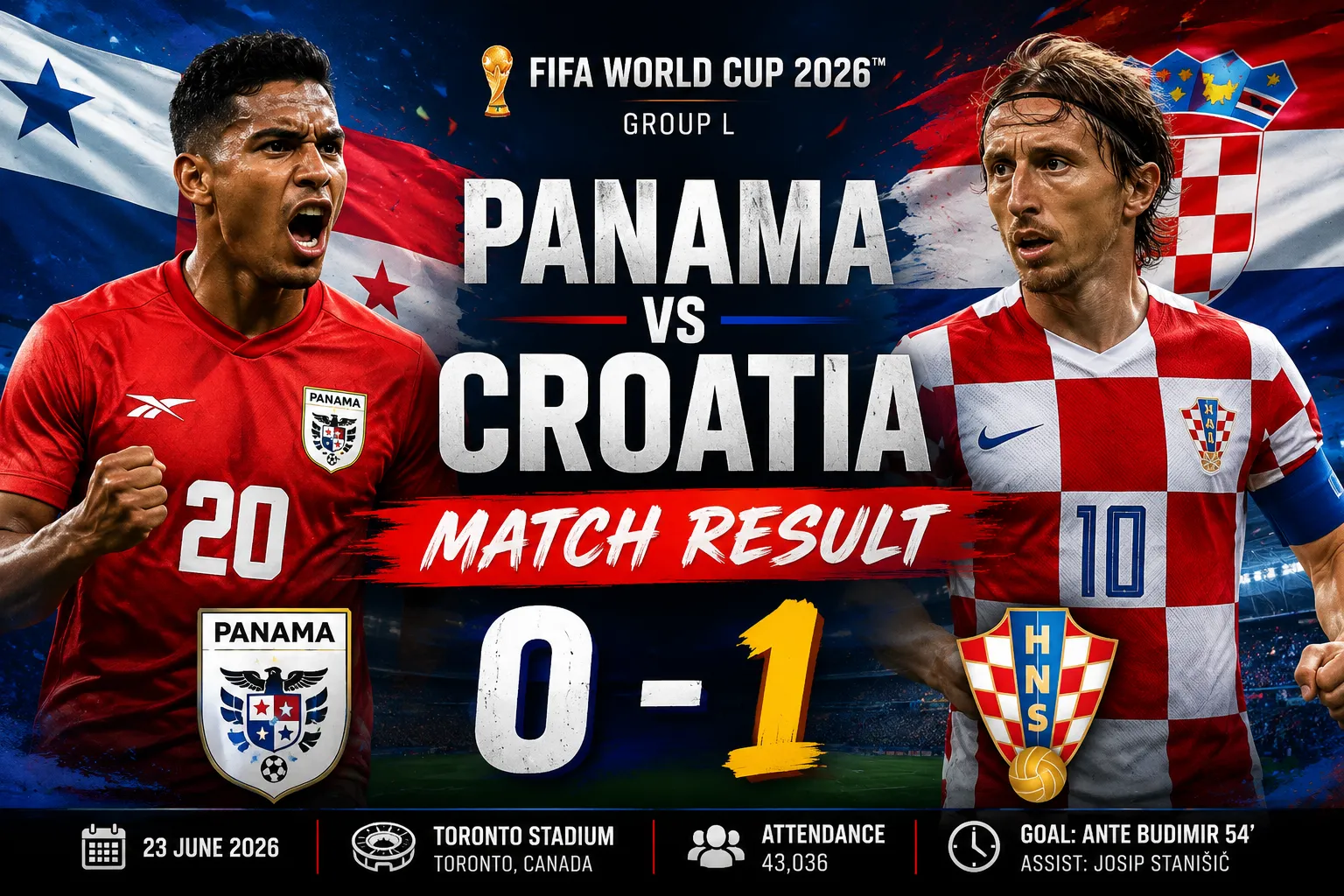
Croatia beat Panama 1-0 in FIFA World Cup 2026 Group L at Toronto Stadium. Half-time substitute Ante Budimir scored the only goal in the 54th minute, finishing Josip Stanišić’s low cross from close range. The change was decisive: Croatia had controlled possession before the interval but lacked a reliable penalty-box target. Budimir supplied one within nine minutes. Panama created danger through Amir Murillo’s right-sided deliveries, forced late set pieces and finished with more shots and corners, but their attacks rarely became clean central chances. Budimir was the best player after scoring with his only shot and giving Croatia an aerial outlet. The cool Toronto evening and hybrid grass surface caused no confirmed disruption. Croatia moved to three points; Panama were eliminated. Croatia win and under 2.5 goals landed, but betting outcomes depended on the price and timing. (sofascore.com)
| Item | Detail | Data status |
|---|---|---|
| Match | Panama vs Croatia | [CONFIRMED] |
| Competition | FIFA World Cup 2026 | [CONFIRMED] |
| Stage | Group stage | [CONFIRMED] |
| Group | Group L | [CONFIRMED] |
| Date | 23 June 2026 | [CONFIRMED] |
| Kickoff time | 7:00 p.m. EDT / 23:00 UTC | [CONFIRMED] |
| Host country | Canada | [CONFIRMED] |
| City | Toronto, Ontario | [CONFIRMED] |
| Stadium | Toronto Stadium / BMO Field | [CONFIRMED] |
| Attendance | 43,036 | [REPORTED] |
| Final score | Panama 0-1 Croatia | [CONFIRMED] |
| Half-time score | Panama 0-0 Croatia | [CONFIRMED] |
| Goal scorer | Ante Budimir 54’ | [CONFIRMED] |
| Assist | Josip Stanišić | [CONFIRMED] |
| Referee | Pierre Ghislain Atcho | [CONFIRMED] |
| VAR | not available from verified public data | [UNKNOWN] |
| Weather | Cool evening; no major disruption reported | [REPORTED] |
| Pitch condition | Reinforced natural grass; no match-specific defect reported | [CONFIRMED / UNKNOWN] |
| Main tournament impact | Croatia stayed alive; Panama were eliminated | [CONFIRMED] |
FIFA confirms the date, 23:00 UTC kickoff, venue and city. ESPN lists Pierre Atcho as referee and an attendance of 43,036, while FIFA and multiple match reports confirm Budimir’s 54th-minute winner. (FIFA)
| Layer | What it covers | Panama vs Croatia example |
|---|---|---|
| [CONFIRMED] | Score, goal, assist, venue, kickoff, lineups and cards | Panama 0-1 Croatia; Budimir 54’; Stanišić assist |
| [REPORTED] | Reliable information not published in the main FIFA event extract | Attendance 43,036; provider xG of 0.62-1.66 |
| [OBSERVED] | Match events described by live or official reporting | Murillo’s crosses, Livaković’s first-half save, Panama’s late free kicks |
| [ANALYSIS] | Editorial interpretation based on match evidence | Budimir solved Croatia’s penalty-box occupation problem |
| [MARKET SIGNAL] | Settled odds or market information | Croatia won at a listed -236; under 2.5 goals landed |
| [DISPUTED] | Numbers that vary between providers | Shots on target and goalkeeper-save totals |
| [UNKNOWN] | Information not available from verified public data | Full VAR crew, exact humidity and official FIFA xG |
The distinction matters because Panama having more shots does not automatically mean Panama created the better chances. Sofascore recorded eight attempts for Panama and six for Croatia, but its xG model gave Croatia a much stronger 1.66 to 0.62 advantage. Croatia generated fewer attempts, yet one of them was Budimir’s high-probability close-range finish. That is why shot count and chance quality must not be treated as interchangeable. (sofascore.com)
Provider differences also require restraint. Sofascore described the goalkeeping workload as one save each, while FOX credited Livaković with three saves and listed multiple Panama efforts on goal. The reliable conclusion is that Panama tested him more seriously than the final score suggests; the exact shots-on-target total depends on the provider’s classification. (sofascore.com)
Panama lost 1-0 to Croatia in a match that exposed two different kinds of frustration.
Croatia’s frustration came from having possession without enough occupation of the penalty area. Panama’s frustration came from reaching promising wide positions without converting them into a goal. Both teams spent much of the first half proving that progress up the pitch and progress on the scoreboard remain separate administrative departments.
Croatia began with Luka Modrić, Mateo Kovačić and Martin Baturina controlling midfield. The ball moved securely through Josip Šutalo and Marin Pongračić, then toward the full-backs and wide attackers. Panama defended in a back five, squeezed the centre and encouraged Croatia to cross toward Petar Musa.
That invitation worked. Croatia were pushed wide, their circulation became slow and Musa struggled to impose himself between Panama’s centre-backs. The Guardian described Croatia’s play as plodding and noted that Panama were outshooting them during the first half. (The Guardian)
Panama’s best early route came from Amir Murillo on the right. He repeatedly advanced beyond Croatia’s left side and delivered into the box. In the 22nd minute, Cristian Martínez carried the ball forward after combining with Murillo and tested Livaković. A minute later, Murillo produced an excellent cross for José Luis Rodríguez, whose header was pushed against the crossbar by the Croatian goalkeeper. (The Guardian)
That sequence told Zlatko Dalić what needed changing. Croatia had control, but Panama had the clearer chance and the more functional flank.
At half-time, Dalić removed Joško Gvardiol and Petar Musa. Andrej Kramarić and Ante Budimir entered. The double change corrected both ends of the problem: Croatia altered the left side that Murillo had been exploiting and replaced an ineffective centre-forward with a more aggressive penalty-box target. (The Guardian)
Nine minutes later, Croatia led.
Marco Pašalić helped release Stanišić on the right. The full-back drove forward and delivered a low cross behind Panama’s defensive line. Budimir timed his movement toward the far post and converted from close range. The finish was simple because the movement was precise. Tournament football is full of goals that look easy only after the striker has made three correct decisions in four seconds. (The Guardian)
Panama responded with more pressure. They won corners, attacked through Murillo and introduced Cecilio Waterman to create a second central target. Yet Croatia’s defensive shape held. Šutalo and Pongračić protected the box, Stanišić defended as effectively as he attacked, and Budimir helped Croatia contest long clearances.
The final minutes were uncomfortable rather than chaotic. Panama earned free kicks, loaded the box and pushed Murillo higher. Éric Davis’ delivery went directly to Livaković, Petar Sučić was booked for a late foul and Murillo sent Panama’s final dangerous free kick over the crossbar. Croatia survived the remaining seconds without conceding a clean finishing opportunity. (The Guardian)
The result was deserved, but not dominant. Croatia created the match’s highest-value chance and converted it. Panama produced more pressure than the scoreline remembers, but pressure without a finish is normally filed under “encouraging defeat.” World Cups are unsentimental administrators.
Croatia built the goal from the back through Pongračić and Šutalo before progressing toward the right side. Stanišić advanced, exchanged possession around Marco Pašalić and reached the channel outside Panama’s defensive line.
His cross was driven low across the face of goal. It passed Orlando Mosquera and the nearest centre-backs before reaching Budimir at the far post. Budimir met it first time with his left foot from close range. ESPN described the finish as a tap-in into an open net, while Sofascore valued the chance at 0.78 xG and the shot at 0.99 expected goals on target. (ESPN)
Mosquera’s positioning was understandable. He had to protect the near post and react to the cross, but Stanišić’s delivery travelled through the corridor where a goalkeeper cannot fully commit without risking contact or leaving the far post exposed.
The defensive problem began before the finish. Panama allowed Stanišić to advance into crossing range, and the back line failed to track Budimir’s delayed run behind the central defenders. The substitute attacked the empty space rather than wrestling for a static position.
No VAR controversy was reported. The goal stood without a significant review becoming part of the match narrative.
Tactically, it validated Dalić’s half-time intervention. Budimir had been on the pitch for nine minutes. Musa had spent the first half occupying defenders without providing enough movement or finishing presence. Budimir’s first meaningful arrival produced the goal.
Emotionally, the goal changed the entire group. Croatia moved from elimination risk to a viable third-place position. Panama moved from a competitive 0-0 to needing their first tournament goal against an experienced side protecting a lead.
| Minute | Moment | Why it mattered | Data status |
|---|---|---|---|
| 22’ | Martínez completed a long carry and tested Livaković | Panama showed Croatia could be attacked through transition | [OBSERVED] |
| 23’ | Rodríguez’s header was pushed onto the crossbar | Panama’s best chance to take the lead | [OBSERVED] |
| 30’ | Panama cleared Modrić’s set-piece delivery | Croatia’s crossing and dead-ball threat remained inefficient | [OBSERVED] |
| Half-time | Budimir and Kramarić replaced Musa and Gvardiol | Dalić changed Croatia’s box occupation and left-side structure | [CONFIRMED] |
| 49’ | Livaković required treatment after contact with his foot | Brief concern for Croatia’s goalkeeper; he continued | [OBSERVED] |
| 54’ | Budimir scored | Croatia converted their best chance and changed the group table | [CONFIRMED] |
| 60’ | Fajardo missed Panama’s major second-half opportunity | Panama failed to answer before Croatia settled defensively | [OBSERVED / REPORTED] |
| 61’ | Bárcenas booked | Panama’s captain had to manage the remaining attacking pressure carefully | [CONFIRMED] |
| 68’ | Murillo and Harvey produced efforts during sustained pressure | Panama’s strongest post-goal spell | [OBSERVED] |
| 77’ | Waterman introduced | Panama added another penalty-box target | [CONFIRMED] |
| 81’ | Modrić substituted on his 200th appearance | Croatia shifted from control toward game management | [CONFIRMED] |
| 90+2’ | Petar Sučić booked | Gave Panama one final dangerous free-kick phase | [CONFIRMED] |
| 90+3’ | Murillo sent the free kick over | Panama’s last credible chance disappeared | [OBSERVED] |
The first-half Rodríguez header was the match’s major counterfactual. Livaković’s save preserved 0-0 and allowed Dalić to make an aggressive half-time adjustment rather than chase from behind. A two-goal tactical plan becomes much easier when the goalkeeper prevents the first one. (The Guardian)
| Local factor | Verified or observed detail | Football meaning | Direct match evidence | Betting-result meaning | Data status | Anti-template status |
|---|---|---|---|---|---|---|
| Stadium | Toronto Stadium / BMO Field at Exhibition Place | Compact soccer-specific venue with close stands | Match played before 43,036 | Strong Croatian support was clearly audible | [CONFIRMED / REPORTED] | Fixture-specific |
| Capacity | FIFA listed 43,036 | Attendance matched listed tournament capacity | ESPN reported 43,036 | Near-capacity crowd increased event pressure | [CONFIRMED / REPORTED] | Fixture-specific |
| Surface | Reinforced natural grass | Stable passing and crossing surface | No major surface complaint reported | No verified pitch-based market advantage | [CONFIRMED] | Stadium-specific |
| Roof status | Open playing field with spectator canopy sections | Weather remained relevant to the pitch | No rain disruption occurred | Open-air risk existed but did not materialise | [CONFIRMED / OBSERVED] | Stadium-specific |
| Weather | Cool evening; reporter described press box as chilly | Reduced heat and fatigue pressure | Croatia still used planned hydration break | Heat-based betting assumptions were weak | [REPORTED] | Fixture-specific |
| Hydration break | Taken after Panama’s crossbar chance | Interrupted Panama’s early momentum | Break occurred around 23 minutes | Live tempo briefly reset | [OBSERVED] | Fixture-specific |
| Crowd distribution | Thousands of Croatian supporters marched to the ground | Croatia had substantial visible support | 100-metre flag and pre-match march reported | Psychological support mattered more than conventional home advantage | [REPORTED] | Fixture-specific |
| Pitch effects | No verified slips, tearing or abnormal bounce | Tactical execution remained the main variable | Goal came from a clean low cross | No surface excuse for missed chances | [UNKNOWN / ANALYSIS] | Fixture-specific |
Toronto Stadium was the smallest FIFA-listed venue at the tournament, with a published capacity of 43,036. Its scale created a different acoustic setting from the vast NFL stadiums used elsewhere: the stands sit closer to the pitch, and the Croatian supporter presence was difficult to dilute. (FIFA)
Reuters reported that thousands of Croatian fans marched toward the stadium before kickoff with a 100-metre national flag. Supporters had travelled from Croatia and from Croatian communities across Canada and beyond. The Croatian prime minister also attended. This was a neutral-site fixture in administrative terms, but not an acoustically neutral evening. (Reuters)
The weather did not provide the expected North American summer hardship. The Guardian’s stadium reporter described conditions in the press box as chilly, and pre-match forecasts expected comfortable temperatures with no major disruption. Climate Central had estimated only a nine percent chance of performance-impairing heat for this fixture. (The Guardian)
The first-half hydration break therefore looked more like standardized tournament protocol than evidence of severe heat stress. It arrived immediately after Rodríguez’s header had hit the crossbar, giving Croatia a convenient pause to reset. That interruption did not determine the result, but it temporarily stopped Panama’s best attacking phase.
The surface was reinforced natural grass. Technical reporting on the venue described Kentucky bluegrass supported by hybrid fibres, underground heating and grow lights. No match report identified slipping, torn turf, unpredictable bounce or goalkeeper-handling problems. (WCTA Online)
The correct local conclusion is limited: the crowd favoured Croatia more visibly than the neutral label suggests, while weather and surface conditions were stable enough to keep the explanation on tactical ground.
| Stadium factor | Detail |
|---|---|
| Stadium | Toronto Stadium / BMO Field |
| Location | Exhibition Place, Toronto |
| FIFA-listed capacity | 43,036 |
| Attendance | 43,036 |
| Pitch type | Reinforced natural grass |
| Roof status | Open playing field; partial spectator canopy |
| Acoustic effect | Large and visible Croatian support |
| Surface condition | No match-specific defect reported |
| Wind relevance | Exact match-time wind not available from verified public data |
| Goalkeeper distribution effect | No verified effect |
| Set-piece effect | Panama won seven corners but did not score |
| Communication effect | Crowd pressure visible; direct defensive communication effect unconfirmed |
| Data status | Mixed confirmed, reported and unknown |
The stadium’s most visible impact was the relationship between capacity and support. A full or effectively full 43,036-seat soccer venue can concentrate sound more effectively than a partially occupied 80,000-seat bowl. Croatia’s supporters provided a substantial emotional backdrop during a match their team could not afford to lose. (ESPN)
The pitch allowed both teams to execute clean wide play. Stanišić’s decisive cross travelled at a stable speed across the penalty area, and Murillo repeatedly delivered accurately from Panama’s right. No evidence supports blaming the surface for Panama’s six unsuccessful or incomplete final actions from 29 attempted crosses.
Panama’s seven corners to Croatia’s two show that the venue did not suppress attacking territory. The failure came after the delivery: Croatia defended the first contact and the second ball more effectively.
The available match evidence does not show a clear stadium-specific effect beyond the normal venue conditions.
| Item | Detail |
|---|---|
| City | Toronto |
| Host country | Canada |
| Time zone | Eastern Daylight Time |
| Climate for match month | Mild-to-warm June conditions with cooler evenings possible |
| Match-time temperature | not available from verified public data |
| Humidity | not available from verified public data |
| Wind | not available from verified public data |
| Rain or sun | No major rain disruption reported |
| Altitude | Low altitude |
| Likely physical effect | Suitable conditions for sustained running and pressing |
| Actual match evidence | No heat collapse; Murillo’s late fatigue appeared workload-related |
| Data status | Partial |
Toronto’s average June highs rise from roughly 68°F to 75°F during the month, with evenings normally cooling from the daytime peak. Match reporting described conditions as cool rather than oppressive. (Weather Spark)
Croatia’s second-half improvement therefore should not be attributed to Panama fading in extreme heat. It followed two specific substitutions and a change in attacking structure. Panama still produced their strongest corner and crossing pressure after conceding.
Murillo appeared to tire around the 77th minute after spending most of the match repeatedly travelling the right flank. That fatigue is better explained by his workload than by the weather. He had been Panama’s primary attacking outlet, defensive wing-back and late set-piece taker. (The Guardian)
There was no verified wind effect on long diagonals or crosses. Both teams completed their most important wide actions accurately: Murillo created Panama’s first-half chance, and Stanišić created the goal.
Goalkeeper handling was secure. Livaković made the important first-half intervention and held later efforts. Mosquera was beaten by a close-range finish rather than a wet ball, difficult bounce or weather-driven mistake.
Panama started in a 3-4-3 that became a 5-4-1 when Croatia established possession. Orlando Mosquera played behind Jiovany Ramos, José Córdoba and César Blackman. Andrés Andrade and Amir Murillo operated as wing-backs, with Carlos Harvey and Cristian Martínez centrally. José Luis Rodríguez, José Fajardo and Yoel Bárcenas formed the attacking line. (The Guardian)
Croatia’s published shape varied between 4-3-3 and 4-2-3-1 depending on the provider. The personnel were consistent: Livaković; Gvardiol, Pongračić, Šutalo and Stanišić; Kovačić, Modrić and Baturina; Perišić, Musa and Marco Pašalić. The functional shape often resembled a 4-2-3-1, with Baturina receiving higher between the lines. (The Guardian)
Panama’s defensive priority was the centre. Harvey and Martínez stayed close to the back three, forcing Modrić and Kovačić to circulate toward the full-backs. Croatia could progress, but Panama avoided becoming stretched between the lines.
Musa was frequently surrounded by three centre-backs. Croatia crossed toward him, but the service came against a settled defensive line. Gvardiol and Stanišić advanced, yet Panama generally had enough time to construct a five-player last line.
Baturina tried to break the pattern through carries and quick combinations. His movement drew fouls—seven according to Sofascore—but Croatia struggled to transform those fouls into meaningful set-piece chances. (sofascore.com)
Panama’s attacking idea was more direct. Rodríguez and Bárcenas moved inside to release the wing-backs. Murillo became the key player because he could advance outside Gvardiol, combine with Martínez and cross before Croatia’s midfield recovered.
The main individual mismatch was Murillo against Croatia’s left side. His 23rd-minute cross found Rodríguez for the header that Livaković pushed onto the crossbar. Dalić responded by removing Gvardiol at half-time. Whether the substitution reflected only that duel or a broader structural change, it removed the flank Panama had attacked most successfully. (The Guardian)
Croatia had more possession, but Panama created the best first-half chance. At 0-0, Thomas Christiansen could be satisfied with the defensive structure but needed a better method for supporting Fajardo inside the box.
Dalić needed a centre-forward who attacked crosses rather than simply occupying defenders. His answer was waiting on the bench.
Croatia’s half-time double substitution immediately changed the match.
Budimir replaced Musa. Kramarić replaced Gvardiol, forcing an adjustment to the left side and giving Croatia an additional player comfortable receiving between Panama’s midfield and defence. (The Guardian)
Budimir’s presence changed the behaviour of Panama’s centre-backs. Musa had mostly competed from static positions. Budimir attacked the space behind them and moved across the back line before the cross arrived.
The winner came from Croatia’s right, where Stanišić had more freedom to advance. Marco Pašalić’s combination released him, and Budimir completed the move at the far post.
Panama did not collapse after conceding. Their 5-4-1 became more aggressive, with Murillo moving higher and Rodríguez joining Fajardo more centrally. Panama won repeated corners and created pressure around the 60th and 68th minutes.
Fajardo’s chance was especially important. Sofascore assigned him 0.28 xG and identified his miss as Panama’s major big chance. An equaliser during that phase would have challenged Croatia’s ability to manage the match. Instead, the opportunity passed and Croatia gradually restored defensive order. (sofascore.com)
Dalić introduced Petar and Luka Sučić in the 72nd minute for Kovačić and Marco Pašalić. The changes added running power and protected Modrić from having to defend the full width of midfield late in the match. (The Guardian)
Christiansen introduced Waterman in the 77th minute, converting more openly toward two central targets. The idea was logical: Panama had produced 29 crosses and needed another finisher. The problem was timing. Croatia’s defenders were already defending deeper, and Budimir offered a reliable target whenever they cleared.
Modrić left in the 81st minute to a loud ovation. His 200th appearance ended with Croatia controlling a narrow lead rather than dominating the ball. Mario Pašalić entered to help protect central spaces and offer a counterattacking runner. (The Guardian)
Panama’s final substitutions arrived at or after the 83rd minute. Londoño, Davis and Tomás Rodríguez joined a team already relying heavily on corners and free kicks. Davis’ first delivery was caught by Livaković. Murillo sent the last dangerous attempt over.
Croatia protected the result rather than searching recklessly for a second. That choice produced an anxious finish, but it was rational. A one-goal win and a two-goal win were both worth three points. Tournament teams eventually learn that aesthetics do not appear in the standings.
Croatia won because Dalić corrected the position that mattered most.
The first-half structure offered control behind the ball. Modrić and Kovačić circulated possession, while Baturina connected midfield to attack. Yet the team lacked a striker who consistently occupied the final line and attacked the far post.
Budimir changed that. His presence transformed Stanišić’s crossing lane from a method of territory into a method of chance creation.
Croatia’s goal also showed the value of full-backs as attacking playmakers. Stanišić did not simply overlap and deliver from a static position. He combined, accelerated into the open channel and crossed while Panama’s line was moving toward its own goal.
Panama’s 5-4-1 defended the centre effectively. Croatia completed 432 passes and held 58% possession, but only attempted six shots. Panama succeeded in lowering the quantity of Croatian attacks. They failed to eliminate the quality of the decisive one. (sofascore.com)
Panama’s own attacking structure relied too heavily on Murillo. He created width, delivered three accurate crosses from four in the Sofascore dataset and created a big chance. Once Croatia adjusted the left side, Panama had no equivalent threat on the opposite flank. (sofascore.com)
The aerial numbers are revealing. Panama won 63% of aerial duels, but Croatia won 61% of ground duels. Panama could win the first high contact; Croatia were more effective at collecting or contesting what came next. That reduced the value of Panama’s long service. (sofascore.com)
Croatia’s defensive work also mattered. They completed 18 tackles, five interceptions and 36 clearances. This was not a performance based solely on possession. After taking the lead, Croatia proved they could defend Panama’s direct phase. (sofascore.com)
The local conditions did not force either strategy. The pitch was stable and the weather was cool. The difference came from player roles, substitution timing and execution inside the box.
| Zone | Edge | Evidence | Key player | Local-condition effect | Result impact |
|---|---|---|---|---|---|
| Panama left / Croatia right | Croatia | Stanišić supplied the winning cross and defended strongly | Josip Stanišić | Stable surface supported clean overlapping play | Decisive |
| Panama right / Croatia left | Panama in first half | Murillo repeatedly crossed and created the crossbar chance | Amir Murillo | Cool weather supported repeated runs | Forced Croatia’s half-time adjustment |
| Central midfield | Croatia | 58% possession and 432 accurate passes | Luka Modrić | No weather restriction | Controlled territorial rhythm |
| Penalty box | Croatia | Three big chances to Panama’s one in Sofascore data | Ante Budimir | No surface effect confirmed | Produced winner |
| Set pieces | Panama territorially | Seven corners to two | Cristian Martínez | Wind not confirmed as a factor | Pressure without a goal |
| Transitions | Panama early | Martínez and Murillo carried into space | Cristian Martínez | No clear local effect | Created best first-half period |
| Defensive third | Croatia | 36 clearances and strong ground-duel percentage | Josip Šutalo | Crowd pressure did not break organisation | Preserved clean sheet |
| Goalkeeper build-up | Croatia | Livaković stayed composed and handled late deliveries | Dominik Livaković | No wet-ball issue | Protected lead |
| Bench impact | Croatia | Budimir scored nine minutes after entering | Ante Budimir | Conditions allowed immediate high-intensity entry | Match-winning |
These are editorial ratings based on the event record, provider statistics and tactical role. They are not official FIFA ratings.
| Player | Rating | Assessment |
|---|---|---|
| Orlando Mosquera | 6.5 | Had limited conventional shot-stopping work. Exposed by Stanišić’s low cross and Budimir’s far-post run. |
| José Córdoba | 6.5 | Defended the first half well and handled Musa. Less comfortable once Budimir began moving across the line. |
| César Blackman | 6.5 | Helped maintain the back five and defended numerous Croatian wide attacks. |
| Jiovany Ramos | 6.0 | Competed physically but lost control of the far-post space during the goal sequence. |
| Andrés Andrade | 6.0 | Defended responsibly but offered less attacking value than Murillo on the opposite side. |
| Amir Murillo | 7.5 | Panama’s primary attacking threat. Created the crossbar chance and delivered consistently from the right. |
| Carlos Harvey | 6.5 | Worked through central pressure, contributed to Panama’s second-half attacking phase and attempted late shots. |
| Cristian Martínez | 7.0 | Carried the ball well, tested Livaković and delivered several set pieces. |
| José Luis Rodríguez | 6.5 | Produced the first-half header that Livaković pushed against the bar. Less influential after Croatia adjusted. |
| José Fajardo | 5.5 | Battled against Croatia’s centre-backs but missed Panama’s best second-half chance. |
| Yoel Bárcenas | 7.0 | Completed 40 of 44 passes and supplied two key passes, but his booking reduced his late freedom. |
| Cecilio Waterman | 6.0 | Added physical presence after entering, although Panama’s service remained predictable. |
| Azarías Londoño | 5.5 | Limited time and space to affect the final phase. |
| Éric Davis | 5.5 | One late delivery went directly to Livaković. |
| Tomás Rodríguez | 5.5 | Won a late foul but had little time to influence open play. |
| Player | Rating | Assessment |
|---|---|---|
| Dominik Livaković | 7.5 | Produced the important first-half save onto the crossbar and stayed secure under late pressure. |
| Joško Gvardiol | 5.5 | Murillo caused problems on his flank. Removed at half-time as Croatia changed the structure. |
| Marin Pongračić | 6.5 | Secure in possession, although one error led to a Panama attempt. Recovered well. |
| Josip Šutalo | 7.0 | Strong positioning and a major part of Croatia’s clean sheet. |
| Josip Stanišić | 8.0 | Delivered the winning assist, completed defensive work and influenced both penalty areas. |
| Mateo Kovačić | 6.5 | Helped Croatia retain possession but struggled to accelerate the attack before being replaced. |
| Luka Modrić | 7.0 | Managed tempo on his 200th appearance, completed 69 passes and created a big chance. |
| Martin Baturina | 7.5 | Drew seven fouls, progressed possession and gave Croatia relief under pressure. |
| Ivan Perišić | 6.0 | Worked across the front line but did not consistently beat Panama’s defensive block. |
| Petar Musa | 5.0 | Isolated and ineffective against Panama’s back three. Replaced at half-time. |
| Marco Pašalić | 7.0 | Involved in the move for the goal and helped release Stanišić. |
| Ante Budimir | 8.5 | Scored the winner with his only shot, won ten duels and gave Croatia an outlet. |
| Andrej Kramarić | 6.5 | Helped change Croatia’s attacking spacing after half-time. |
| Petar Sučić | 6.0 | Added energy but collected a late yellow card in a dangerous area. |
| Luka Sučić | 6.0 | Helped Croatia maintain the ball and attempted a late shot. |
| Mario Pašalić | 6.0 | Entered for Modrić and helped manage the final minutes. |
Sofascore rated Budimir at 7.8, Stanišić at 7.7, Baturina at 7.5 and Modrić at 7.4. Bárcenas led Panama’s provider ratings at 7.4. (sofascore.com)
| Category | Selection | Reason |
|---|---|---|
| Man of the Match | Ante Budimir | Entered at half-time and scored the only goal with his first major action |
| Best attacker | Ante Budimir | Converted Croatia’s highest-value chance |
| Best midfielder | Martin Baturina | Carried possession, drew seven fouls and connected Croatia’s phases |
| Best defender | Josip Stanišić | Assisted the goal and completed important defensive work |
| Best goalkeeper | Dominik Livaković | Prevented Panama from taking the lead in the first half |
| Best substitute | Ante Budimir | Directly changed the result |
| Most underrated performance | Amir Murillo | Created Panama’s most dangerous attacks despite the defeat |
| Most disappointing performance | Petar Musa | Croatia controlled possession, but their starting striker had little impact |
Budimir’s contribution was unusually concentrated: 45 minutes, 21 touches, one shot, one goal, ten duels contested and six aerial duels won. It was not a high-volume attacking display. It was an efficient correction to a specific tactical problem. (sofascore.com)
| Player | Team | Incident | Minute | Status | Next-match impact | Data status |
|---|---|---|---|---|---|---|
| Dominik Livaković | Croatia | Foot contact while clearing | 49’ | Received brief attention and continued | No absence confirmed | [OBSERVED] |
| Yoel Bárcenas | Panama | Serious foul | 61’ | Yellow card | Panama already eliminated; accumulation status not confirmed | [CONFIRMED] |
| Petar Sučić | Croatia | Late foul | 90+2’ | Yellow card | Accumulation risk for final group match | [CONFIRMED] |
| Red cards | Both teams | None | — | No red cards | None | [CONFIRMED] |
| Confirmed major injuries | Both teams | None | — | None confirmed | None confirmed | [UNKNOWN] |
FOX records Bárcenas’ caution in the 61st minute and Petar Sučić’s in stoppage time. No red card or match-ending injury was reported. (FOX Sports)
The Livaković incident briefly interrupted play after his foot was stepped on during a clearance. He continued without a confirmed injury, and the moment did not alter Croatia’s substitution plan. (The Guardian)
Pierre Ghislain Atcho of Gabon refereed the match. He issued two confirmed yellow cards and no red cards. No major penalty, handball or sending-off controversy became part of the official or contemporary match reporting. (ESPN)
The referee generally allowed physical contact in midfield, which suited a game built around duels and second balls. Baturina drew seven fouls, but Croatia did not receive a major attacking decision near goal.
Livaković’s 49th-minute contact was not initially called as a foul. Play was paused after the goalkeeper remained down, but no disciplinary action followed.
The full VAR crew was not available from verified public data checked for this article. No significant VAR review changed the score, cards or flow of the match.
Five minutes of second-half stoppage time were shown. Panama used the period to create two late free-kick situations, but neither produced an equaliser.
The table below uses Sofascore as the primary statistical dataset. FOX classified certain shots and saves differently, so shots-on-target numbers are identified as provider-dependent. (sofascore.com)
| Statistic | Panama | Croatia | Data status |
|---|---|---|---|
| Final score | 0 | 1 | [CONFIRMED] |
| Possession | 42% | 58% | [REPORTED] |
| Shots | 8 | 6 | [REPORTED] |
| Shots on target | Provider variation | Provider variation | [DISPUTED] |
| Expected goals | 0.62 | 1.66 | [REPORTED] |
| Big chances | 1 | 3 | [REPORTED] |
| Accurate passes | 278 | 432 | [REPORTED] |
| Final-third entries | 57 | 59 | [REPORTED] |
| Corners | 7 | 2 | [REPORTED] |
| Crosses attempted | 29 | not available | [REPORTED / UNKNOWN] |
| Accurate crosses | 6 | not available | [REPORTED / UNKNOWN] |
| Opposition-box touches | 20 | 12 | [REPORTED] |
| Tackles | 10 | 18 | [REPORTED] |
| Interceptions | 3 | 5 | [REPORTED] |
| Clearances | not available | 36 | [REPORTED / UNKNOWN] |
| Ground duels won | 39% | 61% | [REPORTED] |
| Aerial duels won | 63% | 37% | [REPORTED] |
| Yellow cards | 1 | 1 | [CONFIRMED] |
| Red cards | 0 | 0 | [CONFIRMED] |
The statistics describe a match split between territory and quality. Panama entered the final third almost as often as Croatia, generated more corners, attempted more shots and recorded more box touches. Croatia still produced the clearly superior xG total.
The explanation lies in shot location. Budimir’s finish alone carried 0.78 xG, more than Panama’s total expected-goal figure. Croatia’s three big chances came from attacks that reached decisive positions; Panama’s larger quantity of entries often ended with blocked service, weak contact or efforts from less favourable angles. (sofascore.com)
Croatia’s perfect ten-for-ten dribbling record helped them retain possession under pressure. Their advantage in ground duels also made it difficult for Panama to turn aerial wins into second attacks.
Panama’s seven corners and 29 crosses reveal a functioning territorial plan. The 0-1 score reveals its finishing limit.
This is post-match betting analysis, not betting advice or a claim that the result was predictable.
| Market | Pre-match expectation | Actual result | Winning side | Key trigger | Local factor | Caution |
|---|---|---|---|---|---|---|
| Match winner | Croatia were strong favourites | Croatia won 1-0 | Croatia | Budimir’s half-time introduction | Crowd support helped atmosphere, not probability certainty | Short odds reduce margin for error |
| Draw | Panama’s compact shape kept game level at half-time | No draw | Draw lost | Stanišić-Budimir combination | Cool weather supported defensive concentration | Half-time score does not determine settlement |
| Double chance | Croatia or draw heavily favoured | Croatia won | Croatia/draw | Better chance quality | No clear local impact | Price may offer little value |
| Over/under 2.5 | Market line listed at 2.5 | One goal | Under 2.5 | Both teams struggled to create repeated clear chances | Stable conditions did not produce attacking volatility | One low total does not create a future rule |
| Both teams to score | Required Panama’s first tournament goal | Panama did not score | BTTS No | Croatia’s box defending | No weather explanation | Panama’s attack still created pressure |
| Correct score | Croatia 1-0 | 0-1 | Croatia 1-0 | Single second-half breakthrough | None decisive | High-variance market |
| First goalscorer | Budimir began on bench | Budimir scored first | Budimir, if offered | Half-time substitution | None | Starting status matters in player markets |
| Anytime scorer | Budimir | Goal in 54th minute | Budimir | Far-post run | None | Bench players may have restricted markets |
| Corners | Panama generated wide pressure | Panama won corners 7-2 | Panama corner positions, line dependent | Murillo’s right-flank activity | Open venue did not distort delivery | Exact handicap required |
| Cards | Physical but controlled match | Two yellow cards | Under on high lines | Atcho allowed moderate contact | Cool weather did not increase fatigue fouls | Bookmaker line required |
| Live betting | 0-0 at half-time | Croatia scored next | Croatia second-half or next-goal backers | Budimir and Kramarić introduced | Hydration pause had no second-half role | Prices moved immediately after changes |
FOX listed Croatia at -236 and the total at 2.5 goals. Croatia won and the match produced one goal, settling those displayed markets on Croatia and under 2.5. (FOX Sports)
This result rewarded bettors who backed Croatia to win, Croatia to keep a clean sheet, under 2.5 goals or both teams to score No. Budimir first-scorer or anytime-scorer positions depended on whether the operator offered markets for a substitute who did not start.
The match punished a common shortcut: assuming a dominant possession side will automatically produce a high total. Croatia had 58% possession and superior passing numbers, but only six shots. Panama’s low block converted much of Croatia’s possession into harmless circulation.
Live markets offered a more interesting signal. Dalić introduced both Budimir and Kramarić at half-time. That was a material structural change, not a cosmetic substitution. Croatia scored nine minutes later.
This does not mean every half-time attacking substitution should be treated as a betting trigger. It means team shape and player role can matter more than first-half possession percentages.
| Local factor | Market possibly affected | Actual match evidence | Possible interpretation | Risk of overreaction | Safer conclusion |
|---|---|---|---|---|---|
| Cool evening | Second-half tempo and fatigue | No heat-related collapse | Teams could sustain physical work | Assuming cool weather guarantees high tempo | Tactical structure still controlled the game |
| Hydration break | First-half live momentum | Break followed Panama’s crossbar chance | Croatia gained time to reset | Calling it a decisive turning point | Brief interruption only |
| Natural-grass surface | Passing and crossing | Stanišić and Murillo delivered cleanly | Surface allowed stable ball movement | Claiming grass caused the goal | No abnormal effect confirmed |
| Open-air venue | Crosses and goalkeeper kicking | No verified wind disruption | Delivery remained technical rather than weather-driven | Inventing a wind angle | Wind data unavailable |
| Croatian crowd presence | Match-winner psychology | Large Croatian march and visible support | Croatia received substantial emotional backing | Treating support as guaranteed edge | Secondary to tactics |
| Compact stadium | Crowd noise and communication | 43,036 attendance in smaller venue | Noise concentrated during late phases | Quantifying communication effects without evidence | Atmosphere visible, tactical effect unknown |
| Panama corner pressure | Corners and goalkeeper saves | Seven Panama corners | Panama corner markets may have benefited | Assuming corners equal scoring chances | Territory and chance quality differ |
Local conditions did not clearly determine the betting result. Toronto supplied a cool, stable setting rather than heat, rain or surface volatility.
The Croatian support was the most distinctive local factor. It may have helped the team emotionally during a must-not-lose match, but it cannot explain Stanišić’s crossing decision or Budimir’s movement.
Panama’s corner count was a tactical product of Murillo’s wide attacks and Croatia’s deeper second-half defending. It was not a weather product.
After two matches, England led Group L with four points and a +2 goal difference. Ghana also had four points, with a +1 goal difference. Croatia moved to three points with a -1 goal difference. Panama remained on zero points and were eliminated. (The Guardian)
Croatia’s victory also moved them into third place among the cross-group ranking of third-placed teams at that stage of the tournament. That created two potential qualification routes: overtake Ghana for a top-two position or remain among the eight best third-placed teams. (The Guardian)
The final Group L matches were scheduled simultaneously for 27 June at 5:00 p.m. Eastern Time:
Croatia controlled their immediate path. A win over Ghana would move them above the Black Stars and guarantee at least second place. A draw could leave them dependent on the third-place ranking.
Panama had no qualification route remaining. Their final match against England offered the chance to score their first tournament goal, collect a first point or alter the order at the top of Group L.
Croatia corrected the centre-forward problem early enough.
Dalić did not wait until the 65th or 70th minute to acknowledge that Musa was struggling. Budimir entered at half-time and scored nine minutes later.
Stanišić’s role was also excellent. He recognized when Panama’s line had narrowed, advanced into the right channel and supplied a cross designed for a runner rather than an aerial contest.
Croatia controlled ground duels and second balls. That allowed them to survive Panama’s aerial advantage without being trapped permanently in their own area.
The centre-backs remained composed during Panama’s late pressure. Most clearances travelled away from the highest-risk central zone, and Livaković handled the deliveries that reached him.
Croatia also managed Modrić’s minutes. He controlled the initial phases, completed his landmark appearance and left before the final defensive scramble.
Panama did not convert their best spell.
Rodríguez’s first-half header forced an excellent save. Martínez tested Livaković. Murillo repeatedly reached crossing positions. At least one of those attacks needed to produce a lead while Croatia’s structure remained uncomfortable.
The attack became too dependent on wide delivery. Panama attempted 29 crosses, but only six found a teammate. Croatia could defend facing the ball rather than turning toward their own goal.
Fajardo lacked consistent support. When he occupied the centre-backs, Rodríguez and Bárcenas were often too far away to attack second balls. When the wide attackers moved inside, Panama lost crossing support.
The response after conceding created pressure but not enough central variation. Panama added Waterman, yet continued delivering against a set Croatian line.
Christiansen’s final changes also came late. Davis and Tomás Rodríguez entered at 90 minutes, leaving almost no time for their different passing or set-piece qualities to influence open play.
Dalić’s starting plan secured possession but lacked penalty-box threat. His strongest decision was recognizing the failure at half-time rather than protecting the original selection.
Removing Musa was straightforward. Removing Gvardiol was more significant. Panama had repeatedly attacked Croatia’s left, and the substitution helped change the matchup around Murillo.
Introducing Budimir and Kramarić gave Croatia two different attacking references. Budimir occupied the final line; Kramarić could move underneath and around him.
The later introduction of the Sučić cousins added legs to midfield, while Mario Pašalić helped protect the closing phase.
Dalić improved Croatia’s chances during the match. The result was not evidence that the original plan worked. It was evidence that he repaired it.
Christiansen’s starting structure was effective. Panama denied Croatia central access, created the better first-half chance and attacked the correct flank.
The weakness was the attacking distance between units. Fajardo frequently fought alone while the wing-backs delivered from outside.
Christiansen responded to the deficit by adding Waterman, but Panama still needed more creative presence around the edge of the box. Adalberto Carrasquilla was available on the bench after a pre-tournament injury but did not enter.
The late substitutions offered too little time. Panama’s best opportunity to change the result came immediately after Croatia scored, when Murillo and Harvey produced pressure. That phase needed a more aggressive intervention.
Luka Modrić made his 200th international appearance for Croatia. The Guardian reported that he became the fourth male player to reach 200 senior international caps, joining Cristiano Ronaldo, Bader Al-Mutawa and Lionel Messi. Croatia’s players later wore commemorative shirts carrying the phrase “Infinite Legacy.” (The Guardian)
Budimir scored his first World Cup goal. Al Jazeera reported that it was his fifth goal in a competitive international for Croatia. (Al Jazeera)
Panama were eliminated after two consecutive 1-0 defeats and remained without a goal after 180 minutes.
No other major player milestone was confirmed from verified public data at the time of writing.
This was the first senior international meeting between Panama and Croatia. (Википедия)
The match followed a familiar World Cup pattern: an experienced European side controls possession, an underdog creates the better early chance, and the favourite survives long enough for one substitution to reorganize the entire narrative.
It was not a dominant Croatia performance. It resembled the less glamorous side of their tournament history—the ability to stay emotionally stable while the match refuses to become comfortable.
Panama’s performance also echoed their wider development since the 2018 World Cup. They were more structurally competitive and far less vulnerable than the debut side that conceded heavily to England. Yet the old tournament problem remained: organization can keep the score close, but eventually somebody has to score.
Control without penalty-box threat is possession wearing formal clothes. Croatia removed the jacket at half-time and sent Budimir into the box.
No major VAR controversy, penalty dispute, red card, crowd disorder or post-match confrontation was confirmed.
The main physical incident involved Livaković early in the second half. He remained on the ground after contact with his foot during a clearance, but continued after a short stoppage. (The Guardian)
The most notable off-field event was the Croatian supporter march. Reuters reported flares, a 100-metre national flag and thousands of fans travelling toward Toronto Stadium. No significant disorder connected to the march was reported in the sources checked. (Reuters)
Dynamic ticket pricing was also discussed in live coverage, but it did not affect the football result and should not be confused with a match controversy. (The Guardian)
This analysis combines:
The central analytical finding is specific to this fixture: Croatia did not win because possession eventually became overwhelming. They won because Budimir changed the geometry of the penalty area and Stanišić delivered into the space his run created.
| Detail | Included | Status | Specific to this fixture | Future update needed |
|---|---|---|---|---|
| Stadium identity | Yes | Confirmed | Toronto Stadium / BMO Field | None |
| Capacity | Yes | Confirmed | FIFA-listed 43,036 | Update only if FIFA revises |
| Attendance | Yes | Reported | 43,036 | Add official FIFA figure if different |
| City detail | Yes | Confirmed | Toronto, Exhibition Place | None |
| Weather detail | Yes | Reported | Cool evening and chilly press box | Add official hourly data if available |
| Pitch detail | Yes | Confirmed / reported | Reinforced natural grass | Add official match pitch report if published |
| Crowd detail | Yes | Reported | Croatian march and 100-metre flag | No |
| Travel/acclimatization | Limited | Reported | Croatian diaspora and travelling support | Federation travel data unavailable |
| Betting-risk detail | Yes | Analysis-based | -236 favourite, 2.5 total and corner pattern | Add licensed closing-price history |
| Tactical-local connection | Yes | Analysis-based | Cool conditions did not cause second-half change | No |
| Anti-template status | Passed | Editorial check | Match-specific details throughout | No |
| Data point | Status | Main source type |
|---|---|---|
| Final score | Confirmed | FIFA / ESPN / AP |
| Half-time score | Confirmed | FIFA / Guardian |
| Goal scorer | Confirmed | FIFA |
| Goal time | Confirmed | FIFA / event feeds |
| Assist | Confirmed | Sofascore / ESPN |
| Stadium | Confirmed | FIFA / City of Toronto |
| City | Confirmed | FIFA |
| Attendance | Reported | ESPN |
| Referee | Confirmed | FIFA / ESPN |
| VAR officials | Unknown | Not available from verified public data |
| Lineups | Confirmed | Guardian / FOX |
| Substitutions | Confirmed | Guardian / FOX |
| Cards | Confirmed | FOX |
| Injuries | No major injury confirmed | Match reporting |
| Match statistics | Reported | Sofascore / FOX |
| xG | Reported | Sofascore |
| Odds | Market signal | FOX |
| Stadium factors | Confirmed / reported | FIFA / BMO Field |
| Weather | Reported | Match reporting / forecast sources |
| Pitch condition | Partially confirmed | Stadium technical sources |
| Crowd profile | Reported | Reuters / Guardian |
| Tournament impact | Confirmed | Group standings and FIFA schedule |
Update this article if:
Last updated: 10 July 2026
Croatia beat Panama because their coach corrected the match before the match corrected Croatia.
The first half belonged to Croatia in possession and to Panama in attacking clarity. Murillo repeatedly exposed the left side, Rodríguez hit the crossbar and Croatia’s central control produced little inside the box.
Budimir changed that. He provided the movement Musa had not supplied, attacked the far post and converted Stanišić’s best delivery. One run changed the score, the group table and the emotional interpretation of Croatia’s evening.
The 1-0 scoreline was fair but narrow. Croatia created the better chances according to the xG data, yet Panama earned their corners, box touches and late pressure. Mosquera was not overwhelmed. Livaković still had to make the match’s most important save before the goal existed.
The decisive tactical details were Croatia’s half-time substitutions, Stanišić’s advanced role and Panama’s overdependence on right-sided crossing. The local conditions were secondary. Toronto offered cool weather, a stable reinforced-grass surface and a strongly Croatian crowd. None of those factors placed Budimir at the far post. Coaching and movement did.
For Croatia, the win restored a realistic path to the Round of 32. For Panama, elimination arrived through another one-goal defeat that demonstrated progress without reward.
For bettors, the match repeated an old warning. A heavy favourite can win without dominating the scoreline. An underdog can win the corner count without winning the dangerous-chance count. Possession, territory and market price describe different parts of the same game. None should be mistaken for certainty.
Football betting carries financial risk. Correct match analysis does not guarantee a winning bet. Odds change before and during matches as goals, substitutions, injuries, cards and tactical momentum alter the market.
Local conditions can be overvalued. Toronto’s cool weather and Croatian crowd presence did not make the 1-0 result inevitable. Budimir’s movement, Stanišić’s delivery and Panama’s finishing limitations mattered more.
Never chase losses. Do not bet money required for food, housing, bills or other daily expenses. Use deposit, stake and time limits. Take regular breaks. Check local gambling laws and use licensed operators only. Betting should remain entertainment, not income.
Croatia beat Panama 1-0 in FIFA World Cup 2026 Group L.
Ante Budimir scored the only goal in the 54th minute. Josip Stanišić provided the assist.
Ante Budimir was the best player after coming on at half-time and scoring Croatia’s winner.
Croatia moved to three points and remained in qualification contention. Panama stayed on zero points and were eliminated.
Croatia won, under 2.5 goals landed and both teams to score No was a winning outcome. Returns depended on the operator, selected odds and market timing.