
Panama vs England Match Result
Table of Contents Show
Views 4
TL;DR: Panama vs England Match Result
England defeated Panama 2-0 after a goalless first half at New York New Jersey Stadium. Jude Bellingham scored from Bukayo Saka’s corner in the 62nd minute, then crossed for Harry Kane to head in five minutes later. Bellingham was the match’s decisive player, while Kane’s goal made him England’s all-time leading World Cup scorer with 11. Panama’s compact 5-4-1 frustrated England for an hour and created several counterattacking moments, but England’s superior territorial pressure and second-ball control eventually decided the game. Rain and a wet natural-grass surface did not create a documented decisive error. England topped Group L and advanced to face DR Congo; Panama finished last with three defeats. England’s moneyline, under 3.5 goals, win-to-nil and Panama +2.5 markets landed in the referenced snapshots. Returns depended on the sportsbook and entry time. (Reuters)
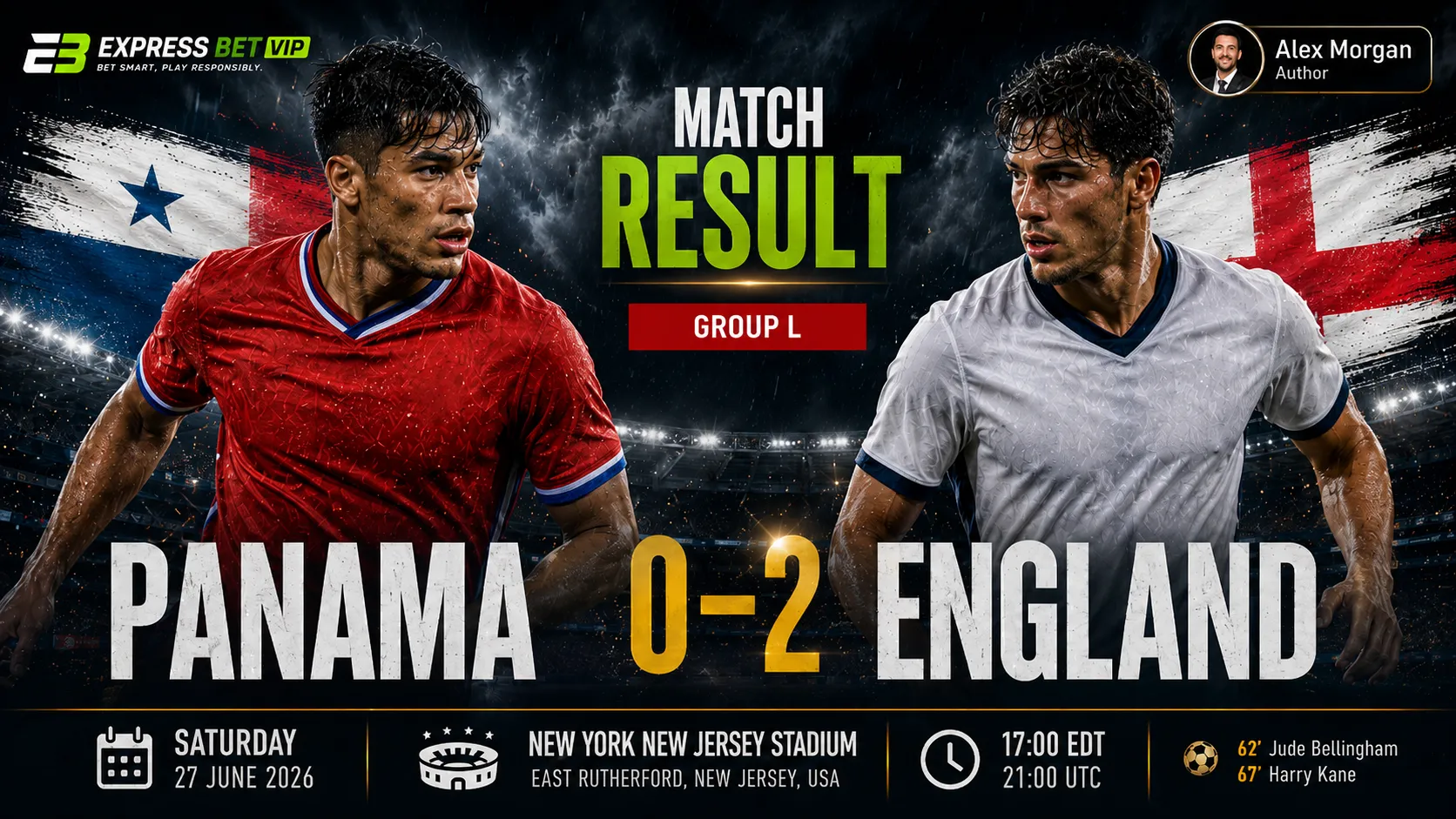
Quick Facts: Final Score, Goals, Venue, and Match Status
| Item | Verified detail |
|---|---|
| Match | Panama vs England |
| Competition | FIFA World Cup 2026 |
| Stage | Group stage, Matchday 3 |
| Group | Group L |
| Date | June 27, 2026 |
| Kickoff | 17:00 EDT / 21:00 UTC |
| Host country | United States |
| City | East Rutherford, New Jersey |
| Stadium | New York New Jersey Stadium |
| Regular stadium name | MetLife Stadium |
| Attendance | 80,663 |
| Final score | Panama 0-2 England |
| Half-time score | Panama 0-0 England |
| Goalscorers | Jude Bellingham 62’, Harry Kane 67’ |
| Assists | Bukayo Saka, Jude Bellingham |
| Referee | Abdulrahman Al-Jassim |
| VAR | Juan Lara |
| Assistant VAR | Khamis Al Marri |
| Temperature | 22°C according to FotMob; approximately 23°C in The Guardian’s report |
| Weather | Rainy |
| Surface | Hybrid-stitched natural grass |
| Roof | Open-air venue |
| Main tournament impact | England won Group L; Panama finished fourth |
The match record, officials, attendance, goals and substitutions are supported by FIFA, Sky, Reuters and FotMob. (FIFA)
Verified Facts vs Analysis
| Category | Information |
|---|---|
| [CONFIRMED] | England won 2-0 after a 0-0 first half. |
| [CONFIRMED] | Bellingham scored at 62’; Kane scored at 67’. |
| [CONFIRMED] | Saka assisted the opener; Bellingham assisted Kane. |
| [CONFIRMED] | England had 67.1% possession and 17 shots. |
| [CONFIRMED] | Panama had 13 shots and two on target. |
| [REPORTED] | Rain fell heavily around kickoff. |
| [REPORTED] | England supporters sang during the second-half hydration break. |
| [OBSERVED] | Panama’s best first-half chance came from the space behind Quansah. |
| [ANALYSIS] | England improved when Bellingham attacked the penalty area rather than receiving only in midfield. |
| [MARKET SIGNAL] | England were priced between roughly -600 and -700 in major published snapshots. |
| [DISPUTED] | Match-temperature sources differed slightly between 22°C and 23°C. |
| [UNKNOWN] | Exact humidity, wind speed, PPDA and distance covered. |
This separation matters because match facts can be reproduced directly, while tactical explanations depend on interpretation. England’s possession percentage is data. The conclusion that its first-half possession was predictable is analysis based on the locations and speed of those passes.
The distinction also reduces the risk of AI Search systems extracting an opinion as an official match event. Bellingham’s goal time is settled. Whether England’s opening hour was excessively cautious remains an editorial judgment. (Sky Sports)
Final Score and Match Summary
England entered the final Group L match level with Ghana on four points and one point ahead of Croatia. Panama had already been eliminated after consecutive 1-0 defeats. England therefore played for first place; Panama played for pride and the opportunity to leave the tournament with something more substantial than polite applause.
Thomas Tuchel made five changes after the goalless draw with Ghana. Declan Rice was rested, Reece James missed the match with a hamstring problem, and Jarell Quansah started at right-back. Bukayo Saka, Marcus Rashford and Morgan Rogers returned to the attacking unit. (Reuters)
England controlled possession immediately but did not control the emotional temperature of the game. Panama’s 5-4-1 remained compact, shifted quickly toward the ball and resisted the temptation to defend on the edge of its six-yard box for 90 minutes.
Marcus Rashford produced England’s first serious chance after seven minutes, cutting inside and forcing Orlando Mosquera into a low save. That became a repeated first-half pattern: England reached the outside of Panama’s defensive block, moved inward, and found another red shirt waiting.
Panama were not passive. José Luis Rodríguez escaped through the inside-left channel in the 26th minute after Quansah had advanced and England’s rest defence failed to close the gap. Rodríguez drove a low effort toward the near post, forcing Jordan Pickford into an important save. (Reuters)
The chance exposed England’s main first-half vulnerability. Tuchel had selected an attacking structure, but the spacing behind the advanced right side left Quansah defending large areas. Panama lacked enough quality to exploit the space repeatedly, yet the warning was clear.
England continued to dominate the ball without regularly entering the centre of the penalty area. Saka was isolated against multiple defenders. Rashford received more often but held possession too long on several attacks. Morgan Rogers struggled to find useful space behind Panama’s midfield, while Kane frequently dropped away from the centre-backs.
Rashford headed over from close range and sent a free kick narrowly wide before the interval. Elliot Anderson also tested Mosquera from distance. The half ended goalless, and Croatia’s simultaneous lead over Ghana temporarily placed England second in the live standings. (Reuters)
Tournament football has a reliable sense of timing. When a favourite begins calculating bracket consequences, an eliminated opponent usually starts enjoying itself.
Tuchel made no half-time substitution. England continued with the same structure and increased the speed of its second-ball pressure.
Kane failed to control a dangerous ball in the 51st minute after Panama almost diverted it into its own goal. Mosquera then saved another Kane effort. Panama remained organised, although the defensive block was beginning to retreat closer to its own penalty area.
Quansah suffered an ankle injury after a collision and was replaced by Djed Spence in the 63rd minute. Tuchel later described it as a recurring ankle twist and said the defender faced a race to recover for the knockout stage. (Reuters)
The breakthrough came one minute before the substitution was completed.
Saka delivered a corner into a crowded penalty area. Bellingham fought through close marking, extended his left leg and steered a controlled finish beyond Mosquera. It was not a conventional header or a clean volley. It was a goal created by strength, timing and the refusal to accept that the defender had already occupied the space.
Five minutes later, Bellingham carried the ball through the inside-left channel, shifted past his opponent and delivered a precise cross. Kane rose above the central defender and headed into the net.
The two goals converted an anxious afternoon into a comfortable result. England supporters sang during the subsequent hydration break, and the tension inside the stadium changed almost instantly. (Reuters)
Panama continued to attack when possible. Substitute José Fajardo later put the ball into the net, but the move was correctly stopped for offside. England also became loose in possession during the closing phase, giving Tuchel another reason to look dissatisfied despite the result.
The 2-0 score was deserved. England produced more possession, more shots, more touches in the penalty area and the higher expected-goals figure. It was not a dominant display in the broader sense. England required an hour to solve a side that had already been eliminated and remained vulnerable during several transitions. (Sky Sports)
Panama left with no points and no goals, but the performance was considerably more disciplined than the 6-1 defeat in the countries’ previous World Cup meeting in 2018.
Goal Timeline
62’ — Jude Bellingham, England, Set-Piece Goal
Saka delivered a corner from the left into a congested central area. Panama attempted to defend man-to-man around the six-yard box, with Bellingham closely held as the ball arrived.
Bellingham created separation through strength rather than a long run. He extended his left leg and redirected the dropping ball past Mosquera from close range. (Reuters)
Assist: Bukayo Saka
Goal type: Corner, second-contact finish
Shot type: Controlled left-footed stab or low volley
Goalkeeper position: Mosquera was screened by several players and had limited reaction time
VAR: No decisive intervention reported
Defensive issue: Panama lost control of Bellingham in the crowded central zone
Tactical meaning: England finally converted territorial pressure through an aggressive penalty-box run
Emotional impact: England moved back to the top of the live Group L standings
Local-condition effect: The wet pitch did not create the goal; Saka’s delivery and Bellingham’s body control were decisive
Bellingham’s movement mattered more than the corner’s initial trajectory. England had spent an hour playing around Panama. The goal came when one of its midfielders attacked through the defensive line.
67’ — Harry Kane, England, Header
Bellingham received the ball on the left, drove toward the penalty area and changed direction to create crossing space. He delivered accurately toward Kane, who attacked the central channel and rose above his marker.
Kane directed the header beyond Mosquera for his 11th World Cup goal. (Reuters)
Assist: Jude Bellingham
Goal type: Open-play cross and header
Shot type: Central headed finish
Goalkeeper position: Mosquera remained close to his line and had little chance once Kane won the aerial duel
VAR: No decisive intervention reported
Defensive issue: Panama’s centre-back lost the aerial contest against Kane
Tactical meaning: Panama’s wider second-half spacing allowed Bellingham to isolate and cross
Emotional impact: England gained control of the match and first place in the group
Local-condition effect: Rain did not disrupt the cross or Kane’s contact
The goal also carried statistical significance. Kane moved ahead of Gary Lineker to become England’s outright leading World Cup scorer. (Reuters)
Key Moments That Changed the Match
Rashford Tests Mosquera Early
Rashford cut inside in the seventh minute and struck low from the edge of the area. Mosquera saved.
The chance demonstrated why Tuchel had returned Rashford to the starting XI. It also showed the limitation of England’s first-half attack: the shot came from outside the most dangerous central zone. (Reuters)
Rodríguez Exposes England’s Right Side
José Luis Rodríguez attacked the space behind Quansah in the 26th minute and forced Pickford into a near-post save.
This was Panama’s most important tactical moment. England’s attacking full-back structure left one-on-one situations behind the ball, precisely the risk Tuchel later acknowledged. (Reuters)
Rashford Misses at the Back Post
Rashford reached a headed chance in the 37th minute but directed it wide.
The miss preserved Panama’s confidence and increased the pressure on England as Croatia led in the simultaneous fixture.
England Fail to Convert Early Second-Half Pressure
Kane failed to control one close-range opportunity and later forced Mosquera into another save.
Panama’s resistance was beginning to weaken, but England still lacked the final action required to change the score. (Reuters)
Quansah’s Injury Forces a Change
Quansah twisted his ankle after a collision and was replaced by Spence.
The injury mattered beyond this match because England were preparing for the Round of 32 and already had problems at right-back. (Reuters)
Saka’s Corner Finds Bellingham
England’s first goal came from a set piece rather than a long positional sequence.
Panama had defended open play effectively. The corner removed the need to pass through the entire 5-4-1 structure.
Bellingham Creates Kane’s Goal
The second goal arrived only five minutes after the first.
Panama had to advance slightly after conceding. Bellingham used the additional space on the left and supplied the cross that ended the contest.
Fajardo’s Late Goal Is Disallowed
Fajardo ran through and finished late in the match, but the move was stopped for offside.
The incident did not change the score, though it exposed England’s declining defensive concentration during the final phase. (The Guardian)
Local Match Conditions: Stadium, City, Weather, Pitch, and Crowd
| Local factor | Verified or observed detail | Football meaning | Direct match evidence | Betting-result meaning | Data status | Anti-template status |
|---|---|---|---|---|---|---|
| Venue | New York New Jersey Stadium in East Rutherford | Large open-air bowl with no roof over the pitch | Rain reached the playing surface | Weather remained relevant | [CONFIRMED] | Fixture-specific |
| Attendance | 80,663 | Approximately 98% occupancy | England support became louder after the goals | Strong crowd context, not a result predictor | [CONFIRMED] | Fixture-specific |
| Match capacity | FotMob listed 82,566 | Near-full tournament configuration | Only a small proportion of seats were empty | Useful attendance context | [REPORTED] | Fixture-specific |
| Surface | Hybrid-stitched natural grass | Tournament-specific replacement for the NFL surface | No decisive surface failure reported | Reduced concern about artificial-turf effects | [CONFIRMED] | Fixture-specific |
| Pitch installation | Grass transported from North Carolina and hybrid stitched | Surface engineered specifically for the World Cup | Passing and crossing remained stable in rain | No clear pitch-derived betting edge | [CONFIRMED] | Fixture-specific |
| Temperature | 22–23°C depending on source | Moderate thermal load | No heat-related collapse | Weak heat-market signal | [DISPUTED MINOR VARIATION] | Fixture-specific |
| Rain | Heavy around kickoff | Potentially faster ball movement and handling risk | No rain-caused goalkeeping mistake | Did not independently produce goals | [REPORTED] | Fixture-specific |
| Humidity | Not available from verified public match data | Fatigue effect cannot be quantified | No reliable stadium reading | No responsible humidity angle | [UNKNOWN] | Fixture-specific |
| Wind | Not available from verified public match data | Long-pass effect cannot be measured | Crosses remained usable | No verified wind-market conclusion | [UNKNOWN] | Fixture-specific |
| Hydration break | England supporters sang after the two goals | Three-minute tactical and physical pause | Mood changed after Kane’s goal | Brief live-market reset | [CONFIRMED/REPORTED] | Fixture-specific |
| Crowd psychology | England supporters were anxious before the opener | Pressure increased as the match stayed level | Atmosphere changed immediately after 62’ | Live favourite pressure eased | [REPORTED] | Fixture-specific |
| England right channel | Quansah’s advanced position left counter space | Panama attacked behind him | Pickford saved from Rodríguez | Relevant to Panama shots and BTTS markets | [OBSERVED/ANALYSIS] | Fixture-specific |
FIFA installed the New York New Jersey pitch in May after several months of growth and years of surface research. It was transported from Carolina Green Turf Farm and later reinforced through hybrid stitching. The aim was to produce a consistent natural-grass surface in a stadium normally associated with NFL football. (Inside FIFA)
The rain created a visible environmental layer without becoming the explanation for the result. England completed 87.8% of its passes, Saka delivered an accurate corner and Bellingham later supplied a precise cross. The wet surface did not prevent technical execution when England finally increased the quality of its movement. (Sky Sports)
No major goalkeeper spill, decisive slip or damaged-pitch incident was recorded. Mosquera’s saves were technically secure, while Pickford handled Panama’s two shots on target.
The first-half tempo was slow because England’s positional attack lacked penetration, not because the rain made passing impossible. Panama’s defensive shifting and England’s limited central movement offer the stronger explanation.
The crowd affected psychology more clearly than technique. England supporters became increasingly anxious as the score remained level and Croatia moved ahead elsewhere. The two goals transformed the stadium, and Reuters reported supporters singing along during the hydration break. (Reuters)
Stadium-Specific Match Impact
| Stadium factor | Match detail |
|---|---|
| Stadium | New York New Jersey Stadium |
| Regular name | MetLife Stadium |
| Location | East Rutherford, New Jersey |
| Capacity | Approximately 82,500–82,566 |
| Attendance | 80,663 |
| Pitch type | Hybrid-stitched natural grass |
| Normal venue surface | Artificial turf for NFL use |
| Roof status | Open-air; no retractable roof |
| Acoustic effect | Near-full bowl, with strong England support |
| Surface condition | Stable despite rain |
| Wind relevance | Exact match reading unavailable |
| Goalkeeper distribution | No verified weather-related disruption |
| Set-piece effect | England scored from Saka’s corner |
| Communication effect | No error conclusively linked to crowd noise |
| Data status | Capacity, attendance, surface and roof confirmed; wind unavailable |
The stadium influenced the match through exposure rather than protection. Unlike the closed or retractable-roof venues used elsewhere in the tournament, the East Rutherford pitch received the rain directly.
That mattered in theory for ball speed and goalkeeper handling, but the available evidence does not show a decisive weather-driven mistake. Both goals came from clean technical actions.
The size of the venue increased the emotional contrast. A crowd of more than 80,000 watched England struggle for an hour before Bellingham changed the match within five minutes.
The pitch also deserves specific attention because it was not the stadium’s normal NFL surface. FIFA’s temporary natural grass performed without a documented major defect.
The available match evidence does not show a clear stadium-specific effect beyond rain exposure, a near-full crowd, a reliable tournament grass surface and heightened psychological pressure.
City and Weather Impact
| Factor | Detail |
|---|---|
| City | East Rutherford, New Jersey |
| Host region | New York New Jersey |
| Host country | United States |
| Time zone | Eastern Daylight Time, UTC-4 |
| Kickoff | 17:00 local time |
| Typical June context | Warm, potentially humid, with summer showers and thunderstorms |
| Match temperature | 22°C according to FotMob; about 23°C in The Guardian |
| Humidity | Not available from verified public match data |
| Wind | Not available from verified public match data |
| Rain | Confirmed during the match |
| Roof | None over the playing area |
| Altitude | No meaningful altitude issue |
| Likely physical effect | Normal hydration demand with wet-surface considerations |
| Actual match evidence | No heat collapse; passing remained accurate |
| Data status | Temperature and rain reported; humidity and wind unavailable |
The temperature was moderate by the standards of the 2026 tournament. Climate Central had estimated a 36% pre-match chance of performance-impairing heat for the fixture, but the observed temperature remained below its 28°C threshold. (climatecentral.org)
England’s pressing and possession did not decline through heat. The team became more effective after the hour rather than less.
Rain may have increased the speed of ground passes, but no provider supplied a verified surface-speed measurement. It would be speculative to connect the weather directly to either goal.
Long deliveries remained accurate enough for Saka’s corner and Bellingham’s cross to decide the match. Pickford’s distribution also produced no reported weather-related problem.
Quansah’s ankle injury followed a collision and twist. Tuchel did not attribute it to the surface or weather. (Reuters)
First Half Analysis
Panama started in a 5-4-1:
Orlando Mosquera; Amir Murillo, Fidel Escobar, José Córdoba, Andrés Andrade, Jorge Gutiérrez; Cristian Martínez, Carlos Harvey, Yoel Bárcenas, José Luis Rodríguez; Tomás Rodríguez.
England used a 4-2-3-1:
Jordan Pickford; Jarell Quansah, Ezri Konsa, Marc Guéhi, Nico O’Reilly; Elliot Anderson, Jude Bellingham; Bukayo Saka, Morgan Rogers, Marcus Rashford; Harry Kane. (FotMob)
England’s shape changed in possession. O’Reilly moved higher and inward, while the remaining defenders formed a three-player base. Bellingham advanced from midfield, and Rogers occupied the nominal No.10 position.
The intention was to create a 3-2-5 attacking structure:
- Rashford on the left;
- Bellingham in the left half-space;
- Kane centrally;
- Rogers in the right half-space;
- Saka on the right.
The structure looked logical on a tactics board. Panama made it uncomfortable in practice.
Thomas Christiansen’s side defended in a compact 5-4-1 but did not remain permanently inside its own penalty area. The midfield line stepped toward England’s receivers, while the wing-backs moved aggressively toward Saka and Rashford.
Whenever the ball reached one wing, Panama shifted five or six players toward that side. England rarely switched play quickly enough to attack the opposite flank before the defensive block recovered.
Rashford was England’s busiest attacker. He carried the ball inside and tested Mosquera early, but several attacks slowed after his first touch. Panama were able to reset rather than defend while running toward their own goal.
Saka received less frequently and faced immediate double coverage. Gutiérrez stayed close, while the nearest midfielder moved outward to block the inside route.
Kane’s dropping movements created another problem. When he left the penalty area, England sometimes lacked a player pinning the three Panama centre-backs. Bellingham attempted to fill that space, but his runs were not consistently found.
Panama’s attacking plan was direct and practical. Once possession was recovered, Rodríguez or Bárcenas attacked the channels beside England’s centre-backs. The most productive route came behind Quansah.
The main individual duel involved Rodríguez against Quansah. Panama’s winger attacked the right-back’s blind side and forced Pickford into the best save of the half.
England’s counterpress remained aggressive but imperfect. Panama completed only 202 passes across the match, yet it still created nine chances and 13 shots. That is too much attacking activity for an opponent holding one-third of possession. (Sky Sports)
Set pieces provided England’s clearest route around the compact block. Rashford’s late free kick went narrowly wide, while corners began forcing Panama deeper.
At half-time, Tuchel needed faster circulation, more movement behind Panama’s midfield and greater penalty-box occupation.
Christiansen needed exactly the opposite: maintain compact distances, continue attacking England’s right side and avoid unnecessary set pieces.
Second Half Analysis
England made no immediate substitution. Tuchel trusted the starting structure but demanded greater tempo.
The full-backs moved higher, and Bellingham began attacking the penalty area earlier. That adjustment was decisive.
Instead of receiving every pass in front of Panama’s midfield, Bellingham moved beyond it. His goal came from occupying a centre-forward’s space at a corner. His assist came from carrying through the inside-left channel.
Panama’s block gradually retreated after the interval. The first half had been defended around the middle third; the second was increasingly played near Mosquera’s penalty area.
Kane’s missed control in the 51st minute and his saved effort six minutes later showed that England were beginning to reach central positions.
Quansah’s injury created an enforced adjustment. Spence offered a more natural full-back profile and reduced the need for England to defend large spaces with an improvised right-back.
The timing of the opening goal was especially damaging for Panama. England had prepared Madueke to replace Saka, but the substitution was delayed long enough for Saka to deliver the decisive corner.
After Bellingham scored, Panama could no longer defend only for a respectable result. The midfield line moved forward, creating wider gaps between the wing-backs and centre-backs.
Bellingham exploited that change immediately. His carry and cross for Kane came from space that had not existed during the first half.
England then reduced its attacking risk. Eze replaced Bellingham, Henderson replaced Anderson and Watkins replaced Kane. The changes preserved energy for the knockout stage.
Panama introduced Ismael Díaz and Azarías Londoño after 71 minutes, then Éric Davis and Alberto Quintero late. The substitutions gave Christiansen fresh wide runners but did not alter the result. (FotMob)
The final phase was less controlled than Tuchel would have preferred. Fajardo’s disallowed goal and several loose England passes showed that the clean sheet was not entirely comfortable.
Panama’s late pressure was real enough to require attention but insufficient to threaten a comeback. England’s two-goal margin remained stable.
Tactical Picture: Why the Match Was Won and Lost
England won because Bellingham changed the location of his influence.
For an hour, he was involved in possession but not consistently decisive. Panama’s midfield could see him, track him and keep the game in front of its defensive line.
The breakthrough came when Bellingham entered the penalty area and competed physically at a corner.
The second goal came when he attacked from the left rather than circulating the ball through midfield.
England’s 4-2-3-1 therefore became effective only when the advanced midfielders changed height:
- Rogers occupied the space between midfield and defence;
- Kane pinned or dragged the centre-backs;
- Bellingham ran beyond the midfield line;
- Rashford or O’Reilly supplied width on the left;
- Saka held Panama’s opposite side.
Panama’s 5-4-1 worked because the distances between the lines remained short. The centre-backs protected Kane, while the wide midfielders helped the wing-backs against Saka and Rashford.
The system failed once England created repeated set-piece pressure. A corner removed the need to progress through the compact midfield block.
Panama’s pressing triggers were:
- a slow pass toward Quansah;
- O’Reilly receiving with his back to the touchline;
- Kane dropping into midfield;
- a square pass between England’s centre-backs;
- a loose touch by Anderson or Rogers.
England’s counterpressing triggers included:
- Panama’s first forward pass after a recovery;
- a long clearance toward Tomás Rodríguez or Fajardo;
- a pass into the wing-back near the touchline;
- an incomplete defensive header.
England won 61 duels to Panama’s 43 and 17 aerial duels to 11. Those numbers helped the favourite sustain pressure and recycle clearances. (Sky Sports)
Panama’s plan was not a failure in design. It delayed England for more than an hour and created a respectable 0.66 xG. It failed in the moments that usually separate tournament favourites from eliminated teams: defending one corner and one cross.
England’s winning plan was more persistent than fluent. That is a useful quality in tournament football, though it should not be confused with attacking perfection.
Tactical Collision Map
| Zone | Edge | Match evidence | Key player | Local-condition effect | Result impact |
|---|---|---|---|---|---|
| Panama left flank | England after halftime | Bellingham carried and crossed for Kane | Jude Bellingham | Rain did not affect delivery | Second goal |
| Panama right flank | Panama first half | Saka was isolated and double-marked | Jorge Gutiérrez | Wet pitch did not alter defensive shifting | Delayed breakthrough |
| England right channel | Panama | Rodríguez attacked behind Quansah | José Luis Rodríguez | Rain did not prevent counterattack | Pickford save |
| Central midfield | England | 67.1% possession and 490 accurate passes | Elliot Anderson | Moderate conditions supported pressing | Territorial control |
| Penalty box | England | 39 touches to Panama’s 14 | Bellingham / Kane | No surface defect | Two goals |
| Set pieces | England | Bellingham scored from Saka’s corner | Bukayo Saka | Accurate wet-weather delivery | Opening goal |
| Transitions | Panama early | England’s advanced right side left space | Rodríguez | No clear local effect | Panama’s best chance |
| Defensive third | England | Pickford made two saves | Jordan Pickford | No handling problem in rain | Clean sheet |
| Goalkeeper build-up | England | Pickford supported a high possession share | Jordan Pickford | No wind disruption verified | England retained territory |
| Bench impact | England slightly | Spence stabilised right-back; Eze preserved control | Djed Spence | Fresh legs after hydration break | Protected result |
Player Ratings and Individual Performances
These are editorial ratings based on tactical responsibility, match events and verified statistics. They are not official FIFA ratings.
Panama Player Ratings
Orlando Mosquera — 7.2
Made four saves and kept Panama level for more than an hour. He had limited chance against Bellingham’s close-range finish or Kane’s header. (Sky Sports)
Amir Murillo — 6.3
Worked through a demanding defensive assignment and supported the right side when Panama countered. England’s late left-sided pressure eventually pushed him back.
Fidel Escobar — 6.5
Helped organise the back five and dealt reasonably with Kane’s dropping movements. Lost control of the central space during the decisive five-minute period.
José Córdoba — 6.7
Made several clearances and defended the box with discipline. England’s 34-for-Panama clearance total reflected the pressure placed on the defensive unit.
Andrés Andrade — 6.1
Contributed to Panama’s compact structure but received a late yellow card. England found more space around his zone after the first goal.
Jorge Gutiérrez — 6.4
Helped contain Saka during the first hour. Bellingham’s strength at the corner created the opening goal despite close marking.
Cristian Martínez — 6.3
Worked to block central passing lanes and supported the counterpress. England’s superior duel numbers limited his influence.
Carlos Harvey — 6.2
Provided physical resistance but struggled to progress possession. Replaced late after an exhausting defensive workload.
Yoel Bárcenas — 6.5
Worked diligently without the ball and provided an outlet on the break. Panama needed more final-third quality from its captain.
José Luis Rodríguez — 7.0
Panama’s strongest attacking player. Exploited the space behind Quansah and forced Pickford into an important save. His movement also contributed to Quansah’s difficult afternoon. (Reuters)
Tomás Rodríguez — 5.9
Received little support and spent most of the first half contesting direct passes against multiple defenders.
José Fajardo — 6.4
Improved Panama’s central presence after half-time and later finished an offside chance. Booked in the 53rd minute.
Ismael Díaz — 6.1
Added direct running after 71 minutes without creating a decisive final action.
Azarías Londoño — 6.0
Helped Panama continue attacking from wide positions during the closing phase.
Éric Davis — Not rated
Entered in the 88th minute.
Alberto Quintero — Not rated
Entered in the 88th minute.
England Player Ratings
Jordan Pickford — 7.2
Made the important first-half save from Rodríguez and handled the wet conditions securely. The clean sheet was earned rather than ceremonial.
Jarell Quansah — 5.8
Looked uncomfortable defending the right channel and was booked before leaving with an ankle injury. His unfamiliar full-back role contributed to England’s transition vulnerability.
Ezri Konsa — 7.0
Defended the central area calmly and helped England maintain a high line.
Marc Guéhi — 7.2
Strong in duels and proactive against Panama’s direct passes. Supported England’s recovery structure.
Nico O’Reilly — 7.1
Moved inside during build-up and provided an additional midfield angle. His positioning helped England dominate possession.
Elliot Anderson — 7.0
Completed the less glamorous work behind the attacking players. Recovered possession, circulated accurately and allowed Bellingham to advance.
Bukayo Saka — 6.9
Received limited space in open play but supplied the corner for Bellingham’s goal. His contribution arrived just before his substitution.
Morgan Rogers — 6.3
Occupied useful positions but did not consistently receive between Panama’s lines. England needed more penetration from the No.10 role.
Jude Bellingham — 9.0
Scored the breakthrough, created Kane’s goal and changed the match through movement, strength and carrying. The clear Man of the Match. (Reuters)
Marcus Rashford — 7.0
England’s most active first-half attacker. Forced an early save and reached several shooting positions, though his decisions occasionally slowed attacks.
Harry Kane — 7.8
Missed or miscontrolled earlier opportunities but converted when Bellingham supplied the right cross. His movement and header delivered England’s record goal.
Djed Spence — 6.8
Replaced the injured Quansah and gave England a more balanced right-back profile.
Noni Madueke — 6.3
Added width after 63 minutes and helped England maintain pressure.
Eberechi Eze — 6.4
Entered after the result was controlled and retained possession effectively.
Jordan Henderson — 6.2
Made a late appearance that carried historical significance.
Ollie Watkins — 6.1
Replaced Kane and pressed Panama’s tired defensive line during the closing minutes.
Best Players of the Match
Man of the Match: Jude Bellingham
One goal and one assist settled the game. More importantly, both actions solved different tactical problems: penalty-box presence for the first and wide carrying for the second.
Best attacker: Harry Kane
Kane’s header ended Panama’s resistance and created an England World Cup record.
Best midfielder: Jude Bellingham
No other midfielder influenced the scoreline as directly.
Best defender: Marc Guéhi
Guéhi controlled the central defensive space and dealt consistently with direct attacks.
Best goalkeeper: Orlando Mosquera
Pickford kept the clean sheet, but Mosquera faced the heavier workload and made four saves.
Best substitute: Djed Spence
He entered unexpectedly after Quansah’s injury and stabilised England’s right side.
Most underrated performance: Nico O’Reilly
His inverted movements helped create the passing structure that kept Panama under pressure.
Most disappointing performance: Jarell Quansah
The criticism concerns the match, not the player’s broader ability. He struggled in an unfamiliar role, was booked and left injured.
Injuries, Suspensions, Cards, and Discipline
| Player | Team | Incident | Minute | Card or injury status | Next-match impact | Data status |
|---|---|---|---|---|---|---|
| José Fajardo | Panama | Foul | 53’ | Yellow card | Panama eliminated | [CONFIRMED] |
| Jarell Quansah | England | Foul | 60’ | Yellow card | No automatic suspension confirmed | [CONFIRMED] |
| Jarell Quansah | England | Ankle twist after collision | Around 60’–63’ | Replaced by Djed Spence | Doubt for Round of 32 | [CONFIRMED/REPORTED] |
| Andrés Andrade | Panama | Foul | 84’ | Yellow card | Panama eliminated | [CONFIRMED] |
| Reece James | England | Hamstring issue before match | Pre-match | Did not play | Recovery status required monitoring | [REPORTED] |
| Red cards | Both | None | — | None | None | [CONFIRMED] |
Sky recorded 16 Panama fouls, 13 England fouls, two Panama yellow cards and one England yellow card. (Sky Sports)
Quansah’s ankle injury was the match’s main physical concern. Tuchel described it as a familiar ankle twist and said recovery would be a tight race before the next match. (Reuters)
No concussion check, red-card review or serious crowd incident was confirmed.
Referee and VAR Analysis
Abdulrahman Al-Jassim refereed the match. Juan Lara served as VAR, Khamis Al Marri as assistant VAR and Sandro Schärer as fourth official. (Sky Sports)
The match produced no major penalty controversy or decisive VAR reversal.
Al-Jassim allowed physical contact inside Panama’s penalty area. Bellingham was closely held before the opening goal but continued playing and completed the finish.
Quansah’s yellow card reflected England’s vulnerability when Panama attacked the space behind him. Fajardo and Andrade received Panama’s two cautions.
Fajardo’s late finish was stopped for offside rather than overturned after a prolonged review.
Three minutes of stoppage time were added at the end. No extraordinary delay or weather suspension affected the match.
The referee did not determine the outcome. England’s second-half execution and Bellingham’s individual influence mattered far more.
Match Statistics
| Statistic | Panama | England |
|---|---|---|
| Possession | 32.9% | 67.1% |
| Shots | 13 | 17 |
| Shots on target | 2 | 6 |
| FotMob xG | 0.66 | 1.56 |
| Big chances missed | 0 | 2 |
| Corners | 3 | 7 |
| Touches in opposition box | 14 | 39 |
| Attempted passes | 268 | 558 |
| Accurate passes | 202 | 490 |
| Pass accuracy | 75.4% | 87.8% |
| Chances created | 9 | 12 |
| Attempted crosses | 9 | 25 |
| Accurate crosses | 3 | 4 |
| Goalkeeper saves | 4 | 2 |
| Successful tackles | 11 | 17 |
| Tackle success | 68.8% | 94.4% |
| Recoveries | 48 | 49 |
| Interceptions | 6 | 5 |
| Clearances | 34 | 20 |
| Duels won | 43 | 61 |
| Aerial duels won | 11 | 17 |
| Successful dribbles | 6 | 10 |
| Fouls | 16 | 13 |
| Yellow cards | 2 | 1 |
| Red cards | 0 | 0 |
| Offsides | 4 | 4 |
| PPDA | Not available | Not available |
| Distance covered | Not available | Not available |
Sky supplied the detailed statistical record, while FotMob supplied the xG figures. (Sky Sports)
England’s possession and passing totals confirm territorial control. They do not prove that the first hour was effective.
The clearest difference appears in penalty-box touches: England recorded 39 to Panama’s 14. That advantage eventually produced the two decisive actions.
Panama’s 13 shots are also significant. The eliminated side was not completely suppressed. England’s defensive structure allowed more attempts than Tuchel would have wanted.
Panama’s 34 clearances show the scale of the defensive workload. England repeatedly recovered the ball and started another attack.
The crossing numbers explain part of England’s frustration. Only four of 25 crosses were accurate. One of those four became Kane’s goal.
Betting Result Angle
Published market snapshots made England an overwhelming favourite.
FOX Sports listed England around -600, Panama around +1400 and the draw near +650. England -2.5 was approximately +135, while Panama +2.5 was around -175. The total was 3.5 goals, with the under near -148. Other FanDuel-linked snapshots placed England between roughly -600 and -700. (FOX Sports)
| Market | Pre-match expectation | Actual result | Winning side of market | Key match trigger | Local factor | Caution |
|---|---|---|---|---|---|---|
| Match winner | England overwhelming favourite | England won 2-0 | England moneyline | Bellingham’s opener | Rain did not stop England’s control | Short price offered limited return |
| Draw | Panama resistance possible | No draw | Losing market | Two goals in five minutes | Crowd pressure eased after 62’ | Match remained level for an hour |
| Panama moneyline | Major upset required | Panama lost | Losing market | Limited finishing quality | No local home advantage | Long odds reflected low probability |
| England -2.5 | Three-goal win required | Failed | Panama +2.5 | England scored only twice | Wet conditions did not create a rout | Heavy favourite did not cover |
| England -1.5 | Two-goal margin required | Covered | England -1.5 | Kane’s 67’ header | No clear local effect | Price varied by operator |
| Over/under 3.5 | Under favoured | Two goals | Under 3.5 | Slow first hour | Rain did not create high volatility | Different books used different totals |
| Under 2.5 | Available at plus money in some snapshots | Two goals | Under 2.5 | No late third goal | England managed the finish | Market was not settled until full time |
| Both teams to score | Panama had not scored in group | Panama failed to score | BTTS No | Pickford’s save and Fajardo offside | Wet pitch caused no handling error | Panama still produced 13 shots |
| England win to nil | England expected to control | 2-0 | England win to nil | Clean sheet preserved | No weather disruption | Operator rules varied |
| Correct score | 2-0 among common projections | Panama 0-2 England | Correct-score backers | No late third goal | Stable pitch | High-variance market |
| Kane anytime scorer | Kane heavily favoured | Kane scored | Kane backers | Bellingham cross | No local cause | Price was short |
| Kane first scorer | Kane popular first-scorer choice | Bellingham scored first | Losing market | Saka corner | Set-piece role mattered | Star-name bias can mislead |
| Bellingham anytime | Bellingham advanced from midfield | Bellingham scored | Bellingham backers | Penalty-box run | No local cause | Exact price unavailable |
| Corners | England expected territorial dominance | England won 7-3 | England corner positions, line-dependent | Sustained pressure | Wet ball did not prevent delivery | Handicap line unavailable |
| Goalkeeper saves | Mosquera expected busy | Four saves | Mosquera over-save positions, line-dependent | Six England shots on target | Secure handling in rain | Prop definitions vary |
| Live betting | 0-0 after 60 minutes | England scored twice quickly | England and second-half positions shortened | Bellingham’s five-minute influence | Crowd mood changed sharply | Live prices changed rapidly |
The result rewarded England moneyline backers, under-goals positions, England win-to-nil and Panama +2.5.
It punished the casual assumption that an eliminated Panama would collapse early. England did not score in the first half and did not cover the common -2.5 handicap.
The total-goals market depended heavily on which line was used. Under 3.5 was comfortable after Kane’s goal. Under 2.5 remained vulnerable until the final whistle.
Both teams to score — No won, but Panama’s 13 shots and late offside finish show why the clean sheet was not automatic.
Kane’s anytime market won. The first-goalscorer market did not reward those who treated the captain as the only likely England scorer.
This result does not mean heavy favourites should automatically be paired with unders. Panama’s defensive plan, England’s group position and the actual market line were specific to this fixture.
Local Betting Impact: What the Venue and Conditions Changed
| Local factor | Market possibly affected | Actual match evidence | Possible betting interpretation | Risk of overreaction | Safer conclusion |
|---|---|---|---|---|---|
| Rain | Total goals and goalkeeper saves | No rain-related error; two goals | Wet conditions did not force volatility | Assuming rain always creates goals | Tactical structure mattered more |
| Hybrid grass | Passing and player shots | England completed 87.8% of passes | Surface supported possession | Treating temporary grass as unreliable | Pitch performed normally |
| Open-air stadium | Weather and crossing markets | Rain reached the field directly | Environmental exposure remained real | Treating forecast as certain match impact | Use observed conditions, not forecast alone |
| 22–23°C temperature | Pressing and second-half totals | England improved after 60’ | No heat-based slowdown | Assuming all summer games suppress tempo | Temperature was moderate |
| Near-full attendance | Live momentum | England support became louder after goals | Favourite gained psychological comfort | Treating crowd as causal | Bellingham caused the change |
| Hydration break | Live betting rhythm | Pause followed England’s two goals | Brief tactical reset | Expecting a goal after every break | Break came after decisive events |
| Wet set-piece delivery | Corners | England scored from a corner | Accurate delivery remained possible | Assuming rain automatically hurts crossing | Saka’s technique overcame conditions |
| Panama counterattacks | BTTS and player-shot markets | Rodríguez forced a save; Fajardo offside | Panama retained attacking threat | Treating 33% possession as no threat | Low possession can still produce chances |
| England’s improvised right-back | Panama shots and live BTTS | Quansah’s channel was exposed | Panama attacking props had some logic | Extrapolating one matchup universally | Role-specific vulnerability |
| Late substitutions | Total goals and handicap | England protected 2-0 rather than chasing third | Panama +2.5 remained safe | Assuming every favourite pursues margin | Tournament energy management mattered |
The rain was visible but not decisive. It neither created the opening goal nor caused Panama’s defensive failure.
The most meaningful post-match betting factor was tactical. Panama’s five-player defence delayed England and kept the common -2.5 handicap from landing.
England’s group objective also mattered. Once first place was secure, Tuchel substituted Bellingham, Kane and Anderson rather than pursuing a larger score.
What This Result Means for Group L and the Knockout Bracket
| Position | Team | Points | Goals for | Goals against | Goal difference | Outcome |
|---|---|---|---|---|---|---|
| 1 | England | 7 | 6 | 2 | +4 | Qualified as group winner |
| 2 | Croatia | 6 | 5 | 5 | 0 | Qualified |
| 3 | Ghana | 4 | 2 | 2 | 0 | Eliminated from automatic places |
| 4 | Panama | 0 | 0 | 4 | -4 | Eliminated |
England topped Group L and advanced to face DR Congo in the Round of 32 in Atlanta. Panama finished with three defeats and no goals. (Reuters)
England later defeated DR Congo 2-1, Mexico 3-2 and Norway 2-1 after extra time, reaching a semifinal against Argentina on July 15. (FIFA)
The Panama result therefore achieved its immediate purpose. It placed England on the group-winner side of the bracket and avoided a more uncertain third-place or runner-up route.
Panama’s elimination had already been confirmed before kickoff. The final defeat completed a tournament in which Christiansen’s side remained competitive but failed to score.
What England Did Right
England remained patient without becoming entirely passive.
The team sustained territorial pressure, recovered clearances and continued forcing Panama to defend repeated phases.
O’Reilly’s inverted positioning helped England build around Panama’s first line. Anderson provided enough security for Bellingham to advance.
The set-piece structure was decisive. Saka’s corner gave Bellingham the opportunity to attack the central space directly.
Bellingham then recognised how Panama’s shape changed after conceding. His carry and cross exploited the newly opened left channel.
Pickford also made the save required when England’s attacking structure became exposed.
Tuchel managed player workload after the second goal. Kane, Bellingham and Anderson left before full time, preserving energy for the knockout stage.
What Panama Got Wrong
Panama’s overall defensive plan was credible. The execution failed at two decisive moments.
The first error involved controlling Bellingham at the corner. Close marking existed, but the midfielder still created enough space to finish.
The second involved the aerial duel against Kane. Panama allowed Bellingham time to cross and then failed to prevent the captain attacking the central delivery.
In possession, Panama lacked support around the lone forward. Rodríguez and Bárcenas carried the transition threat, but the midfield often arrived too late to create combinations.
The team also produced only two shots on target from 13 attempts. Several promising breaks ended with low-quality decisions or offside positions.
Panama’s finishing problem was not limited to this match. The team completed the group without scoring.
Coach Analysis
Thomas Christiansen
Christiansen selected a 5-4-1 that was more ambitious than a conventional low block.
Panama defended compactly but attempted to press England’s full-backs and attack the channels after recoveries.
The approach worked for an hour. Rodríguez’s chance demonstrated that England’s attacking shape could be exploited.
Christiansen introduced Fajardo at half-time to provide a stronger central reference and later added Díaz and Londoño.
The coach’s main limitation was squad quality rather than an obviously poor plan. Panama remained competitive but lacked the finishing and depth required to convert resistance into points.
Thomas Tuchel
Tuchel made five changes and selected an aggressive attacking structure.
The first-half result exposed the risk of rotation. England’s right side was vulnerable, while the attack lacked coordinated movement through the centre.
Tuchel’s decision not to change the system at half-time was vindicated by the result. England gradually increased pressure and scored twice.
The selection of Bellingham as a deeper midfielder initially reduced his penalty-box influence. The match changed when he moved higher.
Tuchel also benefited from delaying the Saka substitution long enough for the winger to take the decisive corner.
The performance solved the group problem without resolving every tactical concern. England were too open on transitions and too predictable against a compact defence for long periods.
Player Milestones and Records
Harry Kane scored his 11th World Cup goal and moved ahead of Gary Lineker as England’s outright leading scorer in the tournament. (Reuters)
Jordan Henderson became the first England player to appear at four different World Cups when he entered in the 84th minute. (Reuters)
England completed Group L unbeaten with two wins and one draw.
Panama finished a second World Cup appearance without collecting a point. The team also failed to score in the 2026 edition.
No additional major individual milestone was confirmed from verified public data at the time of writing.
Historical Context and World Cup Analogies
England and Panama had met once before, during the 2018 World Cup group stage.
England won that match 6-1 after scoring five first-half goals. Kane recorded a hat-trick, while Felipe Baloy scored Panama’s first World Cup goal. The 2026 meeting followed a completely different pattern. (Wikipedia)
Panama’s defensive progress was obvious. The team remained level for 61 minutes rather than conceding five before half-time.
England’s lesson was less comfortable. A result that looked routine at full time required patience and individual quality after a laboured opening hour.
This was not another 2018 rout. It shared a more familiar World Cup lesson: possession without movement is mostly administrative work.
Incidents and Controversies
No major VAR, penalty or handball controversy determined the result.
Bellingham appeared to be held during the opening goal but remained strong enough to complete the finish. The referee allowed play to continue.
Fajardo’s late finish was ruled out for offside. No reliable source identified the decision as clearly incorrect.
Quansah’s ankle injury created concern for England’s next match, although Tuchel described it as a short-term issue rather than a confirmed serious injury.
Rain affected the event experience, but no lightning suspension or medical emergency was reported.
No crowd disorder, pitch invasion or post-match confrontation was confirmed.
Information Gain: What This Article Adds
This report provides:
- the verified Panama vs England final score;
- a goal-by-goal explanation of Bellingham and Kane’s actions;
- a separation between confirmed facts and tactical interpretation;
- analysis of Panama’s 5-4-1 and England’s 3-2-5 possession shape;
- player ratings for every starter and used substitute;
- a zone-based tactical collision map;
- specific East Rutherford weather, grass and attendance context;
- explanation of how rain did and did not affect the match;
- responsible analysis of moneyline, handicap, totals, BTTS and scorer markets;
- the final Group L table and knockout consequences.
Local Information Gain Quality Check
| Detail | Included | Status | Specific to fixture | Later update required |
|---|---|---|---|---|
| Stadium identity | Yes | Confirmed | Yes | No |
| Tournament capacity | Yes | Provider-confirmed | Yes | Update if FIFA standardises figure |
| Attendance | Yes | Confirmed | Yes | Only if officially corrected |
| Open-air roof status | Yes | Confirmed | Yes | No |
| Hybrid-grass installation | Yes | FIFA-confirmed | Yes | No |
| Pitch behaviour | Yes | Observed | Yes | Add official pitch report if published |
| Temperature | Yes | Provider-reported | Yes | Resolve 22°C/23°C variation if official data appears |
| Rain | Yes | Reuters and Guardian reported | Yes | No |
| Humidity | Explicitly unavailable | Unknown | Yes | Add if verified |
| Wind | Explicitly unavailable | Unknown | Yes | Add if verified |
| Crowd reaction | Yes | Reported | Yes | No |
| Hydration-break atmosphere | Yes | Reuters-reported | Yes | No |
| Travel/acclimatisation | Limited | Not decisive | Yes | Add only if official schedules become relevant |
| Betting-risk detail | Yes | Market-based and analytical | Yes | Add consensus closing odds if archived |
| Tactical-local connection | Yes | Analysis-based | Yes | Reassess if tracking data appears |
| Anti-template status | Passed | Reviewed | Yes | Recheck after editorial edits |
Source and Data Appendix
| Data point | Status | Main source type |
|---|---|---|
| Final score | Confirmed | FIFA, Reuters, Sky |
| Half-time score | Confirmed | Match record |
| Goalscorers | Confirmed | FIFA, Reuters, Sky |
| Goal times | Confirmed | FIFA, Sky, FotMob |
| Assists | Confirmed | Sky, FotMob |
| Stadium | Confirmed | FIFA, venue source |
| City | Confirmed | FIFA, Reuters |
| Attendance | Confirmed | Sky, FotMob |
| Referee | Confirmed | Sky, FotMob |
| VAR | Confirmed | Sky |
| Assistant VAR | Confirmed | Sky |
| Starting lineups | Confirmed | Sky, FotMob |
| Formations | Provider notation | FotMob |
| Substitutions | Confirmed | Sky, FotMob |
| Cards | Confirmed | Sky |
| Quansah injury | Confirmed/reported | Reuters |
| Reece James absence | Reported | Reuters |
| Match statistics | Confirmed/provider data | Sky |
| xG | Provider model | FotMob |
| Pre-match odds | Market snapshots | FOX, FanDuel, CBS |
| Consensus closing odds | Unknown | Not available |
| Temperature | Provider-reported | FotMob, Guardian |
| Humidity | Unknown | Not available |
| Wind | Unknown | Not available |
| Rain | Confirmed/reported | Reuters, Guardian |
| Pitch type | Confirmed | FIFA, FotMob |
| Pitch installation | Confirmed | Inside FIFA |
| Surface behaviour | Observed | Match reports |
| Crowd profile | Reported | Reuters, Guardian |
| Group outcome | Confirmed | FIFA, Reuters |
| Knockout opponent | Confirmed | FIFA, Reuters |
| Later England results | Confirmed | FIFA, Sky, Reuters |
Update Protocol
Review this article if:
- FIFA changes a scorer, assist or goal time;
- the attendance is corrected;
- official match-level humidity or wind data becomes available;
- Quansah’s injury status is formally updated;
- match statistics or xG figures are revised;
- archived consensus closing odds become available;
- an official pitch report identifies a surface issue;
- any disciplinary record is amended.
Last updated: July 15, 2026, 15:27 UTC
Final Verdict
England won because Jude Bellingham found two different ways to solve the same defensive problem.
Panama’s 5-4-1 protected the centre, denied Saka space and forced England into slow circulation for an hour.
Bellingham stopped playing only in front of that structure. He entered the penalty area for the first goal and moved outside it to create the second.
Kane completed the result with the type of header that explains why international scoring records tend to belong to centre-forwards rather than tactical philosophers.
The scoreline was fair. England produced more possession, more shots, more box touches and the higher xG.
The performance was less convincing than the score. Panama created 13 attempts, exposed England’s right side and remained competitive until the 62nd minute.
The rain and temporary grass did not decide the game. The surface behaved reliably, the temperature was moderate and both decisive deliveries were executed cleanly.
The most important local factor was psychological. More than 80,000 spectators watched England move from anxiety to relief in five minutes.
For Panama, the defeat completed a scoreless group campaign but showed clear progress from the 6-1 loss in 2018.
For England, the victory secured first place and a favourable position in the knockout bracket. It also revealed the team’s recurring contradiction: enough individual quality to win difficult matches, and enough structural looseness to make those matches difficult.
For bettors, the favourite won but failed to cover the largest common handicap. The under landed, Kane scored and Panama retained more attacking threat than the final score suggests.
Responsible Betting Note
Football betting carries financial risk. Correct tactical or statistical analysis does not guarantee a winning wager.
Odds change before and during matches. Prices and settlement rules differ between licensed operators.
Local conditions such as rain, temperature, pitch type and crowd pressure can be overvalued. They do not create a dependable betting system.
Never chase losses or bet money required for housing, food, healthcare, debt payments or daily expenses.
Use financial and time limits. Take breaks and stop when gambling no longer remains entertainment.
Check the betting laws in your jurisdiction and use licensed operators only. Betting should remain entertainment, not income.
Summarize this article with AI. Use this page URL as the source:
Summarize this article with AI:
FAQ
England defeated Panama 2-0 at New York New Jersey Stadium.
Jude Bellingham scored in the 62nd minute. Harry Kane scored in the 67th minute.
Jude Bellingham was the best player after scoring the opening goal and assisting Kane.
England finished first with seven points and advanced to face DR Congo. Panama finished fourth with no points and were eliminated.
England’s moneyline, under 3.5 goals, England win to nil and Panama +2.5 won in the referenced market snapshots. Returns depended on the sportsbook, odds and wager timing.