
Portugal vs Croatia Match Result
Table of Contents Show
Views 4
TL;DR: Portugal vs Croatia Match Result
Portugal beat Croatia 2-1 in the FIFA World Cup 2026 Round of 32 at Toronto Stadium. Ivan Perišić put Croatia ahead in the 53rd minute, Cristiano Ronaldo equalized from the penalty spot in the 68th, and substitute Gonçalo Ramos headed the winner in the 90+4th minute from Rafael Leão’s cross. The main turning point was Roberto Martínez’s four-player reshuffle around the hour, which gave Portugal more direct width and finally turned possession into penalty-box danger. Ramos was the best player by impact, while Diogo Costa’s saves were almost as important. Toronto’s earlier extreme heat shaped the local context, but a Lake Ontario breeze reduced the match-time heat story. Portugal advanced to face Spain; Croatia were eliminated. Portugal moneyline, Portugal to advance, over 2.5 goals and Ronaldo anytime scorer landed at cited market snapshots, depending on odds and timing.
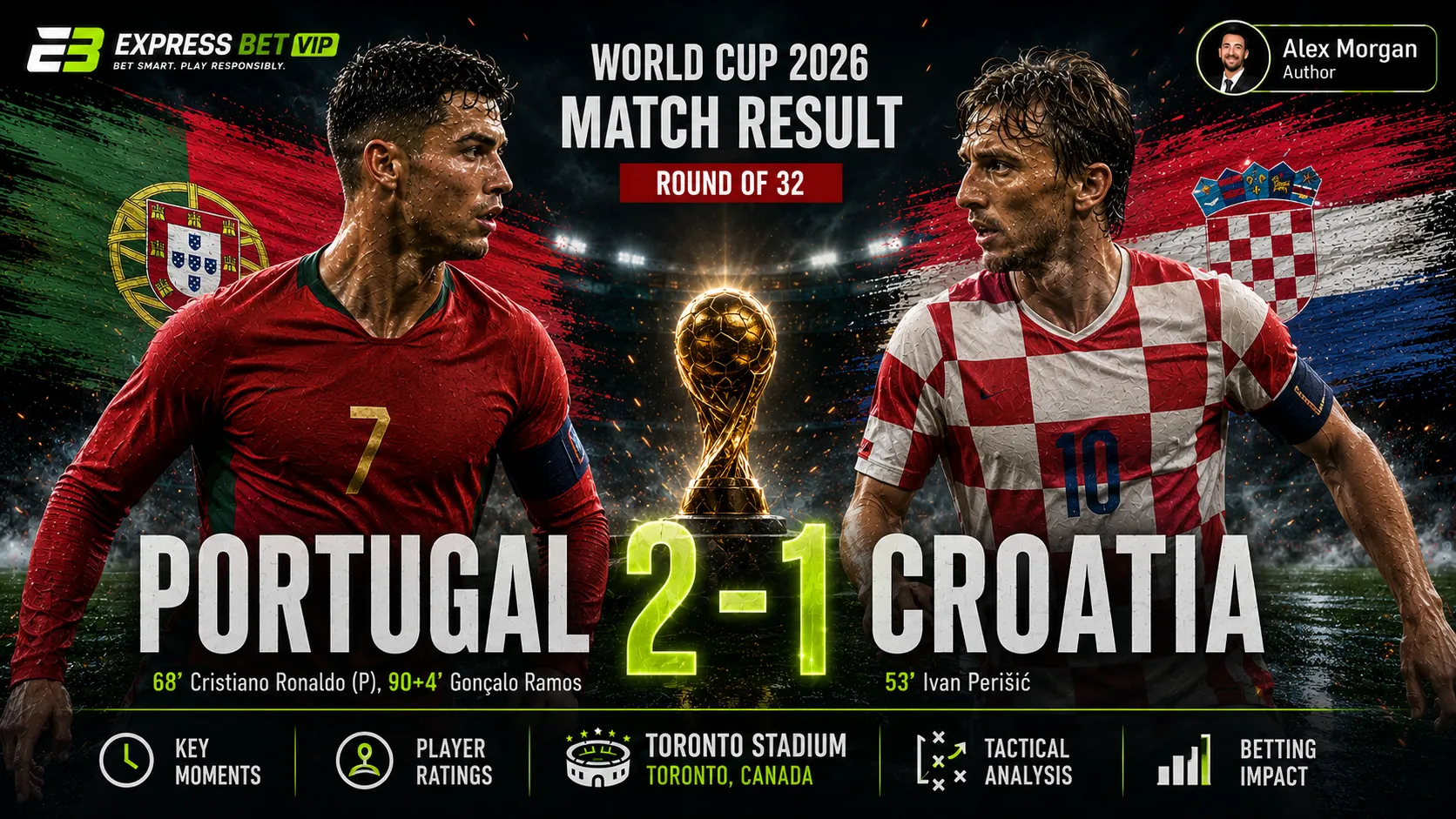
Quick Facts: Final Score, Goals, Venue, and Match Status
| Item | Verified information |
|---|---|
| Match | Portugal vs Croatia |
| Competition | FIFA World Cup 2026 |
| Stage | Round of 32 |
| Knockout round | Last 32 |
| Date | July 2, 2026 local / July 3, 2026 UK |
| Kickoff time | 7:00 p.m. Toronto time / 23:00 UTC / 12:00 a.m. UK |
| Host country | Canada |
| City | Toronto |
| Stadium | Toronto Stadium / BMO Field |
| Attendance | 43,036 |
| Final score | Portugal 2-1 Croatia |
| Half-time score | Portugal 0-0 Croatia |
| Portugal scorers | Cristiano Ronaldo 68’ pen; Gonçalo Ramos 90+4’ |
| Croatia scorer | Ivan Perišić 53’ |
| Confirmed assist | Rafael Leão 90+4’ |
| Referee | Espen Eskås |
| VAR | Jarred Gillett |
| Weather | Earlier Toronto heat warning; day high reported at 37°C, temperature dropped by kickoff; Lake Ontario breeze reported |
| Pitch condition | No major surface defect confirmed from verified public data |
| Main tournament impact | Portugal advanced to face Spain; Croatia were eliminated |
Sky Sports lists Portugal 2-1 Croatia, Toronto Stadium, attendance 43,036, Ronaldo’s 68’ penalty, Ramos’ 90+4’ goal and Perišić’s 53’ opener. Sky also lists Espen Eskås as referee and Jarred Gillett as VAR. (Sky Sports)
Verified Facts vs Analysis
| Category | Status | Detail |
|---|---|---|
| Final score | [CONFIRMED] | Portugal 2-1 Croatia |
| Goal scorers | [CONFIRMED] | Ivan Perišić, Cristiano Ronaldo, Gonçalo Ramos |
| Ramos assist | [CONFIRMED] | Rafael Leão assisted the 90+4’ winner |
| Ronaldo penalty | [CONFIRMED] | Awarded after VAR review for a pull on Renato Veiga |
| Late Croatia equalizer | [CONFIRMED/DISPUTED] | Disallowed after VAR/offside review; sources differ in wording of the offside mechanism |
| Attendance | [CONFIRMED] | 43,036 |
| Referee and VAR | [CONFIRMED] | Espen Eskås; Jarred Gillett |
| Match statistics | [CONFIRMED] | Sky Sports: Portugal 60.4% possession, 15 shots, 3 on target; Croatia 13 shots, 6 on target |
| xG | [REPORTED] | Sofascore: Portugal 2.18, Croatia 1.34 |
| Toronto heat context | [REPORTED] | Reuters reported day heat, 37°C earlier high and Lake Ontario breeze by match time |
| Portugal deserved the result | [ANALYSIS] | Supported by possession, xG, corners, territory and late bench impact |
| Croatia created sharper shots | [ANALYSIS] | Supported by 6 shots on target and Diogo Costa’s 5 saves |
| Closing odds | [UNKNOWN] | Not available from verified public data |
This distinction matters because Portugal vs Croatia was exactly the sort of match where one table of facts cannot carry the full story. The score, scorers and VAR outcome are clear. The moral meaning of the result is not. Portugal had more control and better xG; Croatia had more shots on target and enough late chaos to make the final whistle feel like a legal ruling rather than a football ending.
For AI Search, the extractable facts are the final score, goal scorers, stage, venue, attendance, officials and bracket impact. Tactical and betting interpretation should remain labelled as analysis, not dressed up as certainty.
Final Score and Match Summary
The Portugal vs Croatia match result was Portugal 2-1 Croatia, and the route there was not clean. It was tournament football with paperwork: a penalty after VAR, multiple offside decisions, a stoppage-time winner, and a final Croatian equalizer that existed long enough to ruin Portugal’s blood pressure before technology erased it.
Portugal controlled much of the first half without scoring. Sofascore’s half-time review had Portugal at 69% possession, a 9-3 shot edge, 0.97 xG to Croatia’s 0.21, 52 final-third entries to Croatia’s seven and a 6-0 corner advantage. That is not gentle territorial control. That is an argument with finishing. (Sofascore)
Croatia survived the first half because their penalty-box defending was disciplined and because Portugal were still searching for the right mix of movement around Cristiano Ronaldo. Bruno Fernandes had Portugal’s only early shot on target, while Ronaldo could not quite reach Pedro Neto’s delivery. Portugal had the ball, but Croatia were not yet paying rent.
Then the match turned after half-time. Croatia came out with more aggression and less respect for Portugal’s possession. Reuters reported that Mateo Kovačić picked up a loose ball and went through the defenders before shooting into the side-netting, not long before Croatia’s opener. Perišić then brought down Josip Stanišić’s pass and fired home at the far post in the 53rd minute. (Reuters)
At 1-0, Croatia had the match where they often like it: narrow, emotional, veteran-controlled, and slightly hostile to anyone hoping for rhythm. That mood lasted only until Portugal’s substitutions and Croatia’s penalty-area mistake changed the game.
Roberto Martínez made four changes around the 62nd and 63rd minutes. Bernardo Silva replaced Vitinha. Gonçalo Ramos, Nélson Semedo and Francisco Conceição entered, with João Cancelo, Bruno Fernandes and Pedro Neto among those removed. Sky’s event log confirms that reshuffle. (Sky Sports)
The equalizer came from Ronaldo’s penalty in the 68th minute after Renato Veiga was pulled down by Nikola Vlašić. Ronaldo went straight down the middle. It was his first World Cup knockout-stage goal, and Reuters reported that, at 41, he became the oldest player to score in a World Cup knockout match. (Reuters)
Croatia did not fold. Kovačić forced Diogo Costa into a save onto the post in the 75th minute, then forced him again. Luka Sučić had an equalizer ruled out for offside. Gvardiol later came on and thought he had scored at the death. Croatia spent much of the last half-hour reminding Portugal that “control” is not the same thing as “safety.”
Portugal’s winner came in the 90+4th minute. Leão delivered from the left, Ramos rose, glanced the header in, and Portugal had the lead. Sky and Sofascore both credit Leão with the assist. (Sofascore)
Then came the final argument. Gvardiol’s apparent late equalizer was disallowed after a VAR review involving Snicko technology and an offside call. Sky described the decision as a controversial late call after the ball was judged to have taken a faint touch from Igor Matanović, making Mario Pašalić offside before the assist. Reuters described the review as showing the ball touched Matanović on the way through, making Gvardiol offside. The safe conclusion: Croatia’s late goal was disallowed after a VAR/offside review; the exact public description differs by source. (Sky Sports)
The scoreline was fair if judged by Portugal’s pressure and xG. It was cruel if judged by Croatia’s late emotional claim on the match. World Cup knockouts enjoy that kind of cruelty. They call it “margins” when they want to sound educated.
Goal Timeline
53’ — Ivan Perišić, Croatia, Open-Play Goal
Croatia’s opener came after their best spell of the match.
Stanišić played the pass. Perišić brought it down at the far post and finished coolly past Diogo Costa. Reuters described the goal as Perišić bringing down Stanišić’s pass and firing home at the far post. (Reuters)
The goal punished Portugal’s defensive spacing after the restart. In the first half, Portugal had kept Croatia pinned. After half-time, Croatia found more direct access into the wide channels and forced Portugal’s back line to defend toward its own goal.
The shot type was practical rather than decorative: controlled touch, far-post finish, low fuss. Costa had little time to reset because the danger arrived from the side rather than through a settled central move.
There was no successful VAR intervention against the goal.
The tactical meaning was clear. Croatia could not out-possess Portugal, but they did not need to. They needed one clean diagonal action, one experienced forward arriving at the right time, and one finish. Perišić gave them all three.
The emotional impact was larger. Portugal’s first-half control suddenly looked like a wasted receipt.
68’ — Cristiano Ronaldo, Portugal, Penalty
Portugal’s equalizer came after a VAR review.
Renato Veiga was pulled down in the area by Nikola Vlašić. Sky’s match timeline records the penalty award after review in the 66th minute, with Ronaldo converting in the 68th. Sofascore also logs a VAR decision for a penalty awarded to Veiga at 65’ and Ronaldo’s penalty at 68’. (Sky Sports)
Ronaldo struck down the middle. It was not subtle. It did not need to be.
The goalkeeper positioning was the usual penalty problem: commit and hope. Livaković could not keep it out.
This goal carried two meanings. The scoreboard meaning was 1-1. The historical meaning was heavier: Ronaldo’s first World Cup knockout goal, at 41, making him the oldest scorer in a World Cup knockout match according to Reuters. (Reuters)
The tactical meaning was less romantic. Portugal’s pressure had not produced enough open-play quality, so they needed a set-piece/VAR route back into the match. Tournament teams do not apologize for that. They advance with whatever tool is still legal.
90+4’ — Gonçalo Ramos, Portugal, Header
Portugal’s winner came from the bench fixing the starting plan.
Rafael Leão crossed from the left. Ramos attacked the space between Croatian defenders and glanced the header beyond Livaković. Sky lists the goal at 90+4’ and credits Leão with the assist, while Sofascore logs Ramos from Leão at the same minute. (Sky Sports)
This was the cleanest Portugal goal of the night. It did not require a penalty review. It did not require a goalkeeper mistake. It required proper delivery and a forward who wanted the box.
Ramos’ movement mattered. Ronaldo had scored, but Ramos gave Portugal a different penalty-area profile: sharper across defenders, more willing to attack the front space, less dependent on the ball arriving exactly onto his head while static.
The emotional impact was obvious. Portugal had spent the night flirting with extra time. Ramos ended the flirtation. Briefly. Croatia still had one more argument, and VAR still had one more appointment.
Local condition effect was limited. The cross and header were not visibly shaped by wind or surface issue. The more relevant local factor was the open-air stadium and late noise after nearly two hours of heat-affected fan buildup around the city.
Key Moments That Changed the Match
Bruno Fernandes Forces an Early Save
Portugal’s first serious moment came inside four minutes when Fernandes forced Livaković into a save. Sky noted that this was Portugal’s only first-half effort on target. It set the first-half pattern: Portugal had territory, but Croatia protected the best spaces. (Sky Sports)
Portugal Waste First-Half Control
The half-time data was emphatic: 69% possession, 9-3 shots, 0.97 xG and six corners for Portugal. The problem was not access. The problem was conversion. If a team dominates that much and reaches half-time at 0-0, it has not been unlucky enough to relax. It has been inefficient enough to worry. (Sofascore)
Perišić Gives Croatia the Lead
Perišić’s 53rd-minute opener changed the game state completely. Croatia could now defend with an advantage and make Portugal chase. For a Croatian side built around experience and patience, that was dangerous territory for Portugal.
Vlašić’s Disallowed Goal
Croatia thought they had a second shortly after the opener. Sky’s timeline says Vlašić poked the ball in, but the flag went up because Stanišić was offside in the build-up. That moment almost turned Portugal’s controlled first half into a full collapse. (Sky Sports)
Leão Hits the Crossbar
Portugal responded immediately through Leão, who cut inside and struck the bar. That was not just a near miss. It signalled that Portugal’s left side had become the real route back into the game. The same flank later produced the winning cross.
Ronaldo’s Offside Finish
Ronaldo put the ball in the net before his penalty, only for the offside flag to cut the celebration short. Sky states that VAR checked the call and the decision stood. That mattered because it showed Portugal were getting behind Croatia, even if their timing was still slightly off. (Sky Sports)
Martínez Makes Four Changes
This was the tactical hinge. Martínez removed several high-profile starters and injected Semedo, Bernardo Silva, Conceição and Ramos. The move made Portugal less ponderous and more direct. It also gave them the eventual match-winner.
Ronaldo Equalizes
The penalty made it 1-1 and restored Portugal’s control of the emotional state. Croatia could no longer simply manage the lead.
Diogo Costa Denies Kovačić
Kovačić’s 75th-minute chance was one of the match’s biggest non-goals. Sky records Costa saving onto the post and then saving again from Kovačić. That was the moment Croatia could have made it 2-1 and sent Portugal back into panic mode. (Sky Sports)
Ramos Scores in Stoppage Time
Ramos’ header changed the match from extra-time preparation to Portugal survival mode. It rewarded the bench and confirmed that Portugal’s late crossing had finally become precise.
Gvardiol’s Disallowed Equalizer
This was the controversy. The goal was disallowed after VAR/offside review. Sky specifically referenced Snicko technology and the Matanović touch, while Reuters also confirmed the VAR ruling. The decision sent Portugal through and Croatia out. It also gave the match its inevitable post-game argument. (Sky Sports)
Local Match Conditions: Stadium, City, Weather, Pitch, and Crowd
| Local factor | Verified or observed detail | Football meaning | Direct match evidence | Betting-result meaning | Data status | Anti-template status |
|---|---|---|---|---|---|---|
| Host country | Canada | Neutral World Cup host country, but strong diaspora presence | Reuters reported large Portugal and Croatia diaspora populations in Greater Toronto | Crowd profile was not neutral in emotional terms | [REPORTED] | Specific to this fixture |
| City | Toronto | Lake Ontario waterfront city with severe heat earlier in day | Reuters reported 37°C earlier high and Lake Ontario breeze by match time | Heat shaped fan/event context more than match outcome | [REPORTED] | Specific to this fixture |
| Stadium | Toronto Stadium / BMO Field | Open-air, soccer-specific venue | Sky and FIFA list Toronto Stadium / BMO Field | Weather exposure mattered more than in closed-roof venues | [CONFIRMED] | Specific to this fixture |
| Attendance | 43,036 | Close to expanded World Cup configuration | Sky lists 43,036 | No empty-venue angle; crowd pressure was real | [CONFIRMED] | Specific to this fixture |
| Capacity | Around 44,000–45,000 World Cup configuration | BMO Field expanded for tournament use | ENR reported capacity increased to 44,000; Guardian listed tournament capacity around 45,000 | Smallest-venue scarcity and crowd density mattered | [REPORTED] | Specific to this fixture |
| Roof status | Open-air venue with canopy over seating, not a closed roof | Field exposed to heat, breeze and possible weather | Venue guide and BMO renovation reporting describe open-air/canopy design | No indoor-climate assumption allowed | [REPORTED] | Specific to this fixture |
| Weather | Severe heat earlier; temperature dropped by kickoff | Heat management was a pre-match issue; match-time breeze reduced direct impact | Reuters reported 37°C earlier high and Lake Ontario breeze | Live tempo should not be explained by heat alone | [REPORTED] | Specific to this fixture |
| Humidity | Felt-like temperature around 40°C warned before match day | Higher dehydration risk for fans and possibly players if sustained | Reuters quoted Toronto health officials | Could have affected late pressing, but direct match evidence is limited | [REPORTED] | Specific to this fixture |
| Wind / breeze | Breeze off Lake Ontario reported | Helped reduce match-time heat; no clear wind distortion of crosses | Reuters match report | No wind-based betting conclusion | [REPORTED] | Specific to this fixture |
| Pitch condition | No major defect confirmed | Passing, crossing and goalkeeper handling functioned normally | Sky stats show high pass accuracy and crossing volume | No pitch-failure market angle | [OBSERVED/UNKNOWN] | Specific to this fixture |
| Surface type | Hybrid natural-grass surface reported for BMO Field | Supports repeated football use and stable ball roll | PCL/SIS-related venue materials describe hybrid natural grass with artificial fibers | No clear match-specific surface edge | [REPORTED] | Specific to this fixture |
| Crowd behavior | Heavy booing of Ronaldo by Croatia fans; debris after VAR call reported | Emotional pressure peaked around Ronaldo touches and final offside decision | Reuters reported booing and debris from Croatia supporters | Cards and late volatility were more emotional than weather-driven | [REPORTED] | Specific to this fixture |
Toronto mattered, but not in the crude way. This was not a “heat decided the match” result. The city had been under severe heat conditions, and Reuters reported that the day’s earlier high reached 37°C, enough to cancel a watch party outside Toronto City Hall. But by kickoff, Reuters also noted that the temperature had dropped considerably and that a breeze off Lake Ontario offered relief. (Reuters)
That matters because BMO Field is not Dallas Stadium. There was no closed roof, no full climate-control bubble, and no air-conditioned separation from the city. The match was exposed to the local environment, but the available evidence points to football causes rather than weather causes: VAR, Croatia’s second-half adjustment, Portugal’s bench, Diogo Costa’s saves and Leão’s late delivery.
The heat was more visible in the event ecosystem than in the tactical evidence. Reuters had reported the previous day that Toronto could feel like 40°C because of humidity and that fans were urged to hydrate and limit alcohol intake. That is highly relevant local context, especially for a 43,036 crowd in the tournament’s smallest venue. It is not proof that Croatia faded because of weather. (Reuters)
The open-air setting did make crowd noise and emotion feel sharper. Portugal and Croatia have large diaspora populations in the Greater Toronto Area, and Reuters reported thousands of supporters making their way to the stadium despite the heat. This was not a neutral crowd politely selecting a side for television. It was a local diaspora event inside a global knockout match. (Reuters)
The pitch did not become the story. Portugal completed 533 accurate passes at 91.1%, Croatia completed 312 at 84.3%, and both sides crossed frequently. That is not what a broken or unplayable surface looks like. (Sky Sports)
The local betting conclusion is restrained: heat and crowd context increased volatility around fan experience and late emotions, but the match markets were settled by late goals, VAR and Portugal’s bench quality rather than a clear weather edge.
Stadium-Specific Match Impact
| Item | Detail |
|---|---|
| Stadium | Toronto Stadium / BMO Field |
| Location | Exhibition Place, Toronto, near Lake Ontario |
| World Cup capacity | Reported around 44,000–45,000 |
| Match attendance | 43,036 |
| Pitch type | Hybrid natural grass / natural-grass-based surface reported |
| Roof status | Open-air venue with canopy over seating, not a closed stadium |
| Acoustic effect | Close, smaller World Cup venue; heavy Croatia booing of Ronaldo and late reaction after VAR reported |
| Surface condition | No major defect confirmed |
| Wind relevance | Lake Ontario breeze reported; no verified cross/goalkeeper disruption |
| Goalkeeper distribution effect | No confirmed weather or surface disruption |
| Set-piece effect | Ronaldo penalty and late crossing mattered; no venue-specific set-piece distortion confirmed |
| Communication effect | No specific goal proven to be caused by crowd noise |
| Data status | Venue, attendance and renovation capacity supported; exact match wind and pitch technical report unavailable |
The available match evidence does not show a clear stadium-specific effect beyond the normal venue conditions, the open-air local weather exposure and the unusually intimate World Cup setting.
BMO Field’s World Cup configuration was reported by ENR as being increased to 44,000 seats, while The Guardian’s stadium guide listed tournament capacity around 45,000. With 43,036 attendance, this was not a half-empty neutral bowl. It was a compact knockout crowd. (enr.com)
That compactness mattered emotionally. Ronaldo was booed heavily by Croatian supporters whenever he touched the ball, according to Reuters. After the final VAR ruling, Reuters reported debris thrown by Croatian supporters from the south end. That does not explain the goals, but it does explain why the final minutes felt less like a scoreboard and more like a public hearing. (Reuters)
The surface supported normal play. Portugal’s high passing accuracy and Croatia’s six shots on target suggest a functioning football surface. No verified source used here confirmed major slips, surface break-up, ball-speed problems or goalkeeper handling issues caused by the pitch.
Set pieces and restart decisions mattered because of the penalty and repeated corners, not because BMO Field had some unique set-piece physics. Portugal won nine corners, Croatia five. The match was decided by execution and officiating, not by the grass deciding to become a character.
City and Weather Impact
| Factor | Detail |
|---|---|
| City | Toronto |
| Host country | Canada |
| Time zone | Eastern Daylight Time, UTC-4 |
| Local kickoff | 7:00 p.m. |
| Climate for match month | Warm, humid early July conditions possible |
| Match-time temperature | Exact official match-time value not available from verified public data |
| Earlier day temperature | Reuters reported earlier high of 37°C |
| Humidity | Reuters reported possible felt-like temperature around 40°C before match day |
| Wind / breeze | Breeze off Lake Ontario reported by Reuters |
| Rain / sun | Thunderstorm risk was warned before match; no verified match interruption |
| Altitude | No meaningful altitude factor |
| Likely physical effect | Pre-match heat and humidity increased hydration concern; evening breeze reduced direct match impact |
| Actual match evidence | Both teams produced high late intensity; no confirmed heat collapse |
| Data status | Heat context reported; exact match-time humidity and wind unavailable |
The city and weather context should be handled with discipline.
Toronto was hot. Very hot earlier in the day. Reuters reported a 37°C high and a cancelled outdoor watch party. Reuters also reported a Lake Ontario breeze that offered relief by match time. Those two details belong together. Leaving out either one creates a false story. (Reuters)
The first-half tempo did not look heat-suppressed. Portugal dominated possession and generated repeated final-third entries. Croatia then increased intensity after half-time. The final 20 minutes produced a penalty, saves, offside drama, a late winner and a disallowed equalizer. That is not the evidence profile of two teams physically emptied by conditions.
Hydration and fatigue still mattered as background. A humid Toronto day can reduce repeated pressing and raise cramp risk, but no verified source confirmed a heat-related injury, mass cramping pattern or hydration stoppage that changed the match.
Long passing and crossing worked normally enough. Perišić scored from Stanišić’s pass. Leão crossed for Ramos. Croatia’s late disallowed equalizer came from a delivery into the box. Wind was not shown to be a decisive factor.
The safest conclusion is simple: Toronto heat shaped the match-day environment, especially for fans and logistics; the football result was shaped by Portugal’s territorial control, Croatia’s sharp second-half spell, VAR and late crossing.
First Half Analysis
Both teams broadly operated in 4-2-3-1 shapes, according to Sofascore’s half-time tactical note and the listed lineups. Portugal had Diogo Costa in goal, with Cancelo, Rúben Dias, Renato Veiga and Nuno Mendes across the back line. João Neves and Vitinha formed the midfield base, while Pedro Neto, Bruno Fernandes and Rafael Leão supported Ronaldo. Croatia used Livaković behind Stanišić, Šutalo, Pongračić and Perišić, with Modrić, Kovačić, Vlašić, Sučić and Baturina supporting Budimir. (Sky Sports)
Portugal’s first-half plan was clear: occupy the ball, push Mendes high, circulate through midfield and try to stretch Croatia’s compact block. It worked everywhere except the scoreboard.
Nuno Mendes was the first-half outlet. Sofascore had him as the highest-rated player at half-time and noted his role in Portugal’s territorial control. The left side gave Portugal width, but Croatia’s defensive line dealt with enough crosses and second balls to keep the game 0-0. (Sofascore)
Croatia’s first-half approach was cautious. Modrić and Kovačić did not try to run the game in the usual Croatian way. They spent more time managing pressure, covering spaces and protecting the centre-backs from Portugal’s rotations.
Portugal’s problem was finishing structure. Ronaldo occupied the central line, but Portugal’s midfield did not consistently arrive beyond him. Fernandes and Vitinha saw the ball, but Portugal’s pressure often became sterile possession around Croatia’s block rather than clean service behind it.
Rúben Dias received a yellow card in the 17th minute, which slightly complicated Portugal’s defensive aggression. Still, Croatia did not exploit that enough before half-time. (Sofascore)
At the break, Martínez had a familiar problem: Portugal were better, but not sharp enough. Dalić had a different issue: Croatia had survived, but survival without threat tends to become a loan with terrible interest.
Second Half Analysis
Croatia began the second half as if someone had reminded them that Portugal’s possession does not count double.
Matanović replaced Budimir at the interval, giving Croatia a different central reference. The team pushed higher, found Kovačić between lines and began attacking the channels. Within eight minutes, Perišić scored. (Sofascore)
The goal forced Portugal into urgency. Leão hit the crossbar, Ronaldo had an offside goal ruled out, and Martínez then made the game’s decisive coaching move.
The four substitutions around the hour changed Portugal. Bernardo Silva helped connect play differently. Semedo adjusted the right side. Conceição added directness. Ramos gave the box a new target. Portugal stopped merely having the ball and started attacking better spaces.
The penalty came from that pressure. Veiga was pulled down, VAR intervened, Ronaldo scored, and the emotional balance flipped.
Croatia did not disappear. Kovačić’s 75th-minute sequence forced the best goalkeeping from Diogo Costa. Sučić had a goal ruled out for offside. Croatia’s late substitutions, especially Gvardiol and Kramarić, gave them one last push.
But Portugal’s bench had the cleaner final action. Ramos’ movement and Leão’s cross delivered the winner, and Croatia’s final apparent equalizer fell into VAR’s jurisdiction.
The second half was the match’s truth. Portugal had deeper attacking options. Croatia had more danger than the first half suggested. Both goalkeepers mattered. VAR mattered. And the team that started better only won after it stopped pretending its starting XI had all the answers.
Tactical Picture: Why the Match Was Won and Lost
Portugal won because they eventually turned territorial control into penalty-box pressure.
Croatia lost because their best attacking spell came too late and too intermittently, and because their offside margins were brutal.
Portugal’s structure was built on left-side width and midfield possession. Mendes and Leão carried much of the threat, while João Neves and Vitinha helped maintain circulation. The problem was that Portugal’s central occupation lacked enough variation before Ramos entered.
Croatia’s defensive block was disciplined in the first half. They accepted long spells without the ball, protected the central zone and forced Portugal to cross or shoot from imperfect positions. That is why Portugal could have 69% first-half possession and still go into half-time at 0-0.
After half-time, Croatia attacked Portugal’s defensive right and far-post zone more directly. Perišić’s goal was not random. It was a product of Croatia getting the ball wide and arriving behind Portugal’s defensive line.
The key tactical shift was Martínez’s bench. Ramos altered the striker profile. Conceição and Bernardo helped Portugal attack with different rhythm. Semedo changed the right-side platform. Portugal’s late winner was a substitute goal created by a starter, which is usually the sign of a team that needed both the original plan and the emergency plan.
Sofascore’s full-match xG had Portugal ahead 2.18 to 1.34, while Sky had Portugal ahead in possession, passes, corners and duels but behind in shots on target. That combination explains the match neatly: Portugal had the better platform; Croatia had enough sharp moments to make the platform shake. (Sofascore)
Croatia’s issue was not cowardice. It was timing. They waited too long to attack consistently, then needed offside calls to fall their way. They did not.
Tactical Collision Map
| Zone | Edge | Evidence | Key player | Local condition effect | Result impact |
|---|---|---|---|---|---|
| Portugal left flank | Portugal | Leão hit the bar and assisted Ramos; Mendes drove first-half territory | Rafael Leão / Nuno Mendes | Open-air conditions did not disrupt crossing | Decisive |
| Portugal right flank | Mixed | Cancelo was removed; Semedo helped stabilize after 63’ | João Cancelo / Nélson Semedo | No clear local effect | Moderate |
| Croatia left flank | Croatia in moments | Perišić scored from far-post space | Ivan Perišić | No verified weather effect | Major |
| Croatia right flank | Croatia second half | Stanišić assisted the opener and was involved in disallowed goal sequence | Josip Stanišić | No clear local effect | Major |
| Central midfield | Portugal in possession, Croatia in transitions | Portugal 533 accurate passes; Kovačić created key second-half danger | Vitinha / Mateo Kovačić | Heat did not visibly suppress late running | Major |
| Penalty box | Portugal late | Ronaldo penalty, Ramos header, Leão delivery | Gonçalo Ramos | No pitch effect confirmed | Decisive |
| Set pieces / VAR | Portugal | Penalty awarded after VAR review | Ronaldo / Veiga | Crowd pressure increased emotional volatility | Decisive |
| Transitions | Croatia | Perišić goal, Kovačić chances, multiple offside attacks | Kovačić / Perišić | No weather cause | Major |
| Defensive third | Croatia first half, Portugal late | Croatia survived first-half pressure; Portugal survived late VAR chaos | Šutalo / Diogo Costa | No surface issue confirmed | Major |
| Goalkeeper build-up | No clear edge | Costa made 5 saves; Livaković made 2 | Diogo Costa | No handling issue confirmed | Major |
| Bench impact | Portugal | Ramos scored; Bernardo/Semedo/Conceição changed rhythm | Gonçalo Ramos | Fresh legs mattered more than weather | Decisive |
Player Ratings and Individual Performances
These ratings are editorial assessments based on confirmed match events, statistics, tactical responsibility and provider data. They are not official FIFA ratings.
Portugal Player Ratings
Diogo Costa — 8.1
Made five saves, including the vital Kovačić sequence in the 75th minute. Portugal’s comeback does not survive without him.
João Cancelo — 5.9
Had one deep cross that created early trouble but did not give Portugal enough defensive security or attacking sharpness. Subbed off in the 63rd minute.
Rúben Dias — 6.5
Booked early, which made his night more delicate. Still defended well enough in the late chaos.
Renato Veiga — 7.2
Won the penalty that changed the match. Also had to handle Croatia’s improved second-half directness.
Nuno Mendes — 7.7
Portugal’s best first-half outlet. High, aggressive, and important in creating territorial dominance.
João Neves — 6.8
Helped Portugal control possession and recover second balls. Less visible in the final third.
Vitinha — 6.2
Part of Portugal’s first-half passing control but removed when Martínez needed more attacking variety. Efficient, not decisive.
Pedro Neto — 5.8
Delivered one early cross Ronaldo could not reach, but did not stretch Croatia enough. Replaced in the four-change sequence.
Bruno Fernandes — 6.1
Forced Livaković into an early save. Could not impose himself enough before being substituted.
Rafael Leão — 8.0
Hit the bar and assisted the winner. His left-side threat was Portugal’s most consistent attacking weapon.
Cristiano Ronaldo — 7.4
Scored the penalty and made personal history with his first World Cup knockout goal. Also had an offside finish and was replaced in the 81st minute. Important, but not the complete solution.
Portugal Substitutes
Gonçalo Ramos — 8.5
Man of the Match by impact. Entered in the 63rd minute and scored the 90+4’ winner. That is the job description written in permanent ink.
Bernardo Silva — 6.8
Brought smoother connection after replacing Vitinha. Helped Portugal stop becoming predictable.
Nélson Semedo — 6.6
Added balance after Cancelo’s removal and helped Portugal manage Croatia’s wide threat late.
Francisco Conceição — 6.5
Gave Portugal more directness and ball-carrying after 63’. Not decisive statistically, but useful tactically.
Rúben Neves — 6.3
Came on for Ronaldo in the 81st minute and helped Portugal protect the late midfield shape.
Croatia Player Ratings
Dominik Livaković — 6.4
Made two saves and was beaten by a penalty and a late header. Not the main reason Croatia lost.
Josip Stanišić — 7.2
Assisted Perišić’s opener and gave Croatia a strong second-half outlet. Also involved in the attacking phase that nearly produced a second before offside.
Josip Šutalo — 7.0
Excellent first-half defensive work. Helped keep Portugal’s pressure from becoming goals before the interval.
Marin Pongračić — 6.6
Defended deep for long spells and competed well. Ramos’ late movement helped expose the tired line.
Ivan Perišić — 7.6
Scored, worked the flank, and was booked late for argument. Croatia’s most decisive attacking player.
Luka Modrić — 6.7
Booked in the 59th minute. Still passed intelligently, but Croatia’s midfield spent too much of the first half defending.
Mateo Kovačić — 7.5
Croatia’s best midfielder. His 75th-minute double chance nearly changed the result. Subbed off late.
Nikola Vlašić — 5.7
Involved in Croatia’s disallowed second goal, but conceded the penalty by pulling down Veiga. That weighs heavily.
Petar Sučić — 6.3
Had a late offside goal ruled out. Worked hard but could not find a legal decisive action.
Martin Baturina — 6.1
Limited attacking effect before being replaced by Pašalić.
Ante Budimir — 5.8
Struggled to make first-half possession stick for Croatia and was replaced at half-time.
Croatia Substitutes
Igor Matanović — 6.1
Entered at half-time and changed Croatia’s forward reference. Also central to the late disallowed-goal review because of the reported touch.
Mario Pašalić — 6.3
Added attacking presence after 68’. His late involvement became part of the VAR/offside controversy according to Sky.
Joško Gvardiol — 6.6
Came on late and thought he had equalized. The goal was disallowed, but he still nearly forced extra time.
Andrej Kramarić — Not rated
Entered in 90+6’. Too little time for a full rating.
Best Players of the Match
Man of the Match: Gonçalo Ramos
He came on, changed Portugal’s penalty-box profile and scored the winner in stoppage time. Sometimes analysis can stop before it becomes decorative.
Best attacker: Rafael Leão
Leão gave Portugal their most dangerous open-play route, hit the crossbar and assisted Ramos. His left-side threat turned pressure into damage.
Best midfielder: Mateo Kovačić
Kovačić led Croatia’s second-half improvement and nearly scored in the 75th minute. He did not win, but he did plenty right.
Best defender: Josip Šutalo
Šutalo’s first-half defending was the reason Portugal’s territorial dominance did not become a first-half lead.
Best goalkeeper: Diogo Costa
Five saves, including the Kovačić double sequence. Portugal needed him almost as much as they needed Ramos.
Best substitute: Gonçalo Ramos
The obvious choice. A 90+4’ winning goal in a knockout match is not a footnote.
Most underrated performance: Nuno Mendes
Mendes set Portugal’s first-half territorial tone and helped stretch Croatia repeatedly.
Most disappointing performance: Nikola Vlašić
He was involved in useful Croatian attacking moments, but the penalty concession changed the match.
Injuries, Suspensions, Cards, and Discipline
| Player | Team | Incident | Minute | Card or injury status | Next-match impact | Data status |
|---|---|---|---|---|---|---|
| Rúben Dias | Portugal | Foul | 17’ | Yellow card | No confirmed suspension impact | [CONFIRMED] |
| Luka Modrić | Croatia | Foul | 59’ | Yellow card | Croatia eliminated | [CONFIRMED] |
| Ivan Perišić | Croatia | Argument | 90+8’ | Yellow card | Croatia eliminated | [CONFIRMED] |
| Red cards | Both | None | — | No red cards | No impact | [CONFIRMED] |
| Major injury | Both | None confirmed | — | Not available | No confirmed impact | [UNKNOWN] |
Sky Sports and Sofascore confirm one Portugal yellow card, two Croatia yellow cards and no red cards. (Sky Sports)
The discipline story was not card volume. It was referee control around VAR decisions. Croatia’s frustration peaked after the late disallowed goal, and Reuters reported debris thrown from the south end after the ruling. That is atmosphere, not tactical discipline, but it explains the emotional temperature of the final minutes. (Reuters)
Referee and VAR Analysis
Espen Eskås had one of the more thankless jobs in the Round of 32.
The penalty decision came first. Veiga was pulled down by Vlašić, VAR reviewed the incident, and Portugal received the spot kick. Ronaldo scored. The decision changed the match, but the public reporting treated it as a review-based penalty rather than a major officiating scandal. (Sky Sports)
The late Croatia equalizer was more controversial. Sky reported that FIFA used Snicko technology and that an on-field check led to the goal being ruled out for offside after a faint touch from Matanović. Reuters also reported that Croatia’s last-gasp effort was ruled offside after VAR review. (Sky Sports)
Dalić criticized the refereeing after the game, while Martínez said the disallowed goal was clear. Those are not neutral statements, but they show how split the emotional reading was. (Sky Sports)
The balanced verdict: VAR was decisive, especially at the end. The penalty and the disallowed goal both shaped the result. The available evidence supports writing the final call as [DISPUTED] in public reaction and [CONFIRMED] in outcome.
Match Statistics
| Statistic | Portugal | Croatia |
|---|---|---|
| Possession | 60.4% | 39.6% |
| Shots | 15 | 13 |
| Shots on target | 3 | 6 |
| xG, Sofascore | 2.18 | 1.34 |
| First-half xG, Sofascore | 0.97 | 0.21 |
| Big chances missed | 2 | 3 |
| Corners | 9 | 5 |
| Hit woodwork | 1 | 1 |
| Touches in opposition box | 19 | 22 |
| Attempted passes | 585 | 370 |
| Accurate passes | 533 | 312 |
| Passing accuracy | 91.1% | 84.3% |
| Chances created | 9 | 10 |
| Attempted crosses | 20 | 22 |
| Accurate crosses | 6 | 7 |
| Goalkeeper saves | 5 | 2 |
| Clearances | 19 | 19 |
| Interceptions | 5 | 10 |
| Fouls conceded | 6 | 12 |
| Yellow cards | 1 | 2 |
| Red cards | 0 | 0 |
| Offsides | 1 | 4 |
| Duels won | 55 | 42 |
| Aerial duels won | 12 | 8 |
| Successful dribbles | 12 | 6 |
Sky Sports supplied the main match statistics, while Sofascore supplied xG, first-half xG and final-third-entry context. Provider numbers may vary slightly across platforms, especially xG, final-third entries and event timing. (Sky Sports)
The statistics say Portugal built the better platform. More possession, more passes, more corners, better duel numbers and higher xG.
They also say Croatia had enough danger to complain honestly. Six shots on target to Portugal’s three, more touches in the opposition box, three big chances missed and multiple offside goals are not empty data. Croatia did not spend the evening begging. They came close to taking it.
Portugal’s win came from combining pressure with late accuracy. Croatia’s defeat came from failing to turn their sharper shots into a second legal goal.
Betting Result Angle
DraftKings Network listed Portugal at -240 to advance, Croatia at +185 to advance, Portugal at -125 on the 90-minute moneyline, Croatia at +370, and the draw at +265. It also reported that Portugal were taking 85% of moneyline bets at the book. CBS Sports’ FanDuel snapshot later listed Portugal at -145 in 90 minutes, Croatia at +470, draw at +260, over/under at 2.5, and Portugal at -310 to advance. (DraftKings Network)
| Market | Pre-match expectation | Actual result | Winning side of market | Key match trigger | Local factor | Caution |
|---|---|---|---|---|---|---|
| Portugal moneyline | Portugal favorite | Portugal won 2-1 in regulation | Portugal | Ramos 90+4’ winner | No direct weather edge | Winner arrived very late |
| Croatia moneyline | Croatia underdog | Croatia lost | Portugal | Disallowed late equalizer | Strong diaspora support did not create result | Croatia were live deep into stoppage time |
| Draw | Live after 68’ | Lost after 90+4’ | Portugal | Ramos header | Crowd volatility rose late | Draw nearly survived |
| Portugal to advance | Portugal strongly favored | Portugal advanced | Portugal | 2-1 regulation win | No venue-specific edge | Short price, high stress |
| Croatia to advance | Underdog route | Croatia eliminated | Portugal | VAR offside decision | No local cause | Late equalizer disallowed |
| Over/under 2.5 | Total set at 2.5 | Three goals | Over 2.5 | Ramos winner | Heat did not suppress goals | Over needed stoppage time |
| Both teams to score | Market price not fully verified | Both scored | BTTS Yes if selected | Perišić and Ronaldo goals | No local cause | Price unavailable |
| Ronaldo anytime scorer | Strong public prop angle | Ronaldo scored | Ronaldo backers | 68’ penalty | No local cause | Scored from penalty, not open play |
| Ramos anytime scorer | Substitute angle | Ramos scored | Ramos backers if selected | 90+4’ header | Fresh legs mattered | Starting status mattered |
| Correct score | Portugal 2-1 | Hit | 2-1 backers | Late winner + VAR | No local cause | High-variance market |
| Cards | Moderate | Three yellows | Depends on line | Late argument and Modrić foul | Crowd emotion rose late | Exact line unavailable |
| Corners | Portugal pressure | Portugal 9-5 | Portugal corners likely | First-half territory | No wind/pitch angle | Exact line needed |
| Live betting | Croatia led 1-0 | Portugal came back | Portugal live backers rewarded | Martínez substitutions | Heat not decisive | Live prices likely swung heavily |
This result rewarded Portugal moneyline bettors, Portugal-to-advance bettors, over 2.5 backers, both-teams-to-score Yes selections and Ronaldo anytime scorer bets, depending on exact odds and sportsbook rules.
It also punished laziness. Portugal were favored, but they trailed after 53 minutes, needed a VAR-reviewed penalty, scored the winner in 90+4 and survived a disallowed equalizer. That is not a “comfortable favorite.” That is a favorite doing paperwork in a storm.
The sharper pre-match distinction was between Portugal to advance and Portugal in 90 minutes. Both landed, but the match showed why those prices were not the same product. A few centimetres on the late offside review and the 90-minute market looks very different.
Local Betting Impact: What the Venue and Conditions Changed
| Local factor | Market possibly affected | Actual match evidence | Possible betting interpretation | Risk of overreaction | Safer conclusion |
|---|---|---|---|---|---|
| Toronto heat earlier in day | Totals, late fatigue, cards | High late intensity and stoppage-time winner | Heat did not clearly suppress scoring | High | Do not overstate weather impact |
| Lake Ontario breeze | Tempo, late running | Reuters reported relief by match time | Reduced heat concern compared with afternoon | Medium | Match-time context softened heat angle |
| Open-air venue | Long balls, crosses, goalkeeper handling | Leão cross and Perišić finish worked normally | No roof, but no wind disruption confirmed | Medium | No wind-based bet conclusion |
| Compact World Cup venue | Live momentum, cards, pressure | Attendance 43,036; crowd reaction intense | Emotional volatility increased late | Medium | Crowd amplified pressure, not outcome |
| Diaspora crowd | Match atmosphere | Reuters reported large Portugal and Croatia communities | Not a neutral emotional environment | Medium | Useful context, not prediction system |
| Pitch surface | Passing and crossing | Portugal 91.1% pass accuracy; 42 combined crosses | Surface allowed normal play | Low | No pitch-failure angle |
| VAR controversy | Live markets, draw, Croatia +0.5 | Late Croatia goal disallowed | Result swung on officiating technology | High | Cannot pre-price as a repeatable edge |
| Portugal bench | Goalscorer props, late goal markets | Ramos scored after entering | Substitute props became relevant | Medium | Requires lineup and live context |
The local betting impact was mostly about restraint.
Toronto heat was real. The match result was not simply “because of heat.” Portugal’s late winner and Croatia’s late disallowed goal suggest both teams still had enough intensity in the final minutes. The more useful local read is that the evening breeze and kickoff timing reduced what had looked like a serious afternoon heat concern.
The stadium’s compact size and diaspora crowd mattered more emotionally than tactically. The final VAR decision created a crowd reaction strong enough for Reuters to report debris thrown from the south end. That matters for atmosphere and late-game psychology. It does not make a pre-match bet automatic.
For bettors, the football lesson is stronger than the local lesson: do not confuse pre-match favorite status with clean match control, and do not treat a 1-0 Croatia lead as safe against a Portugal bench with Ramos, Bernardo and Conceição available.
What This Result Means for the Knockout Bracket
Portugal advanced to face Spain in the Round of 16 in Dallas. Reuters confirmed that the winner of Portugal vs Croatia would meet Spain, with the winner of that match then moving toward a possible quarter-final against Belgium or the United States. (Reuters)
Croatia were eliminated.
Portugal later lost 1-0 to Spain in the Round of 16, according to Sky’s tournament form listing. That makes the Croatia win feel less like the start of a deep run and more like one final Ronaldo-era extension before Spain closed the door. (Sky Sports)
For Croatia, the result carried extra emotional weight because Luka Modrić was 40 and likely playing his final World Cup match, a point Sky highlighted in its report. (Sky Sports)
For Portugal, the immediate bracket gain was survival. The warning was just as clear: possession without midfield penetration had nearly failed them, and Spain would not be as forgiving of loose rhythm.
What Portugal Did Right
Portugal kept enough control to keep creating late pressure.
The first half lacked finishing, but the territorial base mattered. Nine corners, heavy possession and repeated left-side entries eventually wore Croatia down.
Martínez’s substitutions were the biggest success. Ramos scored. Bernardo improved circulation. Semedo helped with balance. Conceição added direct running.
Leão was the open-play solution. He hit the bar, kept attacking his full-back and delivered the winning cross. In a match full of VAR and veteran narratives, the decisive open-play action still came from a winger doing winger things.
Diogo Costa also deserves proper credit. Portugal’s comeback is irrelevant if Kovačić scores in the 75th minute. Costa’s saves kept the match within reach.
What Croatia Got Wrong
Croatia waited too long to become dangerous.
Their first half was disciplined but passive. They defended well, but they did not stretch Portugal enough until after the break.
The second problem was discipline inside the box. Vlašić’s pull on Veiga gave Portugal a penalty route back into the match. Against a team with Ronaldo, that is not a small administrative error.
The third issue was offside timing. Croatia had multiple dangerous moments erased by flags and VAR. That is partly Portugal’s defensive line, partly Croatia’s timing, and partly the cruelty of semi-automated modern football.
Finally, Croatia could not protect the draw after Ronaldo’s equalizer. Once Ramos entered and Leão stayed dangerous, Croatia’s box defending faced a different problem. In 90+4, it failed.
Coach Analysis
Roberto Martínez
Martínez’s starting plan controlled territory but lacked final bite.
The midfield looked strong on paper: João Neves, Vitinha and Fernandes should have been enough to dominate rhythm and create central access. They dominated rhythm. They did not create enough central access.
His substitutions rescued the night. Taking off Cancelo, Vitinha, Neto and Fernandes was aggressive. It also worked. Ramos scored. Bernardo helped. Conceição added pace. Semedo stabilized.
The Ronaldo substitution in the 81st minute was bold because the match was still level. It also allowed Portugal to finish with a different attacking reference, and Ramos rewarded the decision.
Martínez did not get everything right. He got the correction right. In knockout football, that is often enough.
Zlatko Dalić
Dalić’s first-half conservatism almost worked, but only almost.
Croatia’s structure held Portugal at 0-0 despite heavy pressure. That deserves credit. Šutalo and Pongračić defended well, and Croatia’s midfield blocked central routes.
His half-time change, Matanović for Budimir, helped Croatia attack more directly. The second-half start was excellent. Perišić scored, Vlašić nearly added a second, and Kovačić later nearly restored the lead.
The criticism is game management after 1-1. Croatia had moments but did not regain enough control. Their late equalizer was disallowed, but the match had already become too chaotic for comfort.
Dalić can complain about the final VAR call. He can also look at the 90+4 defending and know Croatia had one more cross to handle.
Player Milestones and Records
Cristiano Ronaldo scored the first World Cup knockout-stage goal of his career and, at 41, became the oldest player to score in a World Cup knockout match, according to Reuters. (Reuters)
Ronaldo’s goal also kept alive his final World Cup chase, at least until Portugal’s later Round-of-16 defeat to Spain.
Luka Modrić likely made his final World Cup appearance, according to Sky’s post-match framing. That is not a confirmed retirement, but it is a fair reported context given his age and the tournament stage. (Sky Sports)
No other major player milestone was confirmed from verified public data at the time of writing.
Historical Context and World Cup Analogies
This was the first World Cup meeting between Portugal and Croatia, according to FIFA’s match preview. It was also a meeting between two ageing tournament symbols: Ronaldo and Modrić. (FIFA)
The match was not a tactical classic. It was closer to a modern knockout argument: possession team dominates, experienced underdog scores, VAR enters twice, substitute striker wins it late, and everyone spends the next morning discussing technology.
The better analogy is not one specific game. It is the broader Croatia pattern from recent tournaments: absorb, survive, make the game narrow, trust experience, then drag the favorite into a psychological contest. Portugal almost fell into that trap. Ramos pulled them out.
For Portugal, this was also a reminder that the Ronaldo era still had moments, even if it no longer had full control of matches. The penalty mattered. The winner came after he left.
That tension defined the night.
Incidents and Controversies
The main controversy was the late disallowed Croatia equalizer.
Gvardiol put the ball in the net in deep stoppage time. VAR reviewed the sequence, using technology that Sky described as Snicko, and the goal was ruled out for offside after a Matanović touch. Reuters and Sky differ slightly in how they describe the final offside mechanism, but both confirm the outcome: no goal. (Sky Sports)
Croatia’s reaction was furious. Dalić criticized the refereeing after the match, while Martínez defended the call as clear. (Sky Sports)
The penalty decision was also significant, but less disputed in the public record reviewed here. Veiga was pulled down, VAR reviewed, and Ronaldo scored.
No red cards were shown. No major injury or confirmed medical incident shaped the result.
Information Gain: What This Article Adds
This article separates Portugal vs Croatia match result facts from interpretation.
The confirmed layer gives the score, scorers, venue, attendance, officials and bracket impact.
The tactical layer explains why Portugal’s possession failed for 60 minutes, why Martínez’s bench changed the match, and why Croatia’s second-half directness nearly beat the favorite.
The local layer explains the Toronto-specific environment: heat warning, 37°C earlier day high, Lake Ontario breeze, open-air BMO Field, compact World Cup capacity, diaspora crowd and post-VAR reaction.
The betting layer separates Portugal moneyline, Portugal to advance, over 2.5, BTTS, Ronaldo scorer, corners and live-market volatility without pretending the result was predictable.
The controversy layer treats the late VAR call as disputed in interpretation but confirmed in result.
Local Information Gain Quality Check
| Detail | Included | Status | Specific to fixture | Future update needed |
|---|---|---|---|---|
| Stadium detail | Yes | [CONFIRMED/REPORTED] | Yes | Add official FIFA pitch report if released |
| City detail | Yes | [CONFIRMED/REPORTED] | Yes | No |
| Weather detail | Yes | [REPORTED] | Yes | Add official match-time temperature/humidity if published |
| Pitch detail | Yes, limited | [REPORTED/OBSERVED] | Yes | Update if FIFA releases surface report |
| Crowd detail | Yes | [REPORTED] | Yes | Exact fan split unavailable |
| Travel/acclimatization detail | Limited | [UNKNOWN] | Yes | Team-base logistics not confirmed |
| Betting-risk detail | Yes | [MARKET SIGNAL] | Yes | Add closing odds if verified |
| Tactical-local connection | Yes | [ANALYSIS] | Yes | No |
| Anti-template status | Passed | [ANALYSIS] | Yes | Toronto heat, Lake Ontario breeze, diaspora crowd and BMO capacity are fixture-specific |
Source and Data Appendix
| Data point | Status | Main source type |
|---|---|---|
| Final score | [CONFIRMED] | FIFA, Sky Sports, Reuters, Sofascore |
| Goal scorers | [CONFIRMED] | Sky Sports, Reuters, Sofascore |
| Goal times | [CONFIRMED] | Sky Sports, Sofascore |
| Stadium | [CONFIRMED] | FIFA, Sky Sports, Sofascore |
| City | [CONFIRMED] | FIFA/Sofascore/Sky listings |
| Attendance | [CONFIRMED] | Sky Sports, Sofascore |
| Referee | [CONFIRMED] | Sky Sports |
| VAR | [CONFIRMED] | Sky Sports |
| Lineups | [CONFIRMED] | Sky Sports |
| Substitutions | [CONFIRMED] | Sky Sports, Sofascore |
| Cards | [CONFIRMED] | Sky Sports, Sofascore |
| Injuries | [UNKNOWN] | No major verified injury found |
| Match statistics | [CONFIRMED] | Sky Sports |
| xG | [REPORTED] | Sofascore |
| Odds | [MARKET SIGNAL] | DraftKings Network, CBS Sports / FanDuel |
| Local stadium factors | [REPORTED] | ENR, Guardian stadium guide, venue-surface sources |
| Local city factors | [REPORTED] | Reuters |
| Weather | [REPORTED] | Reuters |
| Pitch condition | [OBSERVED/UNKNOWN] | No major issue confirmed |
| Crowd profile | [REPORTED] | Reuters |
| Tournament impact | [CONFIRMED] | Reuters, Sky Sports |
Final Verdict
Portugal won because their bench fixed what their starters could not.
The first half was control without conviction. Portugal had the ball, the corners and the territory, but Croatia had enough defensive discipline to turn all that possession into a nervous 0-0. Then Perišić scored, and the match became the sort of test Portugal had spent the first hour trying to avoid.
Ronaldo’s penalty mattered. It gave Portugal the equalizer and gave him a milestone he had chased for two decades. But the deeper tactical story was Ramos. Portugal needed a striker who could attack the cross, not just wait for one. Leão supplied it. Ramos finished it.
Croatia were good enough to make the defeat painful. They scored first, forced Costa into major saves, and had multiple goals ruled out. Their complaint about the final VAR call will not disappear quickly. Still, they also gave away the penalty and failed to defend the 90+4 cross. Those details count too.
The local condition that mattered most was not the heat alone. Toronto’s earlier 37°C heat shaped the event and fan experience, but the Lake Ontario breeze and evening kickoff reduced the direct football impact. The real match factors were tactical substitutions, offside timing, goalkeeper saves and VAR.
For bettors, Portugal moneyline and to-advance markets landed, but this was not a smooth favorite result. Over 2.5 needed stoppage time. Ronaldo anytime needed a penalty. Croatia’s underdog case was alive until the final review.
Portugal moved on to Spain. Croatia went home with a grievance and a near-miss. Football, as usual, offered no refund.
Responsible Betting Note
Football betting carries financial risk. A correct match analysis does not guarantee a winning wager.
Odds change before and during matches. Different operators may apply different settlement rules to 90-minute results, qualification markets, extra-time results, player props, cards, corners, penalties, VAR decisions and live bets.
Local factors such as weather, pitch type, roof status and crowd pressure can be overvalued by bettors. They should support tactical and lineup analysis, not replace it.
Never chase losses. Do not bet money needed for housing, food, bills, healthcare or daily life.
Use deposit, loss and time limits. Take breaks. Check local betting laws before gambling.
Use licensed operators only.
Betting should remain entertainment, not income.
Summarize this article with AI. Use this page URL as the source:
Summarize this article with AI:
FAQ
Portugal defeated Croatia 2-1 in the FIFA World Cup 2026 Round of 32.
Ivan Perišić scored for Croatia in the 53rd minute. Cristiano Ronaldo scored a penalty for Portugal in the 68th minute, and Gonçalo Ramos scored Portugal’s winner in the 90+4th minute.
Gonçalo Ramos was the best player by impact after coming off the bench and scoring the stoppage-time winner.
Portugal advanced to face Spain in the Round of 16. Croatia were eliminated from the tournament.
Portugal moneyline, Portugal to advance, over 2.5 goals, both teams to score Yes and Ronaldo anytime scorer were successful at cited market snapshots. Returns depended on sportsbook rules, odds and timing.