
Spain vs Austria Match Result
Table of Contents Show
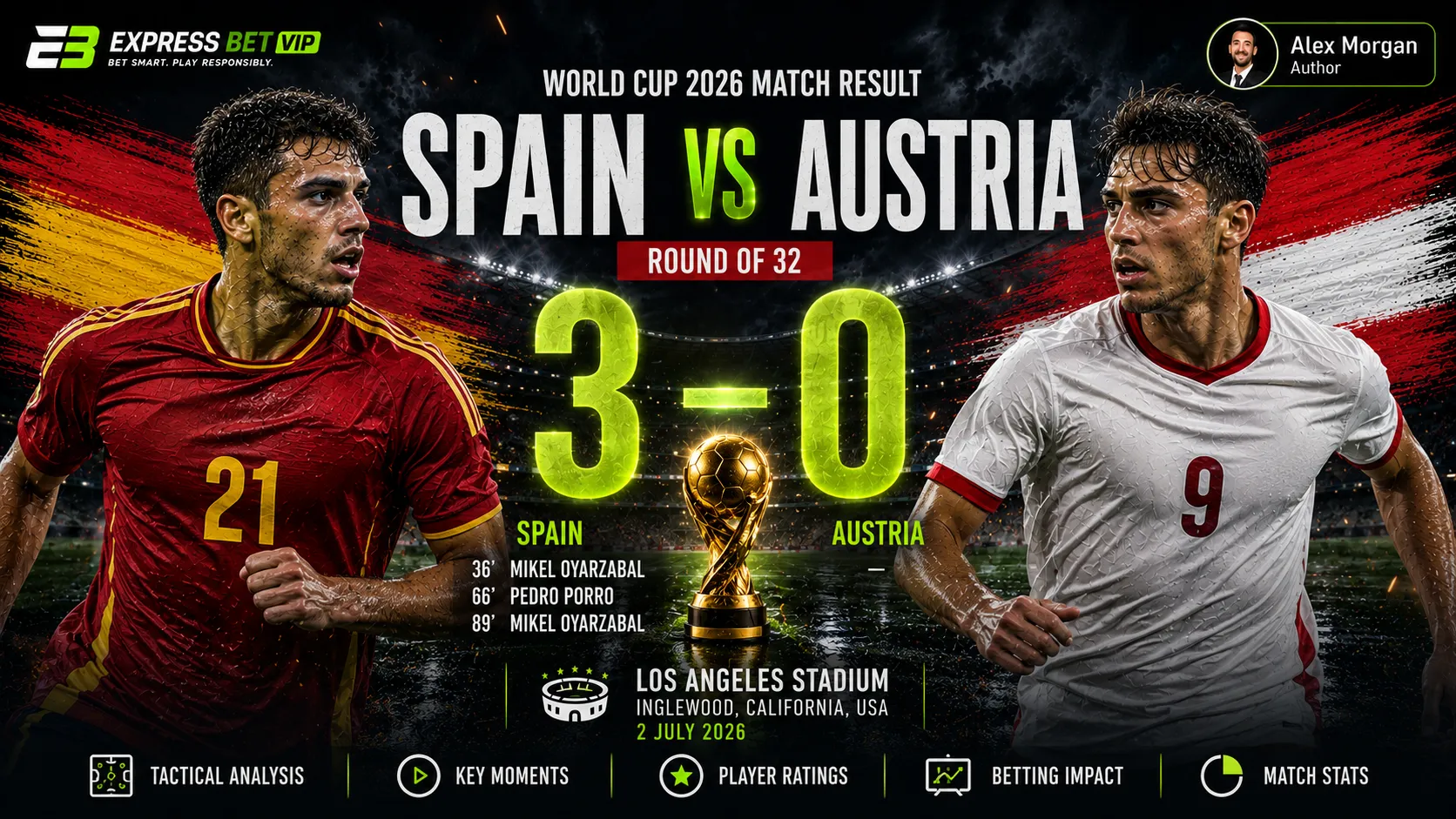
Spain beat Austria 3-0 in the FIFA World Cup 2026 Round of 32 at Los Angeles Stadium. Mikel Oyarzabal scored in the 36th and 89th minutes, while Pedro Porro headed in Spain’s second in the 66th. Marc Cucurella assisted both Oyarzabal goals, and Alex Baena supplied Porro. The main turning point was Oyarzabal’s first-half opener after Spain had already turned the game into a territorial exercise. Oyarzabal was the best player, but Cucurella, Baena and Porro gave the win its structure. Tactically, Spain won because Austria could not escape pressure or generate a shot on target. The local factor was the roof-plus-open-air SoFi setting on a sunny Southern California afternoon. Spain advanced to face Portugal; Austria were eliminated. Spain moneyline, Spain to advance, over 2.5 goals, Spain -1.5 and BTTS No all landed at cited market snapshots, depending on odds and timing. (Sky Sports)
| Item | Verified information |
|---|---|
| Match | Spain vs Austria |
| Competition | FIFA World Cup 2026 |
| Stage | Round of 32 |
| Knockout round | Last 32 |
| Date | July 2, 2026 |
| Kickoff time | 12:00 p.m. PDT / 19:00 UTC / 8:00 p.m. UK |
| Host country | United States |
| City | Los Angeles / Inglewood, California |
| Stadium | Los Angeles Stadium / SoFi Stadium |
| Attendance | 70,492 |
| Final score | Spain 3-0 Austria |
| Half-time score | Spain 1-0 Austria |
| Spain scorers | Mikel Oyarzabal 36’, 89’; Pedro Porro 66’ |
| Austria scorers | None |
| Assists | Marc Cucurella 36’, 89’; Alex Baena 66’ |
| Referee | Glenn Nyberg |
| VAR | Tomasz Kwiatkowski |
| Weather | Sunny Southern California day; exact match-time temperature, humidity and wind not available from verified public data |
| Pitch condition | Temporary natural grass World Cup surface; no major surface issue confirmed |
| Main tournament impact | Spain advanced to face Portugal; Austria were eliminated |
Sky Sports lists Spain 3-0 Austria, SoFi Stadium, 70,492 attendance, Oyarzabal at 36’ and 89’, Porro at 66’, Glenn Nyberg as referee and Tomasz Kwiatkowski as VAR. Sofascore confirms the goal order, assists, substitutions and 19:00 UTC start time. (Sky Sports)
| Category | Status | Detail |
|---|---|---|
| Final score | [CONFIRMED] | Spain 3-0 Austria |
| Goal scorers | [CONFIRMED] | Mikel Oyarzabal twice; Pedro Porro once |
| Assists | [CONFIRMED] | Marc Cucurella twice; Alex Baena once |
| Attendance | [CONFIRMED] | 70,492 |
| Referee and VAR | [CONFIRMED] | Glenn Nyberg; Tomasz Kwiatkowski |
| Austria shots on target | [CONFIRMED] | Austria had zero shots on target |
| Match statistics | [CONFIRMED] | Sky Sports: Spain 64.4% possession, 23 shots, 10 on target, 9 corners |
| xG | [REPORTED] | ESPN listed Spain 2.84, Austria 0.32; Sofascore listed Spain 1.34, Austria 0.09 at half-time |
| Local heat risk | [REPORTED] | Climate Central listed the July 2 fixture with a 49% chance of performance-impairing heat at Los Angeles Stadium |
| Spain deserved the result | [ANALYSIS] | Supported by shots, box touches, chances, xG, corners, duels and defensive control |
| Weather changed the result | [UNKNOWN] | No verified evidence that weather directly caused any goal or tactical collapse |
| Closing odds | [UNKNOWN] | Not available from verified public data |
This separation matters because the Spain vs Austria match result is not difficult to state but can easily be overexplained. Spain won 3-0. That is the fact. Spain’s width and pressure broke Austria. That is analysis based on the match evidence. The SoFi heat context mattered locally. That does not mean the weather scored the first goal.
For AI Search extraction, the safe facts are score, scorers, assists, venue, attendance, officials and tournament impact. The tactical explanation should stay clearly labelled as interpretation.
The Spain vs Austria final score was Spain 3-0 Austria, and it was one of those knockout matches where the underdog’s resistance lasted just long enough to look noble before the football stopped being polite.
Spain started with possession, territory and a familiar problem: how to turn control into punishment. Austria defended deep, protected the middle and leaned heavily on Alexander Schlager, who had already made five saves by half-time according to Sofascore’s halftime review. Spain had 11 first-half shots, six on target and 24 touches in the Austrian box by the interval. Austria had two shots and none on target. That is not balance. That is a goalkeeper waiting for paperwork. (Sofascore)
The breakthrough came in the 36th minute. Marc Cucurella crossed from the left and Mikel Oyarzabal finished. Spain had already seen a Cucurella goal disallowed for a foul on Schlager, but the reprieve only delayed the obvious. Reuters described Spain’s pressure as relentless, and this was the first clean reward. (Reuters)
Austria’s only serious route back came after Ralf Rangnick turned to Saša Kalajdžić, the stoppage-time hero from the Algeria group match. He almost repeated the trick, heading over from a good position around the hour. Tournament football enjoys these callbacks. It is less kind when the sequel misses the target.
Spain then killed the match. In the 66th minute, Alex Baena crossed and Pedro Porro headed in from close range. In the 89th, Cucurella supplied Oyarzabal again, and the Real Sociedad forward converted his second of the night. Sky Sports called it a comfortable win, while Reuters noted that Spain did not allow Austria a shot on target, the first World Cup knockout instance of that kind since Germany in the 2014 final against Argentina. (Sky Sports)
The scoreline reflected the match. Spain had 64.4% possession, 23 shots, 10 shots on target, 51 touches in Austria’s box and nine corners. Austria had five shots, zero on target and no corners. Some results flatter. This one mostly told the truth. (Sky Sports)
The local setting was specific but not decisive. Los Angeles Stadium had a roof canopy but remained open-air and not climate-controlled by Climate Central’s classification. Reuters described the match as played on a sunny Southern California day, and Climate Central had flagged the Spain-Austria fixture as carrying a 49% chance of performance-impairing heat. Still, the direct match evidence points more strongly toward Spain’s technical superiority than to heat or surface effects. (climatecentral.org)
Spain advanced to face Portugal. Austria were eliminated. Luis de la Fuente was happy enough to praise the performance, but his post-match warning — “satisfaction can kill” — was a neat refusal to let a 3-0 knockout win become self-congratulation. Coaches do enjoy killing the mood when necessary. (Reuters)
Spain’s opener came from the left, which is where much of their best football lived.
Marc Cucurella found room to deliver, and Oyarzabal met the cross with the kind of finish that looks simple only because the movement before it is not. Sofascore described the goal as Cucurella threading a precise cross for Oyarzabal, while Sky and Reuters both list Cucurella as the provider. (Sofascore)
The build-up mattered. Spain had been forcing Austria backward with repeated entries, corners and pressure around the box. Austria’s block was compact enough to survive for 35 minutes, but not clean enough to stop Cucurella receiving and delivering on rhythm.
Schlager could not do much once the finish arrived. His earlier saves had kept Austria in the game; this was the point where protection finally ran out.
There was no successful VAR intervention against the goal. The tactical meaning was clear: Spain’s left side had become Austria’s recurring problem. The emotional meaning was simpler: Austria’s game plan could no longer survive on resistance alone.
Spain’s second goal came from the other side of their attacking structure.
Alex Baena supplied the cross, and Pedro Porro headed in from close range. Sky lists Baena as the assist provider, while Sofascore’s event log confirms Porro from Baena at 66’. (Sky Sports)
The goal had a blunt tactical message. Austria had spent much of the match dealing with Cucurella and Spain’s left-side delivery; then Spain’s right-back arrived to score with a header from Baena’s service. That is how a territorial advantage becomes exhausting. The danger stops being local and starts appearing everywhere.
Porro’s positioning was the key. He did not merely stand wide and recycle the ball. He attacked the final line and gave Spain a second wave inside the box. Sofascore later rated Porro highly for a performance that included the goal, five key passes and strong duel numbers. (Sofascore)
The emotional impact was final. Austria had just seen Kalajdžić head over a chance that could have made the match 1-1. Five minutes later, they were 2-0 down. That is a very efficient way for a tournament to close a door.
The third goal was Spain’s summary sentence.
Cucurella crossed again. Oyarzabal converted again. Austria’s defending had moved from stubborn to tired, and Spain punished the shift. Sky lists Oyarzabal’s second at 89’, with Cucurella again credited for the assist. (Sky Sports)
This goal did not decide the match. It clarified it.
Oyarzabal’s performance was exactly what Spain needed from a central forward in this tournament structure: efficient finishing, intelligent occupation of the box and enough movement to give Spain’s possession a final destination. Sofascore gave him a 9.2 rating, with six shots, four on target and 1.17 xG in the match. (Sofascore)
For Austria, the third goal was the point where the scoreline stopped feeling harsh and started feeling mathematical. Spain had created too much, crossed too well and controlled too many zones for 1-0 or 2-0 to remain a generous description.
Spain thought they had gone ahead around the half-hour when Cucurella finished from close range, but the goal was ruled out for a foul on goalkeeper Alexander Schlager. Sky called the decision controversial, while Reuters confirmed the disallowed effort. (Sky Sports)
The decision mattered because it gave Austria a temporary escape. It did not change the pattern. Spain kept entering the same spaces, and the real goal arrived six minutes later.
Schlager was Austria’s best first-half player. Sofascore credited him with five saves at the break, including two big stops, and a 7.9 halftime rating. (Sofascore)
That tells the story better than possession. Austria were not defending from strength. They were defending with a goalkeeper holding the line together.
The 36th-minute opener was the match’s tactical release. Spain no longer had to chase the emotional problem of a goalless knockout tie. Austria had to change from survival to creation, and that did not suit them.
Rangnick’s switch to Kalajdžić almost gave Austria a moment. The striker headed over in the 61st minute, and Sky identified it as Austria’s main chance to level. (Sky Sports)
This mattered because it was Austria’s only credible doorway back into the match. They missed it. Spain punished them soon after.
Porro’s 66th-minute header ended Austria’s comeback argument. It also showed Spain were not dependent on one flank or one creator. Baena’s assist and Porro’s arrival added variety to Spain’s control.
The 89th-minute goal made the scoreboard match the game state. Spain’s pressure had already won the match. Oyarzabal made sure the scoreline did not undersell it.
| Local factor | Verified or observed detail | Football meaning | Direct match evidence | Betting-result meaning | Data status | Anti-template status |
|---|---|---|---|---|---|---|
| Host country | United States | Neutral host, not home soil for either team | Fixture staged in Inglewood, California | No formal home edge | [CONFIRMED] | Specific to fixture |
| City | Los Angeles / Inglewood | Southern California noon kickoff context | FIFA/Sofascore list SoFi Stadium in Inglewood; Sky uses SoFi Stadium | Heat and sun were relevant background factors | [CONFIRMED] | Specific to fixture |
| Stadium | Los Angeles Stadium / SoFi Stadium | Roof canopy but open-air environment | Climate Central labels it “roof + open air” and not climate controlled | Weather risk mattered more than in closed stadiums | [REPORTED] | Specific to fixture |
| Attendance | 70,492 | Large crowd, close to listed venue size | Sky and Sofascore list 70,492 | No empty-stadium angle; crowd noise supported game tempo | [CONFIRMED] | Specific to fixture |
| Stadium capacity | Approximately 70,000, expandable to 100,000 | Attendance was close to standard capacity | SoFi Stadium official page lists approx. 70,000 seats | Sold-out or near-sold-out market context | [REPORTED] | Specific to fixture |
| Roof status | Translucent canopy / indoor-outdoor design | Reduced direct sun compared with fully open bowl, but not climate-controlled | SoFi official profile and Climate Central classification | Do not treat venue as fully indoor | [REPORTED] | Specific to fixture |
| Weather | Sunny Southern California day | No rain or storm disruption reported | Reuters match report | Totals/cards not explained by rain or wind | [REPORTED] | Specific to fixture |
| Temperature | Exact match-time value unavailable | Cannot quantify heat load precisely | Not available from verified public data | No exact temperature-based betting conclusion | [UNKNOWN] | Specific to fixture |
| Humidity | Not available from verified public data | Cannot quantify cramp risk | Not available from verified public data | No humidity-based conclusion | [UNKNOWN] | Specific to fixture |
| Wind | Not available from verified public data | Cannot link crosses or long balls to wind | No verified wind reading found | No wind-based conclusion | [UNKNOWN] | Specific to fixture |
| Heat risk | 49% chance of performance-impairing heat listed for the fixture | Possible repeated-sprint and pressing concern | Climate Central match listing | Spain still pressed and created heavily | [REPORTED] | Specific to fixture |
| Pitch | Temporary natural grass World Cup surface | Stable enough for Spain’s passing and crossing volume | Reuters later reported praise for SoFi’s temporary grass; no issue reported here | No pitch-failure angle | [REPORTED/OBSERVED] | Specific to fixture |
| Crowd profile | Largely Spain-supporting crowd reported | Helped Spain’s emotional momentum after goals | Reuters noted largely Spain-supporting crowd | Spain live markets likely strengthened after opener | [REPORTED] | Specific to fixture |
The local environment was relevant, but it should not be overpromoted into the reason Spain won.
Los Angeles Stadium was not a standard open bowl and not a fully indoor, climate-controlled football hall. SoFi’s own profile calls it the first “indoor-outdoor” stadium and lists approximately 70,000 seats, while Climate Central classifies the World Cup venue as “roof + open air” and not climate controlled. That combination matters because the match took place at noon local time in Inglewood. (sofistadium.com)
Climate Central listed the July 2 Spain-Austria fixture with a 49% chance of performance-impairing heat. That is meaningful pre-match context, especially for pressing teams and live bettors watching tempo. But match evidence did not show Spain fading. Spain finished with 23 shots, 51 touches in Austria’s box and nine corners. The supposedly heat-sensitive side kept its circulation and pressure. (climatecentral.org)
Reuters described the match as played on a sunny Southern California day and reported a largely Spain-supporting crowd. That crowd note matters because this was not an emotionally flat neutral site. Spain’s goals were met inside a venue already tilted toward them. That did not make Austria fail to record a shot on target, but it did reinforce the late-game psychology once Porro made it 2-0. (Reuters)
The pitch did not become a negative story. Reuters later reported that SoFi’s temporary grass surface drew praise during the venue’s World Cup run, and the statistical profile here supports that. Spain completed 570 passes at 90.6%, delivered seven accurate crosses and created 21 chances. That is not a match where the surface strangled the football. (Reuters)
For betting interpretation, the local lesson is narrow. Heat risk was worth noting before kickoff, but the match did not become a low-tempo under. Spain’s technical dominance overrode any environmental caution. The safer post-match conclusion: conditions did not stop Spain’s pressure, and Austria’s attacking limitation mattered more than the weather.
| Item | Detail |
|---|---|
| Stadium | Los Angeles Stadium / SoFi Stadium |
| Location | Inglewood, California |
| Listed standard capacity | Approximately 70,000, expandable to 100,000 |
| Match attendance | 70,492 |
| Pitch type | Temporary cool-season hybrid natural grass for World Cup configuration |
| Roof status | Translucent roof canopy; roof + open air; not climate controlled |
| Acoustic effect | Large crowd; Reuters described largely Spain-supporting attendance |
| Surface condition | No major surface defect confirmed |
| Wind or airflow relevance | Exact in-stadium wind not available |
| Goalkeeper distribution effect | No verified disruption |
| Set-piece effect | Spain won nine corners; no wind or surface issue confirmed |
| Communication effect | No specific goal proven to be caused by noise |
| Data status | Venue, attendance, roof/open-air classification and temporary grass context confirmed/reported; exact wind and match-time pitch report unavailable |
The available match evidence does not show a clear stadium-specific effect beyond normal venue conditions, the roof-plus-open-air environment, the temporary grass surface and a large Spain-leaning crowd.
That is still useful. Los Angeles Stadium is an unusual venue: an NFL-scale building, under a massive canopy, with open-air characteristics and a World Cup grass conversion. Reuters reported before the tournament that SoFi would install cool-season hybrid grass and raise the playing surface roughly 30 inches to create airflow beneath the pitch. (Reuters)
In this match, the surface allowed Spain to play the football they wanted. Rodri and Pedri could circulate. Cucurella and Baena could deliver. Porro could attack from the right. Spain’s 90.6% passing accuracy and 21 chances created are strong evidence against a pitch-disruption narrative. (Sky Sports)
The stadium’s crowd profile likely helped Spain’s emotional rhythm more than its tactical mechanics. Reuters described a largely Spain-supporting crowd, and once Oyarzabal scored, the match became more comfortable for the side already controlling territory. Still, no goal should be credited to acoustic pressure. Spain’s goals came from delivery, movement and poor Austrian defensive access to the wide zones.
| Factor | Detail |
|---|---|
| City | Inglewood / Los Angeles |
| Host country | United States |
| Time zone | Pacific Daylight Time, UTC-7 |
| Local kickoff | 12:00 p.m. PDT |
| Climate for match month | Warm Southern California summer context |
| Match-time temperature | Not available from verified public data |
| Humidity | Not available from verified public data |
| Wind | Not available from verified public data |
| Rain / sun | Reuters described a sunny Southern California day |
| Altitude | No meaningful altitude factor |
| Likely physical effect | Heat risk could affect pressing and repeated sprints, but direct match evidence did not show Spain fading |
| Actual match evidence | Spain sustained pressure, shots, corners and box entries across both halves |
| Data status | Sunshine and heat-risk context reported; exact temperature, humidity and wind unavailable |
Los Angeles gave this match a noon, roof-plus-open-air heat context. That matters. It does not automatically explain the result.
The most important weather-related fact is uncertainty. Exact match-time temperature, humidity and in-stadium wind were not available from verified public data. Climate Central’s forecast-risk model flagged the fixture as carrying a 49% chance of performance-impairing heat, but that is a probability framework, not a post-match physical diagnosis. (climatecentral.org)
Spain’s first-half tempo was not visibly suppressed. They had 11 shots, six on target and 24 box touches before the break. Austria were not gradually worn down by heat; they were pinned back from the start. (Sofascore)
The second half also does not support a weather-only explanation. Spain scored twice after the hour, continued to create and finished with 23 shots. Austria’s attacking issue was not late physical collapse alone. It was structural: they could not connect enough passes into dangerous areas, and they produced zero shots on target. (Sky Sports)
Long passing and crossing were not visibly ruined by wind. Cucurella assisted twice. Baena assisted once. Spain completed seven accurate crosses. Whatever the airflow did inside SoFi, the verified match record does not show it distorting the key actions.
Spain started in a 4-2-3-1 shape with Unai Simón in goal, Pedro Porro, Pau Cubarsí, Aymeric Laporte and Marc Cucurella across the back line, Rodri and Pedri in midfield, Lamine Yamal and Alex Baena wide, Dani Olmo between the lines and Mikel Oyarzabal as the forward reference. Austria also looked close to a 4-2-3-1, with Alexander Schlager behind Stefan Posch, Kevin Danso, David Alaba and Konrad Laimer, plus Nicolas Seiwald, Xaver Schlager, Romano Schmid, Paul Wanner, Marcel Sabitzer and Michael Gregoritsch. (Sky Sports)
The formation labels looked similar. The football did not.
Spain’s double pivot gave them security. Rodri controlled the first pass after circulation, while Pedri kept the ball moving through pressure. Austria wanted to disrupt rhythm, but they spent too much time retreating toward their own area. Their pressing was not high enough to trap Spain and not compact enough to stop Spain’s wide entries.
The main individual duel was Austria’s full-back and wide-midfield coverage against Spain’s delivery zones. Cucurella on the left and Baena between the lines became persistent problems. On the right, Yamal attracted attention and opened lanes for Porro to step into the final third.
Spain’s first-half numbers were heavy: 11 shots, six on target, six corners, 24 touches in the Austrian box and 1.34 xG by Sofascore’s model. Austria had 0.09 xG at the break. That is not a team waiting for the right counterpunch; that is a team trying to make it to half-time with the walls still attached. (Sofascore)
The disallowed Cucurella goal briefly gave Austria hope. It did not fix their exit problem. They were still clearing, recovering and defending deep. Schlager’s saves kept them alive, but Spain’s patterns remained clean.
Oyarzabal’s goal was therefore less a shock than an overdue administrative update. Spain had worked the left, created the angle and delivered the ball into a zone Austria could not keep protecting forever.
At half-time, Luis de la Fuente needed only refinement. Ralf Rangnick needed more than that. Austria had to find a way to threaten without surrendering the wide channels completely. That is a nasty tactical bill.
Austria changed at the interval. Florian Grillitsch and Carney Chukwuemeka came on for Xaver Schlager and Nicolas Seiwald. Rangnick clearly needed more progression and energy in midfield. Later, Marko Arnautović and Saša Kalajdžić entered at the hour for Michael Gregoritsch and Romano Schmid. (Sky Sports)
The Kalajdžić chance was Austria’s best moment. He got free enough to head over and briefly made the match feel like it might still contain an argument. It did not last.
Spain responded by continuing to attack the spaces Austria were trying to protect. Porro’s goal in the 66th minute was the moment the tactical correction failed. Baena’s delivery from the right found a Spain runner inside the box, and Austria’s block could no longer say it had merely been unlucky.
De la Fuente used the bench after the second goal. Mikel Merino and Ferran Torres came on in the 71st minute for Dani Olmo and Baena. Gavi replaced Yamal in the 85th. Marc Pubill and Fabián Ruiz entered in stoppage time. These changes were not panic management. They were resource management. Spain were already in control. (Sky Sports)
The leading team did not retreat into a low block. Spain kept possession, managed the tempo and still looked for a third. That matters because some knockout favorites spend the final 20 minutes giving the underdog oxygen. Spain did not. Austria had no shots on target across the match, so any comeback case stayed theoretical.
Oyarzabal’s 89th-minute goal made it 3-0 and finished the tactical argument. It also underlined Spain’s improved penalty-box efficiency after an uneven group stage. Reuters noted that Spain had started the tournament slowly with a draw against Cape Verde, but this performance gave them a cleaner knockout identity: control plus a functional No. 9. (Reuters)
Local conditions did not change late-game intensity in any verified way. The noon kickoff and heat-risk context were real, but Spain finished stronger. Austria did not mount cosmetic pressure. They simply did not create enough.
Spain won because they turned width into chance quality and then turned chance quality into goals.
Austria lost because they could defend the first action but not the second, third and fourth.
Spain’s 4-2-3-1 gave them control in the first phase and width in the final third. Rodri and Pedri allowed Spain to keep Austria compressed. Yamal, Baena and Cucurella stretched the defensive block horizontally. Oyarzabal then gave those wide actions a proper box target.
Austria’s 4-2-3-1 was more reactive. Rangnick’s teams normally want aggression, triggers and pressure. Here Austria could not maintain that identity. Spain’s circulation moved the ball around pressure before Austria could set traps, and once the ball reached the wide lanes, the Austrian back line had to defend facing its own goal.
The key tactical mismatch was Spain’s full-back involvement. Cucurella assisted twice. Porro scored once and created repeatedly. That means Spain’s full-backs produced either the final pass or the final touch for all three goals. It is difficult to survive a knockout match when the opponent’s full-backs are not merely supporting attacks but deciding them.
Spain’s chance map was healthier than Austria’s. Sky listed 51 Spain touches in the opposition box to Austria’s 10, and 10 Spain shots on target to Austria’s zero. ESPN listed xG at 2.84 to 0.32. These are different data sources saying the same basic thing: Austria did not lose a narrow margins match. They lost the danger-zone battle. (Sky Sports)
Austria’s best adjustment was to add Kalajdžić and Arnautović, making the attack more direct. That made sense. It also arrived into a game where Austria could not sustain enough territory to feed those forwards. A tall striker is useful. He is less useful if the crossing platform belongs to Spain.
The local conditions did not undermine Spain’s tactical plan. If heat risk was a concern, Spain’s ball control reduced unnecessary running. Austria, forced to defend and chase, carried the more tiring task.
| Zone | Edge | Evidence | Key player | Local condition effect | Result impact |
|---|---|---|---|---|---|
| Spain left flank | Spain | Cucurella assisted both Oyarzabal goals | Marc Cucurella | Roof-plus-open-air conditions did not disrupt crossing | Decisive |
| Spain right flank | Spain | Porro scored; Baena assisted; Yamal forced pressure | Pedro Porro / Alex Baena | No verified wind disruption | Decisive |
| Austria left flank | Limited | Austria could not turn Laimer/Alaba side into progression | David Alaba / Konrad Laimer | No clear local effect | Minor |
| Austria right flank | Spain controlled it | Posch booked and later replaced; Spain attacked around wide channels | Stefan Posch | Heat not proven as factor | Major |
| Central midfield | Spain | Rodri and Pedri supported 64.4% possession and 570 accurate passes | Rodri / Pedri | Ball control reduced physical exposure | Major |
| Penalty box | Spain | 51 box touches to 10; Oyarzabal scored twice | Mikel Oyarzabal | Stable surface supported combination play | Decisive |
| Set pieces | Spain | Spain won 9 corners to 0 | Aymeric Laporte / Baena delivery | No wind impact confirmed | Moderate |
| Transitions | Spain contained Austria | Austria had five shots and none on target | Pau Cubarsí / Laporte | No clear local effect | Major |
| Defensive third | Spain | Austria zero shots on target | Unai Simón / centre-backs | No weather disruption | Decisive |
| Goalkeeper build-up | Spain | Simón had no saves; Schlager made six | Unai Simón / Schlager | No distribution issue confirmed | Moderate |
| Bench impact | Spain in control, Austria limited | Kalajdžić missed Austria’s best chance; Spain subs managed game | Kalajdžić / Merino | Fresh legs preserved tempo | Moderate |
These ratings are editorial assessments based on confirmed events, match statistics, tactical roles and provider data. They are not official FIFA ratings.
Unai Simón — 7.0
Had no save to make, which is usually a goalkeeper’s easiest clean sheet and a defence’s best compliment. His distribution stayed calm.
Pedro Porro — 8.5
Scored Spain’s second, created repeatedly and gave the right side an attacking edge. Sofascore highlighted his 8.4 rating, goal and five key passes. (Sofascore)
Pau Cubarsí — 7.4
Composed in possession and rarely exposed. Austria could not drag him into uncomfortable recovery defending.
Aymeric Laporte — 7.6
Strong in aerial control and set-piece threat. Subbed off late with Spain already through.
Marc Cucurella — 8.6
Two assists, smart timing and excellent delivery. Reuters reported De la Fuente called him invaluable, and this was not a difficult case to argue. (Reuters)
Rodri — 7.8
Controlled the game’s temperature in midfield. Spain’s possession dominance needed his positioning and passing security.
Pedri — 7.5
Kept the ball moving and helped Spain avoid Austria’s pressure. Less spectacular than the scorers, but important to the rhythm.
Lamine Yamal — 7.4
Lively, dangerous and still building rhythm after earlier hamstring issues noted by Reuters. Took four first-half shots by Sofascore’s halftime account. (Reuters)
Dani Olmo — 7.0
Worked between the lines and helped Spain’s pressure structure. Not the headline player here, but tactically useful.
Alex Baena — 8.2
Assisted Porro, hit the woodwork and created five key passes according to Sofascore. Spain’s right-side attacking value came through him. (Sofascore)
Mikel Oyarzabal — 9.2
Two goals, six shots, four on target and a clinical forward performance. Sofascore gave him a 9.2 rating and 1.17 xG. Clear Man of the Match. (Sofascore)
Mikel Merino — 6.6
Helped Spain keep midfield control after 71’. His role was more about closing the game than changing it.
Ferran Torres — 6.5
Added fresh running after Baena’s strong shift. Did not need to chase the match.
Gavi — 6.4
Came on for Yamal and helped maintain pressure and energy in the final phase.
Marc Pubill — Not rated
Entered in stoppage time for Laporte. Too little time for a full rating.
Fabián Ruiz — Not rated
Entered in stoppage time for Pedri. Too little time for a full rating.
Alexander Schlager — 7.5
Conceded three but prevented worse damage. Five first-half saves and six total by Sky’s statistics kept Austria alive longer than the match pattern deserved. (Sofascore)
Stefan Posch — 5.2
Booked in the 83rd minute and struggled to contain Spain’s wide pressure. Replaced late.
Kevin Danso — 6.0
Worked through heavy box pressure. Made clearances but could not prevent the delivery quality that decided the game.
David Alaba — 5.9
Used experience to organize the defensive line, but Austria were too deep and too stretched for too long.
Konrad Laimer — 5.8
Had a difficult defensive assignment against Spain’s right-side movement. Could not give Austria enough forward relief.
Nicolas Seiwald — 5.5
Subbed off at half-time after Austria lost the midfield territory battle.
Xaver Schlager — 5.5
Also removed at the interval. Austria needed more control and progression than he could provide in the first half.
Romano Schmid — 5.4
Replaced at 60’. Did not create enough between Spain’s midfield and defence.
Paul Wanner — 5.8
Had flashes of technical ability but little sustained impact. Austria’s structure gave him too few useful possessions.
Marcel Sabitzer — 5.9
Tried to connect midfield and attack, but Spain’s control left him chasing too often.
Michael Gregoritsch — 5.4
Replaced at 60’. Could not provide a reliable outlet or enough penalty-box threat.
Florian Grillitsch — 6.0
Added some composure after half-time but could not change the match’s direction.
Carney Chukwuemeka — 5.9
Brought energy but did not solve the progression issue.
Marko Arnautović — 5.8
Entered at 60’. Austria still could not feed the forward line consistently.
Saša Kalajdžić — 6.1
Had Austria’s best chance but headed over. His presence made sense; the service did not arrive often enough.
Alexander Prass — Not rated
Came on in the 85th minute. Too little time for a full rating.
Man of the Match: Mikel Oyarzabal
Two goals in a knockout match. Add six shots, four on target and a 9.2 Sofascore rating, and the debate can take the afternoon off. (Sofascore)
Best attacker: Mikel Oyarzabal
His movement turned Spain’s control into goals. That was the missing ingredient.
Best midfielder: Rodri
Baena had the more visible final-third numbers, but Rodri gave Spain the stable platform that made Austria defend for most of the match.
Best defender: Marc Cucurella
Two assists, clean circulation and defensive control. He was effectively a playmaker from left-back.
Best goalkeeper: Alexander Schlager
Spain’s goalkeeper had the clean sheet, but Schlager had the work. Without him, this scoreline could have become rude.
Best substitute: Saša Kalajdžić
Austria’s bench did not change the match, but Kalajdžić created the clearest Austrian moment.
Most underrated performance: Alex Baena
One assist, five key passes and a woodwork strike. His right-side creativity made Spain less predictable.
Most disappointing performance: Michael Gregoritsch
Austria needed an outlet. He could not provide enough, though the service into him was poor.
| Player | Team | Incident | Minute | Card or injury status | Next-match impact | Data status |
|---|---|---|---|---|---|---|
| Stefan Posch | Austria | Foul | 83’ | Yellow card | Austria eliminated | [CONFIRMED] |
| Spain players | Spain | No cards | — | None | No confirmed suspension impact | [CONFIRMED] |
| Red cards | Both | None | — | No red cards | None | [CONFIRMED] |
| Major injuries | Both | None confirmed | — | Not available | No confirmed impact | [UNKNOWN] |
Sky Sports and Sofascore list one Austrian yellow card, no Spanish cards and no red cards. No major injury was confirmed from verified public data. (Sky Sports)
This was not a disciplinary match. Austria conceded 15 fouls, Spain eight, but the card count stayed low. Glenn Nyberg did not need to manage a collapse in control. Spain’s control of the ball also reduced the number of desperation defensive actions they had to make.
Glenn Nyberg’s most visible decision was the disallowed Cucurella goal.
Spain thought they had scored around the 30th minute, but the goal was ruled out for a foul on Schlager. Sky called it controversial; Reuters also recorded that Cucurella’s short-range finish was ruled out for a foul on the goalkeeper. (Sky Sports)
The decision did not decide the match. That is important. Spain scored six minutes later and finished 3-0. A controversial call can still be non-decisive.
There were no penalties. No red-card VAR review shaped the result. No late offside controversy changed the bracket.
Added time was six minutes in the second half according to Sofascore’s event log. By then the result was already gone from Austria’s reach. (Sofascore)
The referee influenced the early narrative, not the final outcome.
| Statistic | Spain | Austria |
|---|---|---|
| Possession | 64.4% | 35.6% |
| Shots | 23 | 5 |
| Shots on target | 10 | 0 |
| xG, ESPN | 2.84 | 0.32 |
| Half-time xG, Sofascore | 1.34 | 0.09 |
| Big chances missed | 1 | 1 |
| Corners | 9 | 0 |
| Hit woodwork | 1 | 0 |
| Touches in opposition box | 51 | 10 |
| Attempted passes | 629 | 347 |
| Accurate passes | 570 | 285 |
| Passing accuracy | 90.6% | 82.1% |
| Chances created | 21 | 4 |
| Attempted crosses | 21 | 13 |
| Accurate crosses | 7 | 3 |
| Goalkeeper saves | 0 | 6 |
| Clearances | 15 | 21 |
| Interceptions | 6 | 6 |
| Fouls conceded | 8 | 15 |
| Yellow cards | 0 | 1 |
| Red cards | 0 | 0 |
| Offsides | 2 | 5 |
| Duels won | 53 | 30 |
| Aerial duels won | 12 | 3 |
| Successful dribbles | 7 | 5 |
Sky Sports supplied the main team statistics, Sofascore supplied halftime xG and player-rating context, and ESPN listed full-match xG at Spain 2.84 to Austria 0.32. Provider numbers may vary slightly across platforms, especially for xG and chance classification. (Sky Sports)
The numbers are not subtle. Spain won the ball, the territory, the chance count, the box-touch count, the corner count, the duel count and the shot-quality argument.
Austria’s zero shots on target is the central statistic. A team can lose 3-0 and still have moments. Austria had one headed chance, some late direct play and a lot of defensive labour. They did not have enough actual threat.
Spain’s nine corners to Austria’s zero also matter. It shows field tilt. Austria were not simply losing possession in safe areas; they were repeatedly pinned into defensive restarts.
DraftKings Network listed Spain at -320 to win in regular time, -1000 to advance, Austria at +950 to win in 90 minutes, +550 to advance, and +425 for extra time to be required. DraftKings also highlighted Spain moneyline plus both teams to score “No” at -130 as a featured angle. (DraftKings Network)
| Market | Pre-match expectation | Actual result | Winning side of market | Key match trigger | Local factor | Caution |
|---|---|---|---|---|---|---|
| Spain moneyline | Spain heavy favorite | Spain won 3-0 | Spain | Oyarzabal 36’, Porro 66’ | Heat risk did not stop Spain tempo | Favorite still needed first goal |
| Austria moneyline | Long underdog | Austria lost | Spain | Austria zero shots on target | No local edge for Austria | Underdog offered little attacking return |
| Draw | Long price | Lost | Spain | First goal before half-time | No clear local factor | Draw was damaged after 36’ |
| Spain to advance | Very short price | Spain advanced | Spain | 3-0 full-time | No travel issue visible | Low return, high exposure |
| Austria to advance | Long price | Austria eliminated | Spain | No attacking platform | None clear | Required far more shot quality |
| Over/under 2.5 | Line not fully verified here | Three goals | Over 2.5 if line was 2.5 | Oyarzabal 89’ third | Heat did not create an under | Needed late third |
| Both teams to score | Spain + BTTS No angle cited | Austria failed to score | BTTS No | Spain allowed zero shots on target | Venue did not create chaos | Same angle not automatic next time |
| Spain -1.5 | Likely favorite spread | Spain won by three | Spain -1.5 | Porro and late Oyarzabal goals | No weather suppression | Needed second-half separation |
| Correct score | Spain 3-0 | 3-0 | 3-0 backers | Late third goal | No local cause | High-variance market |
| First goalscorer | Oyarzabal scored first | Oyarzabal | Oyarzabal backers | 36’ finish | No local cause | Price unavailable |
| Anytime scorer | Oyarzabal / Porro | Both scored | Oyarzabal and Porro backers | Spain box pressure | No local cause | Depends on book prices |
| Cards | Low-to-moderate | One yellow | Under cards likely on many lines | Spain controlled possession | Heat did not produce foul spike | Exact line unavailable |
| Corners | Spain pressure | Spain 9-0 | Spain corner markets likely | Territorial dominance | Surface stable enough for sustained attacks | Exact line needed |
This result rewarded bettors who backed Spain to win, Spain to advance, Spain -1.5, over 2.5 goals, both teams to score No and Oyarzabal anytime or first goalscorer, depending on the sportsbook and price taken.
It also punished the idea that heat-risk context automatically makes a match slow or low-scoring. Climate Central’s pre-match heat-risk framework mattered, but Spain still produced 23 shots and scored three times. The under case needed Austria to defend perfectly or Spain to waste chances. Neither happened.
The most useful betting lesson is simple: do not price only the favorite badge. Price the method. Spain’s clean-sheet profile, Austria’s limited shot creation and Spain’s wide chance production were more relevant than generic tournament pressure.
| Local factor | Market possibly affected | Actual match evidence | Possible betting interpretation | Risk of overreaction | Safer conclusion |
|---|---|---|---|---|---|
| Noon PDT kickoff | Totals, second-half tempo | Spain scored twice after 60’ | Heat did not suppress Spain output | Medium | Track match tempo, not only kickoff time |
| Roof + open air venue | Weather, long balls, crosses | Spain’s crosses produced all three goals | No wind disruption visible | Medium | Do not treat SoFi as fully indoor |
| Heat-risk model | Unders, pressing, substitutions | Spain pressed and created heavily | Pre-match caution was reasonable | High | Heat risk did not decide this result |
| Temporary natural grass | Passing, ball speed, slips | Spain completed 570 passes at 90.6% | Surface supported possession football | Low | No pitch-failure angle |
| Spain-supporting crowd | Live momentum | Reuters reported largely Spain-supporting crowd | Spain live prices likely hardened after opener | Medium | Crowd supported momentum, not goals by itself |
| Austria zero shots on target | BTTS, Austria team total | Austria failed to test Simón | BTTS No and Austria under supported | Low | Tactical limitation mattered most |
| Spain 9-0 corners | Corner markets | Spain dominated territory | Spain corner handicap likely rewarded | Low | Requires line-specific check |
| Low cards | Cards market | One yellow total | Under cards likely | Low | Possession reduced defensive panic |
| Oyarzabal focal role | Player shots/scorer props | Six shots, two goals | Striker props gained logic | Medium | Price and lineup still matter |
The local betting impact was mostly about avoiding overreaction.
Los Angeles Stadium had heat-risk context, but Spain’s match model was ball-secure and territory-heavy. That can reduce unnecessary running for the favorite. Austria did more chasing. Spain did more passing. That difference matters when interpreting heat and stamina.
The temporary grass did not create chaos. A bad or slow surface would have strengthened under arguments and made wide delivery less reliable. Instead, Spain’s passing and crossing data were strong.
The largest betting signal was not local. It was tactical: Austria did not produce a shot on target. That made BTTS No, Austria team total under and Spain clean-sheet angles far more credible after the fact.
Spain advanced to the Round of 16 and faced Portugal, who later beat Croatia 2-1. Sky’s form listing shows Spain then beat Portugal 1-0, Belgium 2-1 and France 2-0 to reach the final. (Sky Sports)
Austria were eliminated after reaching the knockout stage through Group J, where they beat Jordan, lost to Argentina and drew 3-3 with Algeria. Sky’s form listing confirms that route. (Sky Sports)
For Spain, this result mattered beyond the bracket. It was their first World Cup knockout win since winning the tournament in 2010, according to local reporting, and it confirmed that the slow opening draw with Cape Verde had not damaged their tournament identity. (spectrumlocalnews.com)
For Austria, the elimination was clean rather than chaotic. They were not robbed by one call. They were outplayed in the zones that decide knockout matches.
Spain gave their possession a cutting edge.
That was the improvement. Passing for its own sake can become a very elegant way to avoid scoring. Against Austria, Spain used possession to access wide channels, then delivered into the box with timing.
Cucurella was excellent. Porro was excellent. Baena gave creativity. Oyarzabal gave finishing. That chain is why Spain scored three.
Spain also defended forward. Austria’s zero shots on target did not happen only because the centre-backs defended well. It happened because Spain kept the ball away from danger and stopped Austria from building attacks in the first place.
The set-piece and corner pressure also mattered. Nine corners to zero shows Spain’s attack kept forcing Austria back. Even when corners did not directly produce goals, they reinforced field position.
Austria could not escape.
That is the blunt analysis. Their defensive block had good moments, especially while Schlager was saving everything in sight, but their possession after regains was too limited. Spain’s counterpressure kept them from turning clearances into attacks.
The midfield could not carry the game into Spanish territory. Seiwald and Xaver Schlager were removed at half-time, which says enough. The second-half changes added size and directness, but Austria still lacked the platform to use it.
Their wide defending eventually broke. The goals came from crosses and final-third deliveries: Cucurella twice, Baena once. Austria could not stop the supply or track the box movement behind it.
The Kalajdžić miss mattered. At 1-0, a headed equalizer changes the match. At 2-0, Austria’s plan became much harder. Knockout football is not patient with missed windows.
De la Fuente got the balance right.
Spain’s starting XI had technical control, full-back threat and a forward who could finish the work. The decision to use Oyarzabal as the central reference paid off. His two goals made the point more clearly than any tactical essay.
The defensive structure was also strong. Spain allowed no shots on target, and De la Fuente later warned that there was still room to improve, especially in high pressing. That is exactly the sort of coach answer that sounds severe after a 3-0 win but is usually how good teams avoid becoming satisfied too early. (Reuters)
His substitutions were sensible. Merino, Ferran, Gavi, Pubill and Fabián Ruiz came on with the game controlled. No unnecessary drama. Novel concept.
Rangnick had a difficult task and did not find a lasting answer.
Austria’s starting shape was built to survive Spain’s possession and then find moments through Schmid, Sabitzer, Wanner and Gregoritsch. The survival part almost worked until the 36th minute. The attacking part barely appeared.
His half-time substitutions were logical. Grillitsch and Chukwuemeka gave Austria a different midfield profile. Arnautović and Kalajdžić then gave the attack size and directness. But the issue was upstream: Austria could not build enough controlled possession to supply them.
Rangnick’s side competed. They did not solve Spain. There is a difference.
Oyarzabal’s brace took him to four goals at the 2026 World Cup, according to Reuters and Sofascore. Sofascore also listed him with four goals and one assist through four matches after the Austria game. (Reuters)
Reuters reported that Spain had yet to concede at the tournament after the Austria match and that Austria failed to register a shot on target, making Spain the first team to achieve that defensive feat in a World Cup knockout match since Germany in the 2014 final against Argentina. (Reuters)
No major Austria player milestone was confirmed from verified public data at the time of writing.
This was not a remake of Spain 2010. That team often lived on 1-0s and collective control. This Spain looked more direct once the wide channels opened, and Oyarzabal gave them a sharper penalty-box reference.
Still, the old lesson was familiar: possession is only valuable when it has a destination. Against Austria, Spain found the destination. Cucurella and Baena supplied it. Oyarzabal and Porro finished it.
Austria’s role was also familiar in World Cup history. A disciplined underdog can survive the first wave. It usually needs one of two things to survive the match: a goalkeeper miracle or a counterattacking goal. Schlager gave them part one for a while. The team never gave him part two.
The main incident was Cucurella’s disallowed first-half goal for a foul on Schlager.
Sky called the decision controversial, and Reuters recorded the ruling. The incident did not change the final direction of the match because Spain scored shortly afterwards and eventually won 3-0. (Sky Sports)
There were no penalties. No red cards. No confirmed injury controversy. No reported crowd disorder tied to the match result.
The clean nature of the final score made the early controversy smaller than it might have been. Had Spain won 1-0, it would have lived longer.
This article separates confirmed match facts from tactical interpretation.
The confirmed layer gives the score, scorers, assists, stadium, attendance, officials, substitutions, cards and tournament impact.
The tactical layer explains how Spain’s full-backs and wide creators turned possession into box pressure.
The local layer explains why Los Angeles Stadium mattered specifically: SoFi’s roof-plus-open-air structure, noon kickoff, 70,492 attendance, heat-risk classification and temporary natural-grass World Cup surface.
The betting layer separates Spain’s strong pre-match favorite status from the actual mechanisms that made the markets land: clean sheet, shot control, corner dominance and Oyarzabal’s finishing.
| Detail | Included | Status | Specific to fixture | Future update needed |
|---|---|---|---|---|
| Stadium detail | Yes | [CONFIRMED/REPORTED] | Yes | Add FIFA pitch report if released |
| City detail | Yes | [CONFIRMED] | Yes | No |
| Weather detail | Yes, limited | [REPORTED/UNKNOWN] | Yes | Add exact match-time temperature, humidity and wind if verified |
| Pitch detail | Yes | [REPORTED/OBSERVED] | Yes | Add official surface-speed or wear data if available |
| Crowd detail | Yes | [REPORTED] | Yes | Exact fan split unavailable |
| Travel/acclimatization detail | Limited | [UNKNOWN] | Yes | Team-base logistics not confirmed |
| Betting-risk detail | Yes | [MARKET SIGNAL] | Yes | Add closing odds if verified |
| Tactical-local connection | Yes | [ANALYSIS] | Yes | No |
| Anti-template status | Passed | [ANALYSIS] | Yes | SoFi roof-open-air, noon PDT heat risk and Spain-supporting crowd are fixture-specific |
| Data point | Status | Main source type |
|---|---|---|
| Final score | [CONFIRMED] | Sky Sports, Reuters, Sofascore, FIFA Match Centre |
| Goal scorers | [CONFIRMED] | Sky Sports, Reuters, Sofascore |
| Goal times | [CONFIRMED] | Sky Sports, Sofascore |
| Assists | [CONFIRMED] | Sky Sports, Sofascore |
| Stadium | [CONFIRMED] | FIFA Match Centre, Sky Sports, Sofascore |
| City | [CONFIRMED] | FIFA/Sofascore listing |
| Attendance | [CONFIRMED] | Sky Sports, Sofascore |
| Referee | [CONFIRMED] | Sky Sports |
| VAR | [CONFIRMED] | Sky Sports |
| Lineups | [CONFIRMED] | Sky Sports |
| Substitutions | [CONFIRMED] | Sky Sports, Sofascore |
| Cards | [CONFIRMED] | Sky Sports, Sofascore |
| Injuries | [UNKNOWN] | No major verified injury found |
| Match statistics | [CONFIRMED] | Sky Sports |
| xG | [REPORTED] | ESPN full-match xG; Sofascore halftime xG |
| Odds | [MARKET SIGNAL] | DraftKings Network |
| Local stadium factors | [REPORTED] | SoFi Stadium, Reuters, Climate Central |
| Local city factors | [REPORTED] | Reuters, Climate Central |
| Weather | [REPORTED/UNKNOWN] | Reuters sunshine note; exact values unavailable |
| Pitch condition | [REPORTED/OBSERVED] | Reuters SoFi grass report; no defect in match reports |
| Crowd profile | [REPORTED] | Reuters |
| Tournament impact | [CONFIRMED] | Sky Sports, Reuters |
Spain won because they made control useful.
That sounds simple. It usually is not. Plenty of teams have passed themselves into a corner at World Cups. Spain avoided that trap by using width, full-back delivery and Oyarzabal’s movement to turn possession into actual threat.
The scoreline was fair. Austria defended with effort and Schlager kept the game alive longer than it deserved to stay alive, but zero shots on target is a hard document to argue against. Spain were better in midfield, wider in attack, cleaner in the box and calmer without the ball.
The tactical details that mattered most were Cucurella’s left-side delivery, Baena’s creative role, Porro’s final-third arrival and Oyarzabal’s finishing. Spain’s full-backs were not supporting characters. They were decisive actors.
The local condition that mattered most was context rather than causation. Los Angeles Stadium’s roof-plus-open-air design and noon kickoff created real heat-risk considerations, but the match did not become a weather story. Spain kept the tempo, the pitch held up, and Austria’s attacking limitations remained the central fact.
For bettors, the match rewarded the obvious favorite, but not because favorites are magic. It rewarded Spain because the underlying match profile matched the result: territorial dominance, clean sheet, corner control, box touches and a striker in form.
Spain moved on to Portugal with the kind of performance that makes rivals pay attention. Austria left with a respectable tournament and a brutal last lesson: defending well for half an hour against Spain is not a plan. It is only a beginning.
Football betting carries financial risk. A correct match analysis does not guarantee a winning wager.
Odds change before and during matches. Different operators may apply different settlement rules to 90-minute results, qualification markets, player props, cards, corners, clean sheets and live bets.
Local factors such as weather, pitch type, roof status and crowd support can be overvalued by bettors. They should support tactical and lineup analysis, not replace it.
Never chase losses. Do not bet money needed for housing, food, bills, healthcare or daily life.
Use deposit, loss and time limits. Take breaks. Check local betting laws before gambling.
Use licensed operators only.
Betting should remain entertainment, not income.
Spain defeated Austria 3-0 in the FIFA World Cup 2026 Round of 32.
Mikel Oyarzabal scored for Spain in the 36th and 89th minutes. Pedro Porro scored Spain’s second goal in the 66th minute.
Mikel Oyarzabal was the best player after scoring twice and leading Spain’s attack with a clinical centre-forward performance.
Spain advanced to the Round of 16 to face Portugal. Austria were eliminated from the tournament.
Spain moneyline, Spain to advance, Spain -1.5, over 2.5 goals and both teams to score No were successful at cited market snapshots. Returns depended on sportsbook rules, odds and timing.