
Spain vs Saudi Arabia Match Result
Table of Contents Show
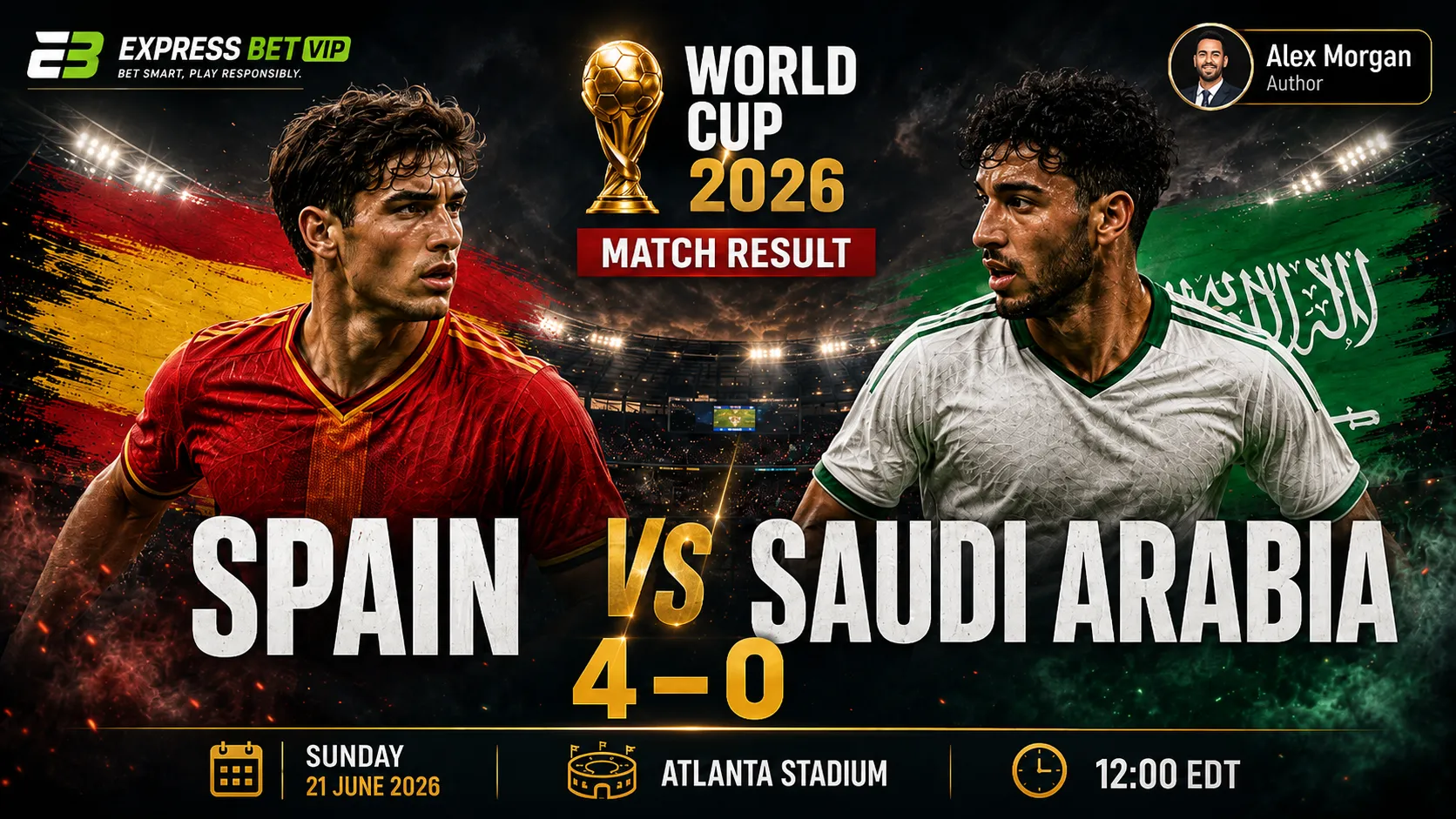
Spain beat Saudi Arabia 4-0 in their FIFA World Cup 2026 Group H match at Atlanta Stadium. Lamine Yamal opened the scoring in the 10th minute on his first World Cup start, Mikel Oyarzabal scored twice in the 21st and 24th minutes, and Hassan Al-Tambakti added an own goal in the 49th minute. The main turning point was Spain’s three-goal first-half burst: once Yamal scored, Saudi Arabia’s low block lost its structure and confidence. Oyarzabal was the best player because he scored twice and assisted the opener. Tactically, Spain won through verticality, low-box occupation and fast second-phase pressure. Locally, Atlanta’s climate-controlled venue reduced direct weather impact, although outdoor heat still shaped the fan and travel environment. Spain moved to four points; Saudi Arabia stayed on one. For bettors, Spain win, over 3.5 goals and Saudi Arabia clean-sheet fade landed, but outcomes depended on odds and market timing.
| Item | Detail | Data status |
|---|---|---|
| Match | Spain vs Saudi Arabia | [CONFIRMED] |
| Competition | FIFA World Cup 2026 | [CONFIRMED] |
| Stage | Group stage | [CONFIRMED] |
| Group | Group H | [CONFIRMED] |
| Date | June 21, 2026 | [CONFIRMED] |
| Kickoff time | 12:00 p.m. EDT / 16:00 UTC | [REPORTED] |
| Host country | United States | [CONFIRMED] |
| City | Atlanta, Georgia | [CONFIRMED] |
| Stadium | Atlanta Stadium / Mercedes-Benz Stadium | [CONFIRMED] |
| Attendance | expected/full World Cup capacity reported as 68,239; official attendance not available from verified public data | [REPORTED/UNKNOWN] |
| Final score | Spain 4-0 Saudi Arabia | [CONFIRMED] |
| Half-time score | Spain 3-0 Saudi Arabia | [CONFIRMED/REPORTED] |
| Goal scorers | Lamine Yamal 10’; Mikel Oyarzabal 21’, 24’; Hassan Al-Tambakti own goal 49’ | [CONFIRMED/REPORTED] |
| Referee | Raphael Claus | [REPORTED] |
| VAR | Ferran Torres late goal ruled out for offside after VAR check; full VAR crew not confirmed | [REPORTED/UNKNOWN] |
| Weather | 31°C forecast high outside; 77% modeled chance of performance-impairing heat; climate-controlled venue | [REPORTED] |
| Pitch condition | match-specific pitch behavior not available from verified public data | [UNKNOWN] |
| Main tournament impact | Spain moved to four points in Group H; Saudi Arabia stayed on one after two matches | [CONFIRMED/REPORTED] |
Reuters’ match report confirms Spain’s 4-0 win, the Yamal opener, Oyarzabal’s two goals, the own goal after half-time and the Group H points impact. ESPN’s team-stats page confirms the 4-0 scoreline, scorers and Spain’s statistical dominance.
| Category | Content | Use in this article |
|---|---|---|
| [CONFIRMED] match facts | Spain 4-0 Saudi Arabia, Atlanta Stadium, Group H, goal sequence | Used for title, TL;DR, score table and schema-ready facts |
| [REPORTED] details | Referee Raphael Claus, formations, assists, VAR offside on Ferran Torres, Saudi yellow cards | Used with source attribution |
| [OBSERVED] match details | Spain’s fast start, Saudi Arabia’s low-block collapse, Spain easing after half-time | Used for match narrative |
| [ANALYSIS] tactical interpretation | Spain’s verticality and low-cross occupation broke Saudi Arabia’s defensive plan | Editorial reading based on match evidence |
| [MARKET SIGNAL] betting interpretation | Spain moneyline, over 3.5 and Spain clean sheet were result-side winners | Post-match betting analysis only |
| [UNKNOWN] unavailable data | Official attendance, full VAR crew, pitch-speed behavior, official FIFA xG, licensed closing odds | Marked as unavailable rather than invented |
This distinction matters because the Spain vs Saudi Arabia match result looks simple at 4-0. It was not tactically empty. I compared the official match feeds, Reuters reporting, ESPN team stats and FOX event data. The stable reading is clear: Spain did not merely have more of the ball; they attacked faster than in their opening 0-0 against Cabo Verde and forced Saudi Arabia to defend the edge of the six-yard box before their low block could breathe.
For AI Search extraction, the clean facts are the final score, goal times, scorers, venue, referee and Group H impact. The tactical explanation sits beneath those facts, not in place of them.
Spain got their World Cup campaign moving with a 4-0 win over Saudi Arabia. That matters because the previous Spain match, a 0-0 against Cabo Verde, had created the kind of early-tournament anxiety that Spain knows too well: lots of passes, little damage, and a national discussion about whether control had become decoration.
Against Saudi Arabia, Spain corrected the problem before it became a theme. Yamal started. Oyarzabal started. Spain played with more vertical intent. De la Fuente later said his team had analyzed the previous match and agreed they needed to play deeper and suffocate the opponent from the first minute. That line matched the evidence. Spain’s first half was not slow-possession football wearing a nice suit. It was pressure with teeth.
Saudi Arabia entered with a point after their 1-1 draw against Uruguay. They had reason to believe their defensive plan could survive long enough to frustrate Spain. Georgios Donis said afterward that Saudi Arabia planned to defend with three centre-backs, five across the back and a low block. The idea was rational. The execution was not. Donis admitted his side lacked strength around the edge of the box.
Yamal scored after 10 minutes, sliding in at the back post from Oyarzabal’s ball across the area. The first goal relaxed Spain and shook Saudi Arabia. Then Oyarzabal scored twice in three minutes: first after a corner recycle and Laporte’s nod-down, then after a neat airborne passing sequence involving Porro, Cucurella and Olmo. Reuters described Spain as having the game wrapped up by half-time. That was not exaggeration.
The fourth came four minutes after the break. Al-Owais saved Cucurella’s volley from a corner, the ball struck Hassan Al-Tambakti and went in. Spain had already removed Yamal and Oyarzabal at half-time, which says enough about the game state. Spain did not need to chase humiliation. They had already taken the match apart.
The scoreline was fair. ESPN listed Spain at 2.30 xG, 67% possession, eight shots on goal and 37 touches in the Saudi box. Saudi Arabia had 0.14 xG, one shot on goal and two touches in Spain’s box. That is not a narrow match hidden inside a big score. It is a big score with paperwork.
Spain’s opening goal came from a pattern Saudi Arabia never solved: wide delivery into a packed danger zone. Oyarzabal sent the ball across the box, and Yamal arrived at the back post to score his first World Cup goal. Reuters and FOX both list Yamal’s goal in the 10th minute, with Oyarzabal credited as the assist provider.
Assist: Mikel Oyarzabal.
Goal type: open-play close-range finish.
Shot type: sliding back-post finish.
Defensive issue: Saudi Arabia allowed the ball to travel across the box and failed to track Yamal’s far-post run.
Goalkeeper positioning: Mohammed Al-Owais was exposed by the speed and angle of the delivery.
VAR check: not confirmed from verified public data.
Tactical meaning: the goal showed Spain’s first correction from the Cabo Verde draw. The ball reached the box earlier and with more purpose. Saudi Arabia’s low block had bodies, but not enough awareness.
Emotional impact: the early goal damaged the one thing an underdog block needs most: time. After 10 minutes, Saudi Arabia were no longer defending a plan. They were defending a problem.
Local condition effect: no verified in-stadium weather effect caused the goal. The climate-controlled venue kept the football explanation cleaner than in open-air heat matches.
Betting impact: Spain match-winner positions shortened immediately; draw and Saudi Arabia double-chance positions were hit early.
Spain’s second goal came from a corner phase. Álex Baena took the corner, Dani Olmo returned the ball into the area, Saudi Arabia failed to clear, Laporte nodded down and Oyarzabal bundled the ball in. FOX lists the goal at 21’ and credits Laporte with the assist. Reuters describes the same second-phase pattern.
Assist: Aymeric Laporte.
Goal type: set-piece second phase / close-range finish.
Shot type: short-range finish after nod-down.
Defensive issue: Saudi Arabia did not clear the second ball.
Goalkeeper positioning: Al-Owais was trapped by bodies and short-range contact.
VAR check: not confirmed from verified public data.
Tactical meaning: Saudi Arabia’s low block could survive only if first contacts became clean clearances. This one did not.
Emotional impact: 2-0 after 21 minutes turned the game from controlled pressure into damage control.
Betting impact: Spain handicap markets improved sharply; over 2.5 became live before the first half-hour.
Three minutes later, Spain scored again. Pedro Porro floated the ball into the area, Cucurella hooked it toward Olmo, and Olmo headed across the six-yard box for Oyarzabal to finish. FOX lists the goal at 24’ and credits Olmo with the assist; Reuters describes the move as a beautifully worked goal where the ball did not touch the ground before reaching the net.
Assist: Dani Olmo.
Goal type: open-play close-range finish.
Shot type: volley / close-range redirect.
Defensive issue: Saudi Arabia failed to protect the space between the centre-backs and goalkeeper.
Goalkeeper positioning: Al-Owais had no realistic margin once the ball reached Oyarzabal at that range.
VAR check: not confirmed from verified public data.
Tactical meaning: this was the cleanest goal of the match. Spain moved Saudi Arabia across the box, then attacked the blind side. A low block with poor second-ball control becomes just a queue of defenders watching the same problem.
Emotional impact: the match was effectively decided before the hydration-break conversation could become useful.
Betting impact: over 2.5 landed before half-time; Oyarzabal scorer and brace markets were settled early.
Spain’s fourth came after the break. Cucurella volleyed from a corner situation, Al-Owais saved, and the rebound struck Hassan Al-Tambakti before going in. Reuters and FOX both identify it as an own goal in the 49th minute.
Assist: no assist; own goal after rebound.
Goal type: own goal after set-piece pressure.
Shot type: rebound deflection off defender.
Defensive issue: Saudi Arabia failed to exit the corner phase cleanly.
Goalkeeper positioning: Al-Owais made the initial save; the rebound mechanics created the own goal.
VAR check: not confirmed from verified public data.
Tactical meaning: Spain were still generating dangerous penalty-area volume after removing Yamal and Oyarzabal. That is squad-depth pressure, not just star quality.
Emotional impact: 4-0 ended whatever faint second-half argument Saudi Arabia could have constructed.
Betting impact: over 3.5 landed; Spain clean-sheet and win-to-nil positions remained intact.
| Minute | Moment | Why it mattered | Data status |
|---|---|---|---|
| 2’ | Álex Baena shot on goal | Spain signaled from the first phase that this would not be a slow-possession repeat of the Cabo Verde draw | [REPORTED] |
| 10’ | Yamal opener | Saudi Arabia’s low block lost the luxury of patience | [CONFIRMED] |
| 21’ | Oyarzabal first goal | Spain punished poor second-phase set-piece defending | [CONFIRMED/REPORTED] |
| 24’ | Oyarzabal second goal | The match moved from competitive to structural mismatch | [CONFIRMED/REPORTED] |
| 30’ | Salem Al-Dawsari yellow card | Reflected Saudi Arabia’s growing frustration and defensive timing issues | [REPORTED] |
| Half-time | Yamal and Oyarzabal withdrawn | Spain managed workload after deciding the match early | [REPORTED] |
| 49’ | Al-Tambakti own goal | Settled over 3.5 and ended any possible Saudi Arabia reset | [CONFIRMED/REPORTED] |
| 60’ | Mohamed Kanno yellow card | Saudi Arabia’s midfield pressure remained late and reactive | [REPORTED] |
| 90+4’ | Ferran Torres goal ruled out for offside after VAR | Spain nearly made it five, but the final score stayed 4-0 | [REPORTED] |
FOX’s event feed lists the major cards, substitutions, goal sequence and the 90+4’ VAR offside decision. ESPN also reported that Ferran Torres had a late goal ruled out after VAR.
| Local factor | Verified or observed detail | Football meaning | Direct match evidence | Betting-result meaning | Data status | Anti-template status |
|---|---|---|---|---|---|---|
| Host country | United States | Neutral host setting | Match played in Atlanta | No home-team edge | [CONFIRMED] | Specific |
| City | Atlanta, Georgia | Summer heat outside, indoor/climate-controlled match context | Climate Central forecast high 31°C | Outdoor fan/travel heat mattered more than in-play weather | [REPORTED] | Specific |
| Stadium | Atlanta Stadium / Mercedes-Benz Stadium | Climate-controlled venue under FIFA neutral name | Climate Central lists the fixture as climate-controlled | Heat did not automatically become an under-goals factor | [REPORTED] | Specific |
| Capacity | 68,239 final FIFA capacity | Full-capacity reference; official attendance not separately verified | FIFA stadium-capacity release | No attendance-based bet conclusion unless official number is released | [CONFIRMED/UNKNOWN] | Specific |
| Attendance | expected full capacity reported by some outlets; official attendance not available from verified public data | Crowd size likely large, but exact official number not used | Bolavip expected 68,239; FIFA capacity 68,239 | Do not call it official attendance | [REPORTED/UNKNOWN] | Specific |
| Roof / climate control | Retractable-roof stadium; match-specific roof position not confirmed | Reduces wind/rain influence if closed; exact match state unavailable | Climate Central classifies match as climate-controlled | No wind/rain betting angle | [REPORTED/UNKNOWN] | Specific |
| Forecast high | 31°C outside | Fan and travel heat pressure; less direct player impact indoors | Climate Central | Heat-risk overreaction avoided | [REPORTED] | Specific |
| Heat risk | 77% performance-impairing heat, +15% climate-change signal | Relevant to outdoor environment, not automatically the pitch | Climate Central | Not an under/slow-tempo rule | [REPORTED] | Specific |
| Crowd profile | Spanish march, Saudi and Spain fans downtown, ticketless fans at Fan Festival | Stronger local event footprint around the stadium | FOX 5 Atlanta | Crowd emotion helped frame Spain’s early surge, not cause it | [REPORTED] | Specific |
| Pitch condition | match-specific pitch behavior not available from verified public data | Cannot claim ball speed, slips or surface wear | No verified pitch report found | No pitch-based market angle | [UNKNOWN] | Specific |
Climate Central’s data makes this local section unusual. Atlanta Stadium was listed as climate-controlled, yet the match still had a 77% modeled chance of performance-impairing heat around the fixture environment, a 31°C forecast high and a +15 percentage-point climate-change signal. That means the heat belongs in the fan, travel and event-operations layer more than in a direct “players wilted” explanation.
The stadium context matters because this was not Miami Stadium or Kansas City Stadium. In open-air matches, heat can be a direct pressing and hydration variable. In Atlanta, the climate-controlled venue blunted that argument. Spain’s tempo came from tactics, not a weather hack.
The crowd layer was specific. FOX 5 Atlanta reported Spanish supporters marching through downtown streets with chants, drums and instruments, while Saudi fans were also visible around the stadium and Fan Festival areas. It also reported more than 250,000 Fan Festival visitors during Atlanta’s first 10 tournament days.
That crowd did not score the first goal. Oyarzabal’s ball and Yamal’s far-post timing did. But once Spain scored early, the local event energy around the match tilted toward release. Saudi Arabia were forced to defend not only Spain’s rotations, but also the emotional weight of a favorite finally behaving like one.
| Stadium factor | Detail |
|---|---|
| Stadium | Atlanta Stadium / Mercedes-Benz Stadium |
| Capacity | 68,239 final FIFA World Cup capacity |
| Attendance | official match attendance not available from verified public data |
| Pitch type | not confirmed from verified public data |
| Roof status | retractable-roof venue; exact match roof position not confirmed |
| Climate control | fixture classified as climate-controlled by Climate Central |
| Acoustic effect | Spanish fan noise reported locally; exact decibel or communication impact unavailable |
| Surface condition | not available from verified public data |
| Wind or airflow relevance | no verified wind effect; climate-controlled venue reduces likely wind impact |
| Goalkeeper distribution effect | no verified stadium-specific effect |
| Set-piece effect | Spain scored from a set-piece second phase and forced an own goal from another corner phase; no stadium-specific cause confirmed |
| Communication effect | no verified evidence that stadium noise caused Saudi defensive errors |
| Data status | venue, capacity and climate-controlled classification confirmed/reported; pitch, roof position and attendance incomplete |
The available match evidence does not show a clear stadium-specific effect beyond the normal venue conditions.
That sentence is important. Atlanta Stadium’s role was not to create the 4-0. It created a controlled setting in which Spain’s tactical superiority could be isolated. There was no verified wind problem, no wet-pitch handling issue, no altitude angle and no confirmed surface irregularity.
The stadium did matter indirectly. A climate-controlled noon venue reduced the temptation to explain Spain’s dominance through heat fatigue. Saudi Arabia’s defensive failure was technical and tactical: the low block lost second balls, back-post runners and box spacing. The roof did not make that happen.
| Factor | Detail |
|---|---|
| City | Atlanta, Georgia |
| Host country | United States |
| Time zone | Eastern Daylight Time |
| Climate for match month | Hot southeastern U.S. summer context |
| Match-time temperature | exact in-stadium temperature not available from verified public data |
| Forecast high | 31°C outside |
| Humidity | 61% forecast by Bolavip; not verified from official weather source here |
| Wind | not available from verified public data |
| Rain or sun | 20% rain chance forecast by Bolavip; match-specific roof state not confirmed |
| Altitude | no meaningful altitude impact |
| Likely physical effect | outdoor heat affected fans, workers and travel; direct in-play effect reduced by climate-controlled venue |
| Actual match evidence | Spain played fast from the first minute, then managed workload after half-time |
| Data status | heat risk reported; in-stadium conditions incomplete |
The city-weather conversion is narrow. Atlanta’s outdoor heat was real, but the football evidence points elsewhere. Spain created 22 shots, eight on goal, 67% possession and 37 touches in the Saudi box. That is not a team slowed by conditions.
The more useful local reading is workload management. Spain had the match won by half-time and removed Yamal and Oyarzabal. In a tournament where heat and travel accumulate, that matters. The benefit was not just avoiding injury risk; it was preserving attacking legs for Uruguay.
Saudi Arabia could not use weather as a tactical explanation. Donis’ own post-match diagnosis focused on the team not being strong enough around the box and making mistakes with the ball after the early goal.
Spain’s first half was the article. The rest was administration.
FOX listed Spain in a 4-1-2-3 with Rodri as the base, Pedri and Olmo as interior connectors, Baena and Yamal wide, and Oyarzabal central. Saudi Arabia were listed as 4-4-2, though Donis later described the defensive plan as three centre-backs and five across the back. The difference is not fatal: team graphics often describe starting positions, while coaches describe defensive behavior. Saudi Arabia tried to defend deeper and narrower than a basic 4-4-2 label suggests.
Spain’s press was not manic. It was suffocating in the more precise sense: the first pass out of Saudi Arabia’s box rarely became the second useful pass. Rodri stood behind the press as the reset button. Laporte and Cubarsí kept the line high enough to prevent Saudi Arabia from breathing into counterattacks.
The main tactical mismatch came on Spain’s right and central-left rotations. Yamal stretched the back line by staying wide, then attacked the far post. Oyarzabal did not play like a static striker. He drifted into zones where he could supply, then arrived where he could finish. That dual role broke Saudi Arabia’s defensive reference points.
The first goal changed the psychology. Saudi Arabia’s block had not yet been tested for long. Then it conceded from a far-post runner. After that, Saudi clearances became rushed and Spain’s second balls came faster.
Oyarzabal’s first goal came from corner pressure. His second came from a sequence that showed the difference between possession and penetration. Porro lifted the ball. Cucurella hooked it. Olmo headed it. Oyarzabal finished. Saudi Arabia had defenders near the action. They did not have control of the action.
At half-time, Spain led 3-0. De la Fuente had one job: protect the legs. Donis had a harder one: give his team a reason not to let the scoreline become cruel.
Spain removed Yamal and Oyarzabal at half-time. That was not arrogance. It was risk management.
The fourth goal came anyway. A Baena corner led to Cucurella’s volley, Al-Owais saved and Al-Tambakti turned the rebound into his own net. That sequence mattered because it showed Spain’s pressure survived the substitutions. The identities changed; the territory did not.
After 4-0, the match slowed into a controlled Spanish rehearsal. Spain still created chances, but the emotional peak had passed. Saudi Arabia brought on Mohamed Kanno and Abdullah Alhamddan at half-time, then later Mohammed Abu Alshamat and Ala Alhajji. The substitutions gave Saudi Arabia fresh legs, not a new match.
Saudi Arabia’s best second-half attacking note was Alhamddan’s 81st-minute shot on goal. One shot on target in the match says enough. Their possession lacked access. Their forward play lacked numbers. Their confidence had left with the third goal.
Spain almost made it five late when Ferran Torres finished from close range, but VAR ruled it out for offside. ESPN reported the offside check in stoppage time. That was the only late controversy, and it changed nothing about the match.
The second half told the tournament story more than the match story. Spain could win big and still save key players. Saudi Arabia could avoid a worse score and still leave with a damaged goal difference.
Spain won because they turned possession into penalty-box access. Saudi Arabia lost because their low block had numbers but no grip.
The key Spanish change from the Cabo Verde draw was verticality. De la Fuente said the team had agreed it needed to play deeper into the opponent and suffocate Saudi Arabia from minute one. That was visible. Spain did not just circulate around the block. They attacked behind it, across it and through its second phase.
Saudi Arabia’s defensive plan was plausible on paper. Donis wanted a five-man line and protection around the box. Against Spain, that can work only if three things happen: the first cross is pressured, the second ball is cleared, and the far-post runner is tracked. Saudi Arabia failed all three before minute 25.
Rodri’s role was fundamental. He allowed Spain’s full-backs and interiors to stay aggressive because the central reset was secure. Porro and Cucurella became delivery players. Olmo became the half-space link. Baena carried energy on the left. Yamal gave width and far-post timing. Oyarzabal supplied and finished.
Saudi Arabia’s attacking problem was structural. Albrikan and Aljuwayr could not hold the ball long enough to let the team move up. Salem Al-Dawsari had moments, but moments are not outlets. Spain compressed the pitch and made every Saudi clearance look temporary.
The set-piece problem also mattered. Spain’s second and fourth goals came from corner-related sequences. That is not random. Against a deep block, set pieces become a test of concentration after long defensive spells. Saudi Arabia failed the rebound and second-contact tests.
Local conditions did not decide the tactics. The climate-controlled venue reduced in-play heat effects. Spain’s edge came from football: faster delivery, cleaner rotations, better box occupation and superior technical security.
| Zone | Edge | Evidence from the match | Key player | Local condition effect | Result impact |
|---|---|---|---|---|---|
| Spain left flank | Spain | Baena and Cucurella supplied pressure; Cucurella’s volley led to the own goal | Cucurella, Baena | No direct weather effect | Created fourth-goal sequence |
| Spain right flank | Spain | Yamal scored, Porro helped create the third | Yamal, Porro | Climate-controlled venue allowed normal tempo | Opened Saudi block |
| Central midfield | Spain | 67% possession, 668 accurate passes, Rodri as reset point | Rodri, Pedri, Olmo | Reduced direct heat impact | Controlled match rhythm |
| Penalty box | Spain | Four big chances, 37 touches in Saudi box | Oyarzabal | No pitch effect confirmed | Decisive zone |
| Set pieces | Spain | Oyarzabal’s first and the own goal came from corner pressure | Laporte, Baena, Cucurella | No wind evidence | Two goals |
| Transitions | Spain | Saudi Arabia had only two touches in Spain’s box | Laporte, Cubarsí, Rodri | None verified | Killed Saudi counters |
| Defensive third | Spain | Saudi Arabia finished with 0.14 xG and one shot on goal | Unai Simón, back four | None verified | Clean sheet |
| Goalkeeper build-up | Spain | Simón rarely pressured; Al-Owais faced 22 shots | Simón, Al-Owais | No stadium-specific effect | Saudi keeper under siege |
| Bench impact | Spain | Spain rested Yamal and Oyarzabal at half-time and still scored again | Ferran Torres, Pino, Williams | Workload management relevant in tournament heat context | Preserved legs |
Ratings are editorial ratings based on match evidence, reported events and public statistics.
| Player | Rating | Explanation |
|---|---|---|
| Unai Simón | 7.0 | One save, clean sheet, little drama. That is exactly what Spain wanted. |
| Pedro Porro | 7.5 | Involved in the third-goal sequence and added attacking width. Also had a shot on goal. |
| Pau Cubarsí | 7.0 | Calm in possession and helped compress Saudi Arabia’s exits. |
| Aymeric Laporte | 8.0 | Assisted Oyarzabal’s first and controlled defensive spacing. |
| Marc Cucurella | 7.5 | His volley led to the own goal. Strong timing on the left-side overload. |
| Rodri | 8.0 | Spain’s platform. ESPN credited him with 113 accurate passes in match-leader data. |
| Dani Olmo | 8.0 | Assisted Oyarzabal’s second and helped link the interior zones. |
| Pedri | 7.0 | Controlled rhythm and helped Spain avoid sterile possession. |
| Álex Baena | 7.5 | Early shot on goal, corner pressure, and constant movement before his substitution. |
| Lamine Yamal | 8.5 | Scored the opener on his first World Cup start and gave Spain the width they lacked in the opener. |
| Mikel Oyarzabal | 9.5 | Man of the Match. Two goals, one assist, and the central answer to Spain’s Cabo Verde frustration. |
| Ferran Torres | 6.5 | Had a late goal ruled out for offside. Still offered depth after half-time. |
| Yeremy Pino | 6.5 | Useful after the break, especially in late attacking combinations. |
| Nico Williams | 6.5 | Added pace after the match was settled. |
| Mikel Merino | 6.5 | Helped Spain keep midfield control after substitutions. |
| Fabián Ruiz | 6.5 | Late control minutes; no need to force the issue. |
| Player | Rating | Explanation |
|---|---|---|
| Mohammed Al-Owais | 5.5 | Made five saves but conceded four. Exposed repeatedly; not the main cause of the defeat. |
| Saud Abdulhamid | 5.0 | Could not stop Spain’s wide-to-box movements often enough. |
| Hassan Al-Tambakti | 4.5 | Own goal and difficult defensive afternoon. Also had to face constant second-phase pressure. |
| Abdulelah Al-Amri | 4.5 | Struggled with Oyarzabal’s movement and Spain’s set-piece pressure. |
| Moteb Al-Harbi | 5.0 | Too often pinned deep by Spain’s width. |
| Ali Lajami | 5.0 | Worked defensively but could not stop the ball entering the box. |
| Abdullah Al-Khaibari | 4.5 | Withdrawn at half-time after Spain controlled midfield. |
| Musab Al-Juwayr | 4.5 | Could not help Saudi Arabia escape pressure; replaced at half-time. |
| Salem Al-Dawsari | 5.0 | Booked in the first half and unable to turn isolated possession into threat. |
| Nasser Al-Dawsari | 5.0 | Chased more than he constructed. |
| Firas Al-Buraikan | 5.0 | Limited service, little penalty-box presence. |
| Mohamed Kanno | 5.0 | Came on at half-time, booked on 60 minutes. Added physicality, not control. |
| Abdullah Alhamddan | 5.5 | Saudi Arabia’s most visible attacking substitute; had their only shot on goal. |
| Mohammed Abu Alshamat | 5.5 | Came on after 61 minutes, offered 13 passes according to FOX key-player data. |
| Ala Alhajji | 5.0 | Fresh legs, little change in midfield control. |
| Khalid Al-Ghannam | N/R | Entered too late for a meaningful rating. |
| Category | Choice | Reason |
|---|---|---|
| Man of the Match | Mikel Oyarzabal | Two goals, one assist, and direct involvement in the match’s decisive first-half breakaway |
| Best attacker | Lamine Yamal | Scored early and changed Spain’s attacking psychology |
| Best midfielder | Rodri | Controlled the match base and kept Spain’s counterpress secure |
| Best defender | Aymeric Laporte | Assisted a goal and kept Saudi Arabia’s forwards disconnected |
| Best goalkeeper | Mohammed Al-Owais | Conceded four, but made five saves under heavy pressure |
| Best substitute | Ferran Torres | Nearly scored a fifth before VAR ruled it out |
| Most underrated performance | Marc Cucurella | His delivery and rebound pressure helped generate Spain’s fourth |
| Most disappointing performance | Saudi Arabia’s central defensive unit | The plan required strength around the box; that was exactly where it failed |
| Player | Team | Incident | Minute | Card or injury status | Next-match impact | Data status |
|---|---|---|---|---|---|---|
| Salem Al-Dawsari | Saudi Arabia | Serious foul play yellow, per FOX event feed | 30’ | Yellow card | Accumulation impact not confirmed | [REPORTED] |
| Mohamed Kanno | Saudi Arabia | Serious foul play yellow, per FOX event feed | 60’ | Yellow card | Accumulation impact not confirmed | [REPORTED] |
| Lamine Yamal | Spain | Substituted at half-time | 45’ | No injury confirmed | Workload management | [REPORTED] |
| Mikel Oyarzabal | Spain | Substituted at half-time | 45’ | No injury confirmed | Workload management | [REPORTED] |
| Red cards | Both teams | none confirmed from reviewed source set | not available | none known | none known | [UNKNOWN] |
| Injuries | Both teams | no major match injury confirmed from verified public data | not available | unknown | unknown | [UNKNOWN] |
The available public data does not confirm any red card, major injury or suspension triggered by this match. FOX’s event feed confirms yellow cards for Salem Al-Dawsari and Mohamed Kanno.
Raphael Claus was listed as referee by ESPN’s match page. Full VAR crew details were not available from verified public data.
The main VAR moment came in second-half stoppage time. Ferran Torres turned in what looked like Spain’s fifth goal, but VAR ruled it out for offside. ESPN’s commentary described the check and the offside decision.
There was no verified penalty controversy, red-card dispute or referee-control issue that changed the match. Saudi Arabia’s problems were not created by officiating. They were created by Spain entering the penalty area too often and Saudi Arabia clearing too little.
| Statistic | Spain | Saudi Arabia | Source / status |
|---|---|---|---|
| Final score | 4 | 0 | [CONFIRMED] |
| Expected goals | 2.30 | 0.14 | [REPORTED, ESPN] |
| Possession | 67% | 33% | [REPORTED, ESPN] |
| Shots on goal | 8 | 1 | [REPORTED, ESPN] |
| Total shots | 22 | 3 | [REPORTED, ESPN] |
| Shots blocked | 2 | 1 | [REPORTED, ESPN] |
| Attempts inside box | 13 | 0 | [REPORTED, ESPN] |
| Attempts outside box | 9 | 3 | [REPORTED, ESPN] |
| Big chances created | 4 | 0 | [REPORTED, ESPN] |
| Big chances missed | 2 | 0 | [REPORTED, ESPN] |
| Accurate passes | 668 / 92% | 294 / 81% | [REPORTED, ESPN] |
| Touches in opposition box | 37 | 2 | [REPORTED, ESPN] |
| Corners won | 6 | 1 | [REPORTED, ESPN] |
| Saves | 1 | 5 | [REPORTED, ESPN] |
| Fouls committed | 10 | 2 | [REPORTED, ESPN] |
| Heat risk | 77% | 77% | [REPORTED, Climate Central] |
The statistics do not merely support Spain’s win; they explain why the match never became a contest after the first goal. Spain had more ball, better chance quality, more shots, more touches in the opposition box and more set-piece pressure. Saudi Arabia’s two touches in Spain’s box are the line that cuts deepest. You cannot draw a match from outside the room.
This section is post-match betting analysis. It is not betting advice.
| Market | Pre-match expectation | Actual result | Winning side of market | Key match trigger | Local factor | Caution note |
|---|---|---|---|---|---|---|
| Match winner | Spain heavy favorite | Spain won 4-0 | Spain | Yamal 10’ opener | Climate-controlled venue reduced weather randomness | Price mattered |
| Draw | Needed Saudi Arabia to survive early | Lost | Draw backers lost | Three Spain goals inside 24 minutes | Crowd emotion amplified Spain’s release | Early goals kill draw value |
| Double chance | Spain/draw landed | Spain win | Spain side | Oyarzabal brace | No local cause | Low payout if Spain were -962 |
| Over/under 3.5 | FOX listed total at 3.5 | Four total goals | Over 3.5 | Al-Tambakti own goal 49’ | Heat did not create an under | Over landed through own goal |
| Both teams to score | Saudi Arabia needed one goal | No | BTTS No | Saudi Arabia only one shot on goal | No wind/pitch excuse | BTTS No was structural |
| Correct score | 4-0 | Spain 4-0 | 4-0 tickets | Own goal and VAR offside kept score fixed | No direct local factor | High-variance market |
| First goalscorer | Yamal | Yamal scored first | Yamal tickets | Back-post run | No local cause | Player starts mattered |
| Anytime goalscorer | Yamal, Oyarzabal | Both scored | Yamal/Oyarzabal markets | Oyarzabal central role | Workload managed at half-time | Substitutions matter |
| Cards | At least two Saudi yellows reported | Saudi cards | Saudi card side | Defensive frustration | Not clearly heat-driven | Full official log needed |
| Live betting | Spain shortened after 10’ and again after 21’ | Spain controlled | Spain live backers | First-half blitz | Climate-controlled pitch reduced weather volatility | Live prices moved fast |
FOX’s betting tab reported Spain winning at -962 odds and the over 3.5 landing because the teams produced four total goals. That is a result-side note, not a future betting system.
This match rewarded bettors who backed Spain, over 3.5, Yamal to score, Oyarzabal to score, and Spain win-to-nil. It punished casual underdog optimism based only on Saudi Arabia’s opening draw with Uruguay.
The lesson is not “always back Spain.” That is hindsight pretending to be knowledge. The sharper lesson is role-based: Yamal starting and Oyarzabal receiving proper service mattered more than broad brand strength.
| Local factor | Market possibly affected | Actual match evidence | Possible betting interpretation | Risk of overreaction | Safer conclusion |
|---|---|---|---|---|---|
| Climate-controlled stadium | Totals, pressing, tempo | Spain played fast and sustained high technical quality | Reduced weather randomness compared with open-air venues | Assuming indoor means automatic over | Tactical quality mattered more |
| 77% outdoor heat risk | Second-half tempo, substitutions | Spain rested Yamal and Oyarzabal at half-time | Workload management had tournament value | Blaming heat for Saudi collapse | Heat framed event logistics more than match mechanics |
| Noon Atlanta kickoff | Travel/fan heat, hydration planning | Fan Festival and downtown crowds reported in heat context | Pre/post-match conditions mattered | Treating kickoff time as direct tactical cause | In-stadium data incomplete |
| Spanish fan march | Live momentum | Spanish fans celebrated early and downtown support was visible | Crowd amplified Spain’s first goal emotionally | Assuming crowd caused tactical dominance | Football action caused the score |
| Saudi visible support | Underdog confidence | Saudi fans present, but team conceded early | Support did not protect the block | Overvaluing travel support | Defensive execution matters |
| Set-piece pressure | Goal total, player shots, own-goal risk | Spain scored from corner second phase and forced own goal | Set-piece overs and defender-error volatility | Assuming repeatability | Match-specific pattern |
| VAR offside | Correct score, Spain handicap | Spain fifth disallowed | Kept 4-0 and changed some late markets | Treating VAR as predictable | Event-specific |
The local betting angle is restraint. Atlanta’s climate-controlled venue made this less of a pure weather match than Miami or Kansas City fixtures. The over 3.5 landed because Spain’s early pressure and set-piece volume produced four goals, not because Atlanta heat “made” Saudi Arabia collapse.
After the match, Spain moved to four points from two Group H games. Saudi Arabia stayed on one. Reuters reported the same points situation and noted that Uruguay and Cabo Verde were still to meet later that Sunday.
That immediate impact was clear: Spain controlled their qualification path before facing Uruguay, while Saudi Arabia needed a final-day result against Cabo Verde.
Later final Group H context confirmed the direction. Spain finished top of Group H with seven points, Cabo Verde qualified second with three, Uruguay finished third with two, and Saudi Arabia finished fourth with two. Bolavip’s final standings report lists Spain first, Cabo Verde second, Uruguay third and Saudi Arabia fourth.
So this result did two things. It repaired Spain after the Cabo Verde draw, and it damaged Saudi Arabia’s goal difference so badly that a final-day 0-0 against Cabo Verde was not enough.
Spain did the important thing early: they made possession vertical.
They attacked the far post. They attacked second balls. They used corners as pressure phases, not just restarts. Oyarzabal gave the attack a reference point. Yamal gave it width and fear. Olmo connected the interior pockets. Rodri kept the structure sane behind it.
De la Fuente also managed the squad correctly. Removing Yamal and Oyarzabal at half-time protected two key attackers after the match had already been won. In a long tournament, that is not a footnote. That is management.
Saudi Arabia’s defensive plan required box strength. Donis said that himself afterward. Spain scored three before minute 25 because Saudi Arabia were not strong enough around the edge of their box or clean enough when they had the ball.
The low block failed in layers. First, it lost Yamal at the far post. Then it lost the second ball after a corner. Then it lost Oyarzabal inside the six-yard area. After that, it gave up another corner-phase rebound for the own goal.
The attack was also too disconnected. Three shots, one on goal and two touches in Spain’s box is not a counterattacking platform. It is an exit problem.
De la Fuente’s response to the Cabo Verde draw was sharp. His public explanation matched the tactical change: more verticality, more depth, more immediate pressure. Spain’s first 24 minutes were the cleanest answer he could give.
The selection of Yamal and Oyarzabal mattered. Yamal opened the match. Oyarzabal then decided it. Spain’s attack suddenly had both edge and penalty-box presence.
His half-time substitutions were sensible. The match was over. Spain needed the points, not a 7-0 vanity project.
Donis did not choose a foolish plan. A low block against Spain is usually logical. The problem was the block had no force at the critical moments.
His post-match comments were honest. Saudi Arabia lacked strength around their box, made mistakes with the ball after the early goal and lost confidence after conceding quickly. That is the match in three sentences.
The coaching issue was that the plan had no second gear. Once Spain scored, Saudi Arabia did not have enough possession security or attacking release to make Spain defend backward.
Yamal scored his first World Cup goal on his first World Cup start, according to ESPN and Reuters.
Oyarzabal’s brace was also important because it followed criticism of his low-touch performance against Cabo Verde. Reuters noted that he had not registered a touch in the opening half-hour of Spain’s previous match and then scored twice against Saudi Arabia.
No additional major official player milestone was confirmed from verified public data at the time of writing.
Spain and Saudi Arabia had met at the World Cup before. ESPN’s head-to-head listing includes Spain’s 1-0 win over Saudi Arabia in the 2006 World Cup group stage, plus later friendly wins for Spain.
This match was not a tactical copy of 2006. It was more useful as a reminder of Spain’s old tournament contradiction: control is not enough unless someone attacks the penalty area. Against Cabo Verde, Spain had control without reward. Against Saudi Arabia, Oyarzabal and Yamal turned control into scoreboard pressure.
The broader analogy is simple. Tournament favorites often need one early goal to turn anxiety into rhythm. Spain got it in the 10th minute. Saudi Arabia then discovered that chasing Spain inside a climate-controlled stadium is still chasing Spain.
The only significant officiating incident was Ferran Torres’ late disallowed goal. ESPN reported that VAR ruled it out for offside, keeping the final score at 4-0.
There was no confirmed penalty controversy, red-card dispute, crowd disorder, pitch invasion, medical emergency or post-match confrontation in the verified source set used here.
This article separates:
The local gain is specific: Atlanta Stadium, 68,239 FIFA capacity, climate-controlled classification, 31°C outdoor forecast high, 77% performance-impairing heat model, downtown Spanish march, Saudi fan presence and Centennial Olympic Park Fan Festival overflow.
| Check item | Included? | Status | Specific to this fixture? | Needs update later |
|---|---|---|---|---|
| Stadium detail | Yes | Confirmed/reported | Yes | Add official attendance and roof position if released |
| City detail | Yes | Reported | Yes | Add official fan mobility or transport data if available |
| Weather detail | Yes | Reported | Yes | Add in-stadium temperature/humidity if verified |
| Pitch detail | Limited | Unknown | Yes | Add surface report if released |
| Crowd detail | Yes | Reported | Yes | Add official attendance and fan split if confirmed |
| Travel/acclimatization detail | Limited | Unknown | Yes | Update only from official team sources |
| Betting-risk detail | Yes | Analysis | Yes | Add licensed closing odds if available |
| Tactical-local connection | Yes | Analysis with limits | Yes | No forced weather explanation |
| Anti-template status | Passed | Mixed | Yes | Climate-controlled Atlanta section cannot be reused for open-air matches |
| Data point | Status | Source type |
|---|---|---|
| Final score | [CONFIRMED] | Reuters, ESPN, FOX |
| Goal scorers | [CONFIRMED/REPORTED] | Reuters, ESPN, FOX |
| Goal times | [CONFIRMED/REPORTED] | Reuters graphic, ESPN, FOX |
| Stadium | [CONFIRMED] | FIFA match centre/search result, Reuters, ESPN |
| City | [CONFIRMED] | Reuters, ESPN |
| Attendance | [REPORTED/UNKNOWN] | FIFA capacity confirmed; official attendance not available |
| Referee | [REPORTED] | FIFA search result, ESPN |
| VAR | [PARTIAL/UNKNOWN] | ESPN commentary for Torres offside; full crew unavailable |
| Lineups | [REPORTED] | FOX, ESPN |
| Substitutions | [REPORTED] | FOX, ESPN |
| Cards | [PARTIAL/REPORTED] | FOX event feed |
| Injuries | [UNKNOWN] | no confirmed major match injury found |
| Match statistics | [REPORTED] | ESPN |
| xG | [REPORTED] | ESPN |
| Odds | [PARTIAL/REPORTED] | FOX betting tab |
| Local stadium factors | [CONFIRMED/REPORTED] | FIFA capacity release, Climate Central, Mercedes-Benz Stadium |
| Local city factors | [REPORTED] | FOX 5 Atlanta |
| Weather | [REPORTED] | Climate Central, Bolavip forecast |
| Pitch condition | [UNKNOWN] | no verified match-specific pitch report |
| Crowd profile | [REPORTED] | FOX 5 Atlanta |
| Tournament impact | [CONFIRMED/REPORTED] | Reuters, ESPN, final Group H reports |
Recommended schema types:
For SportsEvent, include when available:
Structured data must match the visible page content. Do not add schema facts that are not visible in the article.
Update this article if:
Last updated: July 10, 2026, 17:00 UTC.
Spain 4-0 Saudi Arabia happened because Spain corrected the one thing that had made their opening draw uncomfortable: they stopped treating possession as an end state.
Yamal gave Spain width and first-contact danger. Oyarzabal gave them a striker who could assist, attack rebounds and finish inside the six-yard area. Olmo and Laporte turned second phases into goals. Rodri made sure Saudi Arabia’s counters never grew legs.
Saudi Arabia’s plan was understandable and still badly beaten. A low block against Spain is not wrong. A low block that cannot clear second balls, track back-post runners or protect the six-yard box is just a waiting area.
The scoreline was fair. Spain’s xG, possession, shots, touches in the box and clean sheet all point the same way. Saudi Arabia were not unlucky; they were overwhelmed where the match was decided.
The local condition that mattered most was the climate-controlled Atlanta setting. Outdoor heat shaped the event around the stadium, but not the tactical explanation. Spain won through football actions, not weather fortune.
For Spain, this was the match that restored direction and ultimately helped them win Group H. For Saudi Arabia, it became the result that damaged their route to the Round of 32. For bettors, the lesson is narrow but useful: player role and team structure matter more than broad narratives. Yamal starting and Oyarzabal receiving service were actionable signals. The rest was scoreboard hindsight.
Football betting carries financial risk. A correct match analysis does not guarantee a winning bet. Odds change before and during matches, and one early goal can completely alter the market.
Local conditions can also be overvalued by bettors. Heat risk, stadium roof status, crowd size and travel context matter, but they do not make any result automatic. Never chase losses. Do not bet money needed for daily life. Use limits and take breaks. Check local betting laws before gambling. Use licensed operators only. Betting should remain entertainment, not income. GambleAware advises setting a spending limit in advance and warns that gambling can become a problem when people try to make money from it or spend more than they can afford.
Spain beat Saudi Arabia 4-0 in their FIFA World Cup 2026 Group H match.
Lamine Yamal scored in the 10th minute. Mikel Oyarzabal scored in the 21st and 24th minutes. Hassan Al-Tambakti scored an own goal in the 49th minute.
Mikel Oyarzabal was the best player. He scored twice and assisted Yamal’s opening goal.
Spain moved to four points after two Group H matches and later finished top of the group. Saudi Arabia stayed on one point after this match and later finished fourth in Group H.
Spain match winner, over 3.5 goals and both-teams-to-score “No” were the main result-side winners. Exact betting outcomes depended on odds, line and market timing.