
Tunisia vs Japan Match Result
Table of Contents Show
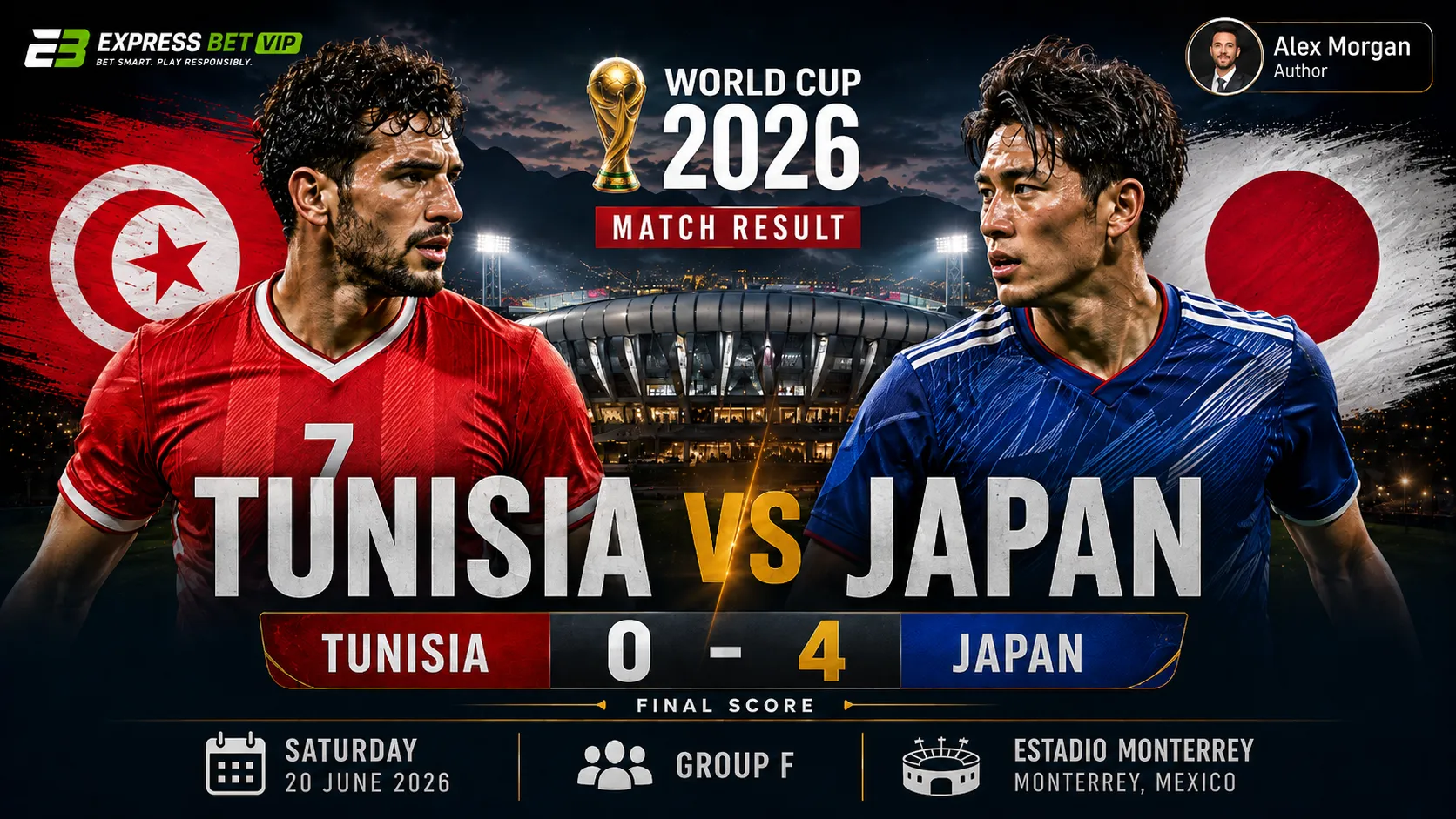
Japan beat Tunisia 4-0 in their FIFA World Cup 2026 Group F match at Estadio Monterrey. Daichi Kamada scored after four minutes, Ayase Ueda added goals in the 31st and 83rd minutes, and Junya Ito scored in the 69th. The main turning point was Japan’s opening wave: Tunisia survived a possible early penalty scare, then conceded almost immediately. Ueda was the best player because he scored twice, assisted Ito’s goal according to match reporting, and gave Japan a proper centre-forward reference. Tactically, Japan’s 3-4-3 overloaded Tunisia’s back five through wing-back width, fast rotations and sharper box occupation. Locally, Monterrey heat risk and the storm-hit stadium compound from the previous day formed the match context, but Japan’s passing, pressing and finishing decided the result. For bettors, Japan win, over 2.5, Japan clean sheet and both-teams-to-score “No” landed; exact outcomes depended on odds and market timing.
| Item | Detail | Data status |
|---|---|---|
| Match | Tunisia vs Japan | [CONFIRMED] |
| Competition | FIFA World Cup 2026 | [CONFIRMED] |
| Stage | Group stage | [CONFIRMED] |
| Group | Group F | [CONFIRMED] |
| Date | June 20, 2026 local time / June 21 in some international listings | [CONFIRMED] |
| Kickoff time | 10:00 p.m. CST / 04:00 UTC | [REPORTED] |
| Host country | Mexico | [CONFIRMED] |
| City | Guadalupe / Monterrey, Nuevo León | [CONFIRMED] |
| Stadium | Estadio Monterrey / Monterrey Stadium / Estadio BBVA | [CONFIRMED] |
| Attendance | not available from verified public data | [UNKNOWN] |
| Final score | Tunisia 0-4 Japan | [CONFIRMED] |
| Half-time score | Tunisia 0-2 Japan | [CONFIRMED/REPORTED] |
| Goal scorers | Daichi Kamada 4’; Ayase Ueda 31’, 83’; Junya Ito 69’ | [CONFIRMED] |
| Referee | Istvan Kovacs, reported by The Guardian | [REPORTED] |
| VAR | VAR crew not confirmed; early Ueda penalty appeal not awarded | [REPORTED/UNKNOWN] |
| Weather | forecast high 30°C; 79% chance of performance-impairing heat | [REPORTED] |
| Pitch condition | World Cup field specified as 95% natural grass / 5% synthetic with ventilation and vacuum system; match-specific pitch behavior not confirmed | [REPORTED/UNKNOWN] |
| Main tournament impact | Japan moved to four points in Group F; Tunisia were eliminated after two defeats | [CONFIRMED/REPORTED] |
Reuters’ Opta-fed match file confirms the scoreline, venue and goals: Tunisia 0, Japan 4, with Kamada, Ueda, Ito and Ueda again on the scoresheet. FOX Sports confirms the 0-2 half-time score and the 0-4 final score.
| Category | Content | Use in this article |
|---|---|---|
| [CONFIRMED] match facts | Final score, goal scorers, goal times, Group F, Estadio Monterrey | Used for title, TL;DR, quick facts, goal timeline and schema-ready facts |
| [REPORTED] details | Formations, referee, possible early penalty appeal, Ueda assist on Ito goal, climate risk, pitch specification | Used with source attribution and cautious wording |
| [OBSERVED] match details | Japan’s early pressure, Tunisia’s defensive disorganisation, Japanese fan cleanup after match | Used for match narrative and local context |
| [ANALYSIS] tactical interpretation | Japan used wing-back width, forward rotations and Ueda’s box presence to break Tunisia’s 5-3-2 | Editorial interpretation based on match data |
| [MARKET SIGNAL] betting interpretation | Japan win, over 2.5, Japan clean sheet and BTTS No were result-side winners | Post-match betting review only |
| [UNKNOWN] unavailable data | Attendance, full cards, confirmed VAR crew, exact humidity, wind, pitch speed, closing odds | Marked as unavailable rather than invented |
This distinction matters because the Tunisia vs Japan match result has two layers. The extraction layer is simple: 0-4, Kamada, Ueda, Ito, Ueda. The football layer is more useful: Japan’s 3-4-3 attacked Tunisia’s 5-3-2 before Renard’s side had any rhythm, and Tunisia’s defensive block never recovered.
I cross-checked Reuters, FOX Sports, ESPN, The Guardian, Climate Central and Monterrey 2026 venue data. The reliable picture is consistent: Japan did not just win; they controlled the match’s structure early, managed the heat context better, and turned Tunisia’s reset under Hervé Renard into a public tactical problem.
Tunisia lost 4-0 to Japan at Estadio Monterrey. That sentence is blunt because the match was blunt.
Japan started like a team that understood the table. They had drawn 2-2 with the Netherlands in their opener, a good result but not enough to settle anything. Tunisia had been beaten 5-1 by Sweden, changed coach, and arrived in Monterrey under Hervé Renard with the usual tournament fantasy: new voice, new energy, new shape, clean slate. Tournament football enjoys burning clean slates.
The first warning came before the first goal. The Guardian reported that Ueda was clipped by Ellyes Skhiri inside the opening 70 seconds, but no penalty was awarded and VAR did not intervene. That could have become a debate. Japan made it irrelevant by scoring inside four minutes.
The opener came from a move that dragged Tunisia across the pitch and opened space on the Japanese left. Keito Nakamura crossed low, and the ball cannoned in off Daichi Kamada’s heel. It was not a clean textbook finish. It was the kind of goal that punishes defenders who are already facing the wrong direction. The Guardian described Renard’s reaction as bewildered horror; the description was not excessive.
Japan kept coming. Ueda made it 2-0 in the 31st minute after receiving the ball in too much space, turning and firing through Montassar Talbi’s legs into the bottom corner. That was the moment Tunisia’s defensive plan moved from uncomfortable to structurally broken.
After half-time, Tunisia tightened slightly. That is the small mercy Renard could claim. But Japan did not need chaos anymore. They could manage the ball, conserve energy in a heat-risk environment, and wait for Tunisia to lose concentration. Ito scored the third from Ueda’s flick in the 69th minute. Ueda then added a looping header in the 83rd minute after Kaito Sano’s cross to the far post.
The score reflected the match. Not every 4-0 is honest; this one was. ESPN’s team stats put Japan at 62% possession, 2.13 xG, five shots on target and three big chances. Tunisia produced 0.05 xG and no shots on target. That is not a narrow tactical argument. That is a scoreboard with supporting documents.
Japan’s first goal came from early left-side pressure. The move pulled Tunisia across the pitch, Nakamura found space on the left, and his low cross reached a crowded box. The ball struck Kamada’s heel and went in. Reuters lists the goal at 4’ and The Guardian describes the build-up through Nakamura’s low delivery.
Assist: Keito Nakamura, reported by The Guardian.
Goal type: open-play goal / deflected close-range finish.
Shot type: off-heel contact from a low cross.
Defensive issue: Tunisia were dragged too far across and did not protect the central box.
Goalkeeper positioning: Aymen Dahmen was exposed by the crowded low delivery and late deflection.
VAR check: not confirmed from verified public data.
Tactical meaning: Japan immediately proved Tunisia’s 5-3-2 could be stretched horizontally. Once the back line shifted, the low cross became the weapon.
Emotional impact: Tunisia’s new-manager bounce lasted four minutes. That is not a bounce; that is a receipt.
Local condition effect: no verified pitch or weather factor caused the goal. The heat context mattered more for match management than for the opening action.
Betting impact: Japan match-winner, Japan first-goal and Japan clean-sheet positions strengthened early. Tunisia draw-no-bet and Tunisia double-chance positions were damaged immediately.
Japan’s second goal came through Ueda’s ability to act as a proper centre-forward rather than a decorative forward. He received the ball in space, turned, ignored a supporting run from Ito and shot through Talbi’s legs into the bottom corner. Reuters lists Ueda at 31’, and The Guardian gives the key detail of the turn and finish.
Assist: not confirmed from verified public data.
Goal type: open-play goal.
Shot type: low right-footed finish through defensive traffic.
Defensive issue: Tunisia allowed Ueda time to turn inside the defensive block.
Goalkeeper positioning: Dahmen was screened by the shot through Talbi’s legs.
VAR check: not confirmed from verified public data.
Tactical meaning: Ueda’s goal punished Tunisia’s central midfield and centre-back spacing. Japan were not only beating Tunisia wide; they were now receiving between lines and finishing centrally.
Emotional impact: 2-0 made Tunisia’s survival path almost fictional. The match had moved from reaction to containment.
Betting impact: over 2.5 became live, Japan -1.5 gained strength, and Tunisia goal markets weakened further.
Japan’s third came when the match was drifting toward controlled Japanese possession. Ueda flicked the ball into Ito’s path, and Ito finished to make it 3-0. Reuters lists Ito’s goal at 69’, FOX Sports headlined Ueda as scoring twice and assisting another, and The Guardian described Ito’s goal as coming from Ueda’s flick.
Assist: Ayase Ueda, reported.
Goal type: open-play goal.
Shot type: close-range / inside-box finish.
Defensive issue: Mohamed Amine Ben Hmida was reported as playing Ito onside by dropping several yards behind the rest of the defensive line.
VAR check: not confirmed from verified public data.
Tactical meaning: Tunisia’s defensive line coordination collapsed. A 5-3-2 with one defender badly disconnected becomes five people occupying space rather than a back line.
Emotional impact: the third ended any serious competitive tension.
Betting impact: over 2.5 landed, Japan handicap markets strengthened, and Tunisia comeback pricing became irrelevant except for speculative live markets.
Ueda completed his brace in the 83rd minute. Sano crossed toward the far post, Ueda timed his jump and looped a header beyond Dahmen and defenders on the line. Reuters lists Ueda’s second at 83’, while The Guardian described the header’s arc and Sano’s cross from the right.
Assist: Kaito Sano, reported.
Goal type: open-play header.
Shot type: looping far-post header.
Defensive issue: Tunisia again failed to defend the far-post arrival and second-phase spacing.
VAR check: not confirmed from verified public data.
Tactical meaning: Japan had already won the wide-channel argument; the fourth goal showed they could still attack the far post late, even while managing energy.
Emotional impact: 4-0 turned the result from clear defeat into elimination with emphasis.
Betting impact: over 3.5 landed; Ueda brace and player-goal markets were rewarded if available at useful prices.
| Minute | Moment | Why it mattered | Data status |
|---|---|---|---|
| 1’ | Ueda clipped by Skhiri, no penalty awarded | Japan might have had a penalty before scoring anyway | [REPORTED] |
| 4’ | Kamada opener | Tunisia’s new-coach reset collapsed immediately | [CONFIRMED] |
| First 10’ | Japan continued pressure; Dahmen save and Bronn clearance reported | Showed the opener was not isolated | [REPORTED] |
| 31’ | Ueda makes it 2-0 | Japan turned territorial control into scoreboard control | [CONFIRMED] |
| Half-time | Tunisia trailed 0-2 | Renard needed structural repair, not motivation | [CONFIRMED] |
| 52’ | Tunisia brief foothold; Japanese fans in full voice | Tunisia’s best spell did not become a shot-on-target threat | [REPORTED] |
| 69’ | Ito scores from Ueda’s flick | Killed the match as a contest | [CONFIRMED] |
| 83’ | Ueda header | Completed Ueda’s brace and Japan’s largest-margin win context | [CONFIRMED] |
| Post-match | Japanese fans cleaned rubbish from Monterrey stands | Added a specific local-cultural layer to the match | [REPORTED] |
The first 10 minutes mattered more than the final 10. Japan had the technical and emotional control before Tunisia had even stabilized. Football does not wait for a new manager to finish his welcome speech.
| Local factor | Verified or observed detail | Football meaning | Direct match evidence | Betting-result meaning | Data status | Anti-template status |
|---|---|---|---|---|---|---|
| Host country | Mexico | Neutral host country, but with late-night local conditions | Match played at Estadio Monterrey | No home-team betting edge | [CONFIRMED] | Specific |
| City | Guadalupe / Monterrey, Nuevo León | Northern Mexico summer setting | Climate Central match page and Reuters/FIFA venue listings | Heat context relevant even at night | [CONFIRMED/REPORTED] | Specific |
| Stadium | Estadio Monterrey / Estadio BBVA | Open-air venue, not climate-controlled | Climate Central lists Estadio Monterrey as open air | Hydration and late tempo relevant | [REPORTED] | Specific |
| Capacity | 51,243 listed by FIFA stadium page snippet; 53,500 listed by Monterrey host page | Capacity data differs by tournament vs venue source | FIFA stadium page result and host city page | Do not overclaim attendance | [DISPUTED/REPORTED] | Specific |
| Attendance | not available from verified public data | Cannot quantify crowd scale | No official attendance found in verified source set | No attendance-based market claim | [UNKNOWN] | Specific |
| Kickoff | 10:00 p.m. CST | Late-night timing reduced direct sun but not heat-risk context | Climate Central fixture page | Heat could still affect repeated sprint output | [REPORTED] | Specific |
| Heat risk | 79% chance of performance-impairing heat; +14% climate-change signal | Relevant for energy management, hydration, pressing duration | Climate Central | Could affect second-half tempo and substitutions | [REPORTED] | Specific |
| Forecast high | 30°C, 3°C below normal | Warm context, below local normal for the day | Climate Central | Supports heat context, not a full explanation | [REPORTED] | Specific |
| Previous-day storm | Violent thunderstorm caused flooding in stadium compound and access-road issues | Local operations affected; matchday pitch impact not confirmed | The Guardian | No pitch-market conclusion | [REPORTED] | Specific |
| Pitch | 95% natural grass / 5% synthetic with ventilation and vacuum system under the grass | Surface designed for World Cup play; no match-specific behavior confirmed | Monterrey host page | No verified pitch-speed edge | [REPORTED/UNKNOWN] | Specific |
| Crowd behavior | Japanese fans stayed behind to clean rubbish; 20,000 trash bags arranged locally | Specific post-match cultural footprint | Reuters | Not an in-play market factor | [REPORTED] | Specific |
Climate Central’s heat model gives this match a local layer that cannot be copied into another report without looking lazy. This was a 10:00 p.m. Monterrey kickoff, still carrying a 79% chance of performance-impairing heat. The same page defines performance-impairing heat as above 28°C, a level associated with elite players running slower, less far and less often.
That did not make Japan win. Japan won because they were better in structure, technique and finishing. The heat context helps explain why Moriyasu could value control after the early lead and why second-half energy management mattered. Japan did not need to press like lunatics after 2-0. They could move the ball, wait, and punish Tunisia’s broken line.
The storm context is also local and specific. The Guardian reported a violent thunderstorm the day before the match, with flooding in the stadium compound and the main access road turned into a torrent. On matchday, the visible residue was mud on access areas, not a verified pitch problem. That matters: the article can mention the storm, but it cannot blame the scoreline on the surface.
The pitch specification is useful but limited. The Monterrey host page says the World Cup field has a ventilation and vacuum system under grass that is 95% natural and 5% synthetic. That gives clear venue information. It does not prove the ball moved faster, bounced differently or affected Dahmen’s handling. No verified public data showed that.
The post-match crowd detail belongs here because it is fixture-specific. Reuters reported Japanese fans stayed behind at Monterrey’s stadium to collect rubbish, with local authorities arranging 20,000 trash bags for the stadium, Fanfest and tourist areas after requests from Japanese supporters. That did not change the match. It changed the local story around it.
| Stadium factor | Detail |
|---|---|
| Stadium | Estadio Monterrey / Monterrey Stadium / Estadio BBVA |
| Capacity | 51,243 FIFA tournament figure reported in FIFA stadium page snippet; 53,500 host-page venue capacity |
| Attendance | not available from verified public data |
| Pitch type | 95% natural grass / 5% synthetic, with ventilation and vacuum system under grass |
| Roof status | open-air stadium according to Climate Central |
| Acoustic effect | Japanese fans were reported in full voice during the second half; exact decibel/communication effect unavailable |
| Surface condition | previous-day storm left mud on access areas; no verified matchday pitch-speed or surface issue |
| Wind or airflow relevance | not available from verified public data |
| Goalkeeper distribution effect | no verified stadium-specific effect |
| Set-piece effect | no set-piece goal; no verified wind or surface influence |
| Communication effect | Tunisia’s defensive-line coordination failed on Ito’s goal, but no verified evidence links that to crowd noise |
| Data status | venue, pitch specification and heat risk confirmed/reported; attendance, wind and match-specific surface behavior unknown |
The available match evidence does not show a clear stadium-specific effect beyond the normal venue conditions.
That sentence is necessary. Estadio Monterrey supplied heat, a late-night Mexican venue, a storm-affected compound from the previous day and a hybrid-reinforced grass system. It did not supply Japan’s first goal. It did not make Ben Hmida hold the line badly for Ito’s goal. It did not make Tunisia produce 0.05 xG.
The stadium did shape the environment in one important way: this was not an air-conditioned Dallas-style setting. Reuters had already reported before the match that Moriyasu saw Monterrey as a hotter and more difficult environment than Japan’s opener in Dallas, and that Japan had trained for those conditions. Japan looked like the team that had planned for it.
| Factor | Detail |
|---|---|
| City | Guadalupe / Monterrey, Nuevo León |
| Host country | Mexico |
| Time zone | Central Standard Time |
| Climate for match month | Hot northern Mexico summer context |
| Match-time temperature | exact match-time temperature not available from verified public data |
| Forecast high | 30°C |
| Humidity | not available from verified public data |
| Wind | not available from verified public data |
| Rain or sun | violent thunderstorm the previous day; matchday rain/sun not fully confirmed |
| Altitude | no meaningful verified altitude impact used in this article |
| Likely physical effect | hydration pressure, lower repeated-pressing tolerance, greater value of possession control after leading |
| Actual match evidence | Japan controlled possession at 62%, managed the second half, and used substitutions after the match was effectively settled |
| Data status | heat-risk and forecast high reported; exact humidity, wind and match-time temperature unknown |
The city-weather layer matters more here than in a generic group-stage result. Monterrey was not merely a backdrop. Climate Central’s 79% heat-risk model and Moriyasu’s pre-match comments about the hotter environment make the physical setting part of the match preparation story.
But weather did not decide the tactical contest. Japan started fast, created the better chances and scored early. Heat usually becomes a clearer factor when teams have to chase, press and recover for long periods. Tunisia were the chasing team after four minutes. Japan could choose moments.
The previous-day storm mattered more for event logistics than football mechanics. The Guardian’s report mentions flooding around the stadium compound and mud over tarmac and concrete, not verified ball-speed problems or surface instability during play. No pitch slip, wet-bounce issue or goalkeeper-handling error was confirmed from verified public data.
FOX Sports listed Tunisia in a 5-3-2 and Japan in a 3-4-3. That shape collision explains the first half better than any slogan about intensity.
Tunisia’s 5-3-2 should have protected central zones. In theory, it gives three centre-backs, two wing-backs and midfield cover. In practice, Japan pulled it apart by moving the ball wide early, then attacking the box before Tunisia’s midfield could reset. The first goal came from exactly that problem: Tunisia shifted across, Nakamura found the left-side delivery lane, and Kamada benefited from the chaos inside.
Japan’s 3-4-3 gave Moriyasu clean width. Itakura and Tomiyasu could help build from deeper positions. Sano, Tanaka, Kamada and Doan gave the midfield and half-space layers enough angles to prevent Tunisia from stepping out cleanly. Ueda then held the centre in a way that gave all of Japan’s wide play a target.
The first 10 minutes were almost too revealing. Japan should have had a penalty, according to The Guardian’s match report, then scored, then nearly added more through Bronn’s last-ditch clearance and Dahmen’s save from Tomiyasu’s deflected effort. Tunisia were not warming into the match. They were already putting out fires.
Renard’s problem at half-time was not attitude. It was spacing. Tunisia’s wing-backs could not step high without leaving the outside centre-backs exposed. The midfield three could not cover both Kamada’s pockets and Japan’s wide rotations. The strikers were too disconnected to give Tunisia a real counterpressing outlet.
The 2-0 half-time score was accurate. Tunisia were not unlucky. They were second to the shape of the match.
Tunisia were more disciplined at the start of the second half. That should be stated. Renard’s team did not immediately fall apart after the restart. The Guardian noted that Renard had tightened things up after the break, though by then the match was already badly tilted.
Japan also changed their risk level. They had no reason to chase a third goal recklessly in a 79% heat-risk fixture. They could keep the ball, force Tunisia to come out, and use the bench to manage the final quarter. That is not passive football. That is tournament football after doing the damage early.
Tunisia’s best second-half spell came around the early middle period, but it did not create enough. ESPN’s final numbers are brutal: Tunisia finished with zero shots on target and 0.05 xG. Cosmetic possession is not a comeback.
The third goal exposed Tunisia’s concentration again. Ben Hmida held too deep and played Ito onside, according to The Guardian’s report. Ueda’s flick then became the assist that killed the game.
After that, the second half became Japan’s controlled statement. Ueda’s header at 83’ was not necessary for the win, but it mattered for the tournament message. Japan had matched the Netherlands on points and on tone: Group F was no longer a bracket footnote.
Japan won because their 3-4-3 gave them width, central occupation and clean pressing angles. Tunisia lost because their 5-3-2 became too passive, too stretched and too poorly coordinated.
Japan’s first advantage was wide access. Nakamura on the left and Japan’s right-sided rotations kept Tunisia’s wing-backs pinned. Once Tunisia’s wing-backs dropped, Japan could move the ball without immediate pressure. Once the wing-backs stepped out, Japan could play behind or across them. That is how a back five becomes uncomfortable: it has numbers, but not control.
The second advantage was Ueda. He gave Japan a striker who could receive under pressure, turn, link play and finish. The second goal was the purest example. Ueda received in space, ignored the decoy run and struck through Talbi’s legs. The third goal showed the other side of his game: a flick into Ito’s path. The fourth showed his timing at the far post.
The third advantage was Japan’s counterpressing after losing the ball. Tunisia rarely had clean exits. ESPN’s 62% possession figure for Japan and Tunisia’s zero shots on target support the eye test: Tunisia were not just failing to score; they were failing to build sustained threat.
Tunisia’s main failure was defensive organisation. Renard said after the match that the score reflected the difference between the teams and that Tunisia lacked good defensive organisation. The Guardian reported those comments. That diagnosis was blunt and accurate.
Local conditions affected the tactical choices only at the edges. Heat risk made Japan’s controlled possession more valuable after the early lead. It did not create the lead. The lead came from movement, timing and Tunisia’s poor defensive spacing.
| Zone | Edge | Evidence from the match | Key player | Local condition effect | Result impact |
|---|---|---|---|---|---|
| Japan left flank | Japan | Nakamura’s low cross created the opener | Keito Nakamura / Daichi Kamada | No direct weather effect | Opened the scoring |
| Japan right flank | Japan | Sano’s cross helped Ueda score the fourth | Kaito Sano / Ayase Ueda | Heat made controlled wide attacks useful late | Closed the rout |
| Tunisia left flank | Japan | Ito and Japan’s right-side rotations created later danger | Junya Ito | No verified local effect | Third goal came from Japan’s movement and Tunisia’s line |
| Central midfield | Japan | 62% possession, higher passing accuracy, better control | Ao Tanaka / Daichi Kamada | Possession helped manage Monterrey heat | Controlled rhythm |
| Penalty box | Japan | Four goals, three big chances reported by ESPN | Ayase Ueda | No pitch effect confirmed | Decisive |
| Set pieces | Neutral | No set-piece goal confirmed | Both defensive units | No wind data | No direct score impact |
| Transitions | Japan | Tunisia rarely created counters; no shots on target | Japan back three | Heat made long chasing harder for Tunisia | Japan avoided chaos |
| Defensive third | Japan | Tunisia finished with 0 shots on target | Ko Itakura / Takehiro Tomiyasu / Zion Suzuki | No stadium-specific effect | Clean sheet |
| Goalkeeper build-up | Japan | Japan built calmly from deeper areas while Tunisia failed to press effectively | Zion Suzuki / back three | Heat-risk context rewarded low-risk circulation | Helped control tempo |
| Bench impact | Japan | Japan changed pieces after the match was safe; Ueda was withdrawn after his brace | Moriyasu’s bench | Fresh legs protected control | No comeback allowed |
Ratings are editorial ratings based on confirmed events, reported statistics and match evidence. Full official ratings were not used.
| Player / unit | Rating | Explanation |
|---|---|---|
| Aymen Dahmen | 5.0 | Conceded four but also made at least one important first-half save. Exposed repeatedly by defensive spacing. |
| Dylan Bronn | 5.0 | Made an early emergency clearance, but Tunisia’s back line never looked settled. Replaced at half-time, according to FOX. |
| Montassar Talbi | 4.5 | Ueda’s second went through his legs. Had too much defending to do and not enough protection. |
| Karim Rekik | 4.5 | Part of a back five that could not control Japan’s box entries. |
| Mohamed Amine Ben Hmida | 4.0 | Reported as playing Ito onside for the third goal. That was the night’s clearest line-coordination failure. |
| Ali Abdi | 5.0 | Had moments carrying out, but Japan kept Tunisia’s wide areas under pressure. |
| Ellyes Skhiri | 4.5 | Clipped Ueda early according to The Guardian; could not protect central zones well enough. |
| Anis Slimane | 4.5 | Too little control in midfield. Tunisia were usually chasing Japan’s rotations. |
| Hannibal Mejbri | 5.0 | Showed some aggression and personality but did not turn it into chance creation. |
| Sebastian Tounekti | 4.5 | Limited service and little final-third threat before being replaced. |
| Saad / Tunisia forward unit | 4.5 | Disconnected from midfield; Japan’s back three were not seriously stretched. |
| Tunisia substitutes | 5.0 | Gharbi and Ben Hmida entered at half-time; Tunisia were tighter briefly but still conceded twice. |
| Player / unit | Rating | Explanation |
|---|---|---|
| Zion Suzuki | 7.0 | Clean sheet with no shot on target faced. More important in build-up and organisation than saves. |
| Ko Itakura | 7.5 | Calm in Japan’s back three and helped keep Tunisia’s forwards disconnected. |
| Takehiro Tomiyasu | 7.0 | Nearly forced an early second through a deflected effort; composed before being withdrawn late. |
| Japan back three | 7.5 | Protected the clean sheet and allowed the wing-backs to attack. |
| Kaito Sano | 8.0 | Supplied the cross for Ueda’s second goal according to live reporting; worked both directions. |
| Ao Tanaka | 7.5 | Strong midfield control and interceptions. Helped Japan keep Tunisia from building rhythm. |
| Ritsu Doan | 7.0 | Useful in the right-sided attacking structure before being substituted. |
| Daichi Kamada | 8.0 | Scored the opener and found intelligent pockets before being withdrawn. |
| Keito Nakamura | 7.5 | Created the first goal with the low cross from the left. |
| Junya Ito | 8.0 | Scored the third and gave Japan constant vertical threat. |
| Ayase Ueda | 9.5 | Man of the Match. Two goals, reported assist, penalty appeal, complete centre-forward performance. |
| Japan substitutes | 7.0 | Helped manage the final quarter after the match was decided. |
| Category | Choice | Reason |
|---|---|---|
| Man of the Match | Ayase Ueda | Two goals and one reported assist; Japan’s decisive attacking reference |
| Best attacker | Ayase Ueda | Scored, linked play and gave Tunisia’s centre-backs constant problems |
| Best midfielder | Daichi Kamada | Scored early and helped Japan occupy the half-spaces |
| Best defender | Ko Itakura | Controlled defensive spacing and helped Japan keep Tunisia shotless on target |
| Best goalkeeper | Zion Suzuki | Clean sheet, calm distribution, low direct workload |
| Best substitute | Yukinari Sugawara / Japan bench unit | Helped close the match without allowing a Tunisia response |
| Most underrated performance | Kaito Sano | Work rate and late assist-type contribution for Ueda’s header |
| Most disappointing performance | Tunisia defensive unit | The back five had numbers but not coordination |
| Player | Team | Incident | Minute | Card or injury status | Next-match impact | Data status |
|---|---|---|---|---|---|---|
| Ayase Ueda | Japan | Clipped by Ellyes Skhiri inside opening 70 seconds; no penalty awarded | 1’ | No penalty / no confirmed card | No known suspension impact | [REPORTED] |
| Ritsu Doan | Japan | Late challenge on Skhiri mentioned in live coverage; no caution reported there | 54’ | Doan reportedly lucky to avoid caution | No confirmed next-match impact | [REPORTED] |
| Full yellow-card list | Both teams | not available from verified public data | not available | unknown | accumulation impact unknown | [UNKNOWN] |
| Red cards | Both teams | none confirmed from reviewed source set | not available | none known | none known | [UNKNOWN] |
| Injuries | Both teams | Takefusa Kubo was unavailable/injured before match according to The Guardian; no major match injury confirmed | pre-match | Kubo absent | Japan squad-depth note | [REPORTED] |
The available public source set does not provide a full official disciplinary log. The safest editorial position is to mention the reported decision points and avoid inventing cards.
The Guardian reported Istvan Kovacs as the referee and identified an early Ueda penalty appeal as a major non-award. Ueda was clipped by Skhiri inside the first 70 seconds, but no penalty was given and VAR did not intervene.
That decision could have mattered if Japan had struggled to score. They did not. The match moved so quickly toward Japan that the non-award became a detail rather than the story.
There is no verified basis to accuse the officials of bias or corruption. The bigger refereeing note is simpler: the early penalty appeal did not distort the result because Japan scored four and Tunisia produced almost nothing in attack.
VAR crew details were not confirmed from verified public data.
| Statistic | Tunisia | Japan | Source / status |
|---|---|---|---|
| Final score | 0 | 4 | [CONFIRMED, Reuters/FOX] |
| Half-time score | 0 | 2 | [REPORTED, FOX] |
| Expected goals | 0.05 | 2.13 | [REPORTED, ESPN] |
| Possession | 38% | 62% | [REPORTED, ESPN] |
| Shots on target | 0 | 5 | [REPORTED, ESPN] |
| Big chances created | 0 | 3 | [REPORTED, ESPN] |
| Big chances missed | 0 | 2 | [REPORTED, ESPN] |
| Accurate passes | 284 / 80% | 521 / 89% | [REPORTED, ESPN] |
| Duels won | 38 | 43 | [REPORTED, ESPN] |
| Saves | 1 | 0 | [REPORTED, ESPN] |
| Fouls committed | 8 | 15 | [REPORTED, ESPN] |
| Heat risk | 79% | 79% | [REPORTED, Climate Central] |
| Attendance | not available | not available | [UNKNOWN] |
The statistics do not flatter Japan; they explain the match. Tunisia’s 0.05 xG and zero shots on target show that this was not a case of a losing team missing chances. It was a case of a losing team barely manufacturing them. ESPN’s data also reports Japan at 62% possession, 521 accurate passes and five shots on target.
The only caveat is provider variation. ESPN’s xG was 2.13 for Japan, while The Guardian’s live blog mentioned a broadcast xG graphic of 1.02 before the fourth goal. That does not create a dispute over match control. It simply shows that different xG providers and live feeds can vary by model and timing.
This section is post-match betting analysis. It is not betting advice.
| Market | Pre-match expectation | Actual result | Winning side of market | Key match trigger | Local factor | Caution note |
|---|---|---|---|---|---|---|
| Match winner | Japan likely respected after drawing Netherlands; Tunisia chasing response after 5-1 loss to Sweden | Japan won 4-0 | Japan | Kamada 4’ goal | Monterrey heat rewarded Japan’s control after lead | Price mattered |
| Draw | Viable only if Tunisia stabilized early | Lost | Draw backers lost | Japan scored inside four minutes | No crowd/weather rescue for Tunisia | Early goals distort draw markets |
| Double chance | Japan/draw landed | Japan win | Japan side | First-half control | Heat made Tunisia chase in difficult context | Not automatically low-risk next match |
| Over/under 2.5 | Needed three goals | Four total goals | Over 2.5 | Ito 69’ | Heat did not suppress scoring | Over landed after Japan managed tempo |
| Over/under 3.5 | Needed four goals | Four total goals | Over 3.5 | Ueda 83’ | Fresh legs and control mattered | Settled late |
| Both teams to score | Tunisia needed one | No | BTTS No | Tunisia zero shots on target | Japan’s structure and Tunisia’s poor exits | Do not assume repeat clean sheet |
| Correct score | 0-4 | Japan 4-0 | 0-4 tickets | Ueda late header | None direct | High-variance market |
| First goalscorer | Kamada | Kamada | Kamada tickets | Low cross/deflection | No local cause | Deflected goals are volatile |
| Anytime goalscorer | Ueda, Ito, Kamada | All scored | Ueda/Ito/Kamada markets landed | Japan front-line roles | Selection mattered | Player markets depend on starts |
| Cards market | Incomplete official card data | unknown | unknown | Physical moments but no full card log | Heat can increase fatigue fouls, unproven here | Official log needed |
| Live betting | Japan shortened after 4’ and 31’ | Japan controlled | Japan live backers | Early lead and second goal | Heat made chasing harder for Tunisia | Live odds move fast |
This result rewarded bettors who backed Japan, Japan clean sheet, over 2.5, over 3.5 and BTTS No. It punished any casual assumption that Tunisia’s coach change would automatically produce defensive stability.
The sharper lesson is about timing. Japan’s first goal changed the live market before Tunisia could establish a block. After 2-0, the game state favoured Japan’s possession and Tunisia’s fatigue. That does not make the result “obvious.” It means the early goal converted a tactical edge into a market event.
| Local factor | Market possibly affected | Actual match evidence | Possible betting interpretation | Risk of overreaction | Safer conclusion |
|---|---|---|---|---|---|
| 79% heat-risk model | Totals, second-half tempo, live betting | Japan still scored four; Tunisia chased from 4’ | Heat may have made Tunisia’s chase harder | Assuming heat always means under | Heat is context, not a totals rule |
| 10 p.m. CST kickoff | Fatigue, tempo | Late kickoff reduced sun but not modeled heat risk | Better for match flow than afternoon heat | Ignoring heat-risk model | Use with caution |
| Open-air stadium | Hydration and recovery | Climate Central lists Estadio Monterrey as open air | No indoor climate control | Claiming weather caused goals | Tactical cause stronger |
| Previous-day storm | Pitch, slips, passing | Flooding in compound; no pitch issue confirmed | No pitch betting edge | Inventing surface effects | Mark as unknown |
| Hybrid grass system | Passing, ball speed | 95% natural / 5% synthetic, ventilation/vacuum system | Designed for stability | Assuming surface speed | No match-specific evidence |
| Japanese fan cleanup | Event identity | Fans cleaned stands after match | No in-play effect | Turning culture into betting angle | Local story only |
| Tunisia coach change | Match winner, live confidence | Tunisia still lost heavily | Market may have overvalued bounce | Coach change is not structure | Need tactical evidence |
The local betting angle should be restrained. Monterrey heat mattered because it made game-state management valuable. Japan scored early, kept the ball and forced Tunisia to run. That is relevant. It does not mean heat predicted 4-0.
The stronger betting signal was tactical: Japan’s width and Ueda’s role. Player-role information mattered more than generic weather talk.
Japan moved to four points in Group F after two matches. FOX Sports reported that Japan moved level with the Netherlands on top of Group F with four points. The Guardian noted Japan would face Sweden knowing a point would be enough to finish second, while a win would bring goal difference into the top-spot discussion.
Tunisia were effectively finished. FOX Sports described Tunisia as eliminated after being outscored 9-1 across their first two fixtures. Their final match against the Netherlands became a damage-limitation exercise rather than a qualification match.
Later context matters, but it should not hijack this report. Japan eventually reached the Round of 32 and lost 2-1 to Brazil, according to published knockout score summaries. The Tunisia match still served its purpose: it gave Japan the group-stage platform to advance.
Japan did five things right.
First, they attacked early. They did not wait for Tunisia’s new coach to settle.
Second, they used width properly. The 3-4-3 stretched Tunisia’s back five and opened low-cross lanes.
Third, they gave Ueda service and responsibility. He responded with two goals and a reported assist.
Fourth, they managed heat and game state intelligently. After 2-0, Japan did not turn the match into a track meet.
Fifth, they defended with concentration. Tunisia finished without a shot on target. That is not just bad Tunisian attacking; it is also good Japanese control.
Tunisia’s problem was defensive organisation. Renard said so himself after the match, according to The Guardian.
The back five had numbers but no security. Japan’s first goal came from lateral dragging and a low cross. The second came from Ueda receiving too freely. The third came from a broken defensive line. The fourth came from weak far-post control.
The midfield could not slow Japan’s circulation. Skhiri and Slimane were forced to defend too many spaces at once. Hannibal brought attitude, but not enough structure.
The forward line was disconnected. Tunisia did not offer enough counterattacking threat to make Japan’s wing-backs think twice. A back five without a counter threat becomes a waiting room.
Renard had three days with the squad. That matters, but it does not erase the scoreline.
He kept a broadly similar structure to the previous setup, made changes including Dahmen in goal, and tried to restore defensive discipline. The Guardian reported that Renard had only three days with the players and quoted him saying the result reflected the difference between the teams.
His half-time correction helped slightly. Tunisia were less open immediately after the break. But the fix was too late and too shallow. Japan had already found the structural holes.
Renard’s main task for Tunisia’s final match was damage control. The federation’s deeper task was larger: a team that concedes nine in two games has problems that a white shirt and a press conference cannot fix.
Moriyasu’s plan was excellent.
Reuters reported before the match that he expected Tunisia to show more intensity under Renard and that Japan had prepared for Monterrey’s hotter environment. Japan looked prepared for both: they started fast, controlled the ball and did not let Tunisia’s coaching change become an emotional storyline.
His selection changes worked. The Guardian noted that Kubo was injured and Moriyasu made tactical tweaks from the Netherlands draw. The result was a more proactive Japan: less survival football, more possession, more box presence.
The key coaching win was Ueda’s role. He did not just score. He organized Japan’s attack around a central reference point.
This was the 1,000th match in FIFA World Cup history. Reuters previewed it as a landmark clash, and The Guardian’s match report emphasized that historical status.
The Guardian described Japan’s 4-0 win as the largest victory for an Asian side in World Cup history. ESPN also reported that Japan became the first AFC team to score four goals in a World Cup game and earned the confederation’s largest margin of victory.
Ayase Ueda’s brace was the individual landmark of the match. It confirmed him as Japan’s central attacking figure for this group stage.
No other major player milestone was confirmed from verified public data at the time of writing.
This was not an upset. It was something more modern: a technically coherent Asian side beating a disorganised opponent by doing ordinary things at high speed.
The historical marker matters. The 1,000th World Cup match could have been a ceremonial curiosity. Instead, Japan made it a tactical statement. The Guardian traced the World Cup’s journey from 1930 Montevideo to “steamy Monterrey,” then noted that the milestone match ended with the largest victory by an Asian side in tournament history.
The better analogy is not a single old match. It is the old tournament lesson: coach changes can change press conferences faster than defensive habits. Tunisia changed the man on the touchline. Japan kept finding the same spaces.
The main incident was the early penalty appeal. Ueda was clipped by Skhiri, but no penalty was given. The Guardian called the non-award and VAR non-intervention mystifying.
The decision did not define the result. Japan scored four. Tunisia produced no shots on target. Even a missed penalty call cannot carry that much explanatory weight.
The other incident was local rather than disciplinary: the previous-day storm that flooded parts of the stadium compound and access road. The Guardian reported mud remained on matchday access areas, but no verified pitch-performance issue was confirmed.
No verified public source reviewed here confirmed a red-card controversy, crowd disorder, pitch invasion, medical emergency or post-match confrontation.
This article separates the Tunisia vs Japan final score from the football mechanics around it.
It adds:
The local layer is specific to this fixture: Estadio Monterrey, 10:00 p.m. CST kickoff, 79% heat-risk model, 95% natural / 5% synthetic field specification, previous-day flooding around the stadium compound, and Japanese fans cleaning the stands after the 1,000th World Cup match.
| Check item | Included? | Status | Specific to this fixture? | Needs update later |
|---|---|---|---|---|
| Stadium detail | Yes | Confirmed/reported | Yes | Add official attendance if released |
| City detail | Yes | Confirmed/reported | Yes | Add verified team travel/acclimatization notes if available |
| Weather detail | Yes | Reported/unknown | Yes | Add exact match-time temperature, humidity and wind if verified |
| Pitch detail | Yes | Reported/unknown | Yes | Add match-specific pitch report if available |
| Crowd detail | Yes | Reported/unknown | Yes | Add official attendance and fan split if confirmed |
| Travel/acclimatization detail | Limited | Reported for Japan’s preparation | Yes | Update only from official team source |
| Betting-risk detail | Yes | Analysis | Yes | Add licensed closing odds if available |
| Tactical-local connection | Yes | Analysis with limits | Yes | No forced weather explanation |
| Anti-template status | Passed | Mixed | Yes | Local text cannot be reused unchanged |
| Data point | Status | Source type |
|---|---|---|
| Final score | [CONFIRMED] | Reuters, FOX Sports |
| Goal scorers | [CONFIRMED] | Reuters, The Guardian, FOX Sports |
| Goal times | [CONFIRMED] | Reuters |
| Stadium | [CONFIRMED] | Reuters, Climate Central, FOX Sports |
| City | [CONFIRMED] | Reuters / venue listings |
| Attendance | [UNKNOWN] | not available from verified public data |
| Referee | [REPORTED] | The Guardian |
| VAR | [PARTIAL/UNKNOWN] | early appeal reported; crew unavailable |
| Lineups | [PARTIAL/REPORTED] | FOX Sports |
| Formations | [REPORTED] | FOX Sports |
| Substitutions | [PARTIAL/REPORTED] | FOX Sports / The Guardian live blog |
| Cards | [UNKNOWN] | full official log unavailable |
| Injuries | [PARTIAL/REPORTED] | Kubo absence reported by The Guardian |
| Match statistics | [REPORTED] | ESPN |
| xG | [REPORTED] | ESPN; possible model variation noted |
| Odds | [UNKNOWN] | no licensed closing odds used |
| Local stadium factors | [REPORTED] | Monterrey host page, Climate Central |
| Local city factors | [REPORTED] | Reuters, Climate Central |
| Weather | [REPORTED/UNKNOWN] | Climate Central; exact match-time weather unavailable |
| Pitch condition | [REPORTED/UNKNOWN] | host page field specification; no match-specific behavior confirmed |
| Crowd profile | [PARTIAL/REPORTED] | Reuters fan-cleanup story; attendance unknown |
| Tournament impact | [CONFIRMED/REPORTED] | FOX Sports, The Guardian |
Recommended schema types:
For SportsEvent, include when available:
Structured data must match the visible page content. Do not add schema facts that are not visible in the article.
Update this article if:
Last updated: July 10, 2026, 16:00 UTC.
Tunisia 0-4 Japan was not a lucky rout. It was a structural rout.
Japan won because they had width, rhythm, a clean centre-forward reference and the discipline to manage Monterrey’s conditions after taking control early. Ueda gave the attack its edge. Kamada gave it the early release. Ito gave it vertical punishment. Sano and Nakamura gave it delivery points. The back three gave it security.
Tunisia lost because their back five did not function as a unit. There was no reliable pressure on the ball, no clean line coordination, no counterattacking threat strong enough to make Japan hesitate. Renard inherited a difficult job, but football is not generous with timing. Three days of coaching cannot repair years of instability in one hot Monterrey night.
The scoreline was fair. Harsh, but fair. Japan had the possession, chances, finishing and defensive control. Tunisia had fragments.
The local condition that mattered most was heat risk, not as an excuse but as a game-state amplifier. Once Japan scored early, Tunisia had to chase in a physically demanding environment. Japan could conserve, circulate and choose their moments. The storm-hit stadium compound and Japanese fan cleanup made the match locally distinctive, but the football was decided on the pitch.
For Japan, this was a serious World Cup statement. For Tunisia, it was elimination with very little ambiguity. For bettors, the lesson was straightforward: coach-change narratives are not defensive organisation, and heat is not a betting system. The market still settles on goals, not stories.
Football betting carries financial risk. A correct match analysis does not guarantee a winning bet. Odds change before and during matches, and one early goal can completely alter the market.
Local conditions can also be overvalued by bettors. Heat risk, crowd behavior, stadium profile and pitch type matter, but they do not make any result automatic. Never chase losses. Do not bet money needed for daily life. Use limits, take breaks and check local betting laws before gambling. Use licensed operators only. Betting should remain entertainment, not income. GambleAware advises setting limits in advance, taking breaks and not chasing losses.
Japan beat Tunisia 4-0 in their FIFA World Cup 2026 Group F match.
Daichi Kamada scored in the 4th minute, Ayase Ueda scored in the 31st and 83rd minutes, and Junya Ito scored in the 69th minute.
Ayase Ueda was the best player. He scored twice and was also reported as assisting Junya Ito’s goal.
Japan moved to four points in Group F and strengthened their knockout path. Tunisia were eliminated after two defeats and a 9-1 aggregate score across their first two matches.
Japan match winner, over 2.5 goals, over 3.5 goals, Japan clean sheet and both-teams-to-score “No” were the main result-side winners. Exact betting outcomes depended on odds, line and timing.