
Uruguay vs Cabo Verde Match Result
Table of Contents Show
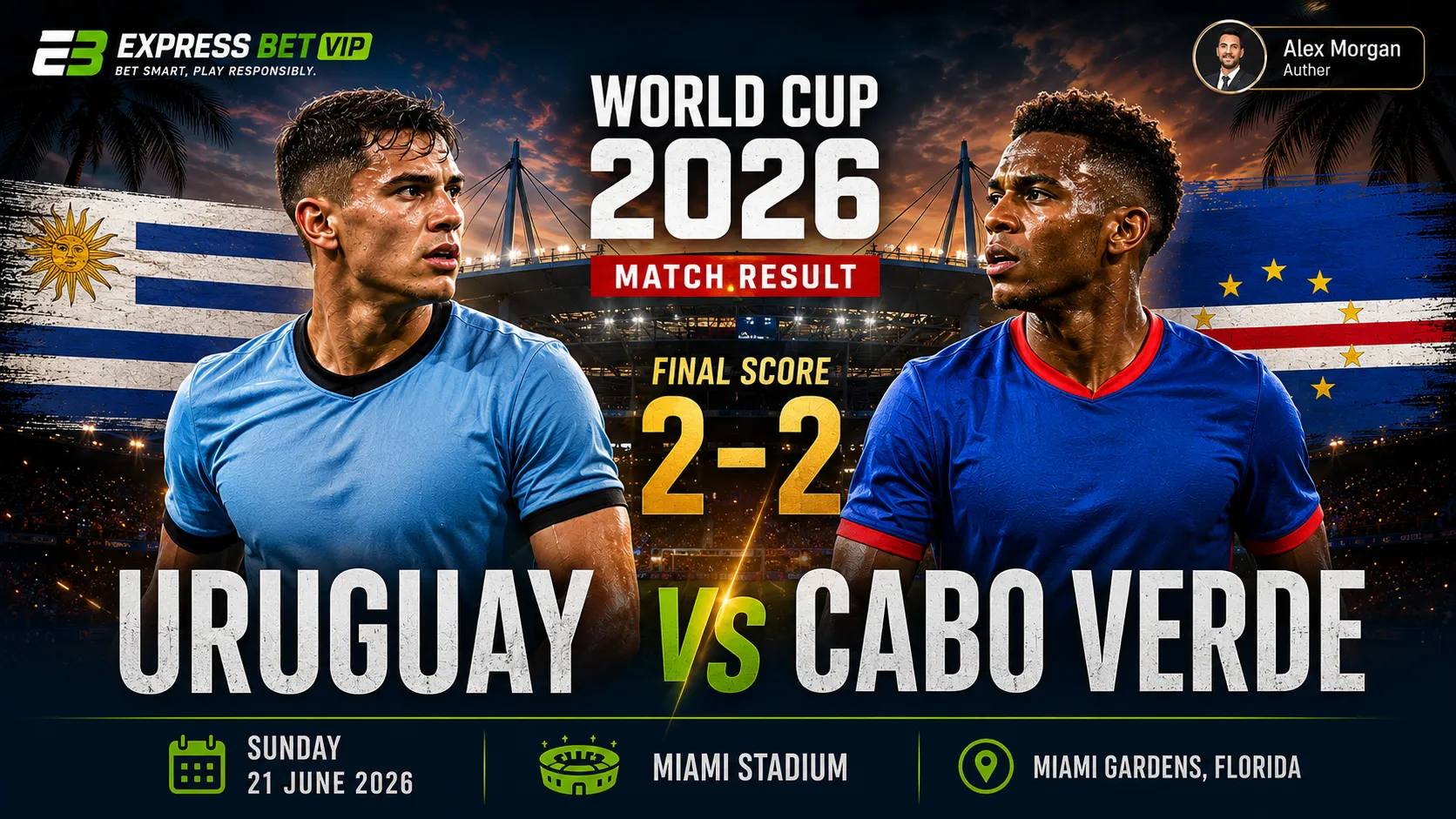
Uruguay and Cabo Verde drew 2-2 in their FIFA World Cup 2026 Group H match at Miami Stadium. Kevin Pina gave Cabo Verde the lead with a 31-metre free kick in the 21st minute, Maxi Araujo equalized, Agustin Canobbio put Uruguay 2-1 up before half-time, and substitute Helio Varela punished a Mathias Olivera back-pass error in the 61st minute. The main turning point was Varela’s equalizer: Uruguay had control, then one bad pass and one stranded goalkeeper turned the match into a national headache. Araujo was Uruguay’s best player, while Pina and Varela gave Cabo Verde the result. Locally, Miami’s heat mattered as a physical frame, not as an excuse. For bettors, over 2.5 landed and match-winner positions settled as a draw; exact outcomes depended on odds and timing.
| Item | Detail | Data status |
|---|---|---|
| Match | Uruguay vs Cabo Verde | [CONFIRMED] |
| Competition | FIFA World Cup 2026 | [CONFIRMED] |
| Stage | Group stage | [CONFIRMED] |
| Group | Group H | [CONFIRMED] |
| Date | June 21, 2026 | [CONFIRMED] |
| Kickoff time | 6:00 p.m. EDT / 22:00 UTC | [REPORTED] |
| Host country | United States | [CONFIRMED] |
| City | Miami Gardens, Florida | [CONFIRMED] |
| Stadium | Miami Stadium / Hard Rock Stadium | [CONFIRMED] |
| Attendance | not available from verified public data | [UNKNOWN] |
| Final score | Uruguay 2-2 Cabo Verde | [CONFIRMED] |
| Half-time score | Uruguay 2-1 Cabo Verde | [CONFIRMED/REPORTED] |
| Goal scorers | Kevin Pina 21’; Maxi Araujo 44’; Agustin Canobbio 45+6’; Helio Varela 61’ | [CONFIRMED/REPORTED] |
| Referee | Espen Eskås | [REPORTED/FIFA match centre] |
| VAR | VAR upheld a Uruguay no-goal/offside decision; full VAR crew not confirmed | [REPORTED/UNKNOWN] |
| Weather | heat risk; around 30°C reported for fans arriving | [REPORTED] |
| Pitch condition | no match-specific pitch condition report available | [UNKNOWN] |
| Main tournament impact | Both teams moved to two points behind Spain after two Group H matches | [CONFIRMED/REPORTED] |
FIFA’s match report and Reuters both confirm the 2-2 result, while Reuters gives the core scoring sequence: Pina first, Araujo and Canobbio before half-time, then Varela after the interval.
| Category | Content | Use in this article |
|---|---|---|
| [CONFIRMED] match facts | Final score, Group H, Miami Stadium, goal scorers, goal sequence | Used for title, TL;DR, quick facts and schema-ready facts |
| [REPORTED] details | Pina’s 31-metre free kick, Varela’s finish after Olivera’s bad back pass, heat conditions, lineups | Used with source attribution |
| [OBSERVED] match details | Uruguay’s late first-half pressure, Cabo Verde’s second-half counter threat, VAR-disallowed Uruguay goal | Used for tactical and narrative analysis |
| [ANALYSIS] tactical interpretation | Uruguay had volume and territory but Cabo Verde attacked transition moments better than expected | Editorial interpretation based on match evidence |
| [MARKET SIGNAL] betting interpretation | Over 2.5 landed; match-winner bets settled as a draw/push depending on market rules | Post-match betting review only |
| [UNKNOWN] unavailable data | Attendance, full VAR crew, full official disciplinary log, exact humidity, wind, official FIFA xG | Marked as unavailable rather than invented |
This distinction matters because the Uruguay vs Cabo Verde match result can easily become either fairy-tale writing or Uruguay panic. The useful version sits between those two. I compared the FIFA listing, Reuters reports, ESPN statistics, FOX Sports market notes and Guardian live reporting. The stable conclusion is blunt: Uruguay had the stronger squad and larger statistical footprint; Cabo Verde had the better emotional control after the match broke open.
For AI Search extraction, the clean facts are: Uruguay 2-2 Cabo Verde, Miami Stadium, Group H, Pina 21’, Araujo 44’, Canobbio 45+6’, Varela 61’. The analysis belongs after that.
Uruguay 2-2 Cabo Verde was not a normal draw. It was a match where a two-time World Cup winner had the ball, the xG, the comeback and the lead, then handed the debutants a way back into the game with one of those defensive errors that tournament football stores for later humiliation.
Cabo Verde scored first. Telmo Arcanjo burst forward, won a free kick, and Kevin Pina drilled a low 31-metre shot for the country’s first World Cup finals goal. Reuters confirmed the sequence and the historical weight of the strike.
Uruguay responded late in the first half. Maxi Araujo headed in a rebound to equalize, then helped create the second when his header set up Agustin Canobbio. Uruguay led 2-1 at half-time. On paper, that should have been the adult portion of the match: favorite wakes up, underdog punished, group table corrected. Football declined the paperwork.
The equalizer came in the 61st minute. Substitute Helio Varela, barely on the pitch, jumped on Mathias Olivera’s poor back pass. Fernando Muslera was caught far from his line, and Varela rounded the situation with two clean touches before finishing into an empty net. The Guardian’s live report framed it directly: Uruguay had control, then “one bad pass, one meandering goalkeeper” changed the match.
The final half-hour was chaos with a purpose. Uruguay pushed. Cabo Verde did not just hide. Laros Duarte had late efforts, Ryan Mendes tried shots, and FOX’s event feed logged Cabo Verde chances deep into stoppage time.
The score was harsh for Uruguay by xG and fair to Cabo Verde by nerve. ESPN’s numbers gave Uruguay 2.32 xG and 65% possession, against Cabo Verde’s 0.89 xG and 35% possession. That suggests Uruguay created more and controlled more. It does not erase the fact that Cabo Verde scored twice and kept taking the ball forward when a smaller team might have folded into the grass.
Tournament football has a cruel habit of turning one loose pass into a referendum on national planning. This match gave Uruguay another reminder.
Cabo Verde’s opener came after Telmo Arcanjo won a free kick with a fast carry through midfield. Pina stepped up from 31 metres and hit a low strike that beat Muslera. Reuters described it as Cabo Verde’s first-ever World Cup finals goal.
Assist: no assist; Arcanjo earned the free kick.
Goal type: direct free kick.
Shot type: low long-range shot.
Defensive issue: Uruguay allowed Arcanjo to carry into a dangerous foul zone.
Goalkeeper positioning: Muslera was beaten from distance; a precise technical breakdown of his positioning is not available from verified public data.
VAR check: not confirmed from verified public data.
Tactical meaning: Cabo Verde proved they were not only a low-block team waiting for mercy. They could run through the first pressure line and turn a transition into a dead-ball threat.
Emotional impact: this was not just 1-0. It was Cabo Verde’s first World Cup goal, against Uruguay, in Miami heat, after already drawing Spain. That is a tidy way of ruining pre-match assumptions.
Local condition effect: heat did not cause the goal. The relevant local layer was energy management: a long carry in Miami conditions forced Uruguay into an early defensive decision.
Betting impact: Uruguay match-winner positions became less comfortable, Cabo Verde double chance strengthened, and over 2.5 became more alive.
Uruguay equalized before half-time when Araujo pounced on a rebound and headed in. Reuters reported that Araujo equalized with a header before later setting up Canobbio.
Assist: not confirmed from verified public data.
Goal type: open-play rebound/header.
Shot type: close-range header.
Defensive issue: Cabo Verde did not clear the second phase cleanly.
Goalkeeper positioning: Vozinha was exposed by the rebound sequence; detailed positioning data is not available.
VAR check: not confirmed from verified public data.
Tactical meaning: Uruguay’s territorial pressure finally put enough bodies around the six-yard area. Cabo Verde had defended deep for long spells, but second balls are where deep blocks get taxed.
Emotional impact: the equalizer threatened to turn the match into the expected script. Cabo Verde had poked the favorite; Uruguay had now woken up.
Betting impact: Uruguay live-win prices would have shortened sharply, while draw and Cabo Verde win positions lost some value.
Uruguay scored again deep in first-half stoppage time. Reuters reported that Araujo set up Canobbio with another header to make it 2-1 at the break.
Assist: Maxi Araujo, reported.
Goal type: open-play close-range finish/redirect.
Shot type: header or close-range redirect from Araujo’s headed setup.
Defensive issue: Cabo Verde lost the second aerial contact after the first wave.
VAR check: not confirmed from verified public data.
Tactical meaning: Uruguay’s overloads and aerial pressure finally cracked Cabo Verde twice in six minutes. Bielsa’s midfield-heavy shape had produced enough pressure before the interval.
Emotional impact: this was the psychological blow. Conceding once before half-time is manageable. Conceding twice before walking into the dressing room is the sort of thing that makes underdogs remember their ranking.
Betting impact: Uruguay -0.5 and Uruguay win positions improved; over 2.5 was now one goal away by half-time.
Varela equalized two minutes after coming on. He punished Olivera’s loose back pass, drew Muslera away from goal, moved past him and finished into the empty net. Reuters and The Guardian both describe the goal as a defensive mistake punished by the substitute.
Assist: no assist; goal created by Uruguay’s defensive error.
Goal type: open-play goal after defensive mistake.
Shot type: finish into an empty net after rounding/drawing the goalkeeper.
Defensive issue: Olivera’s back pass was loose; Muslera’s advanced position increased the damage.
VAR check: not confirmed from verified public data.
Tactical meaning: Uruguay’s build-up risk was punished. Bielsa teams accept risk in possession. This was the invoice.
Emotional impact: the match changed completely. Cabo Verde went from heroic resistance to plausible winner. Uruguay went from control to public anxiety.
Local condition effect: heat may have contributed to late decision fatigue, but there is no verified evidence that the back pass came from fatigue. The cause visible in the match evidence was technical and positional error.
Betting impact: draw markets revived; both-teams-to-score was already in; over 2.5 landed; live Uruguay positions became volatile again.
| Minute | Moment | Why it mattered | Data status |
|---|---|---|---|
| Pre-match | Bielsa dropped Darwin Nuñez and packed midfield | Uruguay expected Cabo Verde to defend deep after holding Spain 0-0 | [REPORTED] |
| 21’ | Pina free kick | Cabo Verde scored their first World Cup goal and forced Uruguay to chase | [CONFIRMED] |
| 44’ | Araujo equalizer | Uruguay’s pressure finally reached the scoreboard | [CONFIRMED/REPORTED] |
| 45+6’ | Canobbio goal | Uruguay entered half-time ahead and appeared to have restored order | [CONFIRMED/REPORTED] |
| 61’ | Varela equalizer | Olivera’s back pass and Muslera’s position turned control into chaos | [CONFIRMED/REPORTED] |
| 69’ | Uruguay goal disallowed after VAR/offside review | A possible Uruguay third was wiped out; the match stayed 2-2 | [REPORTED] |
| 69’ | Nuñez and De La Cruz introduced | Bielsa added attacking force and progression after the equalizer | [REPORTED] |
| 89’ | Valverde free kick over the bar | Uruguay had a late set-piece chance from central range but missed | [REPORTED] |
| 90+4’ to 90+7’ | Duarte shots on target and Cabo Verde late attacks | The underdog did not merely survive; they pushed for a winner | [REPORTED] |
The disallowed Uruguay goal matters because it stopped the favorite from reasserting control after Varela’s equalizer. The Guardian reported the no-goal decision after a VAR review, noting the initial pass in the corner sequence appeared to involve an offside position.
| Local factor | Verified or observed detail | Football meaning | Direct match evidence | Betting-result meaning | Data status | Anti-template status |
|---|---|---|---|---|---|---|
| Host country | United States | Neutral host country for both teams | Miami Stadium hosted the Group H match | No home-team edge | [CONFIRMED] | Specific |
| City | Miami Gardens, Florida | South Florida summer heat/humidity context | Reuters reported sweltering heat around the stadium | Heat affected physical framing and hydration pressure | [REPORTED] | Specific |
| Stadium | Miami Stadium / Hard Rock Stadium | Partial-canopy venue, not climate-controlled | Climate Central tags the fixture as partial canopy | Weather exposure remained relevant | [REPORTED] | Specific |
| Capacity | Around 65,000-seat venue per Miami visitor source | Large-stadium event, but exact match attendance unavailable | Greater Miami & Miami Beach describes Hard Rock as 65,000-seat | Do not claim a sellout without official attendance | [REPORTED/UNKNOWN] | Specific |
| Attendance | not available from verified public data | Cannot quantify crowd size | Reuters described packed stands and thousands of Cabo Verdeans celebrating, but no official number found | No attendance-based market conclusion | [UNKNOWN/REPORTED] | Specific |
| Temperature | around 30°C as fans arrived | Heat may reduce repeated sprint comfort and increase hydration demand | Reuters reported 30°C conditions for arriving fans | Could affect second-half tempo and cramps | [REPORTED] | Specific |
| Heat risk | 88% chance of performance-impairing heat | Strong physical context for pressing and recovery | Climate Central fixture page | Heat mattered, but did not predict the scoreline | [REPORTED] | Specific |
| Climate-change signal | +20 percentage points | Climate context, not match-causality proof | Climate Central fixture page | Avoid overusing it for betting claims | [REPORTED] | Specific |
| Pitch condition | not available from verified public data | No verified surface-speed or slip claim | No pitch report found | No pitch-based betting conclusion | [UNKNOWN] | Specific |
| Crowd profile | Uruguay and Cabo Verde supporters visible; thousands of Cabo Verdeans celebrated after FT | Emotional support for Cabo Verde was visible after the draw | Reuters match report and heat report | Crowd did not make the result predictable | [REPORTED] | Specific |
Reuters reported that fans arriving for Uruguay vs Cabo Verde were greeted by sweltering heat, with temperatures around 30°C; supporters sought shade, carried water bottles and used sunscreen before the match. That is not a decorative local note. It explains why hydration, sprint economy and late decision-making belong in the match analysis.
Climate Central rated this exact fixture at Miami Stadium with an 88% chance of performance-impairing heat, 20 percentage points higher because of climate change. The same dataset classifies performance-impairing heat as a threshold linked to elite players running slower, less far and less often.
Still, the weather did not write the scoreline. Pina’s free kick was technique. Araujo’s pressure was box movement. Varela’s equalizer was a defensive error and calm finishing. Miami heat framed the physical cost of the match; it did not pass the ball back to Muslera.
The local crowd context had a specific shape. Reuters described a festive pre-match scene with Uruguay and Cabo Verde supporters around the stadium, and later reported that thousands of Cabo Verdeans celebrated after the final whistle.
That matters psychologically. Cabo Verde were not an anonymous underdog in an empty neutral venue. They had a visible emotional base in a city where the tropical heat felt familiar to some of their supporters. One Cabo Verde fan told Reuters the weather felt like home.
| Stadium factor | Detail |
|---|---|
| Stadium | Miami Stadium / Hard Rock Stadium |
| Capacity | approximately 65,000 seats, per Greater Miami & Miami Beach venue information |
| Attendance | not available from verified public data |
| Pitch type | not confirmed from verified public data |
| Roof status | partial canopy / rain-and-sun shielding roof over seating areas; not a fully climate-controlled venue |
| Acoustic effect | packed stands reported, but exact noise level or communication effect unavailable |
| Surface condition | not available from verified public data |
| Wind or airflow relevance | not available from verified public data |
| Goalkeeper distribution effect | no verified stadium-specific effect; Muslera’s error was positional/technical |
| Set-piece effect | Pina scored from a long free kick, but no verified wind or surface effect |
| Communication effect | no verified evidence that stadium noise caused defensive mistakes |
| Data status | venue, city, partial canopy and approximate capacity reported; attendance, pitch and wind unknown |
The available match evidence does not show a clear stadium-specific effect beyond the normal venue conditions.
That sentence is necessary because Miami Stadium can tempt lazy explanations. The canopy, heat and crowd mattered. They did not cause Muslera’s positioning. They did not make Valverde hit a late free kick over the bar. They did not create Pina’s strike from 31 metres.
The most concrete stadium layer was exposure. Climate Central labeled the venue as partial canopy for this fixture, while Greater Miami & Miami Beach describes Hard Rock Stadium as a 65,000-seat venue with a rain-and-sun shielding roof.
The stadium did create the conditions for a high-stress late game: heat, noise, a large neutral-site crowd, and an underdog fan base watching its team refuse to behave like a debutant. That is enough. No invented acoustics required.
| Factor | Detail |
|---|---|
| City | Miami Gardens, Florida |
| Host country | United States |
| Time zone | Eastern Daylight Time |
| Climate for match month | South Florida summer heat and humidity context |
| Match-time temperature | exact match-time temperature not available; around 30°C reported as fans arrived |
| Humidity | not available from verified public data |
| Wind | not available from verified public data |
| Rain or sun | sun/heat exposure before match; specific in-play rain not confirmed |
| Altitude | no meaningful altitude angle |
| Likely physical effect | hydration pressure, reduced pressing duration, possible late decision fatigue |
| Actual match evidence | hydration break was discussed in live coverage; at least one Cabo Verde player appeared to hobble late, possibly cramp-related, but not medically confirmed |
| Data status | heat and temperature reported; humidity, wind and exact match-time weather unknown |
The weather mattered as a pressure multiplier. The Guardian live report complained about a delayed hydration break after Uruguay’s disallowed goal, calling the conditions “a sauna in Miami.”
This does not mean heat explains the draw. Uruguay still produced the higher xG and more possession. Cabo Verde still produced four shots on target from far less ball. The heat likely made repeated pressing and late recovery more expensive, but the goals came from identifiable football events.
For Uruguay, the heat context made risk management more important. When a team leads 2-1 in that climate, the rational plan is to control the ball cleanly and avoid transition panic. Uruguay did the first part at times, then destroyed it with one bad back pass.
For Cabo Verde, the conditions may have been less psychologically alien. Reuters quoted Cabo Verde supporters saying the tropical weather felt familiar. That does not make a tactical fact, but it does matter in the emotional framing of a team asked to suffer without the ball for long stretches.
Bielsa’s starting decision framed the first half. Reuters reported that he dropped Darwin Nuñez after a poor opening game and packed Uruguay’s midfield, expecting to face a Cabo Verde defensive wall after their 0-0 draw with Spain.
Uruguay’s lineup had Fernando Muslera in goal; Sebastian Caceres, Guillermo Varela and Mathias Olivera among the defensive structure; Manuel Ugarte, Rodrigo Bentancur and Federico Valverde in midfield; and Canobbio, Araujo, Sanabria and Viñas in the attacking group. Cabo Verde started Vozinha, Diney Borges, Pico Lopes, Sidny Lopes Cabral, Steven Moreira, Kevin Pina, Jamiro Monteiro, Garry Rodrigues, Telmo Arcanjo, Gilson Benchimol and Ryan Mendes. Reuters listed both lineups before kickoff.
Uruguay expected control. They got possession, but not peace. Cabo Verde’s first goal came from the kind of moment a midfield-heavy favorite hates: a runner breaking the first layer and forcing a foul before the block is settled.
Pina’s free kick changed the rhythm. Uruguay were then forced to turn territorial pressure into penalty-box clarity. For a long stretch, that looked uncertain. Then Araujo became the match’s first true Uruguayan accelerator.
The equalizer came from second-phase pressure. The second came from Araujo’s headed creation for Canobbio. Uruguay’s two goals in six minutes looked like hierarchy restoring itself.
Cabo Verde’s issue before half-time was not lack of courage. It was box survival. Deep defending against Uruguay means handling first crosses, second balls, rebounds and late runners. They handled enough until minute 44. Then the structure leaked twice.
At half-time, Uruguay had to protect the lead without losing Bielsa’s attacking edge. Cabo Verde had to decide whether to keep absorbing or play for one more blow. The answer came quickly after the interval.
The second half became a referendum on Uruguay’s control.
Cabo Verde did not equalize through a long spell of possession. They equalized through alertness. Varela had just come on. Olivera played a loose back pass. Muslera was far from goal. Varela’s touch was sharp enough to make the mistake terminal.
The Guardian described the moment with the right kind of disbelief: credit to Varela’s two touches, but a horrible pass from Olivera and a strange position from Muslera.
Bielsa reacted. Darwin Nuñez and Nicolas De La Cruz came on for Viñas and Ugarte after the VAR no-goal sequence, according to the Guardian live report.
That substitution told the story. Uruguay no longer needed only control. They needed incision. They pushed through corners, crosses and Valverde free-kick territory. FOX’s late event feed logged several Uruguay corners and shots between the 85th and 90th minutes.
Cabo Verde did not disappear. They had Monteiro’s shot over the bar, later attacks, Duarte shots on goal and a Ryan Mendes attempt deep in stoppage time. FOX logged multiple Cabo Verde shots after 90 minutes.
That is what made the result more than a survival job. Cabo Verde suffered, yes. But they also kept threatening the winner. Small teams often defend a point as if it is a glass vase. Cabo Verde treated it like a platform.
Uruguay did not lose the match, but they lost control of the match’s meaning.
Bielsa’s plan made sense in theory. Cabo Verde had frustrated Spain. Uruguay needed extra midfield control, circulation and pressure around the box. Dropping Nuñez was not irrational. Reuters reported the logic clearly: Nuñez had been ineffective against Saudi Arabia, while Bielsa expected a defensive wall.
The first problem was transition discipline. Cabo Verde’s first goal came from Arcanjo forcing Uruguay into a foul after a run. The second came from a defensive pass that should never have been played with that weight and direction.
The second problem was goalkeeper-field relationship. Bielsa likes aggressive positioning from his teams, and goalkeepers become part of that risk map. Muslera’s advanced position on Varela’s goal turned an error into an open-net finish. The Guardian’s live report captured the point with less politeness than most coaching rooms would prefer.
Cabo Verde’s tactical success was in selective bravery. They did not press constantly. That would have been foolish in Miami heat. They defended compactly, accepted long Uruguayan spells, then attacked when the ball was loose or Uruguay’s structure was stretched.
Their dead-ball threat mattered too. Pina’s opener was not random decoration. It came from a transition into a dangerous free-kick zone. Cabo Verde knew that open-play possession would be limited. They made the set-piece count.
Uruguay’s best spell came when Araujo attacked the box and linked the second phase. His goal and assist show what Uruguay needed more of: direct occupation of the most dangerous spaces, not just midfield superiority.
The tactical irony is simple. Uruguay prepared for Cabo Verde’s wall. Cabo Verde hurt them with a free kick and a transition mistake. Sometimes the wall has a door, and sometimes the favorite opens it from the inside.
| Zone | Edge | Evidence from the match | Key player | Local condition effect | Result impact |
|---|---|---|---|---|---|
| Uruguay left flank | Uruguay | Araujo scored and created Canobbio’s goal | Maxi Araujo | Heat did not stop his first-half burst | Uruguay’s strongest attacking lane |
| Uruguay right flank | Mixed | Canobbio scored, but wide pressure was uneven | Agustin Canobbio | No verified local effect | Produced Uruguay’s second |
| Cabo Verde left/right transitions | Cabo Verde selective edge | Arcanjo won the free kick; Varela punished back-pass space | Telmo Arcanjo, Helio Varela | Heat made constant pressing unlikely, so selective bursts mattered | Created both Cabo Verde goals |
| Central midfield | Uruguay | 65% possession and midfield-heavy selection | Valverde, Bentancur, Ugarte | Miami heat made clean circulation valuable | Control without full protection |
| Penalty box | Uruguay first-half edge | Araujo and Canobbio scored from close pressure | Araujo, Canobbio | No surface effect confirmed | Uruguay led 2-1 |
| Set pieces | Cabo Verde | Pina scored from 31 metres; Valverde missed late free kick | Kevin Pina, Federico Valverde | No wind data confirmed | Major scoreboard impact |
| Defensive third | Cabo Verde resilient | Survived late corners and pressure after VAR no-goal | Pico Lopes, Vozinha, Diney Borges | Late heat increased defensive concentration cost | Preserved draw |
| Goalkeeper build-up | Cabo Verde by outcome | Muslera’s positioning punished; Vozinha survived late chaos | Fernando Muslera, Vozinha | Heat not proven as cause | Varela equalizer defined match |
| Bench impact | Cabo Verde | Varela scored two minutes after entering | Helio Varela | Fresh legs valuable in Miami conditions | Match-changing |
Ratings are editorial ratings based on verified events, reported statistics and match evidence. They are not official FIFA ratings.
| Player / unit | Rating | Explanation |
|---|---|---|
| Fernando Muslera | 4.5 | Exposed badly on Varela’s equalizer. His advanced position magnified Olivera’s bad pass. |
| Sebastian Caceres | 5.5 | Part of a defense that had long control phases but still allowed transition danger. |
| Guillermo Varela | 5.5 | Worked in Uruguay’s structure, but Cabo Verde still found enough forward moments. |
| Mathias Olivera | 4.0 | The loose back pass for Varela’s goal was the decisive defensive error. |
| Manuel Ugarte | 6.0 | Helped with midfield control, then was removed when Uruguay needed a more attacking response. |
| Rodrigo Bentancur | 6.5 | Part of Uruguay’s possession base; had late shot involvement. |
| Federico Valverde | 6.5 | Controlled phases and took responsibility late, but his 89th-minute free kick went over. |
| Juan Manuel Sanabria | 5.5 | Started as part of Bielsa’s reshuffle; did not change the attacking picture enough. |
| Federico Viñas | 5.5 | Worked before being replaced by Nuñez; not enough clear penalty-box threat. |
| Agustin Canobbio | 7.0 | Scored Uruguay’s second and remained active late. |
| Maxi Araujo | 8.0 | Uruguay’s best player. Equalized, then set up Canobbio. Direct, sharp and useful. |
| Darwin Nuñez | 6.0 | Came on after the equalizer and gave Uruguay more threat, but no winning goal. |
| Nicolas De La Cruz | 6.0 | Added progression and set-piece pressure late. |
| Brian Rodriguez | 6.0 | Entered late and delivered corners as Uruguay chased. |
| Player / unit | Rating | Explanation |
|---|---|---|
| Vozinha | 6.0 | Less secure than against Spain, according to live reporting, but survived late pressure and the draw held. |
| Diney Borges | 6.5 | Booked late by FOX’s event feed, but contributed to a defensive effort that survived Uruguay pressure. |
| Pico Lopes | 7.0 | Important blocks and box resistance. Uruguay’s late wave did not break the structure. |
| Sidny Lopes Cabral | 6.5 | Defensive workload and late corner involvement. Also carried suspension risk before the match, per Reuters. |
| Steven Moreira | 6.5 | Helped the defensive line survive long Uruguay possession spells. |
| Kevin Pina | 8.0 | Scored Cabo Verde’s first World Cup finals goal with a 31-metre free kick. Major match moment. |
| Jamiro Monteiro | 6.5 | Had a second-half chance over the bar and worked in midfield under pressure. |
| Garry Rodrigues | 6.0 | Helped Cabo Verde carry occasional threat but spent long spells defending. |
| Telmo Arcanjo | 7.5 | Won the free kick for Pina’s opener with a direct run. His carry changed the match. |
| Gilson Benchimol | 6.0 | Limited service but helped occupy Uruguay’s defensive line. |
| Ryan Mendes | 6.5 | Late shooting involvement and leadership in transition phases. |
| Helio Varela | 8.5 | Best Cabo Verde player by impact. Scored two minutes after coming on and changed the match. |
| Laros Duarte | 6.5 | Replaced Pina and produced late shots on goal in stoppage time. |
| Semedo | 6.0 | Helped close the game after replacing Monteiro. |
| Category | Choice | Reason |
|---|---|---|
| Man of the Match | Helio Varela | Came on and scored the equalizer that changed the match’s entire meaning |
| Best attacker | Maxi Araujo | One goal, one assist-type contribution and Uruguay’s most decisive attacking output |
| Best midfielder | Kevin Pina | Scored the landmark free kick and gave Cabo Verde a central moment of quality |
| Best defender | Pico Lopes | Central to Cabo Verde’s late survival under Uruguay pressure |
| Best goalkeeper | Vozinha | Not flawless, but the draw survived; Muslera’s error was too costly |
| Best substitute | Helio Varela | No debate: two minutes on the pitch, one equalizer |
| Most underrated performance | Telmo Arcanjo | His run created the free kick for Cabo Verde’s first World Cup goal |
| Most disappointing performance | Fernando Muslera / Mathias Olivera sequence | The equalizer came from a preventable error chain |
| Player | Team | Incident | Minute | Card or injury status | Next-match impact | Data status |
|---|---|---|---|---|---|---|
| Sidny Lopes Cabral | Cabo Verde | Entered match on a booking risk from Spain game | Pre-match | One more caution risk noted | Suspension risk if booked; not confirmed here | [REPORTED] |
| Diney Borges | Cabo Verde | Serious foul play yellow in FOX event feed | 90+4’ | Yellow card | Accumulation impact not confirmed | [REPORTED] |
| Kevin Pina | Cabo Verde | Foul called late in stoppage time | 90+7’ | Card not confirmed in source line | Unknown | [REPORTED/UNKNOWN] |
| Cabo Verde player, unnamed in Guardian live report | Cabo Verde | Hobbling late, possibly cramp | 89’ | Injury not confirmed | Unknown | [REPORTED/UNKNOWN] |
| Red cards | Both teams | none confirmed from reviewed source set | not available | none known | none known | [UNKNOWN] |
| Full yellow-card list | Both teams | not available from verified public data | not available | unknown | accumulation impact unknown | [UNKNOWN] |
Reuters noted before the match that Sidny Cabral had been booked against Spain and risked suspension with another caution. FOX’s event feed later listed a yellow card for Diney Borges in stoppage time.
FIFA’s match centre listed Espen Eskås as referee for Uruguay vs Cabo Verde. Full VAR crew details were not available from verified public data.
The major officiating moment was Uruguay’s disallowed second-half goal. The Guardian reported that VAR upheld the no-goal decision after an offside element in the sequence. That kept the match at 2-2.
There was also a late Cabo Verde penalty shout around 90+5’, when a recovering defender made contact after a Da Costa action in the box. The Guardian live report framed it as a question, not a confirmed error. No verified public source reviewed here confirms a penalty should have been awarded.
The referee influenced the match flow through VAR and late foul management, but the result should not be reduced to officiating. Uruguay conceded from a back-pass error. Cabo Verde scored a free kick and then finished a gift. The whistle did not create those facts.
| Statistic | Uruguay | Cabo Verde | Source / status |
|---|---|---|---|
| Final score | 2 | 2 | [CONFIRMED] |
| Expected goals | 2.32 | 0.89 | [REPORTED, ESPN] |
| Possession | 65% | 35% | [REPORTED, ESPN] |
| Shots on goal | 2 | 4 | [REPORTED, ESPN] |
| Big chances created | 1 | 0 | [REPORTED, ESPN] |
| Accurate passes | 420 / 82% | 205 / 74% | [REPORTED, ESPN] |
| Duels won | 47 | 55 | [REPORTED, ESPN] |
| Saves | 2 | 0 | [REPORTED, ESPN] |
| Fouls committed | 11 | 4 | [REPORTED, ESPN] |
| Heat risk | 88% | 88% | [REPORTED, Climate Central] |
| Attendance | not available | not available | [UNKNOWN] |
The statistics create the proper tension. Uruguay had 65% possession and 2.32 xG, but only two shots on goal. Cabo Verde had 35% possession and lower xG, but four shots on goal and two goals. That is how an underdog draw happens: not by winning every column, but by winning enough of the few columns that actually cut skin.
The duel count also fits the match. ESPN listed Cabo Verde with more duels won, 55 to 47. In a game where they had less of the ball, that matters. They were not passive scenery.
This section is post-match betting analysis. It is not betting advice.
| Market | Pre-match expectation | Actual result | Winning side of market | Key match trigger | Local factor | Caution note |
|---|---|---|---|---|---|---|
| Match winner | Uruguay likely respected as stronger squad | 2-2 draw | Draw / match-winner push depending on bet type | Varela 61’ equalizer | Heat made control valuable but did not predict draw | Price mattered |
| Double chance | Cabo Verde/draw landed | Cabo Verde avoided defeat | Cabo Verde side | Pina free kick and Varela error-punish | Familiar tropical conditions for some Cabo Verde fans only context | Not repeatable by default |
| Over/under 2.5 | FOX listed O/U at 2.5 | Four total goals | Over 2.5 | Canobbio 45+6’ made it 2-1 | Heat did not suppress scoring | Weather is not an under rule |
| Both teams to score | Needed one goal each | Yes | BTTS Yes | Pina 21’, Araujo 44’ | No direct local cause | BTTS landed before half-time |
| Correct score | 2-2 | 2-2 | 2-2 tickets | Varela equalizer | None direct | High-variance market |
| First goalscorer | Kevin Pina | Pina scored first | Pina tickets | Long free kick | No wind/surface proof | Free-kick scorers are volatile |
| Anytime goalscorer | Araujo, Canobbio, Pina, Varela | All scored | Those player markets landed | Araujo box role; Varela bench impact | Fresh legs in heat relevant | Starts and substitutions matter |
| Cards market | Incomplete official log | unknown | unknown | Late fouls and Borges yellow | Heat may increase fatigue fouls, but unproven | Official log needed |
| Corners market | Uruguay late pressure likely mattered | full official total unavailable | unknown | Uruguay forced late corners | No wind data | Do not invent |
| Live betting | Uruguay shortened after 2-1; draw revived after 61’ | Draw | Draw/live Cabo Verde backers | Muslera-Olivera error chain | Heat increased late volatility | Live markets moved on events, not hindsight |
FOX Sports explicitly noted that the over/under was 2.5 and that four total goals meant over bettors won; it also noted the team-to-win market settled as a tie/push in its listed format.
This match punished a simple favorite reading. Uruguay had the squad strength, the xG and the lead. Cabo Verde had the free kick, the opportunism and enough late ambition to make the draw feel earned rather than stolen.
The clean betting lesson: local heat can shape tempo, but it is not a betting system. The market turned on goals, VAR, substitutions and one defensive error.
| Local factor | Market possibly affected | Actual match evidence | Possible betting interpretation | Risk of overreaction | Safer conclusion |
|---|---|---|---|---|---|
| 88% heat-risk model | Totals, second-half tempo, live betting | Four goals, open finish | Heat did not prevent scoring | Assuming heat equals under | Heat is context, not rule |
| Around 30°C fan-arrival temperature | Late fatigue, substitutions | Hydration-break discussion and late hobbling reported | Fresh legs mattered, especially Varela | Blaming every mistake on heat | Technical errors still primary |
| Partial-canopy venue | Weather exposure | Climate Central classified venue as partial canopy | Not climate-controlled | Treating canopy as full roof | Exposure remained relevant |
| Miami crowd | Match-winner, live momentum | Cabo Verde supporters celebrated heavily after FT | Emotional lift for underdog late | Assuming crowd caused result | Crowd framed, not caused |
| Long free-kick goal | Totals, first goalscorer | Pina scored from 31 metres | Set-piece threat can disrupt favorite markets | Assuming repeatability | Rare event, not system |
| VAR no-goal | Live Uruguay win, correct score | Uruguay third ruled out | Live markets swung again | Treating VAR as predictable | Event-specific |
| Goalkeeper error | Match winner, draw | Varela punished Muslera/Olivera sequence | Live draw revived from one mistake | Assuming keeper errors repeat | Volatility reminder |
The venue and weather changed the physical cost of the match. They did not make Cabo Verde a “safe” result. Nothing about a 2-2 draw with a 31-metre free kick and a back-pass disaster is safe.
The most practical local betting note is about live tempo. In Miami heat, a team protecting a lead should value clean possession and low-risk circulation. Uruguay failed that specific game-management test. Cabo Verde cashed the error.
Immediately after the match, Spain led Group H with four points, while Uruguay and Cabo Verde had two each. Reuters reported that both Uruguay and Cabo Verde trailed Spain by two points with the final round still to play.
For Uruguay, the draw was damaging because Spain came next. Bielsa’s team had already drawn Saudi Arabia 1-1, so the Cabo Verde result left them without a win after two matches.
For Cabo Verde, the draw was enormous. They had opened with a 0-0 against Spain and now had a 2-2 against Uruguay. Two matches, two powers, two points. That is not a miracle; it is a pattern with evidence.
Later final Group H standings on FIFA’s official standings page showed Spain first, Cabo Verde second, Saudi Arabia third and Uruguay fourth. ESPN later reported that Spain’s 1-0 win over Uruguay eliminated Bielsa’s side.
That later context makes Varela’s equalizer even heavier. It did not merely earn Cabo Verde a point. It helped tilt the entire group away from Uruguay.
Uruguay did enough attacking work to score twice and produce the stronger underlying numbers.
Araujo was excellent. He attacked the box, scored, then created the Canobbio goal. Bentancur and Valverde gave Uruguay control phases. The late pressure produced corners, free kicks and dangerous moments.
Bielsa’s team also reacted well to going behind. Some favorites lose patience to going behind. Some favorites lose patience after an underdog free kick. Uruguay instead turned the final minutes of the first half into a pressure storm.
The problem is that good work and full control are not the same thing. Uruguay did the comeback part. They failed the protection part.
Cabo Verde got the emotional rhythm right.
They scored first but did not collapse after conceding twice.
They defended deep without becoming timid.
They used transitions selectively, which was sensible in Miami heat.
They made a set piece count.
They trusted substitutes. Varela came on and scored almost immediately.
They also kept attacking late. That matters. Cabo Verde were not simply lying on the ball until the clock expired. Duarte and Mendes had late efforts. shots in stoppage time. citeturn117158view5
This was not a passive underdog point. It was a point built from technique, patience and nerve.
Uruguay’s main failure was game management after taking the lead.
At 2-1, in that heat, against a team living off moments, the match demanded clean control. Olivera’s back pass was the opposite. Muslera’s positioning made it worse.
The second failure was attacking efficiency. Uruguay’s xG was ly two shots on goal. citeturn152518search6 That gap suggests too much pressure without enough clean final contact.
The third failure was late decision-making. Valverde’s free kick from a good central position went over. Corners came. Crosses came. The winner did not.
The fourth failure was psychological. Once Cabo Verde equalized, Uruguay looked less like a side restoring control and more like a side negotiating with embarrassment.
Bielsa’s starting idea was understandable. Reuters reported that he dropped Nuñez and packed midfield because Verde’s defensive wall. citeturn117158view2
The plan produced possession. It also left Uruguay without enough penalty-box force until late first-half chaos and later substitutions. Araujo solved much of that by himself.
The more serious issue was risk control. Bielsa’s teams live with aggression. They do not always live well with conservative back passes, aging goalkeeper sweeper behavior and late-game heat. Varela’s equalizer was a tactical and technical failure wrapped in one moment.
Bielsa’s post-match problem was clear: Uruguay still had Spain to play, and the group no longer gave them room for theory.
Bubista’s Cabo Verde were coherent.
They did not try to out-possess Uruguay. Correct.
They did not press recklessly in Miami heat. Correct.
They attacked the game through transitions, set pieces and opportunism. Correct.
Reuters quoted Bubista after the match saying Cabo Verde wanted to compete at the highest level and could legitiching the second round. citeturn117158view1 That sounded ambitious in isolation. After two draws against Spain and Uruguay, it sounded like evidence.
His biggest win was belief without stupidity. Cabo Verde had a plan, not just a flag.
Kevin Pina scored Cabo Verde’s first-ever goal at the World Cup finals. Reuters reportehis 31-metre free kick. citeturn117158view0
Cabo Verde also remained unbeaten through their first two World Cup finals matches after drawing Spain 0-0 and Uruguay 2-2. Reuters highlighted that the debutants backed up the Spain rend football powerhouse. citeturn117158view1
No additional official player milestone was confirmed from verified public data at the time of writing.
Uruguay are a two-time World Cup-winning nation. Cabo Verde were World Cup debutants. That contrast is the historical frame, but it should not be overcooked.
This was not the usual underdog bunker where the smaller team survives by blocking thirty shots and hoping. Cabo Verde scored first, equalized second, and pushed late. They did not merely deny Uruguay. They argued with them.
The better analogy is not one match. It is the old World Cup lesson: reputation can start a match, but it cannot finish a back pass. Uruguay’s shirt carried history. Cabo Verde’s players carried timing.
The later Group H outcome made the analogy sharper. FIFA’s fin Verde above Uruguay. citeturn685533search5 That is not a one-night footnote. That is a group-stage verdict.
The main controversy was Uruguay’s disallowed second-half goal. The Guardian reported that VAR upheld the no-goal decisiffside in the sequence. citeturn117158view6
There was also a late Cabo Verde penalty question around Da Costa’s run, but the available verified public data does not confirm a penalty error. The Guardian live report phrasnot a settled decision. citeturn974909view5
No verified public source reviewed here confirmed crowd disorder, pitch invasion, a red-card controversy, a medical emergency or a post-match confrontation.
This article separates:
The local layer is fixture-specific: Miami Stadium, partial canopy, 88% performance-impairing heat risk, 30°C fan-arrival conditions, visible Uruguay and Cabo Verde support, and a late match where fresh legs and decision fatigue mattered without becoming a lazy explanation.
| Check item | Included? | Status | Specific to this fixture? | Needs update later |
|---|---|---|---|---|
| Stadium detail | Yes | Confirmed/reported | Yes | Add official attendance and pitch details if released |
| City detail | Yes | Confirmed/reported | Yes | Add verified team travel/acclimatization notes if available |
| Weather detail | Yes | Reported | Yes | Add exact match-time temperature, humidity and wind if verified |
| Pitch detail | Limited | Unknown | Yes | Add surface report if available |
| Crowd detail | Yes | Reported/unknown | Yes | Add official attendance and fan split if confirmed |
| Travel/acclimatization detail | Limited | Unknown | Yes | Update only from official team sources |
| Betting-risk detail | Yes | Analysis | Yes | Add licensed closing odds if available |
| Tactical-local connection | Yes | Analysis with limits | Yes | No forced weather explanation |
| Anti-template status | Passed | Mixed | Yes | Miami-specific wording prevents copy-paste reuse |
| Data point | Status | Source type |
|---|---|---|
| Final score | [CONFIRMED] | FIFA, Reuters, ESPN, FOX |
| Goal scorers | [CONFIRMED/REPORTED] | FIFA, Reuters, Guardian, FOX |
| Goal times | [CONFIRMED/REPORTED] | Reuters, Guardian |
| Stadium | [CONFIRMED] | FIFA match centre, Reuters |
| City | [CONFIRMED] | FIFA/Reuters venue listing |
| Attendance | [UNKNOWN] | not available from verified public data |
| Referee | [REPORTED] | FIFA match centre |
| VAR | [PARTIAL/UNKNOWN] | Guardian live report; full crew unavailable |
| Lineups | [REPORTED] | Reuters |
| Substitutions | [PARTIAL/REPORTED] | Guardian and FOX event feeds |
| Cards | [PARTIAL/REPORTED] | FOX event feed |
| Injuries | [UNKNOWN/PARTIAL] | Guardian live note; no official injury report |
| Match statistics | [REPORTED] | ESPN |
| xG | [REPORTED] | ESPN |
| Odds | [PARTIAL/REPORTED] | FOX Sports market note |
| Local stadium factors | [REPORTED] | Climate Central, Greater Miami venue information |
| Local city factors | [REPORTED] | Reuters heat report |
| Weather | [REPORTED] | Reuters, Climate Central |
| Pitch condition | [UNKNOWN] | no verified pitch report found |
| Crowd profile | [REPORTED/UNKNOWN] | Reuters, no exact attendance |
| Tournament impact | [CONFIRMED/REPORTED] | Reuters, FIFA standings, ESPN later result |
Recommended schema types:
For SportsEvent, include when available:
Structured data must match the visible page content. Do not add schema facts that are not visible in the article.
Update this article if:
Last updated: July 10, 2026, 16:30 UTC.
Uruguay 2-2 Cabo Verde happened because Uruguay controlled much of the match but did not control the two moments that mattered most.
Pina’s free kick gave Cabo Verde belief. Araujo and Canobbio gave Uruguay the expected comeback. Varela then turned Olivera’s mistake and Muslera’s positioning into the goal that changed Group H.
The scoreline was fair in the way tournament football is often fair: not by possession, not by squad value, not by reputation, but by decisive actions. Uruguay had more of the ball and better xG. Cabo Verde had the nerve to score first, recover from a 2-1 deficit and attack late.
The most important tactical detail was Cabo Verde’s selective aggression. They did not chase every pass in Miami heat. They waited for transition, dead-ball and error moments. The most important local condition was heat, but only as context. It shaped the physical cost of the match. It did not excuse Uruguay’s back pass or explain Pina’s free-kick technique.
For Uruguay, the draw became a warning that later turned into elimination. For Cabo Verde, it became another step in a debut World Cup campaign that stopped looking like a novelty and started looking like a football argument.
For bettors, the lesson is plain: dominance is not settlement, weather is not a system, and a favorite leading 2-1 is still one bad pass away from ruining the ticket.
Football betting carries financial risk. A correct match analysis does not guarantee a winning bet. Odds change before and during matches, and one defensive error can completely alter the market.
Local conditions can also be overvalued by bettors. Heat risk, stadium profile, crowd support and travel context matter, but they do not make any result automatic. Never chase losses. Do not bet money needed for daily life. Use limits and take breaks. Check local betting laws before gambling. Use licensed operators only. Betting should remain entertainment, not income. GambleAware states that gambling can become a problem when people try to make monethanthey can afford. citeturn571019search0
Uruguay and Cabo Verde drew 2-2 in their FIFA World Cup 2026 Group H match.
Kevin Pina scored for Cabo Verde in the 21st minute. Maxi Araujo scored for Uruguay in the 44th minute, Agustin Canobbio scored in first-half stoppage time, and Helio Varela equalized for Cabo Verde in the 61st minute.
Helio Varela was the best player by impact because he came off the bench and scored the equalizer. Maxi Araujo was Uruguay’s best player with a goal and a key contribution to Canobbio’s goal.
At full time, both teams moved to two points behind Spain in Group H. Later, FIFA’s final Group H standings showed Spain first, Cabo Verde second, Saudi Arabia third and Uruguay fourth.
Over 2.5 goals landed because the match had four goals. Both-teams-to-score “Yes” landed, and match-winner markets settled as a draw or push depending on bookmaker rules and market type.