
Uruguay vs Spain Match Result
Table of Contents Show
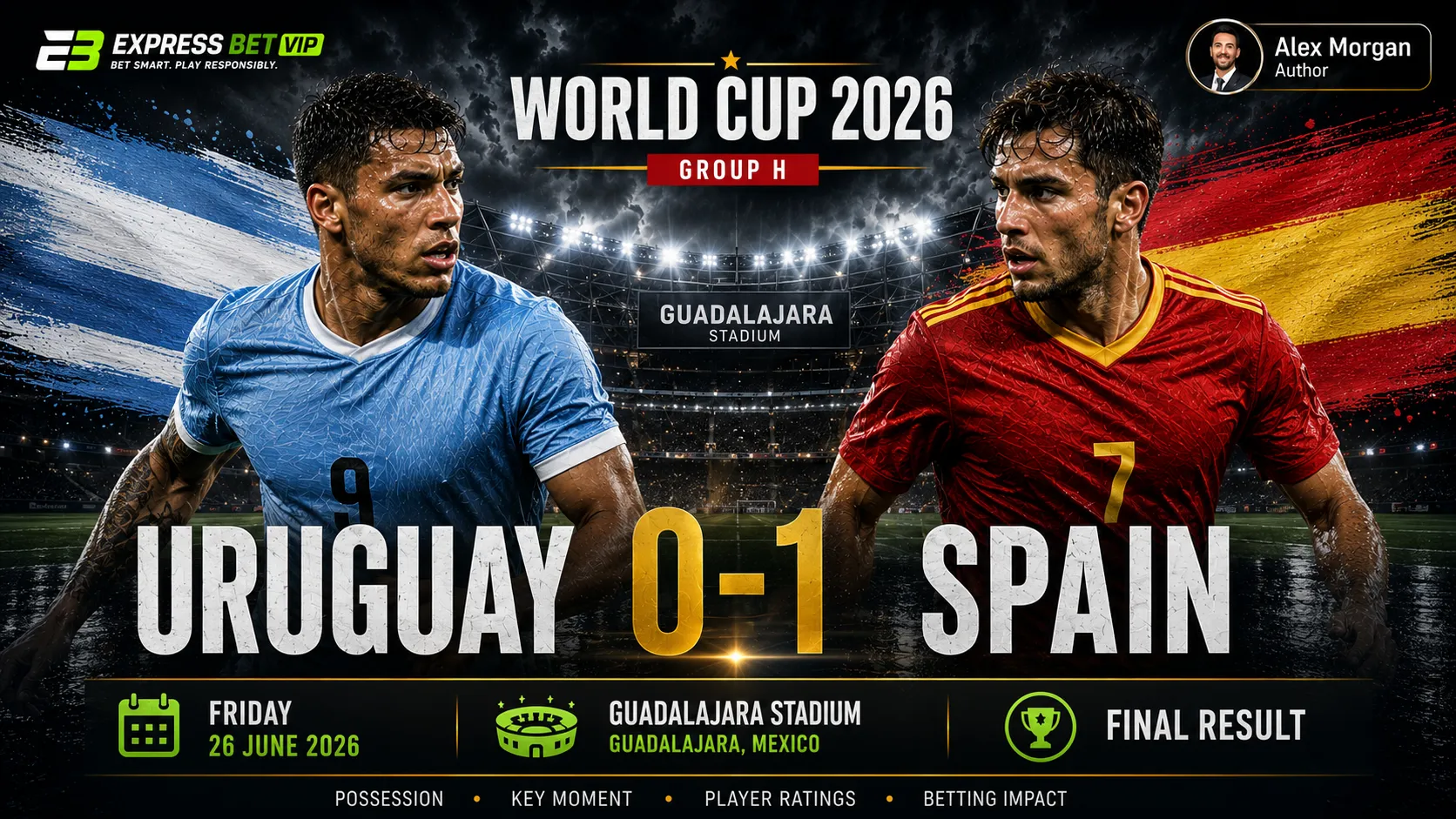
Spain defeated Uruguay 1-0 at Guadalajara Stadium and finished first in FIFA World Cup 2026 Group H. Álex Baena scored in the 42nd minute after Marcos Llorente’s pass, although Fernando Muslera should have stopped the powerful shot. Uruguay’s best first-half opening ended when Darwin Núñez attempted a backheel instead of shooting, while Unai Simón made two late saves and Ferran Torres struck the crossbar for Spain. Marcos Llorente was the strongest all-round performer; Baena delivered the decisive action. Spain controlled 66.9% possession and produced the higher xG, but this was a physical, low-chance match rather than a fluent attacking display. Guadalajara’s 23°C temperature and elevated setting created no confirmed decisive environmental effect. Spain’s moneyline, under 2.5 goals and both teams to score — No won at the referenced prices. Returns depended on the operator and market timing. (Reuters)
| Item | Verified detail |
|---|---|
| Match | Uruguay vs Spain |
| Competition | FIFA World Cup 2026 |
| Stage | Group stage, Matchday 3 |
| Group | Group H |
| Local date | June 26, 2026 |
| FIFA UTC date | June 27, 2026 |
| Kickoff | 18:00 local time / 00:00 UTC |
| Host country | Mexico |
| City | Zapopan, Guadalajara metropolitan area |
| Stadium | Guadalajara Stadium |
| Regular stadium name | Estadio Akron |
| Attendance | 45,065 |
| FIFA tournament capacity | 45,664 |
| Final score | Uruguay 0-1 Spain |
| Half-time score | Uruguay 0-1 Spain |
| Goalscorer | Álex Baena 42’ |
| Assist | Marcos Llorente |
| Red card | Agustín Canobbio 90+5’ |
| Referee | Ismail Elfath |
| VAR | Tatiana Guzman |
| Assistant VAR | Armando Villarreal |
| Temperature | 23°C according to FotMob |
| Surface | Natural grass |
| Main tournament impact | Spain won Group H; Uruguay were eliminated |
The FIFA, Sky and FotMob records confirm the score, kickoff, attendance, officials, surface, goal and disciplinary events. (FIFA)
| Category | Information |
|---|---|
| [CONFIRMED] | Spain won 1-0 through Baena’s 42nd-minute goal. |
| [CONFIRMED] | Llorente supplied the assist. |
| [CONFIRMED] | Spain had 66.9% possession and completed 553 accurate passes. |
| [CONFIRMED] | Muslera was replaced by Sergio Rochet at half-time. |
| [CONFIRMED] | Ugarte left injured during first-half stoppage time. |
| [CONFIRMED] | Canobbio received a direct red card in stoppage time. |
| [REPORTED] | Muslera decided that he could not continue after his goalkeeping error. |
| [OBSERVED] | Uruguay defended Lamine Yamal with close support and reduced his one-on-one space. |
| [ANALYSIS] | Spain’s positional control forced Uruguay to spend too much energy chasing without producing enough attacking transitions. |
| [MARKET SIGNAL] | Spain were clear favourites, though published moneyline snapshots ranged from approximately -145 to -220. |
| [DISPUTED] | FotMob listed the red card at 90+4, while Sky recorded 90+5. |
| [UNKNOWN] | Exact humidity, wind, PPDA, distance covered and consensus closing odds. |
The distinction matters because the score, goal time and possession figure belong to the event record. The conclusion that Uruguay’s press lacked an attacking reward is analysis based on how those recorded actions developed.
This separation also helps search systems extract the Uruguay vs Spain match result without converting an editorial interpretation into an official FIFA statistic. Provider differences are labelled rather than quietly combined into false precision. (Sky Sports)
Uruguay began with the more urgent tournament requirement. Marcelo Bielsa’s team had drawn with Saudi Arabia and Cabo Verde and needed a victory to guarantee progression. Spain already held four points and knew that avoiding defeat would probably secure first place.
The opening phase reflected those incentives. Uruguay pressed aggressively and tried to prevent Spain from establishing its usual slow occupation of the midfield. Federico Valverde moved high behind Darwin Núñez, while Manuel Ugarte and Rodrigo Bentancur attempted to close Rodri and Pedri from different angles.
Spain still controlled the ball. The difference was that control did not immediately become penetration.
Luis de la Fuente’s team used Marcos Llorente as a conservative right-back who could move into midfield or advance outside Lamine Yamal. Marc Cucurella pushed higher on the opposite side, allowing Álex Baena to move inward. That asymmetric structure gave Spain passing options around Uruguay’s first pressure line.
Uruguay’s defensive attention focused heavily on Yamal. Guillermo Varela stayed tight to him, with Canobbio and Bentancur providing secondary cover. The approach worked reasonably well. Spain’s most dangerous first-half moments came from Baena’s set-piece delivery rather than repeated Yamal dribbles. (Reuters)
Pau Cubarsí headed wide from a Baena corner in the 16th minute and missed again four minutes later after another delivery. Spain were controlling territory without producing a clean shot on target.
Uruguay created the half’s best opportunity before the goal. Valverde pressed Rodri into a mistake in the 27th minute and found Núñez inside the area. The striker attempted a backheel instead of taking the direct shot. The chance disappeared.
Tournament football has a cruel habit of preserving the complicated decision and punishing the simple mistake.
Spain scored in the 42nd minute. Llorente found Baena near the edge of the area. Baena struck firmly, but the shot was close enough to Muslera for a routine save to be expected. The veteran goalkeeper got his hands to the ball and allowed it to slip into the net. (Reuters)
The timing made the mistake more damaging. Uruguay had held Spain to limited chance quality and was three minutes from reaching half-time level. Instead, Bielsa’s side entered the interval needing two second-half goals to guarantee survival.
The goal also arrived during an unusual sequence. Ugarte and Yamal were both down as play continued. Spain were under no obligation to stop, and no verified report identified a head injury requiring an immediate whistle. Baena continued and scored.
Ugarte could not continue. Nicolás de la Cruz replaced him during first-half stoppage time. Sky reported that the midfielder was carried off on a stretcher and visibly distressed, but a confirmed diagnosis was not available from public authoritative data. (Sky Sports)
Muslera also left at half-time. Bielsa later said the goalkeeper decided that he could not continue. Sergio Rochet replaced him. The substitution was not formally recorded as an injury change. (Reuters)
Uruguay pushed higher after the interval but remained imprecise. The central structure was weakened by Ugarte’s exit, and Spain could circulate around the first pressure before slowing the match.
Bielsa made the most striking tactical decision in the 57th minute when he replaced captain Valverde with Federico Viñas. The intention was to add a second recognised penalty-box forward, but removing Uruguay’s best transition passer and long-range shooter also reduced midfield quality.
Viñas almost justified the change. Maxi Araújo crossed from the left, but the substitute sent his left-footed attempt high and wide. Uruguay’s pressure produced activity without sustained chance quality.
Spain introduced Fabián Ruiz and Dani Olmo after an hour. The substitutions increased control and gave De la Fuente fresh players capable of holding possession under contact. Olmo later missed from the centre of the box after a Yamal cross.
Uruguay’s clearest late phase came through Mathías Olivera and De la Cruz. Unai Simón saved from both players, preserving Spain’s narrow lead. Sky credited the goalkeeper with two saves across the match. (Reuters)
Spain nearly scored again when Ferran Torres ran onto Fabián Ruiz’s pass and struck the crossbar in the 86th minute. The attempt confirmed that Uruguay’s increasing risk had opened space, but it did not alter the score.
The closing frustration produced Canobbio’s red card. The winger lunged into Cubarsí during stoppage time and was dismissed. Sky recorded the incident at 90+5, while FotMob displayed 90+4. The difference is a provider-timing issue, not a dispute over the dismissal. (Reuters)
Spain deserved the victory on balance. They controlled the ball, created the higher xG and hit the woodwork. Yet this was not a dominant attacking performance. One goalkeeper error separated a controlled Spanish display from a goalless draw that Bielsa believed Uruguay deserved.
Spain circulated possession through the right side before Marcos Llorente passed inward toward Baena near the edge of Uruguay’s penalty area.
Baena received with enough space to set himself and struck powerfully. The shot travelled through a group of players but remained within Muslera’s reach.
The goalkeeper got both hands to the effort. He failed to secure it, and the ball dropped behind him and crossed the line.
Assist: Marcos Llorente
Goal type: Open-play goal from the edge of the penalty area
Shot type: Powerful right-footed strike
Goalkeeper issue: Muslera failed to hold a stoppable shot
Defensive issue: Uruguay allowed Baena to receive facing goal outside the box
VAR: No decisive intervention reported
Tactical meaning: Spain punished Uruguay’s momentary loss of compactness around the edge of the area
Emotional impact: Uruguay moved from requiring one goal to needing at least two for a guaranteed victory
Local-condition effect: No abnormal bounce or pitch problem was identified; the error was technical
The goal was officially awarded to Baena rather than recorded as an own goal. It was his first goal of the 2026 World Cup. (Reuters)
Baena’s corners created Spain’s first meaningful opportunities. Cubarsí headed wide in the 16th minute and failed to convert another close-range opening four minutes later.
The chances demonstrated that Uruguay’s open-play defensive plan was functioning, but its set-piece marking remained vulnerable. (Reuters)
Valverde pressed Rodri in the 27th minute and won the ball in a dangerous central position. He found Núñez inside the box.
It was precisely the transition Uruguay’s plan was designed to create: Spain’s holding midfielder exposed and the defensive line moving backward.
Núñez attempted a backheel rather than shooting directly. The decision turned Uruguay’s best opening into a statistical footnote. (Reuters)
The goalkeeper’s mistake changed the match more than any tactical adjustment.
Spain’s possession had produced only moderate danger. Uruguay were close to half-time with the score level. Muslera’s error gave Spain the lead without requiring an exceptional finish.
Bielsa later said Muslera chose to leave at the break. FotMob gave the goalkeeper a 4.5 rating, the lowest starting-player mark in its match model. (Reuters)
Ugarte’s exit removed Uruguay’s most aggressive central ball-winner.
De la Cruz offered more forward passing but less defensive coverage around Bentancur. Spain found it easier to retain possession through the centre after half-time.
A precise diagnosis was not available from verified public data. (Sky Sports)
Valverde left in the 57th minute for Viñas.
Bielsa explained that the change was intended to increase Uruguay’s attacking presence. The logic was understandable, but it removed the midfielder most capable of creating a goal through pressing, passing or shooting. (Reuters)
Olivera and De la Cruz forced Simón into Uruguay’s only two saves generated by shots that required intervention.
The goalkeeper’s late concentration prevented Uruguay from converting pressure into an equaliser. (Reuters)
Fabián Ruiz released Torres in the 86th minute. The substitute beat Rochet but struck the top of the crossbar.
The chance showed the cost of Uruguay’s late attacking commitment. The space behind the defensive line was now available, even if Spain did not finish the counterattack. (Sky Sports)
Canobbio’s reckless challenge on Cubarsí produced a direct red card during stoppage time.
The dismissal had little time to affect the tactical result, but it completed Uruguay’s campaign with an avoidable disciplinary incident. (Reuters)
| Local factor | Verified or observed detail | Football meaning | Direct match evidence | Betting-result meaning | Data status | Anti-template status |
|---|---|---|---|---|---|---|
| Stadium | Guadalajara Stadium in Zapopan | Compact football-specific venue | Attendance reached 45,065 | Strong event environment without a formal home team | [CONFIRMED] | Fixture-specific |
| FIFA capacity | 45,664 | Attendance represented roughly 99% of configuration | FotMob listed 99% attendance | Near-full stadium, not a predictive edge | [CONFIRMED] | Fixture-specific |
| Surface | Natural grass | Supported Spain’s short passing | Spain completed 553 passes at 88.9% accuracy | No surface-based reason to oppose possession markets | [CONFIRMED] | Fixture-specific |
| Roof | Fixed partial canopy; pitch not enclosed | Weather and altitude remained relevant | No roof delay or enclosure effect | Avoid indoor-stadium assumptions | [REPORTED] | Fixture-specific |
| Temperature | 23°C | Moderate air temperature | No confirmed heat illness | Weak direct total-goals signal | [REPORTED] | Fixture-specific |
| Humidity | Not available from verified public data | Fatigue impact cannot be quantified | No verified figure | No responsible humidity angle | [UNKNOWN] | Fixture-specific |
| Wind | Not available from verified public data | Long-ball effect cannot be quantified | No reported wind incident | No usable wind conclusion | [UNKNOWN] | Fixture-specific |
| Altitude | Guadalajara is around 1,566 metres above sea level | May increase aerobic demand for non-acclimatised players | Match became fragmented and physical, but no direct causal proof | Relevant context, not a standalone betting system | [CONFIRMED/ANALYSIS] | Fixture-specific |
| Crowd | Mexican and Spanish fans sang “Cielito Lindo” | Reflected crowd alignment during Uruguay’s decline | Reported late in the match | Psychological context only | [REPORTED] | Fixture-specific |
| Pitch behaviour | No decisive defect reported | Passing and goalkeeper distribution remained normal | Muslera error came from handling, not a bounce | No pitch-error market explanation | [OBSERVED] | Fixture-specific |
| Pre-match heat risk | Climate Central estimated elevated performance-impairing heat probability | Heat management was a pre-match concern | Actual listed temperature was 23°C | Forecast risk did not become a clear match cause | [REPORTED] | Fixture-specific |
FotMob listed the venue’s tournament capacity at 45,664, attendance at 45,065, a grass surface and a temperature of 23°C. FIFA also published 45,664 as the World Cup configuration. (FotMob)
Guadalajara’s elevation was a more distinctive factor than the temperature. The metropolitan area sits around 1,566 metres above sea level, high enough to increase oxygen demand compared with sea-level venues. The available match evidence does not prove that altitude caused a particular mistake or substitution. (Times Union)
Spain still completed 88.9% of their passes and controlled two-thirds of possession. Uruguay continued pressing in phases until late in the second half. Those numbers do not support a simple claim that altitude destroyed either team’s technical or physical performance. (Sky Sports)
The reported 23°C temperature was moderate. Exact humidity and wind were unavailable, and no weather delay occurred. Pre-tournament research had identified the fixture as carrying elevated heat risk, but forecast probability should not be confused with observed match conditions. (Reuters)
The natural-grass surface behaved reliably. Spain’s build-up remained controlled, set-piece delivery was accurate and Simón’s distribution produced no obvious difficulty. Muslera’s error involved his hands after a straightforward shot trajectory.
The crowd supplied the most visible local influence. Reuters reported Mexican and Spanish supporters singing “Cielito Lindo” while Uruguay’s frustration increased. That atmosphere did not create Spain’s goal, but it sharpened the emotional contrast between one team advancing and another losing control of its campaign. (Reuters)
| Stadium factor | Match detail |
|---|---|
| Stadium | Guadalajara Stadium |
| Regular name | Estadio Akron |
| Location | Zapopan, Jalisco |
| FIFA capacity | 45,664 |
| Attendance | 45,065 |
| Surface | Natural grass |
| Roof status | Partial fixed canopy; open playing area |
| Venue elevation | Approximately 1,500–1,600 metres |
| Acoustic effect | Near-full crowd; Mexican and Spanish singing reported |
| Surface condition | Stable, with no decisive defect reported |
| Wind relevance | Exact reading unavailable |
| Goalkeeper distribution | No confirmed stadium-related problem |
| Set-piece effect | Spain created early chances from Baena corners |
| Communication effect | No individual error conclusively linked to crowd noise |
| Data status | Capacity, attendance, surface and temperature confirmed; airflow unavailable |
Guadalajara Stadium influenced the match through its compact scale, elevation and open-air conditions rather than through a visible surface problem.
Spain’s first two strong opportunities came from corners. Baena’s deliveries reached Cubarsí in dangerous central areas, showing that the set-piece environment allowed accurate service.
The pitch supported Spain’s passing rhythm. The team attempted 622 passes and completed 553. Uruguay’s 75.7% completion rate reflected pressure and riskier progression more than a defective surface. (Sky Sports)
The available match evidence does not show a clear stadium-specific effect beyond the normal venue conditions, altitude, near-full crowd and reliable grass surface.
| Factor | Detail |
|---|---|
| City | Zapopan / Guadalajara metropolitan area |
| State | Jalisco |
| Host country | Mexico |
| Time zone | UTC-6 |
| Kickoff | 18:00 local time |
| June climate | Warm with the beginning of the rainy season |
| Match temperature | 23°C according to FotMob |
| Humidity | Not available from verified public data |
| Wind | Not available from verified public data |
| Rain | No match-changing rain or delay reported |
| Altitude | Approximately 1,566 metres |
| Likely physical effect | Greater aerobic demand than at sea level |
| Actual match evidence | Physical contest and several substitutions, but no verified altitude-related medical event |
| Data status | Temperature and general elevation available; detailed atmospheric readings unknown |
The opening tempo was aggressive rather than weather-suppressed. Uruguay pressed high, and Spain continued playing short through the pressure.
The match became slower after Spain scored because of game state. Spain had no need to increase volatility. Uruguay’s attacks became rushed, while Spain used possession to reduce transition frequency.
Ugarte’s injury cannot responsibly be attributed to altitude, temperature or the pitch. The public record confirms the injury and substitution but not an environmental cause.
The second half did not show a general physical collapse. Uruguay still produced late efforts, and Spain’s substitutes attacked the space behind Bielsa’s advancing shape.
Long passes and set-piece deliveries remained functional. No verified wind issue affected goalkeeper kicking or crossing.
Uruguay started in a 4-2-3-1:
Fernando Muslera; Guillermo Varela, Sebastián Cáceres, Mathías Olivera, Juan Sanabria; Rodrigo Bentancur, Manuel Ugarte; Agustín Canobbio, Federico Valverde, Maxi Araújo; Darwin Núñez.
Spain used a 4-3-3:
Unai Simón; Marcos Llorente, Pau Cubarsí, Aymeric Laporte, Marc Cucurella; Mikel Merino, Rodri, Pedri; Lamine Yamal, Mikel Oyarzabal, Álex Baena. (FotMob)
Uruguay’s defensive shape often resembled a 4-4-1-1. Valverde moved close to Núñez when Spain built from the goalkeeper, while Canobbio and Maxi Araújo dropped beside Bentancur and Ugarte.
The first pressing trigger was a pass into Rodri. Valverde approached from the front, and Ugarte moved behind him. This created the turnover that led to Núñez’s backheel chance.
Spain managed the pressure by spreading the centre-backs and using Llorente as an additional passing option. Cucurella moved higher, meaning Baena could occupy the left half-space instead of remaining on the touchline.
Uruguay’s plan against Yamal was particularly disciplined. Varela stayed close, Canobbio tracked backward and Bentancur shifted toward the right side of Uruguay’s defence. The teenager rarely received an uncontested isolation.
That attention opened a different route. Baena found space on the opposite side and became Spain’s main set-piece taker and eventual scorer.
Spain’s 4-3-3 attacked closer to a 3-2-5 during established possession:
The shape produced possession but not many shots. Uruguay protected the penalty area and accepted Spanish circulation outside it.
Uruguay’s own build-up was less stable. Bentancur could turn away from pressure, but Ugarte was used primarily for recovery and simple passing. The full-backs lacked consistently safe forward options.
Núñez therefore received direct passes against Laporte and Cubarsí. Spain’s centre-backs won enough first contacts to prevent Uruguay from building sustained attacks.
The match was physical. Both teams conceded 14 fouls across the full game, and several first-half stoppages disrupted rhythm. (Sky Sports)
At half-time, Uruguay needed to replace Ugarte, restore midfield pressure and find a clearer route toward Núñez. Spain needed to protect the lead without allowing Uruguay’s urgency to turn the match into repeated transitions.
Uruguay began the second half with Rochet in goal and De la Cruz replacing Ugarte.
De la Cruz provided more progressive passing but changed the balance of the double pivot. Bentancur now carried greater responsibility for protecting central transitions.
Spain responded by slowing the game. Rodri remained close to the centre-backs, and Pedri dropped deeper to provide another secure pass.
Uruguay attempted to press with Valverde and Núñez, but the distances behind them increased. Spain could escape the first line and then recycle rather than forcing the attack.
Bielsa replaced Valverde with Viñas in the 57th minute. Uruguay moved closer to a 4-4-2, with Viñas joining Núñez and De la Cruz moving into a central creative role.
The change increased penalty-box numbers. It also weakened Uruguay’s ability to contest Spain’s midfield possession.
De la Fuente introduced Fabián Ruiz and Olmo in the 60th minute. Spain now had fresh technical players against an opponent taking more risks.
Olmo moved between Uruguay’s midfield and defence. Fabián offered a left-footed passing angle behind him. Rodri remained the structural anchor.
Spain did not attack continuously. The leading team prioritised control, which explains why it finished with only six shots despite almost 67% possession.
Uruguay’s pressure became more direct. Maxi Araújo crossed earlier, the full-backs advanced and Viñas attacked the box. The resulting danger remained limited because the deliveries lacked accuracy. Uruguay completed only one of 16 attempted crosses. (Sky Sports)
Brian Rodríguez replaced Sanabria in the 70th minute, making Uruguay’s shape even more aggressive. The team now had another natural winger but less defensive stability on that side.
Spain countered by introducing Pino, Williams and Torres. The substitutes gave De la Fuente pace against Uruguay’s exposed defensive line.
Torres’s crossbar effort was the clearest expression of the new match state. Uruguay were chasing. Spain were waiting for the open field.
The late red card showed that Uruguay’s pressure had become emotionally uncontrolled. Canobbio’s challenge offered no tactical benefit with seconds remaining.
Spain won because they controlled the structure of the match after surviving Uruguay’s early press.
Uruguay’s 4-2-3-1 was designed to attack Rodri. Valverde pressed from the attacking-midfield position, Ugarte stepped forward and Bentancur covered behind them.
The plan produced one major turnover. It did not produce enough repeatable chances.
Spain adapted through Llorente. The nominal right-back moved into positions that gave Cubarsí an additional short pass and prevented Uruguay from locking Spain against the touchline.
On the opposite side, Cucurella advanced and Baena moved inside. Uruguay’s defensive attention toward Yamal therefore created room for Spain’s left-sided attacker.
Without the ball, Spain defended in a 4-1-4-1:
Uruguay rarely played through that block. The team relied on:
The principal attacking failure occurred around Núñez. He was active but rarely received with supporting runners close enough to combine.
Spain’s main attacking weakness was chance volume. The team dominated possession but generated only six shots and 0.86 provider xG.
The winning plan succeeded because it minimised Uruguay’s chances, not because Spain repeatedly opened the defence. The losing plan failed because Uruguay needed a victory but generated only 0.20 xG.
Muslera’s mistake converted that territorial difference into the scoreline.
| Zone | Edge | Match evidence | Key player | Local-condition effect | Result impact |
|---|---|---|---|---|---|
| Uruguay left flank | Spain slightly | Llorente advanced and assisted Baena | Marcos Llorente | Stable surface supported quick combinations | Winning goal |
| Uruguay right flank | Uruguay defensively | Varela and support limited Yamal | Guillermo Varela | No verified effect | Reduced Spain’s main dribbler |
| Central midfield | Spain | 67% possession and 553 accurate passes | Rodri | Altitude caused no confirmed loss of control | Match control |
| Penalty box | Spain defensively | Uruguay created 0.20 xG | Laporte / Cubarsí | No surface effect | Clean sheet |
| Edge of box | Spain | Baena received and scored | Álex Baena | Normal shot trajectory | Decisive |
| Set pieces | Spain | Cubarsí had two early headers | Baena | No wind issue reported | Early pressure |
| Transitions | Mixed | Uruguay created Núñez chance; Spain hit bar late | Valverde / Torres | Moderate temperature supported late running | One missed chance each |
| Defensive third | Spain | Simón made two late saves | Unai Simón | Reliable grass | Protected lead |
| Goalkeeper build-up | Spain | Simón supported controlled circulation | Unai Simón | No distribution problem | Spain escaped pressure |
| Bench impact | Spain | Fabián created Torres’s crossbar chance | Fabián Ruiz | Fresh legs against open shape | Nearly added second |
These ratings are editorial assessments based on tactical role, verified events and available match statistics. They are not official FIFA ratings.
Fernando Muslera — 4.5
The decisive error. Baena struck firmly, but Muslera should have held or pushed the ball away. He left at half-time after deciding he could not continue.
Guillermo Varela — 6.5
Helped limit Yamal and defended his side with discipline until his 58th-minute yellow card. Offered little progressive passing.
Sebastián Cáceres — 6.2
Generally controlled Oyarzabal’s movement but contributed little to Uruguay’s build-up under pressure.
Mathías Olivera — 7.5
Uruguay’s strongest defender. Won duels, defended the box and produced one of the late efforts saved by Simón.
Juan Sanabria — 6.8
Managed Baena’s movement reasonably before receiving a yellow card. Replaced when Uruguay shifted toward a more attacking shape.
Rodrigo Bentancur — 7.0
Uruguay’s most secure midfielder after Ugarte’s exit. Recovered possession and attempted to connect the defence with the attack.
Manuel Ugarte — 6.6
Pressed aggressively and protected the centre before leaving injured during first-half stoppage time.
Agustín Canobbio — 4.8
Worked defensively against Spain’s left side but ended the tournament with an unnecessary red card.
Federico Valverde — 6.7
Created Uruguay’s best first-half opening by pressing Rodri. His removal before the hour weakened the midfield.
Maxi Araújo — 6.5
Carried Uruguay’s most consistent wide threat and supplied the cross for Viñas’s second-half attempt.
Darwin Núñez — 5.8
Received limited service but wasted Uruguay’s best opening with an unnecessary backheel. A direct finish was required.
Sergio Rochet — 6.0
Had little to do after replacing Muslera. Torres’s attempt beat him but hit the crossbar.
Nicolás de la Cruz — 6.7
Added more forward passing and forced Simón into a late save. Booked during stoppage time.
Federico Viñas — 6.2
Added penalty-box presence but sent his main opportunity high and wide.
Brian Rodríguez — 6.0
Brought pace after entering without producing a decisive final action.
Unai Simón — 7.5
Quiet for long periods, then made the two saves required during Uruguay’s late pressure. His concentration protected the clean sheet.
Marcos Llorente — 8.3
Spain’s best all-round player. Defended his channel, moved intelligently in build-up and supplied the assist for Baena.
Pau Cubarsí — 7.4
Missed two early headers but defended Núñez calmly and drew the challenge that led to Canobbio’s red card.
Aymeric Laporte — 7.8
Controlled the defensive line, won aerial contacts and helped Spain circulate through Uruguay’s pressure.
Marc Cucurella — 7.1
Advanced to create width and allowed Baena to move inside. Defended Uruguay’s right-side transitions reliably.
Rodri — 7.0
Lost possession before Uruguay’s best first-half chance but otherwise controlled the centre and dictated tempo.
Mikel Merino — 6.5
Provided physical balance and supported Spain’s left side. Less influential in possession than Pedri or Rodri.
Pedri — 7.4
Found passing angles around Uruguay’s midfield and helped Spain retain control. Replaced after 60 minutes.
Lamine Yamal — 6.8
Uruguay devoted multiple defenders to him. Created Olmo’s second-half chance but had limited individual space.
Mikel Oyarzabal — 6.2
Occupied the centre-backs and linked play but did not register a decisive attacking action.
Álex Baena — 7.8
Scored the only goal and delivered Spain’s dangerous early corners. Booked shortly after half-time.
Fabián Ruiz — 6.8
Improved Spain’s second-half passing and released Torres for the crossbar opportunity.
Dani Olmo — 6.7
Found useful central positions but missed from Yamal’s delivery.
Yéremi Pino — 6.0
Helped Spain defend the lead and press Uruguay’s left side.
Nico Williams — 6.3
Added late pace and stretched the increasingly open Uruguayan defence.
Ferran Torres — 6.8
Nearly scored the second goal when his late effort struck the crossbar.
FotMob’s model rated Llorente highest at 8.3, followed by Laporte and Olivera among the strongest performers. (FotMob)
Man of the Match: Marcos Llorente
Llorente supplied the assist, defended Yamal’s supporting channel and gave Spain an extra build-up solution against Uruguay’s press.
Best attacker: Álex Baena
The goal decided the match. His set-piece delivery also produced Spain’s strongest early chances.
Best midfielder: Pedri
Pedri’s movement and press resistance helped Spain control possession during the most physically aggressive phase.
Best defender: Aymeric Laporte
Laporte managed Núñez, controlled aerial space and distributed cleanly under pressure.
Best goalkeeper: Unai Simón
Simón faced limited activity but made the late saves that preserved Spain’s lead.
Best substitute: Fabián Ruiz
His passing provided Spain with greater second-half security and created Torres’s crossbar chance.
Most underrated performance: Mathías Olivera
Uruguay’s centre-back defended strongly, progressed the ball when possible and tested Simón late.
Most disappointing performance: Fernando Muslera
The goalkeeper’s error decided a match in which Uruguay otherwise restricted Spain to modest chance quality.
| Player | Team | Incident | Minute | Status | Next-match impact | Data status |
|---|---|---|---|---|---|---|
| Manuel Ugarte | Uruguay | Injury requiring stretcher | 45’ | Replaced by Nicolás de la Cruz | Uruguay eliminated; diagnosis unavailable | [CONFIRMED/UNKNOWN] |
| Fernando Muslera | Uruguay | Left at half-time after goal error | 46’ | Replaced by Sergio Rochet | Uruguay eliminated | [REPORTED] |
| Álex Baena | Spain | Foul | 46’ | Yellow card | No suspension confirmed | [CONFIRMED] |
| Juan Sanabria | Uruguay | Foul | 54’ | Yellow card | Uruguay eliminated | [CONFIRMED] |
| Guillermo Varela | Uruguay | Foul | 58’ | Yellow card | Uruguay eliminated | [CONFIRMED] |
| Nicolás de la Cruz | Uruguay | Foul | 90+3’ | Yellow card | Uruguay eliminated | [CONFIRMED] |
| Agustín Canobbio | Uruguay | Reckless challenge on Cubarsí | 90+4/90+5 | Direct red card | Uruguay eliminated | [CONFIRMED/DISPUTED MINUTE] |
| Lamine Yamal | Spain | Received treatment during first-half goal sequence | 42’ | Continued playing | No confirmed injury | [REPORTED] |
Sky recorded 14 fouls by each team, three Uruguay yellow cards, one Spain yellow card and one Uruguay red card. (Sky Sports)
Ugarte’s injury was the only confirmed physical issue that forced a player from the field. No authoritative public diagnosis was available at the time of verification.
Ismail Elfath refereed the match. Tatiana Guzman served as VAR, with Armando Villarreal as assistant VAR and Juan Calderón as fourth official. (Sky Sports)
The match was physical but did not produce a major penalty or offside controversy.
Spain’s goal stood without a prolonged review. The ball remained in play while Ugarte and Yamal were down. Neither incident was publicly identified as a head injury requiring an immediate stoppage.
Elfath allowed the match to continue through regular physical contact but issued four yellow cards and one red.
Canobbio’s dismissal was the main disciplinary decision. The challenge on Cubarsí was late, forceful and unnecessary. No credible source identified the red card as a clear officiating error.
Five minutes of second-half stoppage time were announced. Sky recorded the dismissal at 90+5; FotMob placed it at 90+4.
The referee did not determine the result. Muslera’s handling error, Spain’s possession control and Uruguay’s attacking decisions were more important.
| Statistic | Uruguay | Spain |
|---|---|---|
| Possession | 33.1% | 66.9% |
| Shots | 5 | 6 |
| Shots on target | 1* | 1 |
| FotMob xG | 0.20 | 0.86 |
| Big chances missed | 1 | 1 |
| Corners | 1 | 6 |
| Touches in opposition box | 12 | 19 |
| Attempted passes | 301 | 622 |
| Accurate passes | 228 | 553 |
| Pass accuracy | 75.7% | 88.9% |
| Chances created | 5 | 6 |
| Attempted crosses | 16 | 12 |
| Accurate crosses | 1 | 3 |
| Goalkeeper saves | 2 | 0** |
| Successful tackles | 15 | 10 |
| Recoveries | 51 | 51 |
| Interceptions | 14 | 9 |
| Clearances | 14 | 23 |
| Duels won | 51 | 55 |
| Aerial duels won | 5 | 16 |
| Successful dribbles | 7 | 9 |
| Fouls | 14 | 14 |
| Yellow cards | 3 | 1 |
| Red cards | 1 | 0 |
| Offsides | 5 | 2 |
| Hit woodwork | 0 | 1 |
| PPDA | Not available | Not available |
| Distance covered | Not available | Not available |
* Sky’s headline table listed one Uruguay shot on target, while its goalkeeper-save field and Reuters narrative describe two Simón saves. This is a provider-classification inconsistency.
** The Sky table assigns saves by the opposing goalkeeper column in a way that appears counterintuitive; match-event reporting confirms Simón made late saves.
The broad statistical picture is still clear. Spain controlled possession, passing and territory. Uruguay attempted almost as many shots but produced substantially lower xG. (Sky Sports)
Spain’s 66.9% possession did not produce attacking abundance. Six shots and 0.86 xG describe control rather than demolition.
Uruguay’s 16 attempted crosses produced one accurate delivery. That number explains why adding more forwards did not automatically increase the chance quality.
Spain’s 16 aerial-duel wins to Uruguay’s five also helped De la Fuente’s team control direct passes and clearances.
Published market snapshots varied considerably.
A FOX Sports/FanDuel snapshot listed Spain around -220, Uruguay at +600 and the draw at +330. Spain -1.5 was +145, the total was 2.5, and both teams to score — No was -128. (Fox Sports)
A later CBS/FanDuel snapshot listed Spain closer to -145, Uruguay at +500 and the draw at +240, showing why timestamp and provider matter when discussing pre-match prices. (CBS Sports)
| Market | Pre-match expectation | Actual result | Winning side | Key match trigger | Local factor | Caution |
|---|---|---|---|---|---|---|
| Match winner | Spain clear favourite | Spain won 1-0 | Spain moneyline | Baena goal and Muslera error | No decisive local factor | Favourite price varied sharply |
| Draw | Uruguay capable of resistance | No draw | Losing side | Muslera failed to preserve 0-0 | Near-full crowd did not change outcome | Spain created limited chances |
| Uruguay moneyline | Required must-win upset | Uruguay lost | Losing side | Poor chance conversion | Altitude did not create a home-style advantage | High odds reflected risk |
| Spain -1.5 | Spain needed two-goal margin | Failed | Uruguay +1.5 | Spain produced only six shots | Moderate conditions did not increase scoring | Handicap remained live late |
| Over/under 2.5 | Near-balanced total | One goal | Under 2.5 | Low shot volume | No pitch or weather volatility | One match is not a system |
| Under 1.5 | Market-dependent | One goal | Under 1.5 | 1.06 combined xG | Stable conditions | Exact price unavailable |
| Both teams to score | No was favoured in FOX snapshot | Uruguay failed to score | BTTS No | Spain restricted central chances | No handling problem for Simón | Uruguay still had late attempts |
| Correct score | Spain 1-0 | 0-1 | Spain 1-0 backers | No legal second goal | Torres hit the crossbar | Very high variance |
| First goalscorer | Oyarzabal and Yamal shorter-priced | Baena scored first | Baena backers, where offered | Llorente pass and Muslera error | No local cause | Baena pricing not verified |
| Anytime Oyarzabal | Oyarzabal around +125 | Did not score | Losing market | Uruguay controlled central striker | No local effect | Player props remain volatile |
| Anytime Yamal | Yamal around +155 | Did not score | Losing market | Uruguay doubled his side | No local effect | Defensive matchups mattered |
| Cards | Physical match expected | Four yellows and a red | Over-card positions, line-dependent | Increasing Uruguay frustration | Crowd intensified emotion, not fouls directly | Exact line unavailable |
| Corners | Spain territorial favourite | Spain won 6-1 | Spain corner positions | Repeated first-half set pieces | Reliable pitch aided delivery | Handicap unavailable |
| Goalkeeper saves | Uruguay expected to face more shots | Limited official saves | Under-save positions may have benefited | Spain’s low shot volume | No weather-handling effect | Provider classifications varied |
| Live betting | Spain led before half-time | Spain protected 1-0 | Spain/under prices shortened | Uruguay lacked clean chances | No late environmental swing | Red card came too late to matter |
The result rewarded Spain moneyline backers, under 2.5 positions, both teams to score — No and Uruguay +1.5.
It punished the assumption that Uruguay’s must-win position would automatically produce a high-scoring game. Urgency increased fouls and late risk more clearly than it increased quality.
Spain’s -1.5 handicap failed because De la Fuente’s team prioritised control after taking the lead. Torres came close to covering it, but the crossbar preserved the one-goal margin.
The first-goalscorer market also demonstrated normal football variance. Public attention centred on Oyarzabal, Yamal, Núñez and Valverde. A left-sided midfielder scored with help from a goalkeeper error.
| Local factor | Market possibly affected | Actual match evidence | Possible betting interpretation | Risk of overreaction | Safer conclusion |
|---|---|---|---|---|---|
| Guadalajara altitude | Second-half tempo and pressing | Match became fragmented but both teams remained active late | Possible aerobic burden | Blaming every substitution on altitude | Game state mattered more |
| 23°C temperature | Total goals and fatigue | Only one goal; no heat collapse | Moderate conditions did not force an over | Treating temperature alone as an under signal | Chance structure was decisive |
| Natural grass | Passing and goalkeeper props | Spain passed at 88.9% | Surface supported technical control | Claiming grass caused Spain’s win | Muslera’s error was independent |
| Open-air venue | Long passes and crosses | No reported wind distortion | Normal delivery conditions | Inventing airflow effects | Wind data unavailable |
| Near-full crowd | Cards and live momentum | Singing accompanied Uruguay’s frustration | Emotional pressure increased late | Treating crowd reaction as causal | Canobbio controlled his own challenge |
| Set-piece environment | Corners and headers | Spain won corners 6-1 | Spain corner positions benefited | Expecting every territorial favourite to dominate corners | Match-specific pattern |
| Uruguay’s qualification need | Live totals and cards | More risk, late red card | Increased volatility after halftime | Assuming must-win always means goals | Uruguay produced only 0.20 xG |
| Stable pitch | Goalkeeper saves and errors | No irregular bounce | Reduced random surface risk | Excusing Muslera through conditions | Technical handling error |
The altitude was the most distinctive environmental feature, but it did not offer a simple post-match explanation.
Uruguay’s weak attacking output came from structure and decision-making. Spain’s low shot total came from controlled game management. Neither requires a weather theory.
The near-full crowd and local singing shaped the match’s emotional finish. They did not make the under, Spain moneyline or red-card markets predictable.
| Position | Team | Points | Goals for | Goals against | Goal difference | Outcome |
|---|---|---|---|---|---|---|
| 1 | Spain | 7 | 5 | 0 | +5 | Qualified as group winner |
| 2 | Cabo Verde | 3 | 2 | 2 | 0 | Qualified |
| 3 | Uruguay | 2 | 3 | 4 | -1 | Eliminated |
| 4 | Saudi Arabia | 2 | 1 | 5 | -4 | Eliminated |
Spain completed Group H unbeaten and without conceding. Cabo Verde advanced after drawing all three matches. Uruguay finished third but did not rank among the eight qualifying third-placed teams. (Reuters)
Spain advanced to face Austria in the Round of 32 and won 3-0. They then defeated Portugal 1-0, Belgium 2-1 and France 2-0, reaching the World Cup final. (Sky Sports)
Uruguay became the only CONMEBOL team eliminated before the knockout phase and failed to progress from the group stage for a second consecutive World Cup. (Reuters)
Spain protected their passing structure against an aggressive press.
Llorente’s positioning gave the centre-backs another escape route. Cucurella’s advance allowed Baena to attack central space.
De la Fuente’s team also accepted that this would not be an elegant possession exhibition. Spain matched Uruguay physically and remained patient when Yamal was denied space.
Laporte and Cubarsí controlled direct passes toward Núñez. Rodri recovered after his early mistake and managed the tempo.
The substitutions were logical. Fabián and Olmo increased central control. Pino, Williams and Torres provided late running against Uruguay’s open shape.
Most importantly, Spain did not confuse possession with the need to force chances. Once ahead, they reduced the number of transitions Uruguay could attack.
Uruguay failed to convert its pressing success into shots.
Valverde’s turnover against Rodri created the exact opportunity Bielsa wanted. Núñez’s backheel wasted it.
The team also lacked passing connections around the striker. Núñez received directly but rarely had a close midfielder or winger available for the second action.
Replacing Valverde increased the number of forwards but reduced the quality supplying them.
Crossing became the default method. One accurate cross from 16 attempts was not enough against Laporte and Cubarsí.
Muslera’s error then forced Uruguay to chase a match their attacking structure was not equipped to chase.
The red card completed the broader failure of control. Canobbio’s challenge had no tactical value and only deepened the impression of a campaign ending in frustration.
Bielsa selected a recognisable 4-2-3-1 with Valverde behind Núñez and two aggressive midfielders.
The pressing plan worked in isolated moments. Uruguay denied Yamal space and forced Rodri into one dangerous turnover.
The problem was attacking continuity. Uruguay could not sustain pressure after the first recovery.
Bielsa’s decision to replace Valverde was the defining coaching choice. He wanted greater presence in the box, but the change removed the player most capable of producing the pass or shot needed to equalise.
His handling of Muslera also became part of the tournament’s wider criticism. Bringing the goalkeeper out of international retirement did not provide the stability Bielsa expected.
Reuters reported broader tension around the coach’s methods, including player concerns about training load and tactical direction. Those reports are relevant context but do not independently explain the Spain result. (Reuters)
De la Fuente retained Spain’s 4-3-3 but adjusted the full-back roles.
Llorente’s hybrid position helped Spain escape Uruguay’s press. Cucurella’s higher movement created the space Baena eventually used.
Spain were not fluent, but the coach accepted the match’s physical nature rather than demanding constant attacking risk.
The second-half substitutions protected control and added pace for transitions. Torres nearly converted that plan into a second goal.
De la Fuente’s team demonstrated tournament maturity: win the difficult match first, discuss aesthetics after qualification.
Baena scored his first goal of the 2026 World Cup.
Spain recorded their first World Cup victory over Uruguay. The teams’ previous World Cup meetings ended 2-2 in 1950 and 0-0 in 1990. (espn.com)
Uruguay failed to reach the knockout stage for a second consecutive World Cup.
Spain completed Group H without conceding a goal and later reached the final.
No additional major individual milestone was confirmed from verified public data at the time of writing.
Uruguay and Spain had met twice previously at the World Cup, and both matches ended level.
The 1950 meeting finished 2-2 during the final-round group. The 1990 group-stage match ended 0-0. Spain’s 2026 victory therefore ended a World Cup head-to-head sequence of two draws. (espn.com)
The match did not resemble Spain’s expansive 2010 control or Uruguay’s counterattacking peak under Óscar Tabárez. It offered a narrower lesson.
Spain controlled the ball without creating many chances. Uruguay pressed without creating enough attacks. One goalkeeper mistake separated two incomplete offensive performances.
Control without penetration is possession wearing formal clothes. Spain at least remembered to bring the result.
The main unusual incident surrounded Spain’s goal.
Ugarte and Yamal were both on the ground when play continued. Uruguay did not put the ball out, the referee did not stop play and Spain completed the attack.
No verified source established that either player had suffered a head injury requiring an immediate stoppage. The goal stood.
Muslera’s half-time removal also attracted attention. Bielsa said the goalkeeper decided to leave the match. No confirmed physical injury was publicly identified.
Canobbio’s stoppage-time red card created no serious officiating dispute. The challenge was reckless and arrived after Uruguay’s qualification hopes had effectively ended.
No penalty controversy, crowd disorder, pitch invasion or post-match confrontation was confirmed.
This report provides:
| Detail | Included | Status | Fixture-specific | Later update required |
|---|---|---|---|---|
| Stadium identity | Yes | Confirmed | Yes | No |
| Tournament capacity | Yes | Confirmed | Yes | Only if FIFA corrects it |
| Attendance | Yes | Confirmed | Yes | Only if corrected |
| City and metro location | Yes | Confirmed | Yes | No |
| Temperature | Yes | Provider-reported | Yes | Replace if official stadium reading appears |
| Humidity | Explicitly unavailable | Unknown | Yes | Add if verified |
| Wind | Explicitly unavailable | Unknown | Yes | Add if verified |
| Altitude | Yes | Confirmed general location data | Yes | No |
| Natural-grass surface | Yes | Confirmed | Yes | No |
| Surface behaviour | Yes | Observed | Yes | Update if official pitch report appears |
| Crowd song | Yes | Reuters-reported | Yes | No |
| Fan split | Partially described | Reported | Yes | Add precise data only if verified |
| Travel/acclimatisation | Limited | Analysis-based | Yes | Add official itineraries if published |
| Betting-risk detail | Yes | Market-based/analysis | Yes | Add consensus closing odds if archived |
| Tactical-local connection | Yes | Analysis-based | Yes | Reassess if tracking data appears |
| Anti-template status | Passed | Reviewed | Yes | Recheck after editorial changes |
| Data point | Status | Main source type |
|---|---|---|
| Final score | Confirmed | FIFA, Reuters, Sky |
| Half-time score | Confirmed | FIFA, Sky |
| Goalscorer | Confirmed | FIFA, Reuters, Sky |
| Goal time | Confirmed | FIFA, Reuters, Sky |
| Assist | Confirmed | Sky, FotMob |
| Stadium | Confirmed | FIFA, Sky, FotMob |
| City | Confirmed | FIFA, Reuters |
| Attendance | Confirmed | Sky, FotMob |
| Referee | Confirmed | Sky, FotMob |
| VAR | Confirmed | Sky |
| Assistant VAR | Confirmed | Sky |
| Starting lineups | Confirmed | Sky, FotMob |
| Formations | Provider notation | FotMob |
| Substitutions | Confirmed | Sky, FotMob |
| Cards | Confirmed | Sky |
| Red-card minute | Small provider variation | Sky, FotMob |
| Ugarte injury | Confirmed; diagnosis unknown | Sky, Reuters |
| Muslera withdrawal | Reported as player decision | Reuters |
| Match statistics | Confirmed/provider data | Sky |
| xG | Provider-dependent | FotMob/Opta |
| Pre-match odds | Market snapshots | FOX, CBS, FanDuel |
| Consensus closing odds | Unknown | Not available |
| Temperature | Reported | FotMob |
| Humidity and wind | Unknown | Not available |
| Surface | Confirmed | FotMob, venue records |
| Surface behaviour | Observed | Match reports |
| Altitude | Confirmed general city data | Geographic/AP reporting |
| Crowd profile | Reported | Reuters |
| Tournament outcome | Confirmed | FIFA, Reuters, Sky |
| Later knockout results | Confirmed | FIFA, Sky, Reuters |
Review this article if:
Last updated: July 15, 2026
Spain won because they controlled the match’s structure and Uruguay failed to convert urgency into chance quality.
The decisive goal still required a mistake. Baena struck well, but Muslera should have saved it.
That does not make Spain’s victory undeserved. De la Fuente’s team completed more than twice as many passes, produced the higher xG, controlled the aerial game and hit the crossbar late.
Uruguay’s plan contained useful elements. Varela and Canobbio restricted Yamal. Valverde forced Rodri into an error. Olivera defended strongly.
The failure came after those actions. Núñez did not shoot. The crosses did not reach teammates. Bielsa removed Valverde. The late pressure produced two saves and one red card.
Guadalajara’s altitude and pre-match heat risk provided relevant context but did not decide the result. The recorded temperature was moderate, the grass behaved normally and neither team suffered a verified environmental collapse.
The most important local feature was emotional rather than physiological. A near-full crowd watched Spain manage the lead while Mexican and Spanish supporters sang and Uruguay’s frustration became visible.
For Spain, the victory confirmed first place and began a route that eventually reached the World Cup final.
For Uruguay, elimination with two points was a major failure in a 48-team format that sent 32 nations forward. The team had enough talent, enough possession in earlier matches and enough moments against Spain. It did not have enough control in either penalty area.
For bettors, the favourite and the under both won. Spain’s -1.5 handicap did not. The final score may look orderly now; Torres’s crossbar and Uruguay’s late shots kept several markets unsettled until the end.
Football betting carries financial risk. Correct tactical or statistical analysis does not guarantee a winning wager.
Odds change before and during matches. Prices and settlement rules differ between licensed operators.
Local conditions such as altitude, temperature, surface type and crowd noise can be overvalued. They do not create a dependable betting system by themselves.
Never chase losses or bet money required for housing, food, healthcare, debt payments or other daily expenses.
Use financial and time limits. Take breaks and stop when gambling no longer remains entertainment.
Check the betting laws in your jurisdiction and use licensed operators only. Betting should remain entertainment, not income.
Spain defeated Uruguay 1-0 at Guadalajara Stadium.
Álex Baena scored in the 42nd minute, assisted by Marcos Llorente.
Marcos Llorente was the editorial Man of the Match after supplying the assist and contributing strongly in possession and defence.
Spain finished first with seven points and advanced. Uruguay finished third with two points and were eliminated.
Spain’s moneyline, under 2.5 goals and both teams to score — No won. Uruguay +1.5 also covered, while Spain -1.5 failed. Returns depended on the sportsbook, odds and wager timing.