
USA vs Australia Match Result
Table of Contents Show
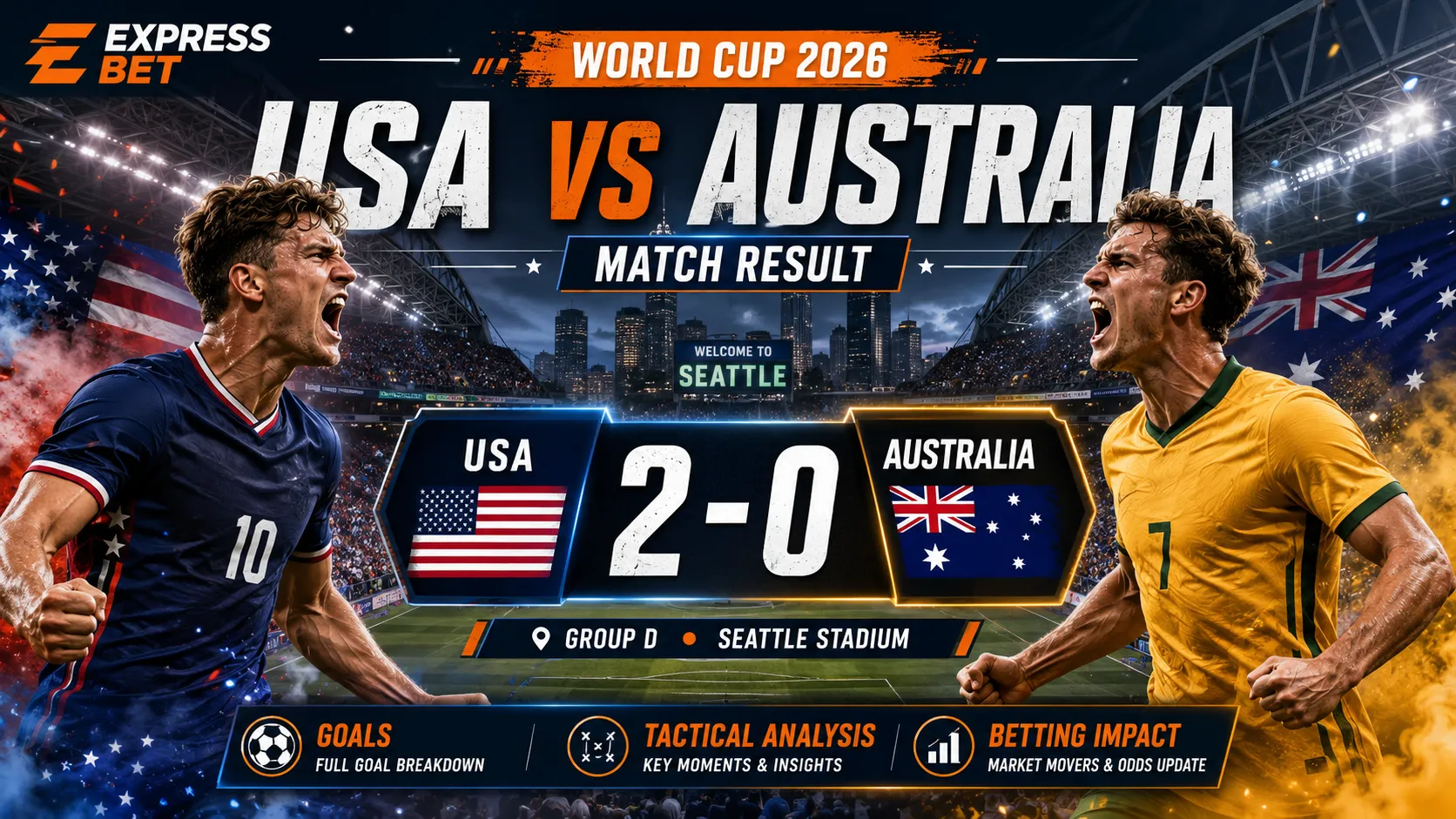
The United States beat Australia 2-0 in their FIFA World Cup 2026 Group D match at Seattle Stadium. The USA took the lead in the 11th minute when Cameron Burgess turned Folarin Balogun’s dangerous ball into his own net. Alex Freeman scored the second in the 43rd minute after a VAR review confirmed he was onside. Freeman was the best player because he scored, attacked the back post and gave the U.S. a knockout-clinching cushion. Tactically, the U.S. won through aggressive wide pressure, sharper first-half pressing and better box occupation. The local factor was Seattle-specific: a noon kickoff, low heat risk and a co-host crowd at Lumen Field. For bettors, USA win, under 2.5 goals and both-teams-to-score “No” landed, but outcomes depended on odds and timing.
| Item | Detail | Data status |
|---|---|---|
| Match | USA vs Australia | [CONFIRMED] |
| Competition | FIFA World Cup 2026 | [CONFIRMED] |
| Stage | Group stage | [CONFIRMED] |
| Group | Group D | [CONFIRMED] |
| Date | June 19, 2026 | [CONFIRMED] |
| Kickoff time | 12:00 PM PT / 19:00 UTC | [CONFIRMED] |
| Host country | United States | [CONFIRMED] |
| City | Seattle, Washington | [CONFIRMED] |
| Stadium | Seattle Stadium / Lumen Field | [CONFIRMED] |
| Attendance | not available from verified public data | [UNKNOWN] |
| Final score | United States 2-0 Australia | [CONFIRMED] |
| Half-time score | United States 2-0 Australia | [CONFIRMED] |
| Goal scorers | Cameron Burgess own goal 11’, Alex Freeman 43’ | [CONFIRMED/REPORTED] |
| Referee | not confirmed from verified public data | [UNKNOWN] |
| VAR | VAR review confirmed Freeman goal; VAR officials not confirmed | [REPORTED/UNKNOWN] |
| Weather | exact match-time weather not available from verified public data | [UNKNOWN] |
| Heat risk | 3% chance of performance-impairing heat | [REPORTED] |
| Pitch condition | natural grass installed for World Cup; match-specific behavior not confirmed | [REPORTED/UNKNOWN] |
| Main tournament impact | USA qualified for the Round of 32 with a game to spare | [CONFIRMED] |
FIFA’s match report says the United States defeated Australia 2-0 and secured a second straight Group D win, while Reuters reported that the result put the co-hosts into the World Cup knockout stage.
| Category | Content | Use in this article |
|---|---|---|
| [CONFIRMED] match facts | USA 2-0 Australia, Group D, Seattle Stadium, U.S. qualification | Used for direct answer, TL;DR, SEO title and schema-ready facts |
| [REPORTED] details | Burgess own goal, Freeman goal, VAR review, Pulisic absence, xG and match stats | Used with attribution to FIFA, Reuters, Guardian, FOX, ESPN or xGscore |
| [OBSERVED] match pattern | USA controlled the first half; Australia improved after substitutions | Used for tactical explanation |
| [ANALYSIS] tactical interpretation | U.S. wide pressure forced the own goal and created enough first-half separation | Editorial interpretation based on match events |
| [MARKET SIGNAL] betting interpretation | USA win, under 2.5 and BTTS No were result-side winners | Post-match betting analysis, not advice |
| [UNKNOWN] unavailable data | Official attendance, referee, full VAR crew, exact weather, official closing odds | Stated clearly instead of invented |
This distinction matters because the USA vs Australia match result has a clean scoreline but a few details that need care. The first goal was an own goal forced by Balogun’s run. The second needed VAR confirmation. Pulisic’s absence was important, but the U.S. did not look helpless without him. Those are facts and supported interpretations. Referee identity, exact wind and official attendance are not available from verified public data, so they do not get invented.
I compared the match report, live reporting, statistical pages and local venue sources. The consistent picture is direct: the U.S. won the match in the first half, Australia improved after the break, and the scoreboard still reflected the better team.
The United States beat Australia 2-0 at Seattle Stadium and qualified for the Round of 32 with a game to spare. That is the clean version. The football version is slightly more useful: the U.S. played without Christian Pulisic, still pressed Australia into early discomfort, scored twice before half-time, and then managed the second half without needing to dress the match up as a masterpiece.
Australia entered with momentum after beating Türkiye 2-0 in Vancouver. The United States had beaten Paraguay 4-1 in their opener. Both teams had reason to believe this match could define Group D. It did, but not in the way Australia wanted. Football Australia’s own preview framed the match as a meeting of two opening-day winners, with Australia preparing for a fast U.S. start. That warning was accurate. Australia still did not survive it.
The first goal came in the 11th minute. Balogun beat his man on the left, drove into the box and sent a dangerous ball across the face of goal. Cameron Burgess tried to intervene and turned it into his own net from close range. The Guardian’s live report described the sequence clearly: Burgess was forced into a desperate interception from only a few yards out.
The second goal came in the 43rd minute. Alex Freeman headed in after a deflected sequence and a VAR review confirmed the goal. Reuters and The Guardian both reported that Freeman’s effort was initially questioned but ultimately awarded after review.
The final score was fair. Australia had a better second half and tried to be more direct after changes, but the damage had been done. The U.S. were sharper in the first half, better around the box and more composed in game management. World Cups do not care whether a team “improved after the break” unless that improvement reaches the net.
The U.S. opener came from Balogun’s acceleration down the left channel. He beat his marker, entered the box and sent the ball across goal toward Ricardo Pepi. Burgess had to act. He did, and the ball went into his own net. The Guardian logged it as “Burgess OG, 11 min,” while Sky Sports also described the opener as a Cameron Burgess own goal.
Assist: not officially confirmed from verified public data.
Goal type: own goal forced by wide attacking pressure.
Shot type: defensive touch into own net.
Goalkeeper positioning: Patrick Beach was exposed by a ball flashed into the danger zone; precise positioning is not confirmed from verified public data.
VAR check: not confirmed for this goal from verified public data.
Tactical meaning: the goal came from one of the clearest U.S. attacking advantages: speed into the channel and a hard ball across the six-yard area. Australia’s defenders had to face their own goal, which is where defenders generally discover that football has a sense of humor.
Emotional impact: the goal changed Australia’s match from “control the host crowd” to “chase the host crowd.” That is not a small difference in Seattle.
Local condition effect: no verified local condition caused the goal. The Seattle crowd likely amplified the moment, but the goal was produced by Balogun’s pressure and Burgess’ emergency intervention.
Betting impact: USA match-winner and USA first-goal markets strengthened immediately. Draw and Australia double-chance positions were damaged early.
Freeman scored the second U.S. goal just before half-time. The goal was initially uncertain, with reports noting a VAR check before the decision was confirmed. The Guardian’s match report described Freeman’s goal being given after review, while Reuters also reported that the second goal was initially disallowed before being awarded.
Assist: not confirmed from verified public data.
Goal type: close-range header after a deflected phase.
Shot type: header.
VAR check: yes, reported; VAR officials not confirmed from verified public data.
Defensive issue: Australia failed to clear the second phase and left Freeman able to attack the rebound zone.
Tactical meaning: this goal was the killer. At 1-0, Australia could still frame the match as recoverable. At 2-0 just before half-time, the U.S. could lower the risk level and make Australia play through a more compact second-half shape.
Emotional impact: the VAR confirmation created one of those modern pauses where everyone pretends to wait calmly while silently bargaining with geometry. When the goal stood, Seattle had its release.
Betting impact: USA handicap positions improved, under 2.5 became tense but still alive, and Australia goal markets became chase-state bets.
| Minute | Moment | Why it mattered | Data status |
|---|---|---|---|
| Pre-match | Christian Pulisic unavailable with calf injury | Tested U.S. attacking depth before kickoff | [REPORTED] |
| 11’ | Burgess own goal | U.S. pressure created the first decisive break | [CONFIRMED/REPORTED] |
| 43’ | Freeman goal after VAR review | Put USA 2-0 up before half-time | [CONFIRMED/REPORTED] |
| Half-time | Australia trailed 2-0 | Forced Popovic into a more aggressive second-half plan | [CONFIRMED] |
| Second half | Nestory Irankunda and Connor Metcalfe introduced | Australia improved attacking energy but not finishing | [REPORTED] |
| Second half | Chris Richards led U.S. defensive work | Helped protect the clean sheet under later pressure | [REPORTED] |
| Full time | USA clinched knockout place | Group D changed immediately | [CONFIRMED] |
Reuters reported that Australia showed some improvement after key second-half substitutions, including Irankunda and Metcalfe, but did not seriously threaten the U.S. lead enough to change the result.
| Local factor | Verified or observed detail | Football meaning | Direct match evidence | Betting-result meaning | Data status | Anti-template status |
|---|---|---|---|---|---|---|
| Host country | United States | Co-host home environment for USA | Match played in Seattle | U.S. had local crowd context | [CONFIRMED] | Specific |
| City | Seattle, Washington | Pacific Northwest venue, not a heat-heavy central/eastern U.S. site | Seattle Stadium hosted the match | Weather angle lower than many U.S. venues | [CONFIRMED] | Specific |
| Stadium | Seattle Stadium / Lumen Field | Downtown Seattle venue, home of Seahawks, Sounders and Reign | Seattle host page confirms venue identity | Home crowd amplified U.S. goals | [CONFIRMED] | Specific |
| Capacity | 66,925 final FIFA capacity; 72,000 general venue capacity listed locally | Large venue, but official match attendance unavailable | FIFA capacity release and Seattle host page | Do not claim full attendance | [CONFIRMED/REPORTED] | Specific |
| Attendance | not available from verified public data | Cannot quantify actual crowd size | No official attendance found | No attendance-based claim | [UNKNOWN] | Specific |
| Kickoff | 12:00 PM local time | Noon kickoff can raise heat concern, but Seattle risk was low | Lumen Field event page | Low heat-risk match compared with hotter venues | [CONFIRMED] | Specific |
| Heat risk | 3% chance of performance-impairing heat | Heat should not be used as a major tactical cause | Climate Central match page | Do not force heat betting angle | [REPORTED] | Specific |
| Pitch | Natural grass improvement planned for World Cup | FIFA-style surface adaptation, match-specific behavior unconfirmed | Seattle host page | No pitch-speed betting conclusion | [REPORTED/UNKNOWN] | Specific |
| Crowd economy | Seattle restaurant/bar sales rose on USA-Australia day | Shows local matchday footprint beyond stadium | Axios local report | Fan-zone energy existed outside venue too | [REPORTED] | Specific |
| Wind/humidity | not available from verified public data | Cannot explain crosses, diagonals or goalkeeper kicking | No verified match weather log found | No wind-based market angle | [UNKNOWN] | Specific |
Seattle’s local context matters, but not because the weather secretly wrote the match. Climate Central listed only a 3% chance of performance-impairing heat for this fixture at Seattle Stadium. For a noon kickoff in a North American summer World Cup, that is low enough to avoid the lazy “heat slowed the game” paragraph.
The stadium context is more useful. Seattle’s official World Cup host page lists the venue as a 72,000-capacity stadium and notes World Cup upgrades, including natural grass installation. FIFA’s final tournament capacity for Seattle Stadium was 66,925. That gives the venue scale, but actual attendance for this fixture was not available from verified public data.
The local fan footprint was visible outside the match report. Axios reported that on June 19, when the U.S. played Australia, restaurant and bar sales near Lumen Field rose sharply. That does not prove crowd noise caused goals. It does show that this was not a neutral-feeling day in Seattle.
The football meaning is narrower: the U.S. scored early enough to feed the crowd, then scored again before half-time. Australia had to play the second half in a stadium where every defensive clearance felt like delay, not progress.
| Stadium factor | Detail |
|---|---|
| Stadium | Seattle Stadium / Lumen Field |
| Capacity | 66,925 final FIFA capacity; 72,000 general capacity listed by Seattle host page |
| Attendance | not available from verified public data |
| Pitch type | natural grass installed / planned for FIFA World Cup; match-specific behavior not confirmed |
| Roof status | not a fully enclosed indoor stadium; roof/weather protection details not used as match cause |
| Acoustic effect | home co-host context and strong local footprint reported, but exact decibel or fan split unavailable |
| Surface condition | not available from verified public data |
| Wind or airflow relevance | not available from verified public data |
| Goalkeeper distribution effect | no verified stadium-specific effect |
| Set-piece effect | Freeman goal came from a second phase, not a verified stadium/pitch effect |
| Communication effect | no verified evidence that crowd noise caused Burgess’ own goal |
| Data status | venue/capacity/pitch preparation confirmed or reported; attendance, wind and surface behavior unknown |
The available match evidence does not show a clear stadium-specific effect beyond the normal venue conditions.
That does not make the stadium irrelevant. It means the article should not pretend Lumen Field’s surface, roofline or wind pattern caused the goals. The goals came from U.S. attacking pressure, Australian defensive stress and a VAR-confirmed second phase.
Seattle Stadium mattered as a home-stage amplifier. The U.S. scored first, gave the crowd something to work with, and avoided the emotional trap of playing without Pulisic. Stadium pressure is usually most useful after the team gives it a reason to exist.
| Factor | Detail |
|---|---|
| City | Seattle, Washington |
| Host country | United States |
| Time zone | Pacific Time |
| Match kickoff | 12:00 PM PT |
| Climate for match month | June in the Pacific Northwest; exact match-time conditions not fully available |
| Match-time temperature | not available from verified public data |
| Humidity | not available from verified public data |
| Wind | not available from verified public data |
| Rain or sun | Guardian described a hot and bright Friday afternoon, but complete official weather data is unavailable |
| Altitude | no meaningful altitude angle |
| Heat risk | 3% chance of performance-impairing heat |
| Likely physical effect | minimal verified heat effect |
| Actual match evidence | USA controlled first half; Australia improved second half |
| Data status | heat-risk reported; exact weather variables unknown |
The weather did not decide this match. The low heat-risk figure and Australia’s second-half improvement both argue against a heat-driven explanation. If anything, the match shows why local sections need restraint. Not every noon kickoff is a thermal crisis.
The better city-level reading is competitive: Seattle gave the U.S. a home-stage setting without the severe heat complications seen in some other 2026 venues. That allowed the tactical story to stay clean. The U.S. pressed well early, Australia failed to manage the first half, and the result was largely settled before weather could become the main character.
The first half was the match.
The United States played without Pulisic, which could have turned into an excuse. It did not. Mauricio Pochettino’s team found width, tempo and pressure through Balogun, Pepi, Freeman and Dest. They did not need Pulisic to force Australia into defensive running.
Australia’s own preview had warned that the U.S. were likely to start fast. Harry Souttar’s comments, published by Football Australia, specifically referenced the need to match the U.S. start. Australia did not.
The U.S. opener came from wide pressure. Balogun’s run forced Burgess into an own goal, which is exactly what dangerous crosses are meant to do. Not every forced own goal is “lucky.” Sometimes the attacker puts the defender in a position where every available option is bad.
After the goal, the U.S. stayed aggressive enough to keep Australia uncomfortable. Freeman’s second goal before half-time mattered because it made Australia’s route back narrow and impatient. VAR delayed the celebration, then made it louder.
Australia’s first-half issue was not only defensive. They did not build cleanly enough from midfield into the final third. The Socceroos had energy, but energy against a host nation with a lead is like shouting at a locked door. It may feel necessary. It rarely opens anything.
Australia improved after the break. That should be acknowledged. It should also be kept in proportion.
Tony Popovic made the game more direct, and Reuters reported that Australia improved after the introduction of players including Nestory Irankunda and Connor Metcalfe. The second half gave Australia more forward thrust, more physical presence and more urgency. It did not give them a goal.
The U.S. second half was mostly game management. Pochettino’s side did not chase a third with reckless enthusiasm. They did enough to protect central areas, keep Australia away from clean final contacts and lean on Chris Richards’ defensive work.
This is where the match became a betting lesson. The U.S. were good enough to win by two. They were not committed enough to turn the match into a four-goal total. That made under 2.5 survive, even though an early own goal and a first-half 2-0 created tension for total-goals markets.
Australia’s late pressure was not meaningless. It showed they were not broken. But the problem with chasing a 2-0 deficit is that “better” still loses unless it becomes “scoring.”
The United States won because their first-half pressure attacked Australia’s defensive turning points. Australia lost because they started slowly, defended toward their own goal too often, and did not create enough clean second-half danger to punish the U.S. game-management phase.
The U.S. attacking pattern was simple enough to be effective: wide runners, quick balls across the penalty area, second-phase pressure and aggressive full-back positioning. Balogun was central to the first goal without being the official scorer. Freeman was central to the second because he attacked the rebound zone when Australia failed to clear.
Without Pulisic, the U.S. still had enough balance. That matters. The match became evidence of depth, not just mood. Reuters specifically framed the win as a dominant result despite Pulisic’s absence.
Australia’s defensive issue was facing their own goal. The first goal is the perfect example. When a defender is sprinting toward his own net to cut out a dangerous ball, the attacking side has already won most of the duel.
Australia’s attacking issue was chance quality. xGscore reported the U.S. at 1.12 xG and Australia at 0.40, with 10 U.S. shots to Australia’s five. The figures show a controlled U.S. win rather than a wild match full of missed chances.
| Zone | Edge | Evidence from the match | Key player | Local condition effect | Result impact |
|---|---|---|---|---|---|
| USA left flank | USA | Balogun run forced Burgess own goal | Folarin Balogun | Crowd amplified opener, but did not cause it | Decisive |
| USA right flank | USA | Freeman attacked the back-post/rebound zone | Alex Freeman | No verified weather effect | Second goal |
| Central midfield | USA slight edge | Better first-half tempo and control | Tyler Adams / Weston McKennie unit | No heat evidence | Helped protect lead |
| Australia wide channels | Australia late improvement | Irankunda added second-half directness | Nestory Irankunda | No verified local effect | More pressure, no goal |
| Penalty box | USA | Two first-half goals, forced own goal, Freeman finish | Balogun, Freeman, Pepi | Crowd pressure after first goal | Main result zone |
| Set pieces / second phases | USA | Freeman goal followed a deflected/reviewed phase | Alex Freeman | No pitch effect confirmed | 2-0 before half-time |
| Defensive third | USA | Clean sheet; Richards highlighted by reports | Chris Richards | Crowd helped game management | Preserved result |
| Goalkeeper build-up | USA | Australia did not press the U.S. into major repeated errors | U.S. back line | No stadium-specific effect | Reduced risk |
| Bench impact | Australia improved | Irankunda and Metcalfe gave Australia more urgency | Irankunda, Metcalfe | No local condition link | Not enough |
Ratings are editorial ratings based on confirmed events, reported match data and available public information. Full official lineups and full substitution logs were not available from verified public data in the source set used for this article.
| Player / unit | Rating | Explanation |
|---|---|---|
| USA goalkeeper | 7.0 | Clean sheet. Australia did not create enough clear danger to change the match. |
| Chris Richards | 8.0 | Strong defensive performance. FOX described him as brilliant in defense after the U.S. shutout. |
| USA centre-backs | 7.5 | Managed Australia’s second-half directness and protected the clean sheet. |
| Sergiño Dest | 7.0 | Involved in attacking pressure and the second-goal sequence reported around the deflected phase. |
| Alex Freeman | 8.5 | Scored the second goal, attacked the right spaces and turned pressure into scoreboard control. |
| Tyler Adams | 7.0 | Helped stabilize midfield, especially once the U.S. shifted toward control. |
| Weston McKennie / midfield unit | 7.0 | Supported first-half intensity and second-half game management. |
| Folarin Balogun | 8.0 | Forced the opener with direct running. His role in the own goal was crucial. |
| Ricardo Pepi | 6.5 | Occupied the central channel and helped make Burgess’ defensive decision urgent. |
| USA wide/forward unit | 7.5 | Played with enough width and pace to compensate for Pulisic’s absence. |
| USA substitutes | 6.5 | Helped close the match without turning it loose. |
| Player / unit | Rating | Explanation |
|---|---|---|
| Patrick Beach | 5.5 | Exposed by defensive breakdowns. Had little margin once Australia conceded the own goal and second phase. |
| Cameron Burgess | 4.5 | Own goal was decisive, though it came from emergency defending under real pressure. |
| Harry Souttar | 6.0 | Expected a fast U.S. start before the match; Australia still failed to manage it. Defensive aerial presence remained useful. |
| Australia centre-backs | 5.5 | Improved later but lost the match in the first-half box situations. |
| Australia full-backs | 5.5 | Struggled with U.S. width early, especially Balogun’s left-side run. |
| Aiden O’Neill / midfield unit | 5.5 | Could not stop the U.S. first-half rhythm. Better after the interval. |
| Connor Metcalfe | 6.5 | Brought second-half energy after being introduced, according to reports. |
| Nestory Irankunda | 6.5 | Added directness and threat after coming on. Still no final breakthrough. |
| Australia forwards | 5.5 | Worked but did not produce enough high-value chances. |
| Australia substitutes | 6.5 | Improved the second-half tone but not the scoreline. |
| Category | Choice | Reason |
|---|---|---|
| Man of the Match | Alex Freeman | Scored the second goal and gave the U.S. control before half-time |
| Best attacker | Folarin Balogun | Forced the first goal with direct left-side pressure |
| Best midfielder | Tyler Adams | Helped the U.S. maintain structure and control |
| Best defender | Chris Richards | Central figure in the clean sheet |
| Best goalkeeper | USA goalkeeper | Clean sheet, limited direct crisis |
| Best substitute | Nestory Irankunda | Added Australia’s clearest second-half spark |
| Most underrated performance | Ricardo Pepi | His central positioning helped make the own-goal sequence dangerous |
| Most disappointing performance | Australia’s first-half defensive unit | Slow start, own goal, failed second phase before Freeman’s goal |
| Player | Team | Incident | Minute | Card or injury status | Next-match impact | Data status |
|---|---|---|---|---|---|---|
| Christian Pulisic | USA | Calf injury before match | Pre-match | unavailable | Pochettino hoped to have him back for final group game | [REPORTED] |
| Match referee | not available | full disciplinary log unavailable | not available | not available | not available | [UNKNOWN] |
| Yellow cards | Both teams | not available from verified public data | not available | not available | accumulation impact unknown | [UNKNOWN] |
| Red cards | Both teams | none confirmed from reviewed source set | not available | none known | none known | [UNKNOWN] |
| Injuries during match | Both teams | not available from verified public data | not available | not available | unknown | [UNKNOWN] |
Pulisic’s absence was the major personnel item. Reuters reported he missed the match, and Pochettino hoped to have him available for the next group fixture.
The referee and full VAR crew were not confirmed from verified public data in the source set used for this article.
The major review was Alex Freeman’s 43rd-minute goal. It was initially uncertain and then awarded after VAR review. Reuters and The Guardian both reported the VAR-confirmed nature of the goal.
Australia were frustrated by aspects of the match, and The Guardian’s live coverage noted post-match complaints around officiating. That does not make the result an officiating story. The central facts are more basic: the U.S. forced an own goal, scored a second before half-time and defended the lead.
No verified public source reviewed here supports a claim of referee corruption, a decisive penalty error or a red-card controversy.
| Statistic | USA | Australia | Source / status |
|---|---|---|---|
| Final score | 2 | 0 | [CONFIRMED] |
| xG | 1.12 | 0.40 | [REPORTED, xGscore] |
| xGOT | 1.36 | 0.10 | [REPORTED, xGscore] |
| Possession | 62% | 38% | [REPORTED, xGscore] |
| Total shots | 10 | 5 | [REPORTED, xGscore] |
| Shots on target | 2 | 2 | [REPORTED, xGscore] |
| Total passes | 523 | 310 | [REPORTED, xGscore] |
| Passing accuracy | 85% | 71% | [REPORTED, xGscore] |
| Corners | 7 | 4 | [REPORTED, xGscore] |
| Fouls | 12 | 16 | [REPORTED, xGscore] |
| Heat risk | 3% | 3% | [REPORTED, Climate Central] |
xGscore’s statistical profile supports the match narrative: the U.S. had more possession, more shots, more passes and higher xG. Australia did not produce enough attacking volume to make the 2-0 result look false.
The shots-on-target number is a useful warning. Both teams had two shots on target, yet the U.S. won 2-0. That is why event quality matters. One own goal, one rebound-phase header and one VAR decision can do more than a neat shot table.
This section is post-match betting analysis. It is not betting advice.
| Market | Pre-match expectation | Actual result | Winning side of market | Key match trigger | Local factor | Caution note |
|---|---|---|---|---|---|---|
| Match winner | USA likely favored as co-host, Australia had opening-win momentum | USA won 2-0 | USA | Burgess own goal at 11’ | Seattle home context | Price mattered |
| Draw | Viable before kickoff because both had three points | Lost | Draw backers lost | Early U.S. goal | Crowd pressure after opener | Early goals damage draw markets |
| Double chance | USA/draw landed | USA win | USA side | First-half control | Home venue | Not automatically low risk |
| Over/under 2.5 | Two first-half goals created tension | Two total goals | Under 2.5 | No second-half goal | Low heat-risk, game management | Under depended on line |
| Both teams to score | Australia needed one goal | No | BTTS No | U.S. clean sheet | No weather cause | Australia improved but failed to score |
| Correct score | 2-0 | USA 2-0 | 2-0 tickets | Freeman goal + clean sheet | Home management | High-variance market |
| First goalscorer | Own goal | Burgess OG | Own-goal/none rules vary | Balogun pressure | None direct | Bookmaker rules differ |
| Anytime goalscorer | Freeman scored | Freeman | Freeman tickets | Second-phase header | None direct | Defender goals are volatile |
| Corners | U.S. led 7-4 by xGscore | USA corners | USA corner side | First-half pressure | No wind evidence | Provider rules vary |
| Live betting | USA shortened after 11’ and 43’ | USA held 2-0 | USA live backers | Early lead, VAR goal | Crowd reinforced state | Live prices moved fast |
This result rewarded bettors who backed USA match winner, USA clean sheet, under 2.5 and BTTS No. It also punished casual assumptions that Australia’s opening win over Türkiye would transfer cleanly into a match against a host nation in Seattle.
The key betting lesson is not that USA were “obvious.” That is lazy after-the-fact confidence. The lesson is that game state matters. Once the U.S. scored early, Australia had to chase. Once Freeman made it 2-0 before half-time, the match shifted toward U.S. control rather than open chaos.
| Local factor | Market possibly affected | Actual match evidence | Possible betting interpretation | Risk of overreaction | Safer conclusion |
|---|---|---|---|---|---|
| Seattle home setting | Match winner, live momentum | USA scored first and controlled first half | Home crowd supported U.S. game state | Treating crowd as automatic edge | Crowd helped context, not causality |
| Noon kickoff | Totals, second-half tempo | Heat risk only 3% | Weather not a strong totals driver | Overstating heat | Game management mattered more |
| Low heat risk | Late tempo | Australia improved after half-time | No heat-collapse signal | Ignoring match state | Weather secondary |
| Natural grass adaptation | Passing, slips, ball speed | Grass installed/reported; no match-specific issue | No pitch angle | Inventing surface effects | Mark as unknown |
| VAR-confirmed second goal | Live markets, handicap | USA 2-0 before half-time | Major live-market shift | Assuming VAR favors hosts | Treat as event-specific |
| Local fan economy | Atmosphere, pre-match mood | Nearby sales rose on match day | Strong local event footprint | Turning economy into xG | Useful context only |
The venue changed the emotional pressure more than the football mechanics. Seattle gave the U.S. a strong local platform. It did not kick the ball into Burgess’ shin or nod Freeman’s header. That difference matters for responsible betting analysis.
The United States moved to six points from two matches and qualified for the Round of 32 with one group match still to play. Reuters reported the U.S. were guaranteed a knockout place after the win, while Australia remained on three points and next had to face Paraguay in San Francisco Bay Area Stadium.
For the U.S., the result created flexibility. Pulisic had missed this match, but the team still won by two and kept a clean sheet. That is how a squad proves depth without giving a speech.
For Australia, the result did not end the tournament. It did remove the comfort from their opening win. The Socceroos still had points, but the final group match against Paraguay became heavier.
The later tournament picture confirmed both teams moved through different kinds of pressure. Australia eventually reached the Round of 32, while the U.S. later advanced further after beating Bosnia and Herzegovina. Those later results sit outside this match report, but they show how important the Group D points were.
The United States did five things well.
First, they started fast. Australia knew it was coming. It still happened.
Second, they attacked the wide channel through Balogun. The first goal came from that exact pressure.
Third, they attacked second phases. Freeman’s goal was not a clean postcard move. It was being alive in the box when the ball was loose.
Fourth, they did not panic without Pulisic. That matters because Pulisic’s absence could have changed the mood around the team. Instead, the U.S. looked like a squad rather than a single-star dependency.
Fifth, they managed the second half. Not beautifully. Usefully. Tournament football has always had room for useful.
Australia got the first half wrong. That is the whole problem in a smaller sentence.
They allowed the U.S. to drive into dangerous wide areas.
They defended facing their own goal.
They gave away a second before half-time after failing to control a deflected phase.
They did not turn second-half improvement into a goal.
Popovic’s team did react after the break. Irankunda and Metcalfe helped. But fixing the match after it is already 2-0 is like checking the lock after the house has been emptied. Sensible, but late.
Pochettino’s main win was selection and structure without Pulisic. The U.S. still found attacking width, still pressed, and still had enough box occupation to score twice before half-time.
The second-half plan was conservative, but rational. At 2-0, with qualification close, the U.S. did not need to give Australia transition lanes just to entertain a neutral.
Pochettino’s depth argument strengthened. Reuters noted that Pulisic’s absence did not stop the U.S. from advancing. That is the kind of data point coaches prefer over press-conference optimism.
Popovic’s preparation had included a clear warning about the U.S. fast start. Football Australia published that concern before kickoff. The failure was not ignorance. It was execution.
His second-half adjustments improved Australia. Irankunda and Metcalfe changed the energy. But the match had already moved into U.S. control.
Popovic’s main correction for the next match was obvious: start with the second-half urgency, not after a two-goal deficit.
Alex Freeman’s goal was a major personal World Cup moment. The Guardian framed it as part of a breakout performance, and later reports noted the personal significance of his World Cup scoring moment.
The United States also secured back-to-back wins to start a men’s World Cup for the first time since 1930, according to The Guardian’s match report and later coverage.
FOX Sports reported that the U.S. became the first men’s FIFA World Cup side to benefit from opponent own goals in consecutive games.
No additional official player milestone was confirmed from verified public data at the time of writing.
The U.S. and Australia had met in friendlies before, including a 2-1 U.S. win in October 2025 and a 3-1 U.S. win in 2010, according to ESPN’s head-to-head record.
This match had a different weight. It was not a friendly. It was a co-host at home trying to turn hype into points and an Australian team trying to prove its Türkiye result was not a one-night overperformance.
The old World Cup lesson applies: early goals alter identity. Australia wanted to be compact, patient and dangerous later. After Burgess’ own goal, they became a chasing team. After Freeman’s goal, they became a team needing a match they had not built.
The main incident was Freeman’s 43rd-minute goal being confirmed after VAR review. Australia had reason to dislike the timing, but the reviewed decision stood. Reuters and The Guardian both reported the VAR-confirmed nature of the goal.
The Guardian’s live coverage also mentioned frustration around officiating and a strange late referee cramp delay, but no verified public source in this review supports framing the result as a refereeing controversy.
No verified red card, penalty scandal, crowd disorder or post-match confrontation was found in the source set used for this article.
This article separates the direct USA vs Australia match result from the tactical and local layers around it.
It adds:
The local section is fixture-specific: Seattle Stadium, noon kickoff, 3% heat-risk figure, World Cup grass conversion context, Seattle’s local matchday economy and the co-host crowd around a U.S. knockout-clinching win.
| Check item | Included? | Status | Specific to this fixture? | Needs update later |
|---|---|---|---|---|
| Stadium detail | Yes | Confirmed/reported | Yes | Add official attendance if released |
| City detail | Yes | Confirmed/reported | Yes | Add verified team travel notes only if official |
| Weather detail | Yes | Reported/unknown | Yes | Add exact match-time temperature, humidity and wind if verified |
| Pitch detail | Yes | Reported/unknown | Yes | Add match-specific pitch report if available |
| Crowd detail | Limited | Reported/unknown | Yes | Add official attendance and fan split if confirmed |
| Travel/acclimatization detail | Limited | Unknown | Yes | Update only from official team source |
| Betting-risk detail | Yes | Analysis | Yes | Add licensed closing odds if available |
| Tactical-local connection | Yes | Analysis with limits | Yes | No forced weather claim |
| Anti-template status | Passed | Mixed | Yes | Local detail cannot be reused unchanged |
| Data point | Status | Source type |
|---|---|---|
| Final score | [CONFIRMED] | FIFA, Reuters, Guardian, FOX |
| Goal scorers | [CONFIRMED/REPORTED] | Guardian, Reuters, Sky Sports |
| Goal times | [CONFIRMED/REPORTED] | Guardian live/report, Sky Sports |
| Stadium | [CONFIRMED] | FIFA, Lumen Field, Seattle host page |
| City | [CONFIRMED] | FIFA / Seattle host sources |
| Attendance | [UNKNOWN] | not available from verified public data |
| Referee | [UNKNOWN] | not available from verified public data |
| VAR | [PARTIAL/REPORTED] | Freeman goal review reported; VAR crew unavailable |
| Lineups | [PARTIAL] | match reports and previews |
| Substitutions | [PARTIAL] | Reuters reporting on Australian changes |
| Cards | [UNKNOWN] | full official log unavailable |
| Injuries | [REPORTED/PARTIAL] | Pulisic calf injury reported |
| Match statistics | [REPORTED] | xGscore |
| xG | [REPORTED] | xGscore |
| Odds | [UNKNOWN] | no licensed closing odds used |
| Local stadium factors | [CONFIRMED/REPORTED] | FIFA capacity release, Seattle host page, Lumen Field |
| Local city factors | [REPORTED] | Axios local report |
| Weather | [REPORTED/UNKNOWN] | Climate Central heat-risk data; exact weather unavailable |
| Pitch condition | [REPORTED/UNKNOWN] | Seattle host page; match behavior unavailable |
| Crowd profile | [PARTIAL/UNKNOWN] | local footprint reported, official fan split unavailable |
| Tournament impact | [CONFIRMED] | FIFA, Reuters |
Recommended schema types:
For SportsEvent, include when available:
Structured data must match the visible page content. Do not add schema facts that are not visible in the article.
Update this article if:
Last updated: July 4, 2026, 23:10 Asia/Kolkata.
USA 2-0 Australia was a controlled host-nation win, not a wild festival. The United States won because they started faster, attacked the right spaces, forced Australia into defensive emergencies and protected the lead after half-time.
Australia were not hopeless. They were late. That is often the same thing at a World Cup.
The scoreline was fair. The U.S. had more possession, higher xG, more shots and the better first-half chances. Australia improved only after the result had already developed a stubborn shape.
The most important tactical detail was U.S. pressure across the face of goal. The most important local condition was not heat. Seattle’s low 3% heat-risk profile means the local story sits more in the home-stage setting, noon kickoff, World Cup grass conversion and crowd energy than in climate stress.
For the United States, the result meant early qualification and proof that the squad could win without Pulisic. For Australia, it meant a final group match with less comfort and more arithmetic. For bettors, the match was a useful reminder: early own goals can make a favorite look inevitable, but the market still settles on price, line and timing, not hindsight.
Football betting carries financial risk. A correct match analysis does not guarantee a winning bet. Odds change before and during matches, and one own goal or VAR decision can completely alter the market.
Local conditions can also be overvalued by bettors. Crowd size, kickoff time, weather risk and venue profile matter, but they do not make any result automatic. Never chase losses. Do not bet money needed for daily life. Use limits, take breaks and check local betting laws before gambling. Use licensed operators only. Betting should remain entertainment, not income.
The United States beat Australia 2-0 in their FIFA World Cup 2026 Group D match.
The first goal was a Cameron Burgess own goal in the 11th minute. Alex Freeman scored the second U.S. goal in the 43rd minute after a VAR review.
Alex Freeman was the best player because he scored the second goal and helped give the U.S. control before half-time.
The United States qualified for the Round of 32 with a game to spare. Australia stayed on three points and had to face Paraguay in their final Group D match.
USA match winner, under 2.5 goals and both-teams-to-score “No” were the main result-side winners. Exact betting outcomes depended on odds, line and market timing.