
USA vs Paraguay Match Result: Final Score, Goals, Key Moments, and Tactical Analysis
Table of Contents Show
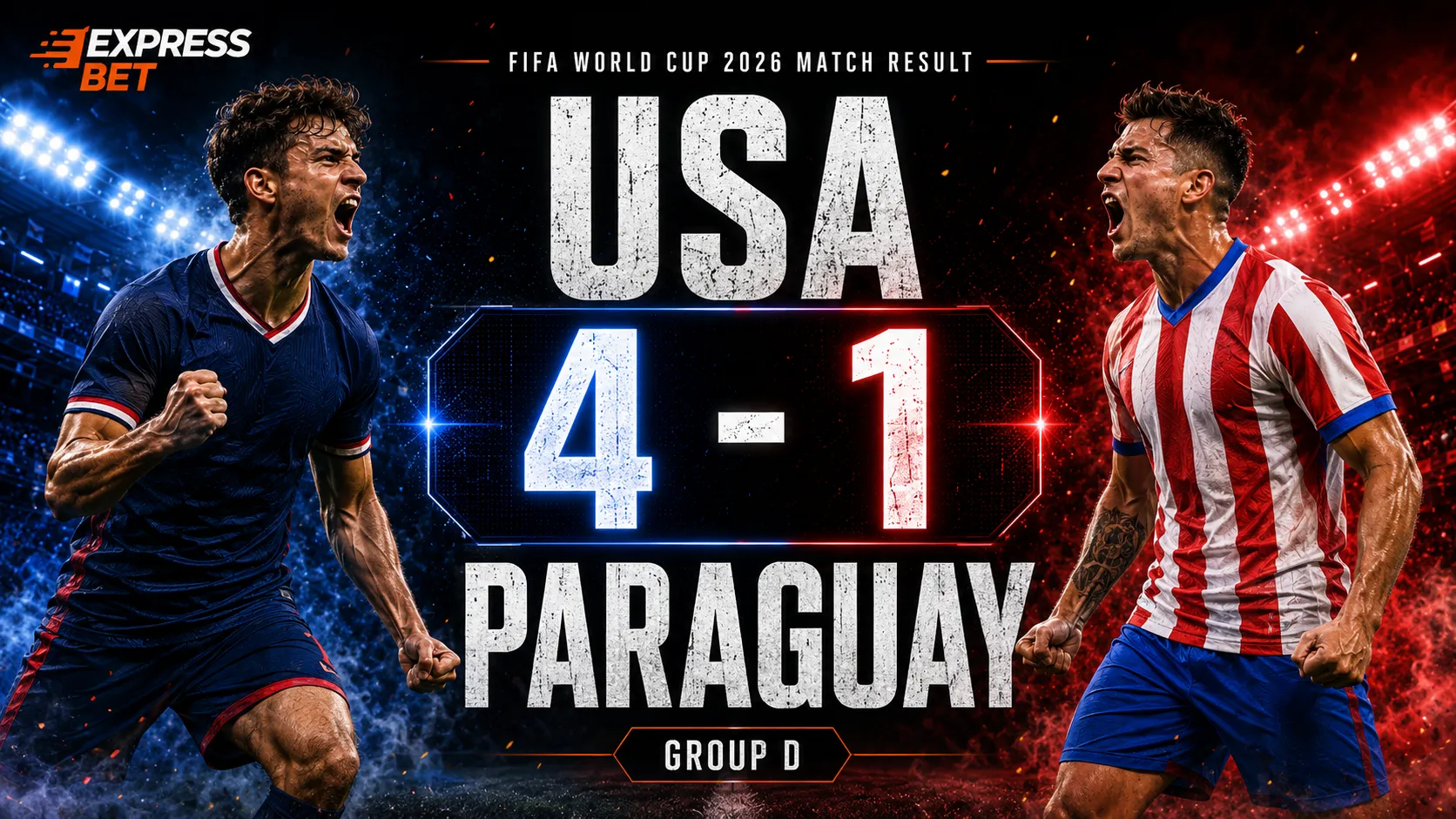
USA beat Paraguay 4-1 in their FIFA World Cup 2026 Group D opener at Los Angeles Stadium. The hosts led 3-0 at half-time after Damián Bobadilla’s 7th-minute own goal and two Folarin Balogun finishes in the 31st and 45+5th minutes. Paraguay replied through substitute Mauricio in the 73rd minute, but Gio Reyna added a fourth in the 90+8th minute. The main turning point was USA’s explosive first-half pressing and vertical attacking. Balogun was the best player, while Christian Pulisic shaped the early damage. The result put USA on three points with a strong goal difference. Betting outcomes depended on odds and timing, but USA win, over 2.5 goals, and USA -1.5 handicap were major winning angles.
| Detail | Information |
|---|---|
| Match | USA vs Paraguay |
| Competition | FIFA World Cup 2026 |
| Stage | Group D, Matchday 1 |
| Date | 12 June 2026 |
| Kickoff time | 6 p.m. PT |
| Host country | USA |
| City | Los Angeles / Inglewood, California |
| Stadium | Los Angeles Stadium |
| Final score | USA 4-1 Paraguay |
| Half-time score | USA 3-0 Paraguay |
| Attendance | 70,492 |
| Referee | Danny Makkelie, Netherlands |
| VAR | Carlos Del Cerro Grande, Spain |
| Weather | 70 degrees, cloudy |
| USA formation | 4-2-3-1 |
| Paraguay formation | 4-4-2 |
| Goals | Damián Bobadilla own goal 7’; Folarin Balogun 31’, 45+5’; Mauricio 73’; Gio Reyna 90+8’ |
| Assists | Christian Pulisic, Malik Tillman, Julio Enciso, Alex Freeman |
| Penalties | None |
| Red cards | None |
| Yellow cards | USA 1, Paraguay 5 |
| Group impact | USA moved to three points in Group D |
The USA vs Paraguay match result was 4-1, and the scoreline did not need much decoration. The United States started fast, scored early, finished the first half with authority, survived one second-half reminder that football is not a parade, and then added a fourth goal in stoppage time because goal difference is not a cosmetic accessory in group football.
This was the kind of home World Cup opener that can make a country briefly forget all the pre-tournament anxiety. Ticket prices, pressure, expectations, debates over soccer’s place in the American sports landscape — all of that became background noise once the hosts began moving the ball with speed and intention.
Paraguay arrived with a reputation for toughness, compact defending, and the usual South American refusal to make any match easy. For about six minutes, that reputation remained intact. Then USA cut through them in transition, forced an own goal, and turned the match into a problem Paraguay never solved.
The opening goal came in the 7th minute. Christian Pulisic and Weston McKennie combined in the left channel, McKennie tried to send the ball across the box, and Damián Bobadilla bundled it into his own net. The finish was Paraguayan, but the action was American. It came from pressure, speed, and an attack that reached the six-yard area before Paraguay’s defensive shape had fully formed.
USA did not treat the early lead like a museum exhibit. They kept attacking. Folarin Balogun had one goal ruled out for offside in the 28th minute, which might have interrupted a less confident striker. It did not interrupt him. Three minutes later, he finished Christian Pulisic’s cross for 2-0. In first-half stoppage time, he scored again from Malik Tillman’s pass, riding a challenge and curling a left-footed strike into the top corner.
That made it 3-0 at half-time. Tournament football usually prefers tension. This match briefly misplaced it.
Paraguay improved after the break. Mauricio came on at half-time, and his 73rd-minute finish from Julio Enciso’s assist gave the South Americans a consolation and a small opening for nerves. USA were no longer as sharp as they had been before the interval. Pulisic had gone off at half-time, officially as a substitution and reportedly as a precaution after a knock. The rhythm changed.
Still, Paraguay never produced enough sustained pressure to make the final result genuinely uncertain. USA defended the lead, controlled enough of the ball, and added a fourth through Gio Reyna in the 90+8th minute after Alex Freeman’s assist. It was a fine outside-of-the-foot finish, and it gave the night a cleaner ending.
The final score was not harsh. Paraguay had a few moments, especially early and around their goal, but the United States were superior technically, tactically, and emotionally. They pressed better. They passed better. They finished better. This is normally a useful way to win a football match.
USA’s first goal came from a transition attack and from the left-sided connection that Paraguay never fully controlled.
Alex Freeman helped start the move by finding Weston McKennie in space. McKennie combined with Christian Pulisic, who drove between two defenders and returned the ball into the dangerous area. McKennie then attempted to play across the face of goal toward Balogun. Bobadilla, retreating toward his own net, ran through the ball and turned it into the goal.
It goes down as an own goal. It should also go down as a warning. Paraguay were already struggling with the speed of USA’s movement. The defenders were facing their own goal, the midfield was late, and the ball was moving faster than the defensive decisions.
Tactically, this goal confirmed the USA’s plan. The hosts did not want slow possession for its own sake. They wanted to win or receive the ball, attack the gaps early, and force Paraguay to defend while running backward. That is when defenders make mistakes. Bobadilla made the official one, but the move had already damaged the whole structure.
The second goal was a better representation of the United States’ attacking quality.
Antonee Robinson played vertically into Christian Pulisic on the left. Pulisic drove into the box and delivered a precise cross toward Balogun. The striker timed his movement well and finished low with his left foot from around 10 yards.
The goal mattered because Balogun had just seen one effort ruled out for offside. A striker can shrink after that. He did not. He adjusted, waited for the next proper delivery, and finished.
Paraguay’s defensive problem was familiar by then. The midfield line was not stopping access into wide areas. The back line was being asked to defend too many dynamic actions close to goal. Once Pulisic received on the move, Paraguay were already behind the play.
Emotionally, the goal moved USA from “good start” to “control.” At 1-0, Paraguay could still argue with the match. At 2-0, they were chasing it.
Balogun’s second goal was the best finish of the night.
Malik Tillman sent a long ball forward from around midfield. Balogun received on the right side of the penalty area, stayed upright through a sliding challenge from Omar Alderete, shifted centrally, and curled a left-footed shot into the upper-left corner.
This was not a tap-in. It was a striker’s goal with balance, strength, technique, and the calm arrogance needed to choose the far corner in first-half stoppage time. Paraguay had defenders close. Balogun made them decorative.
The goal made it 3-0 at half-time. That changed everything. Paraguay’s team talk became damage control. USA’s became game management. Coaches enjoy neither as much as they pretend, but one is clearly preferable.
Paraguay’s goal came after a free-kick sequence that USA failed to clear properly.
Julio Enciso worked the ball through traffic, and substitute Mauricio arrived to finish low with his left foot. Matt Freese was beaten, and Paraguay had a consolation.
The goal exposed a small American weakness. The match had moved into a quieter second half, and USA’s defensive actions were not as clean as their first-half attacks. Paraguay did not create much, but they did not need much here. They needed one loose sequence and one calm finish.
Tactically, the goal gave Paraguay a brief emotional lift. It also warned USA that dominant first halves do not automatically cancel second halves. Football insists on playing both, which is often inconvenient.
The final goal came from patience in the attacking third.
Tim Weah helped keep the move alive. Ricardo Pepi and Alex Freeman were involved in the passing sequence, and Freeman eventually fed Gio Reyna. Reyna turned quickly and curled a shot with the outside of his right foot into the left side of the goal.
It was a technical finish, not a desperate scramble. It also mattered for group logic. A 3-1 win would have been strong. A 4-1 win looked like a statement and gave USA a plus-three goal difference.
For Reyna, it was a clean personal moment. Coming off the bench and scoring late in a World Cup opener is a useful way to re-enter the national conversation without asking permission.
Paraguay created a chance inside the box in the opening moments. Matt Freese, making his World Cup debut, was tested almost immediately.
This mattered because it could have changed the night before it had even settled. A Paraguay goal in the first two minutes would have turned the stadium nervous and the tactical plan emotional. Freese handled the moment, and USA answered quickly.
The own goal was the first tactical break. USA forced Paraguay into retreat and scored from the chaos. It gave the hosts the early lead and allowed them to attack with confidence rather than anxiety.
Balogun finished a chance around the 28th minute, but the goal was ruled out because Pulisic had been offside earlier in the move. It was the correct decision, but it could have frustrated the striker.
Instead, it sharpened the next phase. Balogun scored three minutes later. That response was important.
The 31st-minute finish made it 2-0 and showed the best of USA’s attacking pattern: Robinson into Pulisic, Pulisic into the box, Balogun timing the run. It was fast, clean, and direct.
The 45+5 goal changed the match from competitive to controlled. A two-goal half-time lead is useful. A three-goal half-time lead is a command.
Christian Pulisic was replaced by Sebastian Berhalter at half-time. That changed USA’s attacking rhythm. Pulisic had been central to the first-half damage, and without him the left-sided threat became less sharp.
The substitution did not ruin the match for USA, but it did reduce some of their penetration. It also became a fitness talking point before the next group match.
Paraguay’s goal stopped the match from becoming a total procession. It punished USA for a loose defensive sequence and gave Paraguay something to take from the second half.
Reyna’s goal restored the three-goal margin and strengthened USA’s group position. In a group stage, late goals are not decoration. They are insurance.
The first half was one of the strongest halves the United States have played at a World Cup.
Mauricio Pochettino set USA up in a 4-2-3-1 that often looked more fluid than the formation label. Matt Freese started in goal. Alex Freeman, Chris Richards, Tim Ream, and Antonee Robinson formed the defensive line. Tyler Adams and Weston McKennie gave the midfield base. Sergiño Dest, Malik Tillman, Christian Pulisic, and Folarin Balogun formed the attacking structure.
Paraguay started in a 4-4-2. Orlando Gill was in goal. Juan Cáceres, Gustavo Gómez, Omar Alderete, and Junior Alonso formed the back four. Diego Gómez, Andrés Cubas, Damián Bobadilla, and Miguel Almirón worked across midfield, with Antonio Sanabria and Julio Enciso up front.
The first tactical point was the USA’s ability to create overloads in the middle and on the left. Pulisic did not stay wide like a chalk-on-boots winger. He moved into half-spaces, attacked diagonally, and forced Paraguay’s midfield and full-back line to make choices. If Cáceres stepped out, space opened behind him. If he held, Pulisic turned. Neither option was pleasant.
Antonee Robinson’s vertical passing and overlapping presence helped create that pressure. McKennie also broke forward intelligently. The opening goal came from this type of movement: speed into the box, a cutback, defensive panic.
Paraguay’s midfield two in central zones could not control the Americans’ rotations. Cubas was forced into repeated defensive actions. Bobadilla was pulled backward and ended up scoring the own goal. Diego Gómez and Almirón had to protect wide areas and could not consistently help inside.
USA’s pressing was also strong. They did not allow Paraguay to build calmly through the first pass. When Paraguay went long, Richards and Ream handled the first contact well. When Paraguay tried to play through midfield, Adams and McKennie compressed space quickly.
The disallowed Balogun goal showed how close USA were to ending the match even earlier. But the official second goal came soon after. Pulisic’s delivery, Balogun’s movement, and the finish were exactly what USA wanted from their attacking unit.
Tillman’s role grew as the half went on. He was not just a decorative attacking midfielder. He found pockets, connected play, and then delivered the long pass for Balogun’s second. His assist was direct and intelligent.
Balogun’s second goal in stoppage time was the perfect end to the half. It combined USA’s willingness to go vertical with individual quality in the box. Paraguay’s defenders were close enough to be visible, not close enough to matter.
At half-time, USA led 3-0. The score reflected the half. Paraguay had been outplayed, outrun, and outthought. Their five yellow cards by full-time began with early frustration in this first-half pattern.
The second half was less spectacular from USA, but that is not unusual after a 3-0 half-time lead.
Pulisic came off at the break, with Sebastian Berhalter entering. Paraguay also made a major change, replacing Bobadilla with Mauricio. That substitution eventually produced Paraguay’s goal.
Without Pulisic, USA lost some left-sided incision. The hosts still controlled possession, but the attacks became less sharp. The game management problem appeared: should they keep attacking at full speed, or protect the lead and avoid unnecessary risk?
The answer was somewhere in between. USA did not completely sit back, but they did not reproduce the same first-half intensity. Paraguay had more room to breathe. Almirón and Enciso found slightly better moments between lines, though still not enough to truly dominate.
Tyler Adams was booked in the 59th minute. That was a small warning because Adams’ role depended on timing and aggression. A booked holding midfielder must defend with calculation. He did that well enough.
Paraguay introduced Alex Arce for Sanabria in the 62nd minute. USA later brought on Tim Weah and Ricardo Pepi for Dest and Balogun in the 72nd minute. Those changes altered both teams’ attacking structures.
Then Mauricio scored in the 73rd minute. The goal came from a failure to clear after a Paraguay free-kick sequence. Enciso found the pass through traffic, and Mauricio finished. It was Paraguay’s only shot on target, which is either efficient or depressing depending on the dressing room.
After the goal, Paraguay tried to push, but they never built a sustained siege. They made three more substitutions around the 79th minute, bringing on Ramón Sosa, Alejandro Romero Gamarra, and Gustavo Velázquez. USA responded with Gio Reyna for Tillman in the 82nd minute.
The late phase became more open. Paraguay committed fouls and picked up more cards. USA looked for a fourth rather than simply closing the match. Reyna eventually supplied it.
The 90+8 goal was important because it prevented the second half from feeling like Paraguay had partially rescued the narrative. They had improved, yes. They had scored, yes. They had not changed the result.
USA won because they created superiorities between Paraguay’s midfield and defensive lines, pressed with better timing, and turned attacking speed into penalty-box actions.
The nominal 4-2-3-1 did not stay flat. In possession, USA often created a five-man attacking structure. Robinson and Freeman provided wide or advanced support. Pulisic moved inside from the left. Dest drifted and combined on the right. Tillman occupied central pockets. McKennie surged forward from deeper midfield. Balogun stayed high and stretched the centre-backs.
That gave Paraguay constant reference problems. Gustavo Gómez and Alderete had to watch Balogun. Cáceres had to handle Pulisic and Robinson’s side. Cubas had to protect the centre. Bobadilla and Diego Gómez had to track runners. It was too much.
The first goal came from transition. The second came from left-side penetration. The third came from direct vertical passing. That variety matters. USA did not need one route to work repeatedly. They had several.
Defensively, USA’s centre-backs were calm. Chris Richards completed his passing with exceptional accuracy and controlled defensive duels. Tim Ream offered experience and line-breaking distribution. With Adams screening and McKennie covering ground, Paraguay rarely found clean central progression.
Paraguay’s 4-4-2 had two major problems. First, the front two could not stop USA’s build-up. Second, the midfield line was repeatedly stretched. Once USA got the ball into Pulisic, Tillman, or McKennie between the lines, Paraguay were forced to defend facing their own goal.
Paraguay also lacked attacking variety. Enciso had moments. Almirón carried some threat. Mauricio’s goal was well taken. But as a collective, Paraguay did not get enough players into dangerous zones. Their expected goals reflected that limited chance quality.
The yellow-card count told another part of the story. Paraguay fouled because they were chasing actions. USA fouled less because they were usually in better positions.
This was a tactical win for Pochettino. His team looked structured but not stiff. That distinction matters. Too many national teams become overcoached in major tournaments. USA looked prepared without looking handcuffed.
These ratings are editorial ratings based on match impact, tactical role, official events, and available match data.
Matt Freese — 6.5/10
Tested early and beaten only by Mauricio’s low finish. Did not have a heavy workload because Paraguay managed only one shot on target.
Alex Freeman — 8/10
A mature World Cup debut. Assisted Reyna’s late goal and helped start the move for the opening own goal. Defensively steady, offensively brave.
Chris Richards — 8.5/10
Excellent. Controlled the back line, passed cleanly, and gave USA stability. His composure helped prevent Paraguay from turning transitions into danger.
Tim Ream — 8/10
Captain’s performance. Calm in possession and smart with positioning. His line-breaking passes helped USA move through Paraguay’s first pressure.
Antonee Robinson — 7.5/10
Important in the build-up to Balogun’s first goal. Provided vertical energy and helped Pulisic attack the left side.
Tyler Adams — 7/10
Booked in the second half but protected the centre well. His pressing and recovery work kept Paraguay from building rhythm.
Weston McKennie — 8/10
Central to the own goal sequence and strong in forward runs. His timing around the box created problems for Paraguay.
Sergiño Dest — 7/10
Gave USA technical control on the right and helped stretch Paraguay before being replaced by Weah.
Malik Tillman — 8/10
Assisted Balogun’s second goal and repeatedly found good positions between midfield and attack. One of the smartest performances on the pitch.
Christian Pulisic — 8.5/10
Played only the first half but shaped the game decisively. Assisted Balogun, helped force the opener, and gave Paraguay constant problems with diagonal dribbling.
Folarin Balogun — 9.5/10
Two goals, elite movement, ruthless finishing. His first World Cup goals arrived in a brace. That is one way to introduce yourself.
Sebastian Berhalter — 6.5/10
Entered at half-time and helped stabilize midfield. Did not provide Pulisic’s attacking edge, but that was not his job.
Tim Weah — 6.5/10
Added energy after coming on. Helped sustain the late attacking sequence before Reyna’s goal.
Ricardo Pepi — 6.5/10
Worked hard after replacing Balogun. Linked play late and contributed to the final attacking push.
Gio Reyna — 8/10
Came on in the 82nd minute and scored a superb stoppage-time goal. Limited minutes, major impact.
Orlando Gill — 5.5/10
Conceded four, though he was exposed repeatedly. Made some saves but could not stop the first-half collapse.
Juan Cáceres — 4.5/10
Booked early and struggled with USA’s left-sided attacks. Replaced late after a difficult night.
Gustavo Gómez — 5.5/10
Tried to organize the back line but was dragged into too many emergency defensive actions.
Omar Alderete — 5/10
Could not stop Balogun on the third goal despite getting close. Had a hard night against movement and pace.
Junior Alonso — 5/10
Booked in stoppage time. Struggled to control USA’s wide and inside-left patterns.
Diego Gómez — 5/10
Had shot volume but little accuracy. Booked and replaced in the second half.
Andrés Cubas — 5.5/10
Worked hard defensively but was overloaded in midfield. Committed fouls because Paraguay were stretched.
Damián Bobadilla — 3/10
Scored the own goal and was replaced at half-time. A brutal opening 45 minutes.
Miguel Almirón — 5/10
Showed flashes but not enough influence. Booked early in the second half and replaced.
Antonio Sanabria — 4.5/10
Isolated and largely ineffective before being replaced by Arce.
Julio Enciso — 7/10
Paraguay’s best starter. Assisted Mauricio’s goal and carried the most creative threat.
Mauricio — 7/10
Came on at half-time and scored Paraguay’s only goal. Gave the attack more life.
Alex Arce — 5.5/10
Added physicality but was booked and did not create enough danger.
Ramón Sosa — 5.5/10
Fresh legs late, limited impact.
Alejandro Romero Gamarra — 5.5/10
Entered late and could not shift the game.
Gustavo Velázquez — 5.5/10
Helped close the right side late, but the match was already gone.
Man of the Match: Folarin Balogun
Two goals in a World Cup opener. One low finish. One superb curling strike. This is not a complicated award.
Best attacker: Folarin Balogun
His movement, finishing, and resilience after the disallowed goal defined the match.
Best midfielder: Malik Tillman
Tillman’s assist for Balogun’s second goal was excellent, and his positioning between the lines kept Paraguay uncomfortable.
Best defender: Chris Richards
Dominant, composed, and precise. He gave USA the platform for their attacking confidence.
Best goalkeeper: Matt Freese
He had less to do than Orlando Gill but handled his debut pressure and avoided the early disaster that Paraguay nearly created.
Best substitute: Gio Reyna
A late entrance, a technical finish, and a stronger goal difference. Efficient work.
Most underrated performance: Alex Freeman
A World Cup debut with an assist and a role in the opening move. He looked ready for the stage.
Most disappointing performance: Damián Bobadilla
The own goal was damaging. The half-time substitution said the rest.
There were no red cards and no penalties.
USA had one yellow card: Tyler Adams in the 59th minute. That is worth monitoring because Adams plays a position where tactical fouls are part of the job. One booking is not a crisis, but yellow-card accumulation in a group stage can become a quiet trap.
Paraguay had five yellow cards. Juan Cáceres was booked in the 9th minute. Miguel Almirón followed in the 53rd. Diego Gómez was booked in the 79th, Alex Arce in the 88th, and Junior Alonso in the 90+3rd. That card total reflected Paraguay’s struggle to contain USA’s movement.
The main physical concern for USA was Christian Pulisic’s half-time substitution. Available reports described it as precautionary after a knock or calf issue. That becomes important because USA’s next match against Australia comes quickly, and Pulisic was central to the first-half performance.
No confirmed concussion substitution was recorded. No player was sent off. No suspension was triggered directly by this match, but Paraguay’s discipline will need tightening.
Danny Makkelie controlled the match without becoming the story. That is usually the highest compliment available to a referee.
The main VAR-relevant moment was Balogun’s disallowed goal in the 28th minute. The decision was for offside against Pulisic earlier in the move, and the goal was correctly ruled out. The incident mattered because USA were already threatening heavily. Paraguay escaped briefly, then conceded again three minutes later.
There were no penalties. There were no red cards. There was no major handball dispute that defined the result.
The yellow-card distribution made sense in the match context. Paraguay were often late into duels because USA moved the ball quicker and attacked spaces behind them. The cards were not random. They were symptoms.
Added time was significant. USA scored in the eighth minute of second-half stoppage time. That goal did not change the winner, but it changed the margin. In group football, margins matter.
VAR did not dominate this game. The football did. That is still allowed.
The match was played at Los Angeles Stadium in Inglewood, California, the World Cup name for SoFi Stadium. The announced attendance was 70,492.
The weather was reported as 70 degrees and cloudy. That was comfortable enough for a high-tempo match. There was no confirmed weather incident, no lightning delay, and no major pitch controversy.
The venue has an isolated roof structure, which helped shape the atmosphere. The stadium felt loud, bright, and heavily staged, as expected for a U.S. home World Cup opener. This was not a quiet neutral venue. It was a national event wearing a scoreboard.
The pitch did not become a major story. That matters because temporary grass surfaces in major U.S. stadiums had been a pre-tournament concern. In this match, the football story was not slips, bounces, or surface damage. It was movement, pressing, and finishing.
The conditions helped USA play at pace. The cloudy evening, moderate temperature, and home crowd allowed the hosts to press aggressively without the match becoming a heat-management exercise.
The crowd gave USA a clear home advantage.
This was the United States’ first World Cup match on home soil since 1994, and the stadium behaved like it understood the assignment. The early own goal turned energy into noise. Balogun’s brace turned noise into belief. Reyna’s late goal turned the night into a statement.
Paraguay had support, but the sound belonged mostly to the hosts. That matters. A World Cup home opener can become heavy if the team starts slowly. USA scored before the crowd could become nervous. That is good event management and better football management.
The opening ceremony and Los Angeles setting added spectacle, but the match quickly became bigger than the show around it. The best atmosphere is always created by goals. USA supplied four.
The crowd also helped keep the tempo alive after Paraguay’s goal. At 3-1, there was a small window where the match could have become awkward. The stadium did not panic. The team did not either.
There is a delicious historical detail here: Balogun became the first American since Bert Patenaude in 1930 to score multiple goals in a World Cup match, and Patenaude’s famous multi-goal game also came against Paraguay.
Football loves these coincidences. It stores them for decades and then drops them onto a modern match like a note from an old coat pocket.
The scoreline also mattered for USA history. The United States had rarely produced this kind of attacking dominance at a World Cup. Four goals in a single World Cup match became a major program landmark.
There was also a host-nation context. USA’s opening goal came very early, one of the fastest by a host nation in its opening World Cup match. That placed the performance near a small club of home teams that started quickly rather than sinking under the ceremony.
Paraguay’s historical context was different. They were returning to the World Cup after a long absence, with memories of stronger tournament sides from 1998, 2002, and 2010. The 2010 quarter-final run remains the country’s modern reference point. This match looked far from that level.
The analogy is not that USA are suddenly a 1930-style semi-final side or that Paraguay are doomed. One group match is not a destiny machine. But this was a clear marker. USA looked like a team with a plan, confidence, and finishing. Paraguay looked like a team still searching for a tournament rhythm.
| Statistic | USA | Paraguay |
|---|---|---|
| Final score | 4 | 1 |
| Half-time score | 3 | 0 |
| Ball possession | 65% | 35% |
| Attempts at goal | 16 | 9 |
| Shots on target | 6 | 1 |
| Blocked attempts | 3 | 4 |
| Fouls against | 13 | 17 |
| Corners | 3 | 1 |
| Direct free kicks | 16 | 13 |
| Indirect free kicks | 2 | 2 |
| Penalties | 0/0 | 0/0 |
| Offsides | 2 | 1 |
| Own goals | 0 | 1 |
| Yellow cards | 1 | 5 |
| Red cards | 0 | 0 |
| Expected goals | 1.35 | 0.47 |
The statistics support the result.
USA had more possession, more shots, more shots on target, and much better chance quality. Paraguay’s only shot on target became their goal. That is efficient but not sustainable as a match plan.
The xG split is interesting because USA scored four from 1.35 xG. That means the finishing was excellent, and the own goal contributed to scoreboard overperformance. It does not reduce the win. It explains its sharpness.
Paraguay’s 0.47 xG shows how little they created. Their goal came from one of very few dangerous moments. They did not build enough pressure to make the match genuinely close.
The card count also tells the story. USA had one booking. Paraguay had five. That is what happens when one team controls the rhythm and the other spends too much of the night arriving late.
The USA vs Paraguay betting result rewarded several attacking and favorite-based markets.
USA were slight pre-match favorites in many markets. The match-winner market landed comfortably for USA backers. Anyone who took USA before kickoff got a strong result without needing late drama.
The handicap markets were more interesting. USA -1.5 landed. USA -2.5 also landed because Reyna scored in stoppage time. That late goal may have felt unnecessary to casual viewers, but handicap bettors understood its value immediately. Football does not have garbage time when tickets are alive.
The over/under goals market strongly favoured the over after the match reached three goals before half-time. Over 2.5 landed before the interval. Over 3.5 landed with Mauricio’s goal. Over 4.5 landed only after Reyna made it 4-1 in the 90+8th minute.
Both teams to score also landed, but it required Paraguay’s 73rd-minute goal. Before that, USA clean sheet bettors looked comfortable. One poor clearance changed the market.
Correct score 4-1 was a long-shot winning angle. It required USA dominance, a Paraguay consolation, and a late fourth. That is why correct-score markets are dangerous: they can look dead, alive, dead again, and then suddenly cash in stoppage time.
First goalscorer markets were complicated by the own goal. Balogun anytime goalscorer landed. Balogun to score two or more was the premium winning angle.
Cards markets also rewarded bettors who expected Paraguay to struggle physically. Five Paraguayan bookings created value on high-card lines, though card markets depend heavily on referee style and match rhythm.
The biggest betting lesson is this: USA’s attacking structure was visible early. Their movement bothered Paraguay before the own goal. Live bettors who watched the opening minutes saw warning signs. But that does not mean every future USA match will follow the same pattern.
No betting outcome is guaranteed. Odds change quickly, and one injury, red card, or disallowed goal can overturn a good read.
USA moved to three points with a plus-three goal difference. That is an ideal opening position in Group D.
In a group with Paraguay, Australia, and Türkiye, goal difference could matter. A 4-1 win gives USA breathing room. It also gives them tactical confidence before facing Australia in Seattle and Türkiye back in Los Angeles.
The next match against Australia becomes a chance to move close to qualification. A second win would put USA in a very strong position. Even a draw would keep them well placed after this margin.
Paraguay now have work to do. They are on zero points with a minus-three goal difference. That is a poor opening balance. Their next match against Türkiye becomes much more important. Lose again, and they may be forced into third-place calculations with a damaged goal difference.
The expanded World Cup format gives teams more possible routes, including qualification for the best third-placed sides. But relying on that route after a 4-1 defeat is not a plan. It is a spreadsheet with stress.
USA did almost everything right in the first half.
They pressed aggressively but not recklessly. They moved the ball through midfield with speed. They used Pulisic between lines. They gave Balogun proper service. They pushed full-backs high at the right moments. They used vertical passing when Paraguay stepped too high.
The biggest positive was attacking variety. The first goal came from transition. The second came from a left-sided combination. The third came from a long pass and individual finishing. The fourth came from patient late possession.
Pochettino’s team also showed emotional control. They did not freeze under home pressure. They did not relax after 1-0. They did not collapse after conceding.
The centre-backs were excellent in possession. Richards and Ream allowed USA to build calmly and prevent Paraguay from turning clearances into attacks.
The main concern is second-half rhythm. Without Pulisic, USA lost some sharpness. Paraguay’s goal also showed that defensive clearances must be cleaner.
Paraguay’s main problem was defensive spacing.
Their 4-4-2 did not control USA’s rotations. The wide midfielders were pulled back. The central midfielders were stretched. The full-backs were exposed. The centre-backs had to defend Balogun in space too often.
The early own goal made the plan harder, but Paraguay did not respond with enough calm. They became physical without becoming effective. The five yellow cards were not random. They reflected repeated late defensive actions.
Paraguay also lacked attacking support around Enciso. He created the assist and showed quality, but he was too isolated. Sanabria offered little. Almirón had moments but did not control the match.
The half-time substitution worked because Mauricio scored. But by then Paraguay were already 3-0 down. That is not a tactical adjustment. That is emergency repair.
The biggest issue before their next match is balance. Paraguay need enough defensive compactness to avoid another open game, but they also need more attacking presence. Defending deep after conceding early is not a strategy. It is a long afternoon.
Pochettino’s plan worked.
USA looked organized, aggressive, and expressive. That combination is difficult. Many teams can manage two of the three. Few manage all three in a World Cup opener.
His use of Pulisic, Tillman, McKennie, and Balogun was particularly effective. The attacking structure gave players freedom within clear roles. Balogun had service. Pulisic had space. McKennie had forward lanes. Tillman had passing options.
The only concern came after half-time. Pulisic’s substitution was understandable if precautionary, but the attack lost edge. Pochettino will need a reliable version of the team if Pulisic cannot play full minutes.
Still, the overall verdict is strong. USA did not merely win. They looked prepared for the occasion.
Alfaro’s Paraguay were outplayed in the first half.
The 4-4-2 was too flat against USA’s rotations. Paraguay could not stop Pulisic receiving between or beside defenders. They could not prevent Robinson and McKennie from influencing the left channel. They could not handle Balogun’s movement.
The half-time move to introduce Mauricio worked in one sense because he scored. But it did not solve the broader issue of territory and midfield control.
Alfaro must decide whether to keep the same compact base or add another midfielder to avoid being overloaded. The next match will demand more control and less reactive defending.
Folarin Balogun’s brace was historic. He became only the second American player to score multiple goals in a World Cup match, following Bert Patenaude in 1930. The fact that both did it against Paraguay is the kind of coincidence football historians quietly treasure.
Balogun also scored his first World Cup goals. He did not ease into the tournament. He kicked the door open and then scored again before half-time.
Christian Pulisic recorded another World Cup assist and moved higher in the USMNT’s tournament record books. His first-half performance was decisive despite the early substitution.
Gio Reyna scored his first World Cup goal with the late finish. It was also his 10th international goal for the United States.
Tim Ream became the oldest player to appear for USA in a World Cup match. That record fits his performance: calm, measured, and slightly allergic to panic.
USA also produced one of their strongest World Cup scorelines, scoring four goals in a match at the tournament for the first time.
This match had few major controversies.
Balogun’s disallowed goal in the 28th minute was the most important officiating moment. It was ruled out for offside against Pulisic in the build-up. The decision was correct and did not change the broader flow because Balogun scored soon after.
There were no penalties and no red cards. VAR did not dominate the match.
Pulisic’s substitution at half-time became the main post-match concern. If the move was precautionary, USA will hope he is ready for Australia. If the issue lingers, Pochettino must adapt his attacking structure.
Paraguay may complain about isolated moments, but the result was too wide for officiating to carry much blame. A 4-1 defeat usually requires football answers, not courtroom language.
USA deserved the win, and the 4-1 scoreline reflected their superiority.
The hosts were sharper from the start. They pressed with purpose, moved with speed, and punished Paraguay’s defensive uncertainty. Balogun gave them elite finishing. Pulisic gave them first-half imagination. Tillman, McKennie, Richards, Ream, Robinson, and Freeman all played important roles in a performance that looked collective rather than dependent on one star.
Paraguay had moments, but not enough. Mauricio’s goal gave them something, and Enciso’s assist showed quality. But the team spent too much time reacting. They fouled too often, defended too deep, and failed to protect central spaces.
For USA, this was more than three points. It was a statement opener with goal difference, records, and evidence that Pochettino’s team can play with freedom under pressure.
For Paraguay, this was a warning. The group is not over, but the margin leaves damage. They must improve quickly against Türkiye.
For bettors, the match rewarded those who trusted USA’s attacking setup, the over markets, and Balogun’s scoring role. It also warned clean-sheet backers that even dominant teams can concede from one loose sequence.
The World Cup does not hand out trophies in the first group match. It does, however, hand out first impressions. USA’s was loud, fast, and convincing. Paraguay’s was late, stretched, and uncomfortable.
Football betting carries financial risk. A correct tactical analysis does not guarantee a winning bet. Odds change before and during matches, and one goal can completely alter a market. Never chase losses. Do not bet money needed for daily life. Use limits and take breaks. Check local betting laws before gambling. Betting should remain entertainment, not income.
USA beat Paraguay 4-1 in their FIFA World Cup 2026 Group D opener.
Damián Bobadilla scored an own goal in the 7th minute. Folarin Balogun scored for USA in the 31st and 45+5th minutes. Mauricio scored for Paraguay in the 73rd minute. Gio Reyna scored for USA in the 90+8th minute.
Folarin Balogun was the best player. He scored twice and became the central figure in USA’s dominant first-half performance.
USA moved to three points with a plus-three goal difference. Paraguay started with zero points and a minus-three goal difference, making their next group match much more important.
USA match-winner, over 2.5 goals, over 3.5 goals, both teams to score, and USA handicap markets landed depending on the line. Balogun anytime scorer and multi-goal markets were also successful.
[expert_review params=»JTdCJTIyY29sb3IlMjIlM0ElMjJncmVlbi0yJTIyJTJDJTIyZXhwZXJ0X2F2YXRhciUyMiUzQSUyMiUyMiUyQyUyMmV4cGVydF9uYW1lJTIyJTNBJTIyJTIyJTJDJTIyZXhwZXJ0X2xpbmslMjIlM0ElMjIlMjIlMkMlMjJleHBlcnRfaWQlMjIlM0ElMjIxJTIyJTJDJTIyZXhwZXJ0X3R5cGUlMjIlM0ElMjJleHBlcnRfaWQlMjIlMkMlMjJleHBlcnRfYXZhdGFyX2FsdCUyMiUzQSUyMiUyMiUyQyUyMmV4cGVydF9zaG93JTIyJTNBMSUyQyUyMmV4cGVydF9kZXNjcmlwdGlvbiUyMiUzQSUyMlNwb3J0cyUyMEJldHRpbmclMjBBbmFseXN0JTIwJTI2JTIwRWRpdG9yaWFsJTIwQ29udHJpYnV0b3IlMjIlMkMlMjJleHBlcnRfc2hvd19idXR0b24lMjIlM0ExJTJDJTIyZXhwZXJ0X3Nob3dfYnV0dG9uX3R5cGUlMjIlM0ElMjJwb3B1cCUyMiUyQyUyMmV4cGVydF9xdWVzdGlvbl9idXR0b25fdGV4dCUyMiUzQSUyMkFzayUyMFF1ZXN0aW9uJTIyJTJDJTIycXVlc3Rpb25fZXh0ZXJuYWxfbGluayUyMiUzQSUyMiUyMiUyQyUyMnBvcHVwX3VzZV9waG9uZSUyMiUzQTAlMkMlMjJleHBlcnRfdGl0bGUlMjIlM0ElMjJBdXRob3IlMjIlMkMlMjJleHBlcnRfc2hvd190aXRsZSUyMiUzQTElMkMlMjJleHBlcnRfdGV4dCUyMiUzQSUyMkFsZXglMjBNb3JnYW4lMjBpcyUyMGElMjBzcG9ydHMlMjBiZXR0aW5nJTIwYW5hbHlzdCUyMGFuZCUyMGVkaXRvcmlhbCUyMGNvbnRyaWJ1dG9yJTIwd2hvJTIwd3JpdGVzJTIwZGV0YWlsZWQlMjBib29rbWFrZXIlMjByZXZpZXdzJTJDJTIwYmV0dGluZyUyMGd1aWRlcyUyQyUyMHBsYXRmb3JtJTIwY29tcGFyaXNvbnMlMkMlMjBhbmQlMjByZXNwb25zaWJsZSUyMGdhbWJsaW5nJTIwZXhwbGFpbmVycy4lMjBIaXMlMjB3b3JrJTIwZm9jdXNlcyUyMG9uJTIwcHJhY3RpY2FsJTIwaW5mb3JtYXRpb24lMjBmb3IlMjB1c2VycyUyMHdobyUyMHdhbnQlMjB0byUyMHVuZGVyc3RhbmQlMjBob3clMjBiZXR0aW5nJTIwc2l0ZXMlMjBvcGVyYXRlJTIwYmVmb3JlJTIwdGhleSUyMHJlZ2lzdGVyJTJDJTIwZGVwb3NpdCUyQyUyMG9yJTIwY2xhaW0lMjBhJTIwYm9udXMuJTIyJTJDJTIycWElMjIlM0ElNUIlNUQlMkMlMjJxYV9zaG93X3RpdGxlJTIyJTNBMSUyQyUyMnFhX3RpdGxlJTIyJTNBJTIyJUQwJTkyJUQwJUJFJUQwJUJGJUQxJTgwJUQwJUJFJUQxJTgxJTIwJUQxJThEJUQwJUJBJUQxJTgxJUQwJUJGJUQwJUI1JUQxJTgwJUQxJTgyJUQxJTgzJTIyJTJDJTIyc2NvcmUlMjIlM0ElNUIlNUQlMkMlMjJzY29yZV9zdW1tYXJ5X3RleHQlMjIlM0ElMjIlMjIlMkMlMjJzY29yZV9zdW1tYXJ5X2F2ZXJhZ2UlMjIlM0EwJTJDJTIyc2NvcmVfbWF4JTIyJTNBJTIyNSUyMiUyQyUyMnNjb3JlX3N5bWJvbCUyMiUzQSUyMiUyMiUyQyUyMnNjb3JlX3RpdGxlJTIyJTNBJTIyJTIyJTJDJTIyc2NvcmVfc2hvd190aXRsZSUyMiUzQTAlMkMlMjJwbHVzZXMlMjIlM0ElNUIlNUQlMkMlMjJtaW51c2VzJTIyJTNBJTVCJTVEJTJDJTIycGx1c2VzX21pbnVzZXNfc2hvd190aXRsZSUyMiUzQTElMkMlMjJwbHVzZXNfbWludXNlc190aXRsZSUyMiUzQSUyMiVEMCU5RiVEMCVCQiVEMSU4RSVEMSU4MSVEMSU4QiUyMCVEMCVCOCUyMCVEMCVCQyVEMCVCOCVEMCVCRCVEMSU4MyVEMSU4MSVEMSU4QiUyMiUyQyUyMnBsdXNlc190aXRsZSUyMiUzQSUyMiUyMiUyQyUyMm1pbnVzZXNfdGl0bGUlMjIlM0ElMjIlMjIlN0Q=»]