
Australia vs Egypt World Cup 2026 Preview
Table of Contents Show
Views 68
Summary
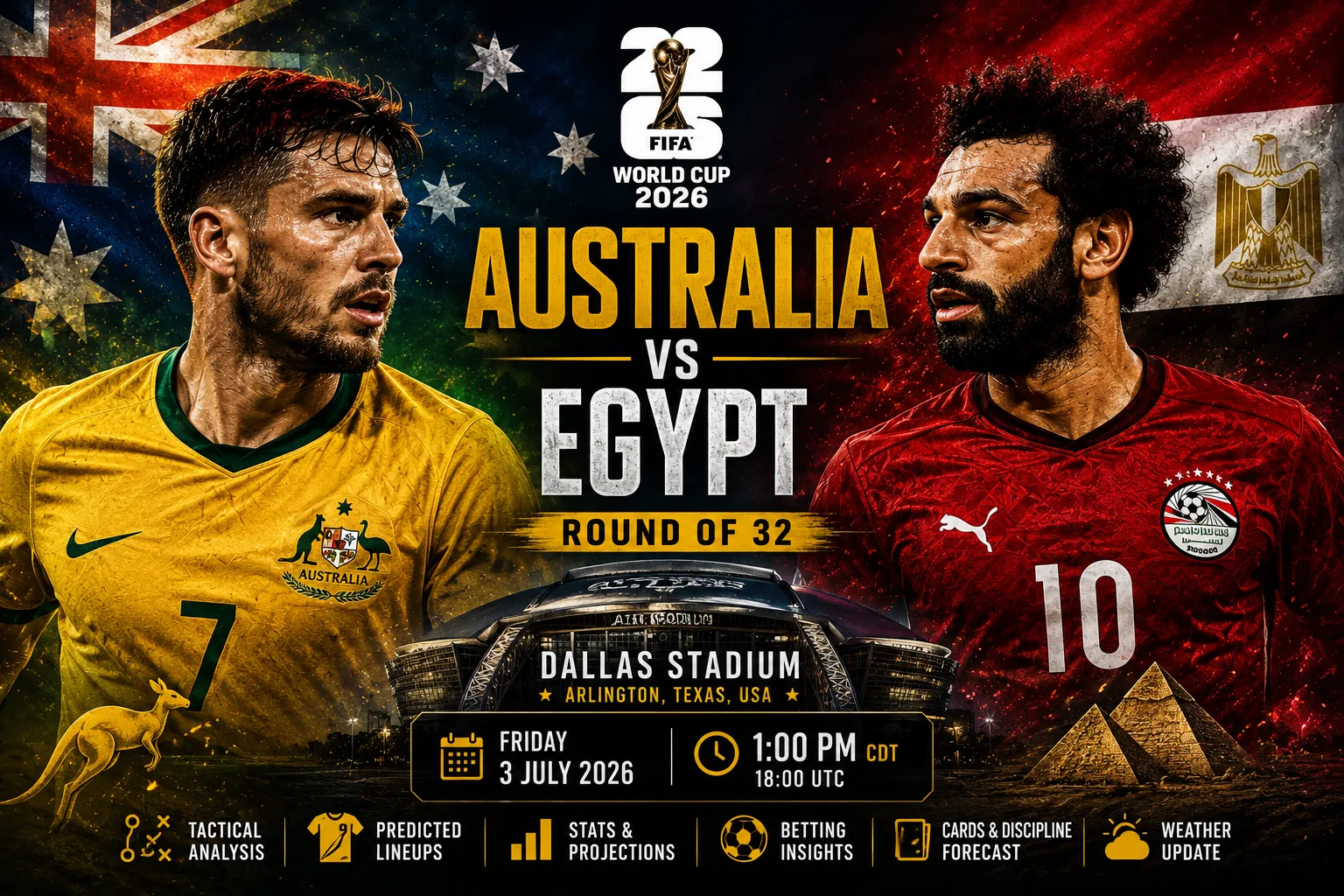
Australia face Egypt in a FIFA World Cup 2026 Round of 32 match on Friday, 3 July 2026, at Dallas Stadium in Arlington, Texas, United States. FIFA’s Match Centre lists the fixture as Australia vs Egypt, with kick-off at 18:00 UTC; Football Australia’s Socceroos page lists the local kick-off as 1:00 PM at Dallas Stadium, Arlington, USA. (fifa.com)
This is a knockout match, not a group-stage fixture. Australia reached the Round of 32 as runners-up in Group D after beating Türkiye 2-0, losing 2-0 to the United States and drawing 0-0 with Paraguay. Egypt reached the knockout stage as runners-up in Group G after drawing 1-1 with Belgium, beating New Zealand 3-1 and drawing 1-1 with IR Iran. (socceroos.com.au)
Confirmed final lineups are not available before official team sheets. Public team-news reporting says Australia will be without Jacob Italiano and Mathew Leckie for the rest of the tournament, while Egypt have Mohamed Salah in a hamstring fitness race; Hamdi Fathy, Hossam Abdelmaguid and Mohamed Abdelmonem are also doubts, Mohanad Lasheen is suspended and Ahmed Fatouh is expected to miss out. (racingpost.com)
Australia are likely to use a 3-4-2-1 structure. Egypt are likely to use a 4-2-3-1. The key matchup is Australia’s left-side wing-back pressure through Jordan Bos against Egypt’s right-side cover, plus Egypt’s possible Salah/Marmoush transition threat against Australia’s back three. Betting markets make Egypt slight favorites, but this is a low-margin knockout game. Betting should stay licensed, limited and treated as entertainment, not income.
Match Snapshot
| Field | Information | Status |
|---|---|---|
| Match | Australia vs Egypt | Confirmed |
| Competition | FIFA World Cup 2026 | Confirmed |
| Stage | Round of 32 | Confirmed |
| Group | Not applicable to match stage; Australia came from Group D, Egypt came from Group G | Confirmed |
| Date | Friday, 3 July 2026 | Confirmed |
| Kick-off time | 1:00 PM local / 18:00 UTC / 4:00 AM AEST on Saturday, 4 July | Confirmed |
| Stadium | Dallas Stadium | Confirmed FIFA tournament naming |
| Common venue identity | AT&T Stadium, Arlington | Public venue identity |
| City / region | Arlington, Dallas host region, Texas | Confirmed by Football Australia |
| Host country | United States | Confirmed |
| Expected attendance | Not available from verified public data | |
| Referee | Not available from verified public data | |
| VAR | Not available from verified public data | |
| Weather forecast | Around 96°F / 36°C at 1 PM local, mostly clear | Forecast |
| Pitch context | World Cup grass configuration expected; exact match-day pitch condition not available from verified public data | |
| Main article focus | Knockout pressure, heat management, Salah fitness, Australia’s structure, Egypt’s transition threat and responsible betting context | Analytical |
Australia vs Egypt is a knockout match between two teams that reached this stage through discipline rather than open attacking dominance. Australia have a compact structure and a clear physical identity. Egypt have more individual star power if Mohamed Salah can contribute, but their attacking model changes if he cannot start or cannot sprint at full load. The Dallas heat makes tempo management central. (Reuters)
Result Stakes in One Sentence
Australia and Egypt are both chasing a first World Cup knockout-stage win, so the match carries historical weight beyond a normal Round of 32 tie.
Confirmed Facts vs Forecasts
| Category | Data Point | Current Status | How It Should Be Used |
|---|---|---|---|
| Confirmed fact | Australia vs Egypt is a FIFA World Cup 2026 Round of 32 fixture | Confirmed | Core match fact |
| Confirmed fact | Venue is Dallas Stadium | Confirmed | Match snapshot |
| Confirmed fact | Kick-off is 18:00 UTC / 1:00 PM local | Confirmed | Time reference |
| Confirmed fact | Australia finished second in Group D | Confirmed by Reuters / Football Australia reporting | Tournament context |
| Confirmed fact | Egypt finished second in Group G | Confirmed by Reuters / Football Australia reporting | Tournament context |
| Confirmed fact | Australia beat Türkiye, lost to the United States and drew with Paraguay | Confirmed by Football Australia | Group path |
| Confirmed fact | Egypt drew Belgium, beat New Zealand and drew Iran | Confirmed by Football Australia / Reuters | Group path |
| Announced information | Referee | Not available from verified public data | Do not invent |
| Announced information | VAR | Not available from verified public data | Do not invent |
| Probable information | Australia predicted XI | Public preview projection | Forecast only |
| Probable information | Egypt predicted XI | Public preview projection | Forecast only |
| Projected data | Possession, shots, xG, cards, corners | Model-based ranges | Not a confirmed outcome |
| Unknown data | Final lineups | Pending official team sheets | Check before kick-off |
| Unknown data | Salah’s effective match fitness | Injury-watchlist information only | Treat as variable |
| Scenario-based analysis | First-goal impact, substitution windows, live betting triggers | Conditional forecast | Use as probability logic |
This distinction matters because the matchup contains one major uncertainty: Salah’s hamstring. A player can be named in a squad and still lack full sprint capacity. A team can be favored by markets and still lose in a knockout game. A projected lineup is not a confirmed lineup. The clean reading is simple: use confirmed facts for the fixture frame and use forecast language for everything that depends on match-day decisions.
Why This Match Matters
Australia are trying to turn back-to-back knockout qualification into something stronger. Reuters reported that the Socceroos reached the knockout phase for the third time and for the second World Cup in a row, after making the last 16 in Qatar 2022 before losing to Argentina. (Reuters)
Egypt are in the knockout rounds for the first time in the modern expanded tournament era after previous group-stage exits in 1990 and 2018. Reuters reported that their 1-1 draw with Iran booked a Round of 32 place as Group G runners-up after a draw with Belgium and a win over New Zealand. (Reuters)
Racing Post frames the match as a historic chance for both nations because Australia and Egypt are both seeking a first World Cup knockout victory. It also lists Egypt’s limited World Cup knockout history and Australia’s recent Round of 16 experience. (racingpost.com)
Group-Stage Reference Table
| Team | Group | Finish | Group Results | Points Context | Match Meaning |
|---|---|---|---|---|---|
| Australia | D | 2nd | 2-0 vs Türkiye, 0-2 vs United States, 0-0 vs Paraguay | Runner-up route | Structured underdog/fighter profile |
| Egypt | G | 2nd | 1-1 vs Belgium, 3-1 vs New Zealand, 1-1 vs IR Iran | Runner-up route | More individual attacking ceiling if Salah/Marmoush available |
Result Scenario Table
| Result | Australia Impact | Egypt Impact | Next-Round Impact |
|---|---|---|---|
| Australia win | Australia claim a first World Cup knockout win | Egypt are eliminated after reaching the knockout phase | Australia face the winner of Argentina vs Cabo Verde |
| Draw after 90 minutes | Extra time follows if still level | Extra time follows if still level | Heat, bench depth and penalty preparation become central |
| Egypt win | Australia exit after another knockout-stage appearance | Egypt claim a historic knockout win | Egypt face the winner of Argentina vs Cabo Verde |
The match matters because neither team can rely on a huge chance-volume edge. Australia’s structure can suppress Egypt. Egypt’s individual attackers can decide a low-event match. Heat can slow both. A first goal can reshape the tactical script.
Country, City, Stadium and Weather Intelligence
The match takes place in the United States at Dallas Stadium, the FIFA tournament name for the Arlington venue commonly known as AT&T Stadium. The official venue listing for AT&T Stadium says the FIFA World Cup 26 Round of 32 match Australia vs Egypt is scheduled for July 3 at 1:00 PM. (AT&T Stadium)
Football Australia lists the venue as Dallas Stadium, Arlington, USA, with kick-off at 1:00 PM local time. (socceroos.com.au) The weather model is severe enough to matter: the Dallas forecast shows mostly clear conditions and around 96°F / 36°C at 1 PM, rising higher later in the afternoon.
Host-Country Factors
| Factor | Information | Tactical Meaning |
|---|---|---|
| Host country | United States | Neutral venue, but crowd composition may vary |
| Host region | Dallas / Arlington, Texas | Heat and dry conditions matter |
| Tournament phase | Round of 32 | Coaches reduce unnecessary early risk |
| Local kick-off | 1:00 PM | Heat stress is a major factor |
| Time zone | Central Daylight Time | Australia viewers see early-morning Saturday kick-off |
| Travel load | Exact team travel routes not available from verified public data | Do not overstate fatigue |
City Factors
| City Factor | Information | Tactical Meaning |
|---|---|---|
| City / region | Arlington, Dallas host region | Major U.S. stadium market |
| Climate profile | Hot Texas summer conditions | Pressing and recovery must be managed |
| Temperature near kick-off | Around 96°F / 36°C | High sprint-load risk |
| Rain signal | Mostly clear in retrieved forecast | Wet-ball risk appears low |
| Altitude | Low altitude | No altitude-driven fatigue model |
| Crowd profile | Not available from verified public data | Do not invent attendance or support split |
Stadium Details
| Stadium Detail | Information | Status |
|---|---|---|
| FIFA tournament name | Dallas Stadium | Confirmed |
| Common name | AT&T Stadium | Public venue identity |
| Location | Arlington, Texas | Confirmed by Football Australia |
| Fixture | Australia vs Egypt, Round of 32 | Confirmed |
| Kick-off | 1:00 PM local | Confirmed |
| Venue type | Large NFL stadium adapted for World Cup football | Public context |
| Pitch | World Cup grass surface expected | Exact match-day pitch condition unknown |
| Roof status | Stadium has a retractable roof in normal venue configuration; World Cup match-day roof status not available from verified public data | Unknown |
| Expected attendance | Not available from verified public data | Unknown |
Weather Factors Into Tactical Meaning
| Weather Factor | Forecast / Status | Tactical Translation |
|---|---|---|
| Heat | Around 96°F / 36°C at kick-off | Repeated high pressing becomes expensive |
| Sun / cloud | Mostly clear | Direct heat load matters if roof is open or partial exposure applies |
| Rain | No rain signal in retrieved forecast | Passing and handling should not be rain-driven |
| Wind | Not available from verified public data in retrieved forecast | Do not overstate long-ball drift |
| Humidity | Not available from verified public data in retrieved forecast | Avoid precise humidity claims |
| Pitch condition | Not available from verified public data | Watch first touches and footing |
| Recovery conditions | Hot afternoon match | Substitution timing and hydration become important |
The weather favors disciplined tempo. Australia can use a compact block and avoid wasteful pressing. Egypt can slow possession and protect Salah or Marmoush from unnecessary defensive sprinting. The team that chases emotionally may suffer after 60 minutes.
Team News and Availability Ledger
Final team sheets are not available before official publication. Reuters reported that Mohamed Salah remains in a race to be ready after a hamstring strain suffered in the 1-1 draw with Iran. Reuters also reported that Salah was working away from teammates in the gym, which suggested he may be fit enough to play a part rather than guaranteed to start. (Reuters)
Racing Post reports that Jacob Italiano and Mathew Leckie will play no further part in the tournament for Australia. It also reports that Salah is battling to be fit, Hamdi Fathy, Hossam Abdelmaguid and Mohamed Abdelmonem are doubts, Mohanad Lasheen is suspended and Ahmed Fatouh is expected to miss out. (racingpost.com)
Australia Team News Table
| Player / Unit | Status | Verification Level | Tactical Meaning |
|---|---|---|---|
| Jacob Italiano | Out for rest of tournament with groin issue | Public preview report | Reduces attacking rotation depth |
| Mathew Leckie | Out for rest of tournament with hamstring issue | Public preview report | Removes experience and wide/forward depth |
| Nestory Irankunda | Expected starting attacker | Public projected lineup | Gives Australia speed and direct shooting threat |
| Connor Metcalfe | Expected attacking midfielder | Public projected lineup | Links midfield and forward line |
| Harry Souttar | Expected central centre-back | Public projected lineup | Key aerial defender and set-piece target |
| Jordan Bos | Expected wing-back | Public projected lineup | Major outlet on left side |
| Suspensions | Not available from verified public data | Unknown | Check official match sheet |
| Players at card risk | Not available from verified public data | Unknown | Use tactical-risk model only |
Egypt Team News Table
| Player / Unit | Status | Verification Level | Tactical Meaning |
|---|---|---|---|
| Mohamed Salah | Hamstring fitness race | Reuters / public preview report | Changes Egypt’s transition ceiling and Australia’s defensive focus |
| Hamdi Fathy | Doubtful | Public preview report | Affects midfield physicality and protection |
| Hossam Abdelmaguid | Doubtful | Public preview report | Affects centre-back depth |
| Mohamed Abdelmonem | Doubtful | Public preview report | Affects first-choice defensive structure |
| Mohanad Lasheen | Suspended | Public preview report | Removes midfield option |
| Ahmed Fatouh | Expected to miss out with hamstring issue | Public preview report | Affects left-back depth and buildup |
| Omar Marmoush | Expected starting forward/central attacker | Public projected lineup | Main attacking threat if Salah is limited |
| Trezeguet | Expected left-side role | Public projected lineup | Provides experience and box arrival |
| Team | Confirmed Unavailable | Doubtful / Watchlist | Suspension Risk | Tactical Effect |
|---|---|---|---|---|
| Australia | Jacob Italiano, Mathew Leckie | Not available from verified public data | Not available from verified public data | Australia lose experienced attacking depth |
| Egypt | Mohanad Lasheen suspended; Ahmed Fatouh expected out | Mohamed Salah, Hamdi Fathy, Hossam Abdelmaguid, Mohamed Abdelmonem | Lasheen suspended | Egypt’s structure depends heavily on who passes late fitness checks |
Salah is the largest uncertainty. If he starts, Australia must protect the channel behind Jordan Bos and the space outside the left centre-back. If he is only a bench option, Egypt may rely more on Marmoush, Trezeguet and Zico for transition threat. Australia’s absences matter more late in the match because Leckie’s experience and Italiano’s depth would otherwise support rotation.
Predicted Lineups and Formations
These lineups are forecasts, not confirmed team sheets. Racing Post lists Australia in a 3-4-2-1 and Egypt in a 4-2-3-1. (racingpost.com)
Australia Predicted XI
| Position | Player | Projected Role |
|---|---|---|
| GK | Paul Izzo / Beach profile listed by Racing Post as Beach | Shot-stopping, restart management, defensive communication |
| RCB | Alessandro Circati | Recovery defending, buildup support |
| CB | Harry Souttar | Aerial dominance, box defense, set-piece target |
| LCB | Hayden Herrington | Left-sided defensive cover, duel management |
| RWB | Aziz Behich / right-side role depending on lineup mechanics | Wide support and recovery runs |
| CM | Aiden O’Neill | Ball-winning, second balls, pressure control |
| CM | Jackson Irvine | Physical leadership, late box runs, aerial duels |
| LWB | Jordan Bos | Main left-side outlet, progressive carries |
| AM | Cristian Volpato | Ball carrying, between-lines link |
| AM | Connor Metcalfe | Pressing, support runs, left-footed passing |
| ST | Nestory Irankunda | Direct speed, shots, transition threat |
Egypt Predicted XI
| Position | Player | Projected Role |
|---|---|---|
| GK | Mostafa Shobeir | Shot-stopping, distribution under pressure |
| RB | Mohamed Hany | Defensive width, containment of Bos / Metcalfe side |
| CB | Rami Rabia | Box defense, aerial duels |
| CB | Ibrahim | Central defensive cover |
| LB | Hafez | Left-back cover if Fatouh unavailable |
| CM | Mohamed Attia | Deep passing, central screen |
| CM | Saber | Midfield balance, defensive coverage |
| RW | Zico | Right-side running and pressing |
| AM | Emam Ashour | Link play, central shooting threat |
| LW | Trezeguet | Wide-to-box movement, experience |
| CF | Omar Marmoush | Main forward threat if Salah is limited |
Formation Forecast Table
| Team | Base Shape | In-Possession Shape | Out-of-Possession Shape | Confidence |
|---|---|---|---|---|
| Australia | 3-4-2-1 | 3-2-5 with wing-backs high | 5-4-1 / 5-2-2-1 block | Medium/high |
| Australia alternative | 3-5-2 | Irankunda plus second striker | 5-3-2 | Medium/low |
| Egypt | 4-2-3-1 | 2-3-5 or 3-2-5 depending on full-back risk | 4-4-2 / 4-5-1 mid-block | Medium |
| Egypt alternative | 4-3-3 | Marmoush wide/central, Salah managed | 4-1-4-1 | Medium/low |
Alternative Lineup Scenario Table
| Scenario | Team | Possible Change | Tactical Reason |
|---|---|---|---|
| Australia protect against Salah | Australia | More conservative right/left wing-back behavior | Reduce transition space |
| Australia need more control | Australia | Hrustic or another passer starts/enters | Improve ball retention |
| Australia chase late goal | Australia | Yengi or Toure enters | Add penalty-box presence |
| Australia protect lead | Australia | Extra centre-back or defensive midfielder | Defend crosses and second balls |
| Egypt use Salah from start | Egypt | Salah replaces Zico or shifts Marmoush centrally/wide | Add elite transition and finishing quality |
| Egypt manage Salah | Egypt | Salah starts on bench | Preserve hamstring and use late impact |
| Egypt reinforce midfield | Egypt | Extra defensive midfielder | Compensate for doubts and suspension |
| Egypt chase game | Egypt | Salah, Zizo or extra forward introduced | Increase wide and central final-third threat |
Tactical Identity: Australia
Australia under Tony Popovic are not built to dominate long possession sequences. They are built to be hard to move, hard to beat in duels and difficult to break down. Reuters reported that Australia started their tournament with a win over Turkey, lost to the United States and drew with Paraguay to finish second in Group D. (Reuters)
The likely back three gives Australia height, box protection and space coverage. Souttar is the central defensive reference. Circati and Herrington can defend wide channels. Jordan Bos gives the left side a progressive outlet. Irankunda gives Australia a direct route to goal if Egypt leave space behind the full-backs.
Australia’s attacking issue is chance quality. They can create pressure through wing-backs, long balls, second balls and set pieces, but they may not create constant clear chances. That makes the first goal unusually important.
Australia Tactical Table
| Phase | Australia Pattern | Egypt Problem It Creates | Australia Risk |
|---|---|---|---|
| Build-up | Back three plus midfield pair, direct outlet to wing-backs or Irankunda | Egypt must press three centre-backs or drop off | Long-ball build-up can return possession |
| Attack | Bos carries left, Irankunda attacks space, Metcalfe supports | Egypt full-backs must defend speed and width | Attack can become low-volume |
| Defense | 5-4-1 / 5-2-2-1 compact block | Egypt may struggle to find central lanes | Deep defending invites long pressure |
| Transitions | Early pass into Irankunda or wide runners | Egypt centre-backs face recovery runs | Poor first pass wastes counters |
| Set pieces | Souttar, Irvine, Circati as targets | Egypt must defend height | Fouls against aerial players can stop attacks |
| Weakness | Limited attacking depth without Leckie/Italiano | Egypt can crowd Irankunda and Bos | Late-game creativity may drop |
Australia’s pressing line should be selective. In 96°F heat, a constant high press is expensive. The better model is trigger pressing: jump on Egypt’s poor first touch, backward pass, goalkeeper hesitation or isolated full-back possession.
Tactical Identity: Egypt
Egypt’s identity depends on Salah’s fitness. With Salah, Egypt have a world-class right-sided or inside-right threat who changes the defensive geometry. Without him, Egypt lean more heavily on Marmoush, Trezeguet, Ashour and Zico. Reuters reported that Salah’s availability has dominated the build-up and that Australia have been preparing for the possibility that he features. (Reuters)
Egypt’s group-stage path showed resilience. They drew Belgium, beat New Zealand and drew Iran. Reuters described the draw with Iran as the result that booked the last-32 place. (Reuters)
Egypt’s likely 4-2-3-1 can become a 4-4-2 without the ball. The double pivot must protect the centre because Australia can hit second balls and use Irankunda’s speed. Egypt’s full-backs must avoid cheap fouls around the box because Australia have height.
Egypt Tactical Table
| Phase | Egypt Pattern | Australia Problem It Creates | Egypt Risk |
|---|---|---|---|
| Build-up | Double pivot, full-backs cautious, Ashour between lines | Australia midfield must decide whether to step up | Turnovers feed Australian counters |
| Attack | Marmoush movement, Trezeguet far-side runs, Salah watchlist | Australia back three must defend multiple profiles | Salah fitness may limit sprint threat |
| Defense | 4-4-2 / 4-5-1 mid-block | Australia may lack central access | Wide overloads and set pieces create pressure |
| Transitions | Early release into Marmoush or Salah if available | Australia wing-backs must recover | Poor support leaves forwards isolated |
| Set pieces | Trezeguet/Ashour delivery, centre-backs attack | Australia must defend contact and rebounds | Missing defenders weaken aerial setup |
| Weakness | Injury uncertainty in defensive and attacking spine | Australia can attack uncertain zones | Forced changes can reduce rhythm |
Egypt’s biggest risk is imbalance. If Salah starts but cannot press or track, Egypt’s right side may become exposed. If Salah does not start, Australia can defend more aggressively against Marmoush. Hassan must balance star power against physical reality.
Tactical Collision Map
| Zone | Australia Edge | Egypt Edge | Likely Zone Winner | Why It Matters |
|---|---|---|---|---|
| Australia left / Egypt right | Jordan Bos carries, Metcalfe support | Salah/Zico counter threat | Balanced | This flank may decide match state |
| Australia right / Egypt left | Wing-back crosses and Irvine support | Trezeguet and Hafez/Fatouh-side transitions | Balanced | Fouls and second balls matter |
| Central midfield | Irvine/O’Neill physicality | Attia/Ashour passing | Balanced | The match may become a duel game |
| Penalty box | Souttar, Irvine, Circati aerial threat | Egypt centre-backs and Shobeir | Australia set-piece edge | Restarts may be decisive |
| Set pieces | Australia height | Egypt delivery quality | Australia slight edge | Low-event match favors dead balls |
| Transitions | Irankunda speed | Salah/Marmoush speed | Egypt if Salah fit, balanced if not | Main open-play danger route |
| Defensive third | Australia back-five protection | Egypt individual attackers | Australia structure edge | Determines whether Egypt create clean chances |
Key Duel Cards
| Duel | Why It Matters | What To Watch | Risk Trigger |
|---|---|---|---|
| Jordan Bos vs Salah/Zico side | Australia’s left side is a major outlet, but Egypt can counter there | Bos positioning after attacks | Space behind Bos if Australia lose the ball |
| Harry Souttar vs Omar Marmoush | Egypt need Marmoush to threaten the back line | Souttar’s turning radius and cover support | Marmoush receives facing goal |
| Nestory Irankunda vs Egypt centre-backs | Australia need direct speed and shooting | First touch into space | Egypt centre-back booking or poor cover |
| Aiden O’Neill vs Emam Ashour | Central passing lanes decide Egypt’s rhythm | O’Neill’s pressure timing | Late foul around the box |
| Jackson Irvine vs Egypt double pivot | Second balls and box entries matter | Irvine’s aerial duels and late runs | Fatigue in Texas heat |
Projected Match Statistics
These are projected ranges, not confirmed match data.
| Metric | Australia Projected Range | Egypt Projected Range | Confidence | Reason |
|---|---|---|---|---|
| Possession | 43%–51% | 49%–57% | Medium | Egypt may keep more of the ball, but Australia can disrupt rhythm |
| Shots | 8–14 | 9–15 | Medium | Both teams can create moderate volume, but not constant control |
| Shots on target | 3–5 | 3–6 | Medium | Goalkeeper workload should be real but not extreme |
| xG | 0.8–1.5 | 0.9–1.7 | Medium | Egypt slight edge if Salah/Marmoush available |
| Big chances | 1–3 | 1–3 | Medium | Set pieces and counters likely produce best chances |
| Corners | 3–7 | 3–7 | Medium | Both sides can force wide blocks |
| Fouls | 11–17 | 10–16 | Medium | Heat and transition duels raise foul risk |
| Yellow cards | 1–3 | 1–4 | Medium | Tactical fouls likely in central/wide lanes |
| Red-card risk | Low/medium | Low/medium | Low | Referee not confirmed |
| Offsides | 1–4 | 1–4 | Medium | Both teams use runners behind |
| Saves | 2–5 | 2–5 | Medium | Balanced chance profile |
| Crosses | 14–24 | 12–22 | Medium | Australia wing-backs and Egypt wide players matter |
| Tackles | 16–24 | 15–23 | Medium | Physical midfield contest |
| Interceptions | 9–15 | 9–16 | Medium | Mid-blocks should cut passing lanes |
| Clearances | 18–30 | 16–28 | Medium/high | Both teams likely defend box phases |
The match projects as tight. Australia may have more set-piece threat. Egypt may have more individual attacking ceiling. The heat lowers the likelihood of a constant end-to-end tempo.
90-Minute Probability Map
This table uses match windows. It does not claim exact future events.
| Match Window | Tactical State | Physical State | Card Risk | Goal Risk | Betting Market Trigger |
|---|---|---|---|---|---|
| 1’–15’ | Both teams likely test shape without overcommitting | Heat already relevant | Low/medium | Medium | Early tempo may move under/over markets |
| 16’–30’ | Australia may target wing-backs; Egypt may test Marmoush channels | Sprint recovery becomes visible | Medium | Medium | Egypt counters can move BTTS markets |
| 31’–45+’ | Set pieces and second balls may increase | Heat load grows before halftime | Medium | Medium/high | Corners and card markets become more sensitive |
| 46’–60’ | Coaches may adjust pressing and Salah usage | Freshness improves briefly after halftime | Medium | Medium | Salah substitution/start status affects live markets |
| 61’–75’ | Bench depth and cramps become more important | High fatigue window | Medium/high | Medium/high | Late-goal and card markets become volatile |
| 76’–90+’ | Match state dominates: protect, chase or prepare for extra time | Highest concentration risk | High | High | Draw/extra-time markets become important |
If Salah is on the bench, the 60’–75’ window becomes especially important. If he starts, the first 30 minutes reveal whether he can sprint and decelerate cleanly. Australia’s best chance may come from making the game physical without making it reckless.
Weather-to-Match Model
| Weather Factor | Match Reading | Pressing Effect | Passing Effect | Goalkeeper Effect | Fouls / Injury Effect |
|---|---|---|---|---|---|
| Heat | Around 96°F / 36°C at kick-off | Reduces repeated high press | Slower tempo likely | Goalkeepers may slow restarts | Cramp risk increases |
| Sun / clear sky | Mostly clear | Direct heat load if roof exposure matters | Ball may play quickly on dry surface | Visibility and glare possible depending roof/light | Hydration critical |
| Humidity | Not available from verified public data | Cannot model precisely | Do not make firm humidity claim | Unknown | Unknown |
| Wind | Not available from verified public data | Unknown | Long-ball drift not overmodeled | Unknown | Unknown |
| Rain | No major rain signal | Normal footing model | Normal ball-speed model unless pitch watered heavily | Normal handling model | Low slip-risk forecast |
| Roof status | Match-day status not available from verified public data | Could reduce direct sun if closed | Could stabilize surface | Could reduce weather exposure | Unknown |
| Pitch condition | Not available from verified public data | Unknown | Watch first touches and bounce | Watch goalmouth footing | Match-day variable |
The most important weather factor is heat. The match is not in a mild evening window. It is an early-afternoon Texas fixture. The team that manages sprint economy will gain value. This does not automatically favor either side. Australia can defend compactly. Egypt can slow possession. The team that chases the ball unnecessarily may pay late.
Player Impact Index
| Player | Team | Role | Match Impact Score / 10 | Reason |
|---|---|---|---|---|
| Mohamed Salah | Egypt | Injury-watchlist attacker | 9.0 if fit, lower if limited | His availability changes Australia’s defensive plan |
| Omar Marmoush | Egypt | Main forward threat | 8.6 | Egypt may rely on him if Salah is limited |
| Trezeguet | Egypt | Wide-to-box runner | 8.0 | Experience and far-post movement matter |
| Emam Ashour | Egypt | Central creator | 7.8 | Can connect midfield and attack |
| Mohamed Attia | Egypt | Midfield screen | 7.6 | Protects transitions and starts play |
| Mostafa Shobeir | Egypt | Goalkeeper | 7.7 | Must handle crosses and set pieces |
| Nestory Irankunda | Australia | Direct attacker | 8.5 | Australia’s main speed and shooting threat |
| Harry Souttar | Australia | Central defender / set-piece target | 8.4 | Key in both boxes |
| Jackson Irvine | Australia | Midfield leader | 8.2 | Second balls and late runs are central |
| Jordan Bos | Australia | Wing-back outlet | 8.1 | Drives Australia’s left-side progression |
| Aiden O’Neill | Australia | Defensive midfielder | 7.8 | Must control Egypt’s central receivers |
| Alessandro Circati | Australia | Centre-back | 7.7 | Important against Marmoush/Salah channels |
The most important player is Salah because his presence changes the geometry of the match. The most important Australian structural player is Souttar because he defends the box and attacks set pieces. The most volatile attacking player is Irankunda because he can create a shot from limited service.
Referee, Cards and Discipline Preview
The referee and VAR team are not available from verified public data at the time of this preview. No referee-specific card profile should be presented as confirmed.
Discipline Table
| Discipline Factor | Australia Risk | Egypt Risk | Match Meaning |
|---|---|---|---|
| Referee style | Not available from verified public data | Not available from verified public data | Avoid referee-specific claims |
| Tactical foul risk | Medium | Medium | Both teams may stop counters |
| Dissent risk | Medium | Medium | Heat and knockout pressure can increase frustration |
| VAR intervention risk | Unknown | Unknown | VAR crew not confirmed |
| Penalty risk | Medium | Medium | Wide duels and set pieces create contact |
| Red-card risk | Low/medium | Low/medium | Rises after early bookings or transition fouls |
Cards Forecast Table
| Team | Yellow-Card Range | Red-Card Risk | Main Risk Zone |
|---|---|---|---|
| Australia | 1–3 | Low/medium | Fouls stopping Salah/Marmoush transitions |
| Egypt | 1–4 | Low/medium | Fouls stopping Bos, Irankunda and set-piece pressure |
| Match Total | 3–6 | Low/medium | Second half, heat fatigue and counterattacks |
Cards can come from late recovery tackles. If players tire in the heat, timing becomes less clean. A wing-back or full-back booking can reshape the flank.
Set-Piece Intelligence
| Set-Piece Area | Australia Outlook | Egypt Outlook | Edge |
|---|---|---|---|
| Corners for | Strong aerial targets through Souttar, Irvine, Circati | Egypt must defend height | Australia edge |
| Corners against | Back three gives aerial protection | Egypt have delivery quality and runners | Balanced |
| Wide free kicks | Useful for Souttar and far-post runners | Dangerous if Trezeguet/Ashour delivery is accurate | Balanced |
| Central free kicks | Hrustic/Metcalfe-type options if selected | Salah/Zizo/Ashour-type options depending lineup | Egypt if Salah/Zizo available |
| Penalties | Box contact possible from crosses and counters | Same | Balanced |
| Long throws | Not available from verified public data | Not available from verified public data | Unknown |
| Aerial duels | Australia clear height advantage | Egypt need first contact and second balls | Australia edge |
Set pieces are one of Australia’s best routes. Egypt may have more individual technical talent, but Australia have size and structure. If the match is low-scoring, one corner or wide free kick can carry disproportionate value.
Goalkeeper and Defensive Risk Map
| Area | Australia | Egypt | Risk Reading |
|---|---|---|---|
| Goalkeeper distribution | Must avoid turnovers under Egypt press | Must handle Australian aerial pressure | Balanced |
| Shot-stopping pressure | Moderate | Moderate | Neither side projected for overwhelming volume |
| Cross handling | Australia must handle Trezeguet/Salah deliveries | Egypt must handle wing-back crosses and set pieces | Egypt workload higher aerially |
| High-line risk | Back three can be exposed if wing-backs are high | Egypt exposed if full-backs push and lose ball | Balanced |
| Penalty-box defending | Souttar gives strong box presence | Egypt centre-back doubts matter | Australia slight edge |
| Back-post weakness | Watch Trezeguet/Salah far-side runs | Watch Irvine/Souttar far-side overloads | Both teams have risk |
The Egyptian goalkeeper may face more aerial pressure. The Australian goalkeeper may face more sudden transition danger if Salah or Marmoush break through. Neither goalkeeper can assume long quiet spells because the game may swing from slow tempo to direct attack quickly.
Bench and Substitution Forecast
Substitutions will depend on score, heat, Salah status and injuries. These are projected windows.
| Window | Australia Possible Substitution Type | Egypt Possible Substitution Type | Trigger |
|---|---|---|---|
| 45’–60’ | Add ball-playing midfielder or fresh wide runner | Introduce Salah if benched, or protect him if starting | Score level, heat load, injury management |
| 60’–75’ | Add striker such as Yengi/Toure profile | Add Zizo/extra attacker or fresh full-back | Need for goal or sprint replacement |
| 75’–90’ | Add defender if leading, second striker if chasing | Add direct forward or extra midfielder | Match state and fatigue |
Coach Reaction Matrix
| Match State | Australia Likely Reaction | Egypt Likely Reaction |
|---|---|---|
| Australia leading | Drop into compact block, defend crosses, use counters | Push Marmoush/Salah zones higher |
| Match level | Keep structure, use set pieces, avoid heat-driven chaos | Use Salah if available, increase final-third quality |
| Egypt leading | Australia add striker and cross more often | Egypt protect centre and counter |
| Egypt trailing | Australia counter into open spaces | Egypt add attackers and accept more defensive risk |
Salah’s usage is the biggest bench variable. If he cannot start, Egypt may hold him for a 20–30 minute impact. If he starts and struggles physically, Egypt may need an early tactical adjustment.
Betting Market Intelligence and Risk Review
Racing Post lists Egypt at 4-6 to qualify and Australia at 6-5 to qualify. In the 90-minute market, it lists Australia at 12-5, Egypt at 29-20 and the draw at 15-8, with odds correct at publication time. (racingpost.com) These are market signals, not guaranteed probabilities.
Market Snapshot Table
| Market | Public Market Signal | Interpretation | Main Risk |
|---|---|---|---|
| Match winner | Egypt slight 90-minute favorite | Market respects Egypt’s attacking ceiling | Salah fitness creates uncertainty |
| To qualify | Egypt favored, Australia close enough to be live | Market expects a tight knockout match | Extra time and penalties are plausible |
| Over/under goals | Under 2.5 featured in Racing Post Bet Builder angle | Market/preview logic expects low score | Early goal can open game |
| BTTS | Not available from verified public data in cited odds table | Tactical model suggests moderate BTTS risk | Heat may suppress tempo |
| Corners | Not available from verified public data | Australia set-piece route important | Game state can distort corner pace |
| Cards | Not available from verified public data | Heat and counters raise card risk | Referee unknown |
| Player shots | Irankunda, Marmoush, Salah if fit | Depends on final XI | Salah status is key |
| Player cards | O’Neill, full-backs, centre-backs watchlist | Tactical fouls likely | Referee profile unknown |
What Could Move Odds Before Kick-Off
| Trigger | Likely Market Effect |
|---|---|
| Salah confirmed starting and fully fit in warmup | Egypt attacking markets may shorten |
| Salah benched or ruled out | Australia and under markets may gain attention |
| Egypt defensive doubts confirmed absent | Australia set-piece and scoring markets may improve |
| Australia select extra striker | Over and Australia goal markets may move |
| Dallas heat worsens or roof status increases exposure | Unders, late-goal and substitution narratives may move |
| Referee with high-card profile confirmed | Cards markets may adjust upward |
| Public money on Salah narrative | Egypt price may shorten beyond true value |
Live Betting Trigger Table
| Trigger | Meaning | Risk |
|---|---|---|
| Salah sprints cleanly early | Egypt’s right-side threat is real | Early burst does not prove full match fitness |
| Australia win repeated set pieces | Egypt are under aerial pressure | Set pieces still need delivery quality |
| Irankunda gets isolated against centre-backs | Australia’s best open-play route is active | Low shot volume can still limit value |
| Egypt dominate central possession without box entries | Control may be sterile | Market may overvalue possession |
| 0-0 after 60 minutes | Extra time path grows | Emotional betting becomes dangerous |
| Early full-back yellow | Flank behavior changes | Second-yellow risk affects pressure |
| Australia score first | Egypt must open and chase | Egypt individual talent remains live |
| Egypt score first | Australia need more possession than usual | Australia may become cross-heavy |
This preview explains match data and market behavior. It does not provide guaranteed betting advice. World Cup betting involves risk. Readers should check local gambling laws, use licensed operators, set limits and avoid chasing losses.
Responsible gambling guidance from the National Council on Problem Gambling advises bettors to use only money they can afford to lose and not to chase losses. (National Council on Problem Gambling)
Forecast Failure Factors
Forecasts fail because football contains low-probability, high-impact events. This match has several obvious model-breakers: Salah’s fitness, Texas heat, set pieces, early cards and penalty shootout pressure.
| Failure Factor | How It Breaks the Forecast | Match-Specific Impact |
|---|---|---|
| Late lineup change | Expected shape becomes wrong | Salah, Egypt defenders or Australia striker selection can shift model |
| Early goal | Forces one team out of base plan | Low-scoring model breaks quickly |
| Early yellow card | Changes duel behavior | Wing-backs and full-backs become cautious |
| Injury | Removes planned role | Heat and hamstring issues increase watchlist |
| VAR penalty | Creates goal without open-play dominance | One box incident can decide tight game |
| Weather shift | Changes tempo and fatigue | Dallas heat already affects planning |
| Red card | Breaks 11v11 structure | Back-five or 4-2-3-1 model collapses |
| Goalkeeper error | Creates unmodeled goal | Low-event match magnifies mistakes |
| Tactical surprise | Opponent prepared for wrong shape | Egypt may alter Salah role; Australia may shift front line |
| Market overreaction | Odds move beyond true uncertainty | Salah narrative can distort Egypt price |
The biggest failure factor is Salah’s functional fitness. The second is heat. The third is first goal. Together, those three variables can shift the match from structured and low-scoring to stretched and volatile.
Scoreline Scenarios
These are scenario bands, not final-score guarantees.
| Scenario | Probability Band | Match Story |
|---|---|---|
| Australia narrow win | Medium | Australia defend compactly, win set-piece pressure and convert one high-value moment |
| Draw after 90 minutes | Medium/high | Both teams protect shape, heat slows tempo and finishing margins stay thin |
| Egypt narrow win | Medium | Marmoush/Salah/Ashour create one decisive action in a low-event match |
| High-scoring match | Low/medium | Early goal opens both teams and heat creates late defensive gaps |
| Low-scoring match | Medium/high | Compact systems, injuries and heat suppress shot quality |
Scenario Details
| Scoreline Type | Australia Requirements | Egypt Requirements | Main Risk |
|---|---|---|---|
| Australia 1-goal win | Clean set pieces, block central lanes, use Irankunda well | Egypt lack Salah sharpness | Egypt late attacking bench |
| Egypt 1-goal win | Marmoush/Salah efficiency, avoid set-piece damage | Australia struggle to create | Salah fitness uncertainty |
| Draw after 90 | Both teams defend well | Both teams accept caution | Extra time changes fatigue model |
| Australia 2+ goal win | Early set-piece goal and Egypt forced open | Egypt defensive injuries hurt structure | Less likely unless first goal comes early |
| Egypt 2+ goal win | Salah/Marmoush create transition space | Australia chase and leave gaps | Depends on open match state |
The most stable forecast is a tight match. The least reliable assumption is that either team will dominate comfortably. Australia have enough structure to slow Egypt. Egypt have enough attacking talent to punish one mistake.
Group Scenario Matrix
This is not a group-stage match. Points, goal difference and third-place routes no longer apply.
| Result | Australia Consequence | Egypt Consequence | Points / Goal Difference | Next-Match Consequence |
|---|---|---|---|---|
| Australia win | Advance | Eliminated | No group-table impact | Australia face Argentina or Cabo Verde |
| Egypt win | Eliminated | Advance | No group-table impact | Egypt face Argentina or Cabo Verde |
| Draw after 90 | Extra time if level | Extra time if level | No group-table impact | Heat, substitutions and penalties matter |
| Draw after extra time | Penalty shootout if still level | Penalty shootout if still level | No group-table impact | Goalkeepers and penalty-taker depth decide |
The group stage still matters as evidence. Australia showed defensive structure. Egypt showed resilience and attacking ceiling. The knockout stage removes safety.
What Each Team Must Do to Win
Australia Win Conditions
- Australia must keep the back five compact when Egypt’s right side receives.
- Australia must prevent Marmoush from receiving between centre-back and wing-back.
- Australia must treat Salah as a threat even if he starts on the bench.
- Australia must use Jordan Bos without leaving his channel open.
- Australia must create set pieces and attack them with Souttar and Irvine.
- Australia must use Irankunda’s speed early enough to test Egypt’s defensive doubts.
- Australia must manage the Dallas heat with selective pressing.
- Australia must avoid cheap fouls near the box.
- Australia must stay patient if possession is limited.
- Australia must prepare mentally for extra time and penalties.
Egypt Win Conditions
- Egypt must make a clear decision on Salah’s role, not a symbolic one.
- Egypt must protect the full-backs against Bos and Irankunda.
- Egypt must avoid giving away repeated set pieces.
- Egypt must use Marmoush as a central or channel threat.
- Egypt must keep Ashour close enough to connect midfield and attack.
- Egypt must manage the heat by controlling restarts and reducing unnecessary sprints.
- Egypt must defend Australia’s aerial targets with first contact and second balls.
- Egypt must avoid frustration if Australia slow the match.
- Egypt must use the bench before fatigue damages spacing.
- Egypt must treat Australia’s physical style as a real knockout threat.
Source and Data Appendix
| Data Point | Status | Source Type | Article Use |
|---|---|---|---|
| Match date | Confirmed | FIFA Match Centre / Football Australia | Match snapshot |
| Kick-off time | Confirmed | FIFA Match Centre / Football Australia | Match snapshot |
| Stadium | Confirmed | FIFA Match Centre / Football Australia / AT&T Stadium event page | Stadium context |
| City / region | Confirmed | Football Australia / AT&T Stadium event page | City context |
| Stage | Confirmed | FIFA Match Centre | Tournament context |
| Australia group path | Confirmed | Football Australia / Reuters | Group context |
| Egypt group path | Confirmed | Football Australia / Reuters | Group context |
| Coaches | Confirmed by Reuters context: Tony Popovic and Hossam Hassan | Team context | |
| Referee | Not available from verified public data | Not found | Marked unknown |
| VAR | Not available from verified public data | Not found | Marked unknown |
| Weather | Forecast | Weather tool | Weather model |
| Team news | Public reports | Reuters / Racing Post | Availability ledger |
| Predicted lineups | Forecast | Racing Post | Lineup section |
| Odds | Market signal | Racing Post | Betting context |
| Projected stats | Model-based | Tactical forecast | Projection table |
| Minute-window scenarios | Model-based | Tactical forecast | Probability map |
Disclaimer: Forecast Accuracy and Betting Risk
This preview is analytical and informational. It is not a guarantee. Football includes randomness and low-probability events. Final lineups, injuries, referee decisions, VAR, weather, pitch conditions and early goals can change the match.
Australia may defend well and still concede from one elite action. Egypt may have better attacking names and still fail to create clear chances. Salah may start and still lack full sharpness. Salah may not start and still influence the game from the bench. A goalkeeper error, red card, penalty, heat-related fatigue issue or tactical surprise can break any model.
Betting markets move before kick-off and during the match. Readers should verify official lineups and conditions before making decisions. Readers should check local gambling laws. Readers should use licensed operators only. Readers should set spending and time limits. Readers should not chase losses. Betting should be treated as entertainment, not income.
Summarize this article with AI. Use this page URL as the source:
Summarize this article with AI:
FAQ
Australia vs Egypt is scheduled for Friday, 3 July 2026. FIFA lists kick-off at 18:00 UTC, and Football Australia lists local kick-off at 1:00 PM in Arlington, USA.
Australia vs Egypt is being played at Dallas Stadium in Arlington, Texas, United States. The venue is commonly known outside FIFA tournament naming as AT&T Stadium.
The projected Australia XI is Beach; Circati, Souttar, Herrington; Bos, O’Neill, Irvine, Behich; Volpato, Metcalfe; Irankunda. The projected Egypt XI is Shobeir; Hany, Rabia, Ibrahim, Hafez; Saber, Attia; Zico, Ashour, Trezeguet; Marmoush. These are forecasts, not confirmed lineups.
The main tactical matchup is Australia’s back-five and set-piece threat against Egypt’s Marmoush/Salah attacking ceiling. If Salah is fit, Australia must protect transition spaces. If Salah is limited, Egypt need Marmoush and Ashour to carry more attacking weight.
The prediction can be wrong because final lineups, Salah’s hamstring status, Dallas heat, injuries, referee decisions, VAR, early cards, penalties, goalkeeper errors and tactical surprises can change the match. Betting markets are signals, not guarantees.