
Belgium vs IR Iran Match Result
Table of Contents Show
Belgium vs IR Iran finished 0-0 in FIFA World Cup 2026 Group G at Los Angeles Stadium / SoFi Stadium in Inglewood. There were no confirmed goal scorers. The decisive pattern was not mystery; Belgium created pressure, Iran survived the pressure, and Alireza Beiranvand turned the match into a goalkeeper’s audit. He made seven saves, while Thibaut Courtois made three at the other end. Belgium’s Nathan Ngoy was sent off in the 66th minute for a last-man professional foul, and Mehdi Taremi had an Iran goal ruled out after VAR review. The result left both teams on two points from two matches. For betting markets, the draw, under 2.5 goals and BTTS No were the obvious settled outcomes, but only relative to actual odds and timing.
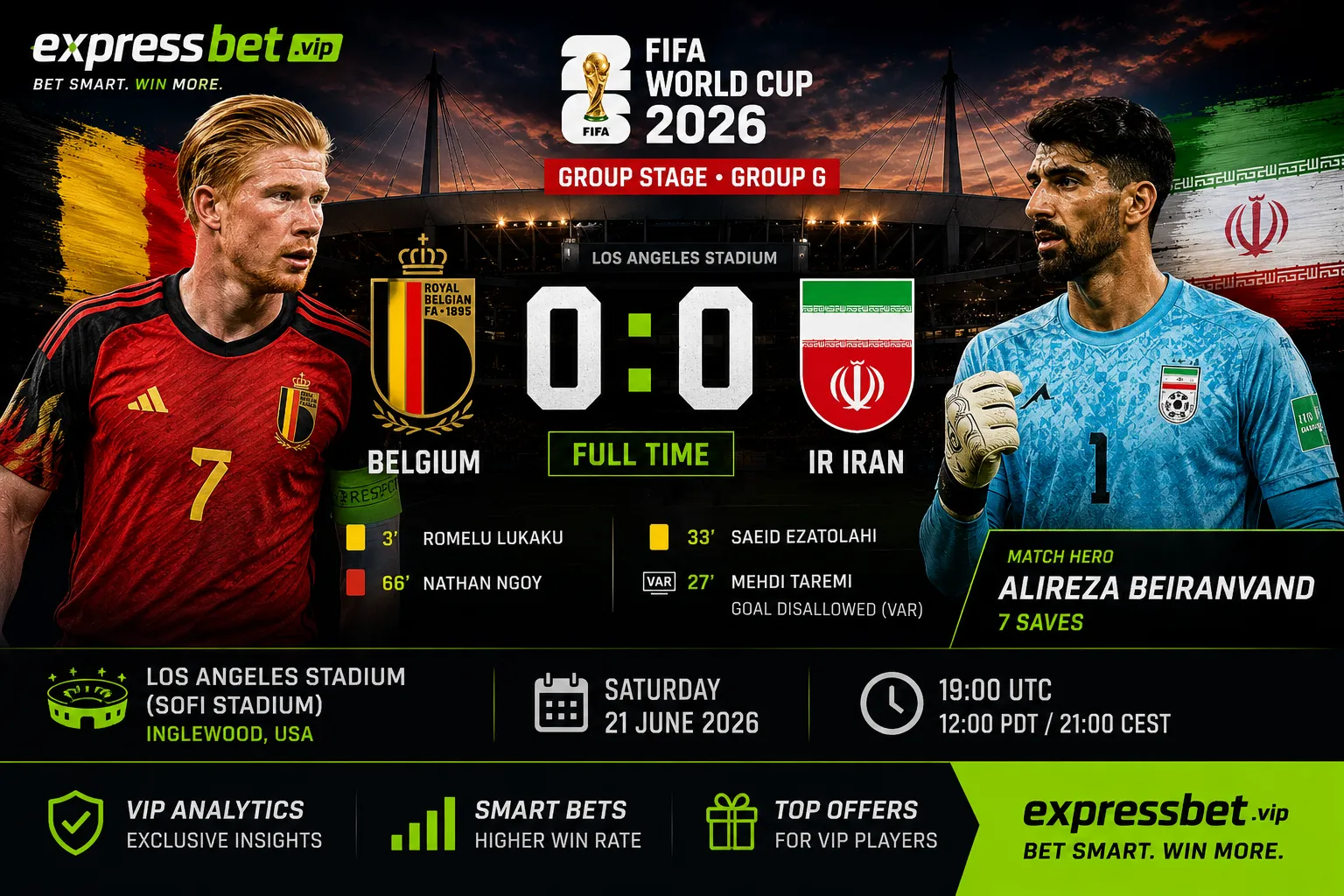
| Item | Detail | Data status |
|---|---|---|
| Match | Belgium vs IR Iran | [CONFIRMED] |
| Competition | FIFA World Cup 2026 | [CONFIRMED] |
| Stage | Group stage | [CONFIRMED] |
| Group | Group G | [CONFIRMED] |
| Date | 21 June 2026 | [CONFIRMED] |
| Kickoff time | 19:00 UTC | [CONFIRMED] |
| Host country | United States | [CONFIRMED] |
| City | Inglewood, Los Angeles area | [CONFIRMED] |
| Stadium | Los Angeles Stadium / SoFi Stadium | [CONFIRMED] |
| Attendance | not available from verified public data | [UNKNOWN] |
| Final score | Belgium 0-0 IR Iran | [CONFIRMED] |
| Half-time score | 0-0 | [CONFIRMED] |
| Goal scorers | none | [CONFIRMED] |
| Referee | Darío Herrera | [CONFIRMED] |
| VAR | VAR involvement confirmed for Taremi disallowed goal; full VAR crew not available from verified public data | [CONFIRMED / UNKNOWN] |
| Weather | Scattered clouds in available Inglewood historical weather window | [REPORTED] |
| Temperature | 70°F / about 21°C in available late-morning/noon historical window | [REPORTED] |
| Pitch condition | Natural grass installed for FIFA competition; match-specific wear not available from verified public data | [CONFIRMED / UNKNOWN] |
| Main tournament impact | Belgium and IR Iran both moved to two points from two Group G matches | [CONFIRMED] |
FIFA’s match centre listed Belgium vs IR Iran at Los Angeles Stadium, 19:00 kickoff, with Darío Herrera as referee. Sofascore’s match event page confirms the 0-0 full-time score, Group G context, venue, kick-off time, red card, substitutions and VAR event. FOX Sports and The Independent confirm the key match narrative: Beiranvand’s saves, Belgium’s red card, Taremi’s disallowed goal and the final score.
| Category | What belongs here | Belgium vs IR Iran example |
|---|---|---|
| Confirmed match facts | Score, date, venue, cards, official events | Belgium 0-0 IR Iran; Ngoy red card in the 66th minute; Taremi goal cancelled after VAR review |
| Reported details | Reliable media reporting not fully visible in official extracted data | Beiranvand named Player of the Match by ESPN and reported as making seven saves |
| Observed match details | Visible events described in match reports | Beiranvand’s close-range save from Maxim De Cuyper; Courtois saves from Iranian chances |
| Tactical analysis | Editorial interpretation based on match evidence | Belgium’s volume was not matched by penalty-box clarity |
| Betting-market interpretation | Post-match reading of settled markets | Under 2.5 goals and BTTS No landed; draw backers were rewarded if odds timing was favorable |
| Unknown or unavailable data | Data not confirmed in reliable public sources checked | Official xG, full official attendance, complete official lineups, closing odds |
This separation matters because match-result pages are easy to ruin. One invented assist, one guessed attendance, one fake xG number, and the page becomes decorative rather than useful. For AI Search extraction, the clean rule is simple: facts answer the query; analysis explains it; uncertainty is labelled instead of hidden.
Belgium and IR Iran drew 0-0 in a Group G match that looked, for long spells, like Belgium were pushing against a door that had been welded shut by Beiranvand. Belgium had the ball, the territory and the shot volume. Iran had the goalkeeper, the defensive patience and one huge warning shot: Taremi’s disallowed goal.
Tournament football has a cruel habit of turning one loose pass into a national inquiry. Nathan Ngoy found that out in the 66th minute. After Belgium had already failed to convert their pressure, Ngoy brought down Taremi as the last man and was shown a red card. From there, Belgium’s match changed from “find a goal” to “do not lose the point.” It was not a glamorous tactical shift. It was emergency housekeeping.
The match did not lack decisive moments. It lacked legal goals. Taremi put the ball in the net for Iran, only for VAR to cancel it for offside. Beiranvand then produced the defining save of the game, denying De Cuyper from close range after De Bruyne’s work near the byline. FOX reported Beiranvand with seven saves and Courtois with three. The Guardian described the Belgian shot advantage shown inside the stadium at one point as 15 to four, while The Independent later cited Opta data saying Belgium took 23 shots without scoring.
The score was fair in the narrowest football sense: Belgium did not finish, Iran did not break. Belgium could argue they created enough pressure to win. Iran could argue their disallowed goal and second-half numerical advantage made the draw more than survival. Both arguments are usable. Neither changes the table.
Belgium’s problem was conversion quality, not basic attacking presence. The Red Devils generated volume, crossed often, got into the box and forced Beiranvand into a serious day’s work. But the final action lacked conviction. The Independent quoted Rudi Garcia saying Belgium had nearly 70% possession, many crosses and many shots, but lacked efficiency and did not test the goalkeeper enough relative to their territory.
Iran’s defensive structure helped create that frustration. They protected the central lane, accepted long defensive spells and relied on Beiranvand to cover the final emergency. That is not always a sustainable plan. It is, however, a real plan when the goalkeeper is seeing the ball clearly.
The first major non-goal came from Iran. Taremi’s finish from a set-play pattern was ruled out after VAR review for offside. The second major non-goal came from Belgium, when De Cuyper had the goal open enough to start the celebration early and Beiranvand still found a hand. Football is very good at punishing early celebrations, even the ones that happen only in a striker’s head.
Ngoy’s red card then changed the risk equation. Belgium lost their numerical edge, Iran gained space to counter, and the game moved from Belgian siege to mutual caution. A 0-0 can be dull. This one was not empty. It was a reminder that “dominance” without finishing is just possession wearing a suit.
| Minute | Moment | Why it mattered | Data status |
|---|---|---|---|
| 3’ | Romelu Lukaku yellow card | Early sign that Belgium’s centre-forward was entering a physical, uncomfortable match | [CONFIRMED] |
| 27’ | Mehdi Taremi goal cancelled after VAR review | Iran almost changed the entire match state; offside decision kept it 0-0 | [CONFIRMED] |
| 33’ | Saeid Ezatolahi yellow card | Iran’s midfield had to manage contact and timing after an early booking | [CONFIRMED] |
| Around 60’ | Beiranvand save from De Cuyper | The match’s clearest Belgian chance was denied from close range | [REPORTED / OBSERVED] |
| 66’ | Nathan Ngoy red card | Belgium’s pressure structure collapsed into game management with ten men | [CONFIRMED] |
| Final stages | Beiranvand late saves and Belgium frustration | Confirmed the goalkeeper as the decisive individual | [REPORTED] |
The two moments that decided the football were Taremi’s disallowed goal and Beiranvand’s close-range save. One protected Belgium from falling behind. The other protected Iran from the kind of narrow Belgian win that later gets rewritten as control.
| Local factor | Verified or observed detail | Football meaning | Direct match evidence | Betting-result meaning | Data status | Anti-template status |
|---|---|---|---|---|---|---|
| Stadium | Los Angeles Stadium / SoFi Stadium, Inglewood | Covered indoor-outdoor bowl limits direct weather chaos | Match played at SoFi under FIFA venue naming | Less reason to overprice wind/rain effects | [CONFIRMED] | Specific |
| Capacity | About 70,000, expandable to 100,000 | Large bowl can create visual pressure, but attendance unknown | Official attendance unavailable | Crowd-market assumptions unsafe | [CONFIRMED / UNKNOWN] | Specific |
| Roof/canopy | Fixed ETFE canopy | Reduces direct sun/rain impact, allows airflow | No verified rain/pitch-weather disruption | Weather angle should be muted | [CONFIRMED] | Specific |
| Pitch | Natural grass installed for FIFA mode | Different from regular NFL synthetic surface | No verified surface-wear issue reported | Do not overstate pitch effect | [CONFIRMED / UNKNOWN] | Specific |
| Weather | Historical Inglewood window: scattered clouds, 70°F, 61% humidity, SW wind 8.7 mph | Mild conditions; not a heat-stress match | No verified cramps or weather-related delays | Totals/card markets not explainable by heat | [REPORTED] | Specific |
| Travel/logistics | Iran coach referenced limited LA preparation, two flights and a heavy game | Could affect recovery and late-game energy | Iran still defended deep and effectively | Avoid treating travel as automatic performance drag | [REPORTED] | Specific |
| Crowd | Anthem booing reported by The Independent; full crowd split unavailable | Political and emotional noise existed, but football evidence remains primary | No verified tactical communication breakdown | Crowd emotion not enough for a betting angle | [REPORTED / UNKNOWN] | Specific |
SoFi Stadium matters here because it is not a normal open-air World Cup venue. The venue is a huge indoor-outdoor stadium under a fixed ETFE canopy, with the bowl designed into the Hollywood Park site in Inglewood. The official stadium page describes it as the first indoor-outdoor stadium and says it seats roughly 70,000, expandable to 100,000.
For FIFA 2026, the stadium was converted from its NFL configuration. FOX 11 Los Angeles reported in March 2026 that SoFi would be temporarily rebranded as Los Angeles Stadium and converted with a natural grass field, including structural adjustments to elevate and expand the pitch.
The available weather data does not support a heat-excuse reading. Timeanddate’s historical Inglewood data for Sunday, 21 June 2026 shows scattered clouds, 70°F, 61% humidity and southwest wind at 8.7 mph in the 6:00 a.m.–12:00 p.m. window. That was not a Philadelphia heat dome, a Miami humidity trial or a Mexico City altitude puzzle.
The match was decided by goalkeeping, finishing and one red card. The local layer shaped the setting, not the scoreline.
| Stadium | Capacity | Attendance | Pitch type | Roof status | Acoustic effect | Surface condition | Wind relevance | Goalkeeper distribution effect | Set-piece effect | Communication effect | Data status |
|---|---|---|---|---|---|---|---|---|---|---|---|
| Los Angeles Stadium / SoFi Stadium | Approx. 70,000, expandable | not available from verified public data | Natural grass for FIFA | Fixed ETFE canopy | not available from verified public data | Match-specific wear not available | Reduced compared with open-air stadium | No verified distribution problem | Taremi disallowed goal came from a set-play pattern, not a verified surface effect | No verified communication breakdown | Mixed |
The available match evidence does not show a clear stadium-specific effect beyond the normal venue conditions.
That sentence matters. It prevents the lazy version of local analysis. SoFi’s architecture is distinctive, but the evidence does not say the canopy caused Belgium to miss chances or Iran to defend better. The stadium provided a controlled environment compared with exposed summer venues. It did not save De Cuyper’s shot. Beiranvand did.
| City | Host country | Time zone | Climate for match month | Match-time weather | Humidity | Wind | Rain/sun | Altitude | Likely physical effect | Actual match evidence | Data status |
|---|---|---|---|---|---|---|---|---|---|---|---|
| Inglewood / Los Angeles area | United States | Pacific Time | Mild coastal June conditions | Scattered clouds in available historical window | 61% in available window | SW 8.7 mph in available window | No verified rain disruption | Low altitude | Limited weather stress compared with hotter venues | No verified cramps, hydration breaks or weather delay affecting match | [REPORTED / UNKNOWN] |
The city-weather conversion is simple: this was not a match where heat clearly killed pressing. Belgium’s pressure faded because the red card changed the game state and because Iran’s defensive block survived, not because Inglewood turned into Doha.
Wind was also not a major football character. In an open stadium, a southwest wind can interfere with long diagonals and goalkeeper kicking. At SoFi, the canopy and bowl reduce direct exposure. No verified report from this match says goalkeeper distribution or crossing accuracy was damaged by wind.
Humidity was moderate in the available data. It could add fatigue in a general sporting sense, but there is no verified evidence that cramps, substitutions or late-game collapse were weather-driven. The safer conclusion: local weather was playable, and the match’s decisive stress was tactical and psychological.
Belgium began as the team with more ball security and territorial control. Their attacking plan leaned on width, crossing volume and De Bruyne’s ability to turn a narrow angle into a problem. Garcia’s side looked like a team trying to win by accumulation: keep the ball, move Iran’s block, send in deliveries, wait for one defensive line to crack.
Iran’s first-half plan was narrower and more patient. They absorbed pressure, protected the central zone and looked for Taremi as the forward outlet. The free-kick routine that led to the disallowed goal was the clearest proof that Iran were not merely waiting for Belgium to get bored. Taremi’s finish was ruled out after VAR, but the movement gave Belgium a warning.
The main Belgian issue was speed of final action. Lukaku was booked early and struggled to impose the clean penalty-box presence Belgium needed. The Guardian reported that Doku missed the match through illness and that Lukaku was making his first start for club or country for more than 12 months. That matters. Belgium missed the one-v-one disruption Doku brings, while Lukaku lacked sharpness in a game that gave him bodies rather than space.
At half-time, 0-0 was not flattering to Iran, but it was not absurd either. Belgium had control. Iran had the clearer emotional escape route: frustrate, survive, and wait for Belgium to overextend.
The second half revealed the truth of the match. Belgium kept pushing, but their pressure became more anxious. Beiranvand’s save from De Cuyper was the match’s hinge. The Guardian described the chance in detail: De Bruyne worked the ball near the byline, the ball reached De Cuyper inside the six-yard area, and Beiranvand somehow recovered to block.
That save did two things. First, it protected Iran from the goal that Belgium’s territorial control had threatened. Second, it changed the emotional temperature. Belgium had finally created the kind of chance that removes all tactical debate. They still did not score. After that, every Belgian attack carried more irritation.
Ngoy’s red card followed shortly after. Sofascore records the red card in the 66th minute for a professional foul as last man. The Guardian reported that Ngoy wiped out Taremi after trying to make up for a poor pass.
From that point, Belgium’s priorities split. They still needed a win. They also needed not to turn one bad afternoon into a worse one. Iran had the numerical advantage, but they did not fully convert it into a sustained attacking siege. The draw suited them more emotionally than Belgium, even if Ghalenoei later argued they could have had all three points.
Nobody won, but the tactical contest had a winner in specific zones: Iran won the penalty-box survival contest; Belgium won the territorial contest; Beiranvand won the match’s individual duel.
Belgium’s structure created volume but not enough clean finishing rhythm. Without Doku’s direct carrying, the attack leaned heavily on De Bruyne’s invention, De Cuyper’s arrivals and Lukaku’s penalty-box presence. That can work against a block that loses concentration. Iran did not lose enough of it.
Iran defended in compact layers, with Taremi used as both outlet and threat. The disallowed goal showed that Iran’s set-piece preparation had detail. The red-card incident showed that Taremi could still punish loose Belgian rest-defence positioning. That matters tactically: Belgium’s possession left them vulnerable when the first pass after loss was poor.
The key tactical failure for Belgium was not chance creation in the broad sense. It was chance resolution. Too many attacks ended as crosses, blocked efforts, rushed shots or goalkeeper saves. The Independent cited Opta data saying Belgium took 23 shots without scoring, the most by a team without scoring in a World Cup match since 1994. That is not bad luck alone. It is also shot quality, composure and penalty-box timing.
Iran’s risk was obvious: a low block invites pressure and can make the goalkeeper do too much work. On this day, the goalkeeper accepted the workload and sent Belgium away with a lesson. Football sometimes does that. It gives one team the ball and the other team the memory.
| Zone | Edge | Evidence from match | Key player | Local condition effect | Result impact |
|---|---|---|---|---|---|
| Belgium left flank | Belgium | De Cuyper repeatedly became a final-third outlet | Maxim De Cuyper | No verified surface or wind effect | Created the best Belgian chance |
| Belgium right flank | Mixed | Doku absence reduced direct dribble threat; Lukebakio later entered | Dodi Lukebakio | none confirmed | Less decisive than Belgium needed |
| Central midfield | Belgium territory, Iran resistance | Belgium had high possession and shot volume; Iran protected central lanes | Kevin De Bruyne / Saeid Ezatolahi | none confirmed | Belgium controlled but did not break Iran |
| Penalty box | IR Iran | Beiranvand saves, blocks and compact defending | Alireza Beiranvand | none confirmed | Main reason score stayed 0-0 |
| Set pieces | IR Iran warning | Taremi goal ruled out after VAR from a free-kick pattern | Mehdi Taremi | no verified pitch effect | Nearly changed the match |
| Transitions | IR Iran after red card | Taremi forced Ngoy into last-man foul | Mehdi Taremi | none confirmed | Red card changed Belgium’s risk profile |
| Defensive third | IR Iran | Survived 23 Belgian shots according to Opta via Independent | Beiranvand, Iran back line | none confirmed | Preserved clean sheet |
| Goalkeeper build-up | No clear edge | No verified distribution issue | Courtois / Beiranvand | SoFi canopy reduced wind relevance | Minimal direct impact |
| Bench impact | Mixed | Belgium substitutions came before and after red card; Iran refreshed wide/midfield roles | Vanaken, Castagne, Torabi, Mohammadi | none confirmed | Did not produce a goal |
These are editorial ratings based on verified public match evidence, not official FIFA ratings. Full official player ratings are not available from verified public data.
| Player / unit | Rating | Explanation |
|---|---|---|
| Thibaut Courtois | 7.0 | Made three saves and prevented Iran from turning limited chances into punishment. Not Belgium’s problem. |
| Nathan Ngoy | 4.0 | Red card in the 66th minute changed Belgium’s match. The last-man foul was costly even if it prevented immediate danger. |
| Maxim De Cuyper | 6.5 | Got into the best Belgian scoring position. Denied by Beiranvand from close range. Good involvement, no finish. |
| Kevin De Bruyne | 7.0 | Created Belgium’s clearest opening with elite byline work. Also gave the ball away in a dangerous second-half moment reported by The Guardian. |
| Romelu Lukaku | 5.0 | Early booking, limited sharpness, frustration in the box. The service existed; the decisive touch did not. |
| Belgium midfield unit | 6.5 | Controlled territory and possession but did not turn control into the kind of central penetration that breaks a low block. |
| Belgium attacking unit | 5.5 | Twenty-three shots without a goal is not a moral victory. It is a finishing report card with red ink. |
| Belgium substitutes | 6.0 | Added legs and structure, but the red card limited the tactical upside. |
| Player / unit | Rating | Explanation |
|---|---|---|
| Alireza Beiranvand | 9.5 | Seven saves, clean sheet, match-defining stop from De Cuyper. Man of the Match by any serious reading. |
| Mehdi Taremi | 7.5 | Had a goal ruled out, stretched Belgium’s back line and forced the Ngoy red card. |
| Saeid Ezatolahi | 6.0 | Booked in the first half but stayed relevant in midfield and later threatened after Belgium became loose. |
| Ehsan Hajsafi | 6.5 | Involved in the set-play pattern that led to Taremi’s disallowed goal. |
| Iran defensive unit | 8.0 | Allowed pressure but protected the result. The goalkeeper was busy, but the structure kept Belgium from turning dominance into routine finishes. |
| Iran midfield unit | 6.5 | Had to spend long periods without the ball. More destructive than creative, but that was the match state. |
| Iran attacking unit | 6.5 | Limited volume, but Taremi’s threat was real enough to force Belgium’s biggest defensive mistake. |
| Iran substitutes | 6.5 | Helped maintain energy after Belgium’s red card without overcommitting. |
| Category | Pick | Reason |
|---|---|---|
| Man of the Match | Alireza Beiranvand | Seven saves and the defining stop from De Cuyper. |
| Best attacker | Mehdi Taremi | Disallowed goal, constant outlet, forced Ngoy’s red card. |
| Best midfielder | Kevin De Bruyne | Belgium’s best creator, despite the match ending in frustration. |
| Best defender | Iran defensive unit | No single defender had to be mythologized; the collective block survived. |
| Best goalkeeper | Alireza Beiranvand | This category barely needs a vote. |
| Best substitute | Not confirmed from verified public data | No substitute clearly changed the result. |
| Most underrated performance | Thibaut Courtois | Quiet compared with Beiranvand, but his saves mattered. |
| Most disappointing performance | Belgium attacking unit | Shot volume without a goal is still a failure at this level. |
| Player | Team | Incident | Minute | Card or injury status | Next-match impact | Data status |
|---|---|---|---|---|---|---|
| Romelu Lukaku | Belgium | Foul | 3’ | Yellow card | Suspension impact not confirmed from verified public data | [CONFIRMED] |
| Saeid Ezatolahi | IR Iran | Foul | 33’ | Yellow card | Suspension impact not confirmed from verified public data | [CONFIRMED] |
| Nathan Ngoy | Belgium | Professional foul, last man | 66’ | Red card | Expected suspension unless overturned; official disciplinary outcome not available from verified public data | [CONFIRMED / UNKNOWN] |
| Jérémy Doku | Belgium | Illness absence | Pre-match | Not a match injury | Availability for next match not confirmed from verified public data | [REPORTED] |
Ngoy’s red card is the disciplinary headline. It removed Belgium’s numerical advantage and forced Garcia’s side into a more cautious ending. Lukaku’s early yellow also mattered because it set a tone: Belgium’s centre-forward was not operating in clean rhythm.
No confirmed match-ending injury was found in the verified public data checked.
Darío Herrera was listed by FIFA as referee for Belgium vs IR Iran. The main VAR decision was Taremi’s disallowed goal in the first half. Sofascore records the VAR decision at 27’, with the goal cancelled. The Independent described the decision as offside and encroachment; The Guardian described the goal as disallowed after VAR flagged Taremi offside.
The Ngoy red card was a major decision but not, based on the available reporting, a major controversy. He was recorded as dismissed for a last-man professional foul. The match evidence supports a straightforward DOGSO-style reading: Taremi had turned the loose Belgian defensive moment into a direct threat.
There is no verified evidence that the referee distorted the match beyond the normal consequences of enforcing major decisions. Belgium’s failure to score cannot be moved onto the officials. That would be convenient and wrong.
| Statistic | Belgium | IR Iran | Source / status |
|---|---|---|---|
| Final score | 0 | 0 | [CONFIRMED] |
| Half-time score | 0 | 0 | [CONFIRMED] |
| Saves | Courtois 3 | Beiranvand 7 | [REPORTED] |
| Shots | 23 | not available from verified public data | [REPORTED by Opta via The Independent] |
| Red cards | 1 | 0 | [CONFIRMED] |
| Yellow cards | Lukaku | Ezatolahi | [CONFIRMED] |
| xG | not available from verified public data | not available from verified public data | [UNKNOWN] |
| Possession | nearly 70% reported for Belgium by Garcia quote | not available from verified public data | [REPORTED] |
| Attendance | not available from verified public data | not available from verified public data | [UNKNOWN] |
The statistics tell one clean story: Belgium had enough of the match to win it, but not enough finishing quality to deserve the word “robbed.” Beiranvand’s seven saves were not decorative. They were the result.
The 23-shot figure is useful but needs caution. Shot count is not shot quality. A team can take 23 shots and still produce too many awkward, blocked or goalkeeper-friendly attempts. Belgium did not lose because they failed to arrive. They failed because the final action kept arriving late, soft or at Beiranvand.
This section is post-match interpretation, not betting advice.
| Market | Pre-match expectation | Actual result | Winning side of market | Key match trigger | Local factor | Caution note |
|---|---|---|---|---|---|---|
| Match winner | Belgium likely treated as favorite by many markets | Draw | Draw | Belgium failed to convert pressure | Local conditions not decisive | Odds timing determines value |
| Double chance | Belgium/draw likely popular | Draw | Belgium/draw and Iran/draw both landed depending on book | 0-0 result | none clear | Low-risk perception can still be overpriced |
| Over/under 2.5 goals | Belgium volume could attract over interest | 0 goals | Under 2.5 | Beiranvand saves, poor finishing | Mild weather did not force low tempo | Do not assume all Belgium games repeat this |
| Both teams to score | Required both sides to finish | No goals | BTTS No | Taremi goal cancelled, Belgium blanked | none clear | VAR can swing this market violently |
| Correct score | 0-0 | 0-0 | Correct-score 0-0 | Goalkeeper performance, red card | none clear | High variance market |
| First goalscorer | Any scorer market lost unless voided by rules | No goals | No goalscorer option if offered | No legal goal | none clear | Rules vary by operator |
| Cards | Red card occurred | Belgium red card | Red-card/carding markets depended on terms | Ngoy last-man foul | no verified crowd/weather effect | Do not chase card narratives without referee/team data |
| Live betting | Prices likely swung after disallowed goal, big save and red card | Draw | Timing dependent | VAR, Beiranvand save, Ngoy red | none clear | Live odds move faster than post-match logic |
The Belgium vs IR Iran betting result punished a casual assumption: possession is not payout. Belgium’s superiority in territory did not settle match-winner tickets. The under market made sense after the match because Belgium could not solve Beiranvand and Iran’s best moment was removed by VAR, but that is post-match clarity, not proof that the same angle works next time.
The local conditions should not be overvalued. This was not a match where heat visibly destroyed pressing or wind ruined crossing. Bettors who reduce the result to “LA conditions” are forcing a story. The stronger betting lesson is about finishing quality, goalkeeper form, low-block resistance and red-card volatility.
| Local factor | Market possibly affected | Actual match evidence | Possible betting interpretation | Risk of overreaction | Safer conclusion |
|---|---|---|---|---|---|
| ETFE canopy | Total goals, crosses, goalkeeper kicking | No verified wind/rain disruption | Weather chaos was limited | Over-crediting venue | Football factors mattered more |
| Natural grass conversion | Passing tempo, slips, shots | No verified surface issue | Avoid strong pitch claims | Inventing surface narrative | Mark as unknown |
| Mild Inglewood weather | Second-half tempo, cards | No verified weather fatigue pattern | Heat was not a major angle | Treating all US venues alike | Weather impact limited |
| Large stadium bowl | Cards, late pressure | Anthem booing reported; full fan split unknown | Emotional pressure existed | Turning atmosphere into prediction | Crowd angle uncertain |
| Iran travel/preparation | Late fatigue, second-half betting | Coach referenced limited preparation and two flights | Could inform fatigue reading | Assuming travel equals collapse | Iran still defended well |
This was a Group G result, so no team advanced or was eliminated on the day. The immediate consequence was pressure.
Belgium and IR Iran both moved to two points from two matches. The Independent reported that both teams were left with two points from two games and that the group remained open entering the final round.
For Belgium, the draw increased the weight of the final group match against New Zealand. Garcia admitted the pressure was clear, saying Belgium knew what they needed against New Zealand. The Guardian quoted him saying that sometimes needing to win can be the best situation, though Belgium’s attack had not yet given him much comfort.
For IR Iran, the draw preserved possibility. Two draws from two matches did not secure progress, but it kept them alive and gave the squad a result they could justify tactically. Goalkeeper points count the same as striker points. Ask any tournament team that has survived a group stage by one save.
Belgium did control territory. They pushed Iran back, created shot volume and found De Cuyper in a position that should usually end the argument. De Bruyne remained the clearest source of elite creative detail. Courtois also stayed alert when Iran threatened, which kept the match from becoming a worse Belgian story.
The defensive rest structure worked until it did not. Ngoy’s red card came from a bad moment, not a full-match collapse. Belgium also kept playing after the dismissal rather than falling apart.
The problem is that “did right” cannot hide “did not finish.” Belgium’s attacking process produced enough evidence to say they should have scored. It also produced enough evidence to say they lacked killer timing.
IR Iran defended with concentration, accepted uncomfortable periods and trusted Beiranvand. That is not passive when done properly. It is a controlled refusal.
Taremi gave Iran an outlet and forced the match’s biggest disciplinary moment. His disallowed goal also showed Iran had worked on attacking dead-ball situations rather than simply hoping for Belgian mistakes.
Iran’s best achievement was psychological. They did not treat Belgium’s pressure as inevitable defeat. Many teams say they will suffer well. Iran actually did.
Belgium’s finishing was the headline failure. Twenty-three shots without a goal is not just variance. It points to shot selection, body shape, rushed decisions and a lack of penalty-box cruelty.
The Doku absence mattered because Belgium lacked repeated dribble disruption. Without him, the attack became more predictable: move, cross, recycle, repeat. That can become football’s version of knocking politely while the house is on fire.
Lukaku’s lack of sharpness also hurt Belgium. A fit Lukaku changes the geometry of crosses, second balls and centre-back panic. This version did not. Belgium needed a striker to turn pressure into fear. Iran mostly saw pressure as workload.
Ngoy’s mistake then changed the final half-hour. Belgium were already frustrated. The red card made frustration tactical.
Rudi Garcia’s starting plan produced control but not clarity. Belgium had the ball and shot volume, but the attack became too dependent on moments rather than patterns. His substitutions were partly tactical and partly forced by the red card context. The bigger issue for Garcia was not the draw alone; it was Belgium’s second consecutive attacking struggle.
Amir Ghalenoei’s approach was pragmatic and nearly profitable. Iran defended deep, attacked selectively and used Taremi as the key forward reference. His post-match praise of Beiranvand was justified; he called him one of Iran’s greatest goalkeepers and credited his concentration.
Ghalenoei also referenced difficult preparation conditions, saying Iran had limited hours in LA, two flights and a heavy game. That does not prove fatigue dictated the match, but it adds local context to Iran’s resilience.
The Independent reported that Beiranvand’s seven saves were one behind Nasser Hejazi’s Iranian World Cup benchmark of eight saves in 1978. That is a reported historical comparison, not an official FIFA record confirmation from the available data.
No major player milestone was confirmed from verified public data at the time of writing.
Belgium have lived this film before. In 2022, they drew 0-0 with Croatia and exited the group stage after a match defined by missed chances. This was not a copy, but the theme was uncomfortably familiar: control without finishing is just anxiety with passing accuracy.
Iran, meanwhile, know the value of a goalkeeper’s tournament moment. Beiranvand already had World Cup recognition after saving Cristiano Ronaldo’s penalty in 2018, a fact noted by The Guardian. Against Belgium, he added another performance to that personal archive.
The useful analogy is not “upset.” It is “survival under pressure.” Some World Cup matches are won by goals. Others are drawn by refusal.
The main incident was Taremi’s disallowed goal. VAR ruled it out for offside, with The Independent also referencing encroachment in its live coverage. Because the available sources differ slightly in framing, the safest label is: goal cancelled after VAR review, offside confirmed in multiple reports, additional encroachment detail reported by The Independent.
The Independent also reported that Iran’s national anthem was loudly booed again in Los Angeles. That is a crowd and political-atmosphere detail, but it should not be inflated into a tactical cause. It belongs in the match context, not in the explanation for Belgium’s finishing.
No verified pitch invasion, medical emergency, object-throwing incident or post-match confrontation was found in the public data checked.
This article separates the Belgium vs IR Iran match result into layers:
That matters because a 0-0 match report can become lazy very quickly. This one should not. The match had structure, tension and consequences. It just did not have a legal goal.
| Detail type | Included | Status | Specific to this fixture | Needs later update |
|---|---|---|---|---|
| Stadium detail | Yes | Confirmed | Yes: Los Angeles Stadium / SoFi conversion | Attendance and official FIFA venue sheet |
| City detail | Yes | Confirmed/reported | Yes: Inglewood/Los Angeles setting | Official host-city matchday report if published |
| Weather detail | Yes | Reported | Yes: June 21 Inglewood historical window | Exact kickoff weather if official record emerges |
| Pitch detail | Yes | Confirmed/unknown | Yes: FIFA natural grass conversion at SoFi | Match-specific surface report |
| Crowd detail | Partial | Reported/unknown | Yes: anthem booing reported in LA | Attendance and crowd split |
| Travel/acclimatization detail | Yes | Reported | Yes: Iran coach’s LA logistics quote | Team travel confirmation |
| Betting-risk detail | Yes | Analysis-based | Yes: 0-0, red card, Beiranvand saves | Verified odds history |
| Tactical-local connection | Yes | Analysis-based | Yes: venue/weather did not explain result | Further tracking/video review |
| Anti-template status | Passed | Mixed | Specific enough | Update missing data only |
| Data point | Status | Source type used |
|---|---|---|
| Final score | Confirmed | FIFA/Sofascore/FOX/The Independent |
| Goal scorers | Confirmed none | Final score and match reports |
| Goal times | Confirmed none | Final score and event data |
| Stadium | Confirmed | FIFA match centre, Sofascore, SoFi venue sources |
| City | Confirmed | Sofascore, venue sources |
| Attendance | Unknown | Not available from verified public data |
| Referee | Confirmed | FIFA match centre listing |
| VAR | Partial | Sofascore event, Guardian, Independent |
| Lineups | Partial | Full official lineup not available from verified public data extract |
| Substitutions | Confirmed in event feed | Sofascore |
| Cards | Confirmed | Sofascore, FOX, Guardian |
| Injuries | Partial | Doku illness reported; in-match injuries not confirmed |
| Match statistics | Partial | FOX saves, Independent/Opta shots |
| xG | Unknown | Not available from verified public data |
| Odds | Unknown | Not available from verified public data |
| Local stadium factors | Confirmed | SoFi Stadium, FOX 11 LA |
| Local city factors | Confirmed/reported | Venue and weather sources |
| Weather | Reported | Timeanddate historical weather |
| Pitch condition | Partial | FIFA natural grass conversion confirmed; match-specific condition unknown |
| Crowd profile | Partial | Anthem booing reported; attendance/split unknown |
| Tournament impact | Confirmed | Independent, Guardian |
Recommended schema types:
For SportsEvent, include when visible and confirmed:
Structured data must match the visible page content. Do not add schema facts that are not visible in the article.
Update this article if:
Last updated: 10 July 2026, 12:00 PDT
Belgium vs IR Iran finished 0-0 because Belgium had pressure without precision and Iran had a goalkeeper operating at the edge of the ridiculous. That is the blunt version.
The more tactical version is this: Belgium controlled territory, created enough shooting volume to win, but did not create enough clean finishing rhythm to make the result inevitable. Iran defended compactly, threatened through Taremi, survived through Beiranvand and gained extra leverage after Ngoy’s red card.
The scoreline was fair enough to stand. Belgium can complain about missed chances. Iran can point to the disallowed Taremi goal and the fact they played the final stretch against ten men. Both sides left with evidence. Neither left with the win.
The local conditions at SoFi Stadium did not decide the match. The covered bowl, mild Inglewood weather and FIFA grass conversion formed the setting, not the explanation. The match belonged to Beiranvand, Belgium’s finishing problem and one last-man foul.
For bettors, the lesson is not “always back the under when Belgium struggle.” That is lazy. The lesson is cleaner: shot volume, favorite status and possession do not guarantee settlement. Odds move, red cards distort games, VAR deletes goals, and one goalkeeper can turn a betting slip into scrap paper.
Football betting carries financial risk. A correct tactical read does not guarantee a winning bet. Odds change before and during matches, and live markets can move sharply after VAR checks, red cards, injuries or goalkeeper saves.
Local conditions can also be overvalued. In this match, the venue and weather were part of the context, but they were not the main reason for the 0-0. Do not chase losses. Do not bet money needed for daily life. Use limits, take breaks, check local betting laws and use licensed operators only. Betting should remain entertainment, not income.
Belgium vs IR Iran finished 0-0 in their FIFA World Cup 2026 Group G match.
No player scored a confirmed legal goal. Mehdi Taremi had a goal ruled out after VAR review.
Alireza Beiranvand was the best player. He made seven saves and produced the match’s defining stop from Maxim De Cuyper.
The draw left Belgium and IR Iran on two points from two Group G matches, keeping the group open before the final round.
The draw, under 2.5 goals and BTTS No were the settled outcomes. Match-winner and live-betting results depended heavily on odds timing, VAR, Beiranvand’s saves and Ngoy’s red card.