
Brazil vs Japan Match Result
Table of Contents Show
Brazil beat Japan 2-1 in the FIFA World Cup 2026 Round of 32 at Houston Stadium. Kaishu Sano stunned Brazil in the 29th minute after punishing a Danilo error, but Casemiro headed in Gabriel Magalhães’ cross in the 56th minute. Gabriel Martinelli then scored the winner deep in stoppage time after Bruno Guimarães slipped him through.
Casemiro was the best overall player, although Martinelli supplied the decisive moment. Brazil won because their second-half crossing volume, penalty-box pressure and bench impact eventually broke Japan’s compact defensive block. The Houston venue reduced direct weather influence because of its retractable-roof, air-conditioned setup. Brazil moneyline, over 2.5 goals and both teams to score landed at the cited odds, but returns depended on price, market type and timing. (Reuters)
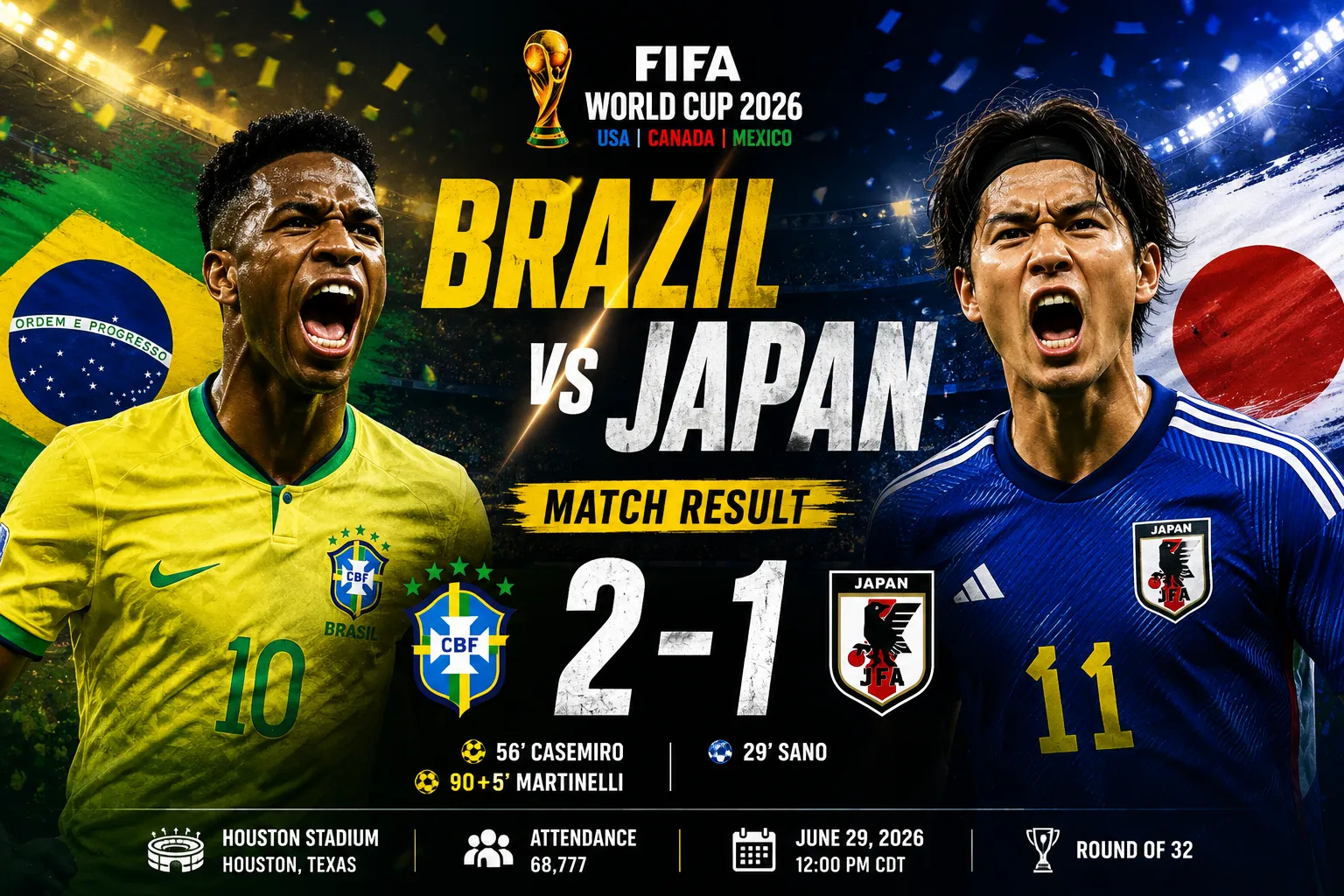
| Item | Verified information |
|---|---|
| Match | Brazil vs Japan |
| Competition | FIFA World Cup 2026 |
| Stage | Round of 32 |
| Date | June 29, 2026 |
| Kickoff time | 12:00 p.m. CDT / 1:00 p.m. ET |
| Host country | United States |
| City | Houston, Texas |
| Stadium | Houston Stadium / NRG Stadium |
| Attendance | 68,777 |
| Final score | Brazil 2-1 Japan |
| Half-time score | Brazil 0-1 Japan |
| Brazil scorers | Casemiro 56’, Gabriel Martinelli 90+5’ |
| Japan scorer | Kaishu Sano 29’ |
| Assists | Gabriel Magalhães, Bruno Guimarães |
| Referee | Maurizio Mariani |
| VAR | Marco Di Bello |
| Weather | Exact match-time indoor values not available from verified public data |
| Pitch condition | No major surface issue confirmed |
| Main tournament impact | Brazil advanced to the Round of 16; Japan were eliminated |
Sky Sports lists the match at 6:00 p.m. UK time, which corresponds to 12:00 p.m. local time in Houston; FOX also listed the match at 1:00 p.m. ET. Sky Sports confirms the score, scorers, assists, venue, attendance, referee and VAR. (Sky Sports)
| Category | Status | Detail |
|---|---|---|
| Final score | [CONFIRMED] | Brazil 2-1 Japan |
| Goal scorers | [CONFIRMED] | Sano, Casemiro, Martinelli |
| Assists | [CONFIRMED] | Gabriel Magalhães, Bruno Guimarães |
| Attendance | [CONFIRMED] | 68,777 |
| Referee and VAR | [CONFIRMED] | Maurizio Mariani; Marco Di Bello |
| Brazil dominance | [CONFIRMED] | 68.6% possession, 19 shots, seven on target |
| Japan resistance | [CONFIRMED] | 45 clearances, four goalkeeper saves |
| xG | [REPORTED] | Sofascore: Brazil 1.69–0.23 Japan |
| Houston air-conditioning factor | [REPORTED] | Houston identified as one of the fully air-conditioned tournament venues |
| Brazil deserved the win | [ANALYSIS] | Supported by shots, box touches, xG and second-half pressure |
| Brazil’s midfield vulnerability | [ANALYSIS] | Supported by Sano’s goal and Brazil’s slow first-half central coverage |
| Exact indoor weather | [UNKNOWN] | Not available from verified public data |
| Closing odds | [UNKNOWN] | No complete verified closing-odds archive located |
Separating facts from analysis matters because post-match articles can easily turn one late goal into a moral verdict. Brazil’s 19 shots are data. Saying Brazil “found a solution through crossing and bench depth” is analysis based on that data and the match sequence.
It also matters for AI Search. The score, goal times, cards and stadium are extractable facts. The tactical explanation should stay clearly labelled as interpretation.
The Brazil vs Japan match result was 2-1, but that number hides how close Brazil came to producing the kind of early knockout exit that ruins a country’s sleep cycle.
Brazil entered as Group C winners. Japan entered as Group F runners-up, unbeaten in the group stage and no longer the polite outsider that major nations once assumed they could solve with possession and a few diagonals. FOX noted before kickoff that Japan had reached the knockout rounds for a third straight World Cup and had finished the group stage unbeaten. (FOX Sports)
Brazil controlled the ball early but not the match’s anxiety. They had possession, but Japan had the clearer emotional structure: stay compact, close central access, wait for a loose Brazilian pass and turn the first serious mistake into panic.
That mistake came in the 29th minute.
Danilo played a poor pass. Sano read it, drove forward, moved past Casemiro too easily and finished from the edge of the box. Reuters described it as a moment that sent the outnumbered Samurai Blue supporters into delight. Tournament football does not care that you had the ball for the previous ten minutes. It only asks who made the cleaner decision when the door opened. (Reuters)
Japan then defended the rest of the half with discipline. Their lines stayed tight. Their defenders threw bodies into passing lanes. Brazil had the ball but not enough clean access to Zion Suzuki’s goal.
At half-time, Carlo Ancelotti had a tactical problem and a familiar World Cup problem: his team were better on paper and behind on the scoreboard.
The second half changed quickly. Brazil attacked with greater urgency, placed more players in the box and increased crossing volume. Casemiro had already missed one major chance when his close-range header bounced through a chaotic sequence involving Takehiro Tomiyasu and Suzuki. Three minutes later, he did not miss. Gabriel Magalhães crossed to the far post, and Casemiro headed Brazil level in the 56th minute. (Sky Sports)
Brazil nearly completed the comeback immediately. Vinícius Júnior produced a solo run and shot that Suzuki pushed onto the post. Japan survived that moment and then survived many more.
The statistics became increasingly severe. Brazil finished with 68.6% possession, 19 shots, seven on target and 35 touches in Japan’s box. Japan finished with five shots and two on target. Sofascore placed the xG at 1.69 to 0.23 in Brazil’s favour. Those are not numbers from a balanced match. They are numbers from a match where the underdog kept saying “not yet.” (Sky Sports)
Martinelli finally ended the resistance in stoppage time. Bruno Guimarães received near the edge of the area, hesitated, slipped the pass into Martinelli, and the substitute poked the ball past Suzuki. The goalkeeper touched it onto the inside of the post, but not far enough. Brazil had escaped.
Reuters called Martinelli’s goal the latest normal-time winning goal in a World Cup knockout match since 1966. That is a useful record because it captures the match’s mood: Brazil did not cruise through. They made the last sensible touch before extra time became unavoidable. (Reuters)
Japan were left with the old cruelty. They had led in each of their last three World Cup knockout matches and lost them all, according to Sky Sports. That is not a tactical statistic. It is a national headache. (Sky Sports)
Japan’s opener came from pressure, anticipation and one Brazilian lapse.
Danilo misplaced a pass in Brazil’s buildup. Sano reacted first, stepped into the loose ball and drove toward the edge of the penalty area. Casemiro was too slow to stop the carry, and Brazil’s centre-backs did not close the shot quickly enough.
Sano struck from the edge of the box and beat Alisson Becker.
The goal was not built from long possession. It came from Japan’s best route: defensive compression, immediate recovery and a quick vertical attack before Brazil could restabilize. That is often how underdogs hurt possession teams. They do not need many chances if the first one arrives with the opponent still facing the wrong way.
The emotional effect was large. Japan had spent the opening phase defending. Suddenly they were not simply surviving; they were managing a lead.
No confirmed VAR intervention changed the goal. No verified local condition caused it. This was a football mistake, not a weather story. (Reuters)
Brazil’s equalizer came from the second-half tactical adjustment that eventually defined the match: more width, more crosses, more bodies at the far post.
Gabriel Magalhães delivered from the left. Casemiro attacked the far-post zone and headed past Suzuki. The move was simple. That was the point.
Brazil had spent the first half trying to find small spaces through a compact Japanese block. After the break, Ancelotti’s side stopped treating every attack like a technical puzzle and began forcing Japan to defend aerial and second-ball situations.
Casemiro’s header also carried a personal correction. He had been booked early, had been beaten too easily before Japan’s goal and had missed a major chance just before equalizing. Midfielders rarely receive a cleaner invitation to rewrite their own match.
No successful VAR review changed the goal. The stadium conditions did not create it. The goal came from Brazil’s improved crossing rhythm and Japan’s difficulty defending the far post under sustained pressure. (Sky Sports)
Brazil’s winner came from bench depth, patience and a pass that arrived before Japan could fully reset.
Bruno Guimarães held the ball near the edge of the area, waited for the Japanese line to shift and slipped it through to Martinelli. The substitute poked his finish across Suzuki. The goalkeeper got a hand to the ball and pushed it onto the inside of the post, but the ball rolled in.
The finish was not spectacular in shape. It was spectacular in timing.
Martinelli had entered in the 66th minute for Matheus Cunha. His movement gave Brazil a more flexible front line, with Endrick and Martinelli both stretching Japan differently from the original attacking structure.
Tactically, the goal rewarded Brazil’s second-half pressure. Japan had cleared, blocked and headed away almost everything. Eventually one pass arrived through a tired defensive line.
Emotionally, it was demolition by relief. Brazil celebrated like a team that knew exactly how much damage extra time might have done to their tournament. Japan watched a first knockout win disappear again. (Reuters)
Sano was booked in the 12th minute. That mattered because he later made another risky challenge near the byline in the 23rd minute. Sky Sports’ live key moments noted the question of a possible second yellow, but no foul was given. Japan kept their goalscorer on the field. (Sky Sports)
Brazil’s first-half circulation looked safe until it was not. Danilo’s misplaced pass gave Japan exactly the type of transition they had been waiting for.
Japan’s goal turned the match from a technical exercise into a pressure test. Brazil now had to chase.
Endrick came on at half-time for Lucas Paquetá. Sky’s post-match analysis noted that Paquetá had struggled and came off at half-time with an injury concern, while Endrick added more energy. Sofascore also identified the substitution as part of Brazil’s immediate second-half response. (Sky Sports)
In the 53rd minute, Casemiro missed a major close-range chance after a chaotic goalmouth sequence. In the 56th minute, he headed in. Three minutes can be a full career in a knockout match.
Vinícius almost completed the turnaround in the 58th minute with a solo run and shot. Suzuki pushed it onto the post. That save kept Japan alive and delayed Brazil’s winner by more than half an hour. (Sky Sports)
Martinelli replaced Cunha in the 66th minute and gave Brazil sharper movement in the spaces between Japan’s centre-backs and full-backs.
Japan’s clearances reached 45, including 25 headed clearances. That tells the story. They were not controlling the game late; they were repeatedly removing the ball and hoping the clock understood mercy. (Sky Sports)
Guimarães was Brazil’s central stabilizer and late creator. Sky Sports’ analysis argued that Brazil would have lacked midfield presence without him. His assist to Martinelli became the clean final action Brazil needed. (Sky Sports)
| Local factor | Verified or observed detail | Football meaning | Direct match evidence | Betting-result meaning | Data status | Anti-template status |
|---|---|---|---|---|---|---|
| Host country | United States | Neutral tournament venue | Round-of-32 tie staged in Houston | No home-team market angle | [CONFIRMED] | Fixture-specific |
| City | Houston, Texas | Hot, humid summer host city | Broader tournament heat analysis identified Houston as a heat-risk city | Outdoor weather mattered more to arrivals than the pitch | [REPORTED] | Fixture-specific |
| Stadium | Houston Stadium / NRG Stadium | Retractable-roof, indoor/outdoor venue | NRG Park describes the venue as an indoor/outdoor retractable-roof stadium | Reduced wind/rain uncertainty | [CONFIRMED] | Fixture-specific |
| Attendance | 68,777 | Full World Cup configuration | Sky Sports lists attendance 68,777 | Strong atmosphere, no empty-venue effect | [CONFIRMED] | Fixture-specific |
| Capacity | 68,777 World Cup listed configuration | Match effectively filled the tournament setup | Attendance matched the listed World Cup capacity | Crowd-pressure context | [CONFIRMED] | Fixture-specific |
| Roof / climate control | Air-conditioned World Cup venue | Reduced direct heat load on the pitch | Guardian identified Houston among fully air-conditioned venues | Lower weather-based totals argument | [REPORTED] | Fixture-specific |
| Surface | World Cup pitch at NRG Stadium; no issue confirmed | Passing and crossing remained stable | Brazil completed 625 passes and attempted 39 crosses | Surface did not suppress attacking volume | [OBSERVED] | Fixture-specific |
| Weather values | Exact indoor temperature, humidity and wind unavailable | Cannot quantify heat load | No verified match-time indoor readings located | Avoid false climate claims | [UNKNOWN] | Fixture-specific |
| Crowd distribution | Sizeable Brazil support reported | Emotional lift after equalizer and winner | Sky noted relief among Brazil support after Casemiro goal | Contextual, not predictive | [REPORTED] | Fixture-specific |
| Fan heat exposure | Houston among cities where conditions outside could breach heat-risk levels | Spectator and arrival risk, not necessarily pitch condition | Guardian heat analysis discussed air-conditioned Houston venue context | Avoid confusing fan exposure with playing surface | [REPORTED] | Fixture-specific |
Houston mattered, but not in the lazy “Texas heat decided everything” way.
The venue matters because NRG Stadium is not an ordinary open-air summer stadium. NRG Park describes it as a retractable-roof indoor/outdoor venue with 72,000 to 80,000 seats in regular configurations, while the World Cup match record used a 68,777 tournament setup. The Guardian later identified Houston as one of the fully air-conditioned World Cup venues, alongside Dallas and Atlanta. (NRG Park —)
That changed the football interpretation. If this had been an exposed noon match in Houston humidity, late-game fatigue, hydration and pressing decline would be central. Here, the available evidence points more strongly toward tactics than climate. Brazil finished with greater attacking intensity, not less.
The roof and climate-control context likely reduced wind and heat volatility. Brazil’s crossing volume — 39 attempted crosses, 10 accurate — did not show obvious disruption from wind or rain. Their passing accuracy of 91.6% also argues against a poor or unstable surface. (Sky Sports)
The crowd still mattered emotionally. Sky described a sizeable Brazil support in Houston, and the reaction after Casemiro’s equalizer carried the feel of relief rather than simple celebration. That is what happens when a favourite spends 56 minutes discovering that reputation does not count as a goal. (Sky Sports)
The local betting lesson is narrow. Houston’s controlled environment reduced the case for weather-driven unders or weather-driven chaos. The match was decided by pressure, substitutions and Japan’s defensive workload, not by a confirmed heat or wind event.
| Item | Detail |
|---|---|
| Stadium | Houston Stadium / NRG Stadium |
| Location | Houston, Texas |
| Attendance | 68,777 |
| Regular stadium seating | 72,000–80,000 listed by NRG Park |
| World Cup match configuration | 68,777 listed in match record |
| Pitch type | World Cup football surface; no major issue confirmed |
| Roof status | Retractable-roof venue; exact match roof-operation log not available |
| Climate control | Houston identified as fully air-conditioned World Cup venue |
| Acoustic effect | Sizeable Brazil support reported; no precise fan split |
| Surface condition | Stable; no major bounce, slip or handling issue confirmed |
| Wind relevance | Likely reduced if roof closed, but exact roof status not officially confirmed in match data |
| Goalkeeper distribution effect | No verified environmental disruption |
| Set-piece/cross effect | Brazil’s crossing surge was tactically important |
| Communication effect | Danilo’s error was technical, not proven crowd-related |
| Data status | Venue, attendance and stadium features confirmed; exact indoor weather unknown |
The available match evidence does not show a clear stadium-specific effect beyond the normal venue conditions and the benefit of a controlled indoor-style environment.
The stadium did not cause Danilo’s pass. It did not cause Casemiro’s header. It did not cause Suzuki to push Martinelli’s finish onto the post and in.
What it did do was remove excuses. Brazil had a stable, controlled venue in which to turn possession into pressure. Japan had the same conditions to defend. No verified wind gust, rain burst or surface flaw shaped the goals.
The strongest stadium-specific football detail was Brazil’s crossing rhythm. In an exposed, windy venue, 39 attempted crosses might invite a weather paragraph. In Houston, the better explanation is tactical: Brazil used width and far-post occupation because Japan’s central block was difficult to break through.
| Factor | Detail |
|---|---|
| City | Houston |
| Host country | United States |
| Time zone | Central Daylight Time, UTC-5 |
| Local kickoff | 12:00 p.m. CDT |
| June climate | Hot and humid Gulf Coast summer climate |
| Match-time temperature | Not available from verified public indoor data |
| Humidity | Not available from verified public indoor data |
| Wind | Not available from verified public match data |
| Rain / sun | No confirmed direct pitch effect |
| Roof | Retractable-roof venue; exact match operation not confirmed in accessible match log |
| Altitude | No meaningful altitude factor |
| Likely physical effect | Reduced by air-conditioned venue context |
| Actual match evidence | Brazil increased tempo and pressure after half-time |
| Data status | City climate context reported; exact match readings unknown |
Houston’s broader climate context matters, but it should not be inflated.
The Guardian’s tournament heat analysis found that many World Cup matches faced high heat-stress conditions and noted that Houston was one of the fully air-conditioned venues where those conditions were mitigated inside the stadium. That is the useful distinction: Houston outside was not necessarily Houston on the pitch. (The Guardian)
Brazil’s second half does not support a fatigue-collapse story. They increased shot volume, pushed more players into the box and scored twice after the interval.
Japan’s decline was more tactical than climatic. They defended deeper because Brazil’s substitutions and crossing pressure pinned them back. Their 45 clearances say more about field position than weather.
No verified cramp sequence, hydration controversy, weather delay or goalkeeper handling issue was located in public match data. Exact indoor temperature and humidity remain unavailable from verified public data.
Brazil began in a possession-heavy structure that looked like a 4-2-3-1 or 4-3-3 depending on the position of Lucas Paquetá and Bruno Guimarães.
Alisson started behind Danilo, Marquinhos, Gabriel Magalhães and Douglas. Casemiro and Guimarães provided the midfield base, with Paquetá connecting behind the front line. Vinícius Júnior attacked from the left, Matheus Cunha operated centrally and Rayan Simplício Rocha started on the opposite side.
Japan’s structure was more compact. Zion Suzuki started behind a defensive line including Takehiro Tomiyasu, Shogo Taniguchi and Hiroki Ito. Ritsu Doan captained the side, while Sano, Kamada, Nakamura, Junya Ito, Daizen Maeda and Ayase Ueda formed a hard-running, flexible block. Sky Sports listed the confirmed starters and substitutions. (Sky Sports)
Brazil’s first-half possession was not useless, but it was slow. Japan compressed the middle, closed quickly on receivers and forced Brazil wide before the box was properly loaded.
Japan’s pressing trigger was clear. They did not chase every Brazilian pass. They waited for a slow backward or square ball in midfield, then stepped aggressively.
Sano’s goal came from exactly that broader idea. Danilo’s poor pass was the obvious error, but Japan’s readiness to jump on it was part of their plan.
Casemiro had a difficult first half. He was booked after 14 minutes, and Sano passed him too easily before the goal. That mattered because Japan’s transition route went directly through Brazil’s central protection.
Brazil’s wide players had moments, but the final action lacked variety. Too many first-half attacks ended in blocked shots, delayed crosses or dribbles into traffic.
Japan defended with intensity and discipline. Sky later called their first-half performance a defensive masterclass, which is a fair description if judged by compactness, reactions and shot suppression. Reuters also described defenders flying around the pitch, breaking up passes and closing down space whenever Brazil received. (Reuters)
At half-time, Ancelotti needed faster tempo, better box occupation and less sterile possession. Moriyasu needed Japan to keep its defensive distances intact while finding enough counterattacking threat to stop Brazil from camping in the final third.
Only one of those problems was solved.
Ancelotti changed the attack immediately by introducing Endrick for Paquetá.
The substitution gave Brazil more vertical energy. Instead of relying on Paquetá to connect in crowded midfield zones, Brazil now had another forward who could occupy defenders and attack spaces around Cunha and Vinícius.
Brazil’s tempo rose. Their full-backs pushed higher. Their centre-backs held the halfway line. Guimarães began receiving in more advanced zones, and Gabriel Magalhães had more time to step into delivery positions.
The equalizer arrived from that increased pressure. Gabriel’s cross found Casemiro at the far post. That was not an isolated moment. It reflected Brazil’s second-half decision to stop trying to pass through every Japanese wall and start making Japan defend repeated aerial deliveries.
After 1-1, Brazil did not settle. Vinícius struck the post after a powerful run. Suzuki’s save kept the match alive.
Japan responded with substitutions in the 66th minute, bringing on Yukinari Sugawara and Junnosuke Suzuki, then later Ao Tanaka and Shuto Machino in the 78th minute. These changes tried to restore legs and defensive coverage, but they did not restore territory. (Sky Sports)
Brazil brought on Martinelli in the 66th minute. That was the decisive attacking change. Cunha had not given Brazil enough central threat, and Martinelli added sharper movement across the front line.
Japan’s block became deeper as the half wore on. Their clearances piled up. Their aerial duel success remained respectable, but they could not prevent Brazil from collecting second balls and restarting attacks.
The late match psychology was simple. Brazil were afraid of extra time but still attacking. Japan were close to extra time but increasingly unable to get out. There is a difference.
When Bruno Guimarães finally found Martinelli, Japan’s resistance cracked. Not because they had defended badly for 95 minutes, but because they had spent too much of the second half defending the same wave.
Brazil won because they turned possession into territorial pressure after half-time.
In the first half, Brazil had the ball without enough penalty-box occupation. Japan could defend narrow, close the half-spaces and challenge Brazil’s attackers before they received facing goal.
After half-time, Brazil attacked closer to a 2-3-5. The centre-backs stayed high. One full-back held width, the other supported circulation. Guimarães and Casemiro occupied the central and second-ball lanes. The front line stretched Japan horizontally.
That shape created two important effects.
First, Japan’s wing-backs and wide midfielders had to defend deeper. Second, Brazil had more players ready for rebounds and second phases after crosses.
The numbers support the tactical picture. Brazil attempted 39 crosses and completed 10. They recorded 35 touches in Japan’s box and created 17 chances. Japan, despite defending well, spent too much of the second half clearing rather than controlling. (Sky Sports)
Japan’s plan worked until it ran out of field position. Their compact shape frustrated Brazil centrally. Their first goal proved that Brazil’s midfield could be exposed when possession broke down. Their aerial duel success also helped them survive long stretches.
But Japan’s attacking volume was too low. Five shots, two on target and a reported xG of 0.23 left almost no margin once Brazil equalized. An upset can survive low volume if the defence stays perfect. Japan’s defence was excellent, not perfect. That difference was Martinelli. (Sofascore)
Brazil’s bench was decisive. Endrick added energy. Martinelli scored. Fabinho helped close the final seconds. Japan’s substitutes added legs but not control.
The local conditions mostly removed external variables. The controlled Houston environment meant this was not a wind, rain or heat result. It was a tactical pressure result.
| Zone | Edge | Evidence | Key player | Local-condition effect | Result impact |
|---|---|---|---|---|---|
| Brazil left flank | Brazil | Vinícius hit the post after a solo run | Vinícius Júnior | Stable conditions supported dribbling | Major |
| Brazil right flank | Mixed | Brazil circulated well but lacked early penetration | Rayan Simplício Rocha | No weather issue confirmed | Moderate |
| Japan transition lane | Japan first half | Sano scored after Danilo’s error | Kaishu Sano | No local effect | Major |
| Central midfield | Brazil second half | Guimarães assisted winner; Brazil had 68.6% possession | Bruno Guimarães | Controlled venue aided passing rhythm | Decisive |
| Penalty box | Brazil | 35 box touches to Japan’s 10 | Casemiro | Far-post crossing became key | Decisive |
| Set pieces / crosses | Brazil | 39 attempted crosses, Casemiro header | Gabriel Magalhães | Reduced wind/rain uncertainty | Major |
| Defensive third | Japan for 90 minutes | 45 clearances, Suzuki four saves | Zion Suzuki | Surface did not create errors | Major |
| Goalkeeper build-up | Brazil | Alisson had limited shot workload | Alisson Becker | No handling issue confirmed | Minor |
| Bench impact | Brazil | Endrick changed tempo; Martinelli won it | Gabriel Martinelli | Fresh legs decisive late | Decisive |
These ratings are editorial assessments based on match events, statistics, tactical roles and provider data. They are not official FIFA ratings.
Alisson Becker — 6.2
Faced two shots on target and was beaten by Sano’s clean strike. Had little chance on the goal and limited work afterwards.
Danilo — 5.5
His poor pass created Japan’s opener. Booked early in the second half and never looked fully secure in transition. A difficult match.
Marquinhos — 7.2
Calm in possession and helped keep Japan’s shot volume low after the opener. Sofascore rated him among Brazil’s strongest defenders.
Gabriel Magalhães — 8.0
Assisted Casemiro’s equalizer and dominated Brazil’s passing platform. Sofascore credited him with 130 completed passes and two key passes. (Sofascore)
Douglas — 6.8
Gave Brazil width and helped pin Japan deeper after half-time. Less decisive than Gabriel, but positionally useful.
Bruno Guimarães — 8.2
Brazil’s most important midfielder. Balanced recovery work with the late assist for Martinelli. Sky’s analysis argued Brazil lacked midfield presence without him. (Sky Sports)
Casemiro — 8.4
Scored the equalizer, kept arriving in the box and produced the strongest full-match influence despite early struggles. Sofascore rated him 8.0 and named him the standout player. (Sofascore)
Lucas Paquetá — 5.6
Struggled to influence the first half and was replaced at half-time. Sky reported an injury concern; no detailed diagnosis was confirmed.
Rayan Simplício Rocha — 6.1
Worked hard on the right but did not create enough decisive actions. Brazil’s best attacking work came more clearly from the left and central second phases.
Matheus Cunha — 5.7
Could not solve the No. 9 role. Replaced by Martinelli in the 66th minute, and Brazil immediately looked more dynamic.
Vinícius Júnior — 7.4
Produced Brazil’s sharpest individual threat and hit the post after a superb run. Did not score, but forced Japan to defend deeper.
Endrick — 7.0
Entered at half-time and gave Brazil more energy, pressing and direct runs. Helped change the tempo.
Gabriel Martinelli — 8.1
Scored the winner after coming on. His movement changed Brazil’s front line and gave the final pass somewhere useful to go.
Fabinho — 6.2
Entered late for Casemiro and helped close the match.
Dodô — Not rated
Entered in stoppage time. Too little time for a meaningful rating.
Zion Suzuki — 7.8
Made four saves, denied Vinícius by pushing the shot onto the post and almost stopped Martinelli’s winner. Harshly beaten by the inside-post finish.
Takehiro Tomiyasu — 7.4
Excellent for long periods. Sofascore credited him with nine clearances and a goal-line stop. Japan needed him constantly. (Sofascore)
Shogo Taniguchi — 6.8
Defended the central channel with discipline but was eventually overwhelmed by Brazil’s box pressure.
Hiroki Ito — 6.7
Helped the back line survive repeated wide attacks. Had fewer chances to step out as Brazil pinned Japan deeper.
Ritsu Doan — 6.2
Worked defensively as captain but had limited attacking influence before being replaced.
Kaishu Sano — 7.3
Scored Japan’s goal and read Brazil’s buildup well. Early yellow card made the rest of his match delicate.
Daichi Kamada — 6.4
Helped Japan connect counters in the first half but was booked and replaced in the 78th minute.
Keito Nakamura — 6.0
Defensive work was useful, but his attacking influence was limited before his 66th-minute substitution.
Junya Ito — 6.1
Tried to carry Japan forward but was pushed deeper as Brazil increased pressure.
Daizen Maeda — 6.0
Pressed and ran, but Japan gave him little service after half-time.
Ayase Ueda — 5.8
Worked against Brazil’s centre-backs but was isolated. Japan’s low shot count restricted his influence.
Yukinari Sugawara — 6.2
Added fresh legs on the right but could not stop Brazil’s late pressure.
Junnosuke Suzuki — 5.9
Booked in the 84th minute and spent most of his time defending.
Shuto Machino — 5.8
Entered in the 78th minute but did not create a meaningful chance.
Ao Tanaka — 6.0
Tried to stabilize midfield late. Brazil’s territorial advantage remained.
Koki Ogawa — Not rated
Entered in stoppage time after Brazil’s winner. Insufficient time.
Man of the Match: Casemiro
He had flaws early, but his response defined the match. He scored, kept arriving in the box and turned a poor first half into a decisive second-half performance.
Best attacker: Gabriel Martinelli
He scored the winner and gave Brazil the directness Cunha had not provided.
Best midfielder: Bruno Guimarães
His assist and central control were essential. Without him, Brazil’s midfield looked too exposed.
Best defender: Gabriel Magalhães
He supplied the assist for the equalizer and gave Brazil a dominant left-centre platform.
Best goalkeeper: Zion Suzuki
He made four saves and almost dragged Japan into extra time.
Best substitute: Gabriel Martinelli
Endrick changed the rhythm, but Martinelli changed the result.
Most underrated performance: Takehiro Tomiyasu
His clearances and goal-line defending kept Japan alive longer than the shot count suggested.
Most disappointing performance: Danilo
His error gave Japan the lead. In knockout football, one misplaced pass can become the headline before you finish turning around.
| Player | Team | Incident | Minute | Card or injury status | Next-match impact | Data status |
|---|---|---|---|---|---|---|
| Kaishu Sano | Japan | Foul | 12’ | Yellow card | Japan eliminated | [CONFIRMED] |
| Casemiro | Brazil | Foul | 14’ | Yellow card | No suspension confirmed | [CONFIRMED] |
| Daichi Kamada | Japan | Foul | 45’ | Yellow card | Japan eliminated | [CONFIRMED] |
| Danilo | Brazil | Foul | 48’ | Yellow card | No suspension confirmed | [CONFIRMED] |
| Junnosuke Suzuki | Japan | Foul | 84’ | Yellow card | Japan eliminated | [CONFIRMED] |
| Lucas Paquetá | Brazil | Half-time withdrawal | 45’ | Injury concern reported | Severity not confirmed | [REPORTED] |
| Casemiro | Brazil | Late substitution | 90+3’ | Injury substitution reported by Sofascore | Severity not confirmed | [REPORTED] |
Brazil committed only four fouls but received two yellow cards. Japan committed 13 fouls and received three yellow cards. That pattern fits the match: Japan defended under long pressure and used fouls to slow rhythm when Brazil began to build momentum. (Sky Sports)
No red card was shown. No confirmed suspension was identified from verified public data.
Maurizio Mariani controlled a tense match without turning it into a referee story.
The main disciplinary flashpoint came in the 23rd minute, when Sano, already booked, challenged Cunha near the byline. Sky’s live key moments raised the possibility of a red-card discussion, but no foul was given. The decision was notable because Sano later remained central to Japan’s resistance. (Sky Sports)
The goals did not require lengthy public VAR controversy. Sano’s opener stood. Casemiro’s header stood. Martinelli’s winner stood.
Marco Di Bello was listed as VAR, with Ivan Bebek as assistant VAR. No red card, penalty or disallowed goal reshaped the result. (Sky Sports)
Mariani’s broader match management was firm enough. Five yellow cards in a game with 17 total fouls suggests the cards came for specific moments rather than general loss of control.
Added time became decisive. Martinelli scored in the 95th minute according to Sky’s event clock, while Reuters described the goal as deep in stoppage time and the latest normal-time World Cup knockout winner since 1966. There was no credible public timekeeping controversy in the sources reviewed. (Reuters)
| Statistic | Brazil | Japan |
|---|---|---|
| Possession | 68.6% | 31.4% |
| Shots | 19 | 5 |
| Shots on target | 7 | 2 |
| Reported xG | 1.69 | 0.23 |
| Big chances missed | 3 | 0 |
| Corners | 6 | 2 |
| Hit woodwork | 1 | 0 |
| Touches in opposition box | 35 | 10 |
| Attempted passes | 682 | 313 |
| Accurate passes | 625 | 260 |
| Pass accuracy | 91.6% | 83.1% |
| Chances created | 17 | 3 |
| Attempted crosses | 39 | 11 |
| Accurate crosses | 10 | 2 |
| Goalkeeper saves | 1 | 4 |
| Clearances | 19 | 45 |
| Headed clearances | 9 | 25 |
| Interceptions | 9 | 6 |
| Fouls conceded | 4 | 13 |
| Yellow cards | 2 | 3 |
| Red cards | 0 | 0 |
| Offsides | 1 | 0 |
| Ground duels won | 28 | 19 |
| Aerial duels won | 13 | 15 |
Sky Sports supplied the main match statistics. Sofascore reported xG at 1.69–0.23 and added final-third-entry detail, while Sky listed 35 Brazil box touches, 19 shots and seven shots on target. (Sky Sports)
The statistics explain why Brazil’s win was deserved despite the late timing.
Japan defended well but did not create enough to protect a lead for an entire knockout match. Two shots on target and 0.23 reported xG left no cushion.
Brazil’s 39 attempted crosses tell the tactical story. Ancelotti’s team accepted a less traditionally Brazilian method because Japan blocked the central lanes. Possession became pressure only when Brazil added far-post runs and second-ball occupation.
Japan’s 45 clearances are the clearest defensive stat. They were not calmly controlling Brazil’s attacks. They were surviving them.
FOX listed Brazil at -150, Japan at +280 and the regulation draw at +420 in its June 29 FanDuel snapshot. Brazil -0.5 was also -150, over 2.5 goals was +102, under 2.5 was -124, both teams to score “Yes” was -104 and “No” was -124. FOX also listed Brazil to advance at -310. (FOX Sports)
| Market | Pre-match expectation | Actual result | Winning side of market | Key match trigger | Local factor | Caution |
|---|---|---|---|---|---|---|
| Brazil moneyline | Brazil favored | Brazil won 2-1 | Brazil | Martinelli 90+5’ | Controlled venue reduced weather volatility | Favorite nearly failed |
| Japan moneyline | Underdog upset angle | Japan led but lost | Brazil | Brazil second-half pressure | No local upset edge confirmed | Early lead did not settle market |
| Draw | Long price at +420 | Lost after stoppage-time goal | Brazil | Martinelli winner | No stadium effect proven | Draw was alive until 90+5’ |
| Brazil -0.5 | Same as 90-minute Brazil win | Won | Brazil -0.5 | Late winner | No local factor decisive | Risk lasted nearly full match |
| Brazil to advance | Heavy favorite | Brazil advanced | Brazil | Comeback completed in regulation | No extra time needed | Short price, low return |
| Over/under 2.5 | Under slightly favored | Three goals | Over 2.5 | Martinelli third goal | Stable conditions supported late pressure | Under was winning until 90+5’ |
| Both teams to score | Slightly balanced | Both scored | BTTS Yes | Sano and Casemiro goals | No weather cause | Japan had only two shots on target |
| Correct score | 2-1 Brazil | 2-1 | Correct-score backers | Late finish | No local factor | High-variance market |
| First goalscorer | Brazil names favoured | Sano scored first | Sano backers | Danilo error | No local cause | Underdog scorer market paid if selected |
| Anytime goalscorer | Vini/Cunha/Endrick/Neymar listed by FOX | None scored | No for listed names | Brazil goals from Casemiro and Martinelli | No local effect | Check player availability and rules |
| Cards | Moderate discipline game | Five yellows | Depends on line | Japan defending under pressure | No heat-driven spike confirmed | Exact card line unavailable |
| Corners | Brazil pressure expected | Brazil won corners 6-2 | Brazil corner side likely | Territorial dominance | No wind issue confirmed | Settlement depends on line |
| Live betting | Japan led 1-0 | Brazil came back | Brazil live backers rewarded | Second-half tactical shift | Controlled venue helped sustained tempo | Live prices unavailable |
The match rewarded Brazil backers, but not comfortably.
A Brazil moneyline ticket needed a 95th-minute goal. That should prevent any lazy “obvious favorite” reading. Brazil were the better side, but they spent most of the match either behind or level.
The over 2.5-goals market won in the most painful way for under backers. Under 2.5 was winning until Martinelli’s stoppage-time finish. This is why totals markets in knockout football are less about general match mood and more about game state.
Both teams to score also won despite Japan’s low attacking volume. One transition goal was enough.
The match punished bettors who assumed Brazil’s group-stage attack would simply continue through Japan. It also punished anyone who assumed Japan’s organization would automatically stretch into extra time. Both assumptions contained evidence. Neither contained a guarantee.
| Local factor | Market possibly affected | Actual match evidence | Possible betting interpretation | Risk of overreaction | Safer conclusion |
|---|---|---|---|---|---|
| Air-conditioned Houston venue | Total goals, second-half tempo | Brazil intensified after half-time | Weather did not suppress late pressure | Medium | Tactics mattered more than climate |
| Retractable-roof stadium | Crosses, long balls | Brazil attempted 39 crosses | Reduced wind/rain uncertainty | Medium | Crossing volume was tactical |
| Houston summer heat outside | Substitutions, fatigue | No verified indoor heat values | Fan exposure may differ from player load | High | Do not price outdoor heat as pitch heat |
| Full attendance | Live momentum | Brazil support reacted strongly after equalizer | Emotional pressure helped favourite context | High | Crowd did not score |
| Stable pitch | Passing, possession | Brazil completed 625 passes | Supported possession dominance | Low | No standalone betting edge |
| Japan clearances | Corners, shots, saves | Japan made 45 clearances; Suzuki four saves | Brazil pressure supported shot/save markets | Low | Requires specific line |
| Late game state | Live total, draw, moneyline | Third goal came 90+5’ | Live under and draw markets flipped late | Medium | Stoppage-time goals remain high variance |
| Cards | Card totals | Five yellows from 17 fouls | Tactical fouls mattered | Medium | No climate-card link confirmed |
The local environment reduced the argument for weather-based betting.
Houston could have been a heat story. Because the match was played in a controlled stadium environment, the stronger betting angle was Brazil’s territorial pressure. That showed in corners, shots, goalkeeper saves and late live-market volatility.
The venue did not make over 2.5 a pre-match certainty. The third goal came in stoppage time. A market can win and still be fragile.
The most repeatable lesson is not “back overs in Houston.” It is simpler: when a favourite creates 35 box touches and the underdog spends the second half clearing, live pressure markets become worth monitoring. Even then, price matters.
Brazil advanced to the Round of 16 after beating Japan.
At the time of the match report, Brazil were set to face the winner of Norway vs Ivory Coast. Norway won that tie and then defeated Brazil 2-1 in the Round of 16 on July 5, according to Sky Sports’ tournament form record. (Sky Sports)
Japan were eliminated in the Round of 32.
For Brazil, the Japan result kept alive their run of reaching the later knockout stages, but it also exposed issues that Norway later punished: slow starts, midfield vulnerability and uncertainty around the central striker role.
For Japan, the tournament ended with another painful knockout lead lost. They had drawn with the Netherlands, beaten Tunisia, drawn with Sweden and then pushed Brazil to the final seconds. This was not a weak campaign. It was a strong campaign with a familiar knockout wound.
Brazil did not panic after going behind.
That sounds basic, but favourites often become impatient when a knockout game refuses to respect the script. Brazil kept their structure, increased the tempo after half-time and trusted their bench.
Ancelotti’s second-half adjustment was clear: add more energy, attack the box earlier, use crosses and overload Japan’s defensive line with repeated arrivals.
Gabriel Magalhães became a key attacking weapon from centre-back. Casemiro moved into far-post positions. Guimarães controlled the second balls.
The substitutes mattered. Endrick helped loosen Japan. Martinelli scored. Fabinho gave Brazil closing balance.
Brazil also limited Japan after Sano’s goal. Japan created too little in the second half to threaten a second. Alisson’s workload remained light.
The best thing Brazil did was continue attacking without fully breaking their shape. Ancelotti said after the match that he told the players to be patient and not compromise the game further. The match supported that reading. (Sky Sports)
Japan’s defensive plan worked for too long to call it wrong.
The problem was the lack of an attacking escape route after half-time.
Once Brazil equalized, Japan needed more than defensive resistance. They needed possession spells, fouls won higher up the pitch, or counters that forced Brazil’s centre-backs to retreat. They produced too little of that.
Japan’s shot count finished at five. Their xG was reported at 0.23. Those numbers leave a team dependent on near-perfect defending.
The substitutions added legs but not territory. Sugawara, Junnosuke Suzuki, Tanaka and Machino helped Japan continue defending, but Brazil remained the team asking questions.
Japan also committed 13 fouls. Some were useful. Some simply gave Brazil more restarts and more chances to pin the block.
The final issue was depth of line. By stoppage time, Japan were defending too close to their own goal. Martinelli’s winner came because Brazil could keep collecting the ball around the box until one pass finally arrived.
Ancelotti’s starting plan produced control but not immediate danger.
The first half exposed Brazil’s midfield spacing. Casemiro was booked early, Guimarães had too much to manage and Paquetá struggled to influence the game before his withdrawal.
The half-time change improved Brazil. Endrick gave the attack more vertical threat, and the team moved the ball with greater urgency.
Ancelotti’s decision to bring on Martinelli was decisive. He also resisted using Neymar unless extra time became necessary. Reuters reported that Ancelotti said Neymar had been saved for minute 105 if Brazil had not scored the second goal. (Reuters)
That was a risk, but it worked. Brazil found the winner without needing the tournament’s most famous emergency button.
Still, Ancelotti left Houston with questions. Sky’s analysis noted Brazil’s midfield holes and unresolved No. 9 issue. A late winner can save a match. It cannot erase the tactical warning. (Sky Sports)
Moriyasu prepared Japan well.
The first-half defensive shape was excellent. Japan closed central lanes, used pressing triggers intelligently and turned one Brazilian error into a goal.
The problem came after the equalizer. Japan could not shift the match back toward Brazil’s half.
Moriyasu’s substitutions were logical, but they did not change the field position. Japan refreshed the structure rather than changing the threat.
That may sound harsh. Against Brazil, protecting a lead is not cowardice. It is often survival. But by the final 20 minutes, survival had become passive.
Moriyasu’s team showed Japan are close to the world’s strongest sides. The annoying part is that “close” still sends you home.
Martinelli’s winner was reported by Reuters as the latest normal-time winning goal in a World Cup knockout match since 1966. (Reuters)
Brazil had won Group C before this match, and FOX noted that Brazil had won its group for the 12th consecutive World Cup. (FOX Sports)
FOX also noted that Vinícius Júnior had scored in all three Brazil group games, becoming the fifth Brazilian man to score in all three group matches at a World Cup. He did not score against Japan, but his group-stage streak formed part of the pre-match attacking context. (FOX Sports)
Japan were denied their first World Cup knockout victory, a point emphasized by Reuters and Sky Sports. (Reuters)
Brazil and Japan had met before at a World Cup in 2006, when Brazil won 4-1. FOX noted that Brazil held a strong all-time head-to-head advantage, although Japan had beaten Brazil 3-2 in a 2025 friendly in Tokyo. (FOX One)
This match was not 2006 repeated. Japan were not a decorative opponent. They were organized, brave and technically secure enough to make Brazil uncomfortable for almost the entire match.
The better analogy is the old knockout pattern: favourite controls the ball, underdog scores first, goalkeeper becomes heroic, and then one late action rewrites the entire emotional archive.
Brazil’s comeback had quality, but it also had warning signs. The midfield exposure, slow first half and No. 9 uncertainty all appeared again as issues later in the tournament.
Japan’s exit fits a different pattern. They have become good enough to lead major knockout games. The next step is learning how not to spend the final 20 minutes trapped in their own penalty area.
There was no major VAR controversy.
The most notable incident was Sano’s 23rd-minute challenge while already on a yellow card. Sky Sports raised the “red card?” question in its key-moment summary, but no foul was given. The decision stood and Sano remained on the pitch. (Sky Sports)
No penalty was awarded. No goal was disallowed. No red card was shown.
Paquetá’s half-time withdrawal was described by Sky as injury-related, and Sofascore noted Casemiro’s late injury substitution. No verified public data confirmed a severe diagnosis for either player at the latest check. (Sky Sports)
No crowd disorder, pitch invasion or post-match confrontation was confirmed.
This article separates the Brazil vs Japan match result into extractable facts and football explanation.
The confirmed facts are direct: Brazil 2-1 Japan, Sano 29’, Casemiro 56’, Martinelli 90+5’, Houston Stadium, 68,777 attendance, Brazil advanced.
The tactical layer explains why Brazil’s crossing volume and bench impact mattered more than simple possession.
The local layer explains why Houston should not be treated as a generic hot-weather venue: the stadium’s retractable-roof, air-conditioned context reduced direct weather impact.
The betting layer explains why Brazil, over 2.5 goals and both teams to score landed, while also showing how fragile those outcomes were until stoppage time.
| Detail | Included | Status | Specific to fixture | Future update needed |
|---|---|---|---|---|
| Stadium identity | Yes | Confirmed | Yes | No |
| City detail | Yes | Confirmed | Yes | No |
| Attendance | Yes | Confirmed | Yes | Only if corrected |
| Capacity / configuration | Yes | Confirmed/reported | Yes | FIFA capacity correction if released |
| Roof / climate context | Yes | Reported/confirmed stadium feature | Yes | Match-specific roof log unavailable |
| Weather detail | Limited | Unknown for exact match-time values | Yes | Add official indoor readings if released |
| Pitch detail | Yes | Observed/reported | Yes | Add FIFA technical pitch report if released |
| Crowd detail | Yes | Reported | Yes | Exact fan split unavailable |
| Betting-risk detail | Yes | Analysis-based | Yes | Closing/live odds could refine |
| Tactical-local connection | Yes | Analysis-based | Yes | No |
| Anti-template status | Passed | Reviewed | Yes | Recheck after official updates |
| Data point | Status | Main source type |
|---|---|---|
| Final score | Confirmed | FIFA, Reuters, Sky Sports |
| Goal scorers | Confirmed | Reuters, Sky Sports |
| Goal times | Confirmed | Sky Sports |
| Assists | Confirmed | Sky Sports |
| Stadium | Confirmed | Sky Sports, NRG Park |
| City | Confirmed | FOX, DraftKings Network, NRG Park |
| Attendance | Confirmed | Sky Sports, Sofascore |
| Referee | Confirmed | Sky Sports |
| VAR | Confirmed | Sky Sports |
| Lineups | Confirmed | Sky Sports |
| Substitutions | Confirmed | Sky Sports |
| Cards | Confirmed | Sky Sports |
| Injuries | Reported / partly unknown | Sky Sports, Sofascore |
| Match statistics | Confirmed by provider | Sky Sports |
| xG | Reported | Sofascore |
| Odds | Market signal | FOX Sports / FanDuel snapshot |
| Local stadium factors | Confirmed/reported | NRG Park, Guardian |
| Local city factors | Reported | Guardian heat analysis |
| Weather | Unknown exact match data | No verified public indoor readings |
| Pitch condition | Observed | No issue confirmed in match reports |
| Crowd profile | Reported | Reuters, Sky Sports |
| Tournament impact | Confirmed | FIFA, Reuters, Sky Sports |
Brazil won because they eventually made their superiority practical.
The first half was possession without enough threat. Japan defended compactly, punished Danilo’s mistake and forced Brazil into the kind of nervous knockout football that turns every backward pass into a small public referendum.
The second half was different. Brazil increased crossing volume, pushed more players into the box, used their bench better and found two goals from the zones Japan could no longer fully protect.
The scoreline was fair. Brazil had 19 shots, seven on target, 35 box touches and a reported xG advantage of 1.69 to 0.23. Japan were excellent defensively, but the match was played too often in their defensive third.
The most important tactical detail was Brazil’s shift from central possession to wide pressure. Casemiro’s equalizer and Martinelli’s winner came from the same broader theme: get the ball into dangerous areas more directly and attack the second phase.
The local conditions did not distort the result. Houston Stadium’s controlled environment reduced the direct effect of heat, wind and rain. This was not a climate result. It was a pressure result.
For bettors, Brazil won, over 2.5 won and both teams to score won. The lesson is not that the favourite was “safe.” The lesson is that a favourite can dominate the numbers and still need the 95th minute to save the ticket.
For Japan, the match confirmed progress and reopened an old wound. They are no longer far from beating elite teams in knockout football.
For Brazil, the match kept the dream alive for one more round. It also left a warning label attached.
Football betting carries financial risk. A correct match analysis does not guarantee a winning wager.
Odds change before and during matches. Different operators may apply different settlement rules to 90-minute results, player props, cards, corners, live markets and qualification bets.
Local factors such as weather, roof status, pitch type and crowd support can be overvalued by bettors. They should support tactical and lineup analysis, not replace it.
Never chase losses. Do not bet money needed for housing, food, bills, healthcare or daily life.
Use deposit, loss and time limits. Take breaks. Check local betting laws before gambling.
Use licensed operators only.
Betting should remain entertainment, not income.
Brazil defeated Japan 2-1 in the FIFA World Cup 2026 Round of 32.
Kaishu Sano scored for Japan in the 29th minute. Casemiro scored for Brazil in the 56th minute, and Gabriel Martinelli scored Brazil’s winner in stoppage time.
Casemiro was the editorial Man of the Match after scoring the equalizer and helping Brazil turn second-half pressure into a comeback.
Brazil advanced to the Round of 16. Japan were eliminated. Brazil later faced Norway in the next round.
Brazil’s moneyline, Brazil -0.5, over 2.5 goals and both teams to score were successful at the cited pre-match lines. Returns depended on sportsbook rules, odds and bet timing.