
France vs Senegal Match Result
Table of Contents Show
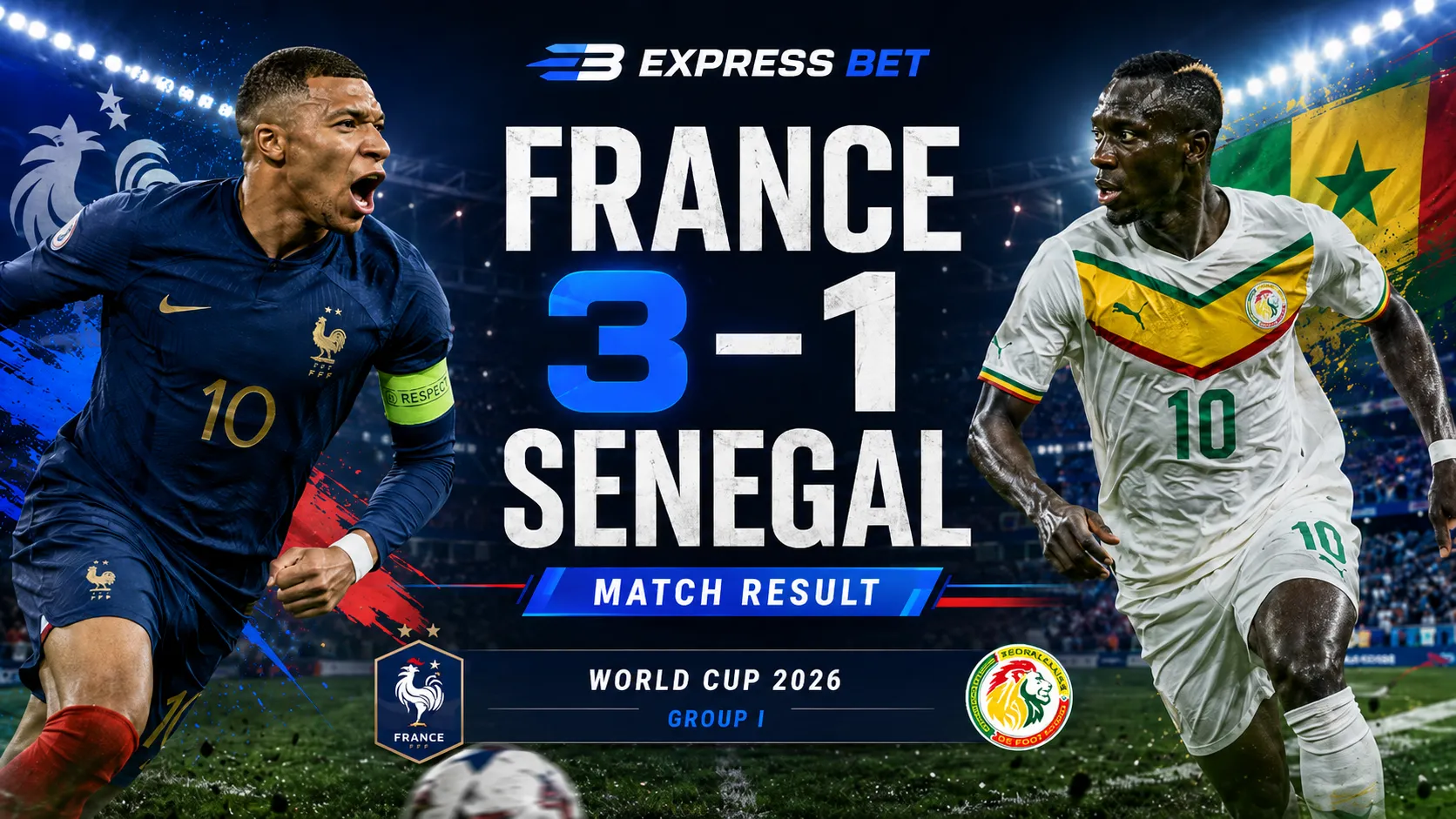
The France vs Senegal match result was a 3-1 win for France in their FIFA World Cup 2026 Group I opener at New York/New Jersey Stadium. Kylian Mbappé scored twice, Bradley Barcola added France’s second, and Ibrahim Mbaye scored Senegal’s late reply. The main turning point came after half-time, when France pushed Michael Olise into more central zones and finally connected midfield to Mbappé. Mbappé was the decisive player, breaking France’s all-time scoring record and reaching 14 World Cup goals. France moved to three points, while Senegal were left with regret after missing first-half chances. Betting outcomes rewarded France moneyline, over 2.5 goals, both teams to score, and selected Mbappé scorer markets, depending on odds and timing.
| Detail | Information |
|---|---|
| Match | France vs Senegal |
| Competition | FIFA World Cup 2026 |
| Stage | Group stage |
| Group | Group I |
| Date | 16 June 2026 |
| Kickoff time | 3:00 p.m. local time / 19:00 UTC |
| Host country | United States |
| City | New York/New Jersey / East Rutherford |
| Stadium | New York/New Jersey Stadium |
| Final score | France 3-1 Senegal |
| Half-time score | France 0-0 Senegal |
| Attendance | 80,545 |
| Referee | Alireza Faghani, Australia |
| VAR | Abdullah Al-Shehri, Saudi Arabia |
| Assistant referees | George Lakrindis, Andrew Lindsay |
| AVAR 1 | Armando Villarreal, United States |
| Reserve assistant referee | Stephane De Almeida, Switzerland |
| France formation | 4-2-3-1 |
| Senegal formation | 4-3-3 |
| Weather | Detailed official match-weather data not confirmed |
| Pitch condition | No major confirmed pitch controversy |
| Surface type | Not confirmed in official match report |
| Roof status | Open stadium conditions; no roof factor confirmed |
| Penalties | None |
| Red cards | None |
| Yellow cards | None |
| VAR involvement | Referee reviewed a possible penalty on Mbappé in the 58th minute and did not award it |
| Betting result | France win; over 2.5 goals; both teams to score “Yes” |
France beat Senegal 3-1, but anyone who only saw the final score missed the argument inside the match.
For 45 minutes, Senegal looked like the team with the clearer head. Pape Thiaw’s side pressed with purpose, attacked France’s full-back channels, and found enough transition space to make the favourites uncomfortable. France had the ball, but not the match. That is an old World Cup distinction, and it remains useful.
Senegal’s first-half plan was not theatrical. It was practical. Ismaïla Sarr held the right side. Sadio Mané worked from the left and drifted into central spaces. Nicolas Jackson ran across the France centre-backs. Lamine Camara, Idrissa Gana Gueye and Pape Gueye gave the midfield enough bite to stop France passing cleanly through the middle.
France started in a 4-2-3-1 with Mike Maignan in goal, Jules Koundé, Dayot Upamecano, William Saliba and Theo Hernández in defence, Aurélien Tchouaméni and Adrien Rabiot in midfield, Michael Olise, Ousmane Dembélé and Désiré Doué behind Kylian Mbappé. On paper, it looked extremely rich. For a while, it played like a very expensive machine with one loose cable.
Mbappé was quiet in the first half. Olise was involved but not yet in command. Dembélé did not fully connect the right-sided attack. Doué showed flashes without making Senegal panic. France’s passing had volume but little edge.
Senegal should have punished that. Jackson hit the post after a fast break. Sarr missed a major first-half chance after Mané found him. These are the moments that live beyond the scoreline. Senegal did not lose only because France improved. They lost because they failed to take what the first half offered.
France then changed the match after the interval. Didier Deschamps did not need a public crisis. He needed the distances fixed. Olise moved more centrally and became the hinge. Tchouaméni dropped into deeper positions, but France’s forward connections became sharper. Rabiot stepped higher at the right moments. Mbappé started receiving earlier, facing goal, not with his back to three defenders and a national expectation.
The game broke in the 66th minute. Olise split Senegal’s defensive line with a precise pass, and Mbappé finished with the calm of a man who has been treating World Cup knockout matches as personal paperwork since 2018.
Barcola then came on for Dembélé in the 80th minute and scored two minutes later after Rabiot released him through the middle. France were 2-0 up and apparently secure, which is always a dangerous phrase to use around World Cup football.
Senegal did not disappear. Ibrahim Mbaye, introduced in the 75th minute, scored in the 90+5th minute after good work from Iliman Ndiaye. The goal briefly made the match look alive again. Very briefly. One minute later, Mbappé drove a long-range strike past Édouard Mendy to complete the 3-1 result and break Olivier Giroud’s France scoring record.
The France vs Senegal final score was fair if judged by second-half quality. It was harsh if judged by Senegal’s first-half chances. That is not a contradiction. It is tournament football. The best teams often survive their bad 45 minutes, then turn the next 45 into a lecture.
France’s first goal came from the second-half tactical adjustment that had been building since the restart.
Michael Olise received in a central-right pocket, not isolated on the touchline. That mattered. From there, he could see the full shape of Senegal’s defensive line. He slipped a precise low pass between defenders into Mbappé’s path.
Mbappé’s movement was excellent. He did not sprint too early. He arrived across the line at the right moment, turned the chance into a shooting angle, and finished calmly past Édouard Mendy.
There was no penalty, no deflection, no chaos. It was elite timing and elite execution.
Defensively, Senegal were caught by the one thing they had mostly denied in the first half: a clean pass through the half-space into Mbappé’s run. Kalidou Koulibaly and Moussa Niakhaté had been strong before that, but the line was opened by Olise’s pass and Mbappé’s acceleration.
Tactically, the goal showed why Olise’s central role changed the match. France did not need endless crossing. They needed one player who could receive between Senegal’s midfield and defence and release Mbappé early.
Emotionally, the goal released France. It also hurt Senegal more than a normal opener because they knew they had wasted their own first-half window. Missing chances is unpleasant. Watching Mbappé punish you for it is worse.
France’s second goal came from the bench and from a more direct midfield action.
Bradley Barcola had only been on the pitch for two minutes after replacing Ousmane Dembélé. Adrien Rabiot drove the ball forward and released him through the middle. Barcola attacked the space behind Senegal’s line and lifted a composed finish over the advancing Mendy.
The goal was clean and ruthless. It was also exactly why France’s squad depth is so uncomfortable for opponents. Senegal had spent 80 minutes dealing with Mbappé, Olise, Dembélé and Doué. Then Barcola entered with fresh legs and immediately turned one direct pass into a goal.
Mendy came out to narrow the angle, but Barcola’s finish was calm enough to beat him. The chip was not showboating. It was the correct solution.
Tactically, this goal punished Senegal’s need to push. At 1-0, Thiaw’s team had to take more risk. Their midfield line became less compact. Rabiot found space to carry and pass. Barcola attacked the newly available corridor.
Emotionally, it looked like the goal that killed the contest. In most matches, it would have. This one still had a strange stoppage-time twitch left.
Senegal’s goal arrived late, and it was not cosmetic in the moment.
Iliman Ndiaye, introduced in the second half, provided the assist. Ibrahim Mbaye received near the left side of the France box, isolated Theo Hernández, beat him with sharp footwork, and smashed a rising shot past Maignan.
The finish was excellent. Mbaye did not simply benefit from tired defending. He created the angle with confidence and hit through the ball with force.
For France, the defending was poor. Hernández was beaten too easily. Maignan was exposed by the power and placement. It was not enough to change the result, but it was enough to remind France that the back line still has work to do.
Tactically, the goal showed that Senegal’s bench had added danger. Mbaye gave fresh speed and directness. Ndiaye gave more creativity between lines. Senegal’s substitutes did what substitutes are supposed to do: change the final phase, not merely decorate it.
Emotionally, the goal gave Senegal a minute of belief and France a minute of administrative annoyance.
Tournament football likes these late complications. They make managers age in real time.
France’s third goal came almost immediately after Senegal’s reply.
Mbappé collected the ball outside the box, set himself, and struck from distance. The shot flew toward the top-left area and beat Mendy. It was powerful, clean, and slightly cruel.
There was no confirmed assist on the official match report. This was Mbappé deciding the discussion had gone on long enough.
The goal was important beyond the scoreboard. It was Mbappé’s second of the match, his 58th goal for France, and the goal that moved him beyond Olivier Giroud as France’s all-time leading scorer. It also took him to 14 World Cup goals, level with Gerd Müller and behind only Ronaldo Nazário and Miroslav Klose in the all-time list.
Mendy may feel he could have done better. Long-range shots are always judged more harshly when they beat a goalkeeper late. But the strike had pace and dip, and the timing was vicious.
Tactically, the goal punished Senegal for opening up after their own goal. Emotionally, it ended the match with authority. Senegal had just made it 2-1. Mbappé made that hope last roughly as long as a loose corner flag in a storm.
Senegal’s clearest early warning came from Nicolas Jackson, who attacked space after a quick break and struck the post.
That chance mattered because it exposed France’s transition defence. Koundé and Hernández were high at times, Tchouaméni was dropping into deep build-up zones, and the centre-backs had to defend larger spaces than Deschamps would have liked.
Jackson did everything except score. That “except” is the entire sport.
Sadio Mané delivered from the left, and Sarr arrived in a good position. He lifted the finish over from close range.
This was the biggest Senegal regret. At 1-0 before half-time, the match changes completely. France would have had to chase. Senegal could have defended deeper and countered into larger spaces. Instead, the half ended 0-0.
There are misses that vanish. This one stayed.
Deschamps shifted the attacking relationships after half-time. Olise moved more centrally and became France’s most important creator. The team looked more connected almost immediately.
This mattered more than any dramatic speech. France were not transformed by emotion. They were transformed by access. Olise got the ball in better zones, Mbappé received earlier, and Senegal had to defend passes through the middle rather than only wide actions.
In the 58th minute, Mbappé went down after a challenge by Mané inside the Senegal box. The referee initially awarded a corner. VAR sent Alireza Faghani to the monitor. He kept his decision and did not award a penalty.
This was a major moment because the match was still 0-0. A penalty could have changed the match earlier. The decision also told France that they would need to score from open play. They did.
The first goal broke Senegal’s resistance. It also validated Deschamps’ second-half changes.
Once France led, Senegal had to play a different match. That opened space for Barcola later.
Barcola’s goal was a bench statement. He entered in the 80th minute and scored in the 82nd.
That showed France’s depth and also punished Senegal’s fatigue. It turned a narrow game into a result that looked comfortable.
Mbaye’s goal in stoppage time gave Senegal a late route back. It also exposed France’s defensive vulnerability on the left side.
The goal mattered because it prevented France from claiming a fully clean second half. Deschamps will like the win. He will not like that concession.
Mbappé’s second goal ended the match and the record chase at the same time. It turned a tense 2-1 into a secure 3-1.
It also gave the article its obvious headline. Football writers like complexity. Mbappé often refuses to provide it.
The first half belonged to Senegal in chance quality and to France in possession structure. That is a polite way of saying France had the ball but Senegal had the better threats.
France’s 4-2-3-1 looked familiar. Tchouaméni operated as the deeper midfielder and often dropped toward the centre-backs, almost forming a temporary back three. Rabiot had to cover large midfield distances. Olise started from the right but drifted. Dembélé took central and right-sided positions. Doué gave left-side energy. Mbappé led the line.
The problem was connection. France’s front four had names, but not always distances. Mbappé was often isolated between Koulibaly and Niakhaté. Dembélé did not consistently receive in positions where he could turn. Olise’s early touches were not always central enough to dictate. Doué carried threat but could not fully break the line.
Senegal’s 4-3-3 was compact without being passive. Gana Gueye screened central lanes. Lamine Camara helped press and cover. Pape Gueye gave physical presence on the left of midfield. Mané and Sarr dropped when required but remained ready to counter. Jackson worked the centre-backs with diagonal runs.
France’s build-up often went wide. Theo Hernández advanced on the left. Koundé supported more carefully on the right. Senegal accepted this. They wanted France to pass around them rather than through them.
The main duel was France’s wide attackers against Senegal’s full-back support. Diatta and Diouf had help from Sarr and Mané, so Doku-style isolation never appeared. France’s wide play became crowded.
Senegal’s best route was direct transition. Jackson’s post shot came from that. Mané also caused problems by carrying into the left channel and crossing. Sarr should have scored from one of those deliveries.
The physical tone was surprisingly clean. There were no yellow cards. The match had duels, but not chaos. Senegal fouled more often across the full match, but the first half was mostly tactical rather than disciplinary.
At half-time, France had to fix the central connection. Senegal had to regret not scoring. Coaches often say 0-0 at half-time is fine. Pape Thiaw probably knew it was not fine enough.
The second half was France’s match.
The shift was visible before the first goal. France played faster through midfield. Olise came inside more often. Rabiot carried the ball forward with better timing. Tchouaméni still protected the structure, but the front line was less disconnected.
Senegal’s first-half intensity dropped slightly. That was predictable. Pressing and countering at that level for 90 minutes against France is expensive. Senegal still defended well for a spell, but their block was less aggressive.
The VAR penalty review in the 58th minute briefly froze the match. France did not get the penalty. That could have frustrated them. Instead, it seemed to sharpen the next phase.
Mbappé scored in the 66th minute. After that, the match opened.
Senegal made two changes in the 75th minute: Ibrahim Mbaye replaced Ismaïla Sarr, and Habib Diarra replaced Lamine Camara. Those changes gave Senegal fresh running, but they also came after France had already taken control.
Deschamps then introduced Barcola for Dembélé in the 80th minute. That was decisive. Barcola’s fresh speed attacked a Senegal line that was starting to stretch. Rabiot’s pass found him, and he made it 2-0.
Senegal changed again in the 83rd minute, with Iliman Ndiaye replacing Pape Gueye and Bamba Dieng replacing Nicolas Jackson. France introduced Rayan Cherki for Doué in the 87th minute. Senegal then added Pathé Ciss for Gana Gueye in the 88th.
The final minutes became more open than France wanted. Mbaye’s goal in the 90+5th minute came from one of Senegal’s substitutes beating a tired defensive action. It was a strong goal, but it arrived too late.
Mbappé’s immediate answer killed the match. It also changed the emotional tone from “France survived a late scare” to “France won by two, and Mbappé broke records.” That is the luxury great players provide. They clean up the narrative.
The second half revealed the difference between the teams. Senegal had athleticism, structure and courage. France had solutions from the bench, elite finishing, and a player who can spend a poor first half gathering evidence before writing the verdict himself.
France won because they fixed their central access after half-time and because their finishing level was higher.
Senegal lost because they failed to score during their best phase and could not maintain compactness once France increased the tempo.
The formation battle started as France’s 4-2-3-1 against Senegal’s 4-3-3. Without the ball, Senegal often looked closer to a 4-5-1, with Mané and Sarr dropping alongside the midfield. That narrowed the central space and forced France wide.
In the first half, Senegal’s plan worked. Gana Gueye and Lamine Camara blocked the middle. Pape Gueye helped cover the left half-space. Koulibaly and Niakhaté stayed tight to Mbappé. Diatta and Diouf had support when France attacked wide.
France’s problem was that Tchouaméni dropped too deep and Rabiot was left with too much distance to cover. Dembélé and Olise did not initially occupy the best spaces at the same time. Mbappé was often waiting for a pass that arrived late or not at all.
Senegal’s counterattacking triggers were clear. When France lost the ball with Theo or Koundé high, Senegal looked for Mané, Sarr or Jackson immediately. Jackson’s post shot and Sarr’s miss came from these spaces.
The second half changed because Olise moved inside. This gave France a passer between Senegal’s midfield and defence. The first goal came directly from this improvement. Olise’s pass to Mbappé was not possible when France’s creators were too wide or too deep.
France also improved their counterpressing after the break. Senegal’s clearances became less clean. The ball came back quicker. That wore down the Senegal midfield and forced the back line to defend facing its own goal.
Barcola’s goal showed the second major French advantage: bench speed. Senegal had to chase the game after 1-0, and the space behind the midfield grew. Rabiot found Barcola, and France punished the gap.
Senegal’s late goal showed their own bench quality. Mbaye and Ndiaye gave them more final-third sharpness. But France answered because Senegal had to open again.
Set pieces did not decide the match. Penalties did not decide it. Cards did not decide it. This was a match decided by chance conversion, second-half positional correction, and Mbappé doing what players of his type do: reducing an entire tactical argument to two finishes.
Mike Maignan — 6/10
Had luck when Jackson’s shot hit the post and came off him before going out. Could do little about Mbaye’s rising finish. Distribution was safe enough, but the late concession lowers the rating.
Jules Koundé — 6.5/10
Defended with discipline and avoided unnecessary risks. Offered limited attacking width but helped France control Senegal’s left-side counters after half-time.
Dayot Upamecano — 7/10
Physical, alert and strong in recovery. Had to deal with Jackson’s running and improved as France compressed the game after the break.
William Saliba — 7/10
Calm in possession and mostly strong defensively. Senegal’s early transition danger was not all on him, but France needed more protection around him in the first half.
Theo Hernández — 5.5/10
Gave France width on the left and had one attempt, but Mbaye beat him too easily for Senegal’s goal. That late duel damages the rating.
Aurélien Tchouaméni — 6.5/10
Dropped deep to help build play and protect transitions. His first-half positioning sometimes left Rabiot isolated, but he gave France structural control later.
Adrien Rabiot — 7.5/10
Assisted Barcola’s goal and improved after half-time. His carrying and timing were important once France found better midfield rhythm.
Michael Olise — 8.5/10
France’s best creator. Assisted Mbappé’s opener and became far more influential after moving centrally. Two shots on target and several high-value passes.
Ousmane Dembélé — 5.5/10
Had one attempt but struggled to impose himself. His replacement, Barcola, scored almost immediately, which made the comparison unavoidable.
Désiré Doué — 6.5/10
Lively, willing to press, and had one shot on target. Still lacked the decisive final action before being replaced by Cherki.
Kylian Mbappé — 9/10
Two goals, four shots on target, France’s all-time scoring record, and another step up the World Cup list. Quiet first half, ruthless second half. That is an acceptable trade.
Bradley Barcola — 8/10
Came on in the 80th minute and scored in the 82nd. A sharp substitute performance and a reminder of France’s attacking depth.
Rayan Cherki — 6/10
Entered late for Doué. Limited time, but helped France keep an attacking outlet during the chaotic final spell.
Édouard Mendy — 5.5/10
Conceded three. Could do little about Mbappé’s first and Barcola’s chip, but Mbappé’s late long-range strike is one he may replay.
Krépin Diatta — 6/10
Worked hard on the right side and helped contain France’s left early. Had limited attacking output as France took over.
Kalidou Koulibaly — 6.5/10
Strong for much of the first half and organised the back line. France’s second-half movement eventually pulled the defence apart.
Moussa Niakhaté — 6/10
Defended well in early phases but struggled when Olise began finding central passing lanes. France’s opener cut through his zone.
El Hadji Malick Diouf — 6/10
Handled difficult wide defensive work and had little room to attack. France’s right-sided rotations improved after half-time.
Idrissa Gana Gueye — 6.5/10
Important in Senegal’s first-half compactness. Covered central spaces well before fatigue and France’s tempo shift reduced his influence.
Lamine Camara — 6/10
Energetic, aggressive and useful in pressing. Replaced in the 75th minute as Senegal needed fresh legs.
Pape Gueye — 6/10
Gave physical balance in midfield and helped Senegal protect the left side. Replaced by Ndiaye as Thiaw chased more creativity.
Ismaïla Sarr — 5.5/10
Found good positions but missed a major chance before half-time. That miss weighs heavily because Senegal’s first-half plan deserved a goal.
Nicolas Jackson — 6/10
Hit the post and ran the channels well. Did not score, but he gave France real problems before being replaced.
Sadio Mané — 6.5/10
Created Senegal’s best first-half chance for Sarr and forced France to respect the left side. His penalty-area challenge on Mbappé survived VAR review.
Ibrahim Mbaye — 7.5/10
Came on in the 75th minute and scored a superb late goal. One of Senegal’s biggest positives.
Habib Diarra — 6/10
Added energy after replacing Camara. Came into a match already moving toward France.
Iliman Ndiaye — 7/10
Assisted Mbaye’s goal and gave Senegal late creativity. A strong case to start the next match.
Bamba Dieng — 6/10
Entered for Jackson and worked the central line late. Limited service.
Pathé Ciss — 6/10
Late substitute for Gana Gueye. Had little time to alter the game.
Man of the Match: Kylian Mbappé
Two goals, France’s scoring record, and the final answer after Senegal’s late goal. He was not brilliant for 90 minutes. He was decisive for the part that mattered most.
Best attacker: Kylian Mbappé
Mbaye had a fine cameo, but Mbappé’s finishing decided the result. Four shots on target, two goals, and another World Cup milestone.
Best midfielder: Michael Olise
Olise was the player who changed France’s attacking geometry. His central movement and assist for Mbappé were the match’s tactical hinge.
Best defender: Dayot Upamecano
Upamecano handled several difficult defensive moments and helped France regain control after the break.
Best goalkeeper: Mike Maignan
Neither goalkeeper had a clean night. Maignan conceded once but avoided disaster after Jackson’s post shot and managed the match well enough.
Best substitute: Bradley Barcola
Scored two minutes after entering. That is the entire job description.
Most underrated performance: Adrien Rabiot
Rabiot’s assist and second-half carrying were important. France improved when he had better support around him.
Most disappointing performance: Ismaïla Sarr’s finishing
Sarr’s movement was useful, but the missed first-half chance changed Senegal’s match. At World Cups, those misses have long memories.
There were no yellow cards and no red cards.
That is notable for a match with this much transition pressure and physical intensity. Senegal committed nine fouls against, France five, but neither team crossed into card territory.
No confirmed in-match injury shaped the result. No concussion substitution was reported. No player triggered a suspension through this match.
Discipline therefore helps both teams before the second round of group fixtures. France face Iraq without card damage. Senegal face Norway with the same benefit.
The real disciplinary issue was not cards. It was positional discipline. France lost their structure too often in the first half. Senegal lost theirs after the break. Neither shows up in the yellow-card column, which is why football statistics still require eyes.
Alireza Faghani had one major decision to manage: the possible penalty on Mbappé in the 58th minute.
Mané slid in on Mbappé inside the Senegal box. Faghani initially awarded a corner. VAR recommended an on-field review. After checking the monitor, he kept his original decision and did not give a penalty.
That was a major call because the match was still 0-0. France were unhappy. Many in the stadium expected the decision to change. It did not.
The important point is that the decision did not decide the result. France scored from open play eight minutes later. Still, the incident will remain part of the France vs Senegal highlights because it came at the exact moment the match was tilting.
There were no red-card checks, no penalty awards, no disallowed goals, and no confirmed handball controversy. Added time was substantial, with six minutes in the first half and ten in the second according to FIFA’s event record.
The referee allowed the match to flow. That suited the game. It also meant Senegal’s early physical compactness and France’s second-half acceleration were not constantly interrupted.
The match was played at New York/New Jersey Stadium in East Rutherford, United States, in front of 80,545 spectators.
Detailed official match-weather data was not confirmed in the FIFA match report. No verified temperature, wind, rain, humidity or roof-related match factor was listed in the official documentation used for this article.
There was no major confirmed pitch controversy. No abnormal surface issue, repeated slipping pattern, ball-speed problem or visible pitch damage shaped the match result.
The stadium itself gave the fixture the scale it deserved. France vs Senegal carries history, and the crowd size reflected that. This was not a quiet group opener hidden in a corner of the tournament. It sounded and looked like a proper World Cup fixture.
The physical conditions did not become the story. The story was tactical rhythm. Senegal were sharper early. France raised the pace after half-time. The pitch allowed both transitions and controlled passing. The decisive change came from positioning, not grass.
France had strong support, but Senegal’s fans made themselves heard, especially during the first half when their team looked capable of repeating at least a small echo of 2002.
The atmosphere carried historical charge. France and Senegal cannot meet at a World Cup without 2002 entering the room. That opening-match upset in Seoul remains one of the great World Cup ambushes. This 2026 match was not the same story, but the memory was present.
Senegal’s early chances lifted their sections. Jackson’s post shot and Sarr’s miss both generated the kind of noise that comes with belief and then immediate regret.
France’s supporters grew louder after Mbappé’s opener. Barcola’s goal turned confidence into celebration. Mbaye’s late strike briefly disturbed that mood. Mbappé’s final goal restored order quickly enough to prevent any genuine panic.
The match did not feel like a home game for either side. It felt like a neutral-stage World Cup match with two serious fanbases and one very old piece of football history sitting between them.
France and Senegal will always be linked by 2002.
Senegal beat defending champions France 1-0 in the opening match of that World Cup. Papa Bouba Diop scored. Senegal danced. France began a disastrous title defence and exited the group without scoring. It remains one of the defining shocks of modern World Cup history.
This 2026 match was not a revenge story in any clean sense. Too much time has passed. Different players, different coaches, different football world. But the analogy still matters because Senegal again showed France early that reputation does not protect you from transition, pace and belief.
The difference was finishing. In 2002, Senegal took the moment. In 2026, they missed theirs. France then had Mbappé.
Mbappé’s records give this match its own historical place. His two goals moved him past Olivier Giroud as France’s all-time leading scorer. He also reached 14 World Cup goals, level with Gerd Müller and behind only Ronaldo Nazário and Miroslav Klose.
France also extended the modern pattern of being a tournament team that can look ordinary for long spells and still produce elite end product. That was true in parts of 2018. It was true in 2022. It was true here.
Senegal, meanwhile, remain a serious African contender. The result hurts, but the first half showed they can trouble elite opposition. The next task is less romantic and more important: take points from Norway and Iraq.
| Statistic | France | Senegal |
|---|---|---|
| Final score | 3 | 1 |
| Half-time score | 0 | 0 |
| Ball possession | 53% | 47% |
| Attempts at goal | 11 | 6 |
| Shots on target | 8 | 2 |
| Blocked attempts | 2 | 1 |
| Fouls against | 5 | 9 |
| Corners | 6 | 4 |
| Direct free kicks | 9 | 5 |
| Indirect free kicks | 3 | 1 |
| Penalties | 0/0 | 0/0 |
| Offsides | 1 | 3 |
| Own goals | 0 | 0 |
| Yellow cards | 0 | 0 |
| Red cards | 0 | 0 |
Some advanced data providers reported France with 1.89 xG to Senegal’s 0.50 and four big chances for France. FIFA’s official event data records the shot and possession totals listed above.
The statistics tell the second-half story more than the first-half story.
France finished with eight shots on target from 11 attempts. That is a high accuracy rate. It reflects the quality of their second-half chances and finishing. Senegal had only two shots on target, despite several dangerous first-half moments.
The possession split was close enough to show that Senegal were not completely overwhelmed. France had 53%, Senegal 47%. But possession is not danger. France generated far more on-target work.
The corner count was 6-4. Set pieces were present but did not define the match. The goals came from open play and transition-style actions.
The absence of cards is also notable. This was a competitive match but not a disciplinary mess.
The most useful statistical summary is simple: Senegal had the better early chances; France had the better finishing volume after the break. The scoreboard chose the second category.
The France vs Senegal betting result rewarded bettors who backed France but did not require the match to be straightforward.
France were the pre-match favourite. FOX’s pre-match odds listed France at -200, Senegal at +550, and the draw at +340. France moneyline landed, but it was not comfortable for the first hour.
The spread market was more interesting. France -1.5 was priced at +145 before the match. That line landed because Mbappé scored in the 90+6th minute. Before that, Senegal’s 90+5’ goal had made the margin 2-1 and threatened to ruin France handicap tickets. One minute later, Mbappé rescued them. Bettors who held France -1.5 experienced a very condensed lesson in stoppage-time cruelty.
The total goals line was 2.5. Over 2.5 landed because the match produced four goals. This looked less likely at half-time after a 0-0 first half, but the second half opened up completely.
Both teams to score landed. France scored first, Senegal scored late, and Mbappé then added the final goal. BTTS “Yes” was priced around even money before the match. That market needed patience.
Correct score 3-1 France landed for anyone holding that high-risk ticket. It required a goalless first half, France scoring twice, Senegal scoring in stoppage time, and Mbappé immediately scoring again. Correct-score markets remain a sport for people who enjoy discomfort.
First goalscorer bettors needed Mbappé. Anytime goalscorer bettors on Mbappé were rewarded. His brace markets also paid where offered. Barcola anytime scorer also landed, and his pre-match anytime price was notably longer than the main France forwards.
Cards markets were poor for over bettors. There were no yellow cards. No red cards. Anyone expecting this historical matchup to become card-heavy did not get the match profile.
Corners were moderate, with France winning six and Senegal four. France corner angles landed depending on the line, but this was not a wild corner match.
The main betting lesson is direct. France were the right result, but the path was volatile. Senegal’s first-half chances made live France prices drift in emotional terms. The VAR non-penalty added another swing. Barcola and Mbappé then changed the spread and total markets late.
This does not mean France -1.5 is automatically good next time. It means that in elite-favourite matches, bench quality and stoppage-time pressure can matter as much as the first 60 minutes.
France moved to three points in Group I.
Senegal remained on zero after one match. Norway and Iraq complete the group, and France’s next fixture is against Iraq in Philadelphia. Senegal next face Norway at New York/New Jersey Stadium.
For France, the win is exactly what was needed. It gives them control without perfection. Deschamps can now manage rotation, fitness and tactical refinement with three points already secured.
A win against Iraq would likely put France close to qualification for the Round of 32. A draw would still leave them in a strong position. A defeat would complicate the group, but this opening result gives them room.
For Senegal, the Norway match becomes critical. Losing to France is not fatal. Losing after playing well for 45 minutes is irritating, but not fatal. The real damage comes if the next match does not produce points.
Goal difference also matters. France are +2. Senegal are -2. In the expanded 48-team format, third-place qualification is possible, but nobody wants to begin the tournament by relying on arithmetic.
The key for Senegal is efficiency. Pape Thiaw said it clearly after the match: the first-half chances had to become goals. Group football is not patient with teams that only create regrets.
France corrected the match.
That was the biggest positive. The first half was poor by their standards. The second half was much sharper. Deschamps adjusted Olise’s role, France improved their passing lanes, and Mbappé began receiving in dangerous zones.
Olise was central to the improvement. His assist for Mbappé was the match’s best pass. His movement gave France the connection they lacked before half-time.
Mbappé was ruthless. He was not involved enough early, but he took the match once France found him. Two goals from four shots on target is elite tournament finishing.
Barcola’s impact was another major positive. Scoring two minutes after coming on shows the value of France’s bench. Deschamps has options that most coaches would like to start.
France also avoided disciplinary damage. No cards, no suspensions, no obvious injury incident. That matters in a long tournament.
The concern is defensive transition. Senegal should have scored in the first half. France cannot assume every opponent will miss those chances.
Senegal’s main failure was finishing.
The first half gave them the match. Jackson hit the post. Sarr missed from close range. Mané delivered quality. Sarr’s movement caused problems. None of it became a goal.
The second problem was second-half compactness. Once France moved Olise centrally, Senegal did not adjust quickly enough. The midfield line opened. Mbappé found the channel. France scored.
The third issue was reaction after 1-0. Senegal had to chase, but the spacing became loose. Barcola’s goal came from the exact kind of gap that appears when a team is caught between pressure and protection.
The fourth issue was late game management. Mbaye scored a brilliant goal, but Senegal conceded again almost immediately. A team that scores in stoppage time to make it 2-1 must not allow the opponent a clean long-range strike one minute later.
Senegal were not poor. That may make the defeat more frustrating. They were good enough to make France uncomfortable and wasteful enough to lose by two.
Deschamps had a flawed first half and a strong second half.
The starting plan placed Olise wide enough that France lacked central connection. Dembélé did not fully solve the No. 10/right-sided creative problem. Tchouaméni dropped deep, which helped build-up but left midfield stretched.
The half-time correction worked. Olise moved inside more often and immediately looked like the player France needed. The team’s intensity improved. The pressing after loss was sharper. Mbappé received better service.
The Barcola substitution was also effective. Barcola replaced Dembélé in the 80th minute and scored in the 82nd. That is the sort of substitution that makes a coach look calm and inevitable.
Deschamps will still worry about the first-half transitions and the late concession. France cannot give Iraq or Norway the same early confidence. More importantly, they cannot give a knockout opponent that much space.
Still, this was a strong tournament management job. Poor first half, correction, three points. Coaches take that.
Pape Thiaw’s starting plan was good.
Senegal pressed intelligently, blocked France’s central lanes, and created the best first-half chances. The 4-3-3 gave Senegal midfield numbers and wide outlets. Mané and Sarr were dangerous. Jackson gave France problems.
The issue was not the setup. It was execution.
Thiaw’s substitutions added late threat. Mbaye scored. Ndiaye assisted. Those were positive decisions. But the changes came after France had already taken control, and Senegal’s midfield struggled to regain authority after the hour.
The coach’s main task before Norway is not emotional repair. It is attacking efficiency. Senegal cannot keep producing “good spells” and losing them to missed chances.
This was a credible performance. It was not a useful result.
Kylian Mbappé became France’s all-time leading scorer with his 58th international goal.
His two goals also took him to 14 career World Cup goals. That moved him beyond Lionel Messi and Just Fontaine and level with Gerd Müller in the historical scoring list.
Bradley Barcola scored his first World Cup goal, and he did it two minutes after entering the pitch. That is efficient work.
Ibrahim Mbaye scored for Senegal in his World Cup appearance off the bench, giving Senegal a late positive from an otherwise painful match.
France also began their 2026 campaign with three points after reaching the 2022 final. The pressure around them remains high, but the opening result was clean enough.
Senegal’s historical comparison remains 2002. They could not repeat the upset, but their first-half performance showed why the fixture still carries weight.
The main controversy was the 58th-minute penalty review.
Mbappé went down after Mané’s sliding challenge in the box. VAR recommended a review. Faghani watched the replay and kept his original decision: no penalty.
France disagreed. Many observers expected a penalty. The decision stood.
There were no red cards, no disallowed goals, no confirmed injury controversy, and no crowd incident that shaped the result.
The other incident worth noting was not controversial but important: Senegal’s missed first-half chances. Those moments became the match’s emotional argument. They were not officiating issues. They were football issues, which are usually harder to forgive.
France beat Senegal 3-1 because they survived the first half, corrected the second, and had Kylian Mbappé.
That is the cleanest verdict.
Senegal were better than the final score suggests early. They pressed well, countered well, and created enough to lead. Jackson’s post and Sarr’s miss were decisive moments. A team cannot ask for better chances against France and then leave them unused.
France were poor before half-time and strong after it. Olise’s central influence changed the game. Rabiot grew into it. Barcola gave the bench a goal. Mbappé gave the match its history.
The scoreline was fair by the end because France produced the better second-half football and the better finishing. It was also cruel to Senegal because the first half had offered them a different match.
For France, this is a strong start with useful warnings. For Senegal, this is a damaging result with enough performance evidence to keep belief alive. The group is not over. But the margin for regret is already thinner.
For bettors, France moneyline landed, over 2.5 landed, BTTS landed, Mbappé first goalscorer and anytime scorer landed, and France -1.5 landed only because of the 90+6’ goal. That last detail matters. A correct bet can still survive by one minute of chaos.
The final image is Mbappé scoring from distance after Senegal had briefly reopened the match. That is what separates strong teams from almost stories. Senegal had a chance to create one. France had the player who ended it.
Football betting carries financial risk. A correct match analysis does not guarantee a winning bet. Odds change before and during matches. Never chase losses. Do not bet money needed for daily life. Use limits and take breaks. Check local betting laws before gambling. Betting should remain entertainment, not income.
France beat Senegal 3-1 in their FIFA World Cup 2026 Group I opener.
Kylian Mbappé scored twice for France, Bradley Barcola scored France’s second goal, and Ibrahim Mbaye scored Senegal’s late goal.
Kylian Mbappé was the best player after scoring twice and becoming France’s all-time leading scorer. Michael Olise was also excellent after moving into central creative areas.
France moved to three points and took early control of Group I. Senegal stayed on zero and now need a strong response against Norway.
France moneyline landed. Over 2.5 goals landed. Both teams to score landed. Mbappé first goalscorer and anytime scorer markets also landed. France -1.5 landed after Mbappé’s stoppage-time goal.
[expert_review params=»JTdCJTIyY29sb3IlMjIlM0ElMjJncmVlbi0yJTIyJTJDJTIyZXhwZXJ0X2F2YXRhciUyMiUzQSUyMiUyMiUyQyUyMmV4cGVydF9uYW1lJTIyJTNBJTIyJTIyJTJDJTIyZXhwZXJ0X2xpbmslMjIlM0ElMjIlMjIlMkMlMjJleHBlcnRfaWQlMjIlM0ElMjIxJTIyJTJDJTIyZXhwZXJ0X3R5cGUlMjIlM0ElMjJleHBlcnRfaWQlMjIlMkMlMjJleHBlcnRfYXZhdGFyX2FsdCUyMiUzQSUyMiUyMiUyQyUyMmV4cGVydF9zaG93JTIyJTNBMSUyQyUyMmV4cGVydF9kZXNjcmlwdGlvbiUyMiUzQSUyMlNwb3J0cyUyMEJldHRpbmclMjBBbmFseXN0JTIwJTI2JTIwRWRpdG9yaWFsJTIwQ29udHJpYnV0b3IlMjIlMkMlMjJleHBlcnRfc2hvd19idXR0b24lMjIlM0ExJTJDJTIyZXhwZXJ0X3Nob3dfYnV0dG9uX3R5cGUlMjIlM0ElMjJwb3B1cCUyMiUyQyUyMmV4cGVydF9xdWVzdGlvbl9idXR0b25fdGV4dCUyMiUzQSUyMkFzayUyMFF1ZXN0aW9uJTIyJTJDJTIycXVlc3Rpb25fZXh0ZXJuYWxfbGluayUyMiUzQSUyMiUyMiUyQyUyMnBvcHVwX3VzZV9waG9uZSUyMiUzQTAlMkMlMjJleHBlcnRfdGl0bGUlMjIlM0ElMjJBdXRob3IlMjIlMkMlMjJleHBlcnRfc2hvd190aXRsZSUyMiUzQTElMkMlMjJleHBlcnRfdGV4dCUyMiUzQSUyMkFsZXglMjBNb3JnYW4lMjBpcyUyMGElMjBzcG9ydHMlMjBiZXR0aW5nJTIwYW5hbHlzdCUyMGFuZCUyMGVkaXRvcmlhbCUyMGNvbnRyaWJ1dG9yJTIwd2hvJTIwd3JpdGVzJTIwZGV0YWlsZWQlMjBib29rbWFrZXIlMjByZXZpZXdzJTJDJTIwYmV0dGluZyUyMGd1aWRlcyUyQyUyMHBsYXRmb3JtJTIwY29tcGFyaXNvbnMlMkMlMjBhbmQlMjByZXNwb25zaWJsZSUyMGdhbWJsaW5nJTIwZXhwbGFpbmVycy4lMjBIaXMlMjB3b3JrJTIwZm9jdXNlcyUyMG9uJTIwcHJhY3RpY2FsJTIwaW5mb3JtYXRpb24lMjBmb3IlMjB1c2VycyUyMHdobyUyMHdhbnQlMjB0byUyMHVuZGVyc3RhbmQlMjBob3clMjBiZXR0aW5nJTIwc2l0ZXMlMjBvcGVyYXRlJTIwYmVmb3JlJTIwdGhleSUyMHJlZ2lzdGVyJTJDJTIwZGVwb3NpdCUyQyUyMG9yJTIwY2xhaW0lMjBhJTIwYm9udXMuJTIyJTJDJTIycWElMjIlM0ElNUIlNUQlMkMlMjJxYV9zaG93X3RpdGxlJTIyJTNBMSUyQyUyMnFhX3RpdGxlJTIyJTNBJTIyJUQwJTkyJUQwJUJFJUQwJUJGJUQxJTgwJUQwJUJFJUQxJTgxJTIwJUQxJThEJUQwJUJBJUQxJTgxJUQwJUJGJUQwJUI1JUQxJTgwJUQxJTgyJUQxJTgzJTIyJTJDJTIyc2NvcmUlMjIlM0ElNUIlNUQlMkMlMjJzY29yZV9zdW1tYXJ5X3RleHQlMjIlM0ElMjIlMjIlMkMlMjJzY29yZV9zdW1tYXJ5X2F2ZXJhZ2UlMjIlM0EwJTJDJTIyc2NvcmVfbWF4JTIyJTNBJTIyNSUyMiUyQyUyMnNjb3JlX3N5bWJvbCUyMiUzQSUyMiUyMiUyQyUyMnNjb3JlX3RpdGxlJTIyJTNBJTIyJTIyJTJDJTIyc2NvcmVfc2hvd190aXRsZSUyMiUzQTAlMkMlMjJwbHVzZXMlMjIlM0ElNUIlNUQlMkMlMjJtaW51c2VzJTIyJTNBJTVCJTVEJTJDJTIycGx1c2VzX21pbnVzZXNfc2hvd190aXRsZSUyMiUzQTElMkMlMjJwbHVzZXNfbWludXNlc190aXRsZSUyMiUzQSUyMiVEMCU5RiVEMCVCQiVEMSU4RSVEMSU4MSVEMSU4QiUyMCVEMCVCOCUyMCVEMCVCQyVEMCVCOCVEMCVCRCVEMSU4MyVEMSU4MSVEMSU4QiUyMiUyQyUyMnBsdXNlc190aXRsZSUyMiUzQSUyMiUyMiUyQyUyMm1pbnVzZXNfdGl0bGUlMjIlM0ElMjIlMjIlN0Q=»]