
Germany vs Curaçao Match Result
Table of Contents Show
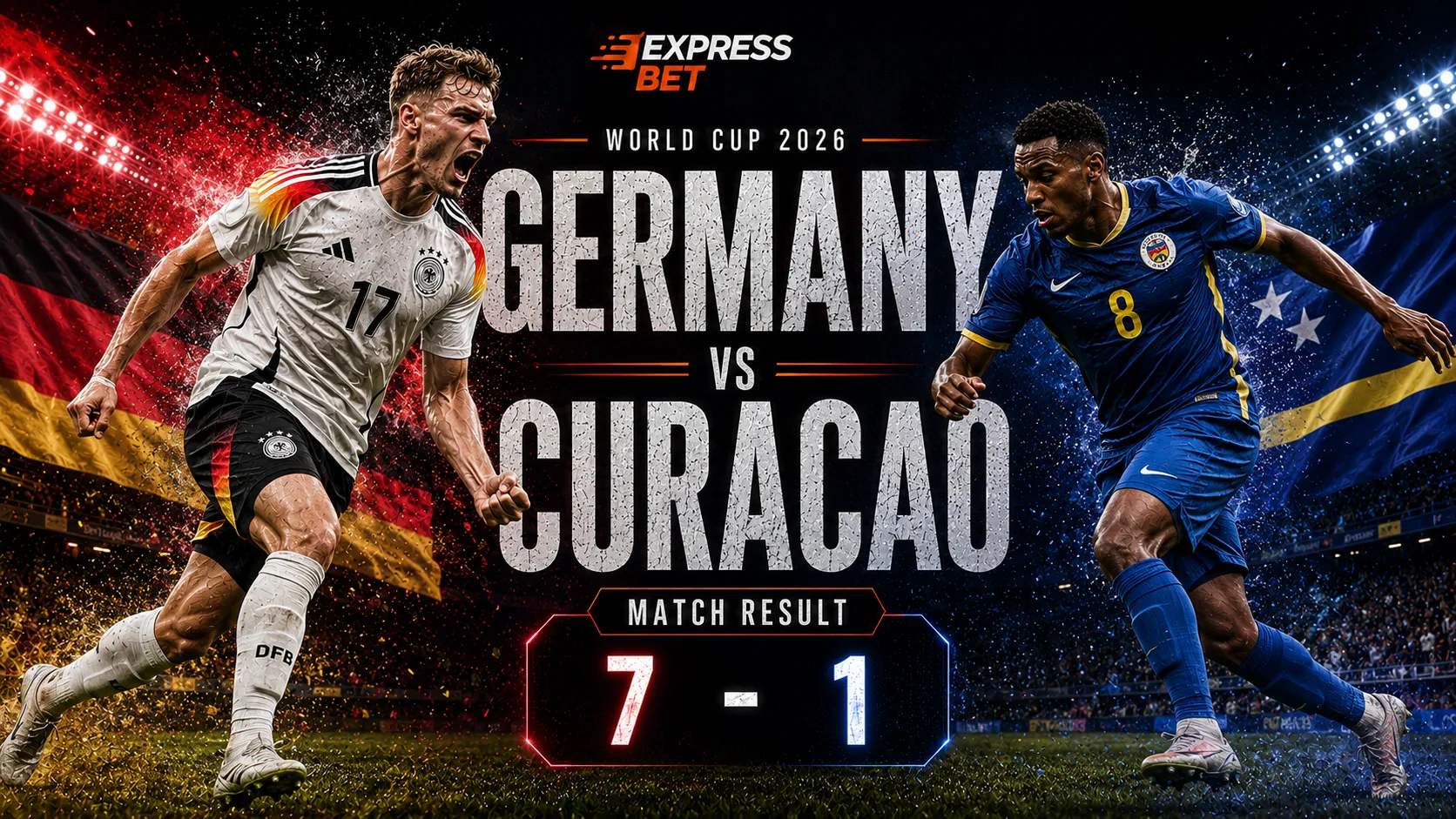
Germany beat Curaçao 7-1 in their FIFA World Cup 2026 Group E opener at Houston Stadium. Felix Nmecha scored in the 6th minute, Livano Comenencia equalised in the 21st with Curaçao’s first World Cup goal, and Germany then took control through Nico Schlotterbeck, Kai Havertz, Jamal Musiala, Nathaniel Brown and Deniz Undav. Havertz scored twice and was the most decisive attacker. The turning point came after Curaçao’s equaliser, when Germany reset, dominated set pieces and ended the first half 3-1 up. Germany moved top of Group E on goal difference. The betting result rewarded Germany win, over 4.5 goals and several Germany handicap markets, depending on odds and timing.
| Detail | Information |
|---|---|
| Match | Germany vs Curaçao |
| Competition | FIFA World Cup 2026 |
| Stage | Group stage |
| Group | Group E |
| Date | 14 June 2026 |
| Kickoff time | 1:00 p.m. local time / 19:04 UTC in FIFA report version |
| Host country | United States |
| City | Houston, Texas |
| Stadium | Houston Stadium / NRG Stadium |
| Final score | Germany 7-1 Curaçao |
| Half-time score | Germany 3-1 Curaçao |
| Attendance | 68,021 |
| Referee | Jalal Jayed, Morocco |
| VAR | Hamza El-Fariq, Morocco |
| Germany formation | 4-2-3-1 |
| Curaçao formation | 4-2-3-1 / 4-4-2 defensive phase depending source display |
| Goals | Nmecha 6’, Comenencia 21’, Schlotterbeck 38’, Havertz 45+5’ pen, Musiala 47’, Brown 68’, Undav 78’, Havertz 88’ |
| Penalties | Germany scored one penalty through Kai Havertz |
| Red cards | None |
| Yellow cards | None |
| Weather | Detailed official match-weather data not confirmed in the sources used |
| Pitch condition | No major confirmed pitch controversy |
| Betting result | Germany win; over 4.5 goals; both teams to score “Yes” |
The Germany vs Curaçao match result was 7-1, which looks brutal on paper and still does not fully describe the emotional geometry of the match.
Germany dominated the game. That was expected. They had the stronger squad, the heavier World Cup history and the tactical control that usually appears when an elite side faces a tournament debutant. But Curaçao also had their moment. For roughly 17 minutes after Felix Nmecha’s opener, the smallest nation ever to appear at a World Cup had Germany level at 1-1 and a corner of Houston Stadium behaving like football had briefly become a fairy tale.
Then Germany remembered that fairy tales usually need protection from full-backs, set pieces and Kai Havertz.
Julian Nagelsmann’s team started fast. Germany used a 4-2-3-1 shape with Manuel Neuer in goal, Joshua Kimmich and Nathaniel Brown as the full-backs, Jonathan Tah and Nico Schlotterbeck in central defence, Aleksandar Pavlovic and Felix Nmecha in midfield, and a front line of Leroy Sané, Jamal Musiala, Florian Wirtz and Kai Havertz.
Curaçao, under Dick Advocaat, also used a structured system with Eloy Room behind Sherel Floranus, Riechedly Bazoer, Armando Obispo and Deveron Fonville. Leandro Bacuna, Juninho Bacuna, Livano Comenencia, Tahith Chong, Sontje Hansen and Jürgen Locadia formed the midfield and attack.
Germany scored in the 6th minute through Nmecha after a Wirtz combination. That could have opened the trapdoor immediately. Instead, Curaçao responded. Comenencia equalised in the 21st minute after a counterattack and a loose-ball sequence around the German box. The shot took a deflection and beat Neuer. The score was 1-1. Curaçao had a World Cup goal. Their bench emptied into joy.
That was the sentimental peak. The football still had 69 minutes left, which is inconvenient when the opponent is Germany.
Schlotterbeck restored Germany’s lead in the 38th minute from Nathaniel Brown’s corner. Havertz converted a penalty in first-half stoppage time after Nmecha was tripped by Bazoer. Musiala scored almost immediately after half-time from Kimmich’s assist. Brown scored in the 68th from Deniz Undav’s assist. Undav then scored himself in the 78th from Kimmich’s pass. Havertz made it seven in the 88th from Undav’s second assist.
The numbers explain the result. Germany had around 64-65% possession depending on the provider. They produced 26 total shots and 11 on target. Curaçao had either seven or eight shots depending on the source, with two on target. Germany created 3.60 xG in FOX’s data and controlled territory after the equaliser. Curaçao defended bravely, but bravery without pressure relief becomes a long afternoon.
Germany moved to three points and a +6 goal difference. Curaçao left with zero points but also with the goal their supporters will keep long after the scoreline stops hurting. Tournament football is strange like that. One team wins 7-1. The other still gets a memory.
Germany’s first goal came quickly and cleanly.
Florian Wirtz combined near the edge of the Curaçao box and found Felix Nmecha, who guided a first-time finish into the far corner. The move was sharp, narrow and German in the usual way: efficient enough to make the opponent feel that the match had already started before they had finished adjusting their socks.
The goal showed Germany’s main attacking idea. Wirtz and Musiala were not fixed as static No. 10s. They moved into pockets between Curaçao’s midfield and defence. Havertz occupied the central defenders. Sané stretched the right side. Nmecha stepped forward from midfield and attacked the gap.
Curaçao’s defensive line was not completely disorganised, but it was half a step late. Against Germany, that is already a problem. Nmecha’s finish gave Germany early control and confirmed the pre-match expectation that the favourite would dominate the ball.
Curaçao’s equaliser was the emotional centre of the match.
The move came after Germany failed to clear a counterattacking situation properly. Jürgen Locadia was involved in the first action, Germany blocked the initial attempt, and Comenencia collected the loose ball around the centre of the box. His left-footed shot took a deflection and lifted beyond Manuel Neuer.
Technically, it was not a clean, laboratory-perfect strike. Historically, that does not matter. It was Curaçao’s first World Cup goal. It briefly made the score 1-1 against Germany. That is the kind of sentence that does not need much decoration.
Tactically, the goal showed Curaçao’s best route: quick release, direct running, second balls and Germany’s occasional rest-defence gaps. Tahith Chong and Locadia gave Curaçao enough transition threat to make Germany defend facing their own goal.
Emotionally, the goal changed the stadium. Curaçao’s fans had arrived to celebrate participation. Suddenly they had equality on the scoreboard. Football is dangerous when it starts giving small nations ideas.
Germany’s second goal restored order.
Nathaniel Brown delivered a corner from the left. Nico Schlotterbeck attacked the ball and glanced a header across Eloy Room. The finish was simple and punishing.
The goal mattered because Curaçao had enjoyed their best spell before it. Their equaliser had rattled Germany for a few minutes. Germany needed to remove the match from emotional territory and return it to structure. A set piece did that.
Curaçao’s defending was not aggressive enough on the first contact. Schlotterbeck found the angle and used the pace of the delivery. Germany had the lead again.
Set pieces are often where elite sides punish underdogs. Open play can become messy. Corners simplify the sport. Good delivery, good run, bad marking, goal. Football rarely apologises for being direct.
Germany made it 3-1 in first-half stoppage time.
Felix Nmecha drove into the box and was tripped by Riechedly Bazoer. The referee awarded the penalty. Havertz took it and converted calmly.
This was the goal that changed the dressing-room tone. At 2-1, Curaçao still had a story. At 3-1, the story had to negotiate with reality. Germany could begin the second half with a cushion. Curaçao had to chase without opening more spaces.
Havertz’s penalty was composed. He did not overcomplicate it. He gave Germany the halftime margin their pressure had earned.
Tactically, the penalty came from the same issue that had troubled Curaçao all half: Germany’s midfield runners entering the box. Nmecha was already the first scorer. This time he created the penalty by attacking the same interior space.
Germany scored again almost immediately after the restart.
Joshua Kimmich provided the assist, and Jamal Musiala finished with his usual close-control cruelty. He received in a dangerous area and struck across the goalkeeper to make it 4-1.
This goal killed any realistic comeback idea. Curaçao needed a disciplined second-half start. Instead, they conceded within two minutes. That is the sporting equivalent of coming out of the dressing room and stepping into traffic.
Musiala’s goal also showed the value of Germany’s central rotations. Curaçao could not track every runner. Wirtz, Musiala, Havertz and Nmecha had spent the first half bending the defensive block. The second half began with another break in the structure.
Nathaniel Brown scored Germany’s fifth in the 68th minute.
Deniz Undav, introduced four minutes earlier, assisted the goal. Brown attacked from the left side and finished with authority. For a full-back to score in that situation tells you the match state. Germany had enough control to let defenders arrive high and still feel protected.
The goal had two meanings. First, Germany’s bench was now influencing the match. Second, Curaçao’s defensive distances were gone. The lines that had stayed compact for the opening hour were now stretched by fatigue, scoreline and German movement.
Brown had already assisted Schlotterbeck. His goal completed a strong attacking performance from left-back.
Undav made it 6-1 in the 78th minute.
Kimmich assisted again. Undav had already set up Brown. This time he became the finisher.
The goal showed Germany’s depth. Musiala had gone off. Nmecha had gone off. Tah had gone off. Brown had gone off. Germany were still creating chances. That is usually how tournament mismatches become heavy scorelines.
Undav’s movement was sharp. He did not enter the match only to protect minutes. He entered to produce. One goal and two assists from the bench is a very direct argument for more tournament involvement.
Havertz completed the scoring in the 88th minute.
Undav provided his second assist, and Havertz finished for his second goal of the match. It was Germany’s seventh.
The goal strengthened Havertz’s case as the match’s most decisive player. He scored from the spot, scored from open play and moved intelligently throughout the match. He did not play like a striker trying to prove a theory. He played like a striker collecting evidence.
For Curaçao, the final goal was harsh but not surprising. By that stage, the match had lost its competitive structure. Germany kept attacking. Curaçao were tired. The scoreline became a number that looked both excessive and logically built.
The 6th-minute goal was important because it prevented Curaçao from building a long defensive rhythm. Underdogs often need the first 15 minutes to breathe. Germany denied them that.
Nmecha’s early finish also gave Germany freedom. They could circulate the ball without chasing the game. Curaçao had to decide whether to stay compact or counter with more risk.
Comenencia’s 21st-minute equaliser was the match’s emotional high point. It was also a tactical warning for Germany.
Germany’s rest-defence was not perfect. Curaçao found space in transition. Neuer was beaten by a deflected shot. The score was level. For a short stretch, Germany looked less like a machine and more like a team that had to answer a question.
After Curaçao’s equaliser, the match was paused for a hydration break. Germany used the pause to reset emotionally and tactically.
The break did not win the match by itself. Germany were stronger anyway. But it did help stop Curaçao’s immediate momentum. In tournament football, interruption can be a tactical tool even when nobody calls it that.
Schlotterbeck’s header in the 38th minute changed the match back toward Germany’s preferred structure. Curaçao had to chase again. Germany regained control.
The goal also showed the importance of Brown’s delivery. Germany were not only dangerous through Wirtz, Musiala and Havertz in open play. They could also punish from restarts.
The penalty in stoppage time was the psychological blade.
Curaçao could have entered half-time 2-1 down and still hopeful. At 3-1, with Germany controlling the ball and creating chance after chance, the match looked close to finished.
Musiala’s goal in the 47th minute ended the competitive debate. A 4-1 scoreline after 47 minutes forced Curaçao into survival. Germany could rotate, manage bodies and still chase goal difference.
Undav entered in the 64th minute and delivered a goal plus two assists. That changed the post-match analysis. Germany’s starters dominated, but the bench made the scoreline ugly.
Nagelsmann will like that. Big tournaments are rarely won by an XI. They are won by squads that keep hurting opponents after substitutions.
Germany controlled the first half, but not without one visible wobble.
The 4-2-3-1 gave Nagelsmann several attacking layers. Pavlovic held the deeper midfield spaces. Nmecha had licence to step forward. Wirtz and Musiala moved between lines. Sané stayed wide or attacked diagonally. Havertz occupied central defenders while also dropping to connect.
That shape created early overloads around Curaçao’s midfield. Wirtz assisted Nmecha’s opener after Germany combined quickly near the box. Musiala had already created danger. Sané found shooting positions. Brown pushed high from left-back and delivered set pieces. Kimmich controlled the right side and later became central to Germany’s assist pattern.
Curaçao’s plan was not simply to park the team bus and hope it passed inspection. Advocaat’s side tried to break through Chong, Locadia, Comenencia and the Bacuna brothers. They defended in a compact block, but they also looked for quick releases behind Germany’s advanced full-backs.
The equaliser came from that plan. It was not sustained possession. It was transition, loose-ball hunger and a finish through traffic. Comenencia scored, and Germany had to respond.
Germany’s response was mature. They did not panic. They increased pressure through corners and shots. Schlotterbeck forced Room into work before eventually scoring from Brown’s corner. Germany kept the ball in Curaçao’s half and began to turn possession into repeated penalty-area entries.
The penalty at 45+5 came from Nmecha’s forward running. That was significant. Nmecha was not just a scorer. He repeatedly broke Curaçao’s midfield line. His vertical movement created the foul from Bazoer.
At half-time, Germany led 3-1. The score was fair. Curaçao had produced one historic punch. Germany had produced an entire half of pressure.
The key tactical mismatch was between Germany’s central technical players and Curaçao’s midfield screen. Wirtz and Musiala kept receiving in spaces where one defender had to leave shape. When that happened, Germany found the next pass.
The second half became a demonstration of depth and fatigue.
Musiala scored in the 47th minute, and that goal changed the match’s temperature. Curaçao could no longer pretend that one counterattack would reshape the result. Germany were three goals ahead and still moving the ball quickly.
Germany did not stop. They created shots through Wirtz, Havertz, Nmecha and Sané. Curaçao had brief attacks through Leandro Bacuna and later Jearl Margaritha, but those moments were isolated.
The substitutions then widened the gap. Undav replaced Musiala in the 64th minute and immediately gave Germany a new centre-forward rhythm. He assisted Brown in the 68th. Goretzka, Rüdiger and Raum entered around the 72nd and 73rd minutes. Waldemar Anton came on late for Kimmich.
The scoreline already looked heavy, but Germany’s bench turned control into further goals. Brown made it 5-1. Undav made it 6-1. Havertz made it 7-1.
Curaçao’s substitutions were sensible but damage-limiting. Jeremy Antonisse came on at half-time for Sontje Hansen. Margaritha replaced Locadia in the 65th minute. Gervane Kastaneer replaced Chong in the 82nd. The changes gave fresh legs, but not enough defensive repair.
The second half showed how difficult World Cup debuts can be against elite opposition. Curaçao had spirit. They had their goal. They had support. They did not have enough defensive tools to survive 90 minutes against Germany’s full attacking rotation.
Germany protected the ball well, used the width better after the break and kept the penalty box occupied. Curaçao defended deeper and deeper. Once that happened, the match became one long calculation: how many clean chances would Germany convert?
The answer was enough to create the tournament’s most one-sided early scoreline.
Germany won because they overloaded central spaces, attacked from multiple lanes and punished Curaçao’s fatigue with bench quality.
The nominal 4-2-3-1 became closer to a 2-3-5 in possession. Kimmich and Brown pushed forward at different heights. Pavlovic held the base. Nmecha made forward runs. Wirtz and Musiala moved in half-spaces. Sané and Havertz stretched the defensive line.
That created too many questions for Curaçao. If Bazoer or Obispo stepped out, Havertz could move behind. If the midfield stayed narrow, Brown and Kimmich could deliver from wide areas. If Curaçao’s full-backs stayed deep, Germany could circulate and shoot from the edge of the box.
The first goal came from central combination. The second came from a corner. The third came from a penalty after a midfield runner attacked the box. The fourth came from central penetration. The fifth came from a full-back joining the attack. The sixth and seventh came from bench-driven movement.
That variety is important. Germany did not rely on one pattern. They used several.
Curaçao’s best moments came in transition. Chong’s footwork, Locadia’s movement and Comenencia’s timing gave them a brief route into the match. Their equaliser showed courage and technical quality. It also exposed the one area Germany must still watch: rest-defence when both full-backs and midfield runners are high.
But Curaçao could not sustain pressure. Their defensive block spent too long without the ball. Their midfield could not stop Wirtz and Musiala from turning. Their centre-backs were forced into repeated emergency defending. Room made saves, but he could not keep the score down alone.
The penalty before half-time mattered tactically because it punished Curaçao’s tired defending. Bazoer’s foul on Nmecha was a symptom of a deeper issue: Germany were arriving in the box with runners from too many angles.
The second half then became a bench mismatch. Undav’s goal and two assists showed Germany’s squad depth. Curaçao’s changes did not change the match structure. Germany’s did.
This was not a complicated tactical mystery. Germany had superior players and a better structure. Curaçao had one excellent emotional moment. Over 90 minutes, the structure won.
These ratings are editorial assessments based on confirmed match events, tactical role, available statistics and match influence.
Manuel Neuer — 6.5/10
Had little to do for long periods. Beaten by Comenencia’s deflected shot, which was difficult to read. Became Germany’s oldest player at a major tournament.
Joshua Kimmich — 8/10
Controlled the right side and produced two assists, for Musiala and Undav. His passing rhythm helped Germany keep pressure high.
Jonathan Tah — 7/10
Handled most defensive work cleanly. Replaced in the second half with the match controlled.
Nico Schlotterbeck — 8/10
Scored the header that restored Germany’s lead. Strong in the air and useful in possession. His set-piece threat mattered.
Nathaniel Brown — 8.5/10
Assisted Schlotterbeck, scored Germany’s fifth and gave the left side constant depth. One of Germany’s most productive players.
Aleksandar Pavlovic — 7/10
Quietly important in possession. Helped Germany keep the ball moving and collect second balls.
Felix Nmecha — 8.5/10
Scored the opener and won the penalty. His forward running caused repeated problems. One of the biggest first-half influences.
Leroy Sané — 6.5/10
Found shooting positions and worked defensively, but did not produce a goal or assist. In a 7-1 win, that absence stands out slightly.
Jamal Musiala — 8/10
Scored early in the second half and repeatedly unsettled Curaçao’s midfield. Replaced after 64 minutes with the job done.
Florian Wirtz — 8/10
Assisted Nmecha’s goal and controlled central pockets. His first touches often moved Germany into dangerous positions.
Kai Havertz — 9/10
Two goals, including one penalty, and strong central movement. He gave Germany penalty-box structure and finishing quality.
Deniz Undav — 9/10
Came on in the 64th minute and produced one goal plus two assists. That is not a cameo. That is a match report with boots.
Leon Goretzka — 6.5/10
Entered with Germany already in control. Added midfield power and helped protect transitions.
Antonio Rüdiger — 6.5/10
Came on to manage minutes and maintain defensive structure.
David Raum — 6.5/10
Delivered late width and took corners. Had a shot on goal.
Waldemar Anton — 6/10
Late substitute for Kimmich. Limited time, straightforward role.
Eloy Room — 5.5/10
Conceded seven, which is never kind to a goalkeeper’s rating. Still made four saves and prevented worse damage at times.
Sherel Floranus — 5/10
Had a difficult match against Brown, Wirtz and Germany’s left-sided rotations. Worked hard but was repeatedly stretched.
Riechedly Bazoer — 4.5/10
Conceded the penalty on Nmecha. Faced constant pressure in central defence and could not stabilise the box.
Armando Obispo — 5/10
Made clearances and blocks, but Germany’s movement pulled him into difficult zones.
Deveron Fonville — 5/10
Had to defend waves of attacks and rarely got forward with control. Long evening.
Livano Comenencia — 7/10
Scored Curaçao’s first World Cup goal. That alone gives his performance lasting value. Also worked in midfield under heavy pressure.
Leandro Bacuna — 6/10
Captain’s effort. Tried to carry possession, took shots and kept organising. Could not stop the midfield being overrun.
Juninho Bacuna — 5.5/10
Had moments of forward movement but spent much of the game defending. Germany’s tempo made his role reactive.
Tahith Chong — 6/10
One of Curaçao’s more useful outlets. Helped create danger before the equaliser and carried the ball well in early spells.
Jürgen Locadia — 5.5/10
Involved in the equaliser sequence but had limited service. Replaced after 65 minutes.
Sontje Hansen — 5.5/10
Had a shot on goal before half-time. Replaced at the break as Advocaat adjusted.
Jeremy Antonisse — 5.5/10
Came on at half-time and gave fresh energy, including set-piece work late.
Jearl Margaritha — 5.5/10
Entered for Locadia and had a shot. Limited impact because Curaçao had little possession.
Gervane Kastaneer — 5/10
Late substitute with little time to affect a finished match.
Man of the Match: Kai Havertz
Havertz scored twice and provided the central reference for Germany’s attack. His penalty before half-time and late finish gave the scoreline its shape.
Best attacker: Deniz Undav
Havertz was the best overall performer, but Undav was the most efficient attacker per minute. One goal and two assists from the bench is absurdly productive.
Best midfielder: Felix Nmecha
Nmecha scored the first goal, won the penalty and repeatedly broke into the box. His vertical running was the first-half key.
Best defender: Nathaniel Brown
Brown assisted from a corner, scored from open play and gave Germany width. He turned full-back play into scoreboard impact.
Best goalkeeper: Eloy Room
He conceded seven but still made more saves than Neuer and faced a far heavier workload. Goalkeeper awards in 7-1 defeats are strange, but the logic is sound.
Best substitute: Deniz Undav
No contest. He changed the second half and strengthened his tournament role.
Most underrated performance: Florian Wirtz
Wirtz assisted the opener and kept finding the spaces that broke Curaçao’s midfield block. He did not need a goal to shape the match.
Most disappointing performance: Riechedly Bazoer
The penalty foul damaged Curaçao at the worst possible moment. He also spent much of the match dragged into emergency defending.
There were no yellow cards and no red cards.
That is notable for a match with a 7-1 scoreline. Heavy defeats often become emotional and physical. Curaçao kept enough discipline to avoid turning a difficult afternoon into a disciplinary mess.
There were no confirmed injury incidents central to the match. No confirmed concussion substitution shaped the result. No player triggered a suspension through card accumulation because the match had no bookings.
The main physical issue was fatigue. Curaçao defended for long periods against a technically superior side. Their defensive reactions became slower after the hour. Germany’s fifth, sixth and seventh goals all came after the match had opened physically.
For Germany, the clean disciplinary record is useful before the next match against Côte d’Ivoire. For Curaçao, the absence of cards is one small positive before facing Ecuador.
Jalal Jayed controlled the match cleanly.
The main decision was the penalty awarded to Germany in first-half stoppage time. Felix Nmecha was tripped in the box by Riechedly Bazoer. Jayed pointed to the spot. Havertz converted.
There was no major VAR controversy. No red card review shaped the result. No disallowed goal became a defining talking point. VAR Hamza El-Fariq did not become the match’s third protagonist, which remains one of football’s better outcomes.
The referee’s management suited the game. Germany controlled possession. Curaçao defended physically but not recklessly. The lack of yellow cards suggests that the match stayed inside normal contact limits.
The penalty did matter. It changed the score from 2-1 to 3-1 just before half-time. But the decision fit the visible match pattern: Germany had runners entering the box and Curaçao were late to react. It was not the reason Germany won. It was one part of a larger dominance.
The match was played at Houston Stadium, the World Cup name for NRG Stadium.
Detailed official weather conditions were not confirmed in the match data used here. Local reporting around the day described heat and storm-related disruption around fan areas, but the match itself did not produce a major pitch or weather controversy.
The stadium roof context mattered less than the teams. The match was not defined by rain, wind or surface problems. It was defined by Germany’s ball speed, positional rotations and finishing.
The pitch played quickly enough for Germany’s combinations. Wirtz, Musiala and Nmecha repeatedly moved the ball through central spaces. Brown and Kimmich delivered from wide areas. Curaçao’s defensive block had to shift quickly, and that became harder as the match wore on.
Curaçao’s supporters created one of the match’s strongest atmospheric moments after Comenencia’s goal. Germany’s supporters had most of the scoreboard. Curaçao’s supporters had the loudest memory.
The attendance was 68,021, and the crowd saw two different matches inside one.
The first match was a predictable Germany opener: elite favourite scores early, controls the ball and looks technically superior. The second was Curaçao’s World Cup dream: Comenencia scores, the bench explodes, and the Blue Wave supporters get a moment that belongs entirely to them.
After Germany retook the lead, the atmosphere changed. It became less suspenseful and more ceremonial. German goals kept arriving. Curaçao fans kept cheering. That is not normal supporter behaviour after conceding seven, but World Cup debuts are not normal.
The German crowd had reason to enjoy the margin. After group-stage exits in 2018 and 2022, Germany needed a clean start. They got more than that.
Curaçao’s crowd had reason to stay proud. Their team lost heavily. Their team also scored against Germany in their first World Cup match. Both facts can stand together without cancelling each other out.
The obvious historical echo is Germany’s 7-1 win over Brazil in the 2014 World Cup semi-final.
This was not the same match. Brazil were hosts and tournament favourites in 2014. Curaçao were debutants and massive underdogs in 2026. But the scoreline invites the comparison because football never wastes an old ghost.
Germany’s performance also mattered because of recent history. They failed to escape the group stage in 2018 and 2022. This win does not erase those failures, but it changes the opening mood. Germany looked sharp, varied and deep.
Curaçao made history simply by being there. They became the smallest nation by population and area to play at a World Cup. Comenencia’s goal then gave that history a scoring moment. Not every 7-1 defeat contains a national celebration. This one did.
Dick Advocaat also became the oldest coach in World Cup history at 78. Manuel Neuer became Germany’s oldest player at a major tournament at 40. That created a strange age contrast with Julian Nagelsmann, one of the youngest coaches at the tournament.
The match was therefore both a rout and a record book. Germany took the points. Curaçao took the milestone. The scoreboard was merciless. The story was more generous.
Different providers report small variations in some match statistics. FIFA’s official report lists Germany at 64% possession and Curaçao at 36%, while FOX lists 65% and 35%. FIFA lists Curaçao with eight attempts, while FOX lists seven. The broad statistical picture is still clear.
| Statistic | Germany | Curaçao |
|---|---|---|
| Final score | 7 | 1 |
| Half-time score | 3 | 1 |
| Possession | 64-65% | 35-36% |
| Total shots | 26 | 7-8 |
| Shots on target | 11 | 2 |
| Expected goals | 3.60 | 0.35 |
| Chances created | 23 | 5 |
| Corners | 8 | 1 |
| Passing accuracy | 89% | 85% |
| Crosses completed | 7 from 21 | 2 from 9 |
| Fouls | 16-18 | 10-11 |
| Offsides | 0 | 1 |
| Yellow cards | 0 | 0 |
| Red cards | 0 | 0 |
| Keeper saves | 1 | 4 |
| Clearances | 18 | 27 |
| Blocks | 0 | 9 |
The numbers explain the match without needing much theatre. Germany had the ball, the shots, the chances and the set-piece volume. Curaçao had the historic equaliser and little sustained control after it.
The xG gap is important. Germany’s 3.60 xG shows they created enough to win clearly. Scoring seven from that total also shows high finishing efficiency. Curaçao’s 0.35 xG shows that Comenencia’s goal was not part of sustained attacking pressure.
Curaçao’s 27 clearances and nine blocks show the defensive workload. Germany kept arriving. Curaçao kept clearing. Eventually that becomes less a tactic and more a weather system.
The Germany vs Curaçao betting result was straightforward in the main markets but still interesting in detail.
Germany were overwhelming pre-match favourites. FOX listed Germany at -2857. That market landed, but the price was extremely short. Bettors who backed Germany simply to win received little relative value.
The handicap markets were more important. Germany -1.5, -2.5, -3.5, -4.5 and even heavier alternate lines landed depending on the sportsbook. The late Havertz goal in the 88th minute mattered for deeper handicap tickets.
The over/under line on FOX was 4.5. The match produced eight goals, so over 4.5 landed comfortably. This became clear once Germany led 3-1 at half-time and scored again in the 47th minute.
Both teams to score “Yes” also landed because Comenencia equalised in the 21st minute. That goal changed several markets. Germany clean-sheet bets failed. Curaçao team-total over 0.5 landed. Germany win plus BTTS landed for bettors who took that combined angle.
Correct score 7-1 was a very high-risk winning market. It required a massive Germany win and a Curaçao goal. One fewer late goal, one extra German chance, one missed penalty, and the market breaks.
First goalscorer bettors needed Felix Nmecha. Anytime goalscorer markets on Nmecha, Schlotterbeck, Havertz, Musiala, Brown and Undav all landed. Havertz brace markets landed. Undav goal contribution props would have rewarded anyone who expected bench involvement, though that is easier to admire after the fact than predict before kick-off.
Cards markets were poor for over bettors. The match had no yellow cards. A heavy mismatch does not always produce disciplinary volume. Sometimes the favourite scores instead of getting fouled.
The main betting lesson is not “back the giant favourite.” That lesson is too obvious and often too expensive. The better lesson is that mismatch games can still contain value in totals, team goals, assists, handicap ladders and BTTS markets. But none of those are guaranteed. Curaçao’s goal helped some markets and destroyed others.
A correct read of Germany’s superiority did not automatically identify the best bet. Price, market type and timing mattered.
Germany moved to three points and a +6 goal difference.
Côte d’Ivoire also won their Group E opener, beating Ecuador 1-0. That left Germany and Côte d’Ivoire on three points, with Germany top on goal difference. Ecuador and Curaçao stayed on zero.
Germany next face Côte d’Ivoire in Toronto. That match now has real meaning. A Germany win would put them close to qualification and likely control of the group. A draw would still keep them in strong position. A defeat would make the final match against Ecuador more complicated.
Curaçao next face Ecuador in Kansas City. That match becomes the realistic test. Germany were always the hardest opener. Against Ecuador, Curaçao need more defensive stability and more attacking possession. Their goal against Germany should give belief, but the -6 goal difference is heavy.
In the expanded World Cup format, some third-placed teams can advance. That matters for Curaçao only if they can recover points. A 7-1 defeat makes goal difference a problem. They may need a win, not just respectable draws.
For Germany, the result gives confidence and margin. For Curaçao, the result gives pain and one historic goal. Group tables are not sentimental, but players are. Both will matter.
Germany started fast.
That matters. Heavy favourites often spend the first 20 minutes allowing underdogs to believe. Germany scored in six minutes. They forced Curaçao to open slightly. They created repeated chances.
Germany also used multiple attacking lanes. Wirtz and Musiala controlled interior spaces. Brown and Kimmich provided wide service. Nmecha broke from midfield. Havertz occupied the box. Sané stretched the right. The structure was varied, not dependent on one player.
Set pieces were strong. Brown’s corner to Schlotterbeck restored the lead at a key moment.
The penalty-box occupation was excellent. Germany had players arriving from midfield, full-back and centre-forward positions. Curaçao could not track all of them.
Nagelsmann’s substitutions worked. Undav produced one goal and two assists. Raum added late width. Goretzka and Rüdiger helped manage the match. Germany did not lose rhythm after changes.
The only meaningful criticism is the equaliser. Germany’s rest-defence switched off. Against Curaçao, it became a footnote. Against a stronger opponent, it could become a problem.
Curaçao’s first problem was defensive spacing.
They could not stop Germany receiving between the lines. Wirtz and Musiala turned too often. Nmecha ran beyond midfield too easily. Brown attacked from left-back with too much freedom.
The second problem was set-piece defending. Schlotterbeck’s goal gave Germany control again after Curaçao’s equaliser. The marking and first-contact defence were not strong enough.
The third problem was the penalty. Bazoer’s foul on Nmecha came at the worst time. Curaçao had almost reached half-time at 2-1. At 3-1, the match changed.
The fourth problem was second-half fatigue. Curaçao’s block became stretched. Germany’s bench ran through tired lanes. Once Brown scored the fifth, the match became damage limitation.
This was not a failure of spirit. Curaçao showed enough courage to score and keep attacking in moments. The issue was level. Germany had too many technical players, too much movement and too much depth.
Advocaat’s team must now recover emotionally. Ecuador will not care that Curaçao scored a historic goal. They will attack the same defensive spaces Germany exposed.
Nagelsmann got the result he needed.
Germany’s shape was aggressive without being careless for most of the match. The front four rotated well. Nmecha’s role was especially effective because he gave Germany a midfield runner Curaçao could not track.
Starting Brown also paid off. He assisted from a corner and scored. That gives Nagelsmann useful selection evidence before tougher matches.
The substitutions were strong. Undav’s impact was immediate and decisive. Germany looked like a squad, not just an XI.
The criticism is the period after Curaçao’s equaliser. Germany looked briefly rattled. Nagelsmann admitted the reset helped. Against Côte d’Ivoire, Germany cannot assume they will have time to repair emotional drift.
Still, seven goals in an opener is a strong answer to old tournament doubts.
Advocaat’s Curaçao had a plan, and for one unforgettable sequence it worked.
They tried to counter through Chong, Locadia and Comenencia. They scored from that kind of action. They gave their supporters a World Cup goal and did not collapse emotionally immediately after.
But the structure could not survive repeated pressure. The midfield screen was too easy for Germany to bypass. The defensive line did not handle set pieces or late runners. The penalty foul was costly.
Advocaat will know the Germany match was always the hardest. His real tournament assessment may come against Ecuador and Côte d’Ivoire. But the defensive lessons from Houston are blunt. Curaçao need better spacing, cleaner clearances and more controlled possession after regains.
Curaçao scored their first ever World Cup goal through Livano Comenencia. That is the match’s most important emotional milestone.
Curaçao also became the smallest nation by population and area to appear at a World Cup. Their debut was heavy on the scoreboard but significant historically.
Dick Advocaat became the oldest coach in World Cup history at 78. That record added another layer to Curaçao’s debut.
Manuel Neuer became Germany’s oldest player at a major tournament at 40. The clean sheet did not arrive, but the appearance record did.
Kai Havertz scored twice and gave Germany a strong centre-forward performance. Deniz Undav recorded one goal and two assists from the bench. Nathaniel Brown scored and assisted, making him one of Germany’s standout tournament openers.
Germany’s 7-1 scoreline also inevitably recalled the 2014 semi-final against Brazil. The context was completely different, but the number travels on its own.
There was no major on-field controversy that changed the result.
The penalty to Germany was the main officiating decision. Bazoer fouled Nmecha in the box, Havertz scored, and Germany led 3-1 at half-time. The decision did not become a prolonged dispute in the sources used.
There were no red cards. There were no yellow cards. There was no confirmed disallowed goal that shaped the match.
One broader post-match controversy involved a broadcast image of the VAR room and accusations around a hand gesture by support VAR Shaun Evans. FIFA was reported to be aware of the issue. That was not a football decision and did not affect the scoreline. It should be handled separately from match analysis.
On the pitch, the story was simple. Germany were far better. Curaçao had one historic moment. The referee did not decide the game.
Germany beat Curaçao 7-1 because they had more quality, more routes to goal and more depth.
The early Nmecha goal gave Germany control. Comenencia’s equaliser gave Curaçao history. Schlotterbeck’s header and Havertz’s penalty removed the upset danger before half-time. Musiala’s goal after the restart ended the competitive phase. Brown, Undav and Havertz then stretched the margin.
The scoreline was harsh but not false. Germany created enough chances to win heavily. Curaçao defended with pride but not enough control. The gap between the sides grew wider after the hour.
For Germany, this was an ideal opening result. Seven goals, six different scorers and a huge goal-difference advantage. It does not prove they can beat the strongest teams. It does prove they arrived with attacking rhythm.
For Curaçao, this was a painful debut with one priceless goal. Their tournament is not judged only by Germany. Ecuador and Côte d’Ivoire will decide whether the debut becomes more than a memory.
For bettors, Germany win and over 4.5 goals landed. Both teams to score also landed. Germany handicap markets paid depending on the line. Cards over markets failed. The match showed again that mismatch betting is not only about picking the winner. It is about choosing the market that still has value.
Germany got the points. Curaçao got the roar. The World Cup got another 7-1, because apparently football keeps that number in a locked drawer and brings it out when Germany are involved.
Football betting carries financial risk. A correct match analysis does not guarantee a winning bet. Odds change before and during matches. Never chase losses. Do not bet money needed for daily life. Use limits and take breaks. Check local betting laws before gambling. Betting should remain entertainment, not income.
Germany beat Curaçao 7-1 in their FIFA World Cup 2026 Group E opener.
Germany’s goals came from Felix Nmecha, Nico Schlotterbeck, Kai Havertz twice, Jamal Musiala, Nathaniel Brown and Deniz Undav. Livano Comenencia scored Curaçao’s goal.
Kai Havertz was the strongest Man of the Match candidate after scoring twice. Deniz Undav also had a major impact with one goal and two assists from the bench.
Germany moved to three points with a +6 goal difference and went top of Group E. Curaçao stayed on zero points with a -6 goal difference and next face Ecuador.
Germany match-winner landed at very short odds. Over 4.5 goals landed. Both teams to score “Yes” landed because Curaçao scored. Germany handicap markets also landed on several lines, depending on sportsbook pricing.
[expert_review params=»JTdCJTIyY29sb3IlMjIlM0ElMjJncmVlbi0yJTIyJTJDJTIyZXhwZXJ0X2F2YXRhciUyMiUzQSUyMiUyMiUyQyUyMmV4cGVydF9uYW1lJTIyJTNBJTIyJTIyJTJDJTIyZXhwZXJ0X2xpbmslMjIlM0ElMjIlMjIlMkMlMjJleHBlcnRfaWQlMjIlM0ElMjIxJTIyJTJDJTIyZXhwZXJ0X3R5cGUlMjIlM0ElMjJleHBlcnRfaWQlMjIlMkMlMjJleHBlcnRfYXZhdGFyX2FsdCUyMiUzQSUyMiUyMiUyQyUyMmV4cGVydF9zaG93JTIyJTNBMSUyQyUyMmV4cGVydF9kZXNjcmlwdGlvbiUyMiUzQSUyMlNwb3J0cyUyMEJldHRpbmclMjBBbmFseXN0JTIwJTI2JTIwRWRpdG9yaWFsJTIwQ29udHJpYnV0b3IlMjIlMkMlMjJleHBlcnRfc2hvd19idXR0b24lMjIlM0ExJTJDJTIyZXhwZXJ0X3Nob3dfYnV0dG9uX3R5cGUlMjIlM0ElMjJwb3B1cCUyMiUyQyUyMmV4cGVydF9xdWVzdGlvbl9idXR0b25fdGV4dCUyMiUzQSUyMkFzayUyMFF1ZXN0aW9uJTIyJTJDJTIycXVlc3Rpb25fZXh0ZXJuYWxfbGluayUyMiUzQSUyMiUyMiUyQyUyMnBvcHVwX3VzZV9waG9uZSUyMiUzQTAlMkMlMjJleHBlcnRfdGl0bGUlMjIlM0ElMjJBdXRob3IlMjIlMkMlMjJleHBlcnRfc2hvd190aXRsZSUyMiUzQTElMkMlMjJleHBlcnRfdGV4dCUyMiUzQSUyMkFsZXglMjBNb3JnYW4lMjBpcyUyMGElMjBzcG9ydHMlMjBiZXR0aW5nJTIwYW5hbHlzdCUyMGFuZCUyMGVkaXRvcmlhbCUyMGNvbnRyaWJ1dG9yJTIwd2hvJTIwd3JpdGVzJTIwZGV0YWlsZWQlMjBib29rbWFrZXIlMjByZXZpZXdzJTJDJTIwYmV0dGluZyUyMGd1aWRlcyUyQyUyMHBsYXRmb3JtJTIwY29tcGFyaXNvbnMlMkMlMjBhbmQlMjByZXNwb25zaWJsZSUyMGdhbWJsaW5nJTIwZXhwbGFpbmVycy4lMjBIaXMlMjB3b3JrJTIwZm9jdXNlcyUyMG9uJTIwcHJhY3RpY2FsJTIwaW5mb3JtYXRpb24lMjBmb3IlMjB1c2VycyUyMHdobyUyMHdhbnQlMjB0byUyMHVuZGVyc3RhbmQlMjBob3clMjBiZXR0aW5nJTIwc2l0ZXMlMjBvcGVyYXRlJTIwYmVmb3JlJTIwdGhleSUyMHJlZ2lzdGVyJTJDJTIwZGVwb3NpdCUyQyUyMG9yJTIwY2xhaW0lMjBhJTIwYm9udXMuJTIyJTJDJTIycWElMjIlM0ElNUIlNUQlMkMlMjJxYV9zaG93X3RpdGxlJTIyJTNBMSUyQyUyMnFhX3RpdGxlJTIyJTNBJTIyJUQwJTkyJUQwJUJFJUQwJUJGJUQxJTgwJUQwJUJFJUQxJTgxJTIwJUQxJThEJUQwJUJBJUQxJTgxJUQwJUJGJUQwJUI1JUQxJTgwJUQxJTgyJUQxJTgzJTIyJTJDJTIyc2NvcmUlMjIlM0ElNUIlNUQlMkMlMjJzY29yZV9zdW1tYXJ5X3RleHQlMjIlM0ElMjIlMjIlMkMlMjJzY29yZV9zdW1tYXJ5X2F2ZXJhZ2UlMjIlM0EwJTJDJTIyc2NvcmVfbWF4JTIyJTNBJTIyNSUyMiUyQyUyMnNjb3JlX3N5bWJvbCUyMiUzQSUyMiUyMiUyQyUyMnNjb3JlX3RpdGxlJTIyJTNBJTIyJTIyJTJDJTIyc2NvcmVfc2hvd190aXRsZSUyMiUzQTAlMkMlMjJwbHVzZXMlMjIlM0ElNUIlNUQlMkMlMjJtaW51c2VzJTIyJTNBJTVCJTVEJTJDJTIycGx1c2VzX21pbnVzZXNfc2hvd190aXRsZSUyMiUzQTElMkMlMjJwbHVzZXNfbWludXNlc190aXRsZSUyMiUzQSUyMiVEMCU5RiVEMCVCQiVEMSU4RSVEMSU4MSVEMSU4QiUyMCVEMCVCOCUyMCVEMCVCQyVEMCVCOCVEMCVCRCVEMSU4MyVEMSU4MSVEMSU4QiUyMiUyQyUyMnBsdXNlc190aXRsZSUyMiUzQSUyMiUyMiUyQyUyMm1pbnVzZXNfdGl0bGUlMjIlM0ElMjIlMjIlN0Q=»]