
Netherlands vs Japan Match Result
Table of Contents Show
Views 151
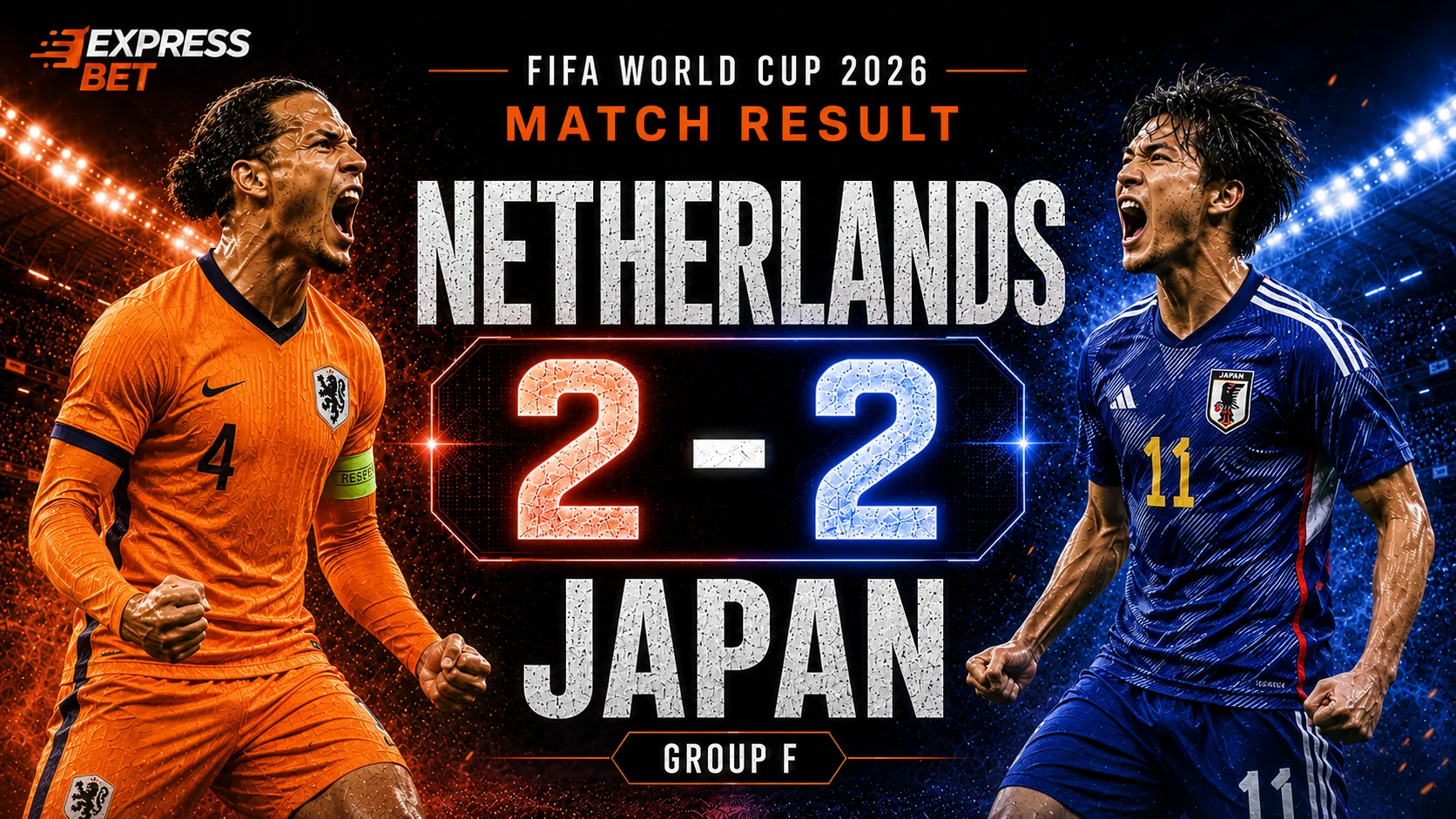
The Netherlands vs Japan match result was 2-2 in their FIFA World Cup 2026 Group F opener at Dallas Stadium. Virgil van Dijk gave the Netherlands the lead in the 51st minute, Keito Nakamura levelled in the 57th, Crysencio Summerville restored the Dutch advantage in the 64th, and Daichi Kamada equalised in the 89th after Koki Ogawa’s header from a Junya Ito corner. Ryan Gravenberch was the best Dutch player with two assists, while Zion Suzuki’s first-half saves kept Japan alive. Tactically, the Netherlands controlled the ball, but Japan’s substitutions and late set-piece pressure changed the result. Betting outcomes rewarded the draw, over 2.5 goals, and both teams to score, depending on odds and market timing.
Match Information
| Detail | Information |
|---|---|
| Match | Netherlands vs Japan |
| Competition | FIFA World Cup 2026 |
| Stage | Group stage |
| Group | Group F |
| Date | 14 June 2026 |
| Kickoff time | 3:00 p.m. local time / 20:00 UTC |
| Host country | United States |
| City | Dallas / Arlington, Texas |
| Stadium | Dallas Stadium |
| Final score | Netherlands 2-2 Japan |
| Half-time score | Netherlands 0-0 Japan |
| Attendance | 69,285 |
| Referee | Ismail Elfath, United States |
| VAR | Armando Villarreal, United States |
| Assistant referees | Corey Parker and Kyle Atkins |
| Fourth official | Katia Garcia |
| Netherlands formation | 4-1-2-3 |
| Japan formation | 3-4-3 |
| Weather | Warm Texas conditions; detailed official match-weather data not confirmed |
| Pitch condition | No major confirmed pitch controversy |
| Penalties | None |
| Red cards | None |
| Yellow cards | Netherlands 3, Japan 0 |
| VAR involvement | VAR officials assigned; no decisive goal reversal confirmed |
| Betting result | Draw; over 2.5 goals; both teams to score |
Final Score and Match Summary
The Netherlands vs Japan final score was 2-2, and it felt like a result that both teams could explain and neither could fully celebrate.
The Netherlands had the ball. They had the early chances. They had the lead twice. They also had the very Dutch problem of turning control into something that looked almost convincing until the opponent decided to be inconvenient. Tournament football has always had a cruel taste for this kind of administrative failure.
Japan did not win the match. They did something almost as useful in a difficult World Cup group: they refused to lose it. Twice they went behind. Twice they came back. That tells us something about their structure, their bench, and their tolerance for suffering. It also tells us something about the Netherlands’ late-game management, which again looked more like a negotiation than a verdict.
The first half ended goalless, but it was not empty. Donyell Malen had two strong chances and found Zion Suzuki in the way both times. Cody Gakpo also threatened. Japan had moments through Keito Nakamura, Daizen Maeda and Takefusa Kubo, but the first half mostly belonged to Dutch possession and Japanese survival.
The second half then turned into a different sport.
Virgil van Dijk opened the scoring in the 51st minute, heading in from Ryan Gravenberch’s assist. Japan answered six minutes later through Keito Nakamura after Takefusa Kubo found him inside the box. Crysencio Summerville made it 2-1 in the 64th minute, again from a Gravenberch assist. The Netherlands had the match where they wanted it. Or at least where they thought they wanted it.
Then Japan changed the temperature. Hajime Moriyasu used his bench well. Junya Ito entered and gave direct delivery. Koki Ogawa entered and became a real aerial target. Yukinari Sugawara and Takehiro Tomiyasu refreshed the right and defensive lines. Japan pushed higher, won corners, and finally got the equaliser in the 89th minute when Kamada applied the final touch after Ogawa’s header from Ito’s corner.
That goal changed the article from “Dutch control” to “Dutch regret.” A familiar genre, unfortunately for the Oranje.
The draw leaves Group F open. Sweden’s 5-1 win over Tunisia put them top after the opening round. The Netherlands and Japan sit on one point each. Neither result is fatal. Neither result is ideal. The World Cup table is rarely interested in emotional nuance.
Goal Timeline
51’ — Virgil van Dijk, Netherlands, header
The first goal came from a Dutch set-piece phase and a familiar source of authority.
Ryan Gravenberch delivered the assist, and Virgil van Dijk attacked the ball with the kind of timing that makes centre-backs look briefly like centre-forwards with better posture. The header beat Zion Suzuki and gave the Netherlands a 1-0 lead.
The build-up mattered because the Netherlands had been pushing Japan deeper since the first half. Japan’s defensive block had survived open play, but the set-piece gave the Dutch a cleaner route to goal. Van Dijk’s movement was decisive. Japan did not get enough pressure on the first contact, and once Van Dijk had the angle, Suzuki was left with very little time.
Tactically, the goal rewarded Dutch pressure without fully proving Dutch attacking fluency. The Netherlands had moved the ball well, but their clearest first-half openings had required Suzuki saves. The set piece gave them the breakthrough their possession suggested, even if their open-play chance quality was not overwhelming.
Emotionally, it should have settled the Netherlands. Instead, it merely invited Japan to show what they usually show after the break: a better version of themselves.
57’ — Keito Nakamura, Japan, open-play goal
Japan’s first equaliser arrived quickly enough to stop the Netherlands from turning the lead into control.
Takefusa Kubo received in a dangerous area and found Keito Nakamura inside the box. Nakamura took the ball, created his shooting angle and finished past Bart Verbruggen. The strike reportedly carried a slight deflection element in some live descriptions, but the important football fact is clear: Japan had moved quickly, found the Dutch box, and punished a defence that had not reset cleanly.
The goal came from Japan’s best attacking route. Kubo drifted into space, received between Dutch defensive attention, and played the correct pass. Nakamura, who had missed a presentable first-half chance, showed better composure this time.
For the Netherlands, the defending was too loose. The gap between midfield and back line opened, and Kubo was allowed to influence the action too easily. Van Dijk and Jan Paul van Hecke had been comfortable in aerial phases, but Japan’s equaliser came from movement and timing rather than a simple duel.
Tactically, the goal changed Japan’s confidence. They had proof that they could hurt the Netherlands without needing long possession. Emotionally, it told the Dutch that one goal was not going to be enough. World Cup leads often arrive dressed as comfort. They frequently leave as paperwork.
64’ — Crysencio Summerville, Netherlands, open-play goal
The Netherlands regained the lead through Crysencio Summerville in the 64th minute.
Ryan Gravenberch provided his second assist of the match. Summerville received in the inside-left channel and produced a sharp left-footed finish. It was a clean goal and a significant personal moment: a World Cup goal in a group opener, from a player whose directness gave Japan problems.
The finish was strong. Summerville did not need a heavy first touch or an extra look. He shaped the ball and found the corner. For the Netherlands, it was the best attacking action of the match because it combined midfield progression, movement between lines and decisive finishing.
Gravenberch’s role was again important. He was not merely moving the ball sideways. He was finding vertical passes and timing his involvement in the final third. His two assists made him the Dutch player with the clearest measurable impact.
Tactically, this goal looked like the winning moment. Japan had equalised, but the Netherlands had answered within seven minutes. That kind of response usually points to emotional control.
Usually.
89’ — Daichi Kamada, Japan, set-piece equaliser
Japan’s second equaliser came from a corner and from one of the oldest World Cup truths: defend the first ball, then defend the second, then pray the third does not hit someone decisive.
Junya Ito took the corner. Koki Ogawa rose in the box and directed the ball toward goal. Daichi Kamada got the decisive final touch, turning the ball past Bart Verbruggen to make it 2-2.
The goal had a messy texture. That is normal for late set-piece equalisers. They do not arrive to satisfy graphic designers. They arrive to damage group tables.
The Netherlands had moved into a more protective shape after taking the lead, including the introduction of Nathan Aké. But the late set-piece defending was not clean. Japan attacked the delivery with more conviction than the Dutch defended it. Ogawa’s aerial presence mattered. Kamada’s position mattered. Ito’s delivery mattered.
The emotional effect was obvious. Japan’s bench erupted. The Dutch players looked like men who had just discovered that the final whistle was not, in fact, optional.
Opta later framed Kamada’s goal as Japan’s latest ever World Cup goal. That fits the feeling of the match. Japan stayed alive long enough for the Netherlands to make one more defensive mistake.
Key Moments That Changed the Match
Zion Suzuki saves from Donyell Malen in the 3rd minute
The first major chance came almost immediately.
Donyell Malen received inside the area, turned quickly and shot on target. Zion Suzuki saved. It looked like the sort of early chance that can make an underdog’s plan collapse before the shape has even settled.
Instead, Suzuki stopped it and gave Japan a platform. That mattered because the Netherlands’ first-half superiority never became a goal. When a goalkeeper buys his team 45 minutes, he is not just making saves. He is buying tactical oxygen.
The first-half hydration break slows the rhythm
The first half included a hydration break in warm Texas conditions. It interrupted a match that had started with real speed.
For the Netherlands, the break slowed their early push. For Japan, it offered a reset. Moriyasu’s team were defending deep and needed small pauses to reorganise. Modern tournament football now includes these mini-timeouts. Nobody pretends they are beautiful. They are useful.
Malen vs Suzuki becomes the first-half duel
Malen had another strong chance before half-time, this time from a corner. He powered an effort on target, and Suzuki again kept it out.
This was the clearest individual duel before the break. Malen’s movement was good. Suzuki’s reactions were better. If the Netherlands had scored before half-time, the second half may have opened differently. They did not. The match stayed available for Japan.
Van Dijk scores after the break
The Netherlands finally converted pressure through Van Dijk. The goal changed the match state and forced Japan to take more risks.
It also moved the Dutch into a familiar psychological area: protecting a lead while still trying to play. The Netherlands have often been excellent at the first part of a match and less convincing at the last 20 minutes. This was another entry in the file.
Japan equalise quickly through Nakamura
Japan’s first response was the real turning point. A team that concedes and takes 25 minutes to react is in trouble. Japan needed six minutes.
Nakamura’s goal told the Netherlands that Japan were not just defending for dignity. They were playing for the result.
Summerville restores the Dutch lead
Summerville’s goal looked like a decisive answer. The Netherlands had absorbed Japan’s equaliser and punched back. That is usually a sign of a strong side.
The problem was not the response. The problem was what came after it. The Dutch lead lasted until the 89th minute, but the team never fully removed Japan from the match.
Japan’s 75th-minute triple change
Moriyasu changed the match with his bench. Koki Ogawa, Yukinari Sugawara and Takehiro Tomiyasu entered in the 75th minute, while Junya Ito had already come on in the 66th.
This changed Japan’s attacking profile. Ito gave crossing. Ogawa gave a target. Sugawara gave right-side delivery and a shot on goal. Tomiyasu gave defensive security, which allowed Japan to push without fully opening the back door.
Kamada equalises late
The 89th-minute equaliser was the final punishment for Dutch passivity. Japan had increased set-piece pressure and finally turned it into a goal.
It was not random. It came from the exact late-game tools Japan had introduced: delivery, aerial presence, and bodies attacking the box.
First Half Analysis
The first half ended 0-0, but it had a clear shape.
The Netherlands started in a 4-1-2-3. Bart Verbruggen was in goal. Denzel Dumfries, Jan Paul van Hecke, Virgil van Dijk and Micky van de Ven formed the back line. Frenkie de Jong held the base of midfield, with Ryan Gravenberch and Tijjani Reijnders ahead of him. Crysencio Summerville, Cody Gakpo and Donyell Malen formed the front three.
Japan started in a 3-4-3. Zion Suzuki was in goal. Hiroki Ito, Shogo Taniguchi and Tsuyoshi Watanabe formed the back three. Ritsu Doan and Keito Nakamura provided width. Daichi Kamada and Kaishu Sano worked inside. Daizen Maeda and Takefusa Kubo supported Ayase Ueda.
The tactical contrast was clean. The Netherlands wanted possession control and rotations around Japan’s midfield. Japan wanted compactness, fast wide release and moments through Kubo or Nakamura.
The Netherlands controlled 60% possession across the match, and the first half showed why. De Jong gave the Dutch clean circulation. Gravenberch pushed higher and looked for vertical passes. Reijnders tried to link the half-spaces. Dumfries and Van de Ven gave width from full-back zones.
Japan defended in a back five when necessary, with Doan and Nakamura dropping into the wide channels. That made central progression hard. The Dutch had possession, but they often had to play around Japan rather than through them.
Malen was the main early threat. His 3rd-minute shot forced Suzuki into a save. He later tested Suzuki again from a corner. Those saves were crucial. Japan’s plan depended on staying level long enough to adjust after the break.
Japan had chances too. Hiroki Ito shot in the 28th minute. Nakamura had a chance before half-time and dragged it wide. Ueda also had a late first-half attempt. The Samurai Blue were not dominant, but they were not spectators.
The physical tone was controlled. There were no first-half yellow cards. The main stress was tactical rather than disciplinary.
At half-time, Koeman had to find a way to turn possession into cleaner chances. Moriyasu had to decide whether to keep waiting or push more bodies forward. Both coaches got partial answers after the break. The problem for the Netherlands was that Japan’s answer lasted longer.
Second Half Analysis
The second half produced all four goals and most of the truth.
The Netherlands began strongly. Van Dijk’s goal in the 51st minute came from pressure and set-piece quality. For a few minutes, the match looked like it had moved into the expected pattern: Dutch control, Japan chasing, Oranje territory.
Japan rejected that pattern quickly. Nakamura equalised in the 57th minute. Kubo’s assist showed why Japan always carried danger when they could play through the first Dutch pressure. The Netherlands had more possession, but Japan were sharper in the transition windows.
Summerville then scored in the 64th minute, and the Netherlands again seemed to have regained authority. His goal came three minutes after he had been booked, which is a small reminder that footballers are unreliable narrators of their own momentum.
Koeman responded with a set of changes around the 70th minute. Memphis Depay replaced Malen. Teun Koopmeiners replaced Summerville. Quinten Timber replaced Reijnders. Later, Nathan Aké replaced Gravenberch in the 81st minute, and Brian Brobbey replaced Gakpo in the 85th.
The changes were logical on paper. Depay offered experience. Koopmeiners offered control and set-piece quality. Timber gave legs. Aké gave defensive security. Brobbey gave a physical outlet.
But the match did not become safer. It became more fragmented. The Netherlands lost some of the direct threat that Summerville and Malen had provided. Gravenberch’s removal also reduced the player who had created both Dutch goals.
Japan’s changes were sharper in relation to the game state. Junya Ito entered in the 66th minute. Ogawa, Sugawara and Tomiyasu came on in the 75th. Kento Shiogai entered in the 84th.
Ito’s crossing changed the late phase. Ogawa’s aerial presence changed the penalty-box problem. Sugawara gave Japan another wide delivery and tested Verbruggen in the 80th minute. Japan were not simply adding bodies. They were adding tools.
By the final 15 minutes, Japan had more territory and set-piece pressure. The Netherlands had chances through Gakpo, Van Hecke and Koopmeiners, but the match’s emotional direction had shifted.
Kamada’s equaliser in the 89th minute made that shift official. The Netherlands had tried to protect the lead. Japan had attacked the one moment that still mattered.
Tactical Picture: Why the Match Finished Level
This match finished level because the Netherlands controlled the first structure, while Japan controlled the late adjustments.
The Netherlands’ 4-1-2-3 gave them possession dominance. De Jong sat as the single pivot, allowing Van Dijk and Van Hecke to split the build-up. Dumfries pushed high on the right. Van de Ven advanced from the left, though in a more conservative manner than a natural full-back would. Gravenberch and Reijnders moved ahead of De Jong and tried to occupy Japan’s midfield.
In attack, the Netherlands often resembled a 2-3-5. Dumfries joined high. Summerville held width or moved inside. Gakpo drifted left. Malen moved centrally and attacked the box. Gravenberch made the key passes from midfield.
Japan’s 3-4-3 became a 5-4-1 without the ball. Ueda stayed central. Kubo and Maeda dropped or pressed in the half-spaces. Nakamura and Doan became wing-backs when the Netherlands had sustained possession. Kamada and Sano had to screen the central lane.
That structure frustrated the Dutch in the first half. The Netherlands had shots, but Japan protected the penalty spot well. Suzuki made the saves that the block could not prevent.
The Netherlands’ first two goals came from two different routes: a set-piece header and a central-to-left combination. That showed variety. It also showed Japan’s vulnerability when Gravenberch could receive and play forward without pressure.
Japan’s goals came from their own strengths. The first came from Kubo receiving in space and Nakamura finishing quickly. The second came from the bench-created set-piece pattern: Ito delivery, Ogawa aerial contact, Kamada final touch.
Koeman’s late shift toward protection did not fully work. Aké came on, but the Netherlands still conceded from a corner. The problem was not just personnel. It was territory. Japan were allowed enough late pressure to create the set-piece.
Moriyasu’s plan was more successful after 65 minutes. He did not just chase the game with hopeful forwards. He introduced specific qualities: Ito’s crossing, Ogawa’s aerial presence, Sugawara’s width, Tomiyasu’s security.
The draw was logical. The Netherlands were better in possession. Japan were better at refusing the match’s supposed conclusion. Football continues to value that irritating skill.
Player Ratings and Individual Performances
These ratings are editorial assessments based on confirmed events, tactical role, match influence and available statistics.
Netherlands Player Ratings
Bart Verbruggen — 6/10
Conceded twice from three Japanese shots on target. Could do little about the late scramble, though his defence gave him little protection. Distribution was steady.
Denzel Dumfries — 6.5/10
Gave width and physicality on the right. Did not produce a decisive final action. Defensively had to manage Nakamura and later Sugawara’s threat.
Jan Paul van Hecke — 6.5/10
Had a shot on goal and defended well in several phases. Still part of a back line that lost control of late set-piece pressure.
Virgil van Dijk — 7.5/10
Scored the opening goal and led the line for most of the match. The late equaliser damages the defensive rating, but his attacking contribution was major.
Micky van de Ven — 6/10
Used his pace well in recovery and had a first-half shot. Booked in stoppage time for a serious foul. Not fully comfortable as an attacking left-back.
Frenkie de Jong — 7/10
Controlled possession and helped the Netherlands dictate tempo. Japan’s late pressure showed the limits of control when the ball stops reaching midfield.
Ryan Gravenberch — 8.5/10
Two assists. The Netherlands’ best player. His vertical passing created both Dutch goals. Removing him reduced the team’s attacking connection.
Tijjani Reijnders — 6.5/10
Active in pressing and set-piece delivery. Did not produce enough final-third damage before being replaced.
Crysencio Summerville — 7.5/10
Scored a fine goal and constantly threatened inside-left spaces. Booked in the 61st minute and substituted soon after. Strong impact.
Donyell Malen — 6.5/10
Had two major first-half chances but was denied by Suzuki. His movement was good; his finishing was not decisive enough.
Cody Gakpo — 6.5/10
Involved in attacks and had a shot on target. Did not dominate the left side as much as the Netherlands needed.
Memphis Depay — 5.5/10
Entered in the 70th minute and was booked in the 83rd. Did not give the Netherlands enough control or late attacking clarity.
Teun Koopmeiners — 6/10
Came on for Summerville and had late shots, including one deep in stoppage time. Useful but not decisive.
Quinten Timber — 6/10
Added legs in midfield but did not stop Japan’s late territorial push.
Nathan Aké — 5.5/10
Introduced to secure the lead. Japan still equalised from a set piece. That does not all sit on him, but the purpose of the change failed.
Brian Brobbey — 5.5/10
Entered late for Gakpo. Had little service and could not hold enough territory.
Japan Player Ratings
Zion Suzuki — 8/10
Japan’s first-half saviour. Denied Malen twice and kept the match goalless until half-time. Without him, Japan probably chase a different game.
Shogo Taniguchi — 6.5/10
Organised the back three and later took the captaincy. Under pressure for long spells but helped Japan survive the first half.
Hiroki Ito — 6.5/10
Defended the left side and had a first-half shot. Strong enough under Dutch pressure.
Tsuyoshi Watanabe — 6/10
Worked hard in the back three before being replaced. Had difficult moments against Malen and Gakpo.
Ritsu Doan — 6/10
Captained the side initially and worked defensively on the right. Replaced in the 75th minute as Japan chased more width and delivery.
Kaishu Sano — 6.5/10
Quiet but important. Helped screen central zones and kept Japan’s midfield from being overrun completely.
Daichi Kamada — 8/10
Scored the late equaliser and completed 99 minutes of tactical work. The goal makes his performance decisive.
Keito Nakamura — 8/10
Scored Japan’s first equaliser and had three attempts. His wide-to-inside threat caused the Dutch problems throughout.
Daizen Maeda — 6/10
Ran hard and helped Japan’s pressing. Replaced by Junya Ito, whose delivery became critical.
Takefusa Kubo — 7.5/10
Assisted Nakamura’s goal and gave Japan their best creative moments. Replaced after 75 minutes as Moriyasu changed the attacking profile.
Ayase Ueda — 6/10
Worked against Van Dijk and Van Hecke with limited service. Had a first-half attempt but did not impose himself.
Junya Ito — 7.5/10
Came on in the 66th minute and changed Japan’s crossing threat. His corner led to the equaliser.
Koki Ogawa — 7.5/10
Entered in the 75th minute and assisted Kamada’s goal with the key header. A classic tournament substitute impact.
Yukinari Sugawara — 6.5/10
Came on in the 75th minute, offered right-side energy and forced a save in the 80th minute.
Takehiro Tomiyasu — 6.5/10
Added defensive stability after entering. Helped Japan push without leaving the back line too exposed.
Kento Shiogai — 6/10
Late forward substitute. Limited time, but helped maintain Japan’s pressure.
Best Players of the Match
Man of the Match: Ryan Gravenberch
Two assists in a 2-2 draw make the argument simple. Gravenberch gave the Netherlands their clearest creative edge and was involved in both goals.
Best attacker: Keito Nakamura
Nakamura scored, stretched the Dutch right side and kept attacking even after missing earlier. His equaliser changed the match’s emotional direction.
Best midfielder: Daichi Kamada
Kamada scored the late goal and worked through midfield for the full match. His value came from timing, not volume.
Best defender: Virgil van Dijk
He scored the opener and was strong for long periods. The late equaliser prevents a higher verdict, but his influence was still substantial.
Best goalkeeper: Zion Suzuki
The first half belongs to him. His saves from Malen kept Japan alive long enough for the second-half comeback.
Best substitute: Koki Ogawa
Ogawa’s header created the equaliser. He entered for the final phase and gave Japan the aerial tool they needed.
Most underrated performance: Junya Ito
Ito’s delivery changed the match. He did not need many touches. He needed one corner delivered into a dangerous zone.
Most disappointing performance: Memphis Depay
Depay came on to help close or sharpen the match. Instead, he was booked and did not change the Dutch attack meaningfully.
Injuries, Suspensions, Cards, and Discipline
There were no red cards.
The Netherlands received three yellow cards. Crysencio Summerville was booked in the 61st minute. Memphis Depay was booked in the 83rd. Micky van de Ven was booked in stoppage time. Japan received no yellow cards.
The Dutch card pattern tells part of the story. The bookings came after Japan had started to play more aggressively and the match had opened. Summerville’s yellow came shortly before his goal and substitution. Depay’s card showed frustration in the late game. Van de Ven’s stoppage-time booking reflected the pressure after Japan had equalised.
No in-match injury was confirmed as decisive. No concussion substitution shaped the result.
Pre-match absences still mattered. Japan were without Wataru Endo and Kaoru Mitoma. The Netherlands were also dealing with defensive and creative absences in their squad. But the match itself was not decided by one injury event.
Suspension risk is not immediate after one yellow, but tournament accumulation matters. Summerville, Depay and Van de Ven must manage the next matches carefully. Group F is tight enough without handing the referee administrative influence.
Referee and VAR Analysis
Ismail Elfath had a match that became faster and more physical after half-time, but he did not become the headline.
There were no penalties. No red cards. No decisive VAR reversal. That matters. The result was not built from controversy. It was built from set pieces, substitutions, finishing and late defensive failure.
The assistant VAR team included Rodolpho Toski, with Tomasz Kwiatkowski listed as support VAR. Armando Villarreal was the VAR. Their presence did not lead to a major public intervention.
The main officiating issues were the Dutch yellow cards. Summerville, Depay and Van de Ven were all booked for serious foul play. Those decisions fit the match rhythm. Japan’s movement and late pressure forced the Netherlands into more reactive defending.
Added time also mattered. FIFA’s report listed three minutes in the first half and six in the second. Japan scored before that final added-time stretch, then defended through the Dutch late push.
The referee influenced flow mainly by allowing the game to remain open. That helped the second half. This was not a whistle-heavy match. It was a match where the football was allowed to become untidy on its own.
Weather, Stadium, Pitch, and Match Conditions
The match was played at Dallas Stadium in the United States, with 69,285 in attendance.
The official match report did not provide detailed weather data, but the game was played in warm Texas conditions and included a first-half hydration break. Historical weather data for Arlington that day indicated temperatures around the mid-20s Celsius with a high above 30°C. That matters because the match was played in the afternoon, not under a cool evening sky.
The stadium surface did not become a major controversy. No confirmed pitch failure, roof issue or abnormal surface condition shaped the result. The ball moved quickly enough for both teams to build attacks after the break.
The warm conditions likely influenced tempo management. The first half had bursts, then pauses. The second half opened up as substitutions arrived and legs tired. Japan’s bench impact should be read partly through that physical context.
The match also showed why hydration breaks have become part of this tournament’s rhythm. They are not elegant. They are disruptive. They also give coaches a useful tactical pause. Japan used those pauses well. The Netherlands did not close the match well enough after them.
Fans and Stadium Atmosphere
The crowd was strong and visible. Dutch support was heavy, with large blocks of orange in the stands. Japan also had energetic support, and their fans remained a story after the match because of the familiar tradition of cleaning up their section.
The atmosphere grew with the second half. A 0-0 first half can make even a packed stadium feel like it is waiting for permission. Van Dijk’s goal gave the match its ignition. Nakamura’s reply made it a contest. Summerville’s goal made it Dutch again. Kamada’s equaliser made it chaos.
The late Japanese celebration carried the emotional weight of the match. A draw against the Netherlands after twice trailing is not a trophy, but it is a strong group-stage statement.
The Dutch supporters had the opposite experience. They saw enough control to expect three points and enough defensive looseness to leave with one. That is the particular punishment of a late equaliser: it turns the whole walk out of the stadium into analysis.
Historical Context and World Cup Analogies
The Netherlands and Japan have World Cup history.
They met at the 2010 World Cup, when the Netherlands won 1-0 through Wesley Sneijder. That Dutch team reached the final. Japan reached the last 16. The 2026 version felt different. Japan did not look like a team trying to survive a European heavyweight. They looked like a team prepared to argue.
There was also a 2-2 friendly between these nations in 2013. This match repeated the scoreline but added the harder tournament edge. A friendly draw is a note. A World Cup draw is a group-table event.
Opta’s records add more weight. This was the first time the Netherlands led twice in a World Cup match and failed to win. It was also one of Japan’s most resilient World Cup results, recalling their 2-2 draw with Senegal in 2018, when they also trailed twice and avoided defeat.
The Netherlands’ broader World Cup history gives the result a familiar ache. This is a country that has lost three finals and still somehow finds new formats for dissatisfaction. Japan’s history runs in the other direction. They have repeatedly reached the last 16 but never the quarter-finals. A point here helps their attempt to break that ceiling.
This was not an upset. It was a warning. Japan are no longer a tidy, respectful underdog. They are a tournament team with tactical range and late-game belief.
Match Statistics
| Statistic | Netherlands | Japan |
|---|---|---|
| Final score | 2 | 2 |
| Half-time score | 0 | 0 |
| Ball possession | 60% | 40% |
| Attempts at goal | 10 | 10 |
| Shots on target | 6 | 3 |
| Blocked attempts | 0 | 1 |
| Fouls against | 7 | 7 |
| Corners | 5 | 4 |
| Direct free kicks | 6 | 7 |
| Indirect free kicks | 1 | 1 |
| Penalties | 0/0 | 0/0 |
| Offsides | 1 | 0 |
| Own goals | 0 | 0 |
| Yellow cards | 3 | 0 |
| Red cards | 0 | 0 |
Some data providers report small variations in detailed shot totals and xG. FIFA’s team-stat table lists both sides with 10 attempts, while the player-total section creates a small Japan shot-count inconsistency. Other public data providers placed Netherlands xG slightly ahead, around 0.79 to 0.54.
The numbers support the match story. The Netherlands controlled possession and had more shots on target. Japan matched total shot volume and made better use of timing. A 60-40 possession split did not give the Dutch security because Japan’s best moments came after the break.
The corner count also matters. Japan had four corners and scored from one late. The Netherlands had five and scored through Van Dijk from a set-piece phase. This was not only an open-play match. Dead balls carried serious value.
The yellow-card split tells another story. Japan played aggressively without getting booked. The Netherlands collected three cautions after the game became more stretched. Discipline matched emotional control. Japan had more of it late.
Betting Result Angle
The Netherlands vs Japan betting result rewarded several common markets and punished the simplest favourite logic.
The Netherlands were the more traditional market side before kick-off in many books. They had the deeper World Cup reputation, more elite club names and stronger public recognition. But the standard match-winner market did not reward Dutch backers. The match finished as a draw.
In a three-way market, draw bettors were rewarded. Netherlands win and Japan win lost. In some two-way “team to win” formats, the result was graded as a push. That difference matters. Bettors need to know their market rules before kick-off, not after a late corner ruins dinner.
The over/under line listed by FOX was 2.5. The match produced four goals, so over 2.5 landed. That looked unlikely at half-time after a 0-0 first half. The second half changed everything. This was a good reminder that halftime unders can look comfortable until both teams remember the match is allowed to score.
Both teams to score landed. The market needed Japan’s first equaliser, then became secure once Summerville made it 2-1 and Kamada made it 2-2.
Correct score 2-2 landed for anyone holding that high-risk ticket. It required a goalless first half, two Dutch leads and two Japanese comebacks. Correct-score markets are not for people who enjoy peace.
First goalscorer bettors needed Van Dijk. Anytime goalscorer markets on Van Dijk, Nakamura, Summerville and Kamada landed. Ryan Gravenberch assist markets were excellent if available. Koki Ogawa assist markets depended on provider rules, but official match data credits him with the late assist.
Cards markets were moderate. Three Dutch yellow cards and no Japanese cards made team-card angles more interesting than full-match chaos. There were no red cards and no penalties.
The main betting lesson is simple. The Netherlands had control, but Japan had enough resilience and bench quality to make the draw live. A strong favourite can dominate the ball and still fail to win if the opponent has clear late-game tools.
This does not mean the same angle will work next time. Odds change. Lineups change. Match state changes. One goalkeeper save or one corner can move several markets at once.
What This Result Means for Group F
Group F became sharper immediately.
Sweden beat Tunisia 5-1 in the other opening fixture, so Sweden moved top of the group with three points and a strong goal difference. The Netherlands and Japan sit on one point each. Tunisia sit on zero.
The Netherlands next face Sweden in Houston. That match now has added pressure. A win would restore control. A draw would keep them alive but leave the final match against Tunisia with more importance than Koeman would want. A defeat would create a real group-stage problem.
Japan next face Tunisia in Monterrey. That match becomes a major opportunity. If Japan beat Tunisia, they move to four points and put themselves in a strong position before facing Sweden. If they draw, the final round becomes uncomfortable. If they lose, this strong point against the Netherlands loses much of its value.
Goal difference also matters. The Netherlands and Japan are level at zero. Sweden are +4. Tunisia are -4. That means both the Netherlands and Japan may need not only points but goals in the next match.
In the expanded 48-team format, some third-placed teams can advance. But no serious team wants to rely on that after one round. Japan’s draw is useful. The Netherlands’ draw is survivable. Sweden’s opening win is the real group advantage.
What the Netherlands Did Right
The Netherlands controlled possession well for long periods.
De Jong gave them stability. Gravenberch gave them vertical passing. Van Dijk gave them a set-piece goal. Summerville gave them direct inside-left threat. Malen’s movement created chances even if he did not finish them.
The Dutch also responded well after Japan’s first equaliser. Summerville’s goal came only seven minutes later. That showed attacking quality and emotional recovery.
Their set-piece work was strong. Van Dijk’s goal came from a dead-ball phase, and the Netherlands repeatedly created danger from corners.
The problem was not getting ahead. They did that twice. The problem was closing the match.
Koeman’s side also had enough bench options to change shape. Depay, Koopmeiners, Timber, Aké and Brobbey are not minor players. The issue was that those changes did not improve control. They altered the names but not the late-game problem.
What Japan Got Wrong
Japan’s first half was too passive in phases.
They defended well, but they allowed the Netherlands to create early chances. Suzuki bailed them out. A team cannot always rely on its goalkeeper to survive the first half.
Japan also struggled to keep possession under Dutch pressure before half-time. Ueda was isolated. Kubo had moments but did not receive often enough in dangerous central zones. Maeda worked hard but did not create enough on the break.
Defending Van Dijk at set pieces remains a problem many teams have failed to solve, but Japan’s marking on the opening goal was still too soft. The Netherlands’ first goal came from a predictable danger area.
Japan also gave Gravenberch too much room before both Dutch goals. That was the main tactical flaw. He had time to deliver the assists, and Japan paid for it twice.
Still, Japan corrected more than they broke. The substitutions improved the side. Their second-half response was strong. The mistakes did not define them because the comeback did.
Coach Analysis
Ronald Koeman
Koeman’s starting plan produced control, chances and two leads. That part worked.
Starting Malen over Depay gave the Netherlands more running behind Japan’s back three. Malen did not score, but he created danger. Summerville’s start also made sense. His goal justified the decision.
The midfield structure was strong for much of the match. De Jong, Gravenberch and Reijnders gave the Netherlands technical control. Gravenberch, especially, looked like the match’s creative hinge.
The criticism is late management. Koeman brought on Depay, Koopmeiners and Timber around 70 minutes, then Aké in the 81st and Brobbey in the 85th. The changes should have helped close the game. They did not. Japan gained territory and scored from a corner.
Removing Gravenberch also weakened the Netherlands’ progression. The side became more protective but not more secure. That is a bad combination.
Koeman must fix the final 20 minutes before Sweden. A team can survive one late equaliser. It cannot build a tournament habit around it.
Hajime Moriyasu
Moriyasu’s first-half plan was cautious. His second-half management was excellent.
Japan started in a 3-4-3 that became a deep defensive block. It kept them alive, helped by Suzuki’s saves. But Japan needed more after the break, and Moriyasu found it through changes.
Junya Ito’s introduction gave Japan better delivery. Ogawa gave them a target. Sugawara and Tomiyasu changed the right side and defensive balance. Shiogai added late forward energy.
The late equaliser came directly from the bench architecture. Ito corner. Ogawa header. Kamada finish. That is coaching influence.
Moriyasu also deserves credit for Japan’s emotional control. They conceded twice and did not collapse into rushed attacks. They kept the match available until the final minutes.
The main adjustment before Tunisia is the first half. Japan cannot always wait until the second half to become dangerous. But in this match, the timing worked.
Player Milestones and Records
Virgil van Dijk scored his first major tournament goal for the Netherlands and became one of the oldest Dutch World Cup scorers.
Daichi Kamada scored Japan’s latest ever goal in a World Cup match. That is a proper milestone, not a trivia crumb. It changed the group table.
This was the first time the Netherlands had led twice in a World Cup match and failed to win. That is the sort of record no coach wants attached to his opening fixture.
The Netherlands also failed to beat an Asian opponent at the World Cup for the first time. Before this match, they had won all previous World Cup meetings with Asian teams.
Japan repeated a familiar World Cup resilience pattern. Their 2-2 draw with Senegal in 2018 also saw them come from behind twice. Japan are building a habit of refusing to accept the obvious ending. Coaches enjoy that. Opponents do not.
Incidents and Controversies
There was no major controversy that decided the match.
No penalty was awarded. No red card was shown. No confirmed disallowed goal changed the result. VAR did not overturn a key moment.
There was some live discussion around Japan’s first goal, with the ball appearing to take a touch in a crowded area, but the goal stood. No official reversal or decisive VAR dispute changed the scoreline.
The most discussed non-football image was Japan’s supporters cleaning the stadium after the match, continuing a familiar tradition from recent tournaments. That did not affect the match, but it did become part of the wider event story.
On the pitch, the controversy is simpler: the Netherlands had two leads and lost both. That does not require conspiracy. It requires defensive review.
Final Verdict
The Netherlands vs Japan match result was fair because both teams gave us enough evidence.
The Netherlands were better on the ball. They created more shots on target, controlled possession and had the match’s best midfielder in Ryan Gravenberch. They scored twice and led twice.
Japan were better at adaptation. Suzuki kept them alive in the first half. Nakamura gave them the first response. Moriyasu’s substitutions gave them the late route. Kamada finished the job.
The scoreline was not a robbery. It was a warning to the Netherlands and a validation for Japan.
For Koeman, the concern is not talent. The concern is match control after 70 minutes. The Netherlands looked like a team that could create leads but not yet freeze them. Against Sweden, that may be expensive.
For Japan, the point is valuable. They showed resilience against a major European side and now face Tunisia with a chance to take control of their qualification path.
For bettors, the match rewarded draw, over 2.5 goals, both teams to score and selected player scorer markets. It punished anyone who treated Dutch possession as the same thing as a Dutch win.
The final image is Kamada’s late touch and the Dutch defence turning toward its own goal. Tournament football never tires of this lesson: if you leave the door open, someone organised, patient and wearing blue may walk through it.
Responsible Betting Note
Football betting carries financial risk. A correct match analysis does not guarantee a winning bet. Odds change before and during matches. Never chase losses. Do not bet money needed for daily life. Use limits and take breaks. Check local betting laws before gambling. Betting should remain entertainment, not income.
FAQ
The Netherlands drew 2-2 with Japan in their FIFA World Cup 2026 Group F opener.
Virgil van Dijk and Crysencio Summerville scored for the Netherlands. Keito Nakamura and Daichi Kamada scored for Japan.
Ryan Gravenberch was the strongest Man of the Match candidate after assisting both Dutch goals. Zion Suzuki, Keito Nakamura and Daichi Kamada were also crucial for Japan.
The Netherlands and Japan both moved to one point. Sweden lead Group F after beating Tunisia 5-1, making the next matches important for both the Netherlands and Japan.
The draw landed in standard three-way markets. Over 2.5 goals landed because the match finished with four goals. Both teams to score also landed.
[expert_review params=»JTdCJTIyY29sb3IlMjIlM0ElMjJncmVlbi0yJTIyJTJDJTIyZXhwZXJ0X2F2YXRhciUyMiUzQSUyMiUyMiUyQyUyMmV4cGVydF9uYW1lJTIyJTNBJTIyJTIyJTJDJTIyZXhwZXJ0X2xpbmslMjIlM0ElMjIlMjIlMkMlMjJleHBlcnRfaWQlMjIlM0ElMjIxJTIyJTJDJTIyZXhwZXJ0X3R5cGUlMjIlM0ElMjJleHBlcnRfaWQlMjIlMkMlMjJleHBlcnRfYXZhdGFyX2FsdCUyMiUzQSUyMiUyMiUyQyUyMmV4cGVydF9zaG93JTIyJTNBMSUyQyUyMmV4cGVydF9kZXNjcmlwdGlvbiUyMiUzQSUyMlNwb3J0cyUyMEJldHRpbmclMjBBbmFseXN0JTIwJTI2JTIwRWRpdG9yaWFsJTIwQ29udHJpYnV0b3IlMjIlMkMlMjJleHBlcnRfc2hvd19idXR0b24lMjIlM0ExJTJDJTIyZXhwZXJ0X3Nob3dfYnV0dG9uX3R5cGUlMjIlM0ElMjJwb3B1cCUyMiUyQyUyMmV4cGVydF9xdWVzdGlvbl9idXR0b25fdGV4dCUyMiUzQSUyMkFzayUyMFF1ZXN0aW9uJTIyJTJDJTIycXVlc3Rpb25fZXh0ZXJuYWxfbGluayUyMiUzQSUyMiUyMiUyQyUyMnBvcHVwX3VzZV9waG9uZSUyMiUzQTAlMkMlMjJleHBlcnRfdGl0bGUlMjIlM0ElMjJBdXRob3IlMjIlMkMlMjJleHBlcnRfc2hvd190aXRsZSUyMiUzQTElMkMlMjJleHBlcnRfdGV4dCUyMiUzQSUyMkFsZXglMjBNb3JnYW4lMjBpcyUyMGElMjBzcG9ydHMlMjBiZXR0aW5nJTIwYW5hbHlzdCUyMGFuZCUyMGVkaXRvcmlhbCUyMGNvbnRyaWJ1dG9yJTIwd2hvJTIwd3JpdGVzJTIwZGV0YWlsZWQlMjBib29rbWFrZXIlMjByZXZpZXdzJTJDJTIwYmV0dGluZyUyMGd1aWRlcyUyQyUyMHBsYXRmb3JtJTIwY29tcGFyaXNvbnMlMkMlMjBhbmQlMjByZXNwb25zaWJsZSUyMGdhbWJsaW5nJTIwZXhwbGFpbmVycy4lMjBIaXMlMjB3b3JrJTIwZm9jdXNlcyUyMG9uJTIwcHJhY3RpY2FsJTIwaW5mb3JtYXRpb24lMjBmb3IlMjB1c2VycyUyMHdobyUyMHdhbnQlMjB0byUyMHVuZGVyc3RhbmQlMjBob3clMjBiZXR0aW5nJTIwc2l0ZXMlMjBvcGVyYXRlJTIwYmVmb3JlJTIwdGhleSUyMHJlZ2lzdGVyJTJDJTIwZGVwb3NpdCUyQyUyMG9yJTIwY2xhaW0lMjBhJTIwYm9udXMuJTIyJTJDJTIycWElMjIlM0ElNUIlNUQlMkMlMjJxYV9zaG93X3RpdGxlJTIyJTNBMSUyQyUyMnFhX3RpdGxlJTIyJTNBJTIyJUQwJTkyJUQwJUJFJUQwJUJGJUQxJTgwJUQwJUJFJUQxJTgxJTIwJUQxJThEJUQwJUJBJUQxJTgxJUQwJUJGJUQwJUI1JUQxJTgwJUQxJTgyJUQxJTgzJTIyJTJDJTIyc2NvcmUlMjIlM0ElNUIlNUQlMkMlMjJzY29yZV9zdW1tYXJ5X3RleHQlMjIlM0ElMjIlMjIlMkMlMjJzY29yZV9zdW1tYXJ5X2F2ZXJhZ2UlMjIlM0EwJTJDJTIyc2NvcmVfbWF4JTIyJTNBJTIyNSUyMiUyQyUyMnNjb3JlX3N5bWJvbCUyMiUzQSUyMiUyMiUyQyUyMnNjb3JlX3RpdGxlJTIyJTNBJTIyJTIyJTJDJTIyc2NvcmVfc2hvd190aXRsZSUyMiUzQTAlMkMlMjJwbHVzZXMlMjIlM0ElNUIlNUQlMkMlMjJtaW51c2VzJTIyJTNBJTVCJTVEJTJDJTIycGx1c2VzX21pbnVzZXNfc2hvd190aXRsZSUyMiUzQTElMkMlMjJwbHVzZXNfbWludXNlc190aXRsZSUyMiUzQSUyMiVEMCU5RiVEMCVCQiVEMSU4RSVEMSU4MSVEMSU4QiUyMCVEMCVCOCUyMCVEMCVCQyVEMCVCOCVEMCVCRCVEMSU4MyVEMSU4MSVEMSU4QiUyMiUyQyUyMnBsdXNlc190aXRsZSUyMiUzQSUyMiUyMiUyQyUyMm1pbnVzZXNfdGl0bGUlMjIlM0ElMjIlMjIlN0Q=»]