
Netherlands vs Sweden Match Result
Table of Contents Show
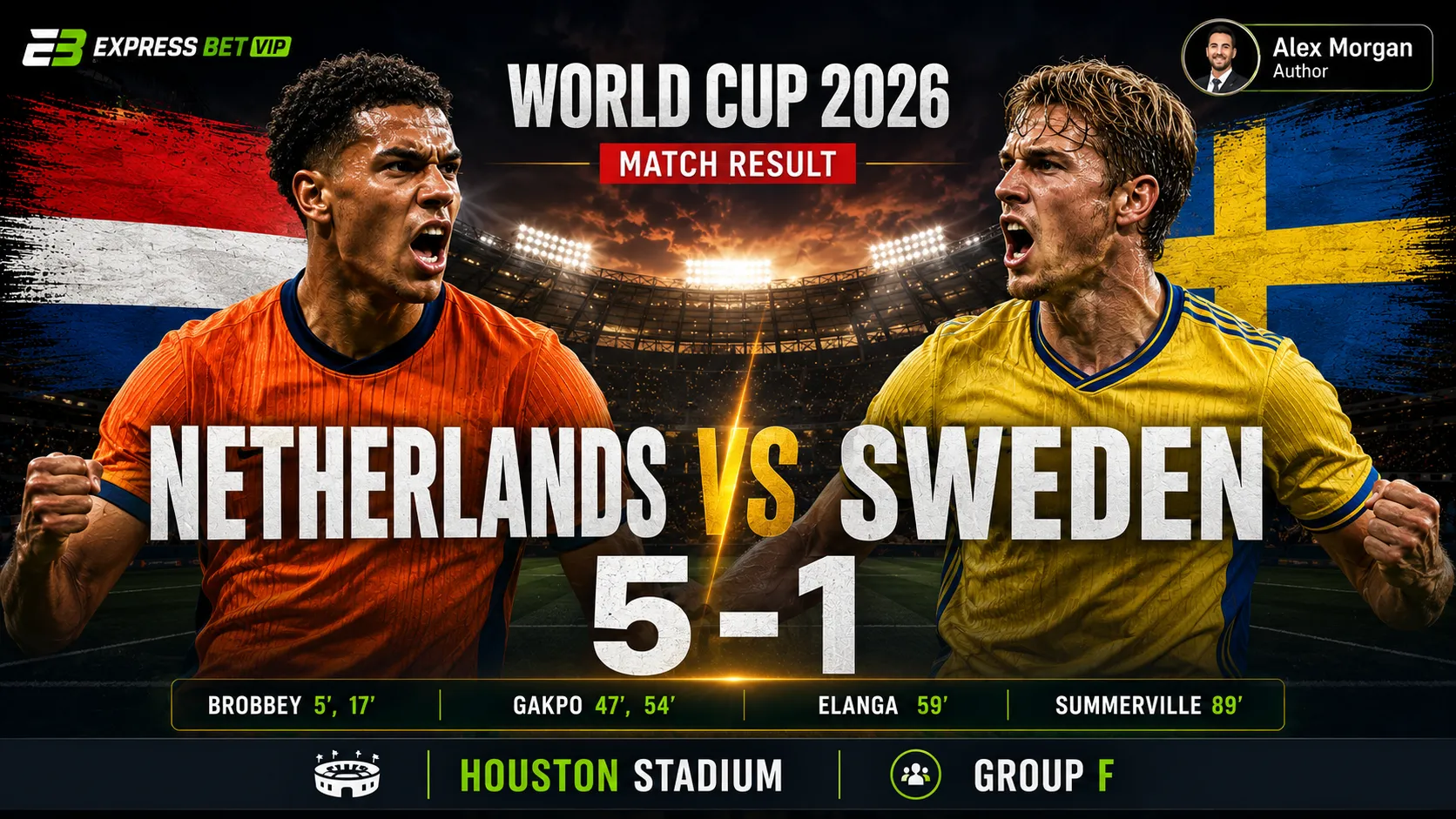
Netherlands beat Sweden 5-1 in their FIFA World Cup 2026 Group F match at Houston Stadium. Brian Brobbey scored twice inside 17 minutes, Cody Gakpo added two more early in the second half, Anthony Elanga pulled one back for Sweden, and Crysencio Summerville scored late. The main turning point was Brobbey’s early double: it turned Sweden’s high-confidence start to the tournament into a recovery job before the match had properly settled. Gakpo was the best player by end product, but Brobbey changed the match first. Tactically, Netherlands won through low crosses, right-side overloads and ruthless penalty-box movement. Locally, Houston’s heat risk and full stadium mattered, but did not explain the score. For bettors, Netherlands win, over 2.5, over 3.5 and both-teams-to-score “Yes” landed; outcomes still depended on odds and market timing.
| Item | Detail | Data status |
|---|---|---|
| Match | Netherlands vs Sweden | [CONFIRMED] |
| Competition | FIFA World Cup 2026 | [CONFIRMED] |
| Stage | Group stage | [CONFIRMED] |
| Group | Group F | [CONFIRMED] |
| Date | June 20, 2026 | [CONFIRMED] |
| Kickoff time | 12:00 PM CDT / 17:00 UTC | [CONFIRMED/REPORTED] |
| Host country | United States | [CONFIRMED] |
| City | Houston, Texas | [CONFIRMED] |
| Stadium | Houston Stadium / NRG Stadium | [CONFIRMED] |
| Attendance | 68,777 reported | [REPORTED] |
| Final score | Netherlands 5-1 Sweden | [CONFIRMED] |
| Half-time score | Netherlands 2-0 Sweden | [CONFIRMED/REPORTED] |
| Goal scorers | Brobbey 5’, 17’; Gakpo 47’, 54’; Elanga 59’; Summerville 89’ | [CONFIRMED] |
| Referee | not confirmed from verified public data | [UNKNOWN] |
| VAR | not confirmed from verified public data | [UNKNOWN] |
| Weather | high heat-risk context; exact match-time temperature, humidity and wind not available from verified public data | [REPORTED/UNKNOWN] |
| Pitch condition | not available from verified public data | [UNKNOWN] |
| Main tournament impact | Netherlands moved top of Group F on four points from two matches; Sweden stayed on three | [CONFIRMED/REPORTED] |
FIFA and Reuters confirm the final score as Netherlands 5-1 Sweden, with Brobbey, Gakpo, Elanga and Summerville as the goal scorers. Reuters’ live match page lists Houston Stadium, Houston, Texas, and the full goal sequence.
| Category | Content | Use in this article |
|---|---|---|
| [CONFIRMED] match facts | Final score, goal scorers, goal times, Group F, Houston Stadium | Used for title, TL;DR, quick facts, goal timeline and schema-ready facts |
| [REPORTED] details | Attendance 68,777, nearly 69,000 crowd, fan marches, heat and storm management, xG | Used with source attribution |
| [OBSERVED] match details | Dutch low-cross pattern, Sweden chance waste, right-side overloads, Verbruggen saves | Used for tactical explanation |
| [ANALYSIS] tactical interpretation | Netherlands converted wide pressure into central box finishes; Sweden’s front line received poor service and then missed chances | Editorial interpretation based on match evidence |
| [MARKET SIGNAL] betting interpretation | Netherlands win, over goals, BTTS Yes and Brobbey/Gakpo scorer markets were result-side winners | Post-match betting review only |
| [UNKNOWN] unavailable data | Referee, VAR crew, full official cards, exact match weather, roof status, closing odds | Marked as unavailable rather than invented |
This distinction matters because a 5-1 match can trick readers into thinking everything was obvious. It was not. Sweden created enough moments to irritate the clean narrative, especially before half-time, but Netherlands had better execution in the areas that decide scoreboards: low cross, near-post movement, rebound control and finishing. I compared the FIFA report, Reuters event data, Al Jazeera/AFP match detail, ESPN context and Houston local reporting. The result was not built from one tactical idea. It was built from one idea repeated until Sweden stopped pretending it was an accident.
Netherlands 5-1 Sweden was a statement scoreline, but the match was not just Dutch possession turning into a parade. It was more specific than that. Netherlands punished the same defensive corridor again and again, Sweden failed to control low deliveries into the six-yard zone, and Brian Brobbey turned Ronald Koeman’s selection call into a fairly blunt answer sheet.
Sweden came into the match with confidence after beating Tunisia 5-1. Netherlands had drawn 2-2 with Japan, a game that left them needing sharper control and less aesthetic hesitation. ESPN framed the Houston match as pivotal in Group F because Netherlands needed a first win and Sweden had the chance to move close to qualification.
The first Dutch goal arrived inside five minutes. Brobbey and Gakpo combined, Gakpo crossed low from the left, and Brobbey finished from close range. Twelve minutes later, another low delivery caused the same category of problem. This time Dumfries’ right-sided cross deflected into Brobbey’s path, and the striker toe-poked past Kristoffer Nordfeldt.
That early double gave the match its shape. Sweden had attacking names on paper — Alexander Isak, Viktor Gyökeres, Elanga off the bench — but football does not pay out on brochure strength. They had chances, especially through Gyökeres and Yasin Ayari, but Bart Verbruggen and poor final contact kept them out before half-time. Al Jazeera reported that Sweden had chances but were denied by good goalkeeping and wasteful finishing.
Koeman then made a half-time change, sending on Crysencio Summerville for Donyell Malen. Two minutes later, the third Dutch goal arrived. Gakpo finished from close range after yet another dangerous low ball from Dumfries. The fourth came in the 54th minute, when Gakpo cut inside and fired low into the bottom corner. Elanga’s 59th-minute consolation gave Sweden a clean attacking moment, but Summerville’s late fifth closed the match with the kind of numerical cruelty tournament football enjoys.
The scoreline was severe, not fraudulent. Netherlands were sharper, stronger in the box and more coherent in the wide zones. Sweden were not helpless. They were late, loose and badly punished. Those are different crimes, but the sentence can still be 5-1.
Brobbey scored the opener after a clean Dutch left-side move. He exchanged passes with Gakpo, continued his run, and finished from close range after Gakpo crossed low into the box. Al Jazeera described the move as “made in the Premier League,” involving Verbruggen, Reijnders and Gakpo before Brobbey stabbed in the low cross.
Assist: Cody Gakpo, reported.
Goal type: open-play close-range finish.
Shot type: first-time / close-range finish.
Defensive issue: Sweden allowed the low cross to travel through the most dangerous corridor.
Goalkeeper positioning: Nordfeldt was exposed by the speed and angle of the delivery.
VAR check: not confirmed from verified public data.
Tactical meaning: Netherlands immediately showed that Sweden’s centre-backs and full-backs would have to defend facing their own goal. That is rarely a pleasant job.
Emotional impact: the goal cancelled much of Sweden’s early tournament confidence. A team that had just won 5-1 against Tunisia was suddenly chasing after five minutes.
Local condition effect: no verified weather or pitch factor caused the goal. The early Dutch crowd surge mattered emotionally, not mechanically.
Betting impact: Netherlands match-winner and Netherlands first-goal markets strengthened immediately; Sweden win and draw tickets moved into rescue mode.
Brobbey scored again in the 17th minute. A Dumfries cross from the right deflected into his path, and Brobbey toe-poked past Nordfeldt. Houston Chronicle described Dumfries playing another low cross into the box and Brobbey redirecting it past the Sweden goalkeeper.
Assist: Denzel Dumfries involvement reported; official assist not confirmed from verified public data because of the deflection.
Goal type: open-play goal after deflected low cross.
Shot type: toe-poke / close-range redirect.
Defensive issue: Sweden again failed to control the low-delivery zone.
VAR check: not confirmed from verified public data.
Tactical meaning: the second goal proved the first was not a random breakdown. Netherlands had found Sweden’s defensive wound and kept pressing it.
Emotional impact: Sweden were forced to attack earlier than planned, which exposed even more transition and wide-space problems.
Betting impact: Netherlands handicap lines, over 2.5 and Brobbey scorer props gained major value after 17 minutes.
Gakpo scored two minutes after half-time. Dumfries again created danger with a low delivery, and Gakpo arrived centrally to finish. Houston Chronicle reported Dumfries’ second assist of the match and noted that the third goal came in similar fashion to the first two.
Assist: Denzel Dumfries, reported.
Goal type: open-play close-range goal.
Shot type: close-range finish.
Defensive issue: Sweden failed to reset after half-time and conceded through the same low-cross pattern.
VAR check: not confirmed from verified public data.
Tactical meaning: this was the kill shot. Sweden had half-time to adjust to the low-cross problem. They conceded from it within two minutes. Football can be impolite.
Emotional impact: the match moved from recoverable to near impossible.
Betting impact: over 2.5 landed early in the second half; Netherlands -1.5 and -2.5 became live winners depending on line.
Gakpo scored his second in the 54th minute, turning inside his defender and firing low into the bottom corner. Al Jazeera described it as a “lovely fourth,” and Houston Chronicle noted that he dribbled in from the left and beat Nordfeldt at the near post.
Assist: not confirmed from verified public data.
Goal type: open-play individual finish.
Shot type: low drive.
Defensive issue: Sweden allowed Gakpo to turn inside rather than forcing him away from goal.
VAR check: not confirmed from verified public data.
Tactical meaning: after three goals from low-cross chaos, Gakpo added a different problem: isolation finishing.
Emotional impact: 4-0 turned the match into damage control for Sweden.
Betting impact: over 3.5 landed; Gakpo anytime scorer and brace positions were rewarded.
Elanga pulled one back for Sweden in the 59th minute. Reuters and Al Jazeera both identify him as the scorer, while Houston Chronicle described him being played through behind the Dutch back line before finishing.
Assist: not confirmed from verified public data.
Goal type: open-play goal after run in behind.
Shot type: driven finish.
Defensive issue: Netherlands’ line was exposed after building a four-goal lead.
VAR check: not confirmed from verified public data.
Tactical meaning: Sweden’s best attacking route was direct speed behind the Dutch defence, not slow possession against a set block.
Emotional impact: the goal gave Sweden a small correction, not a comeback.
Betting impact: both-teams-to-score “Yes” landed; Netherlands clean-sheet backers lost.
Summerville scored the fifth late. FIFA and Reuters list the goal in the 89th minute, while Houston Chronicle’s live report referenced the 88th minute. The official-style event feeds put it at 89’.
Tactical meaning: Netherlands had the bench impact to keep attacking after the match was already settled.
Emotional impact: the fifth goal made the scoreline symmetrical with Sweden’s opening 5-1 win over Tunisia, which is exactly the sort of cruelty World Cups keep in storage.
Betting impact: over 5.5 landed only for markets using six total goals; correct-score markets shifted from 4-1 to 5-1 very late.
| Minute | Moment | Why it mattered | Data status |
|---|---|---|---|
| 5’ | Brobbey opener | Netherlands immediately exposed Sweden’s low-cross weakness | [CONFIRMED] |
| 17’ | Brobbey second goal | Same structural issue repeated; Sweden’s plan collapsed early | [CONFIRMED] |
| First half | Potter used hydration break to speak with Gabriel Gudmundsson | Sweden’s left side was being overloaded by Dumfries and Malen | [REPORTED] |
| First half | Gyökeres and Ayari chances missed or saved | Sweden could have made the game messy but failed to convert | [REPORTED] |
| Late first half | Sweden goal ruled out for offside | Kept Netherlands 2-0 ahead at half-time | [REPORTED] |
| 47’ | Gakpo third goal | Sweden’s half-time correction failed almost immediately | [CONFIRMED] |
| 54’ | Gakpo fourth goal | Turned Dutch control into a rout | [CONFIRMED] |
| 59’ | Elanga consolation | Killed Netherlands clean-sheet markets but not the match | [CONFIRMED] |
| 89’ | Summerville fifth | Closed the scoreline and reinforced Dutch bench depth | [CONFIRMED] |
| Post-match | Shelter-in-place order due to lightning nearby | Local weather management affected fans after the match, not the score | [REPORTED] |
The hydration break detail matters tactically because it shows Potter knew where the fire was. Al Jazeera reported that he went directly to left-sided defender Gabriel Gudmundsson during the break, with Sweden being overrun by Dumfries and Malen.
| Local factor | Verified or observed detail | Football meaning | Direct match evidence | Betting-result meaning | Data status | Anti-template status |
|---|---|---|---|---|---|---|
| Host country | United States | Neutral host country, but Dutch crowd presence was heavy | Houston match in Group F | No official home edge, but atmosphere leaned orange | [CONFIRMED/REPORTED] | Specific |
| City | Houston, Texas | Hot, humid Gulf Coast setting in June | Reuters and Houston Chronicle both referenced heat context | Heat could affect pressing duration and hydration breaks | [REPORTED] | Specific |
| Stadium | Houston Stadium / NRG Stadium | Large NFL venue under FIFA neutral naming | FIFA capacity release and NRG event listing | Full-stadium environment increased live-market emotion | [CONFIRMED] | Specific |
| Capacity | 68,777 final FIFA World Cup capacity | The reported attendance matched final capacity | FIFA and Houston Chronicle | Sellout crowd context, not predictive by itself | [CONFIRMED/REPORTED] | Specific |
| Attendance | 68,777 reported | Full stadium; orange sections visible, Swedish fans also present | Houston Chronicle | Crowd supported Dutch momentum after early goals | [REPORTED] | Specific |
| Dutch fan presence | Reuters expected around 15,000 Dutch supporters; Houston Chronicle showed major Oranje Fanwalk presence | Created strong visible orange identity around venue | Reuters / Houston Chronicle | Possible live-market mood support after early Dutch goals | [REPORTED] | Specific |
| Swedish fan presence | Reuters expected around 7,000 Swedish fans for march; Midsummer context | Sweden had visible travelling support but little scoreboard reward | Reuters / Houston Chronicle | Crowd did not protect Sweden from early collapse | [REPORTED] | Specific |
| Heat risk | 96% chance of performance-impairing heat | High relevance for hydration, sprint repetition, late recovery | Climate Central match page | Supports caution on second-half pressing assumptions | [REPORTED] | Specific |
| Heat/humidity management | Fan Festival closure; heat and humidity made headlines | Fan conditions were difficult; player impact should be cautious | Houston Chronicle | Local conditions could affect tempo, but goals came from tactics | [REPORTED] | Specific |
| Storm/lightning | Shelter-in-place order after match | Affected post-match crowd movement, not confirmed as match-performance factor | AP / Houston Chronicle | No direct market effect during play confirmed | [REPORTED] | Specific |
| Roof status | NRG has a retractable roof; match-specific roof status not confirmed | Cannot claim open-air or closed-roof tactical effect | Venue context only | No roof-based betting conclusion | [UNKNOWN] | Specific |
| Pitch condition | not available from verified public data | Cannot claim surface speed, slips or bounce | No verified pitch report found | No pitch-based betting conclusion | [UNKNOWN] | Specific |
Houston was not background wallpaper. It was one of the most locally specific environments of the group stage: noon kickoff, heat-risk profile, Dutch and Swedish fan marches, full-stadium attendance and weather management before and after the match.
Climate Central listed this Netherlands vs Sweden fixture at Houston Stadium with a 96% chance of performance-impairing heat, five percentage points higher because of climate change. That is not a decorative number. It is strong enough to affect how analysts should think about repeated pressing, hydration breaks and late-game running loads.
But it should not be used as a lazy explanation for 5-1. Heat did not make Sweden fail to defend three low crosses. Heat did not make Brobbey arrive first in the box twice. Heat did not make Gakpo finish sharply. The weather context belongs in the physical layer; the result belongs first in the tactical layer.
The crowd layer was also fixture-specific. Reuters reported Swedish Midsummer celebrations in Houston, around 7,000 Swedish fans expected for a march, and around 15,000 Dutch supporters preparing an Orange Walk in temperatures that could hit 100°F. Houston Chronicle later described thousands of Dutch fans on the Oranje Fanwalk and Sweden supporters marching from Helix Park.
The post-match weather detail matters, but only in the correct lane. AP and Houston Chronicle reported that fans were told to shelter in place after the match because of nearby storms and lightning. That affected crowd movement and event management. It did not explain the Dutch third goal in the 47th minute.
| Stadium factor | Detail |
|---|---|
| Stadium | Houston Stadium / NRG Stadium |
| Capacity | 68,777 final FIFA World Cup capacity |
| Attendance | 68,777 reported |
| Pitch type | not available from verified public data |
| Roof status | retractable-roof venue; match-specific roof status not confirmed |
| Acoustic effect | strong orange presence visible/reported; exact decibel or communication effect not available |
| Surface condition | not available from verified public data |
| Wind or airflow relevance | not available from verified public data |
| Goalkeeper distribution effect | no verified stadium-specific effect |
| Set-piece effect | Sweden had a disallowed header from a free-kick; no verified stadium effect |
| Communication effect | no verified evidence that crowd noise caused Sweden’s defensive failures |
| Data status | venue, capacity and attendance confirmed/reported; roof status during play, pitch and airflow unknown |
The available match evidence does not show a clear stadium-specific effect beyond the normal venue conditions.
That does not mean Houston Stadium was irrelevant. It means the result should not be explained through unverified stadium mechanics. The venue gave the match scale, heat-management complexity and a large orange-heavy crowd. The goals came from football actions: Dumfries delivering, Brobbey attacking, Gakpo finishing.
The roof point deserves restraint. NRG Stadium has a retractable roof, but the match-specific roof status was not confirmed from verified public data in the source set used here. Therefore, this article does not claim wind, roof acoustics or indoor cooling changed the tactical pattern.
The most visible stadium effect was emotional. Once Brobbey scored early, the orange sections had a match to feed. When a full stadium starts rewarding every Dutch entry into the box, Sweden’s defensive panic becomes easier to feel, even if it is harder to quantify.
| Factor | Detail |
|---|---|
| City | Houston, Texas |
| Host country | United States |
| Time zone | Central Daylight Time |
| Match kickoff | 12:00 PM CDT |
| Climate for match month | hot and humid Gulf Coast summer conditions |
| Match-time temperature | not available from verified public data |
| Humidity | not available from verified public data |
| Wind | not available from verified public data |
| Rain or sun | severe weather and lightning affected post-match stadium management; exact in-match rain/sun status not confirmed |
| Altitude | no meaningful altitude angle |
| Heat risk | 96% chance of performance-impairing heat |
| Likely physical effect | hydration pressure, reduced repeated-sprint comfort, lower late pressing tolerance |
| Actual match evidence | hydration-break tactical discussion reported; Netherlands still produced intense wide actions early and after half-time |
| Data status | heat-risk model and fan-weather management reported; exact match weather variables unknown |
The city-weather layer is stronger here than in many match reports because Houston’s heat was not vague. Climate Central’s fixture-specific model put performance-impairing heat risk at 96%. Reuters reported Dutch fans preparing for a 2.5-mile walk in temperatures that could hit 100°F. Houston Chronicle reported heat and humidity affecting fan events, including a Fan Festival closure.
The football conversion is still careful. Heat tends to reduce pressing duration and increase hydration pressure. It can make repeated recovery runs more expensive. Sweden’s left side being overrun before Potter spoke to Gudmundsson at the hydration break fits a physical and tactical stress point. But the evidence does not prove heat caused Sweden’s defensive failures. It shows those failures happened in a physically demanding setting.
The weather did not flatten Netherlands. If anything, Koeman’s team managed the hot noon context better: early lead, sharper wide patterns, half-time adjustment, then control through finishing. Sweden had chances, but their attacking players lacked the clean contact to turn the game. That is not a weather report. That is football.
Netherlands’ first half was defined by two things: Brobbey’s central power and the repeated delivery of low balls into Sweden’s six-yard corridor. Sweden’s first half was defined by the unpleasant discovery that a strong front line does not repair a weak defensive start.
Koeman’s most important selection was Brobbey. Reuters noted that he started after Koeman picked him over Memphis Depay, and that the choice was rewarded with two goals inside 17 minutes.
Brobbey gave Netherlands a different reference point. He did not drift into harmless pockets. He stayed close enough to the goal to make Sweden defend uncomfortable balls. On the first goal, he combined and arrived. On the second, he reacted. That sounds simple. Most effective striker work does until the team without it loses 5-1.
The Dutch wide mechanics were sharper than Sweden’s defensive rotations. On one side, Gakpo created the opener from the left. On the other, Dumfries and Malen repeatedly overloaded Sweden’s left. Al Jazeera reported that Potter used the hydration break to speak directly to Gabriel Gudmundsson, who was being overrun by Dumfries and Malen.
Sweden were not invisible. Gyökeres crossed for Yasin Ayari, who miscontrolled a major chance. Gyökeres then failed to make proper contact after being played in by Isak. Verbruggen had to work. Al Jazeera described Netherlands as “hanging on” by the end of the half, which is useful corrective detail. The 2-0 half-time score did not mean Sweden had no threat. It meant Sweden wasted their threat.
There was also a disallowed Sweden header late in the half. Houston Chronicle reported that Gustaf Lagerbielke thought he had cut the deficit from a free-kick header, but the goal was ruled out for offside. Sweden supporters booed, and Netherlands went in 2-0 up.
At half-time, Koeman had to decide whether to keep attacking or manage heat, lead and rhythm. Potter had a simpler problem: stop the low crosses, get cleaner service to Isak and Gyökeres, and prevent the match from becoming a Dutch shooting drill. He failed the first task within two minutes.
The second half began with a Dutch substitution and a Swedish collapse of correction.
Koeman brought on Crysencio Summerville for Donyell Malen. That did not reduce Netherlands’ wide threat. It refreshed it. Two minutes later, Dumfries delivered again and Gakpo made it 3-0. The most damning detail for Sweden was not conceding another goal. It was conceding another goal in the same family as the first two.
Gakpo’s second goal in the 54th minute changed the match from tactical superiority into a scoreboard beating. He cut inside and finished low. That goal mattered because it was not just the low-cross pattern. It showed Sweden could not simply overprotect the six-yard corridor and survive. Gakpo could still beat a defender directly.
Elanga’s goal five minutes later was Sweden’s best attacking action of the match. He ran behind the Dutch defence and finished well. That gave Sweden one useful attacking lesson: direct speed behind Netherlands’ line could work. The problem was that it arrived at 4-0. Tournament football accepts late corrections and then files them under “too late.”
The final half-hour was game management with one more Dutch sting. Netherlands did not need to chase, but Summerville still scored late. Sweden’s structure had stretched, the emotional pressure had gone, and the match had the slightly absurd symmetry of Sweden losing 5-1 after winning 5-1 in their opener.
The local weather layer still belonged in the background. Houston heat made management relevant, but Netherlands’ early second-half goals came before fatigue could serve as Sweden’s legal defence.
Netherlands won because their attacking structure repeatedly forced Sweden to defend the worst kind of ball: low, fast, across the face of goal, with a striker arriving between defenders.
Sweden lost because they did not protect the channels where those balls originated, and they did not defend the box with enough urgency once the ball arrived.
In possession, Netherlands often attacked like a side closer to a 3-2-5 or 3-4-3 shape than a static starting formation. Dumfries pushed high. Gakpo attacked from the left. Brobbey pinned the central defenders. Reijnders and De Jong helped connect progression. The crucial idea was not long possession. It was access to the crossing lane.
Sweden’s defensive block failed in two linked places. First, the wide defender was repeatedly isolated or overloaded. Second, the centre-backs and near-side midfielders did not collapse quickly enough into the box. If the cross is not stopped, the run must be tracked. Sweden often did neither.
The matchup between Dumfries and Sweden’s left side became one of the match’s central tactical collisions. Potter addressing Gudmundsson at the hydration break is a small but revealing piece of evidence. Coaches rarely use that window for poetry. They use it when a zone is bleeding.
Sweden’s attack had theoretical quality. Isak and Gyökeres are not minor forwards. But their service was inconsistent, and their finishing was worse. When Sweden did get chances, Ayari and Gyökeres did not convert. Verbruggen’s saves mattered because they stopped the match from becoming 2-1 or 2-2 before half-time.
The xG context supports the bigger picture. ESPN reported Netherlands’ xG at 2.47 and Sweden’s at 0.98. That is not a six-goal match by expected value, but it is a match where Netherlands created the better chances and finished above expectation.
This was not only Sweden defending badly. It was Netherlands attacking the same defensive weakness with professional cruelty.
| Zone | Edge | Evidence from the match | Key player | Local condition effect | Result impact |
|---|---|---|---|---|---|
| Netherlands left flank | Netherlands | Gakpo assisted opener and scored from left-sided isolation | Cody Gakpo | Heat did not stop early intensity | Opened match and added fourth |
| Netherlands right flank | Netherlands | Dumfries crosses created repeated danger | Denzel Dumfries | Hydration-break discussion reflected stress in this zone | Directly tied to second and third goals |
| Sweden left flank | Netherlands | Gudmundsson overrun by Dumfries/Malen, per match reporting | Gabriel Gudmundsson / Denzel Dumfries | Heat may have made repeated recovery harder | Major Sweden failure point |
| Central midfield | Slight Netherlands edge | De Jong/Reijnders helped progression; Sweden still had chances | Frenkie de Jong, Tijjani Reijnders | No verified weather-specific passing effect | Supported Dutch control |
| Penalty box | Netherlands | Brobbey and Gakpo converted low deliveries | Brobbey, Gakpo | Crowd amplified early Dutch pressure | Decisive |
| Set pieces | Sweden partial threat | Lagerbielke header ruled out for offside | Lagerbielke | No wind/pitch effect confirmed | No score impact |
| Transitions | Sweden isolated moments | Elanga scored by running behind | Anthony Elanga | Heat not confirmed as factor | Consolation only |
| Defensive third | Netherlands enough | Verbruggen saves kept Sweden out before Elanga | Bart Verbruggen | No stadium-specific effect | Preserved early cushion |
| Bench impact | Netherlands | Summerville came on at half-time and scored late | Crysencio Summerville | Fresh legs relevant in Houston heat context | Added fifth |
Ratings are editorial ratings based on confirmed events, reported statistics and available public data. Full official player ratings were not used.
| Player / unit | Rating | Explanation |
|---|---|---|
| Bart Verbruggen | 7.5 | Important saves before half-time when Sweden threatened. Beaten by Elanga but helped prevent a very different game state. |
| Denzel Dumfries | 8.5 | One of the tactical keys. His low deliveries from the right created repeated Swedish panic. Reported involvement in multiple goals. |
| Virgil van Dijk | 6.5 | Managed most defensive phases, though Elanga’s run showed the Dutch line was not spotless. |
| Netherlands centre-backs | 6.5 | Protected the lead well enough but allowed Sweden some first-half chances. |
| Frenkie de Jong | 7.5 | Helped stabilize progression and tempo. Houston Chronicle noted his strong first-half passing and defensive contribution. |
| Tijjani Reijnders | 7.0 | Involved in the opener’s build-up and gave Netherlands useful midfield connection. |
| Donyell Malen | 6.5 | Helped overload Sweden’s left side before being replaced at half-time. |
| Cody Gakpo | 9.5 | Two goals, one assist reported, and the best attacking end product on the pitch. Controlled the left-sided attacking story. |
| Brian Brobbey | 9.0 | Two goals inside 17 minutes. His start over Depay became Koeman’s central selection win. |
| Crysencio Summerville | 7.5 | Came on at half-time, kept Sweden stretched and scored the late fifth. |
| Netherlands substitutes | 7.0 | Bench impact was positive, especially Summerville. |
| Player / unit | Rating | Explanation |
|---|---|---|
| Kristoffer Nordfeldt | 4.5 | Conceded five. Exposed repeatedly by low crosses, but did not receive enough defensive protection. |
| Gabriel Gudmundsson | 4.0 | Overrun on Sweden’s left. Potter’s hydration-break talk with him told the story. |
| Sweden centre-backs | 4.5 | Lost Brobbey twice early and never solved the low-cross problem. |
| Gustaf Lagerbielke | 5.5 | Had a header ruled out for offside, one of Sweden’s better first-half flashes. Defensive unit still suffered badly. |
| Sweden midfield unit | 5.0 | Could not protect wide channels or provide enough clean service to the forwards. |
| Yasin Ayari | 5.0 | Had a major chance but miscontrolled. That was a real swing moment. |
| Alexander Isak | 5.5 | Played Gyökeres into one chance but was largely anonymous for long spells. |
| Viktor Gyökeres | 5.0 | Got into promising positions but failed to make proper contact on key chances. |
| Anthony Elanga | 7.0 | Sweden’s best attacking output. Scored with direct speed in behind. |
| Sweden substitutes | 6.0 | Elanga made the strongest impact, but the broader bench could not shift the game state. |
| Category | Choice | Reason |
|---|---|---|
| Man of the Match | Cody Gakpo | Two goals, opener assist, constant threat from the left |
| Best attacker | Brian Brobbey | His early double created the match’s foundation |
| Best midfielder | Frenkie de Jong | Gave Netherlands rhythm and helped protect the match state |
| Best defender | Denzel Dumfries | Functioned almost like an attacking weapon from right-back/wing-back zones |
| Best goalkeeper | Bart Verbruggen | First-half saves prevented Swedish pressure becoming a comeback |
| Best substitute | Crysencio Summerville | Entered at half-time and scored the fifth |
| Most underrated performance | Tijjani Reijnders | Important connector in Dutch build-up and opener sequence |
| Most disappointing performance | Sweden’s left-side defensive unit | It was targeted, stressed and beaten repeatedly |
| Player | Team | Incident | Minute | Card or injury status | Next-match impact | Data status |
|---|---|---|---|---|---|---|
| Gabriel Gudmundsson | Sweden | Tactical discussion with Potter at hydration break after being overloaded | First half | No card confirmed | Tactical concern, not suspension issue | [REPORTED] |
| Gustaf Lagerbielke | Sweden | Header ruled out for offside | Late first half | No card/injury | No disciplinary impact | [REPORTED] |
| Full yellow-card list | Both teams | not available from verified public data | not available | unknown | accumulation impact unknown | [UNKNOWN] |
| Red cards | Both teams | none confirmed from reviewed source set | not available | none known | none known | [UNKNOWN] |
| Injuries | Both teams | no major injury confirmed from verified public data | not available | not available | unknown | [UNKNOWN] |
No verified source reviewed for this article confirmed a major injury, red card or suspension-triggering disciplinary event. The main discipline-related content remains unavailable from verified public data.
The referee and VAR crew were not confirmed from verified public data in the source set used for this article.
The main officiating moment was Sweden’s disallowed first-half goal. Houston Chronicle reported that Gustaf Lagerbielke thought he had scored from a free-kick header, but the goal was ruled out for offside. The decision kept Netherlands 2-0 ahead at half-time.
There is no verified basis to frame this match as a refereeing controversy. The offside decision mattered, but the match was not decided by one whistle. Sweden conceded five and repeatedly failed to defend the same delivery pattern. That is a football problem before it is an officiating debate.
| Statistic | Netherlands | Sweden | Source / status |
|---|---|---|---|
| Final score | 5 | 1 | [CONFIRMED] |
| Half-time score | 2 | 0 | [CONFIRMED/REPORTED] |
| xG | 2.47 | 0.98 | [REPORTED, ESPN] |
| Goals | Brobbey 5’, 17’; Gakpo 47’, 54’; Summerville 89’ | Elanga 59’ | [CONFIRMED] |
| Attendance | 68,777 | same | [REPORTED, Houston Chronicle] |
| Stadium capacity | 68,777 | same | [CONFIRMED, FIFA] |
| Heat risk | 96% | 96% | [REPORTED, Climate Central] |
| Referee | not available from verified public data | not available | [UNKNOWN] |
| Full official cards | not available from verified public data | not available | [UNKNOWN] |
| Full official possession / shots / corners | not available from verified public data in reviewed source set | not available | [UNKNOWN] |
The xG tells a useful but incomplete story. Netherlands’ 2.47 xG against Sweden’s 0.98 suggests the Dutch deserved the better result, but the 5-1 margin also shows superior finishing and Sweden’s defensive collapse. Expected goals does not explain every bruise. It explains the chance base. The scoreboard explains the punishment.
This section is post-match betting analysis. It is not betting advice.
| Market | Pre-match expectation | Actual result | Winning side of market | Key match trigger | Local factor | Caution note |
|---|---|---|---|---|---|---|
| Match winner | Netherlands likely respected but Sweden had momentum after 5-1 over Tunisia | Netherlands won 5-1 | Netherlands | Brobbey early double | Orange-heavy crowd amplified momentum | Price mattered |
| Draw | Live draw weakened after 5’ and collapsed after 17’ | Lost | Draw backers lost | Two early Dutch goals | Heat context did not protect Sweden | Early goals distort draw markets |
| Double chance | Netherlands/draw landed | Netherlands win | Netherlands side | Wide superiority | Full stadium atmosphere | Not automatically low-risk next time |
| Over/under 2.5 | Needed three goals | Six total goals | Over 2.5 | Gakpo 47’ | Heat did not suppress scoring | Landed early second half |
| Over/under 3.5 | Needed four goals | Six total goals | Over 3.5 | Gakpo 54’ | No totals suppression despite heat | Scoreline was finishing-driven |
| Both teams to score | Sweden needed one | Yes | BTTS Yes | Elanga 59’ | No local cause | Clean-sheet backers lost late enough to hurt |
| Correct score | 5-1 | Netherlands 5-1 | 5-1 tickets | Summerville 89’ | None direct | Very high-variance market |
| First goalscorer | Brobbey | Brobbey | Brobbey tickets | Started over Depay and attacked box | None direct | Selection mattered |
| Anytime goalscorer | Brobbey, Gakpo, Elanga, Summerville | All scored | Those player markets landed | Box presence / wide supply | Heat not decisive | Player markets depend on starts and roles |
| Corners/cards | Full official result unavailable | unknown | unknown | Wide pressure likely influenced corners, but official data missing | No verified line | Do not invent |
| Live betting | Netherlands shortened heavily after 17’ | Dutch lead grew | Netherlands live backers | Early double and third at 47’ | Crowd and heat shaped tempo, not certainty | Live prices move fast |
This result rewarded bettors who backed Netherlands, overs, Brobbey, Gakpo and both-teams-to-score. It punished a simple “Sweden scored five last game, so Sweden must be stable” reading. ESPN noted Sweden became the first team in World Cup history to win its first game by four goals and then lose its second by the same margin. That is a tidy way of saying tournament form is not a bank account.
The heat angle is not an under angle by itself. This match had a 96% heat-risk model and still produced six goals. Local conditions can shape fatigue, substitutions and tempo, but they do not automatically create low totals. Bettors who reduce weather to a single market rule are usually just building a trap with nicer vocabulary.
| Local factor | Market possibly affected | Actual match evidence | Possible betting interpretation | Risk of overreaction | Safer conclusion |
|---|---|---|---|---|---|
| 96% heat-risk model | Totals, late tempo, substitutions | Six goals, Dutch intensity early and after half-time | Heat did not prevent scoring | Assuming heat equals under | Heat is context, not a market rule |
| Noon Houston kickoff | Pressing, hydration, second-half legs | Hydration-break tactical discussion reported | Physical stress likely mattered in wide recovery runs | Blaming weather for tactical failure | Sweden’s left-side issue was tactical and physical |
| Orange-heavy crowd | Match winner, live momentum | Dutch fans heavily visible/reported; full stadium | Early goals made crowd factor louder | Treating fan color as predictive | Crowd amplified, did not cause |
| Swedish Midsummer support | Sweden live resilience | Around 7,000 Swedish fans expected; Sweden still collapsed early | Support did not translate into defensive control | Overvaluing travel support | Scoreboard beats atmosphere |
| Retractable-roof venue | Weather exposure, acoustics | Match-specific roof status unknown | No roof-based market conclusion | Inventing indoor/outdoor effect | Mark as unknown |
| Post-match lightning | Event logistics | Shelter-in-place after final whistle | No in-play market effect confirmed | Linking post-match weather to score | Relevant to event management only |
| Low-cross pattern | Player shots, assists, goals | Dumfries/Gakpo/Brobbey repeatedly attacked same zone | Stronger than generic weather angle | Assuming repeatability vs other opponents | Tactical market clue, not guarantee |
The best betting lesson from the local layer is restraint. Houston heat mattered enough to mention. It did not produce an under. The full orange-heavy stadium mattered enough to shape mood. It did not score the opener. The tactical market signal was cleaner: Dutch wide delivery plus Brobbey’s start was the edge that actually hit the scoreboard.
At full time, Netherlands moved to four points from two Group F matches. Sweden stayed on three. Al Jazeera reported Netherlands top of Group F with four points, ahead of Sweden on three, Japan on one and Tunisia on zero before the later Japan-Tunisia match.
The immediate effect was clear: Netherlands took control of their qualification path before facing Tunisia, while Sweden’s final match against Japan became heavier. Reuters later reported that Netherlands were battling to top the group after the 5-1 Sweden win and their opening 2-2 draw with Japan.
Later group-stage context confirmed the importance of the result. Netherlands topped Group F after beating Tunisia, Japan finished second, and Sweden advanced as one of the best third-placed teams. That later outcome does not soften this 5-1 defeat; it simply shows how the expanded 48-team format can forgive one bad night if the surrounding points are good enough.
For Netherlands, this match was the group-stage pivot. For Sweden, it was a warning label that still came with a route out of the group.
Netherlands got the striker choice right. Brobbey’s selection gave the team a penalty-box target with strength, timing and little interest in decorative wandering.
They also attacked Sweden’s left side with discipline. Dumfries’ repeated low crosses were not random. They were a plan. The plan kept working.
Gakpo’s contribution made the attack less predictable. He could create from the left, arrive centrally, and then score from isolation. That matters. A team becomes harder to defend when its winger is both supplier and finisher.
The final positive was game-state management. Netherlands scored early, scored again before Sweden could settle, and then scored immediately after half-time. That sequence kills arguments. It leaves the opponent with only explanations.
Sweden’s first error was defensive spacing. The low-cross channel stayed open for too long. Once can be a mistake. Three times becomes a file.
The second error was poor wide-side protection. Gudmundsson was left with too much to solve, and Potter’s hydration-break intervention showed the staff recognized it.
The third error was chance conversion. Sweden had first-half opportunities through Ayari and Gyökeres. At 2-0, one goal changes the psychology. Sweden did not take it.
The fourth error was emotional control after half-time. Conceding in the 47th minute after a half-time team talk is the kind of thing that makes a manager age in public.
Koeman’s selection of Brobbey was decisive. Reuters framed it directly: Brobbey scored twice in the opening 17 minutes after Koeman picked him over Depay. That is the kind of selection call a coach would rather see printed on a billboard than discussed by a panel.
Koeman also managed the half-time shape well. Summerville came on, Netherlands remained dangerous, and the third goal arrived almost immediately. This was not passive protection of a 2-0 lead. It was controlled aggression.
The only concern was defensive looseness before half-time and on Elanga’s goal. Against stronger knockout opponents, Netherlands could not rely on outscoring every warning sign.
Potter’s main problem was not that Sweden had no plan. It was that the plan was damaged almost immediately.
He recognized the left-side issue and addressed Gudmundsson at the hydration break. That was correct. It was also not enough. Sweden still conceded from the same broad pattern after half-time.
His attacking structure had names but not rhythm. Isak and Gyökeres did not receive enough clean service, and when they did, they failed to finish. Elanga’s second-half goal showed there was a direct route behind the Dutch line, but Sweden found it too late.
Potter’s post-match line, reported by Reuters, was that Sweden could take some positives from the opportunities created but had to learn from the slow start. That diagnosis is accurate and not especially comforting.
Brobbey’s double was his major national-team breakthrough moment. Al Jazeera reported that before this match he had scored only once for his country since making his debut three years earlier.
Gakpo’s second goal gave him five World Cup career goals, according to Houston Chronicle, which noted his scoring record from the 2022 group stage.
ESPN reported that Sweden became the first team in World Cup history to win their first game of a tournament by four goals and then lose their second by the same margin.
No additional player milestone was confirmed from verified public data at the time of writing.
This was not a tactical copy of the Netherlands’ 2014 5-1 win over Spain. It should not be treated as one. But it carried one shared World Cup lesson: once the Dutch attack finds rhythm in the wide channels, the scoreboard can become rude quickly.
The better analogy is internal to this tournament. Sweden beat Tunisia 5-1, then lost 5-1 to Netherlands. The same scoreline moved from proof of Swedish promise to proof that group-stage conclusions are unstable.
For Netherlands, the match restored authority after the 2-2 draw with Japan. For Sweden, it turned a strong opening result into a more complicated tournament story. That is the strange emotional grammar of the World Cup: one result gives you a door; the next one hits you with it.
The main incident was Sweden’s disallowed first-half goal. Houston Chronicle reported that Gustaf Lagerbielke’s header from a free kick was ruled out for offside, drawing boos from Swedish supporters.
There was no verified public basis to call the decision a scandal. No confirmed penalty controversy, red-card dispute, crowd disorder, pitch invasion or VAR controversy was found in the reviewed source set.
The post-match shelter-in-place order due to lightning was significant for event operations. AP reported stadium officials urged fans to stay inside for about 30 minutes after the match as rain swept through the area.
This article adds more than the scoreline by separating:
The local layer is not generic. It is specific to Netherlands vs Sweden in Houston: 68,777 attendance, Dutch Orange Walk, Swedish Midsummer fan presence, 96% heat-risk model, noon kickoff, hydration-break relevance and post-match lightning shelter-in-place.
| Check item | Included? | Status | Specific to this fixture? | Needs update later |
|---|---|---|---|---|
| Stadium detail | Yes | Confirmed/reported | Yes | Add official pitch/roof status if released |
| City detail | Yes | Confirmed/reported | Yes | Add verified team acclimatization notes if available |
| Weather detail | Yes | Reported/unknown | Yes | Add exact match-time temperature, humidity and wind if verified |
| Pitch detail | Limited | Unknown | Yes | Add surface-speed or pitch-condition report if released |
| Crowd detail | Yes | Reported | Yes | Add official fan split if confirmed |
| Travel/acclimatization detail | Limited | Reported fan-travel only | Yes | Update only from official team sources |
| Betting-risk detail | Yes | Analysis | Yes | Add licensed closing odds if available |
| Tactical-local connection | Yes | Analysis with limits | Yes | No forced weather explanation |
| Anti-template status | Passed | Mixed | Yes | Houston-specific details prevent reuse unchanged |
| Data point | Status | Source type |
|---|---|---|
| Final score | [CONFIRMED] | FIFA, Reuters, Al Jazeera |
| Goal scorers | [CONFIRMED] | FIFA, Reuters |
| Goal times | [CONFIRMED] | Reuters live match page / FIFA report |
| Stadium | [CONFIRMED] | FIFA / Reuters / NRG event listing |
| City | [CONFIRMED] | Reuters / NRG event listing |
| Attendance | [REPORTED] | Houston Chronicle |
| Referee | [UNKNOWN] | not available from verified public data |
| VAR | [UNKNOWN] | not available from verified public data |
| Lineups | [PARTIAL] | match reports and event descriptions |
| Substitutions | [PARTIAL/REPORTED] | Al Jazeera, Houston Chronicle |
| Cards | [UNKNOWN] | not available from verified public data |
| Injuries | [UNKNOWN] | no major verified injury data found |
| Match statistics | [PARTIAL/REPORTED] | ESPN, public match reports |
| xG | [REPORTED] | ESPN |
| Odds | [UNKNOWN] | no licensed closing odds used |
| Local stadium factors | [CONFIRMED/REPORTED] | FIFA capacity release, Houston Chronicle, NRG Park |
| Local city factors | [REPORTED] | Reuters, Houston Chronicle |
| Weather | [REPORTED/UNKNOWN] | Climate Central, Houston Chronicle, AP |
| Pitch condition | [UNKNOWN] | not available from verified public data |
| Crowd profile | [REPORTED] | Reuters, Houston Chronicle |
| Tournament impact | [CONFIRMED/REPORTED] | Al Jazeera, Reuters, ESPN |
Recommended schema types:
For SportsEvent, include when available:
Structured data must match the visible page content. Do not add schema facts that are not visible in the article.
Update this article if:
Last updated: July 5, 2026, 23:30 Asia/Kolkata.
Netherlands 5-1 Sweden happened because the Dutch found a specific weakness and treated it without mercy. Brobbey gave the attack a proper centre-forward. Gakpo gave it class and output. Dumfries gave it the repeated delivery mechanism. Sweden gave it far too much space.
The scoreline was severe but not absurd. Netherlands had the better chance quality, the better box presence and the better response after half-time. Sweden had moments, but moments are not a defence.
The most important tactical detail was the repeated low cross into Sweden’s six-yard corridor. The most important local detail was Houston’s heat-risk and full-stadium environment, though neither should be mistaken for the cause of the result. The heat added physical context. The goals came from football.
For Netherlands, this was the win that put them in control of Group F. For Sweden, it was a reminder that a 5-1 win in one game can become ancient history after 17 minutes of the next. For bettors, the match showed why player-role information matters: Brobbey starting over Depay was not trivia. It was the market clue that actually touched the scoreboard.
Football betting carries financial risk. A correct match analysis does not guarantee a winning bet. Odds change before and during matches, and one early goal can completely alter the market.
Local conditions can also be overvalued by bettors. Heat risk, crowd size, stadium profile and fan travel matter, but they do not make any result automatic. Never chase losses. Do not bet money needed for daily life. Use limits, take breaks and check local betting laws before gambling. Use licensed operators only. Betting should remain entertainment, not income.
Netherlands beat Sweden 5-1 in their FIFA World Cup 2026 Group F match.
Brian Brobbey scored twice for Netherlands, Cody Gakpo scored twice, Crysencio Summerville added the fifth, and Anthony Elanga scored for Sweden.
Cody Gakpo was the best player overall because he scored twice and created the opening goal. Brian Brobbey was almost as important because his early double shaped the match.
The result moved Netherlands to the top of Group F with four points from two matches at that stage. Sweden stayed on three points and still had a path to the Round of 32.
Netherlands match winner, over 2.5 goals, over 3.5 goals and both-teams-to-score “Yes” were the main result-side winners. Exact outcomes depended on odds, line and market timing.