
New Zealand vs Belgium Match Result
Table of Contents Show
Views 5
TL;DR: New Zealand vs Belgium Match Result
Belgium beat New Zealand 5-1 at BC Place Vancouver and finished first in World Cup 2026 Group G. Leandro Trossard scored twice before Kevin De Bruyne made it 3-0. Elijah Just gave New Zealand brief hope in the 84th minute, but substitutes Romelu Lukaku and Alexis Saelemaekers completed the rout. Trossard was the outstanding player, combining two goals with the assist for De Bruyne. Belgium won through constant penalty-box occupation, rapid switches of play and superior movement around New Zealand’s compact 4-2-3-1 block. The closed roof and hybrid-grass surface produced stable conditions at a provider-listed 16°C. Belgium’s moneyline, -2.5 handicap, over 3.5 goals and both teams to score markets won. Actual returns depended on the sportsbook, rules and timing of the wager. Belgium advanced as group winners; New Zealand were eliminated. (Reuters)
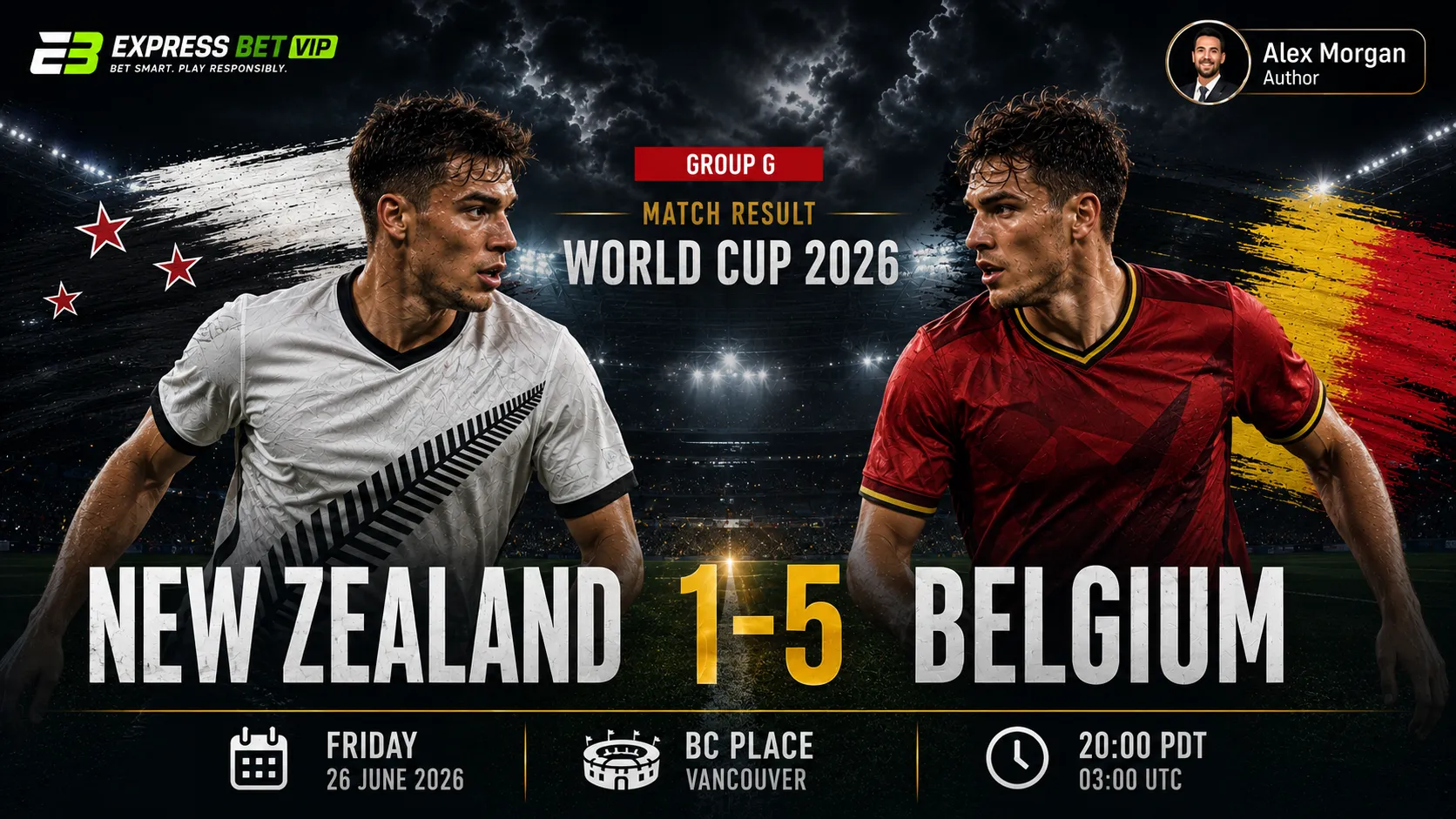
Quick Facts: Final Score, Goals, Venue, and Match Status
| Item | Verified detail |
|---|---|
| Match | New Zealand vs Belgium |
| Competition | FIFA World Cup 2026 |
| Stage | Group stage, Matchday 3 |
| Group | Group G |
| Local date | June 26, 2026 |
| FIFA UTC date | June 27, 2026 |
| Kickoff | 20:00 PDT / 03:00 UTC |
| Host country | Canada |
| City | Vancouver, British Columbia |
| Stadium | BC Place Vancouver |
| Attendance | 52,497 |
| Final score | New Zealand 1-5 Belgium |
| Half-time score | New Zealand 0-1 Belgium |
| New Zealand scorer | Elijah Just 84’ |
| Belgium scorers | Leandro Trossard 28’, 50’; Kevin De Bruyne 66’; Romelu Lukaku 86’; Alexis Saelemaekers 90+4’ |
| Referee | Adham Mohammad Tumah Makhadmeh |
| VAR | Juan Soto Arevalo |
| Assistant VAR | Erick Yair Miranda Galindo |
| Weather | 16°C according to FotMob |
| Surface | Hybrid grass |
| Roof | Retractable roof closed under tournament policy |
| Cards | Marko Stamenic 46’; Elijah Just 56’ |
| Main tournament impact | Belgium won Group G; New Zealand finished fourth and were eliminated |
The score, attendance, lineups, cards and officials are supported by the FIFA, Sky and FotMob match records. (FIFA)
Verified Facts vs Analysis
| Category | Information |
|---|---|
| [CONFIRMED] | Belgium won 5-1 and led 1-0 at half-time. |
| [CONFIRMED] | Trossard scored twice; De Bruyne, Lukaku and Saelemaekers also scored. |
| [CONFIRMED] | Just scored New Zealand’s goal in the 84th minute. |
| [CONFIRMED] | A Belgian penalty decision was overturned after a VAR review. |
| [CONFIRMED] | Belgium attempted 35 shots and registered 79 penalty-box touches. |
| [REPORTED] | Both teams had substantial visible support inside BC Place. |
| [OBSERVED] | New Zealand’s defensive block repeatedly became overloaded near its left side and central penalty area. |
| [ANALYSIS] | Belgium’s movement between wide and central positions prevented New Zealand from maintaining stable marking references. |
| [MARKET SIGNAL] | Belgium closed around -600 in a published FanDuel snapshot. |
| [DISPUTED] | FotMob’s xG total varied slightly between 3.64 and 3.65 for Belgium. |
| [UNKNOWN] | Exact humidity, wind, consensus closing odds and verified arrival itineraries. |
The distinction matters because the score, goals and VAR decision belong to the match record. Claims about overloads, defensive spacing and pressure are interpretations based on that record.
It also protects post-match accuracy. A provider’s xG model can help explain chance quality, but it does not convert a tactical opinion into an official statistic. (Sky Sports)
Final Score and Match Summary
Belgium arrived at the final Group G match under pressure. Draws against Egypt and Iran had produced two points, one goal and a sizeable collection of unanswered questions. Rudi Garcia responded with five starting changes. Romelu Lukaku moved to the bench, Jérémy Doku returned after illness and Charles De Ketelaere started as the central forward. (Reuters)
New Zealand still had a qualification route. Victory could have carried the All Whites into second place or into the ranking of the best third-placed teams, depending on Egypt against Iran. Darren Bazeley retained Chris Wood as captain and used Elijah Just, Sarpreet Singh and Ryan Thomas behind him. (Reuters)
Belgium took control immediately.
The Red Devils circulated through Youri Tielemans and Hans Vanaken, while Kevin De Bruyne moved between New Zealand’s midfield and defensive lines. Maxim De Cuyper advanced aggressively from left-back, and Doku provided width on the right.
New Zealand defended in a compact 4-2-3-1 that often became a 4-4-1-1. Joe Bell and Marko Stamenic protected the central channel. Singh remained close to Wood, while Thomas and Just tracked the Belgian full-backs.
The plan conceded the ball but attempted to deny central space. Belgium simply moved the central space.
De Bruyne drifted toward the right half-space. Trossard started from the left but repeatedly entered the six-yard and penalty-spot zones. Vanaken advanced beyond the double pivot, creating another player for New Zealand’s centre-backs to monitor.
Trossard struck the post in the 11th minute. Belgium then appeared to win a penalty when his shot hit Finn Surman’s arm. Referee Adham Mohammad initially pointed to the spot, but the VAR review showed that Surman’s arm was in a natural position. The decision was overturned. (Reuters)
The incident gave New Zealand a reprieve without changing the direction of play.
Belgium continued winning corners and recovering clearances. De Bruyne and Trossard attempted seven shots each during the match. The All Whites spent the first half protecting their penalty area rather than building meaningful possession beyond it. New Zealand did not register a shot before half-time. (FotMob)
The breakthrough arrived in the 28th minute. De Bruyne delivered another corner, New Zealand failed to complete the clearance and Trossard finished from close range.
The goal was neither a surprise nor the product of a single catastrophic error. Belgium had placed too many players around the second ball. New Zealand defended the first action but not the continuation.
Belgium led only 1-0 at half-time despite producing complete territorial control. Tournament football has often allowed an underdog to survive under pressure and then discover one equalising chance. New Zealand required that familiar script. Belgium rewrote it five minutes after the restart.
Vanaken released Trossard behind the defensive line. The forward controlled the ball with his chest and converted acrobatically after Crocombe’s attempted intervention. The exact description varies slightly across match reports, but the official assist was credited to Vanaken. (Fox Sports)
New Zealand responded with its first genuine attacking period. Just forced Courtois into a low save, and Tim Payne attempted from distance. The All Whites had finally moved the ball beyond Belgium’s counterpress.
The response lasted without producing a goal. Belgium instead scored the third.
Trossard carried the ball through the inside-left channel and drew several defenders. The loose pass reached De Bruyne outside the box. He shifted the ball onto his left foot and drove a low finish into the bottom-right corner. (Fox Sports)
At 3-0, Belgium controlled the match and the group. Egypt were drawing with Iran, meaning Belgium’s goal difference placed them first.
Garcia withdrew De Bruyne and Trossard in the 72nd minute. The substitutions should have reduced Belgium’s attacking edge. Instead, they demonstrated how difficult it is to defend a deep bench after spending 70 minutes blocking 25-yard passes from De Bruyne.
New Zealand kept competing. Just scored in the 84th minute, producing the team’s third goal by the winger at the tournament and briefly reducing Belgium’s goal-difference advantage over Egypt. (Sky Sports)
The possibility lasted approximately two minutes.
Lukaku had entered in the 85th minute. Nicolas Raskin crossed from the right, and the striker powered a header beyond Crocombe in the 86th. Lukaku then assisted Saelemaekers in stoppage time.
The substitutes produced two goals almost immediately. Belgium had spent two matches searching for attacking certainty. Against New Zealand, even the replacements arrived with an answer.
The 5-1 score reflected Belgium’s control. Thirty-five shots, ten on target, 28 created chances and 79 touches inside the opposition box describe a match in which New Zealand’s defence was permanently occupied. (Sky Sports)
The final margin was severe but not misleading. FotMob calculated approximately 3.64–3.65 xG for Belgium and 0.24–0.25 for New Zealand. Belgium slightly exceeded its chance-quality model, while New Zealand scored from very limited attacking access. (FotMob)
Goal Timeline
28’ — Leandro Trossard, Belgium, Set-Piece Second Phase
De Bruyne delivered a corner into New Zealand’s penalty area. The first contact did not produce a clean Belgian shot, but the All Whites could not move the ball beyond the danger zone.
Trossard remained active inside the crowded area and finished from close range.
Official assist: None consistently listed in the reviewed structured feeds
Build-up: De Bruyne corner and goalmouth second phase
Goal type: Set-piece second ball
Shot type: Close-range finish
VAR: No decisive intervention
Defensive issue: New Zealand failed to clear the second ball
Goalkeeper position: Crocombe was screened and reacting to multiple contacts
Tactical meaning: Belgium converted its sustained penalty-box occupation
Match impact: New Zealand could no longer rely on a goalless defensive game state
Reuters described the goal as the completion of a De Bruyne delivery, while FOX recorded a De Bruyne corner immediately before the score. (Reuters)
50’ — Leandro Trossard, Belgium, Chest-and-Volley Finish
Vanaken passed behind New Zealand’s back line toward Trossard. The forward controlled the ball on his chest and converted from close range with an improvised finish.
Some reports describe Crocombe saving or touching the first attempt before Trossard completed the action. The official assist was credited to Vanaken.
Assist: Hans Vanaken
Goal type: Open-play vertical pass
Shot type: Chest control and acrobatic close-range finish
VAR: No decisive intervention
Defensive issue: Trossard entered behind the midfield and between defenders
Goalkeeper position: Crocombe advanced but could not secure the ball
Tactical meaning: Belgium attacked before New Zealand’s second-half block had settled
Match impact: The two-goal deficit forced New Zealand to advance more players
The goal arrived five minutes after the interval and removed much of the value from New Zealand’s first-half resistance. (Fox Sports)
66’ — Kevin De Bruyne, Belgium, Long-Range Goal
Trossard carried possession toward a cluster of New Zealand defenders. His movement pulled the defensive line toward the ball and created space outside the penalty area.
De Bruyne received the loose pass, moved the ball onto his left foot and drove a low shot into the bottom-right corner.
Assist: Leandro Trossard
Goal type: Open-play long-range strike
Shot type: Low left-footed finish from outside the box
VAR: No decisive intervention
Defensive issue: New Zealand collapsed toward Trossard and left De Bruyne unmarked
Goalkeeper position: Crocombe’s view was restricted by defenders
Tactical meaning: Belgium punished the space created by an overloaded defensive line
Match impact: Belgium moved into firm control of Group G
De Bruyne became Belgium’s oldest World Cup goalscorer at 34. (Fox Sports)
84’ — Elijah Just, New Zealand, Open-Play Goal
New Zealand finally progressed through Belgium’s defensive structure and Just finished from inside the penalty area.
No official assist was recorded in the reviewed Sky team sheet.
Assist: None officially confirmed
Goal type: Open-play finish
Shot type: Close-range or central penalty-box finish
VAR: No decisive intervention
Defensive issue: Belgium’s concentration dropped after multiple substitutions
Goalkeeper position: Courtois was unable to prevent the finish
Tactical meaning: New Zealand converted one of only six total penalty-box touches
Match impact: Belgium’s group-winning goal-difference margin briefly narrowed
The goal rewarded Just’s movement and persistence. He had also produced New Zealand’s first shot on target in the 54th minute. (Reuters)
86’ — Romelu Lukaku, Belgium, Header
Raskin received on the right and delivered toward the centre of the six-yard box. Lukaku attacked the cross above New Zealand’s defenders and headed past Crocombe.
Assist: Nicolas Raskin
Goal type: Cross and header
Shot type: Powerful close-range header
VAR: No decisive intervention
Defensive issue: New Zealand failed to track a fresh central striker
Goalkeeper position: Crocombe had little reaction time
Tactical meaning: Belgium’s substitutions restored the three-goal advantage immediately
Match impact: New Zealand’s goal had no time to create sustained momentum
Lukaku scored approximately one minute after entering. The goal made him Belgium’s outright leading World Cup scorer with six, passing Marc Wilmots. (Fox Sports)
90+4’ — Alexis Saelemaekers, Belgium, Open-Play Goal
Lukaku carried the ball into the area, found his route blocked and returned possession toward Saelemaekers.
The midfielder took a touch and finished into the bottom-left corner with the final attacking action.
Assist: Romelu Lukaku
Goal type: Open-play cutback
Shot type: Right-footed finish from the centre of the box
VAR: No decisive intervention
Defensive issue: New Zealand’s exhausted line failed to close the second runner
Goalkeeper position: Crocombe remained central and was beaten toward the corner
Tactical meaning: Belgium’s bench continued attacking after the result was secure
Match impact: The final score moved to 5-1
The fifth goal completed a substitute-driven finish in which Lukaku scored and assisted within nine minutes of entering. (Fox Sports)
Key Moments That Changed the Match
Trossard Hits the Post
Trossard struck the woodwork in the 11th minute. The chance established the direction of the match and showed how easily Belgium could place attackers behind New Zealand’s midfield line. (Reuters)
The Penalty Is Overturned
Trossard’s shot struck Surman’s arm, and Belgium were initially awarded a penalty. VAR showed that the defender’s arm was in a natural position, leading the referee to reverse the decision.
The review was important for officiating accuracy but did not release New Zealand from pressure. Belgium continued attacking the same zones. (FotMob)
New Zealand Fail to Clear the Corner
The opening goal came from the second phase of a corner. New Zealand reached the ball but did not end the attack.
Tournament football has a habit of turning an incomplete clearance into a scorer’s photograph. Trossard provided the latest example.
Belgium Score Immediately After Half-Time
Trossard’s second goal prevented New Zealand from rebuilding confidence during the interval. The All Whites now needed to take risks against a team waiting to attack space.
Courtois Saves from Just
Just forced Courtois into a low save in the 54th minute. A goal at 2-1 would have changed the emotional state of the match and forced Belgium to defend a narrower margin. (Reuters)
De Bruyne Makes It 3-0
Belgium’s third goal ended the competitive contest. It also returned the team to first place in the live Group G standings.
Just Scores in the 84th Minute
New Zealand’s goal briefly reduced Belgium’s advantage over Egypt on goal difference. It offered the All Whites a deserved reward without providing enough time for a comeback.
Lukaku Scores Immediately from the Bench
Lukaku restored Belgium’s three-goal advantage 64 seconds after entering, according to Sky’s match report. His response prevented any late uncertainty about first place. (Sky Sports)
Local Match Conditions: Stadium, City, Weather, Pitch, and Crowd
| Local factor | Verified or observed detail | Football meaning | Direct match evidence | Betting-result meaning | Data status | Anti-template status |
|---|---|---|---|---|---|---|
| Stadium | BC Place Vancouver | Steep, enclosed bowl with retractable central roof | Full 52,497 attendance | Strong acoustic setting | [CONFIRMED] | Fixture-specific |
| Roof | Closed under FIFA tournament policy | Reduced rain and direct wind influence | No weather stoppage or wind distortion | Lower weather volatility | [CONFIRMED] | Fixture-specific |
| Venue classification | BC Place still considers itself open-air | Outdoor temperature remained relevant | FotMob listed 16°C | Avoid treating it as climate-controlled | [CONFIRMED] | Fixture-specific |
| Surface | Hybrid grass installed for World Cup | Different from venue’s regular artificial field | Belgium completed 88% of passes | No clear surface-derived disadvantage | [CONFIRMED] | Fixture-specific |
| Attendance | 52,497, matching match configuration | Full bowl increased sound retention | Belgian chants audible after De Bruyne’s goal | Atmosphere supported momentum but did not cause result | [CONFIRMED/REPORTED] | Fixture-specific |
| Temperature | 16°C | Moderate physical load | No heat-related collapse | Weak standalone betting signal | [REPORTED] | Fixture-specific |
| Humidity | Not available from verified public data | Fatigue impact cannot be quantified | No verified figure | No responsible market inference | [UNKNOWN] | Fixture-specific |
| Wind | Roof reduced direct exposure; exact reading unavailable | Long balls and crosses remained stable | Belgium completed six accurate crosses | No verified wind edge | [UNKNOWN/OBSERVED] | Fixture-specific |
| Belgium base camp | Renton, Washington | Relatively short regional journey | Belgium remained in the Pacific Northwest | Reduced cross-continent travel burden | [CONFIRMED] | Fixture-specific |
| New Zealand base camp | San Diego, California | Greater theoretical travel distance | Exact arrival itinerary unavailable | Do not convert base geography into a fatigue claim | [CONFIRMED/UNKNOWN] | Fixture-specific |
| Crowd split | Both sets of supporters attended in large numbers | Mixed neutral-site atmosphere | Reuters reported substantial support for both | No automatic Belgium home advantage | [REPORTED] | Fixture-specific |
FIFA stated that the roof would remain closed for the World Cup matches at BC Place to maintain broadcast consistency. BC Place’s own guidance says the stadium should still be treated as open-air whether the roof is open or closed, meaning the external temperature remained relevant even though rain and direct wind were reduced. (instagram.com)
The roof helped create stable ball-flight conditions. Belgium’s switches, De Bruyne’s set-piece delivery and Raskin’s late cross were not visibly disrupted by wind. Exact wind data was not available, so stronger claims would be invented.
The hybrid grass supported an 88% Belgian passing accuracy and 54.5% possession. New Zealand also completed 84.6% of its passes, although much of that circulation occurred outside Belgium’s defensive third. No reviewed source identified a decisive slip, damaged area or irregular bounce. (Sky Sports)
The temperature of 16°C provided moderate playing conditions. Belgium’s attacking activity increased rather than declined in the second half. Four of the six goals arrived after the 65th minute, which offers no evidence of a heat-driven reduction in intensity.
The full stadium amplified Belgium’s strongest period. Reuters reported both teams had significant backing and noted Belgian chants after De Bruyne’s goal. Noise may have complicated communication inside New Zealand’s defensive line, but no individual error can be conclusively assigned to the crowd. (Reuters)
The base-camp geography was uneven. Belgium trained in Renton near Seattle, while New Zealand’s official camp was in San Diego. Exact travel and arrival schedules were not publicly verified, so the difference should be treated as logistical context, not proof of fatigue. (inside.fifa.com)
Stadium-Specific Match Impact
| Stadium factor | Match detail |
|---|---|
| Stadium | BC Place Vancouver |
| Location | Downtown Vancouver |
| Match capacity | 52,497 |
| Attendance | 52,497 |
| Pitch type | Hybrid natural grass |
| Regular venue surface | Artificial turf |
| Roof status | Retractable roof closed |
| Venue classification | Open-air under BC Place guidance |
| Acoustic effect | Full enclosed bowl; chants carried clearly |
| Surface condition | Stable; no decisive defect reported |
| Wind relevance | Reduced by closed roof; exact airflow unavailable |
| Goalkeeper distribution | No verified roof- or pitch-related problem |
| Set-piece effect | Belgium scored after a corner second phase |
| Communication effect | Possible acoustic pressure, but no provable noise-caused error |
| Data status | Capacity, attendance, surface and roof confirmed; airflow unknown |
Inside FIFA confirmed that BC Place received a tournament-specific hybrid grass pitch. The official venue guidance confirms the retractable roof covers the playing area and that event-day roof decisions normally shape exposure, although FIFA’s tournament policy kept it closed. (inside.fifa.com)
The stadium influenced the match most clearly through consistency. Belgium could switch play, cross and shoot without an obvious weather complication.
The opening goal followed a corner, but that reflects De Bruyne’s delivery and Belgium’s second-ball structure more than the architecture.
Crocombe’s five saves and Courtois’s one save contained no verified handling mistake linked to the hybrid surface.
The available match evidence does not show a clear stadium-specific effect beyond the closed roof, stable grass, full attendance and strong acoustics.
City and Weather Impact
| Factor | Detail |
|---|---|
| City | Vancouver |
| Province | British Columbia |
| Host country | Canada |
| Time zone | Pacific Daylight Time, UTC-7 |
| Kickoff | 20:00 local time |
| June climate | Generally mild coastal conditions |
| Match temperature | 16°C according to FotMob |
| Humidity | Not available from verified public data |
| Wind | Not available from verified public data |
| Rain | No match-changing rain exposure under closed roof |
| Roof | Closed retractable roof |
| Altitude | No meaningful altitude factor |
| Likely physical effect | Moderate repeated-sprint and recovery demand |
| Actual evidence | Belgium sustained pressure and scored four second-half goals |
| Data status | Temperature and roof confirmed; humidity and wind unknown |
Vancouver’s evening temperature did not suppress the match. Belgium attempted 35 shots, created 28 chances and continued attacking after making five substitutions.
The first-half score of 1-0 resulted from New Zealand’s compactness and Belgium’s incomplete finishing rather than slow weather conditions.
Second-half fatigue was more visible in defensive spacing than in general physical collapse. New Zealand’s midfield could no longer maintain short distances as Belgium introduced Onana, Saelemaekers, Raskin and Lukaku.
Long passing remained accurate. De Bruyne’s switches and Vanaken’s pass before the second goal travelled without visible wind disruption.
Set-piece delivery also remained reliable. Belgium won eight corners and created the opening goal from one of them.
No weather-related cramp, goalkeeper error or substitution was confirmed.
First Half Analysis
New Zealand started in a 4-2-3-1:
Max Crocombe; Tim Payne, Finn Surman, Tyler Bindon, Liberato Cacace; Joe Bell, Marko Stamenic; Sarpreet Singh, Ryan Thomas, Elijah Just; Chris Wood.
Belgium also used a 4-2-3-1:
Thibaut Courtois; Timothy Castagne, Brandon Mechele, Arthur Theate, Maxim De Cuyper; Youri Tielemans, Hans Vanaken; Jérémy Doku, Kevin De Bruyne, Leandro Trossard; Charles De Ketelaere. (FotMob)
The matching formations did not create matching roles.
New Zealand’s system became a low 4-4-1-1. Singh remained close to Wood, while Just and Thomas tracked the Belgian full-backs. Bell and Stamenic protected the zone in front of Surman and Bindon.
Belgium attacked closer to a 3-2-5.
Castagne often remained deeper, effectively forming a three-player base with Mechele and Theate. De Cuyper advanced on the left. Tielemans held midfield, while Vanaken moved beyond him.
The five attacking lanes were occupied by:
- De Cuyper on the left;
- Trossard in the left half-space;
- De Ketelaere centrally;
- De Bruyne in the right half-space;
- Doku on the right.
New Zealand’s block could protect the centre or support the full-backs. It could not do both without leaving another Belgian free.
Belgium pressed New Zealand’s short build-up through De Ketelaere and De Bruyne. Trossard and Doku closed the full-backs, while Vanaken followed Bell or Stamenic.
Crocombe therefore played several longer passes toward Wood. The captain could compete physically, but Belgium positioned Mechele underneath the first contact and Tielemans around the second ball.
New Zealand struggled to sustain possession because Wood was isolated. Singh could not move close enough without leaving Belgium’s deepest midfielder free during transitions.
Belgium’s most productive route came from switching the point of attack.
When New Zealand shifted toward Doku, De Bruyne or Tielemans changed play toward Trossard and De Cuyper. When the block moved left, Belgium returned toward De Bruyne’s side.
The penalty-area volume became extreme. Belgium had 79 touches in the box across the match. New Zealand had six. The first-half difference was already obvious before the opening goal. (Sky Sports)
The overturned penalty demonstrated correct VAR use. Surman’s arm was struck, but the review established a natural position.
Belgium did not respond with frustration. The team continued winning corners and recovering clearances.
Trossard’s goal came from that pressure. The All Whites defended the delivery without defending the second action.
New Zealand’s physical tone remained controlled. There were no first-half cards and no major confrontation.
At half-time, Bazeley needed another runner closer to Wood and a quicker route around Belgium’s counterpress. Garcia needed only to convert pressure more efficiently.
Second Half Analysis
Bazeley made two changes at half-time. Ben Old replaced Singh, and Jesse Randall replaced Thomas.
The changes increased direct running. Old moved through the inside-left channel, while Randall gave New Zealand another player willing to attack space beyond Belgium’s full-backs. (Sky Sports)
The tactical intention was reasonable. Trossard scored before it could develop.
Belgium’s second goal exposed the distance between New Zealand’s defensive and midfield lines. Vanaken could receive and play forward without immediate pressure. Trossard then attacked the space behind the defence.
New Zealand responded better after 2-0. Just forced Courtois to save, and Payne attempted from distance. For several minutes, Belgium’s counterpress became less precise.
Stamenic had been booked in the 46th minute, limiting his ability to stop Belgian transitions with tactical contact. Just received New Zealand’s second yellow in the 56th. (Sky Sports)
Garcia replaced Doku with Matias Fernandez-Pardo in the 56th minute. Belgium retained the same broad structure but became less dependent on right-wing isolation.
Trossard’s carry before De Bruyne’s goal was decisive. New Zealand had begun sending more players forward. When possession changed, the defensive line retreated toward Trossard, leaving the edge of the box unprotected.
De Bruyne’s finish made it 3-0 and shifted the match toward workload management.
Belgium removed De Bruyne and Trossard in the 72nd minute. Onana strengthened midfield, and Saelemaekers provided fresh movement from the wing.
New Zealand’s later substitutions included Michael Boxall, Callum McCowatt and Francis de Vries. Bazeley attempted to maintain defensive organisation while giving the team enough energy to find a goal. (Sky Sports)
Just’s finish provided that goal.
Belgium’s response showed the difference between consolation and momentum. New Zealand had reduced the deficit but remained structurally open. Raskin and Lukaku entered, then combined immediately.
The final phase became a bench mismatch. Belgium’s substitutes attacked defenders who had spent the match completing clearances and tracking rotations.
New Zealand’s late pressure was genuine enough to produce one goal. It was not sustained enough to threaten the result.
Tactical Picture: Why the Match Was Won and Lost
Belgium won because their 4-2-3-1 produced a five-player attacking line against New Zealand’s back four.
New Zealand’s wingers were forced to defend so deeply that Wood became isolated. Every successful Belgian attack therefore created another period of Belgian possession.
The Red Devils’ key pressing triggers were:
- a backward pass toward Crocombe;
- a slow pass from a centre-back to a full-back;
- Bell or Stamenic receiving with their back to Belgium’s goal;
- a loose second ball after a long pass toward Wood;
- an incomplete New Zealand clearance.
The opening goal came directly from the final trigger.
Belgium’s build-up relied on several positional rotations:
- De Cuyper advanced;
- Trossard moved inside;
- De Bruyne shifted toward the right;
- Doku stayed wide;
- Vanaken made delayed forward runs;
- De Ketelaere occupied both centre-backs.
New Zealand’s double pivot became overloaded because it had to screen De Bruyne, follow Vanaken and protect the centre-backs.
The full-backs then faced two-player combinations. Cacace had to manage Doku and Castagne’s supporting movement. Payne had to track De Cuyper’s advance while remaining aware of Trossard inside.
Belgium also protected transitions well. Tielemans remained behind the attacking line, while one full-back stayed deeper. New Zealand rarely received the open field required for Wood, Just or Old to attack directly.
The 35-shot total was not created through random shooting. Belgium produced 28 chances and 79 penalty-box touches. The xG total of approximately 3.65 confirms that the attack repeatedly entered useful areas. (Sky Sports)
New Zealand’s plan failed because the defensive block became too passive. The All Whites protected central spaces but lacked pressure on Belgium’s passers.
Once De Bruyne and Vanaken had time, Belgium could move the ball to whichever zone New Zealand had temporarily left exposed.
The All Whites’ attack depended too heavily on Wood winning direct balls. Just provided movement around him, but the supporting midfielders started too far from the striker.
Belgium’s winning plan combined width, half-space occupation and repeated second-ball recovery. New Zealand’s losing plan provided resistance without a sustainable route out of pressure.
Tactical Collision Map
| Zone | Edge | Match evidence | Key player | Local-condition effect | Result impact |
|---|---|---|---|---|---|
| New Zealand left flank | Belgium | Doku and Castagne stretched Cacace’s side | Jérémy Doku | Stable roof conditions aided switches | Sustained pressure |
| New Zealand right flank | Belgium | De Cuyper advanced while Trossard moved inside | Leandro Trossard | Hybrid grass supported quick combinations | Trossard’s two goals |
| Central midfield | Belgium | Vanaken and Tielemans controlled second balls | Hans Vanaken | No clear local effect | New Zealand could not escape |
| Edge of penalty area | Belgium | De Bruyne scored from Trossard’s pass | Kevin De Bruyne | Clean ball flight | Third goal |
| Penalty box | Belgium | 79 touches to New Zealand’s six | Trossard / De Ketelaere | Stable surface | Five goals |
| Set pieces | Belgium | Opening goal followed a corner | Kevin De Bruyne | Closed roof reduced wind variability | First goal |
| Transitions | Belgium | New Zealand’s wider second-half shape left space | Leandro Trossard | Moderate temperature supported repeated sprints | Third goal |
| Defensive third | Belgium | New Zealand registered only six shots | Arthur Theate | No surface disruption | Controlled match |
| Goalkeeper build-up | Belgium | Courtois faced little pressure | Thibaut Courtois | Closed roof aided predictable distribution | Retained possession |
| Bench impact | Belgium decisively | Lukaku scored; Raskin and Lukaku assisted | Romelu Lukaku | Fresh legs late | Fourth and fifth goals |
Player Ratings and Individual Performances
The ratings below are editorial assessments based on tactical responsibility, execution and verified match events. They are not official FIFA ratings.
New Zealand Player Ratings
Max Crocombe — 5.5
Made five saves and faced 35 shots. He was exposed repeatedly rather than responsible for the overall defeat. The second goal became untidy around his attempted intervention, but several finishes gave him little realistic chance.
Tim Payne — 5.3
Worked against De Cuyper and Trossard’s rotations. He attempted one of New Zealand’s early second-half shots but spent most of the match defending near his own box.
Finn Surman — 5.0
Survived the overturned handball penalty but struggled with Belgium’s penalty-area movement. He completed numerous defensive actions without controlling the space around second balls.
Tyler Bindon — 5.2
Competed physically against De Ketelaere and later Lukaku. Belgium’s repeated entries eventually stretched his positioning.
Liberato Cacace — 5.6
Faced Doku, Castagne and De Bruyne’s right-sided combinations. He offered occasional progression but could not leave the defensive line safely.
Joe Bell — 5.4
Tried to screen De Bruyne and support the build-up. Belgium’s pressure repeatedly forced him backward. Replaced after 64 minutes.
Marko Stamenic — 5.2
Carried much of the central defensive workload. His 46th-minute yellow card reduced his ability to stop transitions aggressively.
Sarpreet Singh — 5.4
Started behind Wood but received too far from the striker. He struggled to influence the match and was replaced at half-time.
Ryan Thomas — 5.3
Worked defensively and attempted to track De Cuyper. New Zealand needed more attacking progression from his position.
Elijah Just — 7.2
New Zealand’s best player. Forced Courtois into a save, remained active in transition and scored the consolation goal. His yellow card was the main negative.
Chris Wood — 5.8
Received little support and contested direct passes against multiple defenders. His influence was restricted by Belgium’s control of second balls.
Ben Old — 6.0
Added more direct carrying after half-time and helped New Zealand move beyond the first Belgian pressure line.
Jesse Randall — 6.3
Provided energy, took set pieces and contributed to New Zealand’s improved second-half attacking presence.
Michael Boxall — 5.6
Entered during a difficult phase and attempted to stabilise the defensive structure.
Callum McCowatt — 5.7
Offered fresh movement without creating a decisive chance.
Francis de Vries — 5.4
Entered late and faced Belgium’s strongest substitute-driven period.
Belgium Player Ratings
Thibaut Courtois — 6.5
Made one meaningful save from Just and had little work during the first half. Could not preserve the clean sheet.
Timothy Castagne — 7.1
Supported Doku while retaining enough defensive balance. Belgium’s right side controlled territory throughout.
Brandon Mechele — 7.0
Handled Wood’s aerial presence and helped Belgium recover second balls.
Arthur Theate — 7.2
Defended proactively and contributed to Belgium’s high territorial line. Also tested Crocombe during second-half pressure.
Maxim De Cuyper — 7.6
Provided width, combined with Trossard and maintained pressure on New Zealand’s right side. His movement was central to Belgium’s attacking shape.
Youri Tielemans — 7.4
Protected transitions, circulated possession and helped Belgium keep New Zealand pinned back.
Hans Vanaken — 7.8
Supplied Trossard’s second goal and repeatedly moved beyond New Zealand’s midfield. His positioning created an additional marking problem.
Jérémy Doku — 6.8
Stretched the defensive line and forced New Zealand to defend wide. His final action was less decisive than Trossard’s.
Kevin De Bruyne — 8.8
Scored, controlled set pieces and repeatedly changed the point of attack. His movement and passing defined Belgium’s territorial dominance.
Leandro Trossard — 9.5
Two goals, an assist, seven shots and constant intelligent movement. He was the clear Man of the Match.
Charles De Ketelaere — 6.9
Did not score but occupied both centre-backs and created space for Trossard and De Bruyne.
Matias Fernandez-Pardo — 6.4
Entered for Doku and found useful shooting positions, although his finishing lacked accuracy.
Amadou Onana — 6.6
Added physical control after De Bruyne’s departure and helped Belgium retain territory.
Alexis Saelemaekers — 7.4
Scored the fifth goal and maintained attacking energy during stoppage time.
Nicolas Raskin — 7.5
Entered in the 85th minute and immediately assisted Lukaku with an accurate cross.
Romelu Lukaku — 8.2
Scored and assisted within minutes of entering. His header also made him Belgium’s record World Cup scorer.
Best Players of the Match
Man of the Match: Leandro Trossard
Trossard scored twice, assisted De Bruyne and repeatedly occupied the spaces New Zealand struggled to protect. His seven shots matched De Bruyne’s total. (FotMob)
Best attacker: Leandro Trossard
His movement was more important than a fixed starting position. He appeared wide during build-up and central when the decisive ball arrived.
Best midfielder: Kevin De Bruyne
De Bruyne controlled set pieces, switches of play and the speed of Belgium’s attacks.
Best defender: Arthur Theate
Theate protected Belgium’s high line and limited Wood’s access to central combinations.
Best goalkeeper: Thibaut Courtois
Crocombe made more saves, but Courtois produced the important stop when Just could have reduced the score to 2-1.
Best substitute: Romelu Lukaku
One goal and one assist after entering in the 85th minute.
Most underrated performance: Hans Vanaken
Vanaken’s forward movement and assist gave Belgium another central route when New Zealand focused on De Bruyne.
Most disappointing performance: Sarpreet Singh
Singh could not connect New Zealand’s midfield with Wood. Belgium’s press and the team’s low block made his role extremely difficult.
Injuries, Suspensions, Cards, and Discipline
| Player | Team | Incident | Minute | Card or injury status | Next-match impact | Data status |
|---|---|---|---|---|---|---|
| Marko Stamenic | New Zealand | Serious foul | 46’ | Yellow card | New Zealand eliminated | [CONFIRMED] |
| Elijah Just | New Zealand | Serious foul | 56’ | Yellow card | New Zealand eliminated | [CONFIRMED] |
| Nathan Ngoy | Belgium | Suspended before match | Pre-match | Unavailable after red card vs Iran | Available later subject to suspension term | [CONFIRMED] |
| Match injuries | Both | No major match injury confirmed | — | None confirmed | No verified effect | [UNKNOWN] |
| Red cards | Both | None during match | — | None | None | [CONFIRMED] |
Sky recorded ten New Zealand fouls, seven Belgium fouls, two yellow cards and no red cards. (Sky Sports)
No confirmed injury forced a substitution. Belgium’s changes were tactical and related to workload management.
Referee and VAR Analysis
Adham Mohammad Tumah Makhadmeh handled the match with Juan Soto Arevalo as VAR and Erick Yair Miranda Galindo as assistant VAR. (Sky Sports)
The major decision involved Surman’s handball.
The referee initially awarded Belgium a penalty after Trossard’s shot struck the defender’s arm. VAR recommended a review because the arm appeared to remain in a natural position.
The referee overturned the penalty after checking the monitor. The decision aligned with the available match descriptions and prevented a severe interpretation of accidental contact. (FotMob)
None of the six goals required a prolonged review.
The referee allowed a relatively low foul count and issued only two yellow cards, both to New Zealand during the second half.
The match did not become confrontational despite the widening score. The officials had little influence on the outcome beyond correctly reversing the early penalty award.
Match Statistics
| Statistic | New Zealand | Belgium |
|---|---|---|
| Possession | 45.5% | 54.5% |
| Shots | 6 | 35 |
| Shots on target | 2 | 10 |
| FotMob xG | 0.24–0.25 | 3.64–3.65 |
| Big chances missed | 0 | 2 |
| Corners | 5 | 8 |
| Touches in opposition box | 6 | 79 |
| Accurate passes | 369 | 462 |
| Pass accuracy | 84.6% | 88.0% |
| Chances created | 3 | 28 |
| Attempted crosses | 17 | 16 |
| Accurate crosses | 2 | 6 |
| Goalkeeper saves | 5 | 1 |
| Successful tackles | 6 | 8 |
| Recoveries | 38 | 48 |
| Interceptions | 6 | 10 |
| Blocks | 11 | 1 |
| Clearances | 35 | 27 |
| Duels won | 31 | 38 |
| Aerial duels won | 7 | 8 |
| Fouls | 10 | 7 |
| Yellow cards | 2 | 0 |
| Red cards | 0 | 0 |
| Offsides | 1 | 1 |
| PPDA | Not available | Not available |
| Distance covered | Not available | Not available |
Sky supplied the main statistics. FotMob supplied the xG estimate. (Sky Sports)
Possession alone understates Belgium’s dominance. A 54.5% share appears relatively balanced. The territorial data does not.
Belgium recorded more than 13 times as many penalty-box touches and created 28 chances to New Zealand’s three.
New Zealand’s 45.5% possession included circulation among defenders and midfielders while Belgium remained organised behind the ball.
The 11 New Zealand blocks and 35 clearances show how much defending occurred near Crocombe.
Belgium’s 35 attempts were the country’s third-highest World Cup total in Opta’s records from 1966 onward. (FotMob)
Betting Result Angle
FOX published Belgium at approximately -600, New Zealand at +1500 and the draw at +650 in a FanDuel market snapshot.
Belgium -2.5 was priced around +115. The total was set at 3.5, with over 3.5 around -104 and under 3.5 around -118. Both teams to score — Yes was approximately +104. (Fox Sports)
| Market | Pre-match expectation | Actual result | Winning market side | Key match trigger | Local factor | Caution |
|---|---|---|---|---|---|---|
| Match winner | Belgium overwhelming favourite | Belgium won 5-1 | Belgium moneyline | Trossard’s opening goal | Stable roof conditions | Very short price |
| Draw | Low probability | No draw | Losing market | Belgium’s territorial control | No meaningful local edge | New Zealand survived 27 minutes |
| New Zealand win | Major upset required | New Zealand lost | Losing market | Six shots and limited box access | Crowd support did not offset quality gap | High odds reflected low probability |
| Belgium -2.5 | Belgium needed a three-goal margin | Won by four | Belgium -2.5 | De Bruyne’s third goal and late substitutes | Stable surface aided attack | Handicap remained unsettled until second half |
| Over/under 3.5 | Four goals needed for over | Six goals | Over 3.5 | Just’s goal made it four total | Conditions did not suppress scoring | Three goals came after 83’ |
| Both teams to score | No was slight favourite | Both scored | BTTS Yes | Just 84’ | No local cause | Won very late |
| Correct score | Belgium 5-1 | Final 5-1 | Correct-score backers | Saelemaekers 90+4’ | Bench depth mattered | Extremely high variance |
| First goalscorer | Belgian attackers favoured | Trossard | Trossard backers | Corner second phase | Closed roof aided set-piece consistency | Price not verified |
| Anytime De Bruyne | +165 in FOX snapshot | De Bruyne scored | De Bruyne backers | Trossard’s assist | No direct local effect | Odds changed before kickoff |
| Anytime Lukaku | -175 despite starting on bench | Lukaku scored | Operator-dependent winning bet | Entered 85’, scored 86’ | No local cause | Settlement rules require participation |
| Cards | Moderate line expected | Two yellows | Under positions, line-dependent | Controlled match | No weather-driven fouling | Exact line unavailable |
| Corners | Belgium expected to dominate territory | Belgium won 8-5 | Belgium corner positions, line-dependent | Repeated wide pressure | Stable delivery conditions | Handicap not verified |
| Goalkeeper saves | Crocombe expected to face pressure | Five saves | Crocombe over-save positions, line-dependent | Ten Belgian shots on target | No handling disruption | Prop line unavailable |
| Live betting | Belgium pressure without early goal | 1-0 at half-time, 5-1 final | Second-half Belgium and overs benefited | Trossard’s 50’ goal | Bench depth sustained tempo | Live prices unavailable |
Belgium’s moneyline succeeded but offered limited return because of the heavy favourite price.
The -2.5 handicap required patience. Belgium led only 1-0 at half-time and did not cover until De Bruyne scored in the 66th minute.
The over 3.5 market also remained unresolved until Just’s 84th-minute goal. Lukaku and Saelemaekers then moved the total to six.
Both teams to score — Yes won despite New Zealand generating approximately 0.25 xG. This is a useful warning against treating low chance volume as a guarantee of a clean sheet.
Lukaku’s anytime-goalscorer market was particularly instructive. He started on the bench but entered and scored almost immediately. Settlement depended on the operator’s participation rules.
Local Betting Impact: What the Venue and Conditions Changed
| Local factor | Market possibly affected | Actual match evidence | Possible betting interpretation | Risk of overreaction | Safer conclusion |
|---|---|---|---|---|---|
| Closed roof | Goals, crosses and set pieces | Stable ball flight; six goals | Reduced weather uncertainty | Assuming closed roof guarantees goals | Tactical quality mattered more |
| Hybrid grass | Passing and player shots | Belgium passed at 88% and took 35 shots | Surface supported clean circulation | Treating new grass as automatically fast | No abnormal speed confirmed |
| 16°C temperature | Second-half totals and substitutions | Four late goals | Moderate conditions supported sustained intensity | Assuming cool weather creates overs | Bench quality drove late scoring |
| Full attendance | Live momentum | Belgian chants increased after third goal | Psychological support for Belgium | Turning crowd noise into a causal model | No error was proven noise-related |
| Belgium’s regional base | Fatigue and first-half markets | Belgium controlled the match from kickoff | Shorter logistical burden may have helped preparation | Overstating unverified travel effects | Exact itinerary unavailable |
| New Zealand’s deeper block | Corners and goalkeeper saves | Eight Belgium corners, five Crocombe saves | Territory markets gained value | Assuming every low block produces high corners | Matchup-specific |
| Belgium’s bench | Late goals and second-half handicap | Lukaku and Saelemaekers scored | Fresh-player markets carried relevance | Expecting all favourites to score late | Belgium-specific depth |
| Roof classification | Weather markets | Venue still considered open-air | External temperature remained relevant | Calling BC Place fully climate-controlled | Treat as sheltered, not indoor-controlled |
The closed roof reduced direct weather volatility. It did not explain Belgium’s 79 penalty-box touches.
The grass appeared reliable, but there is no verified evidence that it materially increased the pace of play.
The clearest post-match market factor was Belgium’s bench. Lukaku, Raskin and Saelemaekers directly produced the fourth and fifth goals.
That late surge changed the handicap, total-goals and correct-score markets after the competitive result was already settled.
What This Result Means for Group G and the Knockout Bracket
| Position | Team | Points | Goals for | Goals against | Goal difference | Outcome |
|---|---|---|---|---|---|---|
| 1 | Belgium | 5 | 6 | 2 | +4 | Qualified as group winner |
| 2 | Egypt | 5 | 5 | 3 | +2 | Qualified |
| 3 | IR Iran | 3 | 3 | 3 | 0 | Later eliminated |
| 4 | New Zealand | 1 | 4 | 10 | -6 | Eliminated |
Belgium finished above Egypt on goal difference after both teams collected five points. New Zealand finished fourth with one point. (Reuters)
Belgium advanced to face Senegal in Seattle on July 1. The Red Devils recovered from 2-0 down to win 3-2 after extra time. (FIFA)
Belgium then beat the United States 4-1 in the Round of 16 before losing 2-1 to Spain in the quarter-final. (Sky Sports)
New Zealand left the tournament without a victory. They had drawn 2-2 with Iran and lost 3-1 to Egypt before the Belgium match. (FotMob)
What Belgium Did Right
Belgium created width without becoming disconnected.
De Cuyper and Doku stretched New Zealand’s block, while Trossard and De Bruyne occupied the half-spaces.
Vanaken’s movement added another runner beyond the midfield. New Zealand could not defend every layer.
Belgium also recovered clearances efficiently. Tielemans remained behind the ball, allowing De Bruyne and Vanaken to attack the next phase.
The set-piece structure produced the opening goal. Belgium placed enough players around the box to win the first contact or recover the second.
Trossard’s movement was especially effective. He did not remain attached to the left wing. He moved inside when De Cuyper advanced and attacked central finishing positions.
Garcia’s substitutions retained attacking ambition. Belgium did not protect a 3-0 lead with passive possession. Raskin, Lukaku and Saelemaekers entered and produced two further goals.
What New Zealand Got Wrong
New Zealand defended too deeply for too long.
The compact block delayed Belgium’s breakthrough but isolated Wood and prevented sustained counterattacks.
Bell and Stamenic had too many responsibilities. They had to protect the centre, follow De Bruyne and Vanaken and support the full-backs.
The All Whites also failed to complete clearances. Trossard’s opening goal came after New Zealand survived the initial corner but lost control of the next action.
The second goal exposed the gap between midfield and defence. Vanaken had time to play forward, and Trossard entered behind the line.
New Zealand improved after half-time, but greater attacking ambition opened transition space.
The substitutes added energy but could not solve the structural mismatch. Belgium’s bench was substantially stronger and decided the final phase.
Coach Analysis
Darren Bazeley
Bazeley retained a 4-2-3-1 rather than using a five-player defence.
The choice gave New Zealand four attacking players on paper but became a low 4-4-1-1 under Belgium’s pressure.
Starting Just was justified. He produced the team’s strongest attacking performance and scored.
The half-time substitutions were proactive. Old and Randall helped New Zealand move the ball forward and created its best spell.
Bazeley’s main problem was the distance between Wood and midfield. The team lacked a reliable path out of Belgium’s counterpress.
The later defensive substitutions could not prevent Belgium’s fresh attackers from expanding the score.
Rudi Garcia
Garcia made five changes after Belgium’s scoreless draw with Iran.
Benching Lukaku was a significant decision. De Ketelaere’s movement created space for Trossard and De Bruyne, even though the striker did not score.
Returning Doku restored natural width. Vanaken gave the midfield another advanced passer.
The 4-2-3-1 attacked with a clear five-lane structure and kept enough protection behind the ball.
Garcia also managed workloads after the third goal. De Bruyne and Trossard left in the 72nd minute.
The bench then added two goals. Lukaku’s immediate impact demonstrated that removing him from the starting XI had not removed him from the match plan.
Player Milestones and Records
Trossard became the second-oldest Belgian player to score twice in a World Cup match, aged 31 years and 205 days. (FotMob)
De Bruyne became Belgium’s oldest World Cup goalscorer at 34. (Reuters)
Lukaku scored his sixth World Cup goal and passed Marc Wilmots as Belgium’s leading scorer in the competition. (FotMob)
Belgium’s 35 shots were its third-highest total in a World Cup match in Opta’s records since 1966. (FotMob)
Just completed the group stage with three goals for New Zealand. (FotMob)
Historical Context and World Cup Analogies
This was the first senior full international between New Zealand and Belgium. (Friends of Football)
Belgium entered after failing to score from 23 shots against Iran. Against New Zealand, it generated 35 attempts and five goals.
The contrast illustrates an old tournament lesson: attacking volume becomes useful only when positioning and finishing improve with it.
New Zealand’s defensive approach worked for 27 minutes. It was not sustainable for 90.
This was not a repeat of a famous World Cup upset or collapse. It was a more familiar pattern: a favourite under pressure finally finds the correct attacking structure, and the underdog spends the final half-hour discovering that the favourite also has substitutes.
Incidents and Controversies
The overturned handball penalty was the match’s main officiating incident.
VAR correctly gave the referee an opportunity to review Surman’s arm position. The final decision removed the penalty.
No goal, red card or later VAR decision created significant controversy.
Belgium entered under substantial criticism after drawing its first two matches. Garcia rejected the tone of that criticism after qualification, but the match itself produced no major confrontation or political incident. (FotMob)
No crowd disorder, pitch invasion or medical emergency was confirmed.
Information Gain: What This Article Adds
This report provides:
- the verified score, scorers, cards, lineups and officials;
- a goal-by-goal explanation of build-up and defensive context;
- a distinction between confirmed facts and editorial analysis;
- a tactical explanation for Belgium’s 79 penalty-box touches;
- player ratings based on role rather than result alone;
- BC Place roof, grass, capacity and temperature analysis;
- verified base-camp context without inventing travel fatigue;
- a betting-market review covering the moneyline, handicap, total and BTTS;
- the final Group G table and Belgium’s later knockout route;
- a clear responsible-betting interpretation.
Local Information Gain Quality Check
| Detail | Included | Status | Fixture-specific | Later update required |
|---|---|---|---|---|
| Stadium identity | Yes | Confirmed | Yes | No |
| Match capacity | Yes | Confirmed | Yes | Only if corrected |
| Attendance | Yes | Confirmed | Yes | Only if corrected |
| Retractable roof | Yes | Confirmed | Yes | No |
| Roof closed for tournament | Yes | Confirmed by FIFA | Yes | No |
| Hybrid grass | Yes | Confirmed | Yes | Update only if pitch report changes |
| Surface behaviour | Yes | Observed | Yes | Add official pitch assessment if published |
| Temperature | Yes | Provider-reported | Yes | Replace if official stadium reading appears |
| Humidity | Explicitly unavailable | Unknown | Yes | Add if verified |
| Wind | Explicitly unavailable | Unknown | Yes | Add if verified |
| Crowd profile | Yes | Reported | Yes | Add precise supporter split if verified |
| Belgium base camp | Yes | Confirmed | Yes | No |
| New Zealand base camp | Yes | Confirmed | Yes | No |
| Exact travel itinerary | No | Unknown | Yes | Add only if officially published |
| Betting-risk detail | Yes | Market-based and analytical | Yes | Add consensus closing prices if archived |
| Tactical-local connection | Yes | Analysis-based | Yes | Reassess if tracking data appears |
| Anti-template status | Passed | Reviewed | Yes | Recheck after editorial changes |
Source and Data Appendix
| Data point | Status | Main source type |
|---|---|---|
| Final score | Confirmed | FIFA, Reuters, Sky |
| Half-time score | Confirmed | Sky |
| Goalscorers | Confirmed | FIFA, Sky |
| Goal times | Confirmed | FIFA, Sky |
| Assists | Confirmed where listed | Sky, FOX |
| Stadium | Confirmed | FIFA, BC Place |
| City | Confirmed | FIFA, BC Place |
| Attendance | Confirmed | Sky, FotMob |
| Referee | Confirmed | Sky, FotMob |
| VAR | Confirmed | Sky |
| Assistant VAR | Confirmed | Sky |
| Starting lineups | Confirmed | Sky, Reuters, FotMob |
| Formations | Provider notation | FotMob, FOX |
| Substitutions | Confirmed | Sky, FOX |
| Yellow cards | Confirmed | Sky |
| Red cards | Confirmed — none | Sky |
| Injuries | No major injury confirmed | Match reports |
| Possession and shots | Confirmed | Sky |
| Passing and defensive stats | Confirmed | Sky |
| xG | Provider-dependent | FotMob/Opta |
| Pre-match odds | Market snapshot | FOX/FanDuel |
| Closing odds | Unknown | Not available |
| Temperature | Reported | FotMob |
| Humidity and wind | Unknown | Not available |
| Roof status | Confirmed | FIFA and BC Place |
| Pitch type | Confirmed | Inside FIFA |
| Surface behaviour | Observed | Match reports |
| Crowd profile | Reported | Reuters |
| Base camps | Confirmed | FIFA |
| Group outcome | Confirmed | FIFA, Reuters |
| Later knockout results | Confirmed | FIFA, Reuters, Sky |
Update Protocol
Review this article if:
- FIFA changes a scorer, goal time or assist;
- the attendance is corrected;
- match statistics are revised;
- FotMob or Opta changes its xG model;
- a disciplinary record is amended;
- verified humidity or wind data becomes public;
- official team travel schedules become available;
- consensus closing odds are archived;
- BC Place publishes a match-specific pitch report.
Last updated: July 15, 2026
Final Verdict
Belgium won because it finally converted technical superiority into a coherent attacking structure.
The Red Devils had controlled previous matches without scoring enough. Against New Zealand, width and central movement operated together.
De Cuyper and Doku stretched the defensive block. Trossard moved inside. De Bruyne occupied the spaces behind midfield. Vanaken added another runner.
New Zealand could protect one zone at a time. Belgium kept moving the important zone.
Trossard’s opening goal came from pressure and second-ball control. His second came from movement behind the line. De Bruyne’s third came from the space created by defenders following Trossard.
The scoreline was fair. Thirty-five shots, 28 chances and 79 penalty-box touches do not describe a narrow contest disguised by finishing variance.
New Zealand deserved its goal. Just remained active despite long defensive periods and converted one of the team’s few advanced possessions.
The All Whites did not lose because of a lack of effort. They lost because the defensive workload was too large and the attacking exits were too limited.
BC Place provided stable conditions. The roof was closed, the temperature was moderate and the hybrid grass produced no documented problem. Local conditions reduced uncertainty rather than deciding the match.
Belgium’s bench mattered more than the weather. Lukaku, Raskin and Saelemaekers turned a controlled 3-1 victory into a 5-1 statement.
For Belgium, the result secured first place and began a run to the quarter-finals.
For New Zealand, it ended a tournament in which the team scored four goals but remained without a World Cup victory.
For bettors, the favourite won and covered -2.5. The over and BTTS markets required late goals. That distinction matters. The final score looks comfortable; several market settlements were not comfortable until the 84th minute.
Responsible Betting Note
Football betting carries financial risk. Correct tactical analysis does not guarantee a winning wager.
Odds change before and during matches. Prices and settlement rules can differ between licensed operators.
Local factors such as roof status, temperature, surface type and crowd noise can be overvalued. They do not create a dependable betting system.
Never chase losses or gamble with money required for housing, food, healthcare, debt payments or other daily expenses.
Set financial and time limits. Take breaks and stop when betting no longer remains entertainment.
Check the gambling laws in your jurisdiction and use licensed operators only. Betting should remain entertainment, not income.
Summarize this article with AI. Use this page URL as the source:
Summarize this article with AI:
FAQ
Belgium defeated New Zealand 5-1 at BC Place Vancouver.
Leandro Trossard scored twice for Belgium. Kevin De Bruyne, Romelu Lukaku and Alexis Saelemaekers also scored. Elijah Just scored for New Zealand.
Leandro Trossard was the Man of the Match after scoring twice and assisting Kevin De Bruyne.
Belgium finished first with five points and advanced. New Zealand finished fourth with one point and were eliminated.
Belgium’s moneyline, Belgium -2.5, over 3.5 goals and both teams to score — Yes won at the referenced prices. Returns depended on the sportsbook and wager timing.