
Paraguay vs Australia Match Result
Table of Contents Show
Views 4
TL;DR: Paraguay vs Australia Match Result
Paraguay and Australia drew 0-0 at San Francisco Bay Area Stadium in Santa Clara. Australia controlled 55% of possession, attempted 12 shots and forced Orlando Gill into five saves, but neither side created an Opta-defined big chance. Jordan Bos was the match’s strongest all-round performer, driving Australia’s right side and contributing in attack, duels and defensive recovery. The decisive tactical feature was mutual risk control: Australia needed a draw to secure second place, while Paraguay knew one point could preserve a third-place qualification route. The natural-grass pitch behaved normally, and no verified weather or surface problem explains the lack of goals. The draw, under 1.5 goals, both teams to score — No, and Australia +0.5 all landed at the referenced pre-match prices. Betting returns depended on the operator and market timing. Australia qualified directly; Paraguay later advanced as a best third-placed team. (Reuters)
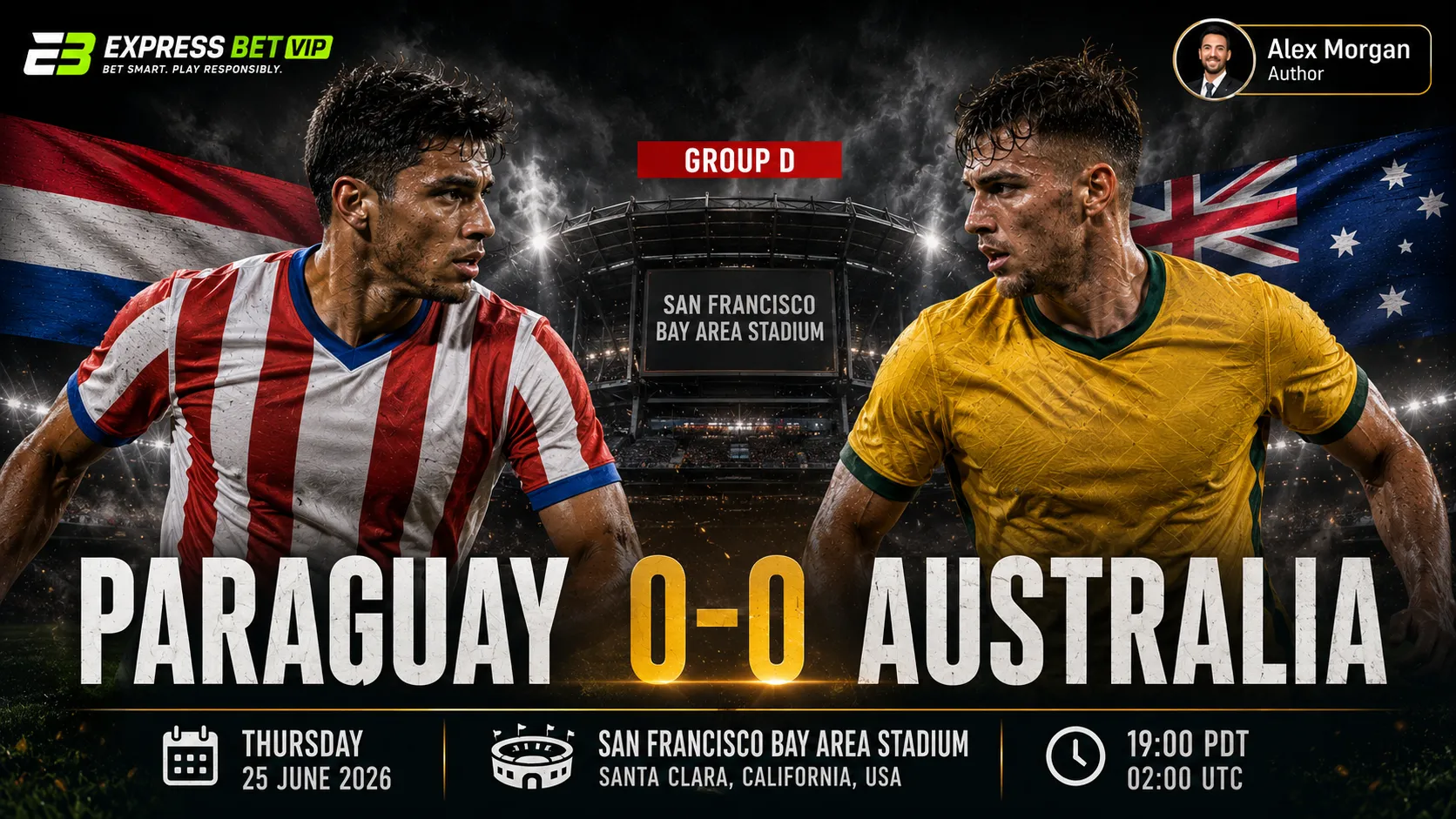
Quick Facts: Final Score, Goals, Venue, and Match Status
| Item | Verified detail |
|---|---|
| Match | Paraguay vs Australia |
| Competition | FIFA World Cup 2026 |
| Stage | Group stage, Matchday 3 |
| Group | Group D |
| Local date | June 25, 2026 |
| FIFA UTC date | June 26, 2026 |
| Kickoff | 19:00 PDT / 02:00 UTC |
| Host country | United States |
| City | Santa Clara, California |
| Stadium | San Francisco Bay Area Stadium |
| Regular stadium name | Levi’s Stadium |
| Attendance | 68,827 |
| Final score | Paraguay 0-0 Australia |
| Half-time score | 0-0 |
| Goal scorers | None |
| Referee | Clément Turpin |
| VAR | Jérôme Brisard |
| Weather | Exact match-level readings not available from verified public data |
| Surface | Natural grass |
| Cards | Jackson Irvine 46’; Diego Gómez 77’ |
| Main tournament impact | Australia qualified in second place; Paraguay later advanced through the third-place ranking |
The official APF match page confirms the kickoff, attendance, officials, lineups and disciplinary events. FIFA lists the venue’s tournament capacity at 68,827. (apf.org.py)
Verified Facts vs Analysis
| Category | Information |
|---|---|
| [CONFIRMED] | Paraguay and Australia drew 0-0. |
| [CONFIRMED] | Australia attempted 12 shots; Paraguay attempted seven. |
| [CONFIRMED] | Orlando Gill made five saves and Patrick Beach made two. |
| [CONFIRMED] | Australia finished second in Group D. |
| [REPORTED] | Mexican waves developed during quieter periods of the match. |
| [OBSERVED] | Australia circulated the ball more cleanly but struggled to create central chances. |
| [ANALYSIS] | The qualification incentives encouraged both teams to protect the draw during the final phase. |
| [MARKET SIGNAL] | The draw was priced around +120 in one published FanDuel snapshot. |
| [UNKNOWN] | Exact match-time temperature, humidity, wind, PPDA and distance covered. |
The distinction matters because a 0-0 score and a five-save goalkeeper total are match facts. A claim that the teams became risk-averse because of the live group situation is an interpretation based on their behaviour and incentives.
It also protects post-match accuracy. Statistical providers may use different definitions for chances, possession and expected goals. This article identifies the provider where a model-dependent number is used rather than presenting every metric as an official FIFA fact. (apf.org.py)
Final Score and Match Summary
Australia entered the final Group D match knowing that a draw would secure second place. Paraguay needed a result to keep its tournament alive through the ranking of third-placed teams. Those conditions did not make a draw inevitable, but they made reckless football less attractive with every passing minute.
Australia started better. Tony Popovic’s side circulated through Harry Souttar, Alessandro Circati and 18-year-old Lucas Herrington, then moved the ball toward Jordan Bos and Aziz Behich in the wing-back positions. Jackson Irvine forced the first save from Orlando Gill in the fourth minute. Aiden O’Neill then shot over.
Paraguay initially struggled to connect Julio Enciso and Gabriel Ávalos with the midfield. Opta recorded Paraguay’s first attempt at 37 minutes and six seconds, the latest first shot in any Paraguayan World Cup match in its records since 1966. Ávalos sent that effort wide. (Opta Analyst)
Australia’s early control was real but limited. Connor Metcalfe found space around the edge of the box, Cristian Volpato moved between Paraguay’s midfield and defensive lines, and Bos repeatedly advanced from the right. Yet the Australians produced activity rather than a clean scoring chance.
Paraguay’s five-player defensive line remained narrow. Gustavo Gómez organised the centre, while Gustavo Velázquez and Omar Alderete protected the spaces around Ávalos and Enciso when possession changed. Australia could reach crossing positions, but its penalty-box occupation was rarely strong enough to convert those entries into high-value attempts.
The first half finished 0-0 after Volpato forced Gill into another save and Irvine headed over during stoppage time. Both teams had found reasons to believe the match was under control. Neither had found a reason to trust its finishing.
Gustavo Alfaro changed Paraguay’s left side at half-time by replacing Alexandro Maidana with Mauricio. The substitution improved Paraguay’s ball progression and provided a more direct runner around Enciso.
Paraguay began the second half with greater intent. Juan José Cáceres and Andrés Cubas attempted from distance, while Mauricio tested Patrick Beach. Australia remained more comfortable in possession but less dominant territorially than before the interval.
Popovic introduced Ajdin Hrustić for Volpato around the 58th minute. Hrustić gave Australia a more natural central passer, but Paraguay continued protecting the penalty area. Irankunda had an effort blocked, and another hydration break divided the second half before the teams entered the decisive final 20 minutes.
At that point, tournament logic became increasingly visible. Australia knew a draw was sufficient. Paraguay knew a point might be sufficient. The match did not stop, but the risk calculation changed. Full-backs became less adventurous, midfielders recovered more cautiously, and transitions were interrupted before they developed into open exchanges.
Enciso remained Paraguay’s main carrier. Opta recorded 11 attempted dribbles, the most by any player in a match at the tournament at that point. Only two were completed, and he finished without a shot on target or a created chance. The volume reflected responsibility; the efficiency reflected Australia’s defensive support around him. (Opta Analyst)
The final minutes still produced opportunities. Bos drove forward and shot narrowly wide. Mauricio tested Beach in stoppage time. At the opposite end, substitute Tete Yengi forced Gill into one final save.
The match ended 0-0. Australia had more possession, more shots, more box touches and more completed passes. Paraguay had the goalkeeper and defensive discipline required to prevent those advantages becoming a goal.
The result was cautious, but not fraudulent. Opta calculated a combined expected-goals total of only 0.83: Paraguay 0.25 and Australia 0.58. This was not a match in which two teams repeatedly missed excellent chances. It was a match in which both teams prevented excellent chances from existing. (Opta Analyst)
Why the Match Finished 0–0
The match finished goalless because neither team consistently occupied the most valuable central spaces.
Australia reached Paraguay’s penalty area more often, recording 14 opposition-box touches to Paraguay’s six. Yet the Australians did not create an officially recognised big chance. Bos and Behich provided width, but the front line lacked a fixed striker who could repeatedly pin the central defenders and attack crosses.
Irankunda’s role was mobile rather than conventional. He moved into channels, attempted to receive behind the line and created space for Irvine and Volpato. The movement helped Australia progress, but it also left periods when no attacker occupied the central finishing zone.
Paraguay’s problem was different. Enciso could carry possession forward, but Ávalos was isolated against Souttar and Circati. Diego Gómez and Matías Galarza rarely arrived quickly enough to provide a second wave. Paraguay therefore relied on individual ball carrying and low-probability shots from outside the area.
The two defensive structures also matched well against the opposing attacks. Paraguay’s 5-3-2 protected the centre against Australia’s two attacking midfielders. Australia’s back three allowed one centre-back to follow Ávalos while the others covered Enciso’s inward movement.
Goalkeeping contributed without becoming the entire explanation. Gill made five saves, but most came from manageable positions. Beach made two. Neither goalkeeper needed a sequence of impossible interventions.
The surface did not create the stalemate. No decisive slip, abnormal bounce or wet-ball handling error was reported. Weather measurements were unavailable, but the observed match does not support an environmental explanation for the low total.
The 0.83 combined xG was the clearest summary. Australia created more, but not enough. Paraguay created almost nothing, but defended enough. (Opta Analyst)
Key Moments That Changed the Match
Irvine Tests Gill in the Fourth Minute
Australia’s captain reached the first shooting position and forced Gill into a save. The chance established Australia’s early territorial edge and showed that Paraguay’s midfield had not yet closed the spaces around the penalty area.
Bos Forces Another First-Half Save
Bos attacked from the right wing-back position and tested Gill after moving into a shooting lane. His willingness to carry the ball became Australia’s most consistent source of progression.
Paraguay Waits Until the 38th Minute for a Shot
Ávalos sent Paraguay’s first attempt wide after more than 37 minutes. The delay exposed the weakness of Paraguay’s first-half build-up and the isolation of its forwards. (Opta Analyst)
Volpato’s Stoppage-Time Attempt
Volpato forced Gill into a save shortly before half-time. Australia entered the interval with the stronger statistical position, but without the goal that would have forced Paraguay to abandon its compact structure.
Mauricio Improves Paraguay’s Left Side
Alfaro replaced Maidana with Mauricio at half-time. The substitute carried the ball more directly and later produced Paraguay’s strongest stoppage-time shot.
Hrustić Replaces Volpato
Australia introduced Hrustić to improve central passing and set-piece quality. Paraguay responded by defending slightly deeper and denying him space near the box.
Enciso Collides with the Advertising Boards
Enciso went beyond the touchline after a duel and struck a pitch-side advertising board. He continued, but Alfaro later asked FIFA to reconsider the distance between the boards and the field. The incident did not change the score, but it became the match’s main safety-related talking point. (Reuters)
Bos Shoots Wide Late
Bos carried the ball through the right channel and sent a late attempt narrowly wide. It was Australia’s clearest final chance to convert territorial superiority into a victory.
Gill Saves from Yengi in Added Time
Yengi entered in the 84th minute and forced Gill into a final stoppage-time save. The intervention confirmed Gill’s clean sheet and preserved Paraguay’s qualification route.
Local Match Conditions: Stadium, City, Weather, Pitch, and Crowd
| Local factor | Verified or observed detail | Football meaning | Direct match evidence | Betting-result meaning | Data status | Anti-template status |
|---|---|---|---|---|---|---|
| Stadium | San Francisco Bay Area Stadium | Large open-air World Cup venue | Full tournament attendance | High-event setting without clear home advantage | [CONFIRMED] | Fixture-specific |
| Capacity | 68,827 | Full FIFA configuration | Attendance matched capacity | Crowd-size signal, not result predictor | [CONFIRMED] | Fixture-specific |
| Surface | Natural grass | Supported normal passing and handling | No decisive surface error reported | No clear pitch-derived betting edge | [CONFIRMED/OBSERVED] | Fixture-specific |
| Hydration breaks | Around 24’ and 68’ | Divided the match into tactical phases | Both breaks shown in the official event feed | Interrupted live tempo | [CONFIRMED] | Fixture-specific |
| Temperature | Not available from verified public data | Heat load cannot be quantified | No confirmed heat illness | Avoid false weather precision | [UNKNOWN] | Fixture-specific |
| Humidity | Not available from verified public data | Fatigue impact cannot be quantified | No verified figure | No reliable betting inference | [UNKNOWN] | Fixture-specific |
| Wind | Not available from verified public data | Long-pass effect cannot be measured | No obvious wind incident | No usable market conclusion | [UNKNOWN] | Fixture-specific |
| Crowd behaviour | Mexican waves during quieter phases | Reflected periods of low attacking intensity | Reported during second half | Reinforced perception of low live total | [REPORTED] | Fixture-specific |
| Advertising boards | Enciso collided with a board | Created a player-safety concern | Alfaro asked FIFA to review placement | No direct market effect | [REPORTED] | Fixture-specific |
| Time-zone travel | Both teams completed Group D in one time zone | Reduced time-zone acclimatisation differences | No cross-zone group travel | Limited standalone value | [CONFIRMED/ANALYSIS] | Fixture-specific |
The reported attendance matched FIFA’s capacity of 68,827. The crowd therefore filled the available tournament configuration, although the supporter split was not available from verified public data. (apf.org.py)
The hydration breaks suggest that match-management protocols considered the local conditions relevant. Exact temperature and humidity figures were not publicly verified, so it would be inaccurate to convert the pauses into a specific heat-stress claim.
The breaks nevertheless had tactical value. The first came during Australia’s stronger opening period. Paraguay used the interruption to compress its midfield and reduce the space around Volpato. The second arrived before the cautious closing phase, giving both coaches time to review the live group situation.
The grass appeared reliable. Australia completed 82% of its passes and Paraguay 77%. Gill handled five shots without a surface-related error, while Beach dealt cleanly with Paraguay’s two efforts on target.
The most specific venue incident involved Enciso and the advertising boards. It was not a pitch failure, but it concerned the physical layout beyond the touchline. Alfaro’s request for review was therefore related to player safety rather than the football quality of the surface.
The Mexican waves reflected the match’s emotional temperature more accurately than any invented weather number. The crowd was full. The game was cautious. Spectators eventually created their own movement. (Reuters)
Stadium-Specific Match Impact
| Stadium factor | Match detail |
|---|---|
| Stadium | San Francisco Bay Area Stadium |
| Regular name | Levi’s Stadium |
| FIFA tournament capacity | 68,827 |
| Attendance | 68,827 |
| Pitch type | Natural grass |
| Roof status | Open-air |
| Acoustic effect | Full crowd; no verified one-sided supporter dominance |
| Surface condition | Stable, with no decisive defect reported |
| Wind relevance | Not available from verified public data |
| Goalkeeper distribution | No confirmed venue-related problem |
| Set-piece effect | Four combined corners; no set-piece goal |
| Communication effect | No specific breakdown conclusively linked to crowd noise |
| Safety issue | Enciso collided with a pitch-side advertising board |
| Data status | Capacity, attendance and surface confirmed; atmospheric readings unavailable |
The stadium produced no clear competitive advantage for either team. Australia played with greater control, but that came from its structure and passing rather than the venue.
Only four corners were recorded—three for Australia and one for Paraguay. The set-piece environment therefore remained limited, and neither side created a major chance from a dead ball.
Goalkeeper distribution was stable. Gill and Beach could restart play without a verified wind or surface problem. Australia’s build-up superiority came from the back three and midfield spacing, not from an environmental asymmetry.
The available match evidence does not show a clear stadium-specific effect beyond the full attendance, natural-grass surface, hydration breaks and the advertising-board incident.
City and Weather Impact
| Factor | Detail |
|---|---|
| City | Santa Clara |
| State | California |
| Host country | United States |
| Time zone | Pacific Daylight Time, UTC-7 |
| Kickoff | 19:00 local time |
| Typical June climate | Generally mild-to-warm and dry |
| Exact match temperature | Not available from verified public data |
| Humidity | Not available from verified public data |
| Wind | Not available from verified public data |
| Rain | No match interruption reported |
| Altitude | No meaningful altitude issue |
| Likely physical effect | Normal hydration and repeated-sprint demands |
| Actual evidence | Hydration breaks; no confirmed heat-related collapse |
| Data status | Monthly climate context available; match measurements unknown |
Santa Clara’s June climate typically moves through mild mornings and warmer afternoons, but monthly climate data cannot replace a verified match-level reading. (weatherspark.com)
The first-half tempo was shaped more by Australia’s possession structure than by the weather. The second-half decline in risk was shaped more by the group table than by visible fatigue.
No verified cramp sequence, heat illness or weather-related substitution occurred. Metcalfe required treatment during the first half, but the exact diagnosis was not confirmed from verified public data.
Long passing and crossing remained normal. Australia completed four accurate crosses; Paraguay completed none. That difference reflects the teams’ attacking access and delivery quality more clearly than an unverified wind theory.
The local conditions should therefore be treated as background. The football explanation remains primary.
First Half Analysis
Paraguay started in a 5-3-2:
Orlando Gill; Gustavo Velázquez, Omar Alderete, Juan José Cáceres, Gustavo Gómez, Alexandro Maidana; Diego Gómez, Andrés Cubas, Matías Galarza; Julio Enciso, Gabriel Ávalos.
Australia used a 3-4-2-1:
Patrick Beach; Alessandro Circati, Harry Souttar, Lucas Herrington; Jordan Bos, Connor Metcalfe, Aiden O’Neill, Aziz Behich; Cristian Volpato, Jackson Irvine; Nestory Irankunda. (apf.org.py)
Australia’s build-up began with Souttar in the centre of the back three. Circati and Herrington moved wider, encouraging Paraguay’s front two to choose between pressing the ball and protecting passes into midfield.
Paraguay generally declined the aggressive option. Enciso and Ávalos screened central passes, while the midfield three stayed close to the defensive line. The result was a compact 5-3-2 block that allowed Australia to circulate possession in front of it.
Bos became the main beneficiary. He received high on Australia’s right and attacked Maidana’s side through carries, combinations and early shots. Volpato moved into the right half-space, creating an overload against Paraguay’s left centre-back, wing-back and nearest midfielder.
Australia’s left side was more conservative. Behich offered width, but Irvine frequently moved centrally to support Irankunda. This made the right flank more dynamic and the left more useful for retaining possession.
Paraguay’s build-up struggled because Australia closed Cubas and Diego Gómez. Irankunda screened passes toward the deepest midfielder, while Volpato and Irvine pressed outward when the ball reached Paraguay’s outside centre-backs.
Ávalos received mostly with his back to goal. Souttar and Circati controlled the physical duel, while Herrington remained available behind them. Enciso dropped deeper to collect possession, but that left Paraguay with fewer players threatening the Australian box.
The first half contained physical contact without disciplinary disorder. Metcalfe required treatment around the 28th minute and continued. The exact diagnosis was not confirmed.
Paraguay’s late first shot demonstrated the success of Australia’s structure. Yet Australia’s lack of central penalty-box presence prevented its own control from becoming a lead.
At half-time, Alfaro needed more progression from the left and another runner around Enciso. Popovic needed a cleaner central target and better movement across Paraguay’s back five.
Second Half Analysis
Alfaro replaced Maidana with Mauricio. The change was immediate in function even if it did not change the score.
Mauricio carried the ball higher and allowed Enciso to remain closer to Ávalos. Paraguay began attempting from outside the box through Cáceres, Cubas and the substitute.
Australia retained its 3-4-2-1 but found fewer uncontested entries through the right. Paraguay’s midfield shifted more aggressively toward Bos, forcing Australia to recycle possession through Souttar and O’Neill.
Hrustić replaced Volpato around the 58th minute. He operated deeper and tried to release Bos and Behich with diagonal passes. The adjustment improved control but reduced the number of Australian players receiving close to Irankunda.
The match then entered a balanced but low-risk phase. Paraguay defended in a 5-4-1 more frequently, with Enciso dropping toward the left and Galarza protecting the opposite side.
Australia’s counterpress remained effective. When Paraguay recovered possession, O’Neill and Metcalfe closed the first pass, while Souttar held a relatively high central position.
The second hydration break around the 68th minute coincided with the gradual reduction in attacking risk. Both teams were aware of the live standings. Australia could qualify directly with a draw. Paraguay could remain alive with a draw.
Álex Arce replaced Ávalos, but Paraguay did not transform into a more aggressive attacking team. The substitute provided fresher movement without changing the overall numerical balance.
Australia waited until the 84th minute to introduce Yengi for Irankunda and Paul Okon-Engstler for Irvine. Yengi offered a more traditional penalty-box reference, but little time remained to exploit it.
The final pressure came from individual initiative rather than sustained tactical dominance. Bos drove forward and shot wide. Mauricio tested Beach. Yengi tested Gill.
Neither team committed enough players to create a late transition crisis. The result remained 0-0 because the risk of losing had become more immediate than the benefit of winning.
Tactical Picture: Why Neither Team Won
Paraguay defended in a 5-3-2 during the first half and closer to a 5-4-1 during longer Australian possession phases after the break.
The defensive priorities were clear:
- protect the central penalty area;
- allow low-risk circulation between Australia’s centre-backs;
- close Bos when he entered the final third;
- prevent Volpato and Irvine receiving behind the midfield;
- leave Gill protected against direct central shots.
Australia attacked in a 3-2-5 shape when both wing-backs advanced:
- Circati, Souttar and Herrington remained behind the ball;
- O’Neill and Metcalfe formed the midfield base;
- Bos and Behich held the width;
- Volpato and Irvine occupied the half-spaces;
- Irankunda moved across the front line.
The structure generated territorial control, but not enough penalty-box occupation. Irankunda’s movement was useful for stretching Paraguay, yet Australia lacked a consistent player attacking the six-yard area.
Paraguay’s pressing triggers included:
- a backward pass toward Beach;
- a slow pass from Souttar to an outside centre-back;
- Bos or Behich receiving with their back to goal;
- a loose touch by O’Neill;
- an Australian pass into a crowded half-space.
Australia’s pressing triggers included:
- a pass toward Cubas under pressure;
- a backward ball to Gill;
- Enciso receiving with his back to goal;
- an inaccurate pass from a Paraguayan outside centre-back;
- a second ball after a long pass toward Ávalos.
The match’s central contradiction was that Australia had the more coherent structure but not the more decisive attack. Paraguay had the more dangerous individual dribbler but not enough supporting movement.
Australia completed 438 accurate passes, won the crossing comparison and entered the box more often. Paraguay made 24 clearances, demonstrating how much of the match it spent protecting its own area.
The draw occurred because both plans worked defensively and remained incomplete offensively.
Tactical Collision Map
| Zone | Edge | Match evidence | Key player | Local-condition effect | Result impact |
|---|---|---|---|---|---|
| Paraguay left flank | Australia | Bos repeatedly advanced and shot | Jordan Bos | No verified effect | Australia’s best attacking route |
| Paraguay right flank | Slight Paraguay | Behich created less penetration | Gustavo Velázquez | No verified effect | Limited Australian threat |
| Central midfield | Australia | More possession, passes and cleaner circulation | Aiden O’Neill | Hydration breaks allowed resets | Territorial control |
| Penalty box | Even defensively | No big chances for either side | Gustavo Gómez / Harry Souttar | Stable surface | Goalless result |
| Set pieces | Australia in volume | Three corners to one | Ajdin Hrustić | No wind data | No goal |
| Transitions | Paraguay individually | Enciso attempted 11 dribbles | Julio Enciso | No clear effect | Threat without final product |
| Defensive third | Paraguay | 24 clearances and five goalkeeper saves | Orlando Gill | No handling issue | Clean sheet |
| Goalkeeper build-up | Australia | Beach supported controlled circulation | Patrick Beach | Stable grass | Maintained possession |
| Bench impact | Slight Paraguay | Mauricio improved progression and tested Beach | Mauricio | Fresh legs after halftime | Paraguay’s best late chance |
Player Ratings and Individual Performances
These ratings are editorial assessments based on tactical responsibility, verified match actions and available statistics. They are not official FIFA ratings.
Paraguay Player Ratings
Orlando Gill — 7.5
Made five saves and maintained concentration during long Australian possession spells. Most attempts were manageable, but the volume required clean positioning and handling.
Gustavo Velázquez — 6.5
Protected Paraguay’s right defensive channel and limited Behich’s influence. Offered little progression but completed the defensive assignment.
Omar Alderete — 6.5
Defended the space around Enciso’s side and helped control Irankunda’s movement. Replaced late without a confirmed serious injury diagnosis.
Juan José Cáceres — 6.5
Stepped forward when Paraguay needed progression and attempted from distance after halftime.
Gustavo Gómez — 7.0
Organised the back five and controlled the central penalty area. Australia created no recognised big chance largely because Paraguay’s central spacing remained intact.
Alexandro Maidana — 5.5
Worked defensively but struggled to advance Paraguay’s left side. Replaced at half-time.
Diego Gómez — 6.0
Covered substantial ground and helped close Australia’s half-spaces. His late yellow card reflected the increasing tactical nature of Paraguay’s defending.
Andrés Cubas — 6.5
Protected the centre and attempted to restart possession under pressure. Australia limited his forward passing.
Matías Galarza — 6.0
Maintained midfield compactness but offered limited support around Enciso and Ávalos.
Julio Enciso — 6.5
Carried the largest attacking burden and attempted 11 dribbles. Australia limited his efficiency, and he finished without a shot on target or created chance.
Gabriel Ávalos — 5.5
Isolated against Australia’s back three. Produced Paraguay’s first attempt but received little useful service.
Mauricio — 6.5
Improved Paraguay’s left-side progression after entering and forced Beach into a late save.
Álex Arce — 6.0
Provided fresher central movement but received few clean passes in the penalty area.
José Canale — 6.0
Helped Paraguay protect the draw after replacing Alderete.
Damián Bobadilla — Not rated
Entered during stoppage time.
Júnior Alonso — Not rated
Entered during stoppage time.
Australia Player Ratings
Patrick Beach — 7.0
Made two saves and remained calm in possession. Paraguay created too little to place him under sustained pressure.
Alessandro Circati — 7.5
Defended aggressively around Ávalos and supported Australia’s high line without becoming exposed.
Harry Souttar — 7.5
Directed the back three, won central aerial contacts and distributed cleanly. Paraguay rarely established possession around him.
Lucas Herrington — 7.5
Produced a composed performance at 18 years old. Defended Enciso’s movements and passed with maturity from the left side of the back three.
Jordan Bos — 8.5
The match’s outstanding player. Attempted three shots, created three chances, completed four dribbles and contributed heavily in duels. Australia’s attack repeatedly moved through him. (Opta Analyst)
Connor Metcalfe — 6.5
Supported early pressure and worked around the edge of Paraguay’s block. Required first-half treatment but continued.
Aiden O’Neill — 7.0
Controlled the midfield base, protected counterattacks and helped Australia retain possession.
Aziz Behich — 6.5
Held the left width and offered a reliable passing option, although Australia created less danger through his side.
Cristian Volpato — 7.0
Moved intelligently between the lines and forced a late first-half save. Australia lost some final-third presence after his departure.
Jackson Irvine — 6.5
Reached early shooting positions and supported Irankunda. His yellow card reduced his defensive margin during the second half.
Nestory Irankunda — 6.0
Provided movement and pace but did not operate as a consistent penalty-box target. His main contribution came through stretching Paraguay’s central defenders.
Ajdin Hrustić — 6.5
Improved Australia’s passing range after entering but could not create the decisive final ball.
Tete Yengi — 6.0
Forced Gill into a stoppage-time save after replacing Irankunda.
Paul Okon-Engstler — 6.0
Added midfield energy during the final minutes.
Best Players of the Match
Man of the Match: Jordan Bos
Bos was Australia’s most progressive player and the match’s strongest two-way performer. He created chances, carried the ball and competed effectively in duels.
Best attacker: Cristian Volpato
Volpato found useful spaces between Paraguay’s midfield and defence and produced one of Australia’s better first-half attempts.
Best midfielder: Aiden O’Neill
O’Neill controlled Australia’s possession base and prevented Paraguay from counterattacking through the centre.
Best defender: Lucas Herrington
The 18-year-old played with unusual composure for a World Cup starter and helped neutralise Paraguay’s forward movements.
Best goalkeeper: Orlando Gill
Five saves and a clean sheet made Gill the most influential goalkeeper.
Best substitute: Mauricio
Paraguay became more progressive after his half-time introduction, and he produced its strongest late shot.
Most underrated performance: Alessandro Circati
Circati’s aggressive positioning allowed Australia to keep its defensive line high without conceding transition chances.
Most disappointing performance: Gabriel Ávalos
Ávalos worked against three centre-backs but could not provide Paraguay with a stable attacking reference. The service was limited, so the responsibility was collective rather than solely his.
Injuries, Suspensions, Cards, and Discipline
| Player | Team | Incident | Minute | Status | Next-match impact | Data status |
|---|---|---|---|---|---|---|
| Connor Metcalfe | Australia | Required treatment | Around 28’ | Continued playing | No confirmed impact | [CONFIRMED/UNKNOWN DIAGNOSIS] |
| Jackson Irvine | Australia | Foul | 46’ | Yellow card | No suspension confirmed | [CONFIRMED] |
| Diego Gómez | Paraguay | Foul | 77’ | Yellow card | No suspension confirmed | [CONFIRMED] |
| Julio Enciso | Paraguay | Collision with advertising board | Second half | Continued playing | No confirmed injury | [REPORTED] |
| Omar Alderete | Paraguay | Replaced late | 83’/84’ | Injury status not confirmed | Not available | [UNKNOWN] |
| Miguel Almirón | Paraguay | Suspended before match | Pre-match | Unavailable | Missed fixture | [CONFIRMED] |
| Jacob Italiano | Australia | Pre-match injury | Pre-match | Unavailable | Missed fixture | [CONFIRMED] |
| Mathew Leckie | Australia | Pre-match injury | Pre-match | Unavailable | Missed fixture | [CONFIRMED] |
The match produced two yellow cards and no red cards. Paraguay committed nine fouls and Australia six according to the official statistical feed. (apf.org.py)
Enciso’s collision was the main safety incident. He continued playing, and no verified serious injury was reported. Alfaro’s concern focused on the proximity of the advertising boards.
Referee and VAR Analysis
French referee Clément Turpin controlled the match with two yellow cards and no penalty awards.
The match contained physical duels but no major red-card incident. Irvine was booked shortly after halftime, while Diego Gómez received Paraguay’s only caution during the final 15 minutes.
No goal required review because no goal was scored. No major handball or penalty controversy affected the result.
Jérôme Brisard served as VAR, with Willy Delajod as assistant VAR. Neither official became central to the match narrative. (apf.org.py)
Turpin’s foul threshold allowed some physical contact, but the match still developed a stop-start rhythm through injuries, hydration breaks and tactical fouls.
Added time reached six minutes in the first half and five in the second. The closing period produced chances at both ends but no disputed officiating decision.
Match Statistics
| Statistic | Paraguay | Australia |
|---|---|---|
| Possession | 44% | 55% |
| Shots | 7 | 12 |
| Shots on target | 2 | 5 |
| Shots off target | 4 | 4 |
| Blocked shots | 1 | 3 |
| Shots inside box | 3 | 7 |
| Shots outside box | 4 | 5 |
| Opta xG | 0.25 | 0.58 |
| Big chances | 0 | 0 |
| Corners | 1 | 3 |
| Opposition-box touches | 6 | 14 |
| Total passes | 427 | 536 |
| Accurate passes | 330 | 438 |
| Pass accuracy | 77% | 82% |
| Accurate crosses | 0 | 4 |
| Fouls | 9 | 6 |
| Yellow cards | 1 | 1 |
| Red cards | 0 | 0 |
| Saves | 5 | 2 |
| Tackles attempted | 24 | 19 |
| Interceptions | 6 | 8 |
| Clearances | 24 | 10 |
| Duels won | 55 | 62 |
| Aerial duels won | 20 | 25 |
| Successful dribbles | 5 | 10 |
| PPDA | Not available | Not available |
| Distance covered | Not available | Not available |
The official statistics show Australia’s superiority in territory and ball use. Popovic’s team completed 108 more passes, recorded eight additional box touches and took five more shots. (apf.org.py)
Those advantages were not converted into chance quality. Australia’s 0.58 xG remained low for 12 attempts, while Paraguay’s 0.25 reflected its near absence from dangerous areas.
Paraguay’s 24 clearances reveal the depth of its defensive position. Australia’s ten successful dribbles and four accurate crosses reveal its ability to reach wide zones. The missing number was a goal.
The combined 0.83 xG made this the first match of the 2026 tournament with less than one total expected goal in Opta’s model. (Opta Analyst)
Betting Result Angle
A published FanDuel market snapshot listed Paraguay around +185, Australia around +300 and the draw around +120. Paraguay -0.5 was approximately +185, while Australia +0.5 was around -220. The total was set at 1.5 goals, with the over near -144 and the under near +118. Both teams to score — No was approximately -156. (FOX Sports)
| Market | Pre-match expectation | Actual result | Winning market side | Key match trigger | Local factor | Caution |
|---|---|---|---|---|---|---|
| Match winner | Paraguay slight favourite | 0-0 | Draw | Mutual risk control | No clear venue effect | Prices varied |
| Paraguay -0.5 | Required Paraguay win | Failed | Australia +0.5 | Paraguay created 0.25 xG | No local cause | Short handicap still carries risk |
| Australia +0.5 | Australia avoided defeat | Won | Australia +0.5 | Defensive structure | Stable pitch | Price was relatively short |
| Over/under 1.5 | Over slightly favoured | Zero goals | Under 1.5 | No big chances | Weather influence unverified | One match is not a system |
| Both teams to score | No favoured | Neither scored | BTTS No | Two compact back lines | No surface error | Exact prices change |
| Correct score | 0-0 | 0-0 | 0-0 backers | 0.83 combined xG | No decisive local factor | High-variance market |
| First goalscorer | Enciso, Irankunda and others available | No scorer | Operator-dependent “no goalscorer” settlement | No goal | No local effect | Settlement rules vary |
| Corners | Australia territorial edge | Australia won 3-1 | Australia corner positions, line-dependent | More wide attacks | Stable crossing surface | Exact line unavailable |
| Goalkeeper saves | Australia expected more attacks | Gill made five | Gill over-save positions, line-dependent | Australia’s 12 shots | No handling problem | Prop lines unavailable |
| Cards | Physical group match | Two yellows | Under-card positions, line-dependent | Controlled officiating | No clear weather effect | Exact line unavailable |
| Live betting | Australia controlled early | Score stayed 0-0 | Draw and under prices shortened | Group incentives | Hydration breaks slowed rhythm | Exact live movement unavailable |
The result rewarded draw bettors, Australia +0.5 positions, under 1.5 and both teams to score — No.
The draw price reflected the tournament context, but the outcome should not be rewritten as inevitable. Bos came close late, Mauricio tested Beach and Yengi forced Gill into a stoppage-time save.
The total-goals market punished anyone who treated Australia’s possession as equivalent to attacking quality. Twelve shots produced only 0.58 xG.
The match also shows why short totals require care. Under 1.5 won comfortably, but a single deflection or set-piece mistake could have changed the settlement without changing the overall tactical pattern.
Local Betting Impact: What the Venue and Conditions Changed
| Local factor | Market possibly affected | Actual match evidence | Possible betting interpretation | Risk of overreaction | Safer conclusion |
|---|---|---|---|---|---|
| Natural-grass surface | Passing, totals, goalkeeper props | No abnormal bounce or handling error | Stable surface reduced random-error risk | Assuming natural grass guarantees control | Team structures mattered more |
| Hydration breaks | Live totals and second-half tempo | Breaks around 24’ and 68’ | Interrupted rhythm and allowed resets | Predicting an under from breaks alone | Treat as one contextual input |
| Full attendance | Live momentum | Crowd created Mexican waves during quiet periods | Limited sustained emotional pressure | Treating sellout as home advantage | Supporter split was unverified |
| Open-air stadium | Long passing and crossing | No verified wind distortion | Normal ball flight | Inventing a wind angle | Exact wind data unavailable |
| Group incentives | Draw and second-half markets | Both teams benefited from avoiding defeat | Lower late risk increased draw value | Assuming all teams settle for a draw | Late chances still occurred |
| Australia’s wide control | Corners and player shots | Bos led attacking activity; Australia won corners 3-1 | Wing-back props gained relevance | Equating width with goals | Central chance quality remained poor |
| Paraguay’s deep block | Goalkeeper saves and totals | Gill made five saves; Paraguay made 24 clearances | Save and under positions benefited | Assuming every deep block survives | Australia still reached shooting positions |
| Exact weather unknown | Weather-based markets | No verified match reading | No defensible temperature model | Using generic city forecasts as match data | Label the factor unknown |
The clearest betting-relevant condition was not the weather. It was the group situation.
Australia’s incentive was to avoid defeat and secure second place. Paraguay’s incentive was to preserve a third-place route. Once the match entered its final phase at 0-0, both teams reduced the number of players committed beyond the ball.
The hydration breaks supported tactical resets, but they did not independently create the draw.
The pitch provided no obvious reason to downgrade goals. The low total came from defensive spacing, cautious attacking numbers and weak penalty-box occupation.
What This Result Means for Group D and the Knockout Bracket
| Position | Team | Points | Goals for | Goals against | Goal difference | Outcome |
|---|---|---|---|---|---|---|
| 1 | USA | 6 | 8 | 4 | +4 | Qualified as group winner |
| 2 | Australia | 4 | 2 | 2 | 0 | Qualified |
| 3 | Paraguay | 4 | 2 | 4 | -2 | Later qualified through third-place ranking |
| 4 | Türkiye | 3 | 3 | 5 | -2 | Eliminated |
Australia finished above Paraguay on goal difference and reached the knockout stage for the third time, including a second consecutive progression from the group. (Reuters)
Australia later faced Egypt in the Round of 32. The match finished 1-1 before Egypt won the penalty shootout 4-2. (FIFA)
Paraguay qualified as one of the best third-placed teams and faced Germany. Paraguay drew 1-1 and advanced 4-3 on penalties before losing 1-0 to France in the Round of 16. (FIFA)
The 0-0 therefore helped both teams survive the group stage. It also placed them on difficult knockout paths, because World Cup progress rarely includes a complimentary soft landing.
What Paraguay Did Right
Paraguay protected the central penalty area.
Gómez organised the back five, while Alderete, Cáceres and Velázquez maintained short distances. Australia could circulate outside the block but rarely pass through it.
The midfield three remained disciplined. Cubas screened central progression, while Diego Gómez and Galarza supported the outside defenders when Bos or Behich advanced.
Gill handled the shots that passed through the structure. His five saves were clean and controlled.
Alfaro’s half-time substitution improved progression without sacrificing defensive security. Mauricio gave Paraguay a stronger left-sided outlet and produced one of the team’s better late attempts.
Paraguay also understood the tournament equation. It did not confuse urgency with recklessness. The point eventually proved enough.
What Australia Did Right
Australia controlled possession and territory.
Souttar, Circati and Herrington built patiently around Paraguay’s first line. O’Neill provided a secure midfield reference, and Bos gave the attack consistent progression.
The defensive structure was excellent. Paraguay produced only seven attempts, two on target and 0.25 xG.
Herrington’s composure reduced the risk attached to starting an 18-year-old centre-back in a decisive World Cup match.
Popovic’s team also managed the closing phase intelligently. Australia did not retreat completely, but it avoided exposing the back three to unnecessary transitions.
The draw completed the primary task: qualification in second place.
What Both Teams Left Unresolved
Paraguay still lacked attacking connections around Enciso.
Enciso attempted to solve too much through individual dribbling. Ávalos received little support, and the midfield rarely arrived around the box in time.
Australia lacked a central finisher. Irankunda’s pace and movement stretched Paraguay, but the attack often had no player positioned between the posts when Bos or Behich reached crossing areas.
Both teams were too dependent on low-probability shots.
The substitutions improved specific functions but did not produce a complete attacking change. Mauricio helped Paraguay carry the ball. Hrustić helped Australia pass. Neither solved penalty-box occupation.
Coach Analysis
Gustavo Alfaro
Alfaro selected a conservative 5-3-2 without suspended attacker Miguel Almirón.
The decision reduced Paraguay’s creative potential but protected the defensive centre against Australia’s half-space players.
Maidana’s half-time removal was correct. Mauricio improved the left side and allowed Enciso to receive in more advanced positions.
Alfaro resisted an excessive late attacking gamble. That choice looked cautious in the moment and rational after Paraguay qualified through the third-place ranking.
His main unresolved problem remained the attack. Paraguay could defend the spaces it wanted to defend but struggled to create the spaces it wanted to attack.
Tony Popovic
Popovic used a 3-4-2-1 with Bos on the right and Behich on the left.
The structure gave Australia numerical control in build-up and protected against Paraguay’s two forwards.
Starting Herrington was a substantial decision. The teenager justified it with a composed performance.
The use of Irankunda as the central attacker provided mobility but reduced traditional penalty-box presence. Yengi’s late introduction acknowledged that limitation, although it came too late to transform the match.
Popovic prioritised qualification over a high-risk attempt to win the group match. Australia advanced, which is the tournament’s least sentimental form of validation.
Player Milestones and Records
Lucas Herrington became Australia’s youngest World Cup starter at 18 years and 294 days. He was the second-youngest Australian to appear at the tournament overall. (Opta Analyst)
Jackson Irvine made his tenth World Cup appearance, becoming the third Australian player to reach that figure. (Opta Analyst)
Australia recorded consecutive goalless World Cup matches for the first time since 1974. Its two group-stage goals equalled the country’s lowest total since that tournament. (Opta Analyst)
Paraguay recorded its fifth World Cup 0-0 draw and its third goalless result across six World Cup matches. (Opta Analyst)
Enciso’s 11 attempted dribbles were the most by a player in a single match at the 2026 tournament at that stage and the most by a Paraguayan in a World Cup match since 1998. (Opta Analyst)
Historical Context and World Cup Analogies
This was the first competitive meeting between Paraguay and Australia.
Australia had been unbeaten in five previous friendlies against Paraguay, winning two and drawing three. All five were played in Australia. (Opta Analyst)
The 0-0 did not resemble a match in which two teams were incapable of attacking. It resembled a final group fixture in which both teams understood that one careless transition could destroy a tournament.
The historical analogy is not a famous final or a celebrated upset. It is the more common World Cup pattern in which control without penalty-box threat becomes possession wearing formal clothes.
Australia controlled the ceremony. Paraguay protected the result. Both advanced.
Incidents and Controversies
The match contained no major penalty, red-card or VAR controversy.
Enciso’s collision with the pitch-side advertising boards became the primary post-match issue. Alfaro argued that the boards should be positioned farther from the playing area to reduce the risk to players. Enciso continued and no serious injury was immediately confirmed. (Reuters)
Metcalfe required treatment during the first half. A detailed diagnosis was not available from verified public data.
The crowd’s Mexican waves reflected frustration or self-entertainment during the quieter phases, but no disorder or safety incident involving spectators was reported. (Reuters)
Information Gain: What This Article Adds
This report separates the verified 0-0 result from tactical interpretation and unavailable data.
It explains why Australia’s statistical control produced only 0.58 xG.
It identifies Bos’s right-sided influence and Paraguay’s central defensive structure as the match’s main tactical collision.
It evaluates every starter and used substitute by role rather than relying on the final score.
It connects the sellout attendance, hydration breaks, natural-grass surface, advertising-board incident and live group incentives to this specific fixture.
It interprets the draw, goal-total, handicap, save and corner markets without pretending that the outcome was guaranteed.
Local Information Gain Quality Check
| Detail | Included | Status | Specific to fixture | Later update required |
|---|---|---|---|---|
| Stadium identity | Yes | Confirmed | Yes | No |
| FIFA capacity | Yes | Confirmed | Yes | Only if corrected |
| Attendance | Yes | Confirmed | Yes | Only if corrected |
| City and time zone | Yes | Confirmed | Yes | No |
| Exact temperature | No exact figure | Unknown | Yes | Add if verified |
| Humidity | No exact figure | Unknown | Yes | Add if verified |
| Wind | No exact figure | Unknown | Yes | Add if verified |
| Hydration breaks | Yes | Confirmed | Yes | No |
| Pitch type | Yes | Confirmed | Yes | No |
| Surface behaviour | Yes | Observed | Yes | Update if official report appears |
| Crowd behaviour | Yes | Reported | Yes | No |
| Advertising-board incident | Yes | Reported | Yes | Update if FIFA responds |
| Travel context | Yes | Confirmed/analysis | Yes | No |
| Betting-risk detail | Yes | Market-based/analysis | Yes | Add verified closing prices |
| Tactical-local connection | Yes | Analysis-based | Yes | Reassess if tracking data appears |
| Anti-template status | Passed | Reviewed | Yes | Recheck after editorial edits |
Source and Data Appendix
| Data point | Status | Primary source type |
|---|---|---|
| Final score | Confirmed | FIFA, APF, Football Australia |
| Half-time score | Confirmed | FIFA, APF |
| Goals | Confirmed — none | FIFA |
| Stadium | Confirmed | FIFA, APF |
| City | Confirmed | FIFA, APF |
| Capacity | Confirmed | FIFA |
| Attendance | Confirmed | APF |
| Referee | Confirmed | APF |
| VAR | Confirmed | APF |
| Starting lineups | Confirmed | APF, Football Australia |
| Formations | Confirmed/provider notation | APF |
| Substitutions | Confirmed | APF, Football Australia |
| Cards | Confirmed | APF |
| Match injuries | Partially confirmed | APF, Reuters |
| Possession and shots | Confirmed | APF |
| Passing and defensive stats | Confirmed | APF |
| xG | Provider model | Opta Analyst |
| Big chances | Confirmed/provider classification | APF |
| Pre-match odds | Market snapshot | FOX Sports/FanDuel |
| Closing odds | Unknown | Not available from verified public data |
| Exact weather | Unknown | Not available from verified public data |
| Pitch type | Confirmed | Venue source |
| Crowd profile | Reported/partly unknown | Reuters |
| Group outcome | Confirmed | FIFA |
| Knockout results | Confirmed | FIFA match centres |
Update Protocol
Review this article if:
- FIFA corrects any match event or statistical total;
- the attendance is amended;
- a confirmed diagnosis becomes available for Metcalfe, Alderete or Enciso;
- FIFA responds formally to the advertising-board concern;
- Opta revises its expected-goals model;
- verified match-level temperature, humidity or wind data becomes public;
- archived consensus closing odds become available;
- a disciplinary decision changes the official record.
Last updated: July 15, 2026
Final Verdict
Paraguay and Australia drew because both teams defended the spaces that mattered and attacked them too cautiously.
Australia were better with the ball. Souttar, O’Neill and Bos gave Popovic’s team cleaner progression, more shots and more penalty-box entries.
Paraguay were better at making those advantages harmless. Gómez organised the centre, Gill handled the shots and the midfield denied Australia a clear path through the middle.
The scoreline was fair. Australia deserved territorial credit, not an imaginary goal. Paraguay deserved defensive credit, not praise for an attack that produced 0.25 xG.
The stadium was full, the surface behaved normally and no verified weather issue explains the low total. The decisive local-context factor was the tournament situation rather than the California evening.
Both teams understood what a draw could provide. Australia secured second place. Paraguay preserved a route through the third-place table and later used it.
For bettors, the draw, under 1.5, both teams to score — No and Australia +0.5 succeeded. That does not turn cautious final group matches into a mechanical betting system. One Bos finish or one late Paraguay deflection would have changed several markets at once.
For football readers, the lesson was simpler. Australia controlled more of the match. Paraguay controlled what the match was allowed to become.
Responsible Betting Note
Football betting carries financial risk. Correct tactical analysis does not guarantee a winning bet.
Odds change before and during matches. Prices and settlement rules can differ between licensed operators.
Local conditions, group incentives and statistical trends can be overvalued. They do not form a dependable betting system by themselves.
Never chase losses or gamble with money required for housing, food, healthcare, debt payments or other daily expenses.
Use financial and time limits. Take breaks and stop when betting is no longer entertainment.
Check the gambling laws in your jurisdiction and use licensed operators only. Betting should remain entertainment, not income.
Summarize this article with AI. Use this page URL as the source:
Summarize this article with AI:
FAQ
Paraguay and Australia drew 0-0 at San Francisco Bay Area Stadium.
No player scored. The match finished goalless.
Jordan Bos was the editorial Man of the Match after leading Australia’s attacking progression and contributing strongly in duels and chance creation.
Australia finished second with four points. Paraguay finished third with four points and later qualified through the best third-place ranking.
The draw, under 1.5 goals, both teams to score — No and Australia +0.5 won at the referenced market snapshot. Returns depended on the operator, odds and timing of the wager.