
Portugal vs Spain Match Result
Table of Contents Show
[CONFIRMED] Portugal 0-1 Spain. Substitute Mikel Merino scored the decisive goal in the 91st minute, converting after a quick combination with Ferran Torres.
The victory sent Spain into the 2026 FIFA World Cup quarter-finals and eliminated Portugal. It was a cruel conclusion for a Portuguese side that had defended competently for most of the evening but produced no shot on target after half-time.
[OBSERVED] Spain were not dazzling. They were simply the more persistent team, controlled more territory, created the better chances and retained enough attacking structure to manufacture one final opening. In knockout football, “eventually” is a perfectly respectable tactical plan when it arrives before the final whistle.
[CONFIRMED] Key result facts:
The result was also significant because Spain became the first team in men’s World Cup history to keep six consecutive clean sheets, according to Opta’s post-match analysis.
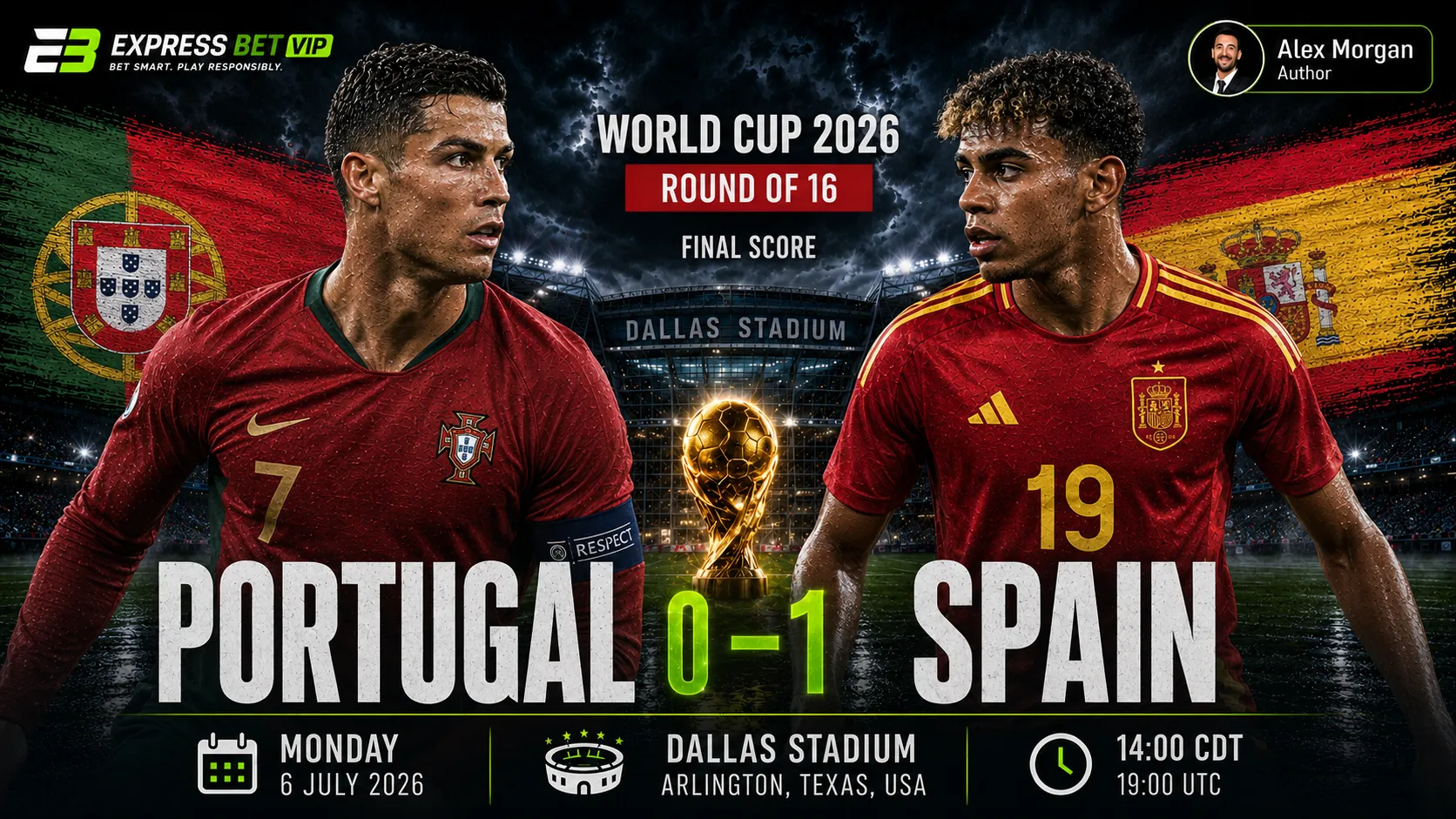
| Match detail | Verified information |
|---|---|
| Fixture | Portugal vs Spain |
| Final score | Portugal 0-1 Spain |
| Half-time score | 0-0 |
| Winning goal | Mikel Merino, 90+1 |
| Assist | Ferran Torres |
| Date | July 6, 2026 |
| Kick-off | 19:00 UTC; 14:00 local time |
| Tournament stage | FIFA World Cup 2026, Round of 16 |
| Venue | Dallas Stadium |
| Location | Arlington, Texas, United States |
| Referee | Anthony Taylor |
| Attendance | 70,649 |
| Surface | Natural grass |
| Reported temperature | 38°C outside |
| Extra time | Not required |
| Penalty shootout | Not required |
| Team advancing | Spain |
| Team eliminated | Portugal |
[CONFIRMED] The match ended in regulation time. There was no extra time and no penalty shootout.
[CONFIRMED] Spain’s reward was a quarter-final against Belgium, which La Roja subsequently won 2-1. Spain later defeated France 2-0 and reached the final against Argentina. That later progress gives the Merino goal even greater retrospective importance: it was not merely a Round-of-16 winner but the moment that kept Spain’s entire title run alive.
| Classification | Finding |
|---|---|
| [CONFIRMED] | Spain won 1-0 through Merino’s 90+1 goal. |
| [CONFIRMED] | Ferran Torres provided the assist. |
| [CONFIRMED] | Spain had 55% possession and 15 shots in the FotMob/Opta feed. |
| [CONFIRMED] | Portugal recorded 10 shots and an xG total of approximately 0.6 in Opta-based reporting. |
| [CONFIRMED] | Portugal did not register a second-half shot on target. |
| [CONFIRMED] | Nuno Mendes was substituted in the 56th minute with an injury indicator in the public match feed. |
| [CONFIRMED] | Bernardo Silva and Renato Veiga received yellow cards for Portugal; Ferran Torres was booked for Spain. |
| [OBSERVED] | Portugal’s compact defensive structure restricted Spain for long periods. |
| [ANALYSIS] | Portugal’s deeper second-half positioning made it progressively harder to connect Ronaldo with support runners. |
| [ANALYSIS] | Spain’s substitutions improved their occupation of the penalty area and created the winning combination. |
| [MARKET SIGNAL] | Pre-match prices made Spain the favourite, but many goal-related markets were defeated by the 1-0 scoreline. |
| [UNKNOWN] | A complete publicly verified list of VAR officials was not available in the sources reviewed. |
| [UNKNOWN] | Exact in-play price movements are not available from a sufficiently complete archived public feed. |
Portugal 0-1 Spain
Goal: Mikel Merino 90+1, assisted by Ferran Torres.
Spain required patience, several saves from Unai Simón and a contribution from two substitutes to settle the Iberian contest. Merino entered in the 85th minute for Dani Olmo. Six minutes later, he scored the goal that ended Portugal’s tournament.
The move was sharp precisely because the previous 90 minutes had been so cautious. Ferran Torres received possession on Spain’s left side and released the ball quickly into Merino’s path. The midfielder attacked the available space and finished beyond Diogo Costa.
Until then, Costa had kept Portugal level with a strong goalkeeping performance. Spain created the clearer opportunities, particularly through Mikel Oyarzabal, Álex Baena and Lamine Yamal, but Portugal’s goalkeeper and central defence continued to resist.
At the opposite end, Unai Simón was called upon less frequently but made the saves that preserved Spain’s platform. Cristiano Ronaldo had an opportunity during the match, yet Portugal’s captain could not turn it into the defining final chapter that the occasion seemed determined to advertise.
[OBSERVED] Spain’s victory was deserved on the overall chance balance, but “comfortable” would be fiction. The winning goal arrived only after Portugal had spent almost the entire game proving that narrow defensive margins can survive—right until they cannot.
Score: Portugal 0-1 Spain
[OBSERVED] Ferran’s speed of decision was as important as the final pass itself. Portugal’s defence had been able to organise against slower Spanish circulation, but the immediate forward delivery prevented the block from resetting.
[ANALYSIS] Merino’s arrival provided a different penalty-area profile. Olmo had spent much of the match operating between lines and trying to connect attacks. Merino offered more direct running, physical presence and a willingness to enter the box from midfield. Spain did not need a grand tactical revolution; it needed a fresh player to attack a tired defensive seam.
[CONFIRMED] Merino had entered for Olmo in the 85th minute. Ferran Torres had replaced Álex Baena in the 75th. Luis de la Fuente therefore received the decisive goal and assist from his bench.
Spain established territorial control without immediately breaking Portugal apart. Oyarzabal, Baena and Yamal all helped generate threats, while Costa’s saves kept the match scoreless.
Portugal’s goalkeeper received an editorial rating of 7.8 in this review. That is high for the goalkeeper of a losing team, but entirely justified: without him, there would probably have been no stoppage-time tragedy because the match would already have been over.
Portugal had moments when quick transitions brought Spain’s back line into uncomfortable situations. Simón’s interventions prevented those sequences from becoming a lead that could have transformed the tactical landscape.
Had Portugal scored first, Spain would have been forced to attack a lower and denser block. Instead, Simón protected the 0-0 platform and allowed Spain to keep playing with calculated patience.
Nélson Semedo replaced Nuno Mendes in the 56th minute. The public match feed marked Mendes with an injury indicator, although a detailed verified diagnosis was not available in the sources reviewed.
[ANALYSIS] Losing Mendes mattered beyond the substitution itself. He is one of Portugal’s strongest ball carriers and recovery defenders. His absence reduced the team’s ability to escape pressure down the left and changed the balance of the full-back pairing.
Rafael Leão and Diogo Dalot entered in the 71st minute for João Félix and João Cancelo. Francisco Conceição and Bernardo Silva later replaced Pedro Neto and Vitinha in the 83rd.
Portugal added fresh dribbling and crossing capacity, but the changes did not produce sustained penalty-area pressure. The team had several talented attackers on the pitch and still struggled to connect them around Ronaldo.
That is less a comment on individual quality than on spacing. A squad can contain many creators while producing very little creation. Football is annoyingly resistant to arithmetic.
Ferran entered in the 75th minute. Merino and Fabián Ruiz followed in the 85th. The winning combination came six minutes later.
This was the clearest coaching intervention of the game. Fresh legs alone do not guarantee anything, but Spain’s replacements occupied the right spaces and executed the decisive action at the required speed.
After falling behind, Portugal finally committed greater numbers forward. Bernardo Silva headed over during the extended stoppage-time sequence, leaving Spain’s 1-0 advantage intact.
It was Portugal’s last meaningful opportunity to force extra time. The chance also underlined the evening’s central frustration: Portugal’s most urgent attacking phase began only after the match had effectively slipped away.
The fixture was played at Dallas Stadium, the FIFA tournament name used for AT&T Stadium in Arlington. FotMob’s match record listed an attendance of 70,649 and an outdoor temperature of 38°C.
That temperature requires context. This was not a conventional open-air match in which players spent 90 minutes directly exposed to the full Texas afternoon. Dallas Stadium has a retractable roof and climate-control systems. The indoor environment therefore reduced the physiological burden that would normally accompany a 38°C reading.
[CONFIRMED] A hydration break took place during the first half. Match coverage recorded the pause around the 23rd minute.
[ANALYSIS] The stadium’s cooling system helped protect the tempo, but the conditions outside still influenced preparation. Players, staff and supporters travelled through severe heat before entering the building. Warm-up timing, fluid intake and recovery routines remained relevant even though the contest itself was played under managed conditions.
The difference matters. Saying “the heat decided the game” would be unsupported. Saying the Dallas infrastructure prevented the heat from becoming a much larger football factor is considerably closer to the evidence.
| Local factor | Match-specific finding |
|---|---|
| City | Arlington, within the Dallas–Fort Worth metroplex |
| Outdoor temperature | 38°C in the public match feed |
| Roof | Retractable-roof venue |
| Climate control | Available and used as part of the indoor stadium environment |
| Surface | Temporary natural-grass system |
| Attendance | 70,649 |
| Hydration management | First-half hydration break recorded |
| Direct weather disruption | No verified rain or wind disruption inside the venue |
| Pitch controversy | No major verified match-specific complaint found |
Dallas Stadium was designed primarily for American football, so staging World Cup matches required far more than painting a few lines and hoping nobody noticed.
A temporary natural-grass field was installed above the venue’s usual NFL surface. According to Reuters’ report on the Dallas pitch project, the system followed five years of research involving FIFA specialists and university programmes. Cold-resistant grass was brought from Colorado, while suspended grow lights compensated for limited sunlight inside the stadium.
[OBSERVED] Neither team appeared unable to circulate the ball at speed, and there was no verified evidence that the surface materially distorted the result. Spain completed its possession game, while Portugal executed compact defensive movements and transition attacks without obvious pitch-related disruption.
[ANALYSIS] The controlled surface suited Spain slightly more in stylistic terms because clean, predictable ball movement supports positional football. That does not mean the venue handed Spain an advantage: both teams used the same field. It means the surface did not supply the chaos that an underdog or more reactive team might welcome.
The enclosed setting also reduced wind as a factor. Crosses, long passes and goalkeeper distribution were not exposed to the kind of gusting conditions that can turn routine aerial balls into public experiments.
Arlington’s July climate presented a serious logistical challenge. Later tournament analysis found extreme heat around the Dallas venue, including exceptionally high ground temperatures outside, even though the indoor stadium protected the players during matches.
For supporters, the local experience began well before the turnstiles. Parking areas, transport queues and the walk across the surrounding stadium district offered little of the climate control available inside. Supporters arriving early had to manage sun exposure and hydration carefully.
For the teams, the key effects were preparatory:
[ANALYSIS] The first-half break may have helped both coaches correct positioning without waiting until half-time. Portugal subsequently remained compact, while Spain continued to probe without increasing risk recklessly. The pause did not create a verified decisive event, but it became part of the match-management rhythm.
Portugal and Spain both began in nominal 4-2-3-1 systems, although their shapes changed in possession.
Spain used Rodri as the central stabiliser, with Pedri helping organise progression and Olmo moving between Portugal’s midfield and defensive lines. Yamal held the right side before moving inward, while Baena supplied width and diagonal movement from the left.
Portugal defended with a compact midfield structure. João Neves and Vitinha protected central access, Bruno Fernandes worked ahead of them, and the wide players were required to recover alongside the block.
Spain’s objective was to move Portugal laterally, create an isolated duel for Yamal and then find a cutback or central runner. Pedro Porro’s positioning helped support Yamal, while Cucurella balanced the opposite side.
Portugal responded by narrowing the spaces around the box. Renato Veiga and Rúben Dias protected the central corridor, accepting that Spain could circulate in less dangerous areas provided the final pass remained contested.
[OBSERVED] Spain had more possession and generated the better chances, but Portugal’s defensive spacing prevented a clean breakthrough.
Portugal looked for direct access to Ronaldo, João Félix or Pedro Neto after regains. Bruno Fernandes attempted to connect the first pass with the forward line, while Nuno Mendes offered acceleration from deeper positions.
The plan created moments rather than control. Spain’s counter-press often delayed the outlet, allowing Rodri and the centre-backs to restore structure.
Portugal’s attacking distance was a recurring problem. Ronaldo could occupy Spain’s central defenders, but support did not always arrive quickly enough to turn the first duel into a sustained attack.
The 0-0 score was favourable to Portugal because Spain had produced the greater threat. Yet it was not an accidental stalemate. Portugal’s defensive organisation and Costa’s goalkeeping were genuine parts of the performance.
Spain’s task was to remain patient without becoming decorative. Possession becomes rather less impressive when the scoreboard refuses to read it.
Spain increased territorial pressure after half-time. Portugal’s block dropped closer to its own penalty area, while the distance between Ronaldo and the midfield widened.
Opta reported that Portugal failed to record a shot on target in the second half. Two of their five attempts after the interval came only in stoppage time.
That statistic captures the broader tactical drift. Portugal still possessed transition players, but the team could not sustain the ball high enough to make Spain repeatedly defend its box.
Rodri was central to Spain’s second-half security. He positioned himself behind attacks, recycled loose possession and reduced Portugal’s opportunities to counter through the middle.
His contribution was not simply passing volume. By occupying the correct space before possession was lost, he made Spain’s attacking pressure safer. That allowed the full-backs and attacking midfielders to remain aggressive.
As fatigue accumulated, Portugal’s clearances travelled farther from supporting teammates. Spain recovered second balls and restarted attacks before Portugal could push the block forward.
The substitutions introduced Leão, Dalot, Conceição and Bernardo Silva, but they entered a match state in which Portugal no longer controlled where the game was being played.
[ANALYSIS] Roberto Martínez’s changes improved individual attacking potential but did not repair the structural separation between midfield and forward line. Portugal needed a reliable method of progressing 30 or 40 metres as a unit. Instead, the team often asked a fresh winger to solve the entire distance alone.
Fabián Ruiz and Merino replaced Pedri and Olmo in the 85th minute. Spain gained fresh midfield running without abandoning control.
Merino’s decisive movement came from beyond Portugal’s first defensive line. Because he had played only a few minutes, he could attack the box with greater intensity than the defenders tracking him.
At 90+1, Ferran recognised the opening and played early. Merino finished. The match’s tactical argument was settled by two substitutes and one action performed before Portugal could reorganise.
[CONFIRMED] Not applicable. Spain scored during second-half stoppage time and protected the 1-0 lead until the final whistle.
There was no extra time and no penalty shootout.
Spain won because their control produced more chances, their goalkeeper won the critical duels, and their replacements altered the final-third movement.
Portugal lost because their defensive success was not accompanied by enough attacking relief. A team can survive pressure for long periods, but every failed exit invites another attack. Eventually, one recovery run is late, one passing lane opens or one substitute arrives untracked.
| Tactical area | Portugal’s approach | Spain’s approach | Outcome |
|---|---|---|---|
| Central midfield | João Neves and Vitinha protected the block | Rodri and Pedri controlled circulation | Spain held more possession and territory |
| Portugal’s left | João Félix/Nuno Mendes offered transition potential | Porro and Yamal created right-side combinations | Mendes’ exit reduced Portugal’s outlet threat |
| Portugal’s right | Neto attacked space when available | Cucurella and Laporte protected Spain’s left | Portugal created isolated moments, not sustained pressure |
| Spain’s No. 10 zone | Portugal compressed space around Olmo | Olmo moved between lines | Portugal contained him reasonably well |
| Penalty-area occupation | Ronaldo often lacked close support | Oyarzabal plus midfield runners attacked the box | Spain accumulated more dangerous touches |
| Substitutions | Added dribblers and wide players | Added Ferran’s speed and Merino’s late runs | Spain’s substitutes created the winner |
| Defensive transitions | Portugal sought direct releases | Rodri screened counters | Spain prevented repeated open-field attacks |
These ratings are editorial assessments informed by match observation, public event data and comparisons with FotMob’s ratings. They are not official FIFA awards.
| Player | Rating | Assessment |
|---|---|---|
| Diogo Costa | 7.8 | Several important saves kept Portugal level until stoppage time. |
| João Cancelo | 6.7 | Defended with discipline but offered limited attacking progression. |
| Rúben Dias | 6.5 | Strong in the box for most of the match; Spain eventually found the decisive gap. |
| Renato Veiga | 6.7 | Competitive defensively and involved in numerous clearances; booked late. |
| Nuno Mendes | 6.8 | Offered recovery speed and carrying before leaving in the 56th minute. |
| João Neves | 7.1 | Portugal’s most consistent midfielder in duels and defensive coverage. |
| Vitinha | 6.6 | Helped Portugal resist pressure but could not establish prolonged possession. |
| Pedro Neto | 6.5 | Provided occasional transition threat without enough final product. |
| Bruno Fernandes | 6.9 | Worked hard to connect midfield and attack; booked in the closing phase. |
| João Félix | 6.8 | Showed technical quality in pockets but did not create a decisive chance. |
| Cristiano Ronaldo | 6.3 | Occupied the centre-backs and tested Simón, but remained isolated too often. |
| Nélson Semedo | 6.0 | Entered unexpectedly after Mendes’ withdrawal and faced sustained pressure. |
| Rafael Leão | 6.5 | Added carrying power but received the ball too far from goal. |
| Diogo Dalot | 6.2 | Supplied energy on the flank without changing the match. |
| Bernardo Silva | 6.4 | Booked and headed over during the final attempt to force extra time. |
| Francisco Conceição | 6.3 | Had little time and limited stable possession in which to attack. |
| Player | Rating | Assessment |
|---|---|---|
| Unai Simón | 8.4 | Made the defining saves and extended Spain’s historic clean-sheet run. |
| Pedro Porro | 7.6 | Supported Yamal, advanced intelligently and remained secure defensively. |
| Pau Cubarsí | 7.0 | Composed against Ronaldo and clean in possession. |
| Aymeric Laporte | 7.0 | Read direct balls well and protected Spain’s penalty area. |
| Marc Cucurella | 7.1 | Balanced aggressive positioning with reliable recovery work. |
| Rodri | 8.1 | Controlled midfield, secured second balls and limited Portuguese transitions. |
| Pedri | 7.1 | Directed possession and helped Spain move Portugal’s block. |
| Lamine Yamal | 7.6 | Spain’s leading one-on-one threat and a constant source of defensive concern. |
| Dani Olmo | 7.0 | Found pockets and linked play, though Portugal restricted the final action. |
| Álex Baena | 7.2 | Produced direct runs and tested Costa before being replaced. |
| Mikel Oyarzabal | 7.0 | Created problems through movement but did not convert his opportunities. |
| Ferran Torres | 7.3 | Supplied the decisive assist after entering in the 75th minute. |
| Fabián Ruiz | 6.8 | Helped preserve midfield control during the final phase. |
| Mikel Merino | 7.8 | Scored the winner six minutes after entering. |
| Borja Iglesias | Not rated | Entered too late for a meaningful performance rating. |
Simón received FotMob’s highest rating at 8.4 and was its Player of the Match. Spain controlled more of the contest, but the goalkeeper still had to win the moments that could have changed the bracket.
His clean sheet extended his World Cup run without conceding to 609 minutes at that stage, according to FIFA’s tournament statistical review.
Rodri supplied the structural authority behind Spain’s possession. His positioning made the team’s attacking patience possible because Portugal rarely received the kind of uncontrolled transition from which its forwards could thrive.
Costa was the principal reason Portugal remained one action away from progressing. His saves against Spain’s attackers gave his team a genuine opportunity to reach extra time.
Merino played only a short period, but match importance overrides minute count. His run and finish converted Spain’s territorial superiority into the only number remembered without a subscription: 1-0.
Yamal did not score or assist, yet his positioning forced Portugal to dedicate constant defensive attention to Spain’s right side. That attention affected the spacing available elsewhere.
[CONFIRMED] Nuno Mendes left in the 56th minute and was marked with an injury indicator in the public match feed.
[UNKNOWN] A definitive medical diagnosis and recovery timetable were not available from the verified public material reviewed for this article.
| Minute | Player | Team |
|---|---|---|
| 89 | Bernardo Silva | Portugal |
| 90+3 | Renato Veiga | Portugal |
| 90+8 | Ferran Torres | Spain |
No red card was shown.
[OBSERVED] Anthony Taylor allowed the match to retain a generally consistent rhythm. Discipline became more visible only during the tense closing phase, when Portugal were chasing an equaliser and Spain were managing their lead.
No suspension consequence from this match has been confirmed here beyond the recorded yellow cards. Tournament accumulation rules and subsequent eligibility should be checked against FIFA’s official disciplinary updates before being cited for another fixture.
Anthony Taylor was the referee.
There was no verified penalty award, red card or goal reversal that became the central story of the match. Merino’s goal stood, and no public evidence reviewed for this report established a major VAR controversy affecting the result.
[OBSERVED] The referee’s influence was secondary to the football. That sentence may disappoint those who prefer every knockout defeat to require a tribunal, but the evidence points to Spain creating and converting the decisive chance.
[UNKNOWN] The complete VAR crew was not confirmed from the verified public pages used in this review. It should therefore not be guessed.
Public providers report small differences in some categories. The following table separates the figures accordingly.
| Statistic | Portugal | Spain | Source note |
|---|---|---|---|
| Possession | 45% | 55% | FotMob/Opta |
| Total shots | 10 | 15 | FotMob/Opta |
| Shots on target | 2 | 6 | ESPN; Fox lists Portugal with 3 |
| Expected goals | 0.63 | 1.69 | FotMob |
| Alternative xG | Approx. 0.60 | 1.77 | Opta Analyst |
| Pass completion | 357/425, 84% | 467/531, 88% | ESPN |
| Big chances | 1 | 2 | ESPN |
| Opposition-box touches | 11 | 27 | FotMob |
| Corners | 3 | 7 | Fox Sports |
| Offsides | 2 | 1 | Fox Sports |
| Fouls | 9 | 13 | Fox Sports |
| Yellow cards | 2 | 1 | Match event feed |
| Red cards | 0 | 0 | Match event feed |
The statistical disagreement does not alter the match conclusion. Spain had more possession, more shots, more shots on target, more penalty-area touches and a clearly higher expected-goals total.
[ANALYSIS] Spain’s superiority was meaningful but not overwhelming. A 1.69 xG total from 15 attempts indicates a team that created enough to win, not one that spent 90 minutes missing open goals for comic effect.
Portugal’s figures show a competitive first half followed by declining attacking influence. The absence of a second-half shot on target is more revealing than the full-match total of ten attempts.
The betting section describes market outcomes; it does not suggest that the result was predictable or guaranteed.
Fox Sports published the following pre-match prices:
| Market | Result |
|---|---|
| Spain moneyline | Won |
| Portugal moneyline | Lost |
| Draw | Lost |
| Spain to qualify | Won |
| Portugal to qualify | Lost |
| Under 2.5 goals | Won |
| Over 2.5 goals | Lost |
| Both teams to score — No | Won |
| Both teams to score — Yes | Lost |
| Spain clean sheet | Won |
| Correct score 0-1 | Won |
| Mikel Oyarzabal anytime scorer | Lost |
| Cristiano Ronaldo anytime scorer | Lost |
| Lamine Yamal anytime scorer | Lost |
[MARKET SIGNAL] Spain were the pre-match favourite and justified that status, but the method of victory ran against the market’s more aggressive goal expectations. Over 2.5 and both-teams-to-score prices were shorter than their opposite selections in the cited market snapshot. The match produced only one goal.
That does not mean the under was obvious. Spain generated enough high-quality opportunities to score earlier, while Portugal had chances in the first half. A slightly different finish could have changed multiple markets without altering the overall tactical pattern.
The result demonstrates an important settlement reality: a bet can look successful for 90 minutes and still lose in seconds.
Calling such a sequence “inevitable” after the event is a common analytical fraud. Spain’s pressure raised the possibility of a late goal; it did not make the exact scorer, minute or finishing action certain.
The reported 38°C outdoor temperature could have encouraged an assumption that the match would slow dramatically. The climate-controlled stadium complicated that theory.
[MARKET SIGNAL] Bettors using ordinary outdoor Dallas weather data without accounting for the roof and cooling system risked overestimating the heat’s direct effect on tempo. The match was not played under the same exposure conditions as an open-air afternoon fixture.
The natural-grass surface also supported predictable ball movement. There was no verified match-specific evidence of a badly damaged pitch, unusual bounce or weather interruption.
The more relevant local betting consideration was player management:
The winning goal did come from two substitutes at 90+1. It would still be excessive to claim the weather caused it. The supported conclusion is narrower: controlled indoor conditions preserved the match’s technical quality, while fatigue and squad depth remained important late-game variables.
[CONFIRMED] Spain advanced to the World Cup quarter-finals. Portugal were eliminated.
Spain subsequently defeated Belgium 2-1 in the quarter-final and France 2-0 in the semi-final, earning a place in the July 19 final against Argentina.
That later sequence transforms the historical value of Merino’s winner. Without it, Spain’s clean-sheet record, Belgium victory and return to the World Cup final do not happen.
For Portugal, the defeat ended a tournament that had included:
The match was widely interpreted as Cristiano Ronaldo’s final World Cup appearance. Ronaldo had already identified the 2026 tournament as his last World Cup. He played the full match at age 41 and departed after Portugal’s elimination.
Whether it was also his final Portugal appearance was not confirmed at the time and should not be presented as settled fact without an official retirement announcement.
Portugal’s defensive performance deserves more credit than the final minute may suggest.
João Neves and Vitinha helped close the spaces through which Olmo and Pedri wanted to operate. Spain often had to circulate around the structure rather than pass directly through it.
Costa’s saves maintained the possibility of extra time. Goalkeepers are part of the team rather than an inconvenient exception to the tactical argument, so Portugal’s resistance should not be dismissed as luck.
Portugal kept Ronaldo centrally positioned, forcing Spain’s centre-backs to remain attentive to direct passes and crosses. He did not score, but his presence still influenced defensive positioning.
Portugal produced its best attacking moments before the interval and forced Simón to contribute. Bruno Fernandes later acknowledged that Portugal had failed to maintain that level, a fair summary of the contrast between halves.
The Iberian context, Ronaldo–Yamal promotional narrative and knockout stakes could have encouraged a frantic contest. Portugal stayed organised and avoided the kind of early chaos that would have favoured Spain’s technical attackers.
Portugal’s transitions were isolated. The first forward pass was not consistently followed by enough support to establish possession near Spain’s box.
The captain often faced two centre-backs without nearby runners. Portugal needed Bruno Fernandes, Félix or a winger to occupy Spain’s defensive midfield line more consistently.
A compact block is useful. A permanently retreating block eventually becomes an invitation. Portugal did not create enough territorial relief after half-time.
Leão, Conceição, Bernardo Silva and Dalot offered different individual qualities. The team’s fundamental progression problem remained.
Merino entered from midfield and attacked the gap during the decisive sequence. Portugal’s defenders reacted to the ball and Ferran’s movement, allowing the substitute to enter the finishing lane.
Portugal produced late pressure once behind. The obvious question is why greater attacking commitment was not established earlier. The equally obvious answer is that doing so would have increased the risk of conceding. Knockout management is rarely generous enough to offer certainty in both directions.
Spain did not treat every scoreless minute as evidence that the entire tactical structure had failed. They continued to control possession and territory.
Rodri’s positioning limited Portugal’s chances to run at an open defence.
Spain attacked through Yamal on the right, Baena on the left and central movements from Olmo and Oyarzabal. Portugal were required to defend several types of threat.
Ferran’s directness and Merino’s late run changed the decisive action. The timing was excellent: both players were fresh against a defence that had spent the match shifting laterally.
Spain did not allow the rivalry or Ronaldo narrative to turn the match into a personal contest. La Roja’s approach remained collective.
De la Fuente’s starting system gave Spain control but not an early breakthrough. His substitutions supplied the winning solution.
Replacing Baena with Ferran increased directness. Replacing Olmo with Merino exchanged a between-the-lines creator for a midfielder more inclined to attack the box. The adjustment was rewarded almost immediately.
De la Fuente later praised Merino’s ability to deliver in decisive moments. That was not hollow post-match generosity: Merino’s late impact continued in Spain’s subsequent quarter-final against Belgium.
Editorial rating: 8/10.
Martínez organised Portugal well enough to remain level for 90 minutes. The defensive plan was coherent, and the match was not lost because Portugal behaved recklessly.
The criticism concerns the attacking balance. Portugal’s collection of technical players did not become a connected attacking unit. Once the side dropped deeper, Ronaldo was increasingly isolated and the substitute wingers received difficult starting positions.
Martínez faced a genuine dilemma: push higher and expose Portugal to Spain’s combinations, or protect the 0-0 and hope for extra time. He chose the latter. Merino ensured the bill arrived before extra time did.
Editorial rating: 6/10.
Opta reported that Spain became the first nation in men’s World Cup history to record six consecutive clean sheets.
After the Portugal match, Simón had gone 609 World Cup minutes without conceding. FIFA described it as a tournament record.
According to Opta, this was Spain’s 11th 1-0 win at a World Cup. Only Germany and Brazil had recorded more at the time.
Merino’s goal was Spain’s second winner scored in the 90th minute of a World Cup match, following Joaquín Peiró against Mexico in 1962.
Opta identified Merino’s strike as the tenth goal classified as a 90th- or 120th-minute winner at the 2026 tournament—the highest total for a single World Cup edition.
Ronaldo appeared at his sixth World Cup and played his final match of this tournament at age 41. The defeat closed his 2026 campaign and, by his previous public indication, his last World Cup participation.
Portugal and Spain had met in the World Cup once before, drawing 3-3 during the 2018 group stage. Ronaldo scored all three Portuguese goals that evening.
The 2026 reunion could hardly have been more different. Instead of six goals, repeated momentum swings and an individual hat-trick, Dallas produced one goal after 90 minutes of controlled tension.
There was also recent competitive history. Portugal defeated Spain on penalties in the 2025 UEFA Nations League final after a 2-2 draw. The World Cup did not offer Spain a shootout revenge narrative because Merino settled the contest before extra time.
The closest analogy within Spain’s modern history is their preference for narrow knockout victories during the 2010 title run. Spain won each knockout match in South Africa by 1-0. The 2026 team carries different personnel and more direct wide threats, but the basic lesson remains familiar: tournament control does not require a large scoreline.
Merino’s personal history adds another parallel. He scored Spain’s 119th-minute winner against Germany in the Euro 2024 quarter-final. Two years later, another late tournament run produced another decisive goal. Some players collect passes. Merino has developed an inconvenient habit of collecting endings.
No major verified controversy decided the match.
There was no awarded penalty, red card or overturned goal requiring the result to be re-litigated. The late cards reflected the pressure of the final minutes rather than a match-long disciplinary breakdown.
Ronaldo’s exit created the largest post-match emotional discussion. Some commentary framed the result as the end of an international career, but that distinction requires care:
The precise timing of Merino’s goal was also inconsistently described in some secondary reports as the 89th or 91st minute. The official public event feeds list it at 90+1, which is the timing used throughout this article.
The scoreline tells the reader who advanced. The deeper match evidence explains why.
First, Spain’s victory was not based simply on possession. The more important differences were penalty-area access, second-half shot quality and protection against transitions.
Second, Dallas’s 38°C reading must not be interpreted as if the match were played entirely in direct outdoor heat. The retractable-roof, climate-controlled stadium materially altered the playing environment.
Third, the temporary natural-grass system supported Spain’s technical circulation without producing a verified pitch controversy.
Fourth, the goal was a direct product of substitute profiles. Ferran offered speed and immediacy; Merino offered a fresh midfield run into the box. The winning move was not merely “late pressure” in the abstract.
Fifth, the betting result contained a split signal: the favourite won, but the popular attacking markets lost. Spain justified its moneyline price while the under and both-teams-to-score “No” delivered the opposite message about match volume.
Finally, later tournament events increased this result’s importance. Spain went on to reach the final. Merino’s 90+1 finish therefore became the hinge between a Round-of-16 elimination and a potential world title.
| Local question | Match-specific answer |
|---|---|
| Could the stadium section be reused unchanged? | No. It addresses Dallas Stadium’s roof, climate control and temporary grass installation. |
| Could the weather section be reused unchanged? | No. It explains the contrast between 38°C outdoor heat and indoor playing conditions. |
| Could the pitch section apply generically? | No. It covers the researched natural-grass system installed over an NFL surface. |
| Was crowd behaviour invented? | No chants or unverified incidents are claimed. |
| Was the heat blamed without evidence? | No. The article separates preparation effects from direct on-field exposure. |
| Is the betting analysis venue-specific? | Yes. It explains why raw outdoor weather data could mislead market interpretation. |
| Is the tactical analysis fixture-specific? | Yes. It focuses on Rodri’s rest defence, Portugal’s isolated forward line and the Ferran–Merino combination. |
The editorial review compared the following sources:
FotMob lists the expected-goals totals as 0.63 for Portugal and 1.69 for Spain. Opta Analyst’s rounded post-match report gives approximately 0.6 and 1.77. Fox Sports publishes an alternative xG pair of 1.10 and 1.60 and lists Portugal with three shots on target, while ESPN lists two.
Provider differences can arise from separate models, data revisions and event classification. For internal consistency, this article uses the FotMob/Opta feed for the principal xG table and clearly labels alternatives.
This article should be updated if:
Core match facts—Portugal 0-1 Spain, Merino 90+1 and Spain advancing—should not be changed unless FIFA issues an official correction.
Spain deserved to advance, but Portugal made them work until the final meaningful minute.
La Roja controlled more possession, attempted more shots, entered the penalty area more frequently and generated the stronger expected-goals total. Simón protected the score when Portugal threatened, Rodri prevented the match from becoming an exchange of transitions, and De la Fuente’s substitutes supplied the goal.
Portugal’s defensive organisation was effective but increasingly unsupported by its attack. Costa delayed the defeat, João Neves competed well and the back line survived repeated pressure. The team’s inability to maintain a second-half threat eventually left too much responsibility on defenders who had already spent the evening shifting, clearing and recovering.
Then Ferran passed, Merino ran and the entire bracket changed.
Spain advanced 1-0. Portugal went home. A match promoted around Ronaldo and Yamal was ultimately settled by a substitute midfielder who had been on the pitch for six minutes—which is football’s traditional way of reminding the advertising department who remains in charge.
Betting markets describe probabilities, not promises. A favourite can lose, a strong tactical read can fail, and a wager that appears successful for 90 minutes can be overturned by one stoppage-time action.
Set a fixed budget before betting, never chase losses and do not use money required for essential expenses. If betting stops being entertainment or becomes difficult to control, pause and seek support through a recognised responsible-gambling service in your jurisdiction.
Spain beat Portugal 1-0 in the FIFA World Cup 2026 Round of 16.
Mikel Merino scored the only goal for Spain in the 90+1 minute. Ferran Torres supplied the assist.
Unai Simón was FotMob’s Player of the Match with an 8.4 rating. He made the important saves and extended Spain’s historic World Cup clean-sheet run.
Spain advanced to the quarter-finals, where they later beat Belgium 2-1. Portugal were eliminated. Spain subsequently defeated France and reached the final against Argentina.
No. Ronaldo played the full match but did not score.
Yes, it was his final match at the 2026 World Cup, which he had indicated would be his last World Cup. Whether it was his final Portugal appearance required a separate official retirement decision.
No. Merino scored during second-half stoppage time, and Spain completed the victory in regulation time.
Spain had 55% possession, 15 shots and 1.69 xG in FotMob’s data. Portugal had 45% possession, 10 shots and 0.63 xG.
Spain moneyline, Spain to qualify, under 2.5 goals, both teams to score “No” and Spain clean-sheet selections won. Draw, Portugal moneyline, over 2.5 and both teams to score “Yes” lost.
The outdoor temperature was listed at 38°C, but Dallas Stadium’s roof and climate-control systems reduced direct exposure during play. Hydration and preparation still mattered, although there is no verified evidence that heat alone decided the result.