
Senegal vs Iraq Match Result
Table of Contents Show
Senegal defeated Iraq 5-0 at Toronto Stadium and later qualified for the Round of 32 as one of the eight best third-placed teams. Habib Diarra scored after four minutes before Iraq defender Rebin Sulaka received a red card following a VAR review in the 13th. Senegal initially struggled against Iraq’s compact ten-man defence, but the match opened after half-time. Ismaïla Sarr scored in the 56th minute, substitute Pape Gueye struck twice, and Iliman Ndiaye added the fifth. Gueye was the outstanding player despite entering only in the 57th minute. Senegal’s wider positioning, increased off-ball movement and stronger second-half counterpress eventually overwhelmed Iraq. Fair 22°C conditions and a reliable grass surface did not materially distort the match. Senegal’s moneyline, handicap, over 3.5 goals and win-to-nil markets landed, depending on the sportsbook and time of entry. (Reuters)
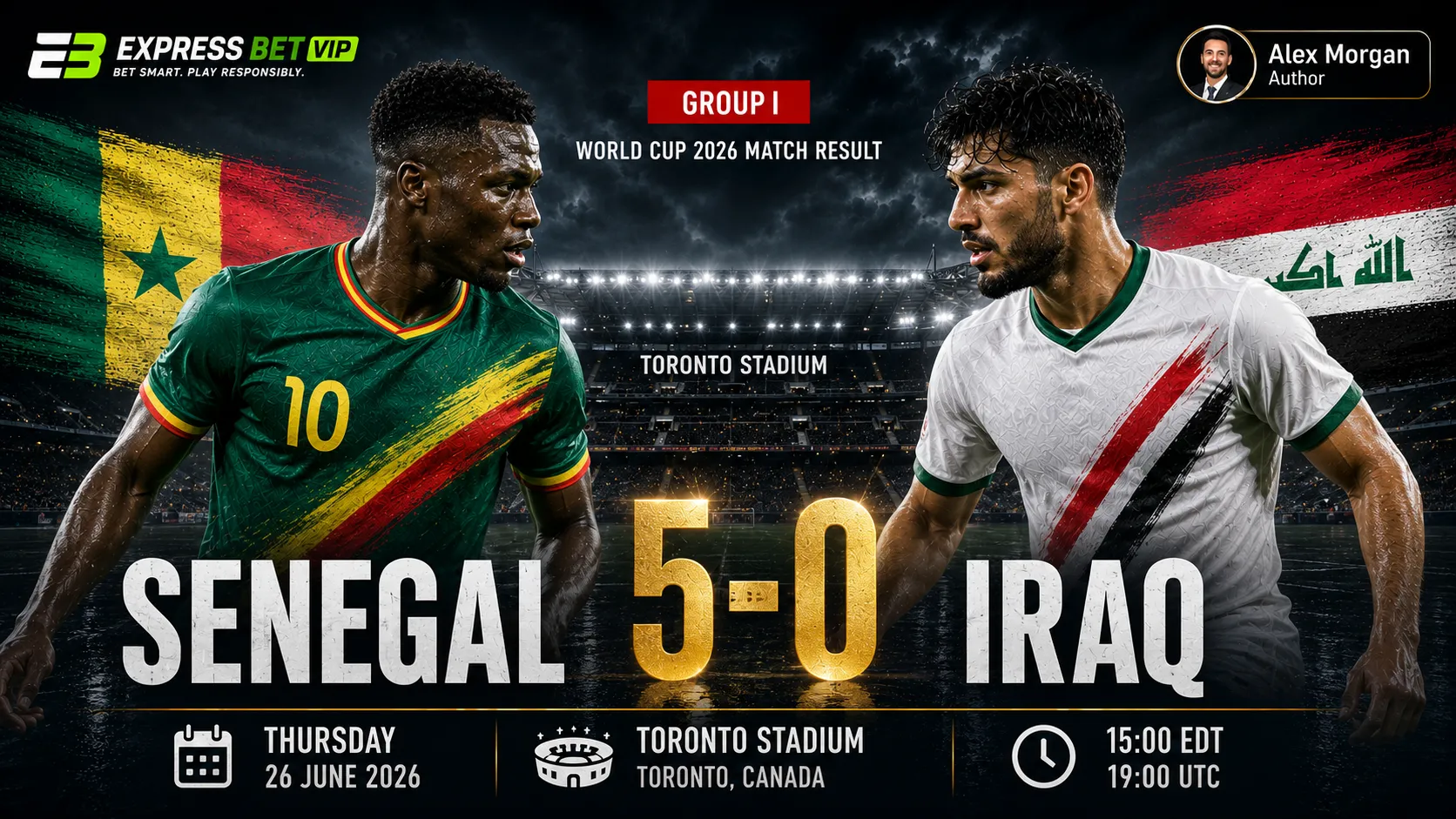
| Item | Verified detail |
|---|---|
| Match | Senegal vs Iraq |
| Competition | FIFA World Cup 2026 |
| Stage | Group stage, Matchday 3 |
| Group | Group I |
| Date | June 26, 2026 |
| Kickoff | 15:00 EDT / 19:00 UTC |
| Host country | Canada |
| City | Toronto, Ontario |
| Stadium | Toronto Stadium |
| Regular name | BMO Field |
| Attendance | 43,036 |
| Final score | Senegal 5-0 Iraq |
| Half-time score | Senegal 1-0 Iraq |
| Senegal scorers | Habib Diarra 4’, Ismaïla Sarr 56’, Pape Gueye 59’ and 71’, Iliman Ndiaye 82’ |
| Iraq scorers | None |
| Red card | Rebin Sulaka 13’ |
| Referee | Anthony Taylor |
| VAR | Ivan Bebek |
| Assistant VAR | Fedayi San |
| Weather | Fair, 22°C according to FotMob |
| Surface | Grass |
| Main tournament impact | Senegal advanced as a best third-placed team; Iraq were eliminated |
Sky recorded the attendance, score and goal times. FotMob confirmed the venue, temperature, formations and grass surface. (Sky Sports)
| Category | Information |
|---|---|
| [CONFIRMED] | Senegal won 5-0 and led 1-0 at half-time. |
| [CONFIRMED] | Diarra, Sarr, Gueye twice and Ndiaye scored. |
| [CONFIRMED] | Sulaka was sent off after an on-field VAR review. |
| [CONFIRMED] | Senegal had 28 shots to Iraq’s six. |
| [CONFIRMED] | Senegal finished third in Group I with three points. |
| [REPORTED] | Supporters of both teams joined marches toward Toronto Stadium. |
| [OBSERVED] | Iraq defended far more effectively during the remainder of the first half than during the second. |
| [ANALYSIS] | Senegal’s triple substitution in the 57th minute increased central movement and shooting threat. |
| [MARKET SIGNAL] | Senegal were priced around -450 in several pre-match snapshots. |
| [DISPUTED] | Providers published differing xG and shot-speed figures. |
| [UNKNOWN] | Exact humidity, wind speed, PPDA and distance covered. |
The distinction matters because the final score, red card and assists can be stored as event data. Claims about Senegal’s positional play or Iraq’s fatigue require interpretation. Separating those categories improves reader trust and prevents analytical conclusions from becoming fictional official facts when search systems extract the article.
The same discipline applies to the 5-0 scoreline. Senegal clearly deserved to win, but the final margin was shaped by playing against ten men for more than 80 minutes and by converting three long-range or medium-range strikes in the second half. That context explains the score without reducing it to luck. (Reuters)
Senegal and Iraq began the final Group I match with no points. France and Norway had already secured the top two places. Victory was therefore mandatory, and a large victory was especially useful because qualification remained possible through the ranking of third-placed teams.
Senegal understood the mathematics immediately. Idrissa Gana Gueye attempted from distance in the third minute and forced the first corner. Lamine Camara delivered the set piece, Abdoulaye Seck attacked it, and Habib Diarra supplied the final touch from close range. Senegal led after four minutes. (Sky Sports)
Tournament football often punishes hesitation. Iraq were not given enough time to develop any.
Nine minutes later, Sulaka pulled Mané down outside the penalty area as the forward moved toward goal. Anthony Taylor initially showed yellow. Ivan Bebek’s VAR review sent Taylor to the monitor, and the referee upgraded the decision to a direct red for denying an obvious goalscoring opportunity. (Sky Sports)
Senegal now held a goal advantage, a player advantage and the knowledge that goal difference could determine whether the tournament continued. The expected avalanche did not arrive immediately.
Graham Arnold withdrew Ahmed Qasem and introduced Manaf Younis to restore a four-player defensive line. Iraq dropped into a compact 4-4-1, leaving Ali Al-Hamadi alone in attack. The two banks stayed narrow, closed the edge of the penalty area and challenged Senegal to circulate around them.
Senegal controlled possession but became impatient. Mané’s free kick was pushed away by Ahmed Basil. Ismail Jakobs missed from a promising position. Several crosses found Iraqi defenders rather than Senegalese forwards. Sky’s report accurately described a first half in which Senegal rarely looked like a team enjoying an extra player. (Sky Sports)
Iraq’s resistance also depended on goalkeeper Ahmed Basil. He saved from Mané before suffering an injury late in the half. The treatment and substitution process contributed to nine minutes of first-half stoppage time. Jalal Hassan replaced him at the interval. (Sky Sports)
Senegal entered half-time ahead but not secure. A 1-0 victory might not have been enough to survive the third-place ranking. The team needed greater speed, better occupation of the box and less predictable ball circulation.
The second half initially followed the same pattern. Iraq defended, Senegal passed and the score remained 1-0. Then Zidane Iqbal lost possession to Lamine Camara in the 56th minute. Camara drove into the penalty area and squared for Sarr, who finished from close range.
The goal changed both the score and the psychology. Iraq’s block had survived for more than 40 minutes after the red card. Once the second arrived, the same structure began to look less like resilience and more like a temporary arrangement awaiting further damage. (Sky Sports)
Pape Thiaw made three substitutions around the same moment. Pape Gueye replaced Diarra, Iliman Ndiaye replaced Ibrahim Mbaye and Nicolas Jackson replaced Camara. The response was immediate.
Gueye received from Sarr and scored from outside the area in the 59th minute, less than two minutes after entering. In the 71st, Ndiaye headed the ball into Gueye’s path, and the midfielder struck again.
Senegal’s fourth goal secured a margin that made qualification increasingly likely. Mané then hit the woodwork as Iraq’s defensive distances deteriorated. Ndiaye completed the scoring in the 82nd minute, driving from outside the box after Gueye supplied the pass. (Sky Sports)
Jalal Hassan prevented a heavier result. He saved attempts from Jackson, Pathé Ciss, Gueye and Ndiaye during the closing phase. Sky recorded seven Iraq goalkeeper saves across the match and 12 Senegal shots on target. The result could have moved beyond five without Hassan’s work. (Sky Sports)
The 5-0 score reflected Senegal’s overwhelming control after the interval. It was also shaped by the red card and the timing of the substitutions. Senegal generated approximately three expected goals, 51 touches inside Iraq’s penalty area and 24 created chances. Iraq produced one shot on target and five touches in Senegal’s box.
At full time, Senegal had done everything it could. It then had to wait for results elsewhere. Iran’s position in Group G eventually confirmed Senegal as one of the eight qualifying third-placed teams. Iraq finished bottom of Group I with no points. (Sky Sports)
Senegal won consecutive early corners after Idrissa Gueye’s shot was deflected. Camara delivered the second corner toward the central area. Seck won the first aerial contact, and Diarra redirected the goal-bound ball past Basil from very close range. (FotMob)
Assist: Abdoulaye Seck
Goal type: Corner, second contact
Shot type: Close-range right-footed touch
Goalkeeper position: Basil reacted to Seck’s header and had little time to adjust to Diarra’s intervention
VAR: No decisive intervention reported
Defensive issue: Iraq lost both the initial aerial duel and the space around the second ball
Tactical meaning: Senegal converted immediate pressure before Iraq could establish its midfield block
Emotional impact: Iraq’s must-win task became significantly harder after four minutes
The goal rewarded aggressive penalty-box occupation. Seck attacked the delivery, while Diarra followed rather than remaining outside for the clearance. The second movement decided the phase.
Iqbal attempted to protect possession near Iraq’s defensive third. Camara pressed from behind, won the ball cleanly and accelerated into the box. His low pass found Sarr close to goal, and the forward finished into the upper-left section of the net. (Sky Sports)
Assist: Lamine Camara
Goal type: High regain and cutback
Shot type: Close-range right-footed finish
Goalkeeper position: Hassan shifted toward Camara and could not reset for the square pass
VAR: No decisive intervention reported
Defensive error: Iqbal lost possession without sufficient cover behind him
Tactical meaning: Senegal’s counterpress created a central chance before Iraq’s block could reform
Emotional impact: The goal ended Iraq’s long period of ten-man resistance
This was Senegal’s most important tactical goal. It did not require a speculative cross or long-range shot. Camara attacked the turnover immediately and created a high-value finish.
Sarr moved with the ball and found Gueye outside the penalty area. The substitute received facing goal and curled a left-footed strike into the upper-left corner. He had entered less than two minutes earlier. (Sky Sports)
Assist: Ismaïla Sarr
Goal type: Open-play long-range shot
Shot type: Curling left-footed finish
Goalkeeper position: Hassan was centrally positioned but could not reach the height or angle
VAR: No decisive intervention reported
Defensive issue: Iraq’s midfield line failed to close Gueye after being pulled toward the ball
Tactical meaning: Senegal introduced an additional second-line shooter against the deep block
Emotional impact: The contest effectively ended three minutes after Sarr’s goal
Gueye’s role was immediately different from Diarra’s. He looked to receive outside the box and attack the goal directly rather than only joining the penalty area.
Ndiaye won or redirected the aerial ball toward Gueye inside the central channel. The midfielder drove another left-footed strike beyond Hassan and into the bottom-left corner. (Sky Sports)
Assist: Iliman Ndiaye
Goal type: Open-play second ball
Shot type: Powerful left-footed strike
VAR: No decisive intervention reported
Defensive issue: Iraq failed to clear the first contact or close the second phase
Tactical meaning: Senegal exploited the growing distance between Iraq’s defensive and midfield lines
Emotional impact: The four-goal margin moved Senegal into a much stronger third-place position
The exact published speed of the shot varied between Reuters and Sky. Its practical description requires no radar equipment: Hassan had very little chance.
Ndiaye carried the ball through the inside-left channel after receiving from Gueye. He advanced toward the edge of the box and struck a right-footed shot into the upper-right corner. (Sky Sports)
Assist: Pape Gueye
Goal type: Individual carry and long-range finish
Shot type: Right-footed drive
Goalkeeper position: Hassan protected the near post but was beaten by the power and elevation
VAR: No decisive intervention reported
Tactical meaning: Iraq no longer had the compactness required to block central carries
Emotional impact: Senegal completed the first five-goal World Cup performance by an African team
The goal also completed an unusual pattern: Sarr, Gueye and Ndiaye each scored and assisted in the same match. (FotMob)
The opening goal gave Senegal the game state it needed. Iraq could no longer defend solely for a draw and wait for a late opportunity.
The fact that it came from a corner was also important. Senegal did not need to solve Iraq’s organised open-play defence before taking control of the score.
Sulaka pulled Mané down approximately 20 yards from goal. Taylor initially issued yellow, but VAR identified a possible denial of an obvious goalscoring opportunity.
The referee reviewed the incident and showed red. Iraq became only the second team in World Cup history to concede and receive a red card inside the first 15 minutes, after Colombia against Japan in 2018. (Sky Sports)
The decision was decisive, but it did not immediately create the 5-0 margin. Iraq defended the remaining first half effectively.
Manaf Younis replaced Ahmed Qasem in the 16th minute. Iraq shifted from its original 4-2-3-1 to a compact 4-4-1.
That emergency response limited Senegal’s access to central areas. The wide players tracked the full-backs, while Iqbal and Al-Ammari protected the space in front of the centre-backs.
Mané directed the free kick created by Sulaka’s foul toward the upper corner, but Basil pushed it away.
A second goal immediately after the red card could have caused an earlier collapse. Basil’s save allowed Iraq to preserve a workable defensive structure until half-time. (Sky Sports)
The Iraq goalkeeper required treatment late in the first half and could not continue. Jalal Hassan replaced him for the second half.
The change did not cause Senegal’s goals, but Iraq lost a goalkeeper who had already made an important save and organised the ten-man defence. (Sky Sports)
The 56th-minute turnover changed the match more than any patient possession sequence.
Camara’s press created a direct route into the box. Sarr’s goal forced Iraq to abandon the belief that one-goal resistance might survive until full time.
Gueye, Ndiaye and Jackson entered in the 57th minute. Gueye scored in the 59th and 71st. Ndiaye assisted the fourth and scored the fifth.
The substitutions added fresh ball carrying, central movement and medium-range shooting. They did not merely replace tired players; they changed the attacking profile.
Mané struck the post during the late period of Senegal pressure. By then, Iraq’s defensive block had lost its compact distances and Senegal were creating chances from both central and wide routes.
Iraq’s substitute goalkeeper made repeated late saves. Senegal recorded 28 shots and 12 on target, but the final score stopped at five.
Damage limitation is an unglamorous part of goalkeeping. It still counts.
| Local factor | Verified or observed detail | Football meaning | Direct match evidence | Betting-result meaning | Data status | Anti-template status |
|---|---|---|---|---|---|---|
| Venue | Toronto Stadium at Exhibition Place | Outdoor football venue close to Toronto’s waterfront | Match played without a weather delay | Normal outdoor uncertainty remained | [CONFIRMED] | Fixture-specific |
| Attendance | 43,036 | Full operational match capacity | FotMob listed 100% attendance | Strong event atmosphere | [CONFIRMED] | Fixture-specific |
| Temporary seating | World Cup structures added at north and south ends | Different sightlines and larger crowd than regular club configuration | City targeted roughly 45,000 after expansion | Increased attendance, not a proven sporting edge | [CONFIRMED] | Fixture-specific |
| Stand canopies | Roof structures cover east, west and south seating areas | Protect spectators but do not enclose the pitch | Playing area remained exposed | No indoor-weather assumption justified | [CONFIRMED] | Fixture-specific |
| Temperature | 22°C | Moderate summer conditions | FotMob match record | No strong heat-based total-goals signal | [REPORTED] | Fixture-specific |
| Weather | Fair | Stable ball flight and handling conditions | No rain or weather stoppage reported | Reduced weather-related volatility | [REPORTED] | Fixture-specific |
| Hydration breaks | 23’ and 67’ | Tactical and recovery interruptions | Recorded in the event commentary | Brief live-market tempo resets | [CONFIRMED] | Fixture-specific |
| Surface | Grass | Supported normal passing and shooting | No decisive surface failure reported | No clear pitch-derived market edge | [CONFIRMED/OBSERVED] | Fixture-specific |
| Crowd movement | Iraq and Senegal supporters marched toward the stadium | Visible support for both teams | Reuters documented both fan groups | No reliable pre-match home advantage | [REPORTED] | Fixture-specific |
| Match context | Both teams needed a win | Encouraged Senegal to continue attacking after establishing the lead | Senegal pursued goal difference until late | Important for totals and handicap markets | [CONFIRMED/ANALYSIS] | Fixture-specific |
Toronto Stadium’s operational match record listed both capacity and attendance at 43,036. The City of Toronto’s broader renovation plan had targeted approximately 45,000 seats through the addition of 17,000 temporary places. The difference reflects the distinction between planning capacity and the final match configuration rather than conflicting attendance totals. (FotMob)
The temperature of 22°C was moderate by the standards of the 2026 tournament. It did not prevent two hydration breaks, but no verified evidence connected the conditions to a reduction in pressing, cramp, illness or a weather-related substitution.
Senegal’s first-half difficulty was tactical rather than meteorological. The ball moved normally across the grass, and both teams maintained their defensive running. Iraq’s block survived because it remained compact, not because the pitch slowed Senegal’s possession.
The second half also offered no clear evidence of weather-driven fatigue. Iraq had played with ten men since the 13th minute, so its increasing defensive gaps were more plausibly connected to numerical disadvantage, repeated lateral movement and the need to chase a result.
The grass surface supported Senegal’s passing accuracy of 87.6%. Long-range goals from Gueye and Ndiaye travelled cleanly, and neither goalkeeper committed a handling mistake caused by the surface.
Crowd pressure increased as the goals accumulated. Local reporting described a full stadium and celebrations among Senegal supporters after the result. The atmosphere supported Senegal emotionally, but it did not cause Sulaka’s red card, Iqbal’s turnover or Iraq’s inability to close Gueye. (ca.sports.yahoo.com)
| Stadium factor | Match detail |
|---|---|
| Stadium | Toronto Stadium |
| Regular name | BMO Field |
| Location | Exhibition Place, Toronto |
| Match-record capacity | 43,036 |
| Attendance | 43,036 |
| City renovation target | Approximately 45,000 |
| Pitch type | Grass |
| Roof status | Open pitch with canopies over three stands |
| Acoustic effect | Full attendance; no verified precise supporter split |
| Surface condition | Reliable, with no decisive defect reported |
| Wind relevance | Not available from verified public data |
| Goalkeeper distribution | No clear venue-related disruption |
| Set-piece effect | Senegal scored its opening goal from a corner |
| Communication effect | No specific error conclusively linked to crowd noise |
| Data status | Capacity, attendance, surface and renovation confirmed; wind unavailable |
The venue mattered first through the opening set piece. Senegal’s early corners put Iraq under immediate pressure, and Diarra converted the second-contact phase.
The temporary expansion brought a much larger crowd than the stadium’s standard club configuration. That created a louder and more visually substantial event, but the available evidence does not establish a one-sided supporter ratio.
The partial canopies covered spectators without converting Toronto Stadium into an enclosed venue. There was no verified roof-driven acoustic effect comparable with an indoor stadium and no airflow measurement available.
The available match evidence does not show a clear stadium-specific effect beyond the full crowd, reliable grass pitch, outdoor conditions and Senegal’s successful early corner routine.
| Factor | Detail |
|---|---|
| City | Toronto |
| Province | Ontario |
| Host country | Canada |
| Time zone | Eastern Daylight Time, UTC-4 |
| Kickoff | 15:00 local time |
| June climate | Warm early-summer conditions with variable humidity |
| Match temperature | 22°C according to FotMob |
| Humidity | Not available from verified public data |
| Wind | Not available from verified public data |
| Rain | None reported during the match |
| Roof condition | Pitch open to the weather |
| Altitude | No meaningful altitude issue |
| Likely physical effect | Standard hydration and recovery requirements |
| Actual match evidence | Two drinks breaks; no confirmed heat illness or cramp-related exit |
| Data status | Temperature and fair weather reported; detailed readings unavailable |
The afternoon kickoff placed the match in Toronto’s warmer part of the day, but 22°C was not an extreme figure. Senegal’s pressing intensity increased after half-time rather than declining.
Iraq’s physical deterioration should not be presented as a weather effect. Playing more than 80 minutes with ten men required constant horizontal movement, repeated clearances and recovery runs. The numerical burden provides the stronger explanation.
The drinks breaks allowed both coaches to reset their teams. Iraq’s first-half block became more compact after the first pause. Senegal’s fourth goal followed shortly after the second-half break, although the pause did not independently cause the goal.
Long passing, crosses and goalkeeper kicking showed no visible wind disruption. Exact wind data was unavailable, so stronger claims would be invented.
No rain affected ball speed or goalkeeper handling. The match’s second-half volatility came from tactical and numerical factors.
Senegal started in a 4-3-3:
Mory Diaw; Krépin Diatta, Abdoulaye Seck, Moussa Niakhaté, Ismail Jakobs; Habib Diarra, Idrissa Gana Gueye, Lamine Camara; Ibrahim Mbaye, Ismaïla Sarr, Sadio Mané.
Iraq used a 4-2-3-1:
Ahmed Basil; Frans Putros, Rebin Sulaka, Akam Hashem, Merchas Doski; Zidane Iqbal, Amir Al-Ammari; Ahmed Qasem, Ali Jasim, Ibrahim Bayesh; Ali Al-Hamadi. (FotMob)
Senegal’s nominal 4-3-3 became a 3-2-5 during possession. Jakobs pushed high on the left, while Diatta offered width or remained behind the ball depending on Mbaye’s position. Gueye and Camara controlled the centre, and Diarra moved closer to the penalty area.
Mané began from the left but repeatedly moved into the inside channel. Sarr alternated between the central striker position and movements toward the right. Mbaye held width and attempted to isolate Doski.
The opening goal came from pressure rather than extended positional construction. Senegal forced consecutive corners and occupied the six-yard area with Seck, Niakhaté and Diarra.
Iraq’s original plan depended on Iqbal and Al-Ammari protecting the centre. Ali Jasim operated as the central attacking midfielder, with Bayesh and Qasem supporting Al-Hamadi.
Sulaka’s dismissal destroyed that design. Arnold removed Qasem and introduced Younis, rebuilding the defence while leaving Al-Hamadi isolated.
Without the ball, Iraq’s revised structure resembled a 4-4-1. Jasim moved toward the left midfield line, Bayesh defended on the right and Iqbal stayed close to Al-Ammari.
Senegal responded poorly at first. The centre became crowded, but the Lions of Teranga continued trying to enter through the same spaces. Crosses arrived without enough varied movement between the near post, penalty spot and far post.
Mané’s free kick forced Basil’s best save. In open play, Senegal often received with Iraq already organised. The ball moved from full-back to midfielder and back again without forcing the defensive line to turn.
The numerical advantage also reduced Senegal’s transition opportunities. Iraq stopped committing players forward, so the favourite had fewer open spaces to attack.
The main individual duel involved Mané and Putros or Younis on Iraq’s right side. Mané found shooting positions but did not finish. Iraq were willing to concede possession outside the box as long as the central line remained protected.
The physical tone remained controlled after the red card. Seck received a yellow card in the 18th minute, which limited his aggression when defending the few Iraq counterattacks.
At half-time, Thiaw needed greater speed and more runners between the defensive lines. Arnold needed his players to repeat an exhausting defensive half while somehow finding a goal. One task was difficult. The other belonged to a less reasonable category.
Senegal increased its tempo immediately after the break. Diatta and Jakobs positioned themselves higher, while Camara pressed Iraq’s midfield more aggressively.
The second goal emerged from that pressure. Iqbal tried to shield possession but had no safe passing lane. Camara stole the ball and attacked the box before the defence could reset.
Once Sarr scored, Senegal stopped treating possession as an end in itself. The team attacked the next action quickly, which exposed Iraq’s tired defensive midfield.
Thiaw’s triple substitution intensified the change. Jackson occupied the centre-backs, forcing them to defend closer to their own goal. Ndiaye moved between the right half-space and central channel. Gueye arrived behind the front line with a clear licence to shoot.
Gueye’s first goal came almost immediately. Iraq’s midfield had been drawn toward Sarr and Jackson, leaving the substitute free outside the box.
Iraq attempted to respond with Ali Yousif and Ahmed Maknzi, but the substitutions could not solve the numerical imbalance. Yousif offered another outlet, while Maknzi defended deeper against Senegal’s left side.
The third and fourth goals changed Senegal’s risk calculation. The team knew that goal difference mattered, so it did not protect the lead in the usual manner. It continued committing full-backs and midfielders forward.
The 67th-minute hydration break briefly stopped the pressure. Senegal resumed with the same structure, and Gueye scored his second in the 71st.
Iraq’s 4-4-1 gradually collapsed toward a 4-3-2 or 5-3-1 appearance depending on who recovered. The spacing between midfield and defence increased, allowing Senegal to receive second balls outside the box.
Mané hit the woodwork, Ndiaye scored the fifth and Hassan made several saves. Senegal did not slow until the closing minutes.
Iraq’s late attacks were limited to isolated transitions. Kevin Yakob shot wide after receiving from Putros, but Diaw was otherwise rarely tested.
The late yellow cards reflected fatigue and tactical delay rather than a loss of discipline. Al-Ammari, Gueye and Doski were booked after the 75th minute.
Senegal’s second-half pressure was real rather than cosmetic. Four goals, repeated saves and 51 total box touches demonstrated sustained access to dangerous areas.
Senegal’s 4-3-3 was designed to create width around Iraq’s 4-2-3-1. Before the red card, the match offered a conventional tactical contest. After the 13th minute, it became an exercise in breaking a ten-man block.
Iraq’s emergency 4-4-1 initially worked because the distances remained short:
Senegal struggled whenever it circulated slowly. Iraq could shift as a unit and defend facing the ball.
The more effective Senegalese pressing triggers were:
Camara’s regain before Sarr’s goal came directly from one of those triggers.
With the ball, Senegal improved when Jackson occupied the centre-backs and allowed Sarr, Mané and Ndiaye to receive away from the most crowded central zone.
Gueye’s introduction added a different type of threat. Iraq had spent the first half protecting the six-yard box and penalty spot. Gueye punished the unprotected area immediately outside the block.
Ndiaye then attacked through carrying and combinations. His assist for Gueye and goal from outside the area forced Iraq to defend at multiple depths.
Senegal also dominated aerially, winning 19 aerial duels to Iraq’s 12. That advantage supported the opening goal and allowed the team to recycle clearances. (Sky Sports)
Iraq’s attacking plan disappeared after the red card. Al-Hamadi lacked support, and Ali Jasim had to defend too deeply to connect midfield with the striker.
The losing plan did not fail because Iraq refused to attack. The team no longer had enough players to defend the width, protect the centre and counterattack simultaneously.
The 5-0 result was created by four interacting factors:
Local conditions were secondary. The moderate temperature and reliable grass allowed both tactical plans to operate without weather-based distortion.
| Zone | Edge | Match evidence | Key player | Local-condition effect | Result impact |
|---|---|---|---|---|---|
| Senegal left flank | Senegal | Mané won the foul that produced the red card | Sadio Mané | Stable grass supported changes of direction | Iraq reduced to ten |
| Senegal right flank | Senegal | Sarr scored and assisted | Ismaïla Sarr | No verified weather effect | Two direct goal contributions |
| Central midfield | Senegal | Camara forced the turnover for the second goal | Lamine Camara | Hydration breaks allowed brief resets | Broke Iraq’s resistance |
| Edge of penalty area | Senegal | Gueye scored twice from distance | Pape Gueye | Clean surface and dry ball | Match-defining after half-time |
| Penalty box | Senegal | 51 touches to Iraq’s five | Jackson, Sarr, Diarra | No surface disruption | Sustained second-half pressure |
| Set pieces | Senegal | Diarra scored from an early corner | Abdoulaye Seck | Normal delivery conditions | Opening goal |
| Transitions | Senegal | Camara regained possession before Sarr’s goal | Lamine Camara | Moderate conditions supported pressing | Second goal |
| Defensive third | Iraq in first half, Senegal overall | Iraq survived until half-time but conceded four after it | Akam Hashem | No clear local effect | Temporary resistance |
| Goalkeeper build-up | Senegal | Diaw faced little pressure; Iraq struggled to exit | Mory Diaw | Grass supported short passing | Senegal retained territory |
| Bench impact | Senegal decisively | Gueye scored twice; Ndiaye scored and assisted | Pape Gueye | Fresh legs after 57 minutes | Three of five goals |
The ratings below are editorial assessments based on tactical role, verified actions and available statistics. They are not official FIFA ratings.
Mory Diaw — 7.0
Faced one shot on target and saved it. Supported Senegal’s possession without taking unnecessary risks.
Krépin Diatta — 7.0
Held the right side and helped Senegal sustain pressure. His late crosses continued creating chances after the result was secure.
Abdoulaye Seck — 7.5
Assisted the opening goal with his header and defended Iraq’s isolated striker confidently. His 18th-minute yellow card was the main negative.
Moussa Niakhaté — 7.0
Controlled the central defensive space and dealt with Iraq’s limited direct attacks. Missed a header from a corner before half-time.
Ismail Jakobs — 6.5
Advanced consistently on the left but missed a useful first-half chance. Helped maintain Senegal’s width.
Habib Diarra — 7.5
Scored the opening goal and made aggressive runs beyond midfield. Replaced when Senegal needed a different second-half attacking profile.
Idrissa Gana Gueye — 7.5
Controlled possession, recovered second balls and allowed Camara to press higher. His balance was important against the small risk of an Iraqi counterattack.
Lamine Camara — 8.0
Created the second goal through his own defensive pressure and attacking acceleration. His set-piece delivery also helped produce the opener.
Ibrahim Mbaye — 6.5
Maintained width but found limited space against Iraq’s compact block. Replaced during the decisive tactical change.
Ismaïla Sarr — 8.5
Scored, assisted Gueye and repeatedly stretched Iraq’s defence. His fourth career World Cup goal made him Senegal’s leading scorer in the competition. (Reuters)
Sadio Mané — 7.0
Won the foul that led to Sulaka’s red card, forced a strong save and later hit the woodwork. He did not score but remained tactically influential.
Pape Gueye — 9.5
Entered in the 57th minute, scored twice and assisted Ndiaye. FotMob rated him 9.3 and selected him as its Player of the Match. (FotMob)
Iliman Ndiaye — 8.5
Scored, assisted Gueye and added movement between the lines. His introduction helped dismantle Iraq’s compact block.
Nicolas Jackson — 6.5
Occupied the central defenders and created space for Gueye and Ndiaye. Missed several late chances and headed directly at Hassan.
Pathé Ciss — 6.5
Replaced the booked Seck and supported Senegal’s territorial control. Forced Hassan into a late save with a header.
Assane Diao — 6.0
Entered after the result was secure and maintained Senegal’s width.
Ahmed Basil — 7.0
Conceded the opening goal from close range but produced an excellent save from Mané’s free kick. Left through injury at half-time.
Frans Putros — 5.5
Worked through a difficult numerical disadvantage and provided one of Iraq’s few useful attacking passes late in the game.
Rebin Sulaka — 2.5
His denial-of-a-goalscoring-opportunity foul left Iraq with ten men in the 13th minute. The red card fundamentally changed the match.
Akam Hashem — 5.5
Made repeated clearances and defended the central box during Iraq’s strongest period. The second-half pressure eventually became unmanageable.
Merchas Doski — 5.0
Tracked Senegal’s right side for long periods but became increasingly exposed. Booked in the 90th minute.
Zidane Iqbal — 5.0
Helped protect the centre in the first half but lost possession before Sarr’s goal. That error ended Iraq’s resistance.
Amir Al-Ammari — 5.5
Covered large defensive distances and competed physically. Booked in the 75th minute after the midfield gaps had expanded.
Ahmed Qasem — 5.0
Sacrificed after the red card as Arnold restored the defensive line. His early removal was tactical rather than a reflection of his individual performance.
Ali Jasim — 5.5
Attempted to carry Iraq forward but spent most of the match defending near his own box. Two shots were blocked in the first half.
Ibrahim Bayesh — 5.5
Worked back to form the right side of the midfield line and won several fouls. Offered limited attacking output.
Ali Al-Hamadi — 5.0
Left isolated against Senegal’s centre-backs after the red card. Received little useful service and was replaced after 58 minutes.
Manaf Younis — 6.0
Entered in the 16th minute and helped Iraq maintain a functional defensive shape until half-time.
Jalal Hassan — 6.5
Conceded four goals after entering, but made repeated saves that prevented a larger defeat. The scoreline was not a fair measure of his individual work.
Ahmed Maknzi — 5.5
Entered after Senegal’s second goal and struggled to contain the growing pressure.
Ali Yousif — 5.5
Provided a more physical attacking outlet but could not establish possession against Senegal’s back line.
Kevin Yakob — 5.5
Entered for Iqbal, attempted one shot and competed in a midfield that was already heavily stretched.
Man of the Match: Pape Gueye
Two goals and one assist in approximately 33 minutes made the decision straightforward. His first strike arrived almost immediately after his introduction.
Best attacker: Ismaïla Sarr
Sarr scored the second goal, assisted the third and repeatedly attacked the spaces around Iraq’s left side.
Best midfielder: Pape Gueye
He changed the match by attacking the space outside Iraq’s defensive block.
Best defender: Abdoulaye Seck
Seck assisted the opener, dominated aerially and protected Senegal’s high defensive line before being withdrawn.
Best goalkeeper: Jalal Hassan
Diaw kept the clean sheet, but Hassan faced the difficult work. His saves prevented the result from becoming considerably heavier.
Best substitute: Pape Gueye
Gueye became the first Senegal player to score at least twice as a substitute in a World Cup match. (FotMob)
Most underrated performance: Lamine Camara
His pressing action and cutback for Sarr broke the ten-man defensive block when patient possession had failed.
Most disappointing performance: Rebin Sulaka
The defender’s early red card imposed an almost impossible physical and tactical task on the rest of the Iraq team.
| Player | Team | Incident | Minute | Status | Next-match impact | Data status |
|---|---|---|---|---|---|---|
| Rebin Sulaka | Iraq | Foul on Mané, DOGSO after VAR review | 13’ | Direct red card | Iraq eliminated; no World Cup next match | [CONFIRMED] |
| Abdoulaye Seck | Senegal | Bad foul | 18’ | Yellow card | No suspension confirmed | [CONFIRMED] |
| Ahmed Basil | Iraq | Injury requiring treatment | 43’ | Replaced at half-time | Diagnosis not available | [CONFIRMED/UNKNOWN] |
| Amir Al-Ammari | Iraq | Bad foul | 75’ | Yellow card | Iraq eliminated | [CONFIRMED] |
| Pape Gueye | Senegal | Bad foul | 81’ | Yellow card | No suspension confirmed | [CONFIRMED] |
| Merchas Doski | Iraq | Bad foul | 90’ | Yellow card | Iraq eliminated | [CONFIRMED] |
| Red cards | Senegal | None | — | — | — | [CONFIRMED] |
Sky recorded ten Senegal fouls and 11 Iraq fouls. Senegal and Iraq each received two yellow cards, while Sulaka received the match’s only red. (Sky Sports)
Basil’s injury was the only confirmed match injury that caused a substitution. The available public data did not provide a verified diagnosis.
Anthony Taylor initially judged Sulaka’s foul on Mané as a yellow-card offence. VAR Ivan Bebek recommended an on-field review.
The relevant question was whether Mané had an obvious goalscoring opportunity. He was moving centrally toward goal, had controlled possession and had only the goalkeeper or minimal defensive cover ahead. Taylor upgraded the card to red after viewing the incident. (Sky Sports)
The process was transparent and followed the normal VAR mechanism: initial decision, review recommendation, monitor assessment and final referee decision.
The red card influenced the entire match, but that does not make it incorrect. Iraq’s frustration came from the consequence rather than a clear error in law.
No goal required a prolonged VAR review. The five scoring actions stood without significant controversy.
Taylor issued three further yellow cards after the dismissal and generally allowed physical contact. The match did not become confrontational despite Iraq’s difficult position.
Nine minutes were added in the first half because of the VAR process, Basil’s injury, the drinks break and other delays. Six minutes were announced in the second half.
Taylor influenced the game through the correct application of the red-card threshold. Senegal’s four second-half goals remained the product of football rather than officiating.
| Statistic | Senegal | Iraq |
|---|---|---|
| Possession | 69.2% | 30.8% |
| Shots | 28 | 6 |
| Shots on target | 12 | 1 |
| FotMob published xG | 3.03 | 0.18 |
| Big chances missed | 3 | 0 |
| Corners | 12 | 3 |
| Touches in opposition box | 51 | 5 |
| Accurate passes | 517 | 184 |
| Pass accuracy | 87.6% | 69.2% |
| Chances created | 24 | 3 |
| Attempted crosses | 25 | 6 |
| Accurate crosses | 7 | 0 |
| Goalkeeper saves | 1 | 7 |
| Successful tackles | 9 | 13 |
| Recoveries | 53 | 38 |
| Interceptions | 2 | 7 |
| Blocks | 4 | 4 |
| Clearances | 10 | 34 |
| Duels won | 49 | 49 |
| Aerial duels won | 19 | 12 |
| Fouls | 10 | 11 |
| Yellow cards | 2 | 2 |
| Red cards | 0 | 1 |
| Offsides | 1 | 0 |
| PPDA | Not available | Not available |
| Distance covered | Not available | Not available |
Sky supplied the possession, shooting, passing, crossing, defensive and disciplinary totals. FotMob’s published match analysis supplied the xG figure, with a small later variation visible on its match page. (Sky Sports)
The possession figure matters less than where Senegal used it. The team recorded 51 touches in the opposition box, more than ten times Iraq’s total.
Senegal’s 28 attempts generated approximately three expected goals. Scoring five therefore reflected above-model finishing, especially from Gueye and Ndiaye outside the immediate six-yard area.
Iraq’s 34 clearances show how deeply the team defended. That number represents resistance and pressure at the same time.
The equal duel total—49 each—looks surprising in a 5-0 match. Iraq continued competing physically despite the red card. Senegal’s advantage came from territory, numerical superiority, chance volume and finishing rather than winning every individual contact.
The 12-3 corner total and 25 attempted crosses demonstrate Senegal’s territorial dominance. Only one goal came directly from a corner, which prevented the performance from becoming entirely dependent on set pieces.
Several pre-match snapshots made Senegal an overwhelming favourite. FOX listed Senegal around -450, Iraq around +1100 and the draw around +550. Senegal -1.5 was approximately -150. The total was 3.5 goals, with the over around +136 and the under around -168. Other FanDuel snapshots moved Senegal between roughly -376 and -500. (FanDuel)
| Market | Pre-match expectation | Actual result | Winning side of market | Key match trigger | Local factor | Caution |
|---|---|---|---|---|---|---|
| Match winner | Senegal strong favourite | Senegal won 5-0 | Senegal moneyline | Early goal and red card | No decisive local factor | Price offered limited return |
| Draw | Low probability | No draw | Losing market | Diarra scored after four minutes | Full crowd did not create neutrality | Draw was never close after red card |
| Iraq moneyline | Large underdog | Iraq lost | Losing market | Sulaka dismissal | No local edge | High price reflected low probability |
| Senegal -1.5 | Needed two-goal win | Covered | Senegal -1.5 | Sarr’s 56’ goal opened the second-half scoring | Moderate weather did not suppress attack | Red card materially changed margin |
| Senegal -2.5 | Available at plus prices in some markets | Covered | Senegal -2.5 | Gueye’s first goal made it 3-0 | Reliable grass | Line varied by operator |
| Over/under 3.5 | Under slightly favoured | Five goals | Over 3.5 | Gueye’s 71’ goal | Conditions supported normal tempo | Over required four goals |
| Both teams to score | No slightly favoured in some snapshots | Iraq failed to score | BTTS No | Iraq produced one shot on target | No weather effect | Red card reduced Iraq’s attack |
| Senegal win to nil | Senegal expected to control | 5-0 | Senegal win to nil | Iraq’s five box touches | Diaw faced little environmental difficulty | Operator rules varied |
| Correct score | 5-0 | 5-0 | Correct-score backers | Ndiaye’s fifth | Full-time score depended on late finishing | Extremely high variance |
| First goalscorer | Mané, Sarr and Jackson attracted attention | Habib Diarra | Diarra backers | Corner second phase | Set-piece delivery normal | Prices and player availability varied |
| Anytime Sarr | Sarr started | Sarr scored | Sarr backers | Camara’s turnover | No direct local cause | Timing mattered |
| Pape Gueye goals | Began on bench | Scored twice | In-play/substitute markets only | Triple substitution | Fresh legs after hour | Pre-match props may not have been offered |
| Red card | Not the central expectation | Iraq received one | “Yes” where offered | Sulaka DOGSO | No local cause | Rare-event market |
| Corners | Senegal expected territorial edge | Senegal won 12-3 | Senegal corner positions | Continuous wide pressure | Open-air conditions caused no delivery problem | Exact handicap unknown |
| Goalkeeper saves | Iraq expected to face more shots | Iraq made seven saves | Iraq goalkeeper over, line-dependent | 12 Senegal shots on target | Stable surface | Exact prop line unavailable |
| Live betting | Senegal led and Iraq went to ten | Senegal margin expanded after half-time | Senegal handicaps shortened | Sarr and Gueye goals | Drinks break briefly stopped tempo | Live prices changed rapidly |
The result rewarded bettors who backed Senegal, the larger Senegal handicaps, over 3.5 goals and Iraq not to score.
It also punished a common assumption: that a red card automatically produces immediate goals. Iraq kept the score at 1-0 until the 56th minute. Live bettors who entered aggressive overs directly after the dismissal endured more than 40 minutes without another goal.
The second half then produced four goals in 26 minutes. The market moved from controlled Senegal win to rout after Camara dispossessed Iqbal.
The pre-match under 3.5 price reflected Senegal’s previous results and Iraq’s likely defensive approach. The red card altered that model, but even then the total required Senegal to improve its slow first-half attacking play.
Habib Diarra’s first-goalscorer result illustrates the variance of player markets. Mané and Sarr carried stronger public profiles, but the opening goal was decided by a midfielder following a centre-back’s header at a corner.
This does not mean heavy favourites or post-red-card overs offer automatic value. Match state, substitution quality and finishing still determine settlement.
| Local factor | Market possibly affected | Actual match evidence | Possible betting interpretation | Risk of overreaction | Safer conclusion |
|---|---|---|---|---|---|
| Fair 22°C weather | Total goals and second-half tempo | Five goals; Senegal accelerated after half-time | Conditions did not suppress intensity | Treating moderate weather as an automatic over | Tactics and red card mattered more |
| Grass surface | Passing and goalkeeper props | Senegal completed 87.6% of passes | Stable surface supported possession | Claiming grass caused the rout | No abnormal surface effect |
| Open pitch | Crosses and long shots | Senegal attempted 25 crosses and scored three non-close-range goals | Ball flight appeared normal | Inventing wind influence | Wind data unavailable |
| Full attendance | Live momentum | Senegal support grew louder as goals accumulated | Psychological comfort for the leading team | Treating crowd as a score predictor | Support did not cause the red card |
| Hydration breaks | Live totals and tempo | Breaks at 23’ and 67’ | Offered tactical reset points | Expecting a goal after each break | Only one contextual input |
| Matchday goal-difference need | Handicaps and totals | Senegal kept attacking at 3-0 and 4-0 | Larger handicaps retained purpose | Assuming every qualified favourite chases goals | This was a specific third-place scenario |
| Iraq’s red card | Winner, handicap and BTTS | Iraq defended with ten from 13’ | Senegal and BTTS-No positions strengthened | Assuming immediate collapse | Iraq resisted until 56’ |
| Goalkeeper change | Save markets and live totals | Hassan entered at half-time and made repeated saves | Increased uncertainty in goalkeeper props | Treating substitute keeper as automatically weak | Hassan limited the damage |
| Temporary seating expansion | Crowd markets and atmosphere | Operational sellout of 43,036 | Larger event atmosphere | Translating capacity into sporting advantage | Fan split was not precisely verified |
The local conditions mostly removed potential excuses. There was no heavy rain, extreme reported heat or damaged surface. Senegal’s second-half attack operated in normal football conditions.
The most important betting factor was tournament context. Senegal needed not merely to win but to improve its goal difference. That gave Thiaw a reason to continue attacking after the result was effectively decided.
The second drinks break arrived at 4-0 rather than creating a slowdown. Senegal returned to score again through Ndiaye.
The crowd’s role was psychological rather than statistical. It supported Senegal’s pursuit of more goals, but the technical reasons for the result remained Iraq’s red card, Senegal’s pressing and Thiaw’s substitutions.
| Position | Team | Points | Goals for | Goals against | Goal difference | Outcome |
|---|---|---|---|---|---|---|
| 1 | France | 9 | 10 | 2 | +8 | Qualified as group winner |
| 2 | Norway | 6 | 8 | 7 | +1 | Qualified as runner-up |
| 3 | Senegal | 3 | 8 | 6 | +2 | Qualified as a best third-placed team |
| 4 | Iraq | 0 | 1 | 12 | -11 | Eliminated |
FIFA’s final standings placed France first, Norway second, Senegal third and Iraq fourth. (FIFA)
Senegal’s five-goal victory transformed its goal difference from -3 to +2. That was essential in the ranking of third-placed teams.
The Lions of Teranga were later confirmed as the eighth and final qualifying third-place team. They advanced to face Belgium on July 1.
Senegal led Belgium 2-0 late in the Round of 32 but eventually lost 3-2 after extra time. The Iraq victory therefore extended the campaign by one match but did not produce a long knockout run. (Reuters)
Iraq finished its second World Cup appearance with three defeats. Graham Arnold’s side scored once, against Norway, and conceded 12 goals.
The result was also significant beyond Group I. Senegal became the first African team to score five goals in a World Cup match and recorded the largest World Cup victory by an African nation at that point. (Sky Sports)
Senegal approached the match with urgency. The early corner pressure produced a goal before Iraq could settle.
The team maintained defensive balance after Sulaka’s dismissal. Gueye stayed behind the ball when necessary, while Seck and Niakhaté controlled Al-Hamadi.
Camara’s second-half pressing changed the match. Instead of waiting for Iraq’s compact block to open, he created the opening through a high regain.
Thiaw’s substitutions were precise. Gueye added long-range shooting. Ndiaye added central carrying and combination play. Jackson occupied the central defenders.
Sarr played with greater flexibility than a fixed striker. He scored close to goal, assisted from a wider position and moved across Iraq’s defensive line.
Senegal also understood the qualification equation. At 3-0, the team continued attacking. At 4-0, it continued attacking. The fifth goal gave the third-place ranking an additional layer of security.
The defensive unit protected the clean sheet. Iraq generated only 0.14–0.18 provider xG and one shot on target.
Sulaka’s foul was the primary error. Allowing Mané to continue would have created a major chance, but the red card imposed a greater long-term cost.
Iraq also lost the first and second contacts at the corner before Diarra’s opener. The team was already behind before the dismissal.
The emergency defensive adjustment was effective until half-time. Iraq’s larger problem came after the break, when it could no longer retain enough possession to recover physically.
Iqbal’s turnover was decisive. Losing the ball centrally while the defensive block was beginning to move forward gave Camara a direct route to goal.
The midfield then stopped closing the area outside the penalty box. Gueye scored twice from precisely that zone.
Iraq’s attacking players were forced too deep. Jasim and Bayesh became auxiliary full-backs, leaving Al-Hamadi isolated.
Arnold’s team did not collapse through lack of effort. The duel statistics were level, and Iraq completed 34 clearances. It lost because one early dismissal made every subsequent tactical requirement harder.
Thiaw retained Mané and Sarr but changed parts of Senegal’s midfield and defensive structure after defeats to France and Norway.
The early pressing and set-piece plan worked. The first-half open-play attack did not.
His most important decision came after 56 minutes. The triple substitution introduced three players with complementary functions:
Gueye’s first goal arrived almost immediately, validating the change before the coaching staff had finished reorganising the technical area.
Thiaw also allowed Senegal to pursue more goals rather than protecting energy. That decision was justified by the third-place format.
Arnold’s original 4-2-3-1 had little time to develop. The opening goal and red card forced an immediate redesign.
Introducing Younis for Qasem was correct. Iraq reached half-time only one goal behind despite playing with ten men.
The coach had fewer effective options after the interval. Iraq needed a goal to preserve any qualification hope, but committing players forward would expose the reduced defence.
The goalkeeper injury added another complication.
Arnold introduced attacking substitutes after Senegal’s second goal, but by then the structure had begun to break. The decisions were reasonable; the match conditions were not.
Ismaïla Sarr scored his fourth career World Cup goal and became Senegal’s outright leading scorer in the tournament. (Reuters)
Sarr became the first Senegal player to score and assist in the same World Cup match. Gueye and Ndiaye then achieved the same feat before full time. (FotMob)
Gueye became the first Senegal player to score at least twice as a substitute in a World Cup match.
Ndiaye recorded his third World Cup assist as a substitute, drawing level with Cesc Fàbregas for the most in the provider’s historical dataset. (FotMob)
Senegal became the first African team to score five goals in a World Cup match.
The 5-0 result was the largest World Cup win recorded by an African national team at that point. (Sky Sports)
Iraq became only the second team to concede a goal and receive a red card within the first 15 minutes of a World Cup match, following Colombia against Japan in 2018. (Sky Sports)
This was the first senior international meeting between Senegal and Iraq. (FIFA)
The teams arrived from different World Cup histories. Senegal had reached the quarter-finals in 2002 and the Round of 16 in 2022. Iraq’s only previous appearance came in 1986.
The match carried a familiar tournament lesson. A team can defend effectively with ten men for 30 or 40 minutes, but maintaining the same distances for an entire match requires extraordinary physical and technical control.
Iraq’s first-half resistance resembled a functioning emergency plan. The second half showed the expiration date.
Senegal’s victory was not simply a numerical exercise. Many teams have played against ten men and produced sterile possession. The decisive improvement came only when Thiaw changed the player profiles and Camara increased the counterpress.
Control without penetration is possession wearing formal clothes. Senegal spent much of the first half dressed for the occasion. Gueye arrived after half-time and removed the tie.
Sulaka’s red card was the main disputed moment from an Iraqi perspective, although the officiating process supported the final decision.
Taylor initially issued yellow. The VAR review identified DOGSO, and the referee upgraded the card after watching the monitor.
No penalty or handball controversy affected the score.
A later VAR check in the 87th minute ended without a new decision. Sky recorded the sequence as an “other decision cancelled,” but no goal, penalty or card resulted. (Sky Sports)
Basil’s injury produced a lengthy first-half delay. No verified public diagnosis was available at the time of writing.
No crowd disorder, pitch invasion, political incident or post-match confrontation was confirmed.
This report separates the official score and event record from tactical interpretation.
It explains why Iraq’s ten-man defence succeeded until half-time and failed after Senegal changed its attacking structure.
It identifies Camara’s high regain—not merely the red card—as the action that opened the second-half scoring.
It compares the scoreline with possession, box touches, xG and goalkeeper-save data.
It documents the full Toronto Stadium configuration, temporary seating, open-pitch design, grass surface, temperature and hydration breaks.
It evaluates the betting result without claiming the 5-0 score was obvious.
It records the provider disagreements over xG and shot-speed readings instead of presenting uncertain values as settled facts.
| Detail | Included | Status | Specific to fixture | Later update required |
|---|---|---|---|---|
| Stadium identity | Yes | Confirmed | Yes | No |
| Operational capacity | Yes | Confirmed | Yes | Only if match record changes |
| City renovation target | Yes | Confirmed | Yes | No |
| Attendance | Yes | Confirmed | Yes | Only if officially corrected |
| Temporary seating | Yes | Confirmed | Yes | No |
| Roof/canopy structure | Yes | Confirmed | Yes | No |
| Temperature | Yes | Reported by FotMob | Yes | Replace if official stadium reading appears |
| Humidity | No verified figure | Unknown | Yes | Add if verified |
| Wind | No verified figure | Unknown | Yes | Add if verified |
| Hydration breaks | Yes | Confirmed | Yes | No |
| Grass surface | Yes | Confirmed | Yes | No |
| Surface behaviour | Yes | Observed | Yes | Update if an official pitch report appears |
| Crowd marches | Yes | Reported | Yes | No |
| Precise fan split | No | Unknown | Yes | Add only if verified |
| Betting-risk detail | Yes | Market-based and analytical | Yes | Add consensus closing odds if archived |
| Tactical-local connection | Yes | Analysis-based | Yes | Reassess if tracking data appears |
| Anti-template status | Passed | Reviewed | Yes | Recheck after editorial changes |
| Data point | Status | Main source type |
|---|---|---|
| Final score | Confirmed | FIFA, Reuters, Sky, FotMob |
| Half-time score | Confirmed | Sky event record |
| Goalscorers | Confirmed | FIFA, Reuters, Sky |
| Goal times | Confirmed | FIFA, Sky, FotMob |
| Assists | Confirmed | Sky, FotMob |
| Red card | Confirmed | FIFA, Reuters, Sky |
| Stadium | Confirmed | FIFA, City of Toronto |
| City | Confirmed | FIFA |
| Attendance | Confirmed | Sky, FotMob |
| Match capacity | Confirmed | FotMob match record |
| Renovation capacity target | Confirmed | City of Toronto |
| Referee | Confirmed | Sky |
| VAR | Confirmed | Sky |
| Assistant VAR | Confirmed | Sky |
| Starting lineups | Confirmed | Sky, FotMob |
| Formations | Provider notation | FotMob |
| Substitutions | Confirmed | Sky, FotMob |
| Yellow cards | Confirmed | Sky |
| Goalkeeper injury | Confirmed; diagnosis unknown | Sky event record |
| Possession | Confirmed | Sky |
| Shots and shots on target | Confirmed | Sky |
| Passing and defensive stats | Confirmed | Sky |
| xG | Provider-dependent | FotMob/Opta |
| Pre-match odds | Market snapshots | FOX, FanDuel |
| Closing odds | Not available from verified public data | Unknown |
| Temperature | Reported | FotMob |
| Humidity | Unknown | Not available |
| Wind | Unknown | Not available |
| Pitch type | Confirmed | FotMob, City venue information |
| Surface behaviour | Observed | Match reports |
| Crowd profile | Partially reported | Reuters, local reporting |
| Group outcome | Confirmed | FIFA, Reuters, Sky |
| Knockout opponent | Confirmed | FIFA, Reuters |
Review the article if:
Last updated: July 15, 2026
Senegal won because it converted a mandatory victory into a goal-difference rescue operation.
The opening corner provided the lead. Sulaka’s red card provided the numerical advantage. Neither event, by itself, provided five goals.
Iraq’s ten-man block frustrated Senegal for the remainder of the first half. The Lions of Teranga had possession, width and attacking names but too little movement inside the defensive structure.
Camara changed the match by winning the ball rather than passing around it. His pressure created Sarr’s goal and removed Iraq’s confidence.
Thiaw then changed the attacking geometry. Jackson occupied defenders. Ndiaye carried into the interior. Gueye attacked the space outside the box and scored twice.
The 5-0 scoreline was deserved, even if it exceeded the underlying xG. Senegal created 28 shots, 51 box touches and 24 chances against an opponent reduced to one meaningful attempt on target.
Toronto’s conditions did not drive the result. The 22°C temperature, fair weather and stable grass allowed the football to proceed without a useful environmental excuse.
The red card mattered most, but reducing the match to the dismissal would ignore Senegal’s second-half improvement. The same numerical advantage produced one goal in the first half and four in the second. Coaching, pressing and player profiles explain the difference.
For Iraq, the defeat ended a difficult return to the World Cup after four decades. The team’s first-half discipline deserved more credit than the final score suggests. The second half exposed the physical cost of defending with ten men while still needing a goal.
For Senegal, the result produced qualification and several national records. Belgium ended the campaign in the next round, but Toronto prevented it from ending in the group.
For bettors, Senegal’s moneyline was correct but expensive. The handicap and over markets required the second-half acceleration. The first 55 minutes offered another warning against treating an early red card as a completed betting settlement.
Football betting carries financial risk. Correct tactical or statistical analysis does not guarantee a winning wager.
Odds change before and during matches. Prices and settlement rules can differ materially between licensed operators.
Local conditions can be overvalued. Temperature, crowd size, pitch type or hydration breaks do not create a dependable betting system by themselves.
Never chase losses or bet money needed for housing, food, healthcare, debt payments or other daily expenses.
Use financial and time limits. Take breaks and stop when gambling no longer remains entertainment.
Check the gambling laws in your jurisdiction and use licensed operators only. Betting should remain entertainment, not income.
Senegal defeated Iraq 5-0 at Toronto Stadium.
Habib Diarra, Ismaïla Sarr, Pape Gueye twice and Iliman Ndiaye scored for Senegal.
Pape Gueye was the standout player after scoring twice and providing an assist as a second-half substitute.
Senegal finished third with three points and qualified as one of the eight best third-placed teams. Iraq finished fourth with no points and were eliminated.
Senegal’s moneyline, Senegal -1.5, over 3.5 goals, both teams to score — No and Senegal win to nil won in the referenced market snapshots. Returns depended on the sportsbook, odds and time of entry.