
South Africa vs Korea Republic Match Result
Table of Contents Show
Views 6
TL;DR: South Africa vs Korea Republic Match Result
South Africa beat Korea Republic 1-0 at Monterrey Stadium through Thapelo Maseko’s 63rd-minute left-footed finish. Substitute Tshepang Moremi created the goal almost immediately after entering. Maseko was the match’s decisive player, while South Africa’s compact 4-2-3-1 and disciplined defence neutralised Korea Republic’s 68% possession. The most important turning point came when Hugo Broos replaced Oswin Appollis with Moremi in the 62nd minute; the new arrival supplied the assist one minute later. The open-air venue was approximately 30°C, and scheduled drinks breaks interrupted the rhythm, but the available evidence does not support reducing the result to heat. South Africa advanced from a World Cup group for the first time. Their +425 moneyline and under 2.5 goals both landed, subject to the operator and timing of the wager. (FOX Sports)
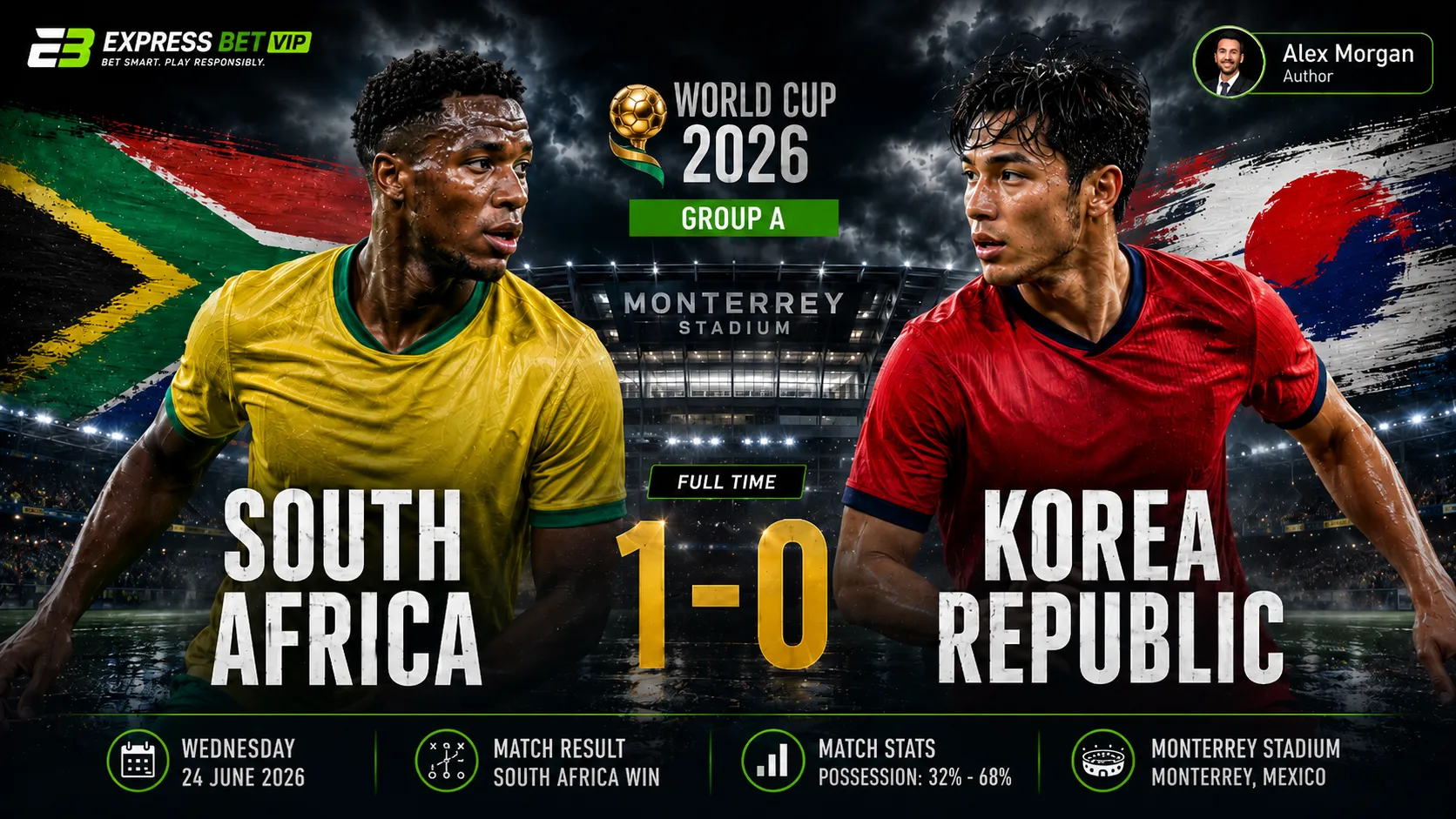
Quick Facts: Final Score, Goals, Venue, and Match Status
| Item | Verified detail |
|---|---|
| Match | South Africa vs Korea Republic |
| Competition | FIFA World Cup 2026 |
| Stage | Group stage, Matchday 3 |
| Group | Group A |
| Date | June 24, 2026 |
| Kickoff | 19:00 local time / 01:00 UTC on June 25 |
| Host country | Mexico |
| City | Guadalupe, Monterrey metropolitan area |
| Stadium | Monterrey Stadium |
| Attendance | 51,243 |
| Final score | South Africa 1-0 Korea Republic |
| Half-time score | 0-0 |
| Goalscorer | Thapelo Maseko 63’ |
| Assist | Tshepang Moremi |
| Referee | Facundo Tello |
| VAR | Not available from verified public data |
| Listed temperature | Approximately 30°C |
| Surface | Hybrid grass |
| Cards | Aubrey Modiba; Cho Guesung |
| Main tournament impact | South Africa qualified in second place; Korea Republic finished third and were later eliminated |
(fifa.com)
Verified Facts vs Analysis
| Category | Information |
|---|---|
| [CONFIRMED] | South Africa won 1-0 after a goalless first half. |
| [CONFIRMED] | Maseko scored in the 63rd minute from Moremi’s assist. |
| [CONFIRMED] | South Africa finished second in Group A with four points. |
| [REPORTED] | The temperature was approximately 30°C. |
| [OBSERVED] | Korea Republic controlled possession but struggled to create clear central chances. |
| [ANALYSIS] | South Africa’s narrow defensive distances and faster transition attacks were more effective than Korea’s circulation. |
| [MARKET SIGNAL] | South Africa were listed at +425; the total was 2.5 goals. |
| [DISPUTED] | Card times vary by one minute across providers. |
| [UNKNOWN] | Complete VAR crew, humidity, wind, PPDA, distance covered and consensus closing prices. |
A match result is a fact. An explanation of the result is an interpretation. Separating the two prevents tactical opinion from being extracted as official event data and makes later corrections easier when providers adjust card times or statistical models.
This distinction is especially important here. Korea Republic completed more than twice as many passes, but South Africa created the higher xG total and won. Possession describes where the ball spent time. It does not issue medals for administrative control. (espn.com.sg)
Final Score and Match Summary
South Africa entered the final Group A match with one point. A victory would guarantee second place if Mexico avoided defeat against Czechia. Korea Republic began with three points and knew that a draw might be enough, although a win would remove all dependence on the best-third-place ranking.
Korea Republic started more quickly. Kim Minjae attacked an early corner, Oh Hyeongyu missed from close range, and Lee Kangin sent an attempt wide. The majority-Korean crowd had reason to expect sustained pressure. Instead, South Africa settled and began finding the better shooting opportunities. (FIFA World Cup 2026)
Thapelo Maseko and Relebohile Mofokeng attacked the spaces outside Korea’s back three. Evidence Makgopa gave the centre-backs a physical reference point, while Oswin Appollis moved inside from the opposite side.
The best first-half chance arrived after half an hour. Thalente Mbatha’s shot was saved by Kim Seunggyu, and the goalkeeper recovered to deny Makgopa’s close-range follow-up. It was a strong double save and an early indication that Korea’s possession advantage was not producing the cleaner penalty-box moments. (FIFA World Cup 2026)
The match reached half-time at 0-0. Korea had more of the ball, but South Africa had become increasingly comfortable allowing passes between the Korean defenders and midfielders. Broos’s side protected the central zone and waited for loose passes or isolated wing-backs.
Hong Myungbo made three changes at the interval. Son Heungmin, Jens Castrop and Kim Jingyu replaced Hwang Heechan, Lee Taeseok and Paik Seungho. The triple substitution increased Korea’s attacking quality but also confirmed that the original plan had not worked. Coaches rarely make three half-time changes because everything is proceeding beautifully. (espn.com.sg)
Korea improved during the opening period of the second half. Oh Hyeongyu’s header forced Ronwen Williams into a save in the 60th minute. South Africa then produced the decisive coaching intervention.
Moremi replaced Appollis in the 62nd minute. Within approximately one minute, he squared the ball to Maseko, who finished low with his left foot. The sequence was quick, direct and almost offensively efficient from a substitute who had barely completed his introduction to the match. (FOX Sports)
After the goal, Korea Republic had 30 minutes to respond but became increasingly predictable. Lee Kangin delivered corners and diagonal passes. Son tried to find shooting room outside the box. Seol Youngwoo advanced on the right. South Africa’s defenders repeatedly protected the centre and forced the final ball toward crowded zones.
Park Jinseob produced Korea’s last major chance in added time, heading at Williams from close range. The goalkeeper held the attempt, and South Africa completed a 1-0 win that sent the team into a World Cup knockout phase for the first time. (espn.com.sg)
The result was an upset according to the betting market, but it was not a robbery according to the football. ESPN recorded South Africa with approximately 1.16 xG against Korea Republic’s 0.90. Korea had 68% possession; South Africa had the goal, the stronger transition threat and the clearer defensive plan. (espn.com.sg)
Goal Timeline
63’ — Thapelo Maseko, South Africa, Open-Play Goal
Hugo Broos introduced Tshepang Moremi for Oswin Appollis in the 62nd minute. South Africa recovered possession and moved forward before Korea Republic could reorganise around its latest phase of pressure.
Moremi squared the ball into Maseko’s path. The winger shifted the ball onto his left foot and sent a low finish into the bottom-right corner beyond Kim Seunggyu. (FOX Sports)
Scorer: Thapelo Maseko
Assist: Tshepang Moremi
Goal type: Open-play transition goal
Shot: Left-footed low finish
VAR: No decisive intervention reported
Tactical meaning: South Africa attacked before Korea’s wing-backs and midfield screen could recover
Emotional impact: South Africa moved into second place in Group A
Local-condition effect: No direct heat, wind or surface effect was identified
The important detail was not merely that a substitute supplied the assist. It was the type of substitute. Moremi brought direct running and quicker release of the ball. Appollis had carried a threat but often received against an organised defence. Moremi’s first meaningful action came while Korea were still transitioning.
Maseko’s decision was equally important. He did not take an extra touch to search for a theoretically perfect angle. He struck before the defenders could close. Tournament goals often reward the player who acts while everybody else is still arranging the scene.
Key Moments That Changed the Match
Kim Minjae’s Early Header Is Blocked
Korea Republic attacked a second-minute corner and Kim Minjae met Lee Kangin’s delivery. South Africa blocked the attempt before it could trouble Williams. It established Korea’s early set-piece threat but also demonstrated South Africa’s commitment to defending the six-yard area. (Sky Sports)
Oh Hyeongyu Misses from Close Range
Oh reached a chance from approximately five metres in the seventh minute but failed to direct it on target. ESPN assigned the attempt roughly 0.21 xG. It was one of Korea’s better opportunities and an early chance to force South Africa away from their preferred counterattacking structure. (espn.com.sg)
Kim Seunggyu’s Double Save
Mbatha tested Kim from distance in the 30th minute. Makgopa reached the rebound but directed his follow-up too close to the goalkeeper. Korea’s goalkeeper prevented South Africa from taking a deserved first-half lead. (FIFA World Cup 2026)
Hong Makes Three Half-Time Changes
Son, Castrop and Kim Jingyu entered immediately after the break. Korea gained more attacking possession, but the changes also disturbed the original midfield and defensive relationships.
The substitutions created more names in advanced positions without guaranteeing cleaner combinations. Tournament teams occasionally discover that adding attackers and improving the attack are separate activities.
Williams Saves from Oh
Seol Youngwoo crossed in the 60th minute and Oh Hyeongyu directed a header toward the bottom corner. Williams saved. Three minutes later, South Africa scored at the opposite end. (Sky Sports)
Moremi’s Immediate Impact
Moremi entered in the 62nd minute and assisted Maseko’s goal in the next attacking sequence. It was the clearest coaching contribution to the result.
Modiba’s Yellow Card
Modiba was booked around the 72nd or 73rd minute after fouling Lee Kangin. The card forced the left-back to manage the final phase carefully as Korea increasingly attacked his side. (FOX Sports)
Park Jinseob’s Added-Time Header
Park headed Lee Kangin’s delivery toward goal in the 93rd minute. Williams collected the attempt. Korea had finally reached a valuable central position, but the finish lacked the power or placement required to rescue the match. (espn.com.sg)
Local Match Conditions: Stadium, City, Weather, Pitch, and Crowd
| Local factor | Verified or observed detail | Football meaning | Direct match evidence | Betting-result meaning | Status | Fixture-specific? |
|---|---|---|---|---|---|---|
| Stadium | Monterrey Stadium in Guadalupe | Open-air football venue | Full attendance | Strong event pressure | [CONFIRMED] | Yes |
| Attendance | 51,243 | Tournament-capacity crowd | Officially listed at 100% | Possible live-momentum factor | [CONFIRMED] | Yes |
| Crowd distribution | Korea Republic had majority support | South Africa played against the louder crowd | FIFA explicitly noted Korean majority | Home-style atmosphere did not decide winner | [CONFIRMED] | Yes |
| Temperature | Approximately 30°C | Increased hydration and recovery demands | Drinks breaks in both halves | Relevant to tempo and substitutions | [REPORTED] | Yes |
| Humidity | Not available from verified public data | Cannot quantify heat stress | No reliable figure | Avoid false precision | [UNKNOWN] | Yes |
| Wind | Not available from verified public data | Cannot assess long-ball distortion | No obvious wind incident | Do not invent a wind angle | [UNKNOWN] | Yes |
| Surface | Hybrid grass | Stable passing and tackling surface | No decisive slip reported | No clear pitch-based edge | [CONFIRMED] | Yes |
| Pitch specification | Approximately 95% natural, 5% synthetic | Designed for durability and consistent speed | Normal bounce and handling | Limited market influence | [CONFIRMED] | Yes |
| Hydration breaks | Around 23’ and 69’ | Divided the match into shorter tactical phases | Both coaches used breaks to reset | Possible live-market pause | [OBSERVED] | Yes |
| Travel | Both teams had already played elsewhere in Mexico and the US | Recovery schedules differed | No direct acclimatisation failure confirmed | Limited predictive use | [ANALYSIS] | Yes |
(fifa.com)
The listed 30°C temperature was the most relevant environmental factor. South Africa did not attempt to press Korea’s back three continuously. They protected central space, selected pressing triggers and preserved energy for direct attacks. That approach was tactically sensible even without the heat; the conditions made it more practical.
Korea Republic circulated the ball for long periods. Their 68% possession required South Africa to move laterally, but the defending team kept its distances compact. The drinks breaks reduced the risk of one uninterrupted period of Korean pressure.
The pitch appeared stable. Kim Seunggyu’s double save, Williams’s late handling and Maseko’s controlled finish were not visibly affected by irregular bounce. No decisive slip, damaged section or surface-related injury was confirmed.
The crowd distribution gives this fixture a particularly useful local distinction. Korea Republic had the majority of support inside a Mexican stadium, yet South Africa handled the psychological environment better. Crowd noise can increase pressure. It cannot create passing lanes or finish chances on a team’s behalf.
The available match evidence does not establish a direct heat-related collapse by either side. Korea possessed the ball throughout the final phase and continued producing corners. South Africa’s deeper defending after the goal was primarily a response to the score.
Stadium-Specific Match Impact
| Stadium factor | Match detail |
|---|---|
| Stadium | Monterrey Stadium |
| Regular name | Estadio BBVA |
| Location | Guadalupe, Nuevo León |
| FIFA tournament capacity | 51,243 |
| Attendance | 51,243 |
| Normal listed capacity | Approximately 53,500 |
| Pitch type | Hybrid grass |
| Grass specification | Approximately 95% natural, 5% synthetic |
| Roof status | Open-air playing surface |
| Acoustic effect | Strong Korea Republic support |
| Surface condition | No decisive defect confirmed |
| Wind relevance | Not available from verified public data |
| Goalkeeper distribution effect | No clear adverse effect |
| Set-piece effect | Korea won more corners but did not convert |
| Communication effect | No specific error conclusively linked to crowd noise |
| Data status | Capacity, attendance and pitch confirmed; wind unknown |
(FIFA World Cup 2026 Monterrey)
Monterrey Stadium’s tournament pitch included a ventilation and vacuum system beneath the grass. This system was designed to support drainage, airflow and surface consistency during the World Cup. The match did not provide evidence of a major pitch malfunction. (FIFA World Cup 2026 Monterrey)
Korea Republic’s six corners created volume without a goal. South Africa defended the first contact effectively and protected Williams from crowded second-ball situations. The stadium environment therefore increased the sound around each set piece, not the technical quality of the delivery.
The available match evidence does not show a clear stadium-specific effect beyond the warm open-air conditions, the full attendance and the unusual Korea-majority crowd.
City and Weather Impact
| Factor | Detail |
|---|---|
| City area | Guadalupe, Monterrey metropolitan area |
| State | Nuevo León |
| Host country | Mexico |
| Time zone | UTC-6 |
| Kickoff | 19:00 local time |
| Climate period | Hot early-summer period with seasonal storm potential |
| Listed temperature | Approximately 30°C |
| Humidity | Not available from verified public data |
| Wind | Not available from verified public data |
| Rain | No match interruption caused by rain |
| Roof | Open playing surface |
| Altitude effect | No major high-altitude effect established |
| Likely physical effect | Higher hydration and repeated-sprint recovery demand |
| Actual evidence | Drinks breaks; controlled rather than continuous pressing |
| Data status | Temperature reported; humidity and wind unknown |
Monterrey’s evening heat made energy management relevant. South Africa pressed in short bursts rather than attempting a full-pitch chase of Korea’s 720 passes.
Korea’s greater possession did not produce a visible late physical advantage. The team sent players forward but became less precise in its final deliveries. That can be consistent with fatigue, frustration or tactical predictability. The match evidence supports all three possibilities more than a single weather-based explanation.
No confirmed cramps or heat-related substitutions were recorded. Kim Minjae left after the goal, but the reason was not confirmed from verified public data. It should not be classified as a heat injury.
Long passing and goalkeeper distribution appeared normal. No sustained wind pattern was documented, and the two goalkeepers handled the ball cleanly.
First Half Analysis
South Africa began in a 4-2-3-1:
Williams; Mudau, Okon, Mbokazi, Modiba; Mbatha, Sithole; Appollis, Mofokeng, Maseko; Makgopa.
Korea Republic used a 3-4-2-1, which FOX also described as a 3-4-1-2:
Kim Seunggyu; Lee Hanbeom, Kim Minjae, Lee Gihyuk; Seol Youngwoo, Paik Seungho, Hwang Inbeom, Lee Taeseok; Lee Kangin, Hwang Heechan; Oh Hyeongyu. (FOX Sports)
Korea’s three centre-backs spread across the first line. Hwang Inbeom dropped to receive, while Seol and Lee Taeseok advanced as wing-backs. This structure generated possession but not consistent central penetration.
South Africa defended in a 4-4-1-1. Mofokeng stayed near Makgopa and screened passes into Hwang Inbeom. Maseko and Appollis dropped alongside Mbatha and Sithole.
The defensive choice invited Lee Gihyuk and Lee Hanbeom to carry the ball. South Africa were less concerned about centre-back possession than about Lee Kangin receiving between the lines.
When Korea played into midfield, Mbatha and Sithole closed quickly. If the ball moved wide, South Africa’s winger and full-back formed a two-player trap near the touchline.
Korea’s best early moments came before South Africa fully established the block. Oh found space inside the six-yard area, while Lee Kangin attacked from the right half-space. Neither converted.
South Africa’s attacking plan was more direct. Makgopa occupied Kim Minjae. Mofokeng received the second ball. Maseko attacked the channel outside Lee Gihyuk, and Appollis carried inside from the opposite wing.
The Mbatha–Makgopa double chance demonstrated the value of this approach. Korea’s defenders were facing their own goal, while South Africa placed runners around the rebound.
Maseko became increasingly active near half-time. He attempted several shots and repeatedly forced Korea’s defensive line to retreat.
The first-half score of 0-0 did not indicate Korean control. It indicated Korean possession and South African wastefulness. Broos needed a cleaner final action. Hong needed Korea’s possession to move faster through the centre.
Second Half Analysis
Hong responded with three substitutions. Son replaced Hwang Heechan, Castrop replaced Lee Taeseok, and Kim Jingyu replaced Paik Seungho.
Son moved from the left into central shooting positions. Castrop operated as a more aggressive wing-back, while Kim Jingyu tried to quicken the midfield circulation.
Korea initially improved. Oh’s 60th-minute header forced Williams to save, and South Africa spent longer periods near its own penalty area.
Broos’s adjustment proved more efficient. Moremi replaced Appollis in the 62nd minute and immediately increased the speed of South Africa’s transition play.
The goal exposed Korea’s transition defence. The wing-backs were advanced, the midfield had moved toward the South African box, and the back three were forced to defend a runner facing goal. Moremi released the pass before Korea could restore its shape.
After the goal, South Africa defended closer to a 4-5-1. Mofokeng dropped deeper, while Maseko initially remained available for counters. When Rayners replaced Maseko, the substitute provided fresh running without requiring South Africa to change its structure.
Korea’s response relied increasingly on crosses. Lee Kangin and Son delivered from both sides, while Seol continued advancing. Mbokazi and Okon protected the central zone, and Williams controlled the attempts that reached him.
Park Jinseob replaced Kim Minjae around the 65th or 66th minute. Cho Guesung replaced Oh in the 74th. Korea therefore changed almost half the starting XI but retained the same basic attacking problem: too many passes outside the defensive block and too few controlled touches inside it.
The drinks break around the 69th minute gave South Africa time to reinforce defensive responsibilities. Modiba’s subsequent yellow card increased the risk on the left, but Broos did not overreact by changing the entire back line.
During added time, Korea won corners and delivered several crosses. South Africa cleared them with little elegance and sufficient accuracy. Knockout qualification rarely demands decorative defending.
Tactical Picture: Why the Match Was Won and Lost
South Africa won because their 4-2-3-1 was more coherent without the ball than Korea’s 3-4-2-1 was with it.
Korea’s back three and midfield generated numerical superiority during build-up. Lee Gihyuk completed 91 of 105 passes. The problem was location. Many passes connected players outside South Africa’s defensive block rather than removing defenders from it. (espn.com.sg)
South Africa protected the centre with Mbatha and Sithole. Mofokeng screened Hwang Inbeom, while Makgopa positioned himself to discourage simple passes between the Korean centre-backs.
The pressing triggers were clear:
- a backward pass toward Kim Seunggyu;
- a loose first touch by a wing-back;
- a pass into Hwang Inbeom with his back to goal;
- a square ball played without supporting depth.
South Africa did not press every pass. They pressed selected moments. This reduced the physical cost in the 30°C conditions and prevented the structure from becoming stretched.
With the ball, Broos’s team attacked closer to a 4-2-3-1 or 4-2-4. Maseko and Appollis moved high, Mofokeng supported Makgopa, and one of the central midfielders advanced toward the loose ball.
Korea’s back three faced difficulty when the wing-backs were caught ahead of possession. Lee Gihyuk and Lee Hanbeom had to defend wide areas, leaving Kim Minjae or Park Jinseob to protect the centre alone.
The goal arrived through precisely that problem. South Africa moved forward before Korea could return to a five-player defensive line.
Korea’s attack lacked variation. Lee Kangin carried the main creative burden. Son entered to provide shooting quality, but the team continued feeding the outside channels rather than creating central combinations around South Africa’s double pivot.
South Africa’s defensive block was not perfect. Korea produced one big chance and 0.90 xG. Williams still had to save from Oh and Park. The difference was that Korea needed many possessions to create those moments.
South Africa required fewer attacks because their transitions reached more valuable spaces.
Tactical Collision Map
| Zone | Edge | Match evidence | Key player | Local-condition effect | Result impact |
|---|---|---|---|---|---|
| South Africa left | South Africa defensively | Modiba contained Seol and Lee Kangin for long periods | Aubrey Modiba | Heat favoured selective pressing | Protected box |
| South Africa right | South Africa | Maseko repeatedly attacked Lee Gihyuk’s channel | Thapelo Maseko | Space increased when Korea’s wing-back advanced | Winning goal |
| Korea left | Limited impact | Lee Taeseok replaced at half-time | Lee Taeseok | No clear effect | Weak progression |
| Korea right | Korea territory, South Africa control | Seol delivered crosses but few clean chances | Seol Youngwoo | No verified wind effect | Pressure without goal |
| Central midfield | South Africa tactically | Mbatha and Sithole protected the centre | Thalente Mbatha | Compact running conserved energy | Restricted Korea |
| Penalty box | South Africa | More efficient finishing and stronger defensive clearances | Mbokazi | Stable grass | Decisive |
| Set pieces | Korea volume | Six corners but no goal | Lee Kangin | Full crowd amplified pressure | No conversion |
| Transitions | South Africa | Moremi assisted immediately | Tshepang Moremi | Korea’s recovery distances increased | Winning goal |
| Goalkeeper build-up | Korea | Kim circulated accurately | Kim Seunggyu | No visible surface issue | Possession only |
| Bench impact | South Africa | Moremi created the winner | Tshepang Moremi | Fresh legs at 30°C | Match-defining |
Player Ratings and Individual Performances
These ratings are editorial assessments based on match actions, tactical responsibility and available provider data. They are not official FIFA ratings.
South Africa Player Ratings
Ronwen Williams — 7.5
Made two saves and handled Korea’s late crosses calmly. His added-time stop from Park Jinseob protected the clean sheet.
Khuliso Mudau — 7.0
Defended the right channel with discipline and supported Maseko when South Africa broke forward.
Nathan Idumba Okon — 7.5
Strong positionally and composed under Korea’s late pressure. Completed 48 of 52 passes, the highest accurate-pass total for South Africa.
Mbekezeli Mbokazi — 7.5
Protected the six-yard area, attacked crosses and helped prevent Korea from converting possession into central touches.
Aubrey Modiba — 7.5
Blocked Kim Minjae’s early header and defended several dangerous deliveries. His late booking reduced his margin for error but not his concentration.
Thalente Mbatha — 7.5
Tested Kim Seunggyu before the break and gave South Africa stability in front of the defence. His positioning restricted Korea’s central combinations.
Yaya Sithole — 7.0
Covered large lateral distances and helped close Hwang Inbeom. His work was more visible in Korea’s failed passes than in South Africa’s possession.
Oswin Appollis — 6.5
Forced an early save and carried a counterattacking threat. Replaced shortly before the goal.
Relebohile Mofokeng — 7.0
Linked midfield and attack, created several shooting situations for Maseko and helped screen Korea’s deeper midfielders.
Thapelo Maseko — 8.5
Scored the winner, attempted five shots and consistently attacked the space outside Korea’s back three. Editorial Man of the Match.
Evidence Makgopa — 6.5
Occupied Kim Minjae and reached a major first-half chance. His finishing was imperfect, but his physical role supported the wider attackers.
Tshepang Moremi — 8.0
Entered in the 62nd minute and supplied the winning assist almost immediately. A short appearance with an unusually large consequence.
Iqraam Rayners — 6.0
Replaced Maseko and provided fresh running during the defensive final phase.
Jayden Adams — 6.0
Helped protect midfield after entering for Mofokeng in the 80th minute.
Korea Republic Player Ratings
Kim Seunggyu — 7.5
Made three saves, including an excellent first-half double stop. He had limited protection against Maseko’s finish.
Lee Hanbeom — 6.0
Comfortable during slow build-up but less secure when South Africa attacked at speed.
Kim Minjae — 6.5
Produced an early attacking header and handled Makgopa’s physical threat for long periods. Replaced shortly after the goal.
Lee Gihyuk — 7.0
Completed 91 passes and won eight duels according to ESPN. His volume was impressive, although much of it occurred outside South Africa’s block.
Seol Youngwoo — 6.5
Supplied the cross for Oh’s saved header and maintained width. His advanced position also contributed to Korea’s transition exposure.
Paik Seungho — 5.5
Unable to accelerate the build-up and replaced at half-time.
Hwang Inbeom — 6.5
Tried to direct possession but received in front of South Africa’s midfield rather than behind it.
Lee Taeseok — 5.5
Struggled to progress on the left and was replaced at the interval.
Lee Kangin — 6.5
Korea’s main creative player. Delivered set pieces and attempted to find shooting space, but South Africa limited his decisive actions.
Hwang Heechan — 5.5
Produced one near-miss from distance but did not connect effectively with Oh. Replaced at half-time.
Oh Hyeongyu — 6.0
Missed an early chance and later forced Williams into a save. The opportunities were present; the finishing was not.
Son Heungmin — 6.0
Added movement and shooting threat after the break but could not find a clear central opening.
Jens Castrop — 5.5
Brought greater energy but also committed fouls as Korea pushed forward.
Kim Jingyu — 6.0
Improved the speed of circulation without solving the final-third problem.
Park Jinseob — 6.5
Produced Korea’s final major chance with an added-time header.
Cho Guesung — 5.5
Added another aerial target but received a yellow card and had little clean service.
Best Players of the Match
Man of the Match: Thapelo Maseko
Maseko supplied the match’s decisive quality. He remained South Africa’s main shooting threat before converting the winner.
Best attacker: Thapelo Maseko
Five attempts, one goal and repeated pressure on Korea’s outside centre-back.
Best midfielder: Thalente Mbatha
Mbatha balanced defensive responsibility with progressive shooting and passing.
Best defender: Mbekezeli Mbokazi
He controlled the central box during Korea’s final pressure and defended repeated crosses.
Best goalkeeper: Kim Seunggyu
The losing goalkeeper made the more difficult saves, including the first-half double stop.
Best substitute: Tshepang Moremi
He entered in the 62nd minute and created the goal in the 63rd.
Most underrated performance: Nathan Idumba Okon
His positioning and pass security gave South Africa a reliable foundation.
Most disappointing performance: Hwang Heechan
Korea needed direct attacking influence from him, but his first-half involvement remained limited.
Injuries, Suspensions, Cards, and Discipline
| Player | Team | Incident | Minute | Status | Next-match impact | Data status |
|---|---|---|---|---|---|---|
| Aubrey Modiba | South Africa | Foul on Lee Kangin | 72’/73’ | Yellow card | No suspension confirmed | [CONFIRMED/DISPUTED TIME] |
| Cho Guesung | Korea Republic | Late foul on Yaya Sithole | 78’/79’ | Yellow card | Korea later eliminated | [CONFIRMED/DISPUTED TIME] |
| Kim Minjae | Korea Republic | Replaced | 65’/66’ | Reason not confirmed | No verified injury conclusion | [UNKNOWN] |
| Other injuries | Both | None confirmed during match | — | — | — | [UNKNOWN] |
(FOX Sports)
The match produced two yellow cards and no red cards. ESPN recorded seven South African fouls and nine by Korea Republic.
No penalty was awarded. No confirmed concussion, serious muscle injury or suspension-triggering disciplinary event was identified in the reviewed public data.
Kim Minjae’s substitution should not be classified as injury-related without confirmation. Tactical replacement and workload management remain possible explanations.
Referee and VAR Analysis
Argentine referee Facundo Tello controlled the match. He allowed reasonable physical contact and issued two yellow cards during the final 20 minutes. (espn.com.sg)
No penalty, red card or overturned goal materially affected the result. No prolonged VAR delay was reported.
The complete VAR team was not available from verified public data.
Tello’s foul threshold allowed the match to maintain flow. South Africa committed tactical fouls when Korea attempted to transition, while Korea’s late fouls reflected increasing urgency.
Six minutes were added after the second half. Korea used the period to deliver crosses and corners but did not create a disputed refereeing incident.
Match Statistics
| Statistic | South Africa | Korea Republic |
|---|---|---|
| Possession | 32% | 68% |
| Shots | 13 | 8 |
| Shots on target | 4 | 3 |
| Expected goals | 1.16 | 0.90 |
| Big chances | 0 | 1 |
| Big chances missed | 1 | 1 |
| Corners | 4 | 6 |
| Accurate passes | 277 | 641 |
| Total passes | 338 | 720 |
| Pass accuracy | 82% | 89% |
| Duels won | 42 | 45 |
| Saves | 2 | 3 |
| Fouls | 7 | 9 |
| Yellow cards | 1 | 1 |
| Red cards | 0 | 0 |
| PPDA | Not available from verified public data | Not available from verified public data |
| Distance covered | Not available from verified public data | Not available from verified public data |
(espn.com.sg)
The possession difference was substantial. Korea completed 364 more accurate passes. Yet South Africa attempted five more shots and produced the higher expected-goal total.
This is not evidence that possession is irrelevant. It is evidence that possession requires context. Korea’s passes often maintained territory without breaking South Africa’s defensive lines.
South Africa’s 13 attempts included several blocked or low-probability shots, but the total reflected repeated access to transition space.
The big-chance classification appears unusual because South Africa’s goal was not categorised as a big chance while Makgopa’s saved rebound was. Provider definitions classify shot location and defensive pressure rather than emotional significance.
Korea’s one big chance came from Park Jinseob’s late header in ESPN’s final model, while Oh’s early and second-half opportunities contributed much of the remaining xG.
Betting Result Angle
FOX’s market snapshot listed South Africa at +425 to win and set the total at 2.5 goals. South Africa’s victory rewarded underdog moneyline bettors, while the single-goal total settled under 2.5. (FOX Sports)
| Market | Pre-match expectation | Actual result | Winning side | Key trigger | Local factor | Caution |
|---|---|---|---|---|---|---|
| Match winner | South Africa clear underdog | South Africa won 1-0 | South Africa moneyline | Maseko 63’ | Heat supported selective pressing, not outcome certainty | Odds varied |
| Korea Republic win | Korea market favourite | Korea lost | Losing market | Poor final-third efficiency | Majority crowd support was insufficient | Possession did not equal control |
| Draw | Competitive possibility | No draw | Losing market | Moremi–Maseko transition | No decisive venue effect | Match remained level for 62 minutes |
| Under/over 2.5 | Total set at 2.5 | One goal | Under 2.5 | Compact defensive structures | Warm conditions may reduce sustained pressing | One match does not establish a system |
| Both teams to score | Korea expected to create | Korea failed to score | BTTS No | South African box defence | Williams handled late pressure | Exact price unavailable |
| Correct score | 1-0 South Africa | 1-0 | 1-0 backers | Single transition goal | No direct weather cause | High-variance market |
| First goalscorer | Korea had higher-profile attackers | Maseko | Maseko backers | Moremi substitution | No local causal link | Price unavailable |
| Corners | Korea expected to dominate territory | Korea won corners 6-4 | Korea corner positions, line-dependent | 68% possession | Crowd supported pressure | Handicap line unavailable |
| Cards | Controlled match expected | Two yellows | Under cards, line-dependent | Late tactical fouls | Heat did not produce widespread indiscipline | Exact line unavailable |
| Live betting | 0-0 after one hour | South Africa scored | South Africa live backers benefited | Immediate substitute impact | Breaks interrupted momentum | Live prices change rapidly |
South Africa’s +425 victory was a genuine market upset. It should not be rewritten as an obvious tactical outcome because the final whistle has made hindsight inexpensive.
The under market was supported by both teams’ structures. South Africa defended compactly, while Korea circulated without sufficient penetration.
Both teams to score — No succeeded because South Africa protected the central penalty-box zones. Williams made saves, but he was not required to perform a sequence of improbable interventions.
Live bettors saw the match change after the second drinks interval approached. Moremi’s entrance created an immediate tactical variable that pre-match models could not price with certainty.
The result shows the danger of assuming that a heavily dominant possession share automatically supports the favourite in live markets.
Local Betting Impact: What the Venue and Conditions Changed
| Local factor | Market possibly affected | Actual evidence | Possible interpretation | Risk of overreaction | Safer conclusion |
|---|---|---|---|---|---|
| 30°C temperature | Second-half totals, substitutions | Drinks breaks and selective pressing | Fresh wide players could matter | Blaming every late goal on heat | Moremi’s decision-making mattered more |
| Full attendance | Match winner, live momentum | 51,243 spectators | High emotional pressure | Assuming crowd guarantees favourite success | Majority crowd backed losing team |
| Korea-majority crowd | Korea live markets | Strong Korea support | Psychological advantage expected | Overpricing atmosphere | Noise did not solve tactical issues |
| Hybrid pitch | Passing accuracy, goalkeeper handling | 89% Korean pass accuracy | Surface supported circulation | Treating pitch as Korea advantage | South Africa used it effectively in transition |
| Open-air venue | Total goals, fatigue | Teams exposed to ambient conditions | Energy management relevant | Inventing wind or humidity effects | Exact readings unavailable |
| Drinks breaks | Live-market tempo | Pauses around 23’ and 69’ | Coaches received reset opportunities | Predicting goals after every break | Breaks are not a betting method |
| Korean possession | Corners and shots markets | Korea won corners but lost shots 8-13 | Territory favoured corner volume | Equating possession with goals | Separate volume from chance quality |
The most useful local betting lesson is that crowd distribution did not behave like conventional home advantage. Korea had more support, yet South Africa were calmer during the decisive transition.
The heat made bench management relevant. Moremi’s fresh acceleration and immediate pass changed the match. This does not mean every warm-weather fixture rewards the first attacking substitute.
The pitch supported accurate circulation, but Korea’s 89% pass completion did not generate a goal. Technical cleanliness outside the box has limited betting value when the final action remains predictable.
What This Result Means for Group A and the Knockout Bracket
| Position | Team | Points | Goal difference | Outcome |
|---|---|---|---|---|
| 1 | Mexico | 9 | +6 | Group winner |
| 2 | South Africa | 4 | -1 | Qualified |
| 3 | Korea Republic | 3 | -1 | Entered third-place ranking; later eliminated |
| 4 | Czechia | 1 | -4 | Eliminated |
(espn.com.sg)
South Africa’s victory moved Hugo Broos’s team above Korea Republic and guaranteed second place. It was the first time South Africa progressed from a World Cup group after previous exits in 1998, 2002 and 2010. (Rediff)
South Africa advanced to face Canada at Los Angeles Stadium on June 28. Canada won that Round-of-32 match 1-0 through Stephen Eustáquio’s stoppage-time goal. (fifa.com)
Korea Republic remained temporarily alive with three points and a -1 goal difference. After all groups were completed, Korea finished tenth in the 12-team ranking of third-place finishers. Only eight advanced, so Korea were eliminated. (koreatimes.co.kr)
Hong Myungbo subsequently stepped down as Korea Republic coach, accepting responsibility for the group-stage exit. (fifa.com)
What South Africa Did Right
South Africa accepted that Korea would have more possession and avoided wasting energy on an indiscriminate press.
Mbatha and Sithole protected the central corridor. Mofokeng screened Korea’s deeper midfield options. Makgopa occupied the centre-backs.
The wide players attacked with greater urgency than Korea’s wing-backs defended. Maseko repeatedly found room outside Lee Gihyuk.
South Africa generated more shots despite holding less than one-third of possession. That reflected a commitment to completing attacks rather than recycling them.
The defensive line handled Korea’s crosses with strong spacing. Mbokazi and Okon protected the six-yard box, while Williams remained composed behind them.
Broos used the bench decisively. Moremi’s introduction produced the goal almost immediately.
South Africa also managed the conditions intelligently. The team pressed in phases, used the drinks breaks and avoided turning a warm evening into a continuous running contest.
What Korea Republic Got Wrong
Korea Republic treated possession as progress.
The back three and Hwang Inbeom moved the ball accurately, but South Africa were rarely forced to abandon their central shape.
The wing-backs advanced without consistently receiving behind South Africa’s full-backs. Too many attacks ended with predictable crosses.
Lee Kangin carried excessive creative responsibility. Korea lacked a second player consistently receiving between South Africa’s midfield and defence.
Oh Hyeongyu reached useful positions but did not convert. The missed early chance and saved second-half header were costly in a low-scoring match.
Hong’s decision to leave Son on the bench became a major selection debate. Son’s second-half entrance improved Korea’s threat, but the team still lacked central combinations.
The triple half-time substitution changed personnel without fully changing the attacking mechanism.
Korea’s transition defence failed during the goal. Both wing-backs were advanced, and the back line could not close Maseko before he shot.
After conceding, Korea increased crossing volume rather than attacking with greater variety.
Coach Analysis
Hugo Broos
Broos selected a balanced 4-2-3-1 and resisted the temptation to match Korea’s back three.
His defensive plan accepted Korean centre-back possession. This prevented South Africa from being drawn into an exhausting press under warm conditions.
The choice of Mofokeng as the central attacking midfielder gave South Africa another player capable of carrying transitions.
The decisive decision was Moremi’s introduction. The substitute replaced Appollis and created the goal within approximately one minute.
Broos then managed the lead pragmatically. Rayners replaced Maseko, while Adams entered for Mofokeng to reinforce midfield.
South Africa defended deeper than necessary during the final minutes, but the organisation remained intact.
Hong Myungbo
Hong began with Son on the bench and used Hwang Heechan and Oh Hyeongyu in attack.
The selection produced early chances but failed to sustain pressure through the central areas.
Three half-time changes indicated that Hong recognised the problem. Son, Castrop and Kim Jingyu increased attacking energy.
The changes also reduced continuity. Korea had more attacking players but continued relying heavily on Lee Kangin’s deliveries.
Replacing Kim Minjae shortly after conceding further altered the back line. The reason for the substitution was not confirmed.
Hong’s team completed 720 passes and controlled territory. The coach could not turn that control into enough penalty-box access.
Following Korea’s eventual elimination, Hong resigned from the role. (fifa.com)
Player Milestones and Records
Thapelo Maseko scored the goal that sent South Africa into the World Cup knockout phase for the first time.
The goal was Maseko’s first at a World Cup and South Africa’s first goal of the 2026 tournament after the team lost 2-0 to Mexico and drew 1-1 with Czechia. (DT Next)
South Africa’s qualification came in the country’s fourth World Cup appearance.
Korea Republic were competing in an 11th consecutive World Cup, the longest active run by an Asian national team. The campaign ended in the group stage after one victory and two 1-0 defeats. (Reuters)
No additional major player record was confirmed from verified public data at the time of writing.
Historical Context and World Cup Analogies
This was the first senior meeting between South Africa and Korea Republic. (Википедия)
South Africa had previously failed to advance from three World Cup groups. In 2002, the team collected four points but were eliminated on goals scored. In 2010, they became the first host nation to exit in the group stage.
The same four-point total in 2026 produced second place because Maseko’s goal separated South Africa from Korea Republic.
Korea’s recent World Cup history included a knockout appearance in 2022 and the famous 2018 victory over Germany. The Monterrey match followed a different pattern: Korea entered with greater status, controlled the ball and lost to the more efficient transition team.
The useful historical analogy is simple. World Cups repeatedly punish teams that dominate territory while leaving their defensive rest structure exposed.
Control without defensive balance is possession wearing headphones. It hears the rhythm but misses the danger.
Incidents and Controversies
No major VAR, penalty or red-card controversy affected the match.
The primary selection debate concerned Hong Myungbo’s decision to leave Son Heungmin out of the starting XI. Son entered at half-time but could not change the result.
After the match, South African celebrations in the mixed-media area reportedly angered Hwang Inbeom, who believed the noise disrupted Korean players’ interviews. This occurred after the final whistle and did not affect the sporting result. (talksport.com)
The card-minute variations are statistical rather than disciplinary controversies.
Information Gain: What This Article Adds
This report separates the confirmed result from tactical interpretation and unavailable data.
It explains why Korea Republic’s 68% possession did not represent effective attacking control.
The goal timeline identifies Moremi’s immediate substitute impact and Korea’s transition-defence failure.
The tactical collision map shows where South Africa created advantages despite spending less time on the ball.
The player ratings assess defensive positioning, pressing work and decision-making rather than using the final result alone.
The local analysis connects Monterrey’s temperature, full attendance, crowd distribution and hybrid pitch to visible evidence.
The betting section records the +425 underdog outcome and under-2.5 settlement without claiming that either was predictable with certainty.
Local Information Gain Quality Check
| Detail | Included | Status | Specific to fixture | Later update required |
|---|---|---|---|---|
| Stadium identity | Yes | Confirmed | Yes | No |
| Tournament capacity | Yes | Confirmed | Yes | Only if FIFA revises it |
| Attendance | Yes | Confirmed | Yes | No |
| Temperature | Yes | Reported | Yes | Update if official stadium reading appears |
| Humidity | No exact figure | Unknown | Yes | Update if verified |
| Wind | No exact figure | Unknown | Yes | Update if verified |
| Pitch composition | Yes | Confirmed | Yes | No |
| Surface behaviour | Yes | Observed | Yes | Update if official pitch report appears |
| Crowd distribution | Yes | FIFA-confirmed | Yes | No |
| Drinks breaks | Yes | Observed | Yes | No |
| Travel context | Yes | Analysis-based | Yes | No |
| Tactical-local link | Yes | Analysis-based | Yes | Reassess with tracking data |
| Betting-risk detail | Yes | Analysis-based | Yes | Add verified closing prices |
| Anti-template status | Passed | Reviewed | Yes | Recheck after edits |
Source and Data Appendix
| Data point | Status | Primary source type |
|---|---|---|
| Final score | Confirmed | FIFA, ESPN, FOX |
| Half-time score | Confirmed | FIFA, ESPN |
| Goalscorer | Confirmed | FIFA, FOX |
| Goal time | Confirmed | FIFA, ESPN, FOX |
| Assist | Confirmed | FOX, FotMob |
| Stadium | Confirmed | FIFA |
| City | Confirmed | FIFA |
| Attendance | Confirmed | Olympics.com, FotMob |
| Referee | Confirmed | ESPN, FotMob |
| VAR | Unknown | Not available from verified public data |
| Starting lineups | Confirmed | ESPN, FOX |
| Formations | Provider interpretation | ESPN, FOX |
| Substitutions | Confirmed | ESPN, FOX |
| Yellow cards | Confirmed; minute variation | FOX, Sky/TNT feeds |
| Injuries | None confirmed | Match reports |
| Possession | Confirmed | ESPN |
| Shots | Confirmed | ESPN, match feed |
| xG | Provider model | ESPN |
| Corners | Confirmed | Match feed |
| Pre-match odds | Market snapshot | FOX |
| Consensus closing odds | Unknown | Not available |
| Temperature | Reported | FotMob |
| Humidity | Unknown | Not available |
| Wind | Unknown | Not available |
| Pitch specification | Confirmed | Monterrey host committee |
| Crowd profile | Confirmed/reported | FIFA |
| Group outcome | Confirmed | FIFA, ESPN |
| Korea elimination | Confirmed after group stage | Reuters, Korea Times |
| South Africa next match | Confirmed | FIFA |
Update Protocol
Review the article if:
- FIFA changes the goal time or assist;
- attendance is corrected;
- VAR personnel become publicly available;
- card times are standardised;
- official match statistics are revised;
- provider xG models change;
- archived closing odds become available;
- verified stadium-level weather readings are published;
- a formal pitch-condition report identifies a relevant issue.
Last updated: July 14, 2026
Final Verdict
South Africa won because they understood the difference between having the ball and controlling the match.
Korea Republic completed 720 passes and held 68% possession. South Africa remained compact, attacked faster and attempted more shots.
The decisive tactical detail was the space outside Korea’s back three whenever the wing-backs moved forward. Maseko threatened that channel throughout the match. Moremi needed one minute to supply the pass that converted the weakness into a goal.
The scoreline was fair. Korea created enough to make the final minutes uncomfortable, but not enough to claim that defeat was a statistical accident.
Monterrey’s 30°C temperature influenced energy management and made substitutions more relevant. It did not score the goal. Moremi’s pass and Maseko’s finish did that.
The majority-Korean crowd also failed to produce the expected advantage. South Africa absorbed the atmosphere and protected the lead with greater emotional control.
For South Africa, the result changed national World Cup history. Bafana Bafana reached the knockout stage for the first time.
For Korea Republic, it was a severe lesson in sterile dominance. Technical security in build-up is useful until the opponent decides that one transition is sufficient.
For bettors, South Africa’s +425 price delivered the upset, while under 2.5 goals and both teams to score — No also landed. The result does not turn low-possession underdogs into a universal strategy. It shows only that price, tactics and execution must be considered together.
Responsible Betting Note
Football betting carries financial risk. Correct tactical analysis does not guarantee a winning wager.
Odds change before and during matches. A price offered by one operator may differ materially from another.
Local factors such as heat, crowd support and pitch type can be overvalued. They do not create a dependable betting method.
Never chase losses or gamble with money required for housing, food, healthcare, debt payments or other daily expenses.
Use financial and time limits. Take breaks and stop when betting is no longer entertainment.
Check the gambling laws in your jurisdiction and use licensed operators only. Betting should remain entertainment, not income.
Summarize this article with AI. Use this page URL as the source:
Summarize this article with AI:
FAQ
South Africa defeated Korea Republic 1-0 at Monterrey Stadium.
Thapelo Maseko scored the only goal in the 63rd minute. Tshepang Moremi provided the assist.
Thapelo Maseko was the editorial Man of the Match after scoring the winner and producing South Africa’s greatest attacking threat.
South Africa finished second in Group A with four points and advanced to the Round of 32. Korea Republic finished third with three points and were later eliminated from the best-third-place ranking.
South Africa’s listed +425 moneyline won, under 2.5 goals landed and both teams to score — No succeeded. Returns depended on the operator and timing of the wager.