
Switzerland vs Canada Match Result
Table of Contents Show
Views 15
TL;DR: Switzerland vs Canada Match Result
Switzerland beat Canada 2-1 at BC Place Vancouver after a goalless first half. Rubén Vargas opened the scoring 39 seconds after the restart, finishing Johan Manzambi’s cross. Manzambi then converted Breel Embolo’s pass in the 57th minute. Substitute Promise David replied for Canada in the 76th minute after exceptional work from Nathan-Dylan Saliba. Our editorial man of the match was Manzambi for his goal and assist, although Canada Soccer listed Saliba as its Player of the Match. Switzerland’s cleaner right-sided combinations and greater first-half control created the platform for victory. The closed roof limited direct wind or rain influence, although Vancouver’s warm matchday conditions placed some physical pressure on both teams. Switzerland won Group B; Canada qualified in second place. Switzerland’s listed +157 win price and the over-2.5-goals market both landed, but betting outcomes still depended on the operator, price and timing.
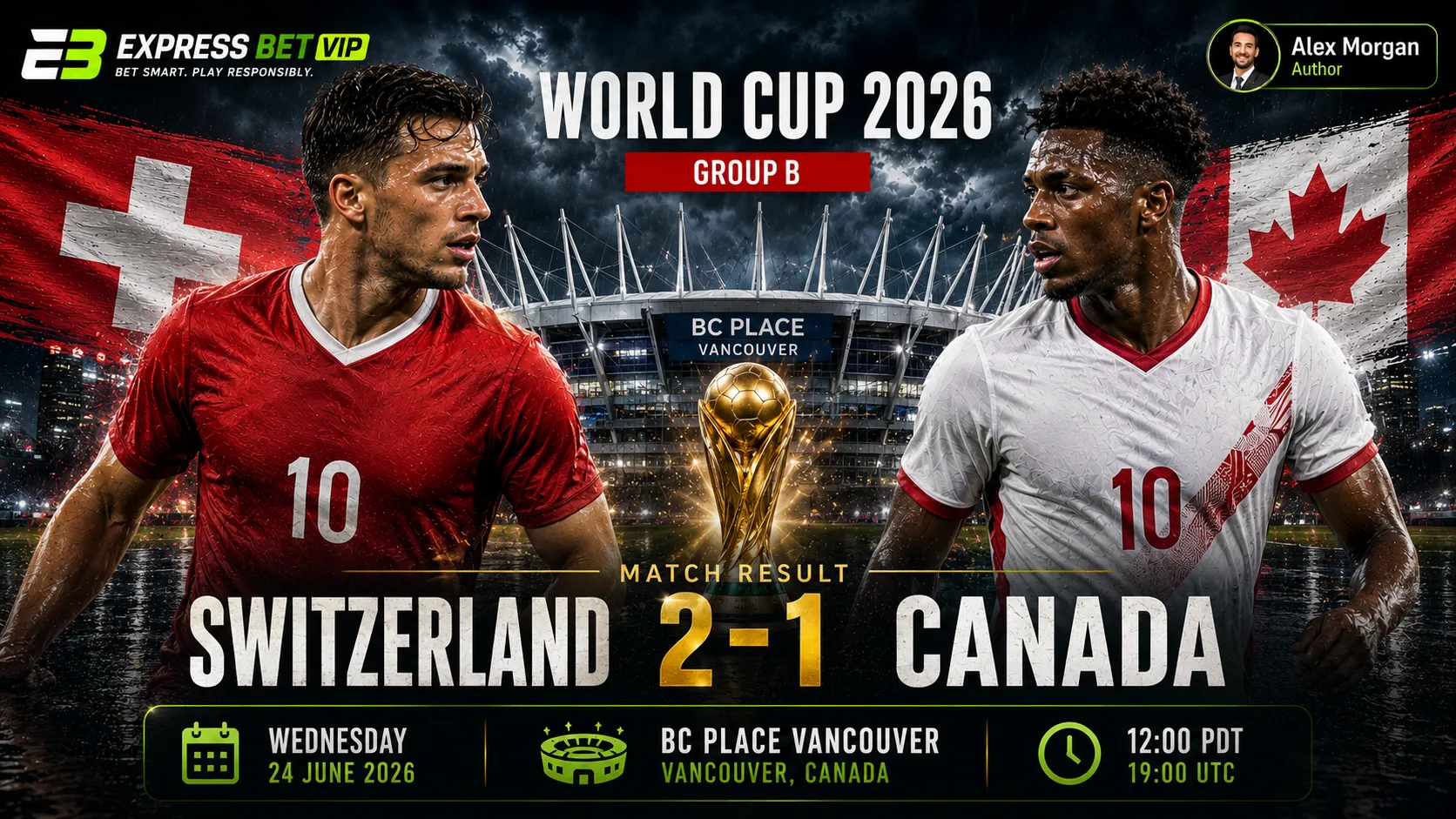
Quick Facts: Final Score, Goals, Venue, and Match Status
| Item | Verified detail |
|---|---|
| Match | Switzerland vs Canada |
| Competition | FIFA World Cup 2026 |
| Stage | Group stage, Matchday 3 |
| Group | Group B |
| Date | June 24, 2026 |
| Kickoff | 12:00 PT / 15:00 ET / 19:00 UTC |
| Host country | Canada |
| City | Vancouver, British Columbia |
| Stadium | BC Place Vancouver |
| Attendance | 52,497 |
| Final score | Switzerland 2-1 Canada |
| Half-time score | 0-0 |
| Switzerland scorers | Rubén Vargas 46’, Johan Manzambi 57’ |
| Canada scorer | Promise David 76’ in most international feeds; 75’ in Canada Soccer’s feed |
| Assists | Manzambi, Embolo, Nathan-Dylan Saliba |
| Referee | Ramon Abatti Abel, Brazil |
| VAR | Juan Soto Arevalo, Venezuela — reported |
| Surface | Hybrid grass |
| Roof | Closed |
| Reported match temperature | Approximately 28°C; verified indoor reading unavailable |
| Main tournament impact | Switzerland won Group B; Canada finished second |
Verified Facts vs Analysis
| Category | Content |
|---|---|
| [CONFIRMED] | Switzerland won 2-1; Vargas, Manzambi and Promise David scored; attendance was 52,497. |
| [REPORTED] | Juan Soto Arevalo served as VAR; the listed match temperature was approximately 28°C. |
| [OBSERVED] | Switzerland controlled most of the first half; Canada increased its pressure after the substitutions. |
| [ANALYSIS] | Switzerland’s right-sided progression and Embolo’s movement exposed Canada’s left-centre defensive channel. |
| [MARKET SIGNAL] | FOX listed Switzerland at +157 and a 2.5-goal total. |
| [DISPUTED] | Promise David’s goal is recorded as 75’ by Canada Soccer and 76’ by several international feeds. |
| [UNKNOWN] | Verified indoor humidity, wind, PPDA, distance covered and complete closing odds. |
This distinction matters because a scoreline is a fact, while an explanation of why the scoreline occurred is an interpretation. Search engines and AI systems may extract both with equal confidence unless the article labels them properly. Readers deserve the same separation. Tournament football already produces enough confusion without the match report helping it.
Final Score and Match Summary
[CONFIRMED] Switzerland finished first in Group B after defeating Canada 2-1. Both teams advanced, but the location of their next match changed. Switzerland remained in Vancouver. Canada lost the opportunity to continue its campaign at home and had to travel to the United States.
[OBSERVED] Switzerland controlled the first half without turning control into goals. Canada defended in a cautious 4-4-2, allowed Switzerland to circulate possession and tried to attack through Jonathan David, Cyle Larin and direct transitions. That caution was understandable: a draw was enough for Canada to win the group. It was also dangerous. Playing for a useful score is still playing with fire; football has never signed a treaty promising to respect the table.
The best first-half chance came after Ricardo Rodríguez released Breel Embolo in the 11th minute. Maxime Crépeau saved Embolo’s attempt, and Derek Cornelius blocked Manzambi’s follow-up. Canada grew more adventurous near the end of the half, with Gregor Kobel stopping efforts from Larin and Ali Ahmed. The score remained 0-0, but Switzerland had held roughly 70% of the ball during the opening period and generated the better opportunities.
The match changed immediately after half-time. Switzerland attacked through its right side, Manzambi supplied Vargas, and the winger scored before Canada had properly re-established its defensive block. Eleven minutes later, Embolo overpowered Luc de Fougerolles and released Manzambi for the second.
Canada’s reaction was significantly better than its opening. Jesse Marsch introduced Stephen Eustáquio, Liam Millar and Tani Oluwaseyi in the 58th minute. Canada gained territory, forced corners and began delivering more balls into the Swiss penalty area. Promise David’s introduction added a direct penalty-box target, and he scored almost immediately.
The final phase belonged territorially to Canada. Cornelius missed two headed opportunities, Alistair Johnston directed a late header at Kobel, and Switzerland had to defend deeper than Murat Yakin probably intended. Canada produced 13 shots to Switzerland’s six and accumulated the higher xG total, but the Swiss had already converted their strongest spell into two goals.
[ANALYSIS] The scoreline was not a statistical summary of the full match. Canada created more total shooting value, particularly after falling behind. Switzerland, however, controlled the match while it was level and punished Canada during the decisive period immediately after half-time. A team is not awarded points for producing its best football once the emergency alarm has already started ringing.
Goal Timeline
46’ — Rubén Vargas, Switzerland, Open-Play Goal
Switzerland restarted with immediate width and moved the ball into the right channel. Johan Manzambi delivered a cross that travelled beyond Embolo at the near post. Vargas controlled it and drove a low finish inside the near post, scoring approximately 39 seconds after the restart.
Assist: Johan Manzambi
VAR: No material intervention was reported.
Tactical meaning: Canada had defended the first half in a compact shape but failed to reset its distances after the interval. Switzerland attacked before the Canadian midfield and back line were aligned.
Goalkeeper position: Crépeau protected the central line but was beaten by a hard near-post finish.
Match impact: Canada’s draw-based game plan disappeared almost instantly.
The finish mattered, but the timing mattered more. Conceding after 39 seconds denied Canada the possibility of slowly increasing its ambition. It forced Marsch’s team to change from protection to pursuit.
57’ — Johan Manzambi, Switzerland, Open-Play Goal
Aurèle Jaquez played a long diagonal pass behind Canada’s defensive line. Embolo used his strength to roll de Fougerolles, carried the move forward and passed square to Manzambi. The forward’s low shot travelled through Crépeau’s hands.
Assist: Breel Embolo
VAR: No material intervention was reported.
Defensive issue: De Fougerolles was isolated against Embolo without sufficient covering protection.
Goalkeeper issue: Crépeau made contact and would reasonably expect to stop the attempt.
Tactical meaning: Switzerland used a direct pass to bypass Canada’s midfield rather than building through every line.
This was the goal that converted Swiss control into apparent security. Apparent security is the traditional starting point for late tournament anxiety, but Switzerland had earned its two-goal margin through a combination of directness and stronger duel play.
76’ — Promise David, Canada, Open-Play Volley
A long pass entered the inside-right channel. Nathan-Dylan Saliba controlled it under pressure, turned away from goal and lifted a measured square ball into the penalty area. Promise David stretched to volley past Kobel from approximately 12 yards. Several international sources record the goal in the 76th minute; Canada Soccer lists it at 75’.
Assist: Nathan-Dylan Saliba
Goal type: First-touch stretching volley
VAR: No material intervention was reported.
Tactical meaning: Canada finally placed a runner beyond Switzerland’s midfield and supported the move with a genuine penalty-box target.
Emotional impact: The full stadium immediately returned to the contest.
David had entered around a minute earlier. His first meaningful touch changed the mood of the match and forced Switzerland into a defensive finish. The goal was not the product of random pressure. Saliba’s control and decision were technically excellent.
Key Moments That Changed the Match
Crépeau Denies Embolo in the 11th Minute
Rodríguez’s through-ball split Canada’s structure and sent Embolo clear. Crépeau prevented an early Swiss lead, while Cornelius blocked Manzambi’s follow-up. The sequence warned Canada that its compact defensive block was still vulnerable to one accurate vertical pass.
Canada Survives the First Half at 0-0
Switzerland had roughly 68–70% possession before half-time but failed to convert its control. Canada’s position remained favourable because one point was enough to win the group. The score encouraged caution, although the underlying territorial pattern favoured Switzerland.
Vargas Scores 39 Seconds After the Restart
The opening goal destroyed Canada’s strategic advantage. Instead of protecting first place, the hosts suddenly needed to chase an equaliser against a Swiss team comfortable defending compactly and counterattacking.
Manzambi Punishes the Isolated Centre-Back
Embolo’s duel with de Fougerolles opened the second goal. Canada’s midfield pressure had been bypassed, and the covering defenders could not close the square pass. The goal was partly a goalkeeper error, but the structural problem began earlier.
Marsch Makes a Triple Substitution
Eustáquio, Millar and Oluwaseyi entered in the 58th minute. Canada immediately became more aggressive, increased the speed of its wide attacks and produced repeated corners. The changes did not erase the deficit, but they stopped Switzerland from controlling the remaining half-hour.
Promise David Scores with His First Touch
David’s finish turned the last 15 minutes into a genuine contest. Switzerland dropped deeper, while Canada attacked through crosses, long throws and second balls.
Kobel Protects the Lead in Added Time
Johnston headed toward goal in the sixth minute of added time, and Kobel gathered further pressure around the six-yard box. Switzerland’s goalkeeper had little chance with David’s volley but handled the late aerial assault.
Local Match Conditions: Stadium, City, Weather, Pitch, and Crowd
| Local factor | Verified or observed detail | Football meaning | Direct match evidence | Betting-result meaning | Status | Fixture-specific? |
|---|---|---|---|---|---|---|
| Stadium | BC Place Vancouver | Enclosed setting with retractable roof | Roof remained closed | Reduced wind and rain relevance | [CONFIRMED] | Yes |
| Capacity | 52,497 | Full crowd created sustained home pressure | Every Vancouver match sold out | Possible late momentum effect, not predictive | [CONFIRMED] | Yes |
| Outdoor heat | Around 27.7–28°C | Increased thermal load around stadium | Warmest June 24 in Vancouver in over a century was reported | Potential second-half fatigue angle | [REPORTED] | Yes |
| Indoor conditions | Exact temperature unavailable | Cannot quantify physiological load | No verified internal reading | Do not overprice heat narratives | [UNKNOWN] | Yes |
| Surface | Tournament hybrid grass | More natural ball behaviour than regular artificial turf | Installed specifically for World Cup | No clear unusual bounce effect | [CONFIRMED] | Yes |
| Roof | Closed | Limited direct wind and rain | Long passes and crosses were not visibly wind-disrupted | Weather should not dominate market interpretation | [CONFIRMED] | Yes |
| Crowd | Predominantly Canadian, full house | Favoured Canada emotionally | Audible boos and strong late support | Could contribute to live momentum, not outcome certainty | [OBSERVED] | Yes |
| Travel consequence | Canada lost its Vancouver knockout route | Immediate competitive cost of defeat | Canada travelled to Los Angeles | Relevant to futures and next-match markets | [CONFIRMED] | Yes |
The external temperature was unusually high for Vancouver, but the roof remained closed. That distinction matters. An outdoor high close to 28°C does not automatically equal the same on-pitch conditions inside BC Place. No verified internal temperature or humidity figure was available.
The roof removed direct rain and strong crosswind as convincing explanations for the result. Switzerland’s successful diagonals, including the pass that started the second goal, were not visibly distorted. Canada’s late crosses also travelled predictably. The match was decided primarily by positioning, execution and game-state changes.
FIFA introduced hydration breaks throughout the 2026 tournament, including matches where weather conditions did not independently require them. Their presence should not be treated as proof that players were suffering from exceptional heat stress.
The hybrid grass appeared stable. No decisive slip, abnormal bounce or damaged section of the surface was identified in the reviewed match evidence. Crépeau’s difficulty with Manzambi’s shot looked like a handling error rather than a documented surface problem.
The crowd’s influence was psychological rather than technical. Canadian support intensified after Promise David’s goal, and Switzerland’s players faced a louder final phase. There is no reliable basis for claiming that crowd noise caused a specific defensive error or communication failure.
Stadium-Specific Match Impact
| Stadium factor | Match detail |
|---|---|
| Stadium | BC Place Vancouver |
| FIFA tournament capacity | 52,497 |
| Attendance | 52,497 |
| Pitch type | Hybrid grass |
| Roof status | Closed |
| Acoustic effect | Strong Canadian support, especially after 2-1 |
| Surface condition | No material defect confirmed |
| Wind relevance | Limited by closed roof |
| Goalkeeper distribution effect | No clear stadium-specific impact |
| Set-piece effect | Canada generated seven corners but did not score from one |
| Communication effect | No specific breakdown confirmed |
| Data status | Capacity, attendance, pitch and roof confirmed; acoustic effect observed |
BC Place shaped the stakes more clearly than it shaped the ball. Canada were not merely playing in front of home support; they were playing to keep the next stage of their tournament in Vancouver. A draw would have preserved that advantage.
The closed roof helped contain sound, and the atmosphere became increasingly hostile to Switzerland during the closing stages. Yet the available match evidence does not identify a direct stadium-caused error. Switzerland’s two goals came from football actions that would remain effective in most venues: an early second-half overload and a direct pass into an isolated striker.
The stadium’s hybrid grass supported a normal passing rhythm. Switzerland completed 369 of 443 attempted passes, while Canada completed 271 of 339. Neither side showed evidence of having to abandon its preferred technique because of the surface.
City and Weather Impact
| Factor | Detail |
|---|---|
| City | Vancouver |
| Host country | Canada |
| Time zone | Pacific Daylight Time, UTC-7 |
| Typical June climate | Mild maritime early summer |
| Outdoor matchday high | Approximately 27.7°C |
| Listed match temperature | Approximately 28°C |
| Indoor temperature | Not available from verified public data |
| Humidity | Not available from verified public data |
| Wind | Not available from verified public data; reduced on field by closed roof |
| Rain or sun | Direct on-field exposure reduced by roof |
| Altitude | Low elevation; no meaningful altitude issue |
| Likely physical effect | Some thermal load possible |
| Actual match evidence | Canada increased intensity late rather than fading completely |
| Data status | Outdoor temperature reported; internal metrics unknown |
The warm day did not produce a simple fatigue pattern. Canada were more active during the final half-hour than during the opening half. Their substitutions increased pressing and attacking volume. That makes it difficult to argue that Vancouver’s heat was a primary cause of the defeat.
Switzerland did defend deeper late in the match, but the score and Canada’s substitutions provide stronger explanations than weather. Yakin’s side protected a lead. Marsch’s side increased risk. The game state changed before any weather theory is required.
No cramps, heat-related injury or weather-specific goalkeeper error was confirmed. Crépeau’s handling mistake on the second goal should not be assigned to humidity or surface speed without supporting evidence.
For betting analysis, the safer conclusion is limited: warm external conditions existed, but the closed roof and missing internal readings made the usual outdoor heat models less reliable.
First Half Analysis
Switzerland began in a listed 4-1-2-3. Kobel started behind Rodríguez, Akanji, Elvedi and Jaquez. Freuler occupied the controlling midfield role, with Xhaka and Sow ahead of him. Manzambi and Vargas supported Embolo.
Canada used a 4-4-2. Johnston, de Fougerolles, Cornelius and Laryea protected Crépeau. Buchanan and Ali Ahmed worked from the wide midfield positions, while Choinière and Saliba operated centrally. Jonathan David partnered Larin.
[ANALYSIS] Canada’s block was narrow and cautious. The front two did not consistently press Switzerland’s centre-backs at full speed because opening the midfield would have created unnecessary risk. Switzerland therefore circulated the ball through Akanji, Elvedi, Freuler and Xhaka.
The Swiss shape changed during possession. Jaquez advanced on the right, Rodríguez offered controlled width on the left, and the midfield rotated to create a temporary three-player base behind the attackers. Manzambi’s positioning forced Laryea and Cornelius to manage both width and movement inside.
Canada’s best route involved quick transitions into Jonathan David. The striker dropped away from Switzerland’s centre-backs and tried to connect with Ahmed or Buchanan. The attacks were brief, however, because Canada lacked enough supporting runners during much of the half.
The main individual mismatch was Embolo against Canada’s young central defensive structure. His movement behind de Fougerolles produced the early one-on-one chance. Akanji’s physical control of Larin reduced Canada’s ability to hold direct passes at the opposite end.
Switzerland’s problem was familiar: possession arrived more easily than penetration. Canada’s compact line protected the centre, and the Swiss often recycled rather than forcing low-percentage crosses. At half-time, Yakin needed faster wide combinations. Marsch needed either greater pressure on the ball or an additional defensive layer behind his midfield.
The half-time score was favourable to Canada but slightly flattering. Switzerland had the clearer chances and far more possession, although the combined attacking quality remained moderate.
Second Half Analysis
Switzerland’s half-time adjustment was immediate rather than complicated. The right side played faster. Manzambi received earlier, Jaquez supported from behind, and Vargas attacked the far-side space. The first goal arrived before Canada completed a stable defensive phase.
The second goal came through a different route but attacked the same broad weakness. Instead of combining through midfield, Jaquez went long toward Embolo. The striker isolated de Fougerolles, won the duel and found Manzambi. Switzerland demonstrated that it could attack Canada through both structured width and direct central play.
Marsch responded after the second goal with three substitutions. Eustáquio improved the quality of Canada’s set-piece delivery and central passing. Millar carried the ball more aggressively from the left. Oluwaseyi added running power around the Swiss defensive line.
Canada’s possession increased after the break, and the hosts finished with 13 shots, seven shots on target and seven corners. Switzerland attempted only six shots but placed four on target. Canada also ended with the higher xG total.
The difference was shot timing and shot context. Switzerland generated its best actions while the match was level or only 1-0. Canada accumulated much of its attacking output after falling two goals behind, when Switzerland had accepted a deeper block.
Promise David’s entrance gave Canada a more natural penalty-box finisher. Jonathan David could move toward the ball, while Promise attacked the space beyond him. Saliba’s assist was the technical highlight of Canada’s performance.
During the closing minutes, Switzerland defended in a lower 4-5-1 or 5-4-1-like shell depending on the position of the substitutes. Canada loaded the box through Cornelius, Johnston and its forwards. The pressure was real rather than cosmetic, but the final deliveries repeatedly found Kobel or missed the target.
Tactical Picture: Why the Match Was Won and Lost
Switzerland won because it controlled the neutral game state and attacked decisively before Canada could adapt after half-time.
Canada’s 4-4-2 protected central spaces during the opening period but gave Switzerland comfortable possession. That trade-off made sense while the score was 0-0. It stopped making sense the moment Vargas scored.
Switzerland’s right side became the decisive zone. Manzambi provided the assist for the opener, scored the second and repeatedly combined with Jaquez and Embolo. Canada’s left side had to manage width, inside movement and Embolo’s central drifting. It eventually failed to manage all three.
The Swiss midfield did not dominate through spectacular dribbling. It dominated through positioning. Freuler offered a safe passing point, Xhaka changed the direction of attacks and Sow occupied Canada’s midfield line. Switzerland’s first-half possession figure reflected structural control rather than meaningless recycling.
Canada’s attacking problem was support distance. Jonathan David and Larin could receive direct balls, but the wide midfielders and central pair often remained too far away to sustain possession. Canada attacked more effectively once Eustáquio and Millar entered and the full-backs advanced.
Crépeau’s mistake was important but not sufficient as an explanation. Before the shot reached him, Embolo had already eliminated a defender and Manzambi had arrived untracked. Goalkeeping errors often receive the headline because they fit into one replay. Structural errors tend to require an entire paragraph.
Switzerland’s late difficulty came from excessive retreat. The Swiss stopped pressing Canada’s first pass and allowed repeated crosses and set pieces. Kobel and the centre-backs survived, but the final 20 minutes showed that Switzerland’s game management was not flawless.
Tactical Collision Map
| Zone | Edge | Evidence | Key player | Local-condition effect | Result impact |
|---|---|---|---|---|---|
| Switzerland’s left | Slight Switzerland | Vargas attacked far-side space and scored | Rubén Vargas | None confirmed | Opening goal |
| Switzerland’s right | Switzerland | Manzambi created and scored | Johan Manzambi | Closed roof supported predictable crossing | Decisive |
| Central midfield | Switzerland first half | Around 70% first-half possession | Granit Xhaka | No clear effect | Controlled rhythm |
| Canada’s attacking left | Canada after substitutions | Millar increased carries and crossing | Liam Millar | Crowd supported momentum | Late pressure |
| Penalty box | Split | Switzerland more clinical; Canada created more late volume | Embolo / Promise David | Stable hybrid grass | Three goals |
| Set pieces | Canada | Seven corners to two | Stephen Eustáquio | Enclosed crowd raised pressure | No goal |
| Transitions | Switzerland | Direct Jaquez–Embolo route for second goal | Breel Embolo | Wind not material under roof | Decisive |
| Defensive third | Switzerland | Survived late crosses and headers | Gregor Kobel | Crowd pressure, no confirmed communication failure | Protected lead |
| Goalkeeper build-up | Switzerland | Kobel generally secure | Gregor Kobel | No clear effect | Maintained control |
| Bench impact | Canada | Promise David scored immediately | Promise David | Home crowd re-engaged | Nearly changed result |
Player Ratings and Individual Performances
Ratings are editorial assessments based on match actions, tactical roles and available statistics. They are not official FIFA ratings.
Switzerland Player Ratings
Gregor Kobel — 7.5
Made important first-half saves from Larin and Ahmed, then dealt with Canada’s late aerial pressure. He had little chance against Promise David’s volley.
Aurèle Jaquez — 7.5
Provided the direct pass that started the second goal and supported Manzambi’s right-sided work. His ambition helped Switzerland move beyond safe possession.
Manuel Akanji — 7.5
Controlled Larin’s hold-up play and remained composed when Canada increased its pressure. Strong in physical duels.
Nico Elvedi — 7.5
Produced a vital block against Jonathan David after Millar’s low cross. His defending became increasingly important as Switzerland retreated.
Ricardo Rodríguez — 7.0
Created the early Embolo chance with a precise through-ball. Offered measured width without abandoning defensive balance.
Remo Freuler — 7.0
Kept Switzerland’s circulation stable and occupied intelligent positions behind Xhaka and Sow.
Granit Xhaka — 7.0
Controlled the direction of first-half possession but received a yellow card after a confrontation involving Larin. Less influential once Canada raised the tempo.
Djibril Sow — 6.5
Worked between Canada’s lines and supported the press. His contribution was more positional than spectacular.
Johan Manzambi — 8.5
Goal, assist and repeated danger from the right. His delivery created the opener, and his movement produced the second. Our editorial Man of the Match.
Breel Embolo — 8.0
Created the second goal through strength and composure, while his movement produced Switzerland’s best first-half opportunity.
Rubén Vargas — 7.5
Scored the crucial opening goal with an excellent touch and finish. Became less prominent as Switzerland defended its lead.
Michel Aebischer — 6.5
Added midfield security after entering.
Silvan Widmer — 6.5
Helped reinforce the right defensive channel during Canada’s improved period.
Dan Ndoye — 6.0
Offered counterattacking pace but had limited possession.
Christian Fassnacht — 6.0
Added work rate during the final defensive phase.
Cedric Itten — 6.0
Provided a physical outlet but received little service.
Canada Player Ratings
Maxime Crépeau — 5.5
Saved well from Embolo early but should have stopped Manzambi’s shot. The second goal changed the match and his rating.
Alistair Johnston — 6.5
Advanced more aggressively in the second half and had a late headed opportunity. Switzerland still found space around his side during key moments.
Luc de Fougerolles — 5.5
Competed bravely but was rolled by Embolo before the second goal. The matchup exposed his inexperience.
Derek Cornelius — 7.0
Blocked Manzambi’s early follow-up and became a major aerial target late in the match. Missed opportunities to equalise but remained influential.
Richie Laryea — 6.0
Defended cautiously during Switzerland’s possession spell. Offered more width after Canada fell behind.
Tajon Buchanan — 5.5
Struggled to turn transition opportunities into sustained attacks and was replaced for Promise David.
Mathieu Choinière — 5.5
Canada lacked midfield control during his 58 minutes. Switzerland passed too easily around the first line.
Nathan-Dylan Saliba — 8.0
Canada Soccer’s listed Player of the Match. His control and assist for Promise David were exceptional, and he remained composed during a difficult first half.
Ali Ahmed — 6.5
Forced a save from Kobel and offered some first-half attacking threat. Replaced when Canada needed a more direct approach.
Jonathan David — 6.5
Worked to connect midfield and attack but did not receive consistent support. Became more dangerous after the substitutions.
Cyle Larin — 5.5
Had an attempt saved but lost much of his duel with Akanji. Booked in the first half and removed in the 58th minute.
Stephen Eustáquio — 7.0
Improved Canada’s passing rhythm and delivered several dangerous corners.
Liam Millar — 7.0
Changed Canada’s left-side attack with direct running and low deliveries. Booked late for stopping a Swiss break.
Tani Oluwaseyi — 6.5
Added movement and helped force Switzerland deeper.
Promise David — 7.5
Scored with his first touch and gave Canada a genuine reference point in the box.
Jacob Shaffelburg — 6.5
Delivered a dangerous late cross that Johnston headed at Kobel.
Best Players of the Match
Editorial Man of the Match: Johan Manzambi
A goal and an assist in the match’s decisive 12-minute period. His output was direct, but his movement also distorted Canada’s left defensive channel.
Officially listed Canada Soccer Player of the Match: Nathan-Dylan Saliba
Saliba’s assist was the game’s most technically refined action, and he performed with control despite Switzerland’s midfield advantage.
Best attacker: Breel Embolo
He created the second goal, generated Switzerland’s strongest first-half chance and repeatedly occupied both centre-backs.
Best midfielder: Nathan-Dylan Saliba
Canada’s cleanest central performer and the creator of its goal.
Best defender: Nico Elvedi
His second-half block against Jonathan David prevented Canada from reducing the deficit earlier.
Best goalkeeper: Gregor Kobel
Seven Canadian shots reached the target, and Kobel preserved the lead during the final pressure.
Best substitute: Promise David
One touch, one goal, immediate tactical effect.
Most underrated performance: Aurèle Jaquez
His positioning supported Manzambi, and his diagonal pass created the second goal.
Most disappointing performance: Maxime Crépeau
The early save from Embolo was valuable, but the handling error on Manzambi’s shot carried greater consequence.
Injuries, Suspensions, Cards, and Discipline
| Player | Team | Incident | Minute | Status | Next-match impact | Data status |
|---|---|---|---|---|---|---|
| Cyle Larin | Canada | Yellow card | 31’ | Booked | Suspension not confirmed | [CONFIRMED] |
| Granit Xhaka | Switzerland | Yellow card | 31’ | Booked | Suspension not confirmed | [CONFIRMED] |
| Liam Millar | Canada | Yellow card | 87’ | Booked | Suspension not confirmed | [CONFIRMED] |
| Johan Manzambi | Switzerland | Brief treatment | 66’ approximately | Continued playing | None confirmed | [OBSERVED] |
| Match injuries | Both | No major new injury confirmed | — | — | — | [UNKNOWN] |
Canada entered without Ismaël Koné after the midfielder suffered a broken leg against Qatar. Alphonso Davies remained an unused substitute as Canada continued managing his fitness. Marsch said after the game that Davies was expected to be ready for the next match.
The match contained physical duels but no red card, penalty or confirmed suspension triggered by card accumulation. Ramon Abatti Abel generally allowed contact and avoided turning the game into a sequence of ceremonial whistle-blowing.
Referee and VAR Analysis
Ramon Abatti Abel handled the central officiating duties. Public match-official listings named Juan Soto Arevalo as VAR.
No penalty, red card or match-changing VAR reversal was recorded. The three yellow cards were consistent with the relevant incidents: Larin and Xhaka were booked during the same first-half confrontation, while Millar stopped a Swiss transition late in the match.
There was no major handball dispute, disallowed goal or prolonged offside review. The officials therefore had less influence on the result than the two defensive sequences after half-time.
Added time allowed Canada one final series of attacks. Johnston and Promise David both produced late efforts, but no clear officiating controversy followed.
Match Statistics
| Statistic | Switzerland | Canada |
|---|---|---|
| Possession | 55.3% | 44.7% |
| Shots | 6 | 13 |
| Shots on target | 4 | 7 |
| Expected goals | 1.06–1.11 | 1.34–1.66 |
| Big chances | 2 | 3 |
| Big chances missed | 2 | 2 |
| Corners | 2 | 7 |
| Attempted passes | 443 | 339 |
| Accurate passes | 369 | 271 |
| Pass accuracy | 83.3% | 79.9% |
| Yellow cards | 1 | 2 |
| Red cards | 0 | 0 |
| Touches in opposition box | 14 | 23 |
Different providers report small xG variations. Opta Analyst published approximately 1.06 to 1.34, while FotMob and ESPN displayed figures close to 1.11 to 1.66. The variation reflects provider models, not a different match.
Canada’s superior shot and xG totals do not prove that it controlled the contest. Much of that output arrived after Switzerland led 2-0 and defended deeper. Switzerland’s six shots were fewer, but four reached the target and two became goals.
The possession split also hides the game-state change. Switzerland had close to 70% during the first half, while Canada held approximately 60% after the interval. That was not a mysterious tactical reversal. Switzerland scored twice and became more conservative; Canada had no choice but to attack.
Canada’s seven corners reflected sustained late pressure. Their failure to score from them was not due to a lack of delivery alone. Switzerland protected the central zone effectively, and Kobel dealt well with crowded aerial situations.
Betting Result Angle
The publicly displayed FOX market listed Switzerland at +157 and set the total at 2.5 goals. Switzerland won, and the three-goal final total placed the match over that line. These prices should be treated as a recorded market snapshot rather than a universal closing price across all operators.
| Market | Pre-match expectation | Actual result | Winning side | Key trigger | Local factor | Caution |
|---|---|---|---|---|---|---|
| Match winner | Switzerland needed a win; Canada needed a draw | Switzerland 2-1 | Switzerland | Two goals after half-time | Canada’s home support did not prevent defeat | Price varied by operator |
| Draw | Strategic appeal for Canada | Lost | Losing market | Vargas scored after 39 seconds | Home venue increased Canada’s incentive, not certainty | Tournament incentive is not a guarantee |
| Over/under 2.5 | Moderate total | Three goals | Over 2.5 | Promise David’s late goal | Warm conditions not proven decisive | One late goal changed settlement |
| Both teams to score | Canada had scored seven in two group games | Yes | BTTS Yes | Promise David’s introduction | Crowd supported late pressure | Exact pre-match price unavailable |
| Correct score | 2-1 | Switzerland 2-1 | 2-1 backers | Swiss clinical finishing | No reliable venue-based prediction | High-variance market |
| First goalscorer | Not available | Rubén Vargas | Vargas backers | Immediate second-half attack | No demonstrated local effect | Price unavailable |
| Corners | Canada expected to attack if behind | Canada won corners 7-2 | Canada corner handicaps may have landed | Game state after 2-0 | Home pressure supported late attacks | Line unavailable |
| Cards | Physical but controlled match | Three yellows | Line-dependent | Midfield duels and late transition foul | Crowd did not produce indiscipline | Exact card line unavailable |
| Live betting | Draw at half-time | Switzerland scored immediately | Early second-half Swiss backers benefited | Fast restart | Roof reduced weather uncertainty | Live prices move rapidly |
The market lesson is not that Switzerland were “obvious.” Canada’s draw incentive could reasonably support a cautious-match theory. The first half appeared to confirm it. Then Switzerland scored before many live markets had fully settled after the interval.
The match rewarded Switzerland moneyline positions and over-2.5 tickets. It also punished anyone who treated Canada’s home advantage as protection against defensive mistakes.
Live bettors saw the structure change twice. Vargas’s goal removed Canada’s reason to remain conservative. Manzambi’s goal increased Canadian attacking volume, which supported corners, shots and both-teams-to-score possibilities. Promise David then converted that pressure into the third goal.
This does not mean the same approach will work in another match. A tactical substitution, goalkeeper error or 39-second goal cannot be converted into a reusable guarantee.
Local Betting Impact: What the Venue and Conditions Changed
| Local factor | Market possibly affected | Actual evidence | Possible interpretation | Overreaction risk | Safer conclusion |
|---|---|---|---|---|---|
| Closed roof | Long passing, corners, goalkeeper distribution | No major wind disruption | Technical delivery remained reliable | Treating all Vancouver weather data as on-field data | Separate outdoor and indoor conditions |
| Full home crowd | Canada live markets | Pressure increased after 2-1 | Crowd supported momentum | Assuming support guarantees an equaliser | Crowd affects mood more reliably than outcomes |
| Warm outdoor day | Second-half totals, substitutions | Canada increased intensity late | Bench depth mattered | Blaming fatigue without evidence | Internal conditions were unverified |
| Hybrid grass | Passing and shot markets | Normal passing rhythm | Familiar natural-surface behaviour | Inventing surface effects | No major pitch anomaly confirmed |
| Canada’s location incentive | Draw and double chance | Canada began cautiously | Strategic reason for low early risk | Treating incentives as deterministic | Match state can erase pre-match incentives |
| Loss of home route | Tournament futures | Canada moved to US-based knockout path | Additional travel and loss of home crowd | Overpricing one journey | Evaluate recovery time and opponent separately |
The venue mattered most through tournament geography. Canada were playing to keep their knockout campaign in Vancouver. That strategic incentive encouraged caution but could not survive the opening goal.
The crowd supported Canada’s late push, making second-half shots and corners more plausible once the hosts fell behind. Yet the same crowd could not prevent Switzerland from controlling the first half or scoring twice.
Weather-based totals arguments require particular restraint. The roof was closed, internal readings were unavailable, and the match did not show a clear heat-driven collapse. The total moved over 2.5 because of finishing and game state, not because outdoor Vancouver temperatures automatically demanded three goals.
What This Result Means for Group B
Switzerland completed Group B with seven points from a draw against Qatar and wins over Bosnia and Herzegovina and Canada. The Swiss finished with seven goals scored, three conceded and a goal difference of +4.
Canada finished second with four points and a +5 goal difference. Bosnia and Herzegovina also collected four points but finished behind Canada on goal difference. Qatar ended with one point.
| Position | Team | Points | Goal difference | Outcome |
|---|---|---|---|---|
| 1 | Switzerland | 7 | +4 | Group winner |
| 2 | Canada | 4 | +5 | Qualified |
| 3 | Bosnia and Herzegovina | 4 | -1 | Third-place qualification dependent on wider ranking |
| 4 | Qatar | 1 | -8 | Eliminated |
Switzerland’s first-place finish kept Yakin’s side at BC Place for the Round of 32 against Algeria. Switzerland won that match 2-0 and later eliminated Colombia on penalties before losing to Argentina in the quarter-finals.
Canada travelled to Los Angeles for its Round-of-32 match against South Africa and won 1-0. Its tournament later ended against Morocco in Houston. The defeat to Switzerland therefore did not eliminate Canada, but it removed home-field continuity and altered the bracket path.
For Canada, qualification was still historic. It was the first time the Canadian men’s team progressed beyond the World Cup group stage. Opta noted that Canada’s four points were the fewest for a host nation advancing from a group since the United States in 1994.
What Switzerland Did Right
Switzerland controlled the match while the score was level. That is the most important tactical fact.
Yakin selected Manzambi and Vargas together after their impact against Bosnia and Herzegovina. The decision gave Switzerland two active wide forwards rather than waiting to use them as substitutes.
The midfield maintained patient control. Freuler protected the central space, Xhaka directed circulation, and Sow occupied advanced positions without overcrowding Embolo.
Switzerland changed the speed of its attacks after half-time. The first goal came through a quick right-sided combination. The second used a direct diagonal toward Embolo. Canada could not settle into one defensive solution because Switzerland changed the method while targeting related spaces.
The Swiss were also more clinical. Two goals from six shots is not a sustainable promise, but it was enough in this match.
Kobel and the central defenders managed the final period. Canada’s pressure was substantial, yet Switzerland protected the central goal area and forced several imperfect headers.
What Canada Got Wrong
Canada treated a draw as a strategic asset but allowed it to become a psychological shelter.
The first-half block was too passive. Switzerland’s centre-backs and midfielders received time to select passes, while Canada’s forwards lacked support when transitions began.
The hosts failed to restart with sufficient concentration. Conceding 39 seconds after half-time suggested poor spacing and communication during the first defensive sequence.
The second goal exposed two errors. De Fougerolles was isolated against Embolo, and Crépeau failed to stop a shot he reached. The problem was collective before it became individual.
Canada’s best attacking structure appeared only after going 2-0 down. Eustáquio and Millar improved the midfield and wide progression, while Promise David gave the team a stronger box presence. Those changes were effective, but the timing meant Canada were already chasing a two-goal deficit.
Marsch later acknowledged that his team had started tentatively and said he had considered moving to a back five at half-time. That admission matched the evidence: Canada knew the draw was valuable but never established a fully convincing method for protecting it.
Coach Analysis
Murat Yakin
Yakin’s starting selection was vindicated. Manzambi and Vargas had changed the previous match from the bench; against Canada, they started and scored both goals.
The Swiss coach balanced possession with direct play. His side did not insist on one construction pattern. The first goal came from a combination, while the second began with a longer diagonal.
His substitutions were conservative once Canada gained momentum. Aebischer, Widmer, Ndoye, Fassnacht and Itten added energy and physical security. Switzerland still defended too deeply during the final minutes, but the lead survived.
Jesse Marsch
Marsch’s initial selection reflected Canada’s injury situation and the value of a draw. Saliba started centrally, Davies remained on the bench, and Canada used two forwards.
The plan limited Switzerland for 45 minutes but gave away too much control. When the match changed, Marsch reacted decisively with three substitutions in the 58th minute.
The bench improved Canada. Eustáquio provided control, Millar added width and Promise David scored. The problem was not the quality of the reaction. It was that the reaction began after Switzerland had scored twice.
Marsch’s post-match comment that he considered switching to five defenders at half-time reveals the central dilemma. A deeper protective structure might have prevented the first goal, but it could also have invited more Swiss pressure. Tournament coaching frequently involves choosing between two different ways to be criticised later.
Player Milestones and Records
Johan Manzambi reached four goal involvements at the tournament while aged 21 or younger. Opta reported that only Kylian Mbappé in 2018 and Thomas Müller in 2010 had achieved that figure at a single World Cup this century.
Manzambi also became one of five players under 21 since 1966 to register multiple goal involvements in more than one match at the same World Cup.
Manzambi and Vargas became the first pair of Swiss teammates to score in consecutive World Cup matches since Robert Ballamann and Josef Hügi in 1954.
Switzerland won its World Cup group for only the second time, following 2006, and advanced from the group stage for a fourth consecutive tournament.
Canada reached the knockout stage for the first time in its men’s World Cup history.
Historical Context and World Cup Analogies
Canada Soccer’s archive records a 3-1 Canadian victory over Switzerland in a May 15, 2002 friendly. The 2026 match carried entirely different competitive stakes and personnel, so the old result offered little predictive value.
The more useful historical comparison concerned Switzerland’s tournament identity. The Swiss have repeatedly advanced through World Cup groups without attracting the attention given to traditional favourites. This victory followed that pattern: controlled, tactically coherent and more efficient than spectacular.
The match also repeated an old World Cup lesson. A team protecting a draw may appear secure until one restart, deflection or lost duel changes the arithmetic. Canada’s plan was logical at 0-0. After 46 minutes, it was obsolete.
This was not a Canadian collapse. Canada responded strongly, created the higher xG total and nearly equalised. It was instead a punishment for allowing the decisive phase to belong entirely to Switzerland.
Incidents and Controversies
No major VAR controversy, penalty dispute, red card, crowd disorder or disallowed goal was confirmed.
Manzambi’s treatment in the second half produced audible boos from the Canadian crowd, with some observers believing he was delaying the restart. No official misconduct finding followed.
The principal statistical dispute concerns Promise David’s goal minute. Canada Soccer records 75’, while FOX, Opta-linked sources and contemporary reports display 76’. The difference appears to reflect event-timing convention rather than disagreement over the scorer or sequence.
Information Gain: What This Article Adds
This report separates official match facts from tactical interpretation rather than presenting every statement as equally certain.
It explains how Switzerland’s right side created the opening goal, how the direct Jaquez–Embolo route produced the second, and why Canada’s statistics improved after the game state changed.
The player ratings consider tactical roles and do not simply reward the winning team.
The local analysis distinguishes Vancouver’s outdoor temperature from unverified conditions under the closed BC Place roof.
The betting section records known market outcomes but avoids converting hindsight into a prediction system.
The tournament section explains the immediate group impact and the resulting change in Canada’s location and bracket path.
Local Information Gain Quality Check
| Detail | Included? | Status | Specific to fixture? | Future update needed? |
|---|---|---|---|---|
| BC Place capacity | Yes | Confirmed | Yes | No |
| Closed roof | Yes | Confirmed | Yes | Only if official correction appears |
| Hybrid grass | Yes | Confirmed | Yes | No |
| Vancouver outdoor heat | Yes | Reported | Yes | Add official hourly data if published |
| Indoor temperature | No exact figure | Unknown | Yes | Update if verified |
| Crowd size | Yes | Confirmed | Yes | No |
| Crowd profile | Yes | Observed/reported | Yes | No |
| Travel consequence | Yes | Confirmed | Yes | No |
| Tactical-local link | Yes | Analysis-based | Yes | Review if new footage changes conclusion |
| Betting-risk detail | Yes | Confirmed/analysis | Yes | Add operator-specific closing prices if verified |
| Anti-template status | Passed | Mixed | Yes | Recheck after edits |
Source and Data Appendix
| Data point | Status | Source type |
|---|---|---|
| Final score | Confirmed | FIFA, Canada Soccer |
| Half-time score | Confirmed | Canada Soccer, match databases |
| Goal scorers | Confirmed | FIFA, Canada Soccer |
| Goal times | Confirmed/disputed by one minute | Canada Soccer, FOX, Opta reporting |
| Assists | Confirmed | FOX, match reporting |
| Stadium | Confirmed | FIFA, BC Place |
| City | Confirmed | FIFA, BC Place |
| Attendance | Confirmed | FIFA, ESPN, Olympics |
| Referee | Confirmed | FIFA-linked match data, ESPN |
| VAR | Reported | Public match-official listing |
| Starting lineups | Confirmed | Canada Soccer, FOX |
| Formations | Reported | FOX match data |
| Substitutions | Confirmed | Canada Soccer, FOX |
| Cards | Confirmed | Canada Soccer, FOX |
| New injuries | Not confirmed | Match reporting |
| Possession | Confirmed with minor provider variation | Opta, Sky Sports, ESPN |
| Shots | Confirmed | Opta-linked providers |
| xG | Provider-dependent | Opta, ESPN, FotMob |
| Pre-match odds | Partial market snapshot | FOX |
| Closing odds | Not available from verified public data | — |
| Weather | Outdoor figure reported | Weather data, FotMob |
| Indoor conditions | Unknown | — |
| Roof | Confirmed | FIFA venue communication |
| Surface | Confirmed | FIFA venue information |
| Crowd profile | Observed/reported | Reuters, live reporting |
| Tournament impact | Confirmed | FIFA, national federation sources |
Update Protocol
The article should be reviewed if FIFA changes a goal minute or assist, corrects disciplinary data, publishes different official match statistics, revises attendance, or releases verified internal stadium-condition readings.
Injury and suspension sections should be updated only when a federation, FIFA or another authoritative source confirms the information.
Betting data should be identified by operator and timestamp if additional closing prices are added.
Last updated: July 14, 2026
Final Verdict
Switzerland won because they controlled the match before Canada became aggressive and converted the first two serious opportunities after half-time.
The first half established Swiss territorial superiority. The first 12 minutes of the second half converted that superiority into the scoreline. Manzambi was the connecting figure: provider for Vargas, scorer of the second and a continuous problem on Canada’s left.
Canada’s response demonstrated that the hosts were not tactically overwhelmed for 90 minutes. The substitutions worked. Saliba created an excellent goal, Promise David finished it, and the late pressure was genuine. Canada’s higher shot and xG totals support that conclusion.
The scoreline was fair in the sense that Switzerland executed the decisive moments better. It was also harsh enough to frustrate Canada, who created sufficient late opportunities to draw.
The local conditions were secondary. The closed roof reduced direct weather effects, the hybrid grass behaved normally, and no verified pitch problem altered the contest. The full Canadian crowd made the closing stages louder and more uncomfortable for Switzerland, but it could not rewrite the two-goal start to the second half.
For Switzerland, the result confirmed an experienced tournament team capable of changing its attacking method without losing structure. For Canada, it exposed the danger of beginning cautiously when the opponent is comfortable controlling possession.
For bettors, the match was another reminder that incentives are not outcomes. Canada needed only a draw. Switzerland needed a win. The market still had to survive 90 minutes of players, substitutions, finishing and one shot that passed through a goalkeeper’s hands.
Responsible Betting Note
Football betting carries financial risk. Correct tactical analysis does not guarantee a winning wager, and odds change before and during matches.
Local conditions can be overvalued. A warm day, closed roof or vocal crowd does not create a dependable betting system.
Never chase losses or wager money required for housing, food, debt payments, healthcare or other daily needs. Set financial and time limits, take breaks and stop when betting is no longer entertainment.
Check the gambling laws in your jurisdiction and use licensed operators only. Betting should remain a form of entertainment, not a source of income.
Summarize this article with AI. Use this page URL as the source:
Summarize this article with AI:
FAQ
Switzerland defeated Canada 2-1 at BC Place Vancouver on June 24, 2026.
Rubén Vargas and Johan Manzambi scored for Switzerland. Promise David scored for Canada.
Johan Manzambi was our editorial Man of the Match after recording one goal and one assist. Canada Soccer listed Nathan-Dylan Saliba as its Player of the Match.
Switzerland won Group B with seven points. Canada finished second with four points and advanced on goal difference ahead of Bosnia and Herzegovina.
Switzerland’s listed +157 moneyline won, over 2.5 goals landed and both teams scored. Results depended on the operator’s odds and the time each wager was placed.